



Abstract
This article introduces the concept of animals’ atmospheres, as a contribution to work in animal and atmospheric geographies. It defines the concept and identifies the key factors that shape an animals’ atmosphere. These offer a framework for future comparative research. The second section focuses on methodological and epistemic challenges of knowing and representing animal atmospheres. The third section examines engineering of animals’ atmospheres, in context of the biopolitics of managing animal life in the Anthropocene. In conclusion, the article highlights its contributions. Illustrations are drawn from the atmospheres of dogs and wolves.
Wolves were reintroduced to Yellowstone National Park in 1995. They had been absent for 70 years and were unknown to the elk, which grazed, slept and moved in the absence of an apex predator. The return of the wolf fundamentally changed elk behaviour. They now avoid areas of low visibility. They gather in smaller herds. They are more flighty, watchful, and anxious. Ecologists speak of an ‘ecology of fear’ (Ripple and Beschta, 2004), in which new animal behaviours have had cascading, landscape-scale effects on wildlife. Some domestic dogs have learnt to predict and detect epileptic seizures and diabetic low blood sugar. These ‘service animals’ tune into shifts in human behaviour and the chemistry of their environment. They are trained to warn their companion of their symptoms with a nudge, or by whining, pawing, or anxious barking. If their owner is incapacitated they can trigger an alarm (Rooney et al., 2013). The sounds and smells of urban environments are conditioned to govern the behaviour of dogs. Adaptil manufacture a ‘dog-appeasing pheromone’. It is sold in a home diffuser and emits a ‘strong signal of security’ (Adaptil, 2016) to reassure dogs in new or stressful settings. The Dazer is a handheld device that emits an unpleasant high-frequency sound to deter aggressive dogs. PestBye offer wall-mounted, bark-responsive ultrasonic technology designed to silence ‘nuisance dogs’ in the immediate neighbourhood.
I Introduction
Dogs and wolves sense and shape the atmospheres in which they live. They have distinct means of tuning in to the world in wild and domestic settings, and their presence can shift the experience of those spaces for others around them. The three following vignettes serve to introduce the concept of an animal’s atmosphere. We understand this (after Bissell, 2010a) to describe the affective intensities of a particular space that gives rise to events, actions, feelings and emotions. The material envelope of the atmosphere and its affective intensities have risen to prominence in recent human geography, most centrally in work developing more-than-representational understandings of social life and volumetric conceptions of space and power. The concept of atmosphere has helped spatialize long-established concerns with affect, performance and assemblages. It has also helped animate established spatial concepts like territory, place and milieu.
Atmosphere is emerging as a multifaceted and productively nebulous concept that is still under development (Anderson, 2014). The burgeoning literature on atmospheric geographies identifies a number of defining features and tensions in the concept. Atmospheres are both personal and collective. Atmospheres are palpable, sensed and felt through the body. But they are also diffuse; they have both a material trace and an ethereal excess (Anderson, 2009). Atmospheres are contained. They describe a space-time. But an atmosphere emerges from amidst the differential mobilities of sensing subjects, and the ‘force fields’ (Stewart, 2011) or ‘weather worlds’ (Ingold, 2007) that envelope a sensing subject. Atmospheres are precarious, often fleeting and indeterminate: they are circumstantial (McCormack, 2014). Atmospheres are in the air. They can emanate from, and be mediated through, the intensities of a gaseous envelope (McCormack, 2008). Atmospheres can be conditioned, but they are also conditioning: subject to deliberate, sometimes political, engineering (McCormack, 2008; Adey, 2014).
There is an established interest in the nonhuman materialities of atmospheres and how these come to shape human experience. Air (Engelmann, 2015; Choy, 2010), weather (Ingold, 2015), architecture (Degen et al., 2015), landscapes (Lund, 2013), balloons (McCormack, 2008), technology (Ash, 2013), light (Edensor, 2012) and sound (Gallagher et al., 2016) all feature prominently. To date, however, there has been limited work on animals as the subjects or receptors of atmospheres (though see Philippopoulos-Mihalopoulos, 2013). There is thus an anthropocentrism in the literature on atmospheres. This paper seeks to address this gap and to develop the concept of atmosphere through an engagement with the affective lives of nonhuman animals. It outlines the new concept of animals’ atmospheres for two broad reasons.
First, this intervention forms part of a broader research agenda that aims to rework prominent concepts in human geography to support the nascent field of animals’ geographies (Hodgetts and Lorimer, 2015). While animal geography has been reinvigorated as a sub-discipline in the last 35 years, work has predominantly focused on the human geographies of animals (or what Philo and Wilbert (2000) originally termed ‘animal spaces’). Their ‘beastly places’, or the lived, sensed, and felt geographies of animals themselves, have remained a more marginal concern (though see Buller, 2014; Lulka, 2009; H Lorimer, 2006). The concept of animals’ atmospheres helps address this neglect. 1 It is grounded in an ontology that works across species divides, enabling sympathetic analysis of the affective, felt and emotional dimensions of social behaviour common to animals (including humans). Humanist scholars have often denigrated affect as being ‘too animal’ to offer serious grounds for theories of agency and ethics. In recuperating the human animal, more-than-representational theory intersects with an ‘ethological turn’ (J Lorimer, 2007) in more-than-human theory. We aim to demonstrate that the concept of animals’ atmospheres has methodological potential, explanatory power, and that it enables novel means of critically examining the biopolitics of animal (including human) life in the Anthropocene.
Second, the paper explores how the (hitherto anthropocentric) concept of atmospheres might be stretched, developed and critiqued through an application to nonhuman animals. It demonstrates that the atmospheric can be sensed and engineered in the absence of people. It draws to the attention of atmospheric social scientists a wealth of comparable but unfamiliar work by animal scientists on affect. In combining ethology and ethnography (Lestel et al., 2006), this literature offers new methodologies for atmospheric research. It also provides an awareness of the capacities of animals to sense the atmospheric in much more radical ways than existing work on humans has imagined. Attending to the engineering of animals’ atmospheres also highlights the entangled fates of marginal human and animal populations in the biopolitics of the Anthropocene. The paper identifies great scope to dramatically expand atmospheric geographies.
To deliver these aims we draw together three broad literatures. The first is work on human atmospheres in cultural and political geography. The second comes from multispecies studies (including work by geographers) and is concerned with the affective lives and emotional experiences of animals whose social and ecological worlds are closely entangled with humans. The final literature overlaps with the second but is drawn from the natural sciences, especially ethology and ecology. There are important ontological, epistemic, methodological and terminological differences between (and within) these literatures. The paper acknowledges these, but seeks to think generatively across the tensions and divergences they represent to develop a shared conceptual vocabulary.
‘Animal’ describes a myriad of lifeforms and biogeographies, entangled in a multitude of interspecies relationships. This paper focuses on the atmospheres of wolves and dogs, and a small number of other terrestrial mammals. We are aware of the violence this selection does to the heterogeneity of Animalia and their animal geographies. We make this selection for three reasons: (i) these animals are familiar, well known to science and animal geography, and have been the focus of some of our own work; (ii) they have biological similarities with humans that enable conceptual conversation with work on human atmospheres; (iii) they live closely entangled with humans and thus give particular insight into the biopolitical impacts of the atmospheric engineering of the Anthropocene. Like other work on canine worlds (e.g. Haraway, 2008), we start from an interest in nonhuman difference, rather than a desire to extend a humanist analysis to animals ‘big like us’ (Hird, 2009). This analysis is very much a starting point for further work that would explore the zoological and spatial heterogeneity of animals’ (and other nonhumans’) atmospheres.
The heart of the paper comprises three sections. The first is broadly ontological. It identifies the range of factors that configure an animal’s atmosphere. The second section is epistemological. It examines the epistemic tensions associated with approaches to knowing animals’ affective experience. It outlines methodologies for researching animals’ atmospheres and considers how atmospheres might be evoked in media. A third section examines the biopolitics of human engineering of animals’ atmospheres. This section reflects on how prevalent conceptions of biopolitics and political ecology shift when animals are refigured as atmospheric subjects. In conclusion, the paper identifies the implications of thinking with animals for current work on atmospheres, and outlines some priorities for future research in animal and atmospheric geographies.
II What configures animals’ atmospheres?
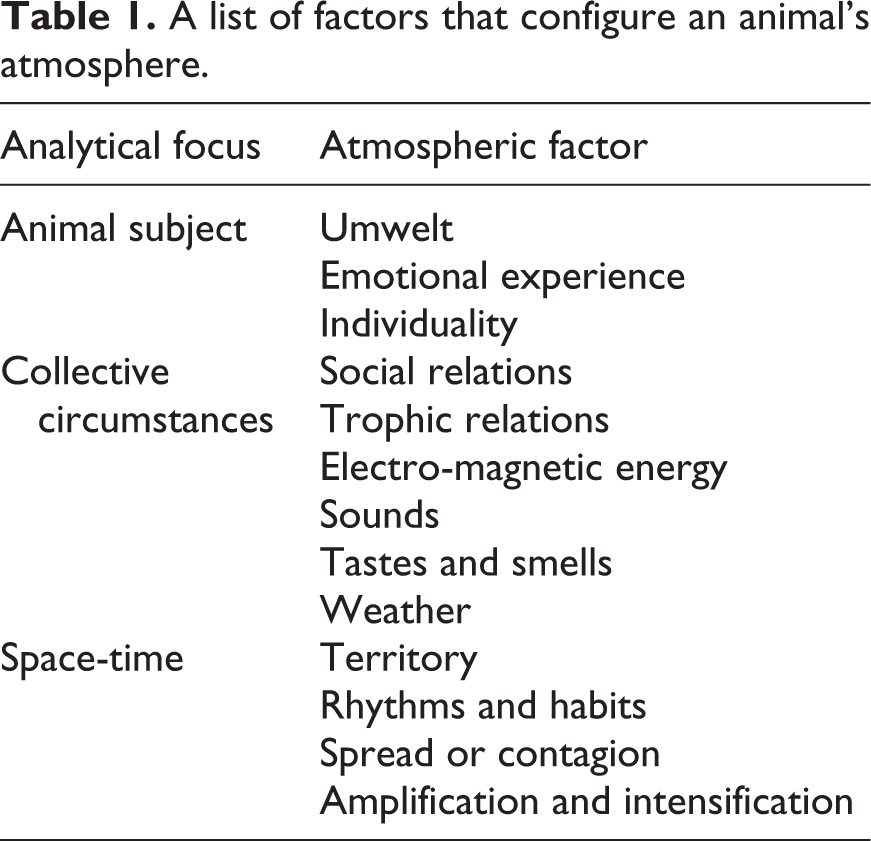
Atmosphere is a nebulous concept whose meaning has often been located between descriptors. These include terms like personal-collective; material-ethereal; palpable-elusive; contingent-engineered, etc. Such accounts can seem paradoxical, or even contradictory. We don’t believe this to be the case, but to parse this complexity we offer a three-part heuristic of what configures an animal’s atmosphere. We identify a list of key dimensions (in italics in the section that follows and summarized in Table 1). We start by outlining the phenomenological characteristics that shape an animal’s receptivity to atmospheric intensities. We then shift to explore the shared social or ‘collective’ (Anderson, 2009) elements of an animal’s atmosphere and the material ‘circumstances’ (McCormack, 2014) within which atmospheres are configured. Finally, we outline the spatio-temporal dimensions of this concept. We align this account with McCormack’s approach to atmospheres that:
A list of factors that configure an animal’s atmosphere.
Acknowledge[s] the passage from and between affect (as a pre-personal field of intensity), feeling (as that intensity registered in a sensing body), and emotion (as that felt intensity expressed in a socio-culturally recognizable form). (2008: 426)
We use these definitions of key terms, and explore how they hold in the context of nonhuman animals.
1 Animal subjects
An animal’s atmosphere requires an animal subject. Animals’ atmospheres only exist through the experience of a sensory animal body. They might not be emotional, but they are felt and subjective. This approach requires a posthumanist approach in which conceptions of subjectivity are reworked to respect different forms of nonhuman animal phenomenology and cognition (see Donaldson and Kymlicka, 2011; Lestel et al., 2014). To understand an animal’s atmosphere, we first need to know something about its sensory, embodied existence. To do so we can turn to ethology – the study of animal behaviour – and specifically the writings of the 19th-century animal ethologist Jacob von Uexkull (2010). Von Uexkull’s ethology (and its reworking by Deleuze and Guattari, 1987) has influenced both more-than-representational theory (e.g. Thrift, 2007) and multispecies studies (e.g. Buchanan, 2008; Despret, 2015).
An ethological model places the animal subject in its umwelt (or lifeworld) and does away with the common division between the organism and the environment (Adams, 2016). Starting from the multisensory animal body, it attends to the ‘signs’ through which an animal affects and is affected by its world. Wolves, for example, communicate with each other through body language, voice, and olfactory means – but their umwelt is not limited to these intra-wolf signals. Relevant signs also encompass atmospheric materials and vibrations sensible to canine sight, sound, touch, taste and smell, and the other senses that are absent or poorly articulated in humans. In the canine umwelt, the significance and intensity of the resulting perceptions is markedly different to that for humans in both range and extent. Biosemiotic analysis of umwelten focuses on animals’ perceptual mechanisms, its physiological make-up, and the reciprocal relations it develops with the other organisms that comprise its ecology (e.g. Kohn, 2013). Ethologists develop rhythmic understandings of animal perception attending to the different mobilities, temporalities and entangled lifelines of interacting organisms (Ingold, 2015).
Ethology also offers understandings of animals’ emotional experiences. Animal emotion is a contested subject, for a range of epistemic and political reasons that we detail below. Nonetheless, work on animal emotion in the animal sciences has challenged the mechanistic models of the instinctive, animal automaton that are prevalent in animal behaviour research. Some ethologists present terrestrial mammals as emotional beings, attuned to and affected by their social and ecological circumstances (Bekoff, 2002; Grandin and Johnson, 2006). This work has reinvigorated a long-standing interest in the comparable emotions of humans and animals (Darwin et al., 1999). We now hear of animals that are playful, joyful, sad, and traumatized, amongst other cross-species and culturally-encoded emotional conditions (e.g. Bekoff, 2010; Bradshaw, 2009; Montgomery, 2015). In so doing this work moves away from understanding animals as species types to acknowledge the individuality (or better, ‘individuation’, after Deleuze and Guattari, 1987) of single animals (cf. Bear, 2011) and of groups aggregated below the level of the species (swarms, herds, flocks, etc.). Pet owners can attest to the personalities of their dogs, and ethologists, through years of patient observation, can demonstrate the same is true of wolves and the packs they comprise (Bekoff, 2010).
2 Collective circumstances
A theory of umwelten provides a useful foundation for conceiving animal atmospheres, but the two concepts are not synonymous. Umwelt describes the ‘bubble’ of animal perception, but it struggles to account for the collective dimensions and diffuse catalysts of place-based affective experience. Although they require an animal subject, animal atmospheres are not only individuated or personal. They can be shared, and always emerge in relation to the shifting intensities of ‘background’ (Thrift, 2007) circumstances. Here we draw on the recent, post-phenomenological development of the concept of circumstances by McCormack, who proposes circumstance ‘as a way of naming the extrusion of the impersonal forces excessive of a life into the worldly textures and trajectories of that life’ (2017: 3). Thinking through circumstances helps identify how animals’ atmospheres are shaped by social, ecological, meteorological and chemical forces.
As copious research makes clear, many animals’ atmospheres are social and collective. They emerge in relation to the complex social (or at least interpersonal) dynamics common to many animal groups. Often these sociabilities will include humans: atmospheres of play and friendship amongst people and pets are well known and have received much attention (Goode, 2007; Haraway, 2008), as have the behaviours of feral animals who actively avoid humans (Beck, 1973). But these atmospheres do not necessarily require human participants. As Lopez notes: Even as adults, wolves play tag with each other or romp with the pups, running about a clearing or on a snow bank with a rocking-horse gait. They scare each other by pouncing on sleeping wolves and by jumping in front of one another from hiding places. They bring things to each other, especially bits of food. They prance and parade about with sticks or bones in their mouths. (2004: 37)
In contrast to these situations of heightened affective intensity, many domestic and zoo animals live lives marked by solitude and the absence or impoverishment of stimuli. ‘Separation anxiety’ is a common explanation of the destructive behaviours of dogs left home alone. There is growing evidence that animals get bored and depressed (Davies, 2010, cf. Anderson, 2004), resulting in psychological problems, including repetitive, stereotypic behaviours, stress, and self-harm (Mason and Rushen, 2008). The changing circumstances that shape animals’ affective atmospheres can be linked to wider political ecological dynamics. For instance, landscapes torn by poaching, mining and deforestation can generate ‘traumatic’ circumstances (Bradshaw, 2009). These fissured ecologies can induce, among other things, alcohol consumption in animals (Barua, 2014), including amongst dogs abandoned and having to cope with precarious urban conditions (Siegel, 2005).
An animal’s trophic relations, or position in the food chain, also configure their affective atmosphere. The atmospheres (or ecologies) of fear (Brown et al., 1999) illustrated in the opening vignette emanate from the situated experience of predator-prey interaction. Many herbivores have evolved ‘affective palettes’ (Thrift, 2007) primed to respond to the visual, aural, or olfactory presence of predators and the kinaesthetic experience of being chased (Berger, 2007). The elk in Yellowstone, for example, graze, breed and move very differently in the absence and the presence of both wolves and of different groups of people and their human infrastructure (Ripple and Beschta, 2004; Dorresteijn et al., 2015).
Animals’ atmospheres are also the outcome of changes in the intensities of the abiotic environment. Animals are sensitive to, and instigate, a wide range of meteorological dynamics not palpable to humans. Many animals sense and make use of parts of the electro-magnetic, acoustic and olfactory spectra that are undetectable to the technological unassisted human body. Most terrestrial mammals live socially through biochemical landscapes, and pheromones are not commonly understood to be significant in ocular-centric accounts of humans’ atmospheres (though see Brennan, 2004; Grammer et al., 2005). Modulations in the background intensities of these spectra are vital catalysts for animal atmospheres. Animals sing, grunt, and roar to mark territory, express anger, fear, love and joy. They mimic, trick and visually disguise themselves. They spray, secrete and roll to modulate their smell. Some animals luminesce or sense and emit infrared radiation. Others attune to electro- or seismic energy for communication within more liquid and solid atmospheric media. Animals are sensitive to changes in their ‘weather worlds’ (Ingold, 2007). Shifts in temperature, wind, light and humidity all cue changes in an animal’s affective atmospheres. This is especially true for migratory and/or temperate animals whose seasonal behaviours are tied to shifts in atmospheric intensities. The service dogs introduced in the opening vignette are just one example of animals acting as sentinels of atmospheric shifts. History, folklore and some modern science offer a wealth of stories of animals as sentinels for disease, weather, natural disasters, pollution and acts of war.
3 Space-time
This analysis identifies significant factors to consider in understanding what comes to configure an animal’s atmosphere. These factors could be encompassed by the concept of an affective assemblage: a material inventory, or abstract diagram, of all the interacting elements in a given situation. Theorists of affect suggest that the concept of an atmosphere takes assemblage thinking further by focusing on the spatial and temporal dimensions of affective experience. They suggest that an atmosphere should be conceived as a specific space-time of an affective assemblage (Anderson, 2014; Shaw, 2014): a collective experience shared in this place, at this time, by some of those present. They stress that an atmosphere is not trans-historical but emerges at particular junctures with distinct relations and concomitant effects (for a canine illustration see Howell’s (2015) detailed, historical account of the circumstances that come to configure the space-times of domestic dogs in Britain).
Work in ethology and in cultural and political geography offers further concepts for examining the space-times (or topologies) of animals’ atmospheres. Here we might start with work on animal territories and the musical understanding of territorial practices offered by Deleuze and Guattari (1987) in their reading of Von Uexkull’s ethology. Many animals mark territories, knowing and claiming space though repeated, routinized spatial practices: the walk, the song, the spray, etc. It is through these practices that an animal’s umwelt comes to take the archetypal spatial form of the bubble or sphere (Anderson, 2014): a volumetric envelope enclosed by the geographies of an animal’s movements (cf. Elden, 2013). Such volumes can be relatively static (in Cartesian space) or hypermobile (as in the case of migratory animals), but they maintain a consistent spherical form. This topological imagination of bounded volumetric territories is intuitive, but it is not sufficient to capture the space-times of the atmospheric materials listed above. The sphere of an animal’s atmosphere is bisected by the circulation of molecules and wave-like vibrations. These vectors are ‘lines of flight’, through which an animal is entrained in a web or meshwork of intermingled territories. Animal territories are formed through counterpoints, reciprocity and intra-action with a heterogeneous entourage of bodies (animate and non-animate) and their concomitant sights, smells, scents and tastes. There are thus complex and under-researched geometries to animals’ atmospheres.
Attempts to capture the spatial heterogeneity of animals’ atmospheres must also acknowledge the multiple and often discordant rhythms through which they are engendered. On the one hand, atmospheres may seem fleeting and contingent: momentary events sparked by a noise, a smell or a gesture. For example, the sudden change in atmosphere in a tranquil living room sparked by a doorbell ring or even a car door slam. The slumbering pet dog is up, hackles raised and barking in an explosion of fur-spreading intensity; but the intensity of alarm is fleeting as it turns out the parcel is for next door. On the other hand, atmospheres can be a sedimented remembrance of past practices and encounters. These are sensed in relation to familiar rhythms, expected durations and habituated intensities. Atmospheres may emanate from the surprising shock of the new, but they also stem from the banal repetition of the same hourly, daily, and seasonal practices (Dewsbury, 2012). In other words, animals’ rhythms get ‘coded’ such that periodic repetition becomes significant. What is at stake here is the interplay between momentary and more protracted durations and the effects of anthropogenic atmospheric disruption or decoding.
Mapping animals’ atmospheres requires an attention to processes of spread. Understanding the passage of animals’ affective atmospheres involves attuning to a range of unfamiliar media and means of communicating across time and space. The attention of atmospheric geographers shifts to the airborne passage of sounds and smells, to seismic rumbles or to fluctuations in pressure, temperate and humidity (Gallagher et al., 2016). We know that some animals’ atmospheres can be as contagious as the spread of fear amongst humans (cf. Bissell, 2010b). Mapping contagion requires an attention to the processes of atmospheric amplification and intensification. We need to know how atmospheric media move, how they congeal, and the nonlinear, sometimes chaotic, processes through which atmospheric phenomena bubble and vortice into being. Not all atmospheres are experienced with the same intensity. While it is possible to follow the contagious howling of wolves or the barking of neighbourhood dogs, not all such amplifications are as easily mapped. Sometimes the signs are less clear – triggers imperceptible to human senses (a smell or distant sound, for example) may be experienced by and communicated between canids in ways that are hard for human observers to read.
To summarize, this section has outlined three important areas of consideration when mapping an animal’s atmosphere. This approach moves from a specification of the animal’s umwelt to situating the animal in its social, ecological and material circumstances. This model works outward from an animal’s body to consider the spatial connections, temporal trajectories and processes of intensification through which an atmosphere comes into being. The italicized terms in the previous section serve as a framework to guide the design of future research on animals’ atmospheres. This is summarized, as mentioned previously, in Table 1.
We anticipate that this framework will enable comparative research that attends to the subjects, circumstances and space-times of atmospheres across difference. As a nomothetic, rather than idiographic endeavour, geographical investigation of atmospheres would explore how a particular situation allows one to ask questions of another. Analysis would attend to how atmospheres come into being, and with what conjunctures, political ecologies and historically situated ‘worldings’ (cf. Haraway, 2016).
III How animals’ atmospheres can be known
In this section of the paper we reflect on the epistemic and methodological challenges of knowing and evoking animals’ atmospheres. The nature of animals’ affective experiences has been the subject of long-standing and heated discussion in zoology. Modern animal behaviourists (working on laboratory animals) accept that animals are affected by their social and physical environment, but doubt the possibility of accurate scientific representation. They argue that representations of animals’ emotions are subjective acts of anthropomorphism: the inappropriate mapping of human understandings on to animals (for discussion see Dawkins, 2012). In contrast, many of the ethologists we encountered above are more sympathetic to the idea of animals’ emotions (alongside animal affects and feelings). They acknowledge the challenges of understanding the private minds of animals, but note that these challenges also apply to understanding other humans (Burghardt, 2007). Some ethologists advocate models of ‘critical anthropomorphism’ (Morton et al., 1990), arguing that anthropomorphism has epistemic value when it is coupled with reflexivity by the human observer as to their own situated positionality in relation to the animal being studied. Geographers informed by ethology suggest that it is possible to develop a ‘standpoint ontology’ for the animal: ‘a perspectivalism that is not located within thought or reason, but within the molecular relationship between an organism and its umwelt’ (Shaw et al., 2013: 263).
1 Attunement
Practical research in this ethological tradition involves a range of methods that allow the researcher to think like a different animal. This work starts by developing an understanding of an animal’s physiology and perceptual mechanisms. It could then involve close (sometimes covert) observation of an animal’s behaviour within the specific social and ecological relations under study (for an introduction see Dawkins, 2007). This would generate an ‘ethogram’, or diagram, of the animal’s umwelt. The atmospheric intensities of the umwelt could then be mapped through the comprehensive detection and monitoring of the electro-magnetic, acoustic and olfactory energies sensible to the animal in question (Manning and Dawkins, 2012). This mapping might be supplemented by tracking and remote sensing technologies, including: GPS tags, weather monitoring equipment, camera traps, and other remotely operated audio-visual devices (for wider discussion see Benson, 2010; Tomkiewicz et al., 2010; Hodgetts and Lorimer, 2015). A more innovative, post-phenomenological take on the ethogram would expand analysis to the broader range of encounters with bodies, materials, and sensations that humans and other animals make meaning from (see Wilson, 2017).
This perspectival approach generates a wealth of data on the abstract animal umwelt. But critics suggest that it is premised on a false sense of objectivity that masks the necessary and shaping presence of the human body in the conduct of ethological research (Despret, 2013). Despret proposes that it is more appropriate to understand ethological research as the pursuit of ‘embodied empathy’ with animals. She argues, in ways that are similar to the arguments of non-representational cultural geographers, that animal research is affective, not just semiotic or perspectival. She presents research as embodied and immersive processes of ‘learning to be affected’ by the world, in which ‘the scientist risks being touched/affected by what matters for the animal he/she observes’ (2013: 57). This approach intersects with a growing body of work by feminist animal scholars (Donovan and Adams, 2007; Geiger and Hovorka, 2015; Gruen, 2015), and has informed a range of methodological experiments, by geographers and others, in attuning to canine life worlds (see Kohn, 2007; Mancini et al., 2012; Brown and Dilley, 2012; Fletcher and Platt, 2016).
This literature has yet to engage with the concept of animals’ atmospheres. Indeed, there is very little methodological guidance in cultural geography on how to research affective atmospheres. Textbook accounts of non-representational methodologies (Vannini, 2015) offer scant practical advice on how to design a piece of atmospheric research. We might begin to address this lacuna by drawing on work in the emerging fields of multispecies (Kirksey and Helmreich, 2010) and ‘more-than-human’ ethnographies (Barua, 2014). These conjoin methods from ethnography and ethology to enable the time-deepened and situated study of animals and their affective relationships (e.g. H Lorimer, 2006; Hodgetts and Lorimer, 2015). To date, multispecies ethnographers have not engaged explicitly with the concept of animal atmospheres, but we can get some glimpses of what this might comprise from existing studies.
For example, recent work has utilized ethological and empathetic approaches not simply to attune to animals, but to attune with them. The aim here is to gain a sense of the animals’ atmospheres so as to better understand particular situations and environments. Working with dogs to trace other forms of wildlife is a case in point. Human handlers can access unseen presences and temporal clues by attending carefully to the postural and vocal communications of tracking dogs, and by attuning to the shared atmospheres such communications contribute to shaping (Hodgetts and Hester, 2017). For a dog (or wolf), the atmosphere of tranquil woodland is probably more lively than for a human given the lingering scent-lines and pheromone traces that permeate the atmosphere, in addition to the visual signs of wildlife presence. As the sniffing of the tracking dog increases in intensity and focus, as movements become faster and more targeted, as the atmosphere of excitement intensifies and is shared with the human handler, both know when the dog has found the scent.
Atmospheres, as we outlined in the previous section, are collective and shared. Such canine multispecies methods rely on the lack of inhibition in dogs when displaying emotions (see Darwin et al., 1999), and the long-noted (if often dismissed) ability of humans to make sense of some of these emotions (Bradshaw, 2011). Indeed, Bradshaw suggests that dogs are (like humans) ‘emotionally transparent’ for a number of social, trophic and evolutionary reasons, which were then selected for in domestication. Dogs are adept at reading human emotional cues, affective intensities, and shared atmospheres. As such, attunement to multi-species atmospheres can and does work in both directions – as reflected in our opening anecdotes about service dogs who alert human companions to imminent seizures, low blood sugar, or other medical conditions. Both humans and dogs can ‘learn to be affected’ in these reciprocal interactions. A comprehensive mapping of animals’ atmospheres involves tracking the circulation of active materials (see, for example, Barua (2014) on the effects of sugar and alcohol on animal behaviours).
In his classic account of sled-dog racing in Alaska the author Gary Paulsen traces his various attempts to learn from his team of sled dogs and their predilections and personalities. His method could be described in terms of immersive attunement. ‘I had to sleep in the kennel’, he explains, ‘I had to be with the dogs all the time, learn from them all the time, know them all the time. More than sleep, I had to live in the kennel. I had in some way to become a dog’ (Paulsen, 1994: 97). The idea of bodily attunement to ‘become canine’ has a long back-story, both in cultural histories of ‘werewolves’ (see Lopez, 2004) and in scientific experiments to make sense of animals’ lives (see Despret, 2013, on the work of the wolf ethologist Farley Mowatt).
In recent years this immersive approach has become something of a trope in literary experiments – examples include Thomas Thwaite’s (2016) Goat Man and Charles Foster’s (2016) Being a Beast. These exemplify a wider set of performative methods involving bodily enhancement and reconfiguration, and novel forms of transportation with the aim of simulating animals’ perceptual lifeworlds and different forms of mobility. These experiments might comprise shedding the basic accoutrements of human life, walking without shoes, swimming and crawling naked and eating raw food. Or they could involve the construction of elaborate prosthetics designed to align the human anatomy with those of animals. Importantly, Paulsen (1994) also writes of the dangers when animals’ atmospheric signs are missed and attunement fails.
Attuning to animals’ atmospheres can be difficult, even with species as ‘accessible’ to humans as dogs and wolves. It is not limited solely by our own ecological affordances as humans, but also by our ideas. Returning to the work of Barry Lopez, in comparing indigenous and western scientific understandings of wolves at the end of the 1970s he wrote: ‘we do not know very much at all about animals. We cannot understand them except in terms of our own needs and experiences. And to approach them solely in terms of the Western imagination is, really, to deny the animal’ (2004: 86). Attunement, even when enacted as an empathetic and bodily practice, remains shaped by cognitive considerations that in turn require reflexive attention. Reflection does not imply a reification of indigenous knowledges that would construct certain peoples as ‘closer to animals’, with all the problematic implications such a framing entails. But it does suggest a critical attention to one’s own situation, while also remaining open to other ways of thinking with the dog or wolf.
2 Evocation
A further epistemic challenge in researching animals’ atmospheres lies in providing compelling representations or ‘lively ethnographies’ (Van Dooren and Rose, 2016). How do we evoke the fleeting, affective experiences of animals that may be witnessed through these methods? The practical and epistemic challenges of recording and replicating atmospheres have been the subject of discussion in non-representational theory (e.g. Anderson and Ash, 2015). Many of the issues raised are relevant here. Indeed these challenges are amplified by a general unfamiliarity with animal experience and the perceptual anthropocentrism of much media: screens, books and recordings struggle to simulate the kinaesthetic and olfactory experience that is so central to animal lifeworlds. A comprehensive review of efforts to evoke animals’ atmospheres is beyond the scope of this paper and a few illustrations must suffice.
One resource is provided by autobiographical accounts of those who live and work with animals, especially in books for a popular audience in which the author adopts a more informal tone that than expected by their professional peers. Examples include works by ethologists, ecologists, zookeepers, vets and animal trainers, as well as those by authors more interested in hunting, eating or eradicating animals (cf. Anthony and Spence, 2009; Bradshaw, 2011; Rebanks, 2015; White, 2012). These works deploy a range of literary techniques, including narrative; personification; and thick, placed-based description. This work bleeds into the related genre of animal fiction: books written from the perspective of an animal. Much of this work is written for children. It is often allegorical and sentimental and heavily moralized in its anthropomorphism (McHugh, 2011; Armstrong, 2008). However, some works stand out either for their fidelity to the alterity of the animal subject or because of their willingness to keep open multiple interpretations of the recounted animal experience (for discussion see Beer, 2005; Daston and Mitman, 2005; Crist, 1999; Cadman, 2016). Canine literature spans this range. Dogs and wolves feature as the central protagonists in accounts from authors as diverse as Jack London, Olaf Stapledon, Franz Kafka, Virginia Woolf, John Berger and Paul Auster (for discussion see Marvin, 2012; McHugh, 2004).
Similar resources can be found in the evocations of animals on film. These range from cartoon and CGI renditions of animal fiction to naturalistic and avant-garde efforts to evoke animal behaviour (Burt, 2002; Bousé, 2000). Big budget blue chip wildlife documentary films increasingly trade off the affective potential of their imagery and offer compelling renditions of intense animals’ atmospheres (J Lorimer, 2010). The BBC series The Hunt, for example, combines a nonlinear montage of carefully choreographed shot sequences with a dramatic musical score to draw out the affective intensities of free-ranging predator–prey dynamics. Anticipation is built through close-ups of prey animals’ eyes, and twitching ears and noses. We see slow, stalking predator bodies. Tension is amplified through a muted, eerie soundtrack. Then aerial shots of fast-running bodies set to drums evoke a mixture of fear and excitement. Death or escape arrives with a full orchestral crescendo.
The power of music to create and evoke atmospheres is well known. Animal sounds have been the subject, or at least motifs within, a wide range of music (Kraft, 2013). The musician and ecologist Bernie Krause (Krause and Payne, 2016) has pioneered the recording of naturalistic soundscapes and has collaborated with a number of composers and musicians. In the Great Animal Orchestra, United Visual Artists develop an immersive, visual and interactive encounter with Krause’s recordings. This aims to simulate and amplify the human acoustic atmospheric experience of remote places – including a compelling orchestration of Alaskan wolves. This experience makes clear the different animal components of the ‘biophony’ and the ways these sounds relate to one another. In so doing it gives a sense of the affective acoustic atmospheres catalysed for animals by the sonic presence, behaviour and dynamics of other animal and geological sounds.
IV How animals’ atmospheres are engineered
In this section we explore how the concept of animals’ atmospheres helps develop recent work concerned with the biopolitics of modern animal management (e.g. Holloway et al., 2009; Biermann and Mansfield, 2014; Shukin, 2009; J Lorimer, 2017). Our broad concern is with how animals’ atmospheres become subject to forms of deliberate and/or inadvertent ‘atmospheric engineering’. The biopolitics of atmospheric engineering has become a central concern of recent work in political geography concerned with volumetric understandings of space (Elden, 2013; Adey, 2014) and forms of atmospheric warfare (Sloterdijk, 2009; Shaw, 2016). We draw on and develop this literature in this analysis.
It is useful to frame this account in relation to the discussions of the Anthropocene and the fundamental changes in the ‘spheres’ of the Earth caused by human activity. It is widely accepted that the Anthropocene ‘Great Acceleration’ (Steffen et al., 2015) has a ‘multi-modal’ pollution profile (Halfwerk and Slabbekoorn, 2015) with significant and largely deleterious effects on animals’ atmospheres (cf. Choy and Zee, 2015). Radical changes have occurred in the electro-magnetic, sonic and chemical composition of the Holocene atmospheres to which animals are adapted. This largely inadvertent atmospheric modification has had far-reaching effects on animal communication, navigation and basic survival (Francis and Barber, 2013; Longcore and Rich, 2004; Lürling and Scheffer, 2007; Peterson et al., 2017). Accelerated climate change has dramatic implications for animals’ biogeographical envelopes and seasonal rhythms. Earlier springs, and warmer and more extreme weather, scramble the choreography of existing behavioural cues (Parmesan, 2006).
Animals in the Anthropocene are also subject to a range of deliberate biopolitical interventions involving both deterrence and death, and affirmative efforts to make certain forms of animal life live. In both cases, interventions secure some forms of life at the expense of others through deliberate practices of atmospheric engineering (cf. Adey, 2014). For example, 20th-century pest control is deeply entangled with the chemicals, practices and technologies of human ‘atmospheric warfare’ (Zierler, 2011; Shaw, 2016). Chemical interventions modify the material composition of the air to engender a palpably inhospitable and/or unpleasant affective atmosphere for the target pest. The best-known and most controversial examples relate to the engineering of atmospheric chemistry for insect eradication (see Kelly et al., 2017; Phillips, 2013). The aerial spraying of endocrine disputing chemicals (like DDT) disrupts the lifecycles of insect species and creates toxic atmospheres with radically simplified ecologies and ecosystem dynamics. While the use of DDT is now closely regulated, the environments of urban and agricultural animals are awash with pesticides and the residues of contraceptive and psychoactive drugs designed to disrupt human endocrine function (Clotfelter et al., 2004). There is growing concern about how these chemicals come to shape animal mood and behaviour (Zala and Penn, 2004; cf. Shapiro, 2015).
‘Wildlife-friendly’ approaches to the deterrence of avian and mammalian pests engineer the sonic and visual components of an animal’s atmosphere. Some sonic interventions, like those for dogs mentioned in the opening vignettes, are designed to be physically painful. They are located to create ‘acoustic fences’ and ‘exclusion zones’, for example in private gardens and around vulnerable infrastructure. Such cacophonic contraptions are often automated and choreographed towards unpredictable compositions to prevent animal habituation. Many work at frequencies inaudible to (adult) hearing, though some are promoted as also deterring human trespassers (cf. Feigenbaum and Kanngieser, 2015; Gallagher, 2016). Other sonic devices simulate the ecologies of fear triggered, for example, by predator calls. Visual interventions like scarecrows (H Lorimer, 2013) and kites employ a similar trophic logic. As do live animals like guard dogs, farm cats and raptors (Atkins et al., 2017). In these cases, biomimetic technologies modulate the intensities of a prey species’ atmosphere with cascading effects on their wider ecologies.
In many cases, these lethal, deterring, carceral, or otherwise governmental practices of atmospheric engineering aim to secure the productivity of a small number of agricultural plant and animal species. They seek to exclude those animals who would normal predate or parasitize them. These interventions form part of the far-reaching forms of atmospheric engineering geared towards the optimization of animal productivity in intensive agricultural settings (cf. Jones, 2005). Chickens provide the limit case. The temperature, humidity, lighting, acoustics and smells of intensive poultry farms are carefully coordinated to accelerate and maximize egg production (Miele, 2011). Such atmospheric engineering interfaces with long histories of selective breeding for animals with particular ‘affective palettes’ (Thrift, 2007: 227) disposed, in the case of chickens, towards docility, hardiness and agoraphobia. The autistic ethologist Temple Grandin has used her ability to tune into bovine affective atmospheres to redesign the standard US slaughterhouse. Through embodied empathetic fieldwork she identifies and addresses seemingly subtle architectural and acoustic factors that cause the animals stress, slow down the slaughter process and compromise the quality of their meat (Grandin and Johnson, 2006). We can develop this analysis of atmospheric engineering to consider the biopolitical means through which some dogs have emerged as discerning consumers in the pet care and pet food industries of late capitalism, and made subject to affective atmospheres of taste and wellbeing (Haraway, 2008).
Atmospheric engineering to generate lively ‘animal capital’ (Shukin, 2009) is also central to the purportedly non-consumptive relations performed in zoos and aquaria. In a similar fashion to human workers in the service sector (e.g. Lin, 2015), charismatic, captive zoo animals are trained to catalyse specific affective atmospheres for their human audiences (J Lorimer, 2015). Zoo atmospheres of wonder, joy and excitement are carefully choreographed using a range of closely guarded and (often controversial) techniques (Davis, 1997; Grazian, 2015). Many of the most captivating zoo mammals are on anti-depressants and live in atmospheres engineered by synthetic pheromones to offset the boredom and depression caused by a lack of social and environmental stimuli (Braitman, 2014, cf. McCormack, 2007). Like the dogs we encountered in the opening anecdotes, these animals come to live in chemical atmospheres designed for careful mood management.
Atmospheric engineering occurs even in the most naturalistic forms of human animal management: rewilding and wildlife conservation. As we mentioned in the opening anecdote, conservationists concerned with the ecological implications of missing predators have begun to explore methods for simulating or reintroducing the atmospheres of fear created by species like the wolf or lynx (Estes et al., 2011; Terborgh and Estes, 2010). Wolves are valued as keystone species, whose effects on the grazing behaviour of their prey can have landscape scale consequences. This critical analysis draws attention to atmospheric engineering and its entanglements with the biopolitics of the Anthropocene across a wide range of human-animal relations. Such an approach to animals’ geographies foregrounds both the ethical and political imperatives, and the potentials, for multispecies studies to imagine and become involved with new, more affirmative and benign forms of atmospheric engineering for life beyond the Anthropocene.
V Conclusions
This paper has outlined the concept of animals’ atmospheres. It has defined the term and identified the key components by which animals’ atmospheres are configured. It identified some of the epistemic, methodological and representational challenges associated with work in this area. It then explored the utility of the concept for developing established concerns with the biopolitics of animal management in the Anthropocene. In conclusion, we will return to the two aims of the paper and reflect on some of the contributions we foresee the concept of animals’ atmospheres making to progress in geography.
The first aim of this paper was to develop work on the lived geographies of animals, or their beastly places. Here the concept of animals’ atmospheres helps ongoing efforts to open up the category ‘animal’ and attend to the different lifeworlds that this label subsumes. When drawn together, the atmospheric factors summarized in Table 1 comprise a new research agenda for work in animal geography. While this paper largely focuses on a familiar terrestrial domesticated animal, future work might explore what happens to both animal geography and our conception of the atmospheric if we transpose this framework from dogs to octopi, swallows, or parasitic worms. Attending to animal atmospheres opens analysis to a rich and underexplored diversity of ways of being in the world. It also raises questions as to how far we might stretch the concept. Can we transpose the concept of atmosphere into other kinds of elemental milieu, particularly the watery spaces and aquatic lives rising to prominence in recent work in human geography (Steinberg and Peters, 2015; Anderson and Peters, 2014; Bear and Eden, 2011)? To what extent does the capacity to sense an atmosphere require a relatively elaborate form of life, or can a virus sense an atmosphere?
The paper identifies the methodological potential for animal geography of approaching fieldwork as a process of learning to be affected by animals and their atmospheres. This approach help overcome the cognitive, representational bias that thwarts the import of ethnographic methods into animal studies. It also enables non-representational methodologies to be used in conjunction with methods for multispecies ethnography and ethology. Animal atmospheres are not necessarily different from human atmospheres. What differs is the capacity to sense variations in the milieus in which different forms of life take shape. We foresee ample opportunity for future research that thinks with animals as conceptual guides to alternative atmospheres, and for collaborations with animals as sentinels and savants for sensing the atmospheric.
We wager that animals’ atmospheres offers new approaches to critical human and animal geography. The methodologies of embodied empathy we encounter in this paper demand an ethological ethics that is attuned to the lived experience of the animal subject. While empathy does not eliminate animal death, and can inform violent forms of care (Van Dooren, 2014), it does inculcate a sense of shared suffering and response-ability. Attending to the affective atmospheric intensities of human and animal life helps ground ethical theory and to work though the lived experience of our shared vulnerability to the air. Working out from the individual animal, the concept of animals’ atmosphere helps trace the trans-species processes of immiseration associated with the biopolitics of the Anthropocene. Thinking atmospheric warfare and planetary stewardship with dogs and wolves offers new insights into the entangled fates of marginal human and animal populations.
The second aim of the paper was to see what happens to the (hitherto largely anthropocentric) concept of atmosphere when it is applied to animals. In this paper we have stretched, developed and critiqued existing work on atmospheres in cultural and political geography. In so doing the paper makes a number of contributions to work in this field. The first, and perhaps most obvious, is to flag how the atmospheric does not require a human subject to be sensed. Myriad animals’ atmospheres exist independent of human sensation. Going further, thinking and sensing the atmospheric with animals opens analysis to a wide range of hitherto neglected atmospheric intensities and experiences. Even from the position of our canine ‘best friend’, the atmospheric emerges through sensations and media alien to most people: smell and scent are paramount here. And these olfactory atmospheres adhere to spatial patterns and temporal rhythms that differ in important and interesting ways to the sonic and visual atmospheres that predominate in human geography. Attending to the diversity of animals’ atmospheres has the potential to greatly enrich conceptual work in this field.
Animals have long served as human surrogates in scientific research, standing in for human pathologies associated with a range of affective and atmospheric conditions. Laboratory and field scientists have developed a sophisticated set of methodologies for understanding animals’ affective experiences in the absence of verbal and textual communication. We see great potential to take these methods from the sciences and to develop them for atmospheric research with people and in contexts in which animals play a central role in shaping, sensing and enduring the atmospheric. Discussions about the potential of critical forms of anthropomorphism can assist non-representational theorists grappling with the epistemic and representational challenges of sensing and speaking for another’s atmospheric experience. While investigations of the engineering of animal atmospheres help reorientate some mainstream analyses of how political economic organization occurs. This approach helps reconceive the loci and trajectories of planetary biopolitics and capitalist accumulation through the experiences of diverse animal subjects.
Footnotes
Acknowledgements
We would like to thank Derek McCormack for his extremely useful comments on an earlier draft. We would also like to thank our three anonymous referees and Noel Castree for a smooth editorial process.
Declaration of conflicting interests
The author(s) declared no potential conflicts of interest with respect to the research, authorship, and/or publication of this article.
Funding
The author(s) received no financial support for the research, authorship, and/or publication of this article.