



Abstract
Responding to geography’s digital and political turns, this article presents an original critical synthesis of the under-examined niche of networked geographies of public-art practices in today’s politicised digital culture. This article advances insights into digital public art as politics, and its role in politicising online public spaces with foci on: how digital technologies have instigated do-it-yourself modes for the co-creation of art content within peer-to-peer contexts; the way art is ‘stretched’ and experienced in/across the digital public sphere; and how user-(co-)created content has become subject to (mis)uses, simultaneously informed by digital ‘artivism’ and a new global politics infused with populism.
I Introduction
We present an original critical synthesis of digital public-art practice that also sets future research agendas. Accordingly, this paper answers Rose’s (2016) plea for more research attention to digital communication technologies and digitally mediated artefacts as cultural phenomena – rather than seeing them as sheer research instruments alone. Public art is traditionally defined as artworks commissioned in wide public interest and designated for open spaces beyond indoor museums and galleries (e.g. Hein, 1996). Moreover, it is embedded in, and fashioned by, cultural and localised discourses about the public and thereby the public sphere (Warner, 2002), which has increasingly been incorporating digital aspects. The myriad of possibilities of digital technologies for producing and exchanging user-created content beyond the intentions of artists and commissioners and the physical dimensions of public space have queried the material ontology of public art (Zebracki, 2017b, forthcoming). Remarkably, we see how artworks are inscribed into online discourse and the digital sphere and how the latter may be turned into sites of public-art production, or public artworks as such (Kidd, 2014; Zebracki, 2017b).
Hence, we undergird Hawkins’ (2013) point that geography and art increasingly involve dynamic spatial relationships between site, matter and embodied practice. Nevertheless, we identify a specific paucity of knowledge of how art practice is at play through digitally networked space: the peer-to-peer and often mobile, geo-located spaces of social media, known as Web 2.0 (John, 2013). Social media have enabled significant possibilities for online users to aggregate, curate, alter, co-create and disseminate content, where digital art sits within a ‘troubling oscillation between intimacy and distance that characterises our new technological regime’ (Bishop, 2012: 436). Social media have especially been imbued with importance due to activist and thereby politicised uses, but also misuses, of user-created content. This is particularly the case in the light of a bourgeoning global politics, often with radical far-left/right traits, as played out over online spaces (Luger and Ren, 2017; Thompson, 2011). Where artistically informed activism (i.e. ‘artivism’; Milohnic, 2005), digital networks and global far-right politics intersect is not only a fecund terrain for research; it is also a nexus with powerful and perilous implications for daily life.
Thus, our focus is on digital public art: art that is defined and engaged by the use of (mobile) hardware devices and digital and online technologies. It is simultaneously rendered, mediated, developed and mutated in/through the peer-to-peer contexts of public online spaces. User engagement may range from observation to active participation (e.g. liking, commenting, sharing) and from text-based to (audio)visual digital content creation. We offer a novel dual focus on digital public art through the understudied lenses of:
creation, with its stronger emphasis co-creation: i.e. online users’ capacity to engage with ‘original’ artwork by reproduction and circulation of ‘secondary’ digital content thereof; and
politics: how may digital public art operate as mode of politics and what is its role in politicising online public spaces?
Therefore, we argue that the geographies of digitally mediated public art are crucial to explore to advance political critiques of creative socio-spatial practices (Marston and De Leeuw, 2013) amidst geography’s ‘creative (re)turn’ (De Leeuw and Hawkins, 2017). We suggest that the implications of the political power of co-created digital public art are not yet fully addressed within debates of the ‘newest’ cultural geography, the geohumanities and digital geography. Cartiere (2008) applied the term ‘further-expanded field’ to understand public-art practices as increasingly intermeshed within multimedia contexts. We now call for a networked understanding that, as we will discuss, integrates more fully art, digital practice and politics.
The below disturbing episode illustrates how digital images can be discerned as public artefacts through the key lenses of co-creation and politics. We will revisit this case in our article to frame its contributions and stress the significance of interrogating the new, complex and even violent digital geographies of public-art practice, yet not as conventionally known or articulated.
In this article, we discuss high-profile cases such as the above to identify key gaps in, and tie together, significant scholarly debates on digital art, the nature of digital urban space (as primary locus of art-making), and how these mediate, and are remediated by, a new global politics. We present a novel critical synthesis to propose a research agenda that is not only important to theory building but also in terms of considering far-right/left populism and the yet-unknown potential of online space for grassroots movements. These digital movements may trigger constructive, but also potentially violent and sometimes frightening, consequences.
Hence, the synecdoche of digital art – including symbols and representations – forms a conceptual lens through which we deconstruct theoretical questions about digital public art as politics and its role in politicising online public spaces. We specifically push further three recent geographical research strands:
The reconceptualisation and ‘expansion’ of who/what is construed as ‘artist’/‘art’ and its ‘expanding field’ (Hawkins, 2013) within and beyond the geohumanities;
The political turn in cultural and urban geography with a regained focus on grassroots movements and populism, left-wing, right-wing and in-between (see Marston and De Leeuw, 2013), and;
The digital turn in urban literature (e.g. Ash et al., 2016) that critically revisits earlier notions of the network society (see Castells, 1996) and the ways in which digital and material spaces co-relate and co-produce and thereby allow art to be stretched, co-created, and mutually-co-opted.
In so doing, we consider the interstitial spaces in-between the artist, artwork, producer, user, observer, and site (see Kester, 2004). What is new is the extension of the idea of interstitial spaces to digitally mediated art practices, wherein public art has demonstrated its tremendous potential to transform politics and material urban space, sometimes merely due to the interpretation – or misinterpretation – of the art itself. The scale, speed, and socio-cultural and political implications of digitally mediated art and the ensuing networked realities deserve greater context and understanding.
In Section II, we attend to art/creative geographies and how they are related to, and unsettled by, the under-explored affordances of digital technologies for public-art engagement. Section III considers the ramifications of digitally mediated public-art practices for politicising online and material urban spaces with a focus on a new global politics and user (mis)appropriations of digital content, especially in contexts of populism. Section IV concludes the paper with critical reflections, including research agendas on the conceptual and ethical implications of politicising art in the digital, peer-to-peer public sphere.
II Art/creative geographies ↔ digital geographies
Our argument sits at the intersection of art/creative and digital geographies. Our key focus on co-creation and politics is informed by the need to precisely consider the digital in the participatory, highly politicised peer-to-peer digital society. Art/creative geographies acknowledge that public-art practices find themselves in an expanding field. This incorporates wider arts disciplines, media, and forms, including architecture. crafts, performance, fashion, and socially-engaged art (see Cartiere and Zebracki, 2016; Hawkins, 2013), as well as the online media spaces and audiences of virtual museums and personal studios and art weblogs (Budge, 2013). Even in such expanded conceptualisation, discussion often falls back upon more traditional notions of who is or is not an artist, of what constitutes art/creative practice, and of the separation between artist/producer and public/user.
We ask scholarship to take greater pains over the purposes and consequences of bottom-up, do-it-yourself (DIY) practices. We need to take more care of such practices to critically look beyond original contents of art and original intents of art makers within the networked material-digital realities of overlapping multi-user environments (i.e. hybrid space; De Souza e Silva, 2006). So, we call for digitally mediated DIY public-art practices to be divorced from and fundamentally reconfigure conventional paradigms, methods, institutions, and hierarchical relations between artists, institutional gatekeepers, galleries, funding bodies, and ‘publics’ as the primordial focus. Publics are ‘mediated by cultural forms…[who] do not exist apart from the [normative] discourse that addresses them’ (Warner, 2002: 54). Indeed, DIY practices may manoeuvre public-art encounters through co-existing norms/publics and alternatives/counter-publics and challenge them to boot (see Zebracki and Palmer, 2017). The dialectical relationship between material public spaces and online worlds has layered further complexity over notions of producers/users. Digitally mediated users have been provided with new possibilities for the co-creation and critical (re)use of art. They may, then, ambiguously play the role of ‘produsers’/‘prosumers’ (Bruns, 2012) within the interstitial spaces of publics and counter-publics.
Kester (2004) theorised how such interstices enable the formation of multiplicities of artistic meaning, identity and interpretation. While public-art practices should be understood as multi-scalar, relational and embodied, its digital geographical dimensions have remained less clearly articulated (Zebracki, 2017b). Therefore, we scrutinise how everyday digital users navigate, act in and enact upon networked digital spaces. Populism and global digital or ‘netroots’ art activism (after Milohnic, 2005) have been politicising spaces by challenging norms and notions of stable places and identities in favour of open, dynamic, situated and contextualised understandings (see Luger and Ren, 2017). Consequently, we put forward a critical digital geography of public-art practice, which upends, or at least re-frames, the digital network society (Castells, 1996) by considering the ways that artivism and populism may converge and conflict (see Section III).
Engagement with digital geographies has particularly emerged from earlier theoretical concerns with extensions of human agency, or the more-than-human (e.g. Haraway, 1991). Arrestingly, Gandy (2005) developed the human-non-human in this author’s idea of the cyborg-city: the networked urbanity of digital media, becoming an everyday exoskeleton for the human body (so a digital extension of mimesis, i.e. the (re)presentation of the self). Nascent geographical work on digitally networked, fluid social spaces has sought holistic apprehension of the relationships between technology, space and social systems in the context of technology-dominated (Goriunova, 2012) and ‘location-aware’ futures (Wilson, 2014).
Also, our concern with the digital foregrounds and revisits the material urban condition as locus for public-art production (see Zebracki and Palmer, 2017). Lefebvre’s (1996) understanding of the city as an ‘oeuvre’, defined as both a collective creative product and context of everyday life, needs updating in today’s digital society. The rise of digital technologies since the 1980s has fundamentally shifted the speed of urban life and mundane encounters. Digital media allow new productions, circulations, rhythms, velocities of time, more-than-human beings and an overall re-imagination of the urban condition (see Amin and Thrift, 2002). The city has increasingly become as much non-territorial as it is territorial, and as much digital as it is material (Brenner and Schmid, 2015). New rights to space, i.e. centrality, have emerged in social mediations and negotiations through high-speed integrated silicon circuits (see Merrifield, 2013). This context is important to a renewed conception of the political encounter as well as the creation of various publics in/through political spaces online, even if never completely detached from their anchors in physical space (Gerbaudo, 2012; Luger, 2016).
Seeing that the urban has become substantially interlaced with the global digital sphere, it has significantly problematised the oxymoronic (i.e. public-private) socio-spatial disposition of public-art practice (Hein, 1996). Sites for production have become complemented, and occasionally exchanged, by spaces qualified as ‘private’ in pre-digital social life, where virtual, ‘real’ (i.e. actual) and embodied relations and spaces coalesce. Various scholars have engaged with how material environments are imbricated with urban public spaces, digital screens, and online networks (e.g. gaming; Boellstorff, 2006; urban screens; McQuire et al., 2009). As an example of so-called vernacular digital creativity (after Edensor et al., 2010), YouTube celebrities may establish a followers’ base worldwide by (live) broadcasting artistic skills from the bedroom. A space traditionally known as ‘private’ has then become digitally networked, in a creative sphere of mediated publicness through which ordinary online users may feel connected; at the same time, there are multiple layers of online privacy (e.g. private settings, closed groups, etc.). We ask again, and not for the last time, where the boundaries are in charting (the publicness of) where, and how, art practices can take place.
Moving from Marston and De Leeuw (2013), we find that creative geographies and practices largely tend not to move beyond more traditional typologies of ‘art’ and ‘artists’ in/through various practices, using terms like ‘visual artist’, ‘performance artist’, or ‘musician’. Understandings of artists beyond those who self-identify as such, and the instantaneous possibilities for producing ‘art’ via digital pathways, complicate traditional typologies and terminologies. The fine lines between artist, non-artist, activist and non-activist in the digital paradigm have been explored to a certain extent (e.g. Luger, 2017; Zebracki, 2017b). Nevertheless, we suggest there is much room for further debate and clarification. What of the internet troll, sitting at home, who suddenly produces a colourful, flashing GIF? Or the various digital publics who reiterate and co-create this ‘artwork’ as it is re-tweeted? Who, what, and where is the artist/art? Are such boundaries necessary?
Geographical theory requires harder thought about the social and spatial implications of digital and online technologies, considering how they are generative of ever-expanding and new complex possibilities for engaging with and defining public artwork. There is an increasing capacity for appropriating and archiving works online, whether ‘in the cloud’ or on social media servers, where, ‘the pervasive and continuous textual commentary [might] displac[e] the real experience of the object’ (i.e. ekphrasis) (Freeman and Sheller, 2015: 5). Digital practice raises questions about the preservation as much as it creates opportunities for the geographical translation of public artwork to and within the material world (Zebracki, 2017b). Sometimes, the original material reference, if any, is no longer in existence. As example of the latter, a famous Roman arch destroyed by the so-called Islamic State (IS) in Syria was 3D printed in New York in 2017, which subsequently has become criticised as an act of digital colonialism (Bond, 2016; Zebracki, forthcoming). So, digital art may outlive the material artwork and artist and accrue new levels of engagement and criticality, just as social media pages may carry on, like ghosts, without the user, and users may only live on as ‘recorded media fragments’ (Leaver, 2013).
Digital technologies have clearly entered the vocabulary of both everyday life and geographical scholarship. Ash et al. (2016: 35) proposed to approach the digital turn through a “tripartite heuristic of geographies through the digital, geographies produced by the digital, and geographies of the digital”. Rather than asserting digital geography as a distinct field, they suggested how the digital forms a trans-(sub)disciplinary analytic for studying people, place and politics in the digital age. Geographical and new media scholarship have made large strides in examining digital life from methodological, ‘netnographical’ perspectives (e.g. Pink et al., 2016) and across emerging fields of human-technology divides (e.g. Kinsley, 2014), online-mediated expressions of identity and intimacy (e.g. Cockayne et al., 2017; Nash and Gorman-Murray, 2016), and robotics, labour and the digital gig economy (e.g. Del Casino, 2016). Here, we have identified digitally mediated public art as a particularly understudied niche. Indeed, Rose (2016) contended that geohumanities scholarship, despite its increasing attention for the digital, needs to re-orient its remit to more actively study the digital mediation of culture and the arts.
The social relational spaces of the networked society let us critically differentiate the multi-scalar spaces of engagement (e.g. home space, street, digital sites), temporalities (e.g. real-time, idling time, real life), objects (e.g. artworks, technological devices, hardware, software), and (counter-)publics. Put differently, we question the internet of things that ‘networks’ both bodies and (art) matter (Zebracki, forthcoming). User-created content ‘travels’ through networked spaces and times via mobilities of digital engagement, rendering art objects as performative, contingent and ever floating (Rose, 2016). As the internet spans beyond the territorial scale, it may offer far-reaching possibilities for everyday citizens to participate and connect online, asking for updated geographical considerations of how processes of belonging/alienation as well as inclusion/exclusion take place through the digital. Although artists and activists engage with everyday online users, there remains an ‘unevenness’ in terms of inclusive participation: there is no global internet access for all across the Global North and South. Limitations to online access and particular online uses are also sanctioned by states. For example, China denies access to a plethora of global social networking sites, creating medium injustice. As limitations are, moreover, as much informed by digital (il)literacies as the affordances of the medium itself (Hartley, 2012), claims on the socially inclusive realities and potentialities of digitally mediated art practices should be exerted with caution.
The socially situated context of the material sites of digital interaction remains crucial and must be part of the exploration. Saliently, the land-limited, authoritarian context of a place like Singapore (see Section III) demonstrates the dynamic, site-specific relationships between scale, politics, place, and artivist co-creation in digitally mediated purviews. The tension between site-specificity, art and socio-political networks and how it is played out through the digital is another under-explored area that we seek to negotiate. Building on the above critique of the limits to participation and inclusivity, not all artists can realise the full potential that the digital brings, and these potentials are realised differently and unevenly. Online users as well may not equally fulfill the potential to engage with art or be granted the privilege of politicising online public spaces in junction with artists and political agents. Firewalls, like urban walls, exist; divides extend from city streets to digital streets.
Thus, a digital participation divide is shaped in and through ‘real life’, rooted in existing social inequalities, the geographies of de-facto and de-jure censorships (Reed, 2014). Linguistic, cultural, ethnic and racial barriers exist, even with ubiquitous apps such as Google Translate online software. Just as scholars write of global ‘black urbanisms’ (Simone, 2012), globally-networked spheres of identity and disparate lived experiences extend to digital space. Studies of location-based social identity construction on leading social media platforms including Facebook, Twitter and Instagram, and how these digital networks reproduce inequality and privilege in distinct online spaces, form an emerging strand of media studies (e.g. Schwartz and Halegoua, 2015; Sunstein, 2017). Such uneven digital geographies might work in/through public-art practices: ‘traditional’ sculptors and painters perhaps might encounter more challenges with engaging digital media than video and sound artists, for example. Hence, it is vital to consider the affordances of the medium (i.e. the [art] matter) and the agencies of the produsers/prosumers (i.e. bodies) in grasping the (co-)creation and politicised (i.e. activist) uses of public-art content (Section III).
III Digital artivism and new global politics
The linkages between digital geographies, the urban and politics form the basis of theoretical queries regarding the nature of a digital urban revolution (Merrifield, 2013); or the power of online space as a complement to, if not substitute for, urban and social movements. While Gladwell (2010) is convinced that ‘the revolution will not be tweeted’, recent examples from Istanbul’s protests to Donald Trump’s ramblings partially prove otherwise. A subarea within the digital turn has focused on what digital space has meant for public art, and vice versa. For instance, Luger and Ren (2017) and Zebracki (2017b) discuss how public-art practices, in their productive relationship with the city, open up possibilities for radical transformation – in urban space, in politics, in culture – to occur via digital networks. The urban plays a central role in this framing, and art in the city is formed by, and helps to form, global digital networks and movements via digital communication forms, including symbols and hashtags (#) (i.e. ‘online tags’). Examples are the #youstink movement in Beirut in the Arab Uprisings, or the crucial roles that public art has played in the Umbrella and Sunflower pro-democracy movements in the quasi-democracies of Hong Kong and Taipei, which were led by students and characterised by ‘people power’ against (soft-) authoritarian state structures (Jones, 2017).
That said, the nexus of art, the urban, politics and digital networks remains largely underexamined terrain. Despite a growing number of recent explorations of digital public art (e.g. Paul, 2016; Reed, 2014), this literature has not yet been firmly joined to scholarship on spatial and political geographies of arts activism (see Milohnic, 2005; Trottier and Fuchs, 2015). Digital activist geographies have broadly dealt with the relationship between global social movements and social media activism (e.g. McCaughey, 2014). This link has been particularly discussed regarding environmental digital activism (e.g. Pickerill, 2003), citizen activism and political cyber-protests, such as in recent contexts of the Arab Spring (e.g. Gerbaudo, 2012) and authoritarian ruling and banal nationalism in Turkey (e.g. Tufekci, 2017) and Tunisia (e.g. Zayani, 2015). Although global social and political movements have necessitated a broadening of the geographies of public-art practice to the digital, and vice versa, specific explorations of the role that art practice and the art encounter play, or might play, are lacking.
Digitally mediated art practices have interacted with – and thereby given a voice to – phenomena indicative of a renewed global populism. Populist movements have increasingly sought for, and gained, persuasive powers in online spaces through various uses of artistic symbols, forms and expressions (Trottier and Fuchs, 2015). We build on Laclau’s (2005) theorem that populism, i.e. the struggle against elitist and privileged populations, is a championing of ‘the people’ over ‘the [dominant] institutional system’ (2005: 73), ‘an institutionalised “other”’ (2005: 17), or, perhaps even ‘power’ itself (2005: 74). Central to this theory is the idea of synecdoche, or ‘empty signifier’ (Laclau, 2005): a symbol, slogan, name or even colour that, in its quality of being singular, comes to represent the multiplicity of the demands of the struggle. We extend, therefore, the idea of co-created populist struggle into a ‘#(hashtag)-larded’ age, where, echoing previous episodes in history, art and representation play a central role in a populist solidarity.
New digital textual and (audio-)visual manifestations of public art include GIFs, tweets, hashtags, creative symbols, including emojis and memes (i.e. objects of interest disseminated and mutated through the internet). Such content crosses territorial boundaries and ambiguous barriers in producer-user languages and styles of expression. Everyday engagement of ordinary produsers/prosumers (Bruns, 2012) stretches beyond original symbolic and cultural values in the direction of vernacular manifestations of creativity (see Edensor et al., 2010). In a sense, user-created content has not only replaced older artistic print forms of political satire, harkening to Daumier in 19th-century France and others before (Arslan, 2016). It has also reconfigured, or subverted, the role of the critic and, thus, deconstructed expert/layperson dichotomies.
Satire over digital peer-to-peer networks has shifted toward the maintenance of network sociality and values of individualisation. Miller (2008) critiqued this Web 2.0, including social media, for prevailing facile, phatic communications, such as promiscuous friendship seeking and liking and disliking just in a click. This condition has been heavily critiqued by new media scholars as being diagnostic of ‘silly’ citizenship (Hartley, 2012) and rooted in a new media ‘idiocy’ (Goriunova, 2012). We observe how digital public-art practices have injected new life into Phillips’ (1988) idea of the public-art ‘machinery’, gradually working its way through the realm of Web 2.0. This art historian was highly critical of the institutionalised, technocratic, utilitarian and consensus-seeking formalised modes of public-art production, offline at that time. Much public art, pejoratively called ‘plop art’, would lack the potential to criticise urban development and promote alternative just futures, while public art, Phillips (1988) argued, precisely has the radical duty to do so. We realise a similar condition has emerged in digitally networked space, yet now strongly on the side of digital publics. Although informalised modes of ‘ordinary’ online user engagement and ‘self-storying’ (Potter and McDougall, 2017) may occasionally intervene in established journalism (Kidd, 2014), they might well lack the potential and readiness for eliciting bottom-up resistance and social change.
This recalls Miller (2008), who contended that networked (inter)actions have become commonly compliant with net behaviours as coded through the architecture of dominant social media platforms. Here, we identify a problematic order of digital ‘autopoiesis’: such network sociality is self-produced and emulated by online users’ (over-)reliance on pre-programmed affordances of the digital medium. Such digital docility may allude to a reification of ‘slacktivism’ (Morozov, 2009): tractable engagements on the internet that support social and political actions which, nevertheless, may carry little empathy and actual involvement and let online users just feel good about themselves.
We have ascertained that site-specificity and (con)textuality are not always part of the discussion about digital public art. In re-framing the latter around meaning and interpretation, we suggest considering how text/digital symbols, even when traded or reproduced though global sites, may have powerful, localised meanings attached to particular and varying geographical contexts of ideologies, state-society relations, and (il)liberties for the expression of political opinion. The poignant examples that follow can be considered site-specific public artworks, statically attached to place as much as they are dynamic, globally networked and constantly entangled in a state of co-creation and negotiation. They illuminate how digital artworks, as argued, may have degrees of transformative public powers, depending on place-based socio-cultural and political contexts, scale, and the idiosyncratic geographies of engagement.
1 Internet, inter-act, and interstices
Digital art, relationality and political commitment, in terms of co-creation and artivism, find themselves within citizen participation that is arched across palimpsests of the material and digital. Kester (2004) argued for the importance of interstices, i.e. the spaces between art, artists, observers, users, (counter-)publics, etc., to evaluate the politics of knowledge production and content (mis)appropriation. How can we extend such argument to both actions and interactions on the internet where we discern new contested social powers and symbolic meanings through the global and (a-)spatial reach of social media? To conceptually clarify these phenomena, we provide a comprehensive critical analysis of reported high-profile cases.
Pepe the Frog (Figure 1) is an anthropomorphic, innocent-looking cartoon frog that originated in Matt Furie’s comic Boy’s Club, first issued in 2005. Pepe became frequently incorporated into posts, most of which had initially nothing to do with politics, on the leading web content rating and discussion boards Reddit and 4Chan. Users on these forums typically discuss prosaic matters, ranging from, for example, videogames to fitness, with the occasional political comment. Since 2008, Pepe has become appropriated, and mutated, by online users through manifold internet memes (Know Your Meme, 2017a). Pepe was commandeered by the alt-right (i.e. alternative right) movement, emerging in the US since 2015. This movement opposes conventional conservatism and propagates white supremacism and nationalism, which appeared to be fundamental to the election campaign of current president Donald Trump. The alt-right adoption of Pepe became virally mediated in the Twittersphere to especially symbolise a white-nationalist, pseudo-fascist movement.
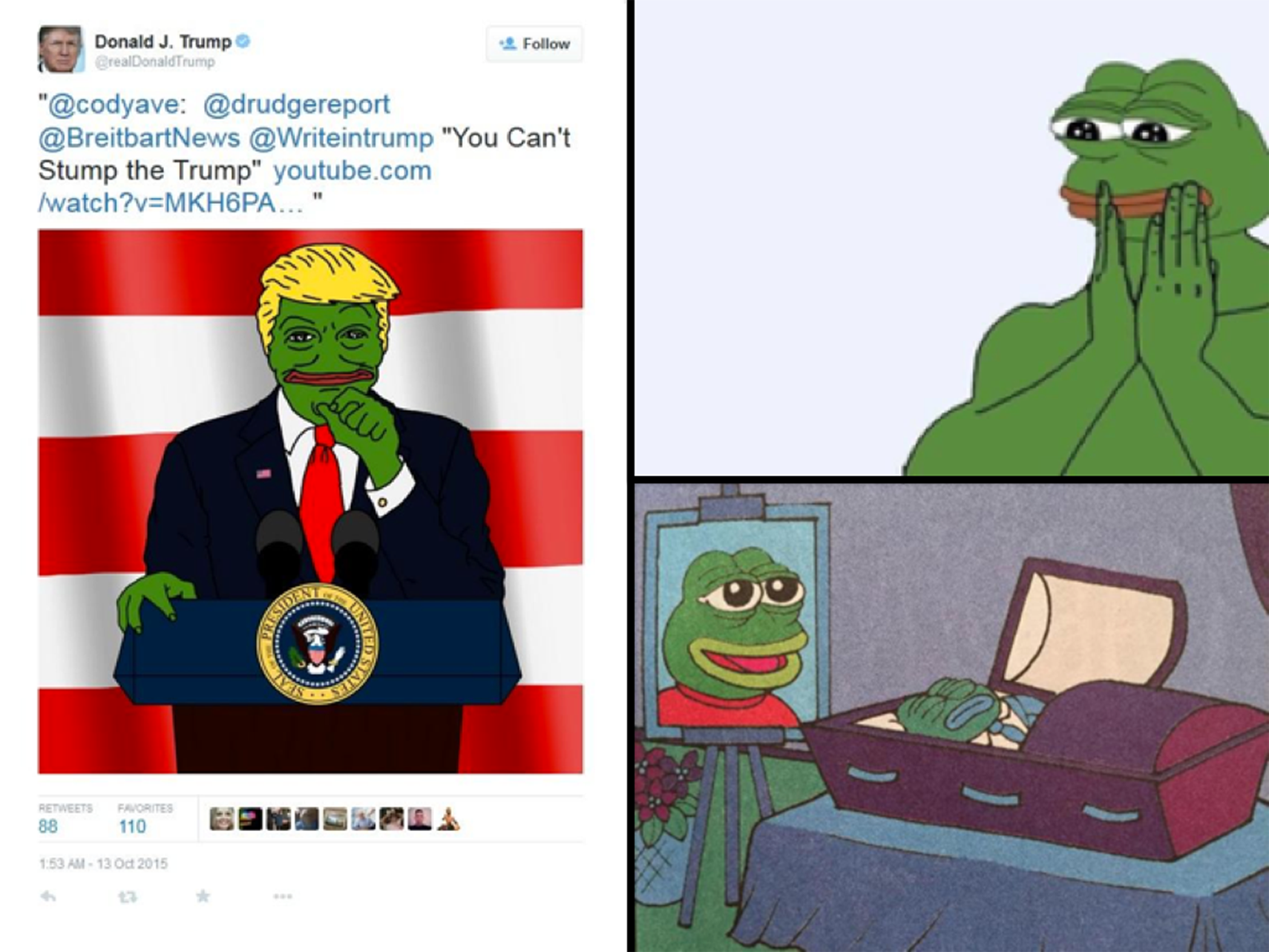
Top right: Alt-right variant of the Pepe the Frog internet meme, which became a white supremacist mascot. Source: public Facebook page, June 2017. Left: Tweet by Donald Trump on 13 October 2015: Pepe the Frog for president. Source: public content from Know Your Meme (2017a). Bottom right: Matt Furie, Pepe the Frog’s creator, responded with a cartoon that ‘killed off’ Pepe, after it was felt to be hijacked by white supremacists. Source: public content from Know Your Meme (2017a).
A particularly problematic alt-right link was born when Donald Trump tweeted a montage parody headlined ‘You Can’t Stump the Trump’ in October 2015. The tweet was accompanied with a cartoon replacing Trump by Pepe staged behind a lectern with the US presidency seal (Figure 1, left). This tweet reached about 11,000 likes and 8,100 retweets within 16 months upon the post date (Know Your Meme, 2017a). Here, Laclau’s (2005) ‘empty signifier’ takes the form of a green cartoon frog, wearing a ‘Make American Great Again’ hat. This case of co-creation and circulation strikingly foregrounds Rose’s (2016: 347) admonition that ‘the contemporary task of the cultural scholar, then, must surely be not to read an object but to navigate that productive network in all its multiple generativity’.
Moreover, Pepe signified a remarkable tool for engendering a digital knowledge politics: ‘the ways in which individuals and institutions leverage digital spatial data and spatial technologies in negotiating social, political, and economic processes’ (Elwood and Leszczynski, 2013: 352). Various activist and mainstream groups started to condemn Pepe, especially Trump’s meme variant, as a hate symbol. Matt Furie, Pepe’s original creator, issued a digital cartoon response, declaring Pepe dead and gone (Osborne, 2017; Figure 1, bottom right). In this example arises the complexity of the ambiguous social media roles of the artist (Matt Furie), the co-creator (those users who re-tweeted Pepe and mutated Pepe’s appearance, meaning and context), and the observer (anyone who encountered and (mis)interpreted Pepe). We do not attempt to define or fix the blurry lines between art, artist, politics and publics in today’s digital culture but expose the latter for further debate. We also employ this case to show the political power, and potentially dangerous implications, of digitally mediated and co-created public art.
Creative social media content has become notoriously known for abusive reuse/co-creation. Internet memes have involved intimidating messaging (i.e. cyberbullying), translating into the offline world (see Zebracki, 2017b). Here, we may draw an interesting parallel between memes and avant-garde performance, known to occasionally feature intuitive acts of violence. For instance, ‘shock performance’ by contemporary celebrity artists Marina Abramović and Paul McCarthy involved self-cutting, screaming and throwing props in galleries. Some of the user-created content might have severe real-world consequences beyond cyberbullying alone. This might then entail fierce action and the infliction of (in)direct material and embodied outcomes, including violence, as seen with the case of the epilepsy-inducing GIF (Section I). This sheds renewed light on geo-politics of intimacies and violence (see Pain and Staeheli, 2014) in digitally mediated contexts. For instance, para-military and fringe groups in Venezuela have been aggressively playing out dissonant symbols and images, acclaimed of national importance, to amplify narratives and actions over social media and ‘in real life’ (Thompson, 2011). We can make further global comparisons and connections. Yet, we still need to acknowledge how digitally mediated art practices are rooted in, and enabled or disabled by, unique national and local territorial and material geographies and places-specific cultural praxes.
To illustrate, the Chinese government simultaneously censors critical internet content and oppresses political opposition in material life (Ibrahim, 2015). Saliently, a manipulated version of the iconic Tiananmen Square ‘Tank Man’ photo showed how the tanks were replaced by the popular travelling Rubber Duck inflatable installation. As discussed by Zebracki (2017a), this spurred on an ‘inter-action’ by a highly placed US Foreign Service Officer, who strategically deployed the tweet: ‘Chinese netizens 1, Chinese censors 0’. Furthermore, Zebracki (2017b) analysed the dispute over Paul McCarthy’s inflatable Tree, a temporary material installation in Paris’s city centre in 2014, which became better known by its epithet ‘butt plug’. Its presence gave rise to hefty commotion over social media, facilitated by in-situ protests, against or in favour of granting an artwork of an allegedly anti-heteropatriarchical nature a platform in public space. This example illustrates how material violence was mediated in relation to online polarisation. An onlooker slapped McCarthy in the face during the unveiling and cried out that the American artist had no business in France; on top of that, just two days after the inauguration, anonymous vandals demolished the inflatable (Zebracki, 2017b).
A key historical analogy of the ‘offline rejection’ of public artwork was Richard Serra’s infamous Tilted Arc, erected in New York’s Federal Plaza in 1981. This black curved wall was widely perceived as an eye sore and road block and was removed in 1989 after prolonged public criticism and lawsuits. Today, both digital content and digital publics may increase the speed, scale and tenor of reactions to and against artwork. This may possibly instigate real violence and damage, as we have seen in the rapid destruction of McCarthy’s inflatable. This contemporary textbook case is an opportunity to learn about how online (inter)actions may augment material dimensions of public artworks, if any, in the first place, and may even transform them into digitally networked memorials (Gauthier, 2015; Zebracki, 2017b). Although Tree is no longer in existence, the debate about its short-lived material existence lives on, and so does the artwork’s digital legacy. Furthermore, we concur with Gauthier (2015) that the discussion of public-art content in electronic outlets, including academic weblogs and the journal in hand, may digitally re-incarnate the art object and pursue a space for digitally networked scholarly engagement (and the same can be said for the ‘murdered’ Pepe the Frog, who lives on).
The symbolic use of art for promoting social change has formed the crux of several reactionary global movements, spanning the fragmented left and right branches of the political spectrum, with strong digitally interactive dimensions. Digital artivism appropriates art practice, taking a pivotal role in connecting publics and politics and fostering social change in online spaces (McCaughey, 2014). However, just as the use and occupation of the urban commons varies according to geography and political context, so does the weight and significance of politically networked art in digital (anti-)commons. Symbols take on highly ephemeral, powerful or powerless meanings as they move across and within liberal democracies, ethnic and religious terrains, cultural affinity groups and authoritarian regimes and controls of material and online spaces. With the following cases we want to highlight how it is in the interstices where the ‘context of context’ (Brenner and Schmid, 2015) of co-creation and the site-specificity of digital artivism are constructed.
A notable example is Singapore’s Pink Dot annual group action by lesbian, gay, bisexual, transgender and queer or questioning (LGBTQ) people, which comprises an occupation of Singapore’s designated protest space at Hong Lim Park, known as Speakers’ Corner. Discussed by Luger (2016), this takes on site-specific power considering Singapore’s soft-authoritarian/illiberal restrictions on assembly and political and identity expression, especially the expression of LGBTQ themes, in the public sphere. This movement has involved both ludic in-situ arts interventions and outreach online, focusing on colour schemes and symbol usages that deviate from conventional LGBTQ protest banners for equal rights. Networked commons thereby queried norms of identity expression in interstitial ‘on-and-offline’ spaces. Reactionary groups opposing the LGBTQ community’s takeover of urban space formed their own artivist conversations online around the colour ‘white’ in the Wear White movement. Led by a coalition of Muslim and Evangelical Christian groups, Wear White has charted its own digital territory in, and beyond, Singapore’s public sphere (Luger, 2016).
The Pink Dot and Wear White networks do not often meet, but when they do, vigorous debates occur in social media threads, particularly on Facebook. Singapore, along with its relatively small geographical size, may be a unique case because of its restrictions to public dissent in urban public space. So, the action radius of ‘glocal’ allies of digitally networked commons and anti-commons (see Paul, 2008) is considerably more expansive, as well as more fluid, than the limited territorial and legal space available in Singapore for conversing and intervening critically in real life. The tensions between Pink Dot supporters and allies and the Wear White family-values coalition has extended and crystallised beyond the Singaporean diaspora. It has seen its emergence within the broader LGBTQ digital community, not to mention major global mainstream press, forming an audience far larger than Singapore’s 720 square kilometres. Global digitally mediated artivism has, in turn, given the site-based, material gathering in Speakers’ Corner greater transformational power and potential to renovate democracy.
Furthermore, recent traumatic events following major terrorist attacks in Europe have produced a repetitive artistic and digital lexicon that relays emotional powers in both offline and online spaces. After the November 2015 Paris attacks, the JeSuisParis hashtag (Figure 2) appeared in millions of globally circulating social media feeds. Users often applied creative filters to images of important ‘offline’ landmarks, such as the Eiffel Tower, and national symbols including the French Tricolour. By incorporating such imageries in user-created content, highly recognisable symbolic sites and regional symbols were re-enacted to provide digitally mediated encounters with senses of empathy and immediacy (see Bell and Lyall, 2005). Material matter became simultaneously over-layered by computer-generated, networked visualisations along urban imaginaries that are rooted in everyday lived spaces from the street and city to the state and the global (see Rose, 2016). Thus, this engendered new multi-scalar experiences of an interstitial ‘digital third space’ (Potter and McDougall, 2017). With the previous examples, we have pointed out that online spaces, as interlaced with material spaces in highly complex ways, have been central to the dissemination, replication, alteration and networking of public discourse, social relations, interactions and actions with both actual and virtual outcomes.
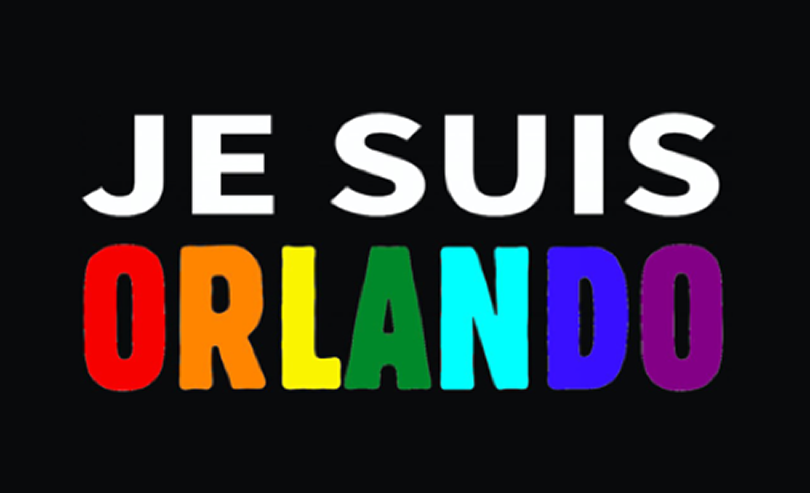
User-created variation on #JeSuisParis. Source: public Facebook page, June 2017.
2 Afterthought: Cyber echo chambers and the digital geographies of bigotry
The field of tension between digital artivism and global populism has revealed a convoluted rhythm of digital mediation. We have seen that identical digital images and symbols are used, altered and disseminated by opposing right-wing and progressive agents simultaneously, then followed by reactionary art practices on both sides. Multi-dispositioned agents, and the intertwined flows of unique and edited/mutated computer-generated images, complicate understandings of the ways in which artivist and populist networks interact. Moreover, digital co-creation may operate in distant, sometimes connected or disconnected, cyber echo chambers: social media spaces ‘where people have their views reflected back at them and conflicting viewpoints are suppressed’ (Shoaib, 2017).
We want to adopt and deepen our conception of the cyber echo chamber as a metaphor of how mirrors are held up in highly politicised digital art practices, or the arts spaces of protest. This particularly pertains to bigotry towards burning topical social issues, such as racism, religious hatred, ethno-nationalism, terrorism and geo-political conflict – with the current Trump administration and Brexit ordeals as big elephants in the room. A case in point on Islamophobia was the virally circulating alt-right tweet with photomontage that displayed a transit rider in drag sitting next to a Muslim woman in full niqab in a New York City subway car (Figure 3). Alt-right actors spread the allusive image numerous of times with the sarcastic caption ‘this is the future that liberals want’. Some online users satirically re-posted this content with the progressive message that such a future is desirable, indeed (Know Your Meme, 2017b).
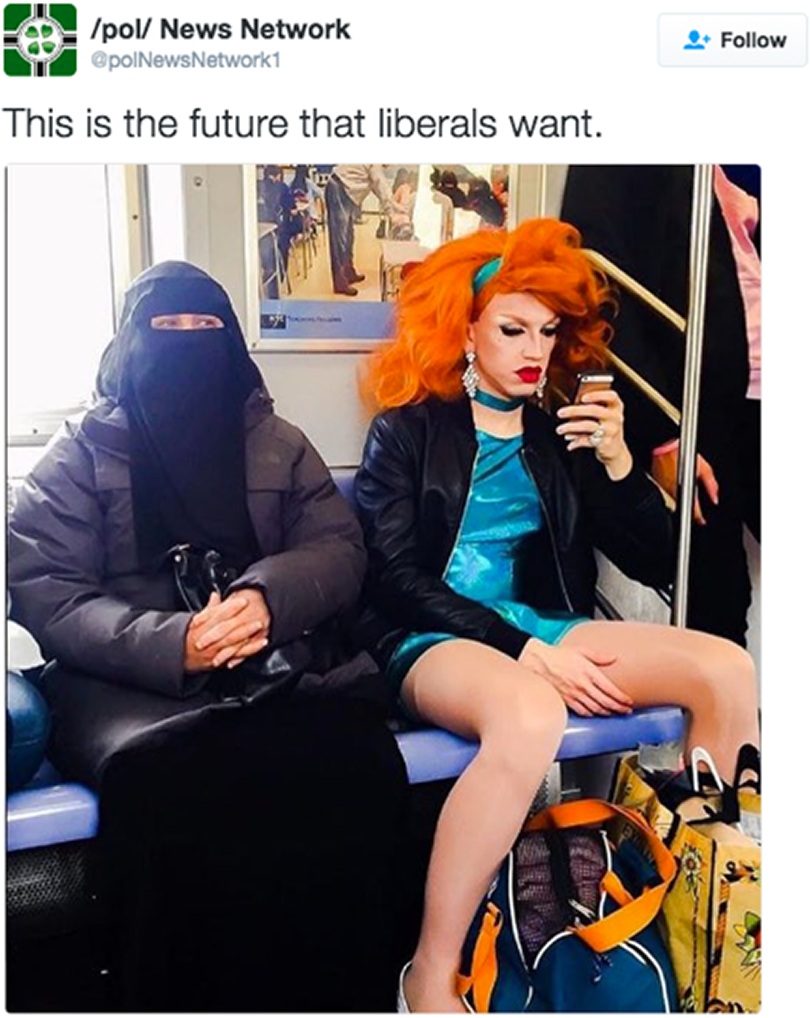
‘This is the future that liberals want’. Source: public content from Know Your Meme (2017b). Original Twitter account (@polNewsNetwork1) suspended.
This example clarifies co-existing and opposing renderings of identical user-created content. This has not only involved antagonised online contact zones, but also contradictory multi-semiotic spaces (see Zebracki, 2017b). Where the alt-right use demonstrated an absolute, abstracted ideological space, antagonising users repurposed it by precisely embracing the encounter of socio-cultural diversity. Sometimes such negotiations took place in the micro-publics of (semi-)private web forums, e.g. Reddit, or even in non-political forums, including male-dominated bodybuilding and gaming chats. Here, moderators act as gatekeepers and ‘joining’ involves an approval process, creating new digital inclusionary/exclusionary realities of such digital chambers.
Furthermore, the reported rise of racist arguments across the US and the UK has become reassembled over social media. In a sense, this has formed a digital manifestation of Brechtian theatre: digital publics discuss and react to material publics who react to actual physical encounters (such as racist tirades on local trains). Bigoted incidents have assumed vast proportions in digital culture. This example, and especially our opening anecdote of the ‘GIF attack’, show how digitally mediated art practice may meld with physical acts of violence. Incidents like these have changed the relationship between digital space, crime and punishment very consequentially. They therefore represent an unnerving new angle to the discourse of how social relations are mediated through the digital.
The alt-right movement sometimes re-appropriated their own art and symbols in multi-sited digital contexts. Pepe the Frog is a significant example of how the alt-right deliberately played with computer-generated images to use/abuse memes to spread and grow support and traction, most of which remains online, yet, as seen, may have real-world impacts. Whereas alt-right gatherings in urban space do occur, provocative, openly racist and bigoted expressions appear to manifest mostly online but, as racist violence in Charlottesville, Virginia, in 2017 demonstrated, can spill into streets of the city as well.
User-created content is often cloaked in anonymity, undergirded by the online capacity for pursuing secret behaviour. This precisely provides a mandate for radically outspoken utterances and the concoction and dissemination of malicious digital content (see Thompson, 2011). As racist and nativist discourses have become mainstream in some Western European contexts, the need for digital conversations to be masked in anonymous cloaks, e.g. avatars, screen names, may be fleeting. Outright racist cases of user-created content signal a networked intensification of bigotry. This problematic practice asks for a critical triangulation of digital landscapes and material places to interrogate how the internet, through digitally mediated creativity and aesthetics, not only informs but also transforms everyday life and its image culture (see Longan, 2015).
In the new paradigm of the digitally networked public-art encounter, a user-created flashing image, symbol or montage under the heading of art can even be used as an assault weapon, and result in actual physical injury, arrest and incarceration. Earlier literatures on emerging digital cultures (e.g. Bell and Kennedy, 2000; Dodge and Kitchin, 2001), and even more hypothetical science fiction literature, which portrays a world where computers send actual human viruses and cyborgs kill, suddenly look less like fiction and more what is known as reality. Anecdotally, we wonder: if Isaac Asimov could see through today’s digitally networked lens, might a Twitter ‘weapon’ have been included in this writer's science fiction fix-up novel I, Robot (1950)?
IV Concluding reflections and further research
This article has advanced original insights into creative geographies, digital art, politics and activism. Our focus on the political qualities of everyday co-creation in digital culture has emphasised the interplay between pressing topical social issues and oft-problematic conducts online that have arisen around the tensions between global populism (i.e. networked politics) and digital artivism (i.e. networked publics). We have, accordingly, offered geographical scholarship a productive lens for studying the production of social spaces and geographies of public-art practice in the digital age. We point to three concluding observations together with some ways forward in waging critically engaged research on this topic.
(1) The ‘matter’ of public art has become significantly reconfigured in digitally networked spaces, where the internet may trigger publics to interact. Digital technologies have provided a wealth of potentials for, as well as limitations to, participation in the everyday life, identity expression and inclusive engagement. Such technologies have heralded a digitised condition of publicness beyond the still hegemonic material urban locus of public-art production. Also, they have the potential to bridge people, places and spaces that have remained divided in material geographies – or rather to reinforce such divisions. Digitally mediated artworks erratically ‘travel’ and become mutated through networked public spaces and their interstices and liminalities.
Thereby, transformative and immersive experiences of immediacy, ‘here-ness’/‘there-ness’, relevance, urgency, now/then, etc., surf across offline-online palimpsests. They impact digital/material, public/private and virtual/actual spaces in unison through dialectic and non-binary ecologies of art-matter (i.e. physical objects, digital content, hardware, software, material practices, ideas), human/non-human and producer/consumer agencies, place (remote/site-specific), and time. So, there is much to gain in empirically examining co-creation and multi-sensorial experience of such digitally mediated ecologies of public-art practice.
We have critically discussed how multimedial DIY user-created content, which sometimes exists as digital entity only, may have real-world consequences that concurrently feed into digitally mediated worlds. We particularly embolden further research regarding the poorly explored modus operandi of the co-creation of digital art content along mediated uses/misuses, actions/reactions, and offline/online interfaces. While there is much rhetoric around place and identity makings in creative and cultural geographies, there is still scant regard for their digital contexts. Digital art content is made over multiple digital platforms (termed ‘multimediality’; Rose, 2016). This demonstrates how online identities are fluid and that cultural objects are not stable entities within the more-than-territorial, ‘post-urban’ online spaces, an area to which scholarship should give more substantial empirical effort.
(2) Contexts of digital mediation have been explored to map networked commons and protests as acts of critical citizenship (e.g. Paul, 2008; Gerbaudo, 2012). Digitally mediated public-art practices may play distinct and potentially conflicting social and symbolic roles in negotiating norms and codes of everyday life. We have argued, however, that they remain an under-examined niche in terms of theory, method, ethics and positionality. We have particularly discussed how (re)appropriations of digital art content are subject to unfolding manifestations of global populist movements vis-à-vis digital artivism.
Digital public-art practices increasingly inform social and political spectrums of digitised lives, where criticality and banality, conservative and progressive thought and regressive and connective actions may be ambivalently assembled and negotiated. The ‘empty signifier’ (Laclau, 2005) that may have been a banner, a slogan or a colour at one time, can now just as easily be a GIF, meme, or hashtag. We have consequently argued how digital commons and online (micro)spaces have been forming, and multiplying, across global online spaces. These are bound to site-specific, fixed and static material spaces, yet simultaneously planetary and varying in nature through digital mediation. Such ambiguous condition, furthermore, is surrounded by capacities for online users to stay anonymous and adopt dynamic online identities. This might especially play into the hands of discussed alt-right parties and related bigoted, banal practices, which therefore are difficult to track down and halt.
Populism-infused and oft-trite user-created art content might generate crucial sites for encounters in real life. They may have powerful consequences in fluid, and often fraught, social and political landscapes. We have underscored the understudied and equivocal relationship between global populist politics and digital artivism – the latter being concerned with radical interventions in the legitimised, consensus-seeking practices of the post-political city (Davidson and Iveson, 2015). Although digital public-art practices may involve trivial and carnivalesque plays with computer-generated co-creations, a considerable bulk of digital content appears to be less guileless under the yoke of conservative anti-elitist movements and sentiments. This is not far-fetched, given the tone and tenor of frequently vitriolic digitally mediated discourses, the implications of which for societies continue to unfold in real time, both globally and locally.
Structure-agency issues of user participation in public-art practices are connected with technological and digital infrastructures and aspects of (in)security, policing, surveillance, and the possibilities of, and limitations to, freedom of speech, etc. We have specifically critiqued how utterances and materialisations of random acts of violence have been informed and mediated through creative propaganda and polemics over social media. Today, troubling user-created art content occurs at a mushrooming pace in globally strategic localities in the name of racism, nationalism, terrorism and religious fervour. For example, even after the recent territorial collapse of the so-called Islamic State (IS), IS continues to operate as a social media phenomenon that is interwoven with digitally networked creative propaganda and severe violent actions (see Blaker, 2015).
(3) There remains a rich space of potential for geographers to interrogate the methodological and ethical dimensions of digital (ethnographic) research into networked digital public-art practices, both in and beyond cyber echo chambers. What research challenges can be identified for collecting and analysing user-(co-)created content and for participating in the process of co-creation as a research method? Further thought and awareness will need to be applied to the use, or potentially inadvertent abuse, of user-created content within the digital peer-to-peer knowledge society. The ways in which online produsers/prosumers (Bruns, 2012) and research-users create, mine, (re)appropriate, mutate and exchange social media data requires a conscientious course of action. Leszczynski (2017) not only revealed a serious concern in this regard with locational privacy involved in retrieving and analysing digital data, but this author also indicated an important methodological problem in that social media data samples impose fundamental difficulties with corroborating meanings with real-life social-spatial practices. That is to say, although everyday online user psychology might seem so, such data samples neither allow the making of robust claims on their representative value for groups online nor on people’s ‘presences’ and practices in everyday life.
The digital sphere not only further expands public art’s field, it also complicates and obfuscates the clarity of who/what is the artist/art/public in networked space. This commands epistemological re-thinking: more endeavour is needed in progressing scholarship through pursuing the digital human as object of study and the expanding digital humanities as method of study (see Crang, 2015). Critiques should move beyond just one-dimensional cyberboles: exaggerated claims such as how artificial intelligence outsmarts human beings (i.e. singularity). What is required then is a profound comprehension of the digital age and digital agents at the nexus of technology, power and the (more-than) human.
Research, we argue, should rigorously address the implications of examining co-creation and politicised (i.e. activist) uses, but also misuses, of technology-enabled digital public-art content from an etic approach (as outside observer), an emic approach (as inside engager) and in spaces in-between. As digital geographers and active online users, we embody this dual positionality: we examine and co-create digital spaces and digital public-art content in concert, or conflict, with other users. We thus call, in conclusion, for further critical inquiry into digital public art as politics and its role in politicising interstitial on-and-offline public spaces with careful consideration of reflexivity on such compound researcher-user positionalities.
Footnotes
Acknowledgements
We wish to extend our gratitude to the editors of Progress in Human Geography and reviewers for their insightful comments that have helped to strengthen our argument. Any errors remain our own.
Declaration of conflicting interests
The author(s) declared no potential conflicts of interest with respect to the research, authorship, and/or publication of this article.
Funding
The author(s) received no financial support for the research, authorship, and/or publication of this article.
