



Abstract
This essay analyzes embodied experiences of enclaving. It argues that by tracking revolutions in built form that gating enacts, urban geography has simultaneously tracked revolutions in urban subjectivity. It highlights three enclaved “body types” within existing literature: securitized bodies in fortressed cities, performative bodies in consumptive enclaves, and hygienic bodies in purified zones. It then offers three ethnographic scenes of gating related to new crises of personhood: metabolic illness, atmospheric breakdown, and resurgent ethno-nationalism. Attention to the psychic forces behind gating, it finally argues, can further show the gender, class, and ethnic underpinnings of what appear as generic architectural zones.
I Introduction
To descend into the international airport of any so-called “emerging market” city is to be engulfed in images hailing weary travelers into curated spaces of enclaved luxury. On the drive into Gurgaon, the satellite city speckled with gated communities outside of New Delhi, where we work, this messaging is explicit: advertisement hoardings beckon you to purify, elevate, luxuriate, or “creep into heaven” via bespoke privatized townships. Perhaps in recognition of the olfactory assault that accompanies one’s exit from the Indira Gandhi International Airport, located in the world’s most air-polluted capital city (Arora, 2021), a sign announces its new luxury offering with “The Aroma of Premium Location.” Imagework centering an enclaved subject further invites one to dream of comforts away from the public melee, with its noise and nuisance. An ethnically ambiguous but decidedly fair woman, with oversized sunglasses, peering from a black limo, glances out to a serene township reflected in the window behind which she is seated (see Figure 1). Advertisement in the Delhi Times for Raheja’s Ayana Residences in Gurgaon, announcing “an extraordinary lifestyle blossoms.” February 20, 2015.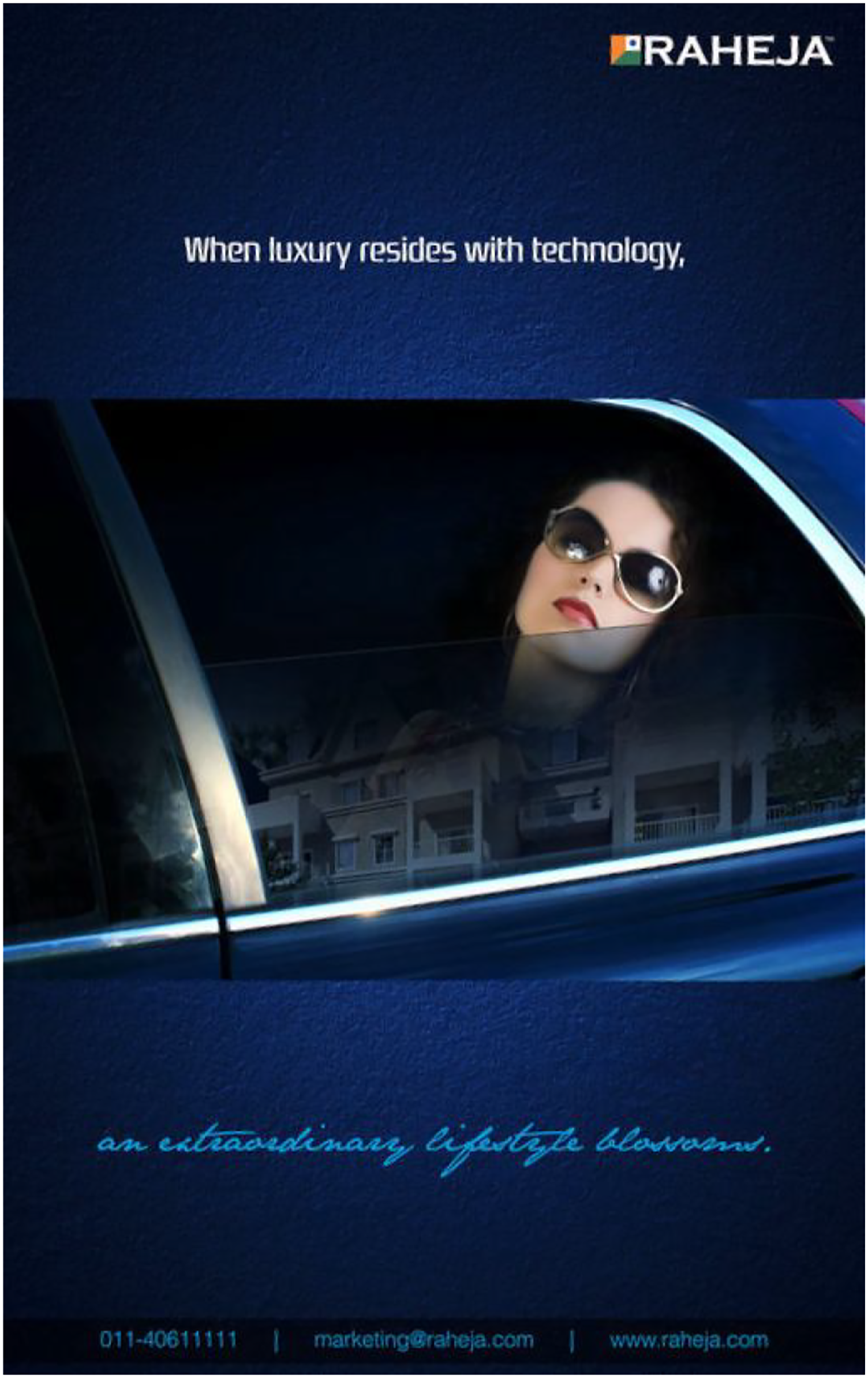
Building on Teresa Caldeira’s (2000) foundational work on fortified enclaves in 1990s Brazil and the critique of the structural predations of neoliberal excess that became magnified with the real-estate turn in international markets in the 2000s (Shatkin, 2017), literature on enclave urbanism has focused on the material form of the enclave, the justifications for its emergence, and the privatization of the public sphere it often precipitates. This research has produced critical insight into how the enclave has emerged as an architectural and financial solution to a variety of crises—economic, sociological, and political. In doing so, this scholarship revealed how the fortification of residential geographies shifts distinctions between the public and the private (Davis, 1992; Graham and Marvin, 2001; Kaviraj, 1997; Soja, 2000), how the enclave (re)produces neoliberal urban policies that privilege the consumption of global lifestyles (Kuldova, 2017; Pow, 2009), and how designed natures entangle ideologies of environmental protection with exclusionary models of citizenship (Ballard and Jones, 2011; Baviskar, 2020). Much of this work has focused on those disaffiliated from, displaced by, or designed out of these spaces (Dinzey-Flores, 2013; Murray, 2017; Sawyer et al., 2021), and on the political economy of the bright developments producing the shadows into which they are forced (Sassen, 2014). A certain “enclaved subject” nonetheless haunts this work, showing up in discussions of how differently positioned individuals submit to technologies of security, how whiteness becomes valorized in enclaved spaces, how the enclaved body becomes globally marketable, and how the beautified natures within enclaves reflect the beautiful people behind the gates.
This essay explores the diagnostic power of this enclaved body, showing how scholarship on enclave urbanism has tracked a revolution in urban subjectivity alongside its more recognized analysis of revolutions in built form. Our aim is to show how this literature trains critical attention on the secessionary selves and forms of privatized personhood that enclaves help coax into being—and often elevate as models of urban citizenship as such. More explicit attention to the types of enclaved bodies imagined into the gates, we submit, can reveal the specific crises of personhood to which the enclave is presented as a positive solution, as well as how unfolding crises of urban citizenship take concrete form through the built environment.
In what follows, we review three distinct yet interrelated categories of the enclaved body within existing literature: the securitized body in the fortress city, the performative body in the consumptive enclave, and the hygienic body in the purified zone. Each of these “body types” emerges in relation to specific diagnoses of enclaves as built form, with the securitized body referenced to the gated community as fortress, the performative body the agent of conspicuous consumption within luxury zones, and the hygienic body the resident of a purified urban ecology. These body types, like the literature that evokes them, necessarily blur, informing and reinforcing each other in the production of enclaved spaces. Though in no way all-encompassing, our intent is to discuss how researchers conceptualize the enclave through the securitization, consumption, and aestheticization of space, and to explicate the terms on which the enclaved subject dictates wider patterns of urban development.
In contextualizing these categories, we draw on a non-dualist ontology of the body and its environment, which tracks the self as an emergent category continuously remade through its interactive environment (Simonsen and Koefoed, 2020). Given the well-documented challenges of participant observation in elite spaces (Armytage, 2018), our focus on enclaved body types shifts the focus from a more phenomenologically individual self to the collective forms of personhood, or normative selves, designed into the operational landscape of the enclave (see Searle, 2013). The aim is to reveal how particular built environments are constructed and metadiscursively defined as valuable and habitable for particular types of classed, gendered, raced, and caste-marked subjects. Key questions thus become: What does a focus on the figuration of the enclaved subject reveal about how bodies are invited into, or denied access to, the increasingly enclaved zones we inhabit? How might a critique of the enclaved body open new possibilities for challenging the fortressing of urban public spaces long lamented in urban geographical literature and policy? The final part of the paper pushes these questions through three short ethnographic scenes, drawn from our research in the National Capital Region of Delhi, to show how a focus on the affective and psychic entailments of enclaved living can further elucidate present and future crises of enclave urbanism. We focus specifically on intensifying crises of personhood concerning metabolic illness, atmospheric risk, and resurgent ethno-nationalisms, domains that point to the porosity of space and subjectivity, and thus to the limits of the enclave as a spatial technology of control.
II The Securitized Body in the Fortressed City
A dominant focus of literature on enclave urbanism wrestles with questions of how and why aspirational residential geographies become fortressed and the implications of their design for the broader “spatial contract” defining the terms of engagement between neighborhoods (Atkinson and Blandy, 2006). In these varied analyses, the fortressed complex—be it a gated community (Davis, 1992; Low, 2003; Ellin, 1997), fortified neighborhood (Ballard and Jones, 2011; Calonge-Reillo, 2022), or privatized township (Knox, 2008; Pow, 2011; Srivastava, 2014)—emerges as a response to desires to secure the self, home, and community from perceived threats from the outside. Such spaces typically employ multiple security technologies, including walls, gates, guards, and security cameras, to deter threats and simulate order.
While embodied experience may not be the explicit focus of these investigations, enclaved subjects’ spatial separation from those outside the gates is central to analyses of the gated community. In this context, Caldeira (2000), describing the rise of fortified enclaves in Brazil, considered the “aesthetics of security,” or the use of architectural and technological interventions to fashion new calibrations of how security looks, sounds, and feels. While the enclave-as-fortress works to “screen threats” and “calibrate vulnerabilities,” it simultaneously elicits particular forms embodied subjectivity through affective states of preparedness, precaution, or aloofness (Ghertner et al., 2020), cultivating a fearful stance even if fear is not the principal motivation for pursuing enclaved living (Geniş, 2007).
For example, Caldeira (2000) characterizes an embodied subjectivity of submission produced by the requirement that residents and visitors conform to processes of verification and surveillance as a condition of entry. The tension produced between freedom and confinement was felt most acutely in Caldeira’s research by wealthy residents, where “to live in isolation is considered best” (Ibid., 289). For lower-class service staff, the landscape commands: show your face, don’t walk too fast, use the service entry, don’t linger, be unseeable/unhearable/untouchable (Ray and Qayum, 2009). As Caldeira explains, This submissive subject reverberates, shaping the public character of the city: Citizens’ strategies of security also affect patterns of circulation, habits, and gestures related to the use of streets, public transportation, parks, and all public spaces…people feel restricted in their movements, afraid, and controlled; they go out less at night, walk less on the street, and avoid the “forbidden zones” that loom larger and larger in every resident’s mental map of the city (Ibid., 297).
One of Caldeira’s well-recognized insights is that architectural fortification represents an assault on the public city, casting the public sphere as an inherent source of risk (cf. Davis, 1992). Less recognized is her insight into the wider crisis of urban citizenship the enclave inaugurated, or the emergence of a mistrust of the urban collective as a viable social form at the precise moment when the nation was democratizing. This mistrust of the urban collective reshapes embodied experiences of the city, as Morales et al., (2022) argue, thanks to the frequent use of privatized transportation and enclosed, inter-zone walkways, inviting the elite to enjoy not just enclaved residential communities but also enclaved mobility.
Insights from South Africa similarly show how fortification emerged as a response to the crisis of post-apartheid integration (Lemanski et al., 2008). As Ballard (2004) suggests, apartheid’s end triggered many perceived insecurities among the white minority, including fear of crime, lost economic privilege, and “unregulated” Black mobility that might “transmit Africa” into previously “European areas.” This first led to the fortification of individual houses with barbed wire, security cameras, and walls, eliciting an individualized white insularity. As a white resident explained, “we continued to live with our privileged existence knowing that there were all those millions…out there in the cold as it were, knowing that there had to be change somewhere…sort of wanting it, but the secret of your heart thinking…you’re giving up your comfort zone” (Ballard, 2004: 51). The enclaving of the nuclear white household, though, had the adverse effect of breaking up networks of white sociality. As one respondent observed, “You live from day-to-day, and you wonder if today’s going to be your day that someone will stick a gun in my head… I am actually a prisoner here” (Ballard, 2004: 10). This led to a collectivized white interiority, with white sociality in crisis and thus in need of defense through the expansion of the fortress’ boundaries beyond the individual home into entire communities.
Kaviraj (1997), Chatterjee (2004), and Fernandes (2004) document a related crisis of bourgeois personhood in India, triggered by the gradual plebianization of the public sphere in the 1980s–1990s. Like the democratization triggering middle-class anxieties in Brazil and South Africa, this crisis was linked to India’s post-1980s democratic upsurge, which delivered local and state-level political representation to Dalits and so-called “Other Backward Classes” (Yadav, 2020), while inviting working-class populations into the public spaces once reserved for European colonial elites and later governed by the caste habitus of the Hindu middle classes. Kaviraj (1997), for example, observes how British-colonial public spaces came to be governed in the early post-colonial decades as extensions of a purified “Hindu inside,” a fluid social sphere grounded in upper-caste domestic codes of civility and gendered hierarchies of association. This “inside” evaded private/public binaries, however, since its rules of order extended from the household into neighborhood parks, footpaths, and even public squares. The “intrusion” of a plebian caste/class habitus associated with the democratization of the public sphere meant that “the fortresses of the middle class started falling, and being divested of their generally aesthetic functions, the parks opened to the poor” leading to uses that “completely destroyed the architectural presupposition of the reciprocity between public and private space, between the houses and the green lawns” (Kaviraj, 1997: 106). The wider “democratization of caste space” (Gorringe, 2016) triggered a middle-class retreat into the domestic interior, as the breakdown of the caste/class spatial order threatened caste purity, bourgeois civility, and gendered propriety.
This took place through the fortification of neighborhood boundaries and “a distinct tendency to move literally up and away, by retreating into relatively tall high-rise flats” (Kaviraj, 1997: 110). This classed retreat rested upon a forceful emphasis on the symbolic distinction between the enclaved house and the exposed streets, or a performative inwardness grounded in a profound sense of bourgeois loss—a melancholic stance vis-à-vis a fallen public sphere. Urban gating accelerated in the 2000s, producing a micro-economy of spatial control through neighborhood welfare associations, whose punitive stance vis-à-vis the “encroachments” of the poor led to aggressive slum removal campaigns and urban beautification drives (Baviskar, 2003; Ghertner, 2015). The growing use of cooperative group housing societies—residential complexes organized on the basis of “community” (read: caste and religion) (Jha et al., 2013)—and the explosion of integrated, luxury townships in India hence need to be seen as more than Indian expressions of a broader pattern of neoliberal urbanism. They are as much responses to a crisis of Hindu domesticity associated with the decline of the joint family, the rise of communal and gender violence (Hansen, 1999), and the (caste) democratization of the public sphere.
Enclaved subjectivity has a different valence in China where walled compounds, known as xiaoqu, have a longer history of use (Hamama and Liu, 2020). While breaking from the enforced communalism of the danwei compound developments of Maoist era (Bray, 2005), those purchasing xiaoqu luxury fortify enclaved nationalism via their enactment of planned community and socialist modernization. Despite offering privatized homeownership to portray class distinction and separation from the poor, these spaces remain tools of participating in, not withdrawing from, state-sponsored developmentalism (Liao et al., 2019). As Tomba (2014) and Zhang (2011) argue, walled residential compounds are still mobilized to reinforce governmental legitimacy and facilitate spatial consensus for state developmentalism, similar to the Singaporean state’s use of the provision of enclaved communities as a means of reproducing state legitimacy among the middle class (Pow, 2011).
The enclave also produces new feminized senses of security premised on tensions between freedom and fear, or new affordances of agency contingent upon the ceding of control to others. Kern (2011), for example, suggests that developers in Toronto pitch securitized residential experiences to single women, commodifying safety while simultaneously drawing professional women into revanchist citymaking practices that offload risks onto working-class and racialized women. Advertisements for these spaces emphasize possibilities for women to embody the city in new ways, using the fortressed tower’s comforts as a base from which they can foray into the riskscape of the neoliberal city. The gated high-rise thus must be understood as part of enclaving of gendered agency that portrays safety as a lifestyle choice and the consumption of privatized spaces as the idealized expression of sexual and gender freedom.
Similar forms of enclaved freedom are common in heavily gender-surveillant contexts, especially those that have seen growing female professional workforces or new opportunities for feminized luxury consumption. In Saudi Arabia, for example, cross-class enclaves allow for the formation of feminine conviviality otherwise censured out of public spaces, confining experiments in liberation to the private boundaries of the zone and diminishing any fledging public critiques of the kingdom’s misogyny (Odrowaz-Coates, 2015). State concessions such as driving licenses for women, celebrated as cracks in the regime’s total control of gendered mobility, operate as extensions of enclaved citizenship, not fundamental social changes.
In India, enclaved leisure spaces, such as walking tracks, gardens, and gyms, support long-restricted leisure practices and invite westernized attire as expressions of a freedom from both the ogling public eye and the surveillant gaze of traditional neighborhoods (Bernroider, 2018; Srivastava, 2014). The contrast between the openness of such enclaves and the restricted female agency experienced in the public city, as in the Saudi case, invites enclaved transit to other privatized public spaces, especially the shopping mall, a defining sphere of feminine middle-class urbanity (Tewari and Bhatia, 2019). As Gooptu (2009) argues, such gendered forms of neoliberal citizenship reinforce the government’s abdication of responsibility for citizen well-being. The assault on the public city so well documented in the literature hence cannot be understood outside of the marketization of feminized consumption, with privatized self-realization proffered as the “fix” to the sexual violence of the public city.
III The Performative Body in the Consumptive Enclave
A second genre of research on urban enclaving centers the gated zone as a playground for a footloose global leisure class (Kaltmeier, 2019). The consumptive enclave here emerges as an architectural and financial-regulatory response to perceived failures of state-driven urban planning and the demands of a rising consumer class craving freedom from those failures (Fernandes, 2006; Shatkin, 2011, 2017). As Sorkin (1992: xiii-xiv), in his classic characterization of “new modes of urban segregation” observes, city government has “largely ceased its historic role as the integrator of communities in favor of managing selective development and enforcing distinction.” Methodologically centered on the analysis of promotional materials, advertisements, and architectural renderings of the enclave, these studies often focus on how these projects stage environments wherein consumer dreams of “global” lifestyles can be realized.
If, as Low (2009) argues, the gated community arose in the US in the 1990s as a means of maintaining whiteness in the built environment, then in the mostly non-white postcolonial city where enclave urbanism is expanding most today, it is whiteness that stands as a master signifier of safety and comfort (see Figure 1). To live in the zone where Euro-American expats live, or to share the spatial freedoms they are understood to enjoy, becomes the dream that luxury townships pitch to buyers. As Waldman et al. (2017) argue, in contexts where the legacies of colonial planning continue to mark stark class and ethnic hierarchies, colonial nostalgia and the elevation of a Victorian pastiche—a kind of architectural heteroglossia that mixes modern materials with colonial textures and insignia—is a common sales strategy. Advertisements for an English-cricket themed enclave outside Delhi claim, for example, that it is “set [in] an idyllic environment to suit everyone…prime locations overlook the cricket ground. In the time-honoured style of the classic English village…imagine dining in the tavern…‘by invitation only’” (Waldman et al., 2017: 184–185). The “invitation” here hinges on the capacity to align with an embodied performance of the self that matches the façade—to sound, look, and consume like the leather-wrapped Chesterfield sofa or argyle-print wall hanging that adorns your interior social world.
As Searle (2016) argues, real-estate developers are not simply waiting for new segments of consumer society to grow; they create them, cultivating new markets by convincing individuals to “upgrade” their tastes. Brosius (2013: 41) similarly emphasizes the “keen desire of different sets of experts in the field (architects, journalists, urban planners, etc.) to ‘teach’ the aspiring middle classes about the ‘good life’…[and] turn them into a moral community of citizens united in their commitment to link pleasure and consumption.” The consumers could be anyone—non-residents looking for investments back “home,” upwardly mobile local elites eager to perform global lifestyles, or institutional investors seeking to up-sell the middle-class dream.
Because these places could be anywhere and everywhere, we note the consumptive enclave’s organization around a globally fungible self, a body that has a foundational yet highly malleable set of attributes into which different users can slot. This fungible self is defined by its ability to conform with the performative expectations of a globally legible lifestyle: to wear international brands, to share in a generic set of civic norms of public comportment, and to validate the model of the public/private division upon which the enclave rests. In an urban environment where the majority of luxury properties lie mostly vacant, sitting idly as investment vehicles for future re-sale or as retirement properties, the fungibility of real estate, or the ability to combine units into larger asset pools, requires an imagined user generically amenable to the distinct stylizations of enclaved living. The elevation of a consumer subject that can perform “the global” from specific national urban environments reflects diasporic aspirations for homeownership that respond to the breakdown—or in the case of China, the re-assertion—of state projects of constructing a national middle class.
Metropolitan areas in China have seen gated enclaves utilize foreign names (e.g., Orange County, Napa Valley, Thames Town) and architectures (e.g., Thames River, Tudor/Victorian-style buildings), while featuring European restaurants (e.g., English Pubs, Costa Coffee) and public squares with statues paying homage to European historical icons (e.g., Winston Churchill, Princess Diana) (Bosker, 2013; King, 2004; Shen and Wu, 2012). Pow and Kong (2007: 141) observe that advertisements for an enclave called Shimao Riviera outside Shanghai featured high-rise apartments next to iconic landmarks such as the Eiffel Tower and Big Ben, while centering villa-style houses inviting buyers to join a “community of like-minded people…friendly, polite, well-educated and knowledgeable professionals from all over the world.” Similarly, Thames Town, also outside Shanghai, persuades buyers that “the authentic English learning style is assiduously promoted and cultivated, the supermarket stocks goods and supplies a greater variety and appeal… and gives everyone a chance to experience for themselves the unique flavor of the English way of life” (Wu, 2010: 392). The adoption of European and U.S. housing styles are not just aesthetic strategies to promote idealized global living at home, but also to showcase China’s economic ascendancy. Architectural mimicry and the ability of Chinese homeowners to take on “western” residential qualities confirm China’s ability to match and surpass Euro-American forms (Bosker, 2013).
Across much of sub-Saharan Africa, too, the enclave reflects a broader spatial aesthetics of detachment (Watson 2014; Nielsen et al., 2021), whereby existing urban centers are “reurbanized” (Murray, 2017) in response to the demands of African capital repatriation and the elite desire to be of, while maintaining socio-cultural distinction from, the existing African city. As one developer told Grant (2005: 671) of Accra-based enclaves: “expatriates can have an American-style house with world-class amenities… away from but close enough to the African city.” As Nielsen et al. (2021, 898) argue, even when enclaving fails as a material project, it offers “spatial and temporal security by physically or imaginatively stabilising the relationship of person and space in the form of a predictable future.”
IV The Hygienic Body in the Purified Zone
Despite diverse sociological and cultural forms, the purified enclave represents one solution to the at-risk environmental subject, the organism adrift in the Anthropocene city characterized by penetrating airs, enervating heat, and generalized environmental risk. This is reflected in work exploring the beautified greenery, manicured gardens, and horticultural embellishments within luxury zones, as well as wider scholarship on “bourgeois environmental” anxieties and their advancement of privatized natures (Baviskar, 2020; Mistry and Spocter, 2022).
Across this literature, we glean a clean and disciplined body, an idealized form reflected in the tamed landscape behind the gates, where the din of the city is screened out. In this green zone, access to beautified nature benchmarks aspirations for a purified subject. Fostering “good natures,” such as manicured parks, flower gardens, and walking tracks that privilege leisure over livelihood, is often contingent upon the exclusion of “bad natures” associated with social intermixing and the “polluting poor” (Mawdsley, 2004; Rice et al., 2022).
Raposo (2006: 52), in her investigation of enclave aesthetics in Portugal, describes how the construction of serene, de-peopled parks and gardens anchors sales pitches, offering nature meant to mirror the serenity within: “users are set apart from any physical encounter potentially disruptive of their pleasure as they are also set apart from visions of the exterior ‘(ab)normal’ world.” By “conjuring the synthetic nostalgic idea that finally one has arrived ‘home’” the environment replenishes the salvaged urban body, restoring it to some forgotten integrated state with nature. In Vietnam, the 500-ha Ecopark, the product of violent agrarian dispossession outside of Hanoi, similarly advertises “perfect harmony across humans and nature,” a harmony productive of an eco-subject with a view over, but critical distance from, the paddy fields and farmers who cultivate nature and sometimes manage the interior gardens (Provost and Kennard, 2016).
While urban enclaving has a longer history in China, scholars have observed an increased deployment of urban ecological restoration, including eco-cities, low-carbon cities, and sponge cities that reposition the gated township as the very mechanism of ecological modernization (Provost and Kennard, 2016; Rodenbiker, 2020). As Shen and Wu (2012:198) illustrate through a review of development proposals that promise “a way of life that enjoys the urban while remaining close to nature, that maintains individual pleasure, while keeping a distance from others,” the appeal is a (sub)urban, green lifestyle not offered in the city center. In other promotional materials, Pow (2009: 381) notices that residents are said to enjoy “living in this xiaoqu because it’s fully enclosed…makes the surroundings cleaner and also more well-kept. Unlike the other neighborhoods, we do not have unwanted people entering the estate, littering, trampling on the grass.” Like Raposo’s (2006) observations from Portugal, the consumers of these eco-cities are saturated with dual messages of a refuge away from the city—what the Ciptura complex in Vietnam brands as “a peaceful oasis among the hustle and bustle of Hanoi” (Provost and Kennard, 2016)—and a territorialization of elite lifestyle.
Ballard and Jones (2011) connect the emergence of eco-estates in South Africa with deeper racial ecologies, noting how such landscapes elevate “indigenous” species and the users who protect them against invasive plant species and (in)human others. By implicitly associating whiteness with nativity, these projects achieve racial exclusion through the environmental rhetoric that outsiders lack the environmental discipline required to manage the urban ecologies they fetishize. For example, “Simbithi Eco-Estate has been planned with one thing in mind, to give you the opportunity to reconnect with nature and embrace a lifestyle in harmony with your natural environment…it is a way of preserving nature, as much as it is a way of preserving a lifestyle” (Ballard and Jones, 2011: 139). For Ballard and Jones (2011: 144), the botanical practice of “weeding reinforces the importance of the perimeter fence and the likely response to its transgression by the wrong plants, people, and behaviors. These estates assure freedom from both botanical and human ‘invasives’…[and] produce landscapes…that claim to protect two different sets of vulnerable assets,” native ecologies and the naturalness of whiteness within them. They at the same time deepen environmental damage for those left outside through their intense resource demands (Mistry and Procter, 2022).
In India, the green enclave emerges as a response to perceptions of socially and biophysically polluted public cities, represented by the plebianization of green spaces. Baviskar (2003, 2020) uses the term “bourgeois environmentalism” to describe how middle and upper-class concerns around aesthetics and civic cleanliness reinforce an environmental imaginary centered on propertied consumption, wherein the unpropertied poor can only figure as environmental encroachers to be cleared altogether (Bose, 2013). By elevating a particular green aesthetic that defines environmental goods based on their appearance, urban greening in India often centers tokenistic environmental amenities such as garden varietals or landscaping, while ignoring wider consumption-based environmental damages such as car use and energy intensification (Ghertner, 2011). The stylization of enclaved environmental amenities offers up communities fashioned as “close to nature,” even though their conditions of production rest on environmental destruction. Lavasa, a controversial, 100-square-kilometer private city modelled after Portofino, Italy, about 3 hours outside of Mumbai, for example, is promoted as a space to “recharge your BODY” in India’s first hill station built since the end of the British Raj (Parikh 2015).
In their investigation of English cricket-themed enclaves, Waldman et al. (2017) and Waldman and Weedon (2019) find that ecological enclaving is often underpinned by a purified self-modeled on colonial natures and bodily aesthetics. Exploring the social logics of placing highly manicured cricket grounds in the center of the complex, they observe how consumer demand for a green, disciplined self facilitates “aesthetic regimes…strictly enforced to police space.” Through stylized greens and manicured paths, a disciplined environmental subject expected to reflect and emulate a disciplined nature emerges, inspired by colonial surveillance and hierarchies: the cricket player with his clean-pressed whites, the quiet walker following her predictable path, or the nature photographer appreciating but not disturbing the flowers fertilized into existence.
V The body in crisis, the embodiment of the zone
Through three scenes drawn from our research in the National Capital Region of Delhi, but with resonance elsewhere, we turn in this section to the indexical relation between crises of personhood and wider urban crises. These scenes are based on participant observation over multiple visits to the enclaved spaces we detail below; interviews with developers, real estate agents, architects, and residents; and document analysis of legal cases and media coverage of these enclaved environments. Focusing on the mutual making and unmaking of personhood and built form (Searle, 2013), we suggest, extends insights into the more seductive and experiential circulations of desire, aversion, and fear that invite so many into enclaves. We focus on the metabolic crisis associated with chronic, non-communicable diseases; the atmospheric crisis of toxic air and uncertain weathers; and the secular crisis of resurgent ethno-nationalism. The emergence of the leisure zone, atmospheric bubble, and majoritarian neighborhood—architectural responses to each of these crises—points to how these interventions reflect and respond to the psycho-social anxieties of a nervous urban public. We offer these scenes as a way to read the enclave as a place of urban bodily performance that sits between the local and global, intimate and public, and to suggest what a more explicit analysis of the geographies of the enclaved body can bring to future studies.
The Urban Metabolic Crisis: Zoning for Sportier Bodies
India is reckoning with a metabolic crisis, prompting new approaches to what Solomon (2016: 5) calls “metabolic living,” or lifestyles attentive to how “bodies and cities are permeable interfaces of active traffic.” We draw from Solomon’s study of metabolic illness in urban India to note the emergence of new sports cities and leisure zones offered as environmental solutions to what the Indian media continually flags as bodily breakdown, be it India’s ranking as the “third fattest country in the world,” the fact that India has the second highest presence of diabetes globally, or the inconvenient emergence of heart disease as the country’s leading killer (Kannan, 2019; Prabhakaran et al., 2018; Sharma, 2014). As one particularly pedantic article from The Economic Times asked of parents on World Diabetes Day in 2008, in a tone illustrative of the public-health anxiety that seeps into the structure of the middle-class family, “sedentary lifestyle, dietary indiscretion, physical inactivity… are you passing on the perils of modern life to your children?” (Baxi, 2008).
Alongside an explosion of self-help advice, fitness and dietary regimens, and a new wellness culture in metropolitan India, the rise of privatized townships centered around sport, fitness, and health have emerged as residential therapeutics for metabolic risk: Sports Villas Apartments and Century Sports Village can be found in Bangalore; Sportsville finds home in Pune; Soho Sports City and Lotus Greens Sports City feature in NOIDA; and Golf Estate and Sports Ville are just two of the prominent sports townships in Gurgaon. Calling all “fitness freaks,” using sales pitches persuading buyers to “switch over to a healthy and active lifestyle,” or asking “what a world-travelled, highly successful, health-conscious person would like in a home,” developers use fitness to differentiate themselves from other luxury competitors and to draw in new, younger buyers: the gym buffs, yoga executives, and health fanatics. Operating through an insider language of bodily righteousness, these developers magnify and capitalize on embodied anxieties that withdrawal into serene luxury spaces might, if not properly appended to a regime of self-care and bodily optimization, lead one to fall into the metabolically risky space of pudgy, enclaved lassitude.
NOIDA, a city within the National Capital Region, has gone so far as to acquire 2800 ha of land intended for six “sport cities” meant to house over a million residents as part of a city-wide campaign to market itself as the greenest, health-oriented city in India (Bhowmick, 2015; Ramnani, 2016). Each sport city is mandated to have a PGA-regulation golf course; professional cricket grounds, football fields and training centers, and tennis academies; state-of-the-art fitness clubs; and world-class health amenities, including branches of the nation’s most prestigious private hospitals. Making use of the “recreational green area” land-use classification, originally zoned as public space (The Economic Times, 2013), these cities offer privatized leisure for those able to afford metabolically improved lifestyles.
As part of a centralized push to improve the health and athletic profile of the nation, a new Indian middle-class body has gained representational centrality. The consolidation of Indian cricket supremacy, emblematized by India’s production of the top athletes and the hugely successful Indian Premier League, combined with national investment in Indian Olympic success, has been central to the advancement of a figure more aligned with European ideals of fitness and bodily aesthetics. Sculpted bodies now saturate popular media outlets, and even Hindu gods have become decidedly more svelte in popular iconography (Baas, 2016; Maddox, 2020; Solomon, 2016). The gym scene, which exploded in the 2000s, is not enough to support this new bodily aesthetic; the whole urban order requires a similar nip and tuck, as developers and state governments design entire cities organized toward achieving metabolically optimized bodies. This was on full display when Devra Waldman was given a tour of the then near-complete flagship NOIDA sports city, including its Greg Norman-branded PGA tournament course, high-performance Olympic-sized swimming pool, World Tennis Association-compliant tennis courts, NBA basketball training center, and integrated fitness and medical facilities—all skirted by a range of premium condominiums and low-rise family villas providing unfiltered access to the “sporty life.” Described by the architect as a space envisioned to meet every “health, fitness, and leisure need,” with opportunities to remedy all perceived bodily shortcomings, the tour ended with Devra Waldman arriving at her hotel just as an actual red carpet was rolled out to welcome the King of Kuwait for a specialized surgery in the sports city’s private hospital.
Accounting for the connection between body work and urban development requires attention to colonial legacies of sport, health, and nature, especially given that cricket, football, tennis, and wrestling were considered ideal vehicles in Victorian England for cultivating masculine traits of discipline, bodily vigor, and fortitude (Mangan, 1998; Malcolm, 2001). Because sport was understood to promote initiative, self-reliance, and obedience, it became spectacularized in the colonial project as a tool to demonstrate proper bodily comportment within a Christian ethos of individual self-making (Mangan, 1998; Mills and Dimeo, 2003). In 1835, when the British Raj introduced a policy of Anglicization to train Indian elites in British tastes, cricket and other sporting cultures were promoted for “deserving” Indian populations (Appadurai, 1996; Mills and Dimeo, 2003). Though sport was appropriated, resisted, and reinvented throughout the colonies, to know and play cricket, for example, often signified a privileged position within Empire.
Land acquisition for leisure environments was similarly central to the colonial project, which looked to tame nature, (re)create familiar landscapes, and design islands of purity to protect colonial bodies from the dangers of disease considered endemic to native zones (Grove, 1996). Contemporary approaches to “fixing” the metabolic crisis of the new Indian middle class align with these colonial approaches of using sport to tame both the body and the landscape. If the question of metabolic living, as Solomon (2016: 13) poses it, is “how do we turn the environment into ourselves?”, then the sports enclave provides one answer to middle-class obsessions about fat, fitness, and overconsumption: engineering environments for a metabolism otherwise.
The Urban Atmospheric Crisis: Zoning for Air
Each autumn, as temperatures drop across the Indo-Gangetic plains, a dense cloud of particulate matter laced with heavy metals descends over North India, settling over Delhi for weeks, sometimes months, causing air quality to plummet and straining asthma clinics and hospitals. These periods of “airpocalypse” eventually pass, sometimes in January, sometimes later, but Delhi is characterized by particularly toxic air year-round, having only two so-called “good” air-quality days—when the Air Quality Index dipped below 50—in 2019. Air pollution was responsible for 1.7 million premature deaths across India that same year (Pandey et al., 2021), straining the body more generally through increased blood pressure and hypertension, reduced lung function, premature births, and, perhaps most alarming to the middle-class public, reduced IQs and testing scores among children (Krishna, 2022).
The threatened lung has prompted new forms of eco-enclaving that shift the green features of luxury enclaves from aesthetic cleanliness (see above) toward efforts to produce purified atmospheric bubbles. Marketed as atmospheric escapes for metropolitan India’s so-called “pollution refugees,” enclave urbanism increasingly offers what the Godrej Air township in Gurgaon calls “air as amenity,” a purified retreat where vulnerable respiratory systems, especially those of children, can “#BreatheEasy” and “inhale only what’s pure” (Figure 2). Gurgaon is witness to whole genres of secessionary atmospheric branding, with green screens and inward-looking sightlines advancing segregationist airs imagined apart from the public city: the promotional slogan for developer M3M’s Polo Suites is “breathe the air of nobility”; the Godrej Nature township promises an “air upgrade.” “Every breath counts,” announcing the launch of the Godrej Air township in Gurgaon. Times of India, December 19, 2018.
Re-enforcing what colonial planners once termed “zoning for air”—an architectural solution to securing white-European selves from native airs via the establishment of segregated “civil lines” for British officers—atmospheric differentiation is back with a bang today. Typically, a package of land-use controls, atmospheric technologies, and scientific prognostics, zoning for air in the 21st century might fall within the domains of regional planning and climate-change mitigation, but technologies of atmospheric control have now been most aggressively utilized in private real estate, with the model airshed downscaled from the climate zone not to the metropolitan region (as environmental planning would have it) but to the residential colony. For example, prospective buyers at Polo Suites, within the same complex housing the Trump Tower NCR, are given a climate study that was supposedly carried out to optimally design for air quality. Some townships boast on-site air-quality engineers who sit in command centers monitoring real-time sensors to control air filtration and deliver on their promise, as Godrej Air states, of “homes that breathe better” or “10x cleaner air.” Anti-smog guns atop penthouse towers, “O2 islands” pumped with medical oxygen for lung-cleansing wellness visits, and permanent, real-time, floor-by-floor displays of indoor air quality offer the township up as an immunologically sequestered sphere (Sloterdijk, 2009). Threatened lungs now demand segregated breath.
These immunological townships, however, diminish the habitability of the public city, extending what Davis (1992), in his early critique, termed the weaponization of architecture into the weaponization of atmosphere. This is because the increased pollution generated in powering immunological home defenses directly usurps the respiratory freedom of those left out: diesel generators quickly fire up to maintain purified interior air during routine power cuts, and overall energy use and automobility intensify the burdens of breathing for anyone outside. Herein lies the absurdity of spectacularized privatization, for the impossibility of true atmospheric sequestration reminds everyone that the Anthropos of the Anthropocene, despite intense inequalities in lived experience, shares a fundamental requirement of breath, one that today’s atmospheric prostheses can never fulfill on their own. Despite the bourgeois body’s ability to largely escape the public city, it cannot escape its reliance on public air.
The Crisis of Urban Secularism: Building the Majoritarian City
Globally resurgent ethno-nationalisms have changed the character of urban space, producing new genres of fortification that align with trends associated with “the neoliberal city” (Desai, 2010; Véron, 2021; Yacobi, 2016). While these fortifications draw on longer-standing fears of crime and ethnic violence, they also reflect an intensified geopoliticization of the urban that downscales bordering processes from national boundaries to cities and even streets (Akar, 2018). The urban citizen is an inescapably geopolitical subject, with the home standing as a site of national defense, literally domesticating homeland security.
Consider the gating that emerged in the wake of the 2020 Delhi Riots, the largest communal attacks the city has seen since 1984—when mobs of Hindu vigilantes attacked Sikh homes following the assassination of Prime Minister Indira Gandhi by her Sikh bodyguard. The 1984 anti-Sikh riots led to substantial enclosures of urban neighborhoods, especially among middle-class housing societies that built perimeter fences and check points out of fear that similar rage might reach them. The 2020 riots generated a similar rise of gating, but in ways that often broke up, rather than consolidated, neighborhoods, thereby ethnicizing the enclaved subject.
The 2020 riots are best understood as a Hindu-fundamentalist attack on secular urbanism. They specifically sought to shut down non-violent protests that emerged against the Citizenship Amendment Act (CAA) of 2019, which controversially introduced religious criteria for conferring Indian citizenship, giving protections to Hindus while threatening Muslim banishment (Jaffrelot, 2021). In what some have called India’s most important social movement since Independence, Muslim women launched an indefinite, non-violent protest from Shaheen Bagh, a neighborhood adjacent to where the Delhi Police violently cracked down on a student-led anti-CAA march (Ahmed, 2022). Coalescing as a cross-class, multi-faith movement, Shaheen Bagh symbolically advanced a call for a secular right to the city and Muslim reparative care (Ghertner and Govil, 2020).
It is against such calls for cosmopolitan inclusion and secular citizenship that a local leader of the Bharatiya Janata Party (BJP), the Hindu-nationalist party in power nationally, labelled Shaheen Bagh a “mini Pakistan,” a space outside of, and antagonistic toward, Indian law. In February 2020, standing with a band of supporters in Delhi’s Maujpur neighborhood, where an anti-CAA protest modeled on Shaheen Bagh was taking place, this leader issued an ultimatum to the police: either clear out the demonstrators or his followers would do it themselves (Gettleman et al., 2020). Over the following week, Hindu-supremacist mobs stormed Muslim-majority neighborhoods in Northeast Delhi, a BJP stronghold, leaving 53 people dead, 400 more injured, 226 houses severely damaged, 487 shops gutted, and 14 mosques desecrated (Singh, 2021).
This act of religious urbicide, unimpeded by the police, led to the erection of metal sheets, bamboo poles, and wooden boards to cordon off Muslim lanes from Hindu ones (Gettleman et al., 2020). These temporary barricades were later converted into permanent gates in a piecemeal manner, as working-class families donated small amounts of cash to fund intra-neighborhood fortification, literally cordoning themselves off from their once-neighbors. Bodies are surveilled for religious markers and style—a bearded man, white-kurta-pyjama-dressed boy, or hijab-clad woman fitting in one zone, not the other—with discrete enclosures allocated for the Hindu majority and outcaste Muslim minority. This incremental gating and intra-neighborhood attunement of bodily movement contrasts with the more monumental fortification that characterizes much of the enclave urbanism literature (Lalwani and Kohli, 2020). One Hindu resident, who described increased reticence among his neighbors to enter the Muslim lanes nearby, used the language of “bordering,” telling journalist Shoaib Daniyal (2020), “This is India and that is Pakistan…There were many attacks from that side. That is why we had to build this gate.”
Post-riot Delhi reveals a broader pattern aligning with Yiftachel and Rokem’s (2021) two observations about neonationalism in the city. First, they find, citing examples from Brazil, India, Israel, Turkey, and the US, that “metropolitan liberal cosmopolitanisms” have become a central target of neonationalist movements. This is evident in Delhi via the Hindu-nationalist attack on secular, Muslim-led expressions of cosmopolitan belonging—the denigration of Shaheen Bagh and the projection of national divisions onto the internal geography of once-integrated neighborhoods providing key examples. Second, they observe that metropolitan elites have “failed to stop neonationalist policies from deepening ethnic and class disparities.” Once the urban elite retreats into privatized enclaves, their protestations over the symbolic “fall” of the public city do not stand a chance against what Yiftachel and Rokem (2021) term a new “urban coloniality” driving majoritarian attacks.
Attending to the enclaved body offers two extensions to Yiftachel and Rokem’s framing of urban political geography in times of ethno-nationalism. First, it reveals unique micro-geographical expressions of “urban coloniality,” with securitization working upon, without displacing, intricate spatialities of the socially mixed city. Hindus and Muslims in Delhi’s riot-affected areas still live together, but in an ethnically enclaved form, with side-by-side lanes now encountered as different “nations.” Second, in contrast to journalistic accounts that frame Muslim and Hindu gating as equal expressions of communal self-defense—or the more common observation in the enclaving literature that working-class areas model themselves on elite gated communities—we identify a pattern of ethnic enclosure, wherein gating-as-self-defense simultaneously operates as an externally imposed form of spatial containment. Here, the enclaved self is not an expression of personal lifestyle choice, but a marker of ethnicized difference, a community “locked in” (Dinzey-Flores, 2013) to a zone defined by infrastructural disconnect, territorialized stigma, and municipal exclusion (Anand, 2012)—not privatized freedom.
VI Conclusion
More than 25 years into the study of globally circulating forms of enclave urbanism, scholarship retains a clear focus on the political economy and built-form characteristics of secessionary urban spaces, as well as their wider role in the privatization of the public city. The enclaved body is latent in this work, present yet often eclipsed by questions about how the enclave shifts understandings of the public/private divide, emerges alongside and reinforces neoliberal rhetorics of consumer freedom, and curates environmental landscapes that naturalize exclusionary models of citizenship. We have sought to show how research on enclaves nonetheless has quietly tracked shifting embodiments of the urban enclave. Our argument is that the substantial geographical critique of the enclave has simultaneously extended a critique of urban subjectivity prompted by the wider crisis of the public city, mass privatization, and globalized gentrification. In excavating three key enclaved “body types” within this work—the securitized self, the performative self, and the sanitized self—we have suggested that attending to the embodiment of enclaved spaces is indeed central to understanding the seductive qualities of enclaved living and the diverse experiments in subjectivity that enclaving inaugurates.
Bringing more explicit attention to the forms of self-fashioning the enclave offers to prospective occupants can bring the corporeal and affective entanglements of urban subjectivity more forcefully into debates about the conditions, meanings, and limits of enclaving. Without a focus on embodied experience, prognostications about the city yet to come risk missing out on the psychic forces driving speculative enclaves and fortified futures. Offering three ethnographic scenes from our ongoing research in contemporary Delhi, we have tried to show how new, or newly intensifying, crises of personhood framed around metabolic illness, environmental catastrophe, and resurgent ethno-nationalism are animating new experiments in enclave urbanism at the precise moment when large-scale speculative projects seem to have run their course otherwise (El-Husseiny et al., 2021; Goldman and Narayan, 2021). In these formulations, the enclave is positioned as a positive solution to embodied anxieties concerning an urban body reaching its absorptive limits, an urban lung facing the suffocating effects of over-urbanization, and heightened communal and majoritarian violence in the face of a hollowed out urban public.
While just a starting point, these scenes are indicative of both new energies driving enclaving efforts, as well as the limits of enclave urbanism as such. The three forms of enclaving these scenes introduce—the health and leisure zone, the atmospheric bubble, and the majoritarian neighborhood—are exaggerated forms of gating that also show the impossibilities of the enclave itself, or how it, in offering escape, amplifies the underlying conditions of urban bodily crisis. Even as the flagship sport city in NOIDA, discussed in our first scene, is reaching completion, the drive for sportier, more metabolically attuned living has stalled, as private developers for the remaining five sport cities subleased their plots for other uses and failed to deliver the sporting infrastructure they promised. Enclaves pitched as atmospheric safe zones, discussed in the second scene, similarly point to the limits of eco-apartheid, as pollution refugees have increasingly skipped over retreating into these estates and simply fled the city, leaving energy-intensive but unoccupied luxury towers behind them, choking the city. Even as intra-neighborhood enclaving meant to defend against communal violence, described in our third scene, has emerged as a localized effort to securitize the city, these enclaves lock in those they ostensibly protect, making them more isolated and prone to attack. The future of the enclave, and the introduction of any future after the enclave, thus crucially depends on identifying how crises of urban personhood can be resolved.
Supplemental Material
Supplemental Material - The enclaved body: Crises of personhood and the embodied geographies of urban gating
Supplemental Material for The enclaved body: Crises of personhood and the embodied geographies of urban gating by Devra Waldman and D Asher Ghertner in Progress in Human Geography
Footnotes
Acknowledgements
We would like to acknowledge Stuti Govil's contributions to our thinking, including her insightful feedback on our early notes on this paper. All errors remain our own.
Declaration of conflicting interests
The author(s) declared no potential conflicts of interest with respect to the research, authorship, and/or publication of this article.
Funding
The author(s) disclosed receipt of the following financial support for the research, authorship, and/or publication of this article: This work was supported by the Social Sciences and Humanities Research Council of Canada (grant number: 756–2019–0664), and the European Research Council (grant number: 851940).

Supplemental Material
Supplemental material for this article is available online.
Author biographies
References
Supplementary Material
Please find the following supplemental material available below.
For Open Access articles published under a Creative Commons License, all supplemental material carries the same license as the article it is associated with.
For non-Open Access articles published, all supplemental material carries a non-exclusive license, and permission requests for re-use of supplemental material or any part of supplemental material shall be sent directly to the copyright owner as specified in the copyright notice associated with the article.
