




Abstract
Research on urban-regional development tends to focus on city-regions with extreme economic outcomes (e.g., superstar cities, ‘left-behind’ places), with less attention paid to more normal, ‘average’ places. In this paper, we use fuzzy-set qualitative comparative analysis to investigate conditions supporting significant growth in small and mid-sized U.S. urban regions that had average income levels in 1993 (our average places). We identify the interplay between physical geography (e.g., energy reserves and natural amenities), contextual conditions, and economic specialization as instrumental to many of these places’ development, raising important questions about future development prospects of these average places.
Keywords
Introduction
Economic geographers widely agree that spatial inequality has risen in many developed economies since the 1980s (Bathelt et al., 2024; Kemeny and Storper, 2024). Related research has mostly focused on spectacular cases of success or decline, such as the concentration of enormous economic opportunity in cities like San Francisco, London, and Paris (Le Galès and Pierson, 2019; Saxenian, 1994; Storper et al., 2015) or the devastating decline in cities like Detroit and Liverpool (Hackworth, 2019; Rodriguez-Pose, 2018). Indeed, there are good reasons for investigating such cases, as much can be learned about economic processes by focusing on extreme economic outcomes. Yet, by centering on extreme cases, we may fail to identify important aspects of the economy that are evident in more modal and ordinary places that represent some state of normal economic life (Amin and Graham, 1997; Robinson, 2006).
In response to this research gap, our inquiry focuses specifically on such normal city-regions, conceptualized here as ‘average places’. Average places are not characterized by extraordinary stories of economic growth or decline. At a given point in time, they are quite average in terms of their economic conditions and do not stand out. These city-regions offer sufficient job opportunities and have relatively stable economies but are small and specialized in industries that do not benefit from strong income and employment multipliers. We focus on average places in the United States, defined here as small and medium-sized stand-alone Core-Based Statistical Areas (CBSAs) 1 with average income levels.
In this paper, we identify and investigate the socio-economic and institutional conditions under which average places experience high income growth. This is done through a systematic analysis of 31 high-growth and 36 low-growth average places, using fuzzy-set qualitative comparative analysis (fsQCA) (Fiss, 2011; Ragin, 2000, 2008; Rutten, 2024). This comparative approach offers advantages in theory-building (Barnes et al., 2007), as it enables better isolation of causal forces (Mossberger, 2009; Tilly, 1984). Our approach takes inspiration from Lagendijk et al. (2020) and Li and Bathelt (2020) in combining qualitative and quantitative data and corresponds with wider shifts in economic geography towards mixed-methods (Pike et al., 2016), aimed at discovering wider spatial patterns without giving up depth in explanation. It also signals a distinct move from single case studies toward comparative work that evaluates cases in relation to one another, using them as benchmarks for interpretation (Geddes, 2003; King et al., 1994). The analysis covers a long period of 25 years from 1993 until 2017, during which significant industrial restructuring processes and a major wave of globalization hit the United States (Bluestone and Harrison, 1982; Hirst and Thompson, 1996).
Our study engages with a broader body of research aimed at ‘building better methods’ in the field (Bathelt and Li, 2020). As a mixed-methods approach, fsQCA on the one hand improves rigor in data processing and inference, which derives from its mathematical foundation. On the other hand, the interpretation of each solution relies on an in-depth understanding of the underlying cases (our average places) and requires a thorough examination of each. The combination of individual case narratives with the application of an integrated analysis of a medium-sized number of average places allows us to better understand causal mechanisms and to draw implications for urban-regional development (Peck and Theodore, 2012).
Our fsQCA approach identified different combinations of socio-economic conditions associated with distinct development trajectories of average places. In contrast to conventional regression analysis, this approach enabled us to identify multiple pathways of average cities, instead of providing a singular causal explanation for their development. We used economic, relational, population/migration, and education/skill-related conditions to characterize different development pathways and identified four major trajectories of high-growth average places: (i) high-connectivity energy towns, (ii) high-immigration energy towns, (iii) skill-based energy towns, and (iv) public administration centers. While the energy sector (especially related to shale oil/gas deposits) clearly played a critical role in three of these trajectories, the reasons behind the growth of average places were more complex and related to specific institutional settings. In addition, not all energy towns in our study experienced high growth or were based on shale gas. Importantly, the growth of energy towns was associated with different socio-economic conditions. It should also be noted that the four trajectories were not the only pathways associated with a strong performance of average cities. A number of high-growth average places were characterized by unique, idiosyncratic pathways that were quite different from other city-regions.
Our findings about average places highlight a different range of growth trajectories compared to other successful regions in the United States. None of these places are driven by high-technology or knowledge-based industries, nor are they characterized by major agglomeration advantages and start-up dynamics. Many are characterized by trajectories related to their historic economic structure and physical geography conditions, particularly access to natural resources and locational advantages. 2 Our study contributes to existing work on urban-regional development by showing that high-growth average places are shaped by different factors than those affecting leading metropolitan areas or regions that are in decline. It also emphasizes that high income growth is not determined by a specific industry base but depends on a set of socio-economic and institutional conditions, as well as their interplay. While we are concerned about the long-term prospects of a high dependence on fossil fuels in average places, the troubling reality is that the growth of many average places depended on these factors and was not related to knowledge-intensive and high-technology industries—though their growth trajectories were also critically shaped by other conditions.
The remainder of this paper is organized as follows: The next section conceptualizes our analysis of average places by joining the dialogue around territorial inequality, with a particular interest in ‘everyday’ aspects of urban-regional economies. We proceed by discussing major dimensions of urban development based on existing literature. Subsequently, we introduce the data-generation process and fsQCA model. We then present the results of our analysis by identifying different pathways of high-growth average places that are characterized by different combinations of socio-economic conditions. In the final section, we summarize and discuss the implications of our findings for development prospects of average places.
Conceptualizing average places
During the 1980s and 1990s, a lively debate in economic geography focused on studying successful regions with specialized economies and close network relations, identified as clusters or regional innovation systems (Braczyk et al., 1998; Maskell and Malmberg, 1999). This research was based on studies of the most dynamic regions, such as high-technology complexes in the United States or industrial districts in Italy (Cooke and Morgan, 1998; Pyke et al., 1990; Saxenian, 1994). Other research was more interested in industrial regions that experienced crises. Examples included investigations on the decline of Boston’s minicomputer industry (Saxenian, 1994) or the crisis of South Korean shipbuilding (Hassink, 2010). In a related stream of research, scholars more recently studied so-called ‘left behind’ regions (Le Petit-Guerin et al., 2025; MacKinnon et al., 2022, 2024; Pike et al., 2024; Rodríguez-Pose, 2018) that are characterized by economic stagnation, unemployment, and/or a lack of public sector engagement, with concerns among residents who feel neglected by policymakers and fear they could fall into economic hardship (Cramer, 2016).
Parallel to and separate from this, a geographical literature has developed around the notion of the ‘ordinary’ city. Amin and Graham (1997) first suggested that rather than centering our gaze on what makes cities exceptional, we should focus on what makes them ordinary. Building on this idea, Robinson (2006) argues that common urban categories such as western, developing, or global (or in our case, ‘superstar’ or ‘left-behind’) obscure the complexity and diversity of other city-regions, and that rather than viewing cities within a normative hierarchical system (with large, western cities at the top), we should reconceptualize cities as ordinary and study the ‘normal’ instead of the ‘exceptional’. By focusing on the ‘ordinary’, this research argues that we might better understand contemporary urbanism and the economy.
The focus on ordinary cities fits within a broader, though still nascent, trend in economic geography of investigating more quotidian processes, actors, and geographies. For instance, burgeoning literatures on ‘everyday’ economic geographies reveal the ways in which countless economic processes are articulated through everyday economic and social interactions, informing our understanding of broad trends like austerity, globalization, and financialization (Hall, 2011, 2019; Peck and Hammett, 2022). Much of this research is informed by a longstanding commitment within feminist economic geography to studying less-represented subjects and geographies to understand economic processes (Hanson and Pratt, 1995; Massey, 1995). These different bodies of scholarship show that much can be revealed about contemporary capitalism by focusing on a more diverse set of actors and geographies. In the current paper, we conceptualize ‘average places’ in a similar spirit. In short, we focus on a group of city-regions in the United States that represent the modal category, at least in terms of economic development. In this sense, we diverge from the ordinary cities approach of considering all cities as ordinary, in order to identify a specific category of average cities that can be operationalized, responding to the need for more research on the development trajectories of ‘normal regions’ that are mostly absent in studies on regional economic development (for early calls to pay attention to such places, see Hellmer et al., 1999; Krumbein et al., 1994; Storper, 1997). Our goal is to reveal the economic and institutional factors which lead to different outcomes for this subset of cities that have, with a few notable exceptions (i.e., Benner and Pastor, 2015; Gordon, 2014), received little attention in the economic development literature.
To operationalize this concept, we identified 254 stand-alone CBSAs as ‘average places’ that had a population under 250,000 in 2017 and income levels between the 15th and 85th percentiles of the income distribution in 1993 (roughly corresponding to a one-standard deviation window around the mean).
3
This is a sizable number of city-regions, spread across the United States, with an overall population of nearly 18 million people in 2017. They represent an important share of the U.S. economy—typically overlooked in academic work—characterized by local economies and development dynamics about which we have limited knowledge. For our paper, we identified 67 average places whose income changes between 1993 and 2017 were below the 15th percentile (low growth) or above the 85th percentile (high growth). As indicated in Figure 1, there are 31 average places with high income growth and 36 with low growth during our investigation period. Same Start, Divergent Growth: Per-Capital Income 1993 and Income Changes 1993-2017 in U.S. Stand-Alone CBSAs with less than 250,000 residents (Source: Bureau of Economic Analysis, 2019). Note. In the first step, city-regions within the 15th and 85th percentile of average income in 1993 (between $17,604.93 and $21,984.89) were selected from all U.S. stand-alone CBSAs with less than 250,000 residents and identified as average places. In the second step, city-regions with high-income growth (above the 85th percentile: >$23,960.68) and with low income growth (below the 15th percentile: <$17,676.00) were identified as high-growth and low-growth average places for further analysis.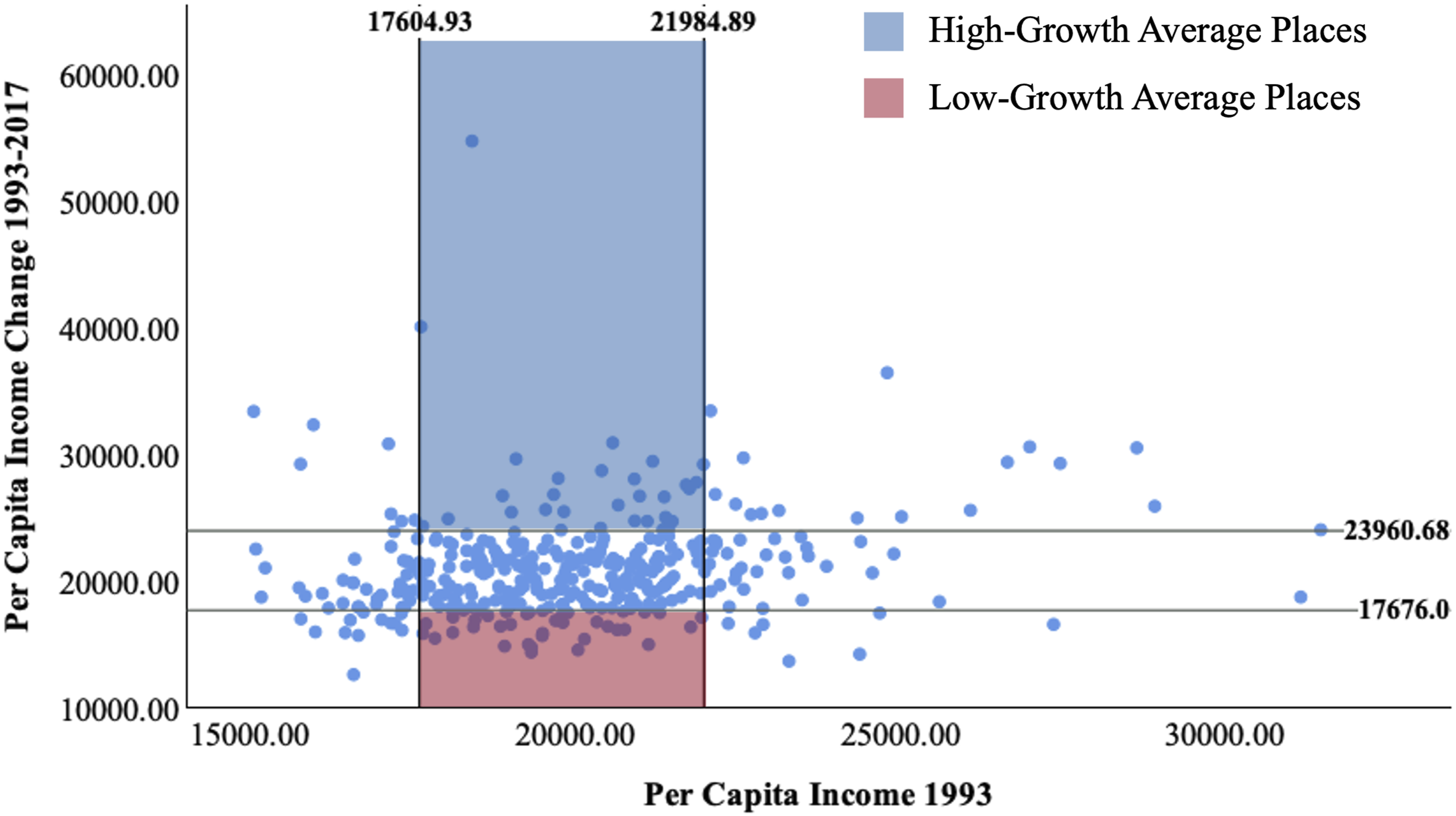
The geographical distribution of these city-regions, shown in Figure 2, is not even across the United States. Specifically, many city-regions with high income growth are located in the western half of the country, while most of their low-growth counterparts are found in the eastern half. The Geography of High-Growth and Low-Growth Average Places in the United States 1993-2017 (Source: Bureau of Economic Analysis, 2019). Note. Shown are all stand-alone U.S. CBSAs with less than 250,000 residents identified as high-growth and low-growth average places in Figure 1.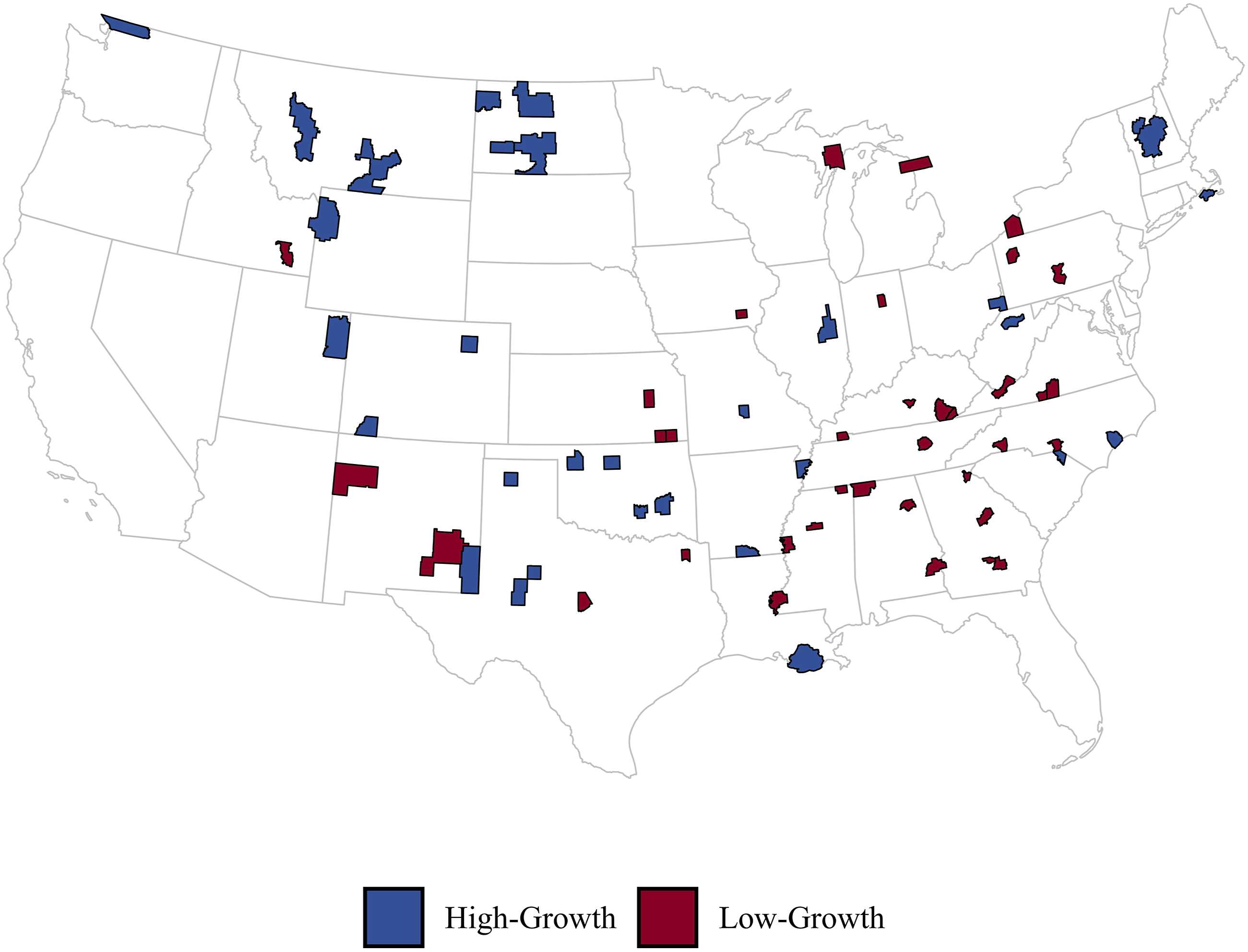
In a recent analysis of urban-regional income trajectories in the United States from 1940 to the present, Kemeny and Storper (2024) find that the vast majority of regions have been converging to a common level of income over the last 80 years. This supports our prior argument that cases of rapid income growth and decline are exceptions rather than the rule. This finding has important consequences for our understanding of the drivers of regional economic development. Cross-regional studies using regression analyses are primarily influenced by cases at the tails of the outcome distribution (Bathelt et al., 2023). What we know about regional economic development from either quantitative or qualitative studies is largely driven by regions with extreme development outcomes that may not be representative of the trajectories of more modal locations. This is consistent with the fact that conventional predictors of regional economic development tend to have greater explanatory power for larger and higher-income urban areas (Bathelt and Buchholz, 2024; Cooke and Kemeny, 2017) than for the vast majority of small and medium-sized city-regions. From the above discussion, we expect that the development pathways of average places are not characterized by a singular pattern of influences and that they deviate from the growth factors typically identified in the literature. In contrast, we expect that they are shaped by different institutional contexts and conditions, leading to a multiplicity of pathways. Economic development in average places may thus require a different conceptual framework.
Dimensions of urban growth in average places
Little is known about whether the causal determinants of regional economic growth discussed in much of the literature equally apply to small and medium-sized city-regions, or the average places discussed here. Similarly, it is unclear whether a universal model can adequately describe the development in these city-regions. Prior work suggests that the results of regression approaches are somewhat difficult to transfer to individual places as particularly smaller city-regions often deviate substantially from estimated model relationships (Buchholz and Bathelt, 2021). They may develop along specific trajectories shaped by distinct socio-economic contexts and institutional conditions that cannot easily be included in regression models of the entire urban system (Glückler and Bathelt, 2017; Gong and Hassink, 2020; Storper, 2009). To investigate such trajectories requires a different methodological approach that sets the development of places in relation to each other in a comparative analysis.
Our investigation focuses on the core dimensions that condition the development of average places and allow us to identify and characterize their growth trajectories. In the absence of large urbanization economies, leading-edge technologies, or major global corporations, the performance of small city-regions may be shaped by unique economic, social, and institutional conditions. These places do not have a full range of economic activities and opportunities; and it may be more difficult to branch off from established economic structures as the diversity of activities is limited. On the one hand, this creates path-dependency in regional economic development (Martin and Sunley, 2006). On the other hand, it structures and limits opportunities for new path development (Hassink et al., 2019; Trippl et al., 2018). As shown in previous work, economic growth in small and medium-sized city-regions is often linked to unique combinations of economic and non-economic influences (Benner and Pastor, 2015; Gordon, 2014; Safford, 2004). Our literature review below focuses on four dimensions (viewed as conditions of development) that play a significant role in these city-regions. (i) Economic specialization: Small and medium-sized city-regions often have some degree of economic specialization, associated with their limited size. For the same reason, they are unlikely to develop fully-fledged value chains or multiple-cluster structures (Buchholz and Bathelt, 2024). Once these city-regions have developed a specialization, this has a substantial and lasting impact (Martin and Sunley, 2006) because other parts of the economy develop in relation to this specialization. The type of specialization in these places thus plays an important role and may be linked to historic structures and access to specific resources and locational conditions. For instance, small city-regions in some parts of the United States developed into energy towns based on oil resources, while another group became traditional manufacturing cities with a coal or metalworking industry; a third group emerged as tourist towns with natural amenities or ports near large bodies of water. Generally, smaller city-regions also have a substantial public-sector presence to satisfy health, educational, and social needs, and employment levels are particularly dependent upon the public sector (Rodden, 2024). Altogether, economic specialization generates specific institutional settings over time, associated with different combinations of socio-economic conditions (Benner and Pastor, 2015; Gordon, 2014). These affect the vulnerability to external shocks and ability to benefit from growth triggers. The small size of these cities and lack of industrial diversity may, for instance, expose them to adverse shocks from import competition and technological change (Autor et al., 2013), and they may be less able to develop new industries (Duranton and Puga, 2001). Largely exogenous events such as the opening or closing of manufacturing plants, increasing or declining public investments, and/or the discovery or exhaustion of resources likely all have outsized impacts on these city-regions. (ii) Supra-regional economic connectivity: Supra-regional linkages with other regions through firm networks are important conditions that support growth opportunities for small and medium-sized city-regions as they provide access to larger markets, enable local firms to acquire knowledge and skills needed to innovate, and provide financial and human capital for strategic expansions (Crescenzi and Iammarino, 2017). Increases in national and international connectivity are critical external sources for path development (Trippl et al., 2018), which is important as internal resources and capabilities are limited. While most investigations focus on economic triggers from international connections (Buchholz and Bathelt, 2021; Cantwell and Zaman, 2018), studies have shown that similar effects can also be achieved through domestic linkages (Bathelt and Buchholz, 2024), and positive effects can result from both inward as well as outward investments (Bathelt et al., 2023; Iammarino, 2018). Expanding supra-regional economic networks not only create pipelines for local businesses to sell their products to a larger market area but also accelerate skill development and support the mobilization of resources in crisis situations. At the same time, being dependent on decisions by external headquarters creates dependencies and can negatively impact local development (Buchholz and Bathelt, 2024). Extra-local economic ties may be particularly important contributors to income growth in small city-regions, which do not have large internal markets and dynamic knowledge ecologies that generate skills and innovation. (iii) Migration/population dynamics: International migration is a significant driver of population growth and economic revitalization in many small U.S. city-regions (Bagchi-Sen et al., 2020; Carr et al., 2012). Immigrants are an important source of labor for firms and industries that need to quickly adjust to shocks and hire more workers. Beyond this, research suggests that the share and diversity of immigrant populations can have positive spillover effects in local economies (Kemeny and Cooke, 2018), due to complementarities in skills with native-born populations (Buchholz, 2021). As with extra-local firm linkages, immigrants may be an important source of new ideas and innovation, as well as improve labor market adaptability. (iv) Skill/educational levels: Skill levels (often defined as the share of workers with college degrees) are a critical influence on regional economic development and are central in recent debates on small and left-behind regions (Benner and Pastor, 2015; Buchholz and Bathelt, 2024; Martin et al., 2021; Poon and Yin, 2014; Rodríguez-Pose, 2018). Studies have shown that city-regions with high skill levels generally have higher income and productivity levels and grow faster than those with low skill levels (Moretti, 2004, 2012). They also attract more skilled workers from other regions through sorting effects (Kemeny and Storper, 2024). Cities with more college-educated workers may be able to attract more inward investments and develop learning and knowledge-creation capabilities.
The above discussion of major influences on economic development in average places shows that the identified economic and non-economic dimensions are linked to each other. Their combinations can establish specific sets of socio-economic and institutional conditions that generate different regional growth pathways, as demonstrated in our empirical analysis.
Data and methodology
Data collection
In the first step of our analysis, we collected a large amount of quantitative and qualitative data for each of the 67 average places. We focused on the socio-economic dimensions discussed above and included a wide range of economic and non-economic data from many different sources. Three primary sources were used to collect quantitative data: (i) the Bureau of Economic Analysis (2019) for data on wage and salary income and population, (ii) the Decennial Census and American Community Survey (United States Census Bureau, 2021) for data on migration, demographic structure, education, income distribution, occupational and industrial mix, and commuting patterns, and (iii) the LexisNexis Corporate Affiliations (2018) database for data on corporate linkages based on subsidiary ownership information. The first two data sources are publicly available while the LexisNexis Corporate Affiliations database is proprietary.
We also systematically acquired qualitative data for each average place, by accessing more than one thousand official websites of all levels of government and of relevant local/regional organizations (such as chambers of commerce, business associations, and unions). Additionally, we systematically searched for news articles, research reports, academic studies, and archival information. Those articles, reports, and websites that were directly relevant to this paper are all cited—other references were used as background information and to triangulate our findings.
We combined all qualitative and quantitative indicators into a comprehensive database for the 67 average places. 4 The preparatory work for this research was conducted during the pandemic and took more than 1 year. From the database, we selected a set of indicators, which were used as context conditions in our analysis as explained below.
Fuzzy-set qualitative comparative analysis (fsQCA)
As the core method in our analysis, we adopted fsQCA—a case-oriented methodology that was largely developed by Ragin (1987, 2000, 2008) to conduct comparisons of a medium number of cases (in our context, average places) using both qualitative and quantitative data—ideally between 10 and 100 cases (Berg-Schlosser et al., 2009). In the approach, these data are viewed as conditions that are associated with a certain desired outcome (here, high-income growth of average places as opposed to low growth). An identified combination of conditions, which are connected to that outcome, is referred to as a solution, representing a specific pathway for high-growth average places (Rutten, 2024). The initial approach to Qualitative Comparative Analysis was developed for qualitative, crisp data sets with binary conditions (Ragin, 1987): either ‘yes = 1’ (full membership) or ‘no = 0’ (full non-membership). This was later extended to include quantitative data, with conditions measured in continuous form as fuzzy sets (Fiss, 2011; Ragin, 2008). fsQCA assigns values between ‘1’ and ‘0’ to cases to indicate likely membership or likely non-membership. 5
The approach builds on set theory and uses Boolean algebra to identify which combinations of conditions (in our study, socio-economic dimensions) are associated with the desired outcome (i.e., high-income growth). In simple terms, the method can be thought of as checking all possible combinations of socio-economic conditions to find those combinations that are associated with high-growth average places through a series of complex logical operations. Because of this set-up, fsQCA takes into consideration that different sets of context conditions may equally produce the desired outcome (Ragin, 1987, 2000; Ragin and Fiss, 2008; Rutten, 2020, 2024). In other words, fsQCA is characterized by equifinality, suggesting that different combinations of socio-economic conditions can be associated with or be responsible for high-income growth in average places (Rutten, 2024)—it allows that multiple configurations are associated with the same result (Li and Bathelt, 2020). This differs from conventional regression analysis that generates a single solution (i.e., an equation with one coefficient per independent variable) in explaining the dependent variable.
The fsQCA approach is complex and does not automatically lead to stable and easily interpretable results (Rutten, 2020). The challenge is to identify a set of conditions that produces stable and interpretable solutions for the study goal at hand—in our case, identifying trajectories that are characteristic for high-growth average places and describe the conditions under which these places were able to achieve such growth dynamics. Since the number of potential solutions can vary tremendously depending on the number of conditions used, one can think of this as selecting a plausible set of conditions between two extremes: On the one hand, when many conditions are chosen, the number of solutions increases exponentially, each representing relatively few cases. An extreme scenario would be that each average place is represented by a single solution, that is, a unique combination of conditions. On the other hand, by reducing the number of conditions, the number of solutions decreases, and each represents larger groups of cases (Schneider and Wagemann, 2012). To be clear: none of these results are wrong or problematic per se, but they lead to different classification schemes and foci in explaining the growth conditions of average places in their own way (Rutten, 2022, 2024).
Context Conditions in the fsQCA Model of Average Places in the United States 1993-2017.
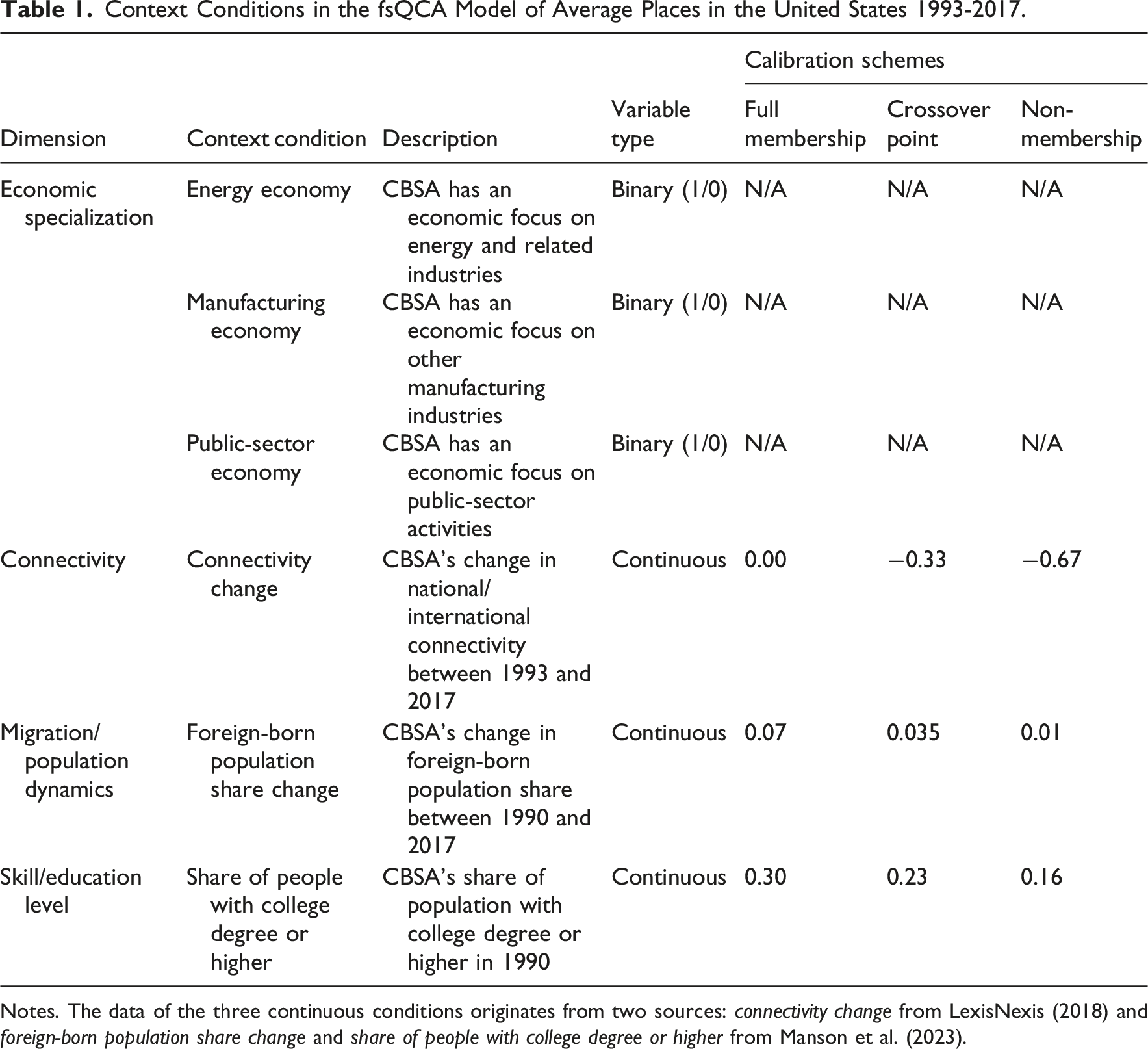
Notes. The data of the three continuous conditions originates from two sources: connectivity change from LexisNexis (2018) and foreign-born population share change and share of people with college degree or higher from Manson et al. (2023).
Data calibration
Using the six context conditions listed in Table 1, we were able to identify meaningful and interpretable growth pathways of average places. Three conditions were related to the economic specialization of average places; they were selected according to the most common sectoral specializations found in the 67 city-regions: (1) energy and related activities (economic activities around natural gas and oil extraction, refining, and the manufacturing of required equipment), (2) other manufacturing (traditional manufacturing sectors, such as food processing, textile and apparel, plastic production, and metalworking industries), and (3) public sector (especially public administration and healthcare). The three conditions for economic specialization were measured as a crisp set, based on employment and firm shares (backed by a content analysis of qualitative data sources), where ‘1’ represented a particular specialization (full membership) and ‘0’ no specialization (full non-membership).
The remaining three conditions were: (4) connectivity change (change in the number of subsidiary connections an average place had to other locations between 1993 and 2017, relative to scale—see Bathelt and Buchholz, 2024), (5) migration/population change (change in the foreign-born population share between 1990 and 2017), and (6) skill/education level (share of population with a college degree or higher in 1990). As the original values of these three conditions were continuous, they needed to be calibrated within a range from ‘1’ to ‘0’, where ‘1’ represents the presence of a condition and ‘0’ its absence. For each continuous condition, two cut-off points for full membership and full non-membership and one crossover point of maximum ambiguity had to be defined (Ragin, 1987). Since the distribution of values for all continuous conditions was unimodal—some being right-skewed and others more symmetrical—it seemed natural to choose values near the mode of each distribution as crossover points for our analysis. Similarly, cut-off points were chosen near the inflection points beyond which the distributions quickly flattened out. These were later checked in a robustness analysis. The calibration schemes for the continuous conditions are shown in Table 1. 7
Table A.1 in the Online Appendix includes our calibrated dataset for all average places, which can be used to replicate our analysis. Table A.2 shows the truth table, which indicates all combinations of causal conditions and their corresponding assigned outcome with at least one real case in our dataset.
Growth pathways of average places in the United States
fsQCA Solutions: Pathways for High-Growth Average Places in the United States 1993-2017.
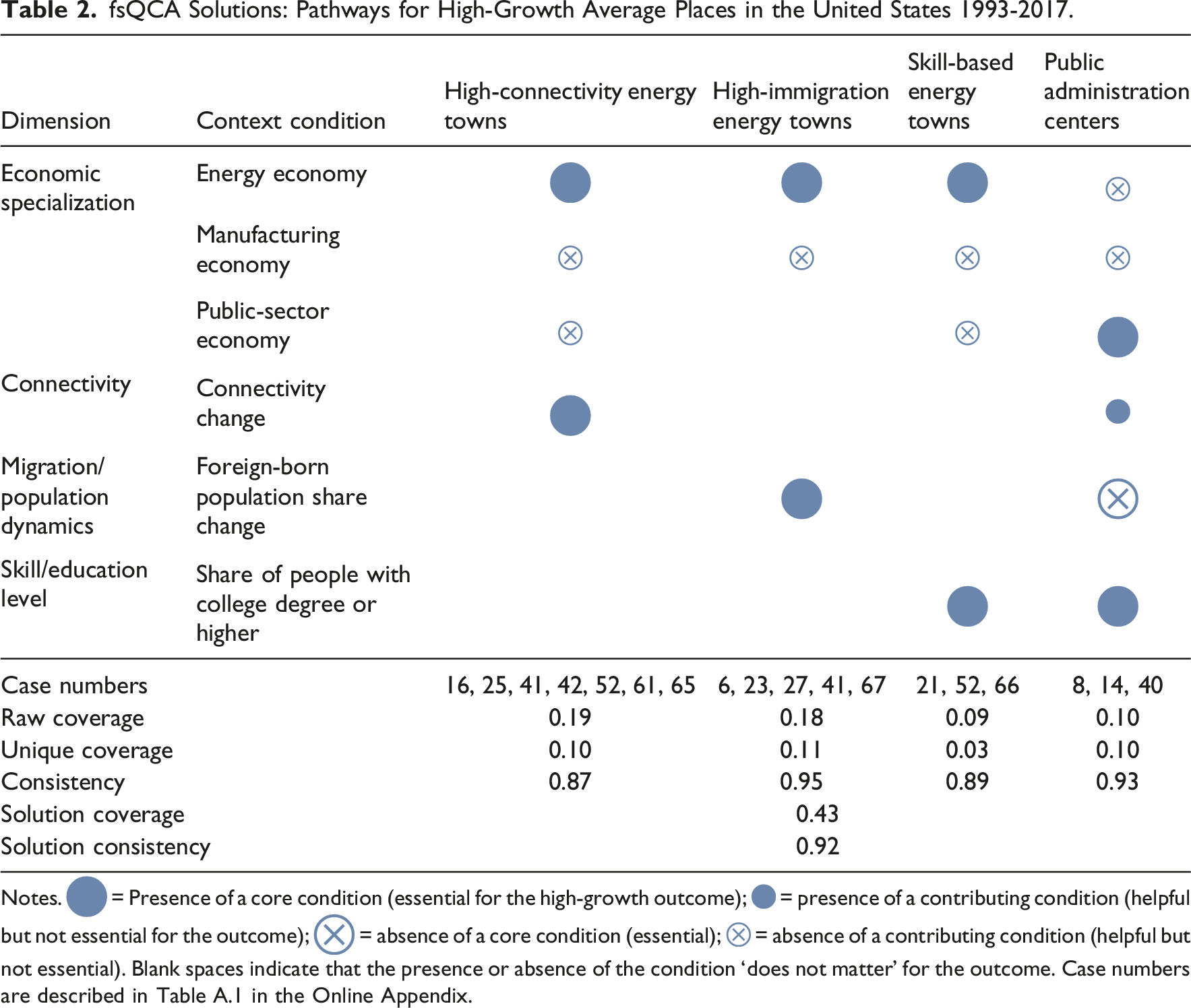
Notes.  = Presence of a core condition (essential for the high-growth outcome);
  = presence of a contributing condition (helpful but not essential for the outcome);
  = absence of a core condition (essential);
  = absence of a contributing condition (helpful but not essential). Blank spaces indicate that the presence or absence of the condition ‘does not matter’ for the outcome. Case numbers are described in Table A.1 in the Online Appendix.
With respect to interpreting the table, each column corresponds with one solution, and the symbols show how that specific solution is associated with each of the six conditions used in the analysis. Filled bubbles in the table indicate that the corresponding conditions are present, while bubbles with an ‘x’ refer to the absence of a condition. The size of bubbles indicates their importance for the solution: core conditions that are essential are characterized by large bubbles, while small bubbles mark contributing conditions that are helpful but not essential. ‘Blank’ spaces indicate when the presence or absence of a condition ‘does not matter’ (for an explanation, see Li and Bathelt, 2021).
Solutions identified through fsQCA are evaluated using two criteria: consistency and coverage. Consistency in our analysis measures to what degree cases with a specific combination of conditions are associated with high-income growth. The values in Table 2 are all above the minimum-threshold level of 0.75, as suggested by Ragin (2000, 2008). Coverage is an indicator of the proportion of high-growth average places that are associated with a specific solution. To test the stability of our fsQCA solutions, we conducted several rounds of robustness checks to see how changes in the calibration schemes of the continuous conditions impacted our solutions (Ragin, 2008; Rutten, 2022, 2024). The results of these checks can be found in the Online Appendix. 8
Growth pathway I: High-connectivity energy towns
Pathway I represents average places characterized by a strong energy economy (present core condition), while other manufacturing and the public sector are often underdeveloped (absent contributing conditions). Firms in these city-regions developed significant economic linkages with other regions through subsidiary linkages and attracted relatively high levels of inward investments (connectivity change as a present core condition). Increases in linkages with other regions and their economic players may have provided access to new technical capabilities and skills, which were important to exploit economic opportunities associated with the energy specialization, together contributing to high economic growth. Migration/population dynamics and skill levels were less important and ‘did not matter’ in these places. We refer to pathway I places as high-connectivity energy towns.
A good example of pathway I city-regions is the Snyder micropolitan statistical area in northwestern Texas. 9 Its economic trajectory is strongly shaped by its location in the Permian Basin with associated oil resources. The discovery of the first major well in Scurry County in 1948 led to a fundamental shift in the local economic structure, and the development of the nearby Kelly-Snyder Oilfield turned Snyder into an oil town with more than 25% of employment in 2017 linked with mining, quarrying, and oil and gas extraction (United States Census Bureau, 2017).
Aside from its strong energy economy with a dense network of drilling and fracking locations, which benefited from the oil boom during the observation period, Snyder experienced a remarkable increase in connectivity through new inward investments. From 1993 through 2017, the number of subsidiaries linked to the energy economy increased from zero to four (LexisNexis, 2018). Activities of these affiliates included drilling, pumping, construction, transportation, and commercial and investment services. This increase in economic connectivity was associated with significant benefits to the regional economy. Most importantly, these investments brought in new drilling/fracking technologies and helped implement more efficient oil production, but also generated skills and resources to improve market access and provided capital for expansion projects. This increased economic connectivity was critical to support the energy economy to exploit growth opportunities (even in wind turbines).
Growth pathway II: High-immigration energy towns
Pathway II describes average places with a similar economic specialization, dominated by the energy economy (present core condition) and the absence of manufacturing (absent contributing condition). In contrast to pathway I, corresponding city-regions were characterized by a substantial increase in the share of foreign-born residents (present core condition). These immigrants had skills that matched the demand for labor in the growing energy sector associated with fracking techniques. Average places of this type were in the southern parts of the United States and particularly benefited from migration from Mexico. In contrast, connectivity change and skill/education levels played a less important role (‘did not matter’). We refer to pathway II average places as high-immigration energy towns.
A typical average place representing pathway II is the Hobbs micropolitan statistical area in the southeastern corner of New Mexico. 10 The Hobbs region has significant oil and gas reserves due to its location in the Permian Basin and a long history as an energy town since the early 1930s. It developed into one of the top oil-producing areas in New Mexico (Business Facilities, 2018). Unlike pathway I energy towns, one of Hobbs’ supportive conditions was the strong growth of its foreign-born labor force in keeping up with the demand from the oil and gas industry. Due to its proximity to the U.S.-Mexico border, Hobbs had relatively easy and consistent access to immigrant workers from Mexico and other countries in the Americas. The inflow of immigrants resulted in substantial changes to Hobbs’ ethnic makeup: from 1990 to 2017, the foreign-born population increased from 7.2% to 16.8% of the total population, and the share of Latino residents reached 56.8% in 2017, playing a critical role in the local economy. According to the U.S. Census Bureau (2021), immigrant workers in 2017 accounted for 27.5% of workers in resource-based industries in Hobbs, compared to 7.2% in New Mexico and 2.6% in the United States.
This is, however, not an entirely positive story. Beyond the emphasis on fossil fuels, media reports (Hay, 2019; Hedden, 2021; Paraskova, 2019) highlight that local businesses in Hobbs often hire (im)migrant laborers (including temporary and undocumented workers) because they can be paid less and are willing to do more physically challenging and dangerous work than their U.S.-born counterparts. These workers have relatively few options in seeking employment and face stiff competition from a large pool of workers, suggesting that rising average incomes in Hobbs may have been accompanied by the exploitation of some marginalized workers.
Growth pathway III: Skilled energy towns
Like pathways I and II, average places associated with pathway III are also characterized by an economic specialization in the energy economy (present core condition) and the lack of a developed manufacturing and public-sector economy (absent contributing conditions). As opposed to the prior pathways, however, the skill/education level (share of residents with a college degree or higher) played a crucial role in these places as a present core condition, while economic connectivity and migration/population changes ‘did not matter’. Since the college-educated labor force is an important component of their growing energy economy, we refer to these places as skilled energy towns.
A typical case that represents pathway III city-regions is the Williston micropolitan statistical area, located on the northwestern border of North Dakota. 11 Sitting in the Bakken Basin, the substantial oil reserves in the area led to Williston’s energy focus since the 1950s, with a boom related to horizontal drilling and hydraulic fracturing since the mid-2000s (Conway, 2020; Kelley, 2020). However, Williston is characterized by a different trajectory compared with the energy towns discussed before, related to its skilled/well-educated labor force that can be employed in new technology fields. Unlike Texas and New Mexico, North Dakota does not have a similar inflow of immigrant labor. However, being aware that the oil business is characterized by bust-and-boom periods, North Dakota put significant efforts into improving its education system (Carnevale et al., 2013). Through ongoing training for workers in the college system, about half of its labor in the construction and extraction industries had a degree beyond high school in the 2010s, as opposed to Texas and New Mexico with only one-third. When oil prices plummeted in the mid-2010s and many oil workers were laid off, the region was able to retain these workers and utilize the education system’s retraining and specialization programs (Jean, 2015; Scheyder, 2015), some targeted toward laid-off oilfield workers, to help workers gain the technical skills or degrees required in energy-related industries. Associated with this, Williston’s population did not drop during the recent bust period but instead increased from less than 30,000 in 2013 to over 33,000 in 2017. The high priority on the education system helped the region build a labor reserve that can be mobilized during the next boom.
Additionally, Williston benefited from a well-developed financial services sector with community banks, credit unions, and private equity firms. This sector not only supported residential housing but also directed money to infrastructure projects and investments in the oil sector, particularly fracking ventures, at a time when large national financial groups were reluctant to fund such projects in the 1980s (Scheyder and Jonas, 2013). Altogether, the education system of the region produced a skilled labor force that, together with the financial sector, which funded oil-related investment projects, created an institutional context that supported continuous per-capita income growth and helped to prevent decline during bust periods.
Growth pathway IV: Public administration centers
In comparison with all other growth trajectories, pathway IV describes a completely different set of average places that are not characterized by a dominant energy economy or manufacturing sector (absent contributing conditions). Instead, these places have a specialization in public-sector activities (present core condition). Government-related firms in these city-regions played a regional or state-wide role in supporting public administration or healthcare. Relatedly, the share of foreign-born workers in these places was relatively low (absent core condition). Since work in public administration/government offices often requires specific skills, it is not surprising that the corresponding city-regions were also characterized by high skill levels (present core condition). Moreover, government-related firms were increasingly linked with supra-regional organizations and other government levels. The corresponding city-regions were thus characterized by increasing interregional connectivity through interfirm networks (connectivity as a present contributing condition). We refer to pathway IV average places as public administration centers.
The Helena micropolitan statistical area in central-western Montana is a typical case representing pathway IV average places. 12 Helena has been Montana’s capital since 1875 and serves as an administrative center in the state. In 2017, the public administration sector accounted for more than 17% of the workforce in the Helena area, much higher than the national average level of 4.7% (Manson et al., 2023). The presence of multiple tiers of government—federal, state, and municipal—transformed Helena into a state-anchored regional economy (Markusen, 1996) with significant government employment opportunities and associated multiplier effects. The city’s role as Montana’s capital attracted other economic activities and investments of firms from other regions. Related to this role, the number of establishments with subsidiary ties to other regions, mainly in the United States, grew from 11 in 1993 to 23 in 2017, ranging from food production to construction and knowledge-based services (LexisNexis, 2018). More than one-third of these establishments were in the financial sector or conducted government-related business such as administrative support, public campaign services, and media coverage. This economic structure was supported by a skilled labor force in the city-region, with 32% of residents over 25 years having a college degree or higher in 1990, compared to the U.S. average of 26% (Manson et al., 2023).
The successful growth trajectory of Helena is related to its strong public-sector economy, along with a supportive knowledge sector, especially financial services. This type of economy offered job opportunities for college-educated workers and encouraged important economic ties to other regions through organizational networks that supported skill transfers and extended market linkages.
Conclusion
Studies in economic geography and related fields, when explaining regional economic growth and successful development, often focus on agglomeration and clustering processes of major industries in mostly large city-regions (Derudder and Tayler, 2018; Kemeny and Storper, 2020; Maskell and Malmberg, 1999). Our research deviates from this work by looking at a different type of average places, asking why some of these places have performed very well in comparison with others. Our study focuses on small and medium-sized city-regions in the United States that were characterized by average incomes in 1993 but had high-income growth over the next 25 years. Using fsQCA with a set of socio-economic conditions that generally impact the development of small and medium-sized city-regions, we were able to identify four different development pathways of high-growth average cities: (I) high-connectivity energy towns, (II) high-immigration energy towns, (III) skilled energy towns, and (IV) public administration centers.
These findings suggest that there was no universal pathway for economic growth and that no single factor explains why some city-regions were more successful than others in terms of income development. The different pathways identified were rooted in the regions’ specific contexts and in different combinations of socio-economic conditions that equally enabled high-income growth. Instead of strong knowledge spillovers, high-technology innovation and self-reinforcing agglomeration processes, we found different explanations for these places’ development. Numerous average places did not clearly fit any of the trajectories identified but followed an idiosyncratic pathway based on unique context conditions. For regional policies, this presents a challenge as common approaches to stimulate growth in metropolitan areas may prove ineffective in the context of average places that are rather differently structured. Interestingly, and perhaps surprisingly, the trajectories of many high-growth average places were linked to their physical geography, especially their natural resource base and locational advantages. These included fossil fuels, the availability of fertile farmland, and locations in mountainous areas or near the ocean with attractive natural environments. Such factors that hardly play a role in current discussions on urban-economic development were deeply entrenched in these places’ history and institutional set-up.
Many places were associated with the surge of the U.S. energy sector through fracking and horizontal drilling techniques, while others were associated with prior investments into the public sector. Notably, the trajectories were not linked to other manufacturing specializations or a diversified economic structure. A sectoral focus was in itself, however, not sufficient to explain positive development outcomes. Not all energy towns automatically developed into high-growth places. While city-regions such as Coffeyville (KS) and Oil City (PA) stagnated, growing energy towns developed under different context conditions that included favorable skill/education levels, increases in extra-local connectivity, and strong migration/population dynamics. Pathway I cities relied on increasing connectivity through investments; pathway II city-regions were associated with high immigration; and those linked to pathway III benefited from high skill levels and a favorable education system.
Our research has also important implications for regional policy. It suggests that small and medium-sized city-regions may not benefit from the same types of development triggers as larger metropolitan areas and that there is no standard economic support policy that will be equally successful in all these places. Average places tend to be specialized and may not have the capabilities to branch into a wide range of sectors. Instead of looking for a ‘one-model-fits-all’ policy, it may be more adequate to consider existing economic advantages and how to strengthen and utilize these through place-based policy tools (Buchholz and Bathelt, 2021; Iammarino et al., 2019). This suggests that average places do not necessarily have to replicate the success stories of other places to prosper in their local settings.
Our findings regarding the importance of physical geography conditions and especially natural resources may seem surprising, given that the bulk of recent research in economic geography and related fields has emphasized factors like learning and institutions, as well as broader political economy influences, as drivers of uneven development (Freemark et al., 2020; Iammarino et al., 2019; Ketterer and Rodríguez-Pose, 2018; Kühn, 2015; Leyshon, 2021; MacKinnon et al., 2022; Peck, 2023; Pike et al., 2017; Rodríguez-Pose et al., 2023). One important consideration here is that average places have generally not experienced prior periods of exceptional growth. Like many cities that were ports or located near natural resources, their existence is linked to some aspect of their physical geography. In tourist towns, this may be unproblematic (with the caveat that tourism is notoriously volatile), but in average places that have grown due to the shale gas/oil boom, the political tides and economic fundamentals may not bode well in the long run. A promising development is that energy towns, such as Big Springs (TX) and Snyder (TX), have started diversifying into renewable energy industries, particularly through the establishment of large wind farms. Clearly, economic specialization patterns did not determine the growth pathways of average places but were associated with the mobilization of a different mix of influences that led to different trajectories. While the conversion of profits from shale gas/oil extraction towards building capabilities in sustainable energy production may be a promising long-term policy approach, whether such attempts will survive the hostile U.S. policy regime of the mid-2020s is an open question.
These considerations also open up important questions about whether the same underlying set of dynamics is at play in other world-region/national contexts. Compared to many other high-income countries, the United States is characterized by limited inter-personal and spatial economic redistribution (Esping-Andersen, 1990; Freemark et al., 2020). Where such policies are more prevalent, do average places rely less on problematic natural resources for their growth? Related questions around the role of physical geography and comparative political economy are important areas for future research on average places. In general, we should not expect that the same types of average places will be identified in different countries. This is because the very notion of an average place is highly contextual and depends on institutional conditions, economic specialization, and historical structures. In the context of Western Europe, we can therefore expect different kinds of urban areas with different institutional conditions to be identified as average places. Rather than expecting to replicate the findings of this study, future research should thus pay particular attention to the differences in average places and their characteristics when applying similar study designs to other urban systems.
This research joins the growing body of work in economic geography and regional studies using fsQCA in an attempt at ‘building better methods’ in our discipline: in our case, a systematic comparative analysis relying on a mix of qualitative and quantitative data. As opposed to other methods, it is important to emphasize (i) that fsQCA is a case-based, instead of variable-based, analysis, (ii) that it generates equifinal, instead of single, solutions, and (iii) that it is a flexible approach that has no predetermined outcome. With respect to the latter, the number of solutions the method produces varies with the number of conditions included in the analysis. What is appropriate depends on whether the goal is to identify idiosyncrasies in regional development or to find commonalities within a limited number of solutions that can be interpreted via the cases that represent them.
It should be emphasized that our investigation ended in 2017 before the COVID-19 pandemic, which was a major rupture to economic, social, and political life and may have affected the pathways identified in this research. In a few years, it would be interesting to investigate in a similarly-structured study how the pandemic and current changes in global and national political economy are shaping the configurations and trajectories identified in this paper. It should also be mentioned that a weakness of the fsQCA approach—as applied in this study—is that it remains at a structural level, which does not include specific actions of economic leaders or strategies of dominant firms that can have a strong impact on local development pathways. It is entirely possible that places with similar conditions therefore experience fundamentally different economic trajectories in the future—an aspect that further research should address specifically.
This paper, of course, only tells part of the story of average places by focusing on those that performed extraordinarily well over a 25-year period: 36 other city-regions had similar average income levels in 1993 but instead experienced slow growth and stagnation, shaped by different combinations of context conditions and different development pathways. These places receive their own space in a separate analysis, based on a comparable methodological approach. In such analysis, it is also important to identify similarities and differences in economic trajectories of high-growth and low-growth average places.
Supplemental material
Supplemental Material - Divergence of economic opportunity in average places: Pathways to growth
Supplemental Material for Divergence of economic opportunity in average places: Pathways to growth by Howard Hao Wang, Harald Bathelt, and Maximilian Buchholz in Progress in Human Geography
Footnotes
Acknowledgments
Parts of this paper, to which all authors contributed equally, were presented at the Global Conference on Economic Geography in Dublin in June 2022 and the Annual Meeting of the American Association of Geographers in Denver, CO in March 2023. We thank the audience for stimulating comments and Adams Aghimien, Cheryl Cheung, and Kevin Roy for terrific research assistance. Special thanks go to Pengfei Li and to the Reviewers of Progress in Human Geography for making excellent suggestions and providing guidance in the revision process.

Funding
The authors disclosed receipt of the following financial support for the research, authorship, and/or publication of this article: Financial support was provided by a Canadian Social Sciences and Humanities Research Council (SSHRC) Insight Grant (File Number 435-2019-0273).
Declaration of conflicting interests
The authors declared no potential conflicts of interest with respect to the research, authorship, and/or publication of this article.
Supplemental material
Supplemental material for this article is available online.
Notes
Author biographies
References
Supplementary Material
Please find the following supplemental material available below.
For Open Access articles published under a Creative Commons License, all supplemental material carries the same license as the article it is associated with.
For non-Open Access articles published, all supplemental material carries a non-exclusive license, and permission requests for re-use of supplemental material or any part of supplemental material shall be sent directly to the copyright owner as specified in the copyright notice associated with the article.
