




Abstract
Urban drainage infrastructure is generally designed to rapidly export stormwater away from the urban environment to minimize flood risk created by extensive impervious surface cover. This deficit is resolved by importing high-quality potable water for irrigation. However, cities and towns at times face water restrictions in response to drought and water scarcity. This can exacerbate heating and drying, and promote the development of unfavourable urban climates. The combination of excessive heating driven by urban development, low water availability and future climate change impacts could compromise human health and amenity for urban dwellers. This paper draws on existing literature to demonstrate the potential of Water Sensitive Urban Design (WSUD) to help improve outdoor human thermal comfort in urban areas and support Climate Sensitive Urban Design (CSUD) objectives within the Australian context. WSUD provides a mechanism for retaining water in the urban landscape through stormwater harvesting and reuse while also reducing urban temperatures through enhanced evapotranspiration and surface cooling. Research suggests that WSUD features are broadly capable of lowering temperatures and improving human thermal comfort, and when integrated with vegetation (especially trees) have potential to meet CSUD objectives. However, the degree of benefit (the intensity of cooling and improvements to human thermal comfort) depends on a multitude of factors including local environmental conditions, the design and placement of the systems, and the nature of the surrounding urban landscape. We suggest that WSUD can provide a source of water across Australian urban environments for landscape irrigation and soil moisture replenishment to maximize the urban climatic benefits of existing vegetation and green spaces. WSUD should be implemented strategically into the urban landscape, targeting areas of high heat exposure, with many distributed WSUD features at regular intervals to promote infiltration and evapotranspiration, and maintain tree health.
Keywords
I Introduction
Global cities and towns have been facing some significant environmental challenges over recent years including extreme weather events, drought and flooding. Such challenging circumstances have been evident across Australian cities and towns. In the week of 26 January 2009 to 1 February 2009, Melbourne experienced a record heat wave, with maximum temperatures exceeding 43°C over three consecutive days from 28 to 30 January, peaking at 45.1°C on 30 January. Health authorities determined that there were 374 excess deaths over the week-long period: an increase of 62% (DHS, 2009) over the number expected. For heat-related illnesses (heat stroke, heat syncope and dehydration), there was an 8.4-fold increase in emergency department presentations, and during the hottest three-day period emergency ambulance dispatches increased by 46% (DHS, 2009). Adelaide also experienced a heat wave around this period, with a mean maximum temperature of 41°C over 26 January to 3 February and a maximum of 45.7°C (Mayner et al., 2010). During this period, emergency department presentations increased by approximately 18% (Mayner et al., 2010). The elderly population (over 65 years) are particularly vulnerable to extreme heat (Van Iersel and Bi, 2009) which is of concern given Australia’s ageing population (Australian Government, 2010). Projections of future climate change from global warming in Australia suggest that there will be an increase in the frequency of heat wave events, but also their intensity, duration and extent (Alexander and Arblaster, 2009).
In addition to the risk from heat waves, the presence of the urban heat island (UHI) is likely to exacerbate the effects of extreme heat. The replacement of natural, vegetated landscapes with impervious infrastructures leads to excess heat storage which is slowly released at night. This, along with waste heat from anthropogenic activities and reduced radiative cooling in urban canyons, supports warmer urban temperatures. Research by Morris and Simmonds (2000) for Melbourne found that between 1973 and 1991 and when anticyclones were positioned over the southeast coast of Australia (which supported optimal UHI genesis), mean UHI intensities were 3.56°C. Torok et al. (2001) observed a peak UHI intensity of 7.1°C between the CBD and the city’s rural outskirts at 9 pm on the evening of 26 August 1992. Coutts et al. (2010) present an UHI profile for 1 am on 26 March 2006 showing a peak UHI intensity of around 4°C between the inner city and the rural outskirts. The UHI keeps minimum temperatures in developed areas higher than in rural areas, and can restrict night-time recovery from daily heat stress. Nicholls et al. (2008) examined heat and mortality relationships in Melbourne for those over 65 years from 1979 to 2001. They found that when daily minimum temperatures exceeded 24°C average daily mortality for those over 65 increased by 19–21% (Nicholls et al., 2008). A combination of urban development and associated increases in UHI intensity, along with a projected increase in hot nights (Alexander and Arblaster, 2009) and warming from climate change, is likely to increase population exposure to higher temperatures, and compromise the comfort and well-being of urban inhabitants (Smith and Levermore, 2008).
Adding vegetation in urban areas has been shown to reduce urban temperatures and is regularly cited as a key mechanism for UHI mitigation (Lynn et al., 2009; Rosenfeld et al., 1998; Rosenzweig et al., 2009; Zhou and Shepherd, 2010) as well as climate change adaptation (Gill et al., 2007). Bowler et al. (2010) reviewed studies that investigated the effects of green space on temperature and found that urban greening in the form of parks and trees may act to cool the environment. The review also found that both shading and evaporative cooling played a role in lowering urban temperatures (Bowler et al., 2010). What receives less attention is the role of water in influencing urban climates through both irrigation and the support of urban vegetation. Impervious urban surfaces prevent infiltration, and runoff is rapidly exported away from urban environments via the stormwater network. This produces a deficit of water in urban areas, and reduces soil moisture levels – a deficit that is often balanced by imported potable water for irrigation. Unfortunately, much of Australia experienced extended dry periods over the last two decades, particularly in the southern cities of Perth, Adelaide and Melbourne, which have placed pressure on city water resources. In a bid to manage potable water supplies from centralized sources, State Governments introduced various compulsory and voluntary strategies to encourage water saving across the community – including outdoor water restrictions. Residents have become highly diligent in saving water in response to outdoor water restrictions, but existing urban vegetation has also struggled with reduced water availability. Residents have adapted gardening approaches to cope with less potable water supplies by planting more drought-tolerant species, and new developments are more commonly designed with xeric style gardens. Each of these factors of drought, water restrictions and xeric gardens, along with the reduced health of urban vegetation, may further exacerbate urban warming and energy demands (Larson et al., 2009).
An approach that could be implemented to assist in dealing with these challenges is improved stormwater management, through Water Sensitive Urban Design (WSUD). WSUD involves technologies and approaches that aim to retain water in the urban landscape through stormwater harvesting and fit-for-purpose reuse and infiltration into soils to meet ecological, social and financial objectives. These objectives include: reductions in stormwater pollutant loads; maintenance of pre-development hydrology; visual amenity; water provision for irrigation during periods of water restrictions; reduced need for downstream stormwater infrastructure; and supplementing of centralized water supplies (Hatt et al., 2006). This paper provides an assessment from existing literature, of the potential for WSUD to mitigate against the effects of urban heating and uncomfortable thermal environments brought about by the UHI, climate change and more extreme heat waves/events. The reintegration of stormwater into the urban landscape through enhanced infiltration and irrigation using harvested stormwater has the capacity to increase soil moisture, increase water availability for urban vegetation and, along with green infrastructure, provide a mechanism for improving urban climates. The set of circumstances experienced across Australian urban environments provides a unique context for an assessment of the effectiveness of WSUD, and demonstrates that urban climate improvement through Climate Sensitive Urban Design (CSUD) should be added to the list of objectives for WSUD. Universal guidelines are presented on how WSUD might be most effectively applied to achieve more thermally comfortable urban environments.
II Water Sensitive Urban Design and Climate Sensitive Urban Design
The definition of WSUD varies among practitioners across Australia; however, we use the definition provided by the National Water Initiative – ‘the integration of urban planning with the management, protection and conservation of the urban water cycle, that ensures urban water management is sensitive to natural hydrological and ecological processes’ (National Water Commission, 2004: 30). WSUD is also commonly known as Low Impact Development (LID) in the USA or Sustainable Urban Drainage Systems (SUDS) in the UK (Morison et al., 2010) and aims to minimize the hydrological impacts of urban development (Lloyd et al., 2002), specifically targeting stormwater. In a demonstration of the ability of WSUD to minimize the hydrological impacts of urban development, Dietz (2007) showed that LID approaches could retain stormwater on site (rather than being exported away) and therefore mimicked pre-development hydrological function. The definition of WSUD is broadening towards the consideration of the integrated management of the urban water cycle with urban planning and design (Wong, 2006) but in practice still tends to focus on stormwater management. WSUD for stormwater management involves the collection, treatment and storage of stormwater through features such as vegetated bio-retention systems, porous pavements, wetlands, bio-swales rainwater tanks and distribution through irrigation (Fletcher et al., 2008) (Figure 1).

Schematic representation of widespread implementation of stormwater harvesting and Water Sensitive Urban Design elements at the micro-scale in the restoration of a more natural water balance, along with increased vegetation cover. This enhances urban evapotranspiration and shading resulting in local-scale cooling effects that can improve human thermal comfort. (See colour version of this figure online).
Climate Sensitive Urban Design (CSUD) (also known as Climate Responsive Design or Bio-climatic Design) is not as straightforward, and there is a paucity of definitions available. Simply interchanging the word ‘water’ for ‘climate’ in the definition of WSUD would imply that the ‘pre-development’ climate of the region should be maintained or restored which is unrealistic and impossible to achieve at the micro-scale. There are also examples of urban environments that are more environmentally acceptable to urban residents than surrounding rural landscapes (e.g. a well irrigated and vegetated city surrounded by desert) and infrastructure can serve to enhance urban environments (e.g. building shading). Emmanuel (2005b) states that the goal of CSUD is captured by the term ‘bio-climatic design’ and is essentially about designing for the human being, leading Climate Sensitive Urban Designers and architects towards a focus on thermal comfort (Emmanuel, 2005a). However, CSUD also requires architecture to be in harmony with nature (Emmanuel, 2005b) and Oktay (2002) also suggested designing with a sense of place, taking into consideration the positive and negative aspects of a site. Grimmond et al. (2010) suggest insensitive building developments require unsustainably large energy resources to keep inhabitants comfortable. CSUD tends to have two primary objectives: (1) CSUD in building design to create more energy-efficient buildings and comfortable indoor environments (e.g. Manioglu and Yilmaz, 2008; Okeil, 2010; Strømann-Andersen and Sattrup, 2011); (2) CSUD in landscape design to create more attractive outdoor spaces that target improvements in human thermal comfort (HTC) (e.g. Erell et al., 2011; Johansson, 2006; Keeble et al., 1991; Mayer and Höppe, 1987; Oke, 1988a). This involves designing for temperature, humidity, wind, and solar access (environmental determinants of HTC; Höppe, 1999) to maintain thermal equilibrium of the human body with the environment (Erell et al., 2011). We suggest that ‘Climate Sensitive Urban Design creates thermally comfortable, attractive, and more sustainable urban environments by enhancing positive natural and man-made features through architecture, planning and landscape design’.
Given the Australian context, we propose that WSUD can provide a mechanism for supporting Climate Sensitive Urban Design by promoting localized cooling at the micro- to local-scale (Figure 1) through enhanced evapotranspiration and surface cooling, and, when integrated across the city, limit UHI intensities and improve HTC. Figure 1 emphasizes how the implementation of WSUD elements at the micro-scale restores a more natural water balance in the urban environment. WSUD features enable infiltration, thereby supporting water loss in the outdoor urban environment through subsurface flows and evapotranspiration, rather than surface runoff (exported stormwater). We propose that WSUD features promote micro-scale cooling effects through evapotranspiration and surface cooling, and when implemented extensively across the urban landscape (e.g. Figure 1 – micro-scale), can promote local-scale cooling (e.g. Figure 1 – local-scale). This paper reviews previous research to determine the capacity of WSUD elements to provide such cooling effects and improve human thermal comfort, and how to maximize these cooling effects through urban design.
III Urban climate, vegetation and water
Urban energy and water balances are connected through evapotranspiration (Grimmond et al., 1991) and the magnitude of evapotranspiration influences the partitioning of convective energy and hence many of the urban climate features observed (Grimmond et al., 2010). Evapotranspiration can directly modify the urban water balance (Figure 1) and subsequently flow through to modifications of the urban energy balance, which is a fundamental controller of urban climates. Hence, there is a potential for modifying evapotranspiration to control/mitigate urban climate. The urban energy balance for a surface layer urban volume is given by:

where Q* is the net all-wave radiation (solar and terrestrial radiation), QF the anthropogenic heat flux, QH the sensible heat flux (atmospheric heating), QE the latent heat flux (or evapotranspiration), ΔQS the net storage heat flux, and ΔQA the net horizontal advective heat flux (Grimmond et al., 2010). The urban water balance is given by:

where P is the precipitation, I the piped water supply, E the evapotranspiration, D the drainage (comprising stormwater and wastewater) and ΔS is the net change in water storage of the urban system (Mitchell et al., 2008). Hence the connecting component is evapotranspiration (QE = E). Manipulating the water balance through WSUD to enhance evapotranspiration (Figure 1) modifies the energy balance, reducing sensible heat fluxes (or atmospheric heating). While vegetation cover is considered a primary control on the urban energy balance, water availability receives less consideration.
Local-scale observations of the urban surface energy balance using micrometeorological techniques (Grimmond et al., 2004; Peters et al., 2011; Spronken-Smith, 2002) has assisted in quantifying rates of evapotranspiration. General patterns have emerged between urban land use, vegetation cover and evapotranspiration – with comparative studies demonstrating that, generally, as vegetation cover increases, evapotranspiration increases (Christen and Vogt, 2004; Offerle et al., 2006). Increasing evapotranspiration then limits energy partitioning into urban heat storage, as well as sensible heating of the atmosphere. As such, increasing vegetation is commonly suggested as a primary mechanism for UHI mitigation. However, there are exceptions to this generalization and, as Oke (1988b) describes, there are spatial and temporal complexities, with a key factor in this appearing to be water availability. Coutts et al. (2007) found that for three local-scale suburban tall-tower sites in Melbourne, Australia, evapotranspiration rates were relatively low given the amount of vegetation cover at the sites (35–47%) and attributed this to the drought and presence of water-use restrictions. Increases in water availability through irrigation have been found by Oke and McCaughey (1983) to increase evapotranspiration rates by 40% in a suburban neighbourhood in Vancouver, Canada, compared to a nearby rural landscape during the day. Meanwhile, Grimmond and Oke (1995) found that variability in evapotranspiration rates across four North American cities was influenced by vegetation, precipitation and irrigation and suggested that an inverse relationship between the mean daytime Bowen ratio (the ratio of sensible heat flux to latent heat flux) and irrigation may exist. Urban climates are strongly connected to vegetation cover and water availability, with vegetation being an important conduit for water loss to the air (Oke et al., 1989).
While increasing vegetation cover is commonly cited as a key UHI mitigation approach, an inherent assumption is that vegetation (including trees and grass) is healthy and water is available to support transpiration and thriving canopies to promote shading. In urban areas, limited water availability due to export of stormwater, restricted irrigation and drought can leave vegetation highly stressed. Urban street trees also face high heat and radiation loads (Oke et al., 1989), and high vapour pressure deficits , which can constrain stomatal conductance (Chen et al., 2011) and can lead to leaf senescence (Munn-Bosch and Alegre, 2004), restricting transpiration. If tree stress is very high and if the right meteorological conditions prevail, trees can lose a proportion of their canopy coverage, reducing leaf area index (Hsiao, 1973) and transpiration, and become less efficient at shading urban surfaces (Shashua-Bar et al., 2010a). Extreme conditions can lead to embolism and death (Gaspar et al., 2002). This compromises the ability of vegetation to act as a cooling mechanism, which is concerning given that it is commonly during extreme conditions when the cooling effects of trees are needed. Ensuring adequate water availability for tree root systems is critical to maintaining tree health, especially under additional pressures from climate change (e.g. heat and drought) (Allen et al., 2010) and urban development.
Choosing the most appropriate tree species to promote cooling while also ensuring tolerance to current and future climate conditions will be critical, but there is very little data on tree physiological controls and responses in Australian urban environments. Pataki et al. (2011a) state that tree water is important in influencing vegetative cooling and has been shown to be highly species-specific in urban forests. The choice of tree species and density of tree planting is important in the context of CSUD and sustainable water management, but current understanding of different tree species’ water use and ‘climate performance’ is limited (Peters et al., 2010). Thought should also be given to the resilience of tree species under climate change. Peters et al. (2010) undertook an assessment of tree transpiration from dominant tree species in a suburban neighbourhood of Minneapolis-Saint Paul, Minnesota, USA, and found that evaporative responses to climate change in urban ecosystems were likely to depend in part on species composition. Pataki et al. (2011b) warns that large-scale tree planting may place additional pressure on already constrained water supply systems due to irrigation requirements. Therefore, species selection, along with fit-for-purpose alternative water sources (e.g. stormwater) could play a critical role in maintaining healthy urban vegetation and maximizing urban cooling.
Stormwater is an abundant source of water in urban areas and stormwater runoff in Australian cities can be similar to, or even higher than, the total potable water consumption (PMSEIC, 2007). In 2010, Melbourne’s annual potable water consumption sourced from water supply catchments was 356 GL, while the total available stormwater runoff was 463 GL (LVMAC, 2011). At present traditional stormwater infrastructure (i.e. drainage) rapidly exports stormwater away from the urban environment which promotes dry urban landscapes. Separate stormwater and wastewater removal systems in Australian cities makes stormwater harvesting a viable option for providing augmented water supplies that are fit for the purpose of irrigation and use in WSUD. The hypothesis is that using WSUD to reintegrate stormwater back into the urban landscape helps to restore the water balance and influence the urban climate by modifying the urban radiation budget and surface energy balance. This in turn drives the environmental parameters that influence human thermal comfort. While this sounds promising theoretically, there is limited empirical evidence demonstrating the climatic benefits of WSUD.
Figure 2 theorizes the key processes involved in developing urban micro-climates (modified after Oke, 2009) during warm summertime conditions between a conventional (water limited) urban landscape (Figure 2, a and c) and a water sensitive urban landscape (Figure 2, b and d), which each exert environmental influences on HTC (e.g. temperature, humidity, mean radiant temperature and wind speed). During the day when aiming to limit heat stress, promoting shading and limiting atmospheric heating are important for creating a more comfortable thermal environment. The water sensitive scenario (along with healthy vegetation) serves to increase shading, evapotranspiration and reduce surface temperatures, thereby reducing QH and radiative loadings on pedestrians, as well as supporting an overall reduction in QG (Figure 2b). This is in contrast to a more conventional urban landscape (Figure 2a) where water is limited and vegetation health is compromised. Under this arrangement, QH dominates, and intense surface heating and reduced shading supports higher radiative loading on the human body. This also increases energy demand for cooling, increasing QF. At night, promoting long-wave cooling and ventilation is important for creating a more comfortable thermal environment, and the water sensitive scenario (having generally stored less heat during the day) is less conducive to supporting urban canopy layer warming (Figure 2d) than the conventional urban layout (Figure 2c).

Generalization of key processes in the formation of urban micro-climates during summer for conventional (water limited) urban landscapes (a and c) and water sensitive urban landscapes (b and d). Day (a and b) and night (c and d) conditions are presented. Surface radiative and energy balance processes are presented with arrows denoting direction and relative strength of fluxes. The relative level of human thermal comfort experienced in each case is also presented by the human and the corresponding human thermal comfort (HTC) scale. In the conventional urban landscape during the day, a combination of high sensible heat fluxes and strong radiative heat loading results in a hotter environment for urban dwellers. In contrast, the water sensitive landscape provides higher water availability to soils and waterways, along with healthy, full canopied vegetation, compared to conventional water limited, xeric urban landscape. WSUD increases evapotranspiration and shading, and reduces surface temperatures, limiting radiative and heating loads resulting in improved human thermal comfort. Reduced heat storage during the day is beneficial at night, as less energy is available to support ongoing low-level atmospheric warming. Cooler outdoor environments along with reduced heat transfer into buildings limits the need for indoor air conditioning and associated anthropogenic heating. Other factors may also be influential, but are not presented here, such as air pollution effects on radiation and wind flows. (See colour version of this figure online).
The following synthesis draws on existing research to demonstrate current knowledge on climatic benefits of WSUD and support the processes presented in Figure 2. This review focuses primarily on the outdoor thermal environment, taking into consideration temperature, humidity, wind and solar access – and the effects of vegetation. The scope of this synthesis is primarily limited to empirical observational studies that attempt to quantify the CSUD benefits within the urban canopy layer, of increasing water availability and implementing WSUD type features throughout the landscape. The scale of interest focuses primarily at the micro-scale, as this is the scale of implementation of WSUD, up to the local-scale where the effects of landscape irrigation may be seen. Given that vegetation is commonly integrated with WSUD, this synthesis also briefly touches on observational studies that attempt to quantify the CSUD benefits of vegetation to understand its role as a component of WSUD (detailed reviews have focused on vegetation previously; e.g. Bowler et al., 2010; Chen and Wong, 2009). Selected modelling studies have also been included to supplement observational studies, but only when the study focuses specifically on WSUD or irrigation. Studies that draw solely on remote sensing have not been included. Emmanuel and Johansson (2006) propose that there is a need for more assessment of climate sensitive design approaches through both observational and modelling studies. Given the growing support for WSUD, it is important to assess the additional benefits for UHI mitigation and CSUD from increased water availability, and to provide insight into how to maximize these benefits through architecture and landscape planning.
IV Potential urban climate benefits of WSUD
Understanding the climate benefits of WSUD is important, as a number of State and Local Governments in Australia are encouraging the implementation of WSUD through policy and practical actions to support WSUD objectives. For example, the Tasmanian State Stormwater Strategy sets out key principles and standards for managing stormwater, such as in new urban developments where ‘All new developments that create 500 m2 or more of additional impervious surface, including subdivisions, roads and other large developments, should incorporate best practice stormwater management’ (DIPWE, 2010: 2). In the State of Victoria, Clause 56.07 of the Victorian Planning Provisions requires new residential subdivisions of two or more lots to incorporate ‘integrated water management’ principles. This includes the management objectives for urban runoff of Clause 56.07-4 which aims ‘To minimize increases in stormwater run-off and protect the environmental values and physical characteristics of receiving waters from degradation by urban run-off’ (VPP, 2006: 2). The following sections explore empirical evidence for supporting the inclusion of CSUD as an objective of WSUD implementation as highlighted above.
1 Insights from studies on vegetation and green space
WSUD commonly integrates vegetation into its design, or provides an alternative water source (e.g. rainwater tank) for irrigation of vegetation. There are few studies that consider the climatic effects of WSUD itself, but insights can be drawn from studies of vegetation and green space to infer the likely benefits supporting CSUD. At the micro-scale, trees have been shown to be particularly beneficial in lowering urban temperatures (Tsiros, 2010) and improving HTC (Georgi and Dimitriou, 2010) due to both transpiration and shading. Important determinants of the intensity of cooling from vegetation include tree location, size and canopy coverage, planting density and irrigation management (Pataki et al., 2011a; Shashua-Bar et al., 2010a) and as much as 80% of the cooling effect of trees is from shading (Shashua-Bar and Hoffman, 2000). ‘Grey’ infrastructure (e.g. buildings and urban infrastructure) is also important in determining the effectiveness of vegetation for urban cooling. Trees are particularly effective in east–west oriented street canyons (Ali-Toudert and Mayer, 2007b) and in wider, shallower street canyons (Shashua-Bar et al., 2010a) because they provide more shading under these arrangements. Water consumption for irrigation of vegetation is critical, as water and landscape managers are likely to seek efficient water use while maximizing cooling, even when stormwater is used. Shashua-Bar et al. (2009) compared the water efficiency of different common urban cooling approaches, including irrigated grass, shade trees, and shade mesh in two adjacent courtyards at the Sede-Boqer campus of Ben-Gurion University, Israel. They found that a combination of irrigated grass and shade trees was the most effective in cooling, while the vegetation alone achieved the highest cooling efficiency per amount of water used (Shashua-Bar et al., 2009). This research demonstrates how effective vegetation is in urban cooling, and begins to draw out the most effective strategies for maximizing cooling effects.
Analysis of the role of green spaces in urban areas provides further insight into how WSUD features at a range of scales may act to support CSUD. Upmanis et al. (1998) have shown that parks can be several degrees cooler than the surrounding urban area, in a feature known as the Park Cool Island (PCI). PCI intensity is often largest at night (like the UHI) and tends to increase with park size (Upmanis and Chen, 1999). Parks with extensive tree coverage tend to be cooler during the afternoon due to shading effects, while more open parks with turf are cooler at night due to greater long-wave radiative cooling (Figure 2) (Chang et al., 2007; Spronken-Smith and Oke, 1998). Hence, important controls on PCI intensity include the park’s size and characteristics, the nature of the surrounding landscape, the macro-scale climate, and irrigation rates. PCIs are often best developed in drier, hotter climates, because evapotranspiration is enhanced due to oasis effects and because of more intense heating of the urban landscape surrounding the park which supports greater urban-park temperature contrasts. This point emphasizes the importance of the surrounding urban landscape, as PCI are a comparative measure, and PCI intensity is determined not only by the characteristics of the park, but also by the characteristics of neighbouring urban surfaces. Jauregui (1990) observed that, after sunrise, Chapultepec Park in Mexico City was actually warmer than nearby urban areas because of the high thermal mass of urban materials which took longer to warm up, though the night-time PCI was around 2–3°C. PCIs can also exert a downwind cooling effect (Figure 1) which Spronken-Smith and Oke (1998) suggest extends to about one park width, but the influence reduces rapidly with distance away from the park boundary. The downwind extent is influenced by wind speed and direction, layout and height of surrounding buildings, and the LAI of parks (Chen and Wong, 2006). Implementation of WSUD should be fit-for-place, drawing on information such as this to strategically design WSUD into urban landscapes to maximize cooling (Figures 1 and 2).
While many studies tend to focus heavily on mitigating elevated temperatures, CSUD should consider all environmental determinants of HTC. For instance, Clarke and Bach (1971) compared the environmental parameters of HTC above grassed and paved surfaces in both downtown Cincinnati and a suburban area 27 km away. They found that during the day micro-climates above the grassed surfaces were consistently more comfortable, and the differences were larger in the downtown streets (Clarke and Bach, 1971). While temperatures under tree canopies may be reduced (especially during the afternoon), there is evidence that at times, relative humidity can be elevated, as is vapour pressure during afternoons and evenings (Souch and Souch, 1993). This was shown in a study of a PCI in Mexico City during the rainy season where again, temperatures were lower compared to surrounding areas, but humidity (vapour pressure) can be higher. However, the net effect on HTC is an overall improvement because the benefits from reduced temperature are larger (Barradas, 1991). During the day, mean radiant temperature is the single most important meteorological factor influencing the human energy balance in summertime conditions (Matzarakis et al., 2007) and hence has a major influence on HTC. Therefore, trees can provide a substantial improvement to HTC by blocking solar radiation (Picot, 2004), even if air temperature reductions are negligible (Shashua-Bar et al., 2010b). Once again, while vegetation and green space can have a positive influence on HTC, it is just one component of the landscape that influences the human thermal experience. Street design (including height to width ratio) and orientation also have an influence on HTC by influencing shading and wind flow patterns (Ali-Toudert and Mayer, 2007a; Johansson, 2006), so Climate and Water Sensitive Urban Design needs to consider both the natural and built components in designing urban landscapes. As highlighted earlier, more research is needed into tree physiological controls and responses in Australian urban environments, and identifying plant species that can maximize improvements in HTC by the assessment of plant traits such as LAI, transpiration rates and resilience to climatic extremes.
Pataki et al. (2011a) suggest that while the many commonly cited environmental benefits of urban green space are still poorly supported by empirical evidence, there is a high potential for urban cooling from urban green space. What is less clear is the influence of reintegrating water back into the urban landscape and the capacity for WSUD to support urban cooling and improving HTC. The provision of water for outdoor urban environments and irrigation can be met through potable water supplies, recycled water and/or harvested stormwater. In the following sections, we focus on the impacts of providing fit-for-purpose water supply through stormwater harvesting and WSUD. This includes the common WSUD approaches of: stormwater harvesting for supporting irrigation; treatment wetlands and open water bodies; bio-retention systems; infiltration systems; and green roofs and green walls.
2 Stormwater harvesting for supporting irrigation
Stormwater harvesting involves the collection and storage of runoff in urban areas. The simplest form of stormwater harvesting involves gutter-pipe systems such as rainwater tanks, while more complex storage systems may include constructed wetlands, where urban runoff can be stored for treatment and drawn on for irrigation. Stormwater harvesting can also involve treatment trains, where runoff may be treated through a bio-filtration system before storage in a tank, providing higher-quality water for multiple end uses. Aquifer Storage and Recovery is another and more advance approach, where underground aquifers are artificially recharged by infiltrating stormwater through permeable media or via direct injection, and the water is recovered later for indoor and outdoor use (Khan et al., 2008). These approaches for stormwater harvesting all provide a source of water for irrigation.
Large-scale irrigation has the potential to influence the climate (Oke, 1987) through modification of the surface energy balance, and studies have shown that irrigation is an important driver of climate variability. Increasing the amount of irrigated vegetation is likely to increase evapotranspiration and reduce heat storage through shading (Figure 2), and hence support night-time cooling (UHI mitigation) (Gober et al., 2010). Harvested stormwater can provide a fit-for-purpose source of water for landscape irrigation, and when liberally applied to the landscape can support high evapotranspiration rates (Oke and McCaughey, 1983). Well watered green spaces such as irrigated parks can support oasis effects, which can occur whenever there is a cool, moist surface that is dominated by larger-scale warmer and drier surroundings. At the smallest scale, this could be an isolated tree in an urban street (Oke, 1987). This has been observed for both irrigated parks (where evapotranspiration rates were three times that of the surrounding residential neighbourhood) (Spronken-Smith et al., 2000) and irrigated suburban lawns (Oke, 1979; Suckling, 1980).
In a study of variability of neighbourhood microclimates during hot, summer conditions in Boulder, Colorado, Bonan (2000) found that irrigation mitigated surface heating during the day, and early afternoon air temperatures in irrigated areas were cooler than those in non-irrigated and urban areas. Irrigation also increases the capacity of the soil to act as a heat sink and supports lower surface temperatures through evaporative cooling, in contrast to impervious surfaces where water cannot infiltrate. Mueller and Day (2005) showed that surface, soil and canopy air temperatures for a 6 × 11 m irrigated turf grass (mesiscape) plot were cooler during the day than concrete, asphalt and gravel xericscape plots because of evapotranspirational cooling, while humidity (vapour pressure) was also higher above the mesiscape. This highlights the potential for evaporative cooling in reducing localized air temperatures, but may increase humidity. Grossman-Clarke et al. (2010) investigated the role of irrigation for cooling during extreme heat events in Phoenix using the Weather Research and Forecasting Model (WRF), in conjunction with the Noah Urban Canopy Model, and found that irrigation provided cooling of 0.5–1° K in maximum daytime and minimum night-time temperatures across most of the area, but was more evident in areas of extensive mesic vegetation (∼2 K) than areas of xeric land use (∼0.5 K).
While increasing soil moisture may support surface cooling during the day, higher soil water contents can actually serve to increase the heat capacity of soils, meaning they may not cool as rapidly at night compared to dry soils. In a comparative study of different parks in Sacramento and Vancouver, Spronken-Smith and Oke (1998) suggest that irrigation is also an important control on the intensity of PCIs. In Sacramento, the state of water availability (along with shade and surface albedo) was an important control of park surface temperature during the day, with the relative coolness of irrigated green space favouring PCI development through evaporative effects. Interestingly, surface temperatures of dry parks during the day could actually be higher than the surrounding urban neighbourhoods (Spronken-Smith and Oke, 1998). In contrast, surface temperatures of drier parks cooled more rapidly at night due to lower soil thermal admittance, and appeared important in supporting slightly larger night-time PCIs (Spronken-Smith and Oke, 1998). Meanwhile, Mueller and Day (2005) observed during summer that canopy air temperatures in their xeriscape plot during the day were higher than asphalt and concrete, but were not significantly different from the mesiscape plot at night. So, while irrigation may serve to slightly slow surface cooling of soils at night, irrigation is beneficial in reducing surface heating of dry pervious surfaces during the day (which are more prominent during periods of drought and water restrictions) and xeriscapes (rising in response to low water availability). WSUD technologies can provide low-energy, decentralized stormwater storage, and fit-for-purpose water supply for use in landscape irrigation, and complement centralized supplies to avoid a trade-off between water consumption and urban climate degradation. However, the capacity to meet irrigation needs through stormwater harvesting will vary across Australian cities depending on the regional climate and the city’s water demand regime. In Brisbane, for instance, with a subtropical climate, the greatest demand for irrigation during the year coincides with the period of highest rainfall. In contrast, Melbourne’s temperate climate leads to a more seasonal irrigation demand, while rainfall patterns are more uniform throughout the year, so storages need to be designed accordingly (Mitchell et al., 2006).
3 Treatment wetlands and open water bodies
In order to meet stormwater quality objectives, such as those prescribed by Victoria’s Clause 56 regulations, a common approach of developers is to integrate stormwater treatment wetlands into residential subdivisions. This also allows developers to meet public open space requirements, and wetlands currently tend to have lower establishment and maintenance costs than more dispersed source control methods like vegetated bio-filtration systems. Similar to the downwind cooling effects of parks (Upmanis et al., 1998), wetlands are also likely to provide downwind cooling influences – a feature known as the Lake Effect (Saaroni and Ziv, 2003). Similar to irrigated urban parks (Spronken-Smith et al., 2000), open water bodies provide a source of moisture to support oasis effects during the day, especially when the area is dominated by larger-scale warmer and drier surroundings (Oke, 1987) of the urban environment. Even water features (e.g. fountains) have the potential to alleviate high urban temperatures through enhanced evaporation (Smith and Levermore, 2008).
A growing number of studies investigate the effects of open water bodies (whether they are treatment wetlands, ponds, rivers or water features) on the climate of urban areas. Generally, studies have shown that temperatures adjacent to and downwind of water bodies are reduced by around 1–2°C compared to surrounding areas nearby, with a maximum temperature reduction seen during the day (Chen et al., 2009; Nishimura et al., 1998; Saaroni and Ziv, 2003). Chen et al. (2009) attributed this temperature reduction to evaporation from the water body, while Saaroni and Ziv (2003) attribute the downwind cooling influence of the pond (1.6°C at midday) in the warmest part of the day to reduced sensible heat flux, as the lake surface was cooler than the surrounding park’s grass cover and the daytime cooling effects were evident under both hot-and-dry and sultry weather conditions. The study by Saaroni and Ziv (2003) of a 100 m wide pond within an urban park in Tel Aviv, Israel, also demonstrated higher humidity and a lower heat stress during the day downwind of the pond. However, later in the day when the grass cover cooled to lower temperatures than the lake surface, evaporative cooling was the main driver for temperature reductions, but this increased humidity, and therefore increased the heat stress (Saaroni and Ziv, 2003). These findings suggest that wetlands implemented for stormwater treatment may also support downwind cooling effects during the day, but potential cooling effects are dependent on the condition of adjacent micro-climates.
Urban waterways (e.g. rivers, creeks) are also open water bodies that could provide a downwind cooling effect, and cities and towns have traditionally been established near rivers because of the social and economic values they provide. Rivers are often an iconic feature of Australian cities, such as the Swan River in Perth or the Yarra River in Melbourne. However, due to rapid development and imperviousness, smaller waterways have been piped and buried to facilitate stormwater removal. ‘Daylighting’ of urban waterways is considered WSUD, and research by Kim et al. (2008) compared conditions before and after the restoration of a 5.8 km stretch of the Cheonggye Stream in Seoul, Korea. They estimated a 0.4°C average (0.9°C maximum) temperature drop during the day over the stream area itself after the restoration (though synoptic-scale and local-scale weather conditions during the two periods were not the same), and observed a downstream cooling effect of up to 1°C. In Hiroshima, Japan, Murakawa et al. (1991) observed downwind cooling effects from the Ota River of at least a few hundred metres. Air temperatures near the 270 m wide river were some 3–5°C cooler (between 12 noon and 5 pm) than the surrounding area on fine days and the extension of local cooling from the river was more widespread when building density was lower and streets were wider (Murakawa et al., 1991). Daylighting of urban streams and maintaining existing waterways in new green-field developments has potential for supporting downwind cooling effects during the day. However, management of urban development in the catchment across Australian cities is also critical to avoid rapid stormwater removal during rain events, which leaves stream base flows extremely low during dry periods. Restoring a more natural water balance through widespread implementation of WSUD and flow-regime management throughout the catchment can support higher base flows in urban streams (Burns et al., 2012) to support cooling when needed.
In contrast to urban parks where the PCI is most pronounced at night, these studies suggest that lake effects are more pronounced during the day. This is because water bodies can maintain warmer temperatures at night due to the high heat capacity and thermal inertia of water. This leads to the possibility of treatment wetlands and open water bodies actually providing a relative warming effect at night (unless evaporative cooling dominates) but, compared to urban surfaces, they may still provide a cooling effect. As with the effects of irrigation, water bodies may serve to increase humidity downwind (Saaroni and Ziv, 2003), but more research is needed in quantifying the overall effects on HTC. While Saaroni and Ziv (2003) observed lake effects even under sultry weather conditions, it is likely that evaporative cooling will be more pronounced in Australian cities with warmer and drier climates. While studies suggest that the distance of the downwind cooling effect of PCIs is similar to the park’s width, less information is available on the range, intensity and downwind influence of water bodies. As with the cooling influence of PCIs, it is also apparent that the design of the surrounding urban landscape is important in maximizing downwind cooling effects.
4 Bio-retention systems
Bio-retention systems have been shown to reduce peak stormwater runoff flow rates and volumes, promote infiltration and evapotranspiration, and improve water quality (DeBusk et al., 2011). Bio-retention systems (or bio-filtration systems, or rain-gardens) do this by channelling stormwater into vegetated basins or trenches, with porous filtration media. Water flows through dense vegetation, and temporarily ponds on the surface before slowly filtering down through the filter media into underlying soils, or the treated water is piped to downstream waterways or storage areas (FAWB, 2009). Grass swales, and vegetated filter or buffer strips, act in a similar manner, serving to slow stormwater down and encourage infiltration – and enhance evapotranspiration which can modulate the urban microclimate (Mitchell et al., 2008). Fletcher et al. (2008) observed that on average 30–35% of inflow into a lined bio-filtration system built at Monash University in Melbourne, Australia, was lost via evapotranspiration. At the University of Guelph, Ontario, Canada, Denich and Bradford (2010) constructed a 1.89 m2 bio-retention system with a lysimeter to measure rates of evapotranspiration, and showed average daily evapotranspiration rates 7.7 ± 0.5 mm day-1. Li et al. (2009) examined six bio-retention systems in Maryland and North Carolina, USA. For two bio-retention systems in North Carolina, one system was lined to prevent ex-filtration, while the other was not lined – and differences in inflow and outflow of the system could be attributed to evapotranspiration. Results showed that the amount of water inflow lost to evapotranspiration was around 19% (Li et al., 2009). This suggests an important consideration for the design of bio-retention systems (and all WSUD for that matter) because if CSUD is an objective of WSUD, designs should focus on enhancing evapotranspiration. A study by Dietz and Clausen (2005) found that for two rain-gardens in Haddam, CT, only 0.4% of the inflow was lost through evapotranspiration.
While it is clear that bio-retention systems can reduce stormwater runoff and encourage both infiltration and evapotranspiration, research is needed on optimal designs of bio-retention systems to maximize their cooling potential. Bio-retention systems need to be resilient to a range of water availabilities seen across Australian cities, as systems could experience both extended dry periods and flash urban flooding. Irrigating bio-retention systems could help sustain vegetation over drought periods while ensuring the system provides a cooling function over an extended period. Design considerations should be given to vegetation types that support CSUD, where bio-retention systems that support trees can achieve the benefits of both enhanced evapotranspiration and shading. Bio-retention tree-pits are an example of this as they promote infiltration of stormwater into the soil layers surrounding the root zone of the tree – providing water for trees to draw on for heat dissipation. Research is also needed in matching the design of WSUD technologies with various plant functional types for Australian urban climates to improve HTC. Some bio-retention tree-pit designs promote surface ponding and saturate the root zone, which may not be ideal for particular plant functional types.
5 Infiltration systems
Infiltration systems act in a similar manner to bio-retention systems, but are non-vegetated technologies. Conventional urban impervious materials absorb a large amount of solar radiation during the day and, because there is no evaporative cooling, surface temperatures of the materials are high, produce a sensible heat exchange from the surface to the atmosphere, and support warmer air temperatures (Asaeda and Ca, 2000). Porous pavements (or permeable pavements) are a common example of an infiltration system and can be very useful where vegetated systems are impractical: for example, treating intensely polluted runoff from industrial sites or urban surfaces such as car parks. Infiltration systems can improve urban micro-climates by reducing surface temperatures of porous urban materials (Nakayama and Fujita, 2010) and enhancing evaporation compared to conventional urban materials, yet provide the same functionality. In a study of an area of water permeable pavement at a test site in Coesfeld, Germany, Starke et al. (2010) found that the permeable pavement could hold up to 3.8 l/m2 more water than the equivalent area of impermeable pavement and evaporation rates were 16% higher (Starke et al., 2010). Asaeda and Ca (2000) compared four surface materials – porous block pavement, dark non-porous asphalt, natural grass and ceramic porous pavement – over a period of two days during hot conditions. They found that surface temperatures of the ceramic porous pavement at noon were similar to the lawn. However, the porous block pavement was actually similar to the asphalt and about 10°C higher. This was because the porous block made from coarse grains was unable to retain water for a long time and so absorbed large amounts of solar radiation like the asphalt pavement (Asaeda and Ca, 2000). This highlights the need for optimal design of WSUD systems to maximize their potential for improving HTC. In an interesting innovation, He and Hoyano (2010) investigated the passive cooling effects of a constructed cooling wall made of highly porous material with high moisture absorption capacity. Using capillary action, harvested stormwater that is supplied to the base of the wall is drawn up wall to a height of about 1 m. As air passes through the wall, it provides an evaporative cooing benefit, while also providing shading to reduce radiative loading on pedestrians (He and Hoyano, 2010). This passive cooling wall essentially acts like a tree, drawing moisture from beneath and acting as a conduit for water loss to the air (Oke et al., 1989). These studies demonstrate the capacity for urban materials and technologies to mimic natural systems in a way that can support CSUD; however, there is little observational evidence of their climatic effects.
6 Green roofs and green walls
Green roofs are probably the best studied WSUD technology in terms of their contribution to CSUD. Research on green roofs has demonstrated their ability to substantially reduce heat flow through roofs (Liu and Minor, 2005; Niachou et al., 2001), reduce building energy requirements (Getter and Rowe, 2006; Solecki et al., 2005), aid in cooling roof surface layers and internal spaces on warm days (Simmons et al., 2008) and generally improve HTC at both street level and roof level (Alexandri and Jones, 2008). Chen and Wong (2009) have extensively reviewed climatic effects of green roofs and green walls. In Australia, very few green roofs have been implemented partly due to lack a lack of scientific data on their local applicability (Williams et al., 2010) and because of the harsh Australian climate. They are primarily designed to meet stormwater quality objectives or amenity, rather than CSUD. Sedum species and other low-growing succulent vegetation types are commonly chosen (MacIvor et al., 2011) because of their ability to survive in harsh, water stressed environments. This is convenient during times of water restrictions, and this plant selection improves the chances of the roof remaining ‘green’. However, more research is needed on plant types that can best survive Australian conditions, as some Sedum species struggle under extended periods of hot weather (Williams et al., 2010), and a balance needs to be met between plant survival and other green roof benefits, such as transpirational cooling (Wolf and Lundholm, 2008).
Studies have shown that green roofs can reduce air temperatures above the roof by several degrees (Wong et al., 2003). However, if a green roof is designed to maximize potential for CSUD, an alternative vegetation selection might be considered, with species that actively transpire during the day to sustain evaporative cooling. Transpiration aids in cooling the roof surface while removing water from the growing medium (Lundholm et al., 2010). MacIvor et al. (2011) investigated the performance of dryland and wetland species in modules forming an extensive green roof and found that the dryland species generally out-performed the wetland species in terms of plant cover, surface temperature reductions, and higher albedo. However, planting wetland species, particularly K. polifolia, showed higher water losses (an indirect measure of evapotranspiration), but also lower water capture. Modules containing growth medium only were also investigated and showed some of the best results for water capture and loss (MacIvor et al., 2011). High water use vegetation, and even Sedum under Australian conditions, may require a supporting irrigation regime (using harvested stormwater) to achieve suitable plant coverage. This may also be beneficial for building energy consumption as wet soils can provide additional insulating effects (Wong et al., 2003) because of evaporation of water. Sfakianaki et al. (2009) found an average 1.4°C surface temperature reduction when a green roof soil was watered compared to dry soil on a sunny day in Athens, Greece. Lazzarin et al. (2005) investigated the evaporative cooling effects of a green roof in Vicenza, Italy, and found that, for a dry soil in summer, heat transfer into a building could be reduced by 60% compared to traditional roofing, but evapotranspiration was very limited. Once the soil was wet, heat transfer into the building was removed, and even reversed, and soil surface temperatures were reduced from as much as 55°C when dry to below 40°C when wet (Lazzarin et al., 2005). Any green roof irrigation regime would need to be carefully designed to ensure that there is sufficient capacity in the growth medium for water retention from rainfall events to meet stormwater runoff objectives. If the bulk of the insulating benefit of an extensive green roof comes from the soil layer, more research is needed to determine the additional cooling benefits of transpiring vegetation or regular watering to warrant additional costs.
Green walls may also be considered to be WSUD, but only when their design supports stormwater objectives of attenuated flows and pollutant removal. This can be achieved if green walls sprout from bio-retention systems, or rainwater is diverted through a vertical green wall system. Monitoring of green walls or facades have shown that they provide shade to minimize heat transfer through walls, reduce wall temperatures and act as a wind barrier (Pérez et al., 2011; Perini et al., 2011; Wong et al., 2009). Wong et al. (2010) compared eight different vertical greenery systems in the tropical environment of Singapore and found maximum temperature reductions of 11.6°C compared to the control wall under clear sky conditions. High foliage density and healthy growth were observed to be important in reducing wall surface temperatures, but other factors such as substrate type and substrate moisture condition all influenced the thermal performance of vertical greenery systems (Wong et al., 2010). Alexandri and Jones (2008) used a simple 2D model to assess the thermal effects of green roofs and walls across nine cities in different climates. They conclude that, for all nine cities, green walls were more effective in cooling temperatures within the urban canyon than green roofs. Green roofs and walls were most effective when introduced into hotter and drier climates, and in narrower streets (Alexandri and Jones, 2008).
More research in the Australian context is needed to determine the optimal design of green roofs and walls for micro-climate benefits under Australian climatic conditions. Simmons et al. (2008) suggest that green roofs need to be designed according to specific performance goals (such as CSUD) and Schroll et al. (2011) argues that regionally relevant designs and plant selections should match specific environmental and management constraints. Also, the effectiveness of green roofs and walls for urban cooling across a range of urban densities has not been clearly identified in terms of the benefits they provide for canopy layer UHI mitigation and the HTC benefits for pedestrians at street level. Installing green roofs on skyscrapers, for instance, is not likely to provide thermal benefits at street level. The direct spatial cooling influence of a green roof is also difficult to assess.
7 Comparison of WSUD approaches
In probably the most targeted study of the effects of WSUD on urban climates, Mitchell et al. (2008) investigated the effects of urban design and the impacts that a range of WSUD strategies might have on urban air temperatures. By linking urban water balance and urban energy balance models, Mitchell et al. (2008) undertook an analysis of six different WSUD scenarios for the typical suburban area of Mawson, in Canberra, Australia, in comparison with a conventional urban layout. These included the addition of a 1.45 ha wetland, 2 ha of lined grass swales, 100% conversion of roofs to unirrigated green roofs, a full WSUD treatment train (roof, swales and a wetland used in series), a full WSUD treatment train along with a 50% reduction in garden watering, and a full WSUD treatment train along with a complete cessation in garden watering. Scenario predictions showed that the full vegetated treatment train resulted in the highest annual rates of evapotranspiration, increased by 55 mm yr-1 above that of the conventional urban layout (Mitchell et al., 2008). Interestingly, complete cessation of garden watering could be almost offset by the introduction of a full WSUD treatment train as annual evapotranspiration only decreased by 9 mm yr-1. Mitchell et al. (2008) then used a simple boundary layer model to infer impacts on air temperature from changes in the convective heat fluxes – compared to a control desert landscape (with no vegetation and no evapotranspiration). In comparison to a desert landscape used as a baseline, the conventional urban layout reduced air temperatures at 3 pm by 4.6°C, due to garden watering, and the scenario of a 50% reduction in garden watering along with the full WSUD treatment train could achieve the same amount of cooling (Mitchell et al., 2008). The scenarios that included the large areal extent of the implementation of vegetated roofs were most effective at cooling, though Mitchell et al. (2008) acknowledged the ambitious nature of this scenario. Nevertheless, this study demonstrates how the widespread implementation of different arrangements of WSUD at the micro-scale can influence urban climates at the local-scale (Figure 1) in an Australian city. If such modelled temperature reductions are representative of cooling potential of WSUD, then this could have large implications for HTC and heat-related illness and mortality for urban populations across Australia. Evidently, more research is needed in this field, drawing on observational, modelling and remote sensing techniques to help quantify the benefits of WSUD on HTC and design and test scenarios of WSUD implementation to maximize cooling in a practical and cost-effective manner.
V Conclusions – WSUD: a key mechanism for enhancing human thermal comfort
WSUD is a novel approach for helping restore natural water balance regimes that are able to support healthy urban vegetation, and purposefully modify the urban energy balance to support CSUD through enhanced evapotranspiration. While there is a strong theoretical basis for why WSUD should help meet CSUD objectives, and a small body of research developing that tends to support this argument, more research is needed to quantify the intensity of cooling and improvements to HTC from WSUD features. This synthesis has outlined that WSUD can support CSUD through three key mechanisms: (1) the creation of oasis effects through enhanced evapotranspiration; (2) providing water for healthy vegetation to support cooling through shade and transpiration; and (3) supporting a reduction in surface radiative temperatures. However, WSUD is just one component in the realization of CSUD, because the degree of cooling or improvements to HTC will vary not only on the design of WSUD features, but also on the nature of the surrounding landscape (such as urban geometry and morphology), city form and climatic zone. Figure 3 sets the context for the contribution of WSUD in improving human thermal comfort, and identifies the connections between the built and natural environment in the urban landscape. Through CSUD, and intentionally modifying urban land surface-atmosphere interactions, urban planners and architects can create thermally comfortable, attractive and more sustainable urban environments. WSUD must be integrated with, and delivered through, urban planning and design, together with urban forestry, while considering local and regional climates (Figure 3). Figure 3 also highlights the inherent complexity of urban landscapes and necessary considerations in creating thermally comfortable urban environments.
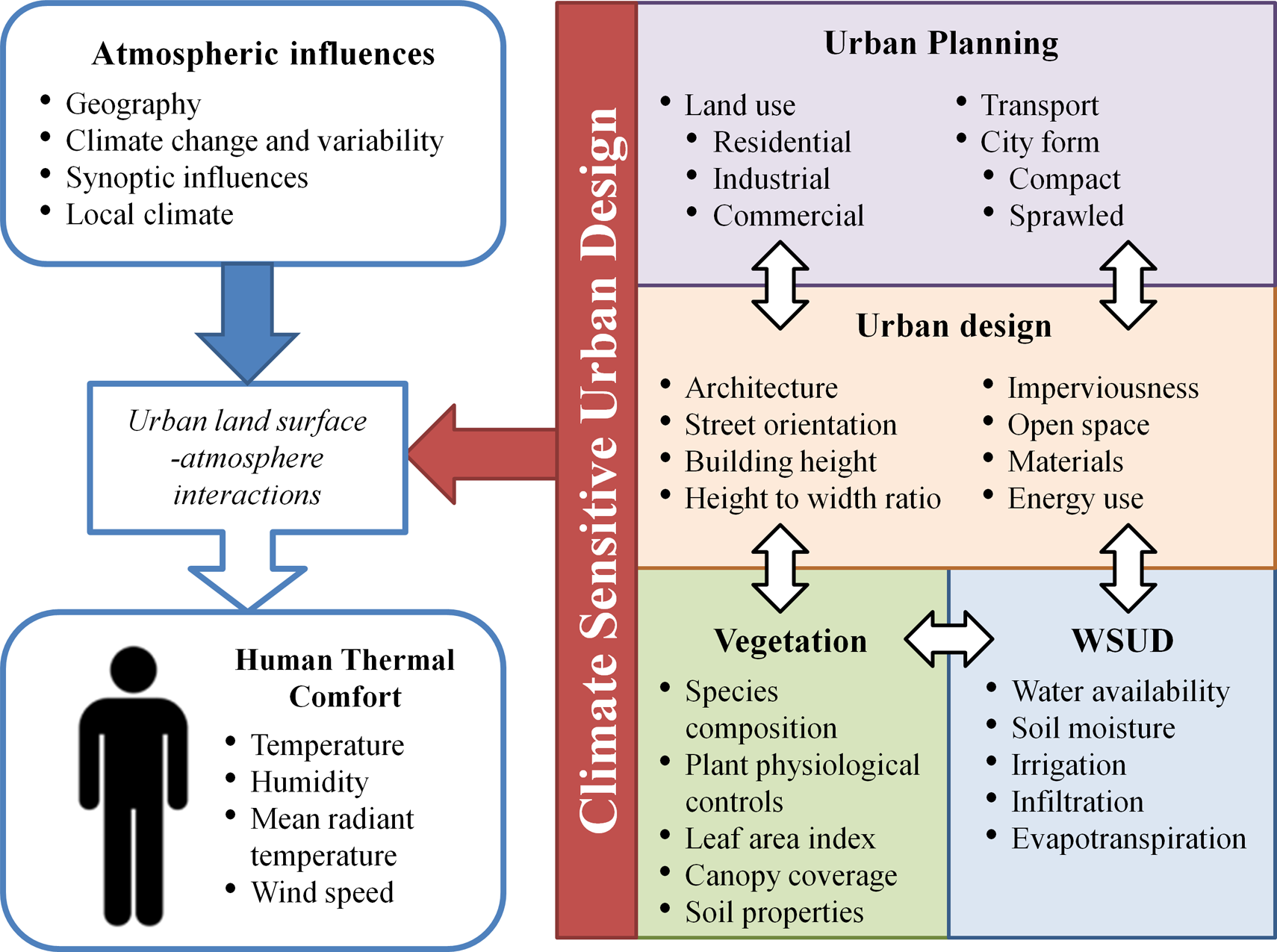
Conceptual diagram demonstrating the connection between Water Sensitive Urban Design and the environmental parameters influencing human thermal comfort – through Climate Sensitive Urban Design and urban land surface-atmosphere interactions.
The evidence suggests that WSUD provides a mechanism to help address some of the long-term challenges facing Australian urban environments, including extreme heat events and drought. Implementing a mix of WSUD approaches can help restore a more natural water balance (Burns et al., 2012) and support evapotranspiration (e.g. Mitchell et al., 2008) across Australian cities. In addition, irrigating green infrastructure and WSUD features can further drive evaporative cooling and support healthy vegetation. Limiting the occurrence of extreme heat events and mitigating the UHI will reduce the exposure of urban populations. This is critical given anticipated urban growth, future climate change and an ageing population in Australia cities. As this review has highlighted, limiting exposure is as much about the urban landscape itself as it is about WSUD (Figure 3), so a mix of mitigation approaches will be needed, including WSUD, to provide a significant benefit to HTC and subsequently human health. WSUD presents a particularly attractive option due to the multiple benefits it provides (e.g. augmenting water supplies, improved stormwater quality runoff, and amenity). However, inter- and intra-city urban climates vary significantly across Australian urban environments, as cities like Melbourne and Sydney experience a more temperate climate while cities like Brisbane and Darwin experience subtropical and tropical climates. While evaporative cooling may not be particularly strong under humid conditions, providing water for vegetation to promote shading and reduce surface radiative temperatures will still be beneficial. Given the example of threshold temperatures by Nicholls et al. (2008), even small temperature reductions of 1–2°C could make a difference in mortality rates. Research that helps quantify climatic improvements from WSUD can help policy development extend beyond urban runoff quality improvements alone.
Maximizing the benefits of WSUD to help meet CSUD objectives truly comes down to smart architectural and landscape design as highlighted in Figure 3. Specific guidance is needed in urban planning and design on implementation of WSUD in the context of improving HTC. Integrating WSUD into urban landscapes relies on an understanding of use of space. Cooling should be optimized based on when a space is used, such as providing shading in public spaces where daytime events are held. Using WSUD to help achieve CSUD capitalizes not only on the concept of fit-for-purpose stormwater, but also on fit-for-place design solutions, which consider local opportunities and constraints. Bowler et al. (2010) found in their review of green space literature that the reported research did not provide information on exactly how vegetation should be best incorporated into the urban landscape in terms of abundance, type and distribution. This is currently also true for WSUD, although snapshots of guidance are provided. For example, Saaroni and Ziv (2003) point out that water bodies, even of the scale of 100 m, can reduce heat stress during the day, and suggest that for maximum benefit they should be located at the edge of a park or in the middle of the city to provide a microclimatic benefit to nearby built-up areas. To implement fit-for-place design solutions, it is important that the local context is well understood, as each city is likely to have its own set of unique circumstances, as demonstrated by the Australian illustration here. Careful design of WSUD is needed, along with recognized benchmarks against which improvements are judged.
While this assessment of the capacity for WSUD to meet CSUD objectives was placed firmly within the Australian context, some universal guidelines on the implementation of WSUD for support of CSUD can be drawn from this review. Considering the objectives of CSUD of human thermal comfort, attractiveness and building energy efficiency, we suggest that the implementation of WSUD should:
Aim to maximize the cooling potential of existing green infrastructure first. WSUD and stormwater harvesting can support fit-for-purpose water for widespread landscape irrigation to maintain healthy vegetation and accentuate urban cooling and HTC benefits. Irrigation is also likely to be particularly effective due to the ability to apply water across a large proportion of the landscape, as well as controlling the times of irrigation.
Target dense urban environments with little or no vegetation. WSUD is most effective under warm and dry conditions. This is convenient because these are commonly areas of highest heat exposure that can place vulnerable populations at risk. Areas of poor energy efficiency should also be targeted to improve indoor HTC and minimize energy consumption.
Harness the cooling and HTC benefits of trees. WSUD should be combined with increased tree cover to maximize cooling via both evapotranspiration and shading. Trees are also an efficient means of water use to provide cooling and HTC benefits. Increased tree cover should also target areas of high solar exposure.
Aim for many, smaller, distributed technologies and features at regular intervals throughout the urban environment to retain stormwater in the urban landscape and promote widespread infiltration into soils. Atmospheric cooling and HTC effects of WSUD are likely to be highly localized, so while a treatment wetland can meet stormwater quality objectives for a residential subdivision, it may only provide a HTC benefit for those residents in the immediate vicinity. Distributing WSUD throughout the landscape should provide a larger areal extent of cooling than large concentrated green areas (Chen et al., 2011; Clarke and Bach, 1971; Honjo and Takakura, 1990). This approach is also aligned with stream ecology benefits, where distributed infiltration of stormwater is facilitated to support near-natural frequency of runoff to minimize urban catchment effects on stream health (Walsh et al., 2005).
Work with the built environment to accentuate cooling influences. WSUD should be strategically designed into the urban landscape, with features implemented upwind of target areas and where urban canopy layer cooling is maximized (within urban canyons where people reside). Urban spaces should be sensitive to local and regional climatic influences (such as sea breezes) and maintain natural cooling mechanisms such as ventilation and trees.
More information on the climatic effects of WSUD and especially on the extent of localized cooling influences is needed. Information is also needed on optimal design approaches to maximize evapotranspiration from individual WSUD features and targeted irrigation regimes, while meeting other WSUD objectives such as supplementing centralized water supplies. The importance of species selection has also been raised, highlighting the synergies between water availability and climate exposure on tree physiology and capacity for meeting CSUD objectives. Seasonal effects of WSUD on urban climate also need further consideration, whereas the focus here has been on warm, summertime conditions. Finally, more research is needed on the positive feedbacks to population health from WSUD interventions and research to support cost/benefit analysis of different WSUD implementation approaches, particularly against other available approaches for mitigating excess urban heating such as increasing surface albedo. Nevertheless, based on the evidence presented here, we suggest that CSUD should be added to the list of objectives for WSUD.
Footnotes
Funding
This research was funded by a large number of government and industry partners as part of the collaborative Cities as Water Supply Catchments research program. A list of funding partners can be found at http://www.waterforliveability.org.au/?page_id=89