




Abstract
This work marked the beginning of a new phase in applied climatology. After this work, new manuscripts would not just incorporate the rote description of statistics or regions, but attempt to place physical aspects of climate as a dynamic factor in the natural environment.
Keywords
I Introduction
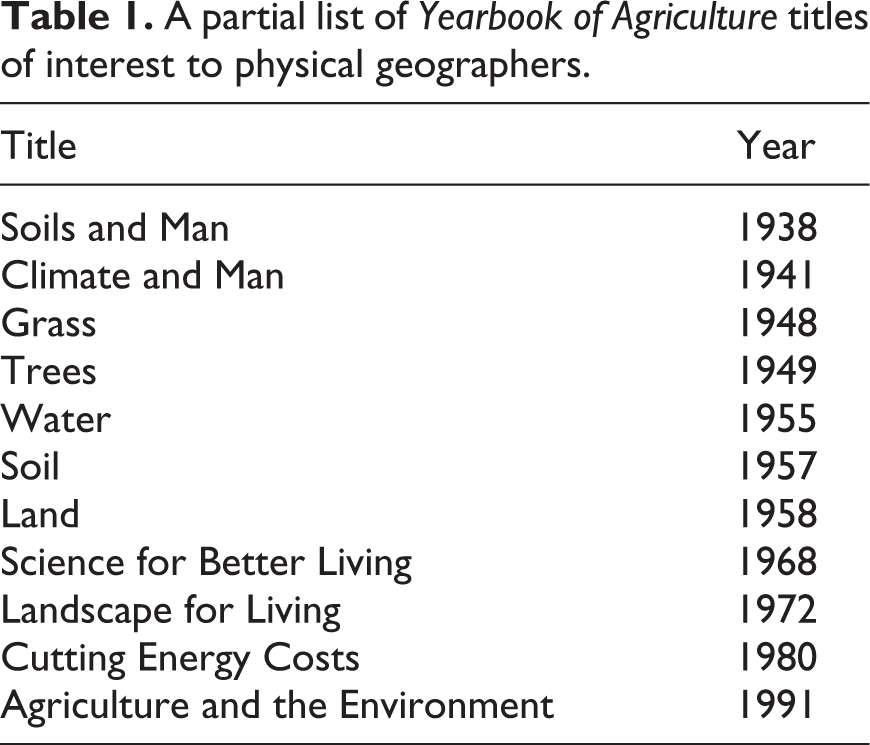
This book is one in a series of annual volumes produced by the United States Department of Agriculture for wide distribution throughout the agriculture community. The series began in 1894 and each yearly volume reviewed developments in agriculture over the previous year. In 1936 the Yearbook series changed focus to present each year a single topic of interest to farmers. Many of these volumes hold special interest to physical geographers. Table 1 is a partial list of these volumes. Note that the topic of soil is the subject of two volumes published almost 20 years apart. It is also of interest how the focus changed from individual descriptive subjects such as soil or trees to more holistic topics representative of issues of the time (cf. Cutting Energy Costs in 1980 and Agriculture and the Environment in 1991). The 1941 Yearbook, Climate and Man, at 1248 pages is the largest of the series. The timing of the volume, published in July 1941, was fortuitous because only one more volume was published (on livestock) during the years of American involvement in the Second World War. It is unlikely such a large volume would have been published during the war because of resource constraints. The series resumed full production in 1947. Another historical anomaly associated with this book is that the Weather Bureau was transferred from the Department of Agriculture to the Department of Commerce during the preparation. Thus two separate events, government reorganization and a world war, insured that this volume would be unique and probably never duplicated.
A partial list of Yearbook of Agriculture titles of interest to physical geographers.
II The volume
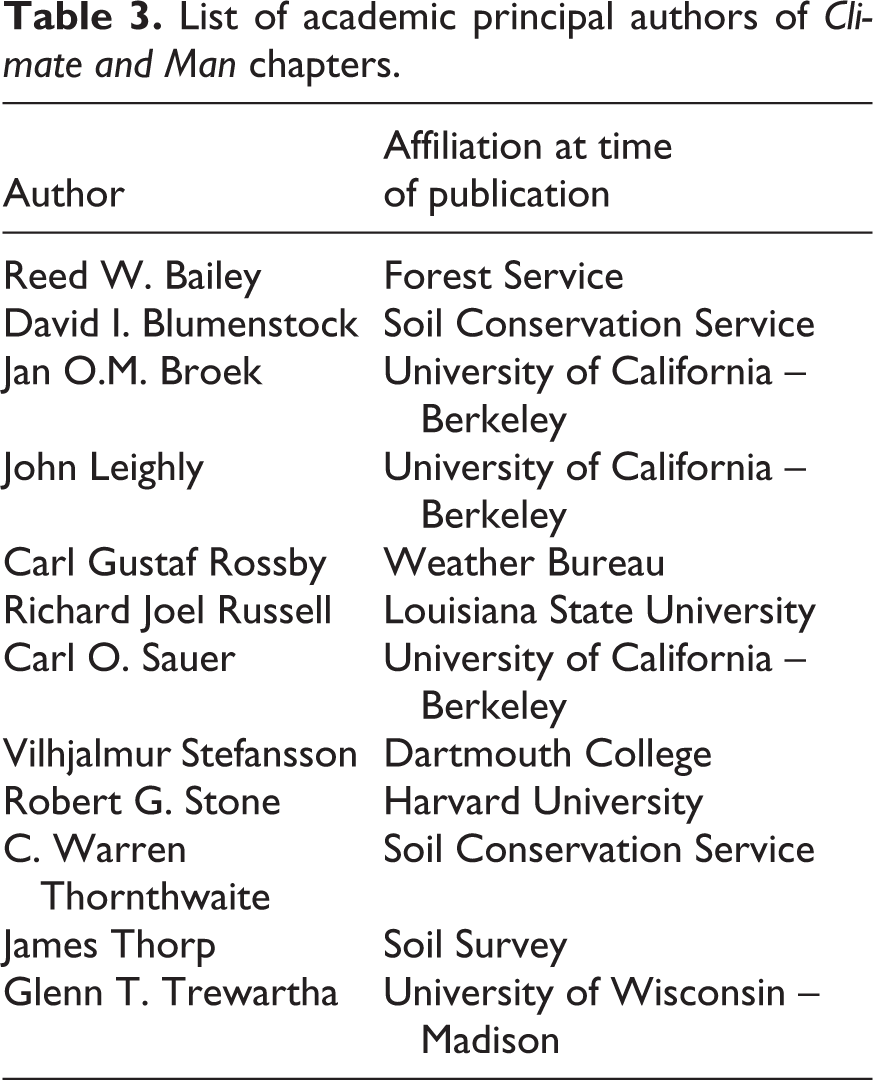
Climate and Man represents a summary of the state of knowledge of the impacts of weather and climate on agricultural practice at the middle of the 20th century. The book is an edited volume developed under the guidance of a committee of scientists from both the Weather Bureau and Department of Agriculture (Table 2). The committee was chaired by Francis Reichelderfer, the long-serving Director of the Weather Bureau (Figure 1). Over 75 authors from the Weather Bureau and Department of Agriculture contributed material to the yearbook in addition to many of the leading academic geographers of the era (Table 3).
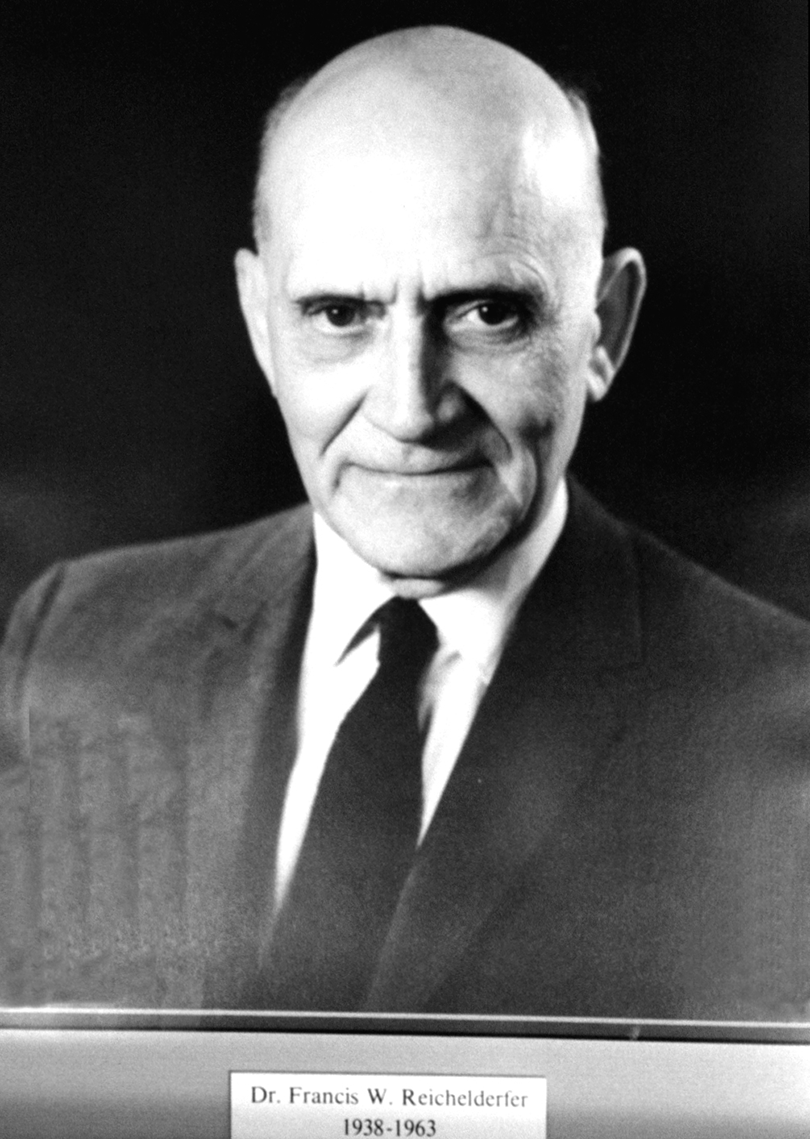
Francis W. Reichelderfer, long-serving Director of the Weather Bureau, who chaired the guiding committee for the volume.
The 1941 Yearbook of Agriculture Committee.

List of academic principal authors of Climate and Man chapters.
The book is divided into five parts, each consisting of multiple articles. Each article was written by a recognized subject area specialist and includes maps, figures, photographs, and references. Part 1, ‘Climate as a World Influence’, begins with an article by Richard Joel Russell discussing geological causes of paleoclimate and the astronomical causes of ice ages. The organizing principle of this article may be paraphrased as ‘Earth’s impact on the climate’. Next, David I. Blumenstock and C. Warren Thornthwaite discuss the classical distribution of climatic elements on the Earth’s surface and the resulting regionalization of climate types, soils, natural vegetation, and agricultural patterns. With a nod to the deterministic paradigm of the time, this article can be characterized as ‘climate’s impact on the Earth’. In their defense, in the discussion of agricultural patterns, the authors note climate as a limiting, not determining, factor and warn of potential problems such as soil erosion if climate is not adequately addressed or appropriate adaptation measures are not incorporated. Both of these articles provide a good look at the state of the art of the time. The last article in this section, by Francis W. Reichelderfer, reads today like a time capsule of historical practices of the Weather Bureau. It is a great source for researchers needing to tie today’s practices to their historical predecessors.
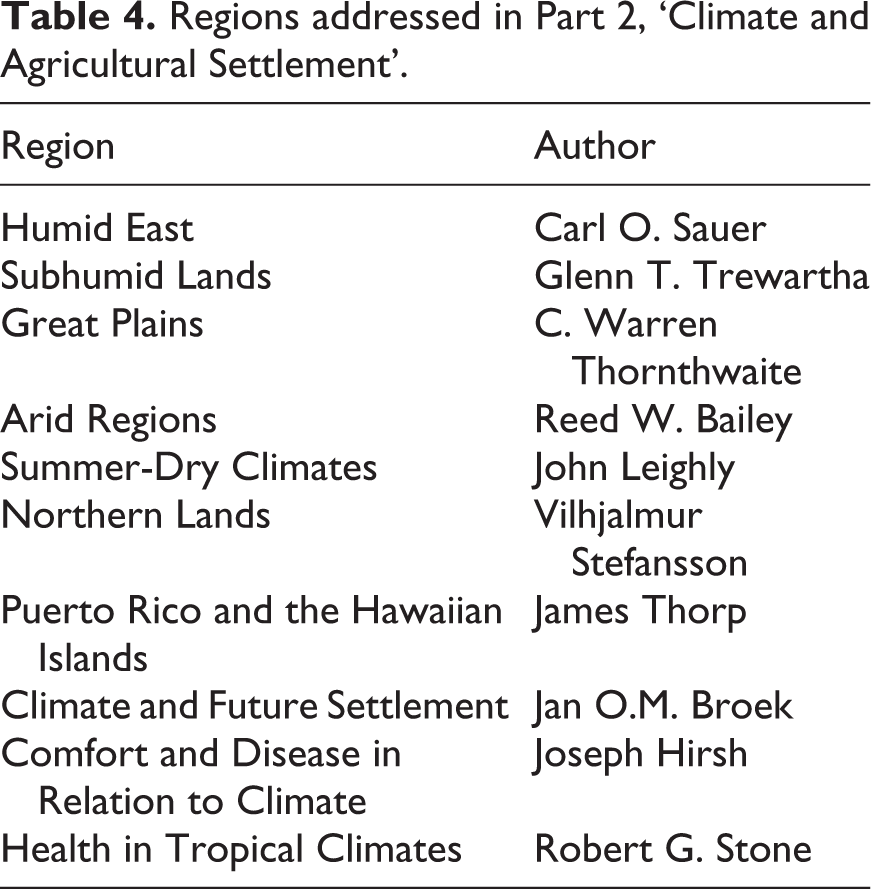
Part 2, ‘Climate and Agricultural Settlement’, details the role of climate in the settlement and development of the United States. The 10 sections were mostly written by geographers, and the influence of Carl Sauer and the Berkeley School is quite evident. Climate influences the means of production, and migrants to new lands bring their means of production from the old lands with them. Those means are then adapted or modified, or new means are developed to fit the limits of the climates in new lands. Missing of course from these discussions is the impact of new technologies, hardly imagined at the time but taken for granted today. This section concludes with two articles on climate and health which would be of historical interest today to medical geographers and bioclimatologists. A list of the articles and their primary authors is given in Table 4.
Regions addressed in Part 2, ‘Climate and Agricultural Settlement’.
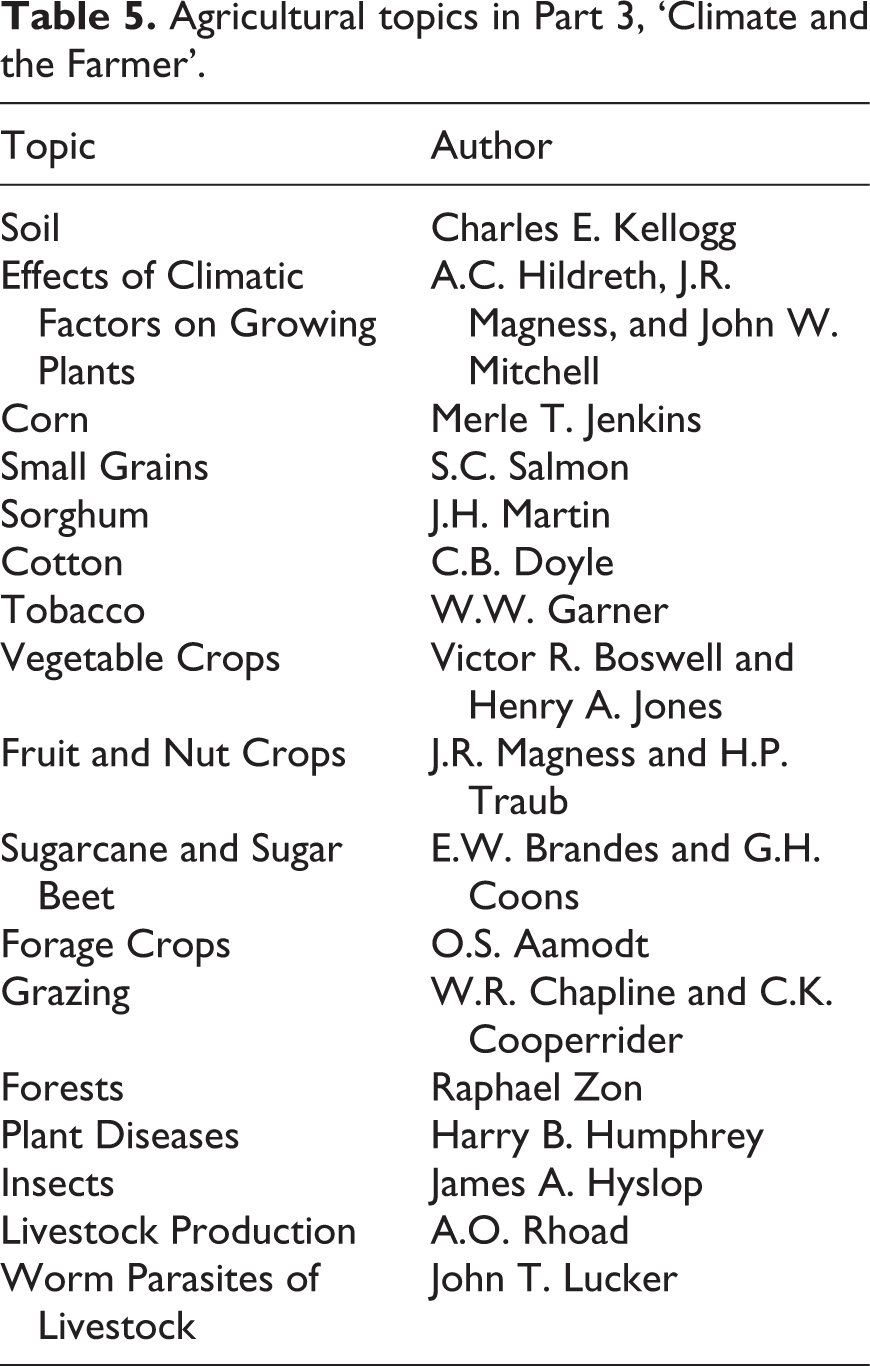
Part 3, ‘Climate and the Farmer’, is the core of the agricultural interest section of the book. It goes into considerable detail on the climate and weather impacts on most of the major and minor crops then produced in the United States. In addition, it includes articles addressing impacts on soil, forests, livestock, and insects. Each of these articles (see Table 5) was prepared by a leading scientist in the appropriate Department of Agriculture section.
Agricultural topics in Part 3, ‘Climate and the Farmer’.
Part 4 is titled ‘The Scientific Approach to Weather and Climate’. It is by far the most technical section of the Yearbook, but still filled with practical advice and commentary of direct relevance to the farmer. The article on flood hazards and flood control is a primer on flood hydrology for the early 20th-century farmer prepared by some of the leading hydrologic researchers of the era (Table 6). The hydrologic cycle is presented in sections specifically adapted to problems and opportunities of farming. Such topics as runoff, evaporation, and transpiration are linked to soil cover, field preparation, and land use. Of particular interest to geographers today is the section detailing the development and practices of the Weather Bureau’s flood forecasting services. A fascinating article in this section (written by C.L. Mitchell and H. Wexler) details the data and procedures used by the Weather Bureau to make the forecast for the Washington forecast district (covering a 16-state region of the Northeast US and Washington, DC) for 30 March 1939. At the time, forecasts were not generated locally as is the practice today. The reliance on subjective analysis, hand-drawn maps, and relative data scarcity is striking compared to today. The section continues with a description of physical meteorology theory of the time, including polar front theory and mid-latitude cyclones (no equations, but many useful diagrams). The section is written by Carl Gustaf Rossby – one of the principal scientists responsible for the evolution of the theory following its development by Bjerknes in the early 20th century (Friedman, 1989) – and concludes with a nod toward the long-range forecasting schemes then being developed by Namias. Rossby concludes this part of the Yearbook with a description of short-term weather prediction from the observation of cloud formations. I can only imagine the smiles on many farmers’ faces when they read this section, with its numerous cloud photographs, following Rossby’s semi-technical discussion in the previous section.
Authors and affiliations of the article ‘Flood Hazards and Flood Control’.

Part 5, ‘Climatic Data, with Special Reference to Agriculture in the United States’, is the most dated but potentially most interesting section of the Yearbook for the physical geographer of today. It contains tables and maps of various climatic elements for stations throughout the world, maps covering the contiguous United States as a whole, and maps and tables for each individual state. They provide a trove of comparative data summarized for use today. The US maps are all based on the period of record of 1899–1938 and represent a view of the country prior to an era of climate change awareness. The climate summaries for the 48 states were prepared by the Weather Bureau Climate Section Director for each state, a position which has now been replaced by a State Climatologist. For each county, summary data is given on the climatic elements of temperature, precipitation, frost dates, and length of growing season. Maps of these climatic elements and supplemental notes are also provided for each state. Data is also provided for various stations in Hawaii, Alaska, and many of the Caribbean Islands. It must be remembered that the volume of data represented in this section is enormous and all of the analysis and mapping was done without the benefit of computer technology!
III Conclusions
This Yearbook and the many challenges of the Second World War marked the beginning of a new phase in applied climatology. After this, new manuscripts would not just incorporate the rote description of statistics or regions (Kendrew, 1922; Ward, 1918), but attempt to place physical aspects of climate as a dynamic factor in the natural environment. This format is evident in applied climatology textbooks (cf. Griffiths, 1966; Mather, 1974; Oliver, 1973; Thompson and Perry, 1997) as well as the new generation of topical climatology works (cf. Bonan, 2008; McGregor and Nieuwolt, 1998; Nicholson, 2011; Shelton, 2009). It has even become the norm in books about the weather and climate of states written for the general audience (cf. Bomar, 1983; Shulski and Wendler, 2007; Winsberg, 1990; Zielinski and Keim, 2003). Climate and Man: The 1941 Yearbook of Agriculture is the important bridge between early descriptive climatology and the post-quantitative revolution analytical climatology of today. It showed us what could be done when large amounts of climatological data are analyzed and interpreted guided by the physical principles of the atmosphere.
Footnotes
Acknowledgements
The author wishes to thank David R. Butler for suggesting this topic and his many good-natured discussions during the writing process. The author acknowledges that this particular text may be difficult to access for some researchers and encourages readers to contact him about specific sections.