



Abstract
Due to the predicted impacts of future climate on hydrology, morphological changes to river channels are expected. Quantifying the magnitudes and rates of future channel change is important for sustainable river channel management. To date, reviews of simulation approaches for investigating river channels and the modelling of environmental change impacts on channel form and process have focused on contemporary process or palaeo perspectives. Hence, herein we review numerical modelling approaches available for reach-scale simulation of future river channels and the predicted in-channel hydro- and morphodynamic changes modelled. We found that despite their widespread availability, hydrodynamic, morphodynamic and cellular models have yet to be used routinely in future in-channel simulations, with cellular models in particular under-represented. Our review shows that predictions of within-channel changes vary greatly between hydro-climatic regions and under contrasting climate change scenarios, mainly due to varying input discharge scenarios; however, increased sediment transport and flood risk are usually predicted. Key challenges in simulating future channel change include representations of external forcing conditions, adequate temporal and spatial scales, transport equations, changing channel materials and lateral erosion; calibration and validation; simulation chains with multiple models; and identification of feedback systems and non-linearity. Nevertheless, despite these challenges, models with increasing complexity have recently been developed and so there is increasing potential in their application. One-dimensional hydro- and morphodynamic simulations, and cellular models, can be modified to reflect the requirements of future representations, such as grain size properties, whilst there is also now an increasing capability to include a greater quantity of external forcing conditions. Some studies, however, have demonstrated the need to develop two-dimensional models for application in centennial-scale studies. We recommend that a wider range of scenarios and the combined effects of multiple external forcing factors should be included, whilst studies are also needed from more hydrologically diverse reaches.
Keywords
1 Introduction
Natural river channels are dynamic geomorphic systems that can respond to changes in flow discharge and sediment load over varying timescales from individual flood events to longer term (decadal to centennial) environmental change (Vita-Finzi, 2012). Given the nature of contemporary geomorphological research in terms of its relationship to society (Kondolf and Piegay, 2011) and funding (Rhoads and Thorn, 2011) there is a role for geomorphologists to infer geomorphic system response to predicted future climate change (IPCC, 2013a). The main tools available to geomorphologists for investigating future geomorphic response are models (conceptual or mathematical for example) that explain how earth surface processes work and how these processes may produce change in the landscape (Wilcock and Iverson, 2002). Such models can be used to simulate future geomorphic response, which Wilcock and Iverson (2002) contrasted to prediction that was defined as “…the foretelling of an event or condition [that can] be either absolute (an event with particular characteristics will occur at a particular place and time) or contingent (a particular event will occur if certain conditions are satisfied)” (Wilcock and Iverson, 2002: 4). Herein we review the emerging literature that has addressed the reach-scale modelling of river channel response to future climate change broadly using approaches that span the simulation and contingent prediction definitions of Wilcock and Iverson (2002). These studies aim to improve our understanding of how river channels may respond to future climate change – as Hooke (2002) suggested it is through understanding as opposed to prediction per se that geomorphologists can be of greatest value to society.
Climatic changes are expected to be an important driver for future rates of fluvial processes since: (a) climate can determine flood magnitude and frequency over decadal timescales (e.g. Knox, 2000) and (b) these climate-driven flood responses have been shown, in some studies, to be the principal factor governing short- and long-term sediment fluxes in the past (Blum and Törnqvist, 2000; Coulthard and Macklin, 2001). It is likely, therefore, that future environmental changes will also transform river channel form and pattern (Anisimov et al., 2008) so the morphodynamic consequences of future climatic and hydrological changes need to be taken into account. According to Gregory (2006), modelling should play an important role in reducing uncertainty associated with channel sensitivity and responses to threshold conditions (Hooke et al., 2011). Modelling also needs to adequately deal with complexity, positive feedback, non-linearity and holism (Coulthard et al., 2012; Hooke, 1999). One issue relevant to both simulation and prediction, however, is how they can be tested, given lack of sufficient knowledge on future changes to drivers, boundary conditions and material properties (Hooke, 2002).
One way of evaluating the likely uncertainties in future simulation is to review the successes and limitations of modelling approaches used in palaeohydrology (Thorndycraft, 2013), where similar problems arise in terms of identifying drivers, boundary conditions and material properties. Van De Wiel et al. (2011) raised seven main issues in relation to numerical modelling of river system response to palaeoenvironmental change: (1) representation of space; (2) representation of time; (3) process representation; (4) data availability; (5) calibration and validation; (6) uncertainty; and (7) non-linearity. Despite these issues, one value of models is that modellers can control their simulated environment to examine river response to different controlling factors (Coulthard et al., 2005), whether in the past or future. For example, Coulthard et al. (2005) used identical simulated Holocene precipitation and land cover indices in four adjacent catchments to model contrasting sediment yields driven by internal characteristics such as catchment morphology. In this study model validation was carried out using stratigraphic and radiocarbon dating evidence for the timing of fluvial incision and aggradation phases. Whilst there were timing issues in the validation given dating errors and incomplete sedimentary records, this is nevertheless an example of how recourse can be made to palaeoenvironmental data to make geomorphologically informed interpretations. Other examples of palaeoenvironmental data that can be used in modelling past fluvial processes include the determination of Holocene palaeochannel form and cross-sectional area (e.g. Knox, 2000); and multi-proxy palaeoecological data to infer channel and floodplain ecosystems including hydrological conditions (e.g. Brown et al., 2001; Brayshay and Dinnin, 1999), important to river channel behaviour given vegetation control on channel processes (Corenblit et al., 2011). These palaeoenvironmental examples provide the opportunity to constrain the likely drivers, boundary conditions and material properties; however, this data does not exist for studies of future channel response, creating further challenges for future simulation research. One important issue for modelling future reach-scale in-channel change is how to handle the likely multifaceted nature of future environmental change and the resulting changes to the magnitude of fluvial processes that could occur, hence the need for greater understanding from simulation and the contingent prediction of Wilcock and Iverson (2002), rather than absolute prediction.
A range of modelling approaches has been applied to the study of past and present river channel changes that are relevant for simulating future change. Physical models, which are performed in laboratory flume environments, have been applied for river channel and particle movement studies (Ghoshal et al., 2010; Kuhnle, 1993; Van den Berg, 1987). Various types of model – conceptual, statistical or empirical, analytical and numerical – have been developed for simulations of natural river geomorphology and environments. Conceptual models provide qualitative descriptions and predictions of landform and landscape evolution based on past or present data, whilst statistical or empirical models apply functional relationships between dependent and independent variables at individual cross-sections and river reaches (Darby and Van De Wiel, 2003). Despite their qualitative nature, conceptual models have sometimes been applied to future channel change analyses (e.g. Sarker et al., 2014). Analytical models are based more on the physical processes involved in the establishment of channel morphology than statistical or empirical models (Darby and Van De Wiel, 2003). Numerical models differ from the other model types, since they are multi-dimensional and capable of dealing both with spatial and temporal dimensions; hence, for example, the use of reach-scale automaton models in palaeohydrological modelling (Coulthard and Van De Wiel, 2012).
Darby and Van De Wiel (2003) reviewed numerical simulation approaches in fluvial geomorphological applications, concentrating mainly on broader models of channel geomorphology, rather than sub-models of in-channel hydro- and morphodynamics. In this present study, therefore, we will concentrate on these in-channel numerical modelling approaches, particularly hydrodynamic, morphodynamic and cellular (i.e. reduced complexity) model approaches, which are capable of simulating reach-scale in-channel flow characteristics, sediment transport and morphological change of natural rivers (Figure 1). With regards to modelling future climate change and river systems, Hunt (2002) reviewed flood response; however, the main emphasis was on hydrological predictions. Goudie (2006) reviewed potential riverine changes due to climate change and claimed much work remained to be done in the early 21st century to establish the full range of geomorphological responses that may take place in fluvial systems. However, since Goudie’s review important advances in the forecasting of future channel hydro- and morphodynamics have taken place. Van De Wiel et al. (2011), in their review of palaeohydrological simulations, only briefly discussed flood inundation models (referred to here as hydrodynamic models) in terms of future simulations. Furthermore, previous reviews have dealt with catchment-scale approaches rather than detailed in-channel analyses at the reach scale (Goudie, 2006; Tucker and Hancock, 2010). Therefore, the aim of this paper is to expand the discussion on future numerical simulations, in particular focusing on hydrodynamic and morphological responses of river channels to future climate change. Firstly, we review numerical modelling approaches, concentrating on hydrodynamic, morphodynamic and cellular (i.e. reduced complexity) modelling applied for future reach-scale in-channel change simulations. We then summarize predicted future in-channel hydro- and morphodynamics from specific case studies before we outline the prospects and challenges related to these modelling approaches, with a particular focus on how the environmental change signal has been included in these simulations.
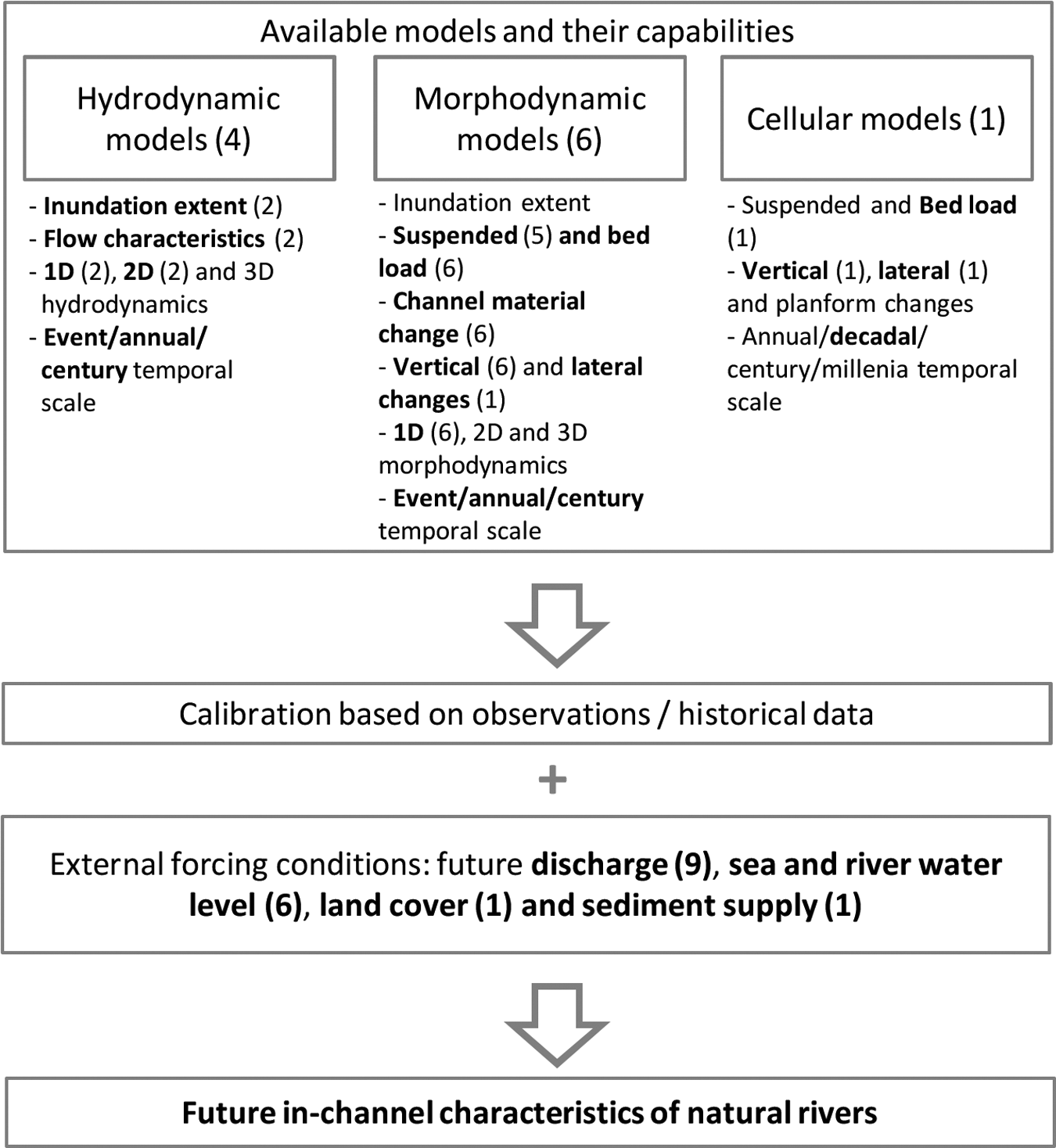
Available modelling approaches and their application procedures in future reach-scale in-channel change simulations. The characteristics of the models, which are written in bold, are the ones included in future simulation approaches. The numbers in brackets show how many future in-channel change simulation studies, reviewed in this paper, have included the particular model characteristic.
II Fluvial process representation in numerical models used for future simulations
1 River channel hydraulics
Fluvial processes, and the physical laws behind them, are expected to perform similarly in the future as at present. Thus, the models applied for present and past in-channel changes are assumed to be applicable for future predictions also. The spatial numerical solution techniques of the conservation of mass and momentum equations (Navier–Stokes) within hydro- and morphodynamic models enable the calculation of fluid motion, including unsteady flow, in geometrically complex river channels with spatially and temporally varying boundary conditions (Bates et al., 2005; Sambrook Smith et al., 2006; Wright, 2005). These simulation capabilities are required as future flows in river channels need to be modelled as unsteady due to the expected changes in hydrology. The simulations can be performed in one, two or three dimensions. The one-dimensional (1D) models simulate in the downstream direction only from one cross-section to the next with results averaged for each cross-section. As can be seen from Table 1, which collates the main characteristics of models used to simulate reach-scale future in-channel change, most future simulations are performed in the one dimension (Table 1). Two-dimensional (2D) models solve shallow water equations for water level and depth-averaged velocities in two spatial directions (Nelson et al., 2003; Pender and Néelz, 2007). These are mainly applicable for simulations of a few years (i.e. the near future) and at the event scale. As a consequence, only a couple of examples of future 2D hydrodynamic simulations exist (Lane et al., 2007; Lotsari et al., 2010; Veijalainen et al., 2010). In three-dimensional (3D) models, the vertical dimension, that is, secondary flows and turbulence, is also included (Nelson et al., 2003). These multi-dimensional models require more computing power because the equations are solved on mesh or grid form geometry. Therefore, the choice of the hydrodynamic model depends on the complexity of the processes to be analysed, the time span in question, the availability and quality of the field data and the computational limitations (Formann et al., 2007). To date, no 3D future hydrodynamic simulations have been performed.
The main characteristics of future in-channel change simulation approaches.
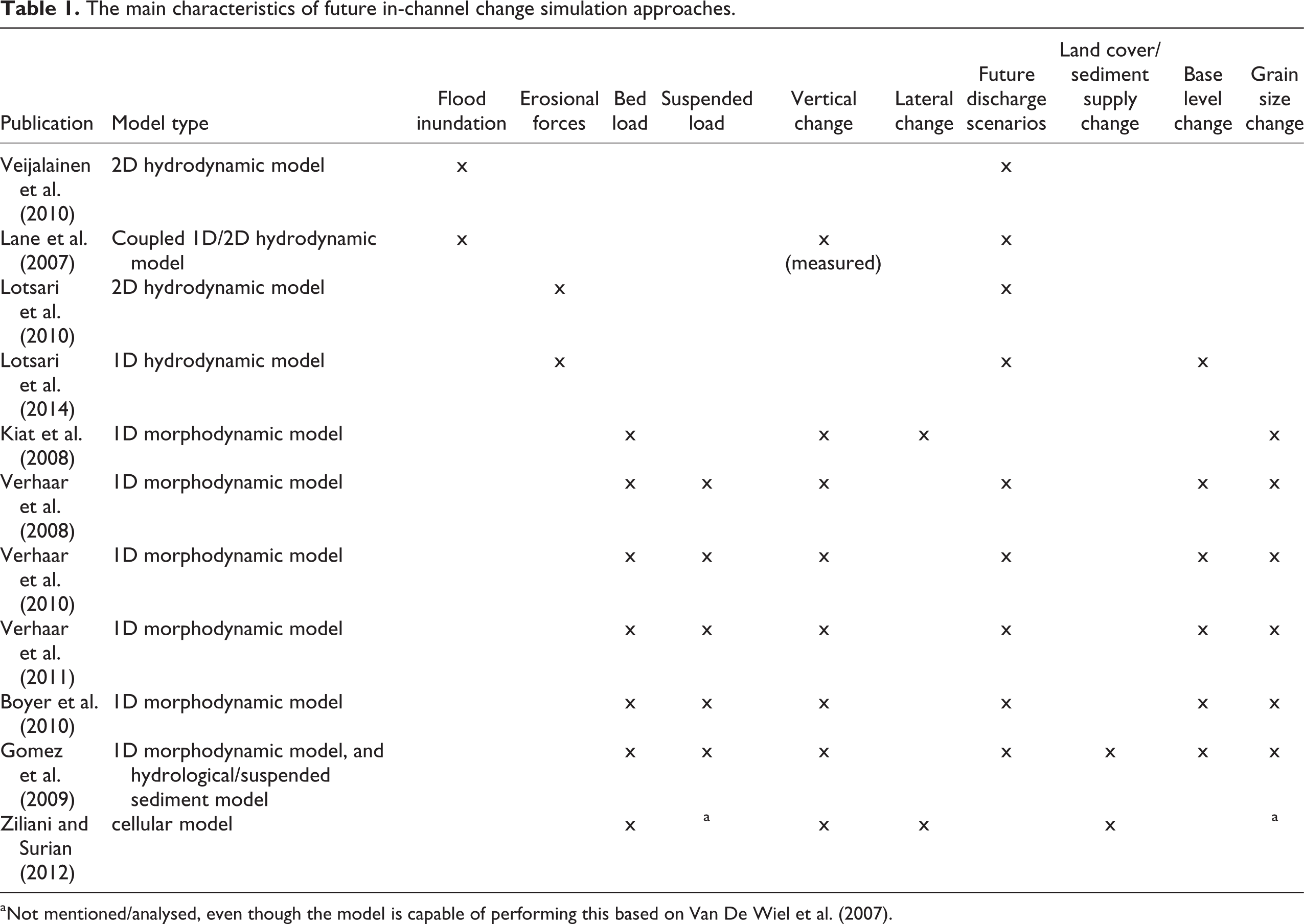
aNot mentioned/analysed, even though the model is capable of performing this based on Van De Wiel et al. (2007).
Reduced complexity cellular models, first developed by Murray and Paola (1994) for braided river applications, can simulate centennial to millennial river evolution (Nicholas et al., 2006). However, they have not been widely applied for future simulations of natural river channels (Table 1). Channel and/or floodplain geometry is represented in grid cells from fine to broad scales. Equations such as Navier–Stokes are computationally too demanding for cellular models, so more efficient algorithms have been applied (Coulthard et al., 2007; Van De Wiel et al., 2007). Different reduced complexity model representations exist (Nicholas and Quine, 2007), but for example a flow-sweeping algorithm can be used to calculate a steady-state, uniform flow approximation to the flow field (Coulthard et al., 2012; Van De Wiel et al., 2007; Ziliani and Surian, 2012). In this type of approach, discharge is distributed to all neighbouring cells within the sweep width range according to differences in water elevation of the donor cell and bed elevations in the receiving cell (Van De Wiel et al., 2007). The Manning’s equation can be used to calculate flow depth and velocity from discharges. This is a similar concept to the implicit solution schemes employed in finite difference algorithms, that is, of hydrodynamic models (Van De Wiel et al., 2007). However, the sweeping algorithm does not conserve momentum nor distinguish between primary and secondary flows.
2 Sediment transport and vertical channel evolution
The inclusion of sediment transport and river bed topographical updates in models is important, since their absence may cause uncertainties in flow predictions (Hunt, 2002). The analysis and simulation of solely future suspended sediment transport, that is, not including bed load or channel bed elevation changes, have mostly been presented at a catchment scale and not within river channels (Asselman et al., 2003; Mukundan et al., 2013; Ward et al., 2009). These catchment-scale suspended sediment analyses have, therefore, not been included in the present review. Similarly, we have excluded the work of Goode et al. (2013) and Thodsen et al. (2008) despite them including suspended sediment transport in their reach-scale in-channel studies. This is because Thodsen et al. (2008) applied only a concept of time-series analysis of suspended sediment concentrations, that is, rating curves, as a modelling approach together with discharge scenarios, whilst Goode et al. (2013) applied only an empirical scour shear model together with discharge scenarios, so neither applied numerical in-channel simulation approaches.
Both suspended and bed load can be incorporated into morphodynamic models, which can therefore predict vertical river bed changes. These models include, in addition to the equations already included in the hydrodynamic models, the equations for the initiation of sediment particle motion, the conservation of sediment (e.g. the Exner equation), as well as a bed update scheme. The equations for particle motion have been developed for different grain sizes (e.g. Meyer-Peter and Müller, 1948; Van Rijn, 1984a, 1984b, 1984c) and the river bed is updated according to transport rates (Callaghan et al., 2006). These morphodynamic simulations can be performed in one, two and three dimensions (e.g. Copeland, 1990; Dargahi, 2004; Simon and Darby, 1997). Van De Wiel et al. (2011) noted that such morphodynamic models had not yet been applied for environmental change studies due to the extensive data requirements and the demands on computational power for long-term larger scale studies; however, Verhaar et al. (2008) had already applied these models for morphological climate change impact analysis. Since then, there has been an increasing number of studies using such modelling approaches (Boyer et al., 2010; Gomez et al., 2009; Verhaar et al., 2010, 2011). To date, however, only 1D morphodynamic models have been applied for future channel change predictions (Table 1: Boyer et al., 2010; Gomez et al., 2009; Kiat et al., 2008; Verhaar et al., 2008, 2010, 2011).
The use of cellular models, especially in present or past braided river channel studies, has increased in recent years (Coulthard et al., 2007; Doeschl-Wilson and Ashmore, 2005; Doeschl et al., 2006; Hodge et al., 2007; Murray and Paola, 1994; Nicholas et al., 2006; Sambrook Smith et al., 2006). However, many of these are simulated with theoretical channel conditions or flume experiments, and without conventional sediment transport equations to determine erosion and deposition that alter the channel form (Coulthard et al., 2007). There has only been one in-channel cellular modelling study focused on future change (Ziliani and Surian, 2012), where the cellular model used is a modified version of a landscape evolution model and applies a suite of physically based rules to simulate the entrainment, transport and deposition of sediments (Van De Wiel et al., 2007). The model therefore has the capability to transport sediments as either bed load or suspended load, which can be selected by the user for each of the grain sizes (Van De Wiel et al., 2007; Ziliani and Surian, 2012). Bed load is distributed proportionally to the local bed slope, but suspended load is routed according to flow velocity (Van De Wiel et al., 2007) and the river bed is updated according to the transported sediment load. Thus, Ziliani and Surian (2012) applied a reach mode of this cellular model, where sediment and water enter the system from one or more points. By contrast, Coulthard et al. (2012) applied the same model as Ziliani and Surian (2012) for the River Swale (UK) but used the landscape evolution version of the model, that is, the catchment mode where catchment geomorphology and sediment yield output were simulated. Due to this model’s coarse resolution and catchment-scale configuration, the Coulthard et al. (2012) paper falls outside the scope of this review; however, the paper provides valuable insights into the potential for applying cellular models in the future simulation of river channel reaches that we discuss in later sections.
3 Sediment transport and lateral channel evolution
Even though most morphodynamic models are not normally able to simulate lateral channel changes, some of the 1D models are now capable of simulating both vertical and lateral erosion (Kiat et al., 2008; Raven et al., 2011). Despite their potential in future in-channel change simulations, to date these have only been applied once – for relative short-term (2006–2016) sediment transport predictions (Kiat et al., 2008). The model applied by Kiat et al. (2008) was described more thoroughly by Chang (2006). In the model, the change in channel width depends on the sediment rate, bank configuration and bank erodibility, where the slope of an erodible bank is limited by the angle of repose of the material. This type of model is also capable of simulating curvature-induced scour and deposition based on the flow curvature (Chang, 2006).
Bank erosion models, which predict only lateral changes without bed elevation changes, are also available. However, they do not predict the in-channel processes in such detail as hydro- or morphodynamic models (Midgley et al., 2012). These have yet to be applied for future simulation approaches. There are also so-called classification models in fluvial geomorphology, which use the relation between discharge and slope of the river for predicting the existence of either multi-thread or single-thread channel types (Anisimov et al., 2008). These have been applied in future channel change predictions, but are excluded from the present review, since they do not simulate the in-channel processes.
Lateral channel changes have also been incorporated into cellular models. In the reach mode simulation approach of Ziliani and Surian (2012), in addition to the river bed changes discussed earlier, lateral erosion and bank failure are represented as local cellular automaton rules (Van De Wiel et al., 2007). The lateral erosion algorithm is split into the determination of local channel curvature, calculation of lateral erosion and distribution of the eroded sediments across the channel. Bank erosion is calculated based on the bank erosion coefficient, the near-bank flow velocity and water depth in the wet cells neighbouring the edge cell. Deposition is determined along the inside bank from the model’s automaton rules and the lateral redistribution of the eroded sediments is simulated using a cross-stream gradient. The future sediment flux simulations of Coulthard et al. (2012), performed in the catchment mode of this same cellular model, included these lateral channel evolution capabilities but were not analysed at the in-channel scale.
4 Input data and external forcing conditions
The main established input parameters applied to reach-scale in-channel change simulation studies include the channel geometry (grid, mesh or cross-section form), the properties of the flowing fluid (density, viscosity), the flow characteristics (discharge, velocity, water level) and estimates of resistance and roughness or grain size (Chanson, 1999; Hunter et al., 2007; Van De Wiel et al., 2007; Verhaar et al., 2008). The more sophisticated, or multi-dimensional, the model is the more input as well as calibration and validation data is needed. Future simulations require calibration and validation based on present or past data. Channel geometry is needed for the initial conditions in all reviewed models; however, morphodynamic and cellular model simulations also require this information from the final time step of calibration and validation periods. The in-channel change simulations require sufficiently detailed geometry for each simulation approach or river channel in question. For example, the reach-scale cellular model of Ziliani and Surian (2012) was based on relatively detailed geometry (25 m × 25 m cells) for their wide braiding reach, whilst the coarser resolution (50 m × 50 m grid) of Coulthard et al.’s (2012) model precluded the in-channel simulation of the narrow River Swale. Most commonly, and in sub-critical flow conditions, discharge and sediment supply are defined as the upstream boundary condition and water level as the downstream boundary condition. In addition, all models applied in fluvial transport simulations require measured sediment properties and transport rates (Gomez et al., 2009; Lane et al., 2007; Van De Wiel et al., 2007; Ziliani and Surian, 2012).
Future climatic (and/or other environmental) changes are depicted in the different models mainly via external forcing conditions, which Van De Wiel et al. (2011) highlighted as one of the main uncertainties of past environmental change analysis. External forcing conditions are extremely important to take into account for all types of future numerical in-channel change simulation approaches. External forcing includes changes to temperature, precipitation, discharge, water level, vegetation or land cover. These can be used as input data or boundary conditions for future simulations. The various future river channel simulation approaches require, in particular, information on future discharge, which can be simulated with hydrological models by using climate change scenarios as their input data (e.g. Andréasson et al., 2004; Bergström et al., 2001; Dankers and Feyen, 2008). The climate change signal (including precipitation and temperature) of climate scenarios, which is based on different regional climate models (RCMs) or global climate models (GCMs) and emission scenarios, is transferred to hydrological models for derivation of future discharge and flood magnitude data (Seguí et al., 2010). The 1990–2100 emission estimates were generated in the IPCC Special Report on Emission Scenarios (SRES) (IPCC, 2000), but new estimates of representative concentration pathways have been released together with the Fifth Assessment Report (IPCC, 2013b). There is thus wide variability of scenarios available for different regions. It must also be kept in mind that in addition to climatic changes, human influences, such as land use change and channelization, can cause major changes to fluvial processes and morphodynamics (Arnauld-Fassetta, 2003; Benito et al., 2010; Thorndycraft and Benito, 2006; Trimble, 2003).
III Future fluvial process magnitude and channel changes
1 Future flooding and hydrodynamics
To date we are aware of 11 studies that have simulated reach-scale future in-channel changes using hydro-/morphodynamic or cellular models. Despite there being many studies of discharge changes resulting from future climatic warming (e.g. Dankers and Feyen, 2008; Lehner et al., 2006), there are only a few examples of the application of hydrodynamic models to simulate future flood inundation and flow characteristics (Lane et al., 2007; Veijalainen et al., 2010) or erosion-sedimentation potential (Lotsari et al., 2010, 2014). A range of spatial and seasonal variability in predictions of future changes in floods and hydrodynamics occurred between the different climate change scenarios applied. Veijalainen et al. (2010) predicted 100-year flood discharges to decrease in Finland on average by 8–22% in 2070–2099 compared to the reference period (1971–2000), but there was considerable variation between different hydro-climatic regions studied, including both increases and decreases in flows (Table 2). However, in-channel simulations indicated that the changes in the extent of the flood inundation areas do not reflect linearly the changes in discharges, for example a –12.1 to –90.1% change in inundation area was modelled for the Lapuanjoki study site compared to a 10.9–31.9% decrease in 100-year flood discharge. Even though the importance of channel topography on the flood inundation results was raised in discussion, Veijalainen et al. (2010) did not include sediment transport or channel changes. By contrast, Lane et al. (2007) simulated future flood inundation changes and estimated the effects of river bed sedimentation based on observations of the River Wharfe (UK). Lane et al. (2007) found that bed aggradation occurred, increasing the frequency of flood inundation. Their study was the first where the importance of channel changes on future flooding was noted: the peak inundation extent of a 1-in-0.5-year-event was estimated to increase 12.2% by the 2050s due to climate change and 38.2% when 2002–2004 sedimentation was combined with the climate scenario for the 2050s. Hence, in-channel sedimentation was shown to increase the future sensitivity of flood inundation (Lane et al., 2007) and indeed sedimentation may have as much impact as climate change on inundation areas and flood risk. Even short duration alterations to channel configuration may lead to significant inundation changes, demonstrating the importance of modelling in-channel morphodynamics.
Future in-channel change predictions.
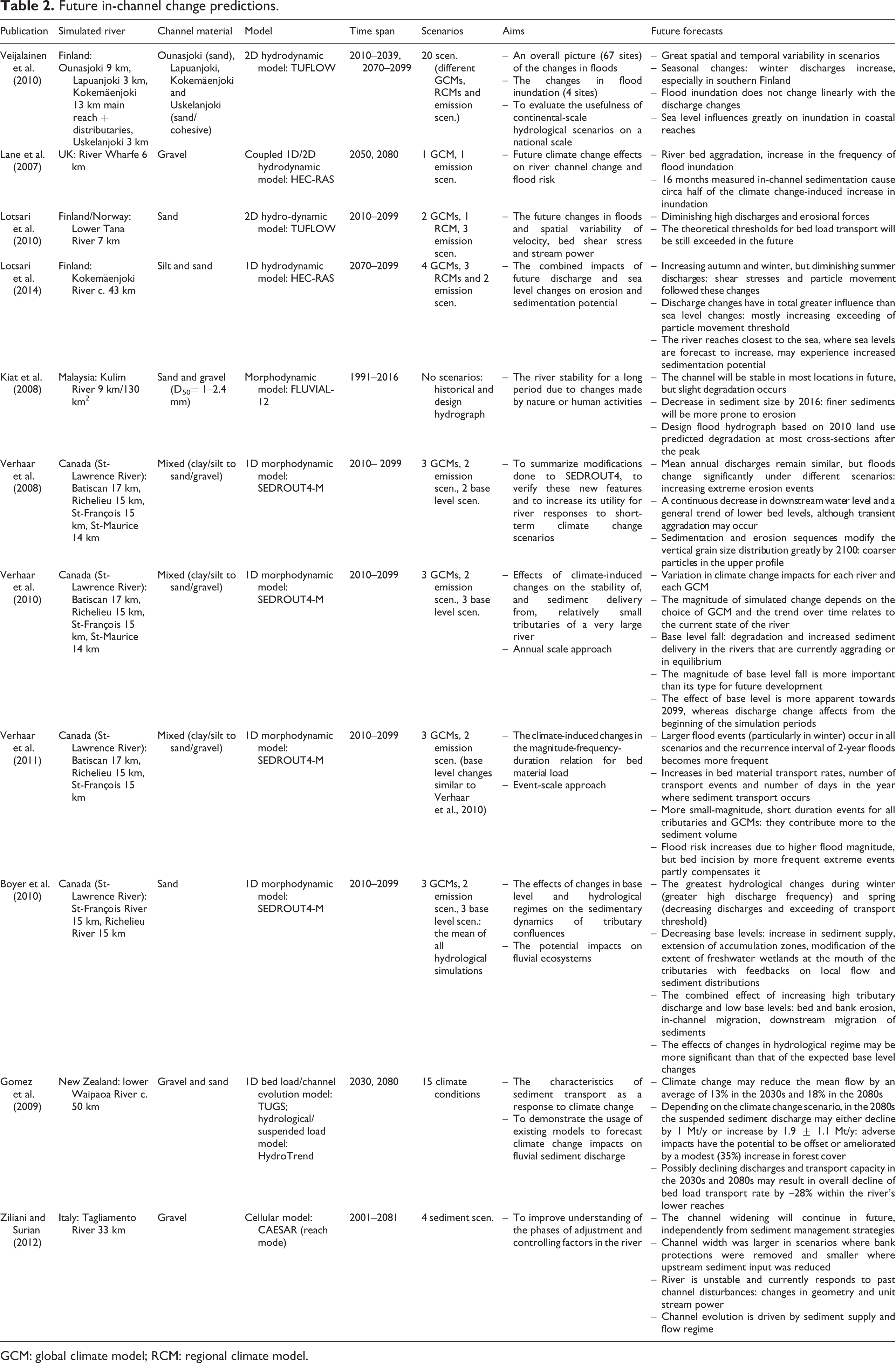
GCM: global climate model; RCM: regional climate model.
Future discharge changes may also have varying impacts on erosional forces. In the high latitude Tana River (Northern Finland/Norway), erosional forces were forecast to mostly decrease, but without influencing the exceedance of sediment transport thresholds during snow-melt peak discharges (Lotsari et al., 2010). The range of changes due to different discharge scenarios was, however, great. In the case of the 1/250 year flood discharge, stream power changed +4.5 to –39.9% and bed shear stress by +2.6 to –26.5% for the period 2070–2099, when compared to 1971–2000. In the Kokemäenjoki River (south-western Finland), the simulated erosional forces differed greatly from the northern Tana River, since greater erosion was predicted in response to increasing discharges (Lotsari et al., 2014). In addition to the overall greater exceedance of critical thresholds and therefore the simulated erosion potential, seasonal changes also varied. In particular, during winter and autumn, increasing river channel erosion forces can be expected, particularly due to increased autumn and winter discharges, whilst other seasons may experience greater deposition (Lotsari et al., 2014). Blöschl and Zehe (2005) stated that the most obvious cause for limits to predictability is the non-linearity of hydrological systems, for example when processes switch between regimes, for example the thresholds of inception of sediment motion in streams. Lotsari et al. (2014) showed that this threshold may no longer be exceeded during some seasons due to diminishing future discharges. These thresholds are important to take into account in future riverine planning and predictions.
The inclusion of sea level scenarios in simulations of future erosional forces within coastal area rivers is also important, since scenarios with increasing sea level may cause greater deposition within river estuaries and thus change the exceedance of particle movement thresholds (Lotsari et al., 2014). The 30-year average boundary shear stresses of scenarios without a sea level change and the same scenarios with maximum and minimum sea level estimates varied between ±18 and ±20% for RCA3-Had-A1B and CNRM-B1 discharge scenarios, respectively. However, in the Kokemäenjoki River, Lotsari et al. (2014) found that changes in discharge were forecast to have in total a greater influence on erosional forces than the predicted sea level changes.
2 Future in-channel sediment transport and channel evolution
With regards to in-channel sediment transport and river channel evolution, most studies to date have been performed in the northern hemisphere and in sand or gravel bed rivers (e.g. Boyer et al., 2010; Verhaar et al., 2008, 2010, 2011). Most of the findings predict increasing fluvial transport and flood risk but also indicate seasonal changes (Table 2). The effect of changes to discharge and sediment supply are shown to be more important to channel evolution than sea or base level change. Also of relevance to the findings for future channel change was the role of present and past development of rivers. For example, past channel geometry and stream power changes were shown to influence channel widening and aggradation of river reaches (Ziliani and Surian, 2012).
The climate change scenarios that produce the highest predicted discharges may also result in the greatest change to the river bed (Boyer et al., 2010). In northern latitudes, winter discharge and erosional events have been mainly predicted to increase. For example, in Canada, four studies were carried out for the tributaries of the St. Lawrence River (Boyer et al., 2010; Verhaar et al., 2008, 2010, 2011). The seasonal effects were enhanced under all GCM scenarios because longer duration, and higher magnitude, winter events were predicted (Boyer et al., 2010; Verhaar et al., 2011). The impacts varied in different tributary study reaches, despite being spatially close to each other (Boyer et al., 2010; Verhaar et al., 2010). Both these studies used exactly the same GCMs and emission scenarios in all tributary watersheds, so were able to examine river response to other controlling factors, as Coulthard et al. (2005) did for their palaeohydrological study of the River Warfe (UK). In these Canadian rivers, the greatest hydrological and fluvial transport changes were simulated during the winter (with increasing frequency of high discharges) and spring seasons, characterized by decreasing discharge (Boyer et al., 2010). This is similar to some catchment-scale sediment transport analyses, which have forecast increased wintertime sediment transport in their study sites in the northern hemisphere (Coulthard et al., 2012; Thodsen et al., 2008). In particular, the extension of sediment accumulation zones was forecast by Boyer et al. (2010), whilst the projected increase in sediment supply was shown to modify the extent of freshwater wetlands at the mouth of the studied tributaries with feedback effects on local flow and sediment distributions. Larger flood events have also been forecast, which cause increases in effective and half-load discharges (i.e. the discharge above and below which half the long-term sediment load is transported), bed material transport rates, number of transport events, extreme erosion events and number of days in the year when sediment transport occurs (Boyer et al., 2010; Verhaar et al., 2008, 2011). According to Verhaar et al. (2011), the relative contribution to sediment volume of the large events (i.e. greater than half load discharge of 509, 1102 or 1225 m3/s, depending on the tributary) for CSIRO-Mk2 and HadCM3 scenarios varied between 77% and 88% of total sediment transport in all the tributaries, and for the ECHAM4 scenario between 68% and 72%. However, future bed load rate was predicted to have greater variation than discharge due to the non-linear character of sediment transport (Verhaar et al., 2011), a finding also noted at the catchment scale by Coulthard et al. (2012). In addition, an increased frequency of small-magnitude, short duration events, which have a greater contribution to sediment volume, are predicted (Verhaar et al., 2011). It was also demonstrated that, despite lower bed elevations, flood risk is likely to increase as a result of higher flood magnitude, even with falling base level. However, flood risk can also partly be compensated for by bed incision during more frequent extreme events (Verhaar et al., 2011).
Increasing average bed material and suspended sediment delivery have also been predicted for the St. Lawrence River (Table 1: Verhaar et al., 2010, 2011). Even without change to base level, increases in average bed material delivery are expected according to these studies, although the magnitude of simulated changes depended on the choice of GCM and the trend over time related to whether the river is currently aggrading, degrading or in equilibrium (Verhaar et al., 2010, 2011). Verhaar et al. (2010) showed that a fall in base level leads to degradation and increased sediment delivery in river channels that are currently either aggrading or in equilibrium, amplifying the effects of climate change on sediment delivery. Of particular interest is the finding that the magnitude of base level fall is more important for future channel development than its duration, that is, whether the fall was sudden or more prolonged. Thus, the work by Verhaar et al. (2010) was the first future in-channel change simulation where the present state of the river channel was acknowledged to be of relevance for its further future development. Also, Boyer et al. (2010) stated that the combined effect of both discharge and base level changes are important, as an increase of high discharges under low base water levels will result in bed erosion, in-channel migration, bank erosion and downstream migration of sediments in the river. In addition, Ziliani and Surian (2012) stated that in the future a river channel may still respond to past disturbances, which may have caused a change of channel geometry and unit stream power.
Few studies have simulated future bank erosion responses to climate change. In the Tagliamento River (Italy), it was shown that long-term future channel widening continues independently from sediment management strategies (Ziliani and Surian, 2012). Naturally, the channel width was greater with scenarios where bank protections were removed, but smaller if sediment input was reduced. However, overall the average channel width increased despite different management strategies from 760 m in 2009 to 960–1015 m in 2040 and to 1180–1230 m in 2080. They also found that channel evolution is driven by both sediment supply and flow regime.
In morphodynamic simulation approaches performed on the Waipaoa River, New Zealand (Gomez et al., 2009), climate change may reduce the mean flow by an average of 13% by 2030 and 18% by 2080, but depending on the climate change scenario the suspended sediment discharge may either decline or increase by the 2080s. Gomez et al. (2009) stated that the adverse impacts of climate change on the suspended sediment load have the potential to be offset or ameliorated by a 35% increase in forest cover, which reduces the mean annual suspended load by 6% in the 2030s, but a 14% decline in the forested area results in a 3% increase in the mean annual suspended load by the 2030s. The declining discharge and transport capacity of the channel may cause overall decline in the bed load transport rate within the river’s lower reaches. Despite the decrease in predicted bed load by the 2080s, a range in sediment discharges (9.4 ± 20.1 kt per year) was predicted under different scenarios (Table 2). However, this predicted bed load for the 2080s is greater than for the 2030s because aggradation reduces the accommodation space and modifies the river’s long profile. Like the findings of Lane et al. (2007), Gomez et al. (2009) showed that river capacity will be reduced and increasing flood risk is expected due to rising channel bed elevation.
The only future channel change study performed in an equatorial region (the Kulim River in Malaysia) indicated limited cross-sectional change and slowing erosion during the 2006–2016 simulation period (Kiat et al., 2008). They also showed that by 2016 sediment delivery may be twice as much as in 2006 but less sediment delivery occurs at downstream parts of the study site, with sediment size decreasing in certain reaches by 2016. These grain size changes, particularly vertical changes and coarser particles occurring in the upper part of the profile, were also predicted in the St. Lawrence River tributaries (Verhaar et al., 2008).
IV Uncertainties related to the external forcing conditions
1 Future discharges
The key factors, and cause of greatest uncertainty in future reach-scale in-channel simulation approaches, are the external forcing conditions and how future climatic, hydrological and land cover changes are taken into account. In the case of hydrological forecasts, many climate models and scenarios have been used in simulation studies (Veijalainen et al., 2010). The magnitude of simulated discharge and bed material delivery change depends on the choice of the GCM (Verhaar et al., 2010). More precisely, the GCM can be the key controlling factor in determining future morphological adjustments of rivers. One interesting finding is that the choice of emission scenarios is much less important than the different GCMs and, in particular, emission scenarios have less effect on sediment delivery than on bed elevation (Verhaar et al., 2010). Future reach-scale suspended sediment transport changes have also varied greatly due to the contrasting hydrological scenarios applied (Gomez et al., 2009). This is also similar to some catchment-scale future sediment flux studies performed using probabilistic approaches (e.g. Coulthard et al., 2012). According to Verhaar et al. (2011), future research should continue to use more than one GCM scenario, unless or until GCM refinement leads to a convergence of climate predictions. However, the application of a limited range of climate scenarios was most common for the studies of future in-channel change predictions summarized in Table 3. Thus, the effect of GCM selection has had an important impact on the results of published studies to date. According to Boyer et al. (2010), the application of the mean result from multiple hydrological scenarios reduces the impact associated with extreme discharge values that may be generated using only one simulation.
The strengths and weaknesses of published simulations of future in-channel changes.
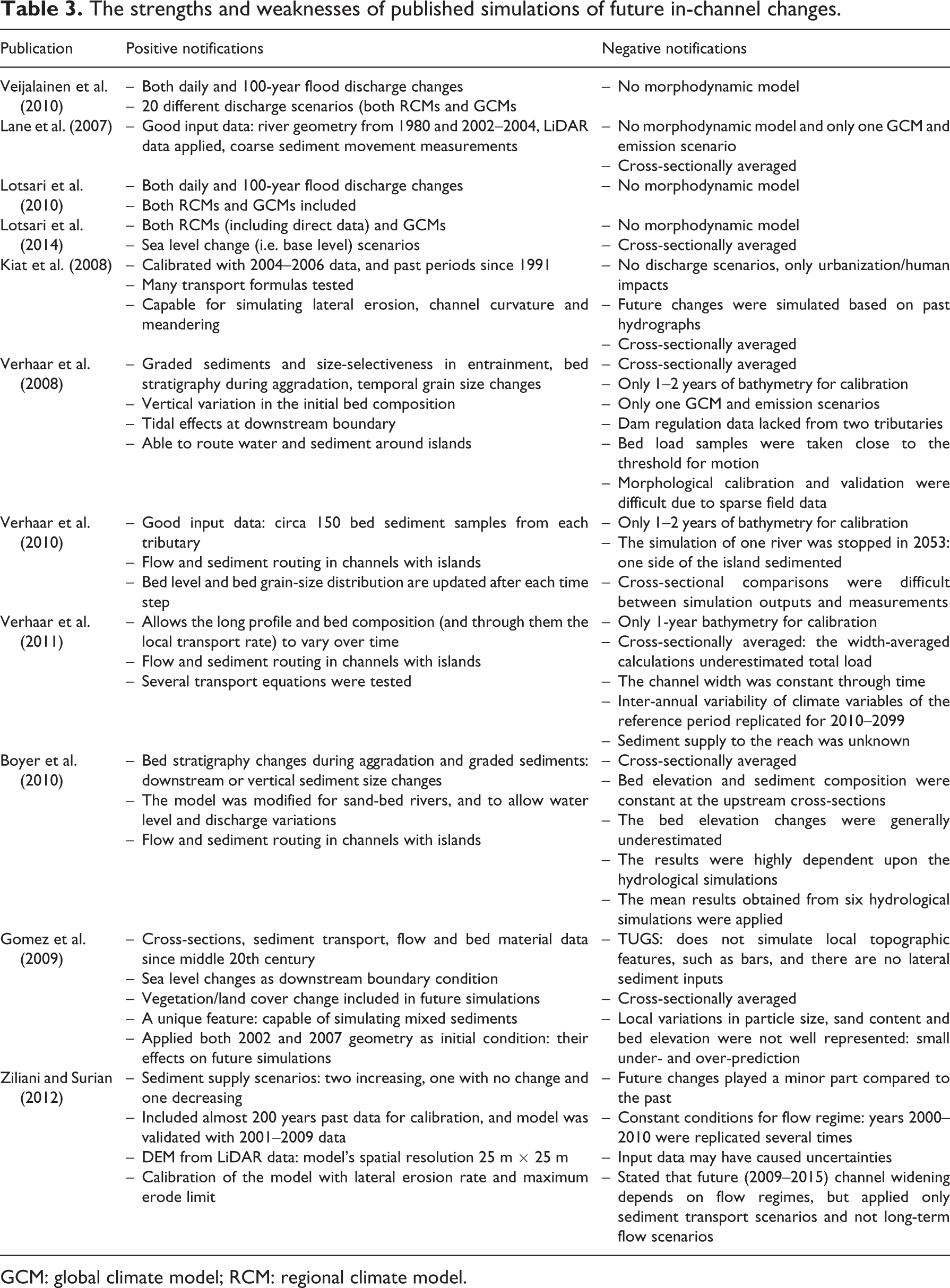
GCM: global climate model; RCM: regional climate model.
Uncertainties also relate to the calculation of flood recurrence intervals, which, in the reviewed papers, were most commonly calculated by applying only one method (cf. Lotsari et al., 2010), for example Gumbel (Veijalainen et al., 2010) or Pearson III approaches (Verhaar et al., 2011). Recurrence intervals can be misleading because they are determined from the peak magnitude of flow and they do not take into account the magnitude and duration of out-of-bank flow (Lane et al., 2007). Lane et al. (2007) pointed out that sediment aggradation will not affect discharge return periods but will alter the frequency of inundation events. This is important to take into account in future in-channel studies. The reliability of the determination of recurrence intervals is also limited because future simulations are based on a 30-year reference period, such as 1971–2000, that is repeated in the future (Verhaar et al., 2011). In the case of future discharge simulations with hydrological models, and thus also in the within-channel hydro- and morphodynamic simulations applying these discharges, uncertainties also relate to the fact that the hydrological model is employed in conditions that have not occurred during the calibration period (Lotsari et al., 2010; Seibert, 2003).
The method to transfer the climate change signal to the hydrological model for future discharge scenarios may also be a source of uncertainty. For example, Verhaar et al. (2008, 2010, 2011) and Lotsari et al. (2010, 2014) applied the delta change method in their analyses of potential channel and sediment transport changes. In the delta change method the monthly temperature changes are added to those observed and precipitation changes are multiplied by the observed precipitation values of the control period, but the potential changes in rainfall variability and intensification of extreme precipitations are ignored. This issue can, however, be partly addressed by applying the temperature-dependent change method, which changes the lower winter and spring temperatures more than the higher temperatures (Lotsari et al., 2010). However, this was not taken into account by Verhaar et al. (2008, 2010, 2011). Other types of transfer methods are available for application in future in-channel change predictions, such as the bias-corrected direct RCM data (Lotsari et al., 2014). However, in some of these RCM data simulations, and thus also future in-channel change predictions, it is assumed that future climate variability remains the same as presently (Lotsari et al., 2014). The latest enhancements in future discharge predictions are one of the major prerequisites for future simulations of within-channel changes. Due to the uncertainty in the projected climate changes scenarios and variability caused by the stochastic nature of the simulated rainfall, probabilistic approaches with multiple repeated simulations for each scenario have been encouraged for future simulation approaches (Coulthard et al., 2012). So far, none of the reach-scale in-channel future simulation studies have included this kind of approach, but the evidence from catchment-scale studies suggest this has potential for reach-scale future simulations.
2 Future base level changes
Only a few of the future simulations reviewed have taken base level changes, including sea or river water level changes, into account (Table 2). Verhaar et al. (2008, 2010, 2011) applied both gradual and step changes at a certain point in time, in addition to no-change future conditions. In coastal rivers, sea level is used as the downstream boundary condition of the models. Lotsari et al. (2014) and Veijalainen et al. (2010) had taken the possible relative sea level changes (including isostatic land uplift) into account in their hydrodynamic simulation of future erosional force changes. These reach-scale in-channel studies, where both discharge and base level change effects are combined, are still rare in the literature. Both Verhaar et al. (2010) and Lotsari et al. (2014) showed for rivers with very low energy slopes that backwater effects of downstream base level on hydraulics and bed shear stress can persist far upstream. Therefore, in river reaches close to the sea, or tributary rivers where the downstream boundary is defined by changes in the main river, these possible base level changes should not be ignored when simulating future river channel changes. However, interestingly, Gomez et al. (2009) did not find difference in the channel change trends whether the sea level changes were included or not.
3 Future land cover and sediment supply changes
Although land use effects have been recognized as an important driver of change in the studies of past river environments (e.g. Notebaert et al., 2011), the simulation of future land use change has proved difficult and many of the future in-channel change simulation approaches have ignored this external forcing condition. Only Gomez et al. (2009) have taken into account the land cover changes when simulating future in-channel processes, whilst Ziliani and Surian (2012) considered the changes occurring in the upstream watershed on sediment supply (bed load). Gomez et al. (2009) also simulated the effects of potential human-induced changes in land use on the suspended sediment discharge by superimposing a change in the vegetation cover on the climate change scenarios. Feedback systems between hydro-climatic conditions, land cover and morphodynamics were shown to increase the uncertainties (Gomez et al., 2009) and should be included in future simulation approaches. However, in contrast to this view, Ziliani and Surian (2012) showed that changes in sediment supply in the catchment area had no, or minor, effects on the channel of the Tagliamento River.
V Issues related to future in-channel change predictions
1 Temporal and spatial representation/resolution
Simulated time spans for modelling future river response tend to be shorter and over smaller spatial extent, with prediction usually performed in river lengths of 3–50 km (Table 2), than in palaeohydrological modelling studies (e.g. Coulthard et al., 2005) or contemporary process studies such as Saleh et al. (2013). This is because future centennial-scale in-channel simulations are computationally demanding; therefore, only 1D morphodynamic models have been applied at centennial timescales to date and there is a need for multi-dimensional models capable of these long-term simulations. However, at the present time it is the 1D models that are the most capable of simulating large river reaches and longer time spans. The results presented in the reviewed morphodynamic approaches have therefore been cross-sectionally averaged. This has implications as, for example, width-averaged 1D calculations may underestimate the total sediment load, because local bed load is a non-linear function of the local flow strength and because the excess flow strength over the threshold of motion varies spatially (Verhaar et al., 2011). The future bed load rate of Verhaar et al. (2011) had higher variation than discharge due to this non-linear character of sediment transport. However, Gomez et al. (2009) showed that local variability, which a 1D model cannot completely replicate, did not appear to have a substantial effect on future in-channel changes. This finding supports the application of 1D models in further future in-channel change simulations, particularly since they may be modified to support the needs of future in-channel change simulations. For example, Verhaar et al. (2008) were able to modify a 1D morphodynamic model, which was originally developed for gravel bed rivers, so that it allowed for simulation of a wider range of grain sizes, variable discharge, downstream water level fluctuations and flow and sediment routing in channels with islands.
However, there are also examples of failed 1D morphodynamic simulations of future changes due to the spatial channel representation of the model and its sediment flow. In one tributary of the St. Lawrence River where the morphology of the channel was characterized by islands, simulation by Verhaar et al. (2010) failed because one of the bifurcations experienced unrealistic sedimentation. Therefore, the need for 2D models, which are capable of dealing with islands and bifurcations, was acknowledged by Verhaar et al. (2010). An alternative approach may be the use of cellular models, as their spatial representation can be comparable to that of 2D models. For example, the cellular model of Ziliani and Surian (2012) was performed in a wide braiding river reach with a 25 m × 25 m spatial resolution. The advantage of this cellular model, compared to the 1D hydro- and morphodynamic models, is that it uses a grid form and so it is possible to simulate spatial variations at a particular cross-section, including for large river systems. Even though the study reach lengths of the 1D model studies were similar to the future reach-scale cellular model approach (i.e. >30 km), the spatial representation is better than for the cross-sectionally averaged 1D models.
Hydro- and morphodynamic models have been applied at event, annual and centennial scales. The appropriate simulated time span depends on the spatial representation. Despite the advantages in spatial representation of 2D models over 1D models, their computational times are still, at present, very long for continuous centennial-scale simulations and only event-scale in-channel change simulations have been performed with them (Table 1). Thus, 2D models should be developed so that they can run long-term, unsteady simulations of bed material transport and incorporate the impacts of bank erosion on channel evolution (Verhaar et al., 2011). Since future simulations have been modelled for shorter time periods than, for example, historical or palaeo-studies, the millennial-scale simulation problems, as noted by Van De Wiel et al. (2011), have not arisen in future simulation studies. The usual time period for future in-channel change analysis is one of 30 years, most commonly for the time periods 2010–2039, 2040–2069 and 2070–2099 (e.g. Verhaar et al., 2008, 2011). Some of the in-channel change simulations are done only with the extreme flow events of the different discharge scenarios (Lotsari et al., 2010; Verhaar et al., 2011), thus the simulated hydrographs have been of short duration. However, 1D models have successfully been used to simulate continuous daily discharge series until 2100 (Lotsari et al., 2014).
Cellular models now show great promise for future simulations because, by using simplifications of flow equations, coupled with sediment transport, they can rapidly simulate geomorphic processes over medium timescales (Coulthard et al., 2012; Ziliani and Surian, 2012) and detailed spatial resolutions (Van De Wiel et al., 2007; Ziliani and Surian, 2012), as demonstrated from a palaeohydrological perspective by Coulthard et al. (2005). Whilst cellular models have the capability to model centennial and millennial-scale simulations, to date the availability of future discharge scenarios is limited to the next 100 years. However, it is questionable whether such long time spans are desirable given typical river management timescales (Downs and Gregory, 2004) and it is the near-future (decadal) in-channel changes that have been shown to be of particular importance to simulate (Kiat et al., 2008; Lane et al., 2007).
2 Calibration and validation of the models for future simulations
A key challenge for future simulation research regards calibration and validation of the models used, as this has been performed based on the adjustment of model parameters against present or past observed data, such as water level and bathymetry (Lane et al., 2007). Lane et al. (2007) stated that models calibrated based on historical topography, discharge and water level data are likely to underestimate future water levels, and hence inundation and flood risk, if aggradation has occurred since the applied past event observational data. In such aggradational reaches, the calibrated friction value would therefore be too low for future channel conditions. This is clearly a problem for hydrodynamic simulations of future river channels, since all reviewed studies have applied present river geometry and channel materials to calculate roughness estimates.
The most effective means to test the accuracy of transport rate predictions of reach-scale morphodynamic or cellular models is against resurveys of river geometry (Verhaar et al., 2008; Ziliani and Surian, 2012). This necessitates a short calibration period as data on sediment accumulation or erosion needs to be gathered during the study (Verhaar et al., 2010). Clearly the application of short (e.g. one year) calibration periods for future century-scale channel simulations is problematic. Longer observation periods or historical data would be needed, such as has been applied in the studies of Kiat et al. (2008) and Ziliani and Surian (2012). Gomez et al. (2009) compared simulated channel change data with historical empirical observations (1948–2002) of aggradation in the river and the documented (1996) downstream variation in the size and composition of the subsurface bed material, which Verhaar et al. (2008) also stated to be important to include in calibrations and validations. Despite the fact that simulated changes in bed elevation were, throughout the study reach of the Waipaoa River, in broad agreement and consistent with the observed trends of bed changes, the calibration results were not perfect and differences in simulated and measured bed elevations occurred (Gomez et al., 2009). If the calibration results have uncertainties, these will inevitably cause uncertainties for future simulations.
One aspect that has emerged from this review is that cross-sectionally averaged results have been difficult to compare against observational data. Matching of detailed topographical measurements to cross-sectionally averaged 1D model results for modelled time intervals is demanding and sometimes not possible with sufficient reliability (Verhaar et al., 2010). However, problems do not only relate to the cross-sectional comparison of simulated and measured geometry but also to flow velocity and sediment transport data. It has been a challenge for researchers to perform extensive and reliable bed load sampling for model calibration. In particular, for many studies the calibration and validation have been difficult to do due to sparse and erroneous Helley–Smith bed load sampling (e.g. Verhaar et al., 2008). Blöschl and Zehe (2005) stated that bed load predictability is poor if the system is close to a threshold but improves as the system moves away from a particular threshold and towards stability. For example, Verhaar et al. (2008) measured bed load transport close to the flow conditions of initiation of particle motion and errors to the calibration bed loads occurred. The relationship between measured sediment transport and discharge was found to be highly variable also in the study site of Verhaar et al. (2011), where a morphodynamic simulation was performed.
Even though many of the future in-channel simulations demonstrated good correspondence with hydraulic parameters, in some studies the 1D simulations could not handle local within cross-section variations of flow velocity and thus sediment transport. Therefore, for in-channel change simulations the accuracy of the models depends partly on the quality and quantity of the input data (Kiat et al., 2008) with unreliable or sparse field data hampering model calibration and validation.
3 Representation of river channel material and transport equations
The representation of river channel material and transport equations arose as a key issue in this review and, in particular, the choice of transport equation has been crucial for morphodynamic models. There are many empirically developed equations, which are applicable in different types of rivers consisting of different grain size. So far, it has not been possible to develop a universal equation. This is problematic, since for future scenarios, sediment size and spatial sorting might also change and questions arise as to whether or not the presently applicable equations may be valid for future river channel sedimentary conditions. The empirical sediment transport formulae should, therefore, be applied with caution for long-term, including future channel change, simulations (Verhaar et al., 2008). Since the accuracy of sediment transport formulae has been questioned (e.g. Barry et al., 2004; Van Rijn, 1984a) and sediment transport models may not be as universal as thought (Papanicolaou et al., 2008), researchers have been encouraged to employ different models with a range of transport algorithms. The study by Kiat et al. (2008) was one of the few in this review that tested many transport algorithms before deciding on the best one according to the test simulations. However, the future in-channel change simulations showed that trends and differences between future scenarios can be identified, even if the applied sediment transport formula is systematically over- or under-predicting actual transport rates (Verhaar et al., 2008). On the other hand, Verhaar et al. (2011) stated that it is hard to assess the uncertainty in bed load transport predictions resulting from entrainment threshold and transport equations. Best practice, therefore, for simulations of future scenarios, is to use transport equations capable of simulating a wide range of sediment particle sizes.
A further challenge, with regard to sediment transport in future simulations, is the spatial and temporal change to bed sediment grain size and the active layer. The horizontal and vertical bed material composition and variation were often neglected in sediment transport and morphodynamic models at the beginning of the 21st century (van Ledden, 2002). Even in present day studies the input grain size, and whether only the D50 or additional grain sizes are included, has been shown to influence simulation results (Lotsari et al., 2014). Some of the reviewed future simulation approaches only used a few sediment samples as the reference for roughness or for application in the actual transport equations. For example, since Gomez et al. (2009) did not have detailed knowledge of grain size variation, they used a constant particle size distribution to characterize long-term sediment supply. Verhaar et al. (2008) applied the same roughness spatially throughout the river reach but they did not have data to verify the roughness conditions for high flows, suggesting further issues for simulating extreme events.
The widely applied approach of using a single fixed grain size in sediment transport equations may not represent the various size fractions within sediment mixtures (Wu et al., 2004). A feature of the morphodynamic model applied by Gomez et al. (2009) was that it was capable of simulating fine sediment dynamics in gravel deposits and, hence, the dynamics of bed load transport in channels in which the bed material contains a high proportion of sand. Similarly, Verhaar et al. (2008, 2010, 2011) applied a model capable of simulating mixed sediments. A positive approach of some models was inclusion of temporal grain size evolution, and therefore changes in channel roughness (Gomez et al., 2010; Kiat et al., 2008; Verhaar et al., 2008). Furthermore, grain size sorting has also been included in some of the reviewed in-channel model approaches (Verhaar et al., 2011). Even though both Verhaar et al. (2008, 2010, 2011) and Gomez et al. (2009) had models where active layer or surface layer thicknesses were possible to define, a constant thickness was applied throughout the simulations. Layer thickness influences the grain size distribution of the transport layer and is therefore important for modelling initiation of particle movement. Gomez et al. (2009) noted one particular strength of their simulation results was that the model successfully simulated the pattern of downstream fining and reproduced the downstream trends in the sand content of the subsurface bed material, as well as bed elevation, over prescribed periods of time. A positive quality of the model of Verhaar et al. (2008, 2010, 2011) was that artificial mixing between the sub-layers was avoided during alternating sedimentation and erosion. In addition, they noted that a stratigraphic record can be built during a long-term simulation, which was found as an advantage over some other 1D morphological models.
In cellular modelling approaches, several bed load or suspended load sediment fractions are possible to define depending on the grain sizes (Coulthard et al., 2012; Van De Wiel et al., 2007; Ziliani and Surian, 2012). Even though their model is capable of dealing with suspended load, Ziliani and Surian (2012) applied only bed load in their reach-scale analyses. Whilst the description of the model was somewhat limited in Ziliani and Surian (2012), it seems that sediment transport was driven by a mixed-size formula (sand, gravel and silt), which calculates transport rates for each sediment fraction, as referred to by Van De Wiel et al. (2007). There were many prospects for this model with regards to grain size representation, in line with those of the hydro- and morphodynamic models described above. The model applied by Ziliani and Surian (2012) allows for sediment heterogeneity and keeps track of several user-defined grain size fractions (Van De Wiel et al., 2007). Selective erosion, transport and deposition of these different fractions results in spatially (horizontal and vertical) variable sediment distributions. The capabilities of this model in updating horizontal and vertical grain size properties, according to future discharge and sediment transport forecasts, has also been demonstrated in the catchment mode approach by Coulthard et al. (2012). Thus, the characteristics of cellular models for representing grain size and sediment transport are good in comparison to the hydro- and morphodynamic models discussed.
4 Lateral erosion
Whilst morphodynamic and cellular models are capable of simulating lateral bank erosion, this process representation has only been applied for simulating both vertical and lateral erosion in the morphodynamic model of Kiat et al. (2008) and the cellular model of Ziliani and Surian (2012). Most of the reviewed papers that applied a morphodynamic model with vertical bed change simulations did not therefore include lateral channel changes (Table 2; e.g. Gomez et al., 2009; Verhaar et al. 2008, 2010, 2011). Some of the studies were performed in river reaches where lateral bank erosion and river migration occurs, but the applied 1D morphodynamic model was not able to take that into account. The inclusion of only either channel bed or bank evolution in the model is problematic, since these changes can influence each other over both the short and long term. Even though Lane et al. (2007) did not actually simulate future lateral changes with their hydrodynamic model, they stated that where river management restricts lateral movement of the channel and transfer of sediment into floodplain storage, the channel bed responds by aggradation. Also in the study by Verhaar et al. (2010), the channel width was considered constant through time and therefore no lateral changes in the channel were simulated. This caused the divergence in bed material flux to be accommodated entirely by a change in bed elevation. In reality, annual differences in both vertical and lateral channel changes occur depending on the water level fluctuations, therefore causing great uncertainties in future in-channel change predictions. In the case of degrading river channels bank erosion may increase in the future (Verhaar et al., 2010), therefore inclusion of both vertical and lateral changes in the models is important. The morphodynamic model of Gomez et al. (2009) did not simulate local topographic features, such as bars, or take into account lateral sediment inputs that cause pronounced local variations in the bed material along the river.
As previously mentioned, only Kiat et al. (2008) and Ziliani and Surian (2012) included lateral changes in their simulations. The morphodynamic model of Kiat et al. (2008) included the width adjustment component, which simulates inter-related changes in the channel bed profile, width variation and changes in bed topography induced by the curvature effect. Therefore, a good feature of this model is that in addition to lateral bank erosion, the changes in channel curvature and meandering can also be modelled. Thus, the model applied by Kiat et al. (2008) was the most sophisticated of the morphodynamic models reviewed; however, the complexity of this increased sophistication meant that it could only simulate a short future change period and with no consideration of climate change impacts on flow conditions.
The advantage of the cellular model of Ziliani and Surian (2012) was that a lateral erosion algorithm was implemented (Van De Wiel et al., 2007) and so their model was capable of simulating both meandering and braided channels, although note that the Ziliani and Surian (2012) study focused on a braided reach. These kinds of reach-scale future cellular model approaches have not been used before (Van De Wiel et al., 2007) but whilst there are prospects for applying such cellular modelling approaches, the fact that the flow-sweeping algorithm applied in the Ziliani and Surian model did not preserve momentum, and no primary and secondary flows were possible to distinguish, may influence the lateral erosion results (Van De Wiel et al., 2007).
5 Chain of multiple simulations
Most of the reviewed future natural river in-channel change analyses employed a chain of multiple different simulations, with the consequence that uncertainties accumulate with each simulation step, as is also evident in catchment-scale models of sediment flux (e.g. Coulthard et al., 2012; Mukundan et al., 2013; Thodsen et al., 2008). This is different to present or near past channel change studies, where input data relies on actual measurements and so no climate or hydrological models are needed to predict the input discharge data. Furthermore, the hydrodynamics need to be calibrated before simulating morphodynamics. In other words, each step of the modelling therefore needs its own input data and model calibrations.
All the studies listed in Table 1, except Kiat et al. (2008) and Ziliani and Surian (2012), applied discharge scenarios that were simulated based on climate change forcing that produced a wide range of predicted discharge changes. For example, in tributaries of the St. Lawrence River (Boyer et al., 2010) the spring discharge peaks varied 200–300 m3/s between applied discharge scenarios. Lotsari et al. (2010) showed –52.4 to –10.7% changes in the case of 1/2a floods and –39.6 to +3.5% changes in 1/250 year floods by 2070–2099 when compared to 1971–2000. Boyer et al. (2010) found that their morphological simulation results were highly dependent upon these hydrological simulations so applying a range of discharges, in addition to water level scenarios, to model input data causes greater variability in the hydro- and morphodynamic output data due to non-linearity. Using Boyer et al. (2010) again as an example, an increase in mean annual volume of sediments ranged from 236% to 530% for the Richelieu River and from 28% to 182% for the St. Francois River for the simulated time horizons of 2010–2039, 2040–2069 and 2070–2099. The sediment volume ranges were thus greater than for their simulated discharges, as also demonstrated by some catchment-scale approaches (Coulthard et al., 2012). Veijalainen et al. (2010) and Verhaar et al. (2010, 2011) also demonstrated the importance of hydrological simulation results on the findings of their hydro- and morphodynamic simulations at the reach scale, for example, the selection of the applied discharge scenarios influenced hydro- and morphodynamic simulation results. Veijalainen et al. (2010) applied many climate scenarios for hydrological simulations, but only selected a few examples in flood inundation simulations. Therefore, in addition to the uncertainties related to the hydrological simulation and model calibrations of both hydrological models and hydro- and morphodynamic models, the selections made by the researchers narrows or broadens the range of output results. Similarly, in catchment-scale studies, Coulthard et al. (2012) has noted this uncertainty caused by the cascade of simulations, particularly due to the non-linear nature of the climatic, hydrological and geomorphic systems.
VI Summary: Prospects and challenges of future in-channel change predictions
This review has shown that a wide variety of models has been used to simulate future hydro- and morphodynamics. In broad terms, the models can be divided into (a) reductionist models, the hydro- and morphodynamic approaches, which break the system down in to smaller scale processes and (b) the more holistic, reduced complexity, cellular models, which simulate the system as a whole whilst simplifying its components (Van De Wiel et al., 2007). It is interesting to note that cellular modelling has been applied less frequently than reductionist approaches despite their capabilities in simulating present and past changes, even over millennial timescales (Coulthard and Van De Wiel, 2012). The reason for this may lay behind the fact that these models have not previously demonstrated quantitatively accurate predictions of sediment transport and channel change in specific situations (Verhaar et al., 2010). Thus, further developments of enhanced simulation approaches combining elements of reduced complexity and reductionist models, such as described by Van De Wiel et al. (2007) – and applied by Ziliani and Surian (2012), who included an improved flow model, bank erosion, sediment heterogeneity and suspended sediment transport in their reach-scale cellular model – are needed.
Our review has highlighted many of the same methodological issues associated with palaeohydrological modelling (Coulthard and Van De Wiel, 2012; Van De Wiel et al., 2011), not least as the same types of models can be applied. Scale and non-linearity are key issues in both palaeo- and future simulations (Blöschl and Zehe, 2005; Van De Wiel et al., 2011); however, the latter tended not to be discussed in the papers reviewed herein. Non-linearity occurs, for example, when processes switch between regimes such as when the threshold of initiation of sediment movement is exceeded. Coulthard et al. (2012) did discuss the non-linearity issue in their catchment-scale sediment flux study of the River Swale in northern England – future simulation runs with similar parameters can generate variable changes across the river catchment. Based on simulations with a surface water flow model (Simpson and Castelltort, 2006, 2012) demonstrated that sediment outflux from the catchment was highly episodic and depended on the changing water discharge due to positive feedbacks between discharge and channel gradient. At the millennial scale, even small changes in discharge can impact greatly on the amount of sediment stored in river valleys. Coulthard et al. (2012) showed that future catchment sediment flux changes do not occur linearly, with for example 1.28 times greater rainfall than for the control period causing five times greater sediment outflow from the catchment.
Spatial scale is also an important issue as no matter what resolution is applied, there will always be some finer-scale details that are impossible to capture and studies have not necessarily demonstrated consistent improvements with increased spatial scale. So whilst some studies have shown improved predictability with increasing spatial resolution (Blöschl and Zehe, 2005; Zehe and Blöshcl, 2004), Kasvi et al. (2014) found that at a particularly detailed scale of one meander bend, the 3D model applied was not effective in simulating the observed channel changes measured in detail with laser scanning. The superiority of the 3D model for morphodynamic reconstruction, when compared to the 2D model, was not evident. Thus, the scale issue can also be considered the other way round in that models may not be able to capture the changes measured at the fine scale. This leads to critical questions for future in-channel change predictions regarding whether modellers should (a) focus on enhancing future simulations with multi-dimensional models, or (b) improve 1D simulation approaches and reduced complexity models so that they are more capable of including morphodynamic representations, such as lateral erosion and channel material changes.
Whilst generalizations are a common feature in future simulations, approaches were taken to include as many external forcing conditions in the models as possible. The complexity of nature was best taken into account in the simulation approaches where land cover changes were included (e.g. Gomez et al., 2009). Many studies, however, were able to detect the isolated influences of climate change (Lane et al., 2007; Verhaar et al., 2010). Due to the overwhelming task of taking all potential external forcing conditions into account in one simulation study, future in-channel change studies concentrated on certain selected changes at a time. For example, Verhaar et al. (2010) and Lotsari et al. (2014) included base level changes, whilst positive feed-backs were taken into account by Lane et al. (2007), as river bed aggradation was shown to cause greater flood hazard. Thus, it has been possible to examine the sensitivity of rivers to selected variables taken in combination or isolation (Verhaar et al., 2010). According to the present review, however, there is still much work to be done to establish the full range of geomorphological responses that may take place in fluvial systems.
Coulthard et al. (2012) have urged the geomorphic modelling community to perform multiple repeated simulations, since the simulation results can vary significantly. We also recommend that a wider range of scenarios and combined effects of multiple external forcing factors should be included in reach-scale river channel studies. As an example, for simulations in rivers in periglacial environments, of particular interest in future simulation studies due to these environments’ susceptibility to climate change (IPCC, 2013b), no river ice effects have yet been included. Furthermore, with respect to permafrost, which can greatly affect bank stability and the input of sediments to the river (Anisimov et al., 2008; Koster et al., 2005), none of the future in-channel change predictions from catchments in periglacial environments included potential permafrost changes. Interestingly, future sediment transport simulation studies performed at the watershed scale almost consistently state that decreasing permafrost will increase suspended sediment transport (Gordeev, 2006; Morehead et al., 2003; Peterson et al., 2002). However, in past change studies, a change from permafrost to non-permafrost conditions has been characterized by a decrease in sediment yield, while a change towards permafrost conditions has increased sediment yield (Bogaart et al., 2003). Therefore, in periglacial environments the effects of permafrost changes would be important to consider in further in-channel change simulation studies.
To summarize the key challenges for future in-channel change simulations we highlight the following: (a) representation of external forcing conditions; (b) capabilities to simulate with adequate temporal and spatial scale; (c) calibration and validation based on present or past data; (d) representation of transport equations, river channel material and its possible changes; (e) the simulation of lateral erosion; (f) simulation chains with multiple different models; and (g) identification of unknown feedback systems and assessment of non-linearity. Despite these challenges, great promise was shown in the studies highlighting good prospects for future in-channel simulations. For example, models with increasing complexity have appeared recently, with increasing potential for their application in future simulations. For cellular, hydro- and morphodynamic simulations it has been possible to modify the models to take into account the needs of future representation, such as to simulate continuous channel changes, grain size variation and unsteady flow situations even combined with base level changes. Cellular models can also now simulate the natural river environment and long calibration periods can be included. One prospect for cellular models is that they can also include both future catchment and reach-scale in-channel simulation approaches, such as hillslope effects in addition to the channel and upstream sediment inputs, in one study (Coulthard et al., 2007, 2012; Ziliani and Surian, 2012). However, this kind of future simulation approach, to include both fluvial and slope processes, has not yet been performed.
From our review we have, therefore, identified an idealized model for simulating future in-channel changes. This model should be 2D or cellular, be able to incorporate multiple sediment transport equations and have the capability to simulate the following: (a) grain size changes; (b) vertical and lateral changes; (c) sediment supply changes in time; and (d) unsteady flow and base level changes. The next stage, therefore, in future simulation modelling includes the need to further develop 2D models for century-scale studies. Furthermore, spatial coverage needs to be increased as most simulations to date are from northern latitudes so wider regional evaluations of future in-channel changes are impossible. Thus, to be able to fully understand future geomorphological changes of rivers, more local reach-scale studies are needed from hydrologically different areas. Input data series have been in most cases very short and inclusion of historical/palaeo-investigations for model calibrations and validations could enhance their application in future simulations with more confidence.
However, the question remains, how detailed should future in-channel change simulations be? This will depend on the goal of future simulation research. According to Verhaar et al. (2010), comparing scenarios may not provide accurate values, or absolute prediction according to Wilcock and Iverson’s (2002) definition, but may give a good indication of the direction, and relative magnitude, of change. So whilst society may desire absolute future prediction of, for example, when a flood may occur, and its magnitude, the more practical application of future geomorphic simulation is contingent prediction to identify the likely geomorphic event if certain future conditions are satisfied (Wilcock and Iverson, 2002). Within this societal context Lane et al. (2007) asserted that we need tools to predict the medium-term response of river beds and river banks to sediment delivery in order to assess flood risk impacts. The enhancement of these tools has already started, but further research on both model development and their application in an increasing range of future simulation approaches is still needed.
Footnotes
Acknowledgements
We acknowledge the support and encouragement by the Department of Geography and Geology (University of Turku, Finland) in the beginning of the corresponding author’s postdoctoral research and this paper. We thank the two reviewers for their comments on the original manuscript.
Declaration of Conflicting Interests
The authors declared no conflicts of interest.
Funding
This work was supported by the Academy of Finland [grant numbers 267345 (ExRIVER), 136234 (RivCHANGE)], the Maj and Tor Nessling Foundation [grant number 201300067 (ExRIVER)] and the Ministry of Agriculture and Forestry [grant number 311290 (LuHa-GeoIT project)].