




Abstract
The challenge of increasing food production to keep pace with demand, while retaining the essential ecological integrity of production systems, requires coordinated action among science disciplines. Thus, 21st-century Agriculture should incorporate disciplines related to natural resources, environmental science, and life sciences. Biogeography, as one of those disciplines, provides a unique contribution because it can generate research ideas and methods that can be used to ameliorate this challenge, with the concept of relative space providing the conceptual and analytical framework within which data can be integrated, related, and structured into a whole. A new branch of Biogeography, Agriculture Biogeography, is proposed here and defined as the application of the principles, theories, and analyses of Biogeography to agricultural systems, including all human activities related to breeding or cultivation, mostly to provide goods and services. It not only encompasses the problem that land use seems scarcely to be compatible with biodiversity conservation, but also a substantial body of theory and analysis involving subjects not strictly related to conservation. Our aim is to define the field and scope of Agriculture Biogeography, set the foundations of a conceptual framework of the discipline, and present some subjects related to Agriculture Biogeography. We present, in summary form, a concept map which summarizes the relationship between agriculture systems and Biogeography, and delineates the current engagement between Agriculture and Biogeography through the discussion of some perspectives from Biogeography and from the agriculture research.
Keywords
I. Introduction
Biogeography attempts to document and explain spatial patterns of biological diversity and how they change over timeframes ranging from decades to millions of years – from genes to communities and ecosystems – across gradients of area, isolation, latitude, climate, depth, and elevation. Biogeography means different things to different researchers, and thus it has many ‘schools’ or disciplines. Some examples are Conservation Biogeography, Dispersal Biogeography, Island Biogeography, and Phylogeography. Despite the multiplicity of ideas in the field, Biogeography is characterized by a central theme or metaphor that provides a cohesive common reference point for researchers: the concept of relative space (Crisci et al., 2003). The concept of relative space is expressed as a relationship among a set of objects; so, there are as many spaces as relationships among sets of objects, physical distance being one of these spaces (Gatrell, 1983). There are numerous spaces of interest to the agriculture research that may be generated, analyzed, and depicted graphically by biogeographical approaches, such as: geographic space (e.g. anthropogenic biomes represented by maps); phylogenetic space (e.g. place of origin of domesticates and identification of wild relatives evidenced by ancestor–descendant relationships); ecological space (e.g. future crop distribution predicted by modeling); and time-space (e.g. time of origin of domesticates using the molecular clock). Historically, the geographic space has been central to Biogeography, but more recently the other spaces are also playing important roles.
Therefore, Biogeography can provide some conceptual tools and methods for Agriculture for generating cross-disciplinary research. However, with very few exceptions, the approaches of Biogeography are more focused on natural rather than on agricultural systems. Here, we propose Agriculture Biogeography as a new discipline that embraces this neglected aspect of both Agriculture and Biogeography. Agriculture Biogeography is defined here as the application of the principles, theories, and analyses of Biogeography to agricultural systems, including all human activities related to breeding or cultivation, mostly to provide goods and services (e.g. crops, poultry, livestock, pets, forestry, aquaculture). What is the value in housing Agriculture and Biogeography under the same umbrella framework?
In 2002, Paul Crutzen suggested that we had left the Holocene and had entered the Anthropocene because of the global environmental effects of increased human population and economic development. Our world is changing at an increasing pace, with the population projected to reach nine billion by 2050 (FAO, 2012), and rapidly growing global demand for food, fiber, and biofuels.
Despite the obvious benefits of Agriculture to people, modern agricultural practices also brought with them a high environmental impact that took humanity at a crossroad. The two interconnected problems that we face are the need for food production and the loss of biodiversity (as one of several environmental issues at conflict with increasing production) in pursuit of this need. Biogeographical knowledge plays an important role as a new way to approach the challenge that Agriculture faces today, moving the central focus from the natural to rural landscapes without a negative connotation. Agricultural knowledge is needed as a wake-up call for biogeographers to develop new methods for taking up this challenge. Agriculture Biogeography is an attempt to make discernible problems that are hidden in the borders of both disciplines.
Why make a new branch of Biogeography? There is growing recognition that new approaches and different types of expertise are needed to renew science and for bridging divides within disciplines. Any metaphor, concept, theory, and new discipline implies a whole that cannot be adequately explained by the reduction to the properties of its parts; nor is it the simple sum of those parts. We expect that the establishment of Agriculture Biogeography will promote a community of scholars, who are often entrenched in their ways and less willing to look outside their realm, that will shape new and different kinds of research. Biogeographers need to acquire more focus and a more positive look towards Agriculture to generate new approaches involving an efficient use of space. Agriculture, on the other hand, needs to acknowledge the contributions of Biogeography; a quick search of the agricultural departments’ websites of worldwide universities shows that their curricula lack courses on Biogeography.
The interface between Agriculture and Biogeography has been crossed often in both directions, a passage signaled more by the use of some methods and approaches than by any sharp demarcation in content. Yet, in spite of this, the degree of direct, collaborative interaction between agriculture researchers and biogeographers has remained surprisingly limited. The emerging impression is that a scientific whole (Agriculture Biogeography) greatly exceeds the sum of its parts (Agriculture plus Biogeography).
Our aim is to set the foundations of a conceptual framework of Agriculture Biogeography, define its field and scope, and present some subjects related to the discipline. We will develop two arguments. First, Agriculture benefits (conceptually and methodologically) using the methods of Biogeography, mostly already in use, to improve its practices. Second, Biogeography needs to apply a more positive vision to agricultural sites in understanding that they are fundamental for food production and, therefore, for our own species survival. These arguments are presented through various subject matters. We wish to focus attention on the need for deleting the boundaries between Agriculture and Biogeography in order to promote cooperation among specialists with different backgrounds.
II. The scope of Agriculture Biogeography
While farming remains a vital and central part of Agriculture, what defines 21st-century Agriculture is much broader, encompassing a range of natural and social science disciplines (Handelsman and Stulberg, 2016; National Research Council, 2009). The 2009 report by the National Research Council, ‘Transforming agricultural education for a changing world’, proposes that Agriculture should be redefined to include disciplines such as forestry and nutrition, as well as related areas in natural resources, environmental science, and life sciences.
Agriculture Biogeography, as one of these related disciplines, would constitute a bridge between Agriculture and Biogeography that encompasses not only the problem that land use seems scarcely to be compatible with biodiversity conservation, but also a substantial body of theory and analysis involving subjects not strictly related to conservation, such as the search for the centers of origin of domesticated plants and animals and their future distribution.
As with any discipline, Agriculture Biogeography can be characterized by the kinds of questions its practitioners ask. Some of these questions include the following.
Where did the current domesticated plants and animals originate from? Where were their distribution areas? Where were their domestication centers? Where were their dispersal routes? Where can wild species of the current domesticated plants and animals be found? How do current agricultural activities modify ecosystems and organism distribution? Which biogeographical methods can be applied to help agricultural practices (e.g. pest control)? Which biogeographical methods can help ameliorate the impact of agricultural practices on the environment (e.g. wild species loss, habitat fragmentation)? How can the dichotomy within Agriculture–biodiversity conservation be overcome? What biogeographical tools can be provided for integrating agriculture production into resource conservation and enhancement? What are the benefits of fragmented countryside habitats for wild species distribution? Where will domesticated plants and animals grow under future climate change constraints? How will the distribution map of crops change with the introduction of new technologies (such as genetically modified organisms), and what will the consequences be for wild species distribution?
Agriculture Biogeography works on long and short temporal scales and broad and small geographic scales (Figure 1). It asks about the origin and past geography of crops, the current regionalization maps that include human activities, potential working areas for family farming, and also about the future areas of crop distribution. Acreage alone is not a basis for classifying the geographic scale of Agriculture, but the general character of a farm and its labor supply are the principal ingredients. Large-scale farming would encompass any kind of farming in which the manager does not carry out the manual work, but confines himself mainly to the work of superintendence (Carver, 1911). Small-scale farming is where the production of crops and livestock is carried out by the farmer and his family, but where the acreage is too small to permit advanced machinery, which makes it ecologically friendly (Carver, 1911; Kutya, 2012). The geographic scale presents, thus, a bidimensional perspective, because Agriculture contains both positively and negatively valenced components – that is, ecologically non-sustainable and ecologically sustainable practices. Agriculture Biogeography must provide the tools for these practices. On the one hand, it can help agricultural practices predict the potential distribution of domesticates and pests, proposing intercropping models (e.g. shade coffee production), establish potential areas for farming or breeding, search for wild crop-related species, and enhance the hospitality of agriculture sites to biodiversity. On the other hand, Agriculture Biogeography must provide the tools to avoid spatially negative effects due to some of the agricultural practices of large-scale farming that lead to habitat fragmentation, species loss, and drastic changes in wild species distribution. We propose that biogeographic methods can be integrated into farming practices to help solve, or at least ameliorate, some of these problems.

Diagram of Agriculture Biogeography. The figure shows several approaches of Biogeography applied to agriculture systems in the different scales where Agriculture Biogeography works, and in the different spaces (ecologic, geographic, phylogenetic, time), from the origin of the agriculture to the present and future anthropogenic biomes, including aquaculture. The left–right arrow represents the interaction between the anthropogenic biomes, including aquaculture, with the environmental impacts and global demands. The time-space is represented by an arrow that goes from the origin of agriculture to the present day and future agricultural practices. See text for further explanation.
Agriculture Biogeography has points in common with other disciplines, such as Agroecology (Altieri, 1999), Conservation Biology (Soulé, 1985), and Conservation Biogeography (Whittaker et al., 2005), but also some unique characteristics. Some of the factors these disciplines have in common arise from the fact that they must consider not just biological matters, but social, economic, and even political issues as well (Ladle et al., 2011).
Since the 1970s, applied ecology in agricultural systems has developed as Agroecology, whereas applied ecology in natural systems has developed as Conservation Biology. Both disciplines are concerned with managing species populations in their habitats, although both have advanced independently (Letourneau, 1998). In a restricted sense, Agroecology studies the ecological processes in croplands, such as predator–prey relationships, or the competition between crops and weeds (Altieri, 1999). Conservation Biology addresses the biology of species, communities, and ecosystems that are perturbed, either directly or indirectly, by human activities or other agents (Soulé, 1985). Conservation Biogeography is the application of biogeographical principles, theories, and analyses, particularly those concerned with the distributional dynamics of taxa individually and collectively, to problems concerning the conservation of biodiversity (Whittaker et al., 2005).
The distribution pattern analysis of the anthropogenic biomes is a clear example of a subject of Agriculture Biogeography that touches on political, social, and economic issues. However, the primary goal of Agriculture Biogeography would not be to engage in politics or unravel the political forces at work in environmental management and transformation, as is the case with Political Ecology (Robins, 2012) or Political Agroecology (De Molina, 2013). Its main goal is to produce knowledge and apply methods in agricultural systems based on the several kinds of space that involve organisms; for example, the geographic space.
Recently, Young (2014) introduced the Biogeography of the Anthropocene as a new discipline, considering that the prevalence of human influences on the biosphere requires rethinking the scope and goals of Biogeography. The Anthropocene is an epoch that presumably initiated in the late 17th century, when analyses of air trapped in polar ice showed the beginning of growing global concentrations of carbon dioxide and methane (Crutzen, 2002; Kress and Stine, 2017). According to Young (2014), additional approaches are needed for the assessment and prediction of how new groupings of species will function ecologically under future climatic and landscape conditions. The point in common between Anthropocene Biogeography and Agriculture Biogeography is that they both deal with effects of human actions on organism distribution (e.g. Capinha et al., 2015; Drapeau et al., 2016; Frishkoff et al., 2016). The former has a critical view of the global alteration of the biosphere by man, not only by agricultural activities. It involves, for example, alterations in global nitrogen, carbon, and water cycles, the planet’s biogeochemistry, and the climatic conditions because of human-caused increases of greenhouse gases. Agriculture Biogeography, on the other hand, would focus exclusively on the agricultural systems, with the relative space playing the central role in the questions that its practitioners may ask.
Agriculture Biogeography does not currently have any unique techniques for the collection of data and analysis; there is more a set of principles, theories, and methods that are exported from Biogeography to agriculture research to generate a new perspective on some of the problems that affect Agriculture. Agriculture Biogeography would employ practices from Biogeography (e.g. Island Biogeography methods, climate and ecological niche modeling) accompanied by methods from other disciplines (e.g. multivariate analysis, phylogenetic analysis, graph theory).
Figure 2 represents a general framework for Agriculture Biogeography, as a concept map (Novak, 2010). It asserts three basic components: (a) the factors that affect agriculture systems; (b) how agriculture systems affect the environment (including biodiversity) and people’s lives; and (c) how Biogeography interacts with the agriculture systems.
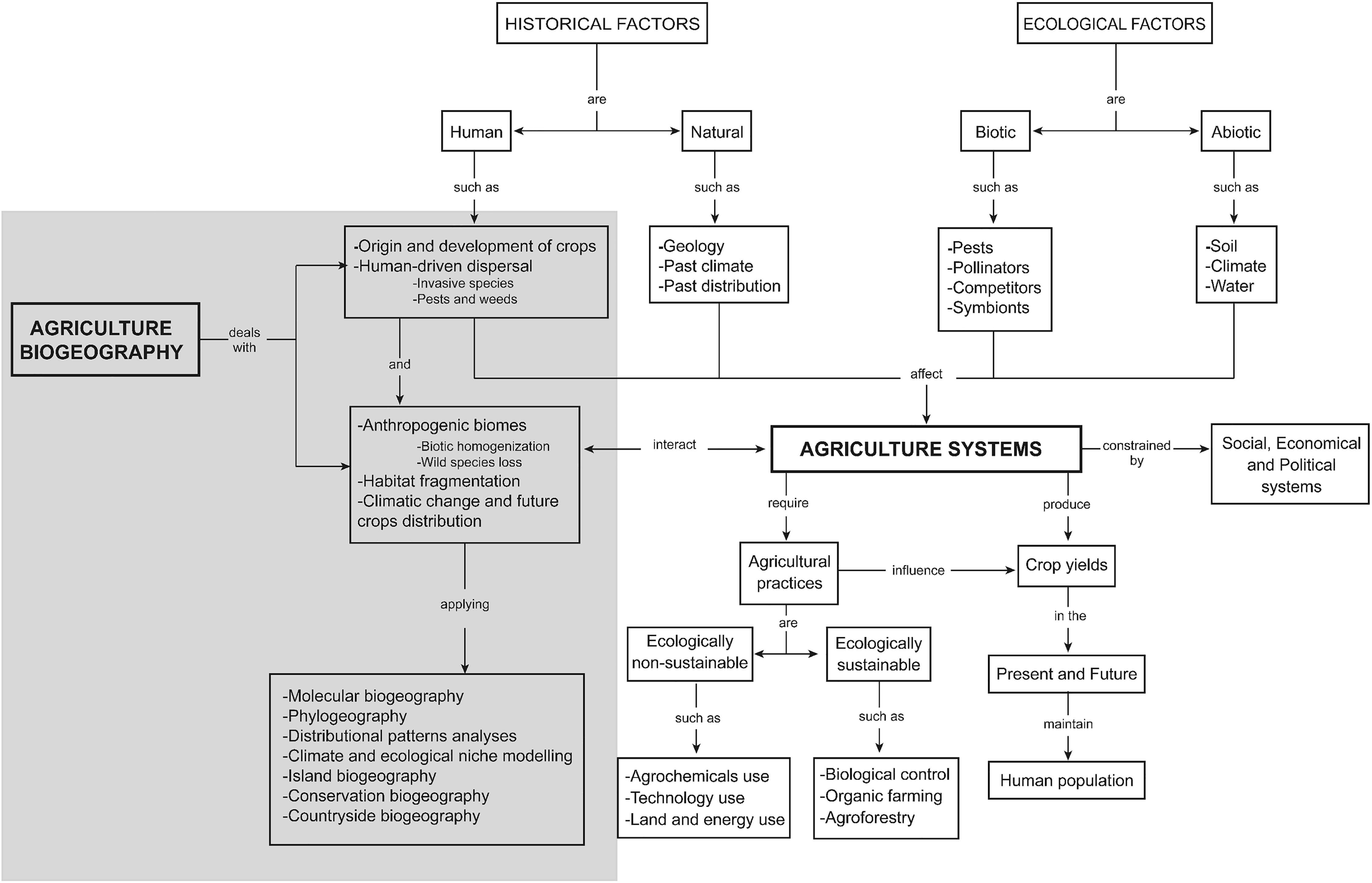
Concept map summarizing the relationship between agricultural systems and Biogeography. The grey rectangle represents the field of Agriculture Biogeography. The topics illustrated are not exhaustive.
A quick search of works published in journals mainly related to Biogeography and Agriculture shows that there is an exponential growth in publications related to ancient, current, and future agriculture systems employing a biogeographical perspective (e.g. Ellis, 2017; Kébé et al., 2017; Levis et al., 2017; Zhang et al., 2017). Agriculture Biogeography, in this sense, would integrate multiple concepts, methods, and theories into the analysis of natural and human-driven processes, to form a unified conceptual framework within which to facilitate the transition to a new paradigm. In the following sections we delineate the current engagement between Biogeography and Agriculture.
III. Perspectives from Biogeography
We present four subject matters – although, this list is by no means exhaustive – that show how Biogeography contributes to Agriculture research: (a) the geographical centers of origin of domesticated plants and animals; (b) invasions and biological control; (c) the impact of climatic change on the future distribution of domesticates; and (d) the test of taxonomic and biogeographic predictivity.
1. The geographical centers of origin of domesticated plants and animals
Some debated questions regarding the evolution of domesticated plants and animals refer to their geographic origin, their routes of dispersal, and the number of times domestication has occurred for a given crop or livestock. The concept of crop diversity centers has had an enormous impact on Agriculture, and led to the development of major new research programs.
If one were to search for possible precursors of Agriculture Biogeography, it would be in the works of de Candolle and Vavilov on the centers of crop origins. The French–Swiss botanist Alphonse Pyramus de Candolle (1806–1893) studied the origin of cultivated plants and the reasons for their geographic distribution. His book Origin of Cultivated Plants (De Candolle, 1885) is considered the beginning of crop geography. On the other hand, the Russian Nikolai Ivanovitch Vavilov (1887–1943) developed a broad view of the geographical distribution of the phenotypic diversity of individual crops and their wild progenitors. This knowledge led Vavilov (1926) to formulate his theory of geographical centers of crop diversity. He realized that each major food crop must have originated from a central point from which it successfully dispersed, and hypothesized that these centers of origin that he recognized (initially five) were likely where the genetic diversity of the crop species is highest.
Modern phylogeographic studies that combine phylogenetic and increasingly detailed geographical data for ancestral species, provide deep insight into the origin of crops. Also, the phylogeographic distributions of old landraces of globally important plants appear to reflect ancient human population movements. One example is the case of primitive maize landraces, for which Freitas et al. (2003) showed a distinct patterning of allelic distribution across the South American continent, apparently reflecting the routes of entry from Mesoamerica. They also found that this allelic pattern was reflected in archaeological samples of maize collected from Andean regions and the lowland tropics of Brazil.
Molecular studies by Morrell and Clegg (2007), based on differences in haplotype frequency among geographic regions at multiple loci in barley, led to infer at least two domestications of the crop: one within the Fertile Crescent, and a second 1500–3000 km farther east. The Fertile Crescent domestication contributed to the majority of diversity in European and US barley cultivars, whereas the second domestication contributed to most of the diversity in barley from Central Asia to the Far East. They thus established the geographic space using the phylogenetic space.
There are also many works that search for the origin and evolution of domesticates using molecular clocks, ancestral area reconstruction, and diversification rate analyses (e.g. Janssens et al., 2016). Ultimately, there is an increase in the integration between phylogenetic studies and archaeology in the search for domestication centers (e.g. Erickson et al., 2005; Levis et al., 2017). Archaeological, cultural, and genetic evidence is used in the search for centers of origin of domesticated animals (e.g. Driscoll et al., 2009; Larson et al., 2014), but biogeographic methods as a tool to search for these centers are practically lacking.
2. Invasions and biological control
The biota may naturally move throughout the world, crossing different barriers, but one consequence of globalization is that, in addition to people and products moving across the globe, other organisms have been transported as well (Capinha et al., 2015). Cultivation and breeding patterns themselves are human-driven dispersal pathways that first came to prominence when the growth in trade routes between settled agricultural communities led to the movement of species in an increasingly organized fashion (Wilson et al., 2008). Some of these alien species may become invasive, others may not.
The interpretation of what an invasive species is changes with the context and perception of the user of the term. By definition, invasive species are species that are not native to the ecosystem being considered (NISC, 2006). In this context, a non-native domesticate is invasive and a native weed or pest is not invasive. But in Agriculture, the term ‘invasive species’ applies to any non-indigenous pest (competitors, parasites, predators), weed, plant, insect, fungus, bacteria, virus, and other disease-causing agent that can interrupt the production of livestock, crops, ornamentals, and rangeland (Carter et al., 2004).
One way of controlling pests is using biological control, but this cannot be implemented without a biogeographic understanding of the patterns of movements and distribution of the control and of the invasive species. Biogeographical methods and research programs involve the following examples.
Distributional patterns analysis, such as multivariate ordination, similarity indices, or clustering approaches for establishing the main geographical determinants of naturalized species (e.g. Pyšek and Richardson, 2006). Every time that the geographic range of a species is established (e.g. by means of maps, grids, transects, aerial photographs, tables of distribution) and analyzed using multiple approaches (e.g. cluster analysis, species abundance and richness analysis, modeling), Biogeography is involved. Molecular Biogeography, which interprets biogeographic relationships and genetic similarity within and among the populations of a given species from its native and introduced ranges where it is invasive (e.g. Meekins et al., 2001). Island Biogeography for pest control strategies, based on the equilibrium theory of Island Biogeography of MacArthur and Wilson (1967) (e.g. Stenseth, 1981). Ecological niche modeling for predicting the spread of invasive species (e.g. Ganeshaiah et al., 2003).
3. Climatic change and future domesticates’ geographic distribution
By 2050, nine billion people worldwide will need to be fed, which, in practice, means that agricultural production should increase by 6% per year (FAO, 2012; but see Points of view and Controversies in this paper). For this reason, the likely impacts of climate change on the agricultural sector have also prompted concern over the magnitude of future global food production (IPCC, 1996).
It is, therefore, not surprising that attempts at predicting future crop distributions, a biogeographic question, have been received with great interest. As with the search of domesticated animal’s centers of origin, there are almost no examples in the literature that deal with their future distribution, although there is plenty information on how climate change may affect the occurrence of livestock disease (e.g. Morand, 2015). This is probably because, unlike plants, animals can be moved to shelters or to areas with better climatic conditions.
The biogeographic simulation of scenarios using climate modeling (e.g. Gordon et al., 2000) and ecological niche modeling (e.g. Beck, 2013; Hannah et al., 2013; Sala et al., 2000) are examples of these attempts to relate Agriculture to environmental changes. Some modeling studies include alternative economic pathways of future development under emerging changes in the productivity of food crops (e.g. Ewert et al., 2005). These scenarios, however, are more complex than anticipated and some authors (Iizumi and Ramankutty, 2015) emphasize that, besides climate, other factors such as cropping area and intensity, and farmer decision-making and technology, can also modulate how climate influences the different components of crop production.
4. Test of taxonomic and biogeographic predictivity
The test of taxonomic and biogeographic predictivity is a biogeographic method that could be considered one of the few methods exclusively created for and applied in Agriculture. A widely held assumption is that taxonomically related organisms, or those found in geographic proximity, are likely to share traits. This concept arises from the knowledge that plant populations are not randomly arranged assemblages of genotypes, but are structured in space, time, and history, resulting from the combined effects of mutation, migration, selection, and drift. Spooner et al. (2009) developed a method to test if traits such as disease and pest resistance can be associated with taxonomically and biogeographically related species to a crop (see also Jansky et al., 2006). A major justification for this research is its assumed ability to predict the presence of traits in a group for which the trait has been observed in only a representative subset of the group. Such predictors are regularly used by breeders interested in choosing potential sources of disease and pest-resistant germplasm for cultivar improvement – by GeneBank managers to organize collection, and by germplasm collectors planning to gather maximum diversity (Spooner et al., 2009). Examples of application involve the prediction of the presence of resistance genes to early blight (caused by the foliar fungus Alternaria solani), (Jansky et al., 2006), and the resistance to the potato virus Y (PVY) (Cai et al., 2011) in wild Solanum species for which resistance was observed in related species and its association to geography. Spooner et al. (2009) tested taxonomic and biogeographic associations with 10,738 disease and pest evaluations derived from the literature and GeneBank records of 32 pest and diseases in five classes of organisms (bacteria, fungi, insects, nematodes, and virus). They showed, for example, that ratings for only Colorado potato beetle (Leptinotarsa decemlineata) and one pathogen (Potato M carlavirus) are reliably predicted both by host taxonomy and climatic variables. The authors concluded that while it is logical to initially take both taxonomy and geographic origin into account while screening GeneBank materials for pest and disease resistances, such associations will hold for only for a small subset of resistance traits.
II. Perspectives from Agriculture
In relation to human action, Biogeography is still strongly focused on the traditional anthropogenic effects on nature and looks to Agriculture as a homogeneous practice without acknowledging the great diversity of agricultural approaches. It does not seem to address and capture the wide variety of agendas that drive Agriculture and conservation – an agenda that speaks equally (if not primarily) to those progressive and ‘counter’ voices that include alternative cultures and practices, contentious claims, and contesting movements. In the following, we will discuss some of these different points of view and controversies, and subsequently remark on the attempts made to conceive of the agriculture sites in a more positive way.
1. Points of view and controversies
There is a growing unease over the tension between the capitalist principle of infinite expansion and the finite supply of natural resources (Streeck, 2014). Researchers envision differently the changes that should be performed to guarantee a proper supply of food in the future. The World Bank (2009) report on how ‘adaptation’ establishes that countries will adapt up to the level at which they enjoy the same level of welfare in the (future) world as they would have without climatic change. Currently, there are contrasting research programs focusing on the adaptation to climate change. On one side, there are conservation efforts such as some key programs of the Convention of Biological Diversity to protect ecosystems, seeing Agriculture as a major driver of biodiversity loss. On the other side, there is an urgency to address agricultural adaptation focusing exclusively on benefitting cropping systems and market risks (e.g. Howden et al., 2007). There are also approaches bringing together science and policy through a focus on sustainable development as the integrating concept (e.g. Blowers et al., 2012; Phalan et al., 2016).
However, there is not a general agreement in the argument for producing more for feeding an expanding population. The proponents of food self-sufficiency (Clapp, 2017), for example, when a country can satisfy its food needs from its own domestic production, clashes with some economic reasoning and political imperatives. Others propose strategies to reduce the waste of food produced worldwide (Arancon et al., 2013; Lin et al., 2014) or to meet the future global demand through moderating calorie-adequate diets (Davies et al., 2014).
The traditional concept of sustainability, claiming the need to ‘balance’ conservation with anthropic production, has been changing with decades of debate, and the idea of balance (and cost-benefits analysis) was dismissed by the so-called nested models of sustainability, where social, ecological, and economic drives do not weight equally. There was a transition from overlapping-circles models, where sustainability was the intersection of three circles representing economy, society, and environment, to nested-dependencies models (Doppelt, 2008). In the nested model, the economy circle is enclosed within the society circle and both are enclosed within the environment circle, showing that human society is a wholly owned subsidiary of the environment and that, without food, clean water, fresh air, fertile soil, and other natural resources, it cannot survive. It is the society who decides how it will exchange goods and services and what economic model it will use.
Another controversy arose concerning the theoretical frameworks that relate Agriculture with an historical interpretation of the origins of the capitalist world economy (Wallerstein, 1974), and how the inequalities between different Agricultures in the world have led to the extreme impoverishment of hundreds of millions of peasants (Mazoyer and Roudart, 2006). Many scholars envisage that solutions cannot be found in more growth – that is, increasing economic growth, more technology (such as the adoption of Genetically Modified Organisms), pushing productivity, more free markets, and more globalization. Some of the alternative proposals include the ‘degrowth’ (Gomiero, 2017; Illich, 1975) that promotes changes in the societal metabolism toward a more frugal, sustainable, and convivial lifestyle; for example, through organic, agro-ecological local and traditional farming, or the ‘resourcefulness’ that seeks to transform social relations in more progressive, anti-capitalist, and socially just ways (MacKinnon and Derickson, 2012). One possible contribution of Agriculture Biogeography in these matters is the application of methods to predict potential cultivation areas in underutilized and neglected local crops that could contribute considerably to food supply. An application example is the case of some species of the plant genus Smallanthus (‘yacón’) that have been used as food for centuries by the Andean inhabitants. Its important nutritional and medicinal value, together with the low ecological requirements of most of its species, constitute a very valuable potential crop for family farming. An ecological niche modeling study by Vitali and Katinas (2015) demonstrated that, taking into account certain temperature and precipitation constraints, some species of Smallanthus could be successfully cultivated when planning family farming areas, at very low costs.
2. Use, modification, and maintenance of natural biomes
Historically, biomes (e.g. steppe, forest, desert, tundra) have been identified and mapped based on general differences in vegetation type associated with regional variations in climate, soil, and topography (Olson et al., 2001; Whittaker, 1975), most simply defined by mean annual temperature and mean annual precipitation. Humans have restructured the biomes for agriculture, forestry, and other uses, and global patterns of species composition and abundance, primary productivity, land-surface hydrology, and biogeochemical cycles have all been substantially altered. The ‘anthropogenic biomes’, ‘anthromes’, or ‘human biomes’(e.g. Alessa and Chapin, 2008; Ellis and Ramankutty, 2008) are heterogeneous, fragmented, landscape mosaics, such as urban areas embedded within agricultural areas, forests interspersed with croplands and housing, and managed vegetation mixed with semi-natural vegetation that now covers more of the Earth’s land surface than natural ecosystems do.
Many researchers have wondered how to integrate the use, on one side, and the maintenance, on the other side, of natural biomes. We will present two examples that aim toward this goal. One is the view of the value of anthropogenic biomes to biodiversity postulated by Countryside Biogeography, and the other is represented by agriculture practices that combine natural and anthropogenic biomes.
Gretchen Daily proposed the concept of Countryside Biogeography (Daily, 1997), related to the idea of sustainability and defined as the study of the diversity, abundance, conservation, and restoration of biodiversity in rural and other human-dominated landscapes. Ladle and Whittaker (2011) found a relationship between the ideas of Countryside Biogeography and the concept of ‘reconciliation ecology’. This conservation effort was proposed by Rosenzweig (2001) as a way to discover how to modify and diversify anthropogenic habitats to harbor a wide variety of species.
Countryside Biogeography has the goal of enhancing the hospitality of agriculture sites to biodiversity. Biologists have paid considerable attention to the status of the biotas in the ‘islands’ or fragments of natural habitat, such as forest patches, and comparably little attention (beyond the context of pest management) to the organisms that occupy the highly disturbed matrix in which those fragments occur, characterized as countryside habitats (e.g. agricultural plots, plantation or managed forest, fallow land, gardens, and remnants of native habitat embedded in landscapes devoted primarily to human activities). By viewing habitat fragments immersed in human-dominated landscapes as the equivalent of true oceanic islands, it has become common practice to apply the principles of Island Biogeography, comparing community composition in forested and deforested areas for human use in plants (Mayfield and Daily, 2005), bats (Mendenhall et al., 2014a), mammals (Daily et al., 2003), reptiles and amphibians (Mendenhall et al., 2014b), birds (Daily et al., 2001; Wolfe et al., 2015), and insects (Horner-Devine et al., 2003; Ricketts et al., 2001). These studies show that the equivalency of true islands and habitat fragments is invalid, and results in the incorrect estimates of extinction rates and ecological risks in human-dominated ecosystems. Therefore, new models such as the reaction–diffusion model, multispecies metapopulation analyses, and models based on the neutral theory have been proposed to address species–area relationships and demography in countryside environments (e.g. Matthews et al., 2016; Pereira and Borda-de-Água, 2013; Pereira and Daily, 2006). Also, a conservation approach in countryside fragmented areas was applied by Shackelford et al. (2014) to map the costs and benefits of conservation versus production.
The other example that combines natural and anthropogenic biomes is the intercropping between crops and wild species, fomenting the overlapping distribution of the two systems. The promotion of the ‘shaded coffee’ method is a good example of intercropping that represents an advance to the conservation goals (Perfecto et al., 2005). Regional large-scale and detailed local surveys of birds in the Caribbean, Mexico, Central America, and Northern South America revealed that coffee plantations produced under the diverse and dense canopy of shades trees of the natural forests support high diversity and densities of birds. These areas constitute an important habitat for migratory birds, serve as dry-season refugia for birds at a time when energetic demands are high and other habitats are food poor, and provide important nectar and insect resources. Likewise, bats and non-flying mammals have been reported to be richer in species and biomass in this type of coffee plantation than in other agricultural habitats (Perfecto and Armbrecht, 2003, and references herein). Shaded coffee certification programs offer the opportunity to link environmental and economic goals. These sustainable coffees command premium prices that have aided certified farmers to withstand any eventual crisis and continue producing coffee (Perfecto et al., 2005).
These practices require the use of biogeographical methods such as distributional pattern analyses between the artificial and the natural system, which allow comparing the responses of coffee intensification for each taxa on the same scale and establishing how yield and species richness are related in a particular region. Some modeling methods (e.g. STICS-CA, Yield-SAFE, SORTIE/BC) were also developed to incorporate plant mixtures combining agronomic and ecological concepts for simulating multispecies plantations, such as native trees with crops (Malézieux et al., 2009). Ewel (1999) enhanced the role of woody perennial species in the sustainability of ecosystem functioning in the humid tropics and proposed forest-like agroecosystems. Tree–crop combinations have a life course that extends in tens of years, up to a century or more in temperate areas. For these reasons, full direct experiments are not feasible and modeling approaches are a requisite. STICS-CA is a modeling approach (Brisson et al., 2004) that aims to predict the fate of various tree–crop combinations in various temperate conditions. Yield-SAFE (Yield Estimator for Long term Design of Silvoarable AgroForestry in Europe; Van der Werf et al., 2007) is a model for growth, resource sharing, and productivity in silvoarable agroforestry (i.e. the cultivation of trees and arable crops on the same parcel of land) to act as a tool for forecasting yield, economic optimization of farming enterprises, and exploration of policy options for land use in Europe. SORTIE-BC (Coates et al., 2003) is a model for mixed conifer/hardwood forests that makes population dynamic forecasts for juvenile and adult trees; it aids the understanding of how disturbance affects forest stand dynamics.
IV. Conclusions
In this study, we have defined Agriculture Biogeography in broad terms, illustrating the issue with a limited set of topics. By selecting some themes, we highlighted some topics, but have doubtless thereby neglected others. In general, Biogeography and agriculture research mostly grew theoretically separately. Biogeography is still focused on the traditional anthropogenic effect on nature, and agriculture research does not seem to acknowledge the contributions that Biogeography has made, is making, and can make by generating research ideas and methods.
A definition of a discipline is an instrument to achieve a purpose; therefore, its value rests entirely on its usefulness. The recognition of Agriculture Biogeography will provide: (a) a better understanding of the space-centered issues in agricultural sites; (b) a tool for operational biogeographical methods to be applied in agriculture research; (c) a way to frame scientific questions regarding the concept of relative space in agriculture research; and (d) a tool for researchers to structure and articulate more thoroughly space-related issues in Agriculture.
Protecting wildlife, while feeding a growing world human population, will require a holistic approach (e.g. Ericksen, 2008; Ingram et al., 2010). This poses a problem in that some things will always be controversial, to some desirable, to others indefensible. Agriculture Biogeography has the difficult task of walking on this razor’s edge and can perform an important contribution through a reasoned, coherent, and organized inclusion of the spatial dimension of this problem.
Footnotes
Acknowledgements

Declaration of conflicting interests
The author(s) declared no potential conflicts of interest with respect to the research, authorship, and/or publication of this article.
Funding
The author(s) disclosed receipt of the following financial support for the research, authorship, and/or publication of this article: The study was supported by the CONICET (Argentina) grant PIP 0729 and the ANPCyT (Argentina) grant PICT 2012-1683.