



Abstract
“The Anthropocene” currently serves as a framework to acknowledge global human influences on the earth systems. Different prominent authors call for geographers and especially physical geographers to intensify their involvement in the discussions on the theme. A bibliometric analysis shows that geographers are already one of the leading contributors to the keyword Anthropocene in journal articles. While we generally support the standpoint of increased engagement with the topic, we want to emphasize that we need to do more than only attaching the “Anthropocene” label to our daily research practice. A critical engagement with and reflection of the research questions and contexts is needed to play a vital role as discussant in the debate. We should take advantage of the diverse themes, topics and viewpoints of our subject by actively following a more critical approach to our research practices in order to find those geographic ties that join us and our discipline and that enable us to contribute more substantially to the Anthropocene debate.
I Introduction
The concept of “the Anthropocene” is becoming increasingly important in current research. Currently, the Intergovernmental Panel on Climate Change (IPCC) uses the term to frame the global human influence on the earth systems (IPCC, 2018). According to Castree (2014a: 438), the idea of the Anthropocene is of potential interest to geographers of all persuasions. Ellis (2017), for example, wrote a plea to physical geographers to actively engage more on topics of the Anthropocene, since they have “(…) such a deep historic and processual understanding of the complex realities of human-environmental change” (Ellis, 2017: 527). Physical geographers are important protagonists of Anthropocene research thanks to their complementary skills and interests that they can bring to the discussion (Cook et al., 2015: 233 ). Geomorphologists are one example of such active discussants (cf. Brown et al., 2017; Goudie and Viles, 2016). On the other hand, Castree (2014a: 454) regards the role physical geographers play in proposing or assessing the ideas of the Anthropocene so far only as modest. This contrasting statement is illustrative for the discrepancy in the self-conception of physical geographers and may be related to the broad definition or understanding of our field.
The main arguments of authors like Ellis (2017) and Castree (2014b, 2014c) to engage with the term Anthropocene (as we read them) thereby are: Geography’s disciplinary character, integrating humans and nature, is predestined to be the major player in discussing the Anthropocene, since we have been doing it since the infancy of our discipline; it is a fashionable term/buzzword; (physical) geographers should use it to get impact in terms of citations and have impact in terms of a wider (scientific and public) audience; the term invites/forces us to work more closely together and to overcome the disciplinary divide (again). With this contribution, we want to add some supportive but also critical thoughts to the discussion. These can be summarized as follows: We as geographers already contribute a lot to Anthropocene research. The topics vary and this might be related to the polysemous character of the term Anthropocene. Due to the unspecific definition of Physical Geography and a fragmentation into various sub-disciplines, that are characterized by a high level of specialization, different languages and understandings of “geographical” problems developed. Although geography is engaged with human and nature, in reality our research can only focus on some of these aspects, hiding and overlooking others. This is further aggravated by research-project-related restrictions and the resulting specializations in the respective research practice. Therefore, a new call for a stronger bridge between physical and human geographers will probably not be sufficient to strengthen our position in the Anthropocene debate. A more critical perspective, highlighting the core elements and social aspects of our individual research practices, might be a way to a joint, Anthropocene-related geographic research.
1 The many Anthropocenes 1
Anthropocene is the topos that is used in a broad range of contexts to illustrate where, to which degree and due to which actions we as humans leave our traces on the Earth. It is now becoming a fashionable term, since the consequences of human-induced climate change, as one aspect of ongoing global change, are increasingly recognized by the general public. However, there is no common agreement on what “the Anthropocene” actually is. The following examples show the ambiguity and polysemy of the term: Proponents of the “geological Anthropocene” (Toivanen et al., 2017: 187) search for the most suitable way to stratigraphically set the Anthropocene. Different proxies are available for such a stratigraphical separation: for instance, CO2 or CH4 inflection in polar ice, flying ash or plastics (Lewis and Maslin, 2015; Zalasiewicz et al., 2017). At the International Geologic Congress 2016, the Anthropocene Working Group (AWG) stated that the Anthropocene may be separated from the Holocene as a separate epoch/series. Radionuclides were suggested to be the most promising proxy to identify the starting date of the Anthropocene (Zalasiewicz et al., 2017: 58). The “biological Anthropocene” (Toivanen et al., 2017: 188) focuses on longer-term changes in the biosphere caused by human practices. One example is the early anthropogenic hypothesis, where early farming and landscape transformation resulted in greenhouse gas emission and global warming, or an inhibition of global cooling (Ruddiman, 2003; Ruddiman, 2017: 5). The “social Anthropocene” (Toivanen et al., 2017: 190) integrates the geological and biological readings of the Anthropocene with societal and historical processes. An example are the investigations of the socio-metabolic energy regimes that change throughout the development of societies. Fischer-Kowalski et al. (2014) differentiate three different modes—hunter-gatherer, farmer, industrial period—each function with its own regime-specific limitations. In their opinion, humanity’s future needs a further energy regime shift since the Earth’s carrying capacity does not allow the growing future human population to sustain itself by the energy of our current industrial regime. Accordingly, a transition to a new energy regime is necessary that might re-link human population and land use in novel ways (Fischer-Kowalski et al., 2014: 28). The “cultural Anthropocene” (Toivanen et al., 2017: 191) refers to cultural representation, communication and understanding of the geological, biological and social Anthropocene.
These different understandings are as broad as the discussions on the beginning of the Anthropocene. Lewis and Maslin (2015: 175) give a comprehensive overview of possible starting dates, ranging from 50,000 years BP until 1950. These starting points are defined based on, for example, farming developments, soil formation, spreading/extinction of species, technology development/use. It is not surprising that no agreement has been reached over whose number is the most appropriate. While Maslin and Lewis (2015) argue for a formal definition of an Anthropocene epoch based upon formal geological criteria, authors like Castree (2014a) and Ruddiman (2018) are arguing to consider a cumulative and flexible set of starting dates. In this light, the work of the AWG on defining a starting date has be seen critically, as its decisions might be influenced by political consideration (see Barry and Maslin, 2016: 6; cf. Lewis and Maslin, 2015; Zalasiewicz et al., 2015a, 2015b).
This leads us to a fifth category that might be called “critical Anthropocene” and that transcends the former by taking a reflective and critical standpoint. In this view, it is important who is discussing about the Anthropocene and what motivates this thinking. From a critical perspective the current issues of global environmental change are not well covered by a term like Anthropocene, since these blur the underlying causes of the problem and do not offer solutions. Accordingly, alternative readings are suggested, like the Capitalocene (Moore, 2017, 2018), Chthulucene (Haraway, 2015, 2016), Plantationocene (Haraway et al., 2016) or Manthropocene (Chiro, 2017), which exemplify the shortcomings in the debate and illustrate a (necessary) alternative view on social, cultural, societal and scientific dynamics.
Which standpoint or definition should we, as physical geographers, follow? Although the critical standpoint is considered necessary, no agreement has been reached on how to reflect this appropriately in a definition of the term, epoch or concept (cf. Barry and Maslin, 2016).
II A small bibliometric analysis: physical geographer’s contribution to the “Anthropocene”
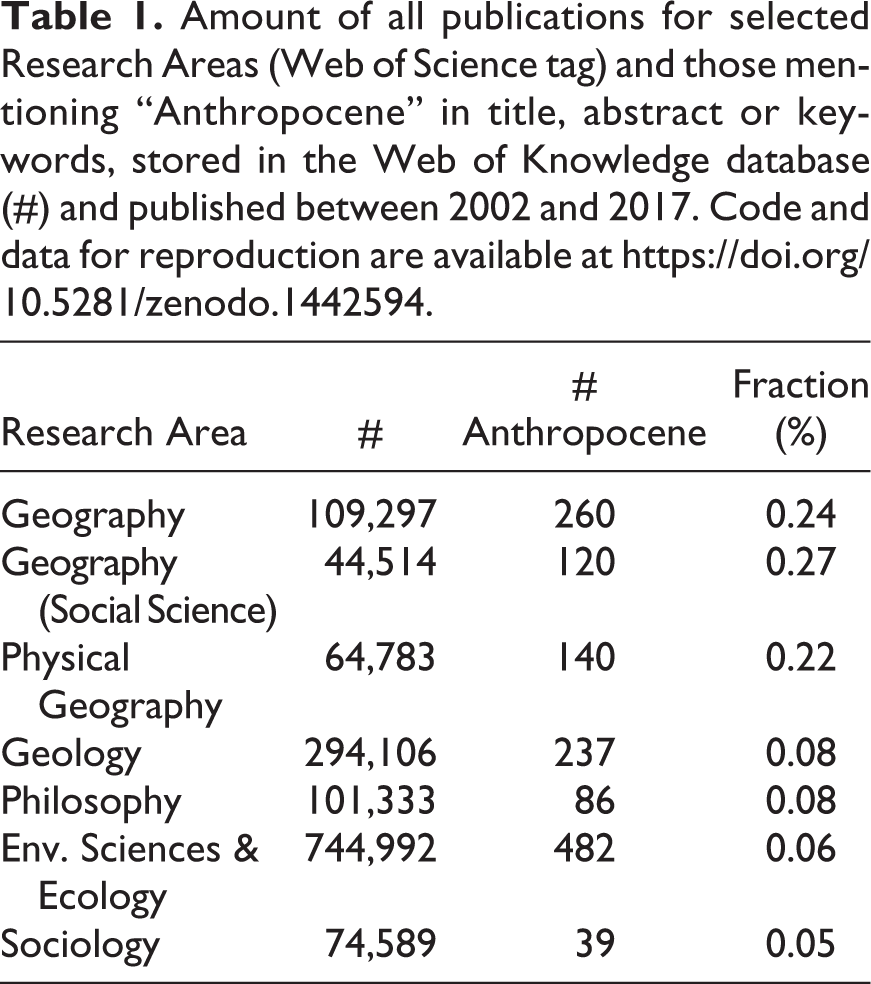
Due to—or despite of?—the conceptual ambiguity of the Anthropocene, (physical) geographers contribute a lot to the research on and discussions about it, at least in terms of publication numbers (this contrasts Ellis, 2017), as shown by an analysis of the number of publications using the word “Anthropocene” in comparison to all publications within the individual “Research Areas” (Table 1). A query of the use of the word “Anthropocene” in publications listed in the Web of Science and separated by Research Areas 2 (Web of Science tag) corroborates this observation (Figure 1).
Amount of all publications for selected Research Areas (Web of Science tag) and those mentioning “Anthropocene” in title, abstract or keywords, stored in the Web of Knowledge database (#) and published between 2002 and 2017. Code and data for reproduction are available at https://doi.org/10.5281/zenodo.1442594.

(a) The term “Anthropocene” mentioned in title, abstract or keyword, separated by Research Areas (Web of Science tag). Research Areas with more than 50 papers are labeled; (b) the annual increase of the term “Anthropocene” in relation to the total number of articles using the keyword “Anthropocene” for the respective research area over the period 2002–2018. It is evident that “Geography” and “Physical Geography” are among those fields that use the term most often. Code and data for reproduction are available at: https://doi.org/10.5281/zenodo.1442594.
Looking at the fraction of publications that explicitly focus on “Anthropocene” (Table 1), we see that there is still a lot of potential for us to engage with the topic. This potential and more active engagement will be as diverse as the various understandings of the term “Anthropocene”, and this is not least due to our umbrella-like understanding of what constitutes the core of Physical Geography.
III The difficulty to define Physical Geography
An exemplary definition of Physical Geography, as put forward by Malanson et al. (2014), defines the subject as linking and integrating geomorphology, climatology, hydrology and biogeography. These constitute the joint core that is characterized by a systems and modeling approach with a reference to human activity and different spatio-temporal scales. Day (2017) states that this rather broad understanding is problematic and that Physical Geography fundamentally (still) lacks a common and widely accepted definition of its aims and scope. However, a joint standpoint is a necessity when it comes to the question of positioning ourselves in the Anthropocene debate. The core is a spatial perspective that underlies the main themes of our field, as collected by Day (2017): the study of (1) systems and processes; (2) the natural world; (3) anthropogenic processes; (4) impacts on people; (5) environmental change; (6) interconnected systems; and (7) a scientific approach (Day 2017: 34). The contributions to a special issue on “Changing priorities in physical geography” (Tadaki et al., 2017) aim to offer some solutions and discuss various contexts ranging from urban settings (Ashmore and Dodson, 2017; Conway, 2017) to climate change (Spencer and Lane, 2017). Besides, the scientific approach is challenging, since there is still a mixture of positivist and rationalist approaches (Inkpen, 2005; Slaymaker, 2017) as well as a recent focus on critical approaches (Lave et al., 2018a; Slaymaker, 2017). As we term ourselves Physical Geographers, the blunt definition of our discipline might be: Physical Geography is what Physical Geographers do (Tadaki et al., 2017: 6).
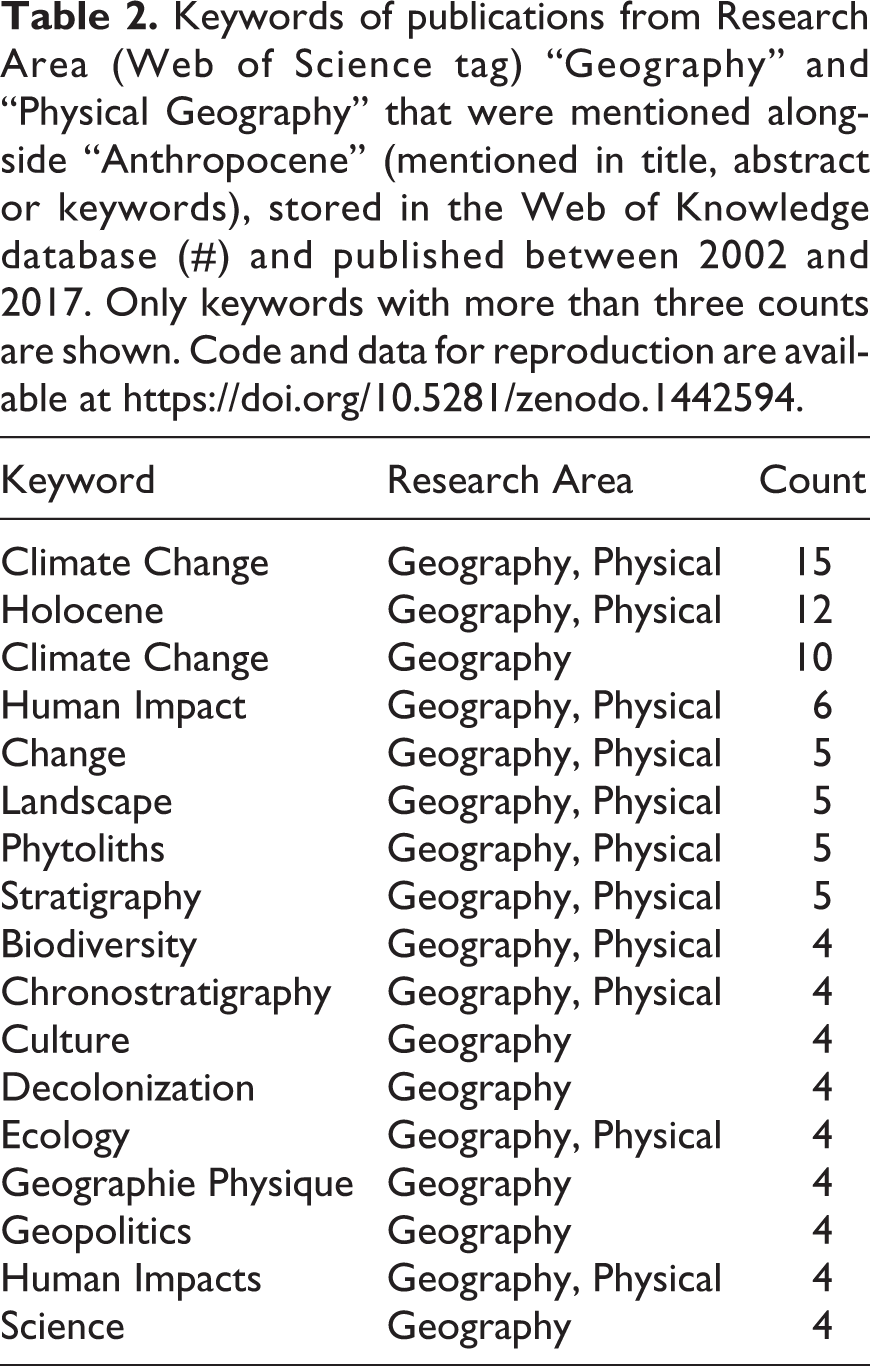
But what are our current contributions to Anthropocene research? Physical Geography does actively contribute to the topic, as represented by the bibliometric figures (Figure 1 and Table 1). However, as a result of the rather comprehensive definition of our field and the polysemous understanding of the Anthropocene, these contributions do often focus with a specialized view on selected aspects and specific topics, concealing and blurring the potential joint focus. A survey of the keywords used in Physical Geography publications between 2002, the year where Crutzen (2002) popularized the term, and 2017 shows that we do have a certain focus (Figure 2(a)). The common denominator of our broad discipline seems to be Holocene climate and its change. The focus is on the dynamics of the environment from different (system) perspectives. Unsurprisingly, Human Geography (Figure 2(b)) has a focus on social aspects of the present and recent past. Ellis (2017) sees a joining force in the Anthropocene and motivates us to erect new bridges to integrate those societal aspects that are relevant for an understanding of our current era. A survey of the keywords of those publications that mention “Anthropocene” in title, abstract or as keyword shows one joining theme—“Climate Change”—and a lot of potential of complementary work since the foci are rather different. “Human Impact(s)” features widely in publications from Physical Geography and might indicate the will and need to represent human activities more intensively in their studies (Table 2).
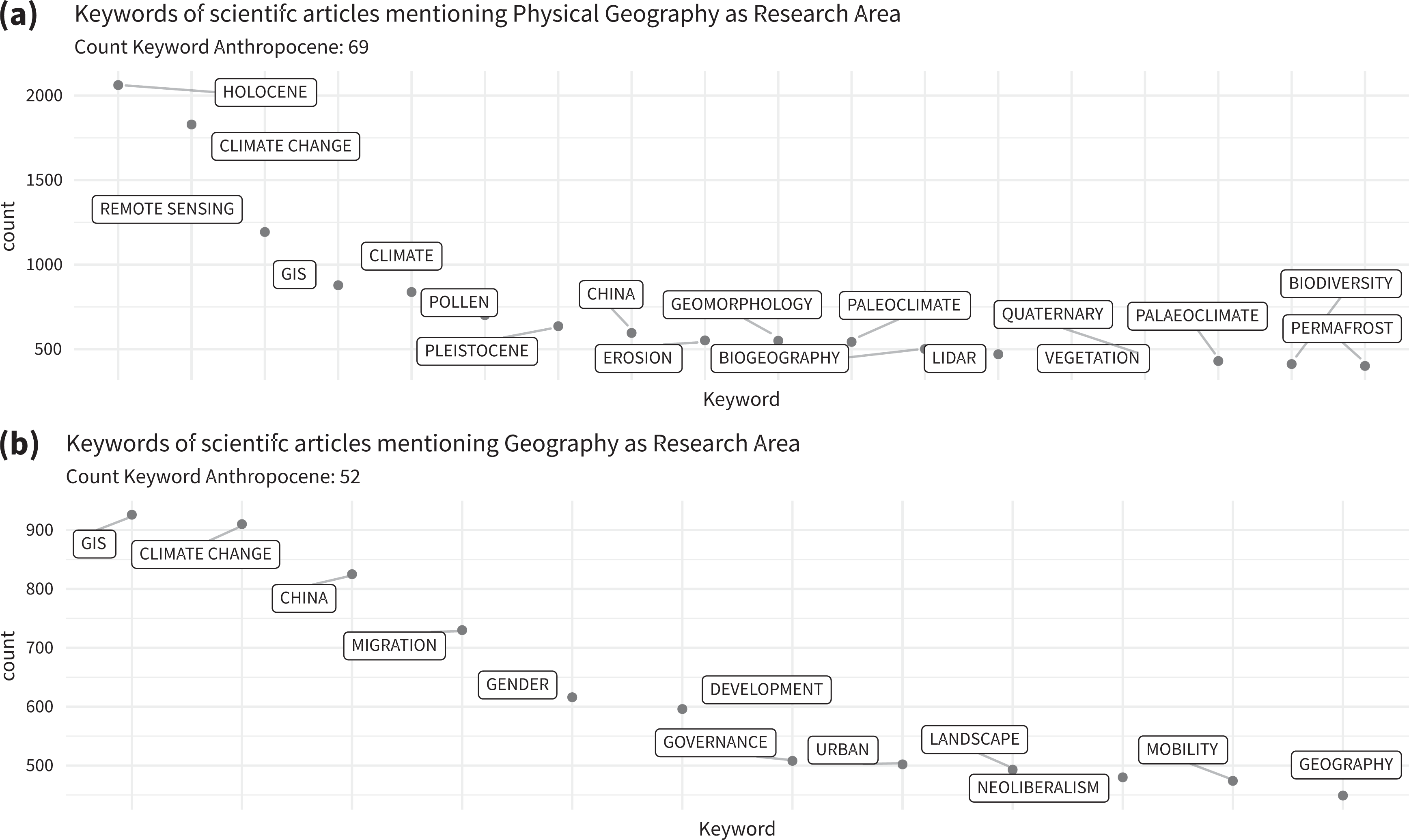
The thematic focus of scientific articles referring to (a) Physical Geography (without “Geography”) and (b) Geography (without “Physical Geography”) as their Research Area. Data stem from Web of Science database and refer to a query of all English-language articles from 2002 to 2017 that mention “Geography” as Research area. Code and data for reproduction are available at https://doi.org/10.5281/zenodo.1442594.
Keywords of publications from Research Area (Web of Science tag) “Geography” and “Physical Geography” that were mentioned alongside “Anthropocene” (mentioned in title, abstract or keywords), stored in the Web of Knowledge database (#) and published between 2002 and 2017. Only keywords with more than three counts are shown. Code and data for reproduction are available at https://doi.org/10.5281/zenodo.1442594.
We want to further illustrate this focus on human-relevant aspects by an exemplary sketch of selected research projects of our physical geographic working group (Table 3, left column). The aim is to show the diversity of stand- and viewpoints and the different levels of engagement with human–environmental relationships at different temporal and spatial scales that are already present at the low level of one university working group. Since there is (a) no definition of Anthropocene research practice in Physical Geography and (b) each project employs a different research design, comparisons between them are difficult or impossible. These differences in project design and the scientific approach are the result of (a) heterogeneous research foci, (b) the need to apply an agreed-upon methodology of the sub-community that are followed by (c) the requirement to publish as many publications as possible that use the same agreed-upon language of the topic-related community. This lack of integration and the focus of one’s own sub-community hinders comparisons between the individual project results and makes it hard to identify a potential joint approach or viewpoint in investigating the Anthropocene. According to this, calls for a more frequent usage of the term as keyword to our individual research (cf. Castree, 2014b; Ellis, 2017) will not lead to a more profound understanding of the potential epoch. It will, rather, blur the context further and lead to more problems, conflicts and misunderstandings. “Anthropocene” would remain the polysemous term that it is now.
Variety of topics in our Physical Geography working group. The left column shows our current project description; in the right column we restate this description to reflect a more critical standpoint. Such a standpoint attempts to consider our contextual relatedness in terms of research questions, chosen methodology, stakeholder integration, etc. It becomes obvious that restating the projects leads to various new questions and, above all, shows which aspects are not considered in the current project design.
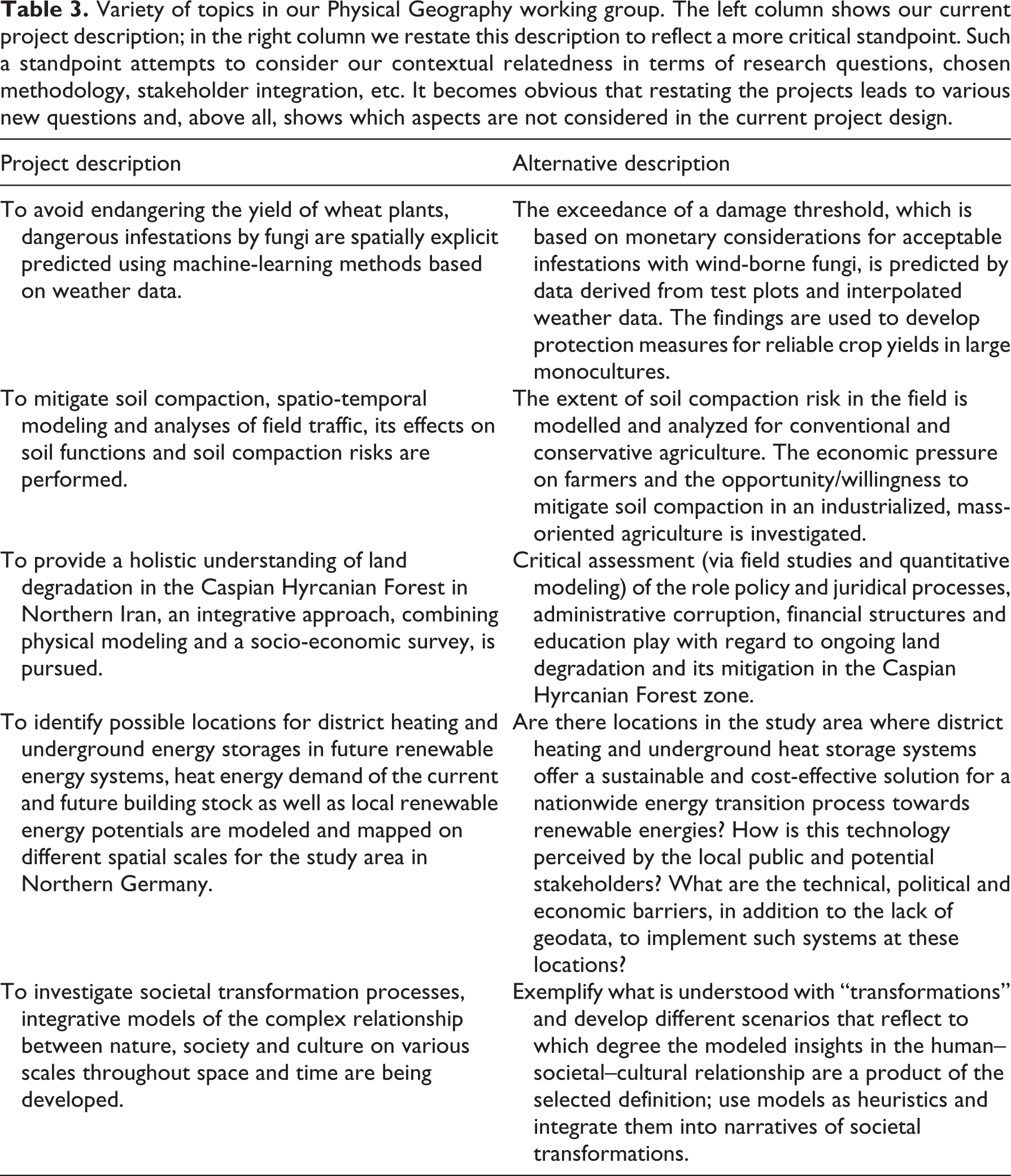
In an attempt to offer an alternative, we have reformulated our project descriptions considering a more critical approach. In our opinion, this can be a first step to integrate our research into current Anthropocene debates (Table 3, right column). That a more critical perspective of physical geographic research practice is needed is not only a result of the discussions about the “critical Anthropocene”, but also to the fact that we have gathered so much evidence of the complex relationship and dynamics of human, society and nature that we are no longer able (have we ever been?) to separate ourselves from our research object. Critical Physical Geography (CPG) (cf. Lave et al., 2014, see the following section) seems to be a promising approach to achieving a more reflective perspective.
IV Critical reflection: we need more than a stronger bridge
As already seen in the broad definition of Physical Geography, Geography as a whole is too heterogeneous and too specialized to be bridged by a joint, subject-related concept (Weichhart, 2008). Attempts to solve this problem—for example, by initiating a “third column” (Wardenga and Weichhart, 2006; Weichhart, 2005) that stands between Physical and Human Geography and that is exclusively engaged with integrative problems and questions—were not taken up by the scientific community. It seems that in times where Physical Geography is a “highly productive mainstream natural science (…) [driven by the] metrics required by the accounting systems dominating the neoliberal University” (Lane, 2017: 84), there is just no common ground that is “worth” being bridged. When geographers from both sides of the discipline talk about the Anthropocene, they talk about different things, and, as we tried to show, this is the case even within Physical Geography. This hinders an integrative and comprehensive engagement with current human–environmental and eco-social systems. But as Lave et al. (2014: 6) state, today’s physical geographers need to consider both material and social processes in order to grasp and explain phenomena of the Anthropocene.
We suggest that (Physical) Geography takes a more critical perspective that enables us to recognize and communicate that not only environmental dynamics but also politics and the selected scientific approach shape our own research and the systems we study (cf. Lave et al., 2014: 9; Tadaki et al., 2015). The case of Lane et al. (2011) can be seen as a real-world example from the field of flood risk management (see also the case studies in Lave et al., 2018a).
The ongoing debates and discussions about what constitutes and defines the Anthropocene mirror the complexity of the current challenges. Accordingly—and aiming to work more critically—these challenges demand that we move beyond dualistic concepts of “culture” or “society” interacting with “nature” (cf. Latour, 1993); gender, racism, globalized markets or the repercussions of colonialism are as fundamental as the hydrologic cycle, atmospheric circulation or plate tectonics; and political institutions interact with contingent, stochastic and complex physical processes to shape the earth (cf. Lave et al., 2014). CPG, as introduced and promoted by Lave et al. (2014) and others, shifts the scientific focus in this direction. The agenda of CPG brings a critical attention to the relations of social power with profound knowledge on the dynamics of earth systems in the service of social and environmental transformations (Lave et al., 2018b: VI), and this could be the new theme for Physical Geography in the Anthropocene. As Lave (2015) states in her introduction to a special issue on CPG in this journal, all study areas that we physical geographers work on are shaped or at least influenced by human activities and power structures. Hence, we as physical geographers are no more able to do recent research on any topic without taking into account the local and specific socio-economic and cultural frameworks that shape our study sites and also our research environment—at least if we aim to work comprehensively.
V Conclusions
Taken together, we state that geographers do most actively contribute to publications on Anthropocene topics. However, we do not seem to have a joint core that characterizes our activities or achievements in relation to the Anthropocene debate. This is caused by (a) the broad definition of Physical Geography that leads to (b) various understandings of the complex Anthropocene with related differences in research practices that ultimately guide our research due to (c) product- and publication-focused individual projects. Without a change, all we can actually achieve are more or less unintegrated (sometimes excellent) findings and results of individual projects whose value to the Anthropocene debate has to be negotiated in further articles on the nature and the implications of the term itself. CPG, with its focus on the aspects of research practice and the attention to power structures in natural systems, might be a good starting point to initiate change and to bring new perspectives in the Anthropocene debate.
Footnotes
Acknowledgements
We would like to thank three anonymous reviewers whose remarks and comments greatly improved this contribution. DK, WH and RD are grateful to the SFB 1266.
Declaration of conflicting interests
The author(s) declared no potential conflicts of interest with respect to the research, authorship, and/or publication of this article.
Funding
The author(s) disclosed receipt of the following financial support for the research, authorship and/or publication of this article: Funded by the Deutsche Forschungsgemeinschaft (DFG, German Research Foundation – Projektnummer 2901391021 – SFB 1266).