




Abstract
Beaver canals and their environmental effects are much less studied than beaver dams, despite being widespread in some beaver-inhabited areas. In this study, we completed a systematic review of previous research on the structure and ecosystem effects of beaver canals to provide an increasingly holistic understanding of these landscape features. Specifically, we: 1) summarized why, where, when, and how beaver develop canals; 2) chronicled all published descriptions on beaver canal morphology; and 3) summarized the literature on the environmental effects of beaver canals. Thirty-one relevant studies were identified and incorporated into this review. Beaver canals have been identified in numerous environments ranging from largely undeveloped mountainous regions to heavily developed agricultural landscapes. Beaver primarily develop canals to increase accessibility to riparian resources, facilitate transport of harvested resources, and to decrease predation risk. As with beaver dams, beaver canals exhibit large structural variability, particularly in lengths, which can be over 0.5 km. Widths of about 1 m and depths of about 0.5 m are common. Beaver canals alter watershed hydrology by creating new aquatic habitats, connecting isolated aquatic features, and diverting water into colonized areas. Beaver canals have been identified as favored habitats for several biotic species and are sometimes used during critical life stages (e.g. dispersal). In addition to increasing overall floral and faunal species richness and diversity, beaver canals may benefit biota by mitigating habitat fragmentation and climate change impacts. Based on the results of this review, incorporating beaver canals into stream restoration practices may be environmentally beneficial.
I Introduction
Beaver are semi-aquatic herbivores and central place foragers that alter aquatic and terrestrial environments to better suit their needs (Francis et al., 2017; Hood and Bayley, 2009; Lamsodis and Ulevičius, 2012). By constructing dams in streams, beaver create ponds that inundate floodplains and create new aquatic habitats, thereby decreasing their need for overland travel and risk of predation (Mumma et al., 2018; Salandre et al., 2017; Thompson et al., 2016). The expanded aquatic coverage increases beavers’ access to resources, particularly riparian vegetation, that may be either consumed, used for building lodges and dams, or stored within food caches for future use (Butler, 1995; Loates and Hvenegaard, 2008; Milligan and Humphries, 2010). Once desirable resources adjacent to beaver ponds are depleted, beaver often excavate canals to expand their home range and increase access to new resources (Abbott et al., 2013; Hay, 2010; Hodgson, 1946). Furthermore, in some ecosystems, such as open water wetlands, where flowing water and beaver dams are largely absent, beaver can develop extensive canal networks that connect otherwise isolated aquatic habitats (Anderson et al., 2015; Hood and Larson, 2015). Beaver canals and their environmental effects are much less studied relative to beaver dams and lodges (Hood and Larson, 2014), despite being widespread in some beaver-inhabited areas (Brusentsova and Ukrainskiy, 2015; Butler, 1995).
Multiple studies have reviewed the impacts of beaver habitat engineering on stream and riparian geomorphology (Gurnell, 1998), hydrology (Burchsted et al., 2010), water quality (Ecke et al., 2017), and biotic communities (Stringer and Gaywood, 2016). However, these and other previous reviews have exclusively focused on the environmental effects generated by beaver dams. These studies have determined that beaver dams often alter the surrounding environment, sometimes drastically. Beaver dams can increase lotic habitats (Hägglund and Sjöberg, 1999), raise water tables (Karran et al., 2018), flood riparian zones (Wohl, 2013), maintain flow during periods of drought (Spence, 2016), alter stream and riparian vegetation (Dee et al., 2018), increase habitat heterogeneity (Kemp et al., 2012), bolster the biotic richness and diversity of aquatic, semi-aquatic, and terrestrial species (Smith and Mather, 2013; Vehkaoja and Nummi, 2015; Wright et al., 2002), and influence biogeochemical cycles (Gatti et al., 2018). Additionally, many studies have provided details about dams themselves (e.g. size, location), highlighting their high diversity within and between beaver colonies and biomes (Anderson et al., 2014; Karran et al., 2017; Klimenko and Eponchintseva, 2015). Although often overlooked, beaver canals are distinctive zoogeomorphic features (Butler and Malanson, 1994) that can produce significant environmental impacts (e.g. Brusentsova and Ukrainskiy, 2015; Mitchell and Niering, 1993; Pasternack, 2001) and are critical to beavers’ use of their surrounding habitat and potentially to their survival (Butler, 1995; Hood and Larson, 2015).
Before widespread trapping throughout Europe and North America, beaver were the primary biotic engineers of river networks within their native ranges (Jones et al., 1994; Naiman et al., 1986). Beavers habitat engineering created complex multi-threaded channels and marsh-like environments (Brown et al., 2018; Burchsted et al., 2010). The beavers’ large-scale landscape impacts were noted over a century ago by geomorphologist Armin Kohl Lobeck, who stated that in North America, “It is now believed that many meadows and swamps formerly considered beds of glacial lakes are more likely the work of long-forgotten [ancient and modern] beavers” (quoted in Lobeck, 1939: 429). Extensive marshes and swamps were also noted within beaver-occupied landscapes by early explorers and land prospectors within North America in the 17th and early 18th centuries (see Byrd, 1841; Lewis and Clark, 1983). However, throughout the 18th and 19th centuries, beavers were systematically trapped from their native ranges for their fur resources. North American beaver populations are estimated to have plummeted from 60–400 million to near extirpation following the arrival of European settlers (Naiman et al., 1986), whereas Eurasian beaver populations were estimated to have declined to about 1200 individuals by the beginning of the 20th century (Nolet and Rosell, 1998). Beaver extirpation fundamentally altered fluvial networks from complex anabranching systems to the single-threaded meandering channels that are common within North American and European landscapes today (Naiman et al., 1988; Polvi and Wohl, 2013). Following the demise of beavers, much of the landscape previously occupied by beaver was further drained for agricultural purposes (Rech et al., 2018). Undoubtedly, beaver extirpations and subsequent agricultural development fundamentally shifted the physical, chemical, and biologic nature of streams within regions where beaver previously thrived.
Over the last century, beaver populations in North America and Europe have significantly rebounded following declines in demand for beaver pelts (Butler, 1995; Nolet and Rosell, 1998) and significant conservation efforts (Ellegren et al., 1993; Macfarlane et al., 2017). Additionally, stream restoration efforts throughout North America and Europe are actively employing targeted beaver reintroductions (Gorczyca et al., 2018; Runyon et al., 2014), with the hope that the ecosystem engineers develop dams and improve habitat conditions in targeted areas (Gibson and Olden, 2014; Scrafford et al., 2018). Recently, beaver dam analogs, artificial dams that are intended to mimic beaver dams, have become increasingly common stream restoration tools (Vanderhoof and Burt, 2018; Weber et al., 2017). Environmental changes that occur within beaver-modified habitats are almost universally attributed to be the result of beaver dams. However, they likely are due to the cumulative effects of all beaver engineering activities, including burrowing of stream banks, establishment of beaver slides, lodge construction, and excavation and maintenance of beaver canals (Lamsodis and Ulevičius, 2012). We are not aware of any studies that separate beaver canal impacts from dam impacts, nor of any studies examining targeted restoration efforts that mention beaver canals. Likewise, we are not aware of any studies employing beaver dam analogs that also include excavation of artificial beaver canals, even though beaver canals can generate positive ecologic outcomes (e.g. Hood and Larson, 2014; Mitchell and Niering, 1993). If beaver reintroductions and beaver dam analogs are going to be effectively used as restoration tools, and if we are to fully understand the impacts of beaver recolonization within their historic home ranges, it will be important to understand if and how beaver habitat engineering beyond dam construction impacts the environment (Anderson et al., 2015).
The importance and underappreciation of beaver canals was emphasized over a century ago by Mills (1913: 51), who stated that: It is remarkable that of the thousands of stories concerning the beaver only a few have mentioned the beaver canals. These are labor-saving improvements, and not only enable the beaver to live easily and safely in places where he otherwise could not live at all, but apparently they allow him to live happily.
II Methods
To attain all relevant studies that describe beaver canals and their effects, we first completed a Web of Science search on October 1st, 2018. The search was structured as: “beaver* or Castor AND canal* or channel*.” The “*” was used to include all word endings following each prefix, for example, beaver* retrieved studies with the keywords “beaver” and/or “beavers.” The initial search returned 1055 studies, ranging in publication date from 1927 to January of 2018. We read the title and abstract of each search result to identify potentially relevant studies. We eliminated publications that did not address beaver canals and reviewed those that remained. We then reviewed all potentially relevant citations within the studies that were initially identified. The additional citations that were not initially identified by the Web of Science search included research published as early as 1868. In sum, 31 studies are incorporated into this review. Below is a summary of the published literature on beaver canals, organized by topic.
III Results and discussion
The reviewed studies are summarized in Tables 1–3. Table 1 identifies each study’s location, describes the canal type in each study, describes the hydrologic setting and morphology of the beaver canals, and indicates if canal dams or levees were identified by the authors; Table 2 provides authors’ explanations of why, where, when, and how beaver develop canals; and Table 3 summarizes each study’s focus and main findings.
Summary of study: location, canal types, mention of canal dams or levees, hydrologic environment of canal locations, and geomorphic characteristics of canals.
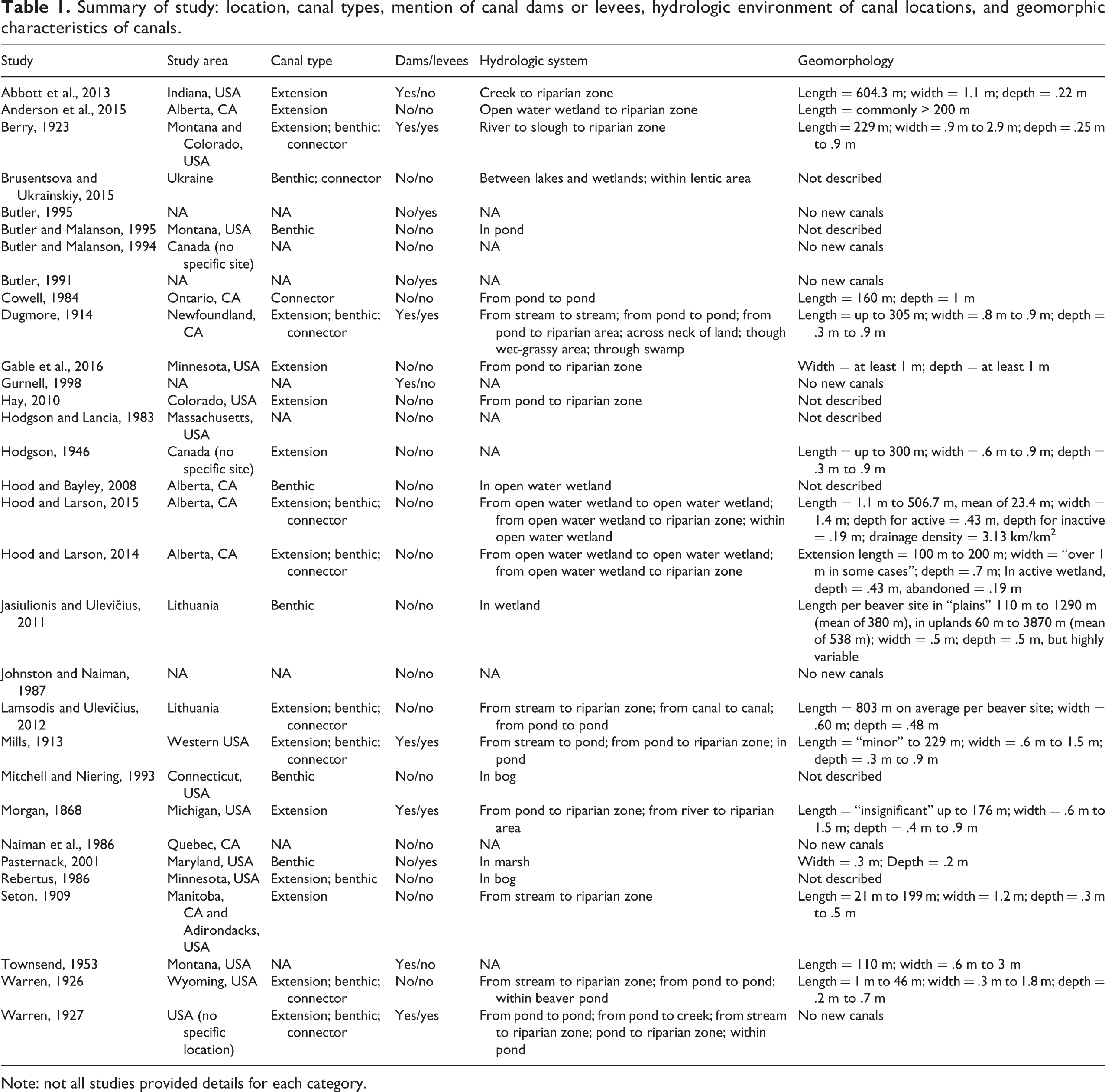
Note: not all studies provided details for each category.
Author descriptions of why, where, when, and how beaver develop canals.
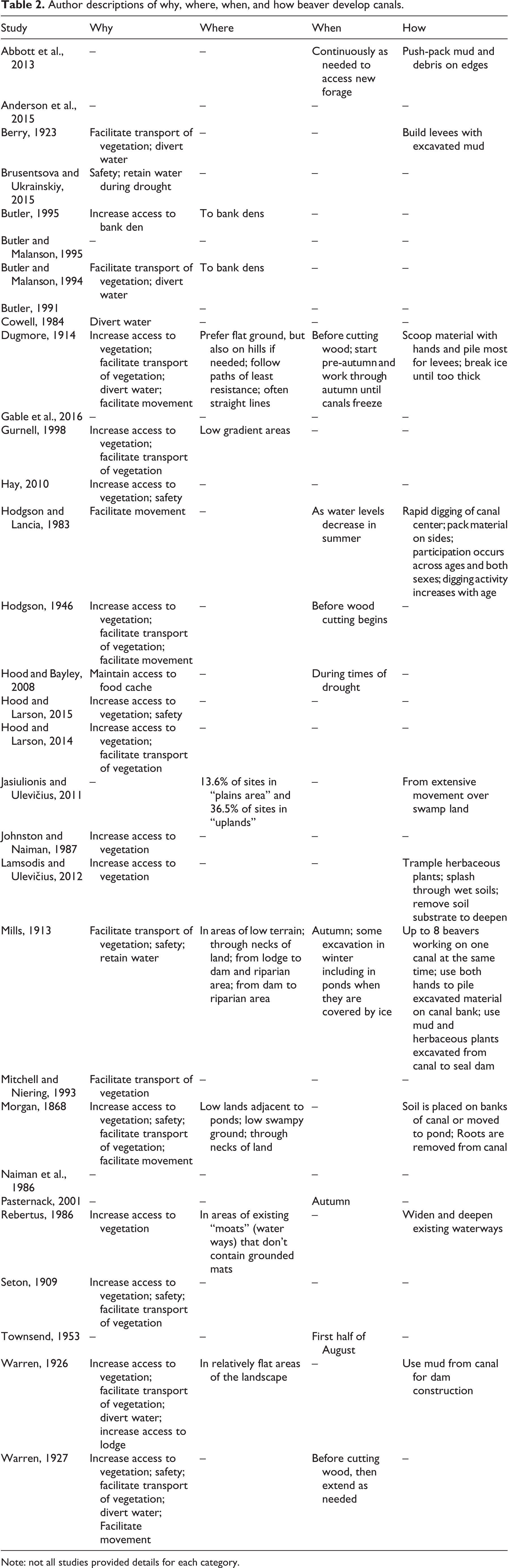
Note: not all studies provided details for each category.
Key findings of each study.
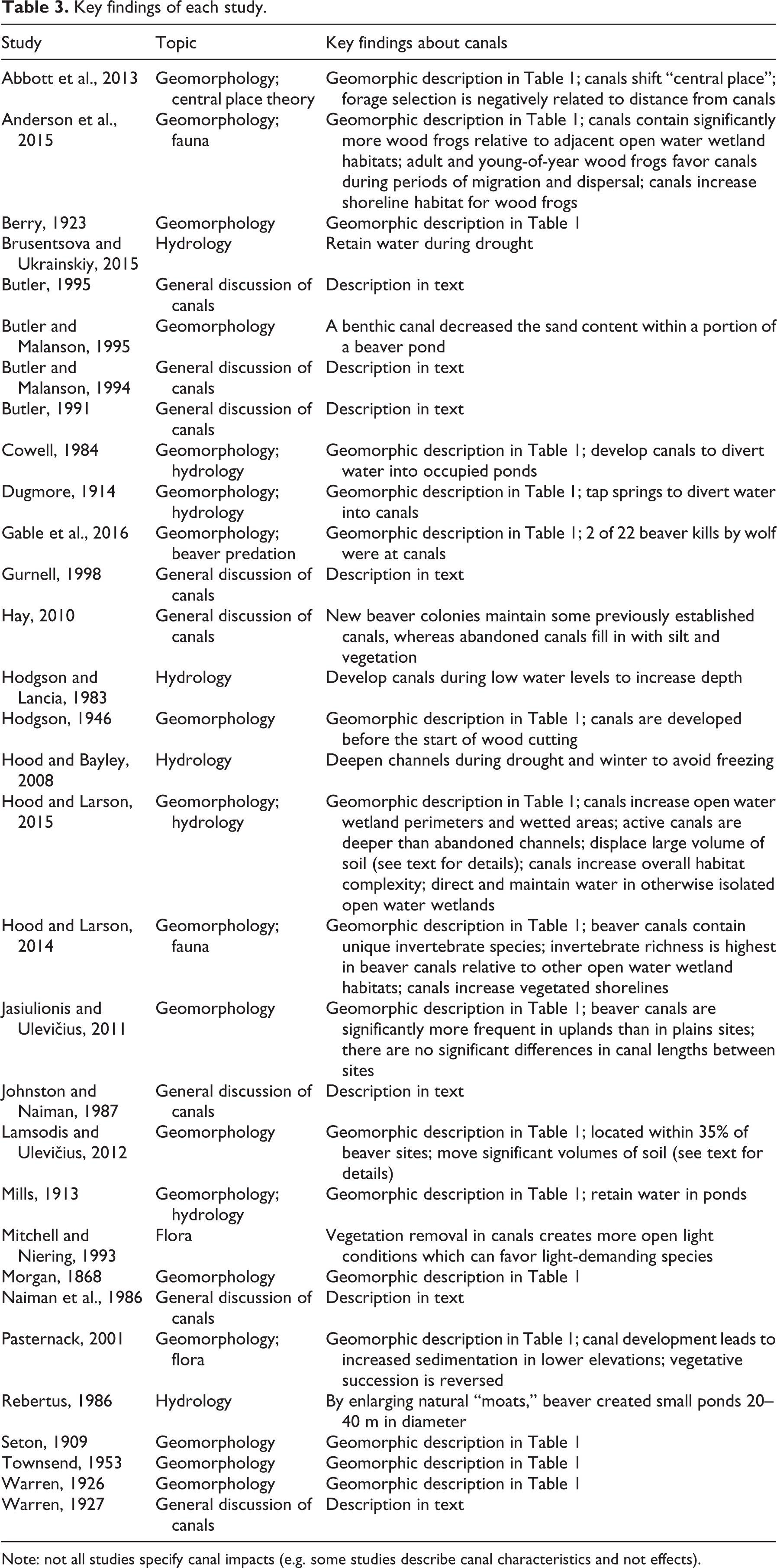
Note: not all studies specify canal impacts (e.g. some studies describe canal characteristics and not effects).
3.1 Canal types
Beaver canals can be classified into three general categories based on their landscape position (Table 1). The most commonly described canal type is the extension canal, which extends from a beaver pond or occupied wetland into a riparian area (e.g. Hay, 2010; Warren, 1926). Extension canals provide a water route through areas that would otherwise require travel over land. The second type of canal is the connector canal, which connects two hydrologically isolated aquatic environments, such as a wetland to another wetland or a pond to a river (e.g. Cowell, 1984; Lamsodis and Ulevičius, 2012). The third type of canal consists of an excavated route that is located at the bottom of a beaver pond or wetland (e.g. Brusentsova and Ukrainskiy, 2015; Rebertus, 1986). Going forward, we refer to the third canal type as a benthic canal (Figures 1 and 2). All three canal types can exist within or adjacent to beaver ponds in streams or isolated water bodies such as beaver occupied wetlands (Figure 2).
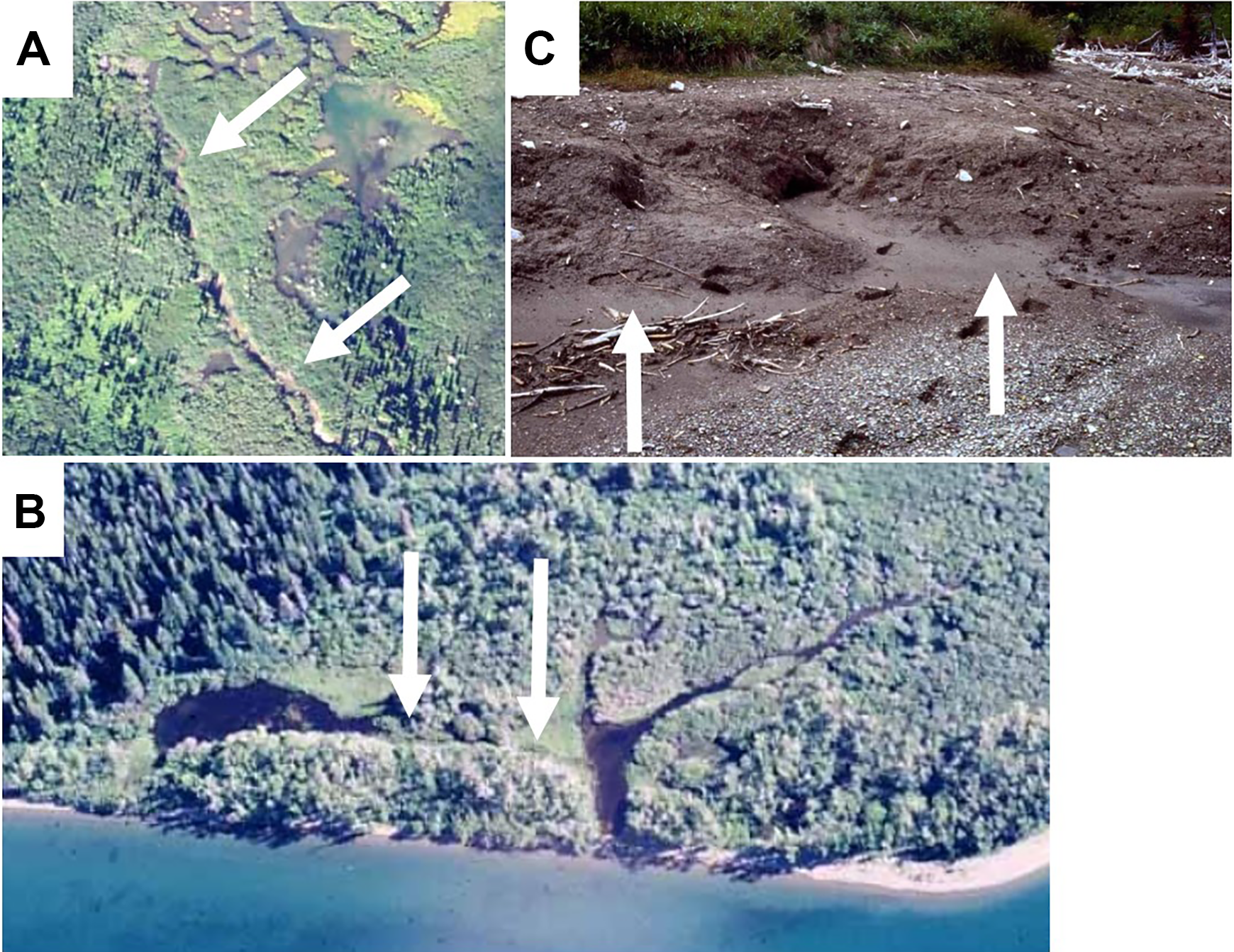
Examples of canal types.
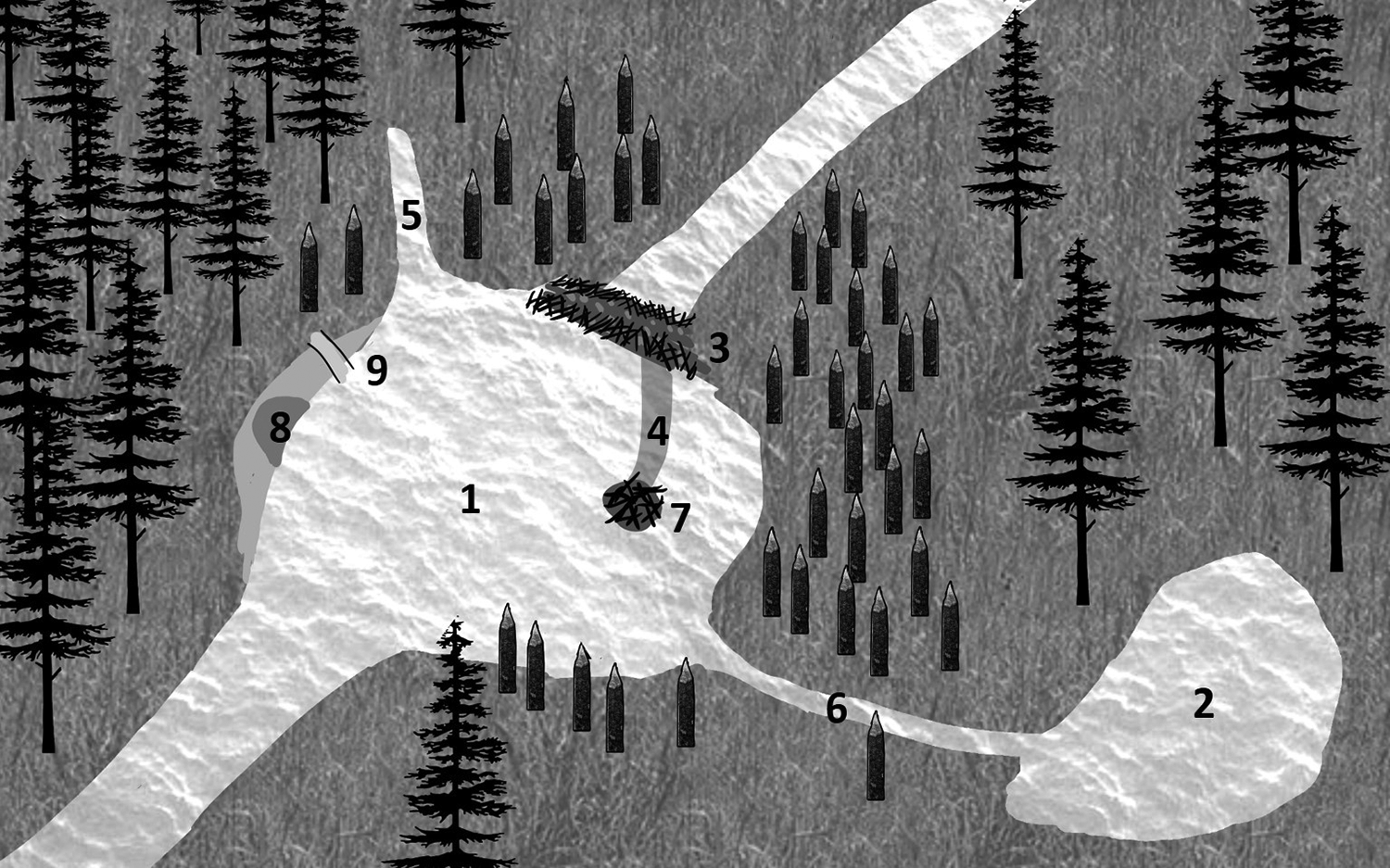
Conceptual model displaying the relationship of various beaver canal types in relation to other potential habitat modifications within a beaver colony.
3.2 Why do beaver build canals?
Beaver have multiple motives for establishing canals (Table 2). The most commonly cited explanations for canal development include: to increase access to new forage for consumption or storage in food caches (Dugmore, 1914; Hodgson, 1946; Rebertus, 1986); to increase access to woody building materials needed for dam and lodge construction (Mitchell and Niering, 1993; Warren, 1926); to facilitate forage and timber transport by floating rather than dragging vegetation over land (Berry, 1923; Gurnell, 1998); and to increase safety during travel (Hay, 2010; Warren, 1927) (Table 2). Extension canals provide more efficient transport routes relative to land travel due to their lack of rough terrain with numerous obstructions (Morgan, 1868). Connector canals provide similar benefits to extension canals but are also often excavated to maintain desired water levels in ponds and wetlands (Berry, 1923; Butler and Malanson, 1994; Cowell, 1984). Benthic canals are often developed to maintain water levels during droughts (Brusentsova and Ukrainskiy, 2015) and to prevent open water wetlands from freezing to wetland bottoms, particularly underneath lodges and adjacent to food caches (Hood and Bayley, 2008). Hodgson (1946) noted canals that were routed across islands in Canada, which appeared to have been constructed to decrease swimming time around the islands. Overall, the reasoning for canal construction may have been best described by Seton (1909: 460), who stated, “The [beaver] canals are made for precisely the same reason as those made by man, for the easy transportation of passengers and freight.”
3.3 Where do beaver build canals?
Beaver develop canals in a wide variety of habitats, including within forests (Seton, 1909), beaver ponds (Butler and Malanson, 1995), wetlands (Naiman et al., 1986), islands (Morgan, 1868), and karst landscapes (Cowell, 1984) (Table 2). The range of environments in which beaver develop canals is not unexpected, since beaver are habitat generalists rather than specialists (Gerwing et al., 2013; Roberts and Arner, 1984; Touihri et al., 2018). Berry (1923) notes that canals are more likely to be developed in areas that are less favorable for colony establishment. Indeed, canals are frequently constructed in areas where local resources are not desirable or preferred forage has been exhausted (Hodgson, 1946; Johnston and Naiman, 1987; Warren, 1926). On the landscape, beaver appear to intentionally target specific terrain characteristics when excavating canal routes. Canals that are developed to reach new riparian resources are often located on flat ground with soft surface soils (Anderson et al., 2015; Cowell, 1984; Mills, 1913). However, in landscapes with more significant elevation change, beaver are able to maintain water levels within canals by constructing check dams (Abbott et al., 2013; Pasternack, 2001; Warren, 1926). Within beaver ponds and wetlands, benthic canals are often excavated between beaver lodges or bank burrows and food caches (Butler, 1995; Hood and Bayley, 2008), and from lodges across the base of dams (Mills, 1913). Benthic canals also commonly extend from ponds or wetlands to dry riparian areas where they turn into extension canals or terrestrial trails (Johnston and Naiman, 1987; Seton, 1909). In a Minnesota bog environment, Rebertus (1986) found that beaver selected existing waterways (“natural moats”) between individual bogs for canal development. Excavation of preexisting channels was also noted by Warren (1926) in Wyoming. Rebertus (1986) found that areas with grounded vegetation mats and dense root networks were avoided for canal development, presumably due to difficulty in excavation. Jasiulionis and Ulevičius (2011), the only study to compare canal development between two different environments, found that beaver canals were more common in uplands than in plains sites. Within steeper upland areas, dams of equivalent size will create a smaller beaver pond and inundate less riparian area relative to flatter plains areas (Gurnell, 1998; Johnston and Naiman, 1987), thus canals may be necessary to reach favorable vegetation within steeper uplands.
3.4 When do beaver build canals?
Various time scales have been described for when beaver develop canals, ranging from daily to annually (Table 2). Seasonally, canal excavation has primarily been observed during the autumn (Townsend, 1953). For example, Pasternack (2001) describes canal development as occurring over a 3–6-week period once plants begin drying out. However, Mills (1913) also observed beaver deepening benthic canals in the winter, when the surface of a beaver pond was covered in ice. Hodgson and Lancia (1983) observed that as water levels dropped in summer within a Massachusetts study site, beaver activity related to canal construction and maintenance increased to maintain water levels. In an open water wetland environment within Alberta, Hood and Bayley (2008) also observed extensive time spent by beaver excavating benthic wetland canals during periods of drought. On a daily scale, it is most likely that canal construction occurs during dusk, dawn, or overnight, times when beaver are generally most active (Buech, 1984; Hodgson and Lancia, 1983). According to Hodgson (1946), beaver will excavate canals before cutting wood in targeted areas, but Mills (1913) and Abbott et al. (2013) noted that canals are continuously extended as riparian resources are depleted.
3.5 How do beaver build canals?
How beaver canals are constructed can be determined from direct observation or from interpretation of the landscape. Several authors believe that beaver are “intelligent” and plan canal layouts before beginning excavation. Seton (1909: 460) states, “They are the obvious result of a plan adhered to from the beginning.” According to Morgan (1868: 379): To conceive and execute such a design presupposes a more complicated and extended process of reasoning than that required for the construction of a dam, and although a much simpler work to perform when the thought was fully developed, it was far less to have been expected from a mute animal. I am somewhat disposed to the belief that in some respects the canal is a higher engineering achievement than the dam. To deliberately plan and dig a channel in which to float logs to a pond, and not only that, but also to build dams in this channel to hold the water to a desired level, is an intelligent act. This is what the animals do, however, when the trees are at a distance from the shore, and the ground is flat enough to permit of carrying water in on a level, or controlling it by miniature dams.
From direct observations Hodgson and Lancia (1983: 101) describe canal construction as: …rapid digging and pushing loosened material with the forepaws away from the center of the canal or channel. This activity is the least complex construction behavior. All age-classes participate, the frequency increases with age, and no sex differences are apparent.
3.6 Canal geomorphology
Beaver canals are highly diverse in their dimensions and structural characteristics (e.g. presence or absence of dams and levees). Reported canal lengths vary from less than 1 m to over 800 m, widths range from 0.6 m to 2.9 m, and depths range from 0.2 m to 1 m. Although canal lengths vary widely within and between sites, widths of approximately 1 m and depths of about 0.5 m are common (Table 1). The inner perimeters of canals typically lack vegetation, but can also be covered in moss (Jasiulionis and Ulevičius, 2011) or fill with organic debris, particularly if not maintained (Hay, 2010; Hood and Larson, 2014). Plant roots within soils increase canal cohesiveness and overall bank strength (Hood and Larson, 2014; Pasternack, 2001). Where beaver canals end and riparian areas begin, the canal terminus is vertical, similar to canal banks (Morgan, 1868). Extension and connector canals often extend perpendicularly from the lentic water body that they originate from (Anderson et al., 2015). Connector canals can be so evenly excavated that the direction of flow between the two connected water bodies may be difficult to discern and can change seasonally depending on the difference in hydraulic head between the connected water bodies (Berry, 1923). The well-defined structure of beaver-excavated canals has been noted by several authors. Warren (1927: 147) states, “It [a canal] was dug as clean and parallel-sided as though trenched with a spade.” Seton (1909: 458) describes a canal as “clean cut with sharp, hard edges, and has a most artificial look.” Mills (1913: 173) describes a canal as having “an angular, mechanical appearance, and suggested the work not of a beaver, but of man, and that of a very careful man too.”
In some areas, beaver have developed multiple tributary canals leading from a main canal, thereby forming an artificial dendritic network (e.g. Warren, 1927). Within a 13 km2 study area, Hood and Larson (2015) mapped 1700 beaver canals with a total length of 39,848 m, resulting in a canal drainage density of approximately 3 km/km2. No other studies have reported canal drainage densities. Canals can also alter wetland morphology and dimensions. By developing connector canals in Alberta, Canada, beaver increased the length of vegetated wetland shorelines by 46,181 m. As a result, the wetland perimeter in the study area increased by over 500% (Hood and Larson, 2014).
Canal development can lead to significant soil displacement. Lamsodis and Ulevičius (2012) calculated sediment displacement rates of 18.2 m3/km2 in an agricultural landscape, whereas Hood and Larson (2015) calculated sediment displacements greater than 1700 m3/km2 at a wetland site. Canal excavation may also alter sediment characteristics (Gurnell, 1998). For example, excavation of a beaver canal in Glacier National Park, MT, was found to alter sediment texture within a beaver pond by decreasing benthic sand content (Butler and Malanson, 1995). When beaver develop canals, the excavated sediment can be either brought into a beaver pond or deposited as a levee (Dugmore, 1914; Warren, 1926).
Eight studies in this review identify canal dams that impound flow (Table 1). Just as beaver build dams on creeks and streams, they construct small dams on canals to maintain or raise water levels (Warren, 1926). If canals require additional water beyond what a canal contains, larger dams that extend beyond canal banks can be developed to trap additional spring discharge (e.g. Mills, 1913; Warren, 1927). In some cases, larger dams create small beaver ponds along the canals (Morgan, 1868). Canal dams may contain depressions in their center for floating woody material over the dams (Morgan, 1868; Warren, 1926). In steeper terrains, the spacing between canal dams decreases. For example, Mills (1913) notes that canal dams in a mountainous Montana site were rarely more than 6 m apart.
Eight studies have identified levees established along canal banks (Table 1). Levees allow for additional water to be contained within canals, thereby increasing depth (Morgan, 1868). In some instances, levees allow water in a canal to be higher than the surrounding terrain (e.g. Berry, 1923). Levees permit canals to persist over longer distances and individual levees can be greater than 50 m in length (Butler, 1995).
It is important to note that there may be observation bias of reported canals relative to those that exist within a landscape. Large canals are more noticeable and may be more appealing to study, and sometimes even extensive canal networks may not be apparent (e.g. Berry, 1923). Dimensions of benthic canals are rarely reported (Table 1), likely due to their low visibility and ability to be surveyed. For example, benthic canals in some areas may only become visible during drought conditions (Hood and Larson, 2015).
3.7 Canal maintenance
If canals are not regularly maintained, they may rapidly (< 1 year) fill in with sediment and vegetation (Pasternack, 2001). Hood and Larson (2014, 2015) found that canals in wetlands that were recently abandoned had significantly lower depths than actively maintained canals. Trees that are uprooted during windfalls can block canals; however, beaver may also use the fallen timber for consumption or construction after clearing it (Dugmore, 1914). Succeeding generations of beaver often maintain a colony’s canals; thus, the configuration of canals can persist for several decades (Hay, 2010). If a colony is extirpated (e.g. due to trapping), new beaver populations may come in, restore, and make use of previously established canal networks (Hay, 2010). As with dams, canals require regular maintenance to retain their structural integrity and usefulness.
3.8 Canal impacts on hydrology
Beaver canal impacts on landscape hydrology include: retention of water in ponds and wetlands (e.g. including during times of drought; Brusentsova and Ukrainskiy, 2015); increased surface area of wetlands due to increased hydraulic head or removal of wetland vegetation (e.g. Hood and Larson, 2014); increased or new hydrologic connectivity between otherwise isolated aquatic habitats (e.g. Hood and Larson, 2015); and alteration of flow paths as a result of water diversions (e.g. from streams into ponds; Cowell, 1984). Extension canals typically fill with water that is sourced from the pond or wetland that the canals extend from. The water elevation within the canals largely depends on the hydraulic head within the source area. In riparian landscapes, if the water table intersects a canal, groundwater may also contribute water to canals (Abbott et al., 2013). When canals are developed on rising terrain, water can be sourced from surrounding springs, particularly if dams extend outside of canal banks (Mills, 1913). If the amount of water within a canal system is insufficient, beaver may also develop diversion canals to pirate water from outside streams into canal networks (Dugmore, 1914).
Hydrologic alterations within beaver-engineered landscapes are often specific to a beaver’s needs during a particular period. Hood and Larson (2015) found that beaver canals funneled water into occupied wetlands during drought conditions, whereas surrounding wetlands desiccated. Water levels within the wetlands increased by about 10 cm, which was sufficient to prevent the wetlands from freezing to their bottoms. The canals appeared to be particularly effective at increasing water depth near a beaver lodge. In adjacent areas without canals, 10% of the beaver colonies did not survive the winter due to water freezing beneath their lodges.
Mills (1913) described one of the most impressive observations of how beaver engineer hydrologic control on a landscape to suit their needs at a specific time. Following a shortage of forage near an occupied beaver pond, a dam was constructed on dry land adjacent to an occupied pond. At first the author was puzzled about the beavers’ intent. Next, the beaver developed a small pond (referred to by the author as a “pondlet”) by building a dam below their occupied pond, which was fed by a brook. Water that was discharging from the occupied beaver pond, through the brook, rapidly filled the pondlet. Then the beaver created an outlet from the pondlet pointing toward the land they intended to flood. However, water flowed out of the pondlet away from the targeted site. Thus, the beaver developed a small “wing dam” that redirected the water in the desired direction. The beaver then excavated a canal from the wing dam that conveyed discharge into what became a new beaver pond above the beaver dam that had been previously constructed on dry land. About half of the discharge from the brook that left the old pond was now flowing through the canal and into the newly formed pond. It took three days to fill the new pond. Once the new pond was filled with water, beaver spent the following season gathering newly available riparian resources. The harvested vegetation was floated up the canal and toward the brook that flowed out of the old pond. After sufficient forage was gathered near the brook, the beaver closed off the entrance of the canal and discharge within the brook doubled, facilitating easier transport of the newly harvested vegetation into the old pond. Once the beaver had stored the vegetation near their lodge, they went back to the new pond to harvest additional resources. They reopened the canal and enlarged it to where a majority of the brook’s discharge now flowed through the canal. They then transported the newly acquired vegetation back to the old pond containing their lodge. This time, the beaver dragged the wood over the old pond’s dam rather than taking it up through the brook. The new pond was abandoned following one year’s use.
Alexander Majors (founder of the Pony Express) provides another remarkable example of how beaver employ canals to alter hydrology within their environment (quoted in Mills, 1913: 218): He [the beaver] can run a tunnel as direct as the best engineer could do with his instruments to guide him. I have seen where they have built a dam across a stream, and not having sufficient head water to keep their pond full, they would cross to a stream higher up the side of the mountain, and cut a ditch from the upper stream and connect it with the pond of the lower, and do it as neatly as an engineer with his tools could possibly do it. I have often said that the beaver in the Rocky Mountains had more engineering skill than the entire corps of engineers who were connected with General Grant’s army when he besieged Vicksburg on the banks of the Mississippi. The beaver would never have attempted to turn the Mississippi into a canal to change its channel without first making a dam across the channel below the point of starting the canal. The beaver, as I have said, rivals and sometimes even excels the ingenuity of man.
3.9 Canal impacts on fauna
Beaver canals create unique landscape niches, promote landscape connectivity, and can increase overall habitat diversity (Hood and Larson, 2015; Naiman et al., 1986). Subsequently, the altered habitats influence faunal interactions with the landscape. Anderson et al. (2015) determined that amphibians made use of beaver canals up to 200 m in length that connected individual open water wetlands in Alberta, Canada. Compared to shoreline habitats within the wetlands, beaver canals contained greater frog populations. Wood frogs in particular favored beaver canals over other habitats during periods of migration and dispersal. Within a wetland environment, Hood and Larson (2014) found that certain invertebrate species (Gerridae and Gyrinidae) were exclusively located in beaver canals and that the canals were habitat “hot-spots” for predaceous invertebrates. Overall, invertebrate taxa richness was significantly higher in beaver canals than in adjacent wetlands and their open water edge habitats.
3.10 Canal impacts on flora
Canals alter vegetation biomass and species composition within beaver habitat complexes. When beaver excavate extension canals, they clear herbaceous plants, thereby decreasing vegetation cover along the canal routes (Jasiulionis and Ulevičius, 2011; Mills, 1913). In a bog environment, following canal excavation, open water and increased light availability was found to favor growth of aquatic plants, including Nymphaea, Brasenia, and Calla, which beaver tend to favor as food sources (Mitchell and Niering, 1993). In open water wetland environments, beaver are also effective at maintaining cleared canals; thus, canals themselves lack emergent and submerged aquatic vegetation found in surrounding wetland areas (Hood and Larson, 2014). However, beaver may also directly increase vegetative biomass in local areas during canal development. For example, in areas where canal dams are constructed, woody plant material is introduced from riparian zones into the aquatic environment (Abbott et al., 2013; Townsend, 1953). Lastly, beaver may alter vegetation zones by increasing shoreline surface area due to canal excavation (Hood and Larson, 2014).
3.11 Biogeochemical impacts from canals
We are not aware of any studies that have quantified biogeochemical impacts (e.g. nutrient transport and/or transformations) of beaver canals. However, beaver movements through canals likely generate pulses of water that transport nutrients and carbon through aquatic environments (Hood and Larson, 2014). Connector canals may also facilitate mixing of water from aquatic habitats that would otherwise be hydrologically isolated (e.g. from stream to wetland). Nutrient and carbon transport through canals may also be generated due to bioturbation of bed sediments (Hood and Larson, 2014), especially for particulate bound nutrients and particulate organic matter (e.g. Rech et al., 2018). Canals may also facilitate biomass transfer between aquatic and terrestrial systems. For example, beaver import riparian resources that can be subsequently cycled into the aquatic environment (e.g. through decomposition or defecation-excretion of plant-based nutrients and carbon). Organic and inorganic materials that are transported through canals undoubtedly generate some biogeochemical effects within beaver habitat complexes and may also impact biota that occupy or temporarily make use of beaver-modified environments.
3.12 Predation associated with canals
Although beaver establish canals to decrease the risk of predation associated with overland travel (Abbott et al., 2013; Brusentsova and Ukrainskiy, 2015), several studies have noted that predators will hunt for beaver along canals. Gable et al. (2016) examined predator–prey dynamics between wolf and beaver in Minnesota and found that two of 22 kill sites were located within beaver canals. One of the kills occurred in late September and the second in early October. Based on site evidence, the authors hypothesized that the wolves most likely attacked the beaver in the canals, then dragged them onto land where they were subsequently killed. At both sites, beaver remains were found within 5 m of the canals. Predators may target beaver within canals more frequently during the fall (e.g. Gable et al., 2016), since that is when canals are commonly used for transport of woody materials (Dugmore, 1914; Naiman et al., 1986; Seton, 1909). Mills (1913) describes a coyote attack on a beaver within a canal that was witnessed in Colorado. In this instance the beaver escaped the attack, but the author speculates that coyotes in the area likely have been successful at killing other beaver within canals.
3.13 Historic appreciation of beaver canals
Numerous authors have pointed out their awe and admiration for beaver canals. In 1868, Morgan (457) stated that beaver canal development is the “highest act of intelligence and knowledge performed [by the beaver].” Over half a century later, Berry (1923: 95) pondered that a beaver canal in Montana was engineered with such ingenuity and quality of construction that it could rival human-engineered canals: When discovered it was at the very acme of structural perfection, in fact was so finished in detail and so well kept that some of those who first saw it had no thought of it as possibly of other than human origin, and expressed a wonder as to who could be running so well constructed an irrigation ditch through that particular piece of forsaken jungle, and more especially how it could have been constructed without their knowing it. These canals, I venture to say, are a demonstration of the highest skill to be found in the work of any animal below man. It is even doubtful whether man in his lowest form does such extraordinary constructive work, and with such remarkable success.
IV Conclusions
This review summarized the published research on beaver canals. Beaver canals are primarily constructed to increase accessibility to riparian resources, facilitate transport of harvested resources, and to decrease predation risk. Beaver canals have been identified in numerous environments ranging from largely undeveloped mountainous regions to heavily developed agricultural landscapes. Although flat terrain with soft soils appears to be favored by beaver for canal excavation, development of dams across canals allows them to be functional on sloped terrains. As with beaver dams, beaver canals exhibit large structural variability, particularly in lengths, which can be over 0.5 km. Widths of about 1 m and depths of about 0.5 m are common. Canals seem to be primarily constructed during the fall season by removing soil and packing canal perimeters. Excavated soil is either placed on canal banks thereby forming levees, brought back into beaver ponds, or used for construction of dams and lodges.
Although studies examining the environmental effects of canals remain limited, those that have been completed have shown that canals generate significant ecosystem effects. Beaver canals alter watershed hydrology by creating new aquatic habitats, connecting isolated aquatic features, and diverting water into targeted areas. Extension and connector canals modify dendritic networks and surface water dynamics, typically by increasing water availability and wetted shorelines. Development of benthic canals during periods of drought or severe cold decreases the likelihood of wetland and pond desiccation and can increase beaver survival.
Beaver canals also have significant impacts on biota. The presence of canals produces thermal microhabitats and alters vegetation communities that can be used by other species during various life stages. Due to increased landscape connectivity, beaver canals bolster the likelihood of amphibian dispersal to new breeding sites, and allow for recolonization of unoccupied sites, thereby also likely increasing gene flow between otherwise isolated biotic populations. Research completed thus far has revealed that these novel zoogeomorphic habitat niches are preferred, sometimes heavily, by certain invertebrate species. In addition to increasing overall floral and faunal species richness and diversity, beaver canals may benefit biota by mitigating climate change impacts. Increased drought in some landscapes where wetlands are common is predicted to decrease wetland size and depth (Cao et al., 2012; Chen et al., 2012). By excavating canals and increasing wetland depth, beaver may be able to mitigate habitat fragmentation effects driven by drought, which may increase overall ecosystem resistance and resilience to disturbances (e.g. Hood and Larson, 2015).
Anderson et al. (2015) specifically state that beaver canals should be utilized for amphibian conservation. For example, connector canals that link isolated open water wetlands may be beneficial to species that inhabited connected aquatic landscapes during their evolutionary history. Beaver reintroductions and beaver dam analogs are increasingly being employed for stream restoration. Based on the meaningful impacts that beaver canals have been shown to produce in the reviewed studies, and likely many others that have yet to be discovered, it is likely that beaver canals can be beneficial to stream and wetland restoration efforts and may also increase ecologic returns on restoration investments.
Despite first appearing in the scientific literature over a century ago, the study of beaver canals and their environmental effects remains highly limited in comparison to beaver dams. Furthermore, no studies have directly compared environmental effects generated by beaver canals to beaver dams. Thus, it is difficult to assess the impact of beaver canals within the context of beaver dams. Despite this, several important conclusions can be drawn based on the patterns observed in this review and previous research summarizing beaver dam impacts. Beaver canals and beaver dams generate some analogous effects, as both: (a) increase aquatic landscape coverage; (b) allow beaver to access and transport vegetation within their colony; (c) increase habitat diversity; (d) alter hydrologic regimes and connectivity; (e) modify floral–faunal dynamics; and (f) increase the beavers’ ability to survive. However, the magnitude of impacts between canals and other landscape features created by beaver, such as dams, may vary, particularly between environments. For example, in areas with extensive canal networks and small beaver ponds, beaver canals relative to dams may produce more aquatic habitat and connectivity, be increasingly utilized by beaver, and may generate more significant biotic effects. However, where canals are rare but dams are common and beaver ponds are large, the aforementioned beaver canal impacts may be minimal in comparison to those generated by beaver dams.
Due to the pervasiveness of beaver canals in some environments and the potential difficulty of their identification, it is plausible that previous studies that have focused on beaver dam impacts may have failed to attribute some environmental effects from beaver habitat modifications to canals. We believe that future research on beaver effects would be fruitful if beaver canals were surveyed and reported in addition to beaver dams when present. By examining beaver canals and beaver dams (along with other beaver habitat features) holistically, a better understanding of the significance of beaver canals within a beaver colony may be attained.
Many unknowns (and thus numerous research opportunities) exist that can increase our understanding of beaver canals. Here we identify several broad research topics related to beaver canals that have yet to be examined and are likely to be of interest to conservation scientists and land-use managers. Physical themes: No studies have measured the impact of beaver canals on water temperature or light attenuation within water. Also, very little is known about the fate of excavated sediments (e.g. proportion used for dam and levee development vs. that deposited within a beaver pond or wetland) and how the excavated sediments alter aquatic habitats (e.g. potential changes to turbidity). Chemical themes: Surprisingly, no studies have examined the impact of beaver canals on nutrient, carbon, or bacterial (e.g. E.coli) inputs and transport. We identify this as a major gap in the literature. Biological themes: No studies have examined the impact of beaver canals on fish or birds, and studies on invertebrates and amphibians are limited to a few species. Additionally, no studies have compared genetic diversity between biotic communities within aquatic habitats connected by beaver canals to those that lack canals and remain isolated.
Footnotes
Acknowledgements
We would like to thank Donna McCollum, David Prytherch, Jason Rech and two anonymous reviewers for providing constructive feedback on an earlier version of the manuscript. We thank David Butler for providing the photographs within figure one and Allie LeBlanc for developing figure two.
Declaration of conflicting interests
The author(s) declared no potential conflicts of interest with respect to the research, authorship, and/or publication of this article.
Funding
The author(s) received no financial support for the research, authorship, and/or publication of this article.
