



Abstract
The role of bedrock geochemistry in vegetation growth within karst areas has been examined in recent works, implying that the approach of the critical zone (CZ) extending from the canopy to the groundwater bottom enhances the understanding of vegetation ecology. In this paper, the research progress of vegetation ecology associated with bedrock features in the karst CZ in subtropical Southwest China is systematically reviewed. There are great differences in soil formation and soil features (water-holding capacity, particle size, and soil chemistry) between karst and non-karst regions, even between dolomite and limestone within a karst region. Water and soil are easily leached due to the connected underground crevices in karst, particularly in limestone-dominated regions, leading to water deficits in karst CZ plants in subtropical Southwest China. The development of plant roots in crevices affects the water and nutrient absorption by plants and microbial activities in the soil, which form the basis for vegetation distribution and growth in the karst CZ. The organic acids from plants also increase weathering rates. As extensive human activities have accelerated vegetation degradation and soil erosion and further led to rocky desertification characterized by increasing areas of rock exposure, state-of-the-art knowledge about the effects of bedrock-associated belowground and aboveground interactions can guide the implementation of vegetation restoration and the control of further rocky desertification in the subtropical karst CZ.
I Introduction
Karst, which is widely distributed throughout the world, accounts for approximately 15% of the global land area (Zheng et al., 1999). A recent work suggests that in addition to climate, bedrock geochemistry could have great potential to influence plant growth in karst areas by controlling the regolith water-holding capacity and exerting effects on vegetation growth, which could have been underestimated (Jiang et al., 2020). To better understand the belowground features of karst vegetation growth, it is essential to systematically review the roles of belowground (rock and soil) features that are directly and indirectly related to aboveground vegetation growth in karst areas.
In China, almost all provinces and regions have different areas of carbonate rock distribution. The total karst area is approximately 1.3 million km2, accounting for 13.5% of the total area of the country. Guangxi, Guizhou, and Yunnan Provinces located in Southwest (SW) China are connected by carbonate rocks, with a total area of 550,000 km2, and compose the most widely distributed karst area in China (Figure 1). It is among the three major karst areas (Mediterranean coast, eastern North America, and SW China) in the world (Cai, 1996). Different from the other two major karst areas, the karst area in SW China has a subtropical monsoon climate with a mean annual temperature of approximately 12−24°C and an annual precipitation of approximately 1200−2400 mm. This area is an important representative of the karst critical zone (CZ) due to its highly developed epikarst (surface horizon of karst) with complicated underground crevices developed under the warm and humid subtropical climate (Cao et al., 2005; Tong et al., 2018). The vegetation in this area is dominated by subtropical evergreen broad-leaved forest, while evergreen broad-leaved shrubland and grassland are commonly found (Wu, 1980). The vegetation productivity in the karst CZ is smaller than those in non-karst regions at the same latitude under the same climate regime (Liu et al., 2013a). Compared to those of non-karst regions at the same latitudes, the climate control on vegetation dynamics is much smaller (Cai et al., 2014; Jiang et al., 2020; Liu et al., 2019; Wang et al., 2015a).
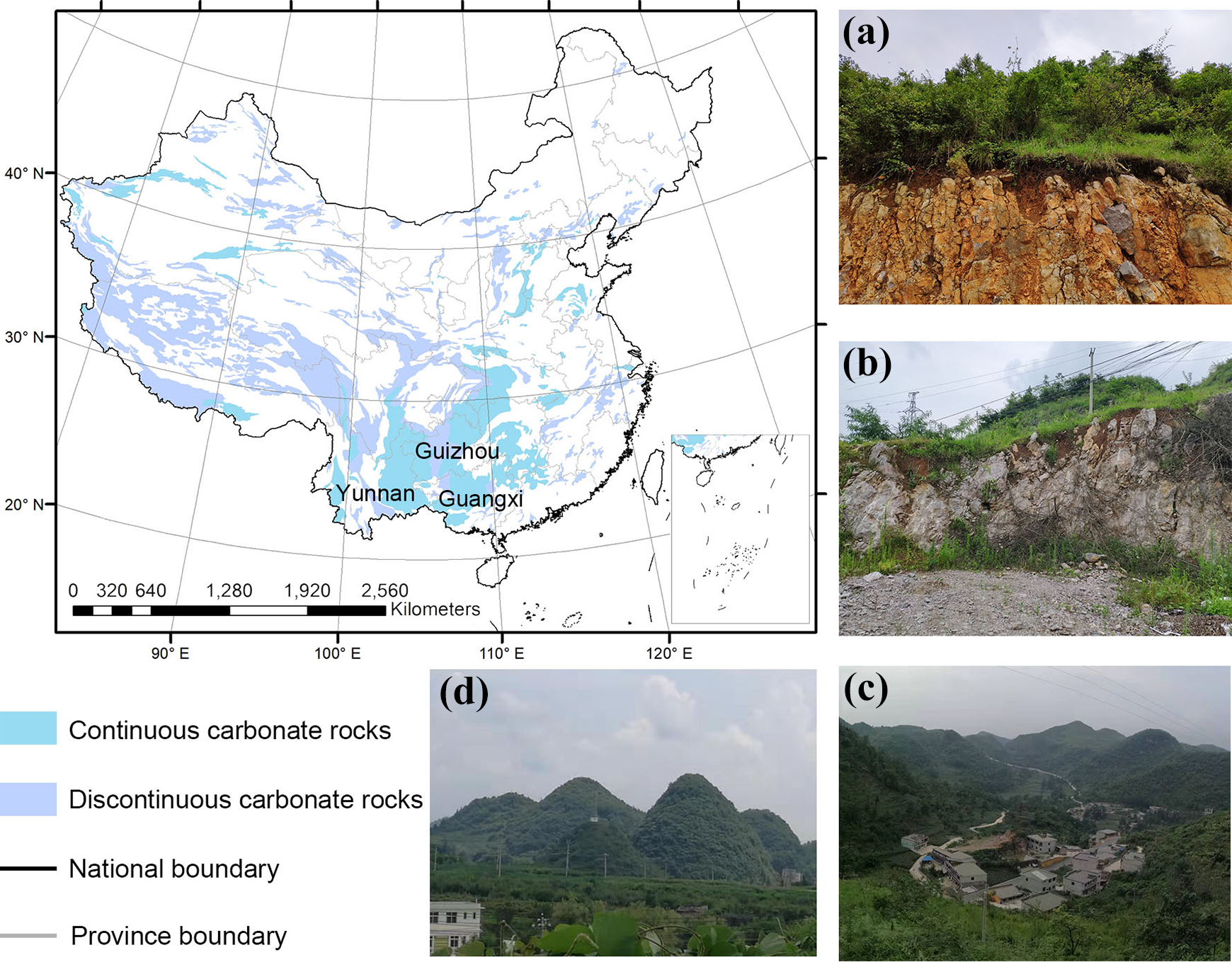
Karst distribution in China, with data from Goldscheider et al. (2020). Photographs (a) and (b) show the belowground and aboveground features in the Guizhou karst of SW China (taken by Chongyang Xu in 2019). Photographs (c) and (d) show typical karst landscapes and land use in the Guizhou karst of SW China (taken by Hongyan Liu in 2019).
The CZ of the Earth refers to the natural habitat regulated by the complex interactions among rock, soil, water, air, and living organisms, which shape the surface of the Earth and support life systems (National Research Council, 2001). The CZ extends from the vegetation canopy to the bottom of the aquifer (Lin, 2010). The effects of the belowground part of the CZ on aboveground vegetation distribution and growth through flows of nutrients and water are one of the core topics for studies of the CZ (Richter and Billings, 2015). CZ studies can thus provide a revolutionary perspective that links the features of aboveground vegetation distributions and dynamics to belowground patterns and processes in soil and rock.
The stability of CZ structures and the sustainability of ecosystem services have direct impacts on human well-being (Banwart et al., 2013). Rocky desertification, the artificial processes that transform land cover from natural vegetation such as grasslands and forests directly to rocky bare land, is a common kind of land degradation process in the karst areas in SW China (Cai, 1996; Jiang et al., 2014). In areas with rocky desertification, soils are easily leached due to connected underground crevices or eroded due to strong heavy rains (Peng et al., 2008). There are approximately 127 million people in this area according to China’s census in 2010. High-intensity irrational land use has accelerated soil erosion, and, consequently, rocks are exposed (Wang et al., 2004; Yao, 2014). Meanwhile, vegetation restoration policies such as “Grain for Green” and hill closure have been widely implemented to control rocky desertification (Jiang et al. 2014; Wang et al., 2015b). At the regional scale, vegetation restoration projects have been assumed to reduce the risks of rocky desertification by increasing the vegetation cover and reducing the vegetation sensitivity to climate perturbations (Tong et al., 2018). The effectiveness of these vegetation restoration measurements on reversing vegetation degradation has been conducted mostly on local scales (Song et al., 2014; Xiong et al., 2012; Yao, 2014).
Understanding the interactions between the bedrock-associated belowground features and their effects on the aboveground vegetation distribution and growth in the karst CZ in SW China is, thus, critical to vegetation restoration and further control of rocky desertification on a regional scale (Brantley et al., 2007; National Research Council, 2001; Lin, 2010; Zhao et al., 2014). However, the effect of bedrock on aboveground vegetation through belowground features remains less clear. In this paper, we systematically summarize the bedrock-determined belowground features that affect the distribution and growth of aboveground vegetation and the effects of aboveground vegetation on belowground features in the karst CZ in SW China (Table 1), in order to provide a scientific basis for vegetation restoration that is important to control rocky desertification in subtropical karst areas.
Comparisons of belowground and aboveground features between karst (limestone and dolomite) and non-karst.

II Bedrock-determined belowground features in SW China
By definition, karst landscapes are formed on carbonate rocks that are highly susceptible to weathering. Different from the acidic zonal soils, including yellow soil and red soil in the subtropical zone, lime soil is formed in areas dominated by carbonate rocks (mainly limestone and dolomite). Carbonate rocks can form very low amounts (1.52% in limestone and 2.02% in dolomite) of insoluble oxides such as Silica, Alumina, Ferricoxide, which are important components of soil particles (Xu et al., 2016). The extremely low contents of acid insoluble matter in carbonate rocks in karst areas makes the soil formation rate low. It takes more than 4000 years and even up to 8500 years to form a 1-cm-thick weathered soil layer in subtropical karst areas, while it takes approximately 800–1000 years to form yellow soil and red soil in non-karst areas (Wang et al., 2011). The average thickness of the soil layer in typical karst areas of subtropical SW China is only 30−50 cm (Li and Xie, 2001), far smaller than that in the North China Plain (> 200 cm) (Xiang et al., 2009). Soil thickness is related to the degree of slope (Zhao et al., 2014). Taking the Wuqing River watershed in Guizhou Province with steep slopes as an example, the average soil thickness is only 29.2 cm, and 62% of the soil is less than 30 cm thick (Yin et al., 2013). Soil erosion during rocky desertification can greatly reduce the soil thickness. Measurements in areas with moderate soil erosion show an average soil thickness of 18−25 cm (Zhang et al., 2010). Soil formation is different on the two main types of rocks – limestone and dolomite – in the karst region. Dolomite is dominated by calcium magnesium carbonate, while limestone is dominated by calcium carbonate in the karst CZ in SW China (Ma, 2002). Under the strong influence of the underlying carbonate rock, the contents of calcium oxide and magnesium oxide in the lime soil developed from dolomite are as high as 118.0 and 67.4 g·kg–1, respectively, which are much greater than those developed from limestone (Liu et al., 2014b). Physical weathering is stronger for dolomite, while chemical weathering is stronger for limestone. In terms of chemical composition, the solubility of limestone is stronger than that of dolomite. Compared with limestone, dolomite has coarse and uneven mineral particles, high hardness, and easy breakage; it develops small pores, fine crevices, and rough surfaces (Wang et al., 2009). The soil on dolomite is slightly alkaline, with pH reaching 8.0, which is also much greater than that from limestone (approximately 7.0) (Liu et al., 2014b). The contents of soil organic matter, total nitrogen, total phosphorus, alkali hydrolyzed nitrogen, and available phosphorus are much greater in soils in dolomite areas than those in limestone areas (Yu, 2015). Different land use patterns have different effects on soil nutrients, among which, organic carbon, total nitrogen, total phosphorus, and alkali hydrolyzed nitrogen all increase with decreases in human disturbance; potassium, which decreases, is an exception (Liu et al., 2014a; Zeng et al., 2007).
Soil water shortages for vegetation growth are also related to rock features. The soil water flow easily penetrates into the epikarst horizon in limestone areas through crevices and finally enters the underground river system (Li et al., 2006; Peng et al., 2008; Zhang et al., 2011). There are strong spatial heterogeneities in water storage within the soil due to the great difference in the connectivity of the underground pipe network in different sections and under different topographic conditions (Chen et al., 2009; Wang et al., 2003). Some specific underground crevice systems can block water and cause local waterlogging in the case of heavy rainfall (Wang et al., 2003). The soil moisture content decreases by 0.82% when the slope increases by 1° (Chen et al., 2009). Rock crevices significantly accelerate water loss from the upper soil layer but increasing the hydraulic conductivity. The water content of soil not embedded in rock crevices is 30−45%, while that of soil embedded in rock crevices is 17−30%. The hydraulic conductivity increases from 1.0 to 8.5 cm/min (Chen et al., 2009). The appropriate proportions of sand, silt, and clay in lime soil in subtropical SW China are beneficial to the formation of soil aggregate structures, with clay contents close to or greater than 20% (Zhang et al., 2006). When strong erosion occurs, soil is coarsened through clay erosion, leading to a thin soil layer, low organic matter content, and poor soil porosity and soil structure (Zhang et al., 2006). The soil water-holding capacity is also weakened due to soil coarsening after erosion (Zhang et al., 2015).
III Vegetation distribution and growth affected by belowground features
Bedrock type is a non-negligible factor contributing to vegetation distribution and growth in addition to climate and human activity in the karst CZ; climatic and anthropogenic effects cannot fully explain vegetation growth variations in SW China as a whole (Cai et al., 2014; Jiang et al., 2020; Wang et al., 2008, 2015), implying that other factors might also contribute to vegetation distribution and growth (Hou et al., 2015). The vegetation type in the subtropical zone of China is generally determined by rock types through the linkage with soil types. Plant communities dominated by oxylophyte such as Pinus massoniana or Rhododendron simsii develop on acidic soil in non-karst areas, while pure limestone and dolomite develop calciphytes such as Cypress funebris, Pyracantha fortuneana, and Rosa cymosa (Editorial Committee of Guizhou Forest, 1992). Due to different belowground features caused by diverse rock types, vegetation distribution is related to rock types within the karst areas in subtropical SW China. It is found that grassland is linked to dolomite, while forests are related to limestone due to differential crevice development (Liu et al., 2019).
Belowground crevices have been suggested to be important regarding the water supply for vegetation growth, with smaller water-holding capacity in karst regions than in non-karst regions (Jiang et al., 2020). The shallow karst soil layer and water infiltration restrict the growth of plants in karst areas, although the bioclimatic conditions are the same as those in non-karst areas. It can be concluded that the karst vegetation growth in SW China is mainly restricted by the water-holding capacity of the regolith (soil and weathered rock) (Jiang et al., 2020). Drought-resistant species preferentially grow in the karst areas in SW China due to frequent soil water shortages (Cao et al., 2005; Du et al., 2015). The lack of sufficient water for plants restricts the growth and development of vegetation. Consequently, the growth of the diameter at breast height (DBH) and the tree height in karst vegetation are characterized by a slow growth rate, small absolute growth amount, large difference in growth process between species and individuals, and low plant species diversity (Zhu, 1997). The biomass of a karst forest is smaller than that of a non-karst forest according to the forest inventory in SW China (Hou et al., 2016; Yu et al., 2010). It has also been confirmed that karst vegetation has stronger drought resistance than non-karst vegetation and that soil properties play the dominant role in the capacities of karst vegetation for drought resistance (Editorial Committee of Guizhou Forest, 1992). Different from vegetation growth increases in the non-karst region during the last four decades, vegetation growth decreases have been observed in karst areas, mainly due to water deficits in the regolith (Cai et al., 2014; Wang et al., 2008). Water limitations impose different extents of drought stress on the dolomite and limestone vegetation because of different belowground crevice structures. The dolomite grasslands experience more severe soil water shortages than the limestone forests, as shown by the normalized differential vegetation index, which is a surrogate for vegetation growth (Liu et al., 2019). Although the amount of soil in a limestone area may be less than that in a dolomite area, the developed crevice structure is more suitable for the growth of trees with deep roots (Liu et al., 2019; Yang et al., 2008; Zhu, 1997).
The bedrock-determined soil chemical features can also contribute to vegetation growth. Under alkaline conditions, nitrogen mineralization in soil is rapid, but the bioavailabilities of phosphorus and iron are poorer than those in acidic soil (Chen et al., 2019; Zhang et al., 2019). The growth of calciphytes in this kind of soil shows the symptoms of phosphorous and iron deficiency (Zhang et al., 2019). Although both karst and non-karst forests are limited by phosphorus in subtropical southern China, phosphorus deficiency is more evident in non-karsts forest than in karst forests (Chen et al., 2018). Soil chemical features are also different for soils on the two main types of rocks, limestone, and dolomite (Table 1). The soil particles in limestone areas easily collect in the crevices of the rock mass, while the residual materials from dissolution of dolomite can be relatively evenly distributed on the surface; therefore, the soil in dolomite areas has higher contents of calcium and magnesium, making the soil slightly alkaline and restricting the existence and effectiveness of many other elements, such as iron and manganese (Liu et al., 2014b).
IV Links between belowground and aboveground
Root biomass and its distribution are important indicators to assess the strength of the linkage between belowground rock and soil and aboveground vegetation. A case study showed that vegetation restoration can increase the root biomass from 2.63 Mg·hm–2 of grassland to 58.15 Mg·hm–2 of forest, implying that aboveground vegetation can greatly change the root biomass in soil and rock crevices (Luo et al., 2010). With vegetation succession from non-woody vegetation to woody vegetation, root biomass greatly increases, particularly that of small roots and fine roots. The root system is mainly distributed on the rock surface or in rock crevices, but the root system is concentrated in the 10-cm soil surface layer at sites with a large amount of soil (Liu et al., 2018). In general, the proportion of coarse roots is 80% and decreases with increasing soil depth (Luo et al., 2010). Some studies also show that 89% of the roots of plants in the karst CZ, especially in the surface soil where the coarse roots dominate, are distributed in the surface 20 cm (Ni et al., 2015). The rock crevices specifically allow the distribution of small and fine roots. The root biomass of the mixed evergreen broad-leaved and deciduous broad-leaved forest in the karst habitat is 35.83 Mg hm–2, which is not greater than that of the typical subtropical evergreen broad-leaved forest in China. However, the ratio of underground/aboveground biomass in the karst habitat is 0.37, which is significantly greater than that in the whole subtropical evergreen broad-leaved forest area (Liu et al., 2018).
Roots determine the ability of plants to obtain water and mineral salts, and to deliver carbon energy into deep weathering layers or even inside rock crevices (Luo et al., 2010; Ni et al., 2015). The interpenetration of plant root systems can improve the permeability of deep soil to increase the soil water content. However, the more thorough destruction of root systems will lead to more intense loss of soil water content (Chen et al., 2009). Plant roots in the soil also change the microbial distribution and activities. Soil microbial diversity is positively correlated with soil pH and calcium ion content, but negatively correlated with soil organic carbon, total nitrogen, and soil moisture (Xue et al., 2017). Changes in the root biomass cause changes in the soil microbial community and function in the forest ecosystem (Liu et al., 2018). Declines in soil biota abundance and food web complexity are associated with a decrease in the soil pH and in the soil organic carbon content with the progressive secondary succession of the plant community (Zhao et al., 2014). The effects of root exudation and litter return on soil microbial and enzyme activities are important for belowground and aboveground interactions (Liu et al., 2013b). In the lime soil in SW China, the proportions of bacteria, actinomycetes, and fungi are 3.5−59.9%, 28.0−96.4%, and less than 1%, respectively (Du et al., 2013). The size of the soil microbial population decreases gradually with vegetation degradation, which has been determined from both bacteria and actinomycetes and differs from that of zonal red soil determined by bacteria (He et al., 2008). This is mainly because the roots of calciphilous plants may secrete substances to stimulate the growth of microorganisms, especially actinomycetes, which greatly increases the number of microorganisms, especially actinomycetes (Liu et al., 2013b; Song et al., 2014). The number of soil microorganisms, especially actinomycetes, decreases with vegetation degradation and consequently weakens the decomposition of tree litter, leaving more lignified fiber components (Song et al., 2014). The soil microbial composition in karst areas may change plant soil nutrient absorption, through which calciphilous plants mainly absorb nutrients, rather than reabsorption of nutrients to meet growth needs (Zeng et al., 2015).
V Implication for vegetation restoration and rocky desertification control
Previous works on belowground and aboveground interactions can benefit the selection among three vegetation restoration policies in the karst areas of SW China (Jiang et al., 2014; Wang et al., 2015a). (a) Hill closure: in karst areas, the soil layer is thin, and the nutrient storage capacity is relatively poor; therefore, it is very important to reduce human interference with the existing forest (Yu, 2015). Hill closure for conserving existing natural forests is an effective method. (b) Afforestation: it should be emphasized that the soil erosion resistance of newly planted trees is poor (Wang et al., 2003; Zhang et al., 2010). The roots of trees with younger ages and smaller DBHs are not sufficient to penetrate and break the bedrock, thus having no direct effect on the physical weathering of the bedrock (Roering et al., 2010). In addition, it is difficult to restore the soil quality by simply returning farmland to forest (Wang et al., 2014). Considering the peak values of soil erosion when slopes reach 15–40°, afforestation on steep slopes has been recommended (Xiong et al., 2012) but might be limited to limestone areas that have developed large crevices (Liu et al., 2019: 3) Conversion of farmland to grassland: this approach might be suitable in dolomite areas with thin soil layers and undeveloped large crevices (Liu et al., 2019). When implementing measures to convert farmland to grassland for grazing, it is necessary to increase the application of phosphorus fertilizer because an increase in potassium caused by grazing promotes the growth of herbs and consumes a large amount of phosphorus (Fan et al., 2014).
Vegetation cover is commonly used as an indicator to evaluate the effectiveness of vegetation restoration for control of rocky desertification (Cai, 1996; Tong et al., 2018; Wang et al., 2004). Increasing vegetation cover in rocky desertification areas has been suggested to improve soil microbial biomass and composition (Zhao et al., 2014), create better soil environmental conditions (Wei et al., 2011), and ultimately benefit vegetation restoration and ecological reconstruction (Hou et al., 2016; Wei et al., 2011); however, vegetation cover alone does not necessarily improve ecological processes, particularly plant–water relations, which are strongly associated with different vegetation types (Cao et al., 2005; Du et al., 2015; Wang et al., 2003). Compared with the soil moisture in bare soil areas, the soil moisture values are 30.5, 20.1, and 10.2% greater in forest, shrub, and grass areas, respectively (Chen et al., 2009). Due to the differences in vegetation types and lithological structures, the spatial heterogeneity of the lower boundary supporting nutrients and water in different CZs is very large. We cannot clearly define the biological activities along the vertical gradient of the CZs and the lower boundary positions of different material cycles (Lin, 2010), which should be addressed in future studies.
Considering the water limitations in the karst CZ, drought-resistant plant species might be considered for future ecological projects in this region. However, an eco-risk assessment should be conducted when introducing drought-resistant plant species (Wang et al., 2015). Using the ranges of leaf water potentials, the relative suitability of the plants for reforestation could be evaluated (Liu et al., 2012). The decision regarding vegetation restoration and control of rocky desertification should also consider the three-dimensional belowground heterogeneity. Deep-rooted plants can only grow in areas with a thick soil layer or an underground network channel to obtain the water and nutrients that plants lack over a long time (Luo et al., 2010; Ni et al., 2015). If the soil layer is thin and the boundary is shallow, they can maintain the growth of only small plants with short roots (Figure 2). The depth of the farming layer in agriculture is generally less than 0.5 m. If the trees are damaged and crops are planted, the plants can only use the limited material resources in the shallow layer. It is possible that niche complementation among different species could make full use of limited resources, stabilize ecosystems, and improve productivity (Loreau and Hector, 2001).

Belowground structure and its relationship with aboveground vegetation in karst regions dominated by limestone (left panel) and dolomite (middle panel), and non-karst regions (right panel). It is shown that deep rock crevices can permit deep-rooted trees, which, in turn, improve soil conditions, creating positive feedback for tree growth in limestone-dominated regions. Shallow soil in dolomite-dominated regions, however, can allow only herb growth. Different from the karst regions, soil is thick in non-karst regions within the same climatic zone, which allows growth of forests with high productivity. For optimization of land use, the karst CZ dominated by limestone with deep crevices can be used for afforestation, while dolomite with shallow soil can be used for grassland or cropland.
VI Summary
Our review of vegetation studies in the karst CZ of SW China shows that the underground and aboveground areas are closely related. The epikarst horizon, with differentiated rock and soil features, determines the aboveground vegetation distribution, species composition, and productivity, which, in turn, affect the belowground processes through water and nutrient uptake, litter input and decomposition, and root secretion for changes in soil microbial composition and activity. Vegetation restoration in the karst CZ should fully consider the heterogeneity in belowground features determined by bedrock types. The currently implemented hill closure and “Grain for Green” policies should be carried out according to the belowground and aboveground interactions.
Footnotes
Declaration of conflicting interests
The authors have no conflicts of interest to declare.
Funding
The author(s) disclosed receipt of the following financial support for the research, authorship, and/or publication of this article: This study is granted by National Natural Science Foundation of China (No. 41571130044).
