



Abstract
Wind energy is becoming an attractive source of clean energy. However, this type of power source is subject to power reductions due to losses in wind energy conversion system and to frequent changes in wind velocity. For that reason, the important phase of a wind farm design is solving the wind farm layout optimization problem, which consists in optimally positioning the turbines within the wind farm so that the wake effects are minimized and therefore the expected power production is maximized. This problem has been receiving increasing attention from the scientific community. In this article, a mathematical optimization scheme is employed to optimize the locations of wind turbines with respect to maximizing the wind farm power production. To formulate the mathematical optimization problem, we used Jensen’s wake model. We calculate the wake loss and express the expected wind farm power as a differentiable function in terms of the locations of the wind turbines. Furthermore, we develop a new constructive approach to find the best solution to the wind turbines placement problem. Finally, our results are compared with those in some other ealier studies.
Introduction
The wind energy has gained great attention because it represents an important option for reducing the reliance on hydrocarbons for energy production, especially for electricity. But like all current technologies, wind energy poses challenges such as the reduction of the wind speed due to the wake (turbulence) effect of other turbines. Normally, if a turbine is within the area of the wake caused by another turbine, or just in the close area behind it, the wind speed suffers a reduction, and therefore, there is a decrease in the production of electricity.
Accurately predicting and reducing these losses may improve the feasibility of wind farm installations. A way of reducing and assessing these losses is to find the best possible way of positioning the turbines in the wind farm. We call this problem the turbine positioning problem (TPP). It considers the impact of turbines on the others and takes into account the terrain and wind conditions in the region.
The existing works that have tackled this problem are limited. In addition, most of these works have been carried out by the wind engineering and wind energy communities, whereas the effort has been done by the optimization community. Existing algorithms include only genetic algorithms and simulated annealing. There is, therefore, potential for improvement using other optimization techniques, such as mixed-integer programming, dynamic programming, and stochastic programming. As it will be clear what follows, the main reasons why this problem has been largely disregarded by the operations research community are its nonlinearity and the difficulty in obtaining data about the problem instances. Few articles have been published to date that apply mathematical optimization to the problem of positioning turbines inside a wind farm. Mosetti et al. (1994) first approached the problem proposing a position optimization scheme based on genetic algorithms. Grady et al. (2005) expanded this approach predicting optimal wind farm configurations for simple cases. Ozturk and Norman (2004) used a greedy heuristic method which consists in trying different operations recursively (add, remove, and move a turbine) in order to maximize the profit.
It is only very recently that Park and Law (2015) have optimized the layout of a wind farm with 80 turbines using sequential convex programming. In Park and Law (2015), the author’s main focus was on demonstrating the usability of a novel continuous wake model that the authors proposed based on Jensen’s (1983) model and which the authors calibrated with computational fluid dynamics (CFD) simulation data. Although the authors solved a continuous-variable wind farm layout optimization (WFLO) problem using a mathematical programming method, the numerical experiments were not sufficient to fully document the effectiveness of the proposed optimization approach. In particular, the authors considered only one wind regime, a fixed number of turbines, and a single starting point for the optimization, focusing instead on characterizing the influence of the wake decay constant on the attainable wind farm efficiency, and the wind direction was not fully discussed in their optimization models.
This article extends the followed procedure in Park and Law (2015) using a new constructive approach (NCA) to maximize the wind farm power function and optimize the wind farm performance.
Problem formulation and methodology
First, a comprehensive model is set up. Both the wake effect impact from all upstream wind turbines and the impact of the wind speed variation on wake effect itself are included in this model. Then, the energy yield calculation model is described in section “Power function of a wind turbine”.
The wind speed

where k (non-dimensional) is a parameter related to the shape of function: high values are related to distribution concentrated around a given value and low values are related to a distribution very spread in the different values. c (m/s) is the scale parameter that fixes the position of the curve, with higher values for the sites with strong wind and lower values for still sites.
Power function of a wind turbine
A German physicist Albert Betz concluded in 1919 that no wind turbine can convert more than

The theoretical maximum power efficiency of any design of wind turbine is

The values for the cut-in wind speed

Swept area of the turbine (Rogers et al., 2009).
Jensen’s wake model
The Jensen wake model is used to generate wake speed of downstream wind turbines. This model was first developed by N.O. Jensen in 1983 which is a simple analytical model with a short calculation time. This article adopts the Jensen model for its simplicity. However, any wake model could be used with our new approach proposed in this article. The wake model is, thus, derived by conserving the momentum downstream of the wind turbine. The velocity in the wake is given as a function of downstream distance from the turbine hub, and it is assumed that the wake expands linearly downstream. If the near field behind a wind turbine is neglected, the resulting wake behind the wind generator can be treated as a turbulent wake. This model is based on the assumption that the wake is a turbulent and the contribution of tip vortices is neglected. Thus, this means that this wake model is strictly applicable only in the far wake region. Based on the findings from his study, Jensen (1983) recommends the Jensen’s model to be used for the energy predictions in offshore wind farms, as it gives a good trade-off between prediction errors.
According to Betz theory, the value of

Given that

Given that

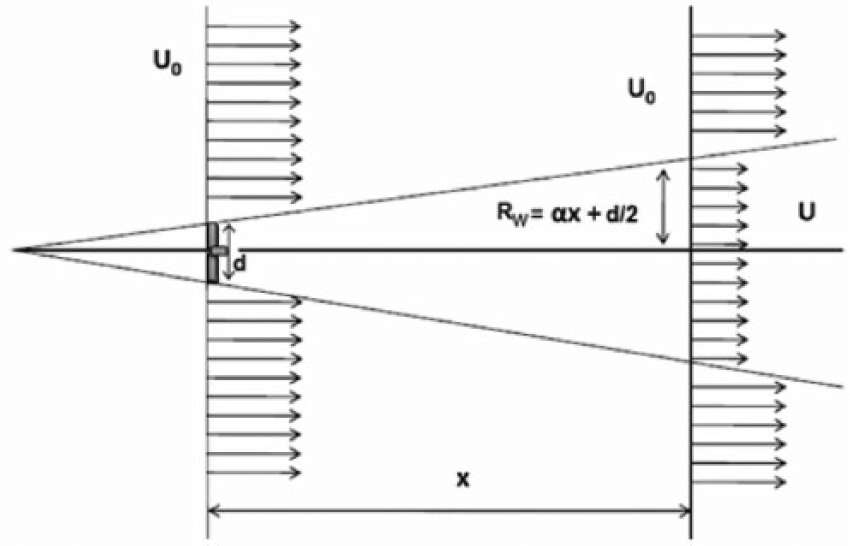
Wind turbine wake model (Jensen, 1983).
The realistic model of the velocity profile is inside the wake region, a modulation term is recommended by Jensen (1983), where a Gaussian profile for the velocity deficit is used as an alternative to the uniform profile. The modulation term is defined mathematically as

where


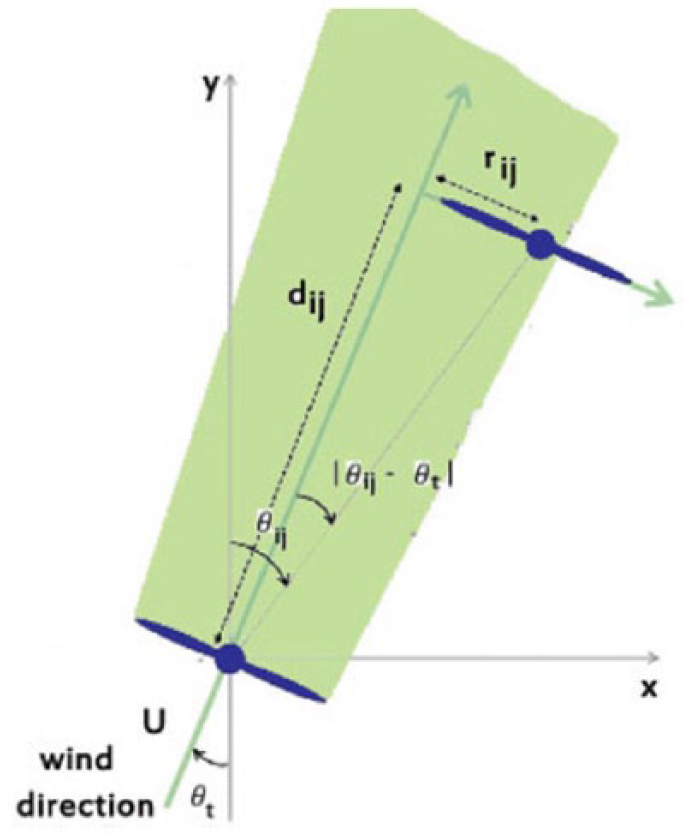
Radial wake inter-distance (Park and Law, 2015).
With this modification, the wind velocity is a function of

In a large wind farm, the downstream wind turbine would be affected by several upstream WTs. In order to evaluate wake effects of corresponding turbines, Katic et al. proposed a method in which the multiple wakes are calculated using the “sum of squares of velocity deficits”. Hence, the wind velocity at the wind turbine in location

WFLO using Jensen’s wake model
The wind farm optimization can be executed by applying specific objective function. The most extensive method is by maximizing the total power of the wind farm that is produced. The power produced is contingent upon the total number of wind turbines on a farm and their positions with respect to one another in order to reduce the wake effect. WFLO is referred as the optimization task that chooses the optimal turbine positions. Optimization does not necessarily mean finding the optimum solution to a problem since it may be unfeasible due to the characteristics of the problem, which in many cases are classed non-deterministic polynomial-time (NP)-hardness problem (Garey and Johnson, 1979). The first step is to define the space of feasible solutions: in the case of a Wind Farm, these feasible solutions will be all the possible layouts. That is, in all the possible combinations of wind turbines, no two turbines are closer than a certain minimum distance. If

Given

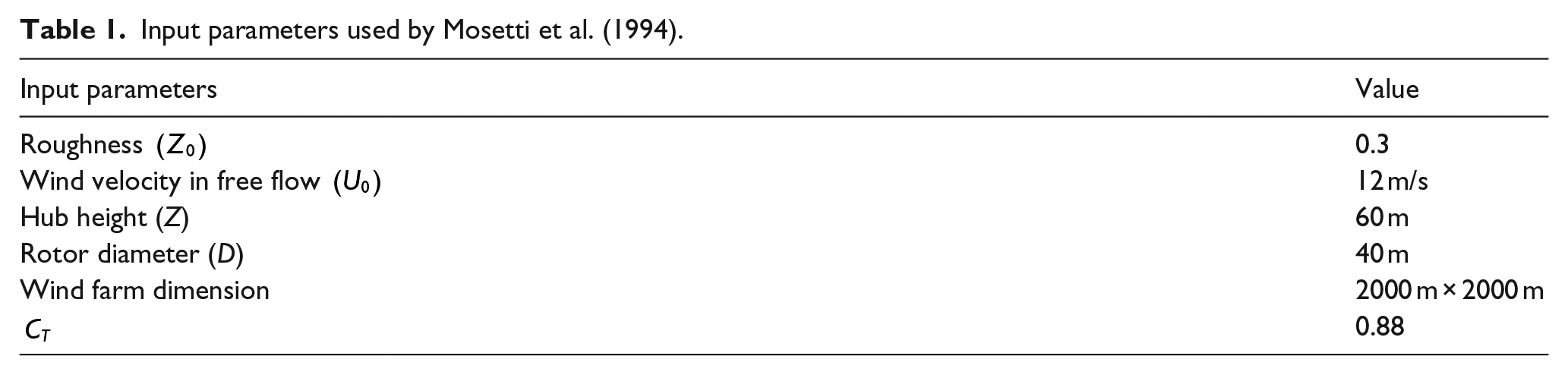
The configuration suggested by Mosetti et al. (1994) was selected for simulation and comparison of results, where the speed and the direction of wind are constants. Table 1 gives the values of the used parameters of entry.
Input parameters used by Mosetti et al. (1994).
The total power of

An NCA
We develop our new approach to find the optimal location of each turbine within the wind farm so that the wake effects are minimized, and the expected power production is, therefore, maximized. It is necessary that the distance between each two turbines is higher than
Our approach consists of fixing an initial block of turbines. In Step j + 1, the positions of the turbines of Block j + 1 are determined using our algorithm so that no turbine is influenced by the turbines of the preceding block j. Accordingly, all the turbines of Block j + 1 will be out-of-field wake generated by the turbines of the preceding block j.
We proceed in the same manner to determine the blocks until determining the positions of the last block of turbines (Figures 4 and 5).

Steps of the constructive approach.

Main flowchart of the algorithm used in this study.
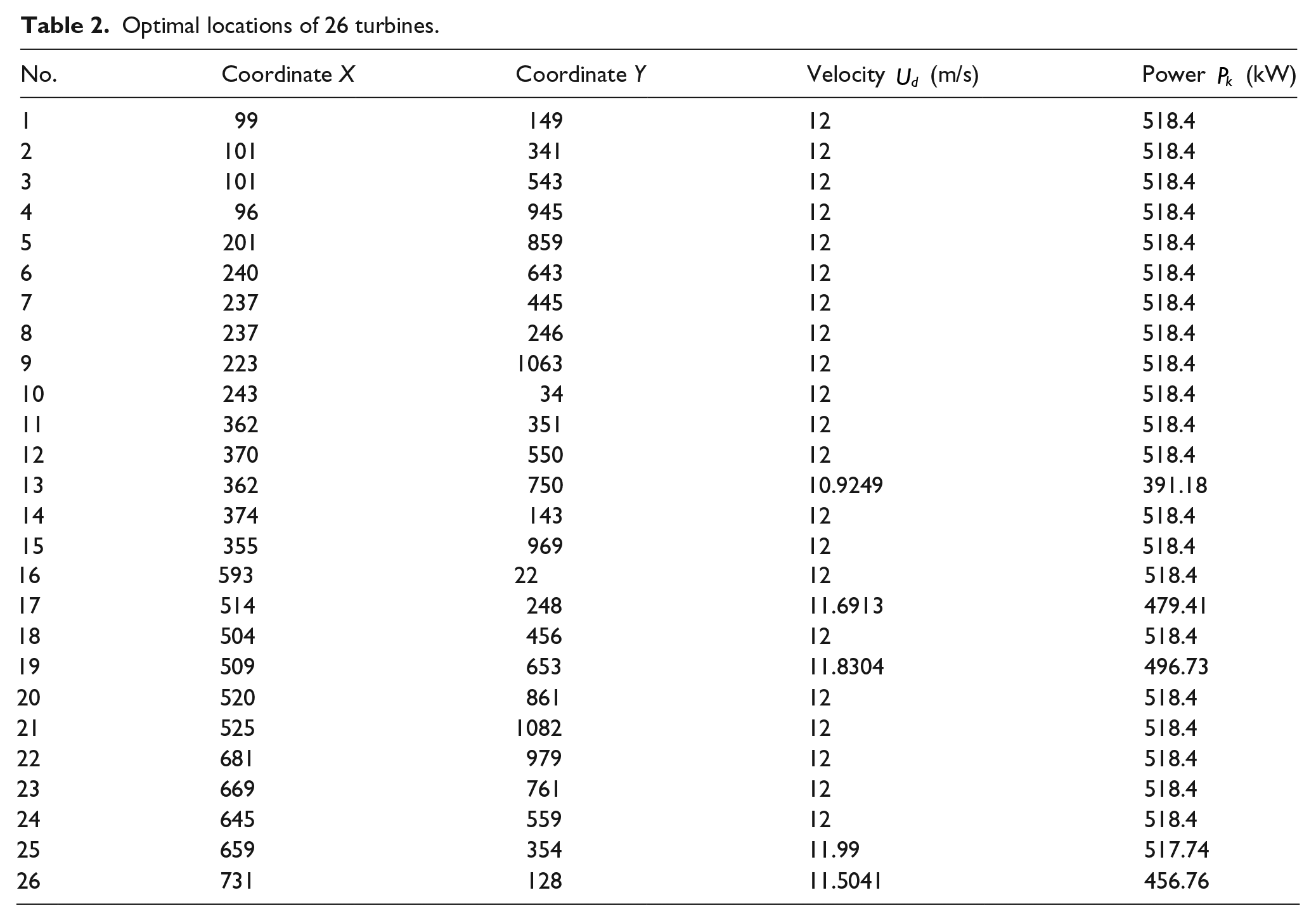
Table 2 gives the detailed results for a wind park of 26 turbines. We specify the Cartesian coordinates X and Y of each turbine, the speed of the wind
Optimal locations of 26 turbines.

Optimal locations of 26 and 30 turbines.
Results and discussion
In a way to verify the NCA performance, some simulations were performed. The results were compared with other author’s works (Do Couto et al., 2013; Grady et al., 2005; Mosetti et al., 1994). These works were chosen because they use the same parameters used by Mosetti et al. model as well as Jensen’s (1983) wake model. As optimization tool, they also use probabilistic algorithms. As a result of that choice, control and reliability of our results are guaranteed (Table 3).
Results for comparison with some previous studies (Do Couto et al., 2013).
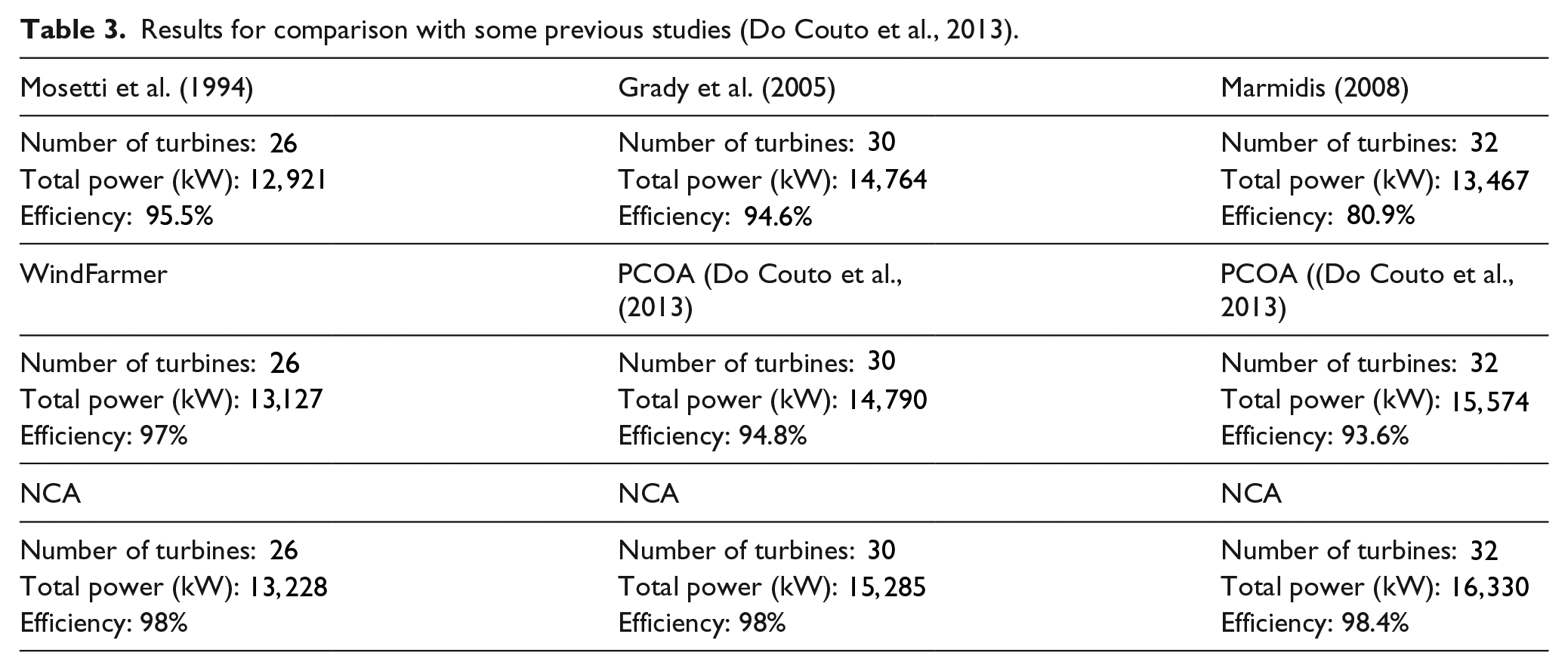
From the results presented in Table 3, some remarks can be made. The first is the quality of our methodology as our results are close by contribution to other works. In addition, the effectiveness of the developed algorithm in this work is guaranteed. This has been verified because of the proximity results compared to the work by Mosetti et al. (1994), Grady et al. (2005), and Do Couto et al. (2013) considering that all of them used a genetic algorithm for optimization. Finally, comparing the results of the NCA with those obtained by Marmidis et al. (2008), we notice that there is a significant increase in the efficiency and production of the wind farm. This difference is related to the used optimization method. Our method which uses a constructive approach block by block proved more efficient than Monte Carlo method used by Marmidis et al.
Moreover, in our configuration, we occupy just 50% of the park ground whose surface is 2000 m × 2000 m.
Conclusion
In this article, an NCA for optimizing an onshore wind farm layout is presented. The optimization model considers the wind turbine radius and the inter-turbines distance as constraints. However, the other constraints can be easily incorporated in this model. The idea is to maximize the energy production by placing wind turbines in such a way that the wake loss is minimized.
The optimal solution is the maximal energy production under the precise constraints. The algorithm does not find the global optimum but one of the local optima. Therefore, it is important to ensure that a local optimum value is close to the global maximum (although it is unknown). For the NCA method, the obtained optimal solution depends on the initial block.
Footnotes
Declaration of conflicting interests
The author(s) declared no potential conflicts of interest with respect to the research, authorship, and/or publication of this article.
Funding
The author(s) received no financial support for the research, authorship, and/or publication of this article.