




Abstract
This article presents a comparative study of empirical power curve models to estimate the output power of the turbine as a function of the wind speed. In these models, modelling strategy relies on the objective of modelling, data being used for the modelling and targeted accuracy. It has been observed that models based on presumed shape of power curve lack desired accuracy since these are developed using the power ratings of wind turbine which are not sufficient to exactly replicate the turbine’s actual behaviour. The performance of various models which comes under manufacturer power curve modelling methodology has been compared with reference to commercially available wind turbines. It has been found that power curves obtained through method of least squares and cubic spline interpolation methods exactly match with manufacturer power curve, whereas 5PL method gives sufficiently accurate results. Modelling based on actual data of wind farm has been found to be a powerful technique for developing site-specific power curves.
Keywords
Introduction
The extraction of power from renewable resources plays an important role in addressing global energy issues. Along with solar energy, wind energy has become a recognized contributor to electricity generator. To maximize the use of wind-generated electricity when connected to the electric grid, it is necessary to estimate the power production of a wind turbine. For the feasibility of a wind energy project, accurate estimation of power production by wind turbines at future times is important. In principle, power produced

Likewise, power produced by a wind turbine is proportional to many parameters such as turbine cross-sectional area A, air density ρ, wind speed v and different turbine efficiency parameters (Cp, ηm, ηg, etc.). Among all, the wind speed is the most promising factor to calculate the output of the wind turbine. In wind energy industry, a power curve helps to express the performance of turbine without giving the technical details of the components of the wind turbine generating system (Carrillo et al., 2013; Lydia et al., 2014). Wind turbine power curve determines the power produced by turbine as a function of the wind velocity. The technical specifications of the turbine are usually provided by the manufacturer in the form of nominal power curve which includes cut-in speed, rated speed and cut-off speed. Here, cut-in wind speed is the minimum wind speed at which the turbine starts to deliver useful power; rated wind speed is the speed of the wind from which the turbine starts to deliver constant maximum output power; cut-off speed is the speed at which the turbine is shut down to avoid damages from high winds. To optimize the operation cost and improve the reliability of the wind energy power system, a reliable and accurate model to estimate the power production of a wind turbine is required and limited empirical models are available for the industry to use with some boilerplate software to test the performance of the machine in actual environments.
Power curve models classification
An ideal power curve gives a typical power extraction, but it cannot be reliable for every model. Therefore, for each wind turbine, an individual power curve is required that can exhibit the characteristics of that machine only. Thapar et al. (2011) stated that commercially available wind turbines have their own design and rating because of differences in the shape of their power curves. Here, the authors have also observed that at different locations, machines having similar ratings may produce different amount of power even if the wind speed is the same. For all these reasons, modelling of the power curve is required that can reflect the actual behaviour of the machine at given site. Based on the data being used for the modelling, models can be broadly classified into three categories:
Models based on presumed shape of power curve;
Models based on actual power curve supplied by manufacturer;
Models based on actual data of wind farm.
Models based on presumed shape of power curve
In this class, power curve of wind turbine is supposed to follow a typical shape. The power delivered by a wind turbine can be expressed by a set of characteristic equations as

These set of characteristic equations are developed using the rated power (pr), cut-in speed (vc), cut-off speed (vf) and rated speed (vr) of the selected turbine and available from the specifications of the turbine.
Modelling approaches for presumed shape power curve
Different approaches have been applied by various researchers to build a model for this class, namely: linear, quadratic, cubic and Weibull parameter-based approach. They have assumed that the relationship between output power and wind speed follows a typical relation q(v) from cut-in to rated wind speed and then it remains constant from rated to cut-off speed. Accordingly, relation q(v) has been designed by various functions using polynomial and other than polynomial expressions. Various authors have suggested different functions for the relation q(v):
Yang et al. (2003) have proposed a linear model for power estimation in which linear equation describes the relationship between output power and input wind speed. This model, though very simple, overestimates the power available.
Giorsetto and Utsurogi (1983) and Diaf et al. (2008) have presented quadratic model to describe the relation between output power and input wind speed. In this model, the relation q(v) has been designed by an equation of degree 2. This model estimates more accurately compared to simple linear model.
Chedid et al. (1998) and Nand Kishore and Fernandez (2011) have suggested a model which describes the relation q(v) by a cubic law. This model should be more realistic as ideally power of wind increases with the cube of wind speed but results are often not accurate.
Powell (1981) and Lu et al. (2002) have recommended a Weibull parameter-based model in which along with machine-specific parameters (i.e. pr, vc, vf, vr), Weibull shape parameter k has been used in the expression of power estimation. Here, the value of shape parameter k depends on wind speed distribution of selected site. Another distribution, that is, Rayleigh distribution, is a special case of Weibull distribution where the value of shape parameter is taken as k = 2, often matched with the wind profile of the selected sites (Olaofe and Folly, 2013). As a result, the expression for relation q(v) will be the same as in quadratic model. In this case, when estimating the output power of wind turbine, results are often not sufficiently accurate.
Limitations of models based on a presumed shape of power curve
It has been observed that models under this category would always lack the desired accuracy. The observation has been made on the basis of following reasons:
Model based on linear power curve does not give accurate results, as power curve of a wind turbine is seldom linear.
In these models, the characteristic equations are developed using the cut-in, cut-off and rated speeds and the rated power only which are not sufficient to exactly replicate the actual behaviour of wind turbine.
A generic polynomial curve is created between cut-in and rated speeds. Site-specific factors are not considered and machine-specific factors are considered partially. Hence, these models are not reliable for power estimation.
Models based on actual power curve supplied by manufacturer
In this class, power curve of individual wind turbine is used to develop characteristic equations using various curve fitting methods. The shape and curvature of power curves vary with different designs and rating powers. For example, there is difference between stall-regulated and pitch-regulated turbines. Stall-regulated turbines have a drop in the output power when winds get very high speed usually above the rated speed. The power delivered by a stall-regulated wind turbine can be expressed by a set of characteristic equations as

whereas pitch-regulated turbines maintain constant output power
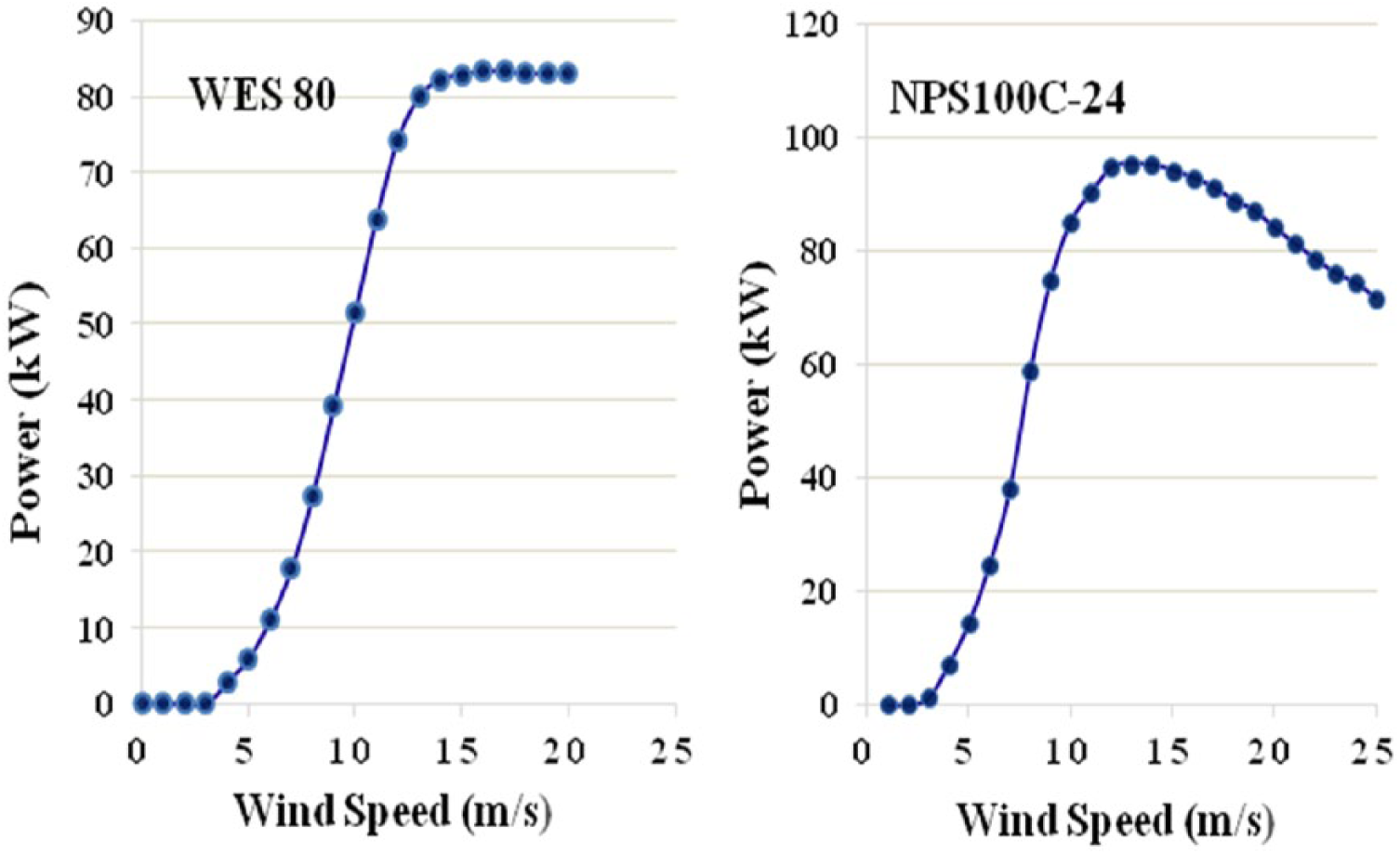
Power curves of model WES-80 and NPS100C-24 (manufactured by Wind Energy Solutions (WES BV) and Northern Power Systems, respectively).
Modelling approaches for actual power curve
In this class, various curve fitting techniques have been used in the literature for accurately estimating the output power of that wind turbine. Since limited numbers of data points are provided by manufacturer, curve fitting using function approximation methods has been used for modelling. In this approach, the set of characteristic equations are developed by approximating relation q(v) through various functions using polynomial and other than polynomial expressions. Carrillo et al. (2013) and Nand Kishore and Fernandez (2011) have applied a second-degree and a third-degree polynomial, respectively, to fit q(v). Since in both cases, the coefficients of equations were calculated using cut-in and rated wind-power reading only, results were not so good. In order to improve fitting accuracy, this work focused curve fitting using piecewise polynomial function approximation and logistic function approximation.
Piecewise polynomial function approximation
A piecewise polynomial function q(v) is obtained by dividing the domain of v into contiguous intervals and representing q by a separate polynomial in each interval. With the aim to achieve more control on the curvature of the power curve, Thapar et al. (2011) and Ai et al. (2003) have divided wind speed domain into contiguous intervals and then a separate second-degree polynomial has been applied on each region. In each region, second-degree polynomial has been applied on three points using least squares method and achieved 100% accuracy. It has been observed that continuity of the curve at knots is not considered. More generally, a kth degree piecewise polynomial with m knots should have continuous derivatives up to degree k − 1. It is claimed that cubic piecewise polynomial are the lowest-order piecewise polynomial for which the knot-discontinuity is not visible to the human eye. Accordingly, the following equations have been applied to estimate the output power of wind turbine for given wind speeds
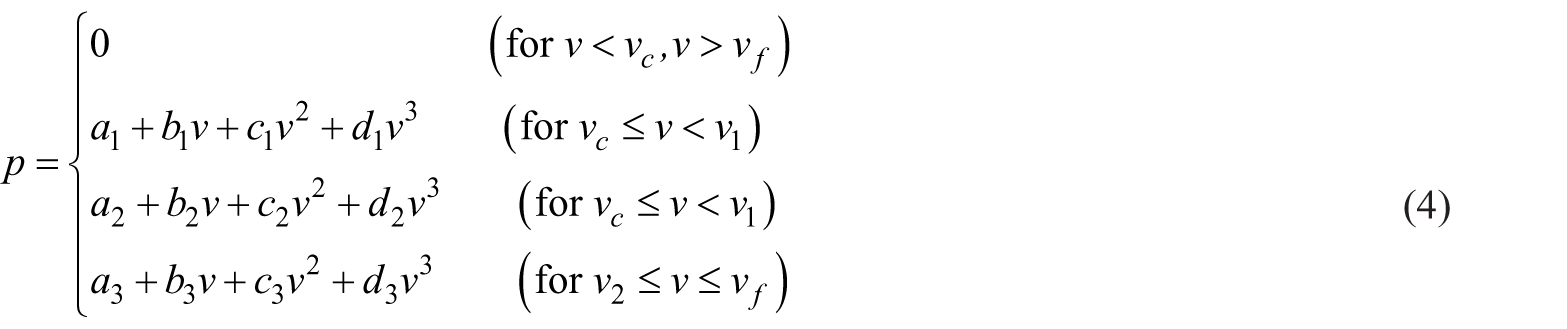
where a1, b1, c1 and d1 are the coefficients cubic equations. Here, v1 and v2 are the break points also known as knots. Since a generalized model can be developed by best fitting lower degree polynomial on optimal number of data points, in experiments, knots should be selected in such a way that for fitting nth degree polynomial between knots more than n + 1 points lies in that region. As a result, it will show better accuracy on those wind speeds for which output power is not given on manufacturer power curve. Based on above approach, the power curve for model NED100, obtained from Appendix 3, equations (C.1–C.3), as compared with power curve supplied by the manufacturer is shown in left panel of Figure 2. It is observed that the empirical power curves best fit with manufacturer power curves.
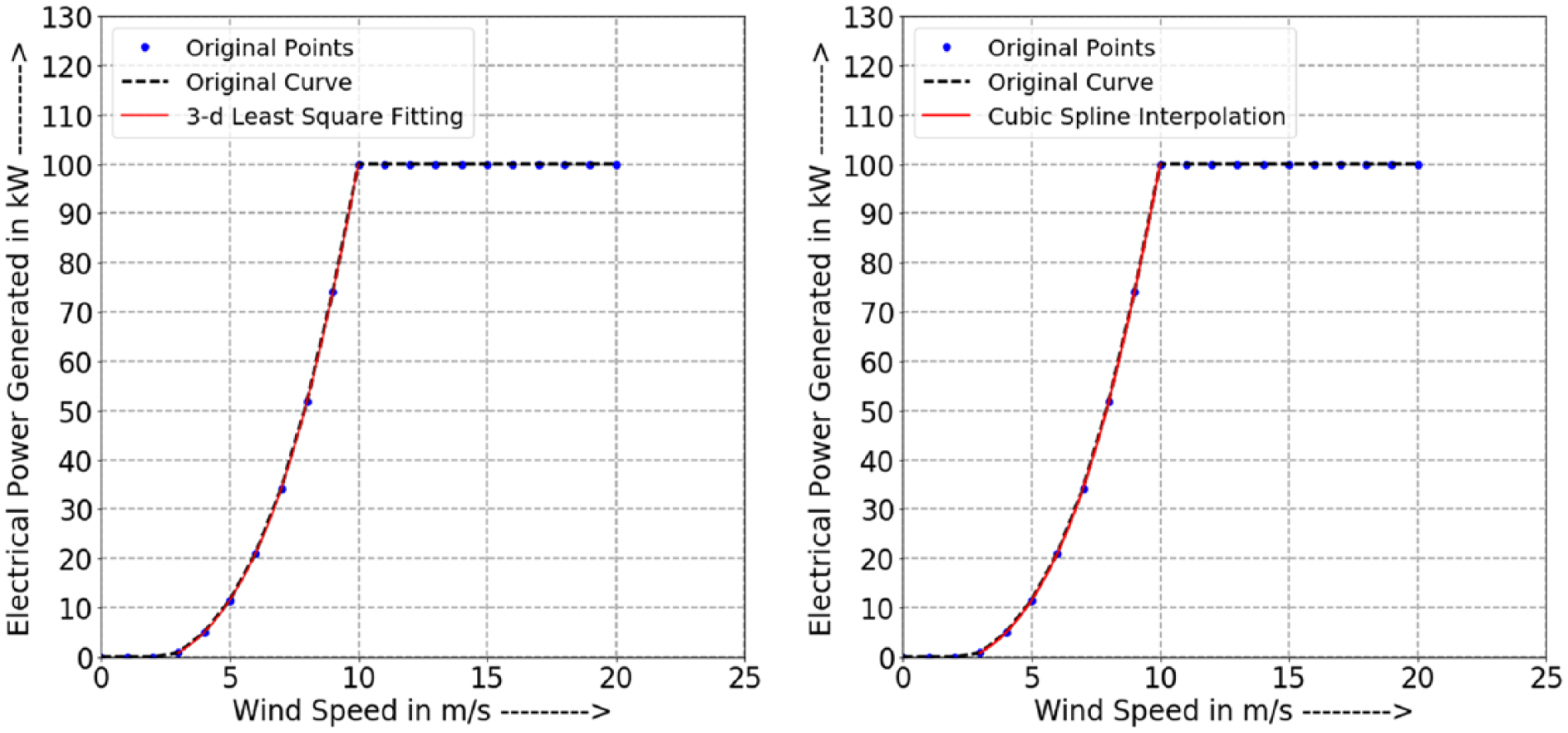
Comparison of power curves obtained from the three degree least squares and cubic spline interpolation models with the actual power curve, for model NED100 of Norvento Enerxia.
Cubic spline interpolation technique
Thapar et al. (2011) and Perera et al. (2013) have estimated the output power produced by the wind turbine through interpolation of given set of readings provided by the manufacturer. Accordingly, the following n number of cubic spline interpolation functions has applied to modelled the output power of wind turbine for given wind speeds
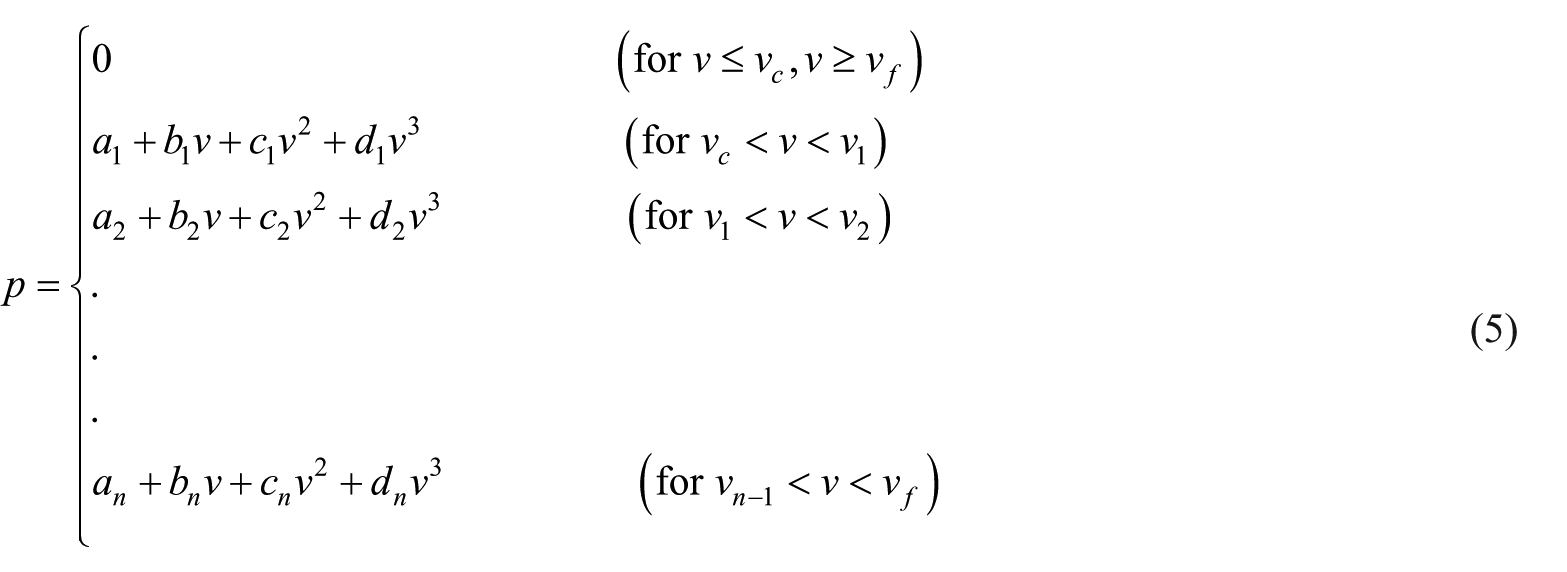
where a spline interpolation function of degree k is a function formed by connecting polynomial segments of degree k so that the values of function and its first k − 1 derivatives agree at the knots. In this method, the shape of a spline can be controlled by carefully choosing the number of interpolation points (or, knots) and their exact locations in order to allow flexibility and avoid overfitting where the trend changes quickly and little, respectively. Based on the above approach, the power curve for model NED100, obtained from Appendix 4, equations (D.1–D.5), as compared with power curve supplied by the manufacturer, is shown in right panel of Figure 2. It is observed that the empirical power curves best fit with manufacturer power curves.
Approximation considering inflection points of the curve
Lydia et al. (2013) have applied four-parameter logistic (4PL) function to model empirical power curve using nominal data provided by the manufacturer. They stated that in most real power curves, there is a point on the curve at which the curvature changes its sign known as inflection point of the curve. In their modelling, they have considered inflection point as one of the parameters to model the empirical power curve. The 4PL function is given below

where a, b, c and d are the minimum asymptote, steepness of the curve, inflection point of the curve and the maximum asymptote, respectively, of 4PL functions. Based on the above approach, the power curve for model NED100, obtained from Appendix 5, equations (E.1–E.3), as compared with power curve supplied by the manufacturer, is shown in left panel of Figure 3. It is observed that the empirical power curves sufficiently fit with manufacturer power curves.
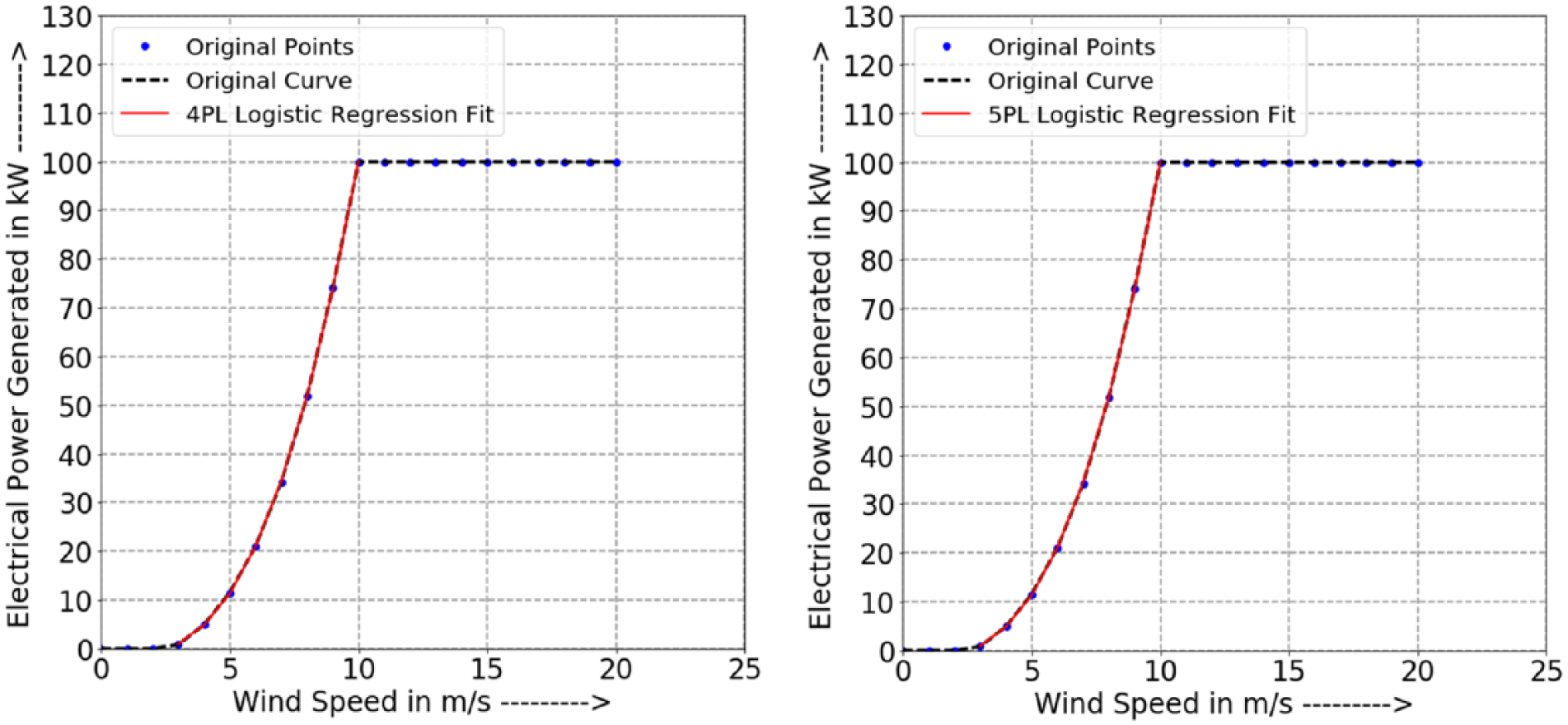
Comparison of power curves obtained from the 4PL approximation and 5PL approximation models with the actual power curve, for model NED100 of Norvento Enerxia.
More often, however, most real power curves are asymmetric about the inflection point, thus model which incorporates asymmetry factor as one of the parameters can produce better results. Sohoni et al. (2016) have applied five-parameter logistic (5PL) function to model empirical power curve using nominal data provided by the manufacturer. In their modelling, along with position of the inflection point, they have considered asymmetry factor as one of the parameters to model the empirical power curve. In this model, a typical 5PL function is given by

where a, b, c and d parameters are same as in 4PL functions and g is the asymmetry factor of the 5PL function. Based on the above approach, the power curve for model NED100, obtained from Appendix 5, equations (E.4–E.6), as compared with power curve supplied by the manufacturer, is shown in right panel of Figure 3. It is observed that the empirical power curves sufficiently fit with manufacturer power curves.
Models based on actual data of wind farm
In this class, the empirical power curve can be developed using the data collected from the operational wind farms. Usually, the data are collected from the supervisory control and data acquisition (SCADA) system of the site. In the literature, variety of modelling techniques have been invented to model the empirical power curve of a wind turbine using actual data and some of them are reported in Marvuglia and Messineo (2012) and Morshedizadeh et al. (2017). Shokrzadeh et al. (2014) have presented a technique to describe the relation between output power and input wind speed of a wind turbine using polynomial regression fit. The polynomial regression model can be considered as

Here, for n input observations,
Results and discussion
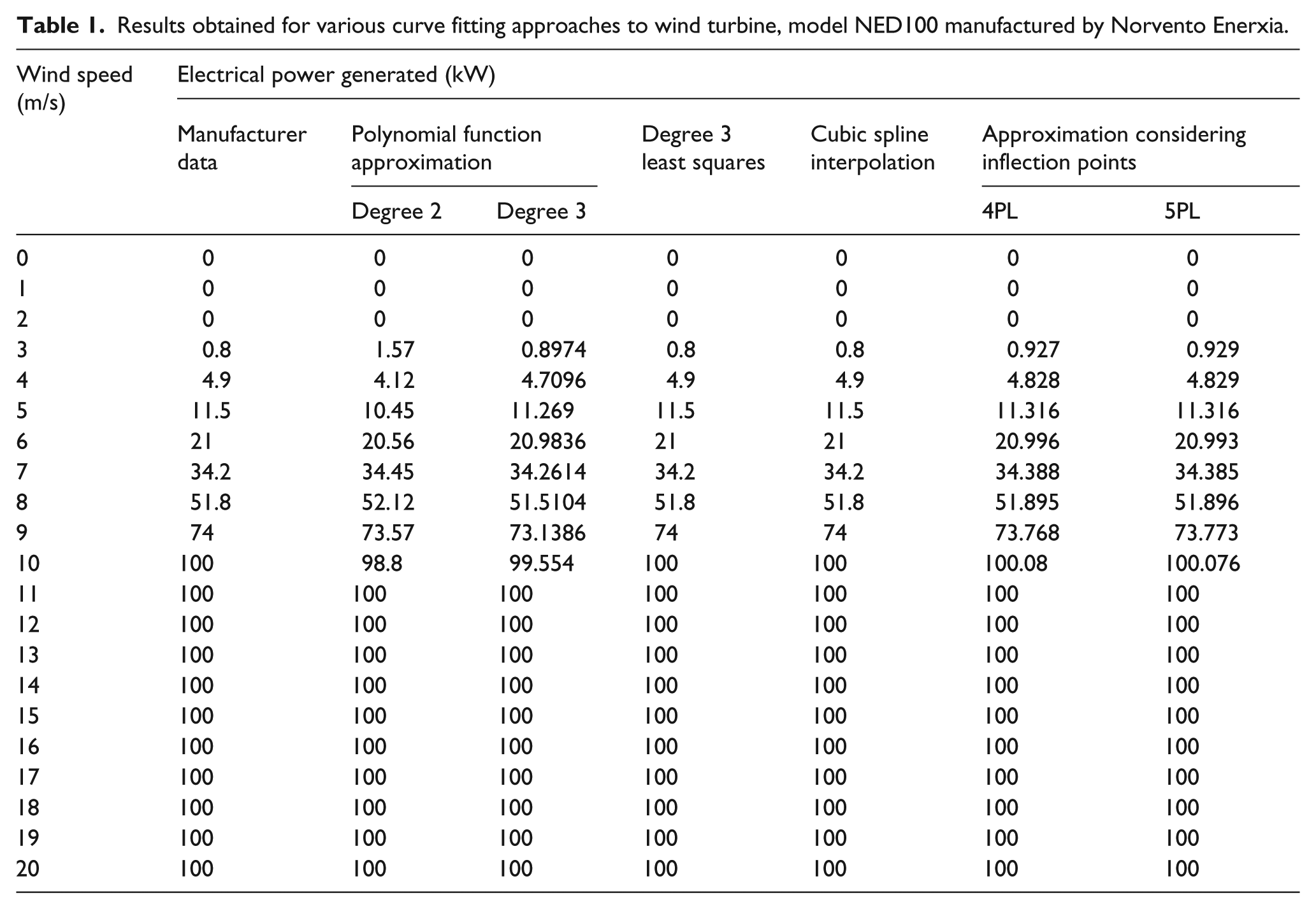
In this article, empirical power curve modelling of wind turbine has been classified into three categories. The classification is based on the wind power data being utilized for the modelling. The model based on presumed shape of power curve comes under first category and has been discussed in section ‘Models based on presumed shape of power curve’. In this class, only cut-in, cut-off, and rated speeds and the rated power are used to develop the model, which are not sufficient to exactly replicate the actual behaviour of wind turbine. In contrast, the model based on actual power curve supplied by manufacturer uses manufacturer provided nominal wind-power readings between cut-in and cut-off speeds to develop the model, resulting in improvement in estimation accuracy. The various modelling techniques representing this class, that is, polynomial function approximation, piecewise polynomial function approximation, cubic spline interpolation technique and approximation considering inflection points of the curve, have been discussed in section ‘Models based on actual power curve supplied by manufacturer’. Based on all these approaches, equations describing empirical power curves for three wind turbines, namely: NED100, WES 80 and Windflow 33-500 manufactured by Norvento Enerxia, Wind Energy Solutions (WES BV) and Windflow Technology Ltd, are shown in Appendices 1–5. The response of each technique for NED100, WES 80 and Windflow 33-500 is demonstrated in Tables 1 to 3, respectively. As seen from Tables 1 to 3,
Results obtained for various curve fitting approaches to wind turbine, model NED100 manufactured by Norvento Enerxia.
Results obtained for various curve fitting approaches to wind turbine, model WES 80 manufactured by Wind Energy Solutions (WES BV).

Results obtained for various curve fitting approaches to wind turbine, model Windflow 33-500 manufactured by Windflow Technology Ltd.

Second-degree polynomial approximation does not give accurate results. However, three-degree polynomial approximation improves accuracy but again it is not enough.
While considering four points in each interval, the results obtained from method of three-degree least squares and cubic spline interpolation exactly match with manufacturer data. In contrast, as the interval size increases, the model performance slightly decreases. Overall, three-degree least squares and cubic spline interpolation outperform compared to other modelling techniques.
The empirical power curve obtained from 4PL and 5PL approximation shows less estimation error than the methods based on second- and third-degree polynomial approximation.
For all practical purpose, results obtained using 5PL approximation estimate more accurately as compared to 4 PL approximations.
Justifications for the above findings are as follows:
As the degree of fitted polynomial increases, that is, fit the data harder, model error in terms of goodness of fit to data tends to decreases. However, with too much fitting, the model generalizes poorly.
nth degree polynomial function fitting to n + 1 data points always gives exact solution.
5PL approximation produces better results than 4PL approximation, as the power curves are asymmetric and only 5PL approximation technique incorporates asymmetry factor in model parameters.
More generally, in models discussed under sections ‘Models based on presumed shape of power curve’ and ‘Models based on actual power curve supplied by manufacturer’, the characteristic equations are developed using the machine reading provided by manufacturer at fixed interval of points but again the behaviour of the machine at different site conditions are not considered. The number of readings provided by the manufacturer is limited and not sufficient to replicate the actual behaviour of wind turbine. In view of above limitations, researches have proposed power curve modelling based on actual data of operation wind farm which has been discussed in section ‘Models based on actual data of wind farm’. In this class, as in equation (8), polynomial regression has been used to estimate the relationship between turbine power output and input wind speed. This relationship helps to understand how the value of output power changes with change in input wind speed. There are many different methods to estimate polynomial coefficients, but by far the most popular is the method of least squares (Shokrzadeh et al., 2014) which focuses on goodness of fit of this function on observational data. In this approach, coefficients have been estimated by minimizing the residual sum of squares. Overall, models based on actual data of wind farm have proved to be much more successful in power curve modelling of wind turbines, where machine-specific conditions as well as site-specific conditions are considered in modelling approaches.
Conclusion
Nominal wind power readings provided by manufacturer are not sufficient to replicate the turbine’s actual behaviour. This article presented a comparative study of different empirical power curve models used for estimating the output power of the turbine as a function of the wind speed. The performance of various models are analyzed with reference to power curves of the commercially available wind turbine, obtained using data provided in resource file of NREL HOMER software. In presumed shape of power curve modelling methodology, characteristic equations are developed using turbine’s power ratings only and not suggested for the systems where accurate results are required. In modelling methods based on actual power curve supplied by manufacturer, a turbine-specific power curve is developed using the machine reading provided by manufacturer at fixed interval of points. These models showed sufficient accuracy under standard test conditions. Finally, to test the performance of wind turbine at different sites, site-specific model of power curve has been developed using actual data of wind farms. After several studies (Lee et al., 2015; Long et al., 2015; Wadhvani et al., 2017), it has been found that the wind turbine may produce different amount of power even if the wind speed is the same. In estimation, this type of predicament makes estimation a difficult task. Developing nonlinear power curve to estimate wind turbine power production would be an interesting topic for future research.
Footnotes
Appendix
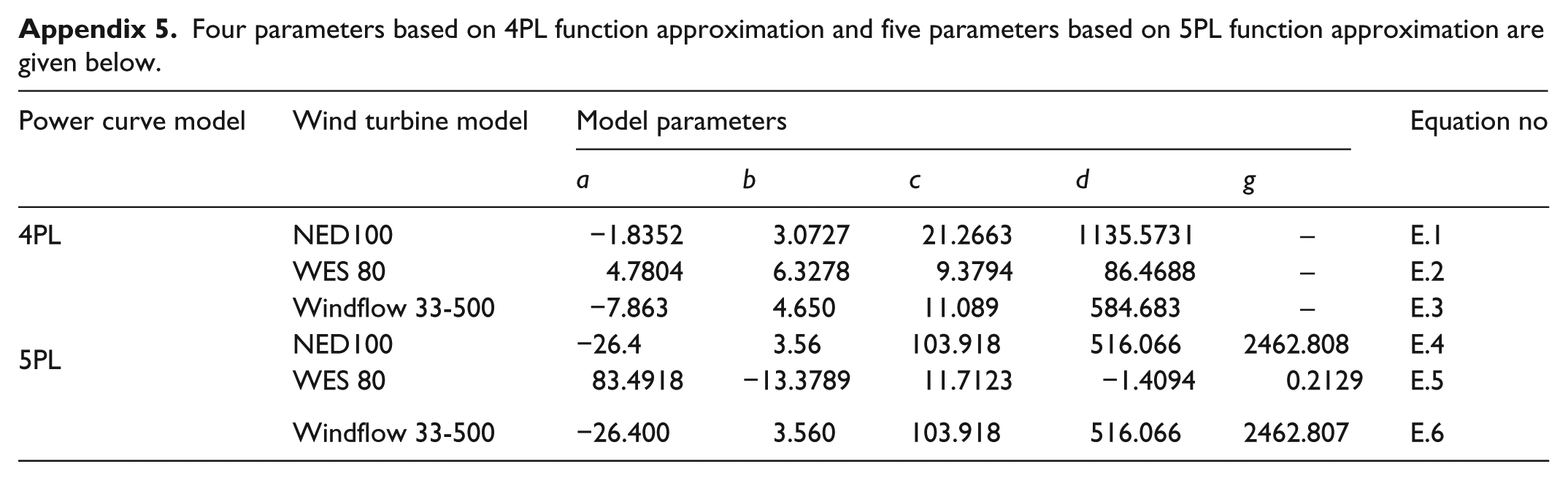
Four parameters based on 4PL function approximation and five parameters based on 5PL function approximation are given below.
| Power curve model | Wind turbine model | Model parameters |
Equation no | ||||
|---|---|---|---|---|---|---|---|
| a | b | c | d | g | |||
| 4PL | NED100 | −1.8352 | 3.0727 | 21.2663 | 1135.5731 | – | E.1 |
| WES 80 | 4.7804 | 6.3278 | 9.3794 | 86.4688 | – | E.2 | |
| Windflow 33-500 | −7.863 | 4.650 | 11.089 | 584.683 | – | E.3 | |
| 5PL | NED100 | −26.4 | 3.56 | 103.918 | 516.066 | 2462.808 | E.4 |
| WES 80 | 83.4918 | −13.3789 | 11.7123 | −1.4094 | 0.2129 | E.5 | |
| Windflow 33-500 | −26.400 | 3.560 | 103.918 | 516.066 | 2462.807 | E.6 | |
Declaration of conflicting interests
The author(s) declared no potential conflicts of interest with respect to the research, authorship, and/or publication of this article.
Funding
The author(s) received no financial support for the research, authorship, and/or publication of this article.
