




Abstract
Clean domestic energy is an attractive option, especially for developing countries. Wind has been one of the most appealing renewable energy sources for those as of the beginning of the 20th century. This study focuses on an important work item of the establishment phase of this important energy source: power plant site selection. Three approaches were examined based on multiple-criteria decision-making methods. Stochastic multi-criteria acceptability analysis (a simulation-based approach with different kinds of uncertain information), analytic hierarchy process (a conventional deterministic approach), and AHP-SMAA (a hybrid approach) were applied separately in Turkey. In terms of novelty, analyses were conducted both with (analytic hierarchy process) and without (stochastic multi-criteria acceptability analysis) the preference information of the decision makers. The unique hybrid method integrates stochastic multi-criteria acceptability analysis with analytic hierarchy process to allow the simulation-based experiments with deterministic variables. As a result of the approaches, the same region (Burhaniye-Pelitköy) showed up as the optimal site to establish wind power plants at every turn. The techniques are globally applicable as long as the computational data and all parameters are gathered completely.
Keywords
Introduction
Energy is vital for human being. Energy generation and sustainable utilization are some of the most important challenges of today’s world (Zoghi et al., 2017). Considering this fact, it can be argued that higher fuel prices, long permitting process, and environmental constraints have limited the planning options for large fossil fuel power plants (Kamalinia et al., 2014).
Most of the energy resources which are currently relied on are finite and will be depleted because of the increasing demand. In addition, there have been serious local air, water, and soil pollution problems due to the consumption of various energy resources. It is obvious that keeping the heavy use of fossil fuels is not wise, because of not only the global impacts on the climate system, but also the short-term and very long term impacts on society and the ecosystem (Elliot, 2007). With the high increase in industrialization, population, and urbanization, the supply of energy has become insufficient. Along with the addition of global environmental concerns, new sustainable energy resources have emerged over time. Wind energy is anticipated as one of the most commonly used and promising renewable energy resources.
The consumption rates of energy, which is the most important input of the economic and social life, increases dramatically as the population, urbanization, industrialization, and technological advancements increase. As an important indicator of social wealth and global development, energy is a major component of international power and dominance.
Numerous researchers have published several studies, which claim that the main reason of the first and the second world wars was the effort of superiority on energy resources (Beaudreau and Lightfoot, 2015; Eichengreen et al., 2016; Hughes and Long, 2014). It seems that the energy issue will carry on its importance in the long view.
The decrease in fossil fuel reserves, the sensitivity of countries to guarantee their national energy security, oil shocks, and environmental awareness have pushed governments, non-governmental organizations, and investors as well. Recently, wind energy has become one of the most important renewable energy resources. The share of wind power in power generation is supposed to increase dramatically in the immediate future.
Wind power infrastructure includes wind turbines, meteorological towers, access roads, and transmission lines. Careful site selection of wind power infrastructure is often the most important measure in managing the biodiversity and other environmental impacts of wind projects. To a very considerable degree, site selection can predetermine the biodiversity-related impacts, as well as the extent to which follow-up mitigation measures might be effective (Ledec et al., 2011).
Moreover, building a wind power plant is a costly process. Although the average service life of a typical wind turbine is about 20 years, the setup cost of wind farms is quite high. Therefore, the site selection process is vital in terms of taking the highest advantage of the return of investment on them.
Even though the cost of acquiring and using renewable energy is higher than acquiring it from fossil fuels, the renewable energy resources might not be sufficient because of nature’s own handicaps (clouds might decrease the sun power or weak wind might not be sufficient for turbines; US Energy Information Administration, 2014); renewable energy resources are defined as “energy resources in the evolution of nature, which can be found next day too”; namely, they are sustainable resources (Ministry of Foreign Affairs, Republic of Turkey, 2012). Despite their high costs, the demand for renewable energy resources is gradually increasing (Arı, 2017). High costs push investors to make tiny distinctions in the site selection process in order to make the return on their investments productive.
Various multiple-criteria decision-making (MCDM) studies on the site selection problem of wind power plants have been carried out. Łaska (2017) performed a comparative study with 9 criteria and 14 alternatives using numerous MCDM methods (multi-attribute utility theory (MAUT), analytic hierarchy process (AHP), decision-making trial and evaluation laboratory (DEMATEL), ELimination and Choice Expressing REality (ELECTRE), Preference Ranking Organization Method for Enrichment Evaluations (PROMETHEE), and Borda Count). Ayodele et al. (2018b) used fuzzy AHP to determine the most suitable wind farm site in Nigeria. Similar studies have also been performed in order to select optimal sites for offshore wind power plants. Chaouachi et al. (2017) identified optimal offshore wind power plant areas for three Baltic countries (Estonia, Latvia, Lithuania) by utilizing AHP with three key criteria and six sub-criteria. Some of the recent related studies have used geographical information systems (GIS) to select optimal locations for offshore wind farms. Cradden et al. (2016) used GIS to locate optimal sites over a vast area in Europe, ranging from Spain to the United Kingdom. On the other hand, Van Haaren and Fthenakis (2011), Latinopoulos and Kechagia (2015), Sanchéz-Lozano et al. (2016), Vasileiou et al. (2017), Anwarzai and Nagasaka (2017), Villacreses et al. (2017), and Bagdanavičiūtė et al. (2018) combined various MCDM methods with GIS.
This study aims to select the optimal site to establish a wind farm in Turkey, using three approaches of MCDM methods. Even though the AHP method has been utilized in many site selection studies, the stochastic SMAA-2 and the hybrid AHP-SMAA methods are used for the first time in such a study. The study was carried out in Turkey, but the results of the applied techniques are global with respect to the required data and parameters and lead to wind power plants from different perspectives in one of the most important issues for the establishment phase.
Literature review
Site selection problems
The siting of power facilities is important to maximize the potential of the implementation of the energy source technology in reality. Any site selection and assessment procedure must address the technical, economic, social, and environmental aspects of the project to determine whether it is suitable for energy development (Georgiou and Skarlatos, 2016). The selection of the wind farm sites is the most important decision in the development of a wind farm. It is best accomplished by listing the criteria affecting the environment, economics, and viability of wind energy output over production time. Selection must consider technical, environmental, and economical restrictions. Site selection for wind farms is one of the major technical challenges in wind resource development. Thus, defining proper location for wind farms is critical for the economic viability (Noorollahi et al., 2016). Shaheen and Khan (2016) claim that it is the most vital process of a wind energy generation process.
Several researchers have grouped site selection problems under various topics such as network layout, mixed integer programming, capacity-limited, hierarchical, single/multiple product, fixed/flexible demand, static/dynamic period, deterministic/stochastic, single/multiple objective models, and so on (Klose and Drexl, 2005).
In this study, various MCDM methods are used in three different approaches for a wind power plant site selection problem.
MCDM
Decision making is a selection process of one or more among various alternatives toward several objectives. In daily life, people unwittingly make numerous decisions with different methods (Okul et al., 2014).
For a decision, several components are supposed to be present. Those are a decision problem, decision maker(s), objective(s), criteria, and alternatives.
The difference between the current situation and the target situation does not in itself constitute a decision problem. A decision problem only arises if there are different ways to reduce the discrepancy between the target and the current situations. A decision problem can be understood as a discrepancy between the target situation and the current situation, where at least two options for an action exist to deal with it (Grüning and Kühn, 2013).
Decision maker is a person or a group, who has the authority to make decision among various alternatives corresponding with the objectives and accept the responsibility of the results of the decision (Aydın, 2008). In interactive methods, a decision maker is invited for simple pairwise comparison. In an interactive method, a decision maker provides his or her preferences in an iterative way and the method finally suggests a solution based on the collected preference information. Based on the method, the decision maker may express his or her preferences in several ways including pairwise comparison of alternative solutions, providing reference points, and setting upper or lower bounds (Özmen, 2017).
Criteria are the tools to compare the alternatives according to a specific importance factor or point of view (İstemi, 2006).
Alternatives are the objects or activities determined by the decision maker(s) that are analyzed during the decision-making process. The number of alternatives should be two or more (Aydın, 2008).
In this part of the study, generally the MCDM methods are shown. Then the stochastic multi-criteria acceptability analysis (SMAA) and AHP methods, their application areas, and literature on these two methods are mentioned.
SMAA
In a classical MCDM method, the quality of the decisions is majorly formed according to the criterion weights gathered from the decision makers and the valuations of the alternatives with those weights. However, in real-life problems, it is not always possible to reach those values properly. Especially in political decision environments, the decision maker(s) might not reveal their opinions. Besides, the decision maker(s) might be insufficient or inexperienced (Okul, 2012). Furthermore, the data gathered might be imprecise or uncertain (Durbach et al., 2014). This condition caused various solution methods to be developed that do not need any decision makers to perform evaluations.
The original SMAA was developed in 1998 (Lahdelma et al., 1998). SMAA is a multiple-criteria decision support technique for multiple decision makers based on exploring the weight space. Imprecise or uncertain input data can be represented as probability distributions. In SMAA, decision makers do not need to express their preferences explicitly or implicitly; instead, the technique analyzes what kind of valuations would make each alternative the preferred one. Imprecise or uncertain criterion values are represented by probability distributions, from which the method computes confidence factors describing the reliability of the analysis (Arı et al., 2016).
The main purpose of SMAA is to provide decision support by means of descriptive measures like multiple integrals. The original SMAA defines three main measures: rank acceptability index, central weight vector and confidence factor. The descriptive measures are calculated by Monte Carlo simulation.
Rank acceptability index


Several SMAA variations are used to solve MCDM problems of selection, ranking, and classification. SMAA-2, SMAA-3, SMAA-TRI, Ref-SMAA, SMAA-O, and SMAA-D can be given as examples.
SMAA-2 is an extended version of the original SMAA method. The original SMAA is needed to be extended because the rank acceptability index does not rank the alternatives, instead it classifies. The step-by-step procedure for the SMAA-2 method is shown below (Lahdelma and Salminen, 2001).

Several studies performed using SMAA-2 are available in the MCDM literature (Aertsen et al., 2011; Hokkanen et al., 2000; Kangas et al., 2006; Lahdelma et al., 2006; Lahdelma and Salminen, 2001; Menou et al., 2010; Tervonen et al., 2011).
In the site selection literature, SMAA and its derivatives are also used commonly. For example, Hokkanen et.al. (1999) used SMAA to select an appropriate site for harbor in Helsinki. Menou et al. (2010) also used SMAA for the evaluation of different alternatives to centralize multimodal cargo at a Moroccan airport hub. In their study, Lahdelma et.al. (2002) tried to choose a location for a waste treatment facility near Lappeenranta in South-Eastern Finland using SMAA-O.
AHP
When decision makers face a multi-factor problem, they generally split it into hierarchical sections. In fact, the decision-making process involves giving weights to a series of options that realize the objectives and finding the best one (Karagöz, 2009).
AHP was first suggested by Myers and Alpert in 1968 but developed by Saaty in 1970s in order to cope with complicated decisions. AHP could be used in decision problems with multiple decision makers, multiple criteria, and multiple objectives, under certainty or uncertainty (Aras, 2016).
The method contains six steps. In the first step, the hierarchical model is established; the objective, criteria, sub-criteria, and alternatives are specified. Then the pairwise comparison matrices are prepared. In this step, the relative importance of the criteria is determined. An (1–9) interval decision scale is generally used. After this step, the priority vectors come up. This is also called the synthesizing phase. After the calculation of the consistency rate from the priority vectors, the final ranking appears regarding the calculated weight of each alternative. The process ends with the sensitivity analysis (Arı, 2017). The flowchart of the method is shown in Figure 1 (Liu et al., 2013).
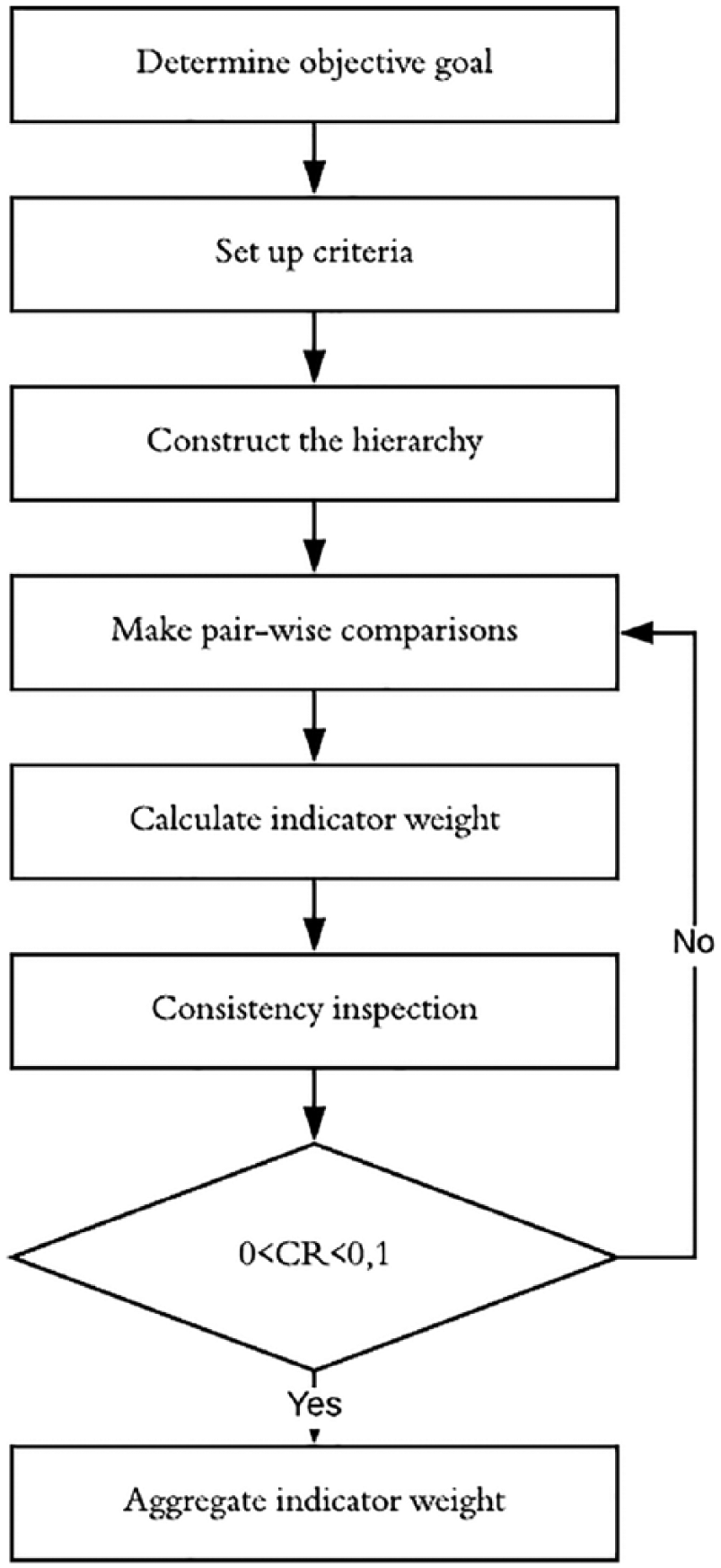
AHP flowchart.
Being an old, applicable, and effective method, AHP has been used in numerous site selection studies; especially in wind power plant site selection, Aitzhanov (2016) used the AHP algorithm embedded in GIS for site selection of wind power plants. Yalçın (2007) used fuzzy AHP in his study for site selection of wind power plants, the alternatives of which were Balıkesir, İzmir, and Çanakkale. Karamanlıoğlu (2011) preferred to use artificial intelligence techniques to select a wind power plant site in Mersin region. Within several stages of the study, he combined AHP with artificial neural networks. Sanchéz-Lozano et.al. (2016) used fuzzy AHP and fuzzy TOPSIS (Technique for Order Preference by Similarity to Ideal Solution) for power plant site selection in southeastern Spain.
Methodology
This section consists of five sub-topics. As of the nature of a typical MCDM problem, the first two sub-topics are about the identification of the alternatives and the criteria.
Selection of the regions (alternatives)
Various studies show that different studies accept different minimum values of wind speeds in order to be utilized in analyses. For example, Ayodele et al. (2018b) determined the minimum value as 4.4 m/s at 10 m. height, whereas Noorollahi et al. (2016) and Satkin et al. (2014) suggested it in a range. In other respects, for Gass et al. (2013), the feasible minimum value should be taken as 6.5 m/s. In this study, the minimum wind speed value is taken as 7 m/s, considering the sector specialist from the leading renewable energy investor.
The selection process of the regions (alternatives) is composed of two steps. First, based on the wind energy potential map, which is prepared by the Ministry of Energy and Natural Resources of the Republic of Turkey, the cities with wind speed below 7 m/s on average were eliminated. At the end of the first elimination phase, 24 cities were selected as alternatives (General Directorate of Renewable Energy, 2012).
At the second phase of the process, the cities with gray areas; which mean that officially no wind power plants can be installed due to several reasons (military zone, flyway, radar area, security zone, etc.); for each city were eliminated.
As shown in Figure 2, Zonguldak does not have any suitable zone to establish a wind power plant (v < 7 m/s everywhere). On the other hand, Sivas (Figure 3) has windy regions to establish wind farms, almost all of which were determined as non-establishable zones (Figure 4).
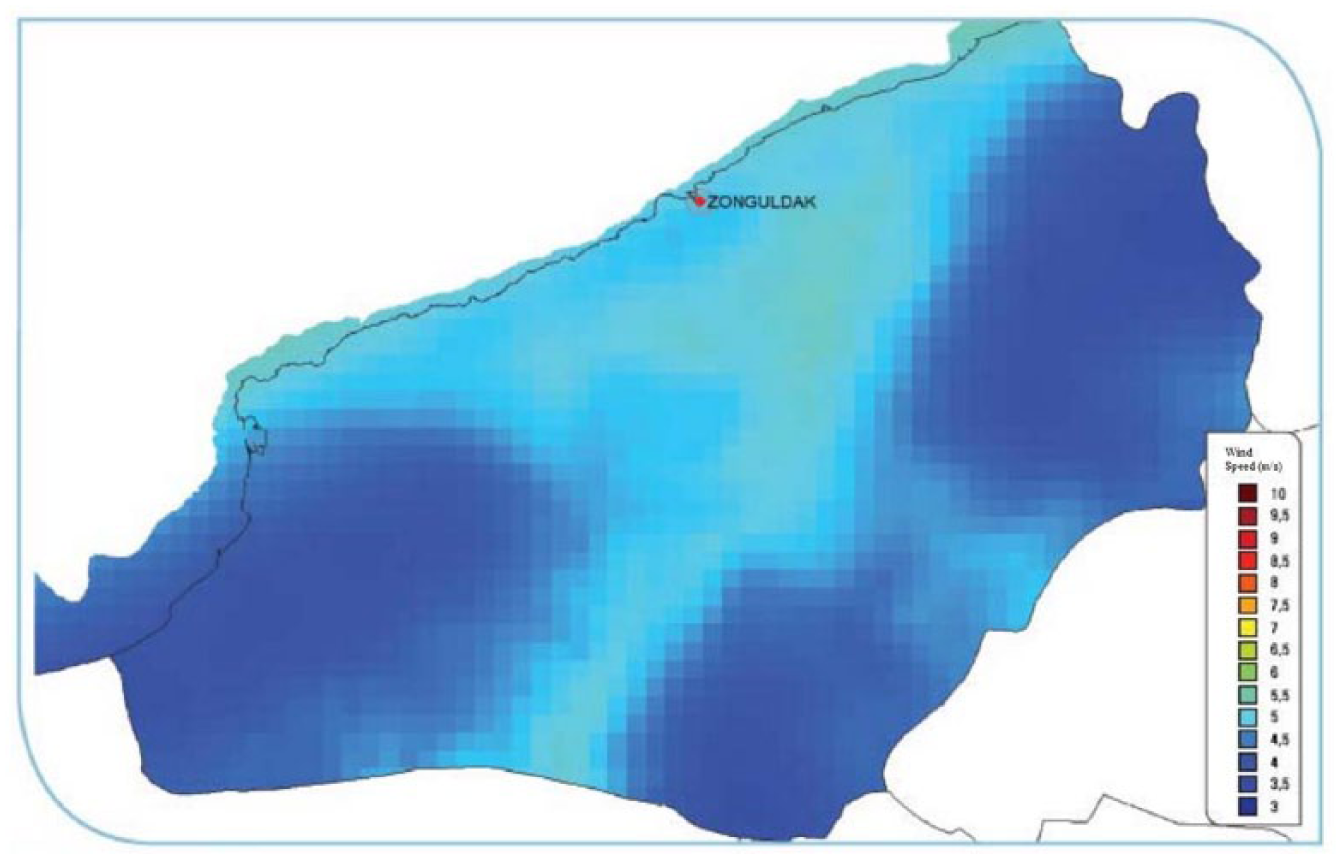
Zonguldak map of wind speed.
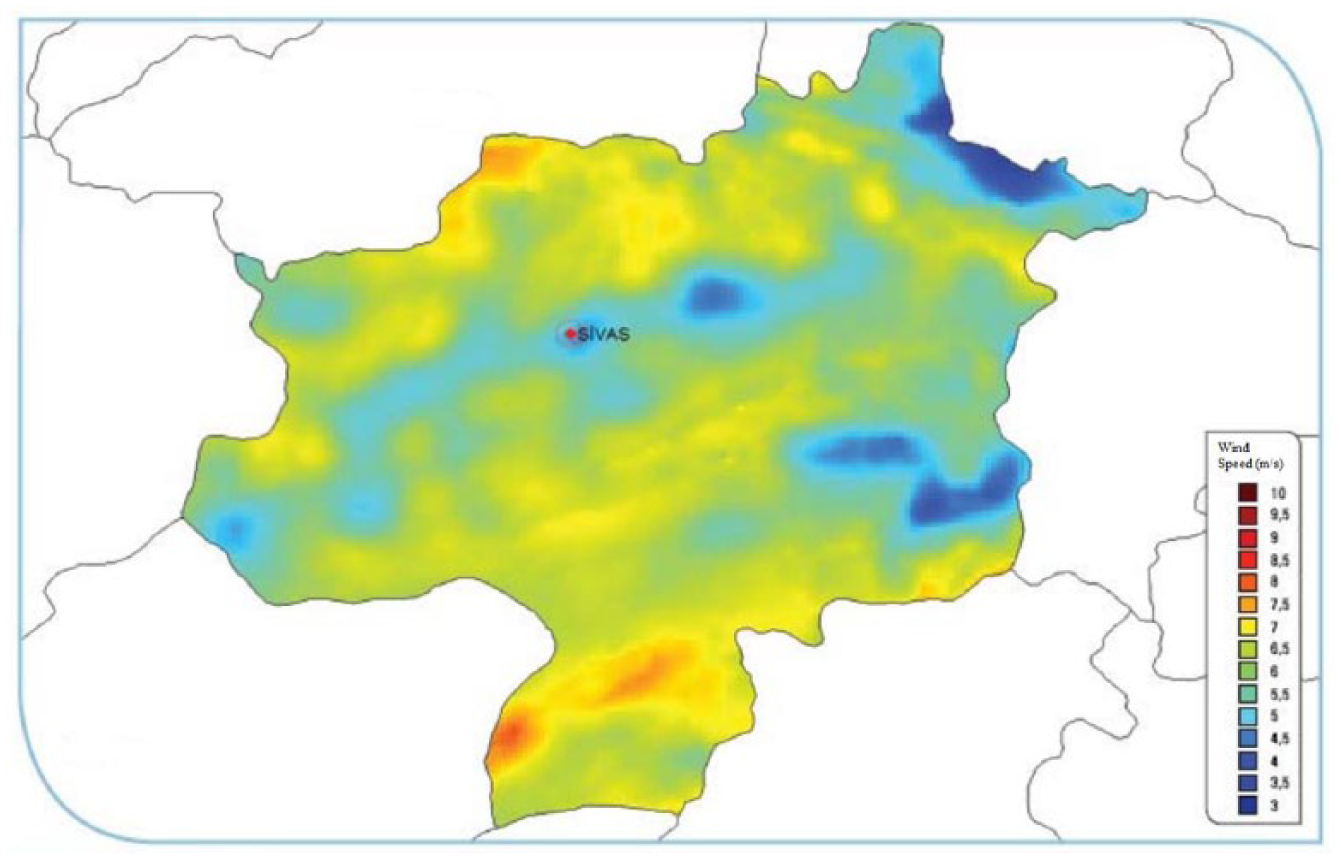
Sivas map of wind speed.

Sivas map of unusable land.
Finally, six regions of five cities remained to be used as the alternatives in the study. Using the potential map, suitable areas were selected as power plant areas among the windiest regions of each city: Yeşildere region of Bursa, Hamidiye region of Manisa, Fatih region of İzmir, Samandağ region of Hatay, and Çakılköy and Pelitköy regions of Balıkesir. The alternative places and the average wind speeds are listed in Table 1.
Alternative places, average wind speeds, and field sizes.

At the end of the region selection process, suitable areas on the regions were contoured with the help of Google Earth. The total field size (m2) of each region is shown also in Table 1. The locations of each site selected are shown in Figure 5.
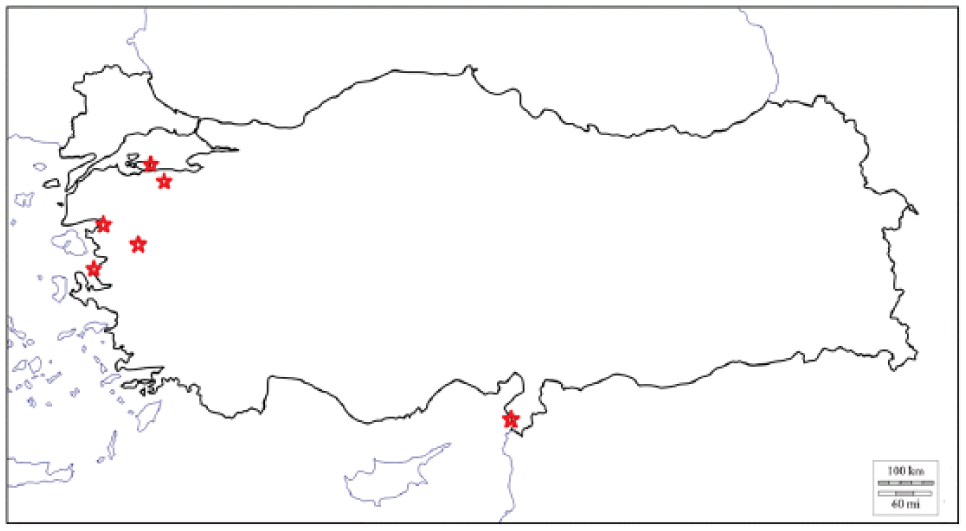
Selected site locations.
Selection of the criteria
After the selection of alternatives, a literature review was performed and various specialists from academy and industry were contacted in order to specify the criteria needed to resume the MCDM process. At the end of the process, seven quantifiable criteria were specified:
Wind speed. As a major criterion, wind speed is expected to be high. Annual average wind speeds of the alternatives that specified at the previous section were gathered from General Directorate of Meteorology and confirmed with Vortex, a virtual mast software, which is also used by numerous wind energy investors.
Distance to energy transmission lines. The ease of energy transportation to transmission lines or transformers is an important issue. The production cost decreases as the distance between the production area and the transmission lines decreases (Atici et al., 2015; Ayodele et al., 2018a; Gass et al., 2013; Georgiou and Skarlatos, 2016; Noorollahi et al., 2016; Satkin et al., 2014). Moreover, the lower distance decreases the workload. The distance data are approximately calculated from the map of transformer stations and power transmission lines.
Slope of the land. Areas with low slope values are best for siting wind farms because a high slope means high turbulence which makes wind unusable for energy generation and makes an area difficult to access. According to the sector specialists, wind turbines cannot be erected on lands with slope over 25%. On the other hand, various authors suggested different slope values as acceptable ranging from 3% to 30% (Atici et al., 2015; Ayodele et al., 2018a, 2018b; Gass et al., 2013; Karamanlıoğlu, 2011; Noorollahi et al., 2016; Satkin et al., 2014). So low-pitched areas are preferred in site selection processes. In this study, 20% is accepted as the maximum slope value on average. Digital maps of General Command of Mapping and Google Earth were used to gather data.
Elevation. The elevation is not preferred to be too much, since a decrease in the density of air also decreases the efficiency of turbines in high-elevation places. As a couple of examples, General Directorate of Renewable Energy (2017) of the Republic of Turkey suggests the maximum elevation of 1500 m, while Gass et al. (2013) determine a maximum of 2000 m. Google Earth elevation data and the contour lines of ArcGIS, which is a commonly used GIS software, were used to measure the altitudes of the alternatives.
Distance to wildlife protection areas. The GEODATA web portal, which is published by the Ministry of Forestry and Water Management, shows the forests, plantation areas, and protection areas (national parks, wetland areas, wildlife protection areas, protected environment areas, etc.) with colored maps.
Employment generation. Employment generation in the region where the power plant is established is an important factor. It contributes to a reduction in unemployment rate and an enhancement in welfare in the region. The latest unemployment data of Turkish Statistical Institute were used for each region.
Accessibility. Transportation is highly important at both the construction and generation stages in order to make the logistics work smoothly. Transportation data were gathered from Google Earth; however, the alternative site areas were chosen to be close to main or linking roads.
Results and discussion
Site selection with SMAA-2
The six determined sites are analyzed with seven criteria using the stochastic sample of MCDM methods—SMAA-2. The measured values of the criteria within the alternatives are shown in Table 2.
Alternatives and criteria for SMAA-2.

SMAA: stochastic multi-criteria acceptability analysis.
All the alternatives and criteria shown in Table 2 are identified on JSMAA, an MCDM software which was developed by Tervonen (2012). Min–max status (Figure 6) and data types of the criteria (Figure 7) are defined separately.
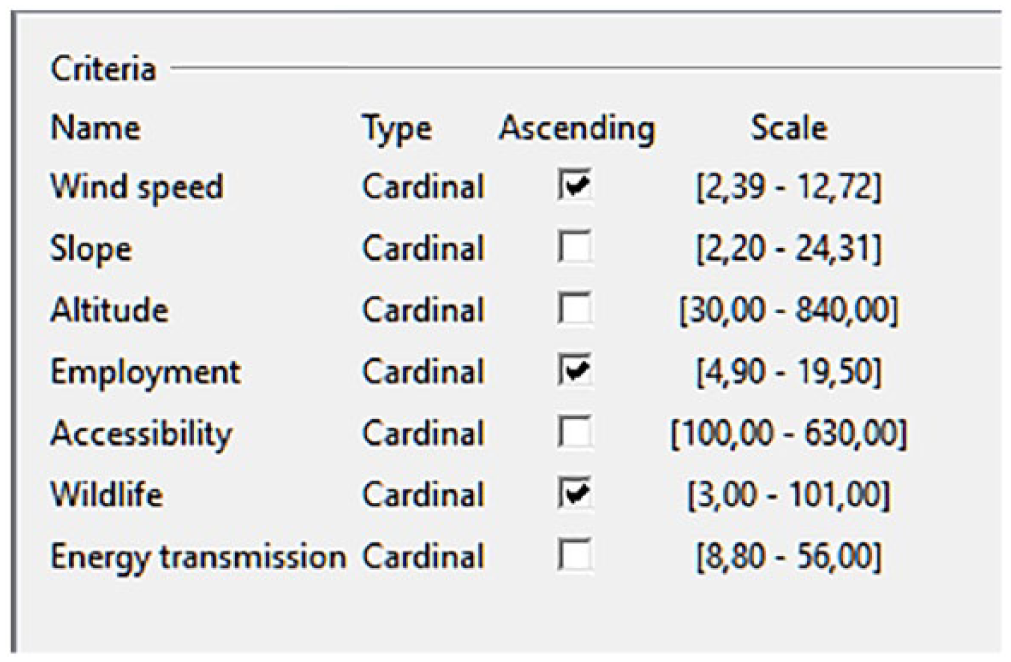
SMAA-2 criterion type specification (JSMAA screen capture).
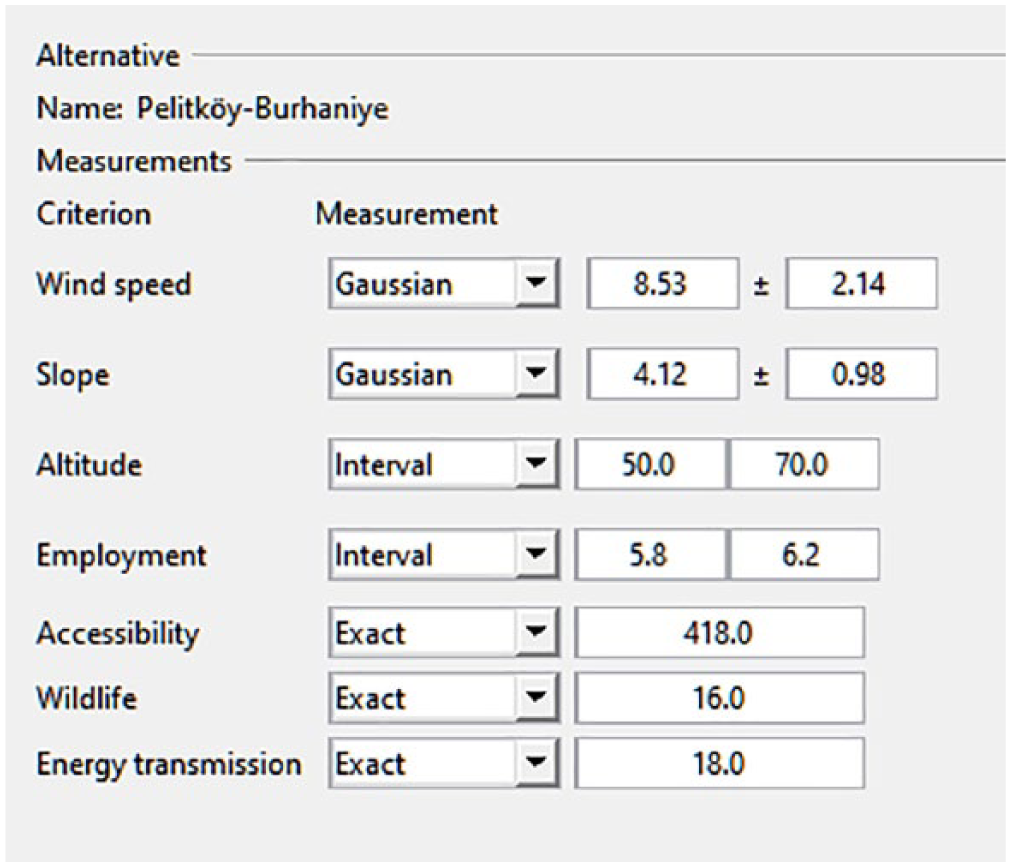
Data types of the criteria (for Burhaniye-Pelitköy; JSMAA screen capture).
It can be seen from Figure 6 that the criteria of wind speed, employment generation, and distance to wildlife protection areas are expected to be maximized, whereas the others need to be minimized.
Moreover, data types of the criteria are also specified. Figure 7 shows the screen capture of the specification process for the alternative Burhaniye-Pelitköy.
As shown in Figure 7, the “wind speed” and “slope” criteria are specified in Gaussian data type, “altitude” and “employment generation” specified in interval type, and the “accessibility,” “distance to wildlife protection areas,” and “distance to energy transmission lines” criteria are specified in exact number type.
After the specification of all criterion values and their types, the descriptive measures of SMAA-2—rank acceptability index, central weight vector, and confidence factor—are shown in Table 3.
Descriptive measures of SMAA-2.

SMAA: stochastic multi-criteria acceptability analysis; R: rank; CF: confidence factor.
As shown in Table 3, according to the calculation of SMAA-2, the Burhaniye-Pelitköy region is the most suitable one to be selected as the site for wind power plants. The table shows that the probability of the region to be selected in the first rank is 52.44%. The result is 60.79% confident and the weights of each criterion are shown in the corresponding row.
On the other hand, Hatay-Samandağ is the least preferable alternative, which is ranked sixth with a probability of 92.51%.
Site selection with AHP
In this part of the study, six sites are ranked using the AHP method in terms of seven quantifiable criteria by taking the experts’ opinions from academia and sector in order to specify weights of the criteria. As a result of the interviews with the experts, criterion weights are shown in Table 4.
AHP pairwise comparison matrix.

AHP: analytic hierarchy process.
The consistency rate of the matrix is 0.016, which is less than the threshold value of 0.1. The matrix is observed to be consistent. At the end of all calculations of AHP, the weight vector and ranking of the alternatives are shown in Table 5.
AHP weights and ranking.

AHP: analytic hierarchy process.
According to the calculations of AHP, the Burhaniye-Pelitköy region seems to be the most appropriate alternative.
The sensitivity analysis shows that the ranking changes as the weights of wind speed and slope criteria are changed. Any changes in the weights of other criteria do not influence the ranking.
Site selection with AHP-SMAA
The JSMAA software allows the user to adjust the weights manually in cardinal or ordinal type if required. In this part of the study, criterion weights gathered from AHP are defined as input weights to SMAA-2 manually. The screen capture of the weighting process is shown in Figure 8. A hybrid method is aimed to examine the results in order to compare with those of its component methods.

AHP criterion weights as input weights of SMAA-2 (JSMAA screen capture).
As a result of the hybrid method analysis, the descriptive measures of SMAA-2—rank acceptability index, central weight vector, and confidence factor—are shown in Table 6.
Descriptive measures of AHP-SMAA.

AHP: analytic hierarchy process; SMAA: stochastic multi-criteria acceptability analysis; R: Rank; CF: Confidence Factor.
According to the rank acceptability index, the Burhaniye-Pelitköy region is the preferred one with a probability of 67.28%, whereas Hatay-Samandağ is the last with the probability of 82.41%. The preferred alternative also has a high confidence with 67.51%.
The weights gathered from the AHP process (equal for each alternative) are shown in the right block of Table 6 (central weight vector).
Conclusion
While energy is one of the most important sources of economic development and fossil fuels keep depleting exponentially, renewable energy has been recognized as the last resort for future economic development. As the demand for energy grows and the focus on renewable sources draws attention worldwide, selection of energy investment and use of resources have become highly meaningful. Due to the initial investment cost for wind power plant being quite high, both the investors and the policymakers intend to develop alternatives, which maximize the benefit–cost ratio. Calculations based on reliable data lie behind achieving a high efficiency from the power plants from the economic and technical aspects.
For the very reason, the aim of this study comes into play. In this study, the main objective is site selection, which is elementary and one of the most important stages in establishing a wind power plant. For that purpose, a main decision aiding approach with three methods on the site selection problem for wind power plants is employed. The main objective of this study is to present the solution within various MCDM methods and show the result of each method.
In the first step of the study, six alternatives and seven criteria were selected according to various methods. After this step, three MCDM methods were examined in order to observed and compare the results of each method.
The stochastic approach—SMAA-2, the deterministic approach—AHP, and the mixture of both—AHP-SMAA—were performed with the identical data for all alternatives.
From the results of each MCDM method, the same region—Burhaniye-Pelitköy—turned out to be the favorable alternative. This study can be qualified as novel, in terms of the comparative perspectives used, and global, due to the applicability of the techniques as long as the computational data and all parameters are gathered.
For future study, other MCDM methods are planned to be used for site selection of wind power plants. Another method to be used is integer mathematical programming. In addition, a site selection study for another renewable energy source—solar energy—is planned to be examined.
Footnotes
Declaration of conflicting interests
The author(s) declared no potential conflicts of interest with respect to the research, authorship, and/or publication of this article.
Funding
The author(s) received no financial support for the research, authorship, and/or publication of this article.
