



Abstract
This paper presents a new nonlinear optimal controller for wind energy conversion systems. This study utilizes a new strategy to solve the Hamilton–Jacobi–Bellman (HJB) equation and design a nonlinear optimal controller for wind turbines. The optimal homotopy asymptotic method (OHAM) is applied to derive the solution of the HJB equation corresponding to variable-speed wind turbines. The OHAM controller ensures proper tracking and achieves maximum wind power extraction while preventing excessive loads on the drive train. The proposed control strategy can provide fast convergence and rapid transient responses with high precision and small control input. The OHAM strategy requires a few iterations and can adjust the convergence domain and the convergence rate. The proposed OHAM controller is compared and evaluated with some existing control strategies. The obtained results indicate that OHAM achieves a suitable compromise between maximizing aerodynamic power capture and minimizing low-speed shaft oscillation.
Keywords
Introduction
Among the various kinds of renewable energy sources, wind energy has received considerable attention due to its advantages such as cleanliness, safety, abundance, and endlessness (Bustan and Hoda Moodi, 2022; Hussain and Mishra, 2020; Yang et al., 2022). Wind energy can be transformed into electrical energy using wind turbines (Song et al., 2022). There are four operating regions for wind turbines that are considered when designing a controller. There have been many attempts to achieve the objectives of different operating areas of wind turbines using diverse control techniques. Some of these strategies include the fuzzy PI controller (Noureddine et al., 2022), sliding mode control (Abolvafaei and Ganjefar, 2020a, 2020b; Abrazeh et al., 2021; Periyanayagam and Joo, 2022), the Q-Learning algorithm (Kushwaha et al., 2020), neural networks (Alzayed et al., 2021; Bagheri et al., 2022; Muñoz-Palomeque et al., 2023), and backstepping controller (Eskandari et al., 2023; Wang et al., 2019), among others. Among the different operating areas of wind turbines, Region 2 has significant importance because it is the area where the most power from the wind can be extracted. In wind turbine research, capturing the maximum power from wind is an important topic that has been studied extensively. A wind turbine achieves maximum efficiency by adjusting the rotor speed according to the wind speed. Thus, tracking the desired rotor speed is the main challenge in this region. To maximize energy extraction from wind turbines, diverse linear and nonlinear control schemes have been developed. Because linear controllers are easy to implement and analyze, they have been widely used to control the rotor speed of wind turbines (Boukhezzar and Siguerdidjane, 2010). For systems with nonlinear dynamics, linear controllers lead to poor performance. Thus, because wind turbines possess inherent nonlinear characteristics, linear controllers are unable to guarantee suitable efficiency. To enhance the performance of wind turbines, it is essential to implement nonlinear controllers that account for the inherent nonlinear characteristics of wind turbines. A nonlinear model predictive control (MPC) based on an intelligent algorithm that can predict the future behavior of the wind turbine over a long period of time was presented by Song et al. (2021). A nonlinear controller was developed to derive the maximum amount of energy from a large-scale variable-speed wind turbine with a time step exceeding the sampling time. To achieve maximum wind energy and minimize control loads, a nonlinear controller was designed for a wind turbine in Bektache and Boukhezzar (2018). In Dali et al. (2021), the proposed controller was developed to enhance the extraction of maximum power for a small-scale wind turbine. Low cost and simplicity, which are important factors in practical applications, have also been considered in the design of this controller. Additionally, other efficient methods have also been developed to extract maximum power while reducing mechanical loads in wind turbines. In Soleymani et al. (2024a), the authors introduced a new robust MPC strategy for nonlinear systems that can track reference signals in the presence of uncertainties and disturbances. The efficacy of the proposed control scheme was demonstrated by applying it to a wind turbine as a specific case study. A parallel Newton-type algorithm was employed to solve the optimization problem, which improves the efficiency of the control scheme, simplifies real-time implementation, and reduces the computational time of the proposed controller. In Soleymani et al. (2024b), a nonlinear time-varying control scheme was proposed to enhance the performance of the tracking nonlinear MPC, which guarantees the convergence of the control performance and alleviates fatigue loads on the drivetrain while maximizing power generation in wind turbines.
Optimal control strategies have been widely employed to design controllers for quadrotors (Chen and Chen, 2021), vehicle suspension systems (Bai and Wang, 2021), rotary inverted pendulums (Nghi et al., 2022), chemical processes (Wu et al., 2022), wind energy conversion systems (WECS) (Bhushan et al., 2021; Prajapat et al., 2018; Shalbafian and Ganjefar, 2022), and many other applications. The design process of the optimal controller is different for linear and nonlinear systems. Generally, a linear optimal controller can be developed by solving the Riccati equation and applying its solution to design the linear quadratic regulator (LQR) (Kirk, 1970). Although linear optimal control problems are easy to handle, linear controllers cannot provide high performance for nonlinear dynamic systems. A nonlinear controller should be used to deal with this problem. For nonlinear systems, a nonlinear optimal controller can be designed by solving the HJB equation. Since obtaining an exact solution for this equation is challenging, many attempts have been made to find an approximate solution (Zhang et al., 2019). In this context, the homotopy perturbation method (HPM) is considered one of the valuable methods for calculating an approximate solution to the HJB equation (Effati et al., 2013; Ganjefar and Rezaei, 2016; Saberi Nik et al., 2012). This method is based on the integration of standard homotopy and classical perturbation approaches, which eliminates the need for any discretization or linearization and simplifies the solution process (He, 1999, 2003). In Shalbafian and Ganjefar (2022), the HPM is used for a two-mass wind energy conversion system to achieve maximum power from the wind. Although HPM has been providing a good response, efforts are necessary to enhance precision and increase the convergence region. Researchers have presented several approaches aimed at improving accuracy and enhancing the convergence region. To achieve better accuracy and faster solution convergence, HPM has been combined with the Laplace transform in various studies (Filobello-Nino et al., 2017, 2018; Madani et al., 2011). In Bota and Căruntu (2017), HPM was coupled with the Least Squares method to accelerate the convergence rate. Another study on the generalization of HPM was carried out by Marinca et al., which led to the introduction of OHAM (Herişanu et al., 2008; Marinca et al., 2008; Marinca and Herişanu, 2008). Compared to HPM, the OHAM algorithm is quicker and requires fewer iterations (Gupta and Saha Ray, 2014). Thus, this approach is suitable for solving complex problems. This powerful technique, which eliminates the need for any discretization, furnishes an appropriate way for managing the convergence domain and the convergence rate using auxiliary constants that are optimally specified. In other words, HPM is a special case of OHAM. The OHAM approach has been effectively utilized to tackle various nonlinear problems. In Hashim et al. (2022), the authors applied OHAM to solve fuzzy fractional differential equations. Furthermore, this efficient approach has been applied to solve Volterra’s integral-differential equation (Agarwal et al., 2021), the nonlocal boundary value problem (İlhan, 2020), and the fractional-order integro-differential equation (Nawaz et al., 2021).
In most studies, designing the optimal controller for wind turbines is done by solving the Riccati equation. Since a nonlinear controller should be used to deal with the nonlinear specifications of wind turbines, this motivates us to present a nonlinear optimal controller by solving the HJB equation related to the one-mass model of a variable-speed wind turbine. Although applying the HPM to achieve the optimal control law for wind turbines is effective, adjusting the convergence rate can be hard to tune. Thus, we employ the OHAM to adjust the convergence rate. Additionally, the computational workload is alleviated by using this technique, allowing us to achieve optimal control input signal with only a few iterations. On the other hand, the required control effort for fast convergence within a limited time is manageable, which results in an increase in system life.
In this study, a nonlinear optimal controller for a single-mass wind energy conversion system is developed for below-rated wind speeds (Region 2) to maximize wind power extraction while preventing excessive loads on the drive train. The OHAM controller offers an appropriate balance between simplicity and efficiency.
The main contributions to this paper are as follows: • For the design of the nonlinear optimal controller, the HJB equation related to the one-mass model of a variable-speed wind turbine is derived. In the next step, a new strategy (OHAM) is applied to obtain the approximate solution of this equation. The OHAM approach requires only a few iterations to attain a precise solution. This results in reduced computational costs and simplifies implementations. • Using high-precision control approaches, fast convergence in finite time can be achieved using a large control signal. A large control input can be used to obtain fast convergence in finite time. In practice, this results in undesirable performance outcomes and is unsuitable for practical applications. The proposed OHAM has been developed to achieve fast convergence in finite time by employing a small control signal. • Simulation results confirm that the OHAM strategy results in better energy capture, faster convergence, and reduced mechanical loads compared to some existing approaches (Mérida et al., 2014; Shalbafian and Ganjefar, 2022). With the designed controller, the trade-off between improving the capture of aerodynamic power and alleviating the mechanical stresses on the drive train is achieved.
This paper is structured as follows. The mathematical model of the wind turbine is described in the next section. The basic formulation of OHAM is then presented, followed by a succinct description of the HJB equation arising in nonlinear optimal control problems. Subsequently, the procedure for the design of the controller is discussed. The simulation results are presented and analyzed in detail. Finally, the conclusions of this study are provided.
Wind turbine model
This section is dedicated to the explanation of the mathematical model of a variable-speed fixed-pitch wind turbine. The aerodynamic power captured by the wind turbine can be expressed as follows (Boukhezzar et al., 2007):



The power coefficient

The rotor of the wind turbine with inertia






The maximum wind energy can be extracted when the power coefficient is maximum. The maximum value of the power coefficient is obtained based on

Thus, in operating region 2, where the primary aim of the controller is to maximize the capture of wind power, the blade pitch angle

Optimal controller design
The optimal controller is developed in two phases. First, the HJB equation related to the one-mass model of wind turbines is extracted. In the next step, OHAM is used to obtain an approximate solution to the HJB equation due to the challenging nature of calculating the precise solution to this partial differential equation. Thus, we discuss the fundamental concepts of OHAM and HJB equations that arise in nonlinear optimal control. Finally, we employ OHAM to compute the optimal control law for the HJB equation derived from the one-mass model of wind turbines as a specific case study.
Fundamental concept of OHAM
To illustrate the main idea of the OHAM (Iqbal et al., 2010), we will examine the following nonlinear differential equation:



A homotopy can be developed

Consequently, by changing

The auxiliary function

To attain an approximate solution,

By substituting (19) into (16) and matching the coefficients of the same powers of p, we derive




The convergence of the series (19) is influenced by the auxiliary constants

By substituting equations (25) in (13), we get the following residue:

If


The approximate solution of any order can be computed by these known constants. The constants

In contrast to HPM, OHAM employs a generalized auxiliary function
Convergence of OHAM
The convergence of the OHAM technique is discussed in this subsection.
Let us consider (a) The series solution (b) The maximum absolute truncation error of the series solution (24) for (13) is obtained as follows: For proof, see Theorem 2 in Gupta and Saha Ray (2014).

HJB equation and nonlinear optimal control
This section addresses the nonlinear optimal control problem. Let us examine the following nonlinear control system (Ganjefar and Rezaei, 2016):


Where

Suppose that

Hence, we can write

According to the principle of optimality, the following equation is obtained:

Hence, using the Taylor series, we get

If

By dividing both sides of equation (37) by

The above nonlinear time-variant differential equation is the HJB equation. The boundary condition of the HJB equation is as follows:

The Hamiltonian function can be obtained using the following equation:

Thus, we have

Then, if we substitute the Hamiltonian function (41) in equation (38), we get

HJB equation for the one-mass model of variable speed wind turbine
In this section, the HJB equation is derived for the one-mass model of a variable speed wind turbine. If we select the rotor speed

The cost function for this system is considered as follows:


The corresponding Hamiltonian function is as follows:

By applying the necessary and sufficient conditions, we obtain

As


Solving the HJB equation corresponding to the one-mass model of the variable speed wind turbine using OHAM
This section is devoted to how to apply the OHAM to obtain an approximate solution of the HJB equation described in the previous section. We construct the following homotopy using OHAM:

Where


Upon replacing equations (50) and (51) into equation (49) and equating the coefficients of the same powers in



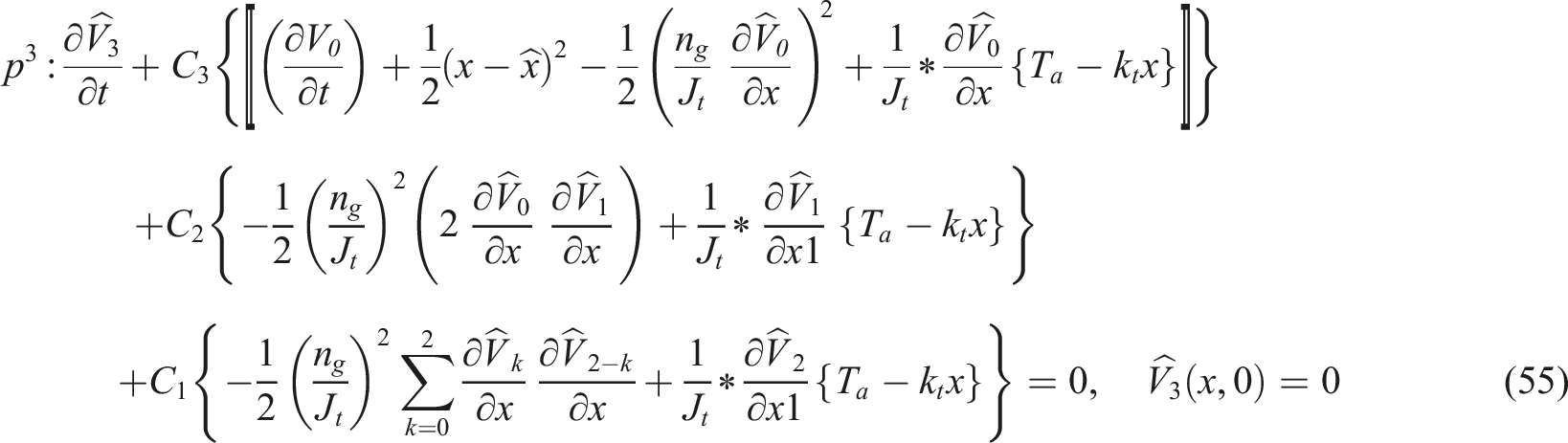
The symbolic calculus software Maple has been utilized to solve equations (52)–(55). Auxiliary coefficients can be optimally determined.
Figure 1 demonstrates the block diagram of the proposed control scheme. The objective of this study is to obtain the optimal control law that can be applied to a wind energy conversion system to maximize energy production and minimize mechanical stress. For this purpose, the OHAM approach is employed to solve the HJB equation arising from the nonlinear optimal control problem. Proposed nonlinear optimal control block diagram.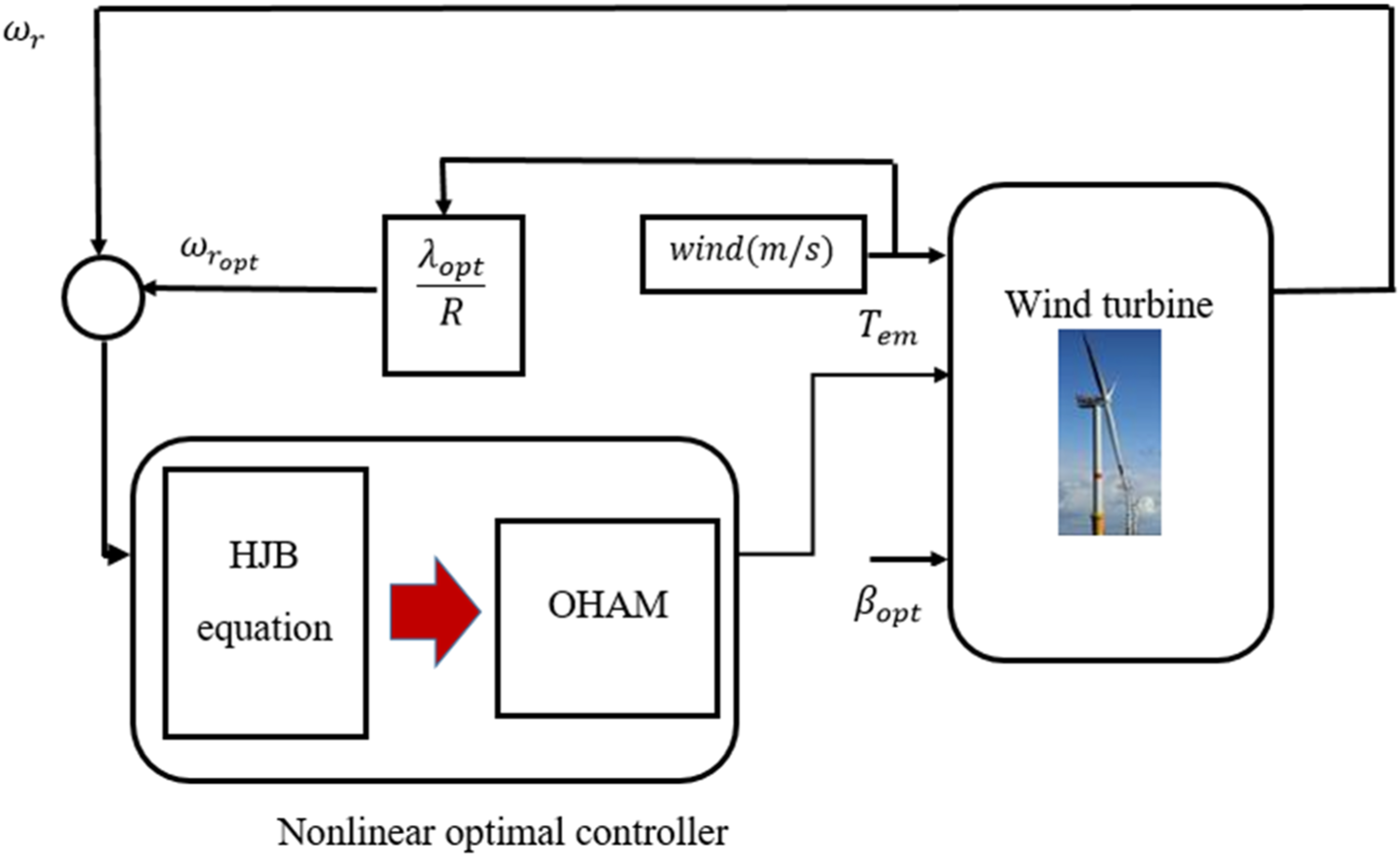
Simulation results
To illustrate the effectiveness of the proposed strategy, the OHAM control scheme is compared with second-order sliding mode control (SOSMC) (Mérida et al., 2014) and HPM (Shalbafian and Ganjefar, 2022) under the two scenarios: random changes and step variations in wind speed. The wind profile applied to the turbine for the two scenarios is represented in Figure 2. Wind speed profile: (a) random variations and (b) stepwise variations.
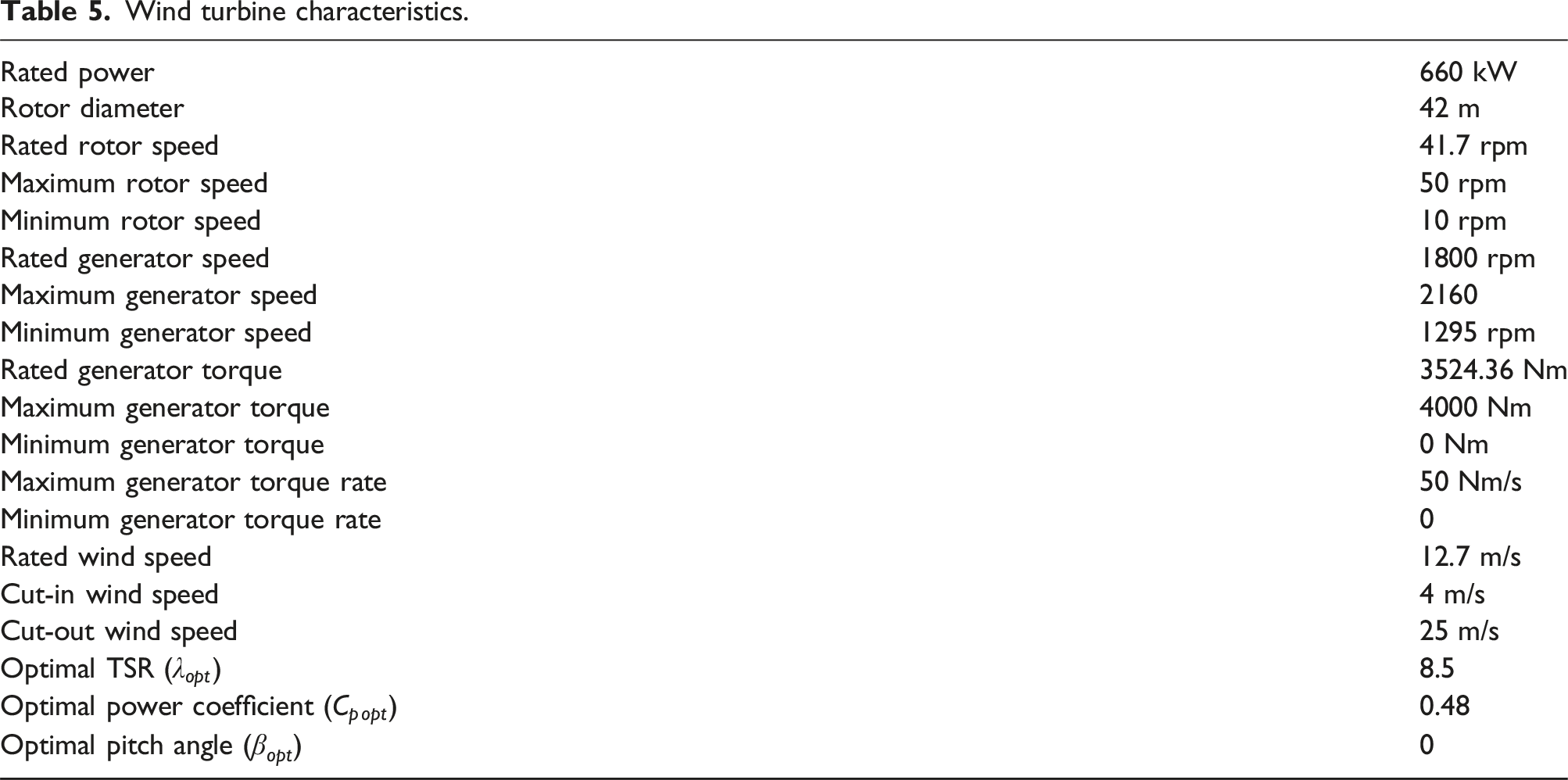
The wind turbine utilized in this study is a 660-kW horizontal-axis, two-bladed turbine. Detailed characteristics of the wind turbine are presented in the appendix.
Random changes in wind speed
The wind profile applied to the turbine in this scenario, as shown in Figure 2(a), contains 600 seconds with an average speed of 8 m/s. Figure 3 compares the rotor speed, generator speed, electromagnetic torque, and rotor shaft torque obtained from the proposed OHAM and some existing control strategies. Based on this figure, the OHAM controller tracks the optimal rotor speed much faster than the other presented controllers. Figure 3(a) shows that SOSMC has lower performance in tracking the optimal value of the rotor speed compared to the OHAM and HPM techniques. In general, the proposed method has a rapid transient response. Thus, the OHAM results in greater power generation. In Figure 3(b), a comparison of generator speed between the OHAM with SOSMC and the HPM is presented. Figure 3(c) represents the comparison of electromagnetic torque (a) Rotor speed. (b) Generator speed. (c) Electromagnetic torque. (d) Low-speed shaft torque.
Figure 4 represents the time derivative of electromagnetic torque and low-speed shaft torque. The time derivative of these torques can provide a better illustration of the mechanical loads on the drive train. As shown in this figure, the SOSMC imposes the greatest loads on the drive train and leads to higher fluctuations compared to the HPM and OHAM. (a) Time derivative of electromagnetic torque. (b) Time derivative of low-speed shaft torque.
The electric power obtained using the HPM, SOSMC, and the proposed OHAM is represented in Figure 5. This figure demonstrates that the proposed strategy extracts more power compared to other schemes. Electric power.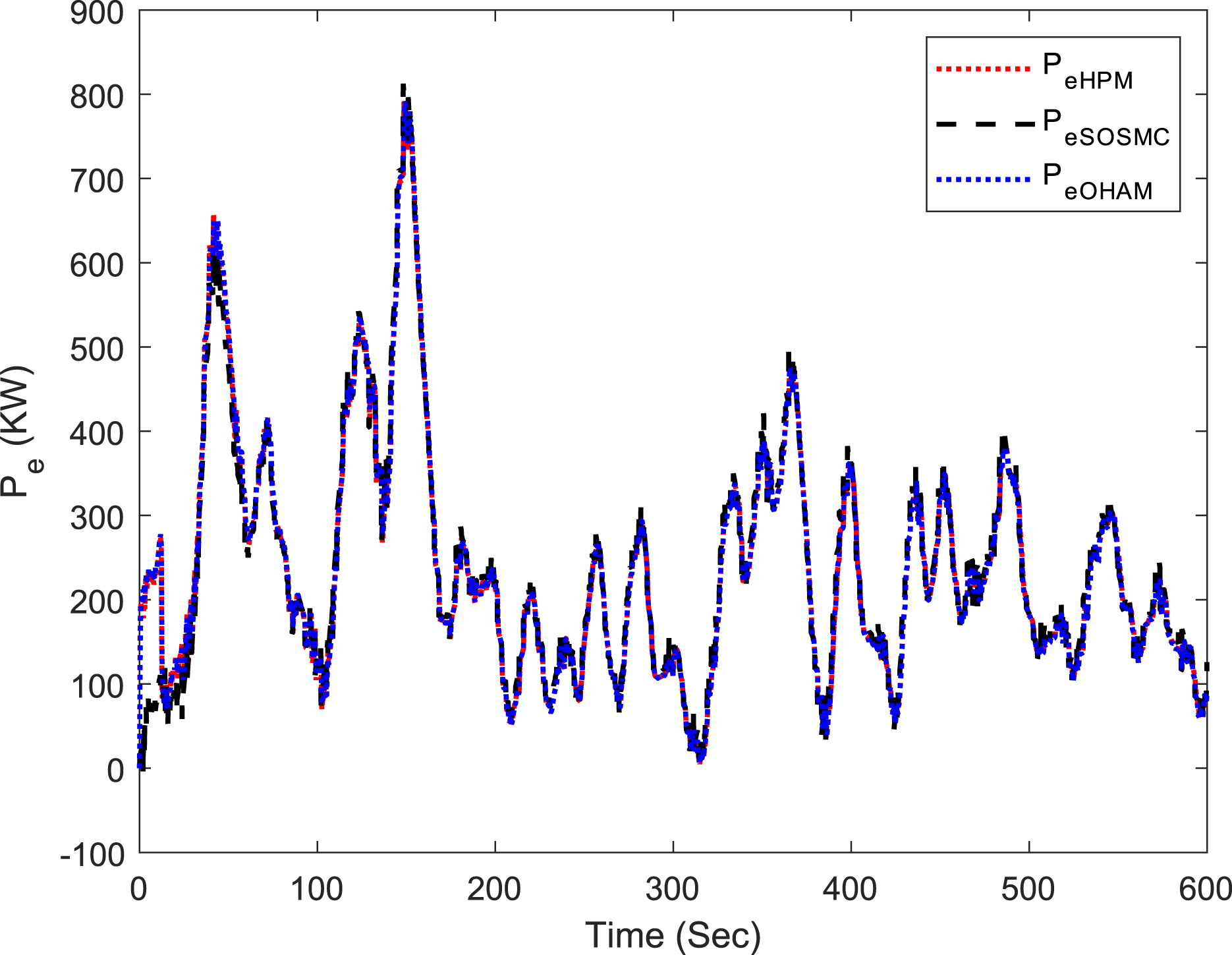

Comparison between the different controllers.
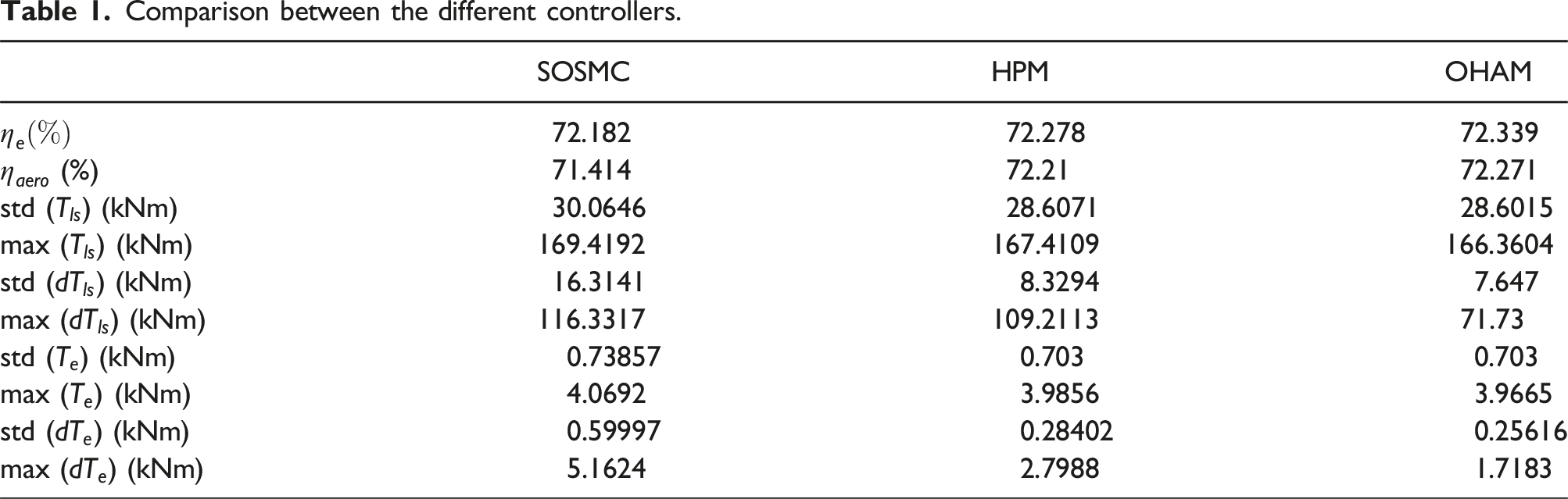
Where
It’s important to note that the results achieved using the OHAM controller require fewer iterations and less computational effort than those with the HPM, highlighting the advantages of OHAM over HPM.
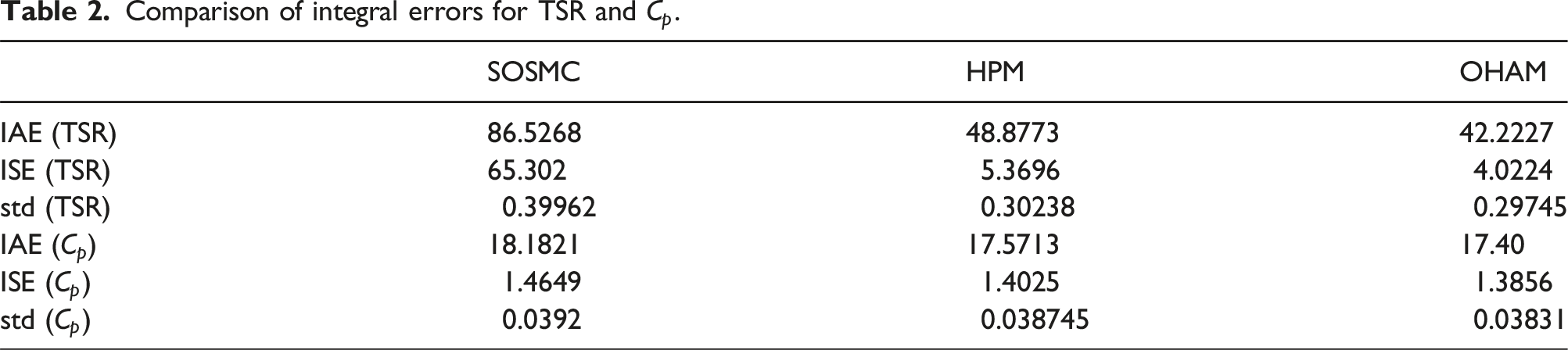
Figure 6 depicts the obtained TSR and power coefficient (a) Comparison of TSR values. (b) Comparison of Comparison of integral errors for TSR and 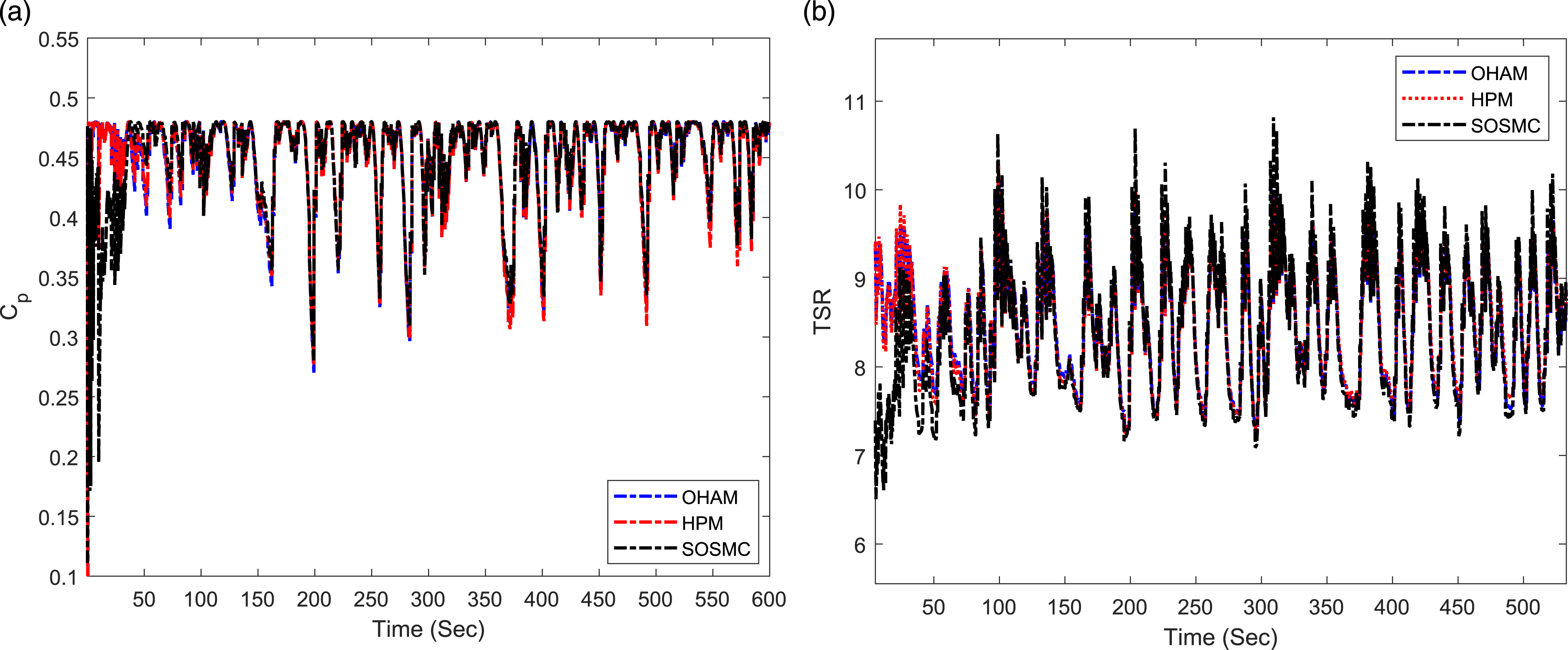
Stepwise changes in wind speed
The performance of the controllers during step and sudden variations in wind speed is investigated in this scenario. The wind profile applied to the turbine is shown in Figure 2(b), which exhibits sudden and severe changes in wind speed.
The comparison of rotor speeds, electromagnetic torques, and low-speed shaft torques under stepwise changes in wind speed is illustrated in Figure 7. The rotor speed performance comparison between the proposed OHAM and the two control strategies under stepwise changes of wind speed is presented in Figure 7(a). This figure indicates that the OHAM and HPM controllers track the optimal rotor speed much faster than the SOSMC controller. Figure 7(a) shows that SOSMC has the lowest performance in tracking the optimal value of the rotor speed compared to OHAM and HPM techniques. Additionally, the rotor speed obtained using SOSMC exhibits larger undershoots and overshoots compared to the HPM and OHAM techniques at the edge of each pulse. As shown in this figure, the proposed OHAM control scheme has a fast transient response and high accuracy. Thus, OHAM leads to greater power generation. The electromagnetic torques obtained from different controllers under the step changes in wind speed are shown in Figure 7(b). This figure indicates that the control effort required to track the optimal rotor speed for SOSMC is greater than that for HPM and OHAM. This means that faster tracking with SOSMC requires a larger control input signal. In other words, if the control effort is reduced, the speed of convergence of rotor speed for SOSMC in Figure 7(a) decreases, and the settling time increases. The low-speed shaft torques obtained using HPM, OHAM, and SOSMC are depicted in Figure 7(c). As shown in this figure, SOSMC leads to greater oscillations in the drive train and produces larger mechanical stresses. In contrast, the proposed OHAM results in the lowest stress on the drive train. Comparison of rotor speeds, electromagnetic torques, and low-speed shaft torques under stepwise changes in wind speed: (a) rotor speeds; (b) electromagnetic torques; (c) low-speed shaft torques.
Comparison of controller performance in terms of tracking errors.

According to the presented results, it can be concluded that step and sudden changes in wind speed do not have a significant effect on the performance of the OHAM controller. Thus, the OHAM demonstrates appropriate performance even under step changes in wind speed.
Conclusions
In this paper, a novel nonlinear optimal controller was proposed to extract the maximum power from the wind for variable speed wind turbines. The optimal control law was obtained by solving the HJB equation using a new strategy called OHAM. The proposed technique requires fewer iterations and lower computational costs. The OHAM controller was compared to existing controllers in terms of aerodynamic and electrical efficiency, as well as the standard deviation and maximum value of the low-speed shaft and the electromagnetic torques. Simulation results were presented to demonstrate the effectiveness and performance of the OHAM.
The presented results indicated that: • The OHAM exhibits the best performance in terms of transient response and fastest convergence. • The rapid convergence of the OHAM achieved by applying a small control input leads to an increase in aerodynamic and electrical efficiency. • The proposed strategy has good dynamic characteristics. The OHAM controller tracks the optimal rotor speed, captures the maximum wind power, and reduces mechanical stress. In other words, the OHAM achieves a good balance between optimizing aerodynamic power capture and minimizing low-speed shaft oscillation.
The optimal adjustment of the controller parameters is one of the challenges associated with the OHAM technique. Although many methods have been proposed to specify the auxiliary constants optimally, neural networks appear to be effective in solving this problem, especially in high-dimensional systems, because they excel at handling complexity. Thus, future research can focus on using neural networks to determine the control parameters of the proposed controller to achieve better performance. In addition, integrating the proposed algorithm with adaptive and robust techniques to enhance the system’s robustness could also be considered for future work.
Footnotes
Declaration of conflicting interests
The author(s) declared no potential conflicts of interest with respect to the research, authorship, and/or publication of this article.
Funding
The author(s) received no financial support for the research, authorship, and/or publication of this article.

Appendix
The wind turbine characteristics are presented in Tables 4 and 5. These parameters are related to the Controls Advanced Research Turbine (CART2) (Bossanyi EA, 2010; Stol, KA, 2004). This 660 kW, horizontal-axis, two-bladed turbine is located at the National Renewable Energy Laboratory. Two-mass model parameters. Wind turbine characteristics.
Parameter
Numerical value
Rated power
660 kW
Rotor diameter
42 m
Rated rotor speed
41.7 rpm
Maximum rotor speed
50 rpm
Minimum rotor speed
10 rpm
Rated generator speed
1800 rpm
Maximum generator speed
2160
Minimum generator speed
1295 rpm
Rated generator torque
3524.36 Nm
Maximum generator torque
4000 Nm
Minimum generator torque
0 Nm
Maximum generator torque rate
50 Nm/s
Minimum generator torque rate
0
Rated wind speed
12.7 m/s
Cut-in wind speed
4 m/s
Cut-out wind speed
25 m/s
Optimal TSR (
)
8.5
Optimal power coefficient (
)
0.48
Optimal pitch angle (
)
0