



Abstract
Accurate estimation of wind power intensity (WPI) is critical for regional energy planning, particularly in geographically complex inland regions where conventional analytical models often fail. This study proposes a real-time compatible regression framework for continuous wind power intensity prediction using daily meteorological data from the Maden region of Turkey. A Gradient Boosting Regression Tree (GBRT) model is trained offline on chronologically ordered data and deployed in a forward-only sequential prediction scheme that prevents access to future observations. The dataset is divided into training (70%), validation (10%), and real-time test (20%) subsets to realistically emulate operational conditions. Results demonstrate strong predictive performance on the real-time test set, with low error levels and high agreement between predicted and observed WPI values. Time-series and scatter analyses confirm the model’s ability to track temporal variations in wind power intensity under realistic deployment constraints. The proposed framework offers a practical and deployable solution for real-time wind power intensity estimation in complex inland terrains.
Keywords
Introduction
Wind energy has become a cornerstone of global efforts to transition toward cleaner and more sustainable energy systems (Sadorsky 2021; Xu and Xu, 2025). Accurate and continuously updated estimation of wind-related parameters, particularly wind power intensity, is critical for site selection, operational planning, and real-time decision-making in regional power systems (Akinci et al., 2025; Shang et al., 2023). While traditional statistical approaches such as Weibull- and Rayleigh-based models remain widely used, they often fail to capture nonlinear interactions among meteorological variables and are unsuitable for real-time operational use, especially in geographically complex inland regions (Ndeba et al., 2025; Selvaraj and Selvaraj, 2022; Yang et al., 2024).
Recent advances in data-driven modeling have enabled more flexible and accurate approaches for wind energy assessment (Abisoye et al., 2024). Machine learning-based regression models, which integrate multiple meteorological indicators such as wind speed, temperature, air pressure, humidity, and air density, have demonstrated superior predictive capability compared to classical analytical models (Deng et al., 2025; Rutherford et al., 2025; Shen et al., 2024). However, the majority of existing studies focus on offshore or coastal regions or turbine-level power forecasting, where wind dynamics are relatively more homogeneous and long-term or batch forecasting is prioritized over real-time applicability (Malakouti et al., 2022; Özen and Deniz, 2022).
In contrast, inland mountainous regions such as Maden, Turkey, exhibit abrupt terrain-induced atmospheric variations that significantly complicate wind power prediction (Song et al., 2023). In such environments, real-time compatible prediction frameworks are particularly important, as energy planning and operational decisions often require continuous, step-by-step estimation rather than static or batch-based predictions (Narayanan et al., 2022). Nevertheless, many existing machine learning studies rely on shuffled datasets or offline evaluation strategies that are not suitable for real-time deployment (Yadav et al., 2025). Systematic literature reviews have shown that artificial intelligence–based models—particularly artificial neural networks—dominate short-term wind energy forecasting studies, primarily due to their strong nonlinear modeling capability (Maldonado-Correa et al., 2021; Shringi et al., 2025). Such environments are widely recognized to exhibit strong randomness and non-stationary behavior in wind power generation due to continuously varying atmospheric and terrain-driven factors, which poses a major challenge for accurate short-term prediction (Liu et al., 2024).
To address this gap, this study proposes a real-time compatible regression framework for predicting wind power intensity using daily meteorological data collected from the Maden region. Instead of discretizing wind power intensity into categorical levels, the proposed approach directly estimates continuous WPI values, enabling real-time monitoring and virtual sensing applications. A Gradient Boosted Regression Tree (GBRT) model is employed due to its strong nonlinear modeling capability, robustness with limited data, and suitability for real-time inference. Unlike existing studies that focus on classification-based outputs, turbine-level forecasting, or offline evaluation strategies, this work introduces a forward-only, regression-based framework explicitly designed for real-time operational deployment in complex inland terrains.
As far as the existing literature indicates, no prior study has presented a real-time compatible regression-based wind power intensity prediction framework specifically tailored to the complex inland terrain of the Maden region. By combining sequential evaluation, continuous prediction, and operational realism, this work contributes a practical and deployable tool for regional renewable energy planning and decision support.
Related works
Reliable evaluation of wind resources and accurate modeling of associated meteorological indicators are essential for their integration into regional energy systems, site selection, and operational planning (Jimenez-Garrote et al., 2025). These challenges become more pronounced in geographically complex and mountainous terrains, where wind flow dynamics are strongly influenced by topography, land cover, and atmospheric stability. In such environments, local terrain effects can lead to highly nonlinear and non-Gaussian wind characteristics, limiting the effectiveness of traditional analytical and statistical estimation techniques. Consequently, data-driven and machine learning-based approaches have attracted increasing attention due to their flexibility and ability to model complex relationships among meteorological variables.
Physics-based numerical weather prediction (NWP) models and computational fluid dynamics (CFD) simulations have been widely employed to assess wind resources in complex terrains. He et al. (2023) examined the sensitivity of the WRF system across different spatial resolutions and planetary boundary layer parameterizations, demonstrating that conventional mesoscale schemes may be inadequate in highly complex regions. Giunta et al. (2022) evaluated the KALM-HD NWP model in the Val d’Agri region and highlighted the strong influence of orographic and thermal effects on local wind and temperature forecasts. Ge et al. (2025) addressed the degradation of long-horizon NWP accuracy by integrating microscale terrain information into extended-range wind energy projections. Similarly, De Moliner et al. (2024) investigated turbulence-resolving flow models coupled with mesoscale simulations in rugged terrain, revealing significant variations in predicted wind energy depending on model coupling strategies and terrain representation. Additional studies using WRF and CFD approaches have shown that nighttime low-level jets, valley effects, and terrain-induced turbulence can lead to substantial discrepancies in wind energy production across complex landscapes (Radünz et al., 2022; Shen et al., 2022; Weerasuriya et al., 2016; Yang et al., 2016).
While physics-based models provide valuable insight into atmospheric processes, their high computational cost and limited real-time applicability have motivated the adoption of data-driven methods. Several studies have demonstrated the effectiveness of machine learning and deep learning models for wind speed and wind power regression in complex terrains (Acikgoz et al., 2020; Wood, 2020). Beu and Landulfo (2024) employed LSTM networks trained on lidar measurements from rugged sites, achieving higher accuracy than conventional power-law extrapolation methods. Liu et al. (2024) combined modal decomposition with an attentional convolutional network to enhance wind power prediction under noisy conditions. Zhang and Li (2022) proposed a hybrid short-term wind energy prediction framework based on data decomposition and optimized LSSVM. Konstantinou and Hatziargyriou (2024) applied deep convolutional architectures for wind energy forecasting in complex terrains across Southeastern Europe, emphasizing the importance of terrain-aware feature representation. Hybrid approaches combining NWP outputs with statistical or machine learning models, such as the NWP–Gaussian process framework proposed by Perne et al. (2023), have also shown improved predictive performance. Furthermore, probabilistic forecasting methods based on variational autoencoders and beta distributions have been introduced to quantify uncertainty in wind speed and power predictions in terrain-driven variable wind conditions (Qian and Ishihara 2022; Salazar et al., 2022).
Despite these advances, a common limitation in existing machine learning-based studies is their reliance on offline or shuffled evaluation protocols, which do not reflect real-world operational conditions. In practice, wind energy monitoring and decision-support systems require continuous, step-by-step prediction frameworks capable of producing reliable estimates without access to future data. Moreover, the interpretability of data-driven models remains a critical concern for their adoption in energy planning applications. Recent efforts to address this limitation include the use of explainable artificial intelligence techniques such as SHAP and DeepSHAP to identify the contribution of meteorological and terrain-related features to model predictions (Konstantinou and Hatziargyriou 2024).
In summary, the existing literature extensively addresses wind speed and wind power forecasting in complex terrains using both physics-based and data-driven approaches. However, real-time compatible regression frameworks that explicitly preserve temporal order and enable continuous numerical prediction for operational use remain relatively underexplored, particularly for inland mountainous regions.
Methodology
Dataset description and preprocessing
This study employs a meteorological dataset collected from the Maden region of Turkey, consisting of 1096 daily observations. The dataset includes nine input features and one continuous output variable, representing wind power intensity (WPI), expressed in W/m2. Unlike classification-based approaches that discretize wind power into predefined categories, the proposed framework directly predicts continuous WPI values, enabling real-time monitoring and numerical assessment.
Meteorological measurements were obtained from calibrated on-site instruments, and supplementary records from the Turkish State Meteorological Service were used to ensure data continuity and reliability. The use of real-world measured data, rather than reanalysis or simulated datasets, enhances the practical relevance of the proposed framework for energy efficiency assessment.
Input and output variables used in the regression model.
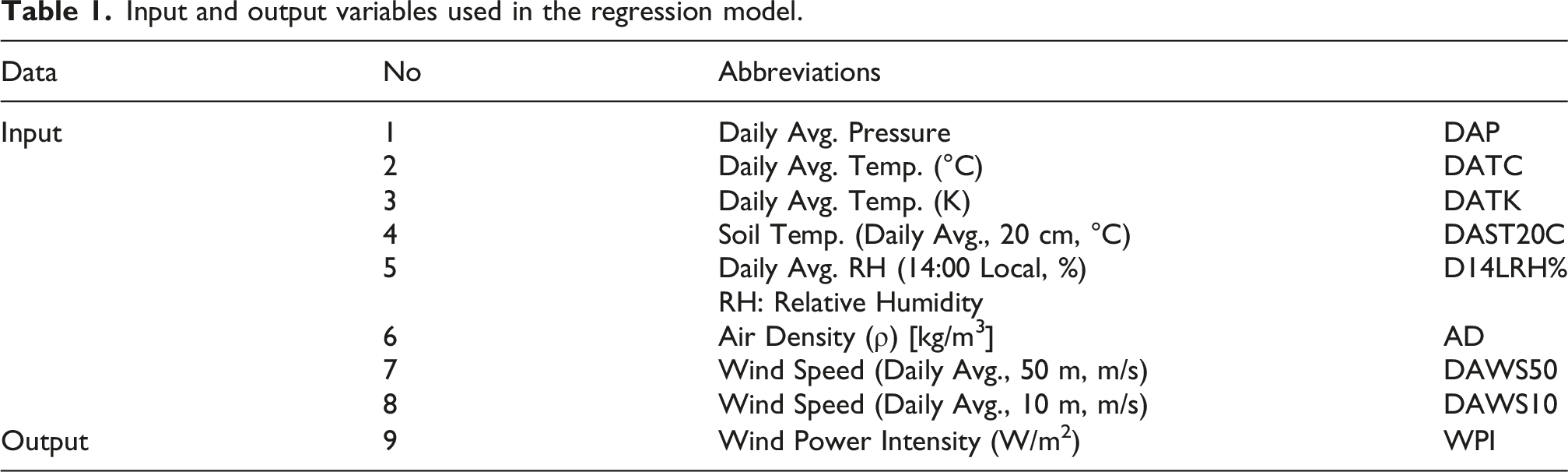
Prior to model training, all input features were normalized using statistics derived exclusively from the training subset to prevent information leakage. The same normalization parameters were subsequently applied to the validation and real-time test subsets. This preprocessing strategy ensures consistency across different evaluation stages and realistically reflects operational deployment conditions.
To preserve temporal dependencies and enable real-time compatibility, the dataset was not randomly shuffled. Instead, it was divided chronologically into three consecutive subsets: 70% for training, 10% for validation, and the remaining 20% for real-time sequential testing. The final subset simulates an operational scenario in which the model generates step-by-step predictions using only current input data, without access to future observations or retraining.
The meteorological dataset used in this study was collected using calibrated field-installed measurement devices rather than simulation or reanalysis products. Wind speed measurements were obtained via anemometers installed at 10 m and 50 m heights to capture vertical wind profile characteristics relevant to wind energy assessment. Atmospheric pressure, air temperature, relative humidity, and soil temperature (measured at 20 cm depth) were recorded using standard barometric, thermal, hygrometric, and soil probe instruments, respectively. All sensors were connected to data loggers that transmitted measurements to a centralized server for synchronized storage and preprocessing. Periodic calibration procedures were applied throughout the data acquisition period to ensure measurement reliability and consistency. Further technical details of the measurement infrastructure are consistent with the setup reported in Akinci et al. (2025). To further examine the relationships between the input variables and wind power intensity, a Pearson correlation analysis was conducted, and the corresponding results are provided in the Supplementary Material (Figure S1).
Regression model and training process
An interpretable regression model was developed using the Gradient Boosting Regression Tree (GBRT) algorithm implemented in MATLAB. The model was trained in an offline manner using chronologically ordered meteorological data to estimate wind power intensity (WPI) as a continuous numerical variable.
The dataset was partitioned into three subsets following a chronological order: 70% for training, 10% for validation, and 20% for real-time compatible testing. This split strategy prevents information leakage from future samples and reflects realistic deployment conditions. Hyperparameters of the GBRT model, including the number of learning cycles and tree depth, were optimized based on validation performance. Gradient Boosting Regression Trees (GBRTs) were selected due to their strong theoretical foundation in modeling nonlinear relationships and their robustness under limited data conditions, as originally established by Friedman (2001). The effectiveness of gradient boosting–based models in wind energy–related applications has also been demonstrated in recent studies, including offshore wind risk assessment and wind turbine response prediction tasks (e.g., Zhou et al., 2025).
Once trained, the GBRT model parameters were fixed and deployed in a sequential prediction framework. During the real-time testing phase, meteorological inputs were provided sample by sample, and predictions were generated in a forward manner (t → t + 1) without model retraining or access to future observations. This procedure ensures compatibility with real-time operational forecasting scenarios. The overall workflow of the proposed real-time compatible regression framework is illustrated in Figure 1. Conceptual illustration of the proposed real-time compatible regression framework. The GBRT model is trained offline using chronologically ordered meteorological data with a 70–10–20 split and subsequently deployed for sequential real-time prediction (t → t + 1) without retraining. The framework enables continuous wind power intensity estimation using fixed model parameters and incoming meteorological observations.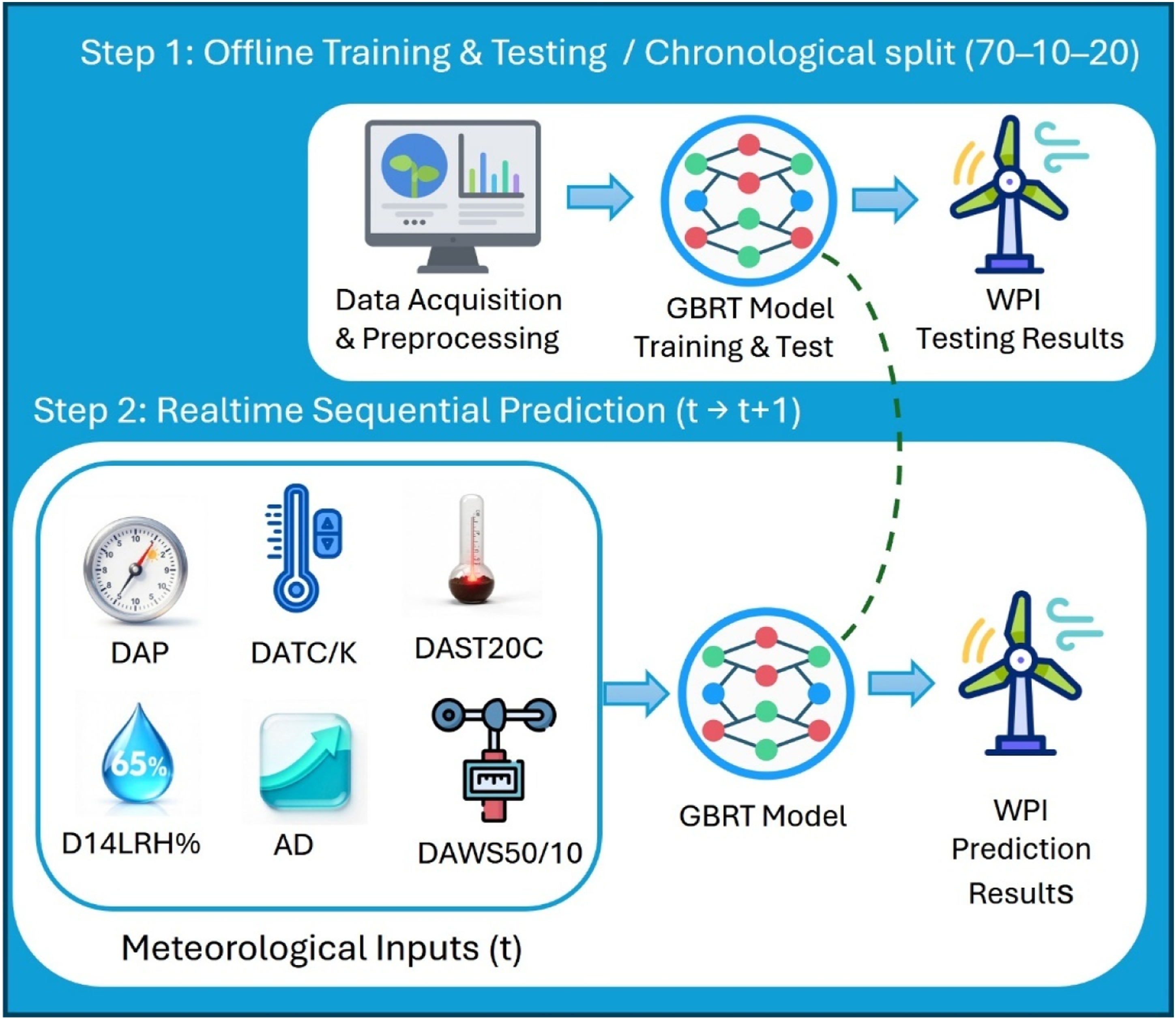
Mathematical formulation of the proposed model
This section presents the mathematical formulation of the proposed real-time compatible wind power intensity prediction framework. The problem is defined in a time-indexed manner, where the objective is to estimate wind power intensity using only currently available and past observations, without accessing future information.
First, the multivariate input feature vector at time step t is defined as shown in equation (1).
The corresponding target output is the wind power intensity value, which is modeled as a continuous real-valued variable, as given in equation (2).
Based on the defined input–output pairs, the complete time-indexed dataset used in this study can be expressed as equation (3).
The predictive task is formulated as a regression problem, where the model aims to learn a nonlinear mapping from the input feature space to the output space, as expressed in equation (4).
Real-time compatibility constraint
Unlike conventional offline learning approaches, the proposed framework explicitly enforces real-time compatibility. At each time step t, the prediction is generated using only historical information available up to time t − 1. This constraint is mathematically expressed in equation (5).
The available historical dataset used for prediction at time t is formally defined in equation (6).
To ensure strict real-time operation, access to future observations is prohibited. This restriction is explicitly stated in probabilistic form in equation (7).
This condition guarantees that no information leakage from future time steps occurs during model training or inference.
Gradient Boosted Regression Tree (GBRT) modeling
The proposed prediction model is implemented using a Gradient Boosted Regression Tree (GBRT) framework. The GBRT model represents the final predictor as an additive ensemble of weak learners, as shown in equation (8).
Here,
The initial model is obtained by minimizing the empirical loss over the training samples, as expressed in equation (9).
The model is then updated iteratively using a gradient boosting strategy. At iteration m, the model update rule is given in equation (10).

Optimization objective and loss minimization
The learning objective of the proposed model is to minimize the expected prediction error over the data distribution, as expressed in equation (12).
Since the true data distribution is unknown, the expected risk is approximated using empirical risk minimization over the available samples, as shown in equation (13).
This optimization framework ensures that the proposed model achieves high predictive accuracy while maintaining strict real-time compatibility.
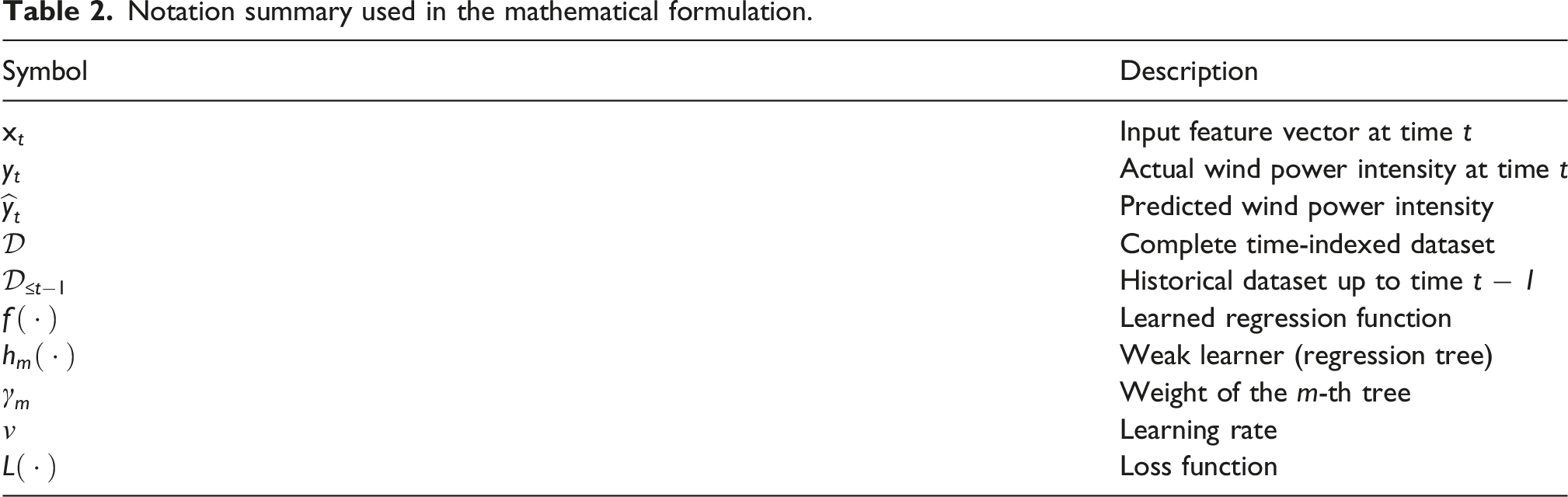
Notation summary
Notation summary used in the mathematical formulation.
Evaluation metrics
The regression performance of the proposed framework was quantitatively evaluated using widely adopted error and goodness-of-fit metrics. Specifically, the Mean Absolute Error (MAE), Root Mean Square Error (RMSE), and the Coefficient of Determination (R2) were employed to assess prediction accuracy, sensitivity to large deviations, and overall model fit, respectively. The mathematical definitions of these metrics are provided in equations (14)–(16).



Results and discussion
Regression performance evaluation
Regression performance metrics obtained on the real-time compatible test set.

Quantitative evaluation metrics computed on the real-time test set demonstrate strong predictive accuracy and robustness. The regression model achieved low prediction error and a high coefficient of determination, indicating a close agreement between predicted and observed wind power intensity (WPI) values. These results confirm that the model effectively generalizes beyond the training period despite operating with fixed parameters.
To further illustrate this behavior, Figure 2 presents the scatter plot of ground truth versus predicted WPI values during the real-time test phase. The data points are tightly distributed around the diagonal reference line, demonstrating a strong linear relationship and minimal systematic bias across the entire WPI range. This result highlights the model’s capability to preserve accuracy even under dynamically changing meteorological conditions. Scatter plot of observed versus predicted wind power intensity (WPI) values during the real-time test phase.
Temporal tracking performance in real-time deployment
Beyond numerical accuracy, the temporal consistency of predictions is critical for real-time wind energy applications. Figure 3 compares the predicted and observed WPI values over the real-time test horizon. The model successfully tracks both low- and high-intensity wind power variations, capturing rapid transitions as well as sustained trends. Scatter plot of ground truth versus predicted wind power intensity (WPI) values obtained during the real-time compatible test phase.
The close alignment between predicted and ground truth time series confirms that the regression framework maintains temporal coherence without relying on sliding windows or online retraining. This characteristic is particularly important for operational wind power estimation systems, where model stability and responsiveness must be balanced.
Notably, even during periods of sharp WPI fluctuations, the proposed model preserves trend fidelity, indicating that the selected meteorological inputs provide sufficient explanatory power for short-term forward prediction.
Error characteristics and stability analysis
The temporal distribution of prediction errors over the real-time test period is illustrated in Figure 4. The error sequence is largely centered around zero, suggesting the absence of systematic overestimation or underestimation. Most prediction errors remain within a narrow range, confirming the numerical stability of the regression framework. Prediction error evolution over the real-time compatible test phase.
Occasional large error spikes are observed at a limited number of time steps. These deviations correspond to extreme wind power events characterized by abrupt changes in atmospheric conditions. Such outliers are expected in real-world wind energy systems and reflect the inherent stochastic nature of meteorological processes rather than model instability.
Overall, the error behavior demonstrates that the proposed approach achieves a favorable balance between accuracy and robustness, ensuring reliable performance under both nominal and extreme operating conditions.
Discussion: Practical implications for real-time wind power estimation
The results clearly demonstrate that the proposed regression framework is suitable for real-time wind power intensity estimation without requiring online retraining or future data access. By employing a chronological training–validation–testing strategy and fixed model parameters, the approach aligns closely with realistic deployment constraints. The proposed framework can be directly integrated into supervisory control systems, operational monitoring dashboards, or regional energy management platforms as a virtual sensing and decision-support module.
This design distinguishes the proposed framework from many existing studies that implicitly rely on information leakage through random data partitioning or adaptive retraining strategies. The ability to perform forward-only prediction (
The computational cost of the trained GBRT model is minimal during inference, as predictions are generated through a fixed ensemble of shallow regression trees. In practice, a single forward prediction requires only basic arithmetic operations and can be executed within milliseconds on standard computing hardware, making the proposed framework suitable for real-time deployment.
In terms of interpretability, an examination of the trained GBRT model indicates that wind speed measurements at multiple heights (particularly 50 m and 10 m) constitute the most influential predictors for wind power intensity estimation. Secondary contributions are associated with air density and atmospheric pressure, reflecting their role in modulating aerodynamic efficiency. Seasonal and thermal variables provide complementary information, especially during transitional periods, supporting the model’s ability to capture non-stationary atmospheric behavior. This interpretability insight enhances the transparency of the proposed framework and supports its practical adoption in operational energy planning systems.
Comparison with conventional offline regression approaches (qualitative)
Conventional regression-based wind power estimation studies often assume stationary conditions and unrestricted access to historical and future data. In contrast, the proposed framework explicitly enforces real-time compatibility by preventing retraining and future data usage during inference.
The strong predictive performance observed under these constraints highlights the effectiveness of the selected meteorological features and the robustness of the Gradient Boosting Regression Tree model. As a result, the proposed approach bridges the gap between offline-trained machine learning models and real-time operational forecasting requirements.
Although deep learning architectures such as LSTM and hybrid CNN–LSTM models have demonstrated strong performance in capturing temporal dependencies in wind forecasting tasks, their applicability often relies on sliding-window inputs, extensive training data, and higher computational cost. In contrast, the primary objective of this study is not to maximize offline predictive accuracy, but to ensure real-time compatibility, low inference latency, and robustness under limited data conditions. Gradient Boosted Regression Trees offer a favorable balance between nonlinear modeling capability, computational efficiency, and interpretability, making them more suitable for real-time operational deployment in regional energy management systems. For these reasons, deep sequence-based architectures were not included as benchmark models in this study.
Conclusion
This study presented a real-time compatible regression framework for continuous wind power intensity (WPI) estimation in geographically complex inland regions. Unlike conventional offline or classification-based approaches, the proposed method directly predicts numerical WPI values while strictly preserving temporal order and preventing access to future information during inference. This design ensures realistic deployment conditions and operational validity.
Using daily meteorological data from the Maden region of Turkey, a Gradient Boosting Regression Tree (GBRT) model was trained offline and deployed in a forward-only sequential prediction scheme. The results demonstrated strong predictive accuracy on the real-time test set, with low error levels and high agreement between predicted and observed WPI values. Temporal tracking and error analysis confirmed that the proposed framework maintains stability and responsiveness under realistic operating conditions, even during periods of rapid wind power variation.
The findings indicate that real-time compatible regression can effectively function as a virtual sensing tool for wind power intensity estimation, offering continuous numerical outputs rather than discrete class labels. This characteristic is particularly valuable for regional energy planning, monitoring, and decision-support applications in inland mountainous terrains, where traditional analytical and offline machine learning methods often fall short.
The proposed real-time compatible forecasting framework is not inherently tied to a specific geographic location. Its design relies on physically interpretable meteorological variables and a chronological learning strategy that reflects operational deployment conditions. Therefore, the framework is expected to be transferable to other inland or mountainous regions where terrain-induced atmospheric variability plays a significant role in wind dynamics. With appropriate local data calibration, the methodology can serve as a generalizable template for regional wind power intensity estimation in complex terrains.
Overall, the proposed framework bridges the gap between machine learning-based wind power modeling and real-world operational requirements. Future work may extend this approach by incorporating higher temporal resolution data, multi-site deployment, or probabilistic uncertainty estimation to further enhance real-time decision-making in renewable energy systems.
It should be noted that the experimental evaluation in this study was conducted using data from a single inland region. This choice was made deliberately to ensure strict real-time compatibility and to avoid confounding effects arising from heterogeneous regional datasets. As a result, the current findings primarily demonstrate methodological feasibility rather than universal generalization. Future work will extend the proposed framework to multiple regions to systematically investigate cross-regional robustness and transferability.
Supplemental material
Supplemental material - Real-time compatible wind power intensity forecasting for regional energy planning in complex inland regions
Supplemental material for Real-time compatible wind power intensity forecasting for regional energy planning in complex inland regions by Hidir Selcuk Nogay in Wind Engineering.
Footnotes

Ethical considerations
Not applicable. This study does not involve human participants or animal subjects.
Author contributions
H.S.N. conceived the study, performed the data analysis, developed the methodology, interpreted the results, and wrote the manuscript.
Funding
The authors disclosed receipt of the following financial support for the research, authorship, and/or publication of this article: This study was supported by the Bursa Uludağ University Scientific Research Projects (BAP) under Project ID: 2240.
Declaration of conflicting interests
The authors declared no potential conflicts of interest with respect to the research, authorship, and/or publication of this article.
Data Availability Statement
The data that support the findings of this study are available from the corresponding author upon reasonable request.
Supplemental material
Supplemental material for this article is available online.
References
Supplementary Material
Please find the following supplemental material available below.
For Open Access articles published under a Creative Commons License, all supplemental material carries the same license as the article it is associated with.
For non-Open Access articles published, all supplemental material carries a non-exclusive license, and permission requests for re-use of supplemental material or any part of supplemental material shall be sent directly to the copyright owner as specified in the copyright notice associated with the article.
