




Abstract
Capitalist growth regimes are analysed drawing on Marx’s insights into the fundamental contradictions of the capitalist mode of production, regulation theoretical arguments about the five basic structural forms of accumulation regimes and their modes of regulation, historical geographical materialism’s emphasis on spatio-temporal fixes, and state-theoretical accounts of the ‘government + governance’ of capitalist social formations in the shadow of hierarchy. This framework is then applied to four specific growth regimes and their crisis tendencies. These regimes are Atlantic Fordism, two (among many) alternative post-Fordist trajectories – the knowledge-based economy and finance-dominated capitalism – and a radical ‘no-growth’ variant of the ‘Green New Deal’. The article highlights the crisis tendencies of the first three and assesses whether the Green New Deal represents an alternative route out of crisis or the capture of an eco-social project by the forces that brought us finance-dominated accumulation. It concludes with a future research agenda.
Keywords
Introduction
The basic features of the capitalist mode of production (CMP) and its nature as a distinctive ensemble of objects of régulation/governance are such that neither capital as a whole nor the capital-labour relation on which its contradictory and conflictual dynamic depends can be reproduced purely through market relations (Box 1). What most distinguishes capitalism from other forms of producing wealth is its treatment of labour-power as if it were a commodity. In short, the appropriation of surplus labour takes the form of exchange. This turns the labour market and labour process into sites of class struggle between capital and workers. This economic class struggle is overdetermined, of course, by juridico-political and ideological structures and struggles, the complexity of class relations in actually existing social formations, and the intersection of class with other social categories. Class struggle and competition are significant sources of capitalism’s open-ended dynamic, and underpin the differential accumulation that reflects the ability of some capitals to grow through market and non-market means faster than others (or at least to suffer less in cyclical downturns and/or in periods of crisis). While the generalisation of the commodity form to labour-power is peculiar to capitalism, there are three other key categories of fictitious commodity: land (or nature); money; and knowledge, with corresponding forms of revenue (rent, interest, royalties) (on degrees and forms of commodification, see Jessop 2007). The relative weight of these fictitious commodities is one way (among others) to distinguish different stages of capitalism, different regimes of accumulation, and different modes of competition within the overall framework of the world market, which is the ultimate horizon of differential accumulation. Thus one might compare rentier extractive economies, regimes based mainly on absolute surplus-value, finance-led economies, and knowledge-based economies.
Some commonalities of capitalism
Wealth appears as an immense accumulation of commodities.
The commodity form is generalised to labour-power, which is treated as if it were a commodity, although, like land, money, and knowledge, it is in fact a fictitious commodity.
The duality of labour-power as concrete labour and abstract labour time.
A specific political economy of time that continually rebases abstract time, creating a treadmill of different forms of competition, which tend to subsume more and more forms of social relations.
The commodity and other forms of the capital relation involve specific expressions of the core contradiction – hence, one or more linked dilemmas between their use-value and value [or exchange-value] aspects.
These contradictions are incompressible: at best their effects can be displaced or deferred through spatio-temporal fixes that are also social and institutional.
Money as a social relation has a key role in mediating the profit-oriented, market-mediated accumulation process (but can get disconnected for a time from the ‘real economy’, creating possibilities for monetary crisis).
Competition (and, hence, in part, entrepreneurship) is central to capital’s dynamic: its foci include (but are not limited to) innovations to reduce socially necessary labour time, socially necessary turnover time, and naturally necessary reproduction time.
Market forces alone cannot secure all the contingently necessary conditions of expanded capitalist reproduction (even ignoring the dual nature of the labour process as concrete labour and a process of valorisation).
Capital accumulation has major extra-economic conditions of existence in other social forms, institutions, organisations and social practices, which must be included as crucial factors of power and domination in its analysis.
Capital as an object of regulation
No accumulation regime or strategy, on whatever scale (or scales) it is identified, can be completely coherent or fully institutionalised. This arises because of three key aspects of the capital relation:
The incompleteness of capital as a purely economic (or profit-oriented, market-mediated) relation such that its continued reproduction depends, in an unstable and contradictory way, on various and changing extra-economic mechanisms whose presence cannot be guaranteed;
The interrelated structural contradictions and strategic dilemmas of the capital relation. The resolution of some may exacerbate others, or at least require hard-to-achieve complementary solutions, the combination of which depends on different accumulation regimes, modes of regulation, and conjunctures; and
Conflicts over the regularisation and/or governance of these contradictions and dilemmas as expressed in the circuit of capital and the wider social formation.
The first feature is addressed briefly above and included in the commonalities of capitalism depicted in Box 1, and should be familiar to readers of this journal. Accordingly, while not wishing to underplay the significance of this first feature, I will focus in this article on the second and third features.
Marx (1967) identified an essential contradiction in the ‘cell-form’ of the CMP, namely the commodity, between its exchange- and use-value aspects. On this basis he unfolded the complex dynamic of the CMP – including the necessity of periodic crises and their creatively destructive role in renewing accumulation. I suggest that all forms of the capital relation (in so far as revenues derive from formal market-mediation, thereby excluding profits from different forms of political capitalism, such as predatory capitalism, force and domination, or unusual deals with political authority), embody different but interconnected versions of this basic contradiction (on political capitalism, see Weber 2009). These impact differentially on (different fractions of) capital and on (different categories and strata of) labour at different times and places (Jessop 1983, 2011). Thus, productive capital is both abstract value in motion (notably in the form of realised profits available for reinvestment) and a concrete stock of already invested time- and place-specific assets in the course of being valorised; the worker is both an abstract unit of labour-power substitutable by other such units (or, indeed, other factors of production) and a concrete individual (or, indeed, collective workforce) with specific skills, knowledge and creativity; the wage is a cost of production and a source of demand; money functions as an international currency exchangeable against other currencies (ideally in stateless space) and as national money circulating within national or plurinational spaces subject to state control; land functions both as rent-generating property (based on the private appropriation of nature) and as a more or less renewable and recyclable natural resource (modified by past actions); and knowledge is the basis of intellectual property rights and a collective resource (the intellectual commons). Likewise, the state is not only responsible for securing key conditions for the valorisation of capital and the reproduction of labour-power as a fictitious commodity, but also has overall political responsibility for maintaining social cohesion in a socially divided, pluralistic society. Taxation is an unproductive deduction from private revenues (profits of enterprise, wages, interest, and rents) and a means to finance collective investment and consumption. And so on (see Jessop 2002).
The tension between the two co-existing poles, each of which is a naturally necessary or inherent feature of a given contradiction and, indeed, which together define it in their opposition, generates strategic dilemmas on how to handle the contradiction. For example, does – or should – the state treat the (social) wage mainly as a source of demand or a cost of production, or attempt to reconcile these aspects? The first case is illustrated in the Keynesian welfare national state (or KWNS), the second in neoliberal austerity politics or export-led growth, and the third in welfare regimes based on ‘flexicurity’. Analogous arguments hold for other contradictions and dilemmas. The plurality of contradictions and their interconnections, the possibilities of handling them at different sites, scales, and time horizons, etc., creates significant scope for agency, strategies and tactics to affect economic trajectories. How they are handled also shapes the form of subsequent crises, but does not determine the nature of subsequent regimes, which also depend on the formal and material adequacy outcome of path-shaping initiatives.
An important caveat is necessary here. To paraphrase Marx in the 1857 introduction, ‘there is no contradiction in general, there is also no general contradiction’: each contradiction has its own aspects and is actualised in its own ways in particular institutional and spatio-temporal contexts, giving rise to a complex, overdetermined, contradictory and multiply dilemmatic ensemble of social relations. In strategic-relational terms, institutions have their own distinctive discursive-material selectivities, favouring some actors, alliances, identities, interests, projects, spatio-temporal horizons, etc.; they are associated with specific technologies of governance; and they are articulated into specific institutional orders and ensembles that create specific forms of domination. While many institutions are related to fundamental categories of the capital relation, their specific forms and logics are irreducible to these basic categories. This approach to institutions is essential to understanding accumulation regimes, their modes of régulation-cum-governance, and their integration into broader societal configurations. Some first-generation Parisian regulation theorists sometimes combined institutional analysis with a form-analytical account of the contradictions inherent in the capital relation (e.g. Aglietta 1979; Lipietz 1986). I follow them in defining an accumulation regime as a complementary pattern of production and consumption that is reproducible over a long period; and a mode of growth as a coherent combination of accumulation regime and mode of regulation. However, I modify their definition of mode of regulation as follows: an ensemble of norms, institutions, organisational forms, social networks, and patterns of conduct that can temporarily stabilise an accumulation regime through its régulation-cum-governance of specific structural forms despite the conflictual and antagonistic nature of capitalist social relations. This reflects my view that, whereas Atlantic Fordism was easier to regularise because of the coherence of its structural forms, the relative primacy of the national economy governed by a national state and the apparent success of crisis-management routines, post-Fordist regimes are less coherent and more turbulent, requiring more active governance. In contrast with some later Parisian work, which tends to be more one-sidedly institutionalist, I still start from the fundamental features of the capital relation. In addition, like the Grenoble school and the Amsterdam school, I emphasise the world market as the ultimate horizon of capital accumulation. (On different regulation schools, see Jessop and Sum 2006.)
Two key concepts that highlight the role of agency and strategy in resolving contradictions and dilemmas are ‘institutional fix’ and ‘spatio-temporal fix’. These fixes both emerge, to the extent that they do, in a contested, trial-and-error process, involving different economic, political, and social forces and diverse strategies and projects; and they typically rest on an institutionalised, unstable equilibrium of compromise. An institutional fix is a complementary set of institutions that, via institutional design, imitation, imposition or chance evolution, helps to provide a temporary, partial, and relatively stable solution to the régulation-cum-governance problems involved in constituting and securing a social order. It can also be examined as a spatio-temporal fix (or STF), and vice versa. STFs establish spatial and temporal boundaries within which the always relative, incomplete, provisional, and institutionally-mediated structural coherence of a given order (here, a mode of growth) are secured – to the extent that this occurs. Issues of institutional design apart, this also involves building support in and across many conflictual and contested fields for the respective accumulation strategies, associated state projects and, where it is relevant, hegemonic visions. STFs help to displace and defer the material (stofflich) and social costs of securing such coherence beyond the spatial, temporal, and social boundaries of the institutional fix. Hence they only appear to harmonise contradictions, which persist in one or another form (see Box 2).
Spatio-temporal fixes (STFs)
A spatio-temporal fix (which is also social and institutional) emerges when an accumulation regime and its mode of regulation co-evolve to create a certain structural coherence among the elements of that political-economic order within a given time-space envelope, in part through displacing and/or deferring regulatory problems elsewhere and/or into the future.
Structurally, an STF is typically linked to a distinctive hierarchy of structural forms that affects interactions in the institutional architecture as a whole and thereby shapes the STF’s overall logic. This hierarchy gives greater priority to regularising some structural forms (and to one or other aspect of their associated contradictions and dilemmas) than others. These priorities vary across accumulation regimes, modes of growth and governance capacities.
Strategically, because capitalism’s contradictions and dilemmas cannot be solved in abstracto, they are resolved – partially and provisionally, if at all – via the formulation-realisation of specific accumulation strategies at various economic and political scales in specific spatio-temporal contexts.
The significance of accumulation strategies (and their associated state projects and, where relevant, hegemonic visions) illustrates the importance of discourse, agency and governmental technologies. Such fixes delimit the main spatial and temporal boundaries within which structural coherence is secured, and externalise certain costs of securing this coherence beyond these boundaries.
Even within these boundaries some classes, class fractions, social categories or other social forces located inside these spatio-temporal boundaries are marginalised, excluded or oppressed.
STFs also facilitate (and come to embody) the institutionalised compromises on which accumulation regimes and modes of regulation depend. This can involve the super-exploitation of internal or external spaces outside the compromise, super-exploitation of nature or inherited social resources, the deferral of problems into an indefinite future, and the exploitation and/or oppression of specific classes, strata or other social categories.
These arguments imply that no regime has just one (fundamental) contradiction that must be regulated and/or governed appropriately to ensure continuing accumulation. The relation between contradictions and dilemmas is not mechanically additive but reciprocally, albeit asymmetrically, overdetermined: they are not simply aggregated as ‘so many potatoes in a sack’ but modify each other in distinctive ways. Their significance varies, posing differently configured sets of régulation-cum-governance problems at different sites and scales (cf. Gough 1991, 2004). The asymmetries can be analysed by deploying three key concepts elaborated by Althusser on the basis of Mao’s insightful, ill-specified and too politically malleable essay on contradiction: 1) the distinction between the principal contradiction and other, secondary contradictions in a given social order – with their articulation being complex and overdetermined rather than simple and set exclusively by the principal contradiction; 2) the distinction between the primary aspect and the secondary aspect of a given contradiction in a given conjuncture, i.e. which of its poles is more problematic for expanded reproduction; and 3) the uneven development of contradictions, i.e. changes in the principal and secondary contradictions and their primary and secondary aspects (Althusser 1965; Mao 1967).
These distinctions are useful in exploring how institutional and spatio-temporal fixes contribute to the overall régulation-cum-governance of the capital relation. Specifically, contradictions and their associated dilemmas may be handled through:
hierarchisation (treating some contradictions as more important than others);
rioritisation of one aspect of a contradiction or dilemma over the other aspect;
spatialisation (relying on different scales and sites of action to address one or another contradiction or aspect, or displacing the problems associated with the neglected aspect to a marginal or liminal space, place, or scale); and
temporalisation (alternating regularly between treatment of different aspects or focusing one-sidedly on a subset of contradictions, dilemmas, or aspects until it becomes urgent to address what had hitherto been neglected).
On this basis, a given stage or variety of capitalism would differ in terms of the weights attributed to different contradictions and dilemmas (hierarchisation), the importance accorded to their different aspects (prioritisation), the role of different spaces, places, and scales in these regards (spatialisation), and the temporal patterns of their treatment (temporalisation). The same criteria can be used to analyse the régulation-cum-governance of modes of growth (see below). In all cases, because the capital relation is reproduced – when it is – through social agency and entails specific forms, stakes, and sites of conflict and struggle, the relative importance of contradictions and dilemmas is not structurally inscribed nor strategically re-scripted. Fixes are not purely technical, but reflect the institutionally-mediated balance of forces in a given situation.
The prevailing strategies modify each contradiction, with the result that they are mutually presupposed, interiorising and reproducing in different ways the overall configuration of contradictions. Different configurations can be stabilised based on the weights attached to 1) different contradictions and dilemmas and their dual aspects; 2) the counter-balancing or offsetting of different solutions to different contradictions and dilemmas; 3) different patterns of social conflict and institutionalised compromise; 4) differences in the leading places and spaces for accumulation; and 5) the changing prospects of displacing and/or deferring problems and crisis-tendencies. The complex structural configuration of a given accumulation regime depends on institutional and spatio-temporal fixes that establish the primacy of one or more contradictions and assign a primacy for governance to one rather than another of its aspects. Other contradictions are regularised/governed according to how they complement the current dominant contradiction(s). Nonetheless, these fixes are not ‘magic bullets’: they cannot eliminate contradictions and dilemmas and, whatever their capacity to temporarily ‘harmonise’ or reconcile them, they create the conditions for the next crisis.
Renewing the Parisian regulation approach
I now draw on these arguments to reinvigorate the early Parisian work that explored how the inherent contradictions of the capital relation were regulated through specific structural forms and institutionalised compromises in different stages of capitalism. Early studies decomposed the capital relation into a series of structural forms, each of which has its own characteristic contradictions and dilemmas, requiring specific forms of regulation. These are conventionally described as the wage relation (individual and social wage, wage form, lifestyle); the enterprise form and competition (internal organisation, source of profits, forms of competition, ties among enterprises and/or banks); money and credit (form and emission, banking and credit systems, allocation of capital to production, national currencies and world monies, and monetary regimes); the state (institutionalised compromise between capital and labour, forms of state intervention); and international regimes (trade, investment, monetary, and political arrangements that link national economies, nation states, and world system). The choice of these forms probably reflects the institutional configuration of Atlantic Fordism in a specific world-historical context rather than a generic set of forms applicable to all accumulation regimes (Röttger 2003). This is why it is better to premise comparative analysis on the inherent contradictions of the capital relation rather than take for granted the features of a particular growth regime. This makes it easier to distinguish the specific institutional configurations corresponding to other growth regimes, especially where they involve strong elements of political capitalism (Weber 2009).
Petit has argued that one structural form will predominate in each period or accumulation regime and shape its institutional dynamics (1999). Translating this proposal into the terminology suggested above, we could say that the dominant structural form is the one linked to the principal contradiction in a given period or regime. I propose that one way to distinguish modes of growth is in terms of how they handle contradictions and dilemmas in terms of the four above-mentioned methods. Thus one can study their principal contradictions and their primary and secondary aspects when they are en régulation, how this configuration displaces and/or defers for a while the inherent contradictions of the capital relation and, indeed, contributes to the typical crisis-tendencies of a given mode of growth, and how the primary and secondary aspects of contradictions and the overall hierarchy of contradictions change when a mode of growth is in crisis. A useful insight here is Boyer’s distinction between stable and transitional periods. In periods en régulation, the dominant institutional form is the one that constrains the covariation of other institutional forms and thereby secures their complementarity or coherence. For Fordism, he claims, this was the wage-labour nexus. In transition periods, however, the dominant structural form is the one that imposes its logic on the others – without this ensuring coherence among all five institutional forms, at least in the short-term (2000: 291). He suggests that, ‘in the 1990s, finance appeared to govern the dynamics of other institutional forms’ (Boyer, 2002b: 320) and, indeed, that a deregulated, internationalised and hyper-innovative financial system had destabilising effects on other structural forms (Boyer 2002b, 2004, 2012).
Drawing on these arguments, I further suggest that, whereas the economic dynamic of periods of stability rests on complementary institutional hierarchies and institutionalised compromise, periods of instability involve disruptive institutional hierarchies and struggles to roll back past compromises and establish new ones. In both cases, thanks to the presence of multiple contradictions and dilemmas, agents are forced, nolens volens, to prioritise some over others. This is not a neutral technical matter but is essentially political and typically contested. This is especially evident in periods of economic crisis, which provoke restructuring through the normal working of market forces as well as through more deliberate, typically contested attempts to restore the conditions for differential accumulation, often through institutional innovation and efforts to modify the balance of forces. This may include changes in the priority of opposing aspects of a contradiction as the previously secondary aspect becomes more urgent and/or in the sites and scales on which contradictions are handled and dilemmas are juggled. These issues become even clearer when there is a crisis of crisis-management, i.e. when conventional ways of dealing with crisis no longer work well, if at all. And this holds particularly when it is the dominant contradiction that generates the most severe challenges and destabilising, disorienting effects. This will vary with the accumulation regime and its mode of regulation and the shifting conjunctures of a variegated world market.
Althusser claims, rather dramatically, that contradictions have three forms of existence: ‘non-antagonism’, ‘antagonism’, and ‘explosion’ (Althusser 1965). Utilising the strategic-relational approach (see Jessop, 2007), we can reinterpret this claim as follows. Non-antagonism exists when there is a relatively stable institutional and spatio-temporal fix associated with a hegemonic economic imaginary and institutionalised compromise within a given time–space envelope. Antagonism occurs when contradictions and crisis tendencies can no longer be managed, displaced or deferred, with the result that growth cannot be renewed within the usual parameters, producing a crisis of crisis-management that provokes struggles over how best to reconfigure the contradictions and dilemmas and secure a new unstable equilibrium of compromise. This is especially likely where one of the structural forms operates to destabilise the inherited growth regime. An explosion is an overdetermined ruptural moment that opens the possibilities of radical restructuring on a qualitatively new basis. Whether or not the search for solutions to economic crisis restores the prevailing accumulation regime and its mode of regulation does not depend solely on the objective features of the crisis and the feasibility of resolving it within this framework. It also depends on the institutional, organisational and learning capacities of the social forces seeking to resolve the crisis and on the outcome of the contest to define the nature of the crisis, to explain its various objective causes, to attribute blame for its development, and to identify the most appropriate solutions.
Atlantic Fordism
I now illustrate these arguments from Atlantic Fordism. The fix associated with Atlantic Fordism can be analysed in terms of the hierarchisation, prioritisation, spatialisation, and temporalisation of its basic contradictions, thereby securing the conditions for its dominance in Fordist social formations and giving the appearance that contradictions had been harmonised, social conflict moderated, and the conditions for permanent prosperity established. Crucial here was a spatio-territorial matrix based on the socially constructed congruence between national economy, national state, national citizenship embracing social as well as civic and political rights, and national society; and the consolidation of institutions relatively well adapted to the twin challenges of securing full employment and economic growth and managing national electoral cycles. The dominant (or principal) structural forms (with their associated contradictions and dilemmas) around which this specific resolution was organised in and through the KWNS were the wage and money forms. Whereas Petit (1999) and Boyer (2000) focused on the wage-nexus, Aglietta also regarded the money constraint as important (see Aglietta 1979, 1986).
In my account, whether Fordism was en régulation or in crisis, the wage-nexus and money form were joint sites of dominant contradictions. On this assumption, Table 1 presents an ideal-typical configuration of this growth regime en régulation and also provides a reference point for studying its crisis-tendencies. This and later tables focus on four structural forms and deal with international regimes in terms of the spatio-temporal aspects of the embedding of each form. This reflects my view that international regimes are closely tied to the other four forms and should be studied in these terms rather than presented as a separate structural form.
Atlantic Fordism en régulation

Atlantic Fordist crisis

The primary aspect of the wage form was its role as a source of domestic demand rather than as a cost of international production. This reflected a context where full employment levels of demand served the interests of industrial capital as well as the Fordist labour force (especially semi-skilled male wage-earners). Although Keynesian fine-turning contributed at best modestly – and often counter-productively – to achieving this goal, the principal foundation was the virtuous circle of mass production and mass consumption reinforced by the Keynesian welfare national state. Wages as a cost of international production were secondary because of the relative closure of national economies and the capacity to live economically and politically with modest inflation, and to resort to modest devaluations to protect full employment levels of demand. The state was permissive towards wage costs as long as they rose in line with productivity and prices. This was relatively easy to achieve in the 1950s and early 1960s, as Fordist firms and branches expanded thanks to their economies of scale and collective bargaining operated within the Fordist class compromise. Labour market pressures were also alleviated in this period by processes such as the transfer of workers from low productivity agriculture, the mobilisation of women into the labour force and, later, state support for responsible trade unionism, collective bargaining, industrial modernisation, the consolidation of big business, and forms of corporatism.
The primary aspect of the money form in most Fordist regimes was its character as national credit money. The development of adequate national, macroeconomic statistics and the steady expansion of the peacetime state budget gave the KWNS considerable leverage in fiscal and monetary terms to steer the economy. Private debt also played a major role in the post-war boom by financing fixed investment and working capital as well as by funding the growth of mass consumption. In turn, lubricated by public and private credit, growth helped to legitimate Keynesian welfare policies, and to generate the tax revenues for collective consumption, welfare rights and social redistribution, as well as for infrastructure provision. It also helped to consolidate a social basis for the Fordist accumulation regime based on a class compromise between industrial capital and organised labour.
Thus, in the expansion phase of Atlantic Fordism, the role of money as an international currency was secondary. This aspect was managed through the embedding of Atlantic Fordism in the Bretton Woods monetary and GATT trade regimes. Most national economies were more closed on their capital than trade accounts, with national states enjoying effective capital controls, fixed but adjustable exchange rates, and significant and legitimate trade controls in place or to hand. Thus economic policy adjustment and intervention were more oriented to economic growth and full employment than to defence of a fixed exchange rate. This was gradually undermined, however, as increasing flows of stateless money and near-money instruments induced national governments, reluctantly or willingly, to abandon capital controls and adopt a floating exchange-rate system. The USA was a partial exception because its national money was the hegemonic international currency. Initially beneficial during its expansion phase, this later became another source of instability and crisis for Atlantic Fordism.
Finally, we should note that some costs of the Fordist compromise and the KWNS were borne inside Fordist societies by the relative decline of agriculture, the traditional petite bourgeoisie and small and medium firms; by the decline of cities, regions and sectors that could find no competitive role in the Fordist circuits; by workers in the disadvantaged parts of segmented labour markets; and, especially in liberal welfare regimes, by women subject to the dual burden of paid and domestic labour. One of the mechanisms for deferring the contradictions of Atlantic Fordism and the KWNS and redistributing their costs was inflation. Based on the capacity of banks and the state to expand credit, inflation served to (pseudo-)validate otherwise unprofitable production and to maintain high levels of capacity utilisation and employment (Lipietz 1985). Provided that all the relevant economies had similar mild rates of inflation or that higher inflation economies could engage in occasional modest devaluations, this did not hinder integration of the Atlantic Fordist circuits (Aglietta 1982). It did produce problems later in the form of stagflation and, throughout this period, it had significant redistributive effects in class, sectoral, and regional terms, favouring big capital in particular (Galbraith 1967). Other costs were borne by economic and political spaces tied to international regimes (such as those for cheap oil or migrant labour) necessary to Atlantic Fordism’s continued growth but not included in the Fordist compromise. This regime gained from a Janus-faced temporal fix. For while it depended on accelerated (and unsustainable) exploitation of nature (especially raw materials and non-renewable resources laid down over millennia, such as fossil fuels), it also produced environmental pollution and social problems that remained largely unaddressed. Increasing difficulties in maintaining this institutional and spatio-temporal fix prompted attempts to challenge the institutionalised compromises on which it rested.
The crisis of the Atlantic Fordist growth regime emerged when internationalisation and other spatio-temporal changes inverted the primary and secondary aspects of the dominant contradictions, undermining the corresponding institutional and spatio-temporal fixes. This disorganised the typical configuration of Atlantic Fordism and triggered struggles to introduce a new growth regime (or regimes). The table for Atlantic Fordism in crisis uses the same grid as that for this regime when it is en régulation; but the content of every cell has been changed to reflect the inversion of the primary and secondary aspects of the dominant contradictions, the factors that contributed to the crisis, and the repercussions of the growing unsustainability of the institutional and spatio-temporal fixes that supported Atlantic Fordism in its heyday. Considerations of space prevent a full discussion of all these features, but they are taken up in the ensuing discussion of two major alternatives proposed as successor regimes to the Fordist growth regime. (For more detail on the crisis itself and initial responses thereto, see de Vroey 1983; Jessop 2002.)
Two post-Fordist growth regimes
While the economic crises affecting Atlantic Fordist economies had many similarities, they were not identical and were also resolved in different ways. Sometimes they were managed largely as crises in Atlantic Fordism, sometimes as crises of Atlantic Fordism (Jessop 2002). Many alternative growth scenarios were proposed during the crisis in/of Atlantic Fordism (for a partial survey, see Boyer 2002a), many of which were short-lived. As Petit (1999) notes, post-Fordist regimes are linked to the dominance of other structural forms from those found in Fordism. It is highly improbable that a regime in crisis can be re-stabilised simply by refocusing régulation-cum-governance from one pole of the dominant contradiction(s) to the other because, as I noted above, all the basic contradictions are interdependent. It follows that new configurations with different institutional and spatio-temporal fixes are required if capital accumulation is to be renewed. One alternative, which appeared to become the hegemonic economic imaginary for the after-Fordist epoch, was the (globalising) knowledge-based economy (KBE). This was strongly promoted by the OECD and productive capital (Jessop 2002). Another alternative was finance-led (or, better, finance-dominated) accumulation, reflecting the interests of money capital. This prevailed in the leading liberal market economies and, through its promotion under the Washington Consensus and its destabilising effects elsewhere, shaped differential accumulation on a world scale. Even in crisis, thanks to the continued dominance of the transnational power bloc that supports it, this finance-dominated model continues to destabilise growth regimes in many regions.
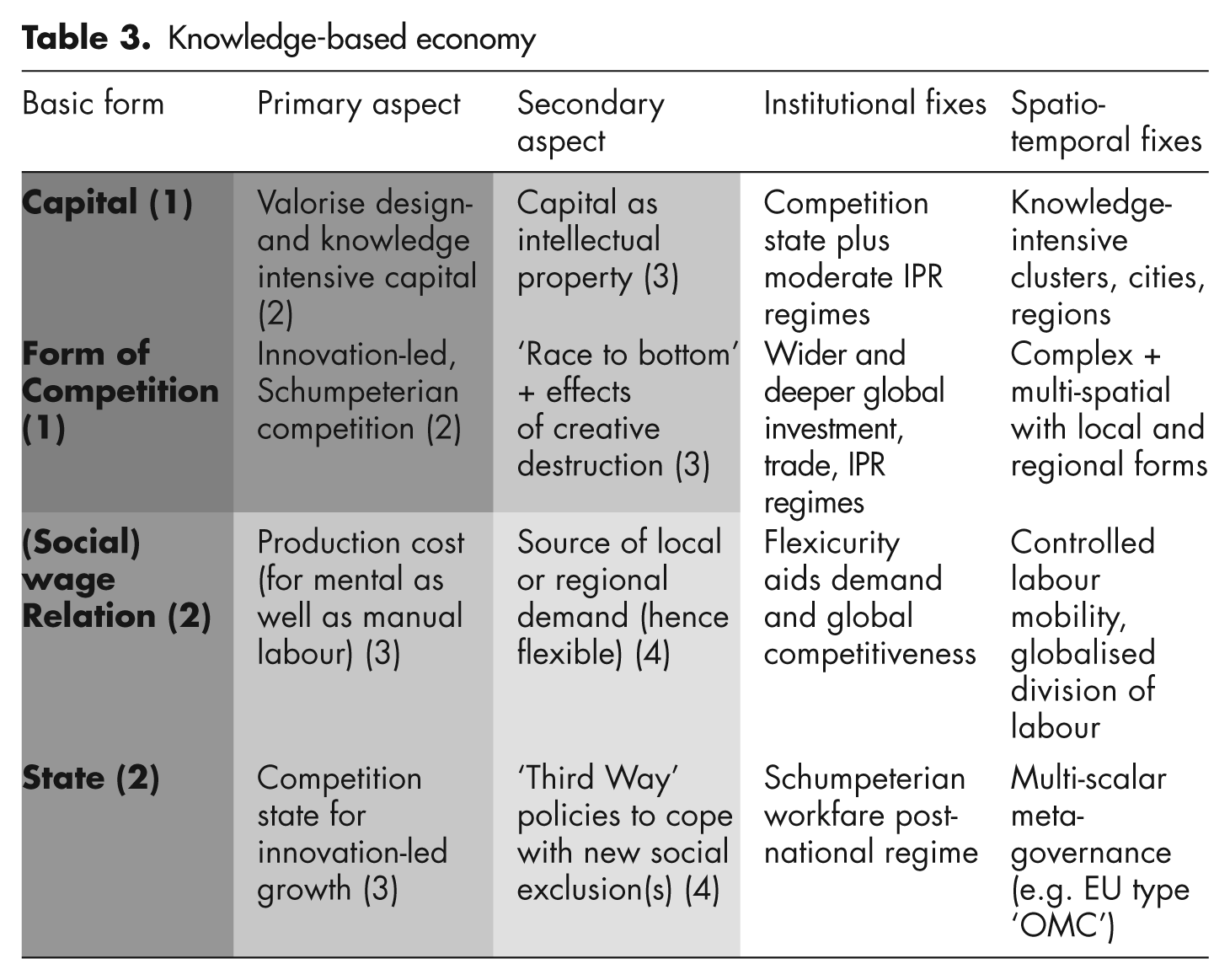
In contrast to Atlantic Fordism, the two principal (or dominant) structural forms in the KBE are capital and competition. The primary aspect of capital is the valorisation of the general intellect in the form of knowledge- and design-intensive commodities (real or fictitious). It involves the production, management, distribution and use of knowledge as a key driver of economic growth, wealth generation, and job creation across the private, public, and ‘third’ sectors. In a true KBE, it is suggested, knowledge is applied reflexively to the production of knowledge and most sectors tend to become more knowledge-intensive. As such, it could potentially help to reduce socially necessary labour time, socially necessary turnover time, and, through bio-technology, naturally necessary reproduction times. KBE discourse can be translated into many visions and strategies (e.g. smart machines, expert systems, knowledge transfer, creative industries, intellectual property rights, lifelong learning, e-government, smart weapons, the information society, and cybercommunity). It can also be pursued at many scales (firms, organisations, cities, regions, nations, supra-national regions, transnational institutions, etc.). While it tends to favour productive over money capital, it has sometimes been inflected in a neoliberal manner that highlights the role of market forces as the driving force behind innovation.
Table 3 depicts the institutional-spatio-temporal fix of an ideal-typical KBE mode of growth with its principal structural forms and complementary forms, if it is be en régulation. Moreover, because knowledge is a fictitious commodity that depends for its valorisation on a broad range of extra-economic supports, there are limits to its commodification, and this indicates that an effective fix depends on embedding the KBE in a multi-scalar knowledge society (Jessop 2007a; cf. Polanyi 1957, on market economy and market society). A suitable state form for this accumulation regime is the Schumpeterian workfare post-national regime in so far as this fits an innovation-led, flexicurity oriented, multi-scalar and governance-based mode of growth (for details, see Jessop 2002). Note that this table rests on a thought experiment, because most examples of the KBE are local, regional, or based on specific global networks rather than being truly national, supranational, or global.
Knowledge-based economy
Another post-Fordist growth regime is finance-dominated accumulation (see Table 4). This is not a simple inversion of Fordism because it involves different principal contradictions as well as different institutional and spatio-temporal fixes. The principal (or dominant) structural forms of finance-dominated accumulation are money and the (social) wage relation; the others are subordinated to these in potentially destabilising ways – as the genesis and repercussions of the North Atlantic financial crisis have amply demonstrated. This regime gained increasing influence in the variegated world market through the disembedding of financial capital and the importance of neoliberalism as the driving force in world market integration (Jessop 2009). The continuing efforts to revive this model tell us something about the limits of the regulation approach in so far as it ignores the broader dynamics of class domination, the ability of those with power not to have to learn from their mistakes, and the growing turn to authoritarian statism and, indeed, repressive measures to maintain class power (on this see, for example, Duménil and Lévy 2004, 2011; Harvey 2005; Lapavitsas 2011).
Finance-dominated accumulation en régulation?
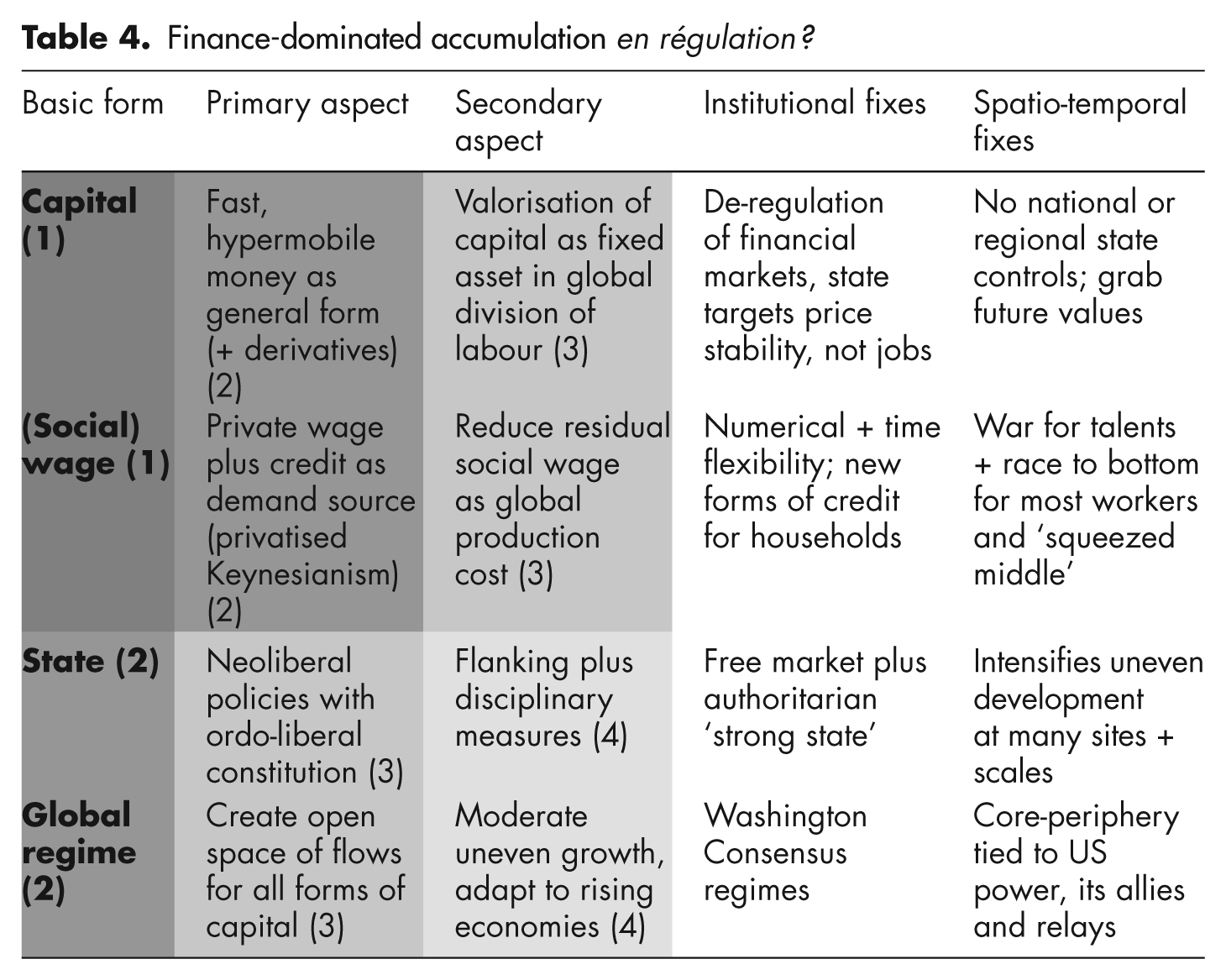
The primary aspect of money (as capital) in the finance-dominated regime is (world) money as the most abstract expression of capital and its disembedding in a space of flows (in contrast to the more territorial logic of Atlantic Fordism or a productivist KBE). The primary aspect of the (social) wage is its privatisation or recommodification, including private consumer credit. The secondary aspect of money (real assets) was secured through the neoliberal policy boost to post-tax profits – that was not always reflected, however, in productive in productive investment in financialised neoliberal regimes. Indeed, the neoliberal bias towards de-regulation also creates the basis for an institutional fix that relies on ‘unusual deals with political authority’, predatory capitalism, and reckless speculation – all of which has helped to fuel the global financial crisis. An ordo-liberal framework would have provided a more appropriate institutional and spatio-temporal fix, including the embedding of neoliberalism internationally in a new, disciplinary constitutionalism and new ethicalism (Gill 1995; Sum 2010). The secondary aspect of the wage form involves cutbacks in the residual social wage, resulting in a lean welfare state.
Separately and together, neoliberal measures (such as liberalisation, de-regulation, privatisation, the use of market proxies in the residual state sector, internationalisation and the lowering of direct taxes) privilege value in motion, the treatment of workers as disposable and substitutable factors of production, the wage as a cost of (international) production, money as international currency (especially due to the increased importance of derivatives), nature as a commodity, and knowledge as intellectual property. World market integration enhances capital’s capacity to defer and/or displace its internal contradictions by increasing the global scope of its operations, by reinforcing its capacities to disembed certain of its operations from local material, social, and spatio-temporal constraints, by enabling it to deepen the spatial and scalar divisions of labour, by creating more opportunities for moving up, down, and across scales, by commodifying and securitising the future, and re-articulating time horizons. This helps to free monetary accumulation from extra-economic and spatio-temporal constraints, increases the emphasis on speed, acceleration, and turnover time, and enhances capital’s capacity to escape the control of other systems in so far as these are still territorially differentiated and fragmented. This disembedding from the frictions of national power containers intensifies the influence of the logic of capital on a global scale, as the global operation of the law of value commensurates local conditions at the same time as it promotes the treadmill search for superprofits. Supported by a stress on shareholder value, this particularly benefits hypermobile financial capital, which controls the most liquid, abstract, and generalised resource and has become the most integrated fraction of capital, and enhances its abilities to displace and defer problems onto other economic actors and interests, other systems, and the natural environment.
In the short-term, financial accumulation depends on pseudo-validation of highly leveraged debt, but finance capital (let alone capital in general) cannot escape its long-term material dependence on the need for surplus-value to be produced before it can be realised and distributed. Nor can it escape its material dependence in this regard on the existence and performance of other institutional orders (e.g. protection of property rights and contracts, basic education, effective legislation, scientific discoveries). And, of course, it always remains a prisoner of its own crisis tendencies.
The overaccumulation of financial capital enabled by its dissociation from, and indifference to, other moments of the capital relation was a crucial factor contributing to the eventual bursting of financial bubbles around the world. But the crisis has a specific form due to the hyper-financialisation of advanced neoliberal economies and, in particular and most immediately, practices of de-regulated, opaque, and sometimes fraudulent financial institutions that still benefit from a corrupt relation with political authority. These features reflect the hybrid nature of finance-dominated accumulation through its articulation with a predatory and parasitic political capitalism. Overall, the hierarchy of structural forms in this regime is generating an epic recession, and perhaps eventually, another great depression, which is based on the vicious interaction between debt, default, and deflation (Rasmus 2010).
Although I have presented the KBE and finance-dominated accumulation as if they were simple alternatives, they actually co-existed as competing accumulation strategies in the same economic spaces and/or in closely connected economic spaces within a variegated world market. This could itself have caused additional problems because it made it less likely that either growth regime would be stable compared to the golden years of Atlantic Fordism, since their co-existence made it correspondingly harder to secure their respective forms of embedding.
Beyond finance-dominated accumulation?
The global financial crisis removed the issues associated with the ‘triple crisis’ – the environmental, food and fuel crises – from the mainstream policy agenda. While the immediate response was the rescue of ‘too big to fail’ and ‘too interconnected to fail’ financial institutions, one medium-term response has been to re-emphasise the need for renewed growth. The contradictions involved in fiscal consolidation are producing a double dip recession for workers (the ‘middle class’ as well as manual workers) because of its one-sided emphasis on the social wage as a cost of production and on public debt as a deduction from profits. Nonetheless, the global environmental crisis has risen up the policy agenda at the margins in the guise of promoting a ‘Green New Deal’ (GND) or, more radically, a ‘no-growth’ or ‘de-growth’ regime as a longer-term strategy aimed at resolving the triple crisis. (For further discussion, see Jessop 2012.)
The GND can be seen in part as an extension of the 1980s-1990s KBE paradigm – one that was sidelined but not negated by the rise of finance-dominated accumulation. The very fuzziness of the slogan has helped to build alliances and compromises around what is allegedly capital’s best hope to create jobs, restore growth and save the earth. To date, the GND has been translated into many different visions and strategies and can be inflected in neoliberal, neo-corporatist, neo-statist and neo-communitarian ways by prioritising, respectively, market incentives, social partnership, societal steering and solidarity. This provides one basis for recuperating and normalising the GND and, indeed, re-contextualising and re-appropriating it on neoliberal lines (e.g. cap and trade) so that it no longer challenges the economic logic that created the triple crisis. This is seen in proposals to commodify nature’s labour power, e.g. its role in carbon sequestration, maintaining biodiversity, and limiting the effects of ‘natural’ (but often in part anthropogenic) disasters. If this route is taken, the incompressible contradictions of capital accumulation will be generalised even further.
Finally (for the moment), the GND risks becoming part of a new imperial strategy whereby the ‘North’ maintains the living standards essential for its class compromises by paying for slower growth in the ‘dependent south’, with disastrous repercussions on food and fuel costs and an increased likelihood of riots and revolutionary movements. To escape this development requires a critique of political ecology to match Marx’s critique of political economy and to match the dimensions of the crisis and, although authors such as Altvater (1993), Burkett (1999, 2006) and Foster (2000) have shown that this is feasible, the task is truly urgent. In general, in contrast to solutions that promote renewed growth in some form as the exit strategy from the current financial and sovereign debt crises (and their debt-deflation-default deleveraging dynamics), a deep green new deal implies quantitative restraints on growth; a transformation in the quality of growth; and geographic, social, and intergenerational redistribution of growth. This also implies the rebalancing of growth across the global North versus global South divide.
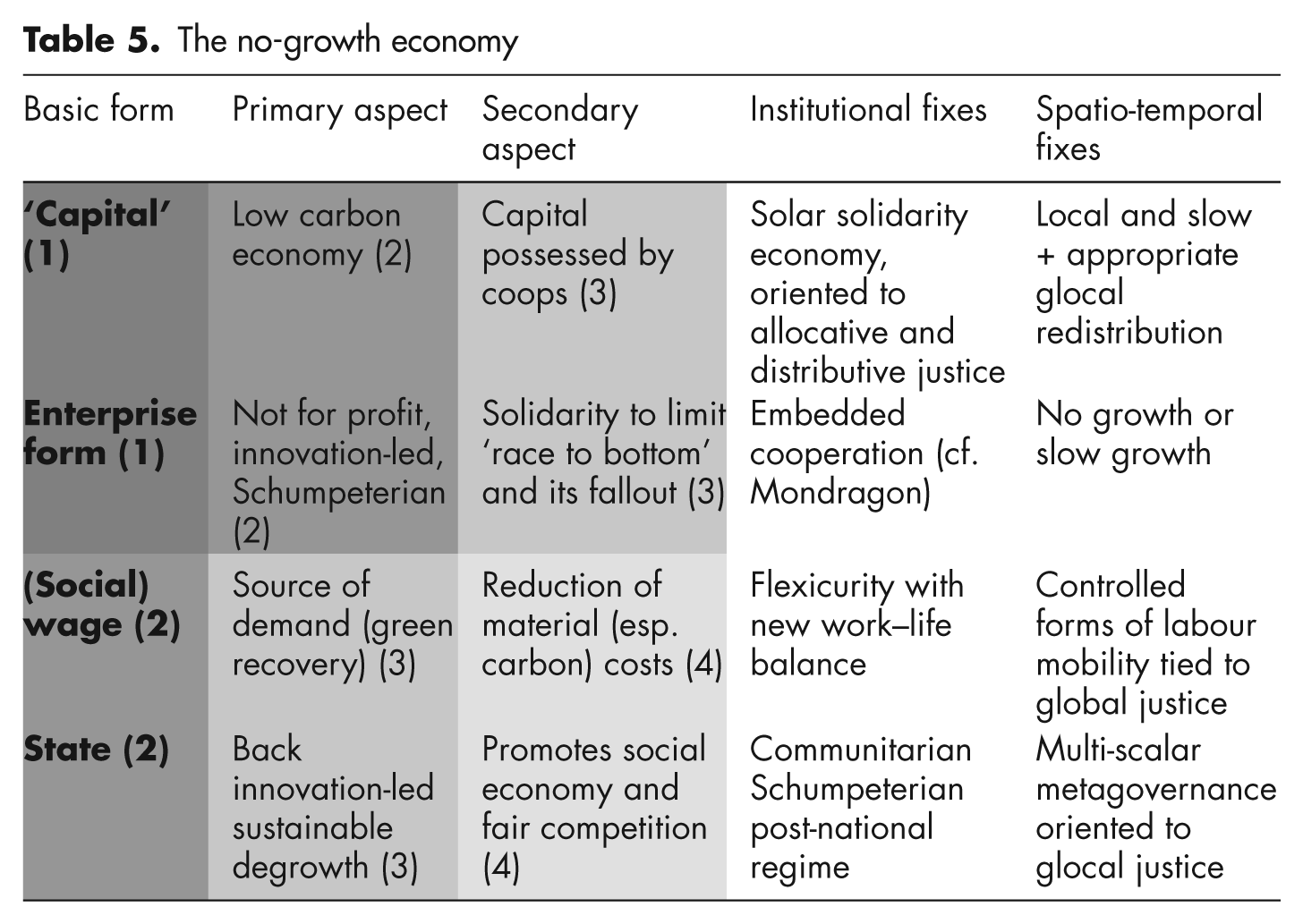
Table 5 presents the matrix for this sort of ‘no-growth’ strategy based on institutional and spatio-temporal fixes that support a solidarity economy. But the form and content of this matrix clearly push at the limits of the proposed analytical approach because it stretches the meaning of the economic categories (structural forms) studied in regulationist analyses of the capital relation. Indeed, it is the deeply rooted nature of these categories that make it so hard, theoretically and practically, to think outside the capitalist ‘box’. This in turn makes it relatively easy for the logic of capital to reassert itself, especially when so many vested interests are committed to this happening.
The no-growth economy
Conclusions
My contribution to this special issue of Capital & Class has argued for a return to the insights of some early Parisian regulationist work on the unstable relationship between the basic contradictions of the capital relation and the institutional forms through which they are contingently resolved, always provisionally and partially, for a significant period of time. It has extended this pioneering analysis by identifying some additional contradictions inherent in the capital relation, linking them to corresponding dilemmas, and indicating how accumulation regimes and their modes of growth can be studied in terms of the institutional and spatio-temporal fixes that contribute to their régulation-cum-governance. In particular, four interrelated strategies for handling contradictions were discussed, and I indicated how specific configurations of these strategies can be used to characterise different modes of growth. On this basis, the article sketched four modes of growth, relying in part on a tabular form of summarising the institutional and spatio-temporal fixes associated with each of these regimes. The results presented here are provisional because they derive from work in progress that is part of a bigger project on a cultural political economy of continuing crises of crisis-management in the North Atlantic financial crisis and the difficulties that capital confronts in re-regulating finance-dominated accumulation.
Two (among many possible) issues are worth noting here as a poor substitute for a more extended set of conclusions in what has already been a too brief and dense analysis. First, a systematic concern with multiple, overdetermined contradictions need not lead to structuralist analyses that marginalise social agency: for contradictions entail dilemmas that open space, practically as well as theoretically, for agents, their strategic choices, and the changing balance of forces to make a difference to the course of accumulation. This invites a far more detailed analysis of economic (and ecological) imaginaries, accumulation strategies, state projects and hegemonic visions and their role in the régulation-cum-governance of the contradictions, dilemmas, and antagonisms of the capital relation. Second, assuming that the world market is both the presupposition and the posit (result) of capital accumulation, and that the integration of the world market generalises and intensifies its contradictions (Jessop 2010, 2011), it is especially important to look beyond national-territorial boundaries in examining the institutional and spatio-temporal fixes that contribute to the provisional, partial, and temporary stabilisation of the capital relation. If the world market is the ultimate horizon of capital accumulation and of capitalist strategies, then our analyses must take account of this too without falling back on some abstract, trans-historical logic of a capitalist world system. The approach suggested here is a modest contribution to this far broader project.
Footnotes
Acknowledgements
The writing of this article was enabled by a professorial fellowship funded by the UK’s Economic and Social Research Council (grant number RES-051-27-0303). The final draft has benefitted from the comments of Uli Brand, Charles Dannreuther, Alex Demirović, Pascal Petit, Mikael Stigendal and Thomas Sablowski. All the usual disclaimers for errors of omission and commission in an unusually idiosyncratic analysis apply.