



Abstract
Recent approaches to class analysis in advanced capitalism have been largely disconnected from the capitalist labour process. This paper has three basic goals. First, we suggest a composite Marxist model of current class structure grounded in ownership, managerial authority, specialized knowledge and value relations in the capitalist labour process. Secondly, this model is used for an empirical assessment of continuity and change in class structure, based on a series of national surveys in Canada in the period 1982–2010. Thirdly, using the same series of surveys, we use this model of class structure to evaluate the extent to which employment class positions are relevant for understanding shifting expressions of class consciousness. Within the employed labour force in this particular advanced capitalist country, we find a generally declining conventional working class and expanding proportions of managerial and professional employees. Connections between employment class positions and class consciousness can involve complex mediations. Evidence for the persistence of strong hegemonic consciousness among corporate capitalists is provided by an additional unique series of surveys. This persistence contrasts with declining working class identity and increasingly mixed class consciousness among most other employment class positions. However, pro-labour oppositional consciousness is found to dominate among unionized industrial workers and professional employees in the private goods-producing sector, who may be among the most directly exploited workers in value terms in an emergent ‘knowledge economy’. The findings suggest the continuing relevance of pursuing class analyses based on production relations in advanced capitalist economies.
Introduction
Marx’s basic contribution to modern class analysis was to show that the development of classes was inextricably bound up with the historical development of the prevailing mode of production within which they were rooted. As capitalism coalesced as a mode of industrial production, its major protagonists took shape and grew within its core structure. The well-spring of capitalism’s expansion was the extraction of surplus value by capitalist owners of the means of production from the unpaid labour time of wage labourers they employed who directly produced the commodities that capitalists then sold to realize that value as profit. Many recent analysts of both classes and production relations appear to be intent on ignoring this connection between class formation and production relations. We will offer a brief critical assessment of recent approaches to class analysis and labour process analysis in capitalism. We suggest a Marxist model of current class structure grounded in relations between owners and hired labour in private enterprises. Then, empirical assessment of continuity and change in class structure are provided, based on a series of national surveys in Canada in the period 1982–2010. Finally, we offer empirical assessment of relations between class positions and expressions of class consciousness based on the same surveys.
Disconnecting class
The death of the political and economic significance of classes based in production relations in advanced industrial societies has been heralded since the end of the Second World War. Early farewells referred to increasing consumer affluence, political quiescence of industrial workers and the end of class-based ideologies (Bell 1962). Since the 1970s, the decline of manufacturing employment and labour unions, coupled with an increasing capacity of large transnational companies to relocate production operations, have drawn death notices from intellectuals who see few signs that the industrial working class can now act as a coherent political force (e.g. Gorz 1982). One of the most extended obituaries (Kingston 2000) claims that the production process itself is extremely unlikely to generate class formation because of very diverse employment conditions, high occupational mobility and experience-diversifying technologies. The emergence of cross-class social movements based on civil rights, and feminist and environmental concerns, has been highlighted in critiques of the inadequacy of existing class analyses to deal with these issues (e.g. Pakulski & Waters 1996). Most recent analyses of classes in advanced capitalist societies have ignored relations in the sphere of production per se while focusing on exchange issues (marketable skills, income levels) or have taken a cultural turn that tends to disconnect class from paid workplaces. Some of these approaches, such as those inspired by Bourdieu, purport to offer more holistic analyses of multidimensional class experience. Such approaches offer complex descriptions of current consumption patterns (Savage et al. 2013). Some who have taken the cultural turn increasingly recognize the need to reconnect with employment characteristics (Atkinson 2009; Hebson 2013). But none of these approaches offer insight into changing class relations within the capitalist labour process.
Marx’s mid-19th-century analysis of the capitalist labour process was not much further developed for over a century until Braverman’s (1974) book on the degradation of work in ‘monopoly’ capitalism. Braverman’s analysis effectively redirected attention to the production process and class relations within production. Braverman’s research stimulated others and was followed by several class analyses with more specific attention to relations of production (e.g. Carchedi 1977; Wright 1978). The renewed interest in production relations generated more complex models of class structure, cores and peripheries, including ‘new’ corporate elites, ‘new’ working classes, ‘new’ middle classes and ‘new’ petty bourgeoisies. Braverman also inspired a variety of case studies of the detailed social and technical division of labour (see Thompson 1983) that challenged a long prevailing focus on labour market relations. A variety of efforts were made to revise Braverman’s degradation perspective, including Friedman’s (1977) ‘responsible autonomy’ and Burawoy’s (1979) attention to subjectivity and workers’ consent. Thompson (1990) proposed a ‘core’ labour process agenda that rejected Marx’s labour theory of value while attending to structured antagonisms and a control imperative to ensure firms’ profitability. While this ‘core’ theory has animated a good deal of empirical research, it has done little to connect with broader analyses of class. Indeed, Smith and Thompson have called attempts to reconnect class analysis and labour process studies a ‘sterile functionalist project’ (Smith & Thompson 1999: 219) that miss the ongoing centrality of ownership and profit maximization in shaping class relations. We agree with this centrality but suggest that rejecting the labour theory of value disarms class analysis by permitting the ‘dazzling appearance’ of free market exchange to obscure the well-springs of private capital accumulation in the exploitation of labour in production.
Since the 1980s, class analysis and labour process studies have become increasingly disconnected (see Carter 1995; Neilson 2007). Analytical Marxists have also dismissed Marx’s labour theory of value as ‘false’ and ‘useless’, defined class structure and exploitation in terms of ownership of various assets and largely ignored production relations per se (Roemer 1982). Much employment class analysis has focused on complex arrays of occupational communities that are disconnected from actual relations of production (e.g. Grusky & Weedon 2001). Labour process research has devolved into either macro analyses of global corporate capitalist enterprise development or micro case studies of firms, both of which are disconnected from systematic employment class analysis (Jaros 2005; Tinker 2002).
A renewed Marxist approach to class relations
For Marx, the most basic driving force of class relations in capitalist economies was the exploitation of productive hired workers by the owners of private companies through the extraction of surplus value in order to maximize profits via the realization of that value in competitive commodity markets. The material interest of hired labourers to attain higher wages to improve their living conditions was a major counterforce. The dominant tendency was for techniques of production to be frequently modified to reduce the amount of living labour per unit of vendible commodities in order to continue to maximize profits. This production process was seen as a drive to commodify everything, leading to the concentration of capital, the centralization of firms and the proliferation of reserve armies of labour.
Capital now flows at an unprecedented scale and accelerated rate through a highly concentrated and centralized global financial system that has expanded enormously in proportion to productive capital in the past three decades (Vitali et al. 2011); information and transportation technologies facilitate widespread restructuring and decentralization of production systems around the globe; and many transnational corporations originating in many countries, most notably the US, have attained a global reach (Panitch & Gindin 2012).
The 20th century saw massive increases in the proportion of the global labour force dispossessed of the means of production and seeking alternative work for wages. It should be stressed here that the world capitalist system is now characterized by a hired labour force and a burgeoning relative surplus population located primarily in the developing and underdeveloped world (Neilson & Stubbs 2011). Advanced capitalist countries such as Canada are characterized by larger shares of global capital, greater shares of relatively well-paid ‘knowledge workers’ and lesser shares of surplus population in desperation. Our focus in the current analysis will be limited to the employed labour force in advanced capitalism on the operating assumption that the exploitation of productive hired workers by private enterprise owners continues to be relevant to the constituting of the class structure and the development of class consciousness in advanced capitalist settings.
Within advanced capitalist centres, direct manual labour continues to decline with de-industrialization and increasingly mechanized commodity production, while more intellectualized and managerial work expands, a condition now widely heralded as a ‘knowledge economy’ (Livingstone & Guile 2012). In such ‘knowledge economies’, with growing amounts of work involving processing of information, mainstream fixation with labour productivity increasingly focuses on capturing knowledge, exemplified by a diffuse knowledge theory of value that is inattentive to knowledge workers’ own interests (Jacques 2000). The notion of ‘knowledge workers’ needs to be specified in terms of class position and working conditions. Contrary to the claims of knowledge economy advocates, the professional and managerial occupations most commonly regarded as advantaged knowledge workers now appear to be experiencing degradation of their working conditions, increasing underemployment and relegation to the reserve army of labour, much as the skilled labour of the past (Livingstone 2009).
Production whereby nature-provided materials are changed by human labour is fundamental to our survival and wellbeing. Marx’s labour theory of value centering on the extraction of surplus value in the capitalist labour process has continued to be seen as essential to understanding capitalist development by lines of activists and scholars (e.g. Foley 2013; Hiroyoshi 2005). Marx’s core theory has been buried frequently. But the theory of value continues to be resurrected in a search for explanations of capitalism’s dynamism, conflict and crises; critical theorists regularly find merit in returning attention to the workers who are primary sources of surplus labour for profits in such ‘knowledge economies’ (e.g. Cockshott et al. 1995; Huws 2014). Few recent Marxist class theorists have attended closely to value relations. A notable exception is Resnick and Wolff’s (1987) model, which focuses on the production/appropriation of surplus value as the fundamental class process. But there is compelling evidence that the rate of exploitation of productive sector workers increased greatly in the period 1987–2009 in advanced capitalist economies (Carchedi 2011).
Prior empirical studies in both advanced capitalist and global settings have found significant relations between rates of exploitation of manufacturing workers and protest actions (Boswell & Dixon 1993; Cuneo 1984). But there has been little recent interest in exploring possible connections between such value extraction from productive workers and more subjective aspects of class existence.
If the extraction of surplus value from productive hired workers by private enterprise owners continues to be a basic driving force of advanced capitalism, then identification of such workers and assessment of their material and ideological conditions remain pertinent to prospects for change in advanced capitalism. We can posit that the more direct and visible condition of the conversion process of surplus value into sale price and profit for these workers may also dispose them to greater oppositional class consciousness.
Most value theorists would agree that manual production workers in private goods-producing industries (i.e. resource extracting and manufacturing) (herein usually called ‘industrial workers’) are direct producers of surplus value. We will also consider other hired employees involved in producing private goods to be productive workers. In an advanced capitalist economy many other hired employees involved in creating diverse goods and services for private sale may also be considered as productive labourers and part of the ‘collective worker’ (Carchedi 1977). But with transnational corporations, currency exchange and long-distance supply chains, the value/price conversion process has become much more mediated, complex and obscure, and there is much dispute over which other workers do productive labour (Bryer 2005). For the purposes of the present analysis, we will identify different class positions in terms of production relations, estimate structural changes in such class positions and explore their association with expressions of class consciousness. Without denying the existence and importance of productive labour in the creation of vendible services, we will focus on differences in expression of class consciousness between owners of major means of production and employees identifiable as direct producers in private goods-producing industries.
The obscene wealth of a few capitalists is now most obvious, as is the global growth of precarious wage labour. If positions in the production process are pertinent for contemporary economic change, they should exhibit some association with views on enduring inequities in wealth and impoverishment. Hired labourers who are not direct producers of commodities may experience very oppressive working conditions and hold negative views about them. Conditions of racial and gender oppression are also likely to be associated with greater recognition of economic inequities. But our operating assumption is that differences in expressions of class consciousness should be related to the extent of exploitation in different class positions, albeit with complex mediations. Three basic levels of class consciousness have been distinguished in Marxist theory (see Mann 1973):
class identity, an awareness of classes and identification with a particular class;
oppositional class consciousness, expressed in sentiments of support for the interests of one class and resistance toward the interests of another class or classes; and
hegemonic (or counter-hegemonic) class consciousness, a vision of and readiness to act to maintain (or achieve) a definite form of society that is based on regarding a particular class interest as universally valid.
A focus on production relations will not generate a comprehensive picture of class existence in advanced capitalism. Classes in themselves cannot be reduced to positions in the labour process but are also constituted in household and community spheres and by an array of material and ideational circumstances (e.g. Seccombe & Livingstone 1999). But in contrast to the complex descriptions of current class situations offered by a fixation on exchange and cultural consumption patterns, a focus on production relations can attend to current value extraction and allow exploration of connections between labour processes and subjective aspects of class existence. As the value/price conversion process has been lengthened and complicated over recent space and time, the process has become harder to discern from many positions in production, perhaps leading to general decline in oppositional class consciousness. But workers who produce goods still have a better vantage point to see where profits originate, where the value they produce goes and how it is realized as profit in which they do not share. After identifying the current general employment class structure in advanced capitalism, we will explore expressed class consciousness among class positions in the employed labour force generally, those in the private sector and those in private goods-producing industries.
A composite Marxist model of employment class structure
The current study proposes a reintegration of class analysis and labour process analysis by presenting a model of class structure based on dimensions of production relations (i.e. ownership, managerial authority, technical division of labour and value extraction) within paid workplaces. We begin using this model to investigate historically specific shifts in ownership and the organization of production, as well as how such structural change may be linked to expressions of class consciousness. We follow Marx in arguing that the most basic class division in capitalism is between the owners of means of production and those who must offer their labour to make a living. These boundaries are more permeable than other social distinctions such as age, sex and race. Many owners do some labour and many labourers own some capital (e.g. pension plans or mutual funds). But some class positions in the production process clearly perform the respective functions of capital and labour, while others have more mixed functions. In addition to value relations, this model is grounded in ownership relations and, secondly, the extent of managerial authority and specialized knowledge exercised in production relations. Each of these dimensions is identifiable in Marx’s production-based analyses of class relations.
Ownership: proprietorship of a private enterprise, either on one’s own account or with hired employees. We posit, with Marx, a dominant tendency for ownership to become increasingly centralized and concentrated with the expansion of the capitalist mode of production and for capital assets to be held in proportionately fewer hands.
Managerial authority: designated role to direct hired employees. We expect that with increasing commodification of production relations, there will be increasing imperative for capitalists to ensure effective co-ordination and control of production for profit maximization by employing proportionately greater numbers of managerial personnel among hired employees.
Specialized knowledge: level of qualification required to perform one’s job. Marx grasped the strategic import of the development of specialized knowledge for the growth of capitalist economies. But there was inherent conflict between socialized access to and privatized appropriation of advanced knowledge. We expect that with increasing mechanization of the labour process there will be increasing demand for remaining workers to use the labour power of their minds in interaction with machinery and for an increasing requirement of knowledge qualifications to obtain jobs in advanced capitalist production, but that this process will be uneven and contested in terms of recognition of this knowledge.
We distinguish nine major employment class groupings: among owners, corporate capitalists, large employers, small employers and the self-employed; among employees, managers, supervisors, professional employees, service workers and industrial workers.
Among owners, corporate capitalists oversee investment in companies and corporations with multi-million dollar assets and many employees; large employers include substantial owners of capital with more than ten employees; 1 small employers, typically in family firms or partnerships, tend to have exclusive ownership, smaller numbers of employees and continue to play active co-ordinating roles in the labour process of their firms. The self-employed remain in formal control of their small commodity enterprises but are reliant on their own labour.
At the other end of the class hierarchy are those employees clearly in the working class, without substantial ownership claims, not delegated any official supervisory authority and whose labour is not recognized by employers as specialized knowledge warranting discretionary control of their job content. This includes industrial workers who produce material goods in extractive, manufacturing and construction sectors. It also includes service workers who create or deliver wide array of sales, business, social and other services.
Between owners and those who are clearly in working class positions are employees who tend to have mixed functions. Managers are delegated by owners to control the overall labour process at the point of production to ensure profitability, but also contribute their labour to co-ordinate this process. Under the authority of managers, supervisors control adherence to production standards by industrial and service workers but may also collaborate directly with them in aspects of this work. Professional employees are recognized for specialized knowledge and are granted discretionary control to: a) design production processes for themselves and others; and b) execute their own work with a relatively high level of autonomy, but they remain subordinated to employer prerogatives. 2 These class divisions based on relations of production are distinct from occupational classifications but overlap with them (see Wright 1980). 3
Beyond the sphere of employment, the relative surplus adult population includes many who play essential reproductive labour roles, including especially unpaid domestic labourers as well as volunteer community labour (Livingstone 1982). It also includes various pensioners who are excluded from paid labour by age and other benefit conditions, and students excluded by preparatory training conditions. Most pertinently, the relative surplus population includes the reserve army of labour available for paid employment, from those actively looking for jobs to those who have become discouraged by repeated failure and have given up hope for jobs. In most advanced capitalist economies, the majority of the adult population is currently in some form of paid employment. In Canada, over 60 percent of the entire adult population and over 70 percent of the population aged between 15 and 64 is in some form of paid employment, one of the highest rates in all advanced capitalist countries (OECD 2012). Unemployment is actually a continuum ranging from those with part-time jobs who need full-time jobs to those chronically without any work. Those outside paid employment at any point in time may have diverse orientations to class positions within the production process. Without denying the important of those outside paid employment for class analysis, the current study is limited to the majority of the adult population that is in some form of paid employment in one advanced capitalist country.
These nine employment class groupings actually reflect a convergence in contemporary studies of class structure based on Marx, as well as those based on Max Weber. This convergence is grounded in models of class structure relying on ownership and control of production criteria. In one sense, this should not be surprising since, as Marx observed (1970: 188–217), production, distribution, exchange, consumption and reproduction aspects of goods, services and material existence are intimately related. Weber differed profoundly from Marx in his view of the primacy of market domination in constituting classes and societies, and the potential for a transformation of capitalism. However, Weber followed Marx in distinguishing ownership and non-ownership (‘negative privilege’) of private property as the major class division. Like Marx, he also recognized among non-owners a working class that sells its general labour to make a living, as well as the ‘declassed, debtors and paupers’ comparable to Marx’s lumpen proletariat and reserve army of labour. In addition, both Marx and Weber saw a petty bourgeoisie of independent labourers who work for themselves (Weber 1978: 302–305). Beyond these generally agreed class positions, Marx discussed the growing importance of hired managerial employees to coordinate and control subordinate labour in larger private enterprises, while Weber emphasized an inevitable development of centralized bureaucratic administrative management of increasingly complex civilization. Marx had begun to problematize skill differentials among hired labourers while Weber identified other ‘middle classes’ who make a living from their acquired skills.
Among related empirical studies of employment class structure since the 1970s, the following sorts of class positions have commonly been identified: owners: employers (big/small); self-employed or petty bourgeoisie; non-owners: managerial supervisory employees; elite/professional/specialized knowledge workers; proletarian/ working class; marginal/reserve/redundant /lumpen/underclass (see Portes 2000). The most influential Marx-based (Wright 1978, 1985, 1997) and Weber-based (Goldthorpe & McKnight 2004) class models identify most of these class positions in some fashion and have continued to be widely relied upon by empirical researchers of class structure. Much of the dispute among later Marxian and Weberian class analysts revolves around ignoring or conflating these class positions, as well as the significance of middle or intermediate class positions that remained more suggestive in Marx and Weber.
There have been several systematic comparisons of different Marx- and Weber-based models of class structure. Leiulfsrud et al. have conducted conceptual and empirical comparisons: two versions of Wright’s and another by Esping-Anderson with Goldthorpe’s typology. Their most general conclusion was that: ‘there is a high degree of resemblance within the class schemes over time’ (Leiulfsrud et al. 2005: 22). Bergman and Joye compared several of Wright’s schemes, Goldthorpe’s simpler and more complex ones and several other stratification scales. Their basic conclusion was that: ‘the stratification schemes… display a tremendous variety in terms of their theoretical underpinnings and methodological constructions. Despite this variation, it is surprising how strongly they correlate with each other and how similar they are with regard to predictive validity’ (Bergman and Joye 2005: 43).
But there has been little continuing interest in value relations among class analysts. Wright’s (1997) class models devolved into treating exploitation diffusely in terms of the presence or absence of ownership, authority and skill assets, and followed Roemer in effectively dismissing the labour theory of value. Conversely, Resnick and Wolff’s (1987) focus on surplus value as the fundamental class process effectively dismissed composite models that include property ownership and control of production as secondary, but they offer no compelling reason for doing so.
Carchedi (1977) proposed an abstract conceptual model of the economic identification of classes in advanced capitalism in terms of ownership, functions of global capital and the collective worker, and the productiveness of labour. Our composite model similarly recognizes the centrality of ownership, as well as capital and labour functions in production and the continuing pertinence of value extraction to class formation. We use these criteria to estimate continuity and change in more concrete class positions and expressions of class consciousness.
Before proceeding to empirical data analysis, a few limitations should be noted. The corporate capitalist class is not adequately distinguished in any national survey because of its very tiny numbers. We draw upon a unique series of representative surveys of corporate capitalists’ attitudes. More importantly, the reserve army of unemployed labour is poorly represented in most sample surveys, including the ones we use. We recognize the importance of the unemployed within broader class struggles but for our noted analytical purposes they are excluded from this analysis.
We should also note here the general limits of survey data to provide insights into social processes. A series of cross-sectional surveys offers at best static snapshots of isolated individuals and can say little about workers’ lived collective experience in specific socio-historical contexts (see Fantasia 1995). These surveys are all nationally representative samples of the employed Canadian labour force designed by critical sociologists asking a common series of questions about production relations and class consciousness. But the survey data offer merely rough approximations of general locations in and sentiments about class relations among employment-based aggregates that can only be of suggestive relevance in predicting the actions of more fully constituted particular class groups.
Empirical findings
In this paper we use data from four national surveys of Canadians—the 1982 Canadian Class Structure (CCS) survey (Clement & Myles 1994), the 1998 New Approaches to Lifelong Learning (NALL) survey, the 2004 Work and Lifelong Learning (WALL I) survey and the 2010 Work and Lifelong Learning (WALL II) survey. 4 All these surveys include comparable questions on ownership, occupation, industrial sector, managerial roles, skill requirements of jobs, discretionary control, employment history, general changes in the workplace and class consciousness, as well as standard demographic features. The Standard Occupational Classification developed by Canada Census (1980) was used to distinguish levels of owners and secondly to identify those with either managerial and supervisory jobs or specialized professional knowledge, as well as industrial and service workers. 5 New occupations emerged over this generation, notably jobs based in production and distribution of information and cultural products. But such jobs continued to be distinguishable in production relations in the same general terms. In the presentation of empirical findings, all differences mentioned in the text are statistically significant at least at the .05 level of confidence.
As the empirical focus of this paper, Canada may have experienced less dramatic change in class relations than many other advanced capitalist economies in the period post-1980, partially because of a relatively rich supply of high demand primary staple commodities to support a well-developed service economy. Throughout the modern era, Canada has relied heavily on the export of staples (furs and fish, wheat and, now, bitumen). The country has also had exceptional economic dependence on the imperial powers of Britain and France, and then the US. But Canada itself is now a developed advanced capitalist economy—a ‘secondary imperialist power’ in some respects. The basic patterns of continuity and change in employment class relations in Canada suggested by this series of surveys may be of relevance to explore in other advanced capitalist economies but cannot be presumed to correspond directly without further comparative study.
We first examine continuity and change in patterns of employment class structure during the period 1982–2010, and then consider relations with expressions of class consciousness.
Findings I: The changing employment class structure in Canada, 1982–2010
General class structure
Table 1 summarizes the estimated distribution of class positions in the employed Canadian labour force between 1982 and 2010 based on the model proposed above. The three measurable ownership classes all remained fairly stable as a proportion of the employed population at around 15 percent in total. Industrial and service workers declined substantially from over 60 percent to around 40 percent of the employed labour force. Those in intermediate class locations grew from around 20 percent to about 40 percent of employed people, with the proportion of managers tripling and professional employees almost doubling; supervisors remained at around 5 percent of the employed labour force.
Class distribution, employed Canadian labour force, 1982–2010.
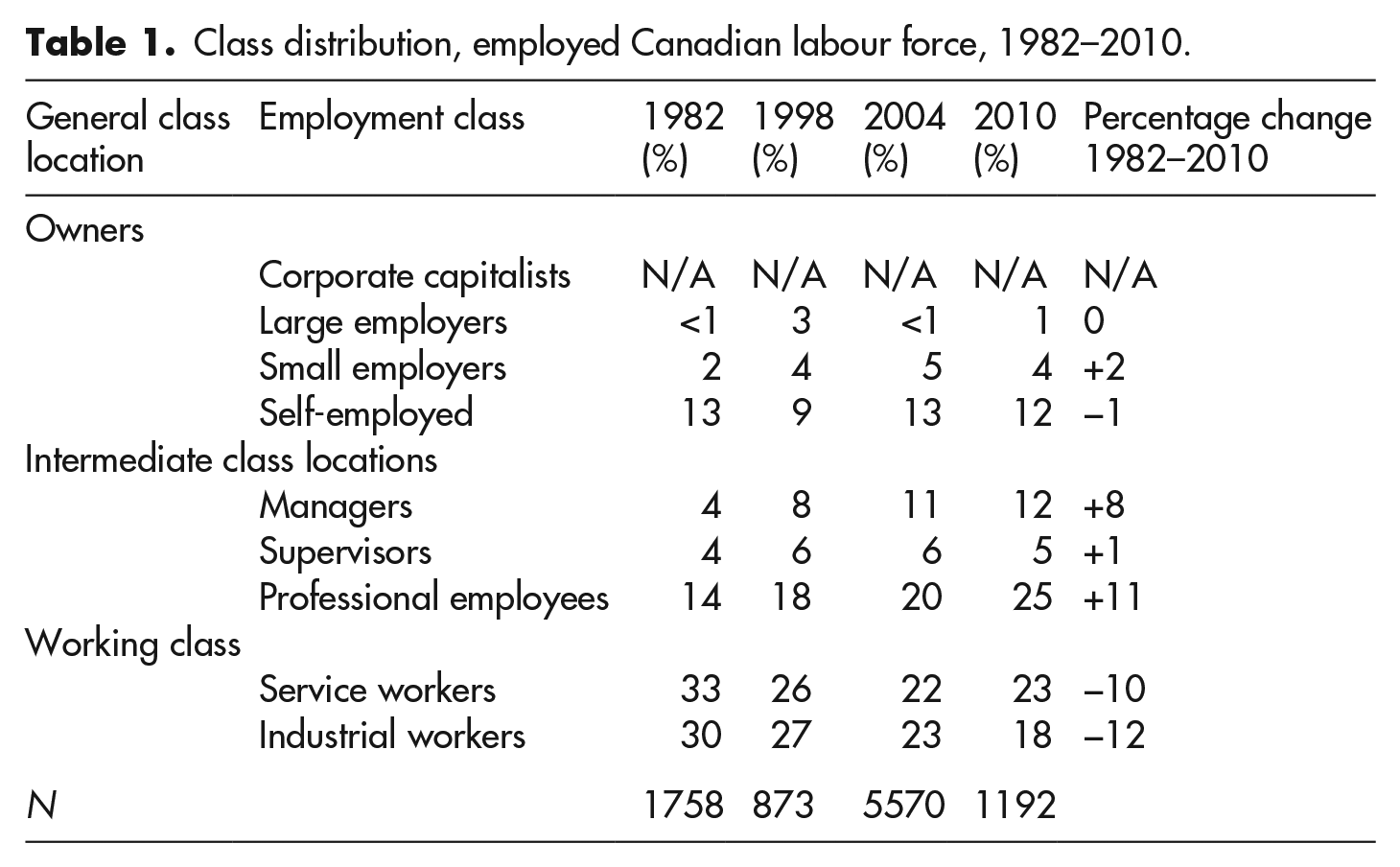
The absolute growth of professional and managerial positions is as predicted in terms of the need to coordinate, control and provide techno-scientific expertise in an increasingly capital- and technology-intensive labor process (Kenney 1997). The decline of manufacturing jobs during this period is a consequence of automation and export of less skilled jobs to less developed countries. The decline of service workers may be less expected because service sector employment generally has grown. But automation and routinization have also led to the rapid rise of self-service (think of the declines of bank tellers, secretarial pools, travel agents and toll booth collectors), growth of back office administrative functions, as well as the export of portable service jobs. In any case, these surveys suggest that all three general class locations (owners, intermediate and working classes) are now of substantial size in Canada. Other empirical research on general occupational change in Canada has found similar trends in the growth of managerial and professional occupations. Using national level census data, both Baldwin and Beckstead (2003) and Lavoie et al. (2003) have concluded that such ‘knowledge work’ is growing significantly in Canada. However, as a cautionary note, it should be recognized that there may have been inflation of managerial job titles and semi-professional occupational designations during this period.
Ownership, managerial authority and specialized knowledge
Table 1 suggests that large employers have been a tiny portion of the Canadian labour force throughout this period. While their numbers are too small for accurate estimates of change with these samples, even if the cutoff limit is as low as 10 employees, they are likely to remain at less than 1 percent of the labour force. These surveys are also consistent with mounting evidence that more national capital assets are being consolidated in fewer hands (Serfati 2014). The survey evidence suggests that small employers have also remained a consistently small percentage of the labour force. Small employers continue to generate large numbers of new jobs but often with very limited security for either their employees or themselves. The self-employed have continued to be a more substantial portion of the labour force, around 10 percent, albeit highly prone to downward mobility through bankruptcy into hired labour posts or unemployment, and more limited prospect of becoming successful enough to hire others and become small employers. Virtually all remain highly dependent on their own labour, whether in independent enterprises or subcontracting to larger firms.
Table 1 also indicates that managerial personnel increased significantly during this period to become over 10 percent of the employed labour force. Further analysis of these surveys (Livingstone et al. 2016) has found that the proportion of those with managerial titles who also exercise direct ‘line’ authority (as distinct from performing administrative ‘staff’ functions) in the labour process similarly increased to over 5 percent of the labour force. As the managerial hierarchy has expanded, more managers themselves are managed. In 1982, around a third of all managers had no manager above them to whom they were required to report; in 2010, the proportion had declined to around 5 percent. This change may be reflective of both a more collective form of labour process with greater consultative decision-making and a general inflation of the number of intermediate managers subordinated to other managers. Further survey questions find increasing proportions of the declining numbers of industrial and service workers reporting increased participation in decision-making in more mechanized production processes, whereas the participation of managers and professional employees remained stable or decreased.
The compositional shift to greater proportions of professional employees and declining proportions of industrial and service workers suggest that the number of jobs with specialized knowledge qualifications is probably increasing. These surveys find that the proportion of Canadian wage and salary earners who required a post-secondary credential to get their jobs increased greatly from around a quarter in 1982 to over half by 2010. The diminishing numbers of industrial workers and service workers have seen educational requirements for getting their jobs increase even quicker. Only around 10 percent of both groups required post-secondary qualifications in 1982; by 2010, about one-quarter of industrial workers and over a third of service workers needed such qualifications.
Formal educational requirements are a limited proxy for labour process requirements and may involve significant credential inflation compared to the specialized knowledge and skill actually needed to perform particular jobs. But reported training time in specific vocational preparation to perform jobs competently has also become longer on average over this period. In 1982, around 70 percent of all hired employees reported becoming competent in their jobs in less than six months; by 2004, only around half achieved competence that quickly. The most significant increases in training time appear to have been among industrial workers. In 1982, less than a quarter of industrial workers needed a year or more on the job to become competent; by 2004, around 40 percent needed this long. The labour force is becoming much more highly educated in terms of formal schooling. Participation in job-related further adult education courses has also increased greatly. It is also now well-documented that hired employees are much more extensively engaged in informal job-related learning practices than formal education and that this is as true for industrial and service workers as for professional and managerial employees (Livingstone 2012). However limited the formal educational requirements may be as a proxy for the actual specialized knowledge needed, it is also true that those in all employee class positions are increasingly exceeding formal requirements and experiencing increasing underemployment of their qualifications; while this is particularly the case for service and industrial workers, it is also true for professional employees and managers (Livingstone 2009).
The deskilling–reskilling debate that has preoccupied many since Braverman has been fraught with conceptual confusion that we will not rehearse here, 6 except to note that the notion of skill contains at least three relevant dimensions: complexity, intensity and autonomy–control. Autonomy–control, which refers to the extent to which the worker has discretion over the manner of task(s) performance, is most relevant for the present analysis. Survey questions have found that clear majorities of managers, supervisors and professional employees believe they can design their own work most of the time, whereas only minorities of service and industrial workers do so. But managers, supervisors and professional employees indicate some decline in their sense of design control in this period, whereas increasing proportions of service and industrial workers express a sense of control.
Working class employees make many micro choices needed to keep the capitalist labour process going (e.g. Kusterer 1978). These survey responses indicate trends to increasing consultation in organizational decisions and increasing discretion in technical design of more information-based tasks for the declining numbers of clearly working class employees. There are also reverse tendencies in this period in public sector organizations facing neo-liberal austerity measures (e.g. Carter et al. 2011). In any case, such perceived increased discretion has occurred at the same time as expansion of managerial positions increases overall control and surveillance of the labour process, and along with more limited recognition and considerable underemployment of subordinates’ formal specialized knowledge.
Findings II: Class consciousness by class position
Prior empirical research on class consciousness
Empirical research on class consciousness has focused primarily on class identity and indicators of oppositional consciousness (in terms of support for the rights of capital and labour). Marxist class schemes have generally posited significant differences in class consciousness between the bourgeoisie and the proletariat, but vary in how these two polar classes are defined as well as consequent differences in distinguishing intermediate classes and predicting their consciousness (see Livingstone & Mangan 1996).
In the decade or so after the working class rebellions of the late 1960s, there were several empirical studies of the capacity of various Marxist and Weberian-based class schemes to distinguish expressions of class consciousness. Using survey data from around 1970 for the USA, Britain and/or Australia, several researchers concluded that both Marxist and Weber’s original class divisions had statistically significant links with both class identity and selected political attitudes (e.g. Robinson & Kelley 1979). But, drawing on a 1972 US national election survey, Goertzel (1979) found that a dichotomous capital–labour class model was very limited for differentiating class identities and political attitudes and that the distinctive views of professional and managerial workers should be more fully recognized.
Wright’s (1997) extensive assessment of the association between class position and class consciousness was based on surveys administered in several countries during the early 1980s. He concluded that: the basic patterns of the relationship between class location and class consciousness were broadly consistent with the generation of people’s subjectivity by experiences and interests within employment positions, with polarization between more fully proletarianized hired workers and capitalists; and there were notable variations in associations between class location and class consciousness between countries and between men and women. Comparisons of Marxian and Weberian-based class schemes using Canadian national survey data from around 1980 found that occupational status scales were better predictors of class identity (Livingstone & Mangan 1996). Marxian class schemes were somewhat better at distinguishing differences in political attitudes; in addition to the predicted polarity between the bourgeoisie and working class, both the traditional petty bourgeoisie and other intermediate class groups expressed distinctive political attitudes (Johnston & Ornstein 1985). Livingstone and Mangan (1996) used a survey conducted in a Canadian city in the mid-1980s to compare Marx’s original model, several neo-Marxist schemes including Wright’s 12 class model, Weber’s original model and several derived stratification scales including Bourdieu’s, both in terms of their structural correspondence and each model’s ability to predict expressions of class consciousness. They found significant associations between employed men’s current locations in the employment class structure and their expressions of class consciousness using most of these (highly correlated) Marxist and Weberian class schemes.
In one of the few more recent studies, Western (1998) conducted an analysis of a 1995 Australian survey that identified class positions similar to Wright’s later schemes and used the private sector working class as the main reference group for comparisons with other class groupings. He found that people’s views on class-based economic issues reflect their own class circumstances, particularly polarization between the private sector working class and private employers, and that there was greater difference of working class positions from managers and professional employees in the private sector than in the public sector. Such sector differences are suggestive for further attention to value extraction in the private sphere where vendible commodities are produced.
Generally, neo-Weberian occupational status scales have been better than either Marxist class schemes or Weber’s original social class divisions at predicting subjective class identity, which tends to be a fairly diffuse, consumption-related perception. Marxist class schemes based on property divisions and incorporating power relations within the labour process have generally been better at predicting aspects of oppositional class consciousness than either simple owner/non-owner dichotomies or occupational status scales that confound basic property-based class divisions with mediating factors such as education, income and prestige. Value relations are rarely investigated.
Most prior surveys of class consciousness have been one-time cross-sectional studies and few have been conducted since the 1990s. The 1982, 2004 and 2010 Canadian surveys offer measures of class identity and oppositional consciousness that permit some inferences about trends in and current relations between class structure and class consciousness. The findings will be summarized first in terms of class identity and then a composite indicator of oppositional consciousness based on support for rights of capital and labour.
Class identity
People who identify as ‘working class’ are defining themselves as subordinated to others either in employment or living conditions, as distinct from those who see themselves as in a higher class because of relatively greater wealth, income or job qualifications. Table 2 summarizes the basic patterns of working class identity by employment class.
Employment class position and working class identity, employed Canadian labour force, 1982–2010.
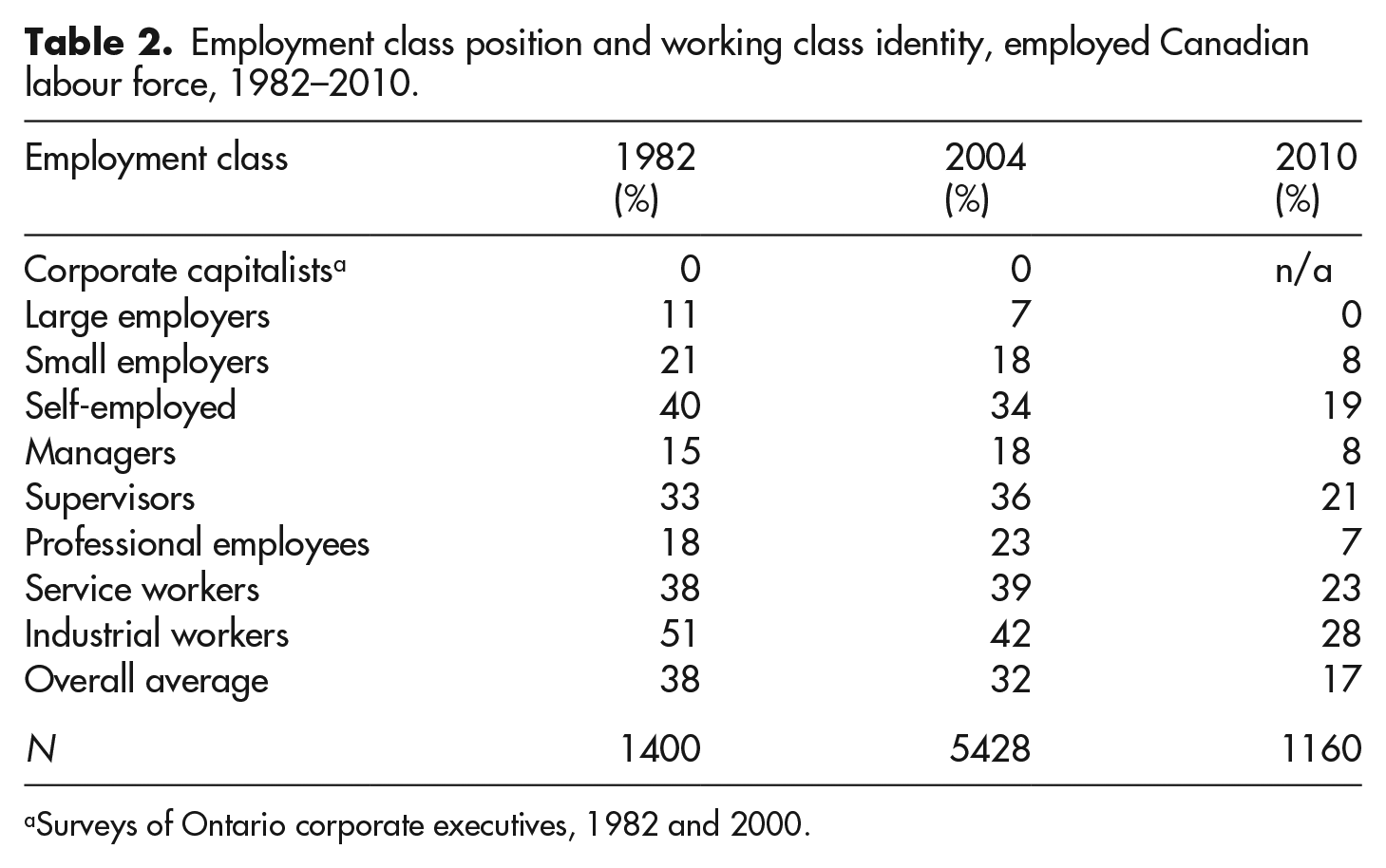
Surveys of Ontario corporate executives, 1982 and 2000.
Overall, the proportion of the employed labour force identifying as working class was nearly 40 percent in 1982 and declined to under 20 percent by 2010. The highest incidence of working class identity is consistently among industrial workers, but this declined from over 50 percent in 1982 to just under 30 percent in 2010. The pattern is similar among industrial workers in general and in the private goods-producing sectors. General declines in working class identity were registered in other employee classes as well. Managers and professional employees, with minor fluctuations over time, have consistently been the least likely employees to take on working class identities. Among owners, large employers rarely have seen themselves as working class, and by 2010 virtually none did so. A unique series of Canadian surveys of private corporate executives between 1980 and 2000 found that over 90 percent of these very large employers consistently saw themselves as upper class or upper middle class throughout that period. 7 Among all other employment classes, the dominant trend during 1982–2010 was for more to see themselves as ‘middle class’.
Further analysis has found that women in industrial and service worker positions have been more likely than men to express working class identities, and non-whites have been more likely than whites to do so. Majorities of non-white female industrial and service workers still tend to have working class identities, reflective of most discriminatory working conditions. Those workers with lower skill requirements for their jobs and less design control in the labour process generally tend to be more likely to indicate a working class identity. Private goods-producing sector workers still express a relatively high working class identity in 2010, around a third. Unskilled, non-unionized— and thereby most vulnerable—private sector industrial workers are higher at about 45 percent. Unionization is associated with higher incomes and higher incomes associated with more middle class identities. Among service sector workers, lower unionization and lower incomes as well as greater proportions of racial minorities and women may be associated with more working and lower class identities. Skilled unionized industrial workers with higher incomes have tended to regard themselves in the middle of their own class schemes between the rich and the poor, but with growing awareness that ‘jobs for life’ and positions in the middle of the class structure have been declining (Seccombe & Livingstone 1999).
The dominant trend to increasing middle class identity is probably associated with increasing levels of mass consumption (Curtis 2013) as well as increasingly pervasive ideological inducements to think of one’s class position in terms of consumption patterns. It may also be reflective of the declining numbers in clearly working class positions, as well as associating increasing skill requirements and perceived increases in design control within remaining jobs with higher economic status. So, there is currently both a declining conventional working class and declining working class identity in the employed Canadian labour force. But substantial numbers among the private sector workers most evidently exploited in value terms or oppressed in working conditions continue to think of themselves as working class. Also, as we shall see, many hired workers who see themselves as ‘middle class’ also express pro-labour oppositional consciousness.
Oppositional class consciousness
The fundamental imperative of capitalism is profit maximization. The extent to which owners and workers support this principle is a key indicator of the extent of oppositional class consciousness. An indicator used in all these surveys has been the extent of agreement with the statement that ‘Corporations benefit owners at the expense of workers’. The findings suggest that throughout this period there has been a general majority sentiment that corporate profits have prevailed unfairly over benefits to workers. There may have been a slight decline from over two-thirds in 1982, but in 2010 nearly 60 percent of the employed labour force still held this view. Among employees, three-quarters of private sector industrial workers expressed the strongest opposition in 1982, declining to about two-thirds in 2010. Service workers and professional employees have also continued to express clear majority opposition, also with some possible recent decline. Among managerial personnel, supervisors also expressed majority opposition throughout this period, while opposition may have grown from a minority to a majority among managers. Among owners, the self-employed have consistently expressed majority opposition to corporate profit taking, which they often perceive to be directly at the expense of their own enterprises. Small employers have expressed more mixed views, largely according to the profitability of their own firms. Within the limits of their very small sample sizes, more large employers may have come to recognize the social costs of maximized corporate profits. In contrast, the surveys of corporate executives between 1980 and 2000 found constant near-unanimous support for unconditional profit maximization. The continued unanimity among this core of the capitalist class coupled with some apparent declines in opposed sentiments to profit maximization among hired employee classes is consistent with an increasingly widespread ideology of neo-liberalism extolling the benefits of ‘free’ markets.
The most basic right of hired workers in capitalist economies is the capacity to withhold their labour to negotiate for more tolerable working conditions. The right to strike has been as central to the sustainability of labour as profit maximization has been to the reproduction of capital. Support for the right to strike has been assessed in all these surveys by extent of agreement with the statement: ‘Management should not be allowed to hire replacement workers during a strike’. Opposition to the hiring of ‘scab’ workers was generally over 60 percent in 1982 and may have declined somewhat to closer to 50 percent by 2010. Among hired employees, private sector industrial workers expressed the strongest opposition in 1982 at over 70 percent but their opposition declined to just over 50 percent by 2010. Service workers expressed similar patterns of declining opposition. Professional employees and supervisors indicated consistent majority opposition to scabs during this period. Unionized workers generally expressed stronger opposition to scabs than non-unionized workers, some of whom may be compelled to serve as replacement workers themselves. Non-white workers in particular were both less likely to be unionized and less likely to be opposed to scabs. Managers were the only employee class in which a majority supported use of replacement workers during this period. These findings suggest that a decline in traditional labour support for the right to strike may correspond with the general decline of the numbers of industrial and service workers and associated decline in numbers of members of previously established unions. But this decline is counterbalanced by the growing numbers of professional employees who have joined unions and comparable associations with similar collective interest in protecting their negotiating rights on working conditions (Livingstone 2014). Among owners, both corporate capitalists and large employers have become increasingly solidary in their support for using replacement workers in pursuit of flexibility in their labour forces. However, small employers express growing opposition to scabs and more sympathy for workers they must work with closely in competition with larger enterprises, while the self-employed are also increasingly opposed as they become more equivalent to contract workers themselves.
Combining views on these indicators of support for the rights of capital and labour generates an index of oppositional class consciousness: the extent to which respondents consistently favour the interests of capital, the interests of labour, or hold more mixed views. Those who support corporate profit maximizing and use of replacement workers during strikes are considered to be consistent supporters of capital interests. Those who believe private corporations benefit at the expense of workers and oppose the use of scabs are considered to be consistent supporters of labour’s interests. Table 3 summarizes the basic findings.
Oppositional class consciousness by class position, employed Canadian labour force 1982–2010.
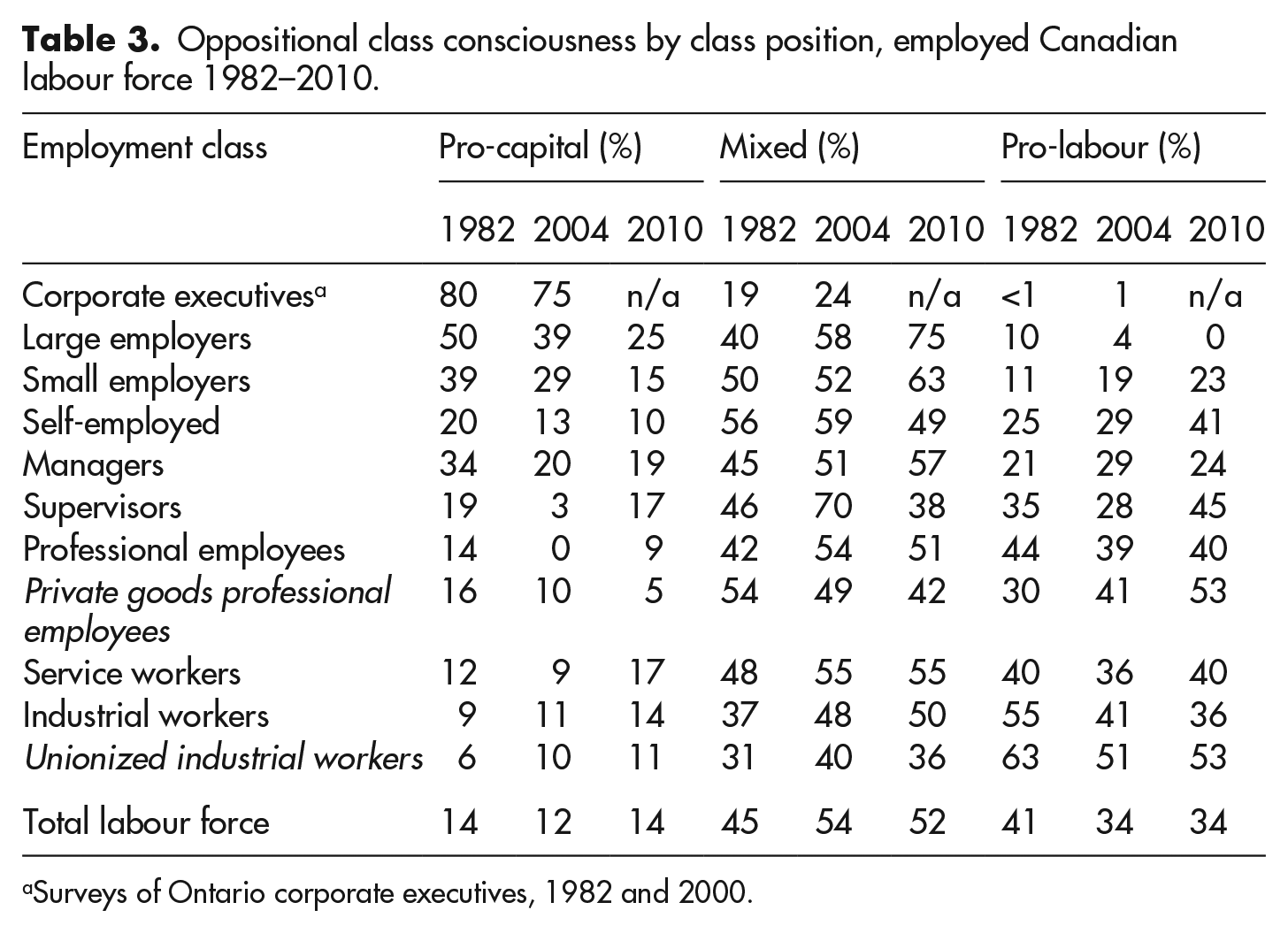
Surveys of Ontario corporate executives, 1982 and 2000.
In 1982, a majority (55 percent) of industrial workers—the traditional core of the working class—indicated consistent pro-labour views. By 2010, a majority of industrial workers expressed more mixed views and less than 40 percent were consistent supporters of labour rights. Further analysis finds that a majority of unionized private industrial workers continued to express pro-labour consciousness in 2010. Among most other hired employees, mixed views have continued to prevail. But pro-labour views are now as likely to be found among service workers, professional employees and also supervisors, as among industrial workers. The increasing similarity of professional employees and supervisors with industrial and service workers in terms of pro-labour consciousness may be a reflection of increasing proletarianization of intermediate employees’ working conditions, as indicated by decreases in their perceived workplace control. In particular, a majority of private goods-producing sector professional employees, such as engineers and technologists, have come to express pro-labour views by 2010. It may be that the specialized knowledge of these professional employees enables relatively clear perception of the value of their work in relation to the profits of their companies. Mixed views have continued to prevail among managers in general, but lower level managers are now more likely to express pro-labour views than pro-capital ones. Among owners, the corporate capitalist core has consistently maintained very strong capitalist consciousness, including unanimous support for profit maximization as the future organizing principle for the economy. 8 But both large and small employers appear to have diminished their support for capital rights and increasingly expressed more mixed views. The self-employed continue to express more mixed views with increasing support for labour rights. Overall, the views of most members of owner classes and most employee classes including the traditional industrial core of the working class have become more mixed. Mixed class consciousness has continued to be most common in the labour force generally, but pro-labour minority views have continued to be much more likely than pro-capital views.
Over 70 percent of union members identifying as activists expressed consistent pro-labour oppositional consciousness with higher rates among union activists in private industrial firms. It could be expected that those taking leadership roles in trade unions would exhibit a high ‘trade union consciousness’. But further evidence on preferred visions of society finds that neither unionized workers nor union leaders generally express much opposition to profit-making as the future driving force of society, in contrast to corporate executives’ unanimous and most other owners’ strong support.
The relationship between class identity and oppositional class consciousness appears to be shifting. Conventional notions of levels of class consciousness associated pro-labour oppositional views with ‘working class’ identity. But identifying oneself as ‘middle class’ may be increasingly accurate for many hired employees in this advanced capitalist country, in the sense that they see themselves between the extremely wealthy and the growing numbers of marginalized and impoverished at home and abroad. Dominant discourse now commonly conflates ‘middle class’ with ‘working people’. Identifying oneself as middle class has not prevented the increasing development of pro-labour oppositional class consciousness among workers beyond narrow definitions of the proletariat.
Based on these data, the current general condition of class consciousness may be seen as approximating the classical situation of ideological hegemony (Livingstone 1976), where the leading fraction of the dominant class consistently believes in and acts to realize its class interests while other classes generally express more mixed or contradictory views and are vulnerable to alliances and actions against their class interests. But majority opposition to capital interests persists among unionized private sector industrial workers and appears to be developing among private industrial sector professional employees.
Concluding remarks
We have offered an assessment of the changing general class structure grounded in production relations in one advanced capitalist ‘knowledge economy’ and of the extent to which different class locations in production are associated with general expressions of class consciousness. On the basis of a series of national surveys between 1982 and 2010, we have found that the traditional working class has declined as a proportion of the employed labour force while professional employees and managers have increased.
The decline in traditional working class numbers has been associated with declining working class identity and an increase in middle class identities. In terms of oppositional class consciousness, the corporate capitalist class has continued to have highly developed hegemonic class consciousness. The industrial core of the traditional working class exhibited the highest working class identity as well as pro-labour oppositional consciousness at the outset, but these views have declined with its numbers. Most general employment classes have expressed increasingly mixed forms of class consciousness through this period. The most notable exception is the private goods-producing industrial sector, where the majority of unionized industrial workers have continued to express pro-labour views, and professional employees have increasingly done so. This is consistent with the notion that both of these groups of workers are centrally involved in creating capital-intensive vendible commodities and are well-placed to perceive that they are among the most exploited workers in a ‘knowledge economy’. The general findings are broadly comparable with the few other fairly recent cross-sectional analyses of production-based classes and their class consciousness (Western 1998; Wright 1997). But we conclude that class positions in production and value relations have more complicated and changing associations with expressions of class consciousness, in terms of changes in perceptions of ‘middle class’ identity, increases in mixed oppositional consciousness and a greater pro-labour consciousness apparently linked with productive labour in goods-producing sectors.
Critics may rightly respond that such macro-level profiles provide little insight into the concrete realities of class relations lived through race, gender and generational dimensions as well as in household and community spheres. As previously noted, survey data generally offer merely rough approximations of class relations among employment aggregates. But these profiles do provide estimations of general differences and changes in production-based class structures and expressions of class consciousness that, however complexly mediated, may represent contextual limits and general dispositions for current actions and alliances among specific class groups. For example, private goods-producing professional employees who now express a relatively high and increasing pro-labour oppositional consciousness could have increasing potential to lead a labour movement of the early 21st century, comparable to the role of skilled craft workers of the 19th century. Professional employees in general are now the most highly organized class group in Canada, with the majority now having membership in unions and associations (Raykov & Livingstone 2014).
The continuing socialization of forces of production (e.g. the Internet) means that there is increasing access to production information for the potential labour force of advanced capitalism at the same time as popular demand for formal education continues to expand. The increasingly capital-intensive production process requires increasing active engagement of the minds of many of the remaining hired workers. Use of tactics of responsible technical autonomy and local decision-making in the capitalist labour process, as reflected in increasing relative discretion for industrial and service workers in these surveys, is indicative of continuing revision of production relations. A central question is whether these revisions within the capitalist labour process will continue to diminish working class identities and defuse pro-labour oppositional consciousness. Gross inequities of reward are blatant, underemployment is increasingly chronic and a highly qualified reserve army of labour of unemployed and marginalized people is growing. Indeed, it could be argued that advanced capitalist countries such as Canada are now ‘knowledge societies’ with much larger proportions of well-qualified people than their narrow ‘knowledge economies’ are able to utilize (Livingstone 2009). In this context, the working conditions and class consciousness of those who are most directly exploited in knowledge economies—including arguably both private sector industrial workers and professional employees—are at least worthy of further critical investigation.
Social protests against the inequities and excesses of capitalism continually erupt. In the wake of the Great Recession of 2008, speculation abounds about future prospects for capitalism (Mann 2013), and leftist scholars reflect soberly about class fractions with the potential to lead offensives challenging capitalist hegemony (Therborn 2014). The present analysis suggests that the corporate core of the capitalist class remains solidary. At least in a country as apparently comfortably integrated within advanced capitalism as Canada, mixed class consciousness has continued to prevail among most employment class positions. But even here, disaffection and skepticism with capital’s domination over labour is widespread among many class positions. General sentiments of resistance among production-based classes—the ‘residual’ industrial working class, professional employees, service workers and others—remain fertile ground for progressive change. Sustainable progressive change will surely involve alliances between activists in relatively secure and more precarious employment class positions as well as the relative surplus population in both advanced capitalism and the developing and underdeveloped world (Neilson & Stubbs 2011). But class relations continue to animate central parts of our lives. Without class analyses connected to production relations we may be unable to comprehend effectively the resonance of broader social movements with genuine sentiments of resistance among the employment classes in advanced capitalism that serve to reproduce and change the capitalist labour process on a daily basis.
Footnotes
Funding
This research was funded by the Social Sciences and Humanities Research Council of Canada, mainly from research grant # 512-2001-0018.