



Abstract
Although vastly outnumbered by strikes, workplace occupations were a relatively well-used tactic in Britain in the 1970s and 1980s, because they allowed workers to exercise more influence from inside the workplace than outside the workplace. Yet the tactic has been little used in the new millennium when workplace closures abounded. A successful occupation by workers at Burntisland Fabrications in late 2017 is used as a lens by which to reconsider the tactic’s utility and the frequency of its usage. This is critical to understanding the specific contexts of when the process of occupation can result in a positive outcome for workers as well as for what particular purposes it is now used.
Introduction
Notwithstanding that strikes in Britain have historically been the most frequently deployed form of collective resistance in the workplace, the tactic of workplace occupation in industrial disputes with employers was a relatively well-used one by workers in the 1970s and 1980s. Occupations were particularly used to fight plant closures and mass redundancies because they offered the possibility of exerting more influence from inside the workplace than by walking out on strike, putting workers outside the workplace, from which trying to control the movement of labour, materials and goods by means of picketing is more difficult. This is due to the ability under occupation to control access to and from the workplace (from within with fewer numbers of workers than by organising mass picketing outside), thus, preventing the removal of assets or the entrance of blacklegs. However, the tactic was little used in the short run aftermath of the financial crash of 2007–2008 when many plant and other workplace closures took place (Gall, 2011), showing that the Observer (26 April 2009) vastly overestimated the number of occupations and sit-ins: ‘Similar worker occupations [to the Visteon occupations] have been springing up all over the country’.
An occupation, accompanied by a work-in, was undertaken by hundreds of workers at BiFab (Burntisland Fabrications) in late 2017 in Scotland to successfully save their jobs. It serves as a useful prompt to reconsider the utility of the tactic and its frequency of usage as the size of the manufacturing sector and its workforce continue to contract and as public sector workplaces continue to shut in the enduring ‘age of austerity’. Indeed, the BiFab case can be used as an appropriate lens, along with the deployment of mobilisation theory (see Kelly, 1998), to understand the specific contexts of when the process of undertaking an occupation can result in a positive outcome for workers. So, drawing upon media reporting, both mainstream and left-wing, this piece first details the BiFab occupation and the other known occupations since 2010 in order to build upon previous research on the frequency of occupations in Britain in the new millennium (see Gall, 2010, 2011). Six factors – collectivised nature of redundancy, immediate and unforeseen nature of redundancy, loss of deferred wages (pensions) and compensation, pre-existing collectivisation, and positive demonstration effect – were identified as being critical to explaining workers’ willingness to undertake occupations (Gall, 2011). Thus, this article sets out an analysis of why and how the occupations took place in order to develop an assessment of why overall so few occupations have been used by workers in Britain to resist recession, austerity and neoliberalism.
BiFab occupation
For a week in late November 2017, workers at three fabrications yards (Burntisland and Methil in Fife, and Arnish on the Isle of Lewis) staged a work-in and occupation in response to BiFab announcing it was about to enter into administration (as a prelude to receivership) as a result of only being paid 40% for the 77% of work it had carried out for its client, Seaway Heavy Lifting (SHL), which had been contracted by energy provider, SSE, to build an offshore wind turbine farm. The workers faced both not being paid their due wages and mass redundancy. The workforce comprised 250 workers employed by BiFab and 1,150 sub-contractor workers, organised by the GMB and UNITE unions with over a 50% density. In order to put pressure upon SHL and SSE as well as the Scottish Government (which has a green energy policy and licenced the offshore farm), the workers agreed at the behest of full-time union officers (Red Robin, 2018) to work without wages with the purpose of continuing production of the turbine jackets while also taking control of the yards so that, in the words of a GMB Scotland organiser: ‘Nothing will come and go without the say so of the action committee’ in order to maintain control of their key bargaining chip, the jackets, and prevent asset stripping. The workers pledged to continue to carry out the occupation and work-in until Christmas and beyond if necessary to secure their jobs. In a joint statement, the GMB and UNITE then said: ‘Make no mistake these yards would be closed today if it wasn’t for the dignity and determination of the workers and their families in Fife and Lewis to save their jobs and industry. With their futures on a knife edge they worked for nothing, stayed strong and resolute and by staying united they have won their future’.
The work-in was used as a legitimatising tactic for the occupation, whereby the workers sought to show that they, the victims, remained willing and able to work. Management did not obstruct the occupation and work-in, owing to their temporary alignment of interests with the workforce, namely to gain payment from SHL and SSE for the work already carried out. A high-profile demonstration was held outside the Scottish Parliament, crowning extensive media coverage during the week. The unions, aided by the Scottish Trade Union Congress (STUC), called for BiFab to be taken into public sector ownership if the company did enter receivership. These pressures forced the Scottish Government to intervene in order to broker a deal between SHL and SSE to resolve BiFab’s liquidity problem with the effect that wages were paid and employment guaranteed until April 2018. The Scottish Government also pledged to provide commercial loans to BiFab if necessary.
Like many on the left, the Solidarity newspaper (24 November 2017) opined: ‘The message from the dispute, short as it was, is: direct action works’, the Scottish Socialist Voice (25 November 2017) ventured: ‘It signals the truth of the old adage, ‘If you stop running they’ll stop chasing you’, and The Clarion (issue 11 December 2017) stated: ‘[The] BiFab victory shows workers’ power the workers … [and] their radical action will shape industrial relations for a generation’. The Socialist Party Scotland (SPS, 2018) then pronounced: ‘The victory … was another example of what is possible when workers move into struggle’. In seeking to make political capital out of the event, the radical left showed a deficiency in understanding the interaction of processes and outcomes at work and the specificity of the conditions under which they operated. The message that direct action is ‘possible’ and ‘works’ at BiFab did not take into account the specificity and combined inter-relationship of the factors of group cohesion, generation of a usable bargaining asset, ability to create political pressure, buoyant product demand and the strategic importance of energy infrastructure. These factors are not necessarily present for all workers and nor is their combined impact true for all other workers. For example, group cohesion, aided by an occupational identity of skilled manual work and high union density, was highlighted by solidarity strikes at BiFab in 2013 and 2015 when directly employed workers struck in support of contractor workers, and the intersection of significant public and private interests provided for the opportunity for workers to exercise both economic and political power. Identifying and understanding the existence of such factors as well as their inter-relationships is as vital to understanding why collective resistance is possible as it is to how it can be successfully deployed, and whether such successes can be replicated in other instances, because struggle per se is not a guarantee of success.
Before examining other occupations, the value of these insights has been reinforced by developments at BiFab a few months later. In February 2018, BiFab provided its workforce with the statutory 45-day notification of the potential for redundancies among permanent and temporary workers as a result of the approaching completion of the turbine jacket work. Although most of the more immediate ‘at risk’ workers were temporary workers at Arnish, the possibility of the other yards closing in the longer term also existed. The response of the workers’ two unions was to engage in political lobbying and to state that jeopardy to the jobs and yards highlighted the need for a national industrial strategy to protect and augment the manufacturing base. The contrast between the events of November 2017 and February 2018 was then stark. 1 The difference hinges upon a number of factors, of which the most crucial were that the threat to the jobs and yards was not unexpected as the winding down of the project gathered pace and some forewarning had been given. So there was no sudden jolt to the workforce with the prospect of penury, and not all the workers were affected in the same way, with some facing redundancy in the short term and others in the longer term. Moreover, a period of consultation helps dissipate anger and provides for some acclimatisation with redundancy payments for some softening the blow.
Other occupations
Seven workplace occupations were recorded in the immediate aftermath of the financial crash, namely between 2007 and the beginning of 2010 (Gall, 2011). A further short-lived one was subsequently identified at the Solectron factory in Cwmcarn, South Wales over the nature of the process of plant closure and redundancy in 2007. Like the seven others, it was of some use in gaining enhanced redundancy terms. A number of other occupations took place since the beginning of the new millennium and prior to the financial crash. Thus, a sit-in was conducted for several days as a part of a strike in 2000 by construction workers over health and safety at the Kent Pfizer plant. The dispute had a successful outcome for the workers. Also in 2000, workers at Fullarton Computer Industries in Ayrshire undertook an unsuccessful occupation to stop redundancies and plant closure. A 2-day sit-in at a Middlesborough construction site was staged by workers over workplace monitoring in 2001 with a successful outcome. In 2002, workers at Fineline Clothing in Flintshire and at Universal Bulk Handling in Lancashire in 2003 also undertook occupations against redundancies and plant closure. And, in 2006, a short-lived sit-in was undertaken as a part of an unofficial strike by Oxford postal workers over pay. This was the latest in a clutch of sit-ins of works canteens used by postal workers as on-site strikes to resist victimisation of fellow workers or unilaterally imposed shift changes (see Gall, 2010: 212). Therefore, between 2000 and 2010, some 19 occupations and sit-ins were staged. From 2010 to 2017, 12 occupations have taken place of which the longest and largest one has been the BiFab one.
Thus, in 2010, 40 construction workers at a Nottinghamshire power plant staged a short sit-in over working time. In 2012, workers conducted a short-lived occupation of the MMP Bootle factory during a strike over redundancies and redundancy payments. In 2013, as a part of an unofficial strike against pay cuts, 300 Brighton refuse workers occupied the council’s main depot for 2 days. Also in 2013, staff, and their supporters, at the Wallsend Memorial Hall occupied the main building for 4 weeks to prevent its repossession, gain unpaid wages and stop redundancies being issued, while cleaners, organised by the IWGB union, briefly occupied the foyer of the offices of a Canary Wharf law firm as a part of a wider strategy to put pressure on their employer, MITIE, over pay and bullying. MITIE was contracted to clean the offices. The IWGB has also used the occupation tactic as a form of short but high profile, disruptive protest, along with strikes and as a part of wider leverage campaigns, at the operations of clients of their members’ employers over similar issues. Examples are those at John Lewis (2013), the Barbican (2013) and CitySprint (2015) with cleaner and courier members. Those participating in the occupation were a mixture of members and supporters. 2 In 2015, staff and supporters at the Leicester Square School of English engaged in a 3-day occupation over redundancy and unpaid wages. Also in 2015, 100 workers at the Kozee Sleep bedding factory in West Yorkshire staged a short occupation over non-payment of wages after the company went into administration. In 2016, a short-lived occupation of the site office of the main Crossrail contractor in London in a wider dispute was undertaken over the victimisation of union representatives and absence of negotiating rights over pay.
In all but 4 of these 12 occupations (66%), a degree of minimal success was accorded to the actions in terms of gaining monetary compensation rather than desisting deleterious changes. Compared to the 19 occupations of 2000–2010 where 58% were concerned with redundancy and closure or fighting for better severance terms for redundancy and closure, of the 12 occupations since 2010, only 42% concerned these issues, suggesting that where the tactic is used it is now less focussed upon redundancy and related issues. This suggests the term, ‘sit-in’, is more appropriate to describe short-lived actions that take over workplaces (or part of them) from the inside and are also part of a strike. So, the sit-in is more akin to a sit-down strike in that it is more used as a tactic within a strike and to either fight the effects of redundancy (like unpaid wages and redundancy money) rather than redundancy per se, or to tackle other issues unrelated to redundancy. By contrast, ‘occupation’ is a more appropriate term to describe longer lived actions that take over workplaces from the inside and seek to bargain with the assets which the occupation gives workers control over (like plant, materials and finished goods). Bargaining with these assets provides the relatively greater prospect of repelling redundancies and closure.
Historical knowledge and public awareness
Public awareness of the occupation tactic has been kept alive to some extent in Scotland by the celebration of previous occupations. The manner of these celebrations has bestowed profile and legitimacy. Thus, similar to the earlier 30th celebration of the Lee Jeans occupation in Greenock of 1981 involving a BBC documentary and a motion in the Scottish Parliament in 2011, generating sympathetic news coverage, the Caterpillar occupation of 1987 was also marked by a BBC documentary and a parliamentary motion in 2017. Public meetings and other articles in the radical left press accompanied these events. The Lee Jeans occupation also experienced further iconisation when it became the subject of a musical performed by members of the former workforce in 2017. The 40th anniversary of the Upper Clyde Shipbuilders (UCS) work-in occupation was also widely commemorated in 2011 in Scotland with similar celebrations (exhibition, gala concert) and widespread sympathetic publicity (especially after the death of its main leader, Jimmy Reid, the year before). Such celebrations kept alive popular historical memory of the tactic for the last major occupation of a workplace, which was the successful 7-week Glacier occupation in Glasgow in 1996. Prior to Glacier, Caterpillar was the last significant occupation. However, this has not led to a higher level of occupations in Scotland compared to elsewhere. Of the 31 occupations since 2000, only 4 (13%), including BiFab, took place in Scotland. To highlight this point further, the closure of the last remaining steel works in Scotland in 2015 was met without any industrial action.
This suggests, in line with the analysis above concerning group cohesion, bargaining assets, political pressure, product demand and strategic importance, that historical knowledge and public awareness are far from being necessary, let alone sufficient, to generate usage of the occupation or sit-in. Moving away from a focus upon Scotland, the irony of the juxtaposition of very few occupations with the rise and fall of the Occupy! movement of late 2011/early 2012 is also apparent. Although the Occupy! phenomenon in Britain politically contested the purpose and use of public spaces, it never occupied buildings of any strategic economic or political importance, so created no usable bargaining leverage. 3 Rather, all it was able to do, for a short space of time, was agitate ideologically and politically around a number of issues like the distribution of wealth and power. Consequently, it did not promote the tactic of occupation per se or of occupation in a particular context, for example, an industrial dispute. Along with the shrunken presence of the far left (Kelly, 2018), and the hegemony of formalised leverage campaigns (see below), there are now fewer effective and credible workplace agents advocating the occupation or sit-in tactic.
Contours of the lacuna of resistance
Rather than the ‘slack’ represented by falling levels of strikes being taken up by a commensurate rise in other alternative forms of collective action, collectivised resistance in the workplace has experienced a general suppression over the past 30 odd years in Britain (Gall and Kirk, 2018). Consequently, while there is merit in understanding the specificities of individual occupations-cum-sit-ins as well as the tactic per se, analysis of the phenomena and its frequency of use cannot be detached from this more general suppressionary effect. In an environment where striking is at its lowest historical level in Britain, with 2017 recording the lowest level of days not worked due to strikes since records began in 1893 (ONS 2018), it would be incomprehensible to find that occupation and sit-ins were frequent because they are direct relations of the strike. Yet that cannot be the end of the matter, for workers’ behaviour is, nonetheless, still based upon making choices like whether to undertake collective action or not, even if the range of choices and the freedom to choose have narrowed considerably (see also Gall, 2011: 608).
While recognising occupations are more demanding to undertake in terms of planning and resourcing than a normal 4 strike, issues like levels of redundancy pay, alternative local employment opportunities, workers’ age profile (vis-à-vis financial commitments and resources) and mobility to find new jobs are salient factors to consider in terms of whether the idea of the occupation tactic enters into workers’ minds as a response to the situation facing them – because workers at some level of consciousness calculate the appropriateness and costs/benefits of taking action. Such factors are likely to have a heavy bearing upon the extent to which redundancies are fought at all. Some indication of the changing balance of such factors may be inferred from the relative distribution of the number of days not worked due to strikes by cause (see Table 1). Thus, the height of resistance to redundancies took place during 2009–2010, falling sharply thereafter. This sharp fall will have reflected both the trajectory of fewer redundancies and closures as well as the availability of other employment opportunities as some growth returned to the economy.
Working days (’000s) not worked by principal cause of dispute, 2007–2017.
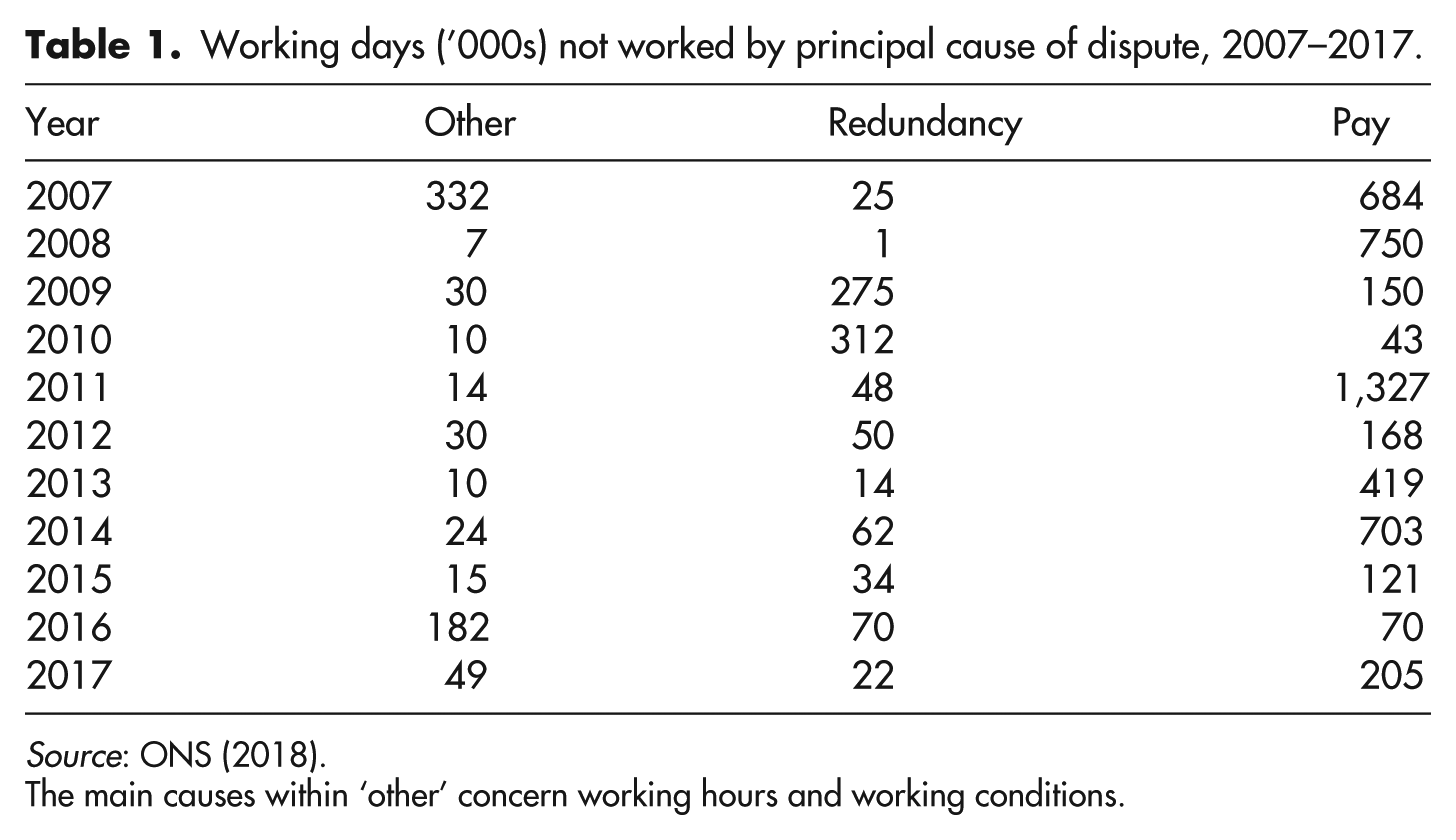
Source: ONS (2018).
The main causes within ‘other’ concern working hours and working conditions.
Leverage campaigns represent something of an alternative to occupations. Now often formalised into union operations, leverage campaigns deploy, inter alia, research, community coalitions, publicity and public pressure, political and regulatory pressure, and economic and legal pressure in addition to other traditional tactics like strikes. Prior to becoming formalised in the late 2000s, de facto leverage campaigns constituted consumer boycotts, publicity-seeking protests, questions in Parliament and the like. After formalisation, they now primarily comprise deployment of (1) content distributed via social media to create reputational damage and (2) publicity-seeking protests targeted at upstream and downstream operators in supply chains. UNITE and GMB are the major practitioners of leverage campaigns. Consequently, a number of unions offer formalised leverage campaigns, in addition to support for strikes, as a primary response to deleterious situations facing groups of their members. This support for leverage campaigns has tended to have the effect of excluding the occupation tactic as a contender for consideration among workers as a form of industrial action. It is in this context that we can see the significance of a BMW worker’s comment at its Cowley plant in 2009, about the occupation tactic not being raised by union leaderships:
If a single union official, or even a shop steward, had stood up at the meeting where we were told we were sacked and called for a sit-in, it could have been a very different story … We were all so angry. I feel sure we would have done it. But instead the union allowed us all to be marched off the site … If we’d had a sit-in on the production line when they sacked us, at the very least we could have won decent redundancy terms and money for retraining. (Socialist Worker 24 February 2009)
The greater recent preponderance of sit-ins is likely to result from them being a lower cost form of action which requires less planning, where they can be held in a more spontaneous matter and in response to a wider array of issues than merely redundancy. The almost complete absence of occupations or sit-ins in the public sector despite massive workplace and workforce retrenchment, union density four times higher than in the private sector and the intersection of public and private interests (as a result of the extensive use of private contractors to provide public services or services to the public sector) requires comment. Thus, it cannot just be factors concerning levels of redundancy payment and alternative employment opportunities which explain this absence. Analysis must also focus upon whether usable bargaining leverage vis-à-vis controlling assets (public buildings rather than materials, machinery and finished goods) can be generated through occupation and on the approaches of PCS and UNISON unions. The occupation tactic, in particular, could be used to develop political pressure upon government (central, local) by creating ‘political heat’ through making an occupation the centre of a campaign to simultaneously defend members’ jobs and services used by citizens. Of note at this point is that as before and after the financial crash, relatively frequent occupations of libraries, nurseries, leisure facilities and community centres have been undertaken, but by their users not providers, that is, workers.
Irish comparison
Using the quality, left-wing and specialist media in Eire, a comparison can provide some illumination. Proportionately speaking, the workforce size in Eire is less than 10% of that in Britain, suggesting that, all other things being equal, less than two occupations should have taken place in Eire (10% of 19 post-crash occupations). Yet between 2007 and 2009, there were some seven occupations and sit-ins in Eire against the terms of redundancy and workplace closure (Cullinane and Dundon, 2011: 628). Since then, there have been another nine, again exclusively concerning redundancy and workplace closure issues. Between 2012 and 2014, workers at retailers Game (13 stores), HMV (three stores), La Senza (one store) and Paris Bakery (one store), manufacturers Co-operative Poultry Products and Vita Cortex, and services providers Old Darnley Lodge and Target Express engaged in sit-ins. In 2016, workers at a Kerry Foods plant staged a short sit-in. This highlights that occupations and sit-ins are used to a far greater degree in Eire than in Britain. Suffice it to say, despite social partnership in Eire, a greater tradition of worker direct action exists, so not all things have been ‘equal’. This has been supported by a more permissive legal framework for such action compared to Britain with the effect that challenging the property rights of capital (through occupation) is relatively easier.
Conclusion
While the BiFab example serves to highlight the paucity of workplace occupations, examining its dynamics indicates the tactic is more likely to be used in situations where (1) continued employment and the employment relationship are immediately threatened, (2) there are available employer assets to generate leverage from and (3) there is possibility of exercising political leverage to force government intervention. Yet, this insight has to be held in the context that the sit-in tactic has been used more frequently recently as a means of increasing pressure upon employers by being a particular form of striking, where continuation of employment and the employment relationship were not at stake. 5 Such an approach is consistent with the mobilisation framework (see Kelly, 1998) in terms of understanding the later consequential steps in the process of turning anger into action as per the aspects of cost/benefit analysis known as opportunity costs as well as windows of opportunity to act.