




Abstract
Anti-immigrant racism has become a prominent issue in Northern Ireland since 1998. It is an issue that is routinely understood and tackled through a ‘race relations’ framework. The first part of this article outlines and discusses the data on immigration and on recorded racist incidents in Northern Ireland, within a race relations framework. The second part of the article argues that the race relations framework is inherently limited because it treats racism as a crime to be punished, rather than as a manifestation of contradictions within capitalism as a social system.
Introduction
Since the signing of the Good Friday Agreement (GFA) in 1998, there has been a significant increase in immigration to Northern Ireland from outside the United Kingdom and the Republic of Ireland. During the same period, and linked to immigration, the issue of racism has become more prominent in the media and in public policy. 1 The relative insignificance of immigration and racism to the region in the 1990s was one of the reasons why they were not topics that were covered in the 1999 Special Issue of Capital and Class on Northern Ireland. That these matters have grown considerably in importance in the two decades since can be seen in the fact that this article has been commissioned for this Special Issue.
This article is divided into two main sections. The first section outlines the data on immigration and on recorded racist incidents. I show that the aggregate-level data for Northern Ireland indicate a correlation between immigration and racial incidents. I argue that this, however, does not mean a causal relationship between the two. I then contrast two district councils in Northern Ireland – Belfast and Mid Ulster – to show that, although the presence of an immigrant or ethnic minority person is a necessary condition for a racial incident to occur, it is not a sufficient one. Belfast has both the highest number of immigrants and the highest number of racial incidents in Northern Ireland. The proportion of the population of Mid Ulster who are immigrants, or are categorised as minority ethnic, is similar to that of Belfast. Dungannon, the largest town in, and the administrative centre of, Mid Ulster, has both experienced the most rapid growth in immigration and has the highest proportion of immigrants of any part of Northern Ireland. In Dungannon, however, the rate of racial incidents is below the Northern Ireland average and immigration is largely viewed positively in the locality. I identify various factors that explain the differences in rates of racial incidents between the two places.
In the second section, I argue that the attempt to understand and tackle racism in Northern Ireland, as in the rest of the United Kingdom and in the Republic of Ireland, is limited by the race relations framework that underpins official and much civil society, anti-racist theory and practice. I point out that the race relations approach attempts to manage racism, not transcend it. The race relations approach treats racism as a crime to be punished, rather than as a manifestation of contradictions within capitalism as a social system. As such, it is confined to dealing with symptoms rather than underlying causes. I also argue that the idea that skin colour is a key marker of racial difference is an implicit assumption of anti-racist theory and practice in the United Kingdom. And I argue that this assumption is the source of much confusion regarding racism in the United Kingdom today, which often takes the form of hostility towards ‘white’ immigrants from eastern Europe. I then go on to argue that the peace process in Northern Ireland and the GFA have operated within a race relations framework. I argue that anti-racists in the United Kingdom and Republic of Ireland should take a closer look at Northern Ireland as part of developing an emancipatory anti-racism.
Immigration and racism in post-GFA Northern Ireland
In 1998, Robbie McVeigh noted that in Northern Ireland there was a perception that ‘there’s no racism here because there are no Black people here’ (McVeigh 1998: 12–13). McVeigh also noted that this perception was wrong on both counts. There was racism and there were Black people living in Northern Ireland. Prior to the signing of the GFA, some pioneering work began to sketch out the characteristics of the ethnic minority population and drew attention to racism in the region (CAJ 1992; Hainsworth 1998; Irwin & Dunn 1997; Mann-Kler 1997). There was some movement by the British state on the issue of racism, in the years immediately preceding the signing of the GFA. The Royal Ulster Constabulary (RUC) began to monitor racial incidents and crimes in 1995, and in 1997 British Race Relations legislation was extended to Northern Ireland, via the 1997 Race Relations (Northern Ireland) Order (Jarman & Monaghan 2003; Lentin & McVeigh 2006: 149–151). By 1998, the British state in Northern Ireland was beginning to wake up to the issue of racism, but the issue was still vastly overshadowed by the issue of the historic conflict in the region. Within a few years of the signing of the GFA, the issue of racism had come out from under the shadow of the conflict.
Explaining racism in Northern Ireland
The RUC data showed that in the early years of the peace process the number of racial incidents was growing at an alarming rate, from 41 incidents in 1996 to 285 in 2000 (Jarman & Monaghan 2003: 19–20). 2 This increase led to Belfast being referred to as the ‘race hate capital of Europe’ (Chrisafis 2004). 3 As Figure 1 illustrates, the number of racist incidents recorded in the late 1990s has been dwarfed in subsequent years.

Recorded racist incidents in Northern Ireland, 1996–2018.
The dramatic increase in recorded incidents from 2004 onwards coincided with significant immigration to Northern Ireland, primarily from those Baltic states newly admitted to the European Union (EU). When we look at the figures for racist incidents in conjunction with the data on the (non-United Kingdom and non-Republic of Ireland) immigrant population in Northern Ireland we can see a correspondence between the two (Figure 2).
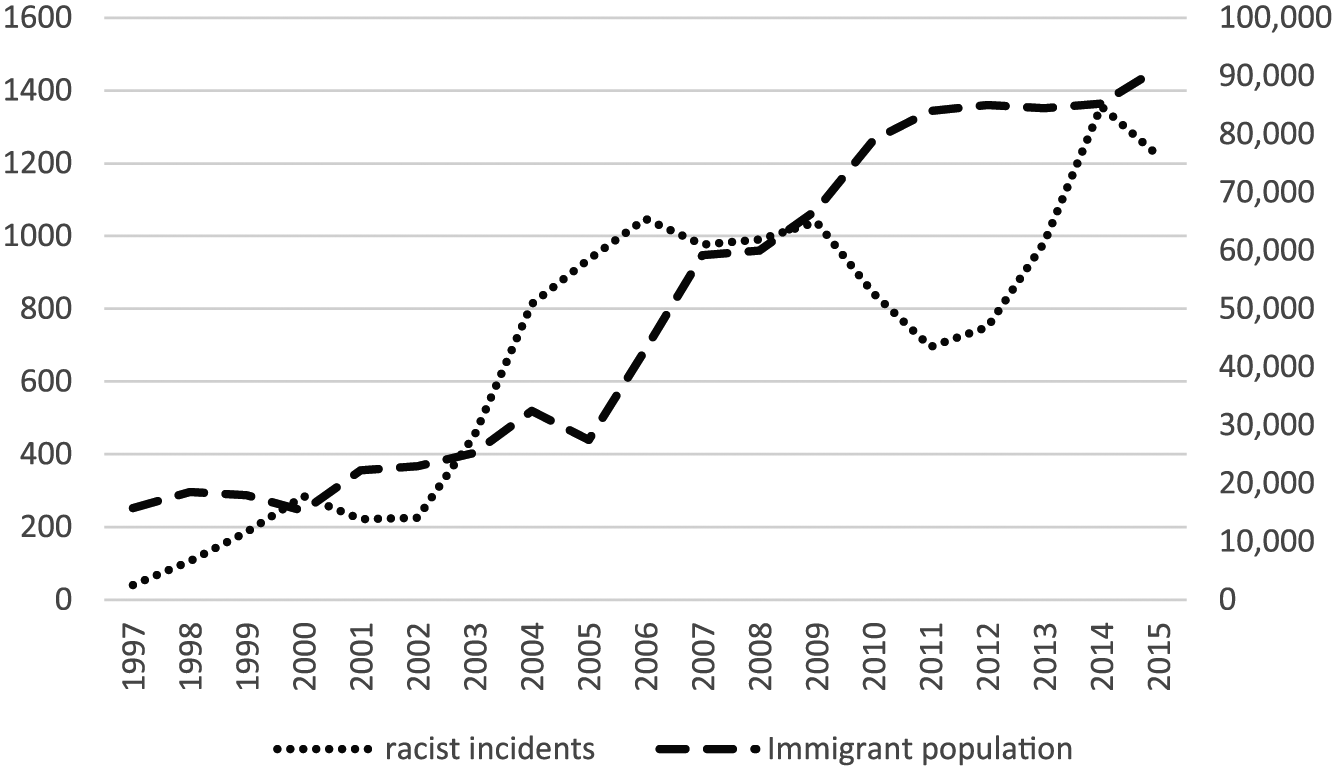
Racist incidents and immigration in Northern Ireland, 1996–2015.
Pointing to a correlation between racist incidents and immigrant populations could be viewed as endorsing the idea that racism has increased in Northern Ireland because the immigrant population has increased. The growth of immigration from outside the United Kingdom and Republic of Ireland has not caused a growth in racial incidents. It is true that there cannot be a racial incident without someone being a target of that incident. Racial incidents do require the presence of a racialised target. 4 The presence of a racialised person, however, does not necessarily lead to a racial incident. In other words, the presence of a racialised person is a necessary, but insufficient, condition for a racial incident to happen. There need to be some other factors at play. If the link was causal, we would not find any divergence between the trend line for racist incidents and the immigrant population in Figure 2.
The fact that the presence of racialised people is an insufficient condition for explaining a racist incident can also be seen in the varying rates of incidents across Northern Ireland. It is instructive to compare two districts in which there are concentrations of immigrants – Belfast and Mid Ulster. According to figures from the 2011 census, both districts have similar proportions of immigrants and other ethnic minorities – in Belfast the proportion of the population who were either born outside the United Kingdom or were born in the United Kingdom and self-identified on the census as Asian, Black, Irish Traveller or Mixed Ethnicity was 9.5%, in Mid Ulster the proportion was 9%. In Belfast, however, the proportion of racial incidents per 10,000 of population has, at least since 2007, been consistently more than twice the rate of Mid Ulster (Table 1). The rate of racial incidents is different in the two regions not because of immigrants, but because of the different contexts that immigrants have stepped into.
Rate of racial incidents per 10,000 of population, by Northern Ireland district, 2007–2017.
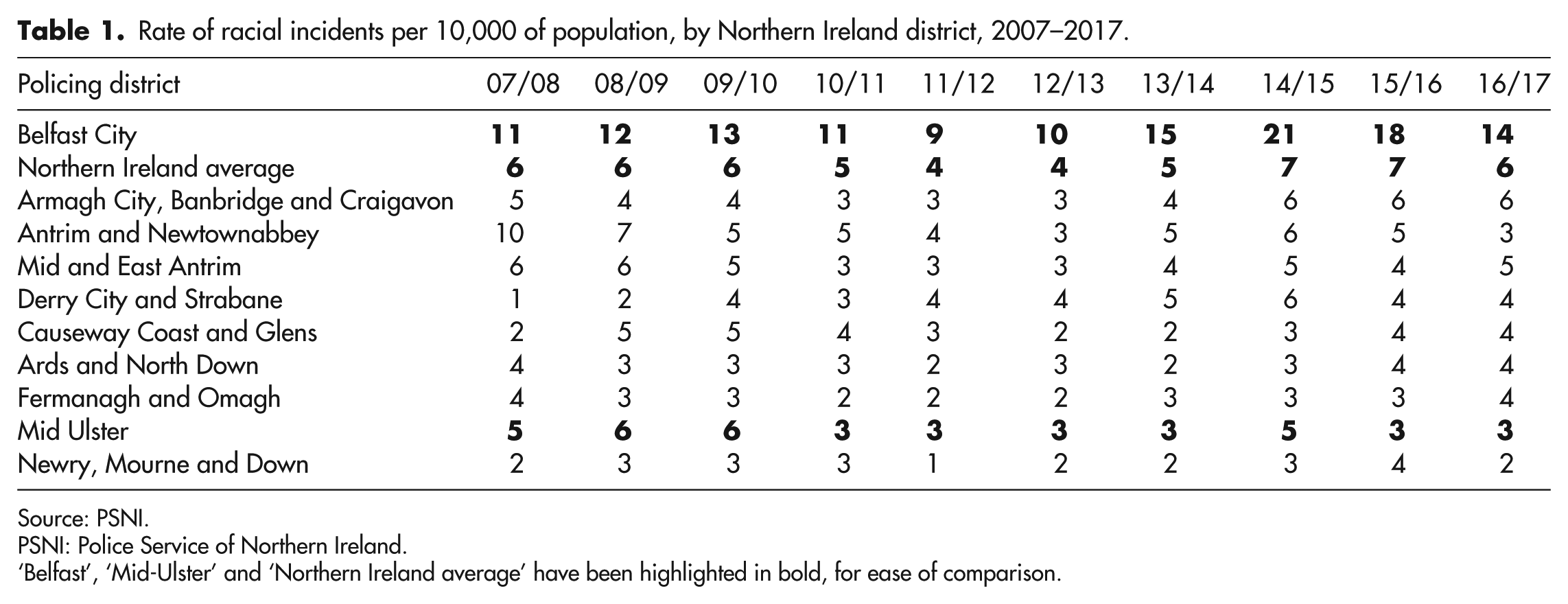
Source: PSNI.
PSNI: Police Service of Northern Ireland.
‘Belfast’, ‘Mid-Ulster’ and ‘Northern Ireland average’ have been highlighted in bold, for ease of comparison.
Belfast
Much has changed in Belfast since the historic ceasefire by the Provisional Irish Republican Army (IRA) declared on 31 August 1994. Politically motivated deaths have declined dramatically, but other forms of violence have persisted, including intra-communal ‘punishment attacks’, sectarian rioting and intimidation and racially motivated violence against immigrants and ethnic minorities (Shirlow & Murtagh 2006). The Protestant population of Northern Ireland, Belfast included, has an older age profile than the Catholic population and is declining as a proportion of the overall population. This decline is particularly marked in Belfast where a combination of higher death rates due to old age and higher rates of movement from the city to suburban satellite towns has led to a decline in the Protestant population. This has had two significant effects that are relevant to our study: immigrants have disproportionately moved into ‘Protestant’ areas, because of greater availability of housing and Unionist political parties have lost their historic majority on Belfast City Council, which reinforces a perception of ‘Protestant decline’ and ‘Catholic ascendency’. In December 2012 protests, including rioting, erupted when Belfast City Council voted to reduce the number of days a year on which it would fly the Union flag over City Hall (BBC News 2014). The protestors, and those who sympathised with them, saw this decision as confirmation that Belfast is becoming either alien to Protestants or hostile to them (Byrne & INTERCOMM 2013; Halliday & Ferguson 2016; Hearty 2014).
Since 2001, Belfast has attracted more immigrants than any other part of Northern Ireland. The largest part of that increase was made up of Polish immigrants, but the number of nationalities represented in Belfast has also grown significantly (including many people from outside the EU). The majority of racist attacks in Belfast happened in Protestant majority residential areas, many of the rest have happened in areas of mixed residential housing in the city centre at the interface of Protestant majority areas. To a significant degree, these racist attacks have been driven by a perception of Protestant decline in a context where there is an existing culture of (sectarianised) territorial demarcation and defence (Connolly & Keenan 2001; Rolston 2004; Shirlow & Murtagh 2006). These racist attacks are also likely to be facilitated by a clearly discernible strand of anti-immigrant hostility in Unionist political culture (Chrisafis 2004; McGarry et al. 2008; McVeigh 2015; Rolston 2004). It is not, however, the case that a majority of Protestants – or even all Loyalist paramilitaries – support violence against immigrants and ethnic minorities (Meredith 2014).
Mid Ulster (Dungannon)
The district of Mid Ulster was created as part of the reorganisation of local government in 2015. In that year, the number of district councils was reduced from 26 to 11. Mid Ulster was created through the merger of three district council areas: Cookstown, Dungannon and Magherafelt. Of those three district council areas, Dungannon has by far the largest immigrant population. In this sub-section, we will focus on Dungannon, which is a small market town situated in a rural area at the end of the M1 motorway corridor that runs to Belfast. Dungannon is a Catholic majority town, and this majority has grown gradually since the 1970s. Dungannon was affected by the Troubles, but not to anything like the same extent as Belfast, Derry/Londonderry or South Armagh – or even to the same extent as Portadown, Craigavon or Lurgan, towns that lie just off the M1 between Dungannon and Belfast. Residential housing in the town tends to be religiously segregated, with the south-east of the town being predominantly Protestant, the centre of the town being a patchwork of predominantly Protestant and Catholic residential areas and the rest of the town being predominantly Catholic (Campbell & Frey 2010). Prior to 1998, Unionist politicians were in the majority on the various iterations of local government, with the Ulster Unionist Party (UUP) being the largest party. Since 1998, Nationalist parties have formed the majority, with Sinn Féin being the largest party. 5 In Dungannon, however, these political and demographic shifts have, by and large, not been experienced as ‘Protestant decline’ and this is, in part, due to immigration.
Dungannon is the Northern Irish town that has experienced the most dramatic population change through immigration. According to census figures, the non-United Kingdom/Republic of Ireland born population in the district increased from 484 residents in 2001 to 5,998 in 2011 – a staggering 1,139% increase in the space of 10 years. As a share of the local population, immigrants have increased from 1% in 2001 to 10.4% in 2011. Dungannon has the highest proportion of immigrants of any district in Northern Ireland (Krausova & Vargas-Silva 2014). This population change was accompanied by tensions in the town. The rapid increase placed a significant strain on local housing and on educational facilities. There were also tensions between long-term residents and Lithuanian immigrants. As one important comparative study of the town noted, Pubs became the site of inter-ethnic conflict, particularly around the consensus operating between some new arrivals and local people that Lithuanians were ‘aggressive and menacing’. Conflicts in gender relations also surfaced when Lithuanian men engaged with Irish women in ways deemed unacceptable. (Hickman et al. 2008: 76)
It appears, however, that the tensions were largely ‘teething problems’ and that in the longer-term immigration to the district has been mostly viewed in positive terms. A mid-2017 consultation on immigration to the town found that instead of a narrative of decline the dominant view that they encountered was ‘that if there were no migrant workers in Dungannon, there would be no industry, no jobs, fewer schools open, and Dungannon would face major decline’ (National Conversation 2017: n.p.). As one participant put it, if it was not for immigration, Dungannon would ‘be a ghost town’ (National Conversation 2017). The proactive intervention of civil society actors – local churches (including Protestant churches), educators and South Tyrone Empowerment Project (STEP), a local pro-migrant non-governmental organisation (NGO) – have been identified as a key factor in both helping to generate a positive perception of immigrants and in helping to ease the integration of immigrants into the locality (Campbell & Frey 2010; Hickman et al. 2008).
Interim conclusion
The cases of both Belfast and Dungannon show that large-scale immigration does generate tensions. Comparison between the two, however, suggests that how those tensions are interpreted and managed are important to the perception of immigrants and ethnic minorities and to interactions between immigrants and the long-term established population. Paradoxically, this examination of immigration and racism suggests that, if the lessons from Dungannon are harnessed and applied more widely, it may be possible to tackle racism successfully in Northern Ireland and create a more diverse, but integrated, society. In the rest of this article, I argue that the aim of emancipatory anti-racism should be to transcend racism, not tackle it.
Transcending racism, not managing ‘race’ relations
Official anti-racism is based on the premise that racism is a fact of life, it can be criminalised, or suppressed, or treated, but it cannot be eradicated. This premise can be seen in the International Convention on the Elimination of All Forms of Racial Discrimination (ICERD), adopted by the United Nations (UN) in 1965. The discussions that led to ICERD provided part of the backdrop to the United Kingdom’s development and adoption of the 1965 Race Relations Act. The 1965 Act was the first time that racist acts became criminalised in Britain (i.e. in England, Wales and Scotland). Michael Banton (1996) argues that ICERD ‘is founded upon the lie that racial discrimination, as defined in ICERD article 1.1, can be eliminated’ (p. 50). Banton’s point is not that the signatories to ICERD had no intention of tackling racial discrimination, or that racial discrimination could not be tackled. He argues that it is possible to reduce racial discrimination, but not to eliminate it (at least as it is defined in ICERD).
Banton notes two guiding principles underpinning action to prevent discrimination: individual freedom and equality of all human beings before the law. The equality that is upheld in ICERD, and UK anti-discrimination law, is moral and juridical equality not material equality. Material inequality was not considered discriminatory because, as Banton (1996) puts it, the UN acknowledged ‘that industriousness deserved reward’ (p. 52). Therefore, the equality and freedom that are enshrined in ICERD and UK Race Relations law, is formal freedom and equality. Race relations law has played an important role in stigmatising racial incidents and racial discrimination by declaring such acts to be unlawful and thus enabling the criminal justice system to be used to prosecute those accused of racist acts. The stated aim of eliminating racial discrimination, however, is rhetorical. The law does not provide any means of eliminating racial discrimination. Race relations policy has three main strands: (1) prosecution of those who break the law, (2) administrative practices (such as monitoring job recruitment) aimed at identifying and measuring racial discrimination and (3) education, which aims to eradicate individual prejudice, through developing greater knowledge and understanding (Banton 1996: 51).
Race relations law does not challenge capitalist social relations, it takes them as given. For this reason, the race relations approach is incapable of eliminating racism. The reason why capitalism is incapable of eliminating racism, however, is not because capitalism is opposed to racial equality. Capitalism, paradoxically, both spontaneously reproduces racial inequality and promotes racial equality. Marx (1887) in volume one of Capital, points out that the sphere of circulation of commodities (i.e. the market) requires equality, ‘because each enters into relation with the other, as with a simple owner of commodities, and they exchange equivalent for equivalent’ (p. 123). Laws prohibiting racial discrimination uphold the principle of equal exchange in the labour market. Capital is indifferent to ‘race’. From the point of view of capital, it is the productive capacity of the worker (i.e. their labour-power, not their ‘race’) that matters. Anti-discrimination laws force employers to act in their economic self-interest by selecting their employees based on their productive capacity, not on extraneous grounds such as ‘race’, ethnicity, colour or national origins.
Once the commodity labour-power is purchased, however, the worker leaves the realm of the labour market and enters the realm of production (i.e. the workplace). It is the realm of production, not the sphere of circulation, that reproduces material inequality. In the process of production, surplus (i.e. unpaid) labour is extracted from the worker. It is this surplus labour, not the ‘industriousness’ of the capitalist, that is the source of capitalist wealth and the source of the vast inequalities of capitalist society. Race relations law treats this source of inequality as sacrosanct and in doing so provides a crucial element for the reproduction of racial inequality. There is no intrinsic reason why the inequality of capitalist society should take a racial form, and yet it does. In the next section, we will look at the role that immigration laws and capitalist exploitation play in generating racial inequality.
Immigration, exploitation and racial inequality
The principle anti-racist focus, of the media and the ‘race relations’ sector in Northern Ireland has been on tackling racial prejudice and racially motivated incidents. The underlying conception of racism, in these approaches to tackling racism, is that racism is a psychological disposition. The task of anti-racist policy is understood to be one of identifying those who suffer from this personal pathology and neutralising them, through either punishing them or educating them. In this view, racism is a product of our limitations as human beings, rather than anything that it produced by capitalism as a social system. Dungannon can be held up as an example of how intervention by civil society actors can help to improve ‘race’ relations and reduce the number of racial incidents. Dungannon is also, however, typical of other parts of Northern Ireland where immigrants are significantly disadvantaged because of their immigrant status. This section looks at two ways in which migrant workers do not enjoy the same freedoms as other workers: in employment and in coming under the scrutiny of the immigration authorities.
A number of recruitment agencies and employers have utilised various practices that enabled them to extract a high rate of surplus labour from migrant workers. These have included paying migrant workers at rates below the minimum wage, deducting rent directly from wages, tying employment to substandard and overcrowded accommodation, charging rents at above the local market rate, deducting wages that EU migrant workers were told were to pay for ‘work permits’ when, in fact, permits were not legally required, requiring workers to purchase their own equipment for work, long working hours, lack of holiday or sick pay and being coerced to work on demand (Allamby et al. 2011; Garvey & Stewart 2015; Potter & Hamilton 2014; Stewart et al. 2013). Migrant workers are easier for employers to manipulate for a variety of reasons. Often migrant workers are not proficient in the English language. This puts them at a disadvantage relative to local employees. They often, for example, do not know what they have signed up to in their labour contract (when they do have a contract) and so have to take their employer’s word when told that something they are unhappy with, was part of the contract that they had signed. Lack of proficiency in English also isolates them from social contact with locals, who could provide an alternative source of information. Even if they do understand the language, they usually do not know what their legal rights are, because these differ from their country of origin. Migrant workers are often willing to work for low wages and under poor working conditions, because they can earn more than they would in their country of origin. Employers also successfully use the threat of being made unemployed, which for many migrant workers would mean having to return to their country of origin (Allamby et al. 2011; Garvey & Stewart 2015; Potter & Hamilton 2014). The intention behind these employment practices is to extract additional surplus labour, over and above what can be achieved under ‘normal’ working conditions. The intention is not to create racial inequality. The effect, however, is to produce racial inequality. This is an illustration of one way in which capitalism spontaneously produces racism.
Gilligan (2017) argues that ICERD is both an anti-racist document, because it protects against racial discrimination and a racist document because it ‘provides a significant exemption for nation-states when it explicitly permits the “right of states to distinguish between citizens and non-citizens”. This right to distinguish between citizens and non-citizens underpins immigration controls’ (p. 126). The lack of citizenship status is what makes migrant workers more vulnerable to overtly coercive exploitation in the workplace. It is also something that makes immigrants and ethnic minorities more likely to be caught in the net of immigration control. In September 2017, in Donaghmore, a few miles from Dungannon town centre, immigration officials raided a Chinese takeaway and arrested and detained three employees who were charged with being in the country illegally (Ulster Herald 2017). They are very likely to have been deported. Immigration controls also affect immigrants who have a legal right to be in the United Kingdom. Immigration authorities have operated racial profiling at ports and airports in Northern Ireland. They have detained people who have a legal right to be in the United Kingdom and disproportionately stopped and questioned UK citizens who are racialised minorities (Gilligan 2018; Latif & Martynowicz 2009 McKay 2007a, 2007b).
Nation-states by their very nature divide humanity into ‘us’ (citizens) and ‘them’ (non-citizens). This is part of the international system. The nation-state is hard-wired into capitalism as a social system. The nation-state has not come about because of racialised human relations, but nation-states by their nature racialise human relations. It is the nation-state as an institution, rather than the subjective outlook of immigration officers, that explains why Black people are disproportionately detained and deported. This can be seen in the testimony of one immigration official who told human rights interviewers that ‘[r]emoving economic migrants who are here illegally is the hardest. You always have some sympathy; they work hard trying to support their families, but the law is the same for them and you just have to do it’ (Latif & Martynowicz 2009: 50). It is not prejudice or lack of cultural diversity training that led this immigration official to detain and deport immigrants, it is a requirement of the job that he detain and deport.
Racialisation, not colour-coded racism
The category of people who are most likely to be victims of a racial incident in Northern Ireland today are ‘white’ East Europeans. The idea that racism in Britain and Northern Ireland is about skin-colour is a historically specific one. It is dated and the product of particular social and historical forces. In the context of the 21st century, however, it is often an underlying assumption that leads to confusion or misdiagnoses regarding contemporary racism in the United Kingdom. Take the example of David Lammy’s review of individuals categorised as Black, Asian and Minority Ethnic (BAME) in the British Criminal Justice System.
6
Lammy (2017) points to evidence that ‘the proportion of people who say that they would mind if a relative married someone from a West Indian or Asian background has fallen significantly over the last two decades’ (p. 69). From this, he infers that overt racism has declined in the United Kingdom, and he suggests that the overrepresentation of BAME individuals in the criminal justice system must be due to ‘unconscious’ or ‘implicit’ bias. This trend, towards looking further inwards for psychological explanations for social outcomes, has become more prominent since the publication of the influential Macpherson Inquiry Report, which introduced the concept of ‘unwitting racism’ into official anti-racist policy (Wight 2003). The assumption that racism is colour-coded has led to increasing racialisation of Whiteness. One influential think tank in the United Kingdom, for example, has argued that when the white majority seeks lower immigration to help maintain their population share, this is racially self-interested rather than racist behaviour. This distinction is important because racism is a taboo, whereas ethnic self-interest, like individual self-interest, is viewed as normal. (Kaufmann 2017: 2)
The idea that White people in the United Kingdom constitute a race or ethnic group is based on racialised thinking. It works with the logic of the race relations framework, it does not challenge it.
There is a danger that, when looking at racism in Britain in the post-war period, we read history backwards and assume that a colour-based understanding of racism was inevitable. It was not. The widespread stories of ‘No Blacks. No Irish. No Dogs’. signs, on boarding houses in England in the 1950s, indicate that there was an awareness that a colour-based understanding of racism was not the only possible outcome (Corbally 2015; Hickman 2000). Ambalavaner Sivanandan notes that post-war immigrants from the Caribbean and South Asia did not initially bind together as Black. They tended to be located in different sectors of the labour market: ‘Asians were generally employed in factories, foundries and textile mills, while recruitment of Afro-Caribbeans was concentrated in the service industries’ (Sivanandan 1982: 5). They did experience discrimination in employment and housing and such experiences prompted self-organisation and self-reliance and a sense of unity, but initially that commonality tended to be nationally based. This can be seen, for example, in the formation of the Indian Workers Association and a separate Pakistani Workers Association. Caribbean immigrants tended to organise on the basis of island and ethnic affiliations. In the face of common experiences of support for anti-colonial struggles, political opposition to encroaching immigration controls and trade union and community self-organisation ‘the mosaic of unities and organisations would resolve itself into a more holistic, albeit shifting, pattern of black unity and black struggle’ (Sivanandan 1982: 8–9). In other words, the idea of a common anti-racist Black struggle was born in, and arose from, experiences in the United Kingdom.
Irish immigrants differed from those from the New Commonwealth in their skin colour. They also differed in having a longer history of immigration and more extensive established social networks that facilitated their integration. A third difference was their immigration status. All three factors, not just skin colour alone, help to explain the difference between the racialisation of Irish immigrants and those from the New Commonwealth in the 1940s, 1950s and 1960s. Mary Hickman notes that the first drafting of the 1962 Commonwealth Immigrants Bill proposed to include the control of immigrants from Ireland, but by the second draft, this proposal had been dropped (Hickman 1998). In the parliamentary debate on the Bill the Home Secretary, Rab Butler argued that the difficulty of securing the land border in Ireland would render immigration controls there ineffective, which would then require controls on travel from Northern Ireland to the rest of the United Kingdom (this concern is echoed in the Brexit debate on cross-border trade). Butler noted that he had consulted the Northern Irish Prime Minister and the latter had assured him ‘that any proposal to restrict freedom of travel between Northern Ireland, which is an integral part of the United Kingdom, and the rest of the country would be unacceptable to the Northern Ireland government’ (cited in Hickman 1998: 300–301). Hickman (1998) also notes that in the debate some Conservative MPs and a large number of Labour MPs, including the leader Hugh Gaitskill, ‘objected to the exclusion of the Irish [from controls] on the ground that it effectively made the controls a colour bar’ (p. 302). Not only that but some, mainly Labour MPs objected to the exclusion of the Irish from controls because they argued that the real source of immigration problems lay with the Irish. There were more Irish immigrants than other groups and in their view the Southern Irish were a social liability. (Hickman 1998: 302)
A few years later, in 1965, Westminster was debating the introduction of what was to become the first Race Relations Act. The position of Northern Ireland came up several times in the parliamentary debate. In the second reading of the Race Relations Bill on 3 May 1965, the Government’s stance was that by convention Westminster did not legislate for Northern Ireland except by the request and agreement of the Government of Northern Ireland. This view was defended by Unionist MPs in the chamber. In response, the Labour MP Bernard Floud argued, If racial discrimination is a bad thing in Great Britain, it is a bad thing in the United Kingdom … Whether legislation should apply to Northern Ireland is not a matter only for the Government of Northern Ireland, but also for the people of Northern Ireland as a whole. The House has some responsibility to the people of Northern Ireland and not merely to the Government of Northern Ireland.
7
A number of MPs also argued that religion should be included in the Bill. Robin Chichester-Clark, MP for Londonderry, responded by saying that ‘Northern Ireland is the only part of the United Kingdom which already has in-built statutory safeguards against religious discrimination … I believe these safeguards to be completely adequate’. This response was greeted with laughter in the chamber. The underlying concern of Unionists had been articulated in a letter from Northern Ireland’s Attorney General to the Minister for Home Affairs at Stormont in 1964 when he said that Irish nationalists may seek to initiate prosecutions against Unionists if the Race Relations Act was introduced (Crangle 2018). Presumably, these Unionists had the emerging civil rights movement in mind when opposing the extensions of the legislation to the region. When it was eventually passed, the Act neither included the criterion of religious grounds, nor extended to Northern Ireland (Dickey 1972).
The GFA as a race relations agreement
The peace process in Northern Ireland, and the GFA that was its outcome, has been shaped by race relations thinking. The 1965 Race Relations Act was not extended to Northern Ireland, and when it was revised in 1968 and 1978, it was still not extended to the region, even though by the latter date Stormont had been prorogued and direct rule established. Since 1969, however, there has been a strand of the governance of Northern Ireland that has operated within a race relations framework. In return for providing British troops to help restore order in Northern Ireland in August 1969, the Westminster government demanded some minor reforms. One of these was the establishing of a Northern Ireland Community Relations Commission (NICRC), modelled on the one created for the rest of the United Kingdom under the terms of the 1968 Race Relations Act. The aim of the NICRC was to help promote better relations between Catholics and Protestants in Northern Ireland. The body was disbanded in 1974, but the development of race relations related law and practice in Northern Ireland continued to shadow, surreptitiously, that of the rest of the United Kingdom. In 1976, a Fair Employment Act was passed and a Fair Employment Agency created. In the mid-1980s, the UK government, working in conjunction with the government of the Republic of Ireland, began to develop a multicultural approach to governing the region. The policy area of community relations was revived. This revival can be seen in the creation of the Central Community Relations Unit by the Northern Ireland Office in 1987, the establishing of Education for Mutual Understanding as part of the school curriculum in 1989 and the creation of the Community Relations Council in 1991. Recognising the rights and identities of the two main (ethnic) traditions or communities in Northern Ireland was central to this multicultural approach. The approach of better managing relations between the two ethnic groups – Irish/Catholic/Nationalist and British/Protestant/Unionist – was a crucial strand of the peace process and has been enshrined in the consociational nature of the new framework of governance established by the GFA (Gilligan 2007, 2016; McGovern 2000).
The GFA encourages a zero-sum understanding of society, in which any gain for Catholics is perceived as a loss for Protestants, and vice versa. To some extent, this zero-sum calculation was assuaged by the lift in the economy in the early years of the 21st century (Todd & Ruane 2012). In the context of the post-2008 recession and the introduction of austerity measures, however, strains are being placed both on sectarianised relations and on devolved government. The latter collapsed in large part due to the strains of austerity and, at the time of writing, does not look like it is going to be re-established any time soon (Gilligan 2016).
Conclusion
Colin Coulter, in the 1999 Special Issue of Capital and Class, noted that even though ‘[s]ocio-economic status exercises rather greater influence than ethnic or national identity over the distribution of life chances’ in Northern Ireland, ethnonational identities persistently trump class in the political culture of the region (p. 92). This remains the case today, and it is a major barrier to the development of emancipatory politics. Commentators tend to look to factors internal to Northern Ireland to explain why this is the case, and there are important internal factors, but the tendency for people in the rest of the United Kingdom and in the Republic of Ireland to treat Northern Ireland as ‘a place apart’ is also a factor. Socialists in the rest of the United Kingdom and Republic of Ireland should pay more attention to the Northern Ireland case. As the United Kingdom continues to fray – in the face of austerity, the crisis of representative democracy, the demand for Scottish independence and Brexit – it is more important than it has been for a generation for people on the Left in the United Kingdom and Republic of Ireland to understand Northern Ireland in the wider context of the United Kingdom and of Anglo-Irish relations.
Satnam Virdee has recently drawn attention to the key role that immigrants have played historically in the development of the labour movement and emancipatory politics in Britain (Virdee 2014). In Northern Ireland in recent years, immigrants have not just been ‘foreigners’, they have also played a role in organising labour struggles, and in doing so they have opened up new hopes for a class-based politics in Northern Ireland, beyond the prevailing ethnosectarian one. Gosia, a migrant worker who came to Northern Ireland from Poland, points to the possibilities, for class-based politics to break down racialised barriers and generate a class-based emancipatory anti-racism, when she says talks about her experience of a workplace-based struggle in Northern Ireland: There was no union at work. Nobody had contracts but we joined the union. The manager heard some people had joined and shouted and said he would find out who had joined. But aſter some time we told him we wanted contracts and now everything is much better. I believe that if you want something and you know you are right, you should go and get it. We didn’t lose our jobs. People shouldn’t be afraid. We got contracts for everyone, even the Irish, everyone, for almost 200 people. (Cited in Stewart et al. 2013: 104)