



Abstract
The rise of the gig economy and the prospect of increased automation has led to renewed calls for the implementation of a Universal Basic Income scheme from a variety of spokespeople on the left, including notable journalists, academics and politicians. Weeks, Mason, Srnicek and Williams and others suggest that such a re-orientation of welfare distribution would not only mitigate the effects of these tectonic changes to the nature of labour, but it might in fact facilitate a break away from neoliberal capitalism and towards a post-work condition. Building upon the work of Universal Basic Income detractors such as Pitts and Dinerstein, this article brings into question the likelihood of these claims. Universal Basic Income’s advocates speak of the freedom to be unlocked by Universal Basic Income: but the freedom to do what and for whom? The article addresses the increasing significance for the process of valorisation today of digital ‘free labour’, and thus explores the idea that Universal Basic Income might have presented itself at this current juncture less to be a vehicle to a utopian future and more to be a handmaid for capitalism as its mode of production evolves. After utilising Charlie Brooker’s Black Mirror to depict a dystopian imaginary of what a Universal Basic Income-future might thus really look like, the article concludes by questioning how we might rescue the scheme as a leftist project: attending to Guattari’s insights into how to resist capitalism’s subjectivation, as well as Fuchs’ vision for an ‘alternative Internet’.
Keywords
Following an extended period on the fringes of political discussion, interest in a Universal Basic Income (UBI) – a stipend paid unconditionally by the state to all citizens – is beginning to resurge among social critics and policymakers in the West. A range of public figures, including the likes of Silicon Valley magnates Elon Musk and Mark Zuckerberg (ubibackers.com 2018), have recently spoken out in favour of the proposal, with popular interest growing year on year: a petition advocating for UBI gathered enough support to force a nationwide referendum on the issue in Switzerland in 2016, while recent polling in the United Kingdom has shown that just under half of the population there would now back such a scheme (Smedley 2017). Noting the success of Alaska’s 40-year experiment with an ‘oil dividend’ (Bott 2018), governments in Finland, Canada and the Netherlands have recently implemented small-scale pilot programmes to explore UBI’s practical viability for their countries, while in the United Kingdom, Shadow Chancellor John McDonnell has established a working group to explore the issue, after previously stating that UBI is ‘an idea whose time may well have come’ (Jenkins 2014). Even the trade unions, who have historically been hostile to UBI-like proposals, are now beginning to lend their support. The TUC – whose unions represent nearly six million of the United Kingdom’s workers – voted in September 2016 to officially endorse UBI, stating that it ‘recognises the need for a rebuilding of a modern social security system for men and women as part of tackling poverty and inequality’ (McFarland 2016). Backed by such a diverse range of advocates, a basic income scheme thus looks increasingly likely to make its way into official policy.
This renewed interest and support has been buoyed by endorsements from a variety of prominent leftist groups and spokespeople working in and around public policy (Chakrabortty 2017; Lucas 2016; Reed and Lansley 2016; Van Parijs 2016), who have suggested UBI offers the best means of defending society’s most vulnerable citizens in the face of work’s rapidly changing social and economic context. The shift to the so-called ‘gig economy’, for example, is greatly increasing vulnerability within the labour market, with 1 in 10 workers now believed to be precariously employed (Farhat 2016). Meanwhile, industry’s growing predilection for robotic labour is beginning to obviate the need for a human workforce, threatening a near future scenario in which vast swathes of society are left without the possibility of employment and a means to attain subsistence (Stern 2016). Advocates have also noted the effect austerity has rendered on the administration of welfare, pointing out that UBI would do away with punitive means-testing and significantly reduce the administrative procedures and costs of centralised social provision systems.
Among these leftist endorsements, a strand of academic discourse has come to the fore in recent months which, building upon the arguments expounded above, has attempted to show a certain utopian potential in the UBI proposal. For Weeks (2011), Levitas (2013), Standing (2017a, 2017b) Bregman (2017), Srnicek and Williams (2016) and Mason (2016), a UBI scheme not only offers to keep welfare in step with a changing socioeconomic condition, but could also be leveraged to help achieve a more equitable ‘post-work’ world: a condition within which workers would be liberated from the imperative to find and secure a means of subsistence and are thus no longer pressured into menial and precarious waged labour situations. Freed from the coercive nature of employment but with an income secured, individuals would be endowed with the capacity to choose how to best apply their time and labour power, allowing greater attention towards other domains of life. Taking these post-work visions one stage further, a handful of critics have suggested that UBI could in fact offer a vital stepping stone towards a future overcoming of capitalism. Here, Mason (2016) is notable, as an advocate for UBI as ‘a transitional measure for the first stage of the postcapitalist project’ (p. 285). Likewise are Srnicek and Williams (2016), who have argued that a realised scheme would help ‘break us out of neoliberalism and […] establish a new equilibrium of political, economic and social forces’ (p. 108).
Few on the left could contend that, by guaranteeing financial security and achieving substantial material improvements for society’s most vulnerable people, the implementation of a UBI would not be welcome. Depending on the size of the stipend, a realised scheme could promptly eradicate homelessness and increase the net income of the poorest decile by as much as 32% (Reed and Lansley 2016: 16). The claim made by Mason, Srnicek and Williams and others, however – that a UBI could offer a stepping stone to overcome neoliberal capitalism – is much more controversial, and as such is beginning to come in for criticism from other interested parties on the left (Cristicuffs 2015; Cruddas and Kibasi 2016; Pitts and Dinerstein 2017).
Pitts and Dinerstein (2017), for example – writing in the wake of UBI’s newfound popularity – have emphasised that by focusing their attention on the wage relation, the ‘post-work prospectus’ (PWP) have failed to recognise the manifold grip which capitalism exerts over labour. The uncoupling of the relation between employer and employee instigated by UBI would not, they argue, weaken other relations which undergird and produce this condition, such as those of social reproduction, money and the state: the forms of which are constituted through and through by capitalism. Consequently, its implementation could not lead necessarily to a post-capitalist condition. The status quo would be maintained, with the state stepping in the place of the employer to provide the means of subsistence and maintain the labouring potential of the working class (Pitts and Dinerstein 2017: 10). As Cristicuffs (2015) notes of UBI, ‘what might present itself as reacting to and dealing with the effects of the capitalist economy is in fact a contribution to its maintenance’.
This article seeks to build upon these critiques, taking inspiration predominantly from Pitts and Dinerstein’s (2017) assertion that, in our discussions of UBI’s desirability, ‘what we understand by “work” and its commodification and monetisation needs to be re-evaluated’ (p. 5). Here, these authors focus on highlighting inequities in the labour of social reproduction, asking questions like ‘who does the work that makes possible the more productive use of our own time?’ (Pitts and Dinerstein 2017: 8), which they claim are unaddressed in the utopian visions of the PWP. But while these are important points to emphasise, I claim they do not go far enough in bringing a broader concept of ‘work’ to bear on the UBI debate: offering only the briefest glimpse of how the scheme could be effectively subsumed by capitalism.
When the PWP speaks of the freedom outside of work, it all too readily imagines the worker-subject ‘split between a subjectivity that is inalienable and a labor power that is to be rented out’ (Feher 2009: 29): utilising classical liberalism’s notion of the ‘free labourer’, which the labour movement has historically relied upon in its fight against capital (Feher 2009: 22). As the article demonstrates, while this model of the working subject may have held sway under the Fordist mode, it has been all but superseded under the ‘factory-society’ (Virno and Hardt 2006) of post-industrialism and specifically what Boutang (2011) has called Cognitive Capitalism: a paradigm within which production is directly the production of social relations and subjectivity itself has become the raw material upon which labour is compelled to work (Lazzarato 1997). Our labour today is predominantly ‘immaterial’ (Lazzarato 1997): applied for the accumulation of capital not only in formal workplaces and through traditional hierarchies of control but also increasingly through the so-called ‘free labour’ (Terranova 2000) of our leisure and play. As we build our digital profiles on platforms like Spotify and Twitter, or when we engage with a whole range of networked material objects, we confer our labour without reimbursement to the valorisation process of a rapidly growing data economy: estimated to already be worth over £250 billion to the EU, but which could grow to 4% of the region’s entire GDP by 2020 (DG CONNECT 2017). Today’s worker is therefore a ‘free labourer’, but in a much more literal sense than the PWP imagines; their suggestion that postcapitalism might follow a post-work condition ignores the fact that capitalism has already colonised this space, obviating in the process the old binaries between the inside and outside of work upon which their arguments depend.
Pitts and Dinerstein (2017) demonstrate that, in spite of the utopian intentions of its advocates, UBI would do little to confront neoliberalism and its exploitation. But given the increasing importance of free labour for capitalism’s extraction of value today, can we even claim that it would serve labour’s interests first and foremost, if it were to be implemented? The PWP enthuse about a potential to be actualised by the freedom which UBI would grant, but ignore the uncomfortable affinity their thinking shares with that of Friedman (1982), Hayek et al. (1994) and Murray (2008) – each of whom have also advocated for UBI in their respective visions for a neoliberal programme – as well as digital capitalists such as Flickr co-founder Stewart Butterfield, who recently argued that ‘giving people even a very small safety net would unlock a huge amount of entrepreneurialism’ (Weller 2017). As such, over and above Pitts and Dinerstein’s claim that capitalism would persist unabated under a UBI, the article thus considers whether UBI might actually present itself as a tool for capitalism to expand its capture of value: called for by it as its forms of exploitation and process of valorisation evolve.
To illustrate what a UBI future might thus really look like, in contrast to the imaginary deployed in the ‘abstract utopias’ of the PWP (Bloch 1986; Pitts and Dinerstein 2017), the article then turns to the dark world of Charlie Brooker’s Black Mirror. In the episode ‘Fifteen Million Merits’, we find a future society within which the centralised provision of the means of subsistence has coincided with a form of cognitive capitalism taken to its most pernicious extreme. In this world, all consumption and production have been arranged and seamlessly integrated, with labour’s exploitation as work successfully obfuscated. Here, the guarantee to the subject of the means of subsistence is also a guarantee of their exploitation and enforced docility, offering a startling vision for our present of how – in contradistinction to the PWP’s assertions – UBI could readily serve capitalism: assisting it in its demand for free labour.
The article concludes by evaluating how, if at all, the leftist argument for UBI might be salvaged. What would be required for this, I claim, is a recognition of the multiple ecological registers (Guattari [1989] 2008) across which capitalism operates and thus the construction of an expanded leftist programme: working not only to tackle the forms of exploitation rendered under waged work but also to redress the inculcation and co-optation of subjectivity. In practice, this would entail devising strategies to confront free labour that could complement the proposals of the PWP and insure their efficacy. As vociferously as we argue for the shortening of the working week or the diminishment of the work ethic, to make UBI work (if you can pardon the pun) we ought also to demand that the Internet be respected as a communicative commons, as well as emphasising the social benefits that could be obtained from big data were its analysis to be collectivised.
Cognitive capitalism and free labour: context for a post-work condition?
Under the dominance of digital mediation and a knowledge-based economy, we are living today through what Boutang (2011) has defined as capitalism’s cognitive epoch, in which capital is increasingly sought in intangible assets and the communicative capacities of workers are called upon in the production of value. Where industrial capitalism was predominantly concerned with the production of material commodities by way of a physical labour, today’s mode is instead defined by ‘the role of the immaterial’ (Boutang 2011: 50). The commodity no longer typically adopts the static physicality of the car or the microwave, as objects of discrete and separate moments of production and consumption. Rather, today it exists as ever expanding knowledge bases and web-based services: the contents of which are open-ended and transferable. Where the material product was typically expired in its consumption, knowledge and information in contrast are animated: ‘increasingly ephemeral’ and ‘more of a process than a finished product’ (Terranova 2000: 48); the tastes and norms developed through the consumptive process are fed back and used to inform production, constantly refreshing both the commodity’s existence and its value.
These new forms rendered by cognitive capitalism present significant challenges to our conceptions of what constitutes economically significant labour. For Marx, labour was something to be found in the sphere of production alone: as a commodity which the capitalist purchases with the wage in order to create a good that can be exchanged in circulation for profit. Furthermore, his understanding of the surplus labour time invested by the worker – that which ensures ‘the value of the product is greater than the value advanced for its production’ (Marx [1867] 2015: 176) – was that it typically constituted a modest excess to the socially necessary labour time required to produce the commodity. While his thought is no doubt still able to offer pertinent critiques of the material conditions within which digital workers work (I think here of the new international division of labour, cf. Antonio 2003; Fuchs 2014: 171, 203), it is no longer able to offer a complete theory. In order to comprehend the full extent of capitalism’s exploitation today, an altogether different understanding of labour is required, which a number of theorists (Fuchs 2014; Lazzarato 1997; Terranova 2000, 2004) have begun to articulate.
Lazzarato (1997), for example, has demonstrated that, as commodities have become increasingly intangible under post-industrial capitalism, an ‘immaterial’ form of labour has concomitantly developed and begun to predominate. According to the author, the commodity today retains both informational and cultural contents: the latter of which is manifest through communicative relations by ‘the kinds of activities involved in defining and fixing cultural and artistic standards, fashions, tastes, consumer norms, and, more strategically, public opinion’. Thus, subjectivity has itself become directly productive, as the raw material across which the process of valorisation operates. As workers, we are invited to ‘become subjects’ (Lazzarato 1997): to make subjectivity both the means and end of our work. That realm of life, conceived by classical liberalism’s notion of the free labourer as pre-existent and incommensurate to the marketplace of commodities, has become the very wellspring of capitalism’s exploitation.
Crucially for the UBI debate, Lazzarato demonstrates that this immaterial form of labour, as it manifests the cultural content of the commodity, increasingly embodies ‘a series of activities that are not normally recognized as “work”’ (Lazzarato 1997). A diverse range of labouring activities, whether performed inside or outside of the workplace – remunerated or freely given – are called upon in the production of value: a fact which has taken on an even greater pertinence following the advent and rollout of networked technologies to all areas of life. As Terranova (2000, 2004) has explored, the increasingly ephemeral and processual nature of digital commodities – manifest as the ‘alive’ virtual spaces of streaming platforms and messaging services – has demanded a new ‘continuous, creative, innovative labour’ (Terranova 2000: 48), a substantial amount of which ‘fall[s] outside the concept of “abstract labor” which Marx defined’ (Terranova 2000: 42). The work of the open-source community, unremunerated and willingly given is, for Terranova, a paramount example of a new ‘free labour’ which digital corporations seek to exploit. Here, capitalism piggybacks off of the individual’s ‘deeply rooted cultural and affective desire for creative production’ (Terranova 2004: 75) as well as what Berardi (2009) has recognised as prevalent ‘individualistic, libertarian drives for self-realization’ (p. 96) that digital technologies facilitate. Operating according to a logic of capture rather than coercion – as the ‘sieve whose mesh will transmute from point to point’ (Deleuze 1992: 4) – it gathers and structures the diffuse labour-powers exerted in cultural production: channelling them into flows from which it can extract value.
What in 2000 Terranova was able to call a mere ‘trait of the cultural economy’ (p. 33), has in 2018 become the paradigmatic form by which value is created. Today, as we utilise search engines like Google, browse social media platforms like Facebook and use fitness apps like Strava, we collectively invest unquantifiably vast amounts of ‘free labour’: producing highly lucrative information, whether in the form of content such as videos, commentary and reviews (De Koznik 2013) or as metadata about our preferences and behaviours. Even when we don’t realise we are online, an increasingly prevalent Internet of Things (Greengard 2015) – smart homes, smart cars and even smart cities – continuously observe and analyse where we go, what we say and how we feel.
On the one hand, corporations leverage this information by pointing users in the direction of products and services likely to appeal to them. Individuals ‘work to market […] things to themselves’ (Smythe 1981: 4): Google’s PageRank algorithm, for example, orders search engine results according to webpage popularity, while dynamic pricing – now ubiquitous to digital marketplaces – alters a product’s value in real-time according to its perceived desirability (Malmgren 2017). Otherwise, they are able to mine the collected data and segment the consumer market into increasingly granular user groups. The so-called microtargeting of advertising has now become commonplace, the shocking effectiveness of which has only recently come to light following the Cambridge Analytica scandal: in which Facebook’s dark posts were harnessed to allegedly swing the result of the 2016 US presidential election (for an indepth analysis, cf. Anderson and Horvarth 2017). Here, companies sell multiple advertisement slots for the same space, with each visible only to the consumers groups most likely to be influenced (Fuchs 2014: 99).
The value of free labour to corporations today, and indeed their dependence upon it, cannot be understated. In 2011, Facebook achieved profits of US$1 billion despite employing only 4,000 people in its regional offices and server farms around the world. It derived this capital, not primarily from its waged workers – who would have laboured a total of approximately 7.2 million working hours – but instead from the nearly 64 billion hours of free labour time invested by the consumers of its product over the course of the year (Fuchs 2014: 105). With the data gleaned from these interactions at its disposal, the company proceeded to make US$872 million in revenue from advertising sales in the first financial quarter of 2012 alone (Constine 2012). In 2016, for the first time, the four publicly traded companies with the highest market capitalisation – Apple, Alphabet (Google’s parent company), Microsoft and Amazon – were all technology companies (Financial Times 2016): each dependent for a large part on the free labour of their consumers. Amazon’s customer review feature, for example – an essential driver of customer retention and therefore of the platform’s value (Howland 2017) – has relied heavily upon the freely given labour of buyers rating and commenting upon the products which they purchase. Elsewhere, the Linux operating system used by Google’s Android phones and indeed the majority of all computer devices today (Net Marketshare 2018), continues to be run as an open-source project.
In this manner, corporations are beginning to transform the process of capital accumulation. On the one hand, the increased dependence on consumers for the derivation of value has collapsed old divisions between spheres of production and circulation. Today’s workers are akin to the ‘prosumers’ imagined by Toffler (1980), handling consumptive and productive responsibilities simultaneously, in a process Smythe (1981 in Fuchs 2014: 74) broadly has defined as ‘audience labour’. And as we have seen, any pretension that capitalism will adequately reimburse the labour expended in the manufacture of value has been thrown out of the window. No longer are profits garnered by extracting from the working day a ‘time in excess’ of that which is socially necessary for the commodity’s production (and which is remunerated by the wage). Instead, capitalism has today cultivated a mode of production within which ‘the rate of surplus value converges towards infinity’ (Fuchs 2014: 104, my emphasis). Under the watchful eye of the network, workers labour everywhere and everywhen: all without coercion or the expectation of remuneration.
The belief that UBI would offer ‘the freedom to lead a good life’ (Van Parijs and Vanderborght 2018) has been significant in guiding its advocates on the left. UK Green Party MP Caroline Lucas, for example, has spoken of ‘a whole freedom and liberation that it gives you’ (Harris 2016), while a recent Compass report has claimed ‘it is a profoundly democratic and egalitarian concept that promotes both security and genuinely effective freedom’ (Reed and Lansley 2016: 10). Srnicek and Williams (2016), meanwhile, have suggested that with a UBI, workers would be able to ‘slow down and reflect, safely protected from the constant pressures of neoliberalism’ (p. 121).
What’s more, by guaranteeing the means of subsistence and ‘making work truly voluntary’ (Srnicek and Williams 2016: 120), it is claimed UBI would force a ‘substantial rupture in the current terms of the work society’ (Weeks 2011: 139). Following its implementation, a ‘post-work’ condition would ensue within which individuals would begin to be able to choose the relative amounts of labour-power afforded to both work and ‘non-work’: leisure, domestic labour, political engagement and so on. As Mason (2016) has articulated, ‘you can look after your kids, write poetry, go back to college, manage your chronic illness […] or just exist’ (p. 285).
But as the above has shown, cognitive capitalism is no context for the achievement of a post-work condition. While a realised UBI scheme might allow individuals to opt out of waged employment, the notion that it would protect them from work altogether is dangerously misled. By focusing solely on the work rendered under the wage relation, the PWP unduly envisages the ‘outside’ of work as a space free from exploitation: missing the significance of digital free labour for the process of valorisation today and thus the full picture of capitalism’s present forms of exploitation. The discovery to be made on the other side of UBI’s implementation will not be a freedom and higher degree of choice with respect to work. Instead, what we will find is that within this freedom, we were already working productively for capitalism. ‘The material conditions of freedom’ (Raventos 2007) made available to us will come at the cost of our immaterial servitude.
Who would UBI really serve?
For the PWP, UBI promises not only to effect a transition to a post-work world. It would also, they claim, grant significant new powers in labour’s fight against capital. Because of the guarantee of an income and thus the absence of an obligation to work, the individual would retain a much more effective bargaining position from which to resist exploitation, should they ever have to enter into a wage relation with an employer. They would no longer need worry about periods of non-payment, meaning industrial action would become easier to initiate and maintain. And as Srnicek and Williams (2016: 120, 121) note, the eradication of a surplus population from the labour market would temper the employer’s capacity to control workers with the threat of unemployment.
UBI’s detractors have disagreed. Philippe Martinez of France’s CGT union, for example, has argued that waged employment plays an essential role in structuring both the routines of daily life and effective forms of resistance. Because UBI would tackle waged work as a space of socialisation, it would limit workers’ capacities to recognise and collectively organise against their exploitation. Pitts and Dinerstein (2017), Poch (2016) and Raventos and Wark (2017: 13) have struck a similar tone, emphasising that by changing the buyer in the wage relation from the capitalist to the state, UBI threatens to ‘liquidat[e] class conflict in production’. A realised scheme would replace the immediate and readily commanded web of relations across which workers are able to antagonise capital today, with an atomised but impersonal connection to a distant state leviathan. While doing little to address the contradictions rendered by class antagonisms, UBI would thus also foreclose the possibility of ‘resolution through antagonism itself’ (Raventos and Wark 2017: 14), which Pitts and Dinerstein and others see as an essential precondition for labour to effectively struggle and overcome its exploitation.
These two branches of the left have taken opposite positions in the debate over whether UBI’s implementation would enhance or diminish labour’s capacity. But each side has chosen to focus solely on labour alone, when this is only one half of the issue. What has hitherto been ignored is the question of the benefits that UBI might render for capital. Once cognitive capitalism’s increasing dependence on free labour is adequately considered, we can duly begin to question whether the renewed interest in UBI might have manifest itself at this present juncture, less to offer us a possible vehicle to a postcapitalist future, and more to provide capitalism with a necessary handmaid for its new mode of production.
The PWP enthuses about a potential to be actualised by UBI: ‘a pure virtuality, a capacity that is as yet undetermined’ (Lazzarato 1997). As has already been outlined above, the various endorsements of UBI each speak confidently of the freedom to be gained by it, as well as the political power this freedom will allow labour to wield. Standing (2017b), for example – long time advocate for UBI and co-founder of the Basic Income Earth Network – has spoken of a certain ‘emancipatory value’ in the proposal. In this discourse, freedom is conceived as a state of being which pre-exists the coercion of obligations: a natural element to be re-discovered in the post-work space opened up by UBI. But as Lemke (2014) has reminded us, ‘freedom is neither an anthropological constant nor a historical universal that is limited or respected by different societies’ (pp. 63, 64). It is instead always something permitted through a social relation with governance: ‘an artificially arranged product and instrument of governmental practices’ (Lemke 2014).
As Foucault ([1979] 2010) has shown, under neoliberal governmentality, freedoms are not ‘observed’ or ‘respected’ by the state (p. 63). Instead, they are actively produced in order that they might be consumed: fostered by governance for the market to find the means for its prolongation and expansion. The alleviation of poverty is considered, least of all a moral project, an enterprise in removing obstacles for further growth and in activating untapped potential. This logic can be seen in the governance of the welfare state today, where the provision of social securities has become as much about maintaining the usefulness of the working class as it has been about enabling the individual. As Terranova (2000) has argued, it has been decreed that ‘the potentialities of work must be kept alive; the unemployed must be monitored […] as some kind of postindustrial reserve force’ (p. 41). Successive neoliberal administrations in the United Kingdom, for example, have been obsessed with training courses as fundamental preconditions for the provision of benefits. The New Deal for Young People introduced under New Labour included a mandatory 10-month programme of courses and administered sanctions for non-attendance that included the curtailment of payments (Daguerre and Etherington 2014: 24). Similarly, the coalition government’s Universal Credit scheme demands that its users attend a community benefit work placement, in order ‘to help claimants move closer to the labour market’ and ‘to establish the discipline and habits of working life’ (Universal Credit 2015: 3). In recompense for their sustenance, the unemployed are expected to maintain a constant state of ‘work readiness’: fulfilling, as Cristicuffs (2015) emphasises, a service to capital in which ‘it can find the workers it needs even after it has discarded them’.
What the PWP miss, in their exaltation of the potential to be unlocked by UBI, is that this virtuality ‘already shares all the characteristics of postindustrial productive subjectivity’ (Lazzarato 1997): that its realisation might as readily produce a freedom consumable by capitalism as offer the emancipation of the individual, and thus that it might be desired by capital as enthusiastically as the left. On the one hand, as continuous data collection becomes increasingly ubiquitous and analytics processes mature, companies have begun to dream that ‘perfect information’ may one day be attainable, as Greengard (2015: 56) has shown. It is believed that with enough devices collecting information about enough variables, and with an infrastructure in place that is capable of capitalising on insights instantaneously, the caprice of markets could be understood and tamed. By getting in ahead of demands as and when they manifest, capitalism can begin to direct consumption: building, a priori, the ‘worlds’ through which the consumer encounters their own needs and desires (Thrift 2009). On the other, capitalism finds itself impelled by ‘the imperative to accumulate ever more capital’ (Fuchs 2014: 98). As Marx ([1867] 2015) famously noted, ‘[m]oney ends the movement only to begin it again’ (p. 129). When each moment of commodity production ends and value is accrued, the necessity to accumulate ever more compels the process to begin anew, with the capitalist searching for alternate means by which profits can be extracted. As Foster and Magdoff (2011) write, ‘the resulting juggernaut accepts no boundaries to its expansion but continually tries to break them down’ (p. 42). Capitalism seeks to maximise surplus value, either by lengthening the working day, or by diminishing the relative proportion of socially necessary labour time for which the worker is remunerated (Marx [1867] 2015). But with every successful expansion, capitalism is doomed to yet again find itself confronting further limits to its proliferation. Even when, as under cognitive capitalism, it has indefinitely prolonged the working day and begun to absolve itself of the wage relation, profits must continue to rise.
Digital corporations thus seek new subjective terrains and the engagement of an ever broader digital labour force. But although free labour may ‘pay back’ to the worker through the platform’s facilitation of communicative networks, such a relationship cannot in the long run provide them with the means of material subsistence, as Fuchs (2014: 103) has noted: required as an insurance for both their survival and their availability to labour. The corporations, already invested in the exploitation of unwaged labour, cannot themselves reimburse their workers: driven as they are by the imperative to maximise profits. Thus, as we have seen from the likes of Richard Branson and eBay founder Pierre Omidyar (Weller 2017), capitalism joins in chorus with its detractors. It too demands UBI: as a means simultaneously to offload the wage responsibility and to indenture the future ‘cognitariat’ (Berardi 2009: 103) labour force it knows it will require.
Black Mirror: a Dystopian vision of a ‘post-work’ future
In Capitalist Realism, Mark Fisher (2009, original emphasis) describes ‘the widespread sense that not only is capitalism the only viable political and economic system, but also that it is now impossible even to imagine a coherent alternative to it’ (p. 8). He laments that today, ‘capitalism seamlessly occupies the horizons of the thinkable’ (Fisher 2009). The PWP have responded to this challenge, offering purportedly viable means through which to achieve alternative futures. But as we have seen, UBI’s introduction under the context of cognitive capitalism would not entail the post-capitalist condition which the PWP imagine, but rather the means for capitalism to reintegrate itself and secure new horizons for value extraction. To confront the PWP’s ‘abstract utopia’ (Pitts and Dinerstein 2017), this article thus offers the dystopian imaginary of the ‘Fifteen Million Merits’ episode of Charlie Brooker’s Black Mirror, as an altogether more disturbing vision of what might happen if UBI and cognitive capitalism were to coincide.
In this distant but familiar future world, governance has developed an atomised relationship with its citizens in much the same way as it would under UBI: intervening directly and immediately to provide the means of subsistence. Each individual is assigned their own standing bicycle, upon which they willingly cycle away the hours of each and every day. Every revolution of the bike’s wheels earns the individual virtual merits, which they can exchange at omnipresent digital interfaces to acquire the necessities of life. These interfaces mediate everything – from the delivery of the right amount of toothpaste to the provision of virtual spaces within which social status can be negotiated – and impose even on the walls of each person’s tiny private living quarters. All interactions are periodically interrupted by personalised advertisements, which individuals are compelled to watch and must pay to skip.
The interfaces predominate in the rooms containing the bicycles, where personal screens offer a plethora of entertainment options for the individual. These include hyper-stimulating TV shows, ranging from the crudely lascivious WraithBabes to the likes of FATTAX IV and Botherguts, in which obese people are made to suffer for their unproductiveness and worthlessness to society through degrading games and challenges. For those who dream of greater social status, shows like Hot Shot prove more popular, in which contestants compete in a Pop Idol-esque talent competition for the chance to win their own slot on TV. Alternatively, individuals can opt for the simplicity of Rolling Road, in which the subject’s digital avatar is placed on a cartoon bicycle in a peaceful rural scene far away from the grey and windowless room in which they really sit. As each individual cycles away, their ‘clockage’ and place in the merit leaderboards is displayed in the corner of their screen, allowing the attainment of both financial and social capital to be observed and managed in real time.
The product of each worker’s physical exertions – the reason why they give each day to cycling on the bicycles – is never made clear, but it is apparent to the viewer that this is the real justification for their existence. It is the core element around which all other domains of life have been artificially arranged. The acquisition of merits and the formation of virtual subjectivity, while important to the individual, are but distractions that obscure both the source and extent of their exploitation. Here, much like under cognitive capitalism today, production hides in plain sight: within an autonomous and freely-determined consumptive process. The means of subsistence, made so readily available to each and every citizen, only stands to guarantee the availability of their labour and its productive potential.
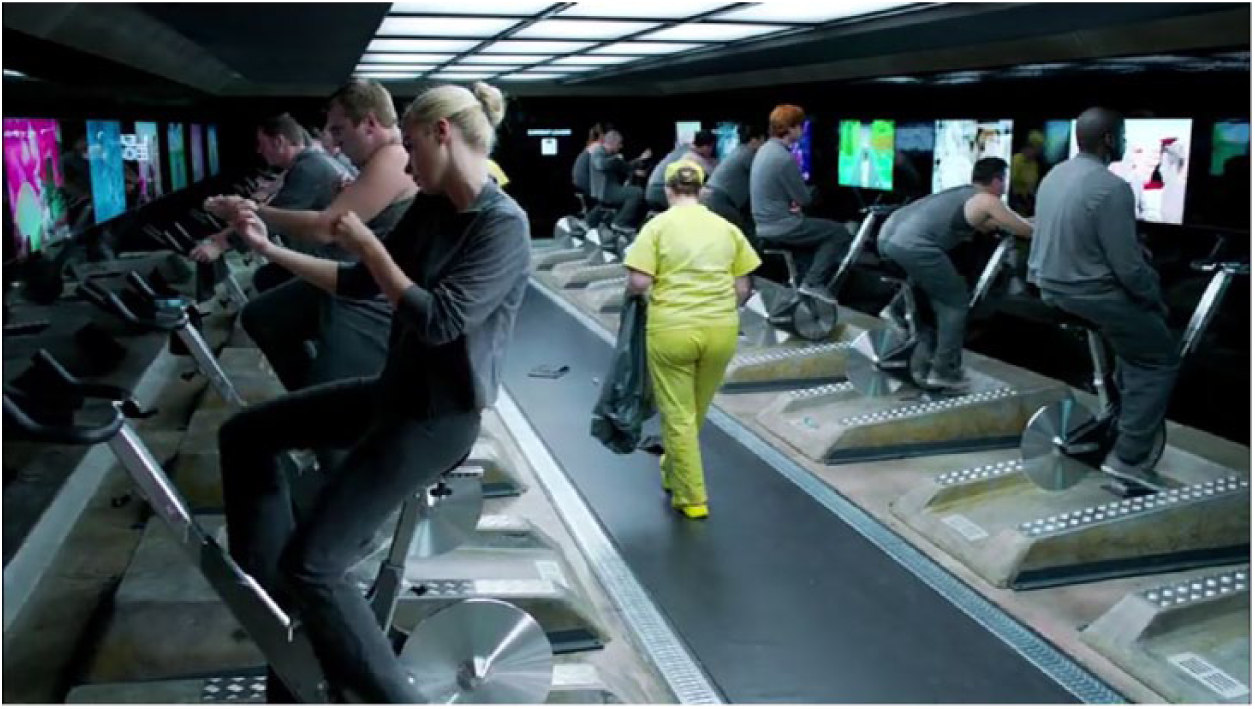
Fifteen Million Merits: 4.00. The inhabitants of the world depicted in ‘Fifteen Million Merits’, simultaneously at work and at play.
The protagonist of Fifteen Million Merits, Bing, begins the episode as the archetypal ‘consumer-spectator’ of whom Fisher (2009) speaks, ‘trudging through the ruins and the relics’ of the hyper-capitalist society which is shown to us: passively conforming to what is expected of him (p. 10). He is clearly tired with his existence, but is blind to the root cause of his dissatisfaction in spite of its obviousness: a fact symbolised by his ignorance of Swift’s affections for him. Once he meets and hears the singing ability of Abi, he becomes increasingly disillusioned with the artifice and ‘fake fodder’ of the world he inhabits. Bing recognises that hearing Abi’s voice is the only ‘real’ experience he has ever had. He decides to gift her the fifteen million merits required to buy an audition place on Hot Shot, in the hope that she might find an escape from their everyday reality. Abi makes it through the auditions, but is drugged just before she goes on stage for her televised performance by the show’s producers. The judges tell her that she is not good enough to become a professional singer, and subtly coerce her into joining one of the pornography channels instead.
Bing, angry and frustrated, hatches a plan to enter into the competition himself: to make a public display of his dissatisfaction and disrupt the status quo. He devotes himself over the following weeks and months to raising the credits needed for another entry ticket, and when he finally gets in front of the judges, he places a shard of glass to his throat and threatens to kill himself on live television if he is not given the chance to speak openly. He goes on to give an impassioned speech castigating the state of society: fake fodder is the only thing that works anymore, fake fodder is all that we can stomach. We’re so out of our minds with desperation, we don’t know any better […] Show us something real and free and beautiful – you couldn’t. It’d break us. We’re too numb for it. (Fifteen Million Merits 2011: 53.00-54.00)
Bing achieves his desired effect; his speech stuns the viewing audience and judges into silence.
But what happens next is pure capitalist realism. After a few seconds, the chief judge leans forward and says: ‘That was, without a doubt, the most heartfelt thing I’ve seen on this stage since Hot Shot began!’ (Fifteen Million Merits 2011: 54.30). Bing is offered a slot on one of the judges channels, in which his dissenting views can be packaged and broadcast on a regular basis. He accepts, and the final shots of the episode show him some time later, milling around a new, upgraded cell. We see him contentedly taking in a view of a forest from a large window on one of the cell’s walls: the only shot of an outside space in the entire episode. However, as the camera zooms out, we are left questioning whether the view is genuine or simply another digitally rendered form of entertainment.
The PWP present UBI as a subversive tool: not just an end in itself, but a means to fight capitalism’s exploitation and to make significant steps towards a post-capitalist future. But Bing’s experiences of resistance demonstrates to us what Boltanski and Chiapello (2007) note: that when faced with that which antagonises it, capitalism seeks to subsume rather than oppose. As Fisher (2009) demonstrates, ‘the limits of capitalism are not fixed by fiat, but defined (and redefined) pragmatically and improvisationally […] [it is] a monstrous, infinitely plastic entity, capable of metabolising and absorbing anything with which it comes into contact’ (p. 10). Although Bing is able to momentarily reveal the social order for what it really is, following its initial shock the system finds a way not only to regain control, but also to harness the discordant energy for its own productive ends.

Fifteen Million Merits: 58.37. Bing performs sanctioned dissension during one of his weekly broadcasts.
First, our protagonist’s subversion is pacified: the judges respond to him as if he were a contestant, casting his act of dissension as just another talent performance for the show. Then, the critique is put to work. Bing’s dissenting voice is rendered as entertainment – consumption deployed to disguise production – channelling its transgressive energy into something which, in a tragic twist of irony, works to sustain the exploited condition to which it was meant to be opposed. What’s more, by way of this ‘change in the modes of profit creation […] the world is momentarily disrupted with respect to previous referents’ (Fisher 2009: 29): further critique finds itself confounded in the face of this new and unexpected arrangement.

Fifteen Million Merits: 1.00.27. Our protagonist gazes out over an idyllic scene, believing he has overcome his exploitation.
Indeed, the ambiguity over Bing’s liberation in the final frames of the episode provide an apt metaphor for the left’s misplaced faith in UBI as a progressive panacea. Like how Bing gazes out over the expanses of the forest and reflects on his freedom, the PWP – convinced of the potential in its ideas – looks ahead to the future: envisaging and hoping for a better world. But what it sees is an image artificially rendered for it: deceptive in its realism and perceived proximity. In truth, the promise of emancipation is held like a carrot in front of our faces: guiding us blindly along a path that capitalism is all too happy for us to walk down.
Can UBI be rescued?
In their blueprint for a post-work condition, Srnicek and Williams present UBI as one of a number of essential components. Alongside it, they claim, we must also demand a fully automated economy, a shortening of the working week and a diminishment of the pervasive work ethic. Crucially, speaking of these projects collectively, they argue that ‘their real power is expressed when they are advanced as an integrated programme’ (Srnicek and Williams 2016: 127): only when each element is combined with all the others is the recipe for a post-work, and ultimately a post-capitalist, future found.
But in spite of the seemingly robust nature of their manifold programme, each project is dependent on an altogether limited notion of work. While, in their support for UBI, the authors do make reference to the benefits for unwaged domestic labourers (Srnicek and Williams 2016: 122), they nevertheless focus almost exclusively on waged work as the principal barrier to be overcome in the accomplishment of a post-work future: often, thanks to their ‘post-work productivism’ (Pitts and Dinerstein 2017), unwittingly depicting the waged work of material production as the only economically significant form of labour to be addressed. As this article has shown, what is ignored in this discourse is the work performed outside of work: the free labour pervasive to cognitive capitalism, which is exerted willingly rather than through coercion or the threat of destitution. As such, the PWP join neoliberal ideologues and ‘Silicon Valley productivity fetishists’ (Pitts and Dinerstein 2017: 7) in noting an opportunity within UBI – a productive potential to be capitalised upon – which could as readily lend itself to a leftist project as to the achievement of capitalism’s increased subsumption. If UBI’s place in a leftist programme is to be restored – if it is truly to be a stepping stone to a post-capitalist future – then we must offer more to accompany it than simply other public policy measures geared towards tackling waged work, as Srnicek and Williams do (in spite of how that may dampen the popular appeal and political expediency of the project).
Under cognitive capitalism, the market has come to dominate the communicative potential of the digital sphere: privatising its spaces of possibility and commodifying its products. It has offered up the communicative tools and platforms which are essential for today’s social exchanges, but has structured them in such a way as to capture the energies exerted in their use and to extract value. Therefore, it is imperative that a contemporary leftist project, while calling for a UBI, also strives for an ‘alternative Internet’: insisting, as Fuchs (2013: 221) does, on the digital sphere as a communicative commons.
On the one hand, the Internet ought to be a resource freely available to all, and should neither be privately owned or controlled by a particular class (Fuchs 2013: 221). On the other, individuals must retain the right not only to make themselves digitally present and active, but crucially, also be ‘equal participants in the decision-making processes that concern the platforms and technologies they use’ (Fuchs 2013: 222), such that they are divested of the logic of capital accumulation and the exploitation of others’ labour and become orientated in the first instance towards the facilitation of their social function. We could therefore, as Fuchs (2013) suggests, begin to advocate for more nonprofit Internet projects in the vein of Wikipedia and public search engines, with the important caveat that each offers full democratic oversight.
Big data, similarly, must be re-framed as a society-wide project (Malmgren 2017). Rather than being harnessed to generate massive advertising revenues for Internet giants like Facebook and Amazon, the analytics industry’s increasingly granular insights should instead be wielded to solve prescient social problems, as has already been demonstrated in areas like biological research (The Cancer Genome Atlas Network 2012). It could even be deployed specifically to fight labour’s cause. As Mehta (2015) notes, the scheduling software used by companies like Starbucks, which utilises sales trend data and real-time weather reports to optimise labour inputs, could be repurposed by unions or worker co-operatives to both minimise each worker’s precarity and ensure generous staffing levels during intensive peak hours.
Furthermore, wherever capitalism takes subjectivity as its object of reference and wellspring of its vitality – cultivating subjective forms in order to appropriate and homogenise them – then an effective resistance should rally the means to ‘resingularise’ subjectivity, as Guattari ([1989] 2008: 33) has shown. We ought to attend to the ‘dispositives of the production of subjectivity’ (Guattari [1989] 2008: 34) and experiment with their mechanisms at a microsocial level: preempting those performances where the individual ‘manufactures’ in line with capitalism’s demands, while searching for the means of an ‘individual and/or collective resingularisation’ (Guattari [1989] 2008) in which subjectivity extends itself above and beyond capitalism’s powers of manipulation. By fostering an open-endedness and indeterminacy of subjectivity in this way, the mental, social and environmental registers might thus begin to be re-captured from capitalism’s ‘world integration’: its grip on the ecology as a whole. While culture jamming may appear to have lost its efficacy online – the atomisation of online advertisements prevents them from being subverted into mass political messages, while ignoring ads serves only to maximise their efficacy at targeting potential consumers – as Madrigal (2012) has shown, a detournement remains possible in the form of ‘statistical noisemaking’. In a manner akin to a denial-of-service attack on a website, the co-ordination of many users’ clicks on an advert ramps up the advertiser’s cost-per-click fee and ultimately drains them of money and resources.
If UBI is to be salvaged from capitalism’s subversion and reinstated as a genuinely progressive programme, then the left’s project must be re-clarified on these lines. We must recognise cognitive capitalism and free labour’s relevance for the debate, and commit ourselves to combating their forms of exploitation in tandem with our resistance to waged work. Then, and only then, UBI might begin to live up to its post-work and post-capitalist promises, and offer a viable means to achieve a more equitable future.
Footnotes
Acknowledgements
I would like to thank Dr James Burton and Oana Parvan for their feedback at various stages in the completion of this work and for encouraging me to seek publication.