




Abstract
This paper discusses productivity growth in the context of the Greek economy. Productivity of labor in the Marxian sense is estimated using the distinction between productive and unproductive labor, and it is compared and contrasted with its mainstream counterpart. Marxian productivity is generally higher in level and exhibits a higher average rate of growth than mainstream productivity. We also estimate econometrically the determinants of productivity growth. Variables stressed in the classical-Marxian approach expressing capital accumulation appear to account for most of the variation in productivity growth. This is in contrast to certain radical approaches and especially the Social Structures of Accumulation school which stress the importance of ‘social’ variables for the explanation of productivity growth. In particular, the negative correlation found here between productivity growth and unemployment rate for Greece contradicts earlier findings in the Social Structures of Accumulation literature which postulate a positive correlation between those variables for countries like Greece and the United States.
Introduction
In a process parallel with the unfolding drama of the last global economic crisis, labor productivity growth has stagnated or even collapsed in almost all advanced capitalist economies. This most recent global ‘productivity slowdown’ is reminiscent of a previous similar episode that of the original ‘productivity slowdown’ that coincided with the economic crisis of the 1970s and early 1980s. Given that then as now several information technology (IT)-related innovations should have resulted into increased productivity growth, which they did not, we have entered what Byrne et al. (2016) call a ‘productivity paradox 2.0’. Therefore, for a second time in living memory a great economic crisis is interwoven with a slowdown or even a fall in productivity. Then, it was the ‘stagflation crisis’, now it is the ‘Great Recession’. But the factors that fundamentally caused the fall in productivity growth still remain a mystery.
In this essay, using data for the greater part of the postwar period in Greece, we argue that empirical evidence from the past and current crises can be used to shed light onto both old and new questions regarding the productivity slowdowns of the 1970s and the 2000s. In particular, we provide evidence that the deceleration in productivity growth, at least in the case of the Greek economy, is the result of a secular increase in capital accumulation and unproductive activities, rather than the result of ‘social’ or conjunctural factors having to do with the make and brake of ‘accords’ of certain content as argued by the Social Structures of Accumulation (SSA) approach. 1 The current essay expands on the existing literature by focusing not only on the econometric determinants of labor productivity in general, but also on Marxian labor productivity, a measure constructed following the methodology of Shaikh and Tonak (1994) for the transformation of National Accounts categories into their Marxian counterparts.
The rest of this essay is structured in the following way. In the second section, we discuss two competing Marxist approaches regarding the relation between productivity growth and economic crisis. In the third section, we discuss the relevance of the distinction between productive and unproductive labor for the proper measurement of labor productivity, which we then estimate. In the fourth section, we briefly survey the empirical literature on the determinants of productivity growth. In the fifth section, we describe the sources and methods used for the econometric estimation of the determinants of Marxian productivity growth. In the sixth section, we construct and estimate a ‘synthetic model’ of labor productivity growth using data for Greece. The seventh section presents our conclusions.
Productivity slowdown and economic crisis in the Marxist tradition
The main Marxist approaches regarding the relation between labor productivity and economic crisis could be divided into two separate traditions: the Neo-Marxist SSA school and the Classical Marxian tradition. 2 The SSA approach is a middle-range theory aiming to replace or complement the ‘abstract general laws’ of historical materialism with a ‘return to the concrete’ via a number of intermediate concepts derived as stylized facts for specific historical periods (Mavroudeas 1999). This approach was first formulated in the late 1970s and early 1980s by the seminal contributions of Bowles et al. (1984), Gordon (1981), Gordon et al. (1982), and Weisskopf et al. (1983), while a review can be found in McDonough Reich and Kotz (2010).
A fundamental assumption of the SSA approach rests on the significance of institutions and a system of institutionalized ‘accords’ between capital, labor, and the state for the formation of ‘a stable and favorable external environment’ (Gordon et al. 1987: 47) that is considered necessary for the support and enhancement of profitability and capital accumulation. The formation of such accords generates a period of sustained accumulation that only ends when those institutionalized relations collapse as a result of accumulated internal and external contradictions. Although the exact periodization of successive SSAs remains a point of debate (McDonough 2008; Reich 1994), a consensus exists that the post-war period contains either two separate SSAs (Lippit 2013; Wolfson & Kotz 2010), or one SSA and its period of deconstruction and crisis (O’Hara 2002).
Central to this argument has been the extend of fall and recovery of the profit rate during the neoliberal period that followed the so-called ‘golden age’ period. In this context, the productivity slowdown of the 1970s was considered as the proximate cause of the profitability crisis and the unraveling of the capital-labor accord as the fundamental cause (Bowles et al. 1991; Weisskopf 1979). This understanding of the crisis generating mechanism emphasized the so-called ‘social’ determinants of productivity (Naples 1987, 1986; Weisskopf 1987; Weisskopf et al. 1983). The main argument was that (a) the progressively increasing power of labor vis-a-vis capital over the issue of working conditions during the late 1960s and 1970s was instrumental in decreasing productivity growth without a similar decline in wages and (b) that the recovery of profitability and accumulation after the early 1980s was a result of capital regaining control of the workspace, using unemployment as a disciplinary device in order to extract productivity gains while at the same time keeping wages low. In particular, Weisskopf (1987) utilizing an international comparative empirical analysis on the effects of unemployment on labor productivity growth found evidence that supported the hypothesis of a positive relationship between the two variables for countries with ‘antagonistic’ capital-labor relations such as the United States, while a negative relationship was found for countries such as Germany and France with ‘cooperative’ relations between capital and labor and worker security from the welfare state.
The Classical Marxian approach places less emphasis on institutional arrangements and more emphasis on issues of proper measurement of Marxian variables. The cause of the decline in the rate of profit according to Shaikh (1987) and Shaikh and Tonak (1994) is not related to institutional developments and distribution phenomena, such as the various ‘accords’ between labor, capital, and the state, but is instead the inexorable result of the rise of capital accumulation. Maniatis (2012) summarizes the main argument of this tradition regarding the nuanced relationship between productivity, unproductive labor and capital accumulation in the following way. Capitalist competition drives technological growth in the direction of increased mechanization and capitalization of the labor process. The increase in available surplus value supports the necessary increase of unproductive labor employment, both in order to supervise and coerce productive labor and in order to facilitate the efficient circulation of produced value. As a result of the combined effects of increasing capital-output ratio, increasing rate of surplus value and increasing rate of unproductive relative to productive labor the net rate of profit falls, therefore reducing investment activity and also productivity growth. Thus, the fall in productivity growth rates is ultimately a result of the fundamentals of the capitalist system, of increased competition and mechanization of production. Moreover, it is significant to note that, Shaikh and Tonak (1994: 132) argue that mainstream measures of labor productivity such as those used by the SSA approach overestimate the extend of the productivity slowdown, since the latter becomes significantly less pronounced if the distinction between productive and unproductive labor is accounted for. In general, within the Classical Marxian tradition productivity is influenced primarily not by institutional or ‘social’ factors, but by the availability of capital per worker properly measured to account for productive labor only. On the contrary, Mihail (1995) examining specifically the determinants of productivity growth in the Greek economy within the theoretical framework of the Social Structures of Accumulation approach for the 1963–1990 period reports supportive evidence for some of the claims of the SSA school, especially of a positive relationship between the unemployment rate and productivity growth in similar fashion to the finding of Weisskopf (1987) for the United States.
Productive and unproductive labor and Marxian labor productivity
The distinction between productive and unproductive labor has been the source of great confusion in the literature. The obvious question, as put forward by Hunt (1979) in his seminal survey of the issue, has to be ‘productive of what?’. The short answer is productive of surplus value. However, since a number of interpretations of the latter statement can be found to be valid within the Marxist tradition and since a full survey of the extensive literature on the subject far exceeds the scope of the argument presented here, we will limit ourselves to an application of the methodology proposed by Shaikh and Tonak (1994) and utilized in previous studies by among others Mohun (2005, 2006, 2014), Paitaridis and Tsoulfidis (2012), Tsoulfidis and Paitaridis (2019) and Maniatis and Passas (2013, 2018).
In our estimates, we distinguish first between production and non-production economic sectors and then we define as productive labor all employed persons (wage laborers and self-employed) in production occupations within the production sectors. As production sectors, following Shaikh and Tonak (1994: 295), we define the International Standard Industrial Classification of All Economic Activities (ISIC rev3) sectors: Mining, Manufacturing, Energy, Construction, Hotels and Restaurants, Transport and Storage, Education, Health and Other Services. As non-production sectors, we define the ISIC rev.3 sectors: Trade, Financial Intermediation, and Business Activities. Again, following Shaikh and Tonak (1994: 108), we define as production occupations within those sectors the following International Standard Classification of Occupations (ISCO88) categories: Professionals, Technicians, Agricultural, Crafts, Plant and Elementary; and as non-production occupations: Senior Officials and Managers, Clerks, and Service Workers and Shop and Market Sales Workers. Therefore, productive labor is labor employed at the intersections of production sectors and production occupations within those sectors, and unproductive labor is labor employed in non-production sectors and in non-production occupations within the production sectors.
In Figure 1, we observe that the ratio of unproductive labor to productive labor compensation exhibits a rising trend from the beginning of the period examined here until the few years before the onset of the Great Recession. Then this ratio falls significantly until 2014, possibly as a result of the streamlining in unproductive activities forced by the huge economic crisis, and then it is stabilized until 2020.
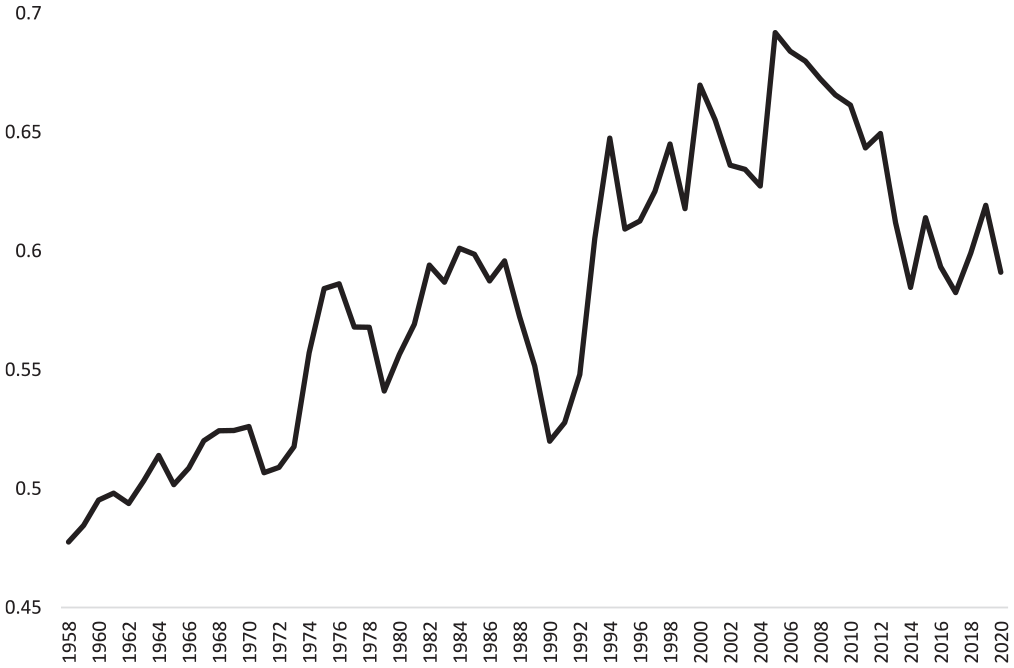
Unproductive to productive labor compensation, 1958–2020.
It is now possible to estimate and compare the mainstream productivity measure with the Marxian measure of labor productivity. We expect that ‘Precisely because the Marxian concept of production differs greatly from the orthodox concept, the corresponding measures of productivity are also very different’ (Shaikh & Tonak 1994). We note that we define Marxian labor productivity as the ratio of deflated Marxian net value added over productive labor employment in the denominator. On the contrary, mainstream labor productivity is defined as the ratio of deflated mainstream net value added in the private sector over total employment. Therefore, the two measures differ both in the numerator (the Marxian measure includes also the intermediate inputs of trade) and in the denominator (productive labor in the Marxian measure and total labor in the mainstream measure); 3 we use the same deflator for both series. A description of data and methods used for the estimation of the Marxian productivity measure can be found in a following section.
In Figure 2, we present the mainstream and Marxian labor productivity measures for the Greek economy. 4 The two measures follow the same growth profile initially until 1973, but then they start to exhibit notable differences. In particular, from the late 1970s until the mid-1990s mainstream productivity is either stagnant or even declining somewhat and rising afterwards for a decade until the onset of the Great Recession. On the contrary, Marxian productivity remains basically stagnant or rising slightly from the late 1970s until the mid-1990s and then picks up pace, rising more than the mainstream measure. This discrepancy in the growth profiles is the direct result of the significant increase in unproductive activities during the neoliberal era. 5 Since unproductive labor is included in the denominator of mainstream productivity but not in the denominator of Marxian productivity, its increase is a burden for the mainstream productivity measure, but not for the Marxian one. In turn, this increase in unproductive activities and the associated discrepancy between mainstream and Marxian productivity reveals that productive labor increased its productivity during the neoliberal period (albeit at a rate less than that achieved during the ‘golden age’ of 1960–1973). This increase could possibly stem from two distinct sources: first, productive labor could have directly increased its productivity, and second, the use of unproductive labor might have resulted in increased work effort and facilitated the faster turnover of capital increasing the availability of capital per productive laborer and productivity.
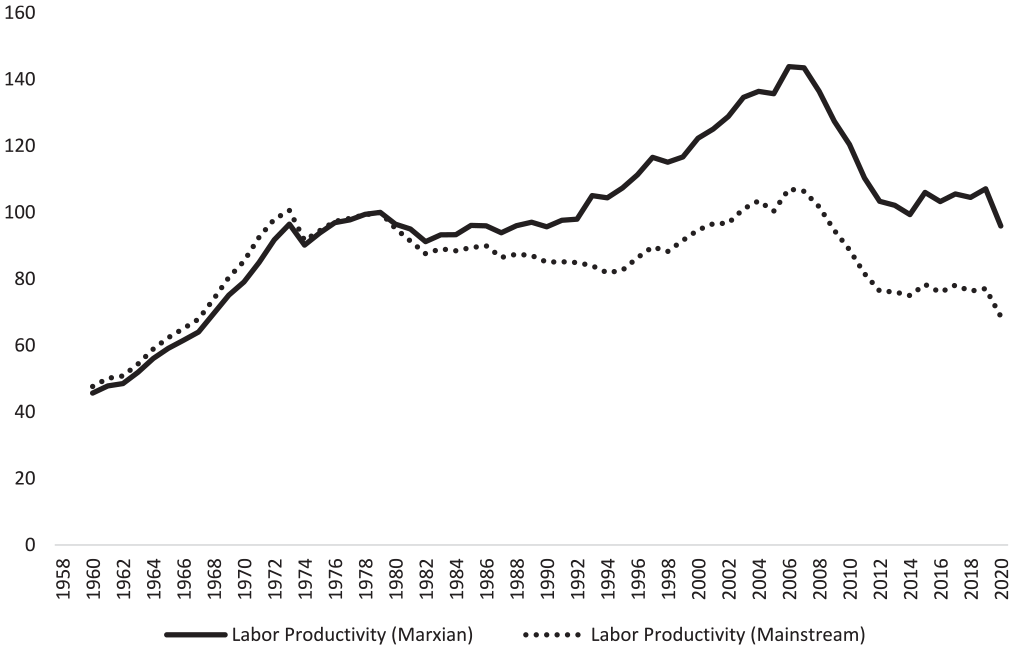
Mainstream and Marxian labor productivity, Index 1979 = 100, 1960–2020.
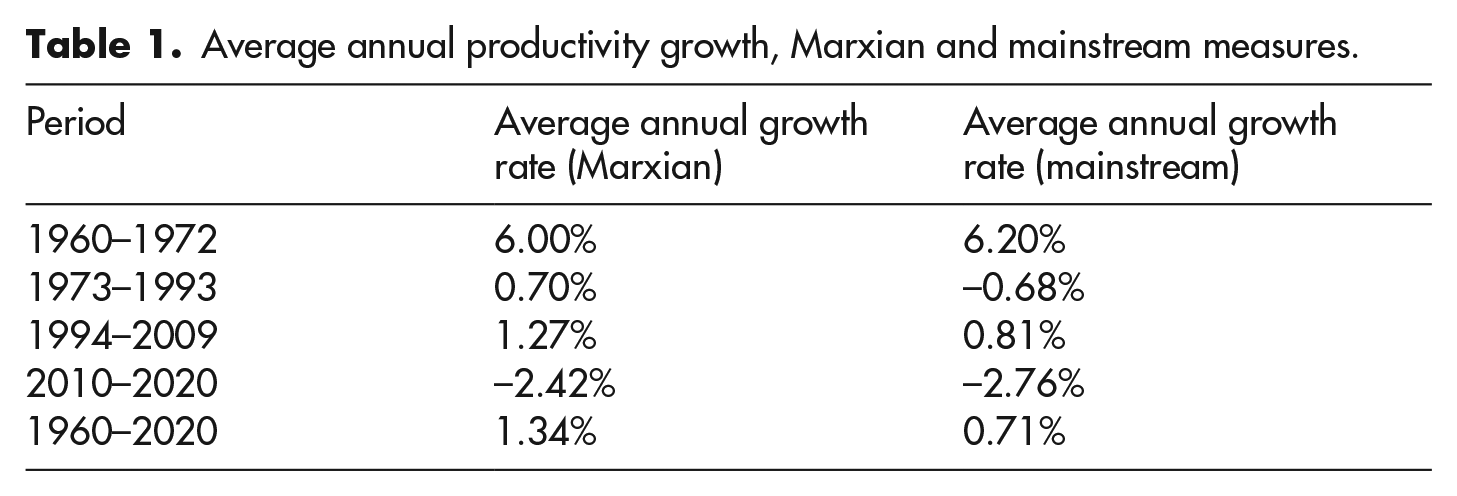
We conclude by noting that labor productivity if properly measured utilizing the distinction between productive and unproductive labor is found to be increasing at a healthy pace in both periods preceding the crises of the ‘70s and of late ‘00s (see Table 1). Productivity is found to stagnate or even fall only during the crisis period proper. During the “stagflation” crisis after a short initial fall, productivity properly measured, stagnated and then recovered albeit at a reduced growth rate along with capital accumulation. Similarly, we do not observe a sudden fall in productivity growth before the latest crisis. On the contrary, during the current crisis productivity (both measures) fell considerably more than in the 1970s–80s. Indeed, productivity fell considerably even in absolute terms and has yet to recover. This is probably due to the great depth of the current crisis and the unprecedented fall in capacity utilization. We argue that those events were more the direct result of a fall in the investment rate and therefore of the availability of capital per unit of productive labor and certainly not the result of increased labor militancy as a result of “an unravelling of the capital-labor accord”. We now turn to an econometric investigation of the determinants of labor productivity growth in order to provide further evidence for this claim.
Average annual productivity growth, Marxian and mainstream measures.
A synthetic model of Marxian labor productivity growth
In the SSA tradition, exemplified by the contributions of Bowles et al. (1991); Weisskopf et al. (1983); Weisskopf (1987), two main types of determinants of labor productivity are considered: ‘technical’ and ‘social’ determinants. Technical determinants in this tradition include capital intensity, capacity utilization, and input prices; whereas social determinants include work intensity, innovative pressure on business, and popular resistance to corporate domination. Therefore, the SSA tradition by including a number of ‘social’ determinants to the framework developed by the mainstream tradition leaves room for ‘social accords’ or ‘social contracts’ between classes that would enhance productivity, a development that would benefit everybody in the economy.
Moreover, a number of studies have explored additional determinants. Those include more detailed descriptions of capital and labor variables in order to account for changes in qualitative characteristics, such as education and R&D, and a number of additional and somewhat ad hoc variables that account for structural and macroeconomic factors.
In general, abstracting from some fixed factors even in the very long run, such as geography and climate, and focusing on the medium term, the following main types of labor productivity determinants are found in the relevant literature: (1) capital stock available per hour of labor employed, since mechanization of production is the primary means for getting the most out of the labor process especially in the classical Marxian approach (Shaikh 1987: 116, 1989: 3), (2) labor quality characteristics, such as age, sex, and experience of the labor force, (3) the relative importance of research and development expenditures, (4) the utilization rate of available resources, especially capital, (5) availability of certain resources, such as energy use per hour of labor employed, (6) work intensity, as it is influenced by unemployment and/or more specifically by the ‘cost of job loss’, accounting for the role of the welfare state in protecting workers during periods of unemployment, (7) innovative pressure on business, and (8) popular resistance to corporate domination. In this list of possible determinants of productivity growth, one could also include a number of additional variables also found sometimes in the literature such as (9) inflation and especially the relative inflation of energy prices, (10) government spending, and (11) trade openness. It is also possible to include as a determinant (12) the share of employment in the secondary sector of the economy as a variable that reflects changes in the (productive) structure of the economy which may influence at the same time productivity growth in a positive way.
The first five from the list above are identified by Bowles et al. (1991), Weisskopf et al. (1983), and Weisskopf (1987) as strictly ‘technical determinants’ of productivity and the next three as ‘social determinants’. Since in the SSA tradition the term ‘technical determinants’ is a catch-all phrase, aimed simply to identify all the non-social determinants proposed by that school, we opt to further divide ‘technical determinants’ into two subcategories. The first subcategory that we use can be considered as technical determinants proper, that is, determinants directly related to (relative) quantities of capital and labor and their characteristics; and the second subcategory as ‘macroeconomic determinants’, that is, determinants that are related to the macroeconomic state of the economy. Thus, we proceed in our analysis using the following four categories of productivity determinants: (1) technical determinants, (2) macroeconomic determinants, (3) social determinants, and (4) structural determinants.
Below, we present a synthetic model of medium-term determinants of Marxian labor productivity growth, following similar approaches (for the mainstream measure of productivity) of Bowles et al. (1991) and Weisskopf et al. (1983) for the US economy, Weisskopf (1987) for eight advanced capitalist economies and Mihail (1995) for the Greek economy. Our model is synthetic in the sense that it includes not only ‘technical’, but also ‘social’, and ‘macroeconomic’ as well as ‘structural’ determinants of labor productivity.
The model that we estimate is presented in equation 1 below:

with MLP denoting the growth rate of Marxian labor productivity growth (MLP) as the dependent variable.
Technical determinants
In our model, we include two strictly ‘technical’ determinants of productivity identified by coefficient bk in equation (1). The first technical determinant is the growth rate of the capital to productive labor ratio denoted by KNR. We include this variable in our model as it is unambiguously considered in both mainstream and heterodox literature a fundamental factor contributing to labor productivity. Capital is measured at constant replacement cost and it is net of depreciation, while the labor input is measured as productive labor employment. We expect this variable to have a positive contribution to labor productivity, since in the Classical Marxian tradition of political economy, capital accumulation in the context of capitalist competition and cost-cutting takes the form of an increase in capital per (productive) worker and this should ceteris paribus result in an increase of output per worker, as more advanced technology is usually employed in new capital goods.
The second technical determinant is the capacity utilization rate denoted by CPT. Basu and Fernald (2000) identify capacity utilization variations during the business cycle as one of the possible causes of the procyclicality of productivity growth, the latter increasing when fixed capital utilization increases during the boom phase of the cycle and vice versa. Bowles et al. (1991) propose that low utilization rates result into lower productivity growth because of inefficient use of production resources during a low-capacity utilization period. Moreover, they propose that low-capacity utilization tends to discourage new capital investments therefore resulting into a further loss of productivity growth. However, two important critical notes should be made on the use of capacity utilization as a determinant of productivity growth. The first is that capacity utilization can only be measured directly in manufacturing and therefore its use as a measure for the total economy rests critically on a number of controversial assumptions regarding the measurement of actual and potential output in the services sectors. The second is that the ratio of actual to potential output rests critically on the specification of the latter, which in turn is again quite controversial in its measurement. In any case, we expect that the capacity utilization rate will be positively correlated with labor productivity growth.
We exclude from our discussion Research and Development expenditure (R&D) as a determinant of labor productivity for two reasons. First, research and development mainly affects productivity via increases in the quality of capital; those increases though are already captured in our estimate of capital stock since this is measured at constant replacement cost. In other words, if we included an R&D variable, we would possibly double count the effect of capital on labor productivity first by estimating the effect of the capital-labor ratio and second by estimating the effect of R&D that has been already incorporated in the capital–labor ratio. The second, more practical reason for not including R&D in our estimations is the lack of such long run data for Greece. We should also note that we do not include in our model measures of human capital, or other so-called quality characteristics of the labor force since we were not able to find time varying measures with a sufficiently long record to match the dimensions of our sample. Moreover, we express our doubt on the usefulness of using crude measures, such as education participation rates or literacy rates, especially for advanced capitalist countries.
Social determinants
We include in the model two ‘social’ determinants of productivity growth (WGC and UNP) identified by coefficient ck in equation (1). We remind that in the SSA literature the three main social determinants of labor productivity are (a) work intensity (the ‘Marx effect’), (b) innovative pressure on business (the ‘Schumpeter effect’), and (c) popular resistance to corporate domination. Bowles et al. (1991) and Weisskopf et al. (1983) propose that work intensity is affected by two distinct channels: the strength of workers own motivation to work and the effectiveness of management’s control over the labor process. They propose the use of the following proxy variables to measure workers motivation to work: (a) real spendable hourly earnings, (b) a work safety index, and (c) a job satisfaction index. On the contrary, the effectiveness of management control is also measured using as proxies: (a) the intensity of supervision, (b) the ‘cost of job loss’, and (c) an index of inequality.
In our model, worker motivation is captured by including the variable WGC that indicates cyclical deviations of the real wage of the average productive laborer. Compensation of (productive workers) is deflated by the consumer price index (CPI) and the denominator is productive employment. Our assumption is that an increase in the cyclical component of the real average wage reflects an above ‘normal’ compensation that acts as a motive to increase labor productivity. Therefore, we expect that the cyclical component of wages and labor productivity will be positively correlated in the spirit of the ‘efficiency wages’ argument shared by both mainstream macro theory and the SSA approach.
The effectiveness of management pressure on labor is captured by the growth rate of the unemployment rate (UNP). Unemployment constitutes the basic element of the composite variable ‘cost of job loss’, the latter being considered by the Social Structures of Accumulation approach as the most important social factor affecting labor productivity. In the SSA tradition (and the heterodox one in general), unemployment acts as a ‘stick’, as a disciplinary device for workers. Even though in a number of empirical studies, the effect of unemployment on productivity is found to be positive for the United States, the direction in which unemployment affects productivity in general, that is, in countries other than the United States, is found to be ambiguous. On one hand, Weisskopf et al. (1983) and Rebitzer (1987) suggest a positive relationship on the grounds that unemployment works as a disciplinary factor forcing labor to be more productive (exert greater effort in the production process) in order to retain its employed status. On the contrary, Weisskopf (1987) in a later article finds evidence that while a positive relationship between unemployment and labor productivity is indeed the case for the US economy and other countries with ‘antagonistic’ labor-capital relations, this relation is reversed in a number of other countries with ‘cooperative’ labor-capital relations. Therefore, since capital-labor relations in Greece during the entire period under investigation could be characterized for the most part as ‘antagonistic’, 6 the sign of the unemployment variable in our model cannot be determined a priori. Mihail (1995) finds a statistically significant positive relationship between ‘cost of job loss’ and productivity growth for the Greek economy during the 1960–1990 period and argues for a novel institutional setting between capital and labor in which higher productivity would not be the result of high unemployment and lost output. We should also note that from a classical Marxian perspective, higher unemployment increases work effort, and measured productivity (brings actual productivity closer to potential productivity allowed by technology and the degree of mechanization, see Shaikh, 1989: 3), but on the contrary, lowers output (more than employment) affecting in a negative way productivity. Thus, it seems that the sign of the unemployment rate is ambiguous depending on the relative strength of the work effort effect and the output foregone effect of a recession or a crisis.
We do not include a variable for the innovative pressure on business because of a lack of adequate data for bankruptcies for the entire time period of our sample. However, our measure of trade openness that is included in the macroeconomic determinants can be considered as a proxy for competition and thus for innovative pressure. We also note that, we classify relative energy prices, the main component of the SSA variable on popular resistance to corporate domination, as a macroeconomic rather than a social variable. In other words, we reduce the SSA model to include only what we consider to be its core argument, namely the effects of real wages and unemployment on labor productivity.
Macroeconomic determinants
Macroeconomic conditions possibly affect labor productivity via a multiplicity of channels and are identified by the coefficients dk in equation (1). In order to capture their effect, we use four variables (INF, NRG, GOV, TRD).
INF denotes the inflation rate, measured as the percentage change of the CPI deflator index. As an alternative formulation we also use variable DEF which is the percentage change of the GDP deflator. Before the stagflation crisis of the 1970s mainstream economic theory anticipated either a positive or no significant link between output growth and inflation and thus also between labor productivity and inflation (Lucas 1972, 1973; Mundell 1963; Tobin 1965). However, more recent works have tended to postulate in general a negative link between output growth and inflation (Fischer 1983, 1991) that exhibits itself through a multiplicity of channels, with some of them affecting output negatively and others affecting output positively. The main argument of this tradition can be summarized in the following manner. ‘Since there are no good arguments for very high rates of inflation, a government that is producing high inflation is a government that has lost control. Economic growth is likely to be low in such an economy’ (Fischer 1991: 332). In other words, high inflation is understood as a symptom of bad macroeconomic policy, possibly indicating a crisis period, and therefore given the procyclicality of labor productivity, it is also expected to be possibly negatively correlated with labor productivity growth.
NRG denotes the growth rate of relative price of energy. In the earlier literature on the determinants of productivity, the energy price shocks of the 1970s were seen as causes of the decline in the growth rate of labor productivity during that time (Berndt 1990; Berndt & Wood 1986; Jorgenson 1984). At the same time, the SSA theory, as we already mentioned, also considered relative energy prices as a social determinant treating the hike of oil prices as a tool against corporate domination being heavily influenced at the time by the OPEC rhetoric of the 1970s that was of somewhat anti-colonial character, a unique episode without continuation. Thus, we decided to include a variable capturing the relative price of energy as a macroeconomic rather than as a social variable in our model.
GOV denotes the growth rate of the ratio of government expenditure to GDP. While the earlier Keynesian tradition understood government spending as an integral part of reviving growth after an economic crisis, for neoclassical economics assuming that the economy is in some sort of equilibrium, government spending should have no impact on economic growth, whereas the extreme view that fiscal contraction may be expansionary has been also proposed in the literature (Giavazzi & Pagano 1990). In general, increases in government spending as a percentage of GDP occur during economic downturns as governments intervene to stimulate demand, whereas at the same time productivity is expected to fall. Therefore, a negative relationship between government spending and productivity is likely to hold during periods of crisis, although increased government spending at least partially offsets this decline in productivity (Aghion et al. 2011, p.31). Under this perspective increased government spending can be seen as an indicator of macroeconomic instability. Thus, the effects of increased government spending on productivity can be considered in a way similar to that of increased inflation. They are both indicators that the government has lost control of the economy and therefore we expect a negative correlation between government spending and labor productivity growth.
TRD denotes the growth rate of trade openness defined as the sum of exports and imports over GDP. The role of international trade in fostering productivity growth has been one of the most discussed subjects in economic theory with the discussion dating back to Adam Smith and his analysis of the effects of international trade on specialization. Trade openness is assumed to affect labor productivity via two distinct channels. First it facilitates technological transfer across different countries, a process known as knowledge spillovers (Aghion & Jaravel 2015). Second, as a variation of the ‘Schumpeter effect’ of SSA theory, we could argue that trade openness increases the degree of competition that the typical firm encounters by adding an international dimension, thus enforcing the competitive outcome that firms with higher productivity survive at the expense of those with lower productivity. Both effects of international trade on labor productivity indicate the presence of a positive relationship between the two variables. Thus, we expect that the trade openness variable will have a positive sign in our model.
Structural determinants
Finally, in order to test for the effect of changes in economic structure to labor productivity growth, we use the variable IND that denotes the growth rate of the share of employment in the secondary sector of the economy. Such a formulation can be considered as a variation and combination of the second law of Kaldor (also known as the Verdoorn law), which assumes a special role for the industrial sector output on labor productivity, and of the first law of Kaldor that assumes that the latter is the ‘engine of growth’ for the entire economy. Therefore, we expect this variable to have a positive effect on labor productivity growth. As an alternative expression aiming to isolate the effect of structural changes, we also use variable ULL that denotes the growth rate of the unproductive to productive labor compensation ratio. We expect this variable to have a positive impact on productivity growth, since relative increases in unproductive labor would result, if employed efficiently, in decreased turnover time of capital; in effect making more capital available per productive worker in a given time period.
Data and methods
Given the significance of measurement issues for econometric estimations in general and for this study in particular, we proceed with the description of methods and data sources for the estimation of the variables in equation (1).
MLP is estimated as Marxian real net value added to productive labor. Marxian real net value added is estimated using National Accounts data as the sum of gross value added in the business sector of the economy, minus the consumption of fixed capital, plus net indirect taxes, plus the intermediate inputs of trade, deflated by the GDP deflator. The business sector of the economy is here defined to include all activities minus agriculture, real estate, and public administration. The rationale for the exclusion of those activities is that in the case of Greece: (1) the vast majority of employment in agriculture during most of the period of the study consists of self-employed persons and not wage laborers, (2) the majority of value added in real estate activities consists of the fictitious element of imputed rents because of the very high rate of self-ownership of dwellings, and (3) all of value added in public administration and defense activities consists of the wages of public sector employees that in turn are financed by taxes already taken into account in the value added of the other sectors. Since we have already discussed our methodology for the estimation of productive and unproductive labor in a previous section, we here limit ourselves to simply note that both variables are estimated using data on labor by sector of economic activity and occupation from the Labor Force Survey. We note that National Accounts data are spliced together in 1995 using two vintages of National Accounts; similarly, the Labor Force Survey data covering the period after 1974 are backwards extrapolated using the detailed data of the population censuses for the years 1961 and 1971.
The capital to productive labor ratio (KNR) is estimated as the business net capital stock to productive labor. The business net capital stock is estimated using National Accounts data on investment, deflated by asset specific deflators, and service lives of assets obtained by the Greek National Statistical Service, ELSTAT. In particular, the net capital stock is estimated, using the traditional perpetual inventory method of accumulating past investments minus depreciation, as the sum of (1) capital stocks of buildings and structures other than dwellings and (2) machinery and equipment. Therefore, we exclude from the aggregate capital stock the asset classes of dwellings, biological resources, and intellectual property products, that is, we focus on the physical structures and machinery employed in the production process itself. We note that as described in detail by Passas (2023), this measure of capital stock uses a geometric depreciation rate and does not take into consideration neither the cohort adjustment and thus nor the integrated age-efficiency and retirement pattern.
Capacity utilization (CPT) is estimated by distinguishing between a trend and a cycle component of Marxian net value added using a Hodrick–Prescott filter. 7 The cyclical component thus indicates a deviation, positive or negative, from trend values that are assumed to correspond to potential output. Having thus obtained the cyclical component, capacity utilization is estimated as the ratio of the cyclical component to actual Marxian net value added in real terms.
Similarly, the cyclical deviation of real hourly wages of productive labor from their trend value (WGC) is also directly obtained using a Hodrick–Prescott filter. Data on wages of productive labor, obtained from National Accounts data, are estimated by multiplying wages per sector, deflated by the GDP deflator; with the ratio of productive to total labor, obtained using the methodology described in a previous section.
A number of variables are directly obtained from the database of the European Commission’s DG-ECFIN (AMECO). In particular, we use without any transformation data on the unemployment rate (UNP), the GDP deflator (DEF), and the CPI, whereas we calculate government expenditure to GDP (GOV) using the ratio of final consumption expenditure of the general government to GDP, and trade openness (TRD) as the sum of exports and imports to GDP at current prices.
The variable for the relative price of energy (NRG) is estimated as the ratio of the spot crude oil price of West Texas Intermediate to CPI. In particular, we transform the dollars per barrel value of the oil price to index form and then estimate the ratio of both indices. Therefore, an increase in the computed index represents an increase in oil prices faster than the general level of consumer prices and vice versa. In that sense increases in the computed index indicate a decreasing availability of energy relative to other commodities and thus a bottleneck for production.
Finally, both the ratio of employment in the industrial sector relative to total employment (IND) and the ratio of unproductive to productive labor (ULL) are obtained using data from the Labor Force Survey. Regarding the first variable, we note that data were used untransformed directly from the labor force survey data set, whereas for the second variable, we applied the same methodology as everywhere else in this study.
Table 2 below presents the summary statistics of the main and alternative variables used for the estimation of equation (1) presented in the previous section and Figure 3 presents the variables in graphical form. Since our data are macroeconomic time series that possibly follow common trends and it is obvious from visual inspection that a number of variables are not stationary, that is, they do not revert to a mean value, ordinary least squares regressions on the untransformed variables will possibly be susceptible to spurious correlation. To test for stationarity, we perform an Augmented Dickey Fuller (ADF) test on the selected variables in natural logarithms. ADF tests the null hypothesis that a unit root is present in the time series, and therefore that the series does not revert to its mean, that the series is not stationary. Thus, rejecting the null amounts to the assumption that the series is stationary, and therefore, standard OLS regressions can be performed. Results, reported in Table 3, indicate that all variables are non-stationary in levels and stationary in first differences. The only exception is the inflation rate in both its specifications, either as the growth rate of CPI, or of the GDP deflator. Therefore, we exclude both those variables from our estimates. We note that by construction capacity utilization and the cyclical component of wages cannot be transformed into logarithmic form since they take negative values and are by construction stationary in levels, thus we will use those particular variables untransformed. Moreover, we also note that Marxian productivity and the capital-productive labor ratio ADF regressions were estimated including a linear trend, thus indicating that a linear trend should also be included in our model estimates. Therefore, the results of the ADF test for unit root indicate that the preferred specification of Equation 1 is for the variables to be estimated as first differenced natural logarithms, i.e. as growth rates.
Summary statistics.
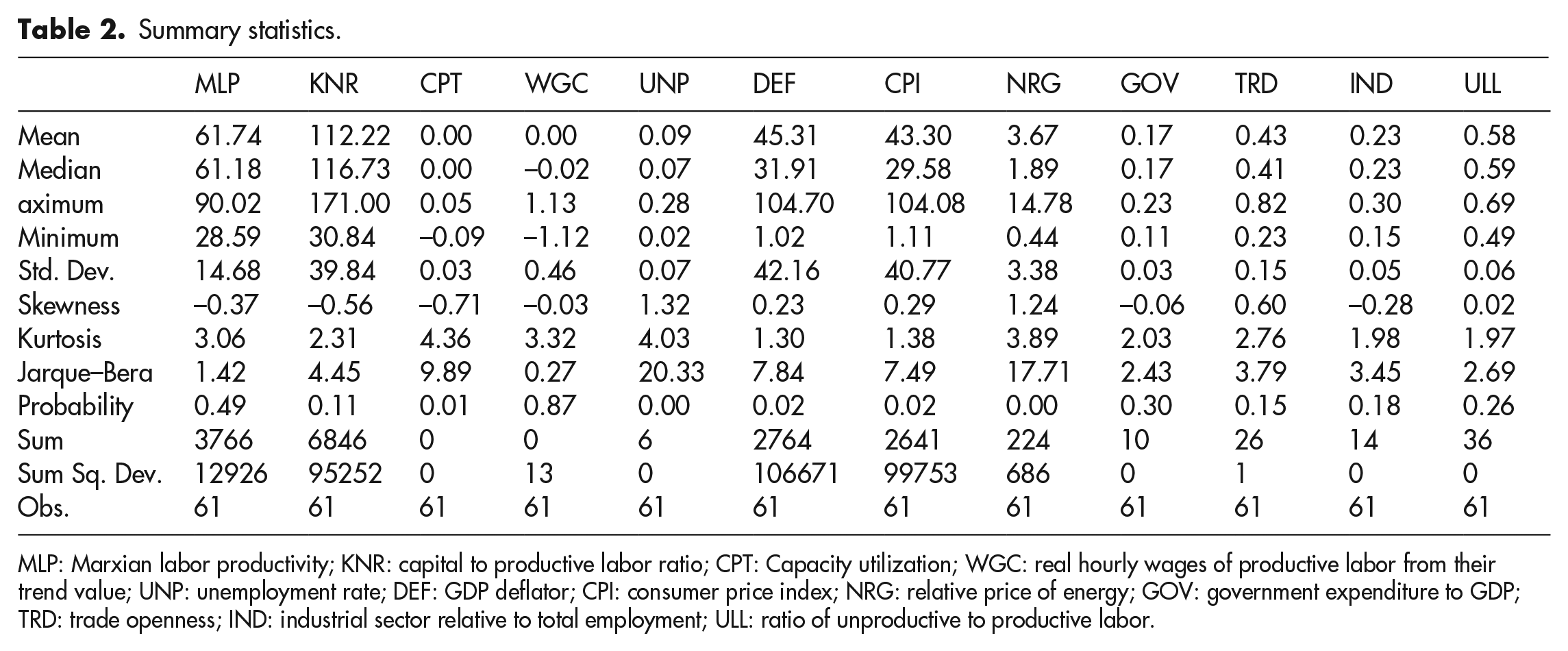
MLP: Marxian labor productivity; KNR: capital to productive labor ratio; CPT: Capacity utilization; WGC: real hourly wages of productive labor from their trend value; UNP: unemployment rate; DEF: GDP deflator; CPI: consumer price index; NRG: relative price of energy; GOV: government expenditure to GDP; TRD: trade openness; IND: industrial sector relative to total employment; ULL: ratio of unproductive to productive labor.
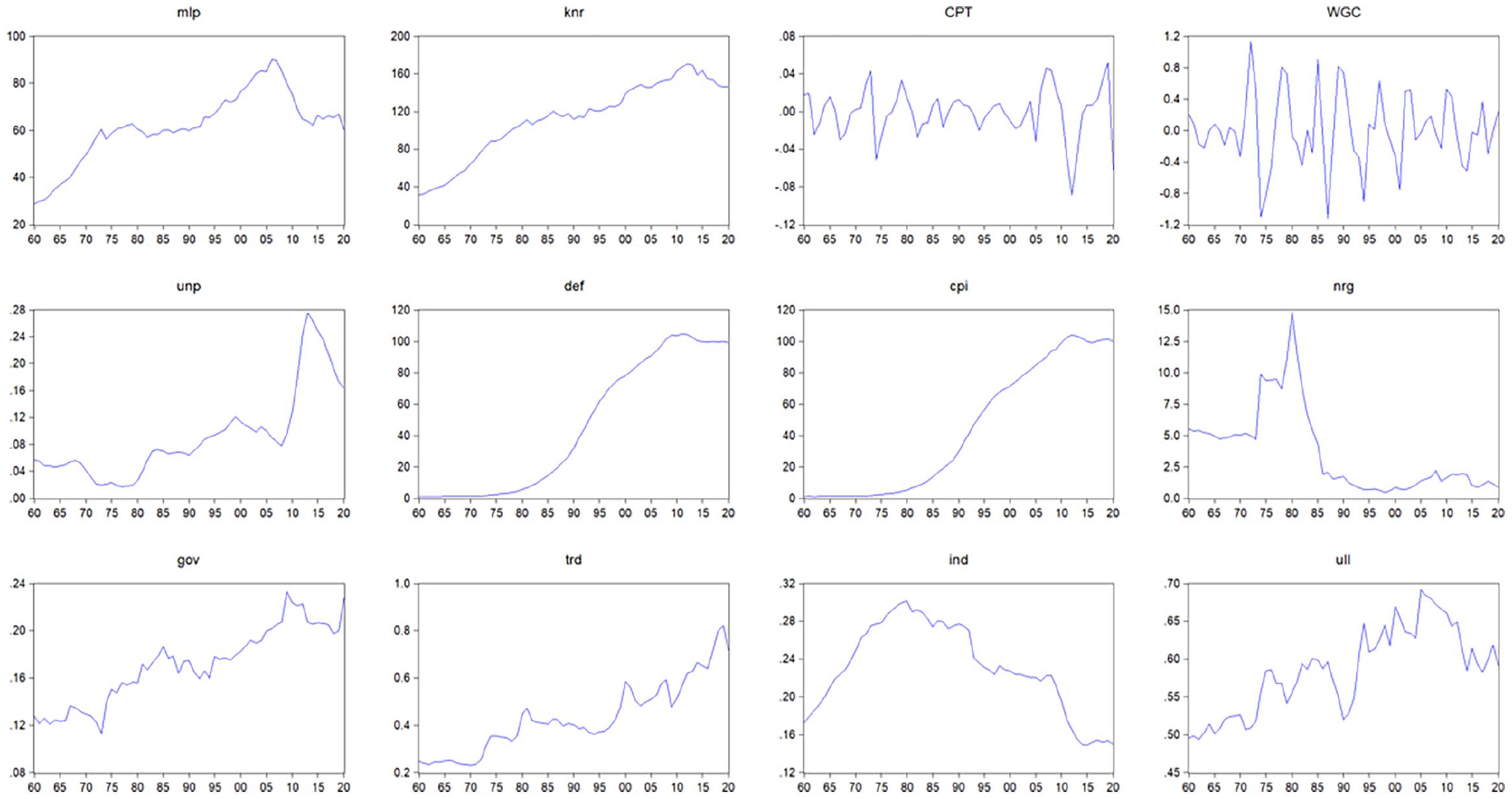
Model variables.
ADF unit root tests.
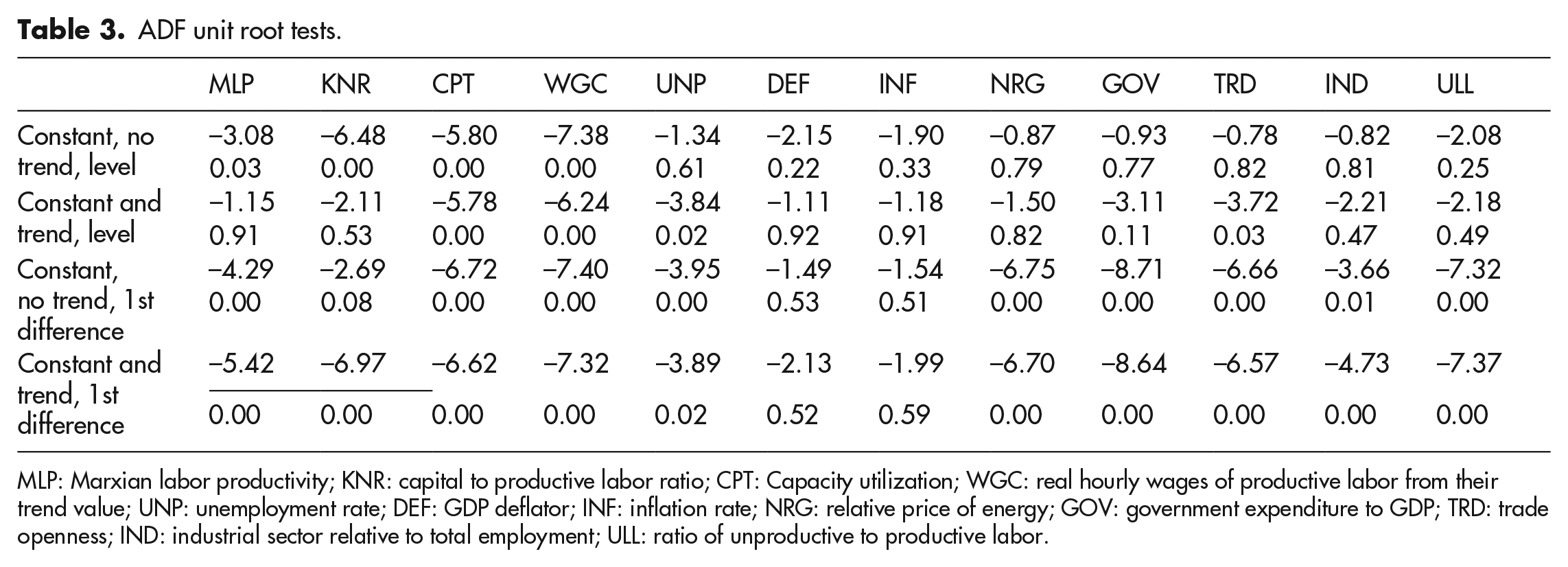
MLP: Marxian labor productivity; KNR: capital to productive labor ratio; CPT: Capacity utilization; WGC: real hourly wages of productive labor from their trend value; UNP: unemployment rate; DEF: GDP deflator; INF: inflation rate; NRG: relative price of energy; GOV: government expenditure to GDP; TRD: trade openness; IND: industrial sector relative to total employment; ULL: ratio of unproductive to productive labor.
Results
Turning to the regression results, presented in Table 4, we proceed by estimating through Ordinary Least Squares (OLS) five alternative models sequentially including additional possible determinants of labor productivity growth. Model 1 includes only ‘technical’–capital accumulation–determinants, Model 2 augments the initial list with social determinants, Model 3 adds macroeconomic determinants, and Model 4 adds structural determinants. Our estimation strategy retains in each subsequent estimation round, i.e. in each model, only the variables found to be significant in the previous round and eliminates insignificant variables. Model 5 is thus our preferred model including all statistically significant variables.
Model estimation, OLS regressions.
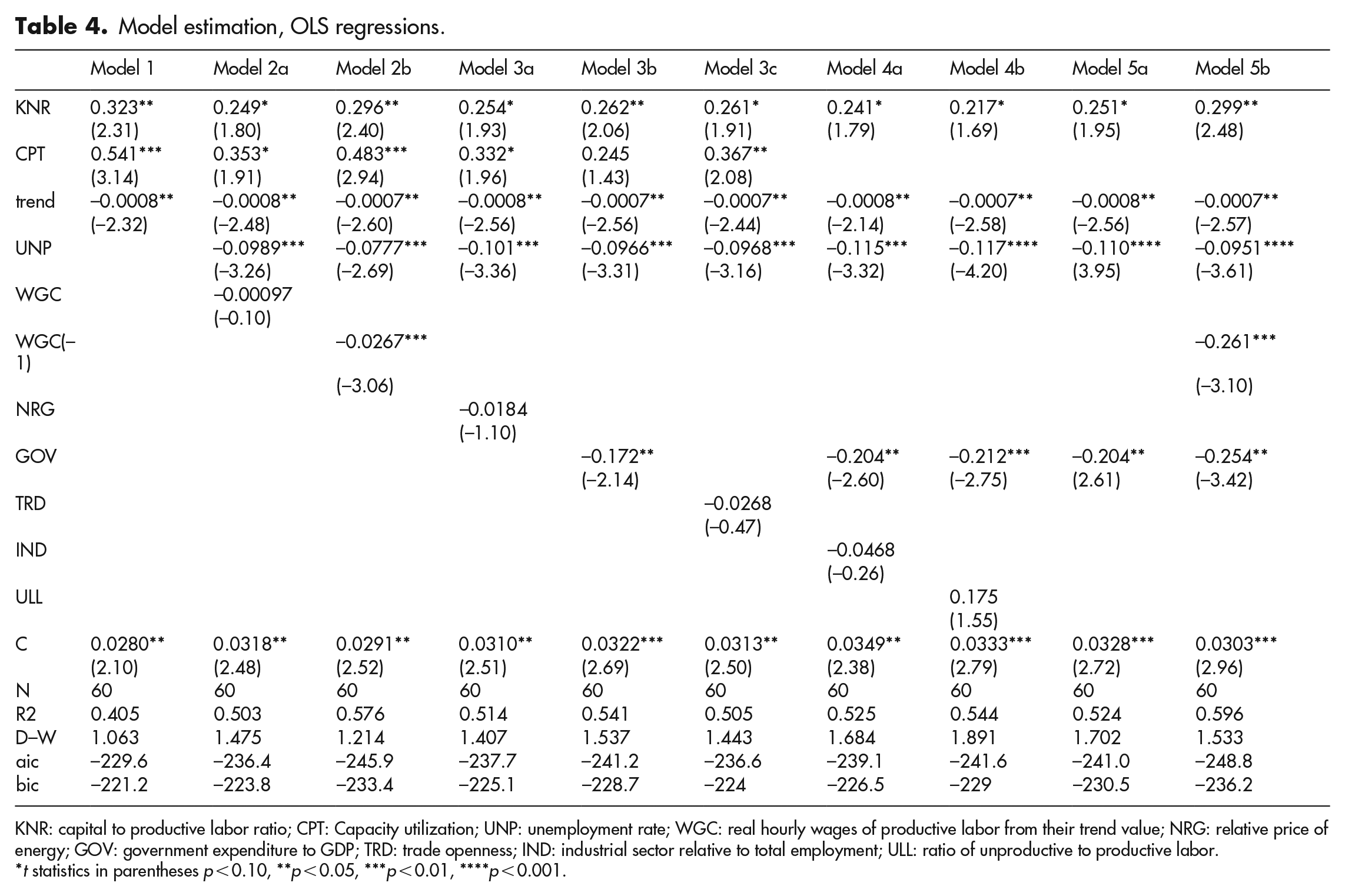
KNR: capital to productive labor ratio; CPT: Capacity utilization; UNP: unemployment rate; WGC: real hourly wages of productive labor from their trend value; NRG: relative price of energy; GOV: government expenditure to GDP; TRD: trade openness; IND: industrial sector relative to total employment; ULL: ratio of unproductive to productive labor.
t statistics in parentheses p < 0.10, **p < 0.05, ***p < 0.01, ****p < 0.001.
In Model 1, the growth rate of the capital–labor ratio, a mechanization and capital accumulation proxy, is found to be significant and has a positive sign as expected. Capital–labor ratio positively influences labor productivity, a result expected by both the mainstream and the heterodox, especially classical Marxian theory. Moreover, the magnitude of the coefficient, in Model 1 and in all subsequent Models, remains within a narrow range around 0.3, a figure close to that reported in other similar studies, such as Weisskopf et al. (1983). The capacity utilization rate is also found to be positive and significant indicating that an increase in capacity utilization results into an increase in labor productivity as expected by the literature. We also note that the time trend included in this and all subsequent models is consistently found to be negative, although very close to zero, and significant; a finding that reminds us the study of Bosworth and Kollintzas (2001) and others reporting a near zero or negative total factor productivity growth in postwar Greece.
Social determinants are considered in Model 2. Positive deviations from the long run trend of the real average wage can be considered as a ‘motivation-enhancing factor in workers earnings’ (Weisskopf et al. 1983: 395) and therefore it is considered to have a positive and significant effect on labor productivity growth. Our results do not verify this prediction as we find evidence of an insignificant relation between the cyclical component of wages and productivity growth. Alternatively, introducing in Model 2b the cyclical component of wages lagged by one period in order to avoid collinearity issues between wages and productivity and to allow for a signaling process between increased wages and increased productivity results into a significant but negative relation. Given that a positive relation between labor productivity and wages is postulated by the SSA theory, we find here evidence that directly contradicts this postulate and the similar argument of ‘efficiency wages’ in the case of Greece.
The unemployment rate is also found to be negative and significant. This is a critical result since it again contradicts one of the main arguments of the SSA school, at least for countries like Greece with mostly ‘antagonistic’ capital–labor relations over the period examined. As we have mentioned, Weisskopf (1987) found that such a mechanism, that is, a negative relation between unemployment rate and productivity growth—was effective only for countries with ‘cooperative’ relations, such as Germany and France and not for countries with ‘antagonistic’ capital-labor relations, such as the United States.
Our finding suggests that a rise in unemployment cannot be considered to be in general as productivity enhancing even in countries with ‘antagonistic’ capital-labor relations like Greece. More specifically, our results are opposite to Mihail’s (1995) earlier finding of a positive relationship between ‘cost of job loss’ and productivity growth in Greece. Those results therefore can be considered as contradicting a main postulate of the SSA theory in the case of Greece. From the point of view of the classical Marxian approach it seems that the tremendous negative effect of unemployment on output overwhelmed the positive effect on work intensity especially since the Greek economy was hit so hard and for so long during the last crisis which has lasted for more of a decade now.
Turing to the macroeconomic determinants in Models 3a to 3c, the relative price of energy and trade openness were found to be non-significant. However, government spending is found to be negative and significant. This result is expected by the mainstream literature on labor productivity growth on the basis that government spending distorts the smooth functioning of the market, crowds out private investment, lowers capital accumulation and thus retards productivity growth. However, from a heterodox perspective, increased government spending could be understood as an indicator of macroeconomic demand problems in the economy resulting in increased participation by the government. Therefore, increased government consumption understood as a proxy of macroeconomic instability and demand deficiency could be associated with slower labor productivity growth. It is important to note that this perspective seems to be validated by the fact that the capacity utilization rate, another variable that captures cyclical changes in the economy, becomes insignificant with the inclusion of government spending in the model, therefore suggesting that the two are highly correlated. Given that capacity utilization is estimated using econometric techniques, whereas government spending relative to GDP is calculated directly as a ratio of observable magnitudes we opt for the use of the second, simpler, variable as a proxy of cyclical variations in economic activity.
Finally, structural determinants, explored in Models 4a and 4b, include the share of industrial employment in total employment and the ratio of unproductive to productive labor compensation. Our results indicate that both those variables have an insignificant impact on labor productivity growth and thus should be excluded from the final model.
Therefore, our preferred specification is Model 5. We propose two specifications, Model 5a not including the lagged cyclical component of wages and Model 5b including this variable. In both specifications the capital to productive labor ratio is found to be positive and significant, the unemployment rate is found to be negative as are government spending and the time trend. We note that this model has an R 2 explaining roughly more than half of the variation in Marxian labor productivity growth. The main difference between the two models is that in Model 5a, by not including the cyclical component of wages, the capital-labor ratio is significant only at the 10% level of confidence, but it has a higher Durbin-Watson statistic, whereas Model 5b includes the capital-labor ratio with a strongly significant statistic and has a somewhat lower Durbin-Watson statistic. Given that the information criteria are minimized in the latter case, we conclude by declaring the latter, Model 5b, as our preferred specification.
Conclusion
We consider the results presented here as important since in our econometric investigation we found evidence that so-called ‘technical’ factors (those pertaining to the capital accumulation process), especially the capital-labor ratio, constitute the critical determinant of labor productivity growth when the distinction between productive and unproductive labor is taken into account. On the contrary, ‘social’ factors, in particular the cyclical component of wages (as a proxy of worker motivation) and the unemployment rate (as a proxy of the ‘cost of job loss’ and work effort), do not fare that well. The empirical results indicate that the positive correlation between unemployment and productivity growth and between the cyclical component of wages and productivity growth, reported in the literature for the US economy (Weisskopf (1987) and Weisskopf et al. (1983) respectively) and the Greek economy (Mihail (1995) do not hold in the case of Greece for the 1960–2020 period. This result is especially important given that Greece cannot be taken as an example of an economy with ‘cooperative’ capital-labor relations like Germany and France. Indeed, the effect of the unemployment rate on labor productivity growth seems to be the exact opposite of those predicted by the SSA theory. For Greece, an increase in unemployment, far from being an effective ‘stick’ used by capital to discipline labor extracting higher levels of productivity, on the contrary results into decreasing productivity growth. Thus, Greece could be added to the list of countries reported by Weisskopf (1987) for which a negative correlation between unemployment rate and productivity growth is observed despite the fact that it cannot be categorized as an economy with ‘cooperative’ capital-labor relations and substantial worker security from welfare state institutions like Germany, Japan and Sweden.
Therefore, since the evidence that we have presented here regarding the determinants of labor productivity growth is more in favor of the Classical Marxian tradition, compared to the Social Structures of Accumulation School we conclude that it is not fruitful or necessary to search or call for some new capital-labor ‘social contract’ that would enhance productivity growth supposedly in favor of all social classes in the economy.
Footnotes
Acknowledgements
The authors would like to thank two anonymous referees for their comments on an earlier version of this paper.
