




Abstract
While the literature often pays particular attention to how brand benefits develop relationship quality, such as trust and satisfaction, this study departs from this approach and demonstrates the mediating roles of brand relationship quality (BRQ) and customer relationship quality (CRQ) in the relationship between brand benefits and brand loyalty in retail service contexts. A total of 524 valid questionnaires from respondents aged between 15 and 24 are analyzed using structural equation modeling. Therefore, this study makes the following contributions to the literature: (1) It demonstrates the importance of both BRQ and CRQ as mediators in the relationship between brand benefits and brand loyalty, and thus deepens the understanding of the process in shaping brand loyalty, particularly in retail service contexts; (2) it elucidates the roles of BRQ and CRQ in establishing brand loyalty in three theoretical frameworks, and thus extends the validity of these theories from a B-B to a B-C context (i.e., retail services).
Keywords
1. Introduction
As the retail service market is becoming increasingly mature, firms are encouraged to develop distinct brand benefits to acquire new customers, and to create the links to retain existing ones (Davis-Sramek et al., 2009; Park et al., 2011; Vlachos et al., 2010). Through the use of functional and symbolic benefits, integral to the relationship marketing approach, firms increase customers’ opportunity costs of breaking relationships (Berry, 1995; Seiders et al., 2005). Previous studies demonstrate the importance of these two types of brand benefits, which contribute to the firms’ overall performance in enhancing customers’ trust, satisfaction, commitment and loyalty (Chitturi et al., 2008; Lee and Widdows, 2011; Orth and De Marchi, 2007). Customer loyalty, among these, is a particularly important source of firms’ competitive advantage and, in consequence, has attracted much research attention (Aaker, 2009b; Keller, 2013; Swoboda et al., 2013; Yoo and Donthu, 2001).
The importance of brand benefits and brand loyalty is now well-established in the literature (Keller, 1993; Park et al., 1986; Reichheld, 1993, 2001; Stokburger-Sauer et al., 2012). While these constructs are important to a firm’s success, it is less apparent in terms of how to achieve the boundary conditions of brand benefits. Prior studies on customer acquisition strategies pay particular attention to brand benefits, and how this approach develops interpersonal relationship quality (RQ), such as trust, satisfaction, commitment and loyalty (Chitturi et al., 2008; Lee and Widdows, 2011; Orth and De Marchi, 2007; Reynolds and Beatty, 1999; Sirgy et al., 1991). While these studies are significant, they overlook potentially important mediator(s) in the relationship between brand benefits and brand loyalty. In this study, we consider how brand relationship quality (BRQ) (Fournier, 1998), a non-interpersonal relationship, and customer relationship quality (CRQ) (Crosby et al., 1990), a relationship between customers and service personnel, mediate the relationship between brand benefits and brand loyalty. This study therefore departs from the prior research by proposing a more detailed examination of the process to build brand loyalty, mediated by BRQ and CRQ in retail service contexts.
The current literature demonstrates the importance of RQ, such as customer satisfaction, trust and commitment (Aurier and N’Goala, 2010; Crosby et al., 1990; Garbarino and Johnson, 1999; Hennig-Thurau et al., 2000; Morgan and Hunt, 1994; Twing-Kwong et al., 2013; Ulaga and Eggert, 2006). However, from a managerial point of view, an overemphasis on service personnel alone to build customer relationship seems too risky and unrealistic (Gutek et al., 1999; Wang et al., 2011). Thus, companies aiming at long-term customer loyalty tend to build both company-level (e.g., BRQ) and individual-level (e.g., CRQ) relationships with customers, to ensure firms’ long-term success (Harrison-Walker and Coppett, 2003). Our work, departing from the extant literature, thus seeks to examine the importance of both BRQ and CRQ as mediators in the relationship between brand benefits and brand loyalty.
The findings of the extant literature on the relationship between brand benefits and customer loyalty, as mentioned, reveal intriguing, but unexplored, research gaps about the roles mediators play in the brand benefits and brand loyalty relationship. In this study we examine the roles played by BRQ and CRQ in the brand benefits and brand loyalty relationship. We specifically examine three issues. Firstly, do both dimensions of BRQ (i.e., attitudinal attachment and sense of community), and of CRQ (i.e., trust and satisfaction), act as significant mediators in the relationship between brand benefits and brand loyalty? Secondly, do different types of brand benefits (i.e., functional, symbolic), and BRQ vary in their impacts on brand loyalty? Thirdly, do BRQ and CRQ exert significant effects on the way brand benefits impact on both aspects of brand loyalty, that is, behavioral and attitudinal loyalty? Our paper thus seeks to contribute to the growing understanding of how and to what extent brand benefits shape the process of brand loyalty in the retail contexts.
The rest of the paper is structured as follows. We first discuss a theoretical lens used to develop the research model, together with related constructs of this study. The research model and hypotheses are then presented, followed by the methodology, empirical results and discussion. Finally, the theoretical and managerial implications of this work are raised, along with the limitations, future research and a conclusion.
2. Literature review
In the following sections, the literature on the Stimulus-Organism-Response (S-O-R) theory (Mehrabian and Russell, 1974), as well as that on each major construct (i.e., brand benefits, BRQ, CRQ and brand loyalty) is reviewed. Each of the constructs is then given relevance within this study.
2.1. The Stimulus-Organism-Response theory
Mehrabian and Russell (1974) propose that environmental stimuli (S) affect an individual’s state of mind, an organism (O) such as satisfaction, which, in turn, influences one’s responses (R). Stimulus refers to an individual’s external factors, comprising of various components of physical atmosphere (Bagozzi, 1986; Belk, 1975). Organism (O) refers to an individual’s internal processes, such as perceptual, feeling and thinking activities (Bagozzi, 1986). Based on this theoretical lens, we infer in the model development that customers’ responses (R) should undertake the cognitive processes (O), after the environmental stimuli (S) are reinforced in the process of shaping customers’ loyalty.
2.2. Brand benefits
The existing literature proposes three categories of brand benefits, that is, functional, symbolic and experiential (Aaker, 1996, 2009a; Keller, 1993; Park et al., 1986). Functional benefits refer to the product attributes of a consistent and reliable quality in order to attain daily problem-solving goals (Park et al., 1986). Symbolic benefits correspond to non-product attributes and relate to intrinsic needs for emotional enjoyment, self-expression and social approval (Aaker, 2009a; Keller, 1993; Solomon, 1983). Experiential benefits relate to what customers feel to use the product or service, and satisfy experiential needs, such as sensory, variety and cognitive stimulation (Keller, 1993; Park et al., 1986).
The contexts of this study, that is, retail stores, are typical examples, emphasizing these two types of brand benefits – namely, functional benefits in the form of a consistent and reliable product quality, and symbolic benefits involving customers’ enjoyment (emotional benefits), self-expression (self-expression benefits) and social approval (social benefits). Consequently, we adopt these two dimensions in this study.
2.3. Brand relationship quality
BRQ is a multifaceted and dynamic relationship construct between consumers and their brands. Quality, more than any other construct, can capture the richness of the fabric from which brand relationships arise (Fournier, 1998: 363). The dimensions of the BRQ construct still remain unclear, despite research interest. Fournier (1998) proposes six types of BRQ: love and passion, self-connection, commitment, interdependence, intimacy and brand partner quality. Keller (2001) proposes the concept of brand resonance as the level of identification and a form of ultimate relationship that the customer has with a brand. Brand resonance can be understood through BRQ as represented by the following two categories: (1) relationship intensity, that is, the depth of the psychological bond that customers have with the brand; and (2) relationship activity, that is, repeat purchases or the extent to which customers seek out brand information, events and other loyal customers (Keller, 2001). Relationship intensity consists of two dimensions – attitudinal attachment and sense of community – while relationship activity consists of active engagement and behavioral loyalty. Other dimensions of BRQ include exchange and communal relationships (Aggarwal, 2004), individual and group-level connections (Swaminathan et al., 2007) and nostalgic connections (Smit et al., 2007).
There are two reasons underlying the choice of Keller’s (2001) two dimensions of attitudinal attachment and sense of community in this study. Firstly, these dimensions of relationship intensity can explain the intermediate cognitive processes in shaping loyalty, rather than relationship activity, which represents external behavior. Secondly, Keller’s operational definitions are easier to quantify with more reliable and valid measurements than Fournier’s BRQ dimensions (Smit et al., 2007).
This study defines attitudinal attachment as customers’ psychological connections that extend beyond a positive attitude (e.g., love and a sense of ownership) to view the brand as something special in a broader context. A sense of community refers to customers’ identification with a brand community, and a kinship or affiliation with other people associated with the brand (Keller, 2001).
2.4. Customer relationship quality
CRQ, in this study, refers to the RQ between customers and in-store service personnel. CRQ has no universally agreed dimensions to date. Three most common dimensions across contexts include satisfaction, trust and commitment (Crosby et al., 1990; Garbarino and Johnson, 1999; Morgan and Hunt, 1994). Additional dimensions of CRQ also involve such constructs as cooperation, adaptation, power and conflict (Athanasopoulou, 2009). Trust, in this study, refers to customers’ confidence that service personnel being encountered is reliable, and will protect their long-term interests, while satisfaction is defined as an overall evaluation and affective reactions based on the overall purchase experience with service personnel over time (Garbarino and Johnson, 1999). The contexts of this study, that is, retails, emphasize the two dimensions of CRQ – that is, trust and satisfaction are often developed with in-store service staff. A selection of these particular CRQs also fits choices made in a prior work (Davis-Sramek et al., 2009).
2.5. Brand loyalty
Brand loyalty was originally understood through two dimensions. The stochastic view suggests that consumers exhibit random behaviors and purchases are not a function of prior behavior. The deterministic view, in contrast, suggests that loyalty results from the impact of external factors (Jacoby and Chestnut, 1978). However, this stream of research overlooks the importance of cognitive processes. Studies of brand loyalty, consequently, should not only consider behaviors but also the rationales or attitudes customers hold toward those behaviors (Dick and Basu, 1994; Odin et al., 2001). In this study, we address this issue directly, and overcome limitations of previous studies by modeling both behavioral and attitudinal dimensions of brand loyalty (Chaudhuri and Holbrook, 2001; Jones and Taylor, 2007; Kabiraj and Shanmugan, 2010; Odin et al., 2001; Oliver, 1999).
Behavioral loyalty, in this study, refers to customers’ continuous purchase of a brand, as well as their repeated intention to purchase it in the future. Since attitudinal loyalty refers to customers’ degree of commitment and their attitude toward the brand, it hence has an emotional component (Chaudhuri and Holbrook, 2001).
3. Research model and hypotheses development
This study draws its foundation from the S-O-R theory (Mehrabian and Russell, 1974). The S-O-R theory posits that an internal organism (e.g., state of mind) triggers a response after a stimulus is reinforced. This section develops this rationale in Figure 1 in a way that brand benefits (stimulus) affect brand loyalty (response), after being mediated by BRQ and CRQ (organism), and proposes four hypotheses.

Research model.
3.1. Brand benefits and BRQ
Functional benefits help solve daily problems by offering reliable products and/or services (Keller, 1993), and these lead to customers’ positive RQs such as trust, satisfaction, attitude and pleasure (Chitturi et al., 2008; Lee et al., 2011; Reynolds and Beatty, 1999). In this study, BRQ relates to positive relationships between customers and their brands. We therefore extend the potential influences of functional benefits on positive RQ to BRQ and hypothesize:
H1a: Functional benefits impact positively on BRQ.
Symbolic benefits satisfy customers’ intrinsic needs, which involve personal enjoyment, self-expression and social self-esteem, and these lead to their positive RQs such as attitude (Lee et al., 2011; White and Peloza, 2009). Related works also demonstrate the significant influences of self-expressive benefits and social benefits on brand attachment and brand identification (Grisaffe and Nguyen, 2011; Stokburger-Sauer et al., 2012; Tuskej et al., 2013). In this study, BRQ is composed of two dimensions of attitudinal attachment and a sense of community. In a similar vein, we extend the likely impacts of symbolic benefits on positive RQ to BRQ, and hypothesize:
H1b: Symbolic benefits impact positively on BRQ.
3.2. Brand benefits and CRQ
From a conceptual viewpoint, positive RQs (e.g., trust and satisfaction) with in-store service personnel should be developed over time, if customers are offered consistent and reliable quality products and/or services every time they interact with different service personnel. Functional benefits therefore reduce customers’ perceived risks with service quality delivered by different service personnel, and in turn might lead to a better CRQ over time. A previous study also demonstrates the significant relationship between functional benefits and satisfaction with the salespeople in the settings of two upscale department stores and a specialty store (Reynolds and Beatty, 1999). With satisfaction conceptualized as an important dimension of CRQ in this study, we thus anticipate the likely influence of functional benefits on satisfaction to CRQ, and hypothesize:
H2a: Functional benefits impact positively on CRQ.
Previous studies demonstrate the significant relationships between self-expression, social approval and customers’ positive attitude and pleasure (Grisaffe and Nguyen, 2011; Lee et al., 2011; White and Peloza, 2009). The link between symbolic benefits and CRQ should be established, if positive responses, such as enjoyment, self-expression and social approval can extend to the relationships with the service personnel. A related work directly posits the positive effects of social benefits on satisfaction with the salespeople in the retail contexts (Reynolds and Beatty, 1999). Since social benefits and satisfaction are two important components of symbolic benefits and CRQ, we thus anticipate the likely influence of a key component of prior works to this study. Based on this, the following hypothesis is proposed:
H2b: Symbolic benefits impact positively on CRQ.
3.3. BRQ and brand loyalty
Behavioral loyalty, in this study, refers to customers’ continuous purchase and extended purchase intention. Attitudinal attachment develops when consumers have brand preferences (Keller, 2001). From a conceptual viewpoint, customers with preferences for certain brands are likely to repurchase in the near future. Previous works demonstrate the significant impacts of brand affect, such as preferences, attitude, commitment and psychological benefits, on behavioral loyalty (Davis-Sramek et al., 2009; Kabiraj and Shanmugan, 2010; Marzocchi et al., 2013; Paul et al., 2009). In a similar vein, customers with a sense of community should share the same values, identification and belongingness with brands (Keller, 2001; Muniz and O’Guinn, 2001). Two parties who mutually share similar values are likely to extend their interactions. Prior studies also demonstrate the significant effects of community benefits and brand identification on behavioral loyalty (He et al., 2012; Lam et al., 2012; Paul et al., 2009). Taken together, it is therefore hypothesized:
H3a: BRQ impacts positively on behavioral loyalty.
Emotional attachment consists of affective variables, such as commitment, enjoyment and love (Thomson et al., 2005), while attitudinal loyalty consists of customers’ psychological commitment to brands (Chaudhuri and Holbrook, 2001; Oliver, 1999). Since attitudinal attachment and loyalty are conceptualized based on an important component, that is, commitment, we thus infer the likely influence of attitudinal attachment on attitudinal loyalty. Related studies find that brand affect has a significant influence on attitudinal loyalty (Marzocchi et al., 2013). Likewise, mutual identification, such as positive interaction, is thus likely to influence mutual commitment. Prior studies also find the significant effects of brand identification on commitment (Tuskej et al., 2013; Zhou et al., 2012). Related works also demonstrate the positive influences of brand identification on attitudinal loyalty (He et al., 2012; Lam et al., 2012; Marzocchi et al., 2013). We thus extend the effects of key components of prior works to this study. Based on this, we hypothesize:
H3b: BRQ impacts positively on attitudinal loyalty.
3.4. CRQ and brand loyalty
CRQ and behavioral loyalty should be connected, because customers who are satisfied with the service personnel are likely to increase their purchasing volume and frequency. Robust findings, in consumer-brand contexts, also propose the significant relationships between brand trust, brand affect and behavioral loyalty (Chaudhuri and Holbrook, 2001; He et al., 2012; Marzocchi et al., 2013; Mazodier and Merunka, 2012). Similarly, related studies also demonstrate the significant relationships between trust, satisfaction (i.e., RQ) and behavioral loyalty (Guenzi and Georges, 2010; Rauyruen and Miller, 2007). Consequently, we infer the likely influence of trust and satisfaction between customers and service personnel on behavioral loyalty and hypothesize:
H4a: CRQ impacts positively on behavioral loyalty.
Attitudinal loyalty primarily involves psychological commitment between two parties (Chaudhuri and Holbrook, 2001), while CRQ in this study refers to customers’ trust and satisfaction with the in-store service personnel. Related works also demonstrate the significant influences of trust and satisfaction on commitment and attitudinal loyalty (Aurier and N’Goala, 2010; Guenzi and Georges, 2010; Rauyruen and Miller, 2007; Ulaga and Eggert, 2006). We thus extend the influences of RQs, demonstrated in other contexts, to the retail contexts of this study, and hypothesize:
H4b: CRQ impacts positively on attitudinal loyalty.
4. Methodology
4.1. Data collection
The purpose of this study is to explore how retail customers respond to companies’ customer acquisition strategies with regard to their loyalty. Sports retailers, which sell branded products, such as those produced by Nike, Levis, Adidas and Timberland, are selected as the research contexts. We choose these brands or retailers because they are not only typical of many other retailers but also make particularly clear attempts to acquire their customers by making use of advertisements, social media (e.g., Facebook) and word-of-mouth to claim their quality products and premium brand images. In addition, these retailers make particular efforts in developing customers’ BRQ and CRQ, respectively through the use of mass media and intensive in-store service personnel training.
This paper targets customers aged between 15 and 24 years old. This segment is chosen for two reasons. Firstly, this group tends to be less loyal to brands, in comparison to older generations (e.g., baby boomers). Companies targeting this segment thus pay particular attention to them in order to develop long-term and sound relationships (Nusair et al., 2011; Vahie and Paswan, 2006). Secondly, this group in particular tends to identify themselves through mechanisms such as the use of brand image (Noble et al., 2009). These also fit the choices of these two types of brand benefits – that is, functional benefits, such as quality products, and symbolic benefits in the form of brand image, in the contexts of retail service.
The quota sampling of this study draws on Taiwan’s population distribution of 15–24 years old, that is, North (47%), Central (21%) and South and East (31%), and a gender split of 1:1 (Ministry of Interior Taiwan, 2012). The respondents show a good overall fit to the general population profile: North (47%), Central (24.7%), South and East (28.3%), and a gender split of females (59.8%) and males (40.2%). Ten universities, that is, North (five), Central (two) and South and East (three), were selected based on Taiwan’s population distribution of this group. Data was collected using a survey instrument (i.e., questionnaire). The respondents were chosen at each college of the selected 10 universities, and then were asked (i.e., face-to-face) to recall a sports retailer they visited recently, or a sports brand (e.g., Nike) they bought recently in that retailer. They were then asked to complete questions in the questionnaires. Of the 621 questionnaires distributed, a total of 524 valid questionnaires (84.4%) were available for further analysis.
There are slightly more female (57.3%) than male respondents (42.7%). The majority (75%) of the respondents are aged between 20 and 24, with the remaining aged between 15 and 19. Nearly 84% of the respondents are students whose average length of relationship with the focal brands is approximately 4.5 years.
4.2. Measurement
The constructs are drawn on the established measures from previous studies: brand benefits (functional, symbolic) (Aaker, 2009b; Keller, 1993; Park et al., 1986), BRQ (attitudinal attachment, sense of community) (Keller, 2001), CRQ (trust, satisfaction) (Crosby et al., 1990; Garbarino and Johnson, 1999; Morgan and Hunt, 1994) and brand loyalty (behavioral and attitudinal) (Chaudhuri and Holbrook, 2001; Odin et al., 2001; Oliver, 1999). All the measurement items were translated into Mandarin, and then translated back to English. Each item was assessed using a five-point Likert scale with endpoints of ‘1 = strongly disagree’ and ‘5 = strongly agree’. Appendix 1 tabulates the operational definitions, measurement items and sources.
4.3. Data analysis
Exploratory factor analysis (EFA), based on 406 valid responses, was conducted using SPSS 18.0 software for support with the principle component and varimax rotation methods. A valid factor had an eigenvalue of greater than 1, total variance of greater than 5% and an accumulated total variance greater than 50% (Hair et al., 2010). Invalid items were deleted from each construct to increase the convergent validity and reliability. Appendix 2 presents the results of the EFA. In total, 28 out of the initial 44 items remained for structural equation modeling (SEM) analysis using SmartPLS 2.0 software. A structural partial least squares (PLS) model was used to test the hypotheses, while the vector of parameter estimates, obtained from 1000 bootstrapping runs, was used to generate the standard errors and t-statistics.
The method of PLS is used in this study for the following reasons. Firstly, it is capable of simultaneously modeling theoretical relationships among complex latent variables, in a way that is particularly well-suited to explain complex relationships (i.e., model complexity) (Fornell and Bookstein, 1982; Hair et al., 2014). Secondly, PLS requires the minimal demands on residual distribution when data is not normally distributed (Chin et al., 2003; Vinzi et al., 2010). Lastly, PLS can be used not only for theory confirmation, but also for theory prediction and development (Vinzi et al., 2010).
5. Results
5.1. Measurement model
Table 1 shows the results of the analysis. The Cronbach’s alphas (α) range from 0.64 to 0.91, so they exceed the recommended threshold of 0.60 (Fornell and Larcker, 1981). Composite reliabilities range from 0.84 to 0.89 and the average variance extracted (AVE) ranges between 0.63 and 0.80. These all exceed the recommended threshold of CR ≥ 0.70 and AVE ≥ 0.50 (Hair et al., 2010). The measurement model, therefore, has high reliability and convergent validity. We evaluate discriminant validity by employing Fornell and Larcker’s (1981) test of shared variance between pairs of latent constructs. The results demonstrate that the correlations between each pair of constructs do not exceed the AVE’s square root of a single construct, and this confirms the model’s discriminant validity. To reconfirm the robustness and stability of this model, we calculate the goodness of fit (GoF) value (Chin, 2010; Fornell and Larcker, 1981) and further conduct cross-validated (CV) redundancy Q2 and CV communality Q2 tests (omission distance = 3) using the blindfolding function in SmartPLS 2.0. The GoF value (0.48) exceeds the threshold of 0.27 (Fornell and Larcker, 1981), and this confirms an excellent fit of the model to our data. The values of CV redundancy Q2 and CV communality Q2 range from 0.19 to 0.80, and as they exceed the threshold of 0, this reconfirms the cross-validity of this proposed model.
Descriptive statistics and correlation matrix.

SD: standard deviation; α: Cronbach’s Alpha; CR: composite reliability; AVE: average variance extracted; diagonal items: √AVE; BRQ: brand relationship quality; CRQ: customer relationship quality.
5.2. Structural model and results
Table 2 shows the path coefficients and t values.
Results of path coefficients and t values.
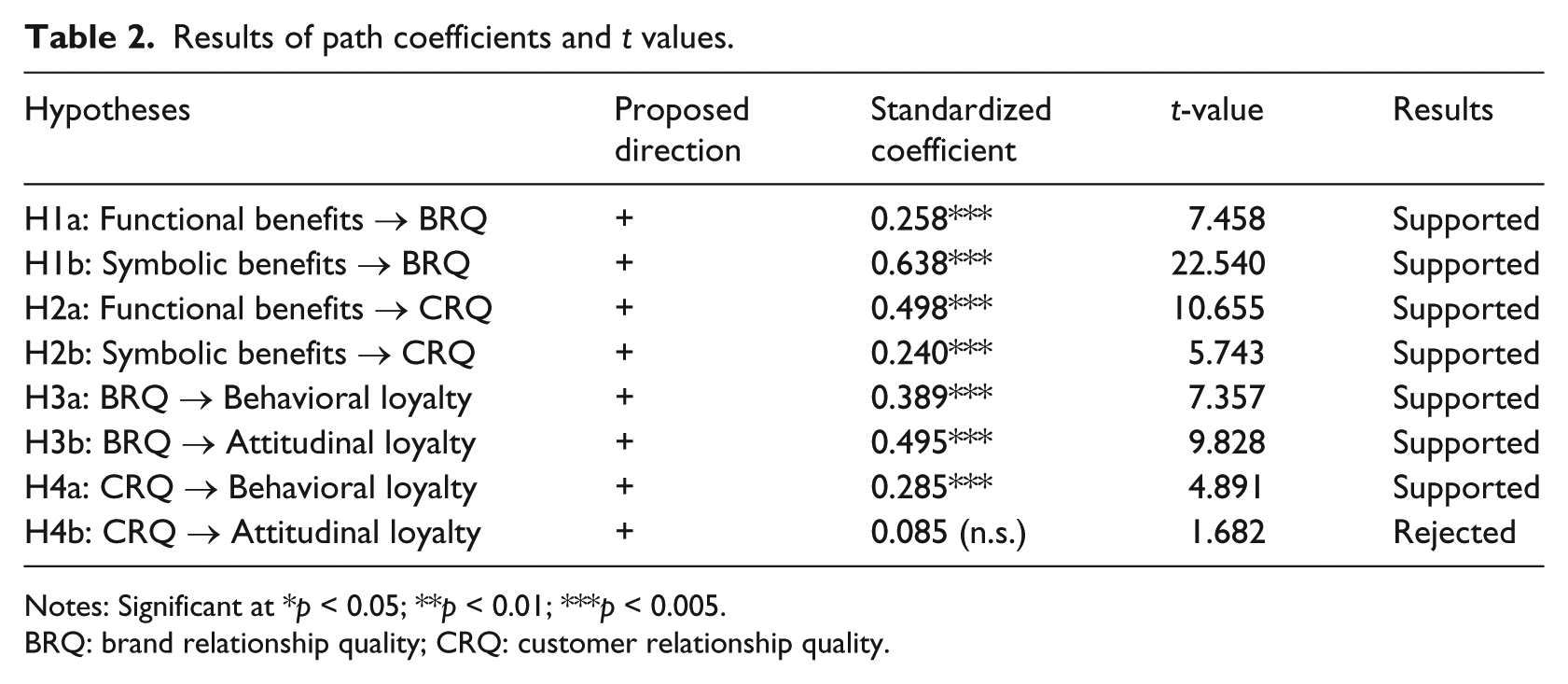
Notes: Significant at *p < 0.05; **p < 0.01; ***p < 0.005.
BRQ: brand relationship quality; CRQ: customer relationship quality.
5.2.1. Antecedents of BRQ
Both functional and symbolic benefits (β = 0.258, t = 7.458; β = 0.638, t = 22.540) have significant effects on BRQ, and show good explanatory power on BRQ (R2 = 0.61). Consequently, H1a and H1b are supported. These results show that symbolic benefits have a stronger influence on BRQ than functional benefits.
5.2.2. Antecedents of CRQ
Brand benefits explain approximately 40% of CRQ (R2 = 0.40). Both functional and symbolic benefits also have significant effects (β = 0.498, t = 10.655; β = 0.240, t = 5.743), in a way that supports H2a and H2b. These results demonstrate that functional benefits are the more important antecedent of CRQ than symbolic benefits.
5.2.3. Consequences of BRQ and CRQ
BRQ and CRQ together effectively explain behavioral loyalty (R2 = 0.37). Of these cognitive responses, both BRQ and CRQ have significant effects (β = 0.389, t = 7.357; β = 0.285, t = 4.891), and so H3a and H4a are supported. BRQ and CRQ effectively explain attitudinal loyalty (R2 = 0.30). Of these, BRQ significantly influences attitudinal loyalty (β = 0.495, t = 9.828), while CRQ has no significant effects on attitudinal loyalty (β = 0.085, t = 1.682). Consequently, H3b is supported but H4b is rejected. Our results demonstrate that BRQ is the more important antecedent of behavioral and attitudinal loyalty than CRQ, and that CRQ has an influence on behavioral loyalty, but not on attitudinal loyalty.
5.2.4. Mediating effects of BRQ and CRQ
To test the mediating effects of BRQ and CRQ, we follow the procedures suggested by Baron and Kenny (1986), and test four competing models, as presented in Figure 2. Model 1 shows that both independent variables (IVs), that is, functional and symbolic benefits, affect significantly the mediators. Model 2 shows that both IVs affect dependent variables (DVs), that is, behavioral and attitudinal loyalty. Model 3 shows that only the mediator, CRQ, has no effects on the DV, that is, attitudinal loyalty. Model 4 clearly shows that functional benefits have no effects on attitudinal loyalty, and that symbolic benefits also have no influence on behavioral loyalty when both mediators (i.e., BRQ and CRQ) are controlled. We therefore conclude that BRQ fully mediates in the relationships between functional benefits and attitudinal loyalty, and between symbolic benefits and behavioral loyalty. We also confirm that both BRQ and CRQ partially mediate in several relationships: BRQ between functional benefits and behavioral loyalty, symbolic benefits and attitudinal loyalty, and CRQ between functional benefits and behavioral loyalty, symbolic benefits and behavioral loyalty.

Mediating effects of brand relationship quality (BRQ) and customer relationship quality (CRQ).
5.2.5. Six significant paths to brand loyalty
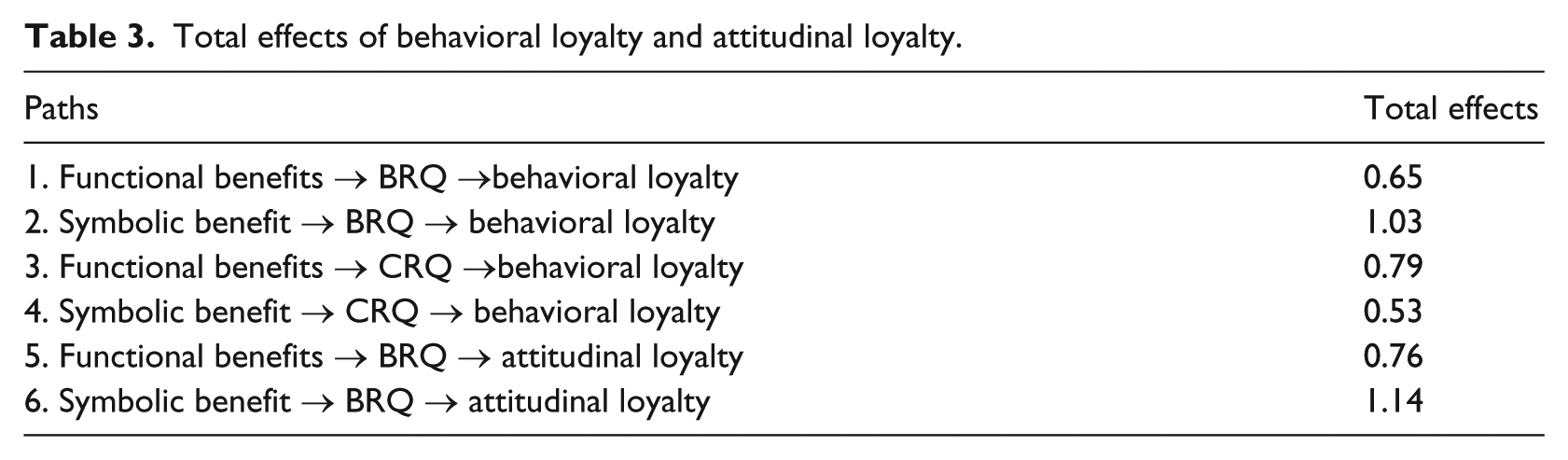
Our findings reveal six significant paths leading to brand loyalty, as tabulated in Table 3. Functional and symbolic benefits, as mediated by BRQ and CRQ, lead to behavioral and attitudinal loyalty. The relationship between symbolic benefits and attitudinal loyalty, as mediated by BRQ (path 6), shows the strongest effect leading to attitudinal loyalty. In contrast, the link between symbolic benefits and behavioral loyalty, as mediated by BRQ (path 2), has the greatest effect leading to behavioral loyalty.
Total effects of behavioral loyalty and attitudinal loyalty.
6. Discussion and implications
In summary, this study finds that symbolic benefits are the main drivers of BRQ, while functional benefits are the main influences of CRQ. BRQ is a key driver of both behavioral loyalty and attitudinal loyalty, while CRQ does not have significant effects on attitudinal loyalty. Most importantly, we find that BRQ and CRQ mediate the relationship between brand benefits and brand loyalty, and that BRQ is the more important mediator than CRQ in the relationship between brand benefits and brand loyalty.
Our findings that symbolic benefits are the main drivers of BRQ both extend and complement previous studies (Lee et al., 2011; Tuskej et al., 2013; White and Peloza, 2009). These issues do not receive much research attention. Our work therefore offers important insights, suggesting that symbolic benefits are operated via mechanisms, such as cognitive appeals, self-expression and social approval, may orient customers toward a stronger BRQ than functional benefits, operated via the mechanism of a consistent and reliable product quality in retail service contexts.
The results that functional benefits are the main influences of CRQ also correspond to previous works. There is still little research on these issues (Chitturi et al., 2008; Lee et al., 2011; Orth and De Marchi, 2007; Reynolds and Beatty, 1999). Therefore, this study offers important insights, suggesting that the mechanism (i.e., reliable product quality), which functional benefits are operated, might direct retail customers to build a stronger CRQ with service personnel than that driven by symbolic benefits, which are operated via the mechanism of cognitive appeals.
This study demonstrates that BRQ is a main driver of both behavioral and attitudinal loyalty. There is limited literature on this issue (He et al., 2012; Lam et al., 2012; Marzocchi et al., 2013; Stokburger-Sauer et al., 2012; Vlachos et al., 2010). Dick and Basu (1994) propose four types of brand loyalty: no loyalty, latent loyalty, spurious loyalty and true loyalty. Spurious loyalty refers to high levels of repeat patronage but a low favorability in attitude relative to comparable brands. True loyalty refers to the situation where customers are both repeat customers and have a relatively positive attitude toward brands. Our paper thus considers brand loyalty as a two-dimensional construct in a departure from prior studies, which treat it as one dimensional. By making the distinction between behavioral and attitudinal loyalty, we account for the distinction between spurious and true loyalty (Dick and Basu, 1994).
We find that CRQ has no significant effects on attitudinal loyalty. This finding is inconsistent with the literature (Aurier and N’Goala, 2010; Rauyruen and Miller, 2007; Ulaga and Eggert, 2006). A partial explanation for these inconsistent results may lie in the facts that CRQ, operated through mechanisms such as interpersonal interactions, has its influence only on behavioral loyalty (e.g., repurchase), but exerts an insufficient strength on attitudinal loyalty (e.g., commitment), particularly for the respondents of this study, that is, 15–24-year-olds who might be more brand- than interpersonal-relationship prone. An alternative interpretation of these findings might be the service encounters phenomenon – that is, customers interacting with different service providers each time might be less satisfied and less attitudinal loyal than those interacting with specific service providers (Gutek et al., 1999).
6.1. Theoretical implications
The findings also demonstrate that BRQ and CRQ mediate the relationship between brand benefits and brand loyalty, and that BRQ is the more important mediator than CRQ. Previous studies on brand benefits pay particular attention to their effects and outcomes – namely, trust, satisfaction, commitment and brand loyalty (Chitturi et al., 2008; Lee et al., 2011; Orth and De Marchi, 2007; Reynolds and Beatty, 1999; Sirgy et al., 1991). These studies, while significant, overlook potential mediator(s) in the relationships between relational benefits and brand loyalty. Morgan and Hunt (1994) posit a key mediating variable (KMV) model in the retail contexts, suggesting that commitment and trust play the central roles in relationship marketing success. Therefore, this study offers a main departure from the existing literature, which treats commitment and trust as mediators, and confirms a KMV model with BRQ and CRQ as the equally important mediators to customer loyalty in retail service contexts (Morgan and Hunt, 1994). Moreover, in accord with the S-O-R theory (Mehrabian and Russell, 1974; Wang et al., 2011), this paper also elucidates the roles of brand benefits as a stimulus, and both BRQ and CRQ as organisms in the process of shaping brand loyalty (i.e., a response).
Arguments in the literature suggest that a bridging strategy with a focus on company-level relationships (e.g., the use of brand relationship) should be adopted to supplement an individual-level relationship strategy (e.g., the use of salespeople). This prevents personal defects of salespeople from having a negative effect on company turnover (Harrison-Walker and Coppett, 2003; Wong and Sohal, 2002). This study identifies a company-level bridging strategy, BRQ, and an individual-level strategy, CRQ, while testing the bridging strategy model in a retail service context (Harrison-Walker and Coppett, 2003).
Pseudorelationships are particular phenomena in the service encounters, in which customers interact with different service personnel within a single company (Gutek et al., 1999). Customers, however, still expect to receive similar products and service quality from a specific company. The phenomena of service encounters thus occur when customers interact with different service personnel each time in a single company. Our work thus echoes the findings of Gutek et al. (1999), by demonstrating a service pseudorelationship (i.e., BRQ), and a service encounter relationship (i.e., CRQ), particularly in retail service contexts.
6.2. Managerial implications
This study specifically offers relevant insights to retail-service providers as it directs them to develop more effective customer acquisition and loyalty strategies. We suggest that companies should adopt symbolic benefits as their customer acquisition strategies to achieve a better BRQ and, in turn, to gain better customer loyalty, and adopt functional benefits to achieve a better CRQ. In addition, our findings suggest that companies seeking spurious loyalty should focus on developing CRQ, while those seeking true loyalty should use BRQ as their primary strategy.
This study demonstrates the mediating roles of BRQ and CRQ; thus, companies aiming at brand loyalty are advised to maintain sound BRQ and CRQ under different customer acquisition strategies. We demonstrate that in the retail contexts, BRQ is the more important mediator, in comparison to CRQ, and thus companies seeking customer loyalty are advised to adopt diverse bridging strategies (Harrison-Walker and Coppett, 2003), such as media, TV commercials, word-of-mouth and technology-supported systems, rather than overemphasizing personal selling (i.e., CRQ) alone. Alternatively, managers may overcome service encounters defects – that is, customers are less satisfied and less loyal due to interactions with different service providers each time (Gutek et al., 1999), by delivering standardized systems, such as self-service technologies (i.e., BRQ) in the retail contexts.
By considering the following approaches, companies can shape their customer acquisition and loyalty strategies. While the relationship between symbolic benefits, BRQ and behavioral loyalty may be the strongest, from a managerial viewpoint, it requires significant investment in resources that may make it infeasible. To effectively and efficiently trigger behavioral loyalty, managers can develop functional benefits and build a sound CRQ in order to drive behavioral loyalty in the form of repurchase and repurchase intention. In practice, this may be achieved through delivering a consistent, reliable and quality product and service personnel training. Managers seeking attitudinal loyalty are advised to develop symbolic benefits and attitudinal loyalty via BRQ. This might, for example, involve advertisements, sponsorship, social media and word-of-mouth.
6.3. Limitations and future research
This study should be viewed in light of its limitations. Firstly, this study only uses two dimensions (functional, symbolic) to measure brand benefits, BRQ (attitudinal attachment, sense of community) and CRQ (trust, satisfaction), respectively. These dimensions may not be directly applicable to other contexts. BRQ and CRQ are complex and multidimensional phenomena that take many forms (Crosby et al., 1990; Fournier, 1998). Future research could choose context-dependent dimensions, such as active engagement (Keller, 2001), interdependence, love/commitment, brand partner quality, self-connection and intimacy (Fournier, 1998) to measure BRQ, and commitment (Morgan and Hunt, 1994) to measure CRQ. Inclusion of experiential benefits (Schmitt et al., 2009) would provide a useful extension to examine this model in the experiential contexts (e.g., Disney Theme Park). Secondly, this study does not separate the store and product brands, and subsequent research could examine the significance of this distinction. Thirdly, we focus on a single segment aged between 15 and 24, and further research could expand the sample profile to include other segments.
7. Conclusion
Despite these limitations, this study makes the following contributions. Firstly, while the literature pays particular attention to how brand benefits develop trust, satisfaction and commitment (i.e., RQs) (Chitturi et al., 2008; Orth and De Marchi, 2007), this paper departs from the literature, and further demonstrates the importance of both BRQ and CRQ as mediators in the relationship between brand benefits and brand loyalty in retail service contexts. This study therefore deepens the understanding of the process in shaping brand loyalty, mediated by both BRQ and CRQ, particularly in retail service contexts. Secondly, the existing theories propose the mediating roles of RQs, such as trust and commitment in the KMV model in a B-B context (Morgan and Hunt, 1994), and the role of organism (O), such as perceptual and thinking activities (Bagozzi, 1986) between stimuli (S) and customer responses (R) in the S-O-R model (Mehrabian and Russell, 1974), as well as the bridging role of the salespeople–customer relationship between company relationship marketing and its performance, in the bridging strategy model (Harrison-Walker and Coppett, 2003). While these studies are significant, they tend to overlook a potential mediator of BRQ, particularly in the retail service contexts. This paper, therefore, extends these three theories by elucidating the mediating roles of both BRQ and CRQ in shaping brand loyalty in the retail service contexts. This study is thus theoretically important because it extends the validity of these theories from a B-B to a B-C context (i.e., retail service), by demonstrating the roles of both BRQ and CRQ as mediators. Thirdly, this paper proposes the managerial implications for retail service firms seeking behavioral and attitudinal loyalty.
Footnotes
Appendix
Results of exploratory factor analysis (EFA).

| Constructs | Dimensions | Items # | Loading (>0.6) | Eigenvalues (>1) | Variance explained % |
|---|---|---|---|---|---|
| Brand benefits | Functional benefits | FB1 FB2 FB3 |
0.857 0.842 0.690 |
2.07 | 34.50 |
| Symbolic benefits | SB5 |
0.860 |
1.98 | 32.97 | |
| Brand relationship quality (BRQ) | Attitudinal attachment | AA3 |
0.825 |
2.44 | 24.42 |
| Sense of community | SC4 |
0.770 |
3.45 | 34.47 | |
| Customer relationship quality (CRQ) | Trust | TR3 |
0.878 |
1.97 | 32.85 |
| Satisfaction | SA2 |
0.861 |
2.27 | 37.75 | |
| Brand loyalty | Behavioral loyalty | BL3 |
0.872 |
1.98 | 33.07 |
| Attitudinal loyalty | AL2 |
0.842 |
1.89 | 31.55 |
Acknowledgements
The authors wish to thank the AJM Editor in Chief, the Associate Editor, and the two anonymous reviewers, for their valuable insights in improving the quality of this manuscript.
Final transcript accepted 25 August 2014 by Ashish Sinha (AE Marketing).
Funding
The authors wish to acknowledge a partially financial support from the National Science Council (NSC-102-2410-H-218-022) for this research.