




Abstract
Gender-focused human resource policies and practices signal an organization’s perspective on gender diversity. The signal produces perceptions that the organization values gender diversity leading to a gender-diverse workforce. In turn, a gender-diverse workforce provides a firm with a competitive advantage that should result in higher performance. This paper tests the mediating effects of gender diversity (at non-management and management levels) in the relationship between gender-focused policies and practices and performance. The findings indicate that non-management gender diversity partially mediates the relationship between gender-focused policies and practices and productivity, and management gender diversity partially mediates the relationship between gender-focused policies and practices and perceived market performance. The results have several theoretical, research and practical implications.
Keywords
1. Introduction
There have been some improvements in the levels of gender diversity at non-management and management levels over the years. For instance, women’s representation in the Australian workforce increased from 41.4% in 1986 to 47.2% in 2012 at non-management levels, and from 22.5% in 1986 to 34.6% in 2012 at management levels (Australian Bureau of Statistics, 2009, 2013). Similarly, women’s representation in the United States (US) workforce increased from 45% in 1983 to 47.6% in 2009 at non-management levels, and from 32.4% in 1983 to 43.1% in 2011 at management levels (Bureau of Labor Statistics, 1983, 2012). However, women are also more likely to leave an organization than men in the absence of supportive human resource (HR) management (Hom et al., 2008). Any further sustained improvements in the levels of gender diversity may require an evidence-based business case for gender-focused HR management. This includes evidence suggesting that gender-focused HR policies and practices lead to a gender-diverse workforce, and a gender-diverse workforce, in turn, leads to organizational effectiveness. This study aims to test these relationships.
Gender-focused HR policies and practices are based on the understanding that more is needed to achieve gender diversity than simply ensuring equal opportunities (Shen et al., 2009). These formalized HR policies and practices are designed to achieve a gender-diverse workforce by effectively promoting diversity and monitoring the well-being of women (see the Appendix for a list of gender-focused policies and practices; Konrad and Linnehan, 1995). The benefits of such policies and procedures include that women feel valued because of the supportive environment (Choi, 2009), and both men and women feel attached because their organization is being socially responsible (Williamson et al., 2008). In general, organizations in Australia do not offer many diversity-focused policies and practices (D’Netto et al., 2014; D’Netto and Sohal, 1999; Fenwick et al., 2011; Lingard and Francis, 2004). For instance, a recent study of nine large global manufacturing companies operating in Australia found that of 10 diversity recruitment and selection practices studied, only three are used by three or more organizations; of eight diversity training and development practices studied, only four are used by three or more organizations; and of nine diversity performance management practices studied, only three are used by three or more organizations (D’Netto et al., 2014). Similarly, a study of 708 US organizations showed that with the exception of affirmative action plans that are used by 69% of organizations, most diversity practices (training, diversity committees, networking programs, diversity evaluations for managers, diversity staff and mentoring programs) are used by only one third of, or fewer, organizations (Kalev et al., 2006).
The current study advances our knowledge of gender-focused HR management in a number of ways. Firstly, it tests signaling theory (Spence, 1973) and the resource-based view of the firm (Barney, 1991). Specifically, the paper predicts that gender-focused policies and practices are positively associated with non-management and management gender diversity based on signaling theory. It also predicts that gender-focused policies and practices are associated with performance, and this relationship is mediated by non-management and management gender diversity, based on the resource-based view of the firm. Although these theories have been separately tested in past research (Ali et al., 2011; Turban and Greening, 1997), this study integrates them to predict mediating effects of gender diversity in the relationship between HR policies and practices and performance. Secondly, responding to the call for investigating how diversity works at multiple organizational levels (Guillaume et al., 2013), this study focuses on gender diversity among non-managers and managers. Employees at these two levels perform work of a different nature (Mintzberg, 1973; Tengblad, 2006). Therefore, the resources gender diversity produces (e.g. market insight, and creativity and innovation; Danilda and Thorslund, 2011; Rommes, 2007) may provide a different value at each level.
Thirdly, this study addresses important research gaps. A large number of studies have investigated diversity dynamics at various levels (for reviews, see McMahon, 2010; Shore et al., 2009; Van Knippenberg and Schippers, 2007). However, research in the field of diversity has focused on diversity processes and their impact on outcomes. This body of research provides little evidence of the antecedents of non-management and management gender diversity (Kalev et al., 2006). Similarly, there is a lack of research on the impact of gender-focused policies and practices on performance (Armstrong et al., 2010), and no research on whether gender diversity (non-management and management) mediates that relationship (Yang and Konrad, 2011). While some studies found positive effects of gender diversity on organizational effectiveness (e.g. Ali et al., 2011; Frink et al., 2003), no prior research investigated the mediating effect of gender diversity in the HR–performance link. Thus, this study provides pioneering evidence for a gender-focused HR policies and practices→gender diversity (non-management and management)→performance relationship. Fourthly, the current study’s design helps strengthen evidence for a business case for both gender-focused policies and practices and a gender-diverse workforce. The predictions are tested using organizations listed on the Australian Securities Exchange (ASX), using data with a one-year time lag between HR policies and practices and performance (Menard, 1991). The design allows the predictor to precede performance (Barney and Mackey, 2005). The current study uses multiple data sources comprising a HR survey and archival databases, which enhances internal validity. It also uses two performance measures: employee productivity and perceived market performance, enhancing construct validity of the outcome measure (Lumpkin and Dess, 1996).
2. Gender-focused human resource management and performance
2.1. Gender-focused policies and practices and gender diversity
According to signaling theory, observable actions of one party are perceived by the other party as reflecting something unobservable about the first party (Spence, 1973, 2002). For instance, candidates’ educational qualifications are a signal that employers can perceive as the high quality of the candidates. There are four elements involved in signaling process: signaler, signal, receiver and feedback (Connelly et al., 2011). The signaler is an individual or organization sending a signal – an observable action or piece of information (e.g. an organization that hires a minority board member). The signal sent is usually planned and aims to produce positive gains (Connelly et al., 2011). The receiver receives the signal and perceives something unobservable about the sender (e.g. potential investors perceive that the organization values diversity and is socially responsible) (Fombrun and Shanley, 1990). In turn, the receiver sends feedback to the sender (e.g. investing in the company and driving up the share price). As a result, the signaler receives some benefits, such as higher share prices. In doing so the two parties involved reduce the discrepancy in the information they hold about a phenomenon; that is, whether the organization values diversity and is socially responsible (Spence, 2002).
This paper argues that gender-focused policies and practices draw a job applicant’s attention to an organization and increase their likelihood of accepting a job offer, leading to a gender-diverse workforce (Celani and Singh, 2011). In comparison to employees, job applicants have low levels of information about the organization. Therefore, there is a clear information asymmetry between the organization and job applicants regarding how much the organization values and supports gender diversity (Casper and Harris, 2008). Organizations that have gender-focused policies and practices in place signal to potential job applicants from both genders that the organization values and supports gender diversity and is socially responsible (Turban and Greening, 1997). This signal is effective because (1) job applicants are likely to do some research about the organization, leading to a high likelihood of the reception of the signal; and (2) ongoing costs involved in offering many gender-focused policies and practices mean not all organizations would be able to send this signal (Connelly et al., 2011). In particular, the high costs of offering those policies and practices strengthen the signal being sent (Krawiec and Broome, 2008). Potential job applicants for both non-management and management positions receive the signal from sources such as recruitment brochures, social networks, corporate advertising and company websites (Celani and Singh, 2011). The signal forms the receiver’s perception that the organization values and supports gender-diverse employees to succeed and contribute to organizational objectives (Williams and Bauer, 1994), which creates initial interest in the position and the organization (Breaugh and Starke, 2000). Job applicants from both genders will provide their feedback on the signal by applying for job positions (Williams and Bauer, 1994), leading to a better quality, gender-diverse pool of applicants. They are also likely to accept the job offer, leading to a gender-diverse organization (Celani and Singh, 2011).
Past empirical research supports the proposition that gender/ethnicity-focused policies and practices lead to a higher representation of minority employees in the workforce. For example, Konrad and Linnehan (1995) studied such policies and practices in 138 organizations in the manufacturing and services industries. Their findings indicate that these policies and practices lead to a higher representation of women and racial minorities in organizations. Similarly, Kalev et al. (2006) studied three sets of policies and practices to promote diversity: policies and practices of responsibility, policies and practices of reducing bias through education and feedback, and policies and practices of networking and mentoring. The study examined these policies and practices in 708 US private organizations and found positive effects on gender and racial diversity in organizational workforces. Thus, it is proposed:
H1a: Gender-focused policies and practices are positively associated with non-management gender diversity.
H1b: Gender-focused policies and practices are positively associated with management gender diversity.
2.2. Gender-focused policies and practices, gender diversity and performance
The mediating effects of gender diversity in the relationship between gender-focused policies and practices and performance can be derived from the integration of signaling theory with the resource-based view of the firm. According to the resource-based view, an organization can gain a sustained competitive advantage if it takes advantage of its valuable, rare, inimitable and non-substitutable resources (Barney, 1991). The resource-based model of sustained competitive advantage is based on two assumptions (Barney, 1991). Firstly, organizations in the same industry can have different strategic resources. Secondly, these different resources are not perfectly transferable across organizations. HR researchers have used the resource-based view to propose that HR practices can provide an organization with a sustained competitive advantage (e.g. Huselid, 1995). Similarly, workforce diversity researchers have used the resource-based view to argue that organizational racial (e.g. Richard, 2000) and gender diversity (e.g. Frink et al., 2003) are sources of competitive advantage. Scholars have noted that intangible and socially complex resources, such as employee competence, are a better source of sustained competitive advantage than tangible resources, such as scale of operations (Barney, 2001; Hitt et al., 1998; Lockett et al., 2009).
This paper argues that gender-focused policies and practices can lead to a gender-diverse organization (see preceding theoretical arguments leading to hypotheses H1a and H1b). A gender-diverse workforce may, in turn, provide an organization with a sustained competitive advantage. Gender diversity is a possible source of intangible and socially complex resources of market insight, creativity and innovation, and improved problem-solving (McMahan et al., 1998). In particular, male and female employees’ different experiences in their social lives, based on their genders, may provide insights into the different needs of male and female customers (Nkomo and Cox, 1996). Understanding customers’ needs is essential in developing successful products and providing effective services (Bisgaard and Høgenhaven, 2010; Rommes, 2007). For example, female employees can provide important insights into women’s preferences, which is important as women play a major role in up to 80% of purchase decisions (Simard, 2007). Further, gender diversity may enhance employees’ overall creativity and innovation because of a combination of different skills, perspectives and backgrounds (Bassett-Jones, 2005; Danilda and Thorslund, 2011; Egan, 2005; Latimer, 1998). For instance, men and women demonstrate different thinking patterns and use different strategies in their creative thinking (Abraham et al., 2014). A mix of these different thinking patterns and strategies can make gender-diverse organizations more innovative than their counterparts (Díaz-García et al., 2013; Østergaarda et al., 2011). In addition, a gender-diverse workforce can produce high-quality decisions because men and women bring different perspectives, leading to varied alternatives (Rogelberg and Rumery, 1996). These varied alternatives are then evaluated from multiple viewpoints, leading to a better understanding of their impact on both soft (e.g. corporate reputation) and hard measures (e.g. financial performance) of organizational performance (Campbell and Mínguez-Vera, 2008).
The resources of market insight, creativity and innovation, and improved problem-solving are valuable, rare, inimitable and non-substitutable. They are valuable because they drive business growth (Robinson and Dechant, 1997). They may also be considered rare. For instance, creative ideas that can lead to competitive strategies are rare (Oetinger, 2001). These resources cannot be easily accessed or copied by homogeneous organizations (Frink et al., 2003), and therefore they are largely inimitable. There are no readily available substitutes for these resources. In sum, organizational gender diversity is associated with intangible and socially complex resources that can provide an organization with a sustained competitive advantage. This competitive advantage should be reflected in higher organizational performance (Grant, 1991). For instance, gender diversity is positively associated with number of customers, sales revenue, market share (Herring, 2009), productivity (Ali et al., 2011), profits (Frink et al., 2003; Herring, 2009) and Tobin’s Q (Nakagawa and Schreiber, 2014).
Past empirical research has not tested the mediating effects of gender diversity in the relationship between gender-focused policies and practices and performance. However, some empirical research supports the argument that diversity/equality management policies and practices lead to higher performance and thus provide a firm with a competitive advantage. For instance, Armstrong et al. (2010) studied the impact of 17 diversity/equality management practices on labor productivity, workplace innovation and employee turnover. The findings support their arguments that diversity/equality management practices help improve labor productivity, workplace innovation and help reduce employee turnover. Thus, it is proposed:
H2: Gender-focused policies and practices are positively associated with performance.
H3a: Non-management gender diversity mediates the relationship between gender-focused policies and practices and performance.
H3b: Management gender diversity mediates the relationship between gender-focused policies and practices and performance.
3. Methods
This study uses a time-lagged research design and data from multiple sources to examine the mediating effects of non-management gender diversity and management gender diversity in the relationship between gender-focused policies and practices and performance, with a one-year time lag between gender-focused policies and practices and performance (Huselid, 1995; Wright et al., 2005).
3.1. Sample and data collection
In September 2007, a survey entitled ‘Managing in today’s competitive environment: HR practices that make a difference’ and a cover letter were sent to HR decision makers (HR directors/HR managers/Managing Directors/CEOs) at 1855 ASX-listed organizations. Two weeks after the original mailout, a reminder letter with another copy of the survey was sent to decision makers who had not yet responded to the survey. A total of 213 organizations completed the survey, resulting in a response rate of 12% after adjusting for undelivered surveys (61 surveys) organizations that did not meet the study’s selection criteria (15 organizations declined to participate, explaining that they were no longer listed on the ASX) and organizations that recently had ceased operating (5 surveys). Of the 213 responses, 198 surveys were usable in terms of having most questions answered, resulting in a corrected response rate of 11.2%.
The survey respondents reported on gender-focused policies and practices for the year 2006, gender diversity at non-management and management levels for the year 2006 1 and perceived market performance for the year 2007. Data on policies and practices and gender diversity were matched with data on employee productivity for the year 2007 from financial databases (FinAnalysis and Datalink databases). The survey respondents also reported on their organization size, organization age, organization type and industry type.
The response rate of 11.2% is low, but acceptable when surveying senior executives. Senior executives have been over-surveyed and are less likely to participate in research because of their busy schedules (Cycyota and Harrison, 2006). A small sample can provide generalizable information if it represents the population of the study (Cook et al., 2000; Werner et al., 2007). This study’s final sample of 198 organizations reflects a range of companies in size, women’s representation and industry. Organization size ranged from no employees except executive board members to 21,268 employees (mean 813). The organizations with no employees except executive board members were not included in statistical analyses because no meaningful value of gender diversity was available for these organizations. Women’s representation in the remaining organizations ranged from 0% to 100% (mean 34%). The participating organizations were drawn from nine out of 10 industry groups based on Standard Industrial Classification (SIC) codes; no organization belonged to the Nonclassifiable Establishments category. The major representations were Mining (36% of organizations); Services (17%); Manufacturing (16%); and Finance, Insurance and Real Estate (13%). Moreover, the archival analysis technique was used to gauge non-response bias and the generalizability of the results (Rogelberg and Stanton, 2007). Data on return on equity for survey respondents (n = 193, excluding missing data) and non-respondents (n = 1507, excluding missing data) were compared, demonstrating that the two sets of organizations are not statistically different in their performance, t(1698) = .35, n.s.
3.2. Australian context
Australia is similar to other Western democracies (e.g. the US, UK and Canada) in terms of a moderate to high level of masculinity (where social roles and behaviors tend to be based on gender; Hofstede, 2001). Australian equal opportunity laws mainly focus on women (Syed and Kramar, 2009). Over the years a shift has taken place in the equal opportunity approach, moving from equal pay to anti-discrimination, and then from equal opportunity to managing diversity (Strachan et al., 2007). The Equal Opportunity for Women in the Workplace Act 1999 has been renamed the Workplace Gender Equality Act 2012 (the Act) to underline the importance of women’s as well as men’s representation and well-being in the workplace (Comlaw, 2012). Under the Act, private sector companies, community organizations, non-government schools, unions, group training companies and higher education institutions with 100 or more employees are required to report on their gender composition, equal remuneration, flexible working arrangements, and consultation with employees to the Workplace Gender Equality Agency (WGEA). Australian organizations had autonomy in terms of the targets they set for themselves and the equal opportunity programs they developed to reach those targets (Burgess et al., 2007; Strachan et al., 2010). However, from October 2014 organizations with 500 or more employees need to formulate a policy or strategy in at least one of the following areas: gender composition, equal remuneration, flexible working arrangements or sex-based harassment and discrimination (WGEA, 2014). This is a shift in the Australian diversity management approach, which was previously based on voluntarism (Burgess et al., 2009). Non-compliance leads to organizations being named on the WGEA website and possibly an inability to tender for government contracts, grants and financial assistance (Comlaw, 2012). Most Australian organizations take a ‘compliance with legislation’ approach towards diversity management and offer few diversity management policies and practices, such as diversity-focused recruitment, selection, training and development (D’Netto et al., 2014; Fenwick et al., 2011).
3.3. Measures
3.3.1. Predictor
Gender-focused policies and practices were measured using a scale developed by Konrad and Linnehan (1995) with a reported reliability of .93. The original scale (54 items) focuses on various dimensions of diversity, including race and physical disability. For this research the items have been slightly modified to focus exclusively on gender diversity, and 11 items from the original scale have been deleted because of their irrelevance. The Cronbach’s alpha for the current study is .92. Items include, for example, ‘an equal opportunity policy statement exists’, ‘turnover rates are calculated for female employees’ and ‘line managers are informed of the equal opportunity goals for their departments.’ All 43 items required yes/no responses (see the Appendix). Two items were dropped from the analyses because there was no variance in the responses (all organizations responded ‘0’ to Items 42 and 43, see the Appendix). The total number of ‘yes’ responses indicated the level of gender-focused policies and practices within an organization.
3.3.2. Outcomes
Lumpkin and Dess (1996) suggested that research focusing on the impact of a variable on performance should consider multiple measures of performance. This study uses two performance measures of employee productivity and perceived market performance. A combination of absolute (employee productivity) and relative to competitors (perceived market performance) performance measures results in a more comprehensive operationalization of performance. Employee productivity was calculated as the natural logarithm of operating revenue (obtained from the FinAnalysis database) divided by number of employees (obtained from the Datalink database) (Huselid, 1995; Konrad and Mangel, 2000). Data on perceived market performance were collected through the survey. The perceived market performance measure consists of four items with a reported reliability of .86 (Delaney and Huselid, 1996). The Cronbach’s alpha for the current study is .90. A representative item from the scale is ‘In comparison to other organizations that are in the same kind of business, how would you compare your organization’s overall performance during the financial year ended in 2007? What about marketing of the organization’s products or services?’ The respondents were asked to make this comparison on a scale ranging from 1, ‘much worse’, to 5, ‘much better.’
3.3.3. Mediators
Blau’s index of heterogeneity for categorical variables was used to calculate gender diversity at non-management and management levels (Blau, 1977). As per Blau’s index, heterogeneity equals 1 – ∑pi 2 , where pi represents the fractions of the population in each category. Blau’s index is based on a ratio or continuous scale (Buckingham and Saunders, 2004). As gender diversity is based on two categories, the index value (level of gender diversity) increases as the representation of men and women becomes more equal. The index ranges from zero, representing homogeneity (0/100 gender proportions), to 0.5, representing maximum gender diversity (50/50 gender proportions).
3.3.4. Controls
The analyses controlled for the effects of organization size, organization age, organization type and industry type. Compared to small organizations, large organizations may have more potential to perform better because of economies of scale. Organization size is also linked with HR policies and practices (Konrad, 2007; Kotey and Sheridan, 2004) and the level of diversity (Richard et al., 2013). Consistent with previous research, organization size was operationalized as the total number of employees (Alexander et al., 1995; Jackson et al., 1991). Organization age may have an impact on the adoption of HR policies and practices (Blum et al., 1994). Moreover, compared to old firms, new firms with less formalized policies and practices may be better positioned to capitalize on the benefits of gender diversity, such as creativity and innovation. Organization age was operationalized as the number of years since the organization was founded (Jackson et al., 1991; Perry-Smith and Blum, 2000). Organizations that are holding companies or subsidiaries, compared to stand-alone organizations, may benefit from their combined financial resources (Richard et al., 2003). A dummy variable called ‘Organization type’ was created with ‘1’ representing ‘Holding or subsidiary’ and ‘0’ representing ‘Stand-alone’.
There are industry differences in regards to the impact of HR policies and practices on diversity and productivity (Blum et al., 1994; Datta et al., 2005). Moreover, the effect of diversity on performance can vary across manufacturing and service industries because of the different level of interaction among employees, and between employees and customers in the two industries (e.g. Ali et al., 2011; Godthelp and Glunk, 2003). The nine SIC industry groups of the sample organizations were categorized into manufacturing and services. ‘Transportation, Communications, Electric, Gas and Sanitary Services’, ‘Wholesale Trade’, ‘Retail Trade’, ‘Finance, Insurance and Real Estate’ and ‘Services’ made up the services category, while ‘Agriculture, Forestry and Fishing’, ‘Mining’, ‘Construction’ and ‘Manufacturing’ made up the manufacturing category (Richard et al., 2007). A dummy variable called ‘Industry type’ was created with ‘1’ representing manufacturing and ‘0’ representing services.
4. Results
Table 1 presents the means, standard deviations and correlation coefficients for all variables. Multicollinearity does not seem to be an issue because of low or moderate correlations between variables. 2
Means, standard deviations and correlations. a

Two-tailed; *p < .05, **p < .01.
Hierarchical multiple regression was used to test the hypotheses. Hypothesis H1a proposed that gender-focused policies and practices would be positively related to non-management gender diversity. Hypothesis H1b proposed that gender-focused policies and practices would be positively related to management gender diversity. To test hypotheses H1a and H1b, control variables were entered in Step 1, and gender-focused policies and practices were entered in Step 2 (see Table 2). The results under Model 2 under ‘Gender-focused policies and practices predicting non-management gender diversity’ indicate that gender-focused policies and practices had a significant positive effect on non-management gender diversity (β = .16, p < .05). Similarly, the results under Model 2 under ‘Gender-focused policies and practices predicting management gender diversity’ indicate that gender-focused policies and practices had a significant positive effect on management gender diversity (β = .23, p < .01). The significant positive relationships between gender-focused policies and practices and gender diversity were consistent with hypotheses H1a and H1b.
Hierarchical regression analyses – non-management gender diversity and management gender diversity. a
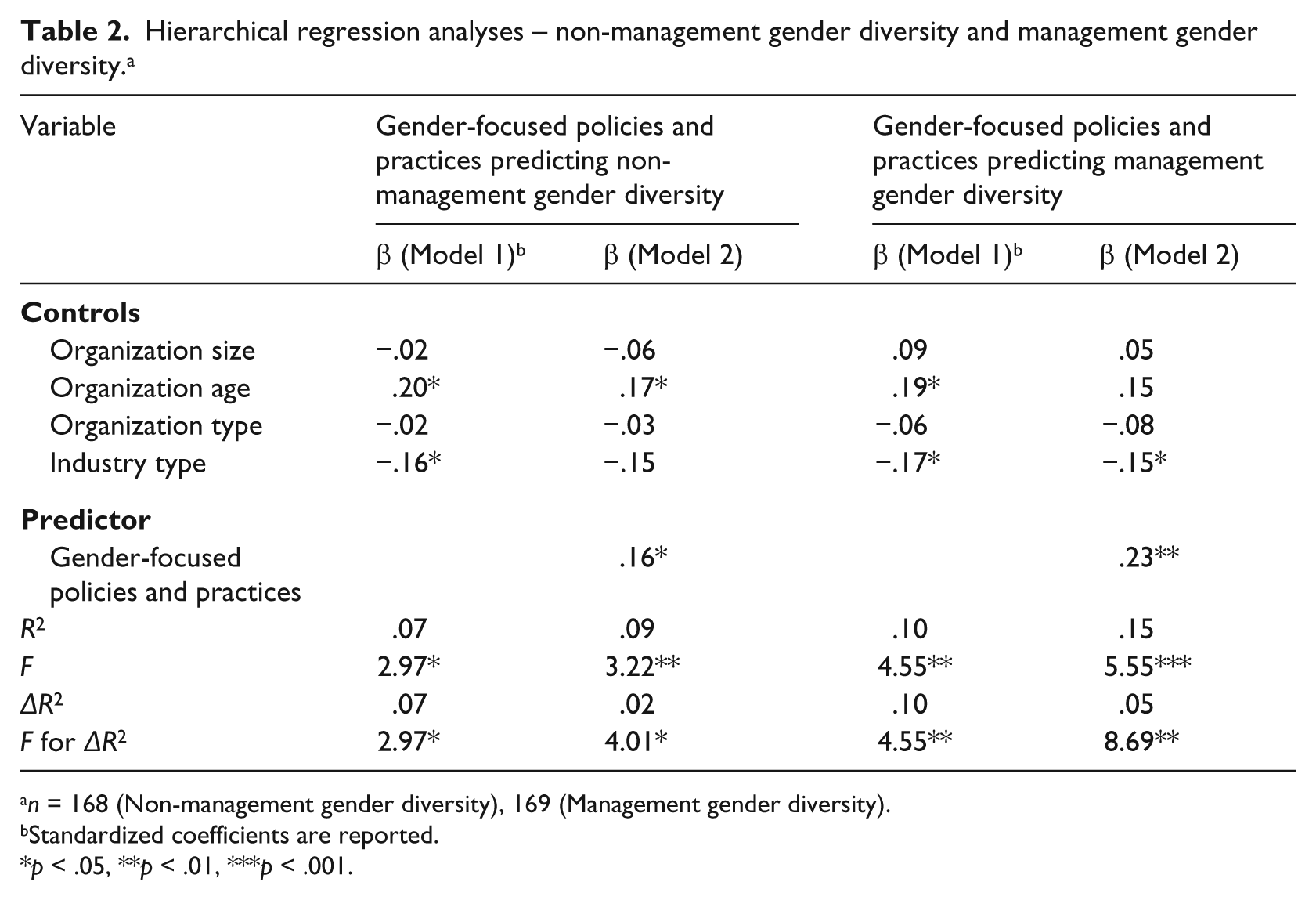
n = 168 (Non-management gender diversity), 169 (Management gender diversity).
Standardized coefficients are reported.
p < .05, **p < .01, ***p < .001.
Hypothesis H2 proposed that gender-focused policies and practices would be positively related to performance. The results under Model 2 under ‘Gender-focused policies and practices predicting employee productivity’ in Table 3 indicate that gender-focused policies and practices had a significant positive effect on employee productivity (β = .19, p < .01). Similarly, the results under Model 2 under ‘Gender-focused policies and practices predicting perceived market performance’ in Table 3 indicate that gender-focused policies and practices had a significant positive effect on perceived market performance (β = .21, p < .05). Thus, support for hypothesis H2 was found for both performance measures.
Hierarchical regression analyses – employee productivity and perceived market performance. a

n = 184 (Employee productivity), 152 (Perceived market performance).
Standardized coefficients are reported.
p < .05, **p < .01, ***p < .001.
Hypothesis H3a proposed that non-management gender diversity mediates the relationship between gender-focused policies and practices and performance. Hypothesis H3b proposed that management gender diversity mediates the relationship between gender-focused policies and practices and performance. Hypotheses H3a and H3b were tested following the four-step procedure outlined by Baron and Kenny (1986). Firstly, the predictor variable (gender-focused policies and practices) should be related to outcome variables (employee productivity and perceived market performance). The results provided support for the first step for both hypotheses H3a and H3b, as gender-focused policies and practices had a significant effect on employee productivity and perceived market performance (see Table 3). Secondly, the predictor variable (gender-focused policies and practices) should be associated with the mediating variables (non-management gender diversity and management gender diversity). Support for the second step for both hypotheses H3a and H3b was also found, as gender-focused policies and practices were significantly related to non-management gender diversity and management gender diversity (see Table 2).
Thirdly, the mediating variables (non-management gender diversity and management gender diversity) should be associated with the outcome variables (employee productivity and perceived market performance) while controlling for the predictor (gender-focused policies and practices). This step was tested separately for non-management gender diversity (see Table 4) and management gender diversity (see Table 5). The control variables were entered in Step 1, gender-focused policies and practices in Step 2, and non-management gender diversity (see Table 4) or management gender diversity (see Table 5) in Step 3. The results under Model 3 under Employee productivity in Table 4 indicate that non-management gender diversity had a significant positive effect on employee productivity (β = .16, p < .05) while controlling for the effects of gender-focused policies and practices. However, non-management gender diversity did not have a significant effect on perceived market performance (β = .01, n.s.) (see Model 3 under Perceived market performance in Table 4). The results under Model 3 under Perceived market performance in Table 5 show that management gender diversity had a significant positive effect on perceived market performance (β = .18, p < .05) while controlling for the effects of gender-focused policies and practices. However, management gender diversity did not have a significant effect on employee productivity (β = –.01, n.s.) (see Model 3 under Employee productivity in Table 5). These results partially support the third step in the mediation testing procedure for both non-management gender diversity (support found for employee productivity) and management gender diversity (support found for perceived market performance).
Hierarchical regression analyses – non-management gender diversity as a mediator. a
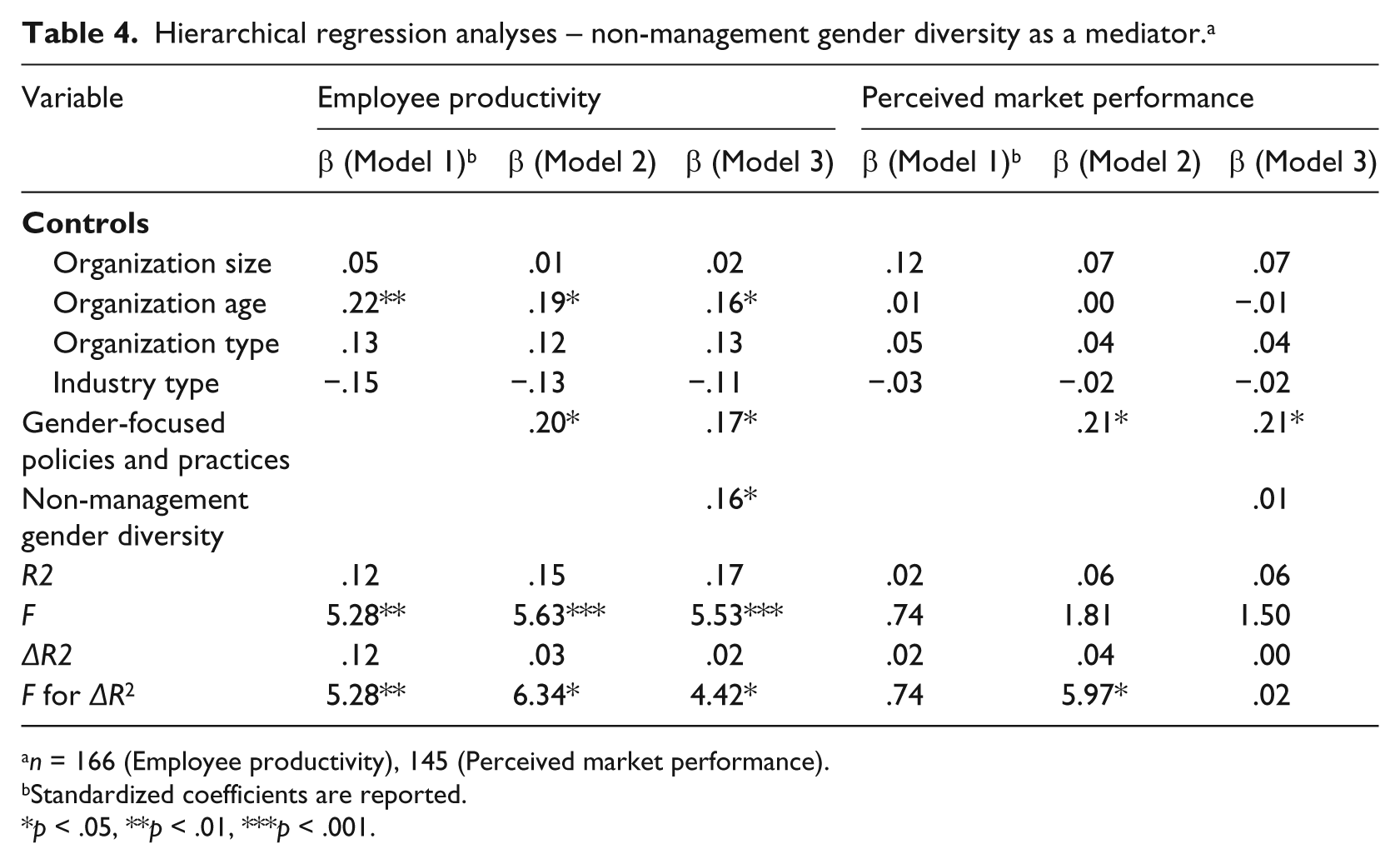
n = 166 (Employee productivity), 145 (Perceived market performance).
Standardized coefficients are reported.
p < .05, **p < .01, ***p < .001.
Hierarchical regression analyses – management gender diversity as a mediator. a
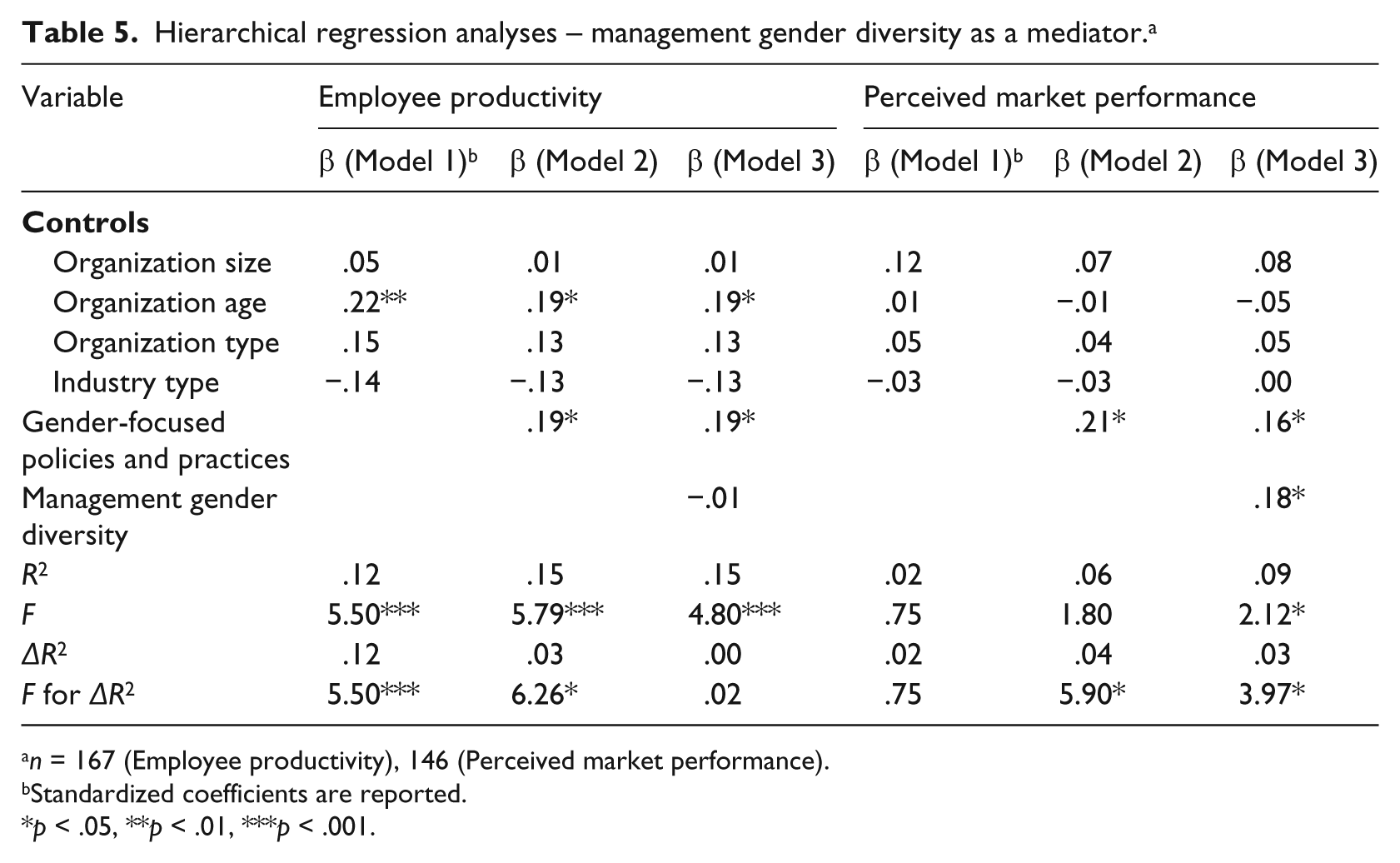
n = 167 (Employee productivity), 146 (Perceived market performance).
Standardized coefficients are reported.
p < .05, **p < .01, ***p < .001.
Fourthly, the previously found significant effect of the predictor (gender-focused policies and practices) on outcomes (employee productivity and perceived market performance) should weaken in the presence of mediators (non-management gender diversity and management gender diversity). Comparing the standardized coefficient for gender-focused policies and practices in Table 3 (Model 2 under Employee productivity and Model 2 under Perceived market performance), Table 4 (Model 3 under Employee productivity) and Table 5 (Model 3 under Perceived market performance), it is clear that the effect of gender-focused policies and practices on both employee productivity and perceived market performance reduced in the presence of non-management gender diversity or management gender diversity. In sum, the results partially support hypothesis H3a (non-management gender diversity mediated the relationship between gender-focused policies and practices and employee productivity) and hypothesis H3b (management gender diversity mediated the relationship between gender-focused policies and practices and perceived market performance). 3
5. Discussion
The main objective of testing the proposed model was to investigate whether (1) gender-focused policies and practices lead to higher levels of gender diversity at non-management and management levels, (2) gender-focused policies and practices lead to higher performance, and (3) gender diversity at non-management and management levels mediates the relationship between gender-focused policies and practices and performance. The results of this study support the relationship between gender-focused policies and practices and gender diversity at both non-management and management levels. The findings also support the relationship between gender-focused policies and practices and performance (productivity and perceived market performance). However, the results only partially support the mediation effects of gender diversity in the relationship between gender-focused policies and practices and performance. Gender diversity at the non-management level mediates the relationship between gender-focused policies and practices and productivity, whereas gender diversity at the management level mediates the relationship between gender-focused policies and practices and perceived market performance.
5.1. Gender-focused policies and practices and gender diversity
At both non-management and management levels, the significant positive relationship between gender-focused policies and practices and gender diversity supports signaling theory (Spence, 1973). The findings suggest that gender-focused policies and practices signal to job applicants that the organization values and supports gender diversity. These perceptions of job applicants can lead to organizational attractiveness and a greater likelihood that applicants will apply for jobs and accept the job offer. The results of this study are consistent with past empirical research that found the positive impact of gender/ethnicity-focused policies and practices on diversity (Kalev et al., 2006; Konrad and Linnehan, 1995; Richard et al., 2013). These findings also indirectly support Edelman’s (1992) argument that these policies and practices signal the employer’s intentions to improve diversity in their workforce. While some organizations may have these policies and practices in place because of institutional pressures (Yang and Konrad, 2011), these formalized policies and practices change the power balance in favor of underrepresented groups and are usually hard to abolish (Kalev et al., 2006).
5.2. Gender-focused policies and practices and performance
The positive relationship between gender-focused policies and practices and productivity, and between gender-focused policies and practices and perceived market performance, support the resource-based view of the firm (Barney, 1991). The results indicate that gender-focused policies and practices provide a firm with a competitive advantage that is reflected in higher productivity and higher perceived market performance. Gender-diverse organizations with many supportive HR policies create a culture where diversity is embraced and differences are celebrated (Härtel, 2004). These organizations may also enjoy a competitive advantage by saving on recruitment, selection, training and development costs (McKay et al., 2007), and by minimizing social capital losses in the form of social networks (Shaw et al., 2005). These findings are consistent with past empirical research that found the positive effects of diversity-supportive HR policies and practices on performance (Armstrong et al., 2010).
The results weaken the argument that gender/ethnicity-focused policies and practices may result in a backlash from men (or majority employees) and may have negative effects on performance (Kidder et al., 2004). Achieving greater organizational performance is an overarching organizational objective for both majority and minority employees (Falbe and Yukl, 1992). Organizations usually share increased profits with both employee groups in the form of benefits and training and development opportunities (Wright et al., 2005). Therefore, both men and women will place high value on an organization’s efforts to embrace diversity (McKay et al., 2007). Of the 43 gender-focused policies and practices studied in this research (see the Appendix), 24 policies and practices are not women-specific; they are meant to benefit both men and women in an organization (e.g. ‘managers are trained in their equal opportunity responsibilities’ and ‘workshops or seminars on managing a gender-diverse workforce are made available to managers’). The other 19 policies and practices also benefit men indirectly by creating a positive diversity climate – a collegial work environment with a lack of bias toward minority members (Plaut et al., 2009). For instance, the practice of calculating turnover rates for female employees allows a comparison with overall turnover rates. This comparison may make it less likely that managers (both male and female) will engage in discriminatory practices.
5.3. Gender-focused policies and practices, gender diversity and performance
The findings related to the mediating effects of non-management gender diversity in the relationship between gender-focused policies and practices and productivity, and the mediating effects of management gender diversity in the relationship between gender-focused policies and practices and perceived market performance, support signaling theory and the resource-based view of the firm (Barney, 1991; Spence, 1973). The results indicate that gender-focused policies and practices produce higher levels of non-management and management gender diversity. In turn, higher levels of gender diversity at non-management levels lead to higher productivity, and higher levels of management gender diversity lead to higher perceived market performance.
The different findings pertaining to non-management and management gender diversity can be explained by the different value of the resources gender diversity produces, such as market insight, creativity and innovation, and improved problem-solving, to non-managers and managers. At the non-management level the significant positive gender diversity–productivity relationship indicates that the resources associated with gender diversity, such as market insight, can help improve sales of the company’s products/services to a gender-diverse set of customers (Frink et al., 2003). At the management level, the resources of creativity and innovation and improved problem-solving are valuable and their impact should be reflected in perceived market performance (Shrader et al., 1997). Managers are more involved in decision-making than non-managerial employees (Richard et al., 2004). Gender diversity at the management level is more visible than gender diversity at the non-management level. Therefore, it sends positive signals to customers and managers, leading to improved perceived market performance.
5.4. Theoretical and research implications
The study’s results have several theoretical and research implications. The findings support signaling theory for both non-management and management gender diversity (Spence, 1973). The findings related to the positive impact of gender-focused policies and practices on non-management and management gender diversity strengthen the signaling argument that the observable actions (gender-focused HR policies and practices) form unobservable perceptions (the organization values gender diversity; Connelly et al., 2011). The support found for both levels indicates that this signal is strong because of the discretionary nature of gender-focused policies and practices and the fact that most organizations do not offer many of these policies and practices (D’Netto et al., 2014; D’Netto and Sohal, 1999; Fenwick et al., 2011; Kalev et al., 2006; Lingard and Francis, 2004). The support found weakens the argument regarding the ambiguity of the signaling process in management research (Connelly et al., 2011). This research demonstrates that testable predictions can be derived from signaling theory. Moreover, the results support the integration of signaling theory with the resource-based view of the firm to propose the processes through which gender-focused policies and practices affect performance (Barney, 1991; Spence, 1973). The support found for this relationship strengthens the argument that signaling theory can be used in various contexts and with other theories (Karasek and Bryant, 2012). The findings can help refine the resource-based view of the firm; the valuable resources provide a competitive advantage that should be reflected in the most appropriate performance measure. The results indicate that non-management gender diversity was positively associated with productivity, while management gender diversity was associated with perceived market performance. As such, this finding also strengthens the argument that scholars should focus on intermediate performance measures, such as productivity (Ray et al., 2004). The effect of competitive advantage on overall organizational financial performance might not be traceable to one particular source, such as gender diversity (Guest, 2011).
This study addresses important research gaps in the fields of gender-focused policies and practices and gender diversity, and provides future research directions. For example, this research contributes to emerging empirical support for a business case for diversity-focused policies and practices (Armstrong et al., 2010) and gender diversity (Ali et al., 2011; Frink et al., 2003). Further, it pioneers the study of gender diversity as a mediator between HR policies and practices and performance. Future research can benefit from studying the processes between gender-focused policies and practices and gender diversity, such as organizational attractiveness, and between gender diversity and performance, such as market insight, creativity and innovation, and improved problem-solving. Just as gender diversity was studied as a mediator between HR policies and practices and performance, diversity climate is another possible mediator between HR policies and practices and performance (Mor-Barak and Cherin, 1998). The supportive HR policies and practices produce the shared perceptions among employees that the employer wants them to succeed, leading to higher productivity. Future research should take a configurational perspective to investigate antecedents of these policies and practices (Delery and Doty, 1996), including internal fit between gender-focused policies and practices and other HR policies and practices (Konrad and Linnehan, 1995), and external fit with competitive strategy (Huselid, 1995). Future research can also benefit from studying a more comprehensive set of diversity-supportive policies and practices, including those related to race, age and disability, and their impact on multiple dimensions of diversity (Yang and Konrad, 2011). In turn, how those multiple dimensions of diversity interact with each other to impact processes and performance needs attention.
5.5. Practical implications
This study has several important industry implications. Firstly, the findings related to the association between gender-focused policies and practices and gender diversity provide a remedy for inequality and lack of diversity. There has been much research conducted on what causes inequality, such as managerial biases in recruitment practices (Ross, 2011). However, employers struggle with identifying evidence-based HR policies and practices that can help to improve workforce diversity (Kalev et al., 2006; Kulik, 2014). Secondly, the offering of gender-focused policies and practices studied in this research can help managers to achieve their gender diversity targets for both non-management and management levels. In particular, Australian organizations need to considerably improve gender diversity at the managerial level (Strachan et al., 2010). The placement of these policies and practices can help them demonstrate to the WGEA that they are making efforts to improve their gender diversity. This is also important given that large Australian organizations will now need to form a policy or strategy in managing gender diversity (WGEA, 2014). Thirdly, the results regarding the impact of gender-focused policies and practices on performance highlight their strategic nature. These policies and practices thus provide an organization with a competitive advantage (Barney, 1991). Managerial perceptions about the strategic impact of these policies and practices can further promote them (Morris et al., 2011). Fourthly, the results inform managers that the impact of gender-focused policies and practices on performance is mediated by gender diversity. These policies and practices enable organizations to attract diverse employees, leading to a higher quality applicant pool and a diverse workforce (Konrad and Linnehan, 2005). In turn, the differential impact of gender diversity at non-management and management levels on performance (with non-management gender diversity impacting productivity and management gender diversity impacting perceived market performance) suggests that managers should focus on the most relevant performance measures for gender diversity at various levels.
5.6. Limitations
This study has some limitations. Firstly, the findings provide only indirect support for signaling theory and the resource-based view of the firm. Direct support for signaling theory would measure applicants’ perceptions about the gender-focused policies and practices offered by an organization and their subsequent impact on an applicant’s decision to apply for the position and accept a job offer (Spence, 1973). Similarly, a direct test of the resource-based view of the firm requires that researchers measure the value, rarity, inimitability and non-substitutability of a resource and its effect on processes and performance (Barney, 2001). This research is conducted at the organizational level, whereas the process variables of market insight, creativity and innovation, and improved problem-solving are more suitably studied at the group/team level (Guest, 2011). Moreover, an organization can have competitive advantages in several business activities (e.g. marketing and HR). Separating HR practices and tracing their effect on organizational performance is challenging (Guest, 2011; Lockett et al., 2009; Paauwe et al., 2013). The generic nature of the resource-based view of the firm also makes it difficult to predict and explain the processes that lead to superior performance (Lockett et al., 2009). Secondly, the study could not control for the effects of other demographic forms of diversity, such as race/ethnicity and age. Organizations in Australia are not legally required to conduct racial and ethnic audits of their workforces (Strachan et al., 2010). These other forms of diversity may interact with gender diversity to strengthen or weaken the impact of diversity on performance.
Footnotes
Appendix
Funding
This research received no specific grant from any funding agency in the public, commercial or not-for-profit sectors.
Final transcript accepted 1 December 2014 by Peter Jordan (AE Organisational Behaviour).