



Abstract
We investigate the relationships between innovation in the business model, business model design themes, and firm performance. The ‘business model view’ and the related ‘business model innovation’ as emerging strategy, and innovation research domains, remain both ill-defined and marred by vague construct boundaries and limited empirical support. We build on existing theory to test our research model in a sample of 331 Australian firms. We find that business model design themes, which we argue are mechanisms for appropriating value from the firm’s business model, mediate the relationship between innovation and firm performance. Innovation without clarity in the business model leads to modest or negligible performance outcomes. We advocate for novelty-centered design themes because they unlock and translate the value from innovation to firm performance to a greater extent than transaction efficiency and user simplicity. We contend that broad innovation within the business model matters to performance but only if firms focus their business model design efforts more narrowly on coherently entrenching novelty and efficiency within their activity and transaction architecture.
1. Introduction
In the popular literature, the business model concept has gone from an idea (Zott et al., 2011) and a theoretical concept to being a research agenda (Aspara et al., 2010; Lambert and Davidson, 2013) within a very short time. Notwithstanding its increased adoption in the strategy literature, the concept remains poorly defined and misunderstood (Teece, 2010). Empirical analyses are limited in the absence of ‘frameworks for normative or predictive findings’ (George and Bock, 2011: 85).
While different dimensions of the business model concept are apparent, there is some convergence of two central components. A business model describes how an organization creates value for its customers and how it shares in that value (Teece, 2010). While this is an internal view of organizations, similar to the resource-based view (Demil and Lecocq, 2010), the advantage of the business model view is that the value of a product or service is defined by the customer and different customer groups who have varying perceptions of value (Priem, 2007). Unlike the position of the resource-based view, a firm’s resources are not intrinsically valuable (Priem and Butler, 2001), but only become valuable when they are organized to create value for the customer.
Emanating from the ‘business model view’ is the construct of business model innovation. While it is almost implicit that this involves reorganizing a business to create different forms of value for existing or new customers, how the construct should be operationalized lacks clarity. Further, although Xerox photocopiers, Apple iPods, and Spotify internet music are intuitive examples of business model innovation, they are also examples of what we would recognize as conventional product and service innovations. The strategy and innovation literature is ambiguous as to where business model innovation fits within existing paradigms. What actually constitutes business model innovation, as opposed to conventional innovation (product, process, or service), is unclear. The current status of business model innovation in the literature is immature to the point of being ‘we know it when we see it’.
In this paper, we respond to calls for more research on the ‘mechanics and processes of business model innovation’ (George and Bock, 2011: 88; Johnson et al., 2008), as well as the complex two-way relationship between innovation and business model choice (Baden-Fuller and Haefliger, 2013). We do this by providing empirical evidence for a relationship between innovation within business models, business model design, and firm performance. We argue that the relationship between innovation and performance is mediated by the presence of a coherent business model design theme. For this purpose, we introduce three business model designs, namely novelty, transaction efficiency, and user simplicity, thereby extending the approach of Zott and Amit (2007).
To achieve our aim of examining these relationships, our paper is organized as follows. Firstly, we define the business model construct and provide an integrated framework depicting the interdependencies between business model elements, business model design themes, and business model innovation. We then proceed to develop hypotheses to test the relationships between these constructs and firm performance. Next we describe our research design and data, which is based on a survey of 331 Australian firms, and then describe the findings of our multivariate analyses. We conclude by showing that, while novelty and transaction efficiency business models are important to ensure that firms benefit from innovations to business model elements, user simplicity may not provide similar benefits.
2. Background
A sound business model is the key to business viability (Magretta, 2002) to the extent that every firm models their business to explain how it creates value (Chesbrough, 2007). While business models are as old as value creation itself, the term has only recently been academically researched broadly. In the contemporary literature, business modeling can be traced back to the ‘emerging knowledge economy’ and growth in e-commerce (Teece, 2010: 174). Driven by the advent of the internet, the new knowledge economy created the need to distinguish digital business from traditional bricks-and-mortar approaches. Business models became a buzzword, widely used and adopted in practice during the early 1990s, as reflected in popular business articles, company reports, and online blogs. At the same time, internet-based business models became prominent as a vehicle for small firms to successfully compete on a global scale with traditional firms.
These trends led academic research to adopt the concept after 1996 when business models appeared widely in the literature for the first time (Lambert and Davidson, 2013). The business model construct was therefore adopted from and firmly grounded in business practice (Teece, 2010). Academic recognition was, however, not universal, as is clearly argued by Porter (2001: 73) that business models inspire ‘The Internet's Destructive Lexicon [and motivate] an invitation for faulty thinking and self-delusion’. Adoption of the business model ‘view’ in academic research is further hampered because it is ill-defined and has no discernible paradigmatic home, leading to researchers adopting diverse paradigms in conceptualizing business models (Amit and Zott, 2001; Morris et al., 2005). The increasing popularity of the business model concept as ‘complex systems or configurations’ of ‘tightly reinforcing’ organizational elements may also stem from its potential to create a vocabulary for theory development in linking organizational development and performance (Siggelkow, 2002: 125) as a central theme in strategy literature. Such vocabulary development is dependent on construct definition, which is discussed next.
3. Business model definition
The business model as a rapidly developing topic of inquiry in strategy, innovation, and entrepreneurship literature is marred by inconsistent conceptualizations and imprecise construct boundaries (George and Bock, 2011). In their literature review of business models, Zott et al. (2011: 1020) conclude that, since 1996, business models have been a new, distinct unit of analysis that emphasizes ‘a system-level, holistic approach to examining how firms do business’ by creating and capturing value. Business model conceptualizations center on the activities of a firm as well as its partners, suppliers, and customers. These models involve, therefore, complex sets of evolving interdependent activities or ‘routines that are discovered, adjusted, and fine-tuned by “doing”’ (Winter and Szulanski, 2001: 731).
Using the extant literature, we define a business model in this study as an abstraction of strategy (Seddon et al., 2004); of ‘how a firm does business’, capturing the heuristic logic (Chesbrough and Rosenbloom, 2002) of how a firm creates, delivers, and captures value through its activity (Zott and Amit, 2010) and transaction system architectures (Nystrom and Starbuck, 1984), in concert with its boundary-spanning relationship network (Teece, 2010; Zott and Amit, 2010).
We distinguish business models and strategy next.
4. Business models and strategy
The distinction between business models and strategy is often blurred and sometimes indistinguishable. This is to be expected, considering that strategy is richly theoretical, and as discussed above, business models originated from practice outside any theoretical paradigm (George and Bock, 2011). Notwithstanding its practice genesis, the business model concept has found a home in entrepreneurship and strategy literature. Business model conceptualizations are characterized by using various business strategy elements: ‘value chain’, ‘value systems’, ‘strategic positioning’, ‘resource based theory’, and ‘strategic network theory’ (Morris et al., 2005: 728). The conceptualization of the relationship between strategy and business models varies significantly within the scholarly discourse (Seddon et al., 2004). Although these authors note that some researchers do not distinguish the concepts, others see them as overlapping to varying degrees, while others see the one as encapsulating the other.
Yet, empirical papers on this topic seem to adopt the stance that business models are not the same as strategy. A business model makes explicit the strategic choices of the firm, representing abstractions of implemented or realized strategy (Casadesus-Masanell and Ricart, 2010; Seddon et al., 2004). Morris et al. (2005) see business models as a tool for creating sustainable competitive advantage in a defined market. Similarly, Chesbrough and Rosenbloom (2002) see the functions of business models to include specifying the firm’s market and competitive position, as well as formulating the competitive strategy for sustained competitive advantage.
Seen against this background, it is very difficult to distinguish between strategy and business models. Magretta (2002) disagrees that business models incorporate competition as a critical dimension of performance. Strategy traditionally focuses on how firms use their resources to compete in the market (Chandler, 1962), whereas business models focus on the activity system for value creation as an abstraction of the business’ strategy (Seddon et al., 2004). This accords with George and Bock’s (2011: 102) view that ‘business models are opportunity-centric, while strategy is competitor or environment centric’. They contend that the business model is the ‘nonreflexive’, static, ‘configurational enactment’ of entrepreneurial opportunity, whereas strategy is dynamic in optimizing the configurational effectiveness, changing the configuration or underlying opportunity and seeking new opportunities (George and Bock, 2011: 102). ‘Strategy analysis is thus an essential step in designing a competitively sustainable business model’ (Teece, 2010: 180). We therefore contend that although highly interrelated, business models and strategy are not the same in that the business model is a static abstraction of the firm’s strategy (Seddon et al., 2004).
Other than the above debate, another important research agenda emerges that requires scholarly attention: to decipher the complex links between organizational innovation, business model choice, and firm performance (Baden-Fuller and Haefliger, 2013; George and Bock, 2011). To direct this research, we present a conceptual framework next, which is then tested empirically to extend the multitude of case studies on this topic (Lambert and Davidson, 2013).
5. An integrated theoretical framework: Innovation within the business model and its design themes
5.1. Business model elements
The practical appeal of the business model concept lies in its ability to present, clarify and simplify the essential elements of how the business creates and captures value (Neubauer, 2011). Many different conceptualizations of these elements are provided in the literature (Chesbrough and Rosenbloom, 2002; Doganova and Eyquem-Renault, 2009; Johnson et al., 2008). Figure 1 represents the business model elements adopted from Osterwalder and Pigneur (2010), which fit our business model definition (Osterwalder, 2004). Spencer (2013: 18) adopts a similar model and refers to it as the ‘foundational level business model’ in that while it represents the basic processes and activities to create and deliver value, it is insufficient to ensure competitive advantage. Although most of the business model elements are observed at the organizational level of analysis, some also transcend the traditional boundaries of the firm in that these elements include various network partners along the value chain and within the immediate competitive and industry environments.
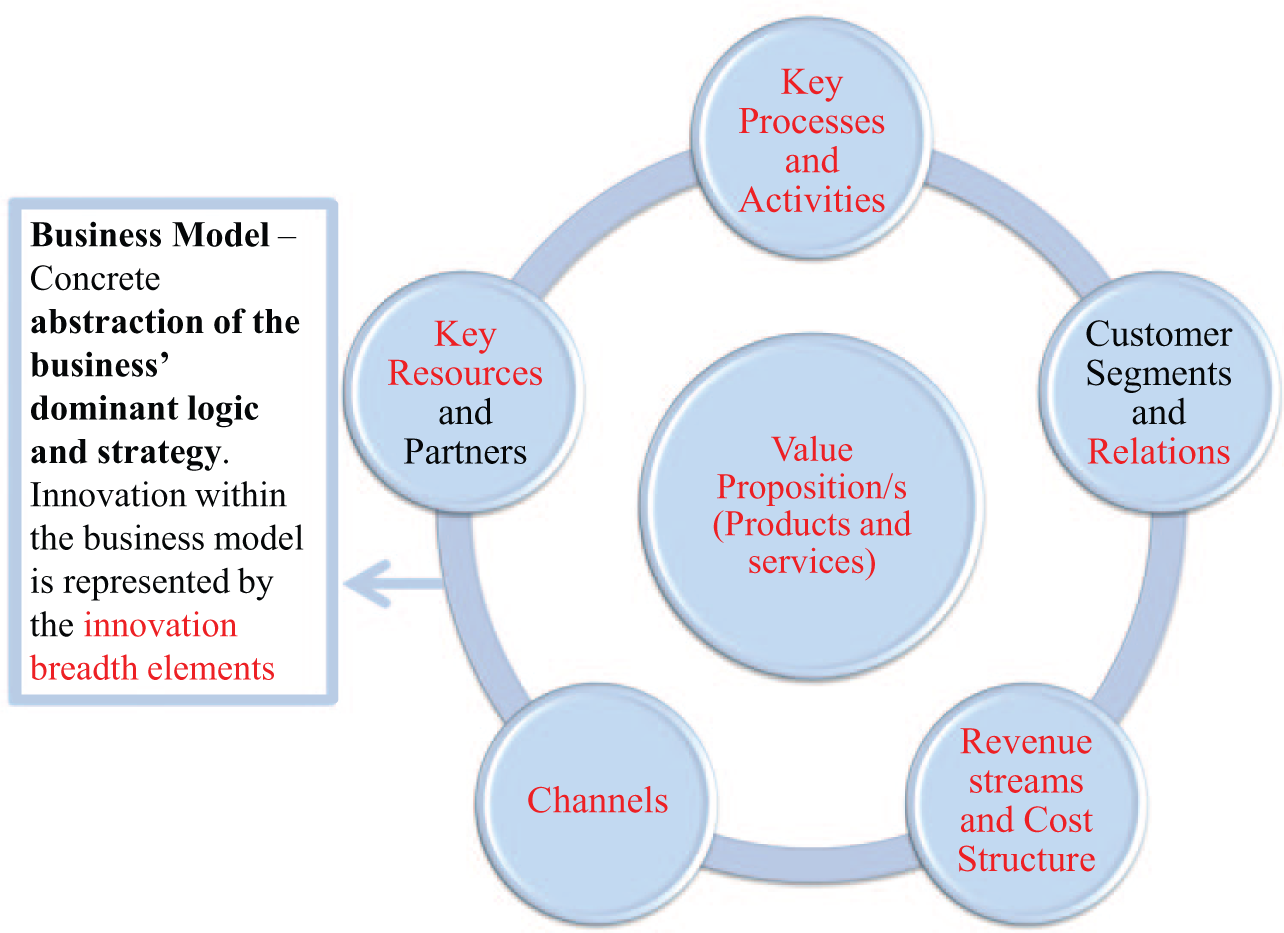
Business model elements. (Color online only.)
We argue that this static abstraction of the business’ dominant logic, often used as a point of departure for management experimentation with alternative strategies, is also a recipe for managers to innovate by modifying or completely redesigning their businesses’ architecture to make it ‘fit for the future’ (Baden-Fuller and Morgan, 2010; Zott and Amit, 2010: 216). Firms can therefore innovate in the elements of their business models to create unique and more efficient business models for increased competitiveness, as discussed in the next section.
This approach to defining a business model is very similar to what we term ‘innovation breadth’ in Section 7.2. To illustrate, the variables used to operationalize this construct are highlighted in red in Figure 1. It includes the introduction of new technology as product and service innovations (associated with the value proposition), as well as a diverse set of processes related to innovations in other elements of the business model. Innovation breadth therefore relates to seven of Osterwalder and Pigneur’s (2010) nine business model building blocks, namely customer relations, channels (communication, distribution, and sales), revenue streams, value propositions, key resources, key activities, and cost structure. Customer segments and key partnerships are the only elements excluded from the scope of our innovation breadth measure. Innovation breadth therefore indicates innovation within the business model, albeit not a proxy for business model innovation. It neither tests for the novel reconfiguration of the business model dimensions of ‘resource structure, transactive structure and value structure’ (George and Bock, 2011: 99) nor the activity system’s content, structure, and governance (Zott and Amit, 2010: 222).
5.2. Business model design themes
While business models are ‘representations of the firm’s business’ (Bock et al., 2012: 290), or a static representation of how the ‘pieces of a business fit together’ (Magretta, 2002: 91), business model designs enact new strategy to create differential advantage and/or exploit opportunity within the competitive and industry environments.
Zott and Amit (2010: 222) develop ‘an activity system design framework’ that sheds light on the connection between business model elements, business model design, and strategy. The firm can enhance its value creation of, and captured value from, the business model by adopting one or more of the following dominant ‘value creation drivers’ or ‘design themes’: ‘novelty, Lock-In, Complementarities or Efficiency’ (Amit and Zott, 2001; Zott and Amit, 2010: 222). These design themes are not mutually exclusive. They ‘describe the holistic gestalt of a firm’s business model’ (Zott and Amit, 2008: 4). They are also close to the realm of strategy as they emphasize value capture at the firm level (Chesbrough and Rosenbloom, 2002). Firm performance is thus seen as a function of the fit between business model design themes and strategy (Zott and Amit, 2008). Firms do not compete on specific aspects of their business models in terms of products alone; competition rather takes place between business models in the market. This is in line with what Spencer (2013: 5) refers to as a ‘differentiated business model’, where competitive advantage is included, ‘providing value that customers perceive as novel, or better, or cheaper’ than competitive offerings. In this paper, we adopt and build on the operationalization of business model design themes proposed by Zott and Amit (2007, 2012). Figure 2 displays how the business model design themes relate to the elements of the business model.
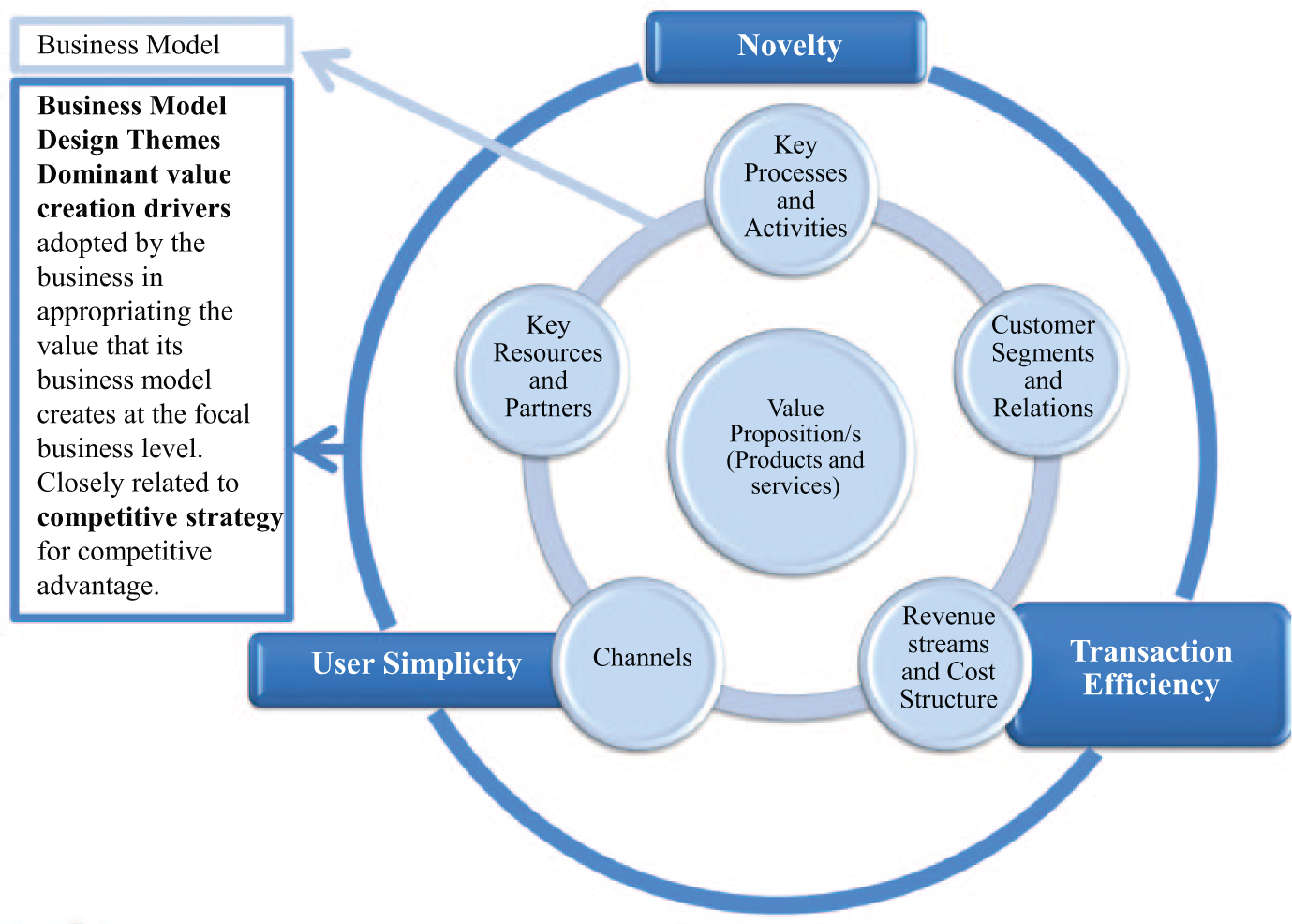
Business model design themes.
Our purpose is to test how these business model design themes relate to innovation within the business model and performance, as discussed next.
6. Research model: innovation breadth, business model design, and performance
Although innovation encompasses invention, it is only when an invention or creative idea is institutionalized, implemented, or commercially exploited that it becomes innovative (Van de Ven, 1986). In its broadest sense, innovation therefore implies value-added novelty. Overwhelmingly, research empirically shows a positive link between innovation (including innovation breadth) and different measures of firm performance (Baldwin and Gellatly, 2003; Grönum et al., 2012; Hoffman et al., 1998; Klomp and Van Leeuwen, 2001; Love et al., 2011; Mansury and Love, 2008; Prajogo, 2006; Roper et al., 2002). Innovation breadth, as a proxy for innovation within the business model elements (as discussed in Sections 5.1 and 7.2), is therefore also expected to positively relate to firm performance. We therefore hypothesize that
H1: Innovation breadth is positively related to firm performance.
McGrath (2010) argues that the business model perspective provides the opportunity for strategy researchers to move beyond a fixation on resource endowment to focus rather on how these resources are used to move dynamically from one temporary competitive advantage to the next. Practitioners clearly believe that the business model matters to firm performance and survival as it relates to exploiting opportunities (George and Bock, 2011). Notwithstanding the practitioner sentiments, adopting Zott and Amit’s (2007) model clearly shows that firm performance results from specific business model characteristics. The ‘design themes that orchestrate and connect the elements of the business model’ (Zott and Amit, 2007: 183) represent powerful tools for creating competitive advantage (Johnson et al., 2008; Teece, 2010) and indeed have the potential to disrupt the traditional logic of its market (Sabatier et al., 2010). Hence, it acts as a force for creative destruction (Schumpeter, 1950) in generating entrepreneurial rent (Schumpeter, 1934). Using Zott and Amit (2007), we argue that, although the three types of business model designs will vary in how strongly they relate to performance, all three are nevertheless important to performance:
H2: Business model design themes (directed at creating and capturing value through novelty (H2a), transaction efficiency (H2b), and user simplicity (H2c)) are positively associated with firm performance.
As argued above, the complex ‘paths to monetization’, linking innovation, the business model, and business performance, remain controversial (Baden-Fuller and Haefliger, 2013: 422). We therefore ask: does the dominant business model design change in the wake of innovation or do changes in dominant business model design initiate innovation? We respond by suggesting that a business model plays two roles in innovation: it is an essential ingredient for successful innovation, but also a source of innovation (Teece, 2010). Firstly, unlocking the value from new technological innovations may require the development of new business models to ‘translate the technical success into commercial success’ (Johnson et al., 2008; Teece, 2010: 184). This does not imply that introducing all new innovations would require business model innovation, because new product or process innovations may be successfully applied to existing business models. However, when a firm introduces diverse innovations across a broad spectrum of business activities and processes (i.e., innovation breadth), the firm will more likely succeed in introducing these innovations. Seen from this perspective, innovation breadth is closely related to new or changed business model design. In effect, this relationship may determine business model structure (George and Bock, 2011). We therefore hypothesize that
H3: Innovation breadth is positively associated with the novelty (H3a), transaction efficiency (H3b), and user simplicity (H3c) business model design theme.
The choice of an appropriate business model ensures that value from innovations is captured and monetized within the competitive landscape by affording the business a competitive advantage (Baden-Fuller and Haefliger, 2013; Teece, 2010). The business model design themes (as operationalized in this paper) of novelty, transaction efficiency, and user simplicity indicate the value creation drivers that the business adopts ‘to appropriate the value that its business model creates’ (Zott and Amit, 2007: 183). From there, we extend the above line of reasoning by building on Zott and Amit’s (2007: 194) ‘theory of business model design that explains how value is created at the business model level of analysis and how value is captured at the focal firm level of analysis’. We argue that the value derived from innovation breadth, as a proxy for innovation within the business model, would be captured by the dominant business model design themes, hence:
H4: The positive association between innovation breadth (innovations within the business model) and perceived firm performance is mediated by the novelty (H4a), transaction efficiency (H4b), and user simplicity (H4c) business model design themes.
These hypotheses are summarized in Figure 3.

Research model.
7. Research design
7.1. Sample and data
We tested our hypotheses using a sample of 331 firms from a major urban region in Australia. We focused on firms in internationally tradable industries, such as manufacturing, construction, information media, and professional services, to avoid firms that were not in highly competitive markets. A statistically random stratified sample within these industries was drawn to ensure representativeness across these industries, firm sizes, and ages. A total of 785 firms were contacted by phone in June 2013. Of these firms, 208 were not contactable and 246 firms declined to participate. Our response rate was therefore just more than 61 percent.
To ensure reliability and validity, we took five steps. Firstly, we used computer-assisted telephone interviewing (CATI) by a third-party provider to overcome the typical low participation rates in mail surveys in Australia. This led to a greater number of completed surveys, thus reducing statistical bias owing to missing data. Secondly, our response rate and stratified sampling strategy gave us confidence that response bias was not a major issue. Because we were in the field for fewer than two weeks, we could not use wave analysis to test for response bias (Armstrong and Overton, 1977).
Thirdly, in designing a questionnaire to address each of the variables in our research model, we used past studies to derive survey items, as described in the next section. Fourthly, we used a panel of public sector economic policy and industry experts to review the draft questionnaire. This process allowed minor changes to existing items to improve its consistent interpretation by respondents and ensure face validity. It also identified redundancy in the business model items, after which we removed some questions as explained next. Lastly, and also in the next section, we conducted both exploratory and confirmatory factor analysis of our scales to ensure reliability.
7.2. Variables
Perceived firm performance was measured using the approach developed by Covin and Slevin (1989) and Gupta and Govindarajan (1984) and used widely in studies that include large numbers of small firms (Brockman et al., 2012; Li et al., 2013; Verreynne et al., in press). We adapted this scale to be representative of a broader measurement approach (e.g., Kaplan and Norton, 1996), to include measures of customer satisfaction, market share, growth, and profit. This approach asks respondents to rate the importance to the firm of, and their associated satisfaction with, 11 financial measures on a five-point Likert scale. The satisfaction scores are then multiplied by the importance scores and aggregated to compute a weighted average performance index for each firm. The higher the aggregate score on this index, the better the perceived level of firm performance. The reliability of the resulting scale was calculated using the Cronbach’s alpha statistic (α = .815).
7.2.1. Innovation breadth
The Oslo Manual’s guidelines in standardizing innovation measurement, used in large-scale innovation surveys among Organisation for Economic Co-operation and Development (OECD) countries (OECD, 2011), were adopted in this paper. Innovation breadth refers to implementing different types of innovation across a range of eight business model elements, namely products, services, production, product process, service process and managerial, marketing or human resources processes (see Figure 1) (Geroski et al., 1993; Grönum et al., 2012). It does not measure innovation depth, intensity, or frequency of the specific types of innovation. Firms were also asked to indicate if their innovations were new to the firm or new to the industry on each of these innovation types, resulting in our innovation breadth variable ranging from eight to 16. The innovation types were not mutually exclusive, as firms could have developed more than one type of innovation. The reliability of the resulting scale was calculated using the Cronbach’s alpha statistic (α = .747).
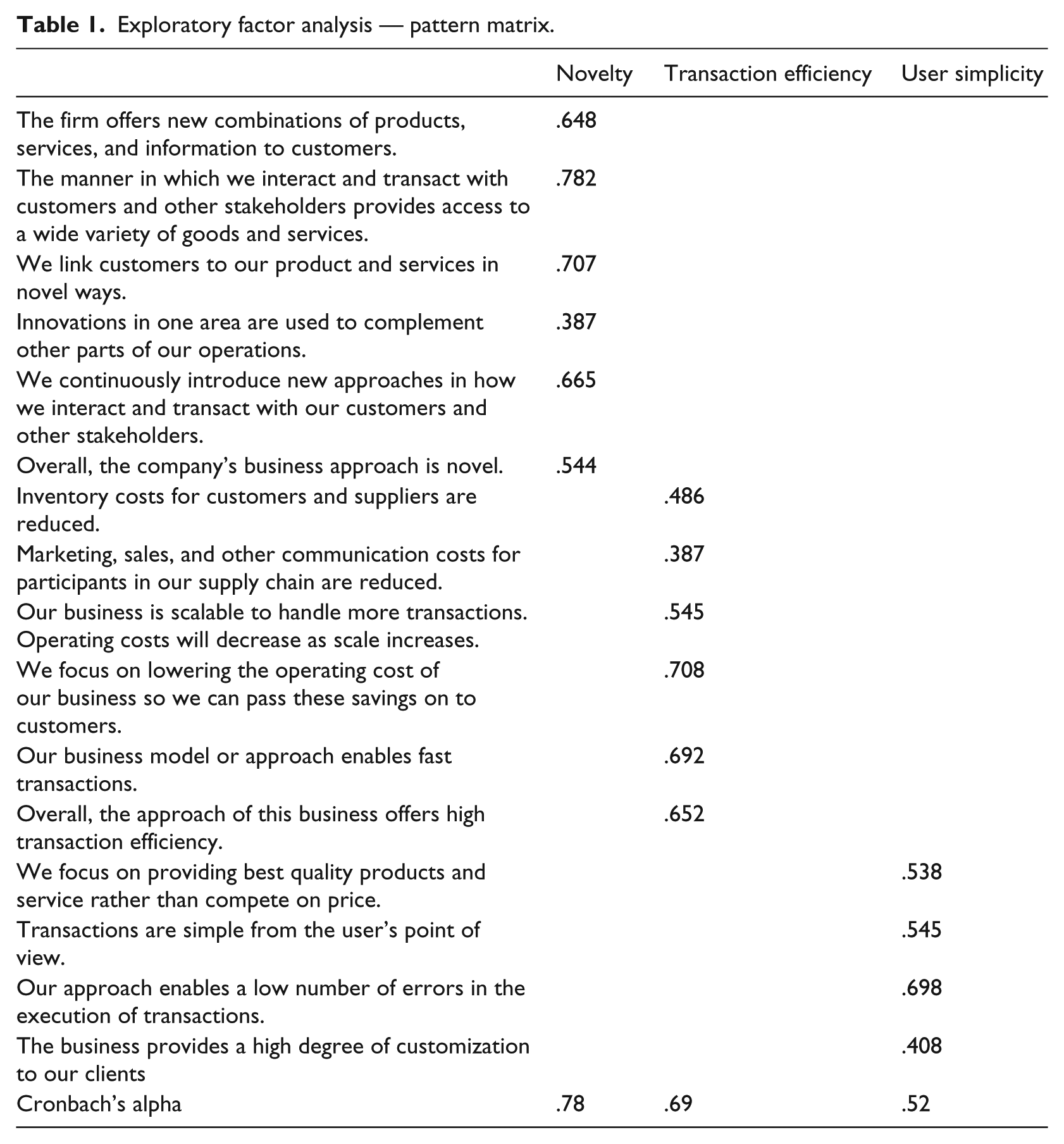
Business model design themes were measured using Zott and Amit’s (2007) scale, originally developed with 26 items to operationalize two types of business model design themes, namely design efficiency and design novelty. The survey targeted large firms, often comprising several business units or serving diverse markets. Our panel of experts found a high level of repetition in nine of the items, thus making them less relevant to the large number of small firms that were also targeted by our survey. Considering the high number of items representing each construct, we deleted these from our scale. Items were rated on a five-point Likert-type scale, anchored with strongly disagree and strongly agree. We used Kaiser’s (1974) and Cattell’s (1966) rules to determine the optimum number of factors based on exploratory factor analysis. We used principal axis factoring to extract factors, and applied a promax rotation to allow for correlations between the factors. As suggested by Hair et al. (2010), correlations above 0.3 were considered to be strong. The final factor pattern showed a simple structure allowing the factors to be named novelty, transaction efficiency, and user simplicity.
Our results differ from Zott and Amit (2007) in that design efficiency clearly fell into two factors, namely transaction efficiency and user simplicity (see Table 1 and Figure 4). Novelty business models were described by the ability of firms to offer new combinations of products, services, and information to customers, enabling customers and other stakeholders to access a wide variety of goods and services, and integration of innovations across areas. Transaction efficiency business models were described by scalability, scale efficiency of operating costs, passing on savings, and fast transactions. User simplicity business models were described by simple transactions from the user’s point of view, low numbers of errors in the execution of transactions, and a high degree of customization to clients. To calculate the final variables, we aggregated the item scores for each factor using equal weights (see Mendelson, 2000).
Exploratory factor analysis — pattern matrix.
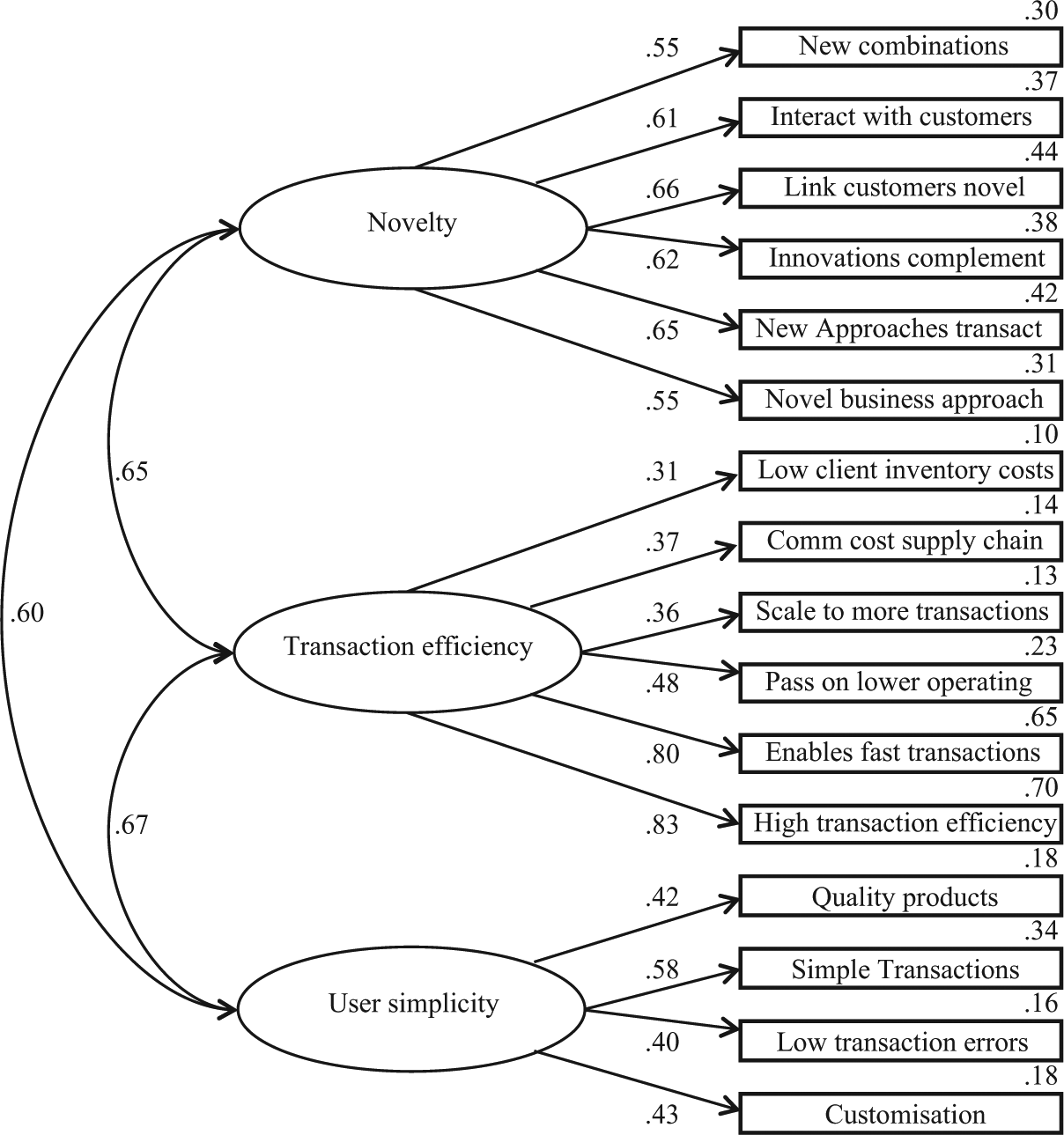
Confirmatory factor analysis.
We tested internal consistency using a Cronbach’s alpha reliability test. As shown in Table 1, two factors satisfied Nunnally’s (1978) guidelines of 0.7, but the third was on the lower side of what others, which Hair et al. (2010) see as acceptable.
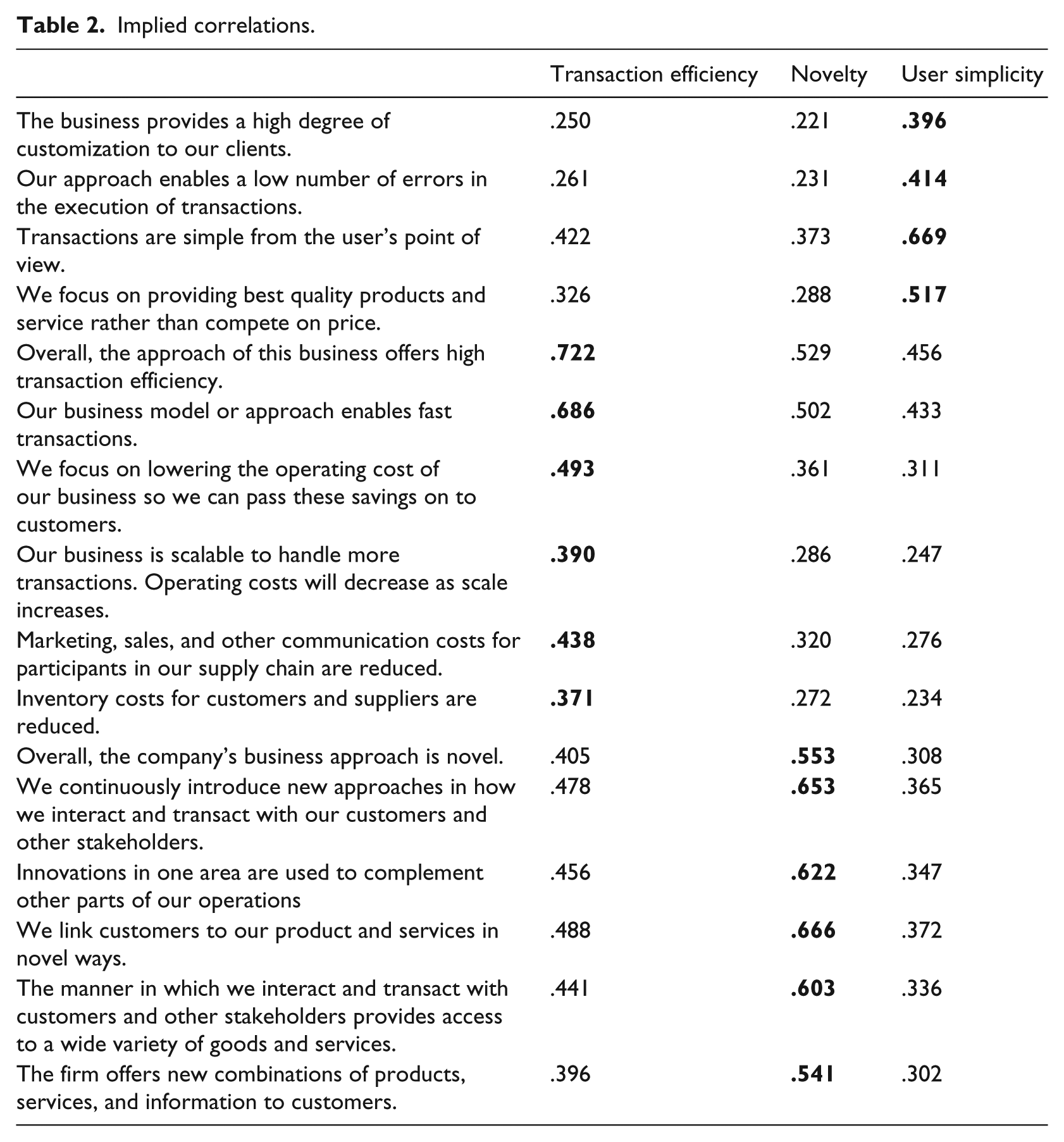
Therefore, to further demonstrate the internal validity of the measures, we ran confirmatory factor analysis using AMOS version 22. We tested the discriminant validity of these measurement models using the imputed correlations for the full measurement model. The results confirmed discriminant validity in that each item loads strongly on only the appropriate factor (see Table 2). Values for Cronbach’s alpha (all above 0.70) showed that reliable scales can be constructed in all cases but one. The user simplicity scale has poor reliability (Cronbach’s alpha = 0.52). However, this scale has acceptable face validity and internal validity, falling well inside the parameters suggested by Byrne (2001) (RMSEA = 0.032, CFI = 0.994, Chi-square = 1.328, df = 1, p = 0.249).
Implied correlations.
7.2.2. Others
We controlled for firm age and size, and industry sector, to account for the liabilities of newness and smallness (Edwards et al., 2005; Klomp and Van Leeuwen, 2001; Lööf and Heshmati, 2006), and industry differences often observed in our variables (Hawawini et al., 2003). We used a combination of self-reported numbers and data from official state government datasets acquired through compulsory employee insurance schemes for this purpose. Both the size and age variables were skewed, and therefore log-transformed to be included in regression models. Industry was recoded into four categories, based on data provided by respondents, namely retail/wholesale (also including cafés and accommodation), manufacturing, services, and ‘other’ industries. The latter industry was left out of regression models as a reference category.
8. Analysis and findings
8.1. Main hypotheses
As shown earlier, our final sample illustrated the success of our sampling strategy. Of the firms that responded, 30 percent employed five or fewer FTEs (full-time equivalent employees), 31 percent between six and 20 FTEs, 13 percent between 21 and 50 FTEs, 14 percent between 51 and 200 employees, and 11 percent 201 or more employees. Seven percent of firms had been established for five years or fewer, 16 percent between six and 10 years, 39 percent between 11 and 20 years, and 38 percent were 21 years or older. With a focus on tradable industries, fewer than 15 percent of our sample had come from retail, wholesale, catering, and accommodation. Almost 19 percent from manufacturing and 32 percent represented different types of services industries. Chi-square tests of difference indicated that there were significant differences in innovative activity in different types of firms. For example, smaller firms were less likely to innovate than larger firms, younger firms less likely to innovate than older firms, and differences also exist among industries. This confirmed our decision to control for these variables.
Table 3 displays the Pearson correlations among the variables of interest. While some correlations exist between independent variables in our regression, we did not see this as presenting a multi-collinearity problem, as their variance inflation factors (VIFs) are low (ranging from 1.167 to 1.476). Table 3 further indicates that there were significant correlations between most of our variables. Firm size was only correlated with innovation breadth, in that larger firms were more likely to innovate across a broad spectrum. Innovation breadth was also important for manufacturing firms, which most likely have to, for example, introduce new processes to ensure the success of new products.
Descriptives and Pearson’s correlations.
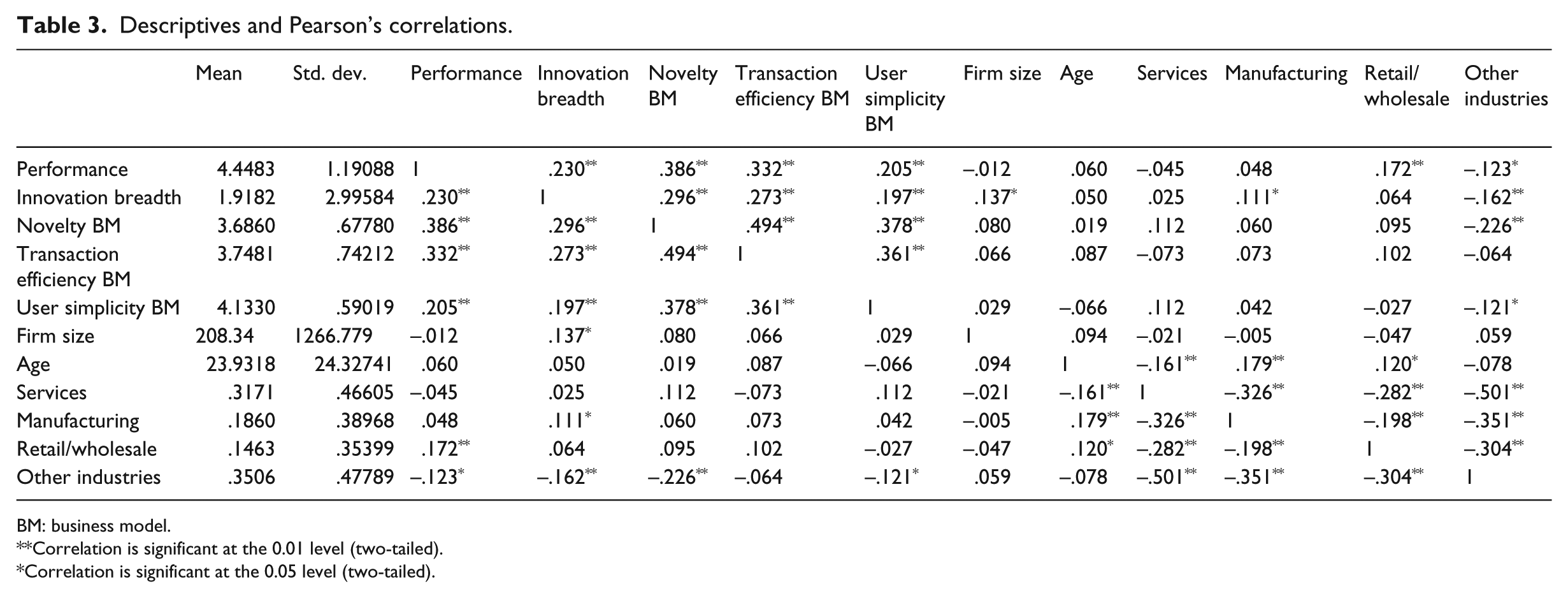
BM: business model.
Correlation is significant at the 0.01 level (two-tailed).
Correlation is significant at the 0.05 level (two-tailed).
Tables 4 –6 depict the ordinary least squares (OLS) regression results, conducted using SPSS version 21. We ran several regression models to explore how innovation breadth and business model design themes combine to explain overall firm performance. Firstly, as shown in Table 4, we investigated how innovation breadth (H1), as well as each of the three types of business model design themes (H2), related to perceived firm performance as a dependent variable. We first tested the relationship between innovation breadth and firm performance. H1 was found to be significant. In H2a, 2b, and 2c, all business model design themes were significant, confirming the hypothesized positive relationship with firm performance. We considered the effect sizes indicated a novelty design theme to explain most of the variance in firm performance, followed by transaction efficiency and user simplicity design themes. When all three types of business models were entered simultaneously in H2, the user simplicity business model design theme was not significant.
OLS regression: Hypotheses 1 and 2—DV firm performance (beta shown).
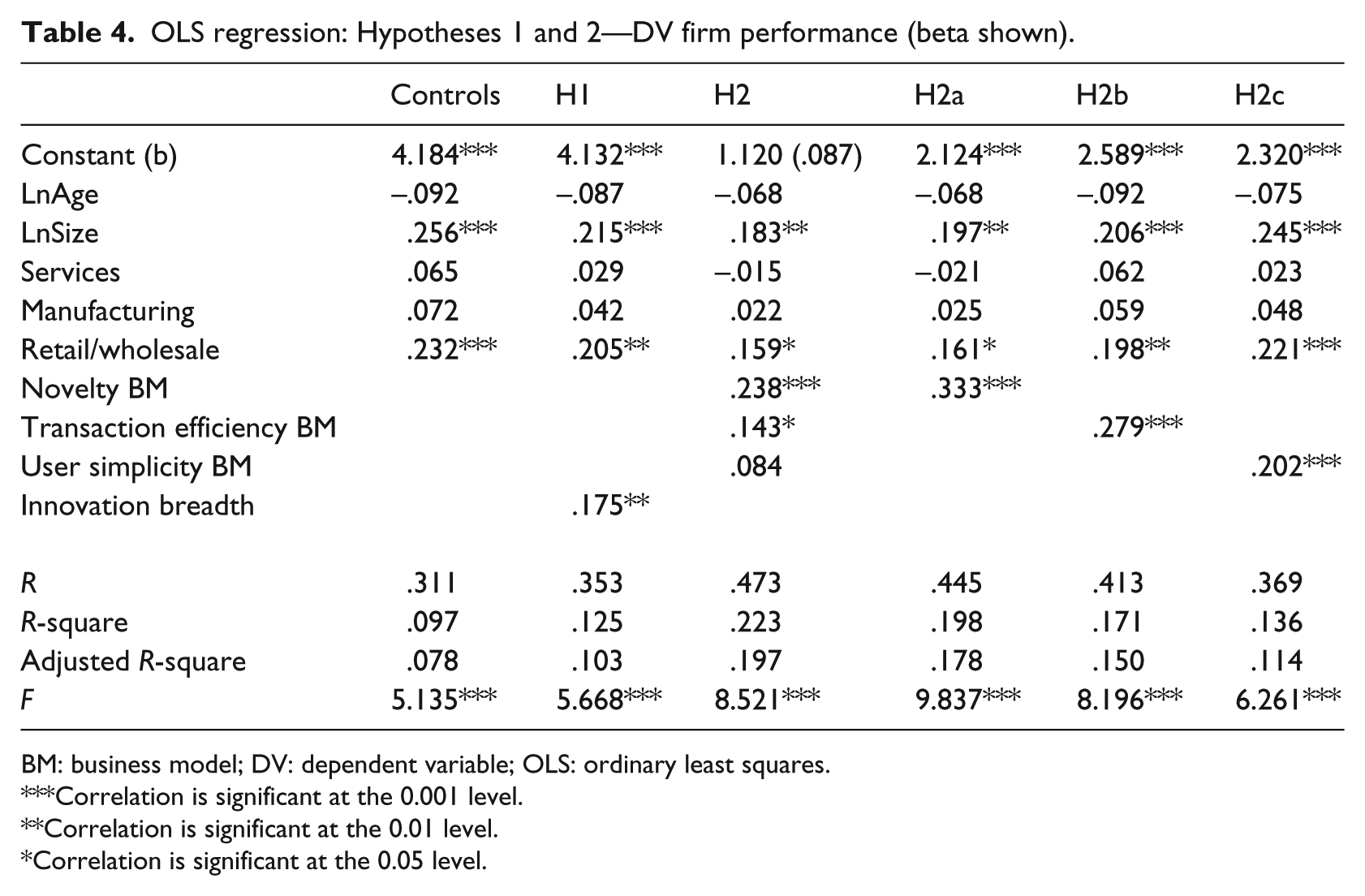
BM: business model; DV: dependent variable; OLS: ordinary least squares.
Correlation is significant at the 0.001 level.
Correlation is significant at the 0.01 level.
Correlation is significant at the 0.05 level.
OLS regression: Hypothesis 3—DVs novelty (H3a), transaction efficiency (H3b), and user simplicity (H3c) BM design themes (beta shown).
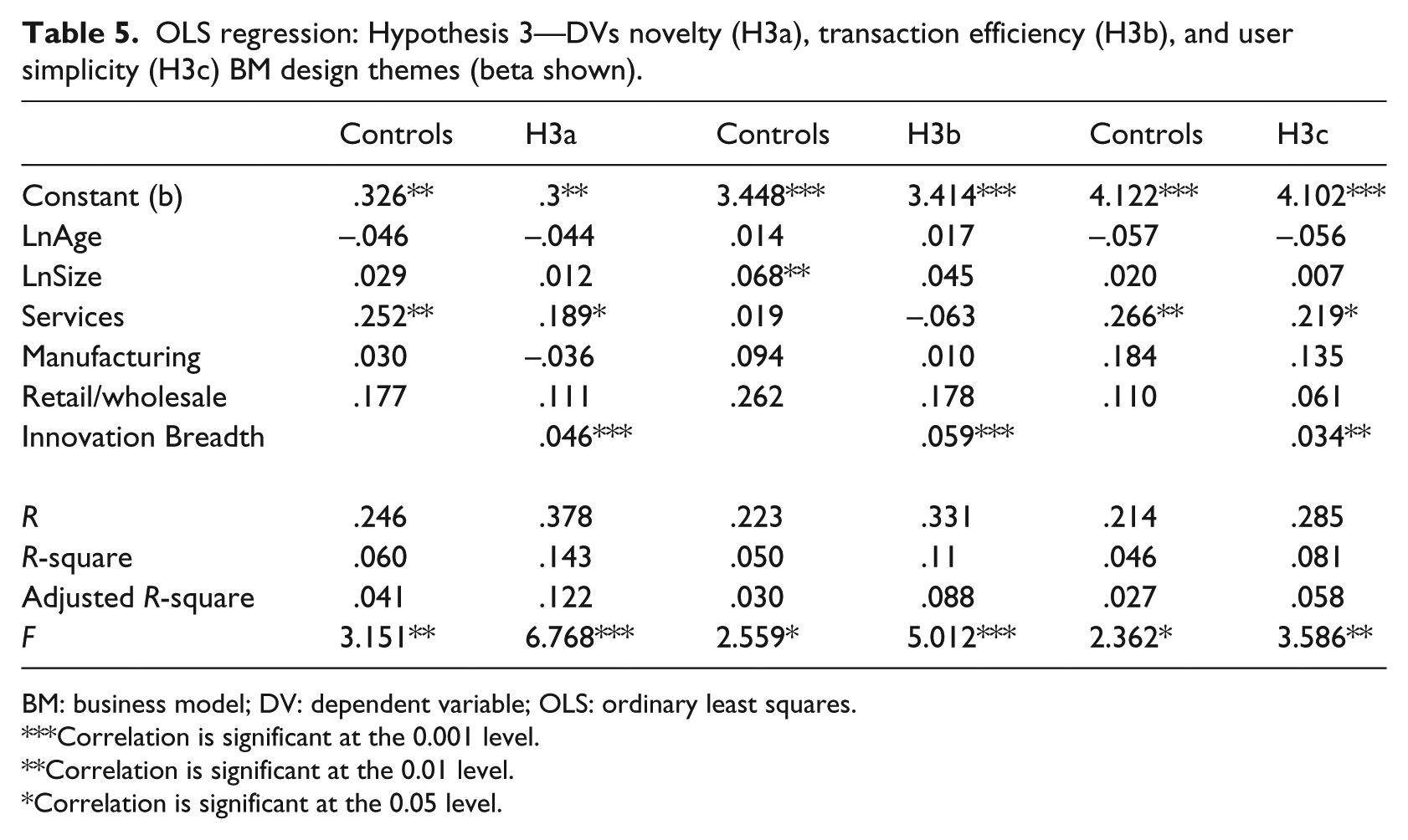
BM: business model; DV: dependent variable; OLS: ordinary least squares.
Correlation is significant at the 0.001 level.
Correlation is significant at the 0.01 level.
Correlation is significant at the 0.05 level.
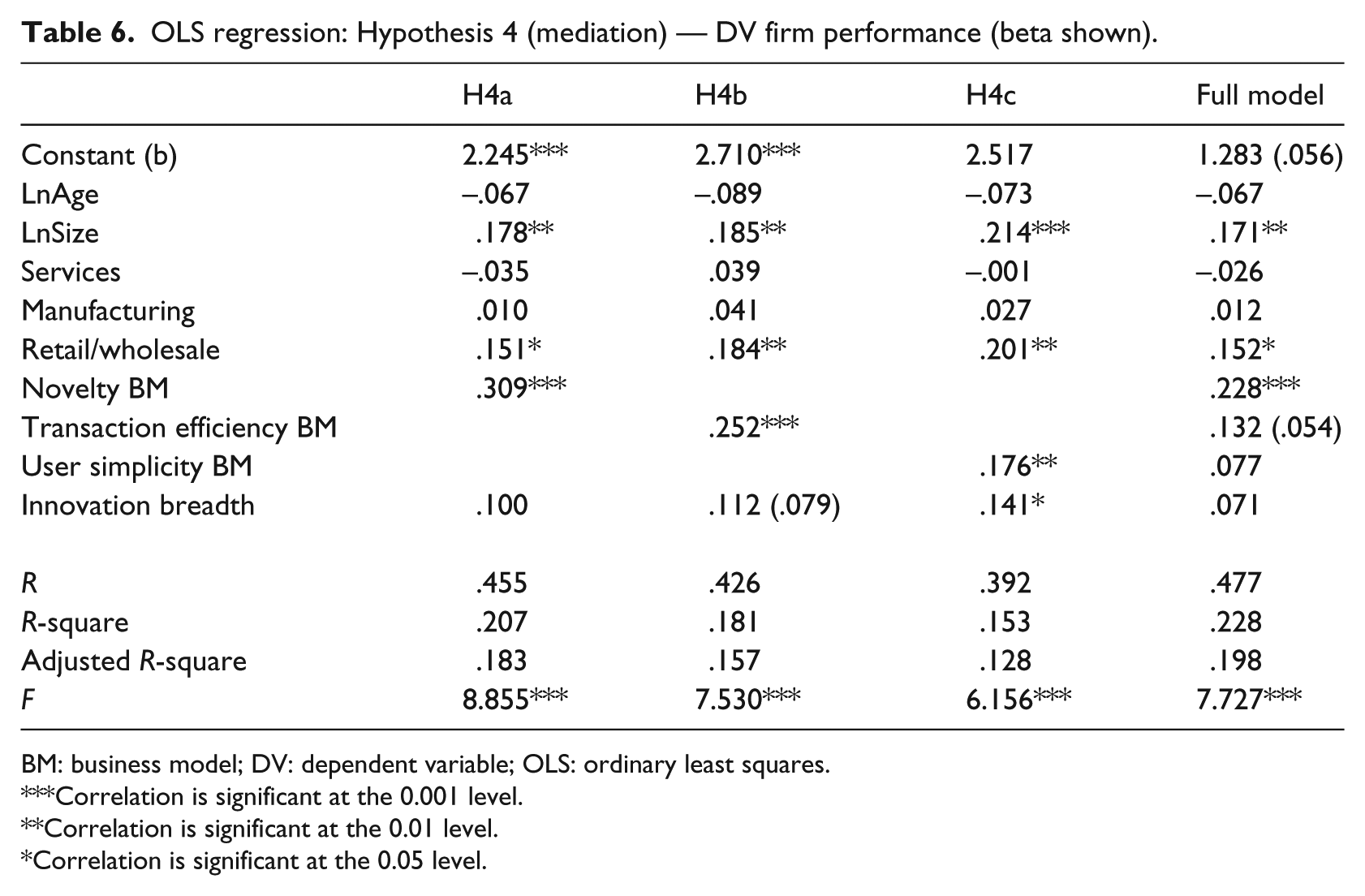
OLS regression: Hypothesis 4 (mediation) — DV firm performance (beta shown).
BM: business model; DV: dependent variable; OLS: ordinary least squares.
Correlation is significant at the 0.001 level.
Correlation is significant at the 0.01 level.
Correlation is significant at the 0.05 level.
Secondly, as shown in Table 5, we investigated how innovation breadth related to each of the three types of business models as dependent variables. In H3a, the novelty business model design theme was significant, as were the transaction efficiency and user simplicity design themes in H3b and 3c, respectively.
Next we tested for mediation (H4) by following the steps prescribed by Baron and Kenny (1986). Firstly, the direct effect between innovation breadth and firm performance was confirmed in H1 (see Table 4). Secondly, we showed that innovation breadth correlates with all three of the business model designs, as confirmed in H3 (see Table 5). Thirdly, we tested for mediation by controlling for each of the business model design themes. The results in Table 6 confirm our mediation hypotheses (H4a, 4b and 4c), that business model design themes represent ‘generative mechanisms’ through which innovation breadth is able to influence firm performance (Baron and Kenny, 1986: 1173). When controlling for novelty and transaction efficiency business model design themes, the innovation breadth coefficients do not reach conventional levels of statistical significance to indicate complete mediation. The user simplicity design theme partially mediates the relationship as evident in the difference between the regression coefficients in the direct and controlled regression models (0.175 and 0.141). We also used an alternative ‘bootstrap’ test of the indirect effect, by running Preacher and Hayes’ (2004, 2008) SPSS syntax, which confirmed the above mediation results (the full results are not reported here). This test is regarded to be more powerful than the Baron and Kenny (1986) tests, as well as their recommended Sobel’s z-test (Zhao et al., 2010). Lastly, we ran the full model with all three types of business model design and innovation breadth included as independent variables. Interestingly, only the novel business model design was significant at the five percent level. Therefore, all the analyses confirm the mediatory effect of the novelty design theme on innovation breadth as well as its dominance in explaining firm performance variance.
8.2. Robustness tests
To ascertain if an alternative model of mediation could also explain our data, we conducted an alternative test of mediation. Baron and Kenny’s (1986) four regression tests for mediation were therefore repeated. H1 and H2 were discussed above, but we had to develop two alternative hypotheses for H3 and H4.
Because these alternative hypotheses find support in the literature, this robustness test was important. For example, business model design theme choice, as also related to competitive strategy, may require, dictate, and initiate innovation of the business model elements. The business model thus also acts as a locus of innovation (Amit and Zott, 2001; Zott and Amit, 2007). Alternative hypotheses of business model choice as a source of innovation of the business model elements in reconfiguring organizational structure (George and Bock, 2011) should therefore also be tested, namely that
HA3: The novelty (HA3a), transaction efficiency (HA3b), and user simplicity (HA3c) business model design themes are positively associated with innovation breadth.
Similarly, the direction of the relationship depicted in H4 may be different in that adopting a dominant business model design theme may dictate innovation activities at the business model level, ultimately leading to performance benefits. We could therefore hypothesize that
HA4: The positive association between the novelty (HA4a), transaction efficiency (HA4b), and user simplicity (HA4c) business model design themes and perceived firm performance is mediated by innovation breadth (innovations within the business model).
Supplementary multiple regression analyses were done to test the alternative hypotheses. We report these results briefly, not fully, for parsimony’s sake. The analysis confirmed hypotheses HA3a, 3b, and 3c in finding that, individually, all three design themes significantly (at the 0.01 level) correlated with innovation breadth. When they were combined in one regression, the user simplicity design theme was non-significant, while both novelty and transaction efficiency were significant (at the 0.05 level). Further supplementary mediation analyses (similar to that used to test the main hypotheses) rejected HA4, indicating that innovation breadth did not act as mediator for any of the three relationships (HA4a, 4b, and 4c). In addition, we also tested for potential moderation of business model design themes on the innovation breadth–performance relationship, as suggested by Baden-Fuller and Haefliger (2013). Our findings suggest that no moderation was evident for any of the three business model designs, as none of the interaction variables were significant in multivariate regressions.
9. Discussion
Our research contributes to theory and practice in a number of ways. Firstly, we show that, although the link between innovation and firm performance is not straightforward, managers who make coherent choices in the context of business model design are much better at realizing the performance benefits of innovation (Amit and Zott, 2012; Baden-Fuller and Haefliger, 2013; Zott and Amit 2007). The corollary of this is that innovation without clarity in the business model leads to modest or negligible performance outcomes. Innovative companies succeed when they align multiple innovations with value-creating outcomes for particular groups of customers (Spencer, 2013).
Secondly, linked to this, we confirm the positive impact of innovation breadth on performance as established in previous research (Grönum et al., 2012). We also introduce the concept of innovation breadth as a proxy for innovation within the business model and illustrate its association with different business model design themes. Innovation within the business model refers to the introduction of any combination of innovation forms across the business model elements. Firms that are active in designing business models centered on the value themes of novelty, transaction efficiency, and user simplicity are found to also engage in innovation across the elements of their business models. The association between innovation breadth and the novelty business model value theme is most pronounced, suggesting that, when a business focuses on novelty as the primary value driver in designing their business models, such novelty tends to innovate more broadly.
Thirdly, we also illustrate how different business model designs vary in their importance for performance. Business model design unlocks the firm’s performance benefits vested in the other forms of innovation. Building on the work of Zott and Amit (2007), we therefore contribute to the ongoing theoretical debate on the nature of business model innovation. Innovation within the business model that extends across a broad array of business model elements will positively affect firm performance once included within a business model designed to focus on specific value themes. The novelty business model design theme, as a mechanism for unlocking the performance benefits of innovation breadth, dominates among the design themes investigated. Although not directly tested, our results seem to confirm Zott and Amit’s (2007: 194) finding, suggesting the existence of ‘diseconomies of scope in design; that is, [those] attempting to emphasize both efficiency and novelty in the design of a business model, may be costly and could affect performance’. We find that, although the three design themes are positively associated with firm performance on an individual basis, only the novelty and, to a lesser extent, transaction efficiency themes are significant when controlling for all three themes in the regression (Zott and Amit, 2008). This indicates a potential trade-off between the design themes, thus implying that managers should focus their business model design and innovation efforts on the novelty value theme and, to a lesser extent, the transaction efficiency theme. In this regard, we also show that business model design does not require radical, discontinuous and game-changing innovation to positively affect firm performance, a view commonly held by practitioners (Bock et al., 2012). Incremental innovations can positively impact on firm performance (Amit and Zott, 2012) if they are coherent with business model design themes.
Our study is not without limitations. Firstly, we acknowledge the role that common method bias, stemming from the use of single respondents, may have on the results. However, in multivariate linear relationships, common method bias generally decreases when additional independent variables are included in a regression equation (Siemsen et al., 2010). In this study, there are four independent and five control variables, suggesting that common method variance has been somewhat addressed through the analysis. Secondly, the cross-sectional design prevents us from examining change in the business models, which would be necessary to conclusively show business model innovation where the value theme changes. To test causality and change, we would need longitudinal data, which would be an important next step for this line of research (Aspara et al., 2010). Thirdly, our data come from tradable industries in one urban area within Australia. While there is no reason to argue that firms in other urban areas would respond differently to our survey, rural firms, or even firms from other industries may. We are therefore careful not to claim broader generalizability of our results.
This research has shed light on the performance impact of design themes but did not extend to include business model innovation. Inconsistency regarding the business model innovation concept hampers the development of empirical measures (Aspara et al., 2010; George and Bock, 2011; Giesen et al., 2009; Johnson et al., 2008; Lambert and Davidson, 2013). Further research should be directed at delineating the conceptual lines between business model innovation and strategy. Business model innovation as creative (re)configuration of the elements of the business model is aimed at improving, creating, or redefining the dominant logic within firms as well as the industry they operate in. Business model innovation is therefore not the same as innovation within the business model, as the former has a strategic outward market focus aimed at creating competitive advantage by exploiting opportunities (Bock et al., 2012). To develop an effective operationalization of business model innovation, a proxy is required that extends to both the firm and industry, or market level of analysis.
10. Conclusion
This paper set out to understand how firms use business model design and innovation in business models to underpin performance. We contribute to the existing debate by showing, firstly, while firms prefer business model designs that focus on user simplicity, those that are improving transaction efficiency or novelty are best able to improve performance. Secondly, and perhaps most importantly, our findings illustrate the importance of business model design for innovation. While regression results show that innovation matters to performance, once the relationship is mediated by an appropriate business model design, innovation’s value is enhanced and unlocked within the firm’s activity and transaction architecture. While we noted some limitations to our study above, we believe that we have taken an important step in connecting the business model concept to established constructs and measures of business innovation, and thus created a more solid foundation for the future development of the ‘business model view of the firm’.
Footnotes
Final transcript accepted 26 April 2015 by Peter Liesch (AE Strategy and International Business).
Funding
The authors gratefully acknowledge the contribution by Brisbane City Council to the cost of the survey.