



Abstract
The number of defective and unsafe products recalled from the market has increased dramatically in the last decade. While several studies have investigated consumer reaction to product recalls, the impact of such events on utilitarian versus hedonic attitudes towards the brand involved in the recall has not yet been assessed. Similarly, it is not clear whether brands with utilitarian positioning and brands with hedonic positioning are equally affected by recalls. Through an experiment based on a real-world stimulus from the laptop product category, this study shows that hedonic brands are more resistant to the negative effects of voluntary product recalls than are utilitarian brands. Furthermore, data show that brand familiarity mitigates the effect of the recall on utilitarian attitudes for both utilitarian and hedonic brands. Brand familiarity also positively moderates the impact of the recall on hedonic attitudes, but only for hedonic brands.
1. Introduction
The number of product recalls has increased dramatically in recent years. In 2012, 2278 notifications of measures taken against dangerous products were reported by European Union (EU) Member States to RAPEX (the EU rapid alert system for all dangerous nonfood consumer products), whereas in 2003, there were just 139 such notifications. In particular, recalls of dangerous products from the market are the most commonly adopted measures. Recalled products belong to a wide range of categories, such as clothing, textiles, toys, motor vehicles, electric appliances and cosmetics (RAPEX, 2013). Similarly, in 2012, the US Consumer Product Safety Commission (CPSC) completed 439 recalls of products that either violated mandatory standards or presented a substantial risk of injury to the public (CPSC, 2013). Moreover, according to Eurobarometer (2011), 15% of the EU’s consumers had been personally affected by product recalls (Eurobarometer, 2011).
Despite the increasing frequency of product recalls in consumers’ everyday lives, few marketing studies have empirically investigated how consumers process this type of information (e.g., Dawar and Pillutla, 2000; De Matos and Rossi, 2007). More interestingly, the impacts of product recalls on the hedonic and utilitarian components of consumer attitudes have not yet been assessed (Batra and Ahtola, 1991; Voss et al., 2003). Existing studies have evaluated consumers’ reactions to product crises and recalls through composite indicators of after-recall attitudes, without differentiating between the hedonic and utilitarian aspects.
Following Homer’s (2008) general framework concerning brands with a quality/image mismatch, we contend that it is relevant for both marketing scholars and practitioners to distinguish between hedonic and utilitarian attitudes in the case of product recalls. By comparing these brand attitudes before and after a recall, it is possible to measure which of the two aspects is more heavily affected by this type of negative event. Drawing on this framework, this paper also intends to evaluate whether a product recall exerts an equivalent effect on brands with hedonic positioning versus brands with utilitarian positioning—thus examining whether some brands are more sensitive to the effects of crisis than others (Dawar and Lei, 2009). Zanna and Rempel suggest that attitudes based on affect, such as hedonic attitudes, are more resistant to persuasion compared to attitudes based on cognition, such as utilitarian attitudes (Zanna and Rempel, 1988). Hence, we may expect that strongly hedonic brands are more resistant to a product recall’s negative effects on consumers’ attitudes than are brands with utilitarian positioning. This supposition is also supported by studies demonstrating that hedonic attitudes involve higher-order processing than utilitarian attitudes (Homer, 2006). These issues are explored through an experiment using a stimulus based on the manipulation of a real recall letter recently sent by a laptop producer to some of its customers.
The results of this study will assist companies involved in product recalls to better predict consumers’ attitudes and behaviours (Batra and Ahtola, 1991). The findings will also support companies in deciding whether to focus on image-oriented and/or functional-oriented brand associations to better counteract the effects of the negative publicity related to product recalls (Cleeren et al., 2008; Homer, 2008; Voss et al., 2003). This paper is organized as follows. The relevant literature on product recalls and brand attitude dimensions is reviewed, and research hypotheses are established. The methodological choices are then explained, and the results are presented. Finally, the findings and their implications are discussed, together with the limitations of the present study.
2. Theoretical background and research hypotheses
Product-harm crises are instances in which products are found to be defective, unsafe or dangerous (Dawar and Lei, 2009; Dawar and Pillutla, 2000). Such crises can seriously damage a brand (Dawar and Lei, 2009; Souiden and Pons, 2009) and can cause a significant reduction in market share and long-term sales (Zhao et al., 2011). Hence, companies should take specific initiatives to counteract these negative effects (De Matos and Rossi, 2007; Vassilikopoulou et al., 2009). Recalls of products from the market are the most common interventions in these cases. For example, all 439 cases reported by the US CPSC in 2012 were product recalls (CPSC, 2013). In a product recall, the company can act voluntarily and/or it can be directed to intervene by national authorities (Mowen et al., 1981). For example, according to the EU’s RAPEX, 67% of such interventions in 2012 were ordered by national authorities, 31% were made on a voluntary basis and 2% included both compulsory and voluntary measures (RAPEX, 2013). In the case of the US CPSC, all 439 recalls were cooperatively completed (100% voluntarily). In this study, we consider only voluntary recalls. Previous research has shown that consumers react more favourably to product recalls that are spontaneously initiated by a firm than to those that are enforced by authorities (Shrivastava and Siomkos, 1989; Siomkos, 1999; Vassilikopoulou et al., 2009, 2011; Zhao et al., 2011). Nonetheless, the news of even a spontaneous product recall remains a form of negative information (Dean, 2004; Jolly and Mowen, 1985), which has the potential to negatively impact both consumers’ attitudes (Vassilikopoulou et al., 2009) and purchase behaviours (Van Heerde et al., 2007; Zhao et al., 2011). Existing studies on product recalls have not quantified the magnitude of the loss of brand image that is related to a recall event because they have measured brand image only once, that is, either before (e.g., Siomkos and Kurzbard, 1994) or after a recall (e.g., Souiden and Pons, 2009). Nor have they verified whether the hedonic and utilitarian components of brand attitudes are equally affected by a recall. Consequently, we do not know whether brands that focus on hedonic positioning are equally damaged by a recall episode as brands that primarily stress their utilitarian aspects.
Several studies have demonstrated that investigating the utilitarian and the hedonic components of brand attitudes separately enhances understanding of the overall brand attitudes (Batra and Ahtola, 1991; Homer and Batra, 1994). Utilitarian attitudes reflect how useful or beneficial the brand is for the consumer, while hedonic attitudes measure the experiential affect that the consumer associates with the brand (Batra and Ahtola, 1991; Homer, 2008; Homer and Batra, 1994). Homer (2008) demonstrates that utilitarian attitudes are mostly driven by attribute-based brand associations (i.e., associations related to functional aspects, such as quality, reliability and performance), while hedonic attitudes result predominantly from non-attribute-based brand associations (i.e., abstract imagery-related considerations, such as those related to brand image). This framework has been applied by Homer (2008) to evaluate consumer attitudes towards quality/image mismatched brands resulting from consumer exposure to negative publicity about either brand quality or brand image, that is, high-image brands affected by negative publicity regarding their quality. This study has found different results for utilitarian and hedonic attitudes. Utilitarian attitudes towards high-quality/low-image and low-quality/high-image mismatched brands are statistically equivalent. On the contrary, hedonic attitudes towards low-quality/high-image brands are significantly higher than those towards high-quality/low-image brands, suggesting that a strong brand image alone can lead to high hedonic attitudes, even when brand quality is challenged by negative publicity. Thus, Homer (2008) concludes that in the case of mismatched brands low image is more damaging than low perceived quality.
In this paper, we posit that news of a product recall due to products that are defective, unsafe or dangerous results in mismatched brands. In this situation, consumers are exposed to negative publicity about the quality of the brand. Given the relationship between attribute-based brand beliefs (i.e., quality) and utilitarian attitudes (Homer, 2008), we expect that a recall will damage utilitarian attitudes. In addition, many studies that address attitude change and persuasion (e.g., Edwards, 1990; Fabrigar and Petty, 1999) suggest that affect-based attitudes are more sensitive to affect-based persuasion, whereas cognition-based attitudes are more sensitive to cognition-based persuasion. A product recall is a case of performance-related negative brand publicity (Pullig et al., 2006) that exerts persuasive effects that match the cognitive basis of attitude. Following this reasoning, a product recall should more heavily affect utilitarian attitudes than hedonic attitudes. Therefore, we hypothesize the following:
H1: In general, utilitarian attitudes are more negatively affected by a product recall than are hedonic attitudes.
Companies can select between functional/utilitarian and symbolic/experiential brand positioning (Park et al., 1986). Brands that solve consumption-related problems are positioned as functional or utilitarian; brands that fulfil needs for self-enhancement, role position and ego-identification or that provide sensory pleasure and variety are positioned as symbolic/experiential (Park et al., 1986). In the case of functional positioning, the utilitarian dimension of attitude is emphasized, whereas with respect to symbolic/experiential positioning, the hedonic dimension of attitude is more important (Voss et al., 2003). These two types of brand positioning are, hereafter, referred to as utilitarian and hedonic, respectively.
According to Dawar and Lei (2009), the effect of a crisis is influenced by its relevance to the brand’s key associations. Hence, we may expect that a brand with utilitarian positioning will be more damaged by a product recall because its key brand associations concerning functional aspects (which are primarily about quality) will be, at least temporarily, disrupted by the recall. On the contrary, hedonic brands should be less severely impacted by a recall because their core associations are not directly related to the quality defects. Moreover, strong abstract brand beliefs create a halo effect that can act as a shield against the negative effects of a product crisis (Coombs and Holladay, 2006; Klein and Dawar, 2004). Because abstract brand beliefs are central to hedonic brands, the halo effect may make these brands more resistant to the negative effects of product recalls than utilitarian brands.
Specifically, with respect to functional brands, the utilitarian attitude is negatively affected because the core benefits concerning utilitarian attributes are disrupted by the recall. Failure to meet utilitarian expectations in turn evokes anger (Chitturi et al., 2008), which, given the absence of strong hedonic associations, negatively affects hedonic attitudes as well (Homer, 2008). With respect to hedonic brands, the recall obviously affects utilitarian attitudes, but the core benefits related to abstract and affective beliefs are resistant to the event (Dawar and Pillutla, 2000). Therefore, we hypothesize the following:
H2: For utilitarian brands, a product recall will cause a decrease in both utilitarian and hedonic attitudes.
H3: For hedonic brands, a product recall will cause a decrease in utilitarian attitudes but not in hedonic attitudes.
Several studies suggest that post-crisis attitudes are influenced by consumer familiarity with a brand (e.g., Cleeren et al., 2008; Dawar and Lei, 2009), that is, by the degree to which consumers are familiar with the brand (Keller, 1993; Netemeyer et al., 2004). Mixed findings have emerged from these contributions, however. On the one hand, a positive direct effect of brand familiarity on brand attitudes has been reported (Cleeren et al., 2008). On the other hand, other analyses have revealed the existence of an interaction effect between brand familiarity and alignment of brand positioning with the content of negative publicity in relation to the effects on brand attitude (Pullig et al., 2006). However, none of these studies has separately evaluated the effect of brand familiarity on utilitarian attitudes versus hedonic attitudes. In our analysis, we use Homer’s (2008) framework to establish whether brand familiarity impacts utilitarian and hedonic attitudes through a direct effect (Cleeren et al., 2008) or an interaction effect (Pullig et al., 2006). Homer’s study regarding the formation of utilitarian and hedonic attitudes indicates that brand positioning (quality/utilitarian or image/hedonic positioning) does not moderate the relationship between brand beliefs and utilitarian attitudes, but rather, it moderates the relationship between brand beliefs and hedonic attitudes. Drawing on these findings, we suggest the two following different effects of brand familiarity on utilitarian and hedonic attitudes.
Firstly, given that the relationship between brand beliefs and utilitarian attitudes is not moderated by brand positioning (Homer, 2008), we hypothesize that brand familiarity will influence utilitarian attitudes uniformly regardless of the utilitarian or hedonic positioning of the brand (i.e., there is a direct effect of brand familiarity on utilitarian attitudes). With respect to the direction of this effect, previous studies (e.g., Laroche et al., 1996) have shown that brand familiarity has a positive impact on consumer brand attitudes and may act as a buffer against the impact of negative information about the brand (Cleeren et al., 2008; Dawar and Lei, 2009). In particular, Mowen (1980) and Dawar and Lei (2009) suggest that when a crisis involves a familiar brand, consumers are more likely to retrieve the pro-attitudinal information present in their minds. In summary, brand familiarity triggers defensive strategies against the negative information brought about by the product recall. Therefore, we hypothesize the following:
H4a: The negative effects of a product recall on utilitarian brand attitudes will be smaller when brand familiarity is high, regardless of the utilitarian or hedonic positioning.
Secondly, given that brand positioning moderates the relationship between brand beliefs and hedonic attitudes, we suggest that the (quality/utilitarian or image/hedonic) positioning of the brand influences the effect of brand familiarity on hedonic attitudes. This supposition is consistent with Pullig et al.’s (2006) study that, based on solid theoretical background (Fazio et al., 1982; Spira, 2002; Van Birgelen et al., 2003), proposes that the effect of negative publicity on brand attitude depends on the interaction between two variables; firstly, the alignment between brand positioning (performance-based positioning, i.e., utilitarian positioning, versus values-based positioning, i.e., hedonic positioning) and the content of the negative publicity (performance-related publicity versus values-related publicity) and, secondly, the level of attitude certainty (low versus high). Attitude certainty reflects a person’s sense of conviction in her attitude. A high level of attitude certainty is found when a person possesses substantial knowledge about an attitude object (Pullig et al., 2006). When certainty is high, brand attitude is more resistant to negative publicity if the brand positioning is aligned with the content of the negative publicity (e.g., performance or utilitarian positioning and performance-related negative publicity). Under these conditions, an insulation effect for the brand is reported (Pullig et al., 2006). When certainty is low, brand attitude is more resistant to negative publicity if the brand positioning is not aligned with the content of the negative publicity (e.g., abstract or hedonic positioning and performance-related negative publicity) (Pullig et al., 2006). In the case of a product recall (i.e., a case of negative performance-related publicity), utilitarian brands are aligned with the content of the publicity, while hedonic brands are not. As the concepts of brand knowledge and brand familiarity overlap to a large extent, attitude certainty is also strongly related to brand familiarity (Huy Tuu et al., 2011; Rao and Monroe, 1988). Therefore, we hypothesize the following:
H4b: When brand familiarity is high, the negative effects of a product recall on hedonic brand attitudes will be smaller for utilitarian brands than for hedonic brands.
3. Method
3.1. Overview
To test the proposed hypotheses, an experiment was conducted based on the manipulation of a real-world stimulus, to enrich the existing knowledge, which comes mainly from the study of hypothetical brand crises (Zhao et al., 2011). In 2011, one of the study authors received a personalized recall letter from the producer of a laptop she owned. The laptop product category was judged to be suitable for the purposes of this research because it was a well-known product category (Chitturi et al., 2008). The letter was used as the basis for the experimental stimulus, but the brand identity of the producer was removed. Two versions of the letter were created utilizing two other brands (one with functional positioning and the other with hedonic positioning), selected according to the procedure described below. The only difference between the two versions of the stimulus was the producer’s brand, which neutralized differences in the degree of perceived danger as well as in the way the recall was managed (Souiden and Pons, 2009). The letter was two pages in length and contained the following information: reasons for the producer-initiated voluntary recall, details of the component subject to recall (the battery), procedures for identifying the code of the laptop to ensure that the battery was included in the recall, and instructions for contacting the producer to organize replacement and shipment. An apology for the inconvenience was also included.
3.2. Pretests
To identify one utilitarian and one hedonic laptop brand, two pretests were conducted. Based on an extensive discussion with five marketing professors and experts, four brands were initially chosen, two of which (HP and Acer) were intended to have utilitarian positioning and two of which (Apple and Sony-VAIO) were supposed to have hedonic positioning in the market where the experiment was conducted.
In the first pretest, according to well-established procedures (Dawar and Lei, 2009; Park et al., 1991), 44 MBA students were asked to provide up to three comments that described the meanings they associated with each of the four laptop brands. Their comments were divided into utilitarian and hedonic categories by three independent coders, culminating in two agreed-upon lists. The results showed that 86% of the comments about HP were related to functional aspects and 14% concerned hedonic aspects; the results for Acer were 89.5% and 10.5%, respectively. However, the comments generated for the HP laptop were significantly more numerous than those generated for the Acer laptop (X = 2.27 versus X = 1.59; t(43) = 3.06, p < .01).
In the case of the Apple laptop, 34.9% of the comments generated were classified as functional and 65.1% as hedonic, whereas for the Sony-VAIO laptop, these values were 33.3% and 66.7%, respectively. Overall, the number of comments for the Apple product was significantly higher than the number for the Sony-VAIO product (X = 2.86 versus X = 1.68; t(43) = 7.53, p < .01).
The results of the first pretest illustrated that the HP and Acer brands exhibited functional positioning, whereas the Apple and Sony-VAIO brands were perceived as having hedonic positioning. We also observed that for the hedonic brands, Apple and Sony-VAIO, a significant percentage of functional comments were registered (34.9% and 33.3%, respectively). This is not surprising considering that utilitarian benefits are generally more important to consumers in the laptop category than in other product categories (Chitturi et al., 2008). In addition, the average number of comments generated suggests greater familiarity with the HP and Apple brands than with Acer and Sony-VAIO.
In the second pretest, 55 undergraduate students were given a verbal description of the concepts of hedonic and functional brand positioning (Park et al., 1991; Thorbjørnsen, 2005) and were asked to categorize each of the four brands (HP, Acer, Apple, Sony-VAIO) as having either hedonic or functional positioning. The HP and Acer brands were described as having functional positioning by 92.7% and 81.8% of respondents, respectively. Only 38.2% classified Sony-VAIO as holding hedonic positioning, which may reflect a low level of consumer familiarity with the positioning of this brand. Finally, 96.4% of participants identified Apple as having hedonic positioning.
Considering the results of both pretests, HP was selected as the brand with utilitarian positioning and Apple as the brand with hedonic positioning. HP and Apple were also the brands enjoying the highest levels of familiarity among those used in the pretest. Conversely, participants’ perceptions of Sony-VAIO and Acer were mixed, and the levels of familiarity with these brands were quite low.
3.3. Procedure and subjects
Participants in the experiments included 237 undergraduate students (similar to Dawar and Pillutla, 2000; Homer, 2008) from a basic marketing course. Each of the participants was randomly assigned to one of the two experimental treatments—that is, a product recall involving a utilitarian brand (HP) or a product recall involving a hedonic brand (Apple). There were 112 respondents for the utilitarian brand and 125 for the hedonic brand. Firstly, participants were told that the experiment concerned a brand of laptop. They were then asked to express their attitudes (utilitarian and hedonic) towards and familiarity with their stimulus brand (HP or Apple). Each participant was then invited to read the instruction page and was then given the stimulus (the recall letter). They were asked to consider their reaction if they had received the recall letter as the owner of a computer potentially involved in the recall program. The participants were then required to complete a questionnaire regarding their post-crisis attitudes (utilitarian and hedonic). At the end of the experiment, the participants were debriefed.
3.4. Measures
Drawing on items from the measurement scales of hedonic and utilitarian attitudes tested by Batra and Ahtola (1991), Voss et al. (2003) and Homer (2008), scales for utilitarian and hedonic brand attitudes were developed. Suitable items were selected, and some were adapted to the laptop product category for which the experiment was conducted. For the utilitarian attitudes, the items included the following: not functional/functional, not practical/practical, unhelpful/helpful and unnecessary/necessary. For the hedonic attitudes, the following items were used: uncool/cool, not delightful/delightful, boring/exciting and unpleasant/pleasant.
Each of the items was measured using a five-point semantic differential scale (Batra and Ahtola, 1991; Voss et al., 2003). The utilitarian and hedonic attitudes were each measured twice: once before and once after the recall stimulus. Two factor analyses with varimax rotation were conducted: one on the hedonic and utilitarian attitudes before the recall and one on these two attitudes after the recall. In both cases, a two-factor solution was extracted, as expected. Moreover, all of the items loaded on the intended factors with high factor loadings. Following standard methods, the averages of the sets of four items were used in the analysis for each of the four constructs (e.g., Dawar and Lei, 2009; Homer, 2008). The resulting scales were found to be reliable: utilitarian brand attitudes before the recall (α = .82); hedonic brand attitudes before the recall (α = .76); utilitarian brand attitudes after the recall (α = .91); and hedonic brand attitudes after the recall (α = .85).
With regard to brand familiarity, we used a five-point scale (1 = not familiar with the brand at all and 5 = very familiar with the brand) (Johnson and Russo, 1984). Similar to Netemeyer et al. (2004), we used a single-item scale to measure brand familiarity. This choice was supported by the C-OAR-SE procedure for scale development, as suggested by Bergkvist and Rossiter (2007). This decision relied on experts (the authors along with three other marketing professors) who judged that both the object of measurement (HP or Apple) and its attribute (familiarity) were concrete and singular. Hence, the constructs were doubly concrete (Rossiter, 2013). In Rossiter’s words, this procedure ensures that “virtually all raters know what the object is and that, for them, there is only one object” (HP or Apple) (Rossiter, 2002: 311) and that there is “virtually unanimous agreement by raters as to what the attribute is” (Rossiter, 2002: 313). A median split (Voss et al., 2003) delineated high and low familiarity. A self-reported familiarity below or equal to 2 was classified as low familiarity (n = 121), whereas a value greater than or equal to 3 (n = 116) was classified as high familiarity (Johnson and Russo, 1984).
4. Results
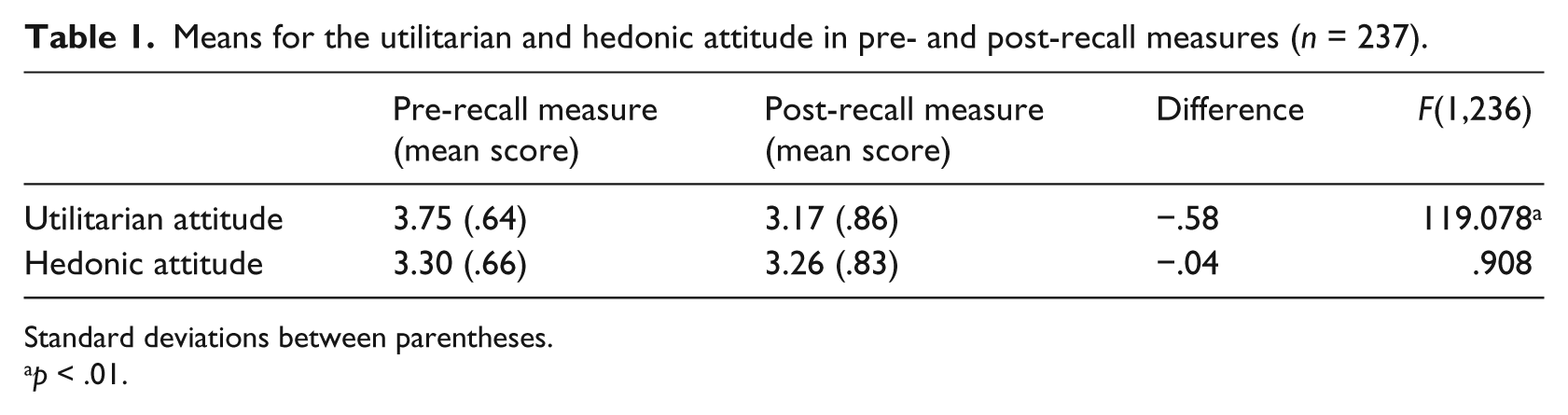
The first hypothesis predicted that, in general, utilitarian attitudes would be more negatively affected by the product recall than hedonic attitudes. First, a general linear model (GLM) repeated measures analysis of variance was conducted with the pre-recall versus post-recall measure as the within-subjects variable and functional and hedonic attitudes as dependent variables (Raney et al., 2003; Van Reijmersdal et al., 2007). This analysis evaluated the presence of statistically significant variations in attitudes. The GLM repeated measure analysis of variance is an appropriate technique for conducting an analysis of variance when the same construct is measured two or more times (Thorbjørnsen, 2005). The results (Table 1) showed that utilitarian attitudes were affected by the recall, with a decrease in the mean value from 3.75 to 3.17 (F(1,236) = 119.078, p < .01). In contrast, hedonic attitudes showed no significant change (F(1,236) = .908, n.s.). Accordingly, there was a significant difference (t(236) = 11.889; p < .01) between the average variation in utilitarian attitudes (–.58) and the average variation in hedonic attitudes (–.04). Thus, H1 is supported.
Means for the utilitarian and hedonic attitude in pre- and post-recall measures (n = 237).
Standard deviations between parentheses.
p < .01.
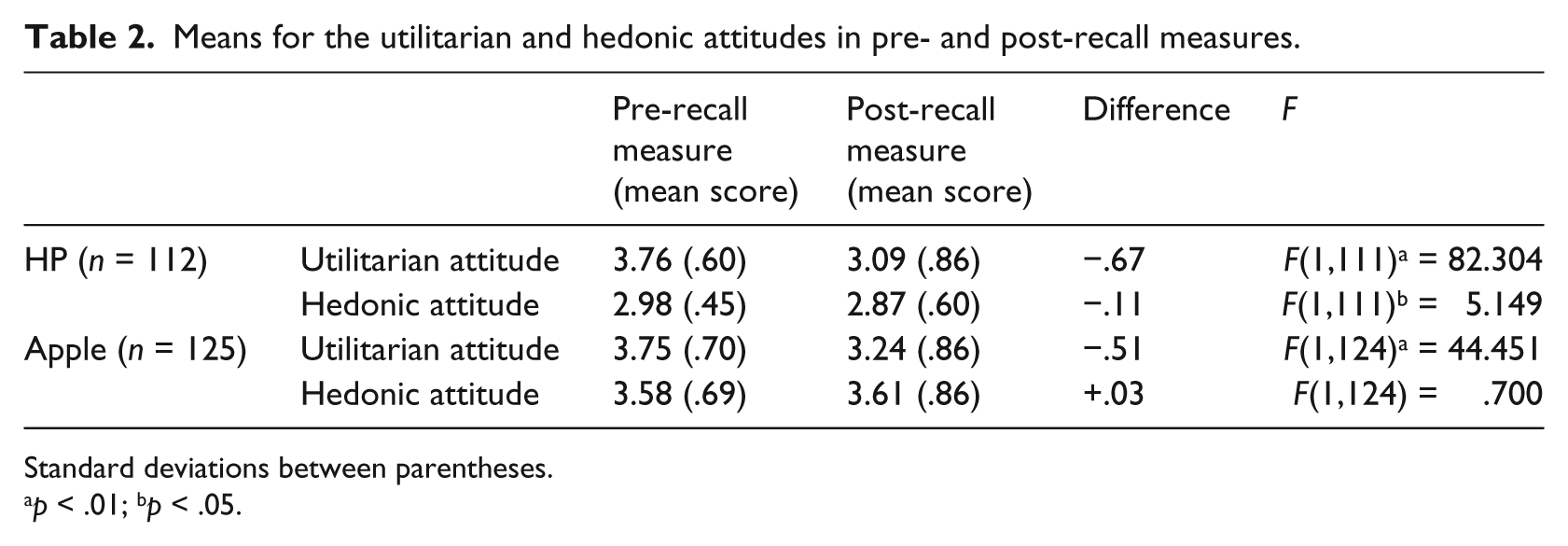
According to H2, for utilitarian brands (i.e., for HP in the experiment), a product recall would cause a decrease in both utilitarian attitudes and hedonic attitudes. A GLM repeated measures analysis of variance was conducted, and its results are reported in Table 2. The hypothesis is supported because both utilitarian and hedonic attitudes decreased significantly from 3.76 to 3.09 (F(1,111) = 82.304, p < .01) and from 2.98 to 2.87 (F(1,111) = 5.149, p < .05), respectively. Hence, H2 is supported.
Means for the utilitarian and hedonic attitudes in pre- and post-recall measures.
Standard deviations between parentheses.
p < .01; bp < .05.
H3 suggests that for hedonic brands (i.e., for Apple in the experiment), a product recall would cause a decrease in utilitarian attitudes but not in hedonic attitudes. The results of the GLM repeated measures analysis of variance, as shown in Table 2, support this hypothesis. That is, after the recall, utilitarian attitudes decreased from 3.75 to 3.24 (F(1,124) = 44.451, p < .01), whereas no significant change was observed for hedonic attitudes (F(1,124) = .700, n.s.). Hence, H3 is supported.
To test H4a and H4b, a two-way analysis of variance was conducted with brand familiarity (low versus high) and brand positioning (utilitarian versus hedonic positioning) as the factors and the difference between post- and pre-recall utilitarian and hedonic attitudes as the dependent variables. H4a predicts less intense negative effects of a product recall on utilitarian brand attitudes when brand familiarity is high, regardless of the utilitarian or hedonic positioning. The results confirm that the impact of the recall on utilitarian attitudes is directly influenced by familiarity (F(1,233) = 6.56, p < .05). The mean differences between the pre- and post-recall attitudes are –.69 for low familiarity and –.46 for high familiarity. The analysis also excludes the presence of a brand familiarity × brand positioning interaction effect (F(1,233) = .001, n.s.). Hence, H4a is supported.
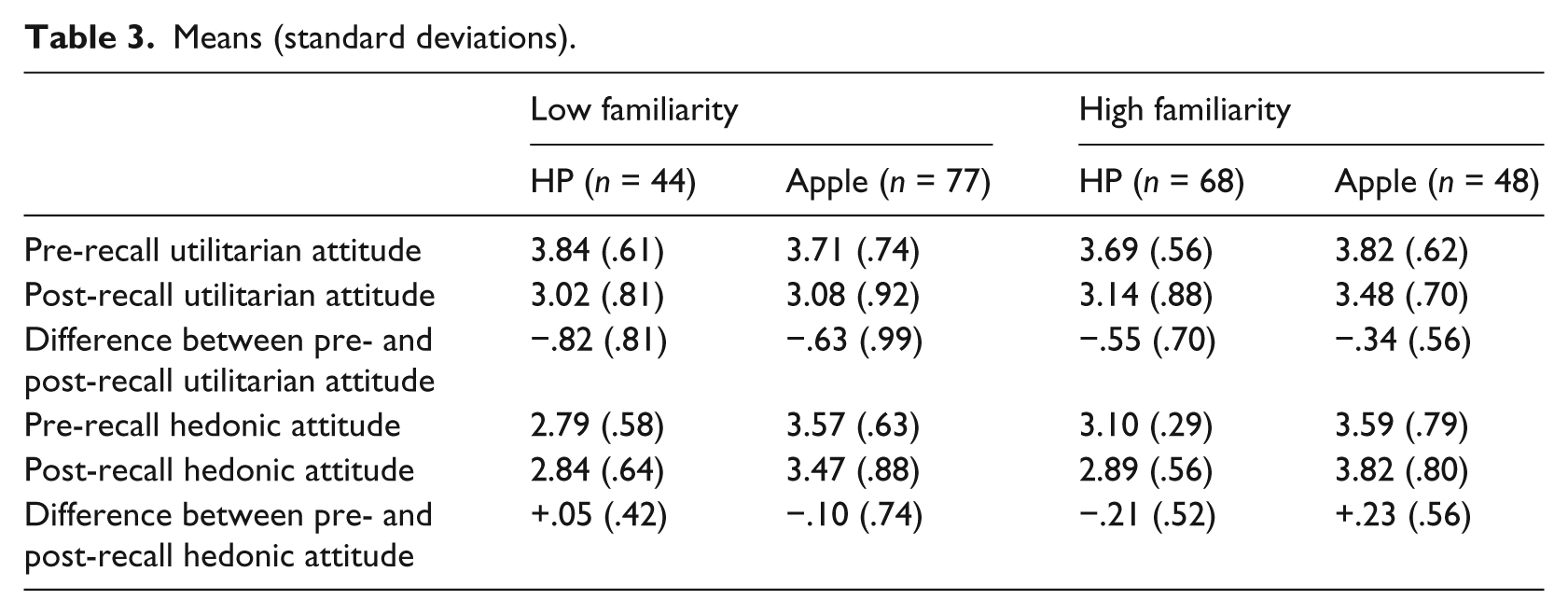
H4b suggests that when brand familiarity is high, the negative effects of a product recall on hedonic brand attitudes are less intense for utilitarian brands than for hedonic brands. The findings highlight the existence of a significant brand familiarity × brand positioning interaction effect (F(1,233) = 13.48, p < .01). The analysis of the mean values (see Table 3) shows that the impact of the recall on hedonic attitudes is significantly different only under the high familiarity condition, and that the effect is the opposite of what was predicted. The change in hedonic attitudes is −.21 for HP and +.23 for Apple (t(1,114) = 4.28, p < .01). Under the low familiarity condition, no differential impact of the recall on hedonic attitudes towards HP or Apple emerges (t(1,119) = −1.22, n.s.). Moreover, no direct effect of familiarity is reported (F(1,233) = .264, n.s.). Hence, H4b is not supported.
Means (standard deviations).
We also verified the presence of a correlation between brand familiarity and pre-recall brand attitudes before the release of the product recall information. The results indicate there exists no significant difference in the pre-recall attitudes between the high- and the low-familiarity conditions (t(235) = .124, p > .10 for utilitarian attitudes and t(235) = –.171, p > .10 for hedonic attitudes). Thus, we reject the supposition that our interpretation of the impact of brand familiarity could be biased by the presence of an interaction between pre-recall attitudes and brand familiarity (Einwiller et al., 2006; Vanhamme and Grobben, 2009).
5. General discussion
The results of the study confirm the hypothesis that a recall has different impacts on the utilitarian and hedonic components of consumers’ brand attitudes. These findings contribute to an existing body of research (e.g., Dawar and Lei, 2009) that suggests that a brand crisis that has no impact on a brand’s core benefit associations is harmless to the evaluation of the brand. Our study partially confirms these results, showing that a product recall negatively affects consumers’ attitudes towards utilitarian aspects, especially for brands whose core positioning or associations are linked to utilitarian benefits. In this case, a decrease is registered also for the hedonic attitudes. However, our findings also show that a brand whose core benefit associations are hedonic in nature is not immune to the effects of a recall. In this case, although consumers’ attitudes towards the brand’s core benefits—that is, the hedonic attitudes—are not undermined, a significant reduction is registered in utilitarian attitudes. In summary, this study suggests that brands with hedonic positioning are more resistant to a product recall’s negative effect on consumers’ attitudes than brands with utilitarian positioning.
The findings regarding brand familiarity can reconcile previous results that have highlighted either direct (e.g., Cleeren et al., 2008) or interaction (familiarity × brand positioning) (e.g., Pullig et al., 2006) effects of brand familiarity on brand attitudes. Our study finds that the direct effect describes the impact of brand familiarity on utilitarian attitudes, while the interaction effect describes the influence of brand familiarity on hedonic attitudes. Contrary to our prediction, the findings also suggest that, under the high brand familiarity condition, consumers’ hedonic attitudes are lower for utilitarian brands than they are for hedonic brands. A similar result may be explained by considering that, in contrast with previous studies (e.g., Pullig et al., 2006), the stimulus used in our research includes not only negative publicity about the brand but also information about the voluntary nature of the product recall. Such a voluntary reaction is perceived by consumers as a sign of the company’s social responsibility (Vassilikopoulou et al., 2009) and becomes a source of positive abstract brand beliefs (Coombs and Holladay, 2006), especially for consumers who are familiar with the brand (Perera and Chaminda, 2013). Studies about judgement revision (Pham and Muthukrishnan, 2002) show that when new information challenges a brand, consumers first try to retrieve pro-attitudinal information consistent with the brand positioning to defend their prior evaluation of the brand. Therefore, consumers will search for abstract-level information in the case of abstract (hedonic) brands, while they will search for attribute-specific information for attribute-specific (utilitarian) brands. Moreover, under the high involvement (familiarity) condition, the effort exerted in and probability of recalling pro-attitudinal information are higher (Pham and Muthukrishnan, 2002). Hence, the abstract-level information that the recall was voluntarily initiated by the company will be used by familiar consumers to confirm their prior affective evaluation of hedonic brands. Conversely, such abstract information does not align with utilitarian brands and does not make these brands resistant to the effects of negative publicity. Consistent with Pham and Muthukrishnan’s (2002) findings, consumers who are familiar with utilitarian brands will instead search for pro-attitudinal utilitarian information. However, such information is aligned with the content of the negative publicity (i.e., the product’s defect); thus, consumers will be more likely to engage in a greater negative revision of their judgements. The failure of utilitarian brands to meet quality expectations evokes anger and thus negatively impacts hedonic attitudes (Chitturi et al., 2008).
In summary, the results suggest that hedonic brands are more resistant to the effects of a voluntary product recall than are utilitarian brands. Furthermore, these findings are consistent with Aaker et al.’s (2004) finding that consumers in strong relationships with sincere brands (i.e., brands based on attribute-based brand beliefs) do not forgive transgressions that are inconsistent with relationship expectations, whereas exciting brands (i.e., brands based on non-attribute-based brand beliefs) encourage consumers to “expect the unexpected”, reducing feelings of vulnerability and risk. Hence, firms with hedonic brands should adopt voluntary product recalls rather than waiting for mandatory recalls (Siomkos and Kurzbard, 1994), because their consumers will not perceive such events as traumatic. These results may explain why some companies are highly regarded even when they voluntarily recall several products every year. Continual focus on hedonic aspects, while exhibiting their concerns for consumers through voluntary recalls, appears to be a successful strategy for brands involved in product crises.
It is also noted that the two brands considered in the study were characterized by similar pre-recall utilitarian attitudes, whereas after the recall, the brand with hedonic positioning received higher scores for both utilitarian and hedonic attitudes. Hence, providing a satisfying quality level may be a prerequisite for successful results, whereas a strong hedonic component may explain differential performance in cases of brand crises. Therefore, companies can build long-term buffers against the negative effects of brand crises by investing in the hedonic components of their brand equity.
6. Conclusions and limitations
While the frequency of product recalls is rapidly increasing, marketing knowledge of this phenomenon is scarce. This study finds that product recalls have a deeper negative impact on the utilitarian component than on the hedonic component of consumers’ brand attitudes. In addition, the findings emphasize that the intensity of such effects depends on brand positioning, indicating that hedonic brands are more resistant to the negative effects of voluntary product recalls than are utilitarian brands.
Several limitations and opportunities for future research are noted. Firstly, this study is based on an experiment that is designed to observe differences in attitudes due to alternative brand positioning (functional versus hedonic). Thus, our intention was to isolate the potential impact of several other variables using two stimuli that are identical except for the brand name (HP versus Apple) and related details (e.g., laptop models). Other variables should be considered to understand the final outcome of a product recall in a real-life situation, such as the number of previous product recalls made by the company (Mowen et al., 1981) and the use of other sources of recall information (e.g., mass media), in addition to personalized printed letters (Jolly and Mowen, 1985). However, the decision to use real brands may not have perfectly isolated the effects of other factors that are not included in the study. In addition, in our study, we consider two alternative brand positioning strategies (functional versus hedonic), but we do not study brands with hybrid positioning—that is, positioning based on both functional attributes and values-related benefits (such as those linked to corporate community involvement or environmental concerns). The results may be different in this case because, as suggested by Pullig et al. (2006), brands with hybrid positioning may be more resistant to negative publicity. Our study also analyses short-term reactions after a recall, but an evaluation of the medium-term effects would also be beneficial. Moreover, although some of the effects found in this study are statistically significant because the cell sample sizes are large, in some cases, the absolute differences between the conditions are not particularly remarkable. Furthermore, the study considers voluntary recalls, not recalls ordered by national authorities. In these cases, the effects on both hedonic and utilitarian attitudes and the role of familiarity may differ from those found in this study. Because this analysis only considers the effect of performance-related negative publicity (product recalls), future studies may verify whether the results could be extended to values-related negative brand publicity—that is, brand publicity that does not involve attributes that affect functional product use (Pullig et al., 2006).
Finally, in general, research about product recall is scarce compared to the rapid increase in this phenomenon. Studies that evaluate the impact of new variables on reactions to recalls or studies that extend available findings to product categories other than cars (De Matos and Rossi, 2007; Souiden and Pons, 2009) and toys (Beamish and Bapuji, 2008) should be encouraged. Evaluating the effects of business-to-business product recalls could provide interesting insights as well, drawing on the fact that the distinction between utilitarian and hedonic attitudes has proved significant in business-to-business markets (e.g., Cassia and Magno, 2012).
Footnotes
Final transcript accepted 15 July 2015 by Ashish Sinha (AE Marketing).
Funding
The author(s) received no financial support for the research, authorship, and/or publication of this article.