




Abstract
Integrating ideas and theories from the numerosity effect and utilitarian/hedonic consumption, this research explores how hedonic and utilitarian attributes specified with contracted and expanded specifications affect consumer preferences. Results from two experiments indicate an expanded utilitarian attribute enhances consumer preference for choosing the utilitarian option. However, an expanded hedonic attribute does not influence preference for choosing the hedonic option. The relative perceived guilt of the hedonic option and the perceived attractiveness of the utilitarian option mediate the effect. Acquisition format (purchase vs windfall) moderates this effect by influencing consumers’ perceived guilt from choosing the hedonic option.
JEL Classification:
1. Introduction
A single attribute can often be measured with different units and described using different degrees of numerosity. For instance, an object’s temperature can be reported in Celsius or Fahrenheit, and distance can be measured in kilometers or miles. Numerosity refers to the number of units into which a measure is divided. For example, an object’s weight can be expressed in grams (e.g. 100 g), providing lower numerosity, or milligrams (100,000 mg) providing higher numerosity (Bagchi and Davis, 2016). An attribute described with relatively high numerosity (like the milligrams in the above example) are expressed with expanded scales, and smaller numerosity is achieved by using a contracted scale (Pandelaere et al., 2011).
There are many contexts in which people encounter differences in both units (e.g. ratings on a 10-point scale or 1000-point scale) and numerosity (e.g. ratings of 7 and 9 vs 700 and 900) when assessing quantities. However, according to the numerosity effect, people tend to ignore unit information and infer greater quantity from higher numerosity (Bagchi and Davis, 2016). Many empirical studies have found the numerosity effect in various scenarios and with different units (e.g. Cadario et al., 2016; Fecher et al., 2019; Huang et al., 2020; Liu and Chou, 2018; Pandelaere et al., 2011; Schley et al., 2017; Siddiqui et al., 2018). For example, Yamagishi (1997) found that people reported the likelihood of developing cancer to be higher when the risk was reported with higher numerosity (e.g. 1286 out of 10,000) compared with lower numerosity (e.g. 24.12 out of 100), even though the real risk in the first case (12.86%) was much lower than in the second one (24.12%).
The numerosity effect is an important factor in many marketing contexts. Managers often use different units to describe product attributes such as size and functionality (Bagchi and Davis, 2016), which might influence consumers’ preferences and purchase decisions. For example, when comparing an attribute of two competing products, the difference between the two products can appear larger when the attribute is described on an expanded scale rather than a contracted scale. Pandelaere et al. (2011) demonstrated that consumers perceive a greater difference between two options in an expanded attribute specification (e.g. warranty: 24 months vs 12 months) than in a contracted attribute specification (e.g. warranty: 2 years vs 1 years). Overall, the numerosity effect suggests that the numerosity of an attribute specification significantly affects consumer judgments and product preferences. Specifically, consumers show an increased preference for the option with the superior attribute when it is presented on an expanded scale (vs a contracted scale).
While the numerosity effect has been studied in many contexts, some important knowledge gaps remain. Previous studies have primarily used utilitarian attributes when testing the numerosity effect (e.g. Burson et al., 2009; Cadario et al., 2016; Pandelaere et al., 2011; Schley et al., 2017). Little is known about the numerosity effect’s applicability to products with hedonic attributes or a mix of hedonic and utilitarian attributes. Exploring the impact of the numerosity effect on these attribute characteristics further clarifies the boundary conditions of the numerosity effect. Filling this gap also provides value for practitioners, who can use the results to determine whether and how they should manipulate descriptions of their product’s utilitarian and hedonic attributes to create greater value.
Generally speaking, hedonic consumption (e.g. bungee jumping or going to a movie) provides affective and sensory experiences with aesthetic appeal, sensual pleasure, fantasy, and fun. In contrast, utilitarian consumption (e.g. buying an oven or a minivan) provides instrumental and functional benefits that are usually task-related and rational (Botti and McGill, 2011; Kronrod and Danziger, 2013; Liu and Chou, 2015; Weisstein et al., 2019). Because people typically consider hedonic consumption as wasteful, especially when adhering to the cultural values of hard work and parsimony, they often feel guilty when purchasing hedonic goods (Kivetz and Simonson, 2002; Okada, 2005; Prelec and Loewenstein, 1998; Strahilevitz and Myers, 1998).
Almost all products have several attributes, each of which might provide different hedonic and utilitarian benefits (Liu and Chou, 2019). Furthermore, hedonic and utilitarian attributes are not necessarily two ends of a one-dimensional scale (Okada, 2005; Voss et al., 2003). For example, a renter in search of an apartment regards a scenic view as a hedonic attribute and the distance from the apartment to his or her workplace as a utilitarian attribute. Similarly, a Ferrari sports car has both design (hedonic) and performance (utilitarian) attributes. When consumers choose among different product options, they might simultaneously consider utilitarian and hedonic attributes (Chitturi et al., 2007). For example, when buying a new mobile phone, consumers may consider both the battery life (utilitarian) as well as external appearance (hedonic). In this study, we investigate how differences in the descriptions of the attributes (i.e. the attribute specifications) influence consumer preferences for the relatively more hedonic product option (has superior hedonic attributes) and the relatively more utilitarian product option (has superior utilitarian attributes).
For utilitarian attributes, an expanded (vs contracted) scale should enhance the difference in the perceived utilitarian benefits of the options, thereby increasing the attractiveness of the superior utilitarian option. An expanded (vs contracted) scale for hedonic attributes, on the other hand, may enhance the perceived difference between the hedonic benefits of the two options, but this likely increases the difference in perceived guilt (for purchasing a hedonic product) of the options. Therefore, an expanded (vs contracted) scale for hedonic attributes does not increase the attractiveness of the hedonic option because the positive impact of the increased difference of hedonic benefits is offset by the negative impact of the increased difference of perceived guilt. In short, the differential expression (i.e. expanded vs contracted) of an option’s hedonic and utilitarian attributes might affect consumers’ product perceptions and preferences. If the generation of perceived guilt can be blocked, we predict that expanded hedonic attributes will also increase the attractiveness of the hedonic option. Providing a product as a windfall gain is one method with which to decrease perceived guilt of hedonic consumption (e.g. Arkes et al., 1994; Liu and Chou, 2017); therefore, acquisition format (purchase vs windfall) might moderate the attribute specification effect on the relative preference for hedonic and utilitarian options.
To summarize, the current research aims to explore how attributes specified on expanded and contracted scales influence consumers’ relative preference for hedonic and utilitarian options. We also identify possible mediators and the moderating effect of the acquisition format. We conduct two experiments to test our predictions. The findings make several unique and valuable contributions to marketing theory, including integrating concepts from the numerosity effect and hedonic consumption to fill an important knowledge gap. We also provide a comprehensive framework that identifies the internal mechanism and helps define the boundary conditions of the attribute specification effect.
2. Literature review and hypotheses
2.1. Numerosity effect and attribute specifications
The numerosity effect can occur whenever people judge quantities. People tend to deduce quantity from the number of the units but ignore the size of the units (Pelham et al., 1994; for a review, see Bagchi and Davis, 2016). As a result, people tend to over-infer the quantity of an item when it is specified in a greater number of units (i.e. on an expanded scale). For example, Lotto et al. (2014) demonstrated frequency-based liability judgments were higher when expressed on an expanded scale (out of 10,000 heparin-treated or untreated patients) than on a contracted scale (out of 1000 heparin-treated or untreated patients).
Many studies have shown that consumers judge risk and attribute differences based on the numerosity of the target object without converting the different units. Pandelaere et al. (2011) proposed consumers tend to perceive the difference in an identical attribute as being larger when specified on an expanded scale relative to a contracted scale. For example, consumers perceived the difference in duration of two warranty periods for a washing machine was lower when the warranties were described as 7 and 9 years than when described as 84 months and 108 months; the durations for both warranties were the same (2 years or 24 months). Similarly, Burson et al. (2009) showed that when different scales were used to describe an attribute, an expanded scale (e.g. price per year) led decision makers to discriminate between the options more than a contracted scale (e.g. price per month). In Burson et al.’s study, participants preferred a cell-phone service plan priced at US$324/year with an average of 6.5 calls dropped per 100 calls over an alternative plan priced at US$384/year with 4.2 calls dropped per 100 calls. However, they preferred a cell-phone plan priced at US$32/month with 42 dropped calls per 1000 calls to an alternative plan of US$27/month and 65 dropped calls per 1000 calls. Overall, these studies show the numerosity used in the description of an attribute significantly affects participants’ judgments and product preferences. Specifically, consumers prefer the option with the superior attribute when it is presented on an expanded scale (vs a contracted scale).
Why do consumers over-infer quantity from numerosity? One explanation is that quantity and numerosity are closely related; consumers associate bigger numbers with bigger quantities (i.e. the numerosity heuristic; Pelham et al., 1994). The numerosity heuristic effect implies consumers fail to notice the differences in the units of measurement; therefore, they do not take the units into consideration when making decisions (Lembregts and Pandelaere, 2013). Another explanation is that converting an unfamiliar unit to a familiar one is cognitively taxing (Pandelaere et al., 2011; Pelham et al., 1994). The latter explanation has support from the anchoring and adjustment model (Tversky and Kahneman, 1974), which has been applied in numerous numerosity effect studies (Dense-Raj and Epstein, 1994; Pelham et al., 1994; Raghubir and Srivastava, 2002). The number in the description acts as an anchor because it is the most accessible and perceptually salient information, then consumers adjust the unfamiliar unit to a more familiar unit, such as converting the face value of a foreign currency to their home currency based on the exchange rate. However, because the adjustment tends to be inaccurate, the conversion process produces a bias.
2.2. Hedonic consumption and perceived guilt
Utilitarian consumption provides functional benefits and is functionally/cognitively driven, whereas hedonic consumption brings enjoyment and pleasure and is emotionally driven (Botti and McGill, 2011; Dhar and Wertenbroch, 2000; Kronrod and Danziger, 2013). Thus, the most important attributes of hedonic products are associated with subjective experiences such as joy and sensory entertainment. As a result, people place less importance and validity on hedonic consumption and may perceive hedonic consumption as wasteful. In fact, people may feel guilty for purchasing hedonic goods, particularly so if this conflicts with their values of hard work and parsimony (Kivetz and Simonson, 2002; Lascu, 1991; Prelec and Loewenstein, 1998; Strahilevitz and Myers, 1998). Moreover, consumers’ perceived guilt inhibits purchasing intentions (Arkes et al., 1994). Therefore, consumers often express mixed feelings about acquiring and consuming hedonic products even though they are motivated to seek hedonic pleasure (Lascu, 1991; Strahilevitz and Myers, 1998).
Many factors influence the attractiveness of hedonic goods. Camerer (1988) purposed that although consumers desire hedonic goods, they choose utilitarian products to reduce potential feelings of guilt. However, in a gift condition, consumers tend to choose hedonic goods because receiving a gift comes with lower perceived guilt. Furthermore, Kivetz and Simonson (2002) showed that when consumers are able to justify their decisions, they are more likely to buy hedonic products.
Lee-Wingate and Corfman (2010) proposed that redefining a hedonic product as a necessity or highlighting its practical value can enhance consumers’ hedonic consumption. Bundling strategies, therefore, might influence consumers’ preference for hedonic goods through the reduced influence of perceived guilt. Strahilevitz and Myers (1998) showed that bundling a hedonic product with a promised contribution to charity reduced consumers’ perceived guilt and facilitated hedonic consumption. A freebie promotion might also reduce perceived guilt by counterbalancing consumers’ perceived self-indulgence, especially when the freebie is guilt-neutral and intended for use by the purchaser or when it is guilt-inducing but intended to be enjoyed by someone else (Lee-Wingate and Corfman, 2010). Based on construal-level theory, Park and Kim (2012) proposed that perceived guilt associated with hedonic consumption is a lower level construal than hedonic pleasure, so consumers feel less guilt and evaluate hedonic products more favorably when the purchase is distant versus imminent.
2.3. The numerosity effect, perceived guilt, and hedonic consumption
Even though previous studies (e.g. Burson et al., 2009; Cadario et al., 2016; Pandelaere et al., 2011; Schley et al., 2017) have demonstrated the numerosity effect influences consumers’ perceptions and preferences, these studies primarily examined utilitarian attributes, such as the warranty period of dishwashers, the quality of TV sets, the energy of apples and Twix bars, vehicle carbon emissions information, ratings for kitchen knives, and the amounts of movie offerings. However, no studies have examined whether numerosity has different effects on hedonic and utilitarian attributes of the same product. Exploring the issue can further develop understanding and knowledge related to the impact of the numerosity effect.
The conceptual framework is shown in Figure 1. When consumers choose between a hedonic and a utilitarian option, consumers perceive larger attribute differences between the options under expanded (vs contracted) attribute descriptions (Burson et al., 2009; Pandelaere et al., 2011). Path 1 is pronounced for both hedonic and utilitarian attributes. An expanded (vs contracted) hedonic/utilitarian attribute enhances consumers’ perceived benefits, and thus, the attractiveness for the hedonic/utilitarian option because perceived benefits increase the perceived attractiveness of a product (Van Osselaer and Janiszewski, 2012). However, path 2 is pronounced for hedonic attributes because consumers perceive guilt for hedonic consumption but not utilitarian consumption (Kivetz and Simonson, 2002; Okada, 2005; Prelec and Loewenstein, 1998; Strahilevitz and Myers, 1998). Moreover, hedonic pleasure is positively related to perceived guilt (Liu and Chou, 2017). An expanded (vs contracted) hedonic attribute should, therefore, enhance the perceived difference in guilt, thereby reducing the attractiveness of the hedonic option. However, an expanded (vs contracted) utilitarian attribute does not enhance the perceived difference in guilt. An expanded (vs contracted) utilitarian attribute should enhance consumers’ perceived attractiveness of the utilitarian option, which should increase their preference for the utilitarian option due to larger difference in perceived benefits. In contrast, an expanded (vs contracted) hedonic attribute does not increase the attractiveness of and preference for the hedonic option because the positive impact of the increased difference of hedonic benefits is offset by the negative impact of the increased difference of perceived guilt.
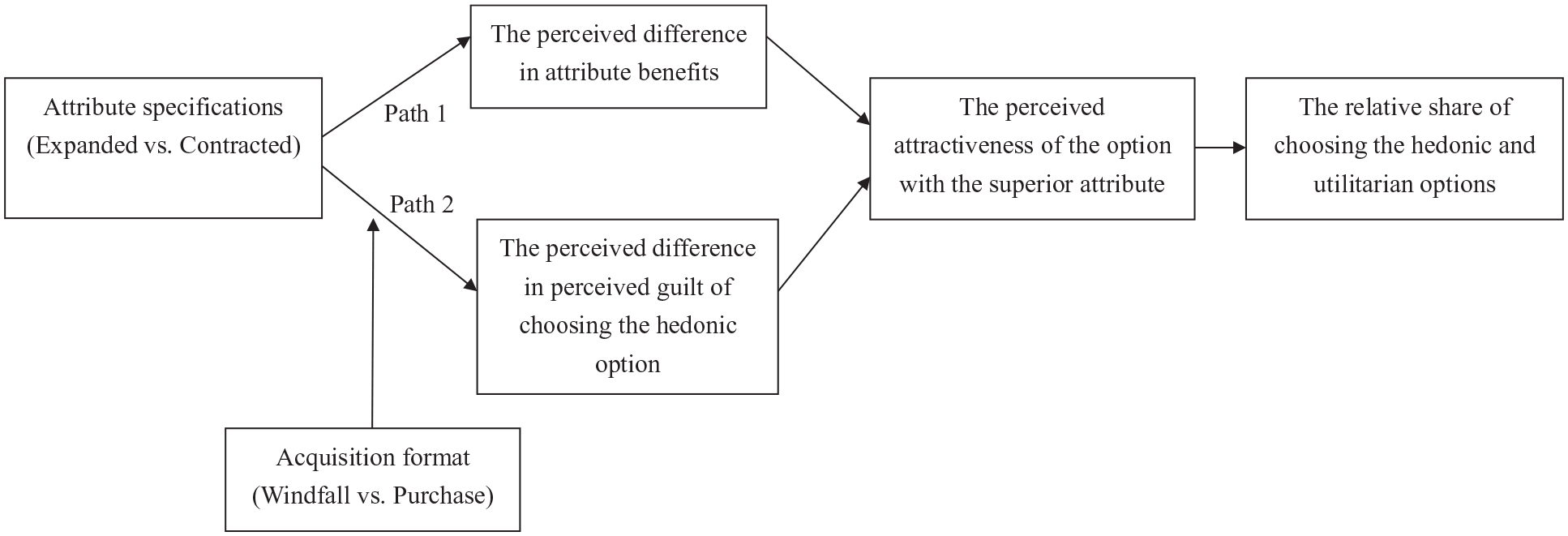
Conceptual framework.
Imagine two rental apartment options, A and B. Both apartments have a hedonic (scenic view) and a utilitarian (distance to a metro station) attribute. A is superior to B on the hedonic attribute (5 stars vs 3.5 stars out of 5 stars), whereas B is superior to A on the utilitarian attribute (6 km vs 3.6 km). Therefore, A is the hedonic option and B is the utilitarian option. When a group of consumers are asked to choose their preferred option, some amount will choose A and B (e.g. 50% vs 50%). We infer that when the utilitarian attribute specification is expanded (now 6000 and 3600 m), keeping the hedonic attribute constant, the relative share of consumers choosing B should increase (e.g. 30% vs 70%) because the perceived difference between the utilitarian benefits is now numerically larger (originally 2.4 km, now 2400 m). In contrast, when the hedonic attribute specification is expanded (now 100 points and 70 points out of 100 points), keeping the utilitarian attribute constant, the relative share of consumers choosing A should remain the same (i.e. 50% vs 50%) because the increase in perceived guilt offsets the numerical increase in the difference of the hedonic benefits (originally 1.5 stars, now 30 points). We do not anticipate an interaction effect between the hedonic attribute specification (expanded vs contracted) and the utilitarian attribute specification (expanded vs contracted) on the relative preference between the hedonic and utilitarian options. This prediction is stated in the following hypothesis:
Based on the previous inferences, we advance the following related hypotheses about the internal mechanisms through which the different attribute specifications affect consumer preferences:
2.4. Overview
These hypotheses are tested in two formal experiments. Both experiments examined whether the attribute specification influenced consumers’ preference for the hedonic or utilitarian option. In Experiment 2, we also examined the moderating role of acquirement format (purchase vs windfall). We did not measure participants’ perceived difference in hedonic and utilitarian benefits because previous studies (e.g. Burson et al., 2009; Pandelaere et al., 2011) have already empirically tested this argument and measuring these items would increase the complexity of the current experiments with little additional benefit.
Both experiments were conducted in Taiwan using samples of university students. The homogeneity of the samples reduced possible confounding effects and increased the internal validity of the results. At least 40 participants were assigned to each condition, surpassing the suggested minimum size (30–40) needed to generate sufficient statistical power (Geuens and De Pelsmacker, 2017). The two experiments used different product attributes and attribute specifications to enhance the generalizability of the results. The experimental products and their relevant attributes were chosen for their similarity to those used in previous studies of hedonic consumption and attribute specifications (e.g. Dhar and Wertenbroch, 2000; Liu and Chou, 2019; Okada and Hoch, 2004) or because participants were familiar with them. In a pretest (N = 67), participants first read definitions of hedonic and utilitarian consumption then responded to two items about the attribute characteristics, “the [attribute] is hedonic/utilitarian for me,” on 7-point Likert-type scales anchored at 1 (strongly disagree) and 7 (strongly agree). This procedure for confirming the characteristics of the product attributes used in formal experiments was adapted from Okada (2005). Following Liu and Chou’s (2017) procedure, we then created relative hedonic scores for each attribute using the difference of the hedonic and utilitarian scores. The higher the relative hedonic score, the more hedonic the participants perceived the attribute.
3. Experiment 1: the effects of different attribute specifications on consumer preference
3.1. Participants, design, and procedure
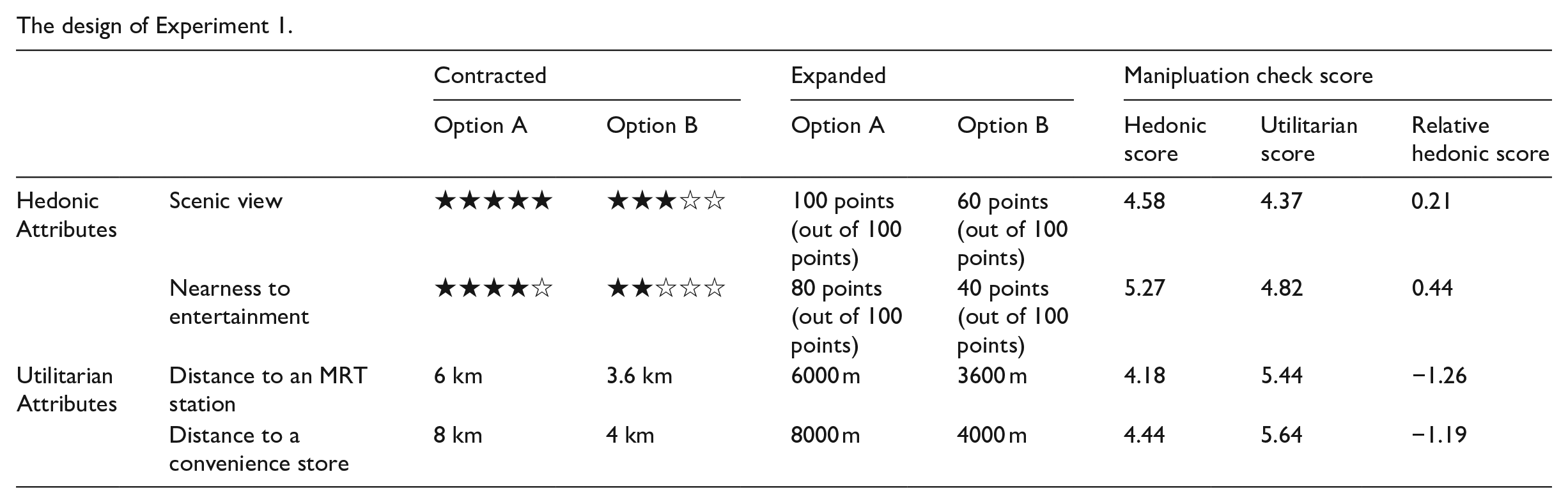
A total of 268 university students (54.5% male, average age = 20.85 years) were randomly assigned to a 2 (hedonic specification: expanded vs contracted) × 2 (utilitarian specification: expanded vs contracted) between-subjects experiment. They all received a candy bar as an incentive to participate. The participants read descriptions of two apartments with two hedonic attributes (scenic view and nearness to entertainment) and two utilitarian attributes (distance to an MRT station and distance to a convenience store). They then had to choose one of the two apartments. Apartment A’s hedonic attributes were better than apartment B’s hedonic attributes, and apartment B’s utilitarian attributes were better than apartment A’s utilitarian attributes. Therefore, apartment A represented the hedonic option and apartment B represented the utilitarian option. In the hedonic expanded scenario, all hedonic attributes had expanded specifications (scores out of 100 points), whereas in the hedonic contracted scenario, all hedonic attributes had contracted specifications (star ratings, maximum of five). Similarly, in the utilitarian expanded scenario, all utilitarian attributes had expanded specifications (meters), whereas in the utilitarian contracted scenario, all utilitarian attributes had contracted specifications (kilometers). Please refer to Appendix 1 for the values of the variables.
We selected these particular attribute specifications for several reasons. First, they were selected to match the characteristics of the products’ attributes. The specifications had to be reasonable and easily imaginable by the participants. For example, distances specified in miles or meters is more reasonable compared to using stars or points. Second, we chose specifications that are familiar to consumers. For example Consumer Reports, a nonprofit organization that publishes product reviews, evaluates products with either stars or points. The use of different specifications also enhances the generalizability of the research findings. Third, these specifications have been used in relevant studies of attribute scales (e.g. Chang and Liu, 2008; Chernev, 2004). The pretest mentioned above confirmed that scenic view (M = 0.54 > 0, p < .05) and nearness to entertainment (M = 0.87 > 0, p < .05) were perceived as more hedonic attributes, whereas the distance to an MRT station (M = −2.04 < 0, p < .05) and the distance to a convenience store (M = −2.12 < 0, p < .05) were both perceived as more utilitarian attributes.
After choosing either apartment A or B, the participants reported the attractiveness of each apartment in response to the item, “apartment A / B is attractive.” Next, the participants read definitions of hedonic and utilitarian consumption (Strahilevitz and Myers, 1998) and responded to eight manipulation check items modified from Okada (2005) and Liu and Chou (2017), including “scenic view / nearness to entertainment / distance to an MRT station / distance to a convenience store is hedonic for me,” and “scenic view / nearness to entertainment / distance to an MRT station / distance to a convenience store is utilitarian for me.” They then responded to two items about perceived guilt, modified from Mishra and Mishra (2011) and Liu and Chou (2017), including “I would feel guilt if I chose apartment A (B).” The responses for all items were reported on 7-point Likert-type-scales anchored at 1 (strongly disagree) and 7 (strongly agree). After responding to these items, the participants provided some demographic information. At the end of the experiment, the investigators thanked and debriefed the participants.
3.2. Results
3.2.1. Manipulation check
Participants perceived scenic view (M = 0.21 > 0, p < .05) and nearness to entertainment (M = 0.44 > 0, p < .05) as hedonic attributes, whereas they regarded distance to an MRT station (M = −1.26 < 0, p < .05) and distance to a convenience store (M = −1.19 < 0, p < .05) as utilitarian attributes. Overall, the manipulation was successful.
3.2.2. The effects of attribute specifications on choices
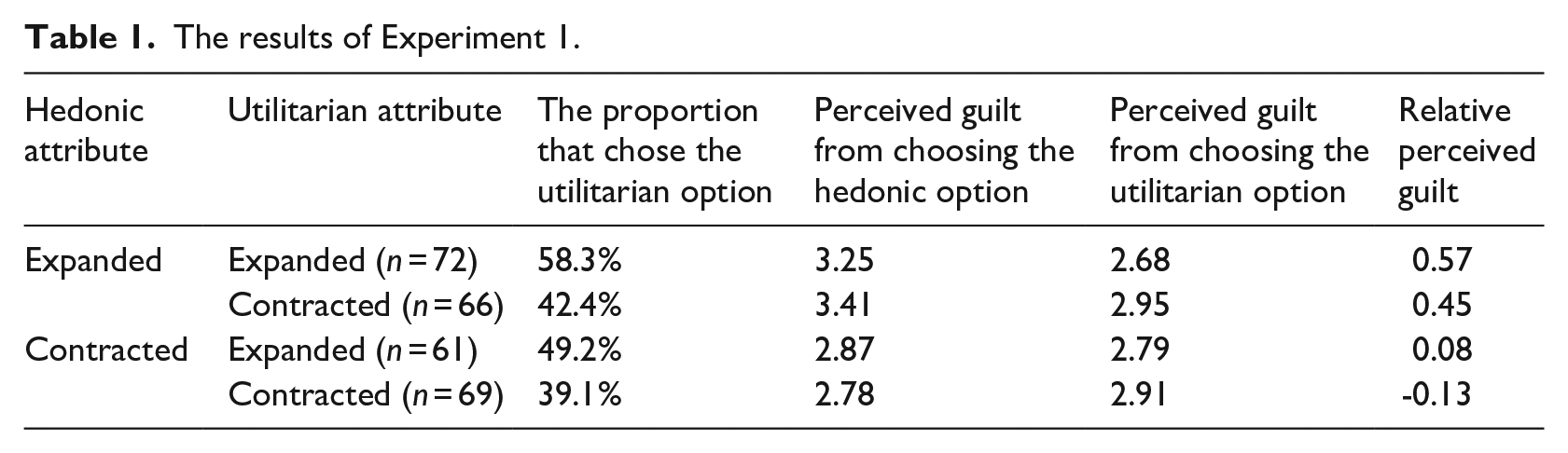
The main results for each condition are shown in Table 1. The result of a CATMOD (categorical method) shows the utilitarian specification (expanded vs contracted) had a main effect, χ2(1) = 4.50, p = .03, which means participants were more likely to choose the utilitarian option in the utilitarian expanded condition than in the utilitarian contracted condition (54.1% vs 40.7%). Both the hedonic specification (expanded vs contracted), and their interactions were not significant, χ2(1) = 1.04 and χ2(1) = 0.22, respectively, both ps > .1. The results support H1.
The results of Experiment 1.
3.2.3. Internal mechanism
To test H2a, we separately tested the impact of hedonic and utilitarian attribute specifications on the perceived guilt of choosing the hedonic and utilitarian options. The results show the perceived guilt of choosing the hedonic option was higher in the hedonic expanded condition than in the hedonic contracted condition (3.33 vs 2.82), F(1, 266) = 8.35, p < .05, whereas the perceived guilt of choosing the utilitarian option was not different between the utilitarian expanded and contracted conditions (2.73 vs 2.93), F(1, 266) = 1.89, p > .1. These results support H2a.
Next, we separately tested the impact of hedonic and utilitarian attribute specifications on the attractiveness of the hedonic and utilitarian options. As expected, the attractiveness of the utilitarian option was higher in the utilitarian expanded condition than in the utilitarian contracted condition (5.13 vs 4.85), F(1, 266) = 4.16, p < .05. Moreover, the perceived attractiveness of the hedonic option was not different between the hedonic expanded and contracted specifications (5.20 vs 5.43), F(1, 266) = 2.55, p > .1, reflecting the perceived hedonic benefits gained from the expanded hedonic specification seemed to be offset by increased perceived guilt, in support of H2b.
3.2.4. Mediation analysis
To explore whether different attribution specifications influence consumer choice (1: hedonic; 0: utilitarian) through different mechanisms, we first followed Liu and Chou’s (2017) procedure to create a relative perceived guilt score using the difference in perceived guilt of choosing the hedonic and utilitarian apartments. The higher the relative perceived guilt, the guiltier the participants feel for choosing the hedonic option compared with the utilitarian option.
Next, we conducted a sequential mediation analysis (Hayes, 2018, model 6; CI = 95% and 5000 bootstrap resampling) with relative perceived guilt and perceived attractiveness of the hedonic option as the sequential mediators between the attribute specifications of the hedonic options (expanded: 0; contracted: 1) and participants’ choice. The result showed that the one-step indirect effect of relative perceived guilt was significant (β = .6112, CI (.0986, 1.3081)), although the indirect effect of perceived attractiveness of the hedonic option was not significant (β = .0954, CI (−.2704, .5094)). Moreover, the size of the indirect effect through the two-step mediation was significant (β = .2382, CI (.0373, .4956)). 1
The utilitarian specifications (expanded: 0; contracted: 1) did not affect perceived guilt; therefore, perceived guilt was not a mediator. We conducted a one-step mediation analysis (Hayes, 2018, model 4; CI = 95% and 5000 bootstrap resampling) with perceived attractiveness of the utilitarian option as the mediator between the attribute specifications of the utilitarian options and participants’ choice. The result shows the size of the indirect effect through the perceived attractiveness of the utilitarian option was significant (β = .4108, CI (.0172, .9110)). Overall, these results support H2c.
3.3. Post study
To provide direct evidence that attribute specifications, regardless of the utilitarian or hedonic character, influence consumers’ perceived difference in attribute benefits, we conducted a post study (N = 64). Participants were randomly assigned to one of two versions of the questionnaire. The attributes, values, and units were the same as those in Experiment 1. In task 1, they first read about two apartments, A and B, with two hedonic attributes; the two hedonic attributes were both contracted (version 1) or both expanded (version 2). Then they reported the perceived difference in attribute benefits between the two apartments with the items, “the difference on scenic view / nearness to entertainment between the two apartments is . . .,” on a 7-point semantic-differential scale anchored at 1 (very small) and 7 (very large) (Pandelaere et al., 2011). They also assessed their familiarity with the unit used to represent the attributes on a 7-point semantic-differential scale anchored at 1 (totally unfamiliar) and 7 (very familiar) to rule out the alternative explanation that the results were due to participants’ degree of familiarity with the units (Lembregts and Pandelaere, 2013). In task 2, on a different page, they read about two different apartments, C and D, with two utilitarian attributes. Both utilitarian attributes were either expanded (version 1) or contracted (version 2). Participants then reported the perceived difference in benefits of the attributes and their familiarity with the units in response to items that were similar to those in task 1. The results show expanded (vs contracted) hedonic attributes enhanced the perceived difference between the options’ hedonic benefits (M = 5.45 vs 4.77 for scenic view; M = 6.00 vs 5.48 for nearness to entertainment), both ts(62) ⩾ 2.19, both ps < .05. Expanded (vs contracted) utilitarian attributes also enhanced the perceived difference between the options’ utilitarian benefits (M = 5.90 vs 5.09 for distance to an MRT station; M = 6.29 vs 5.73 for distance to a convenience store), both ts(62) ⩾ 2.27, both ps < .05. No significant difference was found in participant familiarity with the hedonic attribute units (star ratings with a maximum of five vs scores out of 100 points) (M = 4.97 vs 4.91), t(62) = .15, p = .879, or for the utilitarian attribute units (kilometers vs meters) (M = 5.33 vs 5.32), t(62) = .03, p = .977.
4. Experiment 2: the moderating effect of windfalls
The results of Experiment 1 demonstrate the effect of attribute specifications on consumers’ preference for either the hedonic or utilitarian option depends on the characteristics of the attributes (H1). We also found evidence for the mediating role of relative perceived guilt between the specification of the hedonic attribute and consumers’ choice (H2c). Therefore, we infer that when perceived guilt is reduced, the positive impact of hedonic attribute specifications through the increased hedonic benefits on the attractiveness of the hedonic option is not offset by perceived guilt, which enhances consumers’ preference for the hedonic option. Experiment 2 further clarifies the relationship between attribute specifications and consumers’ choice by focusing on the mechanism of relative perceived guilt.
Many studies have shown the perceived guilt of acquiring a hedonic product decreases when consumers can justify the decision (Kivetz and Simonson, 2002) or when the product is acquired as a gift or a windfall (Arkes et al., 1994; Henderson and Peterson, 1992; O’Curry and Strahilevitz, 2001; Thaler, 1985). Many companies design promotions that frame a product as a gift or give the product away in a draw. Experiment 2 investigates how the acquisition format (windfall vs purchase) moderates the impact of attribute specifications on consumers’ preference for the hedonic or utilitarian option (see Figure 1).
To reduce complexity in Experiment 2, we only compared hedonic and utilitarian attributes that are either both expanded or both contracted. The results of Experiment 1 show an expanded (vs contracted) utilitarian attribute enhances consumers’ preference for the utilitarian option, but an expanded (vs contracted) hedonic attribute does not enhance the preference for the hedonic option because of the increase in perceived guilt. Thus, we infer that when the hedonic and utilitarian attributes are simultaneously expanded (vs contracted), this increases consumers’ relative preference for the utilitarian option.
Furthermore, we propose the acquisition format (windfall vs purchase) moderates the impact of attribute specifications on consumer preference for the hedonic or utilitarian option. Specifically, we expect that when consumers purchase the product, an expanded attribute specification enhances their preference for the utilitarian option relative to the hedonic option. However, a windfall gain reduces perceived guilt for acquiring the hedonic option no matter which form the attribute is specified (expanded or contracted). Therefore, the enhanced hedonic benefits of an expanded attribute specification are not offset by increased perceived guilt. Thus, consumer preference for the utilitarian option should disappear in the expanded specification condition. These predictions are formally expressed in the following hypothesis:
More generally, if the acquisition format moderates the impact of attribute specifications through differences in perceived guilt, then relative perceived guilt should mediate this effect. Therefore, we propose the following hypothesis:
4.1. Participants, design, and procedure
To test H3 and H4, we used a 2 (acquisition format: windfall vs purchase) × 2 (attribute specifications: expanded vs contracted) between-subjects design. A total of 222 university students (44.6% males, average age = 20.00 years) were randomly assigned to one of the four conditions and chose between two mobile phones. The two hedonic attributes (appearance and screen size) of phone A had higher values than phone B, whereas the two utilitarian attributes (memory storage and battery capacity) of phone B had higher values than phone A. Therefore, phone A represented the hedonic option and phone B represented the utilitarian option. In the expanded condition, the appearance was a rated on a scale of 100, memory storage was expressed in megabytes (MB), screen size in millimeters (mm), and battery capacity in milliampere-hour (mAh). In the contracted condition, the appearance was rated out of five stars, memory storage was expressed in gigabytes (GB), screen size in inches, and battery capacity in ampere-hour (Ah). Appendix 2 contains details of the specific values for each attribute. The pretest described previously confirmed that the appearance (M = 0.99 > 0, p < .05) and screen size (M = 0.45 > 0, p < .05) of mobile phones were perceived as hedonic attributes, whereas memory storage (M = −1.90 < 0, p < .05) and battery capacity (M = −1.88 < 0, p < .05) were perceived as utilitarian attributes. Participants read that they had to pay for the phone themselves in the purchase condition. In the windfall condition, they read that they won the phone in a draw. In all conditions, participants had to choose between the hedonic and utilitarian mobile phones. We purposely chose the target products in Experiment 2 to be different from Experiment 1 to enhance the generalizability of the results.
After making their choices, participants responded to eight manipulation check items and two items about perceived guilt. The items were similar to those used in Experiment 1 and responses were also reported on 7-point Likert-type-scales. Other details were similar to Experiment 1.
4.2. Results
4.2.1. Manipulation check
Participants regarded the appearance (M = 0.78 > 0, p < .05) and screen size (M = 0.53 > 0, p < .05) as hedonic attributes, whereas they regarded memory storage (M = −1.90 < 0, p < .05) and battery capacity (M = −1.91 < 0, p < .05) as utilitarian attributes. Overall, the manipulation was successful.
4.2.2. Main results
The results are shown in Table 2. With participants’ choice as the dependent variable, acquisition format, attribute specifications, and their interaction as the independent variables, the results of the CATMOD show that both the acquisition formats and attribute specifications separately had significant main effects, χ2(1) = 3.70, p = .05, and χ2(1) = 4.25, p < .05, respectively, reflecting participants’ higher preference for the utilitarian phone in the expanded specification than in the contracted specification (48.7% vs 35.2%), and in the purchase condition than in the windfall condition (49.1% vs 35.7%). More importantly, the interaction effect was significant, χ2(1) = 3.77, p = .05. In the purchase condition (n = 110), more participants chose the utilitarian option in the expanded specification than in the contracted specification (62.5% vs 35.2%), χ2(1) = 8.21, p < .01. In contrast, in the windfall condition (n = 112), the proportion of participants choosing the utilitarian phone was not significantly different between the two attribute specifications (36.1% vs 35.3%), χ2(1) < 0.01, p > .1. Thus, these results support H3. It is noteworthy that in the two expanded specification conditions, the increased preference for the hedonic option from the purchase condition to the windfall condition showed that the enhanced hedonic benefits resulting from the expanded specification were not offset by perceived guilt.
The results of Experiment 2.

4.2.3. Mediated moderation analysis
We conducted a mediated moderation analyses (Hayes, 2018, model 7; CI = 95% and 5000 bootstrap resampling) to examine the mediating role of relative perceived guilt. We coded the specifications (expanded: 1; contracted: 0) and the acquisition format (windfall:1; purchase:0). The index of mediated moderation through relative perceived guilt was significant for product choice (β = 0.3170, CI (0.0288, 1.0112)). These results support the prediction that relative perceived guilt mediates the interaction effect between acquisition format and the attribute specifications on consumers’ preference for the hedonic or utilitarian option. These results support H4.
5. General discussion
The experimental findings show that attribute specifications on expanded and contracted scales influence consumers’ product choice (hedonic and utilitarian). Specifically, Experiment 1 shows that expanding the utilitarian attribute specification enhances the attractiveness of the utilitarian option. However, expanding the hedonic attribute specification does not influence the attractiveness of the hedonic option because this expansion also increases consumers’ perceived guilt. These effects were not considered in previous studies, which implies that previous numerosity effect studies should be re-examined to determine whether their results are only applicable to utilitarian targets.
Experiment 2 shows that the simultaneous use of expanded (vs contracted) hedonic and utilitarian attribute specifications enhances consumers’ preference for the superior utilitarian option (but not the hedonic option). However, acquisition format moderates the effect because it reduces consumers’ perceived guilt for hedonic consumption when the hedonic attribute specification is expanded. This suggests that in some conditions (e.g. draws and prize awards), manipulating the attribute specifications might have little effect on consumers’ relative preference for the utilitarian or hedonic option.
5.1. Theoretical implications
Pandelaere et al. (2011) and Burson et al. (2009) demonstrated consumers perceive greater differences between product options when the product attributes are specified with an expanded (vs contracted) scale. Therefore, expanding the attribute specifications enhances consumers’ relative preference for the option with superior performance on those attributes. Schley et al. (2017) further demonstrated the numerosity effect occurs when the options are evaluated simultaneously, but the effect is attenuated when the options are evaluated sequentially. Most products are composites of hedonic and utilitarian attributes. However, previous studies of the numerosity effect (e.g. Burson et al., 2009; Cadario et al., 2016; Pandelaere et al., 2011; Schley et al., 2017; Wong and Kwong, 2000) have not explored whether the numerosity effect differs for hedonic and utilitarian attributes. Therefore, our study makes an important contribution by filling this knowledge gap. We advise researchers to place more emphasis on the role of the attribute characteristics in future numerosity effect research.
Another valuable implication of the current study is its Asian research context. Previous studies on the numerosity effect have primarily examined Western contexts and consumers. As Gunasti et al. (2020) noted, different languages have different linguistic structures for numbers and numerosity. English-, French-, and Chinese-speaking consumers might process numerical cues (e.g. product prices and attributes) differently. The current study expands the understanding of the numerosity effect in an Asian, Mandarin-Chinese speaking context. The authors call for additional research into the numerosity effect using different languages and cultural contexts.
Previous studies focused on cognition-based internal mechanisms (e.g. the perceived difference in an attribute). Our unique contribution is the identification of an affect-based, internal mechanism that explains how attribute specifications affect consumer choice (i.e. through the mediation of relative perceived guilt), which partially echoes Chitturi et al.’s (2007) two-stage model (i.e. emotions mediate behavior). The current research provides a more accurate model of how the attribute specification effect is generated and subject to the dual mediation of cognition and affect orientation, distinguishing possible differences in the direction of mediation. Future research should build on the current research findings to examine other possible moderators by promoting or blocking cognition- and affect-based mechanisms.
Previous studies have indicated perceived guilt inhibits hedonic consumption (Arkes et al., 1994; Henderson and Peterson, 1992; Liu and Chou, 2017; O’Curry and Strahilevitz, 2001; Park and Kim, 2012; Thaler, 1985; Thaler and Johnson, 1990). Our study further shows that an expanded (vs contracted) hedonic attribute specification enhances consumers’ perceived guilt for choosing the hedonic option, but an expanded (vs contracted) utilitarian attribute specification does not influence perceived guilt. Consistent with previous studies (e.g. Arkes et al., 1994; Thaler, 1985), and further expanding possible applications, our results suggest the effect of attribute specifications on hedonic consumption is moderated by acquisition format. Our research enhances understanding of the possible effects of perceived guilt and windfall gains in a different context.
It seems that the current results also align with Hsee and Rottenstreich’s (2004) study. They proposed when consumers use feelings or affect to judge a stimulus, consumers are more attuned to the presence of the stimulus. When consumers primarily rely on calculation, they interpret the level of the stimulus to arrive at a valuation. The current findings show consumers are more sensitive to the changes in the scales used to specify utilitarian attributes than hedonic attributes.
However, our study differs from Hsee and Rottenstreich (2004) in several ways. First, they only measured the consequent responses (e.g. willingness to pay and willing to work for how long), ignoring the intermediary perception process. We found the description of hedonic attributes does not influence consumers’ perceived attractiveness of and preference for the hedonic option, but we demonstrated the specifications of the hedonic attributes influence the internal mechanism (i.e. the perceived difference in hedonic benefits between the options and the perceived guilt for choosing the hedonic option). We suggest an expanded (vs contracted) hedonic attribute specification does not increase the attractiveness of and preference for the hedonic option because the positive impact of the increased hedonic benefits is offset by an increase in perceived guilt. In short, the current research provides a more complete explanation of how attribute specifications influence the mediators and why they do not influence relative preferences. Hsee and Rottenstreich’s feeling versus calculation process is unable to explain these effects on its own. The current findings also suggest that the lack of consumer behavioral responses to changes in response to the scope of the stimulus used in Hsee and Rottenstreich’s study may be the result of offset effects.
More importantly, the current results cannot be explained solely by Hsee and Rottenstreich’s (2004) proposition. The current findings suggest expanding the hedonic scale under the windfall gain condition still enhances the attractiveness of the hedonic option due to decreased perceived guilt. Therefore, in the windfall condition, the proportion of participants choosing the utilitarian phone was not significantly different between the two attribute specification conditions. If the effect of attribute specifications on participants’ preferences was due to participants’ reliance on feelings when processing hedonic attributes (thus being insensitive to the variations in the scope of the hedonic attributes), then the effect would be similar across the different acquirement formats. The current study suggests that different response indices have different characteristics. Even if consumers rely on feelings to make a decision, their perceived guilt and perceived attribute benefits are sensitive to the changes in the numbers describing the attribute. In addition, consumer behavioral responses are not always insensitive with the changes in hedonic benefits when they make their decisions under certain conditions (e.g. in a draw). Echoing Zeelenberg et al. (2002), who cautioned against assuming different emotions respond in the same way to identical manipulations, researchers should carefully consider whether to use the general concept of “feelings” to express the relationship between attribute specifications and hedonic consumption.
5.2. Practical implications
For practitioners, manipulating the specifications of the attributes (i.e. using expanded units) causes consumers to perceive a greater difference in benefits between the options. This manipulation might be a useful way to enhance sales for products that have superior utilitarian attributes. However, if the products have superior hedonic attributes, then manipulating the specifications might have little effect on sales.
Okada (2005) proposed consumers are willing to pay more for utilitarian products and spend more time for hedonic products. The current study suggests using expanded utilitarian attribute specifications could enable the setting of higher prices because consumers are willing to pay more for the option with superior utilitarian attributes. For hedonic products, varying an attribute specification is likely to have little effect. However, using expanded specifications for hedonic attributes could attract consumers who spend a lot of time acquiring the product. Thus, providing expanded specifications of the hedonic attributes for a gift in a bundled loyalty program could benefit the seller. In fact, hedonic products in general are ideal as prizes or gifts. Although a draw prize might not increase profits, it might draw more consumers to the store and thereby increase total sales.
Finally, because perceived guilt has a strong impact on consumer preferences for utilitarian and hedonic options, companies should attempt to decrease the perceived guilt associated with hedonic products.
5.3. Limitations and future research
This study has several limitations. First, although the post study provides direct evidence that attribute specifications (utilitarian and hedonic) influence consumers’ perceived benefits, we did not measure the perceived difference of attribute benefits in the formal experiments, which limited the amount of data to test the complete parallel mediating process.
Second, as discussed in Chitturi et al.’s (2007) study, when consumers consider the trade-offs between utilitarian and hedonic options, this may evoke different emotions, including sadness / disappointment, cheerfulness / excitement, and confidence / security. Various emotions influence consumer judgments and decision-making (Garg, 2019). The possible roles that different emotions play in the functional mechanisms linking attribute specification effects to consumer choice are worth further exploration.
Third, we did not test if brands influence consumers’ product attribute evaluations. Companies may use more utilitarian or more hedonic brand positioning strategies (Magno et al., 2017). Future research should test whether the company’s brand image (utilitarian vs hedonic) affects consumers’ responses to attributes with utilitarian and hedonic characteristics, thereby moderating the attribute specification effect.
In some marketing channels (e.g. supermarkets, convenience stores, and warehouse stores), products within the same category are placed next to each other. Consumers may more easily perceive the differences between product attribute specifications if the nearby competing and allied products are described with different units. Does the salience of alternative units cancel the attribute specification effect when consumers conduct unit conversions? Is there a detrimental effect on products that are described in expanded / contracted units due to consumers’ inference of the firm’s motivation to use the specified units? Future research should investigate these questions and other related issues because there are a number of contexts in which practitioners cannot use the same units to describe similar attributes.
Footnotes
Appendix 1
The design of Experiment 1.
| Contracted | Expanded | Manipluation check score | ||||||
|---|---|---|---|---|---|---|---|---|
| Option A | Option B | Option A | Option B | Hedonic score | Utilitarian score | Relative hedonic score | ||
| Hedonic Attributes | Scenic view | ★★★★★ | ★★★☆☆ | 100 points (out of 100 points) |
60 points (out of 100 points) |
4.58 | 4.37 | 0.21 |
| Nearness to entertainment | ★★★★☆ | ★★☆☆☆ | 80 points (out of 100 points) |
40 points (out of 100 points) |
5.27 | 4.82 | 0.44 | |
| Utilitarian Attributes | Distance to an MRT station | 6 km | 3.6 km | 6000 m | 3600 m | 4.18 | 5.44 | −1.26 |
| Distance to a convenience store | 8 km | 4 km | 8000 m | 4000 m | 4.44 | 5.64 | −1.19 | |
Appendix 2
The design of Experiment 2.

| Contracted | Expanded | Manipluation check score | ||||||
|---|---|---|---|---|---|---|---|---|
| Option A | Option B | Option A | Option B | Hedonic score | Utilitarian score | Relative hedonic score | ||
| Hedonic Attributes | Appearance | ★★★★☆ | ★★★☆☆ | 80 (out of 100 points) |
60 (out of 100 points) |
4.81 | 4.03 | 0.78 |
| Screen size | 4.3 inch | 3.8 inch | 109 mm | 88.9 mm | 4.91 | 4.38 | 0.53 | |
| Utilitarian Attributes | Memory storage | 16 GB | 20 GB | 16,384 MB | 20,480 MB | 3.76 | 5.66 | −1.90 |
| Battery capacity | 1.5 Ah | 1.8 Ah | 1500 mAh | 1800 mAh | 3.83 | 5.74 | −1.91 | |
Acknowledgements
The authors are grateful for helpful suggestions from Yu-Ting Wang.
Final transcript accepted 3 October 2021 by Nitika Garg (AE Marketing).
Declaration of conflicting interests
The author(s) declared no potential conflicts of interest with respect to the research, authorship, and/or publication of this article.
Funding
The author(s) disclosed receipt of the following financial support for the research, authorship, and/or publication of this article: This work was supported by the National Science Council, Taiwan (NSC 102-2410-H-390-027-MY2).
1.
A supplemental test showed relative perceived guilt negatively influenced the perceived attractiveness of the hedonic option (t = −9.18, p < .01) and the relative share of choosing the hedonic option (β = −1.35, χ2 = 57.11, p < .01). However, the hedonic attribute specification did not influence the attractiveness of the hedonic option. This result agrees with the framework in  ; the hedonic attribute specification influences the attractiveness of the hedonic option not only through the perceived difference in perceived guilt, but also through the perceived difference in attribute benefits. Thus, the two forces are offset, leaving the attractiveness of the hedonic option unchanged. Similarly, the hedonic attribute specification did not influence participants’ choice because the positive impact of the increased difference in hedonic benefits and the resultant increase in attractiveness of the hedonic option was offset by the increased difference in perceived guilt and the resultant decrease in attractiveness of the hedonic option. For additional details of the supplemental analysis, please contact the authors.