



Abstract
We examine and compare the extent to which the reaction of investors to earnings announcements is influenced by a firm’s governance profile and prevailing market conditions. We find that firms with better governance characteristics experience a larger initial reaction to both good and bad earnings announcements regardless of the prevailing sentiment and uncertainty conditions. However, the influence of governance is constrained to the announcement period. We demonstrate that changes in market uncertainty and/or investor sentiment are related to the post-earnings announcement drift. We also find that a major channel through which greater corporate governance influences the market response to unexpected earnings news is by lowering information uncertainty and so providing greater clarity of the implication of the news for firm value. Finally, we establish that two types of uncertainties (market and information) have very different influence on investor’s response to information signals.
Keywords
1. Introduction
Every day, investors process vast amounts of data and information signals in their attempt to find the true value of particular stocks. Whenever a new piece of information is released, investors try to predict the potential implications of such information for the value of the company. However, the process of interpreting information signals is not straightforward as it is susceptible to factors such as the prevailing market sentiment and uncertainty as well as the perceived quality of the information signal itself. Put differently, upon receiving a new piece of information, investors do not always update their beliefs and expectations about the value of a stock in a fully rational or a standard Bayesian fashion but rather are influenced by several market-wide and firm-specific factors that introduce some bias into the process (Brav and Heaton, 2002; Epstein and Schneider, 2008).
Prior evidence in the literature suggests that factors such as market-wide uncertainty (Williams, 2015), firm-specific uncertainty (Francis et al., 2007), and investors’ beliefs and sentiment (Bird and Yeung, 2012; Kumar, 2009; Pevzner et al., 2015) impact investors’ response to new information. For instance, investors tend to underreact initially to imprecise or uncertain information signals, although this underreaction may be corrected if the uncertainty is subsequently resolved (Brav and Heaton, 2002; Francis et al., 2007; Zhang, 2006). Empirical findings with regard to the effect of market-wide (or macro) uncertainty (Bird and Yeung, 2012; Williams, 2015) and firm-specific (or micro) uncertainty (Francis et al., 2007; Zhang, 2006) on processing information signals support this proposition. Prior findings in the literature have also linked investors’ reactions under uncertainty to their sentiment and beliefs about the market. For instance, Kumar (2009) finds that individual investors display stronger behavioural biases such as overconfidence about stock values when uncertainty at the firm and/or market level is high. Furthermore, Bird and Yeung (2012) and Bird et al. (2014) show that positive market sentiment mitigates the effect of high uncertainty on investors’ reactions to earnings announcements.
A relatively recent stream of research has focused on examining the relationship between the firm’s corporate governance characteristics and market participants’ reaction to different events and news. Findings from past studies suggest that governance mechanisms help reduce information uncertainty through different means, such as increasing voluntary disclosures (Beekes and Brown, 2006; Beekes et al., 2016), enhancing the quality of information (Bhat et al., 2006; Cai et al., 2006; Lau et al., 2016) and reducing information asymmetry (Kanagaretnam et al., 2007).
This study extends the previous literature by examining and comparing the role of the corporate governance mechanisms and prevailing market conditions in influencing investors’ initial and subsequent reactions to earnings announcements, with special attention to one of the most persistent market anomalies, namely the post-earnings announcement drift (PEAD). While several explanations for the PEAD based on the rational expectations model or some behavioural observations are provided in the literature (see Bartov et al., 2000; Mendenhall, 2004; Sadka, 2006), the prevailing market conditions such as market uncertainty and investor sentiment have received increasing attention in recent years as possible contributing factors to the PEAD (Bird and Yeung, 2012; Bird et al., 2014; Francis et al., 2007; Ozoguz, 2009; Williams, 2015). Although the relationship between governance and the initial reaction to earnings announcements was examined in several recent studies (e.g. Bonetti et al., 2016; Lau et al., 2016), to the best of our knowledge no study has attempted to extend such exercise to the reaction during the post-announcement period. We are also not aware of any previous study which compares the role of corporate governance in influencing investors’ reactions to earnings announcements to the prevailing market conditions or one that investigates the direct and indirect contribution of corporate governance to such reaction.
In a sample of quarterly announcements made by US public firms between January 2006 and December 2015, we find that better governance significantly strengthens the magnitude of the initial market reaction to both positive and negative earnings announcements. This contrasts with the comparatively smaller impact of either market uncertainty or investor sentiment which will have a different effect depending on whether the response is to good news or bad news. Furthermore, unlike market sentiment and uncertainty, a firm’s governance profile appears to play no role in explaining movements in share prices during the post-announcement period that are attributable to any reassessment of the initial announcement. Moreover, consistent with previous findings that (1) better corporate governance reduces information uncertainty and (2) a reduction in information uncertainty increases investors’ initial response to earnings announcements, we find that information uncertainty is a major channel through which corporate governance operates to increase the market’s initial reaction to earnings announcements. Finally, we are the first study to show that investors exhibit a very different reaction to market uncertainty than they do to firm-level information uncertainty. Consistent with previous studies on macro-level uncertainty, we show that a high level of market uncertainty can assert an asymmetric effect on investors’ reaction to earnings news, reducing reaction to good news but exacerbating reaction to bad news. In contrast, our results show that a high level of information uncertainty diminishes investor reaction to both good and bad news. Furthermore, this apparent reluctance to act on information continues in the post earnings period with high level of information uncertainty significantly reducing the PEAD.
The remainder of this study is organised as follows. Section 2 provides a summary of relevant prior studies and outlines the main research questions. Section 3 describes the sample and methodology used. Section 4 presents the results of our analysis and a battery of robustness tests while section 5 concludes the article.
2. Literature review and research questions
2.1. Literature review
Findings in the literature suggest that market conditions such as the prevailing level of market uncertainty and the overall sentiment of market participants exert a significant influence on how investors interpret and react to the influx of information (e.g. Anderson et al., 2009; Bird and Yeung, 2012; Epstein and Schneider, 2008; Ozoguz, 2009). The separation between the concepts of risk and uncertainty first discussed in the work of Knight (1921) and then Keynes (1937) laid down the foundation for a stream of research that looks at how uncertainty affects asset prices outside the framework of traditional asset pricing models. For example, the theoretical work of Chen and Epstein (2002) shows that excess returns for a security are made of a risk premium and an ambiguity or uncertainty premium. The empirical results of Anderson et al. (2009), Connolly et al. (2005), Epstein and Schneider (2008) and Ozoguz (2009), among others, document the presence of a strong relation between uncertainty and return, confirming the existence of an uncertainty premium. Several empirical studies found that the asymmetric response to earnings surprise is primarily caused by uncertainty, whether economy-wide or firm-specific (Bird and Yeung, 2012; Choi, 2014; Jiang et al., 2005; Williams, 2015; Zhang, 2006). Furthermore, it has been suggested that uncertainty is a major contributor to the persistence of the PEAD (Bird et al., 2014; Caskey, 2009; Francis et al., 2007; Gerard, 2012).
It has been found that the sentiment of market participants also plays an important role in determining the direction and extent of their reaction to new information (De Long et al., 1990). For instance, Mian and Sankaraguruswamy (2012) find that markets are more responsive to good news released during periods of high sentiment as well as bad news released during periods of low sentiment. Moreover, Chung et al. (2012) find that market sentiment helps predict the returns on all portfolios during an economic expansion state when investors’ optimism increases. Likewise, Baker and Wurgler (2006) report that market sentiment at the beginning of the period impact the expected returns at the end of it for a large subset of US stocks. In addition, the findings of Baker and Wurgler (2007), Conrad et al. (2002), Lemmon and Portniaguina (2006) and Zouaoui et al. (2011), among others, suggest a significant role for market sentiment in predicting stock returns and explaining some market anomalies such as pricing bubbles. Bird and Yeung (2012) find that investor sentiment interreacts with market uncertainty in influencing how investors respond to earnings announcements to the extent they can override the signal with investors often reacting negatively to good news released at a time of high market uncertainty and low market sentiment. Bird et al. (2014) also found that investor sentiment and market uncertainty combine to impact on any market response to the information in the post-announcement period.
An important factor that can influence investors’ reaction to new information, but which has received limited attention in the literature, is corporate governance. The strength of the firm’s corporate governance framework influences the firm’s information environment through several channels such as improving the quality as well as the quantity and frequency of its disclosures. In a recent study, Beekes et al. (2016) study a sample of more than 5,000 firms from 23 countries in the period between 2003 and 2008 and find that better governed firms made a greater number of disclosures to the market. Their results also show that better governed firms tended to release documents to the market in a timelier fashion, especially when these documents related to bad news. The results of Beekes et al. (2016) are similar to those reported in Beekes and Brown (2006) in the Australian market where they find that better governed firms make more informative disclosures which in turn improves the accuracy of analysts’ forecasts. Beekes and Brown (2006) also report that better governance is associated with timelier price discovery.
With regard to governance’s effect on information quality, Byard et al. (2006) report the presence of a strong positive association between the quality of analysts’ forecast about a firm’s upcoming earnings and the quality of its corporate governance practices. They also report that corporate governance’s strength affects the quality of mandatory and voluntary disclosures made by a firm, confirming the fact that better quality disclosures may reduce information uncertainty and improve analysts’ ability to predict the firm’s future performance. Similarly, Cai et al. (2006) report that governance characteristics such as the number of founding family members on the board and the number of female directors influence the level of information uncertainty in the market. Specifically, the more founding family members and the less female directors the board has the greater the information uncertainty (see also Bonetti et al., 2016; Dargenidou et al., 2007; Hass et al., 2014; Lau et al., 2016). On the whole, while a number of studies have focused on examining the relationship between corporate governance quality and the initial response to earnings announcements, there appears to have been no prior attempt at studying the relationship between corporate governance and the well-documented drift during the post-announcement period.
Finally, this study also relates to the literature that takes into account the joint impact of several sources of uncertainty. It is worth distinguishing the difference between market-wide uncertainty sometimes proxied by VIX and a specific form of firm-level uncertainty, information uncertainty, as documented by Zhang (2006). Studies by Bird and Yeung (2012), Choi (2014) and Williams (2015) have demonstrated that investors exhibit an aversion to macro-level uncertainty. In a heightened uncertainty climate, investors apply a maxmin expected utility function in their reaction to the news. The investors will look at news negatively and take actions to maximise their utility in the worst-case scenario. The end effect is that investors will underreact to good news and overreact to bad news (Bird and Yeung, 2012; Choi, 2014; Williams, 2015). On the contrary, information uncertainty relates to a situation where there is ambiguity concerning the implications of the new information on a firm’s value. Zhang (2006) shows that investors faced with information uncertainty will exhibit a muted response to the news announcement. This initial underreaction will be followed by a correction in the PEAD period where we will observe higher returns following good news and relatively lower returns following bad news. One of the questions that we propose in this study is whether this market correction will take place. We hypothesise that the information uncertainty that results from poor corporate governance does not dissipate because the corporate governance quality of any firm changes slowly over time. Therefore, in the absence of any significant change in the information climate, we question whether there will be a correction in the stock prices in the post-announcement period.
2.2. Research questions
This study first addresses two related questions:
1. Is the market’s immediate or subsequent response to a firm’s earnings announcements affected by its corporate governance characteristics?
2. What is the impact of corporate governance relative to market uncertainty and investor sentiment in explaining the extent of the initial and subsequent market response to earnings announcements?
In undertaking our analysis, we examine the role of the firm’s corporate governance quality on influencing investors’ initial and subsequent reaction to earnings announcements and consider the interplay between corporate governance, market uncertainty and investor sentiment. The literature suggests that the level and/or movement in both market uncertainty and investor sentiment exert a significant influence on how investors interpret and react to the flow of information (e.g. Anderson et al., 2009; Baker and Wurgler, 2007; Conrad et al., 2002; Epstein and Schneider, 2008; Lemmon and Portniaguina, 2006; Ozoguz, 2009). Furthermore, prior evidence in the literature suggests that stronger governance mechanisms are likely to enhance investors’ immediate reaction to information signals through reducing firm-specific uncertainty and improving the perception of the quality of the firm’s announcements (Cai et al., 2006; Hass et al., 2014; Kanagaretnam et al., 2007). While no evidence is available in the literature on the relationship between corporate governance and the subsequent reaction to earnings announcements or the PEAD, the ‘stickiness’ of the firm’s corporate governance framework may suggest that it will have weak to no impact on investors’ reassessment of their initial reaction.
We then address a third question that relates to the channel through which a firm’s corporate governance environment might influence the market’s immediate and subsequent response to earnings announcements:
3. Is the influence of corporate governance on the market’s response to earnings announcements attributable to a significant extent to the favourable impact that it has on improving a firm’s information environment?
Francis et al. (2007) and Zhang (2006), among others, associate any delayed response to an earnings announcement with the perceived quality of a firm’s information signal. Francis et al. (2007) find that announcements by firms with higher information uncertainty (IU) tend to experience a more muted initial market reaction. Zhang (2006) finds evidence that greater IU is associated with a greater price drift. Based on this evidence as well as the earlier discussion regarding the role of good corporate governance in reducing the effect of IU, firms with stronger governance are expected to have a greater initial reaction to earnings surprises and as a result a potentially smaller or an insignificant drift during the post-announcement period.
Our last research question relates to the impact of the two types of uncertainties considered in our study (market uncertainty and firm-specific information uncertainty) on investors’ initial and subsequent reaction:
4. Do the two types of uncertainties (market uncertainty and firm-specific information uncertainty) analysed in our study impact the market response to information signals in a similar way?
3. Data and methodology
3.1. Sample description
The sample of our study covers the quarterly announcements made by US public firms between January 2006 and December 2015. 1 We source our accounting and market data from the CRSP/COMPUSTAT database for all firms that are part of the S&P 1500 Index. 2 We extract corporate governance for the same sample from the ISS (formerly RiskMetrics) database and we construct our own corporate governance index following the approach outlined in the methodology section. To calculate our measure of unexpected earnings, we base our expectations on analysts’ earnings forecasts obtained from I/B/E/S with the requirement that at least three analyst forecasts are available for a data point to be included in our final sample to avoid bias in our results due to limited analyst coverage. We also rely in our analysis on the announcement dates reported in the I/B/E/S database. Our final sample consists of all quarterly observations with sufficient governance and accounting/market data from the different databases. We winsorise all continuous variables at 1% and 99%. This results in us having 21,692 observations in our final sample, consisting of 14,672 positive surprises and 7,020 negative surprises. 3
3.2. Methodology
3.2.1. Uncertainty and sentiment measures
Finding an accurate and a reflective measure of uncertainty has been a challenging task for many researchers in the field (Connolly et al., 2005). We follow Connolly et al. (2005), Williams (2015) and others in using the implied volatility from the options market, namely the market volatility index (VIX), to measure market uncertainty. An alternative proxy for uncertainty used in the literature has been disagreement among experts, such as a measure of the dispersion of analysts’ economic forecasts (Anderson et al., 2009). We find strong support in the literature for using VIX as a measure of market uncertainty, and it has the advantage of being forward looking and calculated on a continuing basis. Bloom (2009) shows that volatility in the stock market as measured by VIX is highly correlated with periods of high economy-wide uncertainty. Furthermore, David and Veronesi (2002) develop an option pricing model that uses economic state uncertainty which identified a positive association between implied volatility in options and investors’ uncertainty about fundamentals. Drechsler (2013) also shows that the large variance premium in options’ prices can be explained by an equilibrium model that incorporates time-varying Knightian uncertainty. Drechsler claims that the variance premium is the result of using options to hedge uncertainty. His results further demonstrate that changes in the levels of uncertainty cause fluctuations in the variance premium (see also Connolly et al., 2005).
We use the cumulative daily returns of a major market index (S&P 1500) over the 5 days prior to the announcement to capture market sentiment at the time of the announcement (SMI) and thus avoid the day of the week effect (Brown and Cliff, 2004). We also capture the change in market sentiment over the post-announcement period (T + 2 to T + 60) by summing daily returns over the period. Various studies in the literature employ the sentiment index introduced in Baker and Wurgler (2006) to measure market sentiment; however, the index is only available on a monthly basis which reduces its usefulness for our purposes as earnings announcements can be released at any time during a month. We use the Baker and Wurgler index in a later section to test the sensitivity of our results to the choice of the sentiment measure.
3.2.2. Standardised unexpected earnings
Different measures of unexpected earnings (UE) which are based on either historical earnings or analysts’ forecasts have been used in the literature. Since analysts’ forecasts are a better reflection of market participants’ expectations of a firm’s earnings than historical earnings (see Livnat and Mendenhall, 2006), we follow Liu et al. (2003), Livnat and Mendenhall (2006) and others by estimating standardised unexpected earnings (SUE) using analysts’ forecasts. We calculate our SUE measure as

where
3.2.3. Corporate governance (GOVI) measure
In line with many previous studies, we construct a firm-level additive index of governance (GOVI) using the commonly used measures of governance listed in Appendix 2 (e.g. Aggarwal et al., 2010; Anderson and Gupta, 2009; Brown and Caylor, 2006; Brown et al., 2011). These 29 measures represent the various governance indicators available from the ISS database and capture well the different aspects of the firm’s governance framework including its board and ownership characteristics, compensation structure, and control or anti-takeover provisions. Following Aggarwal et al. (2010) and Brown and Caylor (2006), we use the most recent governance thresholds provided by the Institutional Shareholder Services (ISS) Governance QuickScore 3.0 to construct our index. A firm gains one point for each of its governance attributes that meets the threshold suggested by ISS’s guideline, or 0 otherwise. 5 The final value of our index is the total number of points accumulated by a firm divided by the total number of attributes, expressed as a percentage. When an attribute is missing for a particular firm, the score is based on the remaining attributes with firms being deleted from the sample if more than one-third of the attributes are missing.
3.2.4. Information uncertainty (IU) measure
We create proxies for information uncertainty in order to address our third question as to whether that it is this channel through which corporate governance works when influencing the market reaction to new information. The three proxies chosen on the basis that they are widely cited in the literature are return volatility, volume traded and earnings forecast dispersion (see Table 1 for more information). We create a dummy variable, IFUH, for each of these proxies that takes on a value of 1 if the value of the IU measure for the announcement year is above the median value for all other observations, or 0 otherwise. The values are calculated using the data from the most recent 12 months leading to the announcement. We construct the different IU measures so that higher values indicate higher IU.
Measures of information uncertainty (IU).a

Bharath et al. (2009) and Krishnaswami and Subramaniam (1999) report that many of the information asymmetry measures used in the literature are highly and significantly correlated.
3.2.5. Main models
3.2.5.1. Governance, uncertainty, sentiment and earnings announcements
In order to answer the first part of our first and second research questions in relation to the impact of corporate governance, market uncertainty and/or investor sentiment on the immediate response to a firm’s earnings announcements, we use Model 1. Furthermore, we use Model 2 (explained later) to address the second part of the same research questions which relates to the role played by the same factors in the subsequent response to earnings announcements. For the announcement period, we define announcements with positive sentiment as those where the cumulative daily return of the market index (S&P 1500) for the preceding 5 days is positive. Furthermore, we define announcements with high uncertainty as those where the value of VIX 1 day prior to the announcement is above the median for all the observations. 6 Following Conrad et al. (2002), Choi (2014), Williams (2015) and others, we specify our model as follows

where NUEi,t (PUEi,t) is the negative (positive) UE measure which takes the value of SUE when it is negative (positive) or 0 otherwise. CARi,t is the cumulative abnormal return calculated for the day of the announcement (T + 0) and the following day (T + 1). 7 GOVHi,t is a dummy variable which takes the value 1 if the governance index value for the announcement year is above the median value for all other observations or 0 otherwise, while SMIPi,t is a dummy variable which takes the value 1 if the cumulative return on S&P 1500 (sentiment measure) 5 days prior to the announcement is positive or 0 otherwise. VIXHi,t is a dummy variable which takes the value 1 if the VIX (uncertainty measure) value 1 day prior to the announcement is above the median value for all VIX observations or 0 otherwise.
We calculate the abnormal return used in CARi,t by subtracting the expected return from the actual return. The expected return is calculated using the market model approach as discussed in MacKinlay (1997) and Kothari and Warner (2007). 8 The parameters of the market model (stated below) are calculated using the data from the 60 days preceding the announcement date (excluding the event window)

where Ri,t and Rm,t are the returns during period t for security i and the market index (i.e. S&P 1500), respectively. Calculating returns this way allows us to account for the systematic risk factor identified in Easton and Zmijewski (1989) and Collins and Kothari (1989) to be related to changes in stock price as a result of the announcement of unexpected earnings.9,10
We have chosen to include four control variables that are known to influence our dependent variable, which were found to be significant in prior studies. 11 SIZEi,t/BTMVi,t are the log of the firm’s market value and its book-to-market value ratio at the time of the announcement, respectively. Both variables were found to be significantly related to firm valuation and PEAD and are used to control differences in risk which are not reflected in the excess returns (Bernard and Thomas, 1989; Bhushan, 1994; Choi, 2014; Foster et al., 1984). SIZEi,t is also included to reduce the coefficient bias effect (Williams, 2015). Furthermore, following DeFond et al. (2007), Landsman et al. (2012) and Pevzner et al. (2015), we add two additional control variables which were found to impact the measured reaction to earnings announcements: earnings reporting lag (RLAGi,t) and number of forecasts (FORCi,t). We control for the lag between the end of the reporting period and the announcement date (RLAG) because a longer lag increases the probability of market participants obtaining significant earnings information prior to the actual announcement, which reduces the significance of the announcement itself (Chambers and Penman, 1984). Moreover, we use the number of forecasts available (FORC) as an indicator of the overall precision of the earnings forecast (Kim and Verrecchia, 1991). All variables are defined in more detail in Appendix 1.
The answer to the first part of our first research question is to be found in both the sign and the significance of β6 and β7 as they represent the difference in the initial reaction to both NUE and PUE for better governed firms as compared to that of the less well-governed firms. Furthermore, both the sign and the significance of coefficients β8, β9, β10 and β11 are important to answer the first part of the second question as they represent the difference in the initial reaction to both NUE and PUE for announcements made during periods of high sentiment (β8 and β9) or high uncertainty (β10 and β11) as compared to announcements made during periods of low sentiment or low uncertainty, respectively.
3.2.5.2. Governance and the PEAD
With regard to the post-announcement period and the PEAD, we estimate the following model for the full sample
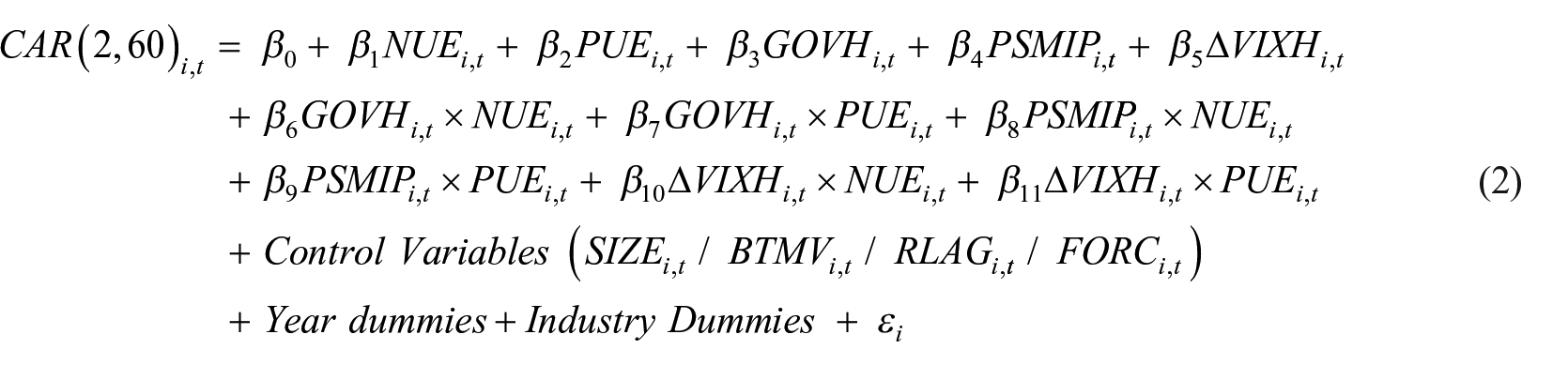
where CAR, PUE, NUE, GOVH and the control variables were defined earlier. PSMIPi,t is a dummy variable which takes the value 1 if the sum of the daily returns on the market index (sentiment measure) over the post-announcement period is positive or 0 otherwise, while ∆VIXHi,t is a dummy variable that measures change in VIX (uncertainty measure) over the studied period and takes the value 1 if the value of VIX increases over post-announcement period (T + 2 to T + 60) or 0 otherwise. As discussed in the previous section, the sign and significance of β6 and β7 provide the remaining answer to the second part of our first research question as they represent the differing impact of earnings announcement for better governed firms as compared to less well-governed firms. In addition, the sign and significance of β8, β9, β10 and β11 provide the remaining answer to the remaining part of the second research question as they represent the differing impact of earnings announcement made during periods of high sentiment (β8 and β9) or high uncertainty (β10 and β11) as compared to announcements made during periods of low sentiment or low uncertainty, respectively.
3.2.5.3. Governance, the firm’s information environment and earnings announcements
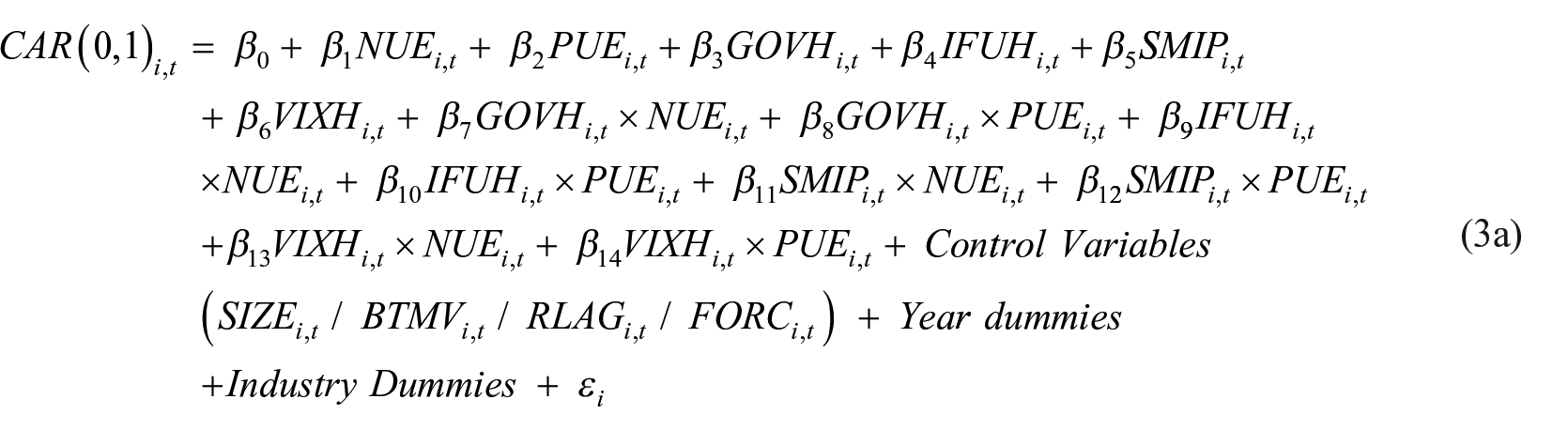
In order to answer our third and fourth questions, we run a regression based on the following number of equations using a structural equation modelling (SEM) routine to test the relationship illustrated in Figure 1



An illustration of the structural equation modelling routine performed to analyse the relationship between corporate governance, information uncertainty and reaction to earnings announcements.
where all variables were explained earlier. We also re-run models 3a–3d with the cumulative abnormal returns for the post-announcement period (T + 2 to T + 60) as the dependent variable and the post-announcement measures of sentiment and uncertainty (PSMIP and ∆VIXH) instead of SMIP and VIXH (similar to model 2 but with the addition of the information uncertainty measures). The SEM routine assumes that governance influences the response to earnings announcements (the dependent variable) both directly (what we have seen so far) and indirectly through its impact on information uncertainty. The indirect impact included in the SEM routine represents governance’s influence on the market response to earnings announcements through its influence on information uncertainty. 12 β3 represents the direct effect of governance on share price while β7 and β8 represent the direct effect of governance through the reaction to the earnings surprise. The indirect effect of governance as illustrated in Figure 1 is represented by α1 × β9 and γ1 × β10 for bad and good earnings surprises, respectively. If our proposition is valid, then we expect β9 and β10 to be significant with negative signs, indicating that firms with higher information uncertainty tend to have a more muted initial reaction to surprises in the earnings announcement. Based on our earlier observations, we also expect β7 and β8 to be significant with positive signs, indicating a higher initial reaction to announcements in better governed firms. In addition, we expect the indirect effect of governance (α1 × β9 and γ1 × β10) to be significant and to represent a significant portion of the total effect (direct and indirect), thereby confirming the role of governance in improving reaction to earnings announcements through reducing information uncertainty. Following Landsman et al. (2012) and Pevzner et al. (2015), we use the Sobel (1982) test to examine the significance of the indirect effect. The answer to our fourth research question regarding the impacts of the two types of uncertainties (market uncertainty and firm-specific information uncertainty) on the market response to information signals is captured by β9 and β10 for firm-specific information uncertainty and β13 and β14 for market uncertainty.
4. Results and discussion
4.1. Governance, uncertainty, sentiment and earnings announcements
In Table 2, we report the findings relating to our first two research questions concerning the impact of corporate governance, sentiment and market uncertainty on the market response to earnings announcement both at the time of the announcement and during the post-announcement period.
Multivariate regressions of the cumulative abnormal returns for the announcement and post-announcement periods on the standardised unexpected earnings and governance, uncertainty and sentiment dummies.

The table presents the results of running ordinary least squares regressions using models 1 and 2. Refer to the text for full explanation of the models. The dependent variable, CARi,t, is the cumulative abnormal return calculated for the period specified in the brackets. NUEi,t (PUEi,t) is the negative (positive) UE measure which takes the value of SUE when it is negative (positive) or 0 otherwise. GOVHi,t is a dummy variable which takes the value 1 if the governance index value for the announcement year is above the median value for all other observations or 0 otherwise. SMIPi,t is a dummy variable which takes the value 1 if the cumulative return on S&P 1500 (sentiment measure) 5 days prior to the announcement is positive or 0 otherwise. VIXHi,t is a dummy variable which takes the value 1 if the VIX (uncertainty measure) value 1 day prior to the announcement is above the median value for all VIX observations or 0 otherwise. PSMIPi,t is a dummy variable which takes the value 1 if the sum of the daily returns on the market index (sentiment measure) over the post-announcement period is positive or 0 otherwise, while ∆VIXHi,t is a dummy variable that measures change in VIX (uncertainty measure) over the studied period and takes the value 1 if the value of VIX increases over the post-announcement period (T + 2 to T + 60) or 0 otherwise. All variables are defined in Appendix 1. The t-statistics are reported in the parentheses. The standard errors are clustered across firm and time. *Significant at the 10% level. **Significant at the 5% level. ***Significant at the 1% level.
4.1.1. At the time of the announcement
We apply model 1 to our sample to address the initial impact of corporate governance and report our findings in the first column of Table 2. The critical coefficients on which to focus are β6 and β7 which measure the difference between the impact of a quantum of unexpected earnings news on the valuation of a firm with high corporate governance as compared with one with low corporate governance. For both negative earnings surprises and positive earnings surprises, these coefficients are positive and significant (0.0075*** for NUE and 0.0082*** for PUE) indicating that an earnings surprise has a much larger impact on the valuation of a firm that enjoys a high level of corporate governance. From this we can conclude that the level of corporate governance influences how investors react to earnings information flowing from a firm. The fact that stronger corporate governance results in a greater reaction suggests that the investors might give more credence to information being released by firms with high levels of corporate governance which is a proposition that we will consider in more detail in the next section. It is also worth noting that the coefficient measuring the direct relationship between corporate governance and firm valuation (β3) is also significant and positive, confirming the findings of previous studies that firms with strong corporate governance are more highly valued by the market (Aggarwal et al., 2010; Anderson and Gupta, 2009; Brown and Caylor, 2006).
Our findings for both uncertainty and sentiment are consistent with the findings of other papers with the market response to good earnings news being greatest when uncertainty is low and sentiment is high, while the response to bad earnings news is greatest when uncertainty is high and sentiment is low (Bird et al., 2014; Bird and Yeung, 2012). We find that greater uncertainty causes investors to take a more pessimistic view when confronted with new information causing them to react more to bad news and less to good news. Investor sentiment has the opposite effect of causing investors to take a more optimistic stance when analysing new information resulting in them reacting more to good news and less to bad news. Hence, it is obvious that governance works in a different way to both uncertainty and sentiment in affecting investor response to new information as a higher level of governance causes investors to respond more to both good and bad earnings news. We would propose this difference reflects that corporate governance works through a different path to both uncertainty and sentiment in terms of influencing how investors respond to information signals. Both uncertainty and sentiment work more on the state of mind of the investors and impact on the expectations that investors without the’ form based on their analysis of the information. In contrast, governance reduces uncertainty and increases investors’ confidence in the information causing them to be less conservative when adjusting their expectations in response to new information. Another observation that we would make is that corporate governance has a much larger impact on how investors initially react to earnings announcements than does either uncertainty or sentiment. We see that for each quantum of good and bad news, the share price of firms with above-median governance increases by about 0.8% more than does the share price of firms with below-median governance. In contrast, both uncertainty and sentiment have a much smaller impact on investor response, which is very minimal in the case of sentiment. In summary, corporate governance has been shown to have a greater influence on the initial reaction to earnings announcements than does both uncertainty and sentiment, and to work through a different channel.
4.1.2. During the post-announcement period
We apply model 2 to our sample to address the impact of corporate governance over the post-announcement period and report our findings in the second column of Table 2. Undoubtedly, our major finding is that the extent of a firm’s corporate governance does not play a role in explaining the drift that typically occurs during the post-announcement period (i.e. the PEAD). In contrast, the change in the level of uncertainty plays a major role in explaining the PEAD, several times the magnitude of what uncertainty contributed to price movement at the time of the announcement. We also find that the prevailing sentiment over the post-announcement period also influences the magnitude of the PEAD but only in the instance of a reaction to a negative earnings surprise as sentiment is not found to influence the magnitude of the PEAD in the case of a positive earnings surprise. It is interesting to observe that this is in line with the influence of sentiment on the initial reaction to the earnings news, which was much greater for bad news than it was for good news.
The question that this raises is why does the level of governance play such an important role in explaining the initial market reaction to an earnings announcement but no role in explaining any drift in the post-announcement period? The answer we suggest lies in the proposition that corporate governance influences the share price response by enhancing the firm’s information environment and thus reducing the ambiguity of the impact of the earnings news on firm value. Hence, the lower the uncertainty, the greater the initial response to the earnings announcement. The question then becomes what would cause investors to reassess their initial response to the earnings announcement? The answer that we would put forward is that any change in information uncertainty would require investors to go back and reassess their initial response to the announcement, but supposedly this would require a non-trivial change in the firm’s governance characteristics. Since corporate governance changes very little overtime, there is no reason to believe that it would play a role in explaining the PEAD. Our findings would suggest that the PEAD is at least partially driven by changes in some of the factors that influenced the initial response to the earnings release. We have seen that changes in market level uncertainty over the announcement period and the sentiment prevailing during this period are both important factors that cause investors to reassess their initial response to an earnings announcement and thus both impact on the magnitude and direction of the PEAD.
4.2. Information uncertainty (IU) as a potential explanation for the role of governance
We have proposed that an important reason for corporate governance influencing the market response to information is because of the impact it has on the firm’s information environment. The third research question relates to identifying the channel through which corporate governance works to influence how investors react to earnings announcements. We have proposed that a major way by which governance works is through reducing information uncertainty and thus allowing market participants to more clearly quantify the impact of the announcement on firm value. We investigate this in two steps: first establishing the link between corporate governance and information uncertainty and then investigating the extent to which the relationship between corporate governance and the market response to earnings announcements is explained by the information uncertainty channel.
4.2.1. Corporate governance and information uncertainty
We rank our firms based on their corporate governance score and then divide the sample into quintiles giving us five sub-samples ranking from those with the lowest corporate governance to those with the highest level of corporate governance. In Table 3, we report the median value for each of our proxies for information uncertainty for each of the five sub-samples. Our findings clearly indicate a monotonic relationship with information uncertainty decreasing as we proceed from the lowest governance quintile to the highest governance quintile. We see for each of the three proxies, there is a very significant difference between the median values for each proxy for the lowest and highest governance quintiles. The conclusion that we draw is that there is a link between the level of corporate governance practised within a firm and the level of uncertainty associated with information flowing from the firm.
Median information uncertainty (IU) measures values based on the governance index scores.

This table presents the median values of the different proxies of IU (defined in Table 1) for each quintile of corporate governance scores. The five quintiles are based on the scores of the governance index with the highest quintile (Quintile 5) having the observations with the highest governance scores (i.e. strongest governance framework). The different IU proxies were constructed so that higher values indicate higher IU. All variables are defined in Appendix 1. *Significant at the 10% level. **Significant at the 5% level. ***Significant at the 1% level.
4.2.2. Information uncertainty and earnings response
The results are to be found in Table 4 from applying models 3a–3d using SEM (see Figure 1) to our sample. We only report the coefficient for the variables of interest, corporate governance (GOV) and information uncertainty (IFU) as those for the other variables remain unchanged to those reported in Table 2. The findings confirm our previous finding that when we use each of the three proxies for information uncertainty, corporate governance increases the impact that both bad and good earnings news have on corporate valuations during the announcement period (i.e. the coefficients attached to both GOVH × NUE and GOVH × PUE in columns 1 to 3 are all positive and significant). Also consistent with our previous finding, the impact of corporate governance on the markets’ response to earnings news quickly fades away and it is found to play no part in explaining the PEAD (i.e. the coefficients attached to both GOVH × NUE and GOVH × PUE in columns 4 to 6 are insignificant). We previously proposed that the heightened initial response reflected that the information uncertainty of the earnings announcements diminishes with the level of corporate governance, but that the influence of corporate governance wanes after the announcement as this variable remains constant over the post-announcement period.
Multivariate regressions of cumulative abnormal returns for the announcement and post-announcement periods on the standardised unexpected earnings and information uncertainty (IU) measure.

The table presents the results of several multivariate regressions (models 3a–3d) using the cumulative abnormal returns (CAR) as the dependent variable and the structural equation modelling routine described in Figure 1. For the sake of brevity, the table presents the results for the variables related to governance and information uncertainty only as they are the focus of this analysis. For the announcement period, CARi,t is the cumulative abnormal return calculated for the day of the announcement (T + 0) and the following day (T + 1), while for post-announcement period the cumulative abnormal return is calculated for the post-announcement period (T + 2 to T + 60). NUEi,t (PUEi,t) is the negative (positive) UE measure which takes the value of SUE when it is negative (positive) or 0 otherwise. GOVHi,t is a dummy variable which takes the value 1 if the governance index value for the announcement year is above the median value for all other observations or 0 otherwise. IFUHi,t takes the value 1 if the value of the IU measure (defined in Table 1) for the announcement year is above the median value for all other observations or 0 otherwise. The IU measures are constructed so that higher values indicate higher IU. All variables are defined in Appendix 1. The likelihood ratio test (chi-square test value reported) compares the model’s fit to the saturated model. The standard errors are clustered across firm and time. The significance of the indirect effect is determined using the Sobel (1982) test. *Significant at the 10% level. **Significant at the 5% level. ***Significant at the 1% level. The total effect is the sum of coefficients of the direct effect (e.g. β7 or β8) and the indirect effect (e.g. α1 × β9 or γ1 × β10) for each type of announcement (bad or good).
The coefficients reported for information uncertainty are negative and significant for all proxies during both the announcement period and the post-announcement period showing that high information uncertainty dampens the market response to both good and bad earnings news (i.e. the coefficients attached to both IFUH × NUE and IFUH × PUE in columns 1 to 6 are all negative and significant) not only during the announcement period but also during the post-announcement period. This is consistent with our previous interpretation that information uncertainty is always a drag on corporate valuations because it reduces investors’ belief in the information and so the extent to which they are willing to build the full impact of the information into their expectations.
Table 4 also offers an interesting insight into how investors react to differing sources of uncertainty. Consistent with Williams (2015) and Bird and Yeung (2012), the presence of market uncertainty induces an asymmetric response to the initial earnings announcement that can be regarded as investors following a minmax utility maximisation in their reaction to uncertainty. The findings in Table 4 also confirm that high sentiment also induces an asymmetric response but in the opposite direction to that of market uncertainty. Yet in the presence of information uncertainty at the firm level, investors appear to systematically underreact to news both at the time of announcement and over the PEAD period. The asymmetric response to market uncertainty is consistent with uncertainty aversion where investors take a dimmer view of information at a time of greater market-wide uncertainty. In contrast, information uncertainty makes it more difficult for investors to interpret the impact of the information on company value and so investors underreact to both good and bad news.
The final important result reported in Table 4 relates to the indirect channel through which corporate governance reduces information uncertainty which in turn impacts on the response of investors at the time of, and subsequent to, the earnings release. We see that this indirect channel explains the majority of the association between corporate governance and the market reaction to the information signal over the announcement window which is consistent with the explanation that corporate governance reduces information uncertainty. However, over the post-announcement period, the indirect channel has no impact on the market response reflecting that it plays no role in explaining the PEAD. This finding is totally consistent with our previous finding that the level of corporate governance did not influence the PEAD as during this period there is no variation in corporate governance that would cause investors to reassess their initial reaction to the earnings release. Overall, our findings confirm that information uncertainty is an important indirect channel through which corporate governance influences the market response to information. This is supported by prior findings in the literature that confirm governance’s role in enhancing the informativeness of earnings announcements which in turn reduces firm-specific uncertainty (Bonetti et al., 2016; Lau et al., 2016). Furthermore, the higher response to surprising announcements by better governed firms can be also explained by the earnings persistence factor found by Easton and Zmijewski (1989) and Collins and Kothari (1989), among others, to be positively related to changes in stock price. 13 Informative and more reliable surprising earnings announcements are more likely to result in a quicker revision to expected future earnings which will in turn lead to immediate changes in stock price. Finally, we note that the other variables in Table 4 have similar signs and significance levels to what was seen earlier.
4.3. Robustness tests
4.3.1. Alternative measures of governance, uncertainty and sentiment
In order to test the robustness of our results to our choice of the different measures of governance, sentiment and uncertainty, we repeat our main analysis using alternative measures as defined in Appendix 3.
Table 5 shows the results derived by applying the same analysis as that used when preparing Table 2 but using these alternative measures for each of governance, uncertainty and sentiment. 14 We find that our main findings generally hold even after using an alternative set of measures for the major variables. Namely, we find that governance significantly increases investors’ reactions to earnings announcements and that it plays a more important role than uncertainty or sentiment during the announcement period. We also find that this role becomes insignificant during the post-announcement period in favour of the prevailing uncertainty and sentiment conditions.
Robustness test: testing the sensitivity of our results to alternatives measures of governance, uncertainty and sentiment.

The table presents the results of running ordinary least squares regressions using models 1 and 2 and the alternative measures. Refer to the text for full explanation of the models. The dependent variable, CARi,t, is the cumulative abnormal return calculated for the period specified in the brackets. NUEi,t (PUEi,t) is the negative (positive) UE measure which takes the value of SUE when it is negative (positive) or 0 otherwise. GOVHAi,t is a dummy variable which takes the value 1 if the first principal component score for the announcement year is above the median value for all other observations or 0 otherwise. SMIPAi,t is a dummy variable which takes the value 1 if the value of the six factors Sentiment Index for the particular month is above the median value for all observations or 0 otherwise. VIXHAi,t is a dummy variable which takes the value 1 if the detrended stock turnover level (uncertainty measure) value 1 day prior to the announcement is above the median value for all observations or 0 otherwise. PSMIPAi,t is a dummy variable which takes the value 1 if the value of the six factors Sentiment Index increases over the announcement period (Month 1 to Month 3), while ∆VIXHAi,t is a dummy variable that measures change in detrended stock turnover level over the studied period and takes the value 1 if the value increases over the post-announcement period (T + 2 to T + 60) or 0 otherwise. All variables are defined in Appendices 1 and 3. The standard errors are clustered across firm and time. *Significant at the 10% level. **Significant at the 5% level. ***Significant at the 1% level.
4.3.2. Endogeneity problem
According to Renders et al. (2010), Wintoki et al. (2012) and others, the improper control for known issues such as endogeneity in similar studies may lead to inaccurate conclusions about the significance of the observed results. In order to address concerns related to endogeneity in our findings, we use a two-way fixed effects model to control for unobserved heterogeneity. Given the dependent variable used in our models (i.e. CAR), we see no strong economic rationale or prior findings in the literature to suggest the need to control for simultaneity or reverse causality (Wintoki et al., 2012).
We report the results of our analysis in Table 6. Albeit less significant, the results from re-estimating both models for the initial and subsequent reactions to earnings announcements suggest similar conclusions as seen earlier, even after controlling for potential endogeneity issues. During the announcement period (column 1), stronger corporate governance continues to be significantly associated with a higher response to a surprise in announced earnings as confirmed by the significant and positive coefficients (0.0051** for NUE and 0.0056** for PUE). However, as seen before, this effect disappears during the post-announcement period (column 2) with coefficients being insignificant and close to zero. In both periods, our findings for both uncertainty and sentiment are consistent with our earlier observations with the market response to good earnings news being greatest when uncertainty is low and sentiment is high, while the response to bad earnings news is greatest when uncertainty is high and sentiment is low.
Robustness test: Test for endogeneity using two-way fixed effects models.

The table presents the results of re-estimating models 1 and 2 from Table 2 using two-way fixed effects. All variables are defined in Appendix 1. The results of the control variables have been omitted as they remain similar to those reported earlier. The standard errors are clustered across firms. The t-statistics are reported in the parentheses. *Significant at the 10% level. **Significant at the 5% level. ***Significant at the 1% level.
5. Conclusion
This study examines and compares the roles of the firm’s corporate governance characteristics and prevailing market conditions in influencing market participants’ initial and subsequent reactions to earnings announcement. Our findings confirm the role of governance in significantly strengthening the initial reaction to earnings announcements with the response to a quantum of both good and bad earnings news being greater for firms with a high level of corporate governance. Our results are consistent with the contention that better governed firms make more informative earnings announcements which reduces firm-specific uncertainty and leads investors to respond quicker to any surprise element in these announcements (Beekes et al., 2016; Cai et al., 2006; Lau et al., 2016). Interestingly, our analysis highlights that corporate governance does not play a role in explaining the PEAD which is a phenomenon that is largely explained by changes in market uncertainty and prevailing market sentiment. A likely explanation for this finding being that investors only turn to reassessing their initial reaction to an earnings announcement when there is a change in the environment that prevailed at the time of the announcement. Corporate governance changes very little over the post-announcement period which contributes to our finding that corporate governance is not a stimulus for investors to reassess their initial reaction to the announcement. In contrast, both market uncertainty and sentiment do change over relatively small periods of time and so it is not surprising to find that they do contribute to the PEAD.
Bernard and Thomas (1989, 1990), Francis et al. (2007) and Zhang (2006) all attribute the delayed response to earnings announcements to uncertainty about the quality of the information signals. We undertake further analysis which confirms that a major contributing factor to the observed relationship between better governance and a greater market response to earnings announcements is the role of governance in reducing information uncertainty and improving the firm’s information environment (Byard et al., 2006; Hass et al., 2014). This suggests that there are two channels through which governance influences investors’ reaction to information signals, one is direct through how investors perceive the firm’s governance quality and its link to the firm’s current and future performance and valuation, whereas the other one is indirect through how governance influences investors’ perception of the information content of the signal.
Finally, we found that market uncertainty and information uncertainty influence the decision-making process of investors in different ways. Market uncertainty causes them to take a more pessimistic stance when evaluating information which causes them to downplay good news but enhance their response to bad news. In contrast, information uncertainty means investor experience greater difficulty in interpreting the implication on firm value on all news which causes them to moderate their response to both good and bad news.
Overall, this study contributes to the stream of research focusing on studying and understanding the response of market participants to different types of news and events under different market and firm-specific conditions. The study also adds to previous attempts to explain the persistence of the PEAD and brings into question whether it is necessarily a process for moving prices back to a more efficient level. The insights from this study may help inform various trading and pricing decisions by investors in the market and contribute to better understanding of investors’ behaviour around earnings announcements. Since the focus of this article is on the overall governance quality of a firm, future research can focus on finding the specific governance attributes that contribute most to the observed relationship. Future research can also examine the impact of using governance quality as an indicator to guide trading strategies targeted towards extracting value from the PEAD.
Footnotes
Appendix
Definitions of alternative variables.

| Indicator | Definition |
|---|---|
| Governance quality | We define our alternative governance measure as the first principal component (and its related loadings) of the correlation matrix of the 29 governance attributes discussed in Appendix 2. The coefficients are rescaled so that the index has unit variance. The first principal component score explains 73% of the variation. We specify the individual measures so that higher score means better governance. This allows us to produce the governance score by allocating different weights to the various governance attributes rather than using similar weights for all attributes as done in the main analysis. |
| Uncertainty | Instead of VIX which was used in our main regressions, we use the detrended stock turnover level used in Connolly et al. (2005) as an alternative measure of uncertainty. Prior research supports the use of stock turnover to measure uncertainty as it reflects dispersion in beliefs among market participants and/or the changes in the investment opportunity set, both of which are linked to uncertainty (Connolly et al., 2005). We measure turnover as the average daily scaled turnover (shares traded divided by shares outstanding) of the firms with the largest market capitalisation (Top 10%). As highlighted in Connolly et al. (2005), such approach helps approximate the overall market conditions while avoiding any noise from uninformative trading of small stocks. Next, we de-trend our turnover measure using a 5-day moving average, which allows us to reduce noise and avoid day of the week effect (Connolly et al., 2005). We use the detrended stock turnover instead of other measures used in the literature such as the quarterly Economic Forecaster Disagreement measure and the monthly Economic Policy Uncertainty measure due to the higher frequency of the first measure. This allows us to better capture intra-month and/or intra-quarter changes in uncertainty conditions. |
| Sentiment | We use the six-factor sentiment index introduced in Baker and Wurgler (2006) as an alternative measure to index returns which we have used so far to measure market sentiment. Baker and Wurgler build a monthly sentiment index based on the first principal component of six different sentiment proxies. The six sentiment measures are trading volume; dividend premium; closed-end fund discount; number of IPOs and average first day returns; equity share in new issues. The authors update their calculations of the index on frequent basis and publish their calculations online (http://people.stern.nyu.edu/jwurgler/). There are few alternative measures to measure market sentiment such as the put-call ratio or the bull-bear ratio. However, it can be argued that while only available on a monthly basis, the sentiment index published by Baker and Wurgler provides a more comprehensive reflection of market sentiment. |
Final transcript accepted 7 April 2022 by Philip Gharghori (AE, Finance).
Funding
The author(s) received no financial support for the research, authorship, and/or publication of this article.
