




Abstract
In the 1850s, tens of thousands of children were imprisoned in Ireland. At that time there was a growing concern internationally that incarceration of children with adult criminals was inappropriate. This concern resulted in the passage of legislation in 1858 which facilitated the opening of reformatory schools in Ireland. By 1870, ten reformatories had opened, yet, as this article argues, three quarters of children given custodial sentences in that year were sent to prison and not to the new institutions. In the second half of the nineteenth century, there were attempts to improve conditions for children in prison; however, as the century drew to a close, there was a general agreement that any form of imprisonment was unsuitable for children. New laws, culminating in the Children Act of 1908, gradually brought about the removal of children from prisons, so that by 1912 there were only five children imprisoned in Ireland.
Introduction
In the middle of the nineteenth century, Irish criminal children over the age of seven could be treated in the same way as adults by the judicial system. 2 Children were sent to prison and transported. While transportation was coming to an end in the 1850s, bridewells, local gaols and convict prisons 3 were all part of a carceral system that existed in every town and county in Ireland in the mid-nineteenth century. Children could be found in each of them. In 1854, there were almost eleven thousand committals of young offenders to Irish local gaols. 4 Over the next six decades, changes to the criminal justice system meant that children first came to be identified as a separate group within the system and then to be gradually removed from adult prisons.
Studies of children and crime in the nineteenth and early twentieth centuries usually focus on certain key developments in this period. Reforms in the judicial system and the establishment of reformatories and industrial schools, in particular, have received a great deal of attention. For decades, these reforms were regarded as a humane and progressive response to the problems of juvenile delinquency and child welfare. The publication in 1969 of Anthony Platt’s The Child Savers was groundbreaking. Platt asserted that the reformers responsible for these changes created institutions for the ‘labeling, processing, and management of “troublesome”’ young people. 5 In 1978, Susan Magarey wrote that, while Platt’s claim that juvenile delinquency was ‘invented’ by the reformers might have been an overstatement, changes in the laws of the nineteenth century meant that the problem of juvenile delinquency was ‘legislated into existence’. 6 Irish institutions for poor and criminal children became the subject of critical attention in the late twentieth century. In the late 1960s, Judge Eileen Kennedy chaired a government committee which visited every industrial and reformatory school in Ireland and produced a report which stated that ‘The Child Care system [in Ireland] has evolved in a haphazard and amateurish way and has not altered radically down the years’. 7 Jane Barnes’ Irish Industrial Schools outlined the development of these schools from their beginnings to 1908 and concluded that they ‘represented an advance in the care of destitute, orphaned and neglected children’ who might otherwise have been homeless or in the workhouse. 8 Towards the end of the twentieth century, studies began to emerge that questioned the positive impact of the institutions on the lives of children and their families and saw them as mechanisms for the ‘regulation of the poor’. 9 This questioning coincided with the publication of the testimony of those who had been inside the institutions, particularly the industrial schools, in the twentieth century. Mary Raftery and Eoin O’Sullivan’s Suffer the Little Children 10 and the Ryan Report a decade later exposed widespread abuse of children in industrial schools and reformatories. 11 Another type of institution for older criminal boys, the borstal, was examined by Conor Reidy. Reidy’s work summarises changes in penal policy for juveniles to the early twentieth century when the borstals were founded. 12 Paul Sargent explored the system of juvenile justice from a ‘governmentality’ perspective from the mid-nineteenth to the early twenty-first centuries. 13
Despite decades of reform and the establishment of new institutions, children continued to be sent to prison, yet child imprisonment in the nineteenth and early twentieth centuries has been largely neglected in the historiography. This study examines prison registers, newspaper accounts of trials and contemporary accounts of interested individuals, as well as official sources, to illustrate the practical application of the law and how it affected the lives of children in the nineteenth and early twentieth centuries. It will show that over a decade after the passing of the Irish Reformatory Act, three quarters of Irish criminal children were sentenced to imprisonment rather than the new institutions and that provisions in the Industrial Schools Act to provide for very young child criminals failed. It will examine the extent of child imprisonment between 1850 and 1908, as well as changes within the prison system for child prisoners, and reforms to remove them from prison.
Child Criminals after the Famine
Thirteen-year-old Margaret Wallace was found guilty of burglary and sentenced to ten years transportation in Armagh in 1850. Margaret was first imprisoned in the local gaol in Armagh while awaiting sentencing. Once sentenced she was sent to the convict depot for females at Grangegorman in Dublin to wait for the departure of the convict ship. On 9 January 1851, she was put on board the Black Friar, bound for Australia. 14 She was one of the last Irish children to be transported. Transportation of prisoners was phased out over the 1850s and the London government began to look at how criminals, who would now be incarcerated at home, should be treated. A government committee of inquiry into transportation and juvenile offenders in 1847 had concluded that ‘the contamination of a gaol as gaols are usually managed may often prove fatal, and must always be hurtful to boys committed for a first offence’. The members of the committee that conducted the inquiry were unanimous in their opinion on ‘the good that may be hoped from education’ to change the course of the lives of criminal children, but their report fell short of recommending that children be removed from the prison system. 15
In the early 1850s, the Irish prison population had risen dramatically as a result of the poverty and social disturbance caused by the Famine. Gaols located in large towns and cities, in particular, saw a significant increase in inmates as the very poor migrated to urban areas in search of subsistence. Some gaols held four times as many prisoners as they were built to accommodate. Cork had a daily average of 1,172 prisoners in 1850. 16 Walter Berwick, a prominent Cork judge, told a government inquiry in 1853 that a third of the 11,500 people that he had tried since 1847 were children, some so small that he had to ask a prison officer to hold them up in the dock so that he might see them. 17 Many of the children in Irish gaols had been imprisoned under the Vagrancy Act of 1847. Children as young as two years old were imprisoned for ‘asking alms’. 18 It was feared that the ‘country vagrants’ who filled the city gaols would bring disease into the overcrowded institutions. In Richmond Bridewell in Dublin, the governor’s solution was to strip the vagrants, shave their hair, have them scrubbed from head to foot by other inmates and put the able-bodied to work on the treadmill, while the old, infirm and children were put to work stone-breaking. 19 A great number of young boys under twelve years of age, the inspectors of prisons noted, ‘committed offences in the workhouses for the purpose of being transferred to the prisons, wherein the dietary is better’. The inspectors proposed that such boys be whipped and returned to the workhouse to discourage such behaviour. 20
In the convict prisons, where prisoners served longer sentences of penal servitude, the imprisonment of children with adults was also a cause for concern. In their first annual report, the Directors of Convict Prisons wrote of boys at the tender ages of twelve and thirteen years sentenced to four years penal servitude for stealing potatoes, &.c…the majority of whom have no parents, no home excepting the low lodging houses, whose owners have sent these children forth to commit the crimes for which they are now suffering.
21
In many Irish gaols, young prisoners could attend school or learn a trade, even during the overcrowded and chaotic post-Famine years. When James W. Kavanagh, Head Inspector of the Commissioners of Education, visited prison schools in the early 1850s, he found that nine of the schools had submitted themselves for support and inspection by the National Board of Education.
23
Richmond Bridewell was the main Dublin gaol for males sentenced by the city courts. By 1851, it was the busiest prison in the country, with over 15,000 committals of men and boys in that year alone. In the four years up to 1852, the Dublin Metropolitan Police had taken over 63,000 children under the age of fifteen into custody. Over 6,000 of these were under ten years of age.
24
Robert Hamil[l] was the schoolmaster in Richmond. In his school report for the year 1850, while admitting that there were boys ‘upon whose minds little or no good impressions can be made’, he expressed his hope in the power of education to change the lives of others: Many of the boys who attend our school are capable of receiving the highest improvement. I endeavour to cherish their natural abilities, and to develop them, and I am happy at being able to add, not without some success.
25
While the prison authorities in Ireland were dealing with the crisis of overcrowding, two government enquiries were taking place in London to investigate the treatment of criminal children. There was growing concern that imprisonment with adult offenders was not appropriate for children. In England, the ‘brilliant, volatile, passionate and arrogant’ Mary Carpenter was at the forefront of a campaign to gain government support for voluntary groups to establish reformatories for criminal children. 27 The Select Committee on Criminal and Destitute Juveniles of 1852 and the Committee on Criminal and Destitute Children which reported a year later were tasked with investigating ‘the present treatment of criminal and destitute children, and what changes are desirable in their present treatment in order to supply industrial training, and to combine reformation with due correction of juvenile crime’. 28 It was to the second Committee that Walter Berwick gave his evidence in 1853. He was one of three Irish witnesses called to testify and was followed into the committee room by James Corry Connellan, one of two Inspectors-General of Prisons of Ireland. When asked if the accommodation and discipline in Irish gaols was inappropriate for juvenile offenders, Corry Connellan replied ‘Beyond all question’. 29 While in a small number of gaols, children were kept in separate cells from adult offenders, and most provided some form of literary and industrial training to child prisoners, Corry Connellan informed the Committee that most Irish gaols did not have suitable accommodation for a system which kept children in separate confinement from adults. He had visited reformatories in France and England and, while he believed that there ‘was not at all the same amount of debauchery’ in the juvenile criminal population of Dublin compared to London, he thought that Ireland would benefit from such institutions. He suggested beginning with an experiment – twin institutions for child criminals, side by side, one penal and one reformatory. The former, operated on a more punitive principle, would act as a warning to the residents of the reformatory, which in turn would be an inducement to the children in the penal school to behave well so that they might be sent to the less strict discipline of the reformatory. 30
In its resolutions, the Committee recommended the establishment of reformatory schools for criminal children and in August 1854 the Act for the Better Care and Reformation of Youthful Offenders in Great Britain provided for state support for reformatory schools. 31 The last line of the new law stated that ‘This Act shall not apply to Ireland’. While there had not been a strong movement for the establishment of reformatories in Ireland, once the British Act had been passed a small group of Irish men began to campaign for similar legislation. In Ireland, however, religious tensions would strongly influence the way that the campaign was conducted and the manner in which the reformatories evolved.
The New Institutions: Reformatories and Industrial schools
The great majority of our prisons are but the seminaries of vice, the plotting places of crimes, whilst our criminal law is little less than legislative vengeance, as cruel and undiscriminating as it is unphilosophical.
32
This condemnation of the prison system was published in the Irish Quarterly Review in January 1854 in an article entitled ‘Our Juvenile Criminals: The Schoolmaster or the Gaoler’. The article brought together much of what had been written on the subject of juvenile crime in Britain and was the opening salvo of a campaign that would be waged in the pages of the Review over the next four years. While the article was published anonymously, it was almost certainly written by Patrick Joseph Murray, a Dublin barrister and co-editor of the journal. Murray would become the driving force behind the extension of the reformatory system to Ireland. 33 From 1854, the Review published a ‘Quarterly record of the progress of reformatory and ragged schools, and of the improvement of prison discipline’ in each issue. Much of the material in the early articles was based on the work of Mary Carpenter, Matthew Davenport Hill, and English clerics and prison chaplains such as Reverend Sydney Turner, Reverend John Clay and Reverend Joseph Kingsmill. In 1856, Murray wrote in a pamphlet addressed to Edward Horsman, the Chief Secretary for Ireland, that he had ‘worked, anxiously with thought, pen and tongue for five years’ to support the reformatory movement in Ireland. 34
In 1856, Horsman brought a ‘Bill for the Better Care and Reformation of Juvenile Offenders in Ireland’ before parliament. Objections came in the House of Commons from Catholic Members of Parliament who believed that Protestants would open reformatory schools for the purpose of converting Catholic children. 35 Vincent Scully, M.P. for Cork, told the house that the bill ‘gave too great facilties to the county magistrates to proselytise the children who might be sent to the juvenile reformatories’. 36 A wording that was satisfactory to the Catholic M.P.s could not be agreed on and when asked in parliament the following year whether the government would introduce reformatory legislation for Ireland, Edward Horsman responded that ‘there was no reason to suppose that another bill would be more acceptable’ to the Irish members until such time as the English law could be tested and improved. 37 Murray persisted and in January 1858 he published a new draft bill in an article in the Quarterly Review which had been prepared with the help of Walter Berwick. Although much of the rhetoric associated with the reformatory movement referred to rising numbers of juvenile delinquents and the threat they posed to society, the numbers of children being imprisoned in Ireland went into a sharp decline in the 1850s. In 1854, children represented almost eighteen per cent of the 60,000 prisoners in local gaols. As the effects of the Famine waned so too did the numbers sentenced to imprisonment and the proportion of children in the gaols. By 1858, the overall numbers had halved with children forming less than seven per cent, a pattern that continued for the rest of the century (Figure 1). While earlier bills stated that only children found guilty of more serious crimes in the higher courts would be eligible for reformatories, Murray and others recognised that there would not be sufficient numbers of such children to fill the new schools so they amended their proposals to include children found guilty of lesser crimes in lower courts. 38
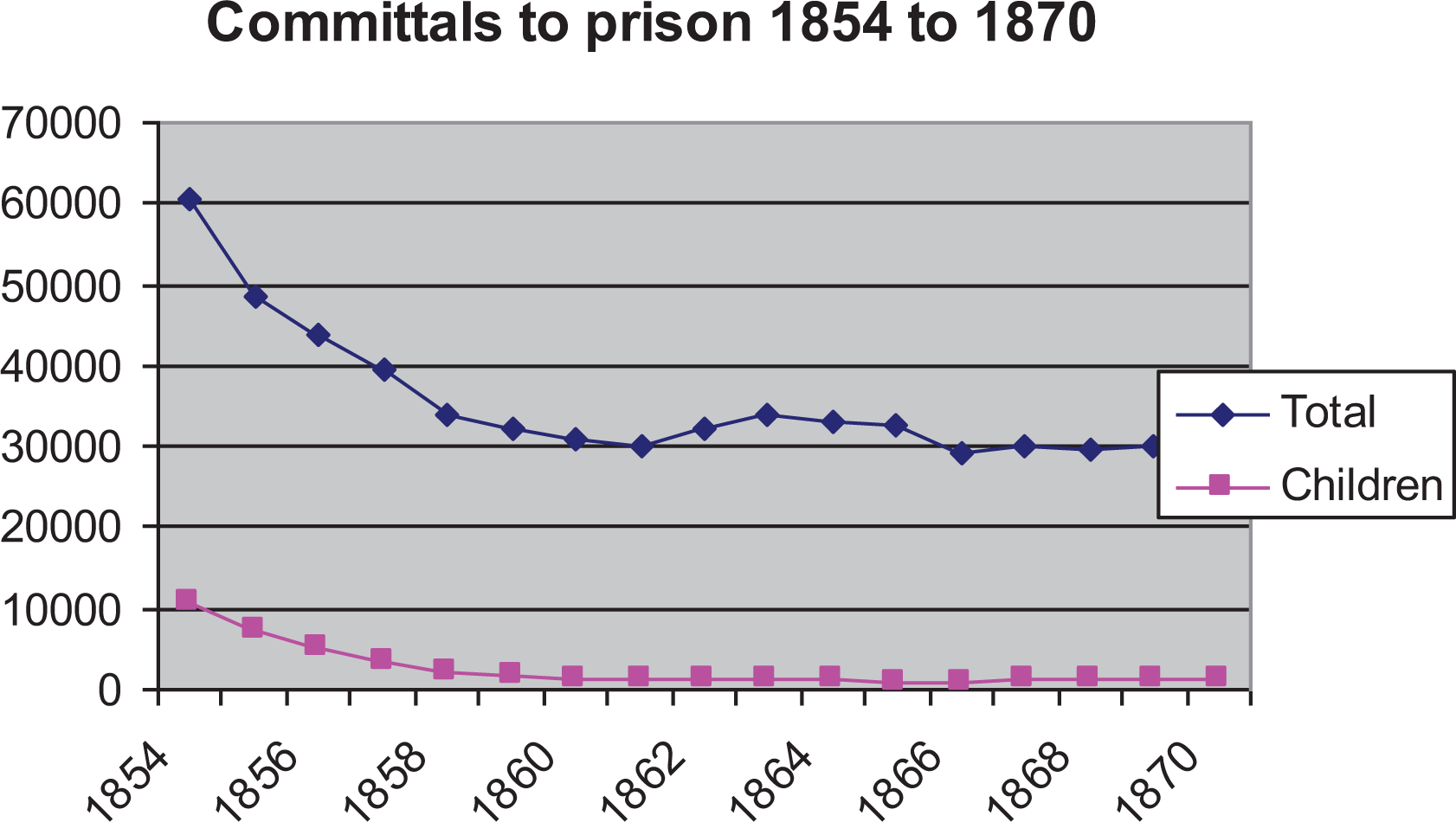
Committals to prison 1854 to 1870. Source: Reports of the Inspectors-General of Prisons, 1855–71.
A new bill was finally granted royal assent on 2 August 1858. Under the terms of the Reformatory Schools (Ireland) Act, the Chief Secretary could certify a school on the application of its managers or directors or withdraw such certification. 39 Any child adjudged to be sixteen or under, found guilty of an offence other than vagrancy at assizes, quarter sessions, Dublin Metropolitan Police courts, or at petty sessions under the terms of the Summary Jurisdiction Act of 1851, could be sent to a reformatory. 40 The reformatory sentence enshrined in the Act was for not less than one year and not more than five. The institutions would be established and managed by voluntary groups with financial support from the treasury in the form of a capitation grant per child. The new Irish Reformatories Act was permissive; it made it possible to establish reformatories and legally detain children in them, but judges and magistrates had complete discretion on how to dispose of a child found guilty of crime. All children destined for these new institutions had to serve fourteen days preliminary imprisonment in their local gaol, and consequently children found guilty of crimes continued to be sent to prison, even if they were given a reformatory sentence by the courts.
Supporters of the schools were concerned that the courts were not sending enough children to them and Murray, who was appointed Government Inspector of Reformatories in 1863, used his annual reports to remonstrate with magistrates who did not sentence children to reformatories. By 1870, ten schools had opened and there were 856 children incarcerated in them. Two hundred and fifty-six children were sent to them by the courts in that year, but this represented just a quarter of children given custodial sentences. The remaining three quarters were sent to prison. 41 John Lentaigne, who succeeded Murray as Inspector, wrote in his annual report that ‘the judicial bench and magistracy throughout Ireland were slow to appreciate the benefits conferred by…the Reformatory Schools Act’. 42 In 1884, a government enquiry into British and Irish reformatories and industrial schools was told that sympathetic magistrates in Ireland sometimes ‘softened down’ the crimes of children, especially girls, so that they would not be sent to reformatories. 43 Overall, as John A. Stack has demonstrated for the English and Welsh context, the impact of the reformatories on the numbers of children being imprisoned is difficult to quantify. 44 This is further complicated by the effects of the Famine and its aftermath on prison statistics in Ireland.
As the reformatory system evolved, there was one category of child criminals that John Lentaigne believed did not belong there. He was concerned that children as young as seven years old were being sent to the institutions, ‘some so young as scarcely to be accountable for criminal acts’. He believed that children under twelve years of age should not be sent to reformatories or prisons. 45 Ten years after the establishment of reformatories, a new proposal began to emerge to address this problem. In 1868, Industrial Schools legislation was passed in Ireland to facilitate the opening of residential institutions for children under the age of fourteen who were found begging, or wandering without a settled home or support, found destitute, or in the company of thieves. The Industrial Schools Act stated that justices and magistrates could send a child under the age of twelve found guilty of a crime which was not a felony to an industrial school instead of prison or a reformatory. 46 This provision for very young children was not successful and very few young criminal children were committed to industrial schools. Initially magistrates were again blamed for not enforcing it. In 1870, twenty-five children under the age of ten, and sixty-seven aged between ten and twelve, were sent to reformatories. 47 Maria Kean, who was eight years old, just a year above the age of criminal responsibility, was given a five-year reformatory sentence in Galway in 1872 for the crime of larceny. 48 There were, at the time, three industrial schools for girls in the county. As the Industrial Schools system evolved, it was the reluctance of the managers to accept criminal children into their institutions that kept them out of the schools. The managers complained that accepting such children cast a stigma on their schools and the children in them. John Lentaigne agreed that the success of industrial schools depended ‘on the fact that the inmates have not been contaminated by association with vicious children’. 49 In spite of general condemnation of the practice, very young children continued to be sent to reformatories and prisons. In 1880, ninety-six children aged twelve and under were sent to reformatories. 50 In 1881, a probationary industrial school for criminal boys under twelve years of age was opened at Kilmore in Dublin. Once boys reached the age of thirteen, they were transferred to ordinary industrial schools like that at Artane in Dublin. 51 Kilmore closed eight years later and has been described as a ‘futile effort on the part of the administration to reverse the trend of admissions to industrial schools’. 52
For most of the children who were sent to prison at this time, their stay was short and was spent in one of the local gaols in their county or town. Of the 1,007 committals of children to these local gaols in 1870, for example, seventy per cent were serving sentences of one month or less, and just over 200 served sentences of forty-eight hours or less. 53 Conditions in these prisons varied, and the children could find themselves in a large city gaol with hundreds of adult prisoners or in a small rural one with twenty or thirty other prisoners. The local gaols were subject to increasingly strict regulation and were rigorously inspected. Each had a board of superintendence which met every month or so, a government inspector who visited at least once a year, a local inspector who visited regularly, chaplains of different faiths and a medical officer. The medical officer attended sick prisoners, supervised the infliction of corporal punishment and assessed the physical fitness of prisoners sentenced to hard labour. 54 In Mayo County Gaol, the local inspector, chaplains, medical officer and an apothecary made 1,016 visits in 1870, while in Richmond these officers made 1,228 in the same year. 55 Any punishments meted out in the prison were entered into a punishment book which was presented to the board of superintendence at their meetings for discussion. 56
Both the local and government inspectors took an interest in individual prisoners and sometimes acted on their behalf. In 1869, in his report on Galway Gaol, the Government Inspector noted from the punishment books that an eight-year-old prisoner was sentenced to twelve lashes, a punishment which he thought ‘very severe for so young a child’. He found a nine-year-old girl, whose mother was in gaol and her father a ‘travelling pedlar’, serving a sentence for larceny from the person. ‘The poor child’, he noted, ‘had sore eyes from hardship and bad food’. Her only hope, he wrote, was to be sent to a reformatory or industrial school. He also reported that the local inspector had ‘taken charge’ of another girl who had been in the gaol for stealing a pair of boots and had found her a job. 57 Although the diligence of the local officers could vary from area to area, this level of inspection and visits contrasts strongly with the reformatories, where one inspector made usually only one or two visits in the year. While the problem of juvenile crime and the mechanisms to deal with it became more ‘visible’ in the middle of the nineteenth century, those who were sent to reformatories became largely invisible to society. 58
Saving Children from ‘Moral Ruin’
By the late nineteenth century, the drive to remove children, especially the very young, from the prison system was gaining widespread support internationally. The Home Secretary, William Harcourt, was so alarmed by the numbers of young children being imprisoned for petty crime in England that he directed he be personally notified in the case of every child under the age of fifteen sentenced to imprisonment. He told the House of Commons that imprisoning young children ‘tended to poison the fountains of life, and make a child a gaol bird before he reached the years of discretion’. 59 Magistrates were often criticised for the arbitrary nature of their sentencing, especially when it came to children. As the reformatory legislation was permissive, one child found guilty of a crime could be sent to an institution for five years, while another child guilty of the same crime could serve a week in a local gaol or not be prosecuted at all. Harcourt believed that many children were sent to reformatories for some crimes which he considered ‘some petty act of naughtiness (such as our own children commit every day)’, a practice which he called a ‘gross and cruel tyrrany’. 60 In 1875, an English prison governor described the unevenness of sentencing as ‘a kind of lottery’. 61 In Britain, the severity of some sentences was brought to the attention of government. Twelve-year-old Sarah Chandler was given a reformatory sentence for the crime of ‘wilful damage to a geranium plant’. Sarah was a first offender, and the harshness of her sentence led the Home Secretary to issue a ‘severe rebuke’ to the magistrate who sentenced her. 62 In the summer of 1889, two children who appeared before magistrates in Ireland left court with very different outcomes. In Hollywood, County Down, eight-year-old Elizabeth Johnston pleaded guilty to stealing a handbag containing ‘nine or ten shillings of silver, a broken ring and other articles’ from a house where she had gone with a collecting card. The bench condemned the practice of sending children to houses with such cards as it ‘placed them in great temptation’ and discharged Elizabeth. 63 At Mullingar petty sessions, a boy named Keenahan was charged with stealing geraniums from the grounds of the local Christian Brothers school. He was fined twenty shillings, or fourteen days in prison if he could not pay, and was warned by the bench that he would be sent to a reformatory if he appeared before them again. The boy served the sentence. The newspaper that reported the case, the Westmeath Examiner, included a comment piece on the trial with the headline ‘Too lenient’. 64
In 1883, Reverend Donegan, the Catholic Chaplain at Richmond Bridewell, told a government enquiry into the Irish prison system that imprisonment of children with adults resulted in irreparable ‘moral ruin’. 65 It was not just the welfare of the children and the possible ‘contamination’ from older prisoners that concerned reformers. It was also thought that children who were imprisoned early in life lost their fear of imprisonment and became inured to it. The Chaplain at Belfast Gaol, Reverend John Spence, described the case of a boy who was sent there from the country. When first imprisoned, ‘he shrank from everybody in fear and trembling, and wept bitterly’ but two weeks later he told the chaplain that it was not such a bad place because people were kind to him and nobody beat him. 66
Not every child inmate of Belfast Gaol experienced such kindness. In 1881, John Lentaigne spoke of the suicide of a boy, William McKinny, in the gaol ten years earlier. William was refused admission to Glencree Reformatory because he ‘had not sufficient bodily strength to undergo labour’. He was only three feet ten inches in height and was disabled. While serving a sentence at Belfast, he was given oakum to pick in his cell. He hanged himself with the rope. 67 In the same year, Bernard Young died in a snowstorm while being escorted through the mountains to Glencree Reformatory. He had been sent from Belfast Gaol without shoes or stockings. In an act of extraordinary bravery, the prison officer who was sent to escort him carried Bernard on his back through the snow and wind and refused to leave him while help was sought. Bernard died in the officer’s arms. 68 Lentaigne carried out an investigation into McKinny’s suicide and the case convinced him of the unsuitability of separation in prison cells for juveniles. 69
In addition to his role as Government Inspector of Reformatories, Lentaigne was Inspector of Prisons and had ample opportunity to meet child prisoners and reflect on the effect that such imprisonment might have on them and on society. Towards the end of his long career, he presented a number of papers at meetings in Dublin and spoke of some of the children he had come across: On my last inspection of Down Gaol in October, 1876,1 found recorded in the journal of the Governor of the prison, that in the previous September, a boy, ten years of age, was committed to the prison by one of the borough magistrates of Newry for having bathed in a mill-pond at Trevor Hill. The boy was sentenced to imprisonment in the gaol for one day. He arrived at the prison at 9.45 P.M., and was discharged from it on the following morning to travel a distance of twenty-six miles back to Newry, and find his way home as best he could, with only a few pence given him by the Governor to support him as he walked back.
70
a very young servant girl in gaol under a short sentence for stealing some trifling matter from her mistress. She was, I was informed, previously of good character, but had been tempted to commit the theft. Two years afterwards, when I again visited the gaol, I found the same girl in custody committed for immoral conduct. Sent adrift after her first imprisonment she had no means to return home, and without friends in the town of Downpatrick, or means of support, she had fallen from the paths of virtue. She has now passed away, and the undue action of the law was her ruin.
71
One group of children that legislators were keen to remove from prisons were those who were there awaiting trial in the higher courts. Bridget Galvin was ten years old when she was sent by her employer to the post office in Gort, County Galway to cash two post office orders. He accused her of stealing the money. At her trial at the Galway Assizes in March 1854, she sobbed and cried and protested her innocence, as did her father, who stated that he and his daughter had served their master faithfully and honestly. Bridget was found not guilty by the jury and walked free but she had already served two months imprisonment in Galway Gaol while waiting to be tried in the higher court. 74 When an inspector visited the same prison twenty years later, he was troubled to find a barefoot young girl running around in the company of women who were repeat offenders. The girl was imprisoned while awaiting trial and he wrote that she might have been ‘perfectly innocent’ but had ‘every opportunity of becoming as depraved as those with whom she is compelled to associate’. 75 The proposed solution for dealing with the issue was to try children summarily for indictable offences in the lower courts, rather that holding them in prison until the higher courts sat. In 1884, a bill was brought before parliament by Edward Gibson to extend to Ireland further measures for summary jurisdiction over children. 76 The bill became law in July. 77 The Act made a clear distinction between ‘children’ between the ages of seven and twelve, and ‘young persons’ who were aged above twelve and under sixteen. Under the new law, children who were brought to court for any indictable offence other than homicide could be tried by the lower courts of petty sessions or police courts. The possible sentences were, consequently, reduced to imprisonment of not more than a month, a fine of no more than forty shillings, and, for boys, six strokes of a birch rod administered in the presence of a senior officer and the child’s parents. If a court found a child guilty of an offence that it considered to be ‘trifling’, it could dismiss the case, order the child to pay damages or release him or her conditionally.
Reformers next began to turn their attention to petty offenders, especially those that had not been convicted before. In Britain, organisations like the Howard Association and individuals like Howard Vincent M.P. began to consider an improved system for the treatment of first offenders. 78 In 1887, Vincent’s Probation of First Offenders Act was passed. It made provision for any first offender ‘convicted of larceny or false pretences, or any other offence punishable with not more than two years imprisonment’, ‘regard being had to [their] youth, character and antecedents’ to be released on probation. 79 Uptake of the provisions of the Act by the courts in Ireland was slow and in 1892 a circular was issued to magistrates reminding them of the terms of the legislation. The Prison Inspectors reported that 11,694 committals in 1890–91 were of first offenders, adult and child, yet the Probation Act was only applied in 232 cases in the previous year. 80 They cited the case of a little girl of twelve who was arrested and brought to prison on remand for larceny and was so terrified that she was ‘almost in a state of collapse’. 81 ‘But still we find’, they wrote, ‘that little children are sometimes committed to prison, and a mark of infamy placed upon them for life…cases which to our mind would be more profitably dealt with under the Probation of First Offenders Act’. 82 Three juvenile first offenders had their sentences overturned by the chief justices in 1891–92. 83 One of these was a ten-year-old schoolboy from County Tipperary, William Dee. William had been given a sentence of fourteen days in gaol and two years in Philipstown Reformatory for the crime of ‘Injuring [an] electric telegraph wire’ by throwing missiles at it. Following the intervention of the chief justices, he was released after his fourteen days in gaol. 84
In 1895, a government inquiry into the prison system, the Gladstone Committee, was established in response to criticism of British prisons. 85 Paul Sargent argues that there was a strong perception that the prison system had failed and that the story of juvenile justice in Britain and Ireland ‘is a continuous discourse of failure’. 86 In an effort to address the problems and appease critics, new rules for the treatment of incarcerated juveniles were implemented in 1897. In March of that year, the General Prisons Board (which had replaced the office of Inspectors-General of Prisons) wrote to Irish prison governors outlining these new rules which specified that children under sixteen years of age who were serving sentences of more than a month were now to be sent to either Grangegorman or Mountjoy Prisons. Those serving shorter sentences in local prisons were to be kept completely separate from adult prisoners. The dreaded plank bed could no longer be used for children and they were to be allowed special library books, additional training in trades and outdoor exercise. Chaplains were to devote particular attention to young prisoners, and they were also to be allowed extra visits, if it was thought that they would improve their ‘moral welfare and future career’. Copies of the new rules were to be displayed in the cells of juvenile offenders. 87 Three years later, the nineteen male and four female prisoners who had been sent to Mountjoy under the new regime were reported to be doing well under the new rules, with the girls gardening, the boys showing an improvement in their physiques and all making ‘satisfactory progress in education’. 88
Outside of government departments and prison officials, public awareness of child welfare was increasing due to newly formed organisations like the National Society for the Prevention of Cruelty to Children (NSPCC) and the Philanthropic Reform Association, and to prominent individuals such as Oscar Wilde. As Maria Luddy has noted, the NSPCC was particularly skilful at promoting its activities in the press. 89 In 1897, Wilde was so moved by the children that he had seen while incarcerated in Reading Gaol that he wrote a long letter to the editor of the Daily Chronicle which was subsequently published as a pamphlet. 90 After his release, he read a report in the Chronicle that a warder from Reading had been sacked for giving a very small hungry boy a biscuit, a boy that Wilde had seen being admitted to the prison. In the pamphlet, he articulated extensive criticism of the English prison system with regard to its treatment of children. He believed that separate confinement of children, in particular, traumatised them and described seeing a boy in a cell whose face was ‘like a white wedge of sheer terror’ and who was crying out for his parents after a night spent alone in his cell. ‘The terror of a child in prison’, Wilde wrote, ‘is quite limitless’. Perhaps most interestingly, he wrote that the ‘contamination’ of children in prison came from the system itself, while it was the prisoners who showed kindness and humanity to each other. The little boy who was given the biscuit was imprisoned with two other children. Wilde wrote that ‘There is not a single man in Reading Gaol that would not have gladly done the three children’s punishment for them’. 91 He believed that no child under the age of fourteen should be imprisoned. Prison officials and reformers had been drawing attention to the plight of child prisoners for many years but their descriptions were buried in official reports, rarely read by the public. Wilde’s letter and pamphlet vividly brought the matter into the public domain. In the same year, the City Coroner for Dublin, Dr. J. E. Kenny, told a meeting of the Philanthropic Reform Association that, while on a visit to Kilmainham Gaol, he heard cries coming from a cell which, he was told, held children serving their fourteen-day preliminary sentences before being sent to a reformatory. He discovered that they were being ‘grossly ill-treated’, spoke to the governor and had the abuse stopped. 92
The children that Dr. Kenny heard being abused in Kilmainham were serving a mandatory sentence before beginning their reformatory sentences. Preliminary imprisonment of children had always been contentious. While there were some who believed that a child found guilty of a crime should first be punished in prison before enjoying the benefit of ‘reformatory treatment’, 93 many officials in the prison and reformatory systems thought that it had a detrimental effect on the child. Preliminary imprisonment was abolished in Britain by a short piece of legislation in 1899 which stated that an offender sentenced to a reformatory ‘shall not in addition be sentenced to penal servitude or imprisonment’. 94 When the Youthful Offenders Bill of 1900 was brought before parliament, the Philanthropic Reform Association supported a clause in the Bill to extend the abolition of preliminary imprisonment to Ireland. 95 In 1902, the Inspector of Reformatories in Ireland reported that ‘no child can for the future be sent to prison preliminary to being sent to a reformatory’. 96 The Youthful Offenders Act of 1901 also dealt with probation. While the Probation Act of 1887 was applicable to all first offenders, it was felt that extra measures were needed in the case of children and the Act extended the range of probation for young people and gave courts the power to place a child or young person with ‘any fit person…who is willing to receive him’ instead of prison while awaiting trial. 97
In 1905, ten boys and two girls under twelve years of age were imprisoned in Ireland, including a seven-year-old boy who was remanded in Galway Gaol while awaiting trial for travelling on the train without a ticket, using abusive language and assault. The General Prisons Board expressed their regret that such young children were still being sent to gaol by magistrates when there were so many alternatives available to them. While condemning the practice the prison authorities persisted in claiming that the good treatment experienced by children in gaol meant that it was not a deterrent. These children would, the Board wrote, be ‘branded with the Prison taint, and being well and kindly treated, lose the salutary dread of Prison’. 98 Although the number of children in prison was decreasing, it was acknowledged that the system of probation was not as successful as it might have been and it was really only in 1907 that the Probation of Offenders Act 99 ‘effected a great reformation’ and provided Ireland with a more workable system. One probation officer, Kathleen Gargan, was appointed after the enactment. She was assisted by an ‘unpaid volunteer’, Miss O’Brien. The Dublin Metropolitan Police reported that sixty-eight boys and eleven girls were subject to probation orders in the first year of the operation of the law. 100
In 1908, the Prisons Board claimed that the practice of imprisoning the very young had been ‘almost given up’. They singled out the case of a ten-year-old boy who was sent to Birr Bridewell for twenty-four hours for the crime of hurling in the street. They wrote that they hoped ‘that an effectual stop will soon be put to the committal of children of tender years to prison, as the “Children’s Bill” now before parliament’ makes it illegal. 101 This long piece of legislation, enacted as the Children Act of 1908, described as a ‘watershed event in terms of providing for the welfare of children’ brought together many strands of legislation regarding the treatment of children. 102 It dealt with incarceration of very young children in one short phrase: ‘A child shall not be sentenced to imprisonment or penal servitude for any offence…’. 103 Young persons could no longer be sentenced to penal servitude and could only be incarcerated if they were of so ‘unruly’ and ‘depraved’ a character that there was no alternative. The Act abolished the death penalty for children and young persons. 104 The section of the Act dealing with juvenile offenders came into effect at the beginning of 1910. 105 In 1912, the members of the General Prisons Board were ‘glad to report’ that only five children under the age of sixteen had been in their gaols. 106
Conclusion
This study has shown that large numbers of children continued to be sent to prison in Ireland until the last decades of the nineteenth century despite the establishment of reformatories and industrial schools. In the years immediately after the Famine, the number of children confined in Irish gaols was at its highest. The opening of reformatory schools for criminal children did not have an immediate impact on the extent of child imprisonment, both because children sent to reformatories had to serve a preliminary sentence in prison and because judges and magistrates continued to favour imprisonment over the new institutions. The incarceration of the very young in both prisons and reformatories was a matter for concern among many in the prison system, and legislation for the establishment of industrial schools made provision for certain children under the age of twelve to be sent to them. This provision was not a success, mainly because the managers of the schools believed that the introduction of criminal children into their institutions would bring a stigma of criminality with them and refused to accept them, and very young children continued to be imprisoned.
John Lentaigne, Inspector of Prisons, Reformatories and Industrial Schools, described how the ‘undue action of the law’ could have a devastating effect on the lives of children who came before the courts. Reformers who engaged in a campaign for the establishment of reformatories in Ireland described gaols as ‘seminaries of vice’. 107 However, this study has shown that there were attempts to improve conditions for children in prison in the second half of the nineteenth century. While the reformatory system was intended to remove children from adult prisons and was presented as a humanitarian response to child imprisonment, for many children a week in their local gaol may have been far preferable to five years in an institution many miles from their homes. The prison system was subject to more rigorous inspection and regulation than the reformatories. As the nineteenth century progressed, there was, however, a growing resistance to the incarceration of children in adult institutions. The drive to remove children, especially the very young, from prisons continued to grow, bolstered by pressure from organisations and individuals with an interest in child welfare. New laws were passed to change how the courts dealt with children and to introduce a system of probation. The Children Act of 1908 ended child imprisonment in Ireland in all but the most exceptional cases.
Footnotes
Declaration of conflicting interests
The author(s) declared no potential conflicts of interest with respect to the research, authorship, and/or publication of this article.
Funding
The author(s) received no financial support for the research, authorship, and/or publication of this article.