



Abstract
Access to information and transparency are considered a vaccine for ensuring good governance and countries must gear up for this vaccine to ensure accountability and prevent corruption. This paper probes the anticipated implementation challenges of the freedom-of-information (FOI) law in Jamaica, and the lessons Ghana stands to learn to improve on its FOI bill, currently at a deliberative stage. The lack of transparency in government or the public sector as a result of lack of access to governmental or public information will be tackled in this study. After describing the background, context, framework and methodology of the study, the paper presents findings, makes a comparative analysis, and provides recommendations especially for Ghana, which is still in the process of passing similar legislation.
Keywords
Purpose of the study
This study aims to examine the views of Ghanaians and Jamaicans on how access to government information could be or has been a means to transparency for governance in both countries. This will be done through examination of the operation of the Access to Information Act (ATIA) in Jamaica as well as probing the anticipated implementation challenges of ATIA. The paper seeks to compare the Jamaican experience to the expectation of Ghanaians, who stand to learn to improve on a bill currently at a deliberative stage in the country. The paper describes the case study in which the researcher conducted interviews and relied on secondary data from documentation review for analysis.
Background
Democracy has held a place in human history for centuries, providing principles and procedures for governing. The concept is highly desirable and recommended, not only by virtue of its principles, but also for the ideas emanating for peaceful co-existence. Freedom of Information (FOI) legislation, a tenet of democracy, works by conferring on the public the legal right to ask for and receive information held by public bodies. However, enforceability of FOI laws is what sets it apart from general pledges of access to information made by governments (Holsen 2007).
In Ghana, the Right to Information (RTI) first reared its head in public discourse in 1999. By 2003, the government had already drafted the first RTI bill to operationalize the constitutional right to information under Article 21(1)f of the 1992 constitution. This provision would suggest that Ghana has accepted, as a constitutional matter, the right to information enshrined in the constitutional document, and to all intents and purposes, the bill, when passed, will consolidate the rights of journalists and the public to access information from government officials and public institutions without hindrance. The bill is still at a deliberative stage, yet to become law.
Jamaica, on the other hand, passed the Access to Information Act (ATIA) in 2002, which came into effect in 2004. ATIA is a powerful tool, and an avenue to exercise that right which all Jamaicans can use to effect change. The purpose of the Act has been to reinforce and give further effect to certain fundamental principles underlying the system of constitutional democracy which includes governmental accountability, transparency, and public participation in decision making by granting to the public a general right of access to official documents held by public authorities (Access to Information Act 2002). Just as every Jamaican citizen has a right to participate in the decision making process of the country, so they have the right to seek and receive information related to operations in the government. Access to information serves to hold government accountable for decisions made, and to help uncover corruption and inefficiencies in government. The Act contains the following features:
The objects of the Act, which are to promote transparency, accountability, and increased public participation in national decision making by granting to the public a general right of access to official documents held by public authorities.
A public authority must publish, within 12 months of the commencement of the Act, of its establishment or the date of the Order bringing it under the Act, information on its organization and functions.
Every person shall have the right of access to an official document; no reason is required to be given and applications may be made in writing or transmitted by telephone or other electronic means.
The Act is made to apply to all public authorities and official documents which are up to 30 years old.
Government related documents includes all types of information including copies of documents, computerized records, emails, maps, audio-visuals etc.
The Act does not apply to the Governor General, judicial functions of a court, the holder of a judicial office or other office connected with a court, the security or intelligence services in relation to their strategic or operational intelligence gathering activities.
Deferral of access may only be done under stipulated conditions and the deletion of exempt matter is subject to conditions.
Fees are payable only for the reproduction of documents.
ATIA provides for nine categories of exemptions including cabinet documents, security, defence or international relations, documents relating to law enforcement, all documents subject to legal privilege, all documents affecting national economy, all documents revealing government deliberative processes, documents revealing trade secrets, heritage sites and documents affecting personal privacy.
The Act provides for two avenue of redress, internal review and appeal to appeal to tribunal.
It is an offence to do acts to prevent disclosure.
The non-application of Official Secrets Act to disclosure of information is provided for under ATIA.
The Minister must report to parliament on the operation of the act at the end of each year.
Review of the Act must take place not later than 2 years after appointed day (Access to Information Act 2002).
Passing ATIA came on the heels of a lot of agitation for government to open up, and much of the influence arguably came from the international system, particularly the United Kingdom (UK). Since Jamaica is a member of the Commonwealth of Nations, and a number of developed Commonwealth countries had some form of access to information law, pressure would have been borne on Jamaica policy makers to pass ATIA.
Ghana and Jamaica are favorite candidates for this study because of their shared heritage, in spite of their geographical contrasts. Located in different hemispheres, the two nations are former British colonies. The two nations have had stable democracy and need to be encouraged to improve upon their democratic credentials. Being Commonwealth nations, it will be argued that the two countries, including other developing Commonwealth nations, would have come under some form of pressure to commit to passing access to information laws to adhere to international standards as proof of their commitment to transparency and accountability. Coincidentally, the two countries started discussion of the bill in 1999, and Jamaica went ahead of Ghana to pass ATIA in 2002.
The study has been conducted within a human rights framework to keep it of manageable scope and size. It is an assumption of this paper that the information society should be located within a human rights framework in order to advocate for unrestricted access to information, especially public information held by government. The value of information as a human right is unquestionable, and is the reason why information is guaranteed as a human right, which is spelled out in many international treaties and in national constitutions. Freedom of information plays an important role, first, in the aspect of human dignity, secondly, as the best means of ascertaining the truth, and thirdly, as a fundamental underpinning of democracy. The aspect of democracy is perhaps most crucial (Mendel 2003) because at a more principled level, democracy is quintessentially about ensuring that governments perform in accordance with the will of the people.
Literature review
The following literature review supported this study. The research article of Callamard (2005) mentioned that freedom of expression is not limited to the right to express oneself, but also includes the right to seek and to receive information from others, including the right to obtain and read newspapers, to listen to broadcasts, to surf the Internet, and, of course, to participate in discussions in public and private as a listener. But the most revealing observation of Callamard related to this study is the right to access information held by public and private authorities. It places a duty on these bodies both to disseminate information of key public importance and to respond to requests for access to publicly held information. These views reinforce international as well as national provisions in advocating for free expression and the right to public information held by government.
In another research article, Holsen (2007) compared and contrasted federal FOI laws in Canada and in the United States as well as national laws in the UK. She examined the costs of compliance, as well as the response rates in each country and discussed the importance of recordkeeping to FOI laws. Holsen posited that exemptions are the key section of any FOI legislation because their breadth and depth determine how much information is actually disclosed. Holsen presented areas of FOI implementation worth examination to understand the complexity of dealing with the legislation. These range from response process system to cost of compliance, from time spent processing requests to FOI training; they serve as a model for other jurisdictions. This is of relevance to this study because countries stand to draw on the many years of experience of these three developed countries when writing and implementing their FOI laws.
A previous paper by Kirkwood provided thought provoking questions, which fleshed out the purpose of this current study. In his conference presentation in Addis Ababa that led to the foundation of Access to Information Network – Africa, Kirkwood (2006) posed the following questions: Does the government have the right to hide information from citizens on grounds of national security or business confidentiality? Should African parliaments play a role in training citizens for democracy through proactive distribution of public information and invitation of public criticism? What is the economic impact of free public access to information on national development? Should governments be fired or lose office for violating public disclosure requirements? The current study seeks to complement the efforts of Kirkwood in addressing these questions.
The research article of Lipinski and Britz (2000) discussed access to information as a critical need in an information age. They observed that where all rights were fixed by law, access to information must be a critical need and should be guaranteed for every citizen. They suggested that any right of control over information, adopted as an incentive to encourage creation and distribution of intellectual property, should be subservient to an overriding need to ensure access to the information (Lipinski and Britz 2000). Their proposition embodied the intent of any legislation underlying FOI regimes. Their observation that the access principle has not always been paramount in judicial or legislative applications provided a thrust to this study.
A research article by Sturges (2007) discusses the concept of transparency by juxtaposing it with accountability. He relates transparency as a concept to be applied in a social context to the revelation of human activity in which there is a valid public interest. The article expresses how the lack of transparency could lead to corruption. Sturges postulates various ways in which citizens could make use of transparency to scrutinize the activity of others, including freedom of information laws, accounting and audit systems, and the protection of public interest disclosure actions. This article provides a foundation for a new insight that this study contributes. The findings in Sturges’ article suggest that the introduction of transparency into governance is almost universally offered as a key to eliminating corruption, usually along with enforcement measures and relevant practical changes in modes of governance. This observation needs to be explored further through research, because some countries have enacted legislation, yet their governments appear to be corrupt and not transparent. This has significance when looking at how to track accountability in Ghana and Jamaica through the research problem under examination.
Another research article by Lord (2006) argues, in contrast, that predictions that transparency will lead inevitably to peace, understanding, and democracy are wrong. Lord investigates the case of the government of Singapore’s successful control of information, and explores the complex implications of growing transparency, paying particular attention to the circumstances under which transparency’s effects are negative. The author provides a good survey of an important subject and a critical perspective that is very much needed in a climate where transparency is seen as an obvious good for governance. The case of Singapore illustrates how a government can control information successfully by using soft methods, and by weakening the link between information flows and political change; and yet Singapore’s government is neither incompetent nor corrupt, two all too common pitfalls of secretive governments. Lord’s finding is contrary to the universal view that people hold about transparency. Singapore’s open but non-liberal society offers a cautionary tale for those who equate openness with democracy.
The book of Darch and Underwood (2010) provided illumination to the present study. They make assumptions that citizens really do deliberate, that the press is neutral and informs, that deliberative citizens make better choices, and that liberal democracies are a just and efficient system. They question how far rights to information have progressed in Africa and other parts of the world. The two authors indicate that the conditions that make information access rights both important and hard to implement are seen in their most extreme forms in Africa, from Angola, Mozambique, Nigeria, South Africa and Zimbabwe. They contend that only a handful of African countries have passed laws enabling access to information, and in the event that some did, they made no pretence that these laws were intended to encourage a new kind of relationship between the state and citizen. Darch and Underwood cite countries that implemented access to information law but missed out on the intended purpose of the legislation. Their observation suggests that conditions for implementation have been absent in the cited countries. The authors’ observation provides justification that freedom of information, as a piece of national or local legislation guaranteeing individual citizens and others access to government information, has not really caught on in Africa and other countries. This current study will specifically focus on Ghana and Jamaica to explore to what extent rights to information have progressed within the Ghanaian and Jamaican context.
Taken together, the results, the findings, and observations in this literature review provide a solid foundation for this case study. This literature review related the study to the larger ongoing dialogue in the field. So far, the literature review emphasizes the need for transparency in governance, and how its lack leads to corruption.
Ostensibly, what has been construed from this review is the idea that accountability is the reason why transparency is introduced into systems of public governance. This is because the concept of transparency allows examination of public authorities, who are regarded as the custodians of public information. Hence transparency in government will be a key focus of this study. The study will specifically explore implementation challenges in Jamaica and the legal vacuum in Ghana which makes it difficult for people to access information and government services.
Research problem and questions
While Jamaica passed ATIA in 2002 (in force in 2004), Ghana, to date, lacks a legal framework to facilitate access and utilization of public information. The problem of interest in this study is two-pronged; the anticipated implementation challenges of the law and the lack of transparency in government or the public sector as a result of the lack of access to government or public information. The lack of access to public information is of dire concern to Ghanaians, given the legal vacuum which makes it very difficult for them to access government information. As such, this study will focus not only on Ghana's lack of access to information law and transparency, but will explore Jamaica’s experience in the implementation process of ATIA which offers useful lessons for Ghana.
In this context, five questions will be explored within this study. Sub questions were constructed to augment these central questions: Can an information law enable citizens to have access to government information? How can the perceived right of access to information bring about transparency in governance? How can the exercise of access to information encourage public participation in governance? How does the exercise of right to information enable citizens to keep their government and public officials accountable? Are there any anticipated implementation challenges?
The case study methodology
The choice of a case study for this research is unambiguous. The intent is to bring an understanding of the issue under examination to add strength to what is already known through previous research. This methodology has been preferred because it emphasizes detailed contextual analysis of a number of issues and their relationship. A case study is the ideal choice because what has been examined is a contemporary real life issue: the lack of transparency in government or the public sector as a result of the lack of access to government or public information, as well as the implementation challenges of an FOI Act.
Methods of data gathering
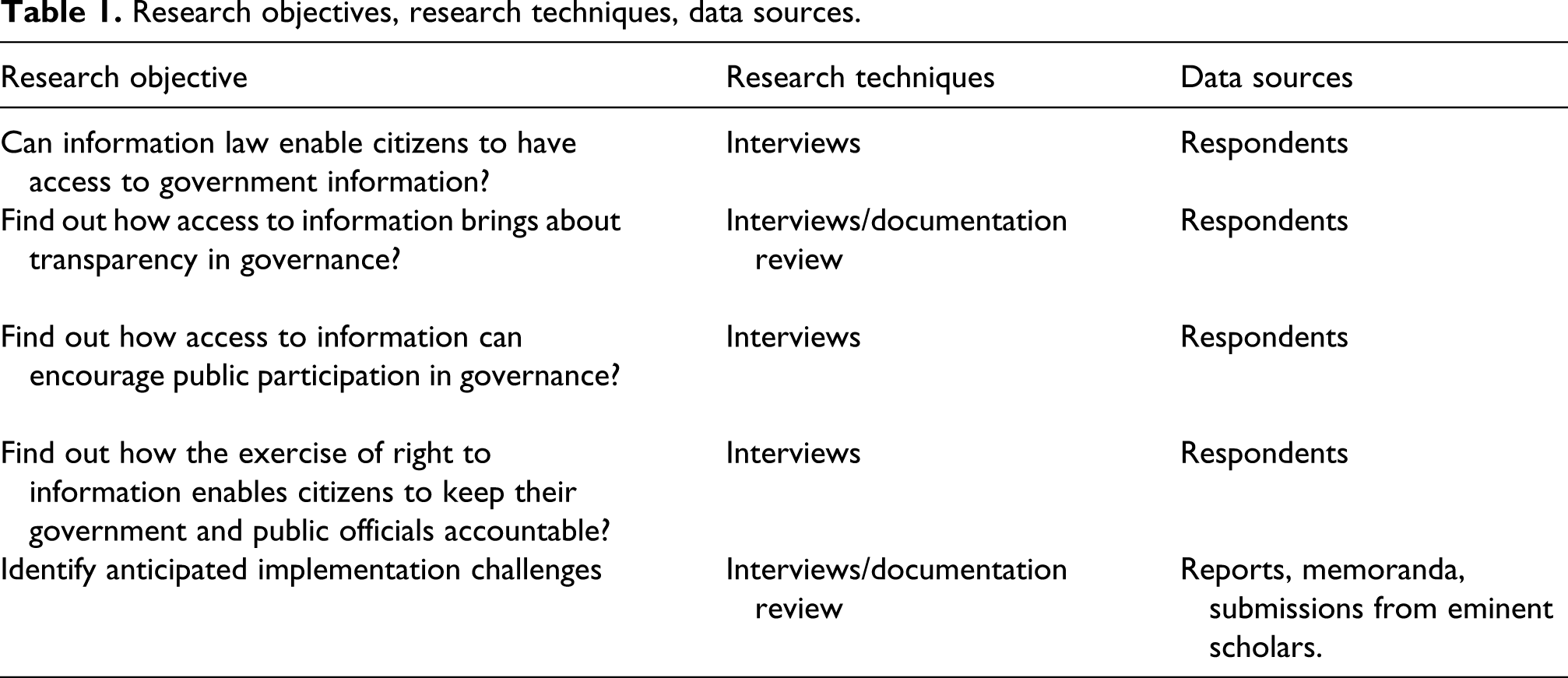
Data were gathered through interviews and through documentation review. The use of documentation review allowed the researcher a complementary view of the phenomenon studied, and the process helped to converge findings to ensure validity. Table 1 shows the research techniques used in the data collection procedure.
Research objectives, research techniques, data sources.
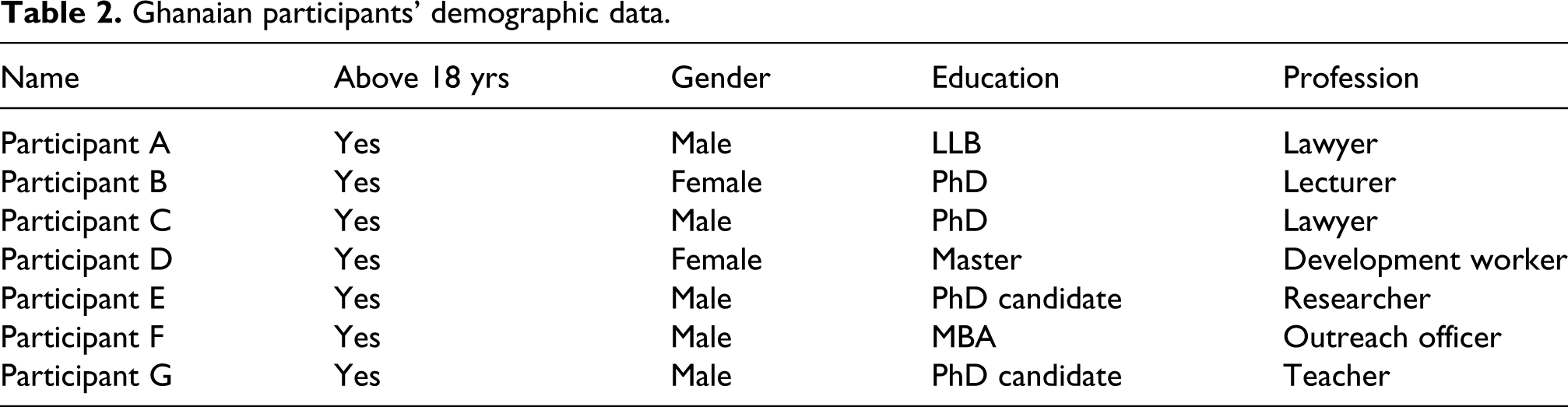
Ghanaian participants’ demographic data.
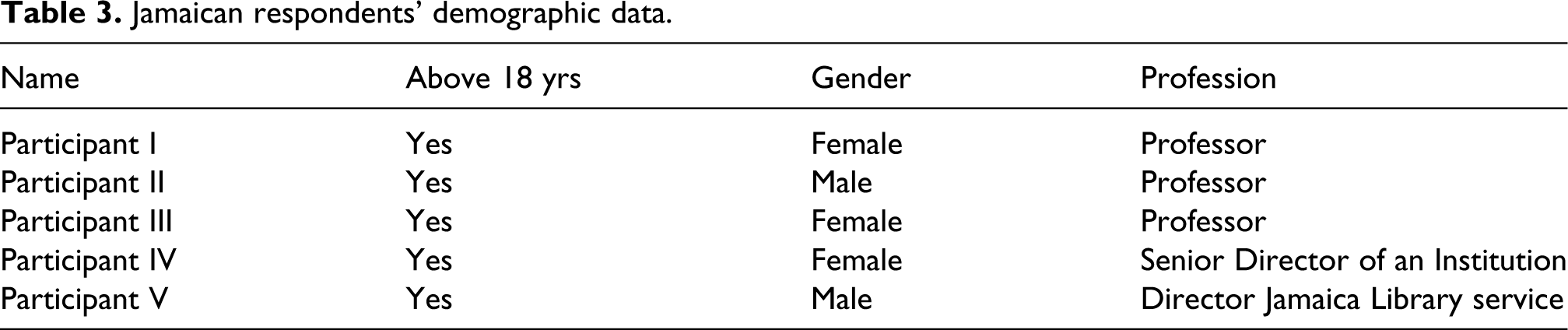
Jamaican respondents’ demographic data.
Study participants and environment
Interview questions were in an open ended format, while documentation review relied on secondary data from memoranda, reports, and comments from authoritative sites. Interviews were set up through email correspondence. Upon reply from participants, questionnaires were emailed. A total of 20 consent forms were sent out. Out of this number, 12 responded. 7 respondents were Ghanaians and 5 Jamaicans. It took more than two months for some to return responses. Some respondents were notified by follow-up email reminders. A total number of 12 questions were used to get relevant responses from respondents. One Jamaican respondent’s interview was conducted via Skype, hence the need to record and transcribe responses. All in all, interviews through email were suitable, as respondents did not feel intimidated, that could have had a negative impact on the interviews. Profile of respondents included university professors, graduate students, lawyers, librarians, and researchers.
Participants in this study were carefully chosen to be individuals who have knowledge about access to information perspectives. The research objectives and the characteristics of the study population determined which people were selected, and how many. A purposeful sampling approach is ideal for this case study in order to have a group of people who are able to inform about the research problem under examination. Against this background, participants were selected based on age, level of education, and experience so that they could purposefully inform their understanding of the research problem. Their ages ranged between 30 and 60 years, and included both males and females. It took approximately 6 months from March to August to complete this study.
Ghanaian respondents
Some Ghanaian respondents were pursuing graduate studies, while others worked in high level positions in international organizations. The setting was chosen based on the fact that it is a pilot study, and findings could serve as the basis for further exploration of the issue using a phenomenological approach in the near future. After the research proposal was approved by the Institutional Review Board (IRB) of the University of Wisconsin-Milwaukee, consent was received from participants indicating their acceptance to participate in this study.
Participant A is a lawyer by profession, and a correctional advisor in one of the recognized and renowned international organizations in Italy. As a former Director of the Ghana Prisons Service, the participant’s counselling role called for learning and mastering democratic principles. Participant B was born in northern Ghana, and is 46 years old. She received a PhD degree in health sciences from a midwestern university in the United States, and is currently a lecturer in a university in Ghana. She has been an advocate for women rights, providing information on health-related issues in deprived communities in northern Ghana. Participant C is a lawyer in practice, and a lecturer in one of the universities in Ghana. This participant worked as a principal investigator at the Commission on Human Rights and Administrative Justice in Ghana. Participant D works as a project officer with a non-governmental organization in Ghana. As a development worker, she facilitated workshops on socio-political issues. She recently received a master’s degree in public policy from one of the renowned universities in Hungary. Participant E is a research fellow at one of the universities in Ghana. He conducted research on information-related issues, especially access to health in rural communities. He is currently pursuing a PhD degree in public health at a university in the United States. Participant F has an MBA degree from a midwestern university in the United States, is committed to issues of democracy, and has been a political activist for one of the major political parties in Ghana. Participant G is a PhD student in a midwestern university. He has a good knowledge of democracy, and is committed to improving education in Ghana. These participants understand how access to information can impact people’s daily life.
Jamaican respondents
Participant I is a professor in one of the renowned institutions in Jamaica, and currently teaches library and information science courses. This participant is an expert in access to information issues in the Caribbean region. The participant is credited with a lot of presentations at international conferences on access to information as a prime research area. The participant has also written a book chapter on e-government and the Internet in the Caribbean. The participant has wide knowledge of knowledge management and telecommunication, openness, and access to government information. Participant II is a professor, and teaches courses in information policy in one of the best institutions in the Caribbean. This participant has published extensively, and served on numerous projects on issues related to corruption and transparency in the Caribbean region. The participant is a consultant on access to information legislation in the region and has published a book on access to information and corruption. Participant III is a human rights activist in Jamaica. This participant has received numerous awards in recognition of advocacy for human rights, and has been the chairperson of the Access to Information (ATI) Advisory Stakeholders Committee, who worked to strengthen the provisions of ATIA by recommending an Access to Information Unit to monitor the performance of government agencies in complying with provisions of the Act. Participant IV has in-depth knowledge of democratic procedures and principles, and is a director of information and access services in one of the highly recognized institutions in Jamaica. Participant V has worked in a field dealing with access to information and providing information to patrons. This participant understands how an information literate society can impact on national development.
Data analysis
The data were analyzed by transcribing responses and reading through answers to identify the main themes. Responses were coded and categorized under the following themes:
access to public information
transparency in governance
public participation in governance
implementation challenges.
A strategy called triangulation was used by combining the answers from interviews and evidences from the documentation review to confirm the results of this study. The strategy provided validity and consistency for the study.
Findings
Access to public information
Ghanaian respondents
The first issue raised was about access to information and the operation of an information law. Respondents indicated that although access to information was growing, particularly with the proliferation of FM radio stations, the print media, and the Internet, some reservations still remain about government information. A glance at the responses shows that people do not have information about government because information is simply not available to them. For example, participant E said, “It is very difficult to get public information.” Respondents indicated that information was treated as confidential and government officials wield so much power that it was difficult to have access to the information they held. Some respondents contended that there is some information available through institution-based websites, while others said that people do not get detailed information because there is little information on the Internet. Respondents revealed that information documentation in Ghana is a very big conundrum and that where there is information, retrieval becomes a daunting task. The difficulty in obtaining public information has more to do with the rather low level of ICT development, as some respondents indicated.
Jamaican respondents
Respondents indicated that ATIA has helped people access government information and has been a very useful tool for enabling every Jamaican to realize the right to information. ATIA provides an avenue to use information to strengthen access to all other rights. For instance, Participant III reported that “persons have been using ATIA to find out about matters important to them on issues of education, road building, provision of water, relocation of a dump, expenditure of funds by government, the care of children by the government and a number of other issues that they consider important.” Responses indicated that ATIA enabled the public to obtain data and information related to the activities of governments. While some respondents specifically revealed that the Act has helped citizens to access information about contracts, ministers’ travel expenses, and details of the examination records of their children, others revealed that access to information has become expensive, given the fees charged for the preparation of the needed data. Participant II reported: “from my analysis, from the information got through journalistic sources, some of the agencies for example, the registrar’s general department has not been as efficient in the release of information especially if it is a three day service, it ends up being a week or 2 and requesters would have paid fees for expedited services.” Responses also indicate that there are a number of exceptions, which may reduce the scope of the information that can be requested.
Transparency in governance
Ghanaian respondents
Questions # 2 and # 4 were answered by examining the responses from interviews. Ghanaian respondents believe that access to information will enable everybody to know what is going on in government. Responses indicate that if there is no access to information, everything seems to be done under cover, irrespective of whether government is transparent or not. On the other hand, when people have access to information, public officials will have it at the back of their minds that they are being checked and this will make them become accountable. Analysis of responses indicates that vibrant mass communication media can help people keep government officials accountable by allowing for critique of government policies and exposing corrupt practices and underhanded dealings in public administration. As regards the current state of government transparency in Ghana, responses were mixed. In spite of the fact that some government policies are made public through parliament, the information ministry, public and private TV, respondents indicated that it was difficult to assess the state of government transparency because Ghanaians get to know about government issues through private media, which are sometimes biased. Some respondents mentioned government officials that have difficulty in giving out information to the public.
Jamaican respondents
Answers to questions #2 and #4 were determined by responses from participants. Respondents indicated the general public has access to reports of ministries, agencies, and projects, which are increasingly posted on the government websites. Parliamentary debates are televised, as well as the proceedings of commissions of enquiry. Respondents believed that the Act contributed to transparency in government, but there is not yet 100 percent coverage as some public institutions have not appointed access officers or begun to participate. Respondents indicated that access to most of the features outlined in the Act has been made possible. For instance, Participant I said, “the Act has encouraged greater access to government information, but it is difficult to say how much participation there has been in governance because of the Act.” Focusing on whether ATIA enabled Jamaicans to keep their government and public officials accountable, respondents indicated that the process was not yet finished and that there was the need to go beyond access to information to further participation in government. Respondents indicated that ATIA has increased awareness even though not everyone was aware that they can have access to certain types of information. Transparency, as reported, has been enhanced in some sense, through contemporaneous development in the telecommunication sector, and the police have been able to stop some corrupt activities thanks to the Act, according to Participant II. Participant III also mentioned that residents of a particular community were able to get sufficient information to mount a successful legal challenge to the failure of a state agency (the National Water Commission) to fix a malfunctioning sewage treatment plant through using ATIA to get the information. This challenge resulted in the agency being ordered to fix the plant and given specific timelines by which to do so.
On the flip side, there have been some negative developments about government transparency where, for example, the police withhold statistical data until they wish to release it, and with regard to the cumbersome procedures involved in obtaining information. Participant II mentioned also that there has been only a slight attitudinal change with the passage of the law and there could still be a lot of resistance to releasing information.
Public participation in governance
Ghanaian respondents
Question #3 was answered by examining responses from interviews. Respondents revealed that public participation in governance was vital in any democratic dispensation. They indicated that when information is available and rendered accessible, it encourages public participation in governance. They also stated that people needed to be educated about governance and what it means to be in government. Since public participation in governance hinges on education there will be the need for the National Commission on Civic Education (NCCE) to re-double its efforts in information dissemination. Participant A reiterated the need for a vibrant, unbiased media in the dissemination of information.
Jamaican respondents
In response to question #3 respondents revealed that the Act encouraged greater access to government information, but it was difficult to say how much participation there has been in governance because of it. Respondents indicated there has been some publicity on the radio, TV, and in some newspapers as part of making the general public understand the meaning and scope of the Act. Respondent III said, “Jamaica has a very free media and the information provided by the media has informed people and allowed for them to make more effective participation in Government and governance on their own behalf and that of others.” Some respondents indicated that TV programs examined public policy and public administration, which actually allowed citizens to participate in the process of governance. Local radio talk shows dissect the work of government and citizens phone in to voice their disapproval or praise government for certain things done. The Access to Information Unit and some public authorities have used the World Wide Web to provide information on the Act and to enable the public to make use of the information offered by the agency as evidence of proactive disclosure of government information.
Implementation challenges
Jamaica
Regarding implementation challenges, answers were determined by examining data from documentation review and interviews. The Carter Center (2006) hinted at implementation challenges which ranged from scope to follow-through issues and from public interest tests to enforcement. Excell (2009), in her submissions to the Joint Select Committee on reform of the Jamaican Access to Information Act, reported two areas of concern regarding challenges. The first deals with the release of records by all public authorities under the Act and the second concerns compliance and enforcement of the right to information. Attention was drawn to the lengthy delays on the part of the Appeal Tribunal in handing down decisions following hearings. Respondents were also concerned about the procedure for requesting documents via the telephone, which was neither simple nor straightforward, and the need for trained personnel. Additionally, the disclosure by the Office of the Contractor General of a corrupt network involving a senior employee of its office, sham contractors, and possibly employees of the National Housing Trust, has raised concerns about the level of corruption in Jamaica according to a Gleanernewspaper report (Web of deceit 2010). The paper reports that Jamaica's slide down the international corruption index is continuing and reiterates the argument of Transparency International (TI) which shows that stemming corruption requires strong oversight by parliaments, a well-performing judiciary, independent and properly resourced audit and anti-corruption agencies, vigorous law enforcement, transparency in public budgets, revenue and aid flows, as well as space for independent media and a vibrant civil society (Web of deceit 2010). Unfortunately, with many of these factors not in place in Jamaica, corruption remains one of the major problems facing the country, according to the paper.
Ghana
Information from the Ghana government URL (Record Keeping 2010) indicates recordkeeping as being a huge challenge facing the country. It is clear that Ghana lacks in this regard and needs her archival system in the public sector to be in good shape in readiness for the law. Technology may or may not be the most urgent issue, but the possible lack of systems for records management and registries within government departments as well as the lack of personnel to help implement the letter of the law are serious concerns.
Conclusions
Overall the results of the research revealed some interesting issues concerning access to public information, transparency in governance, public participation in governance, and some implementation challenges in the two countries.
First, it was found that Ghanaians are concerned about the lack of operation of their constitutional right under article 21 (1)f of the 1992 Constitution. Respondents mentioned a certain degree of optimism about how the bill, when passed into law, will make government information accessible to the public. This finding raises concern about information documentation in Ghana, which has been a big conundrum. Much as findings indicate that Ghanaians have high expectations of the bill, if information is not properly documented and kept, retrieval will be a daunting task which will threaten democracy in general and the operation of a Right to Information (RTI) law in particular.
Findings on the accessibility of government information in Jamaica were mixed. While results show that ATIA has been a very useful tool for enabling every Jamaican to obtain information related to the activities of government, the current study shows the operation of ATIA to be somewhat bureaucratic. Access to information has become expensive given the fees for the preparation of the data needed. The number of exceptions reduces the scope of the information requested and the procedures involved in retrieving the needed information make it cumbersome for the public.
There have been great expectations about how an access to information law will enhance transparency in governance in Ghana. But such expectations need to be matched with a change in attitude on the part of Ghanaians, given the Jamaican experience.
The findings portray a not too good picture for Jamaica. In spite of the general public’s access to reports of ministries, agencies, and projects which are increasingly posted on the government websites, and irrespective of the parliamentary debates being televised as well as the proceedings of commissions of enquiry, the results of this study indicate a low level of transparency in Jamaican governance. Transparency in governance in Jamaica seems to be on a downward slide, as corroborated by reports in the Gleaner newspaper (Web of deceit 2010).
Some respondents indicated that executive agencies in Jamaica are not operating at their maximum level. These agencies have been allowed to charge fees for their services, rendering government public administration a lot more expensive for the citizens. Responses show that the Registrar General’s department has not been as efficient as it should and has not produced information in a timely enough fashion. A nominally 3-day service ends up taking a week or two, despite requesters having paid fees for expedited services.
The low transparency score in governance in Jamaica is corroborated by results from Table 4 showing the current and previous scores on transparency of the two countries from 2002 to 2010, according to Transparency International (TI). The index ranked participating countries according to the degree to which corruption is perceived to exist among public officials and politicians.
CPI: Ghana.
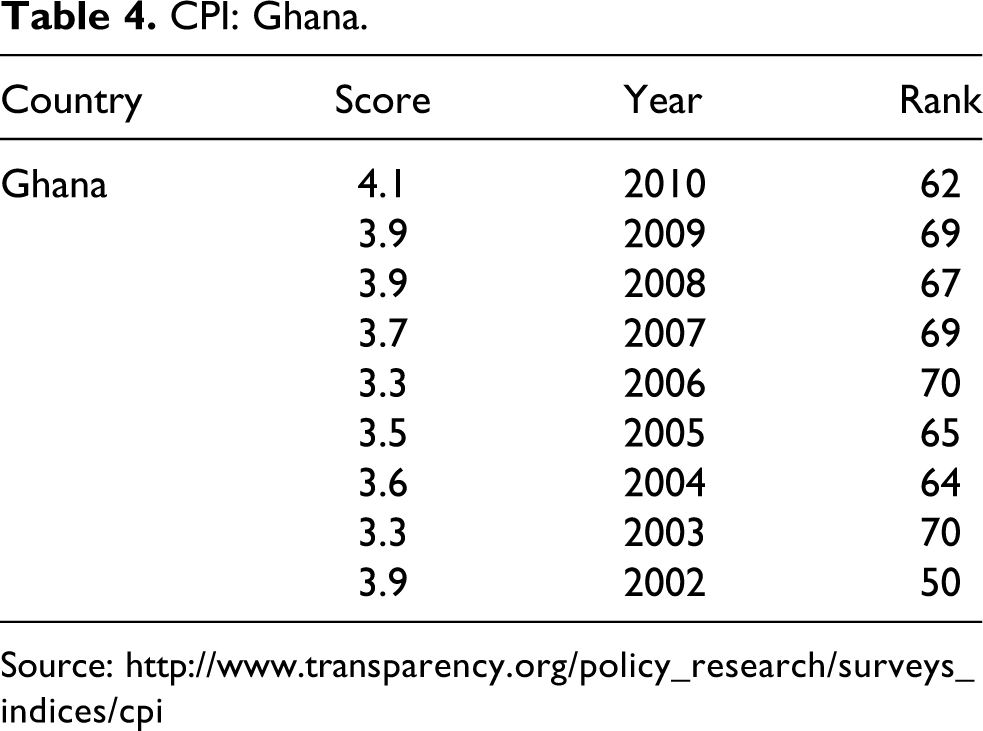
The Corruption Perception Index (CPI) drew on different polls and a survey to portray these results. The numbers from Tables 4 and 5 provide interesting results to contextualize the law in Jamaica and the not-yet-passed bill in Ghana. The results indicate a major decline in Jamaica’s corruption ranking from 64th in 2005, 96th in 2008 to 99th in 2009 as compared to a slight improvement in Ghana’s ranking from 65th in 2005, 67th in 2008, and 69th in 2009 to 62nd in 2010. These results show that Jamaica’s slide down the international corruption perception index is continuing while Ghana’s rise is slightly progressive.
CPI: Jamaica.
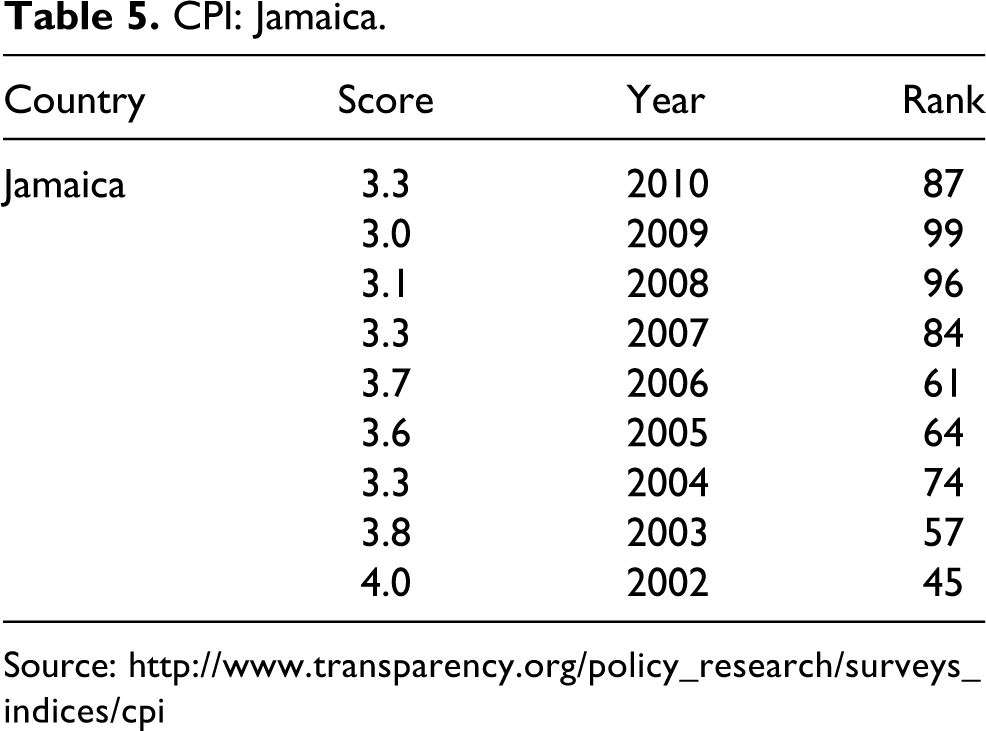
The Corruption Perception results also confirm the skepticism of informants about transparency in governance in the two countries. For instance, in Jamaica, there has been a slight attitudinal change among citizens with the passage of the law but there could still be a lot of resistance in the release of information, as Participant II indicated. Some negative developments about the police withholding statistical data until they wish to release it feed into the skepticism that people hold about government transparency. Yet Ghanaian respondents are basking in the hope that once the Right to Information law is passed, transparency in government will automatically improve. Ghana has to be cautious about counting her chicks before they are even hatched.
More essentially, the comparative results in Tables 4 and 5 are shocking because Jamaica has had a fairly advanced ICT policy environment which supports online access since the liberalization of the telecommunication sector in 2001(Jamaica Country Report 2009). The country also has a fairly high literacy rate as compared to Ghana. Given these strengths, one would have expected the country to continue to show very good CPI scores from 2002 onwards, when Jamaica’s score of 4.0 coincided with the passing of the ATIA law. But that is not the case. The question to be asked, therefore, is whether the Jamaican Act is making a difference? Based on the results of this study, the response would have to be negative.
The reasons for the downward trend in the Corruption Perception Index (which relates directly or indirectly to transparency) for Jamaica raise questions about the implementation challenges for freedom of information legislation. Simply put, these challenges include a host of factors such as lack of resources, resistance, illiteracy, low levels of education, and difficult IT access, which may all combine to result in delays and failure to comply with or use the laws effectively. This leads to the problem statement of this study, which concerns the lack of transparency in government or the public sector as a result of lack of access to government or public information. Much remains to be done to improve the operation of Jamaica’s legislation, and the implementation challenges hinted at by the Carter Centre and the submissions made by Excell to the Joint Select Committee will provide input for amendments to the ATIA.
What are the lessons for Ghana? Ghana will have to focus on the implementation challenges in making sure that when its own FOI law comes into force, there will be an adequate education campaign, considerable IT accessibility, and frequent publication and disclosure of public information. When these challenges are taken care of and information released fully, promptly and proactively, then there is hope for more transparent decision making, which will ultimately reduce corruption and improve Ghana’s CPI scores.
Limitation
Since this has been a small-scale research project undertaken by a single investigator, some limitations of the study must be noted. The results of the research are strictly related to the moment in which the case study was carried out from March to August 2011. As the situation of transparency improves and progresses as a result of a combination of factors including ICT, frequent publication and release of information, and e-governance, the same research undertaken in 3 years’ time may give different outcomes.
Recommendation for further research
The analysis of the results revealed interesting new issues to be studied. Future research should delve into international standards for FOI laws and the effectiveness of e-governance in combating corruption. Future research could focus solely on the implementation challenges of information legislation. New investigations could be based on FOI laws as tools for literacy promotion. The inability to generalize the findings of this research is recognized, even though it would have served as a baseline for further exploration of the issue. A phenomenological study is recommended in order to explore participants’ views and perceptions on the issue under investigation. In this sense, the study would take place in a natural setting, and the process would be inductive and would benefit from a larger sample size.
Footnotes
Appendices
Revised version of a paper presented at the World Library and Information Congress: 77th IFLA General Conference and Assembly, 13–18 August 2011, San Juan, Puerto Rico, in session 141 – Access to information: the Afro-Caribbean connection / Accés á l'information : paralléles entre l'Afrique et les Antilles; Access to Information Network – Africa (ATINA) / Réseau d'accès à l'information en Afrique (RAIA). The original paper was the winner of the IFLA LIS Student Paper Award, 2011.