



Abstract
We are living in a world that is changing rapidly due to the technological revolution and, as such, both libraries and librarians seem to be struggling to maintain their traditional roles. It is essential to respond to and integrate this new technology into library services, while maintaining the traditional role of librarians. In an age where knowledge and information are delivered in a fast paced mode, it is essential to re-evaluate the core competencies for librarians serving children and young adults. This paper presents a literature review of the key skills required for librarians in a digital era and the ALA competencies of librarians working with children and young adults. The paper also presents the feedback of nine librarians, working at the children's and young adult libraries at the Bibliotheca Alexandrina, on a survey that listed the essential skills required for them to serve their users in the best possible way. The skills were divided according to the age group and nine librarians responded to the survey by checking the skills they viewed as essential for a children's or young adults’ librarian. Finally, it presents a list of skills and competencies essential to our roles in providing access to information in a fast-changing digital age.
Introduction
Our everyday life is changing rapidly due to the technological innovations in all fields. These new technological changes are affecting the field of library science and information systems just like any other field. They are shifting the role of a librarian from simply being a book keeper to a dynamic agent that brings together information from different sources and makes it available for the users. Librarians in the new era are required to play different roles that demand the presence of various skills ranging from the traditional roles of user education, facilitation and evaluation to being a professional who is able to manage the digital information system within a library (Awad 2008; Bin Hashim and Mokhtar 2012). In order to disseminate knowledge and information available in all current formats: print and electronic, the new era librarians are required to understand the need to learn more about new technologies and be comfortable using them in order to perform their utmost role, which is to organize the vast amount of information and resources in a way that is conveniently accessible to library users (Bin Hashim and Mokhtar 2012). Aschroft (2004) stated the need for the skills, roles and characteristics of the LIS professionals to change in order to cope with the change in technology. However, there are very few studies that list the skills and competencies required for LIS professionals in the digital age (Nonthacumjane 2011), none of which are focused specifically on the LIS professionals working in children’s and young people’s libraries.
The main research question for this paper is: what are the essential requirements of librarians working with children and youth in the digital age?
Literature review
Most of the efforts done by researchers and librarians in identifying the core technology competencies for librarians focus on the regular reference and technical service librarians or the IT department staff. The lists of competencies presented by Bin Hashim and Mokhtar (2012); Abels et al., (2003); Nonthacumjane (2011); Soderdahl and Hirst (2009); Childers (2003); and Soo-Guan Khoo (2007) are mainly divided into Professional Skills, Personal Skills and Knowledge-specific skills that are applicable to anyone working in the information business.
Bin Hashem and Mokhtar (2012) divided the skills required for librarians to work efficiently and successfully in a digital era into two main categories: professional and personal. The professional skills include content knowledge, and ability to evaluate and filter based on appropriateness; ability to develop accessible cost-effective information services; ability to design information technology services based on needs and value; ability to organize and disseminate information for users; assess and evaluate the outcomes of information use and improve services accordingly. The personal skills include a range of competencies that are mainly present in any customer service environment and another set of skills that are referred to as survival skills. Those skills include flexibility, effective communication skills, positive attitude, teamwork, leadership, desire to seek opportunities for ongoing learning and values professional networking. The survival skills include items such as creative thinking, making quick decisions, self assessment and confidence.
Soo-Guan Khoo (2007) divided the competencies needed for librarians within a Singaporean context into traditional skills, value- added skills, IT, computer literacy, personal attitudes and traits, and subject knowledge. Those skills encompass competencies such as communication, cataloguing, user education and training, administrative and managerial skills, networking skills, and intellectual curiosity.
The Special Libraries Association Board of Director’s Committee listed two main types of competencies that are needed in order for the information professionals to succeed in fulfilling their role in gathering and disseminating information into professional and personal competencies. These two competencies are seen as extremely essential for any information professionals to survive their jobs. The professional competencies are classified into four competencies: managing information organizations, managing information resources, managing information services and applying the information tools and technologies. For the purpose of this paper, only the competencies for managing information resources, managing information service and applying information tools are listed. These competencies includes skills such as the ability to: evaluate the information resource according to the fees paid, quality, appropriate, synthesise information from different sources into a user friendly format, modify information product to meet user’s needs, customize information services to meet user’s needs, educate the user about information literacy and internet usage, assess users' wants and gaps and keep abreast of emerging technology and educate one’s self and self develop in the field of technology science.
The personal values and skills include the ability to present ideas clearly, respects diversity, takes risks, courageous, creative, flexible, seek challenging opportunities.(Abels et al., 2003)
Nonthacumjane (2011) reviewed the roles and skills of digital librarians that were listed by some LIS researchers. These skills were categorized into three different requirements for the technology competency: personal, generic and discipline specific knowledge skills. The personal skills include being analytical, reflective, flexible, creative, adaptable, enthusiastic; self motivated and has the ability to deal with different users. The generic skills, which are the general skills required in any discipline, include information literacy, communication skills, critical thinking, teamwork, ethics and social responsibility, problems solving and leadership. The discipline specific knowledge is the knowledge that is specific to the LIS field and is taught in the LIS courses. (Webjunction 2013 and RUSA 2003) These skills include knowledge of metadata, database development, digital archiving and preservation, collection development and content management system.
Childers (2003) discussed how the need for computer literacy for the library staff in general is becoming extremely essential to face this ever-changing technology. Training librarians to be computer literate can be required at three levels: baseline, desired and target levels. The base line information includes general skills such turning on the computer, familiarity with the basic operations of computers, turning on printers and adding paper, knowing how to open browsers and use menu bars, sending and receiving emails, and search engines. The desired level includes skills that are a little more advanced than the basic level, but are not as developed as those in the target level, which include knowledge of downloading files, cookies and general security issues.
Soderdahl and Hirst (2009) divided the areas of technology stated in the Iowa Core Competency List for the technology needed for librarians into: basic workstation set up, printing, Internet, computer security, Microsoft Windows operating system, email, calendaring, IT policy and others. These areas are required on three different levels: baseline, intermediate and advanced based on the degree of knowledge required to perform library tasks.
In light of the above, most of the technology competency requirements for librarians are generic in nature in the sense that they can be applied for librarians working with children and young people.
ALA Competencies of Librarians Working with Children and Young Adults
Walter (2001) compiled the set of Association for Library Service for Children competencies for librarians serving children in public libraries to define knowledge and essential skills (Personal/ Interpersonal competencies) for today’s librarians. The seven vital core competencies that contribute to successful job performance and services are: knowledge of client group; administrative and management skills; communication skills; materials and collection development; programming skills; advocacy, public relations and networking skills; and professionalism and professional development.
The Young Adult Library Services Association’s Competencies for Librarians Serving Youth outlined different skills and knowledge that teen’s librarians need to have to effectively serve youth in the 21st century and which tools they need to develop and adapt to change. It points out that the services teenagers need and deserve are not to be only maintained, but also be evaluated and improved. The competencies are generalized and divided into seven areas: Leadership and Professionalism; Communication, Outreach and Marketing; Knowledge of Client Group; Administration; Knowledge of Materials; and Access to Information and Services.
Methodology
Qualitative survey method was employed to develop a list of competencies required for librarians serving children and young adults in a digital era. A cross- sectional survey was used to gather the feedback of 9 librarians and 2 section heads working at the Children’s and Young Adults’ libraries at the Bibliotheca Alexandrina. The skills mentioned in the survey were combined from previous LIS lists of skills for librarians in the technology age and from the ALA competencies for both children’s and youth librarians (Walter 2001; Nonthacumjane 2011; Education Committee 2009; Young Adult Library Services Association; Skills for the 21st Century Librarian; Bin Hashim and Mokhtar 2012; and Abels et al. 2003). The survey was conducted in the library and all librarians voluntarily participated in the survey. The survey took place in two different sessions: one for the librarians working with children and the other for those working with young adults. The purpose of the survey was made clear and all the skills were clearly explained in Arabic to make sure the terminology was clear. The participants had all day to respond to the survey and submit it back. It is worth mentioning that not every element of the YALSA’s set of standards is demonstrated in this survey, only the skills that librarians should possess for teen services and what seems practically achievable in serving teens at the Young People’s Library at the Bibliotheca Alexandrina were included.
Participants
The participants were all Egyptians working at the Bibliotheca Alexandrina. A total of five librarians and one section head working with children and four librarians and one section head working with young adults participated in the survey. At both the children's and young adults’ libraries not all participant librarians provide reference services, and as such, the need for technology would vary according to whether they are providing reference service or program implementation. The demographics of the participant librarians were as follows:
Age-range
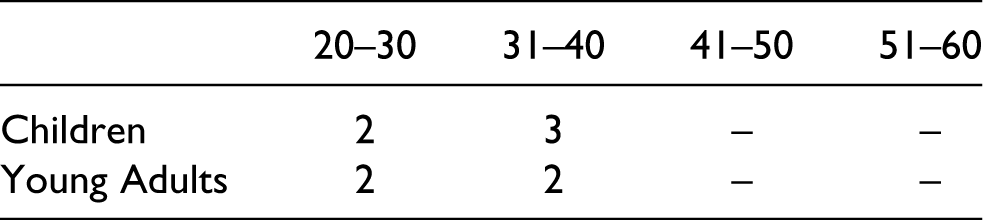
Gender
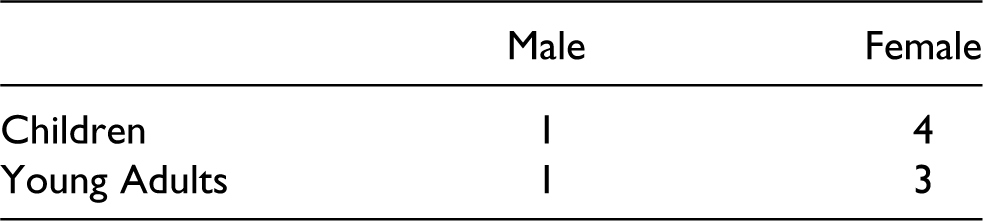
Education

Years of Experience
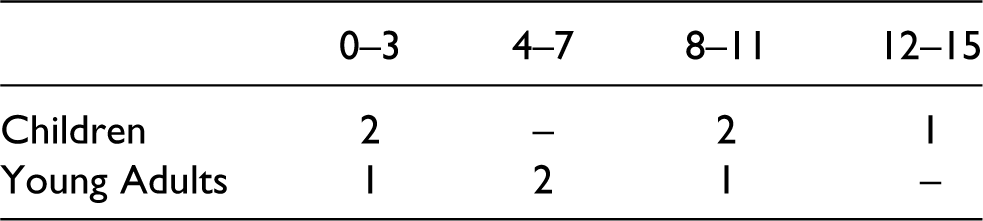
Type of Employment
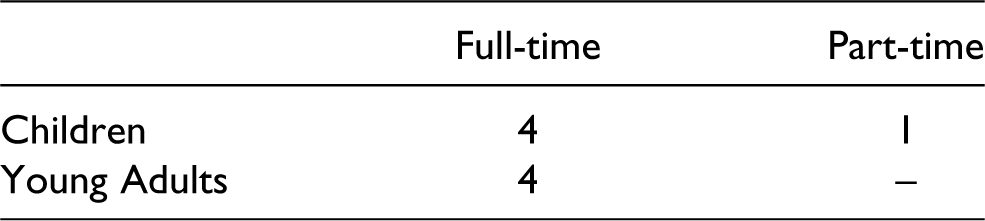
Languages Mastered

Results
Tables 1–6 present the responses of librarians, in both the children’s and young adults’ libraries to whether or not they agree or disagree to the personal skills, professional skills and discipline-specific knowledge required for serving users in a digital age.
Skill requirements for librarians serving children
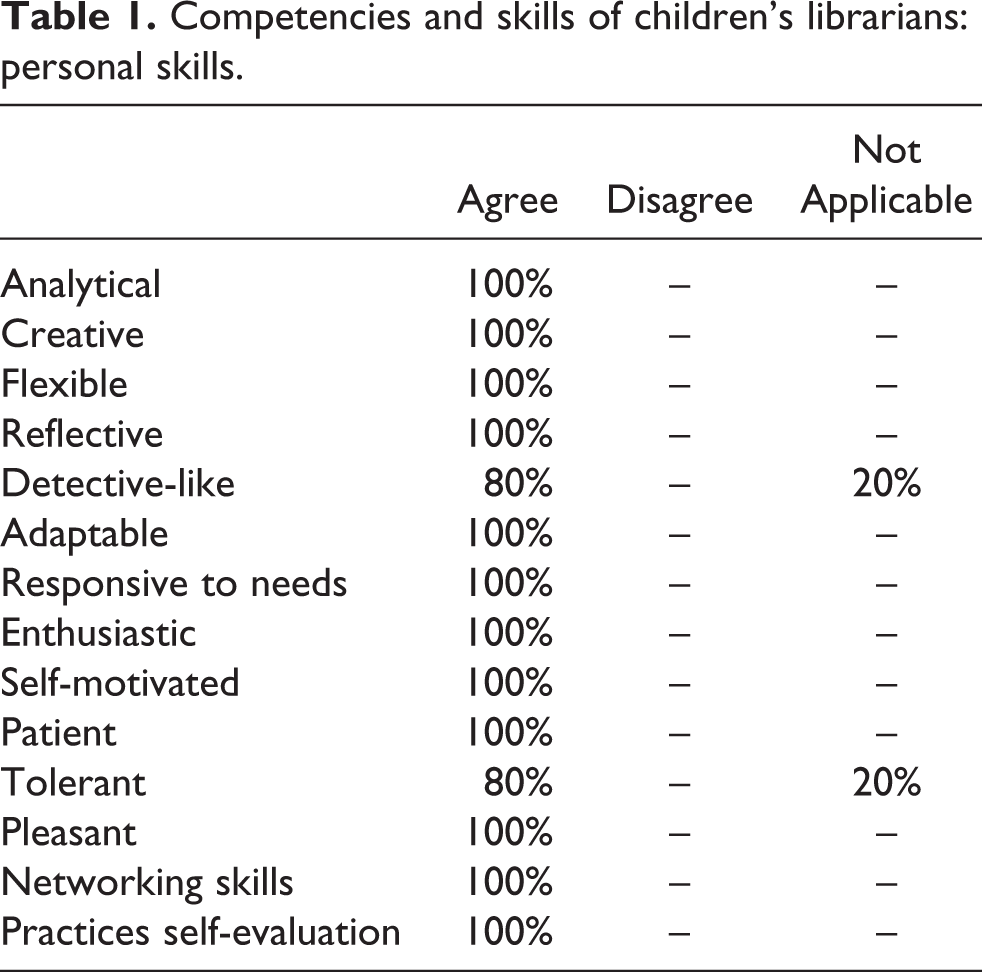
The personal skills listed as vital requirements for children’s librarians are: analytical, creative, flexible, reflective, detective-like, adaptable, responsive to needs, enthusiastic, self-motivated, patient, tolerant, pleasant, has networking skills and practices self evaluation. All the participants from the children’s library, except for one, agreed that all the skills are an essential requirement for librarians to better serve children in the digital age. Only one participant thought that ‘detective-like’ and ‘tolerant’ are not applicable (Table 1).
Competencies and skills of children’s librarians: personal skills.
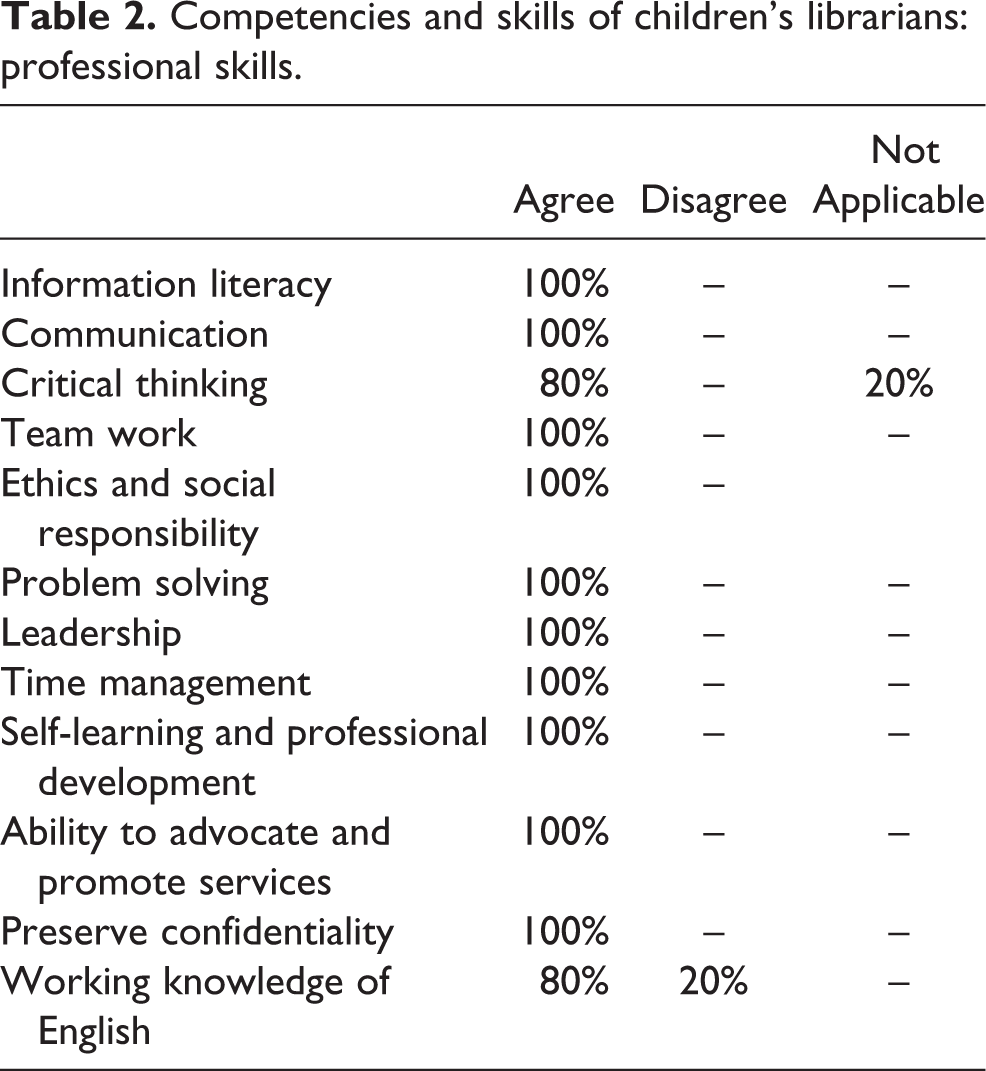
The professional skills listed as essential requirements are: information literacy, communication, critical thinking, team work, ethics and social responsibility, problem solving, leadership, time management, self-learning and professional development, ability to advocate and promote service, preserve confidentiality, working knowledge of English. Two participants agreed that all those skills are essential requirements. Two participants disagreed that the working knowledge of English is a crucial requirement. One participant thought that critical thinking skill is not applicable as a requirement for children’s librarians (Table 2).
Competencies and skills of children’s librarians: professional skills.
The discipline-specific knowledge required is: knowledge of child development theories, understanding individual needs, aware of collection, ability to evaluate content, knowledge of technical services, knowledge of electronic resources, technology literate, comfortable using different technologies, ability to develop, implement and evaluate programs, ability to design programs for parents and families. Three participants agreed that all those areas of knowledge are crucial to acquire. Two participants disagreed that being comfortable using different technologies is an important requirement and one participant perceived that being technologically literate is not applicable as a requirement (Table 3).
Competencies and skills of children’s librarians: discipline-specific knowledge.

Skill requirements for librarians serving young adults
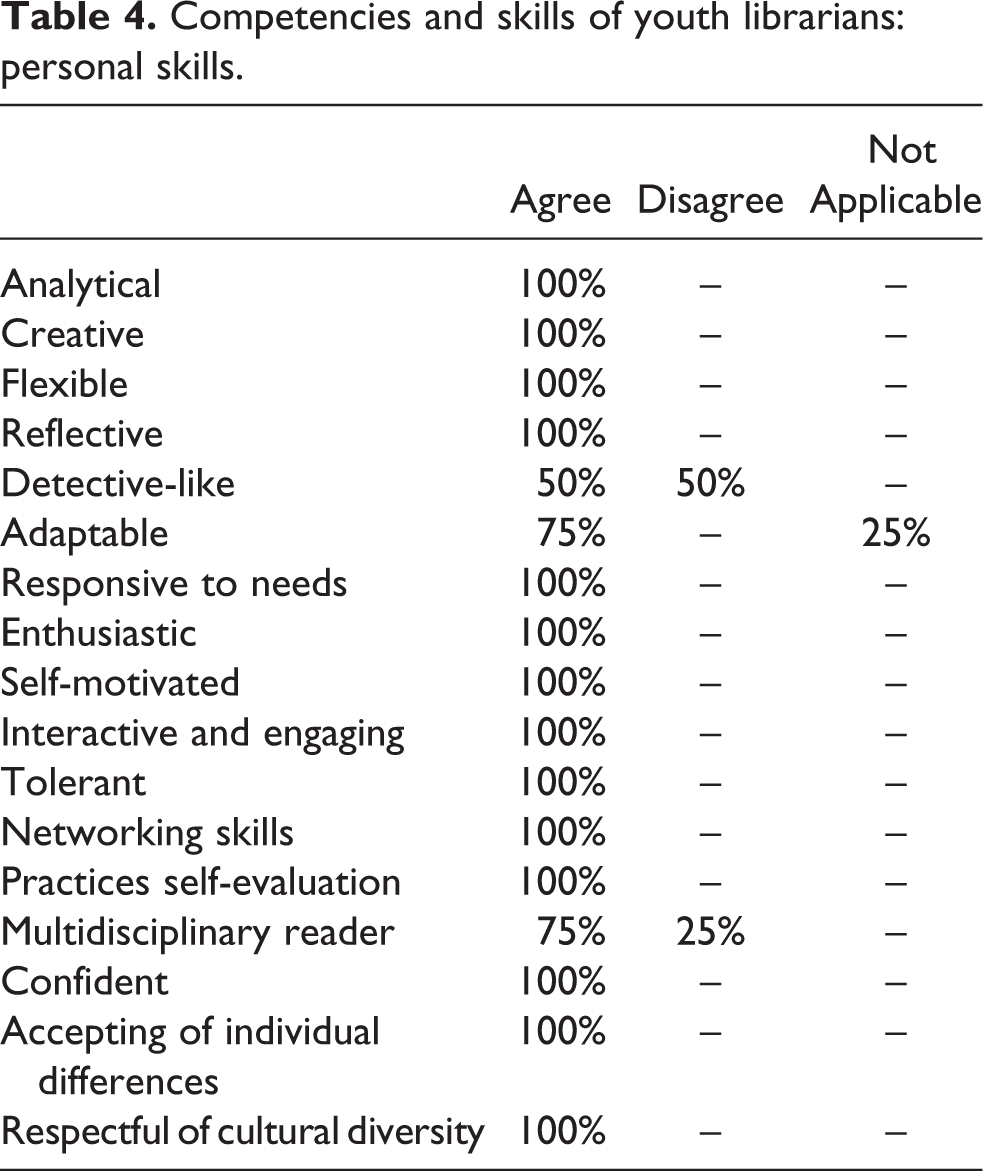
The personal skills listed as vital requirements for young adults’librarians are: analytical, creative, flexible, reflective, detective-like, adaptable, responsive to needs, enthusiastic, self motivated, interactive and engaging, tolerant, networking skills, practices self evaluation, multidisciplinary reader, confident, accepting of individual differences and respectful of cultural diversity. One participant from the Young Adults’ library agreed that they are all an essential requirement. Two participants disagreed that ‘detective-like’ is required and one participant disagreed that being a multi-disciplinary reader is a requirement. One participant thought that ‘adaptable’ is not applicable (Table 4).
Competencies and skills of youth librarians: personal skills.
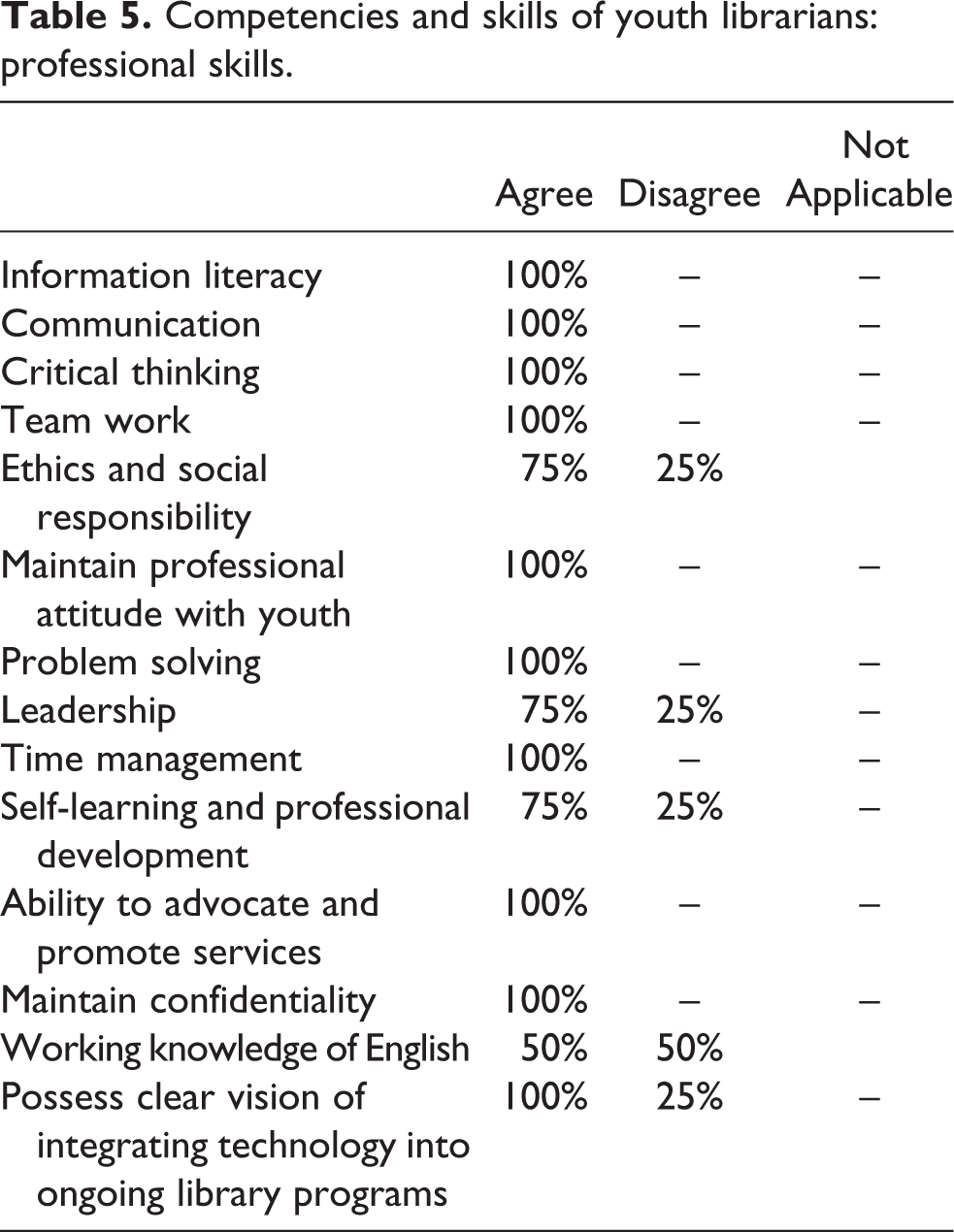
The professional skills listed as essential are: information literacy, communication, critical thinking, team work, ethics and social responsibility, maintain professional attitude with youth, problem solving, leadership, time management, self-learning and professional development, ability to advocate and promote service, maintains confidentiality, working knowledge of English, possess clear vision of integrating technology into library programs. Two participants agreed that all those skills are essential while two participants disagree that working knowledge of English is essential. One participant disagreed that ethics and social responsibility; leadership, self learning and professional development, working knowledge of English and possessing clear vision of technology are essential to better serve youths (Table 5).
Competencies and skills of youth librarians: professional skills.
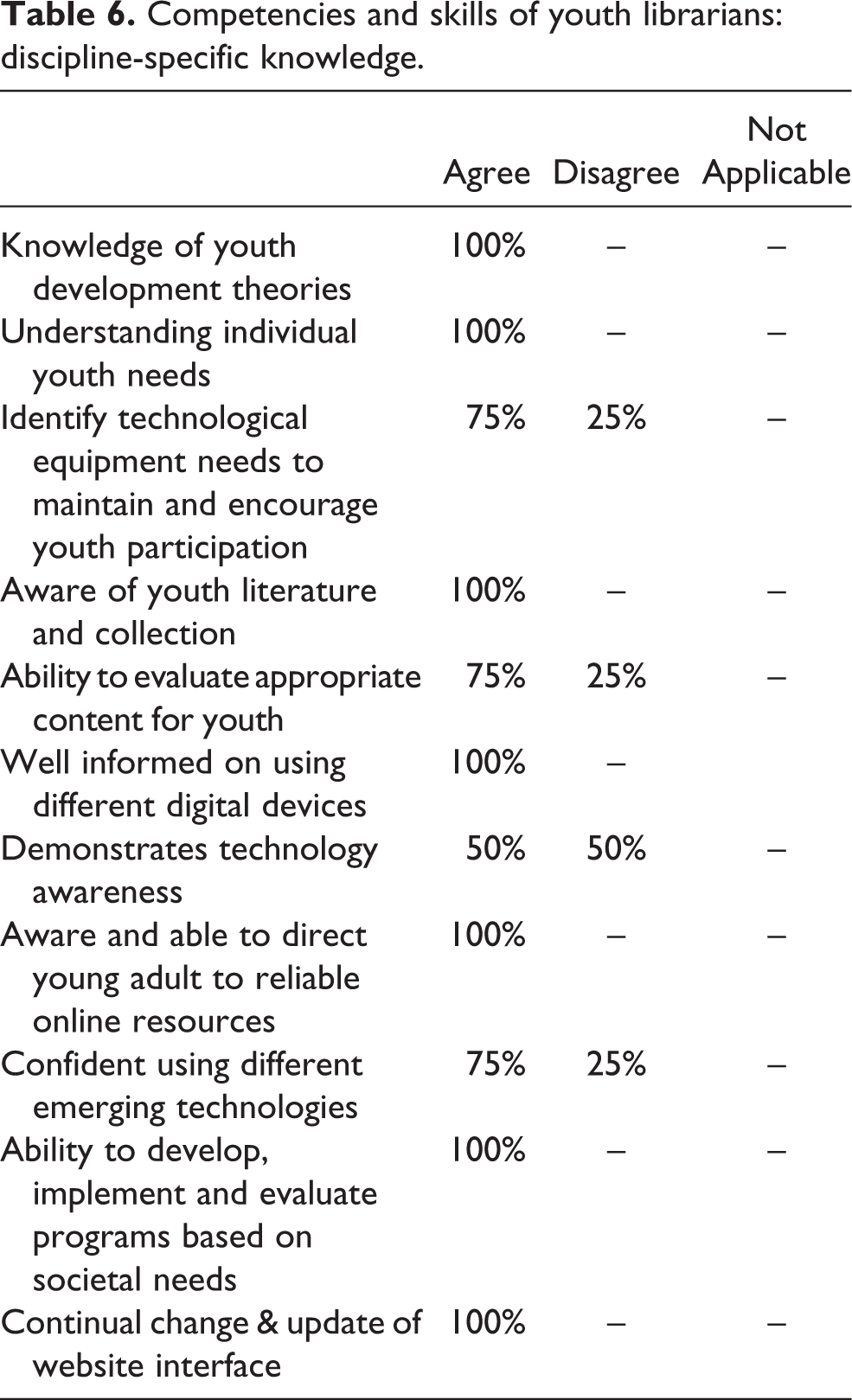
The discipline-specific knowledge required is: knowledge of development theories, understanding interests and needs, identify technological equipment, collection awareness, ability to evaluate content, well informed on using different digital devices, technology awareness, aware of reliable online resources, confident using different emerging technologies, ability to develop, implement and evaluate programs, and continual change and update of website interface. Two participants agreed that all those areas of knowledge are crucial for youth librarians to acquire. Two participants disagreed that demonstrating technology awareness is an important requirement and one participant disagreed that the ability to evaluate content and confidence using emerging technology is essential. One participant disagreed that identifying technological equipment needs is a requirement (Table 6).
Competencies and skills of youth librarians: discipline-specific knowledge.
With regards to the feedback of the section heads of both the children and young adult’s librarians all the listed skills in the personal, professional, and discipline-specific knowledge areas were marked as crucial competencies for librarians to better serve their users in a digital age.
Discussion
This study was guided by the two main questions: “What is needed to educate future children’s and youth librarians? And “Is the current curriculum content adequate to create professional librarians serving children or teens in the 21st century?
According to the feedback from the survey for both the children’s and young adult librarians, the final skill requirements of both types of librarians are mostly consistent with the previous research for librarians of all types and specializations. The majority of the participants agreed that most of the personal, professional skills and the discipline specific knowledge were essential for librarians serving children and youth. For example, 80 percent of the participants agreed that being technologically literate is important in serving children and 75 percent of the participants agreed that being confident using technology is essential when serving youth.
It does appear that there are a lot of skills required and that could pose a problem as it would be difficult to find librarians with all those qualifications. There is a belief that librarians are introverts and, if that is true, it would be quite difficult to find a qualified librarian based on those skills (Soo-Guan Khoo 2007). However, some skills anchor other minor skills and some are more important than others. For example, in personal skills, an adaptable librarian can be “flexible” and “tolerant” enough to cope with the integration of technology in the library services as well as serving the users (Fourie 2004). Also the ICDL (International Computer Driving Licence), a programme which defines the skills and competencies necessary to use a computer and common computer applications (skills and knowledge in the areas of databases; graphics and multimedia; Internet use and email programs; networks and other communications systems; operating systems and computer hardware; programming; spreadsheets and word processing) includes most of the soft skills listed as a requirement for librarians nowadays.
In the process of conducting this survey, a literature review of the courses taught at the library science programs in Egypt was carried out. The outcome of the review reflected that there is a gap between the library science curriculum in the universities of Egypt and the librarianship skills required for market demand in a technology era. Hassan (2012) mentioned that a number of courses have been added to the LIS curriculum to respond to the current market requirements, such as web resources, social and digital information, communication skills, copyright, Web markup languages (MXL, HTML) and data mining. The modernization of the library science curriculum in Egypt is in place and the new courses cover 31 percent of the overall curriculum (Arwa 2009). This upgrade of course topics aims at integrating new technology into library science courses in Egypt. In a survey about the professional development of librarians in a digital age, Soliman (2010) found that in the Library and Information Science Department at the Alexandria University, the computer science courses rate a lot higher than communication and leadership skills courses. However, this needs to be taken into consideration when planning library science curriculum as it contradicts with the findings mentioned by Nonthacumjane of the study carried out by Gerolimas and Konsta (2008), which indicated that communication skills are one of the highest ranked skills for a digital librarian.
The technology age is indeed overwhelming for both libraries and librarians. In order to cope with this age, it is important for libraries to develop a set of requirements that include the highly required skills needed in a present-day librarian position. Those selected skills could be listed as follows:
Personal Skills: creative, adaptable and self-motivated. Professional Skills: communication & leadership, self-learning and professional development and possesses clear vision of integrating technology into library programs. Discipline-Specific: knowledge of user’s needs, technology literate, knowledge of emerging electronic resources and collection development awareness.
The above mentioned skills are the most important skills that would reflect the librarians’ willingness and comfort level to work in a world of technology. In addition to those skills, knowledge of Web 2.0 seems to be essential for librarians to be on track with the huge movement of social networking that appears to be a major attraction for young adults nowadays. This would also facilitate having an interactive website where information about the library services and collection could be exploited by the young users.
Limitations of study
A major limitation of this study is the sample size. The number of participants from the children and young adult libraries is not representative of librarians in Egypt. If the sample size were bigger, the results might have reflected a less unanimous agreement on the required skills. Another limitation is the educational background of the librarians. Only one librarian in each section has an LIS certificate. This means that the feedback from the participants is not indicative of the LIS curriculum and market demand, and that experience and general knowledge could be a variable that needs to be considered when doing more research in this field. A third limitation is the lack of previous research done in the fields of children’s and young adults’ librarianship regarding competency requirements in Egypt and so the ALA competencies were the one used as a guideline.
Conclusions
The new generation of children’s and young adults’ librarians, and libraries in general, are overwhelmed by the perpetually changing technology. In order for them to cope with such continuous change, and provide information to young users in an exciting an efficient manner, special skills are needed. Those skills are acquired through formal education, experience and above all personal inclination. Lists of the essential skills, developed from a mixture between the traditional core competencies for children’s and young adults’ librarians and basic competencies for digital librarians are included in the tables.
Not everyone is comfortable using technology or at ease with rapid transformations, even when a level of technology education is in place. It is also important to keep in mind the classification of the country based on the available resources, and according to the level of technology integration in everyday life: its “technoholic” level.
This study brings up an important thought and that is: would it be better to keep two separate fields of library science in countries with a low technology integration level? Should we consider having a classical librarianship certificate plus a new branch of high technology in libraries?
Recommendations
In light of the above, continuing education of technology related courses for librarians who are already in the field is highly needed in the new era. No doubt professional development for library science educators and paraprofessionals in regard to technology is vital for today’s libraries to be proficient in the current trends of technology to keep pace with the changes.
Competent librarians must often seek out learning opportunities, be self-motivated, and have professional development plans that include conference attendance, online courses, join professional forums to understand the importance of keeping up with technology and willingness to adapt and explore the possibilities that new technology brings.