



Abstract
The New Library of Alexandria performs a unique 21st century role as a library, a museum, an art gallery, an archive, an academy, a conference center, a science center, a university, and a special school. By blending today’s information and communications technology with yesterday’s rich cultural heritage and national memory, the Library of Alexandria has shown that innovation from the top down preserves the past and guarantees a future.
Introduction
The New Library of Alexandria, sometimes called by its Latin name, the Bibliotheca Alexandrina, or as its staff and many friends like to call it, just the “BA”, is not a national library, but it works closely with many national libraries and archives. Simply put, it is a sui generis creation: a unique institution that is part library, part museum, part art gallery, part archive, part academy, part conference center, part science center and part university and special school. It has been seen by many, including a previous President of the Egyptian Republic, as a national institution with an international dimension and a global humanist mission. That mission was to recapture the spirit of the ancient library of Alexandria with the tools of today and in the context of the 21st century. Built almost exactly on the same spot where the ancient library once stood, it aspires to be a worthy successor to its ancient namesake. So although it is not the national library of Egypt, it is a very prominent institution in Egypt and much of the world.
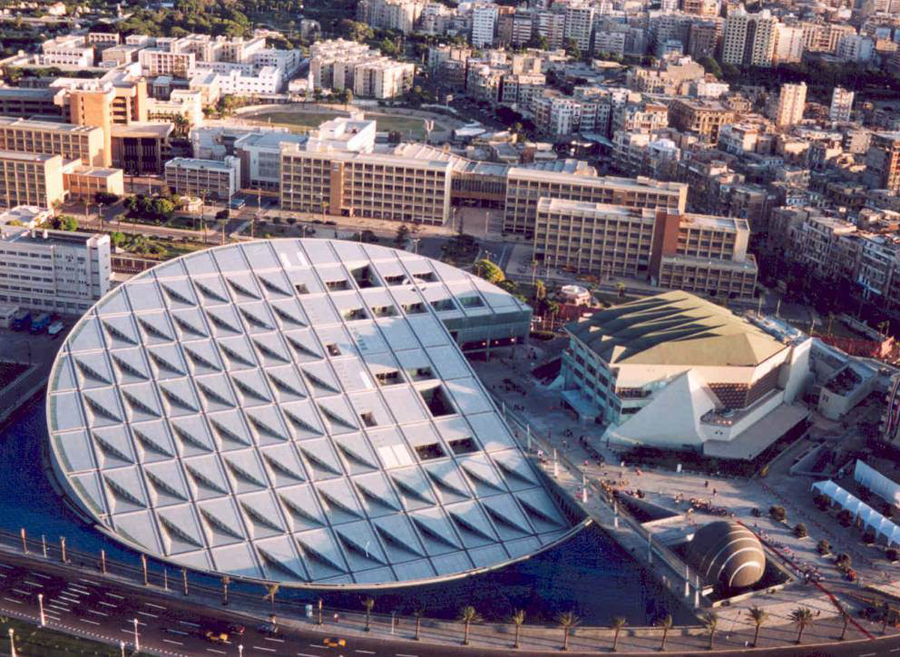
The New Library of Alexandria from the air.
Like national libraries, the BA performs many services and has a diverse audience. Beyond the books, it promotes in novel ways the national memory and the culture of the nation. The BA has been Egypt’s pioneer in conserving knowledge and experiences in conventional and digital formats.
Founded by a special law in 2001 1 , and inaugurated in October 2002, it is an autonomous institution dedicated to the production and dissemination of knowledge and it is attached directly to the head of state as the highest symbol of national sovereignty. In January 2011 the youth of Egypt launched a revolution that toppled the president and yet supported the BA by protecting it with a human chain, and by wrapping it in a huge national flag.
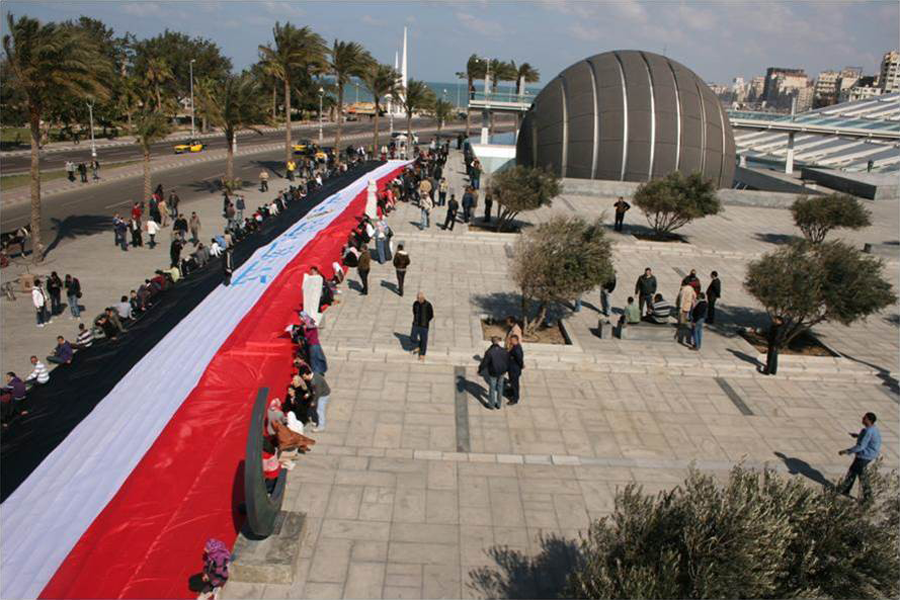
Citizens protecting the New Library of Alexandria with the Egyptian flag.
It was an exalting moment, which gave ample proof that the unique multi-faceted institution had succeeded in the eyes of its primary users. This brief essay is to explain why we have been able, perhaps better than most, to meet the huge challenges that faced and still face us, and face all national libraries in the world, and to look forward to the future of this unique library and ask some questions about the future of all libraries, especially national libraries around the world.
Challenges met, challenges to come
From the beginning the BA built an environment that would be favorable to innovation. We adopted the view that the acquisition of knowledge was not only through reading. The Library layout was modified to interweave exhibitions and individual works of art along with the spaces for reading amidst the open stacks.
First: From the start the BA considered itself a multi-faceted institution with broad goals and a diversified set of services that reaches out to many constituencies. Our programs to maintain the heritage and enhance the national memory of Egypt were supported by many research institutes and museums and art galleries, and did not rely only on the presence of the documents in our stacks. A planetarium and science center complement our programs of art and science and academic research with exhibitions and meetings, from small seminars to huge conferences…all were an integral part of our daily fare. The interaction between disciplines and across boundaries of such diverse departments and centers promotes a climate of openness, innovation, collaboration, and creativity.
Second: Information and Communications technology (ICT) was not seen as a service sector to serve the librarians, it was an independent and equal partner in running the institution. That meant that this dynamic sector, where innovation moves at a very rapid pace, had an equal place at the table in planning the strategy and applications of the BA. We knew that this was a field where our comparative advantage would balance the meager collections we started with. Our IT innovations and achievements were considered some of the most important institutional achievements. We embraced the digital revolution fully, in all facets of our operations.
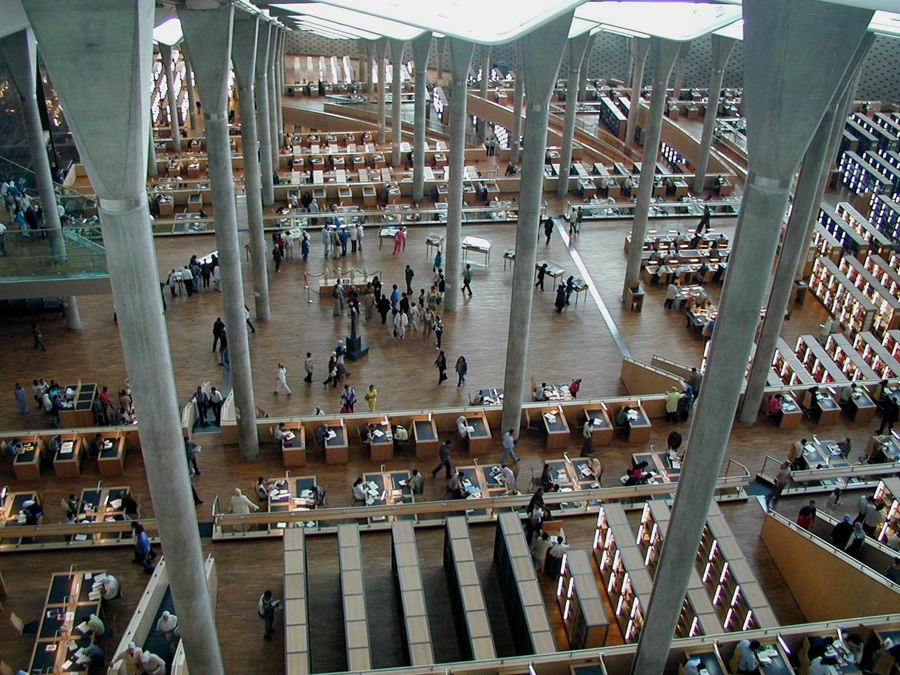
Main reading room of the New Library of Alexandria.
Third: Building on its Director’s considerable international connections and a Board of Trustees composed of many eminent international figures; the institution participated in many international partnerships and agreements that ensured that our work would be measured from the start against international benchmarks, and kept the institution from getting mired in local matters.
Fourth: The library started with a small nucleus of staff composed of very young people and grew rapidly, adding fresh young university graduates so that its staff remained young, all of which makes for an open and easygoing system.
Fifth: It was based on a meritocratic system of promotions that did not take seniority into account. The result is a young and gender-balanced management and staff who are open to the best of new ideas and do not represent significant legacy problems. Many cross-disciplinary retreats were organized to weld the managers into a team.
So what sort of innovations did this young management come up with? From a nucleus of 1000 PowerPoint lectures in public health, these became the BA Science SuperCourse, the largest site of free lectures (170,000), used by over 60,000 teachers to reach over one million students in 170 countries per year – for free. Sending out electronic and print media in a “Bookmobile” to tour remote schools in poor neighborhoods. Formal science clubs were established in 300 middle schools with computers linked to the BA Planetarium/Exploratorium science center. Developed a sophisticated Digital Assets Repository (DAR) where hundreds of thousands of objects and books are available for on-line consultation and retrieval. From commissioning operas to creating the first classical music orchestra in Alexandria, to organizing special classes for talented youngsters, to assisting young artists sell their first work, the BA has aggressively advanced the cause of the arts. Art and science competitions were organized in Egypt and internationally for young students that helped the BA reach beyond Alexandria. Held annual book and science fairs where tens of thousands of visitors came to participate.
But then what?
Remaining innovative: The challenge of tomorrow
The culture of innovation requires nurturing. It is liable to be destroyed from both ends of the creativity and success spectrum. Those who live in a stultified bureaucracy and who do not even try to innovate, and those who live in a successful organization and are likely to be smug, fall into what Jack Welch, former CEO of General Electric, once called the “not-invented-here syndrome.” Innovation requires constant nurturing.
Excessive precision and rigid administrative procedures are not conducive to innovation and creativity. Companies that have continuously innovated allowed significant margins for transgressing administrative boundaries and unconventional arrangements to promote internal “product champions” who even invest their own time working on the ideas they are championing without formal recognition and funding. The BA recognized and gave wide latitude for these product champions to develop their ideas to fruition.
In management terms, creating such an atmosphere where innovation is encouraged and creativity is rewarded also requires that we accept a certain measure of imprecision in our work. Where there are some blurry edges between departments and a degree of chaotic exchange of ideas there needs to be encouragement to constantly look outside the institution at the rapidly changing world. Management needs to keep in mind the goals of the institution, repeated and communicated to all the staff with clarity and precision, and look for new ways to achieve these goals in the light of rapidly changing circumstances nationally and internationally. The good ideas should be implemented and those who championed the ideas recognized.
Management is about dealing with people and getting them to do more than they thought they were capable of doing. This requires an inspiring vision and flexible administration with constant reinforcement to create self-confidence among staff.
The metaphor for management is not that of the engineer and efficiency, it is that of the gardener who nurtures the plants. The engineer has a well-oiled machine that he pushes to its maximum level of efficiency that is already predetermined in the design of the machine. As a gardener, you work with the plants. You make them grow by feeding their roots, not by pulling on their branches. You occasionally prune, turn them to face the best light, and fertilize the soil they inhabit, but in the end, it is the plants that bring forth the flowers and the fruits.
Whatever has been achieved in the last decade is only prologue. The world is on the cusp of a major transformation that will change all our modes of interaction with knowledge, and will challenge our societies with an enormous explosion of information – of varying quality – that will require all institutions of knowledge reinvent themselves to avoid being swept aside as irrelevant.
The libraries of tomorrow
Elsewhere, (see BiblioAsia, special issue for the IFLA meeting, Singapore, August 2013) I have written about the unique revolution in knowledge that we are going through right now
2
. I mentioned seven ‘pillars’ of that revolution: the nature of our documentation and transmission of knowledge, where constantly updated websites are part of the living global tissue of the production and distribution of knowledge that images will play an increasingly big role in addition to the traditional use of text that humans will need machines to interact with any kind of knowledge that complexity and chaos (in the formal scientific sense) are the prime characteristics of our world that computation theory and applications will be an integral part of the broad research paradigm and not just a specialized discipline that we will actively seek the convergence of fields of science and their transformations rather than plowing well established fields; and that we will need pluri-disciplinarity in our approaches to be able to cope with this changing scene.
The revolution manifested through these seven pillars is changing the concept and practice of education and of the supporting institutions of culture, namely libraries, archives and museums. Libraries as institutions will continue to be strong supporters of the values we hold dear – free inquiry, free thought, free speech, and pluralism. But they will have to cope with ever accelerating change and an unprecedented deluge of information as we add more information every year than we have inherited from the beginning of recorded history. Some will be excited by the accelerating rhythm and vast content. Others will be asking the questions posed by T.S. Eliot a century ago: Where is the Life we have lost in living? Where is the wisdom we have lost in knowledge? Where is the knowledge we have lost in information?
3
If all materials become virtual and mobile, what will become of the physical space we now call a library?
First, they will continue to harbor the originals. Manuscripts and first editions will continue to work their fascination for us, as the objects – above and beyond the content – are seen to have intrinsic value and worth. Being able to consult them will confer on the visitor special joys and possible new insights.
Second, there will continue to be certain materials that for institutional and monetary reasons will be beyond the reach of most people to obtain for a nominal fee, and that libraries will be able to provide only in situ.
Third, libraries will be the bridge between the general population, especially researchers, and the national and international archiving system. The sheer scale of that enterprise will pose particular problems that are likely to be addressed only by libraries and archiving institutions.
Overarching all, is the fact that libraries will be transformed and will continue their essential societal role.
Where will we be 20–30 years from now?
Looking at the rapidly evolving realities of our world, we are definitely going to have to change the existing legal and organizational structure in which knowledge and art are produced and their distribution managed to an ever larger and more sophisticated public. The traditional system which we have inherited from the past two centuries is increasingly strained. The roles of publishers, the place of books and journals, of TV and media, of films and exhibits will be different, as will the role of distributors and retailers. Copyright will have to be rethought in the massively digital age of tomorrow. Rules governing inter-library loans of materials will have to be adapted to the new technologies.
Looking at existing technologies with limited extensions of their capabilities and applications, creates an exciting vision of the future where all knowledge will be available to all people at all times in all places.
Imagine that: Interaction will be through the mediation of machines that will read our thoughts by the electrical currents that pass through our neurons. Books, in terms of a collection of words and sentences of considerable length, will be callable in instant downloads to appear before our eyes on virtual screens that will read our minds and leaf through pages, or scroll down text as we seamlessly call in videos and images into what will be the multi-media virtual “reading” experience of the future, including those times when we are in bed or bath or at the beach. Manipulable, holographic 3-D representations will pop out of the material in the text of the new digital books and 3-D videos will replace much of the pictures we are used to seeing on the web today. Virtual visits will really be virtual visits not just various clicks on a website. Documents will be retrieved as we think of the subject at hand and wearable computerized sensors will read the actions of our neurons and send messages to search engines that will use the successor of the successor of the semantic web to help us retrieve the relevant information and help us structure it into meaningful arguments. Every language will be instantaneously translatable to any other language through successors to the primitive machine translation of today. Android librarians will interact with real and virtual visitors to create and maintain their profiles and to assist them to access, retrieve, manipulate and add to the stock of knowledge.
The libraries will be the command centers where the massive deluge of data will be organized by enormous networks of machines using quantum computers and new algorithms adapted from those developed for handling big data in science.
The library physical spaces themselves will evolve very rapidly as stacks of printed material are moved off-site and the space is reconfigured for users. Instead of the traditional reading room, you will have a beautiful community room with major exhibitions of original art, manuscripts, and objects and yes, books, too! These great new spaces will have music, coffee bars and other amenities and inviting places in which to lounge and cubicles in some locations. The large community rooms will be connected with auditoriums and seminar rooms.
There will also be (at least) three kinds of spaces for students and researchers. There will be a space for creative interaction that involves music, food and an abundance of worktables and lots of smart boards or their future (probably digital) equivalents. We will replicate today’s common rooms in dorms of colleges and universities supported with an expanded infrastructure of knowledge. There may be two types of quiet rooms; one where groups of students and/or researchers can work collaboratively around a table, and the individual quiet space or cubicles where single researchers or writers will be able to work alone.
In this vision, the librarians will be working on tasks vastly different from the traditional cataloguing and user support. They will be planning their exhibits, their educational programs for use in the auditoriums and the seminar rooms. They will be fine-tuning their organizational skills to deal with the massive flood of material that the world will be producing. They will focus on preparing some interesting new ways of presenting that organized knowledge which will be done at the global scale by a network of libraries.
This international network of libraries that will span the globe will be based on national networks, where the national libraries, the university and special libraries, and the general public libraries will be interlinked at the national scale and with their peers on the international scale.
It will be a totally different world. Libraries will continue to pursue their mission but in totally different ways. Standing at the edge of this new world and thinking about how we are going to cleave a path into that exciting transformation is the challenge; for every decision we take today is a step to either marginalization and irrelevancy or renewed vigor and meaningful roles for the libraries of the future. There is a tide in the affairs of men Which taken at the flood leads on to fortune Omitted, all the voyage of their lives Is bound in shallows and in Miseries. On such a full sea are we now afloat, And we must take the current when it serves Or lose our ventures.