



Abstract
The National Library of Singapore was set up in 1960, and has been working tirelessly to transform itself to meet the changing needs of its end users. From the early days when users had to travel to visit the National Library in Stamford Road to today’s users who carry a variety of digital devices and mobile gadgets and prefer to access content online, the needs of its users have changed dramatically. This gives the National Library tremendous opportunities to prototype, innovate, and to come up with new ways of serving its users wherever they are, 24 by 7, using any device they hold in their hands.
Keywords
Background
The National Library of Singapore started in 1960 as one of the Ministry of Culture’s departments. It runs the national library, public libraries, and government department libraries. In 1995, a major review of publicly-funded libraries in Singapore resulted in the library being converted from a government department to a statutory board called the National Library Board (NLB). This gave the NLB greater flexibility in funding, hiring and firing, and managing operations. In November 2012, the government added the National Archives to the NLB family for better synergies and seamless access to content. Today, the NLB runs the National Library, the National Archives, 25 public libraries, and 15 special libraries, including one tertiary institution library.
When the library review was conducted in 1995, one of the activities undertaken by the Review Committee was to survey users to ask them for feedback on the libraries. Many responded that libraries were dated and not responsive to user needs. This gave the NLB much needed food for thought and the impetus to plan for a revamp of its services, collections, IT, and physical infrastructure. Funds were secured from the government to renovate existing libraries and to test new models for locating libraries, such as in shopping malls frequented by users. New services were prototyped and successful services were replicated in the other libraries bringing greater convenience and efficiencies to users all over the island. Collections were also updated and new collections were added to meet the needs of library customers.
The over-arching principle of customer-centredness
In 1995 when the NLB was formed, Dr. Christopher Chia was appointed as the NLB’s first Chief Executive. With a strong IT background, Dr. Chia immediately saw the benefits of using IT to help NLB transform its services from a largely manual service to one that is enabled by IT and which is self-service.
The senior management team at the time was very clear from the start that to remain relevant to the end user, libraries must put the user at the centre of all considerations and user convenience must take centre stage. They were also clear that time must be saved for both the staff providing the services and for the end users. Users must spend their time in libraries not queuing up for services, but for being engaged in reading and learning.
Customer-centredness became the focus for the whole of the NLB. A review of the way NLB was serving its users at every touch point was conducted. NLB then launched an intensive campaign to bring all staff to the same level of understanding. All NLB staff were trained in customer service excellence. This effort was sustained and continues to this day. Project teams were set up to review both the front and back end processes. A major business reengineering exercise was conducted involving over 50 NLB staff. All NLB professional and executive staff were trained in project management methodology as a common language was deemed to be important in the transformation journey. Today, the NLB is still pursuing this journey of service excellence.
Service prototype and roll-out
From the word go, the NLB focused its energies in identifying the pain points for the library user. The aim was to reduce the hassle for the user and to make it easier to get the desired service. This could be from registering for a new library membership card to obtaining the book that he wishes to read to his child or to obtaining the statistics that he needs for his research or policy paper. Every service was reviewed to see how time spent by the staff and by the user could be reduced to a minimum.
In 1995, queues were a common sight with library users queuing for up to an hour to borrow or to return books. This was one of the reasons that resulted in customer dissatisfaction. A question that was asked at the beginning of the journey was: can we remove all the queues in the libraries at peak hours?
The result of the hours of discussions and solution seeking was to go for self-service. There was no way for the NLB to deploy so many staff to serve the thousands of customers who visited each library on weekends and during the school holidays.
Once the idea of self-service was accepted by staff, the NLB started looking into ways to replace the manual processes with self-service solutions. These included prototyping and designing self-service borrowing and returning stations and automating the library transactions such as borrowing and returning of books, registering new members, and the payment of overdue fines.
Every transaction was automated during the period 1995–2002 including prototyping the answering of reference enquiries via the Internet. Radio frequency tagging was used on all library materials to enable self-service borrowing and returning. The self-service borrowing and returning service turned out to be a huge success. Queuing time was reduced from one hour to zero seconds 99.9% of the time.
Bringing libraries to where the people are
To ensure library relevance, the placement of libraries was another principle that the NLB adopted. In the early days when the NLB was looking at ways to serve its customers better, one of the frequent questions asked by project teams was: how do we bring the library to the people, if the people are not prepared to make the effort to make a trip to the library?
The NLB started experimenting with the first library in shopping malls in 1995. As the concept was then new to the NLB, the first shopping mall library was not as well-located as it could be. The NLB was late in joining the shopping mall. By then, the mall manager had rented out all its spaces on the floors served by escalators leaving the library to take a floor in the mall that was served only by lifts. Despite the initial disadvantage of the location, the shopping mall library soon became a success as parents found that they could take their children to the library while shopping for groceries. The cost per loan in the shopping mall library was found to be much lower than the standalone libraries that were located in their own premises due to fewer overheads and a more convenient access.
With the success of the first shopping mall library, the NLB began to make earnest plans to locate more libraries in shopping malls or to co-locate them with other popular premises where people congregate. Today, more than half of the NLB’s libraries are in shopping malls or co-located with other agencies.
The advent of the Internet
While all this work to bring the physical library to where the people are was going on a lot was happening in the Internet world. Internet use was becoming more popular and more library users had access to the Internet. NLB libraries started to provide Internet services in all its premises and this service was very well-used. Household Internet use was also increasing. NLB found that more customers were accessing its online catalogue remotely and using its digital resources outside libraries.
Improving digital service delivery through search engine optimization
From the early 2000s, the NLB had been creating digital content and parking this on its corporate website. Various marketing efforts were launched to promote and market its services. However, it was found that no matter how much effort was put into marketing and promotions, use would inadvertently drop after the period of aggressive promotions.
Somehow, users were not remembering the names of NLB websites to access the content. Also, Google and other search engines were becoming more popular in enabling users to find content on the web. Users felt that there was no need for them to visit the library website to obtain the information that they needed.
The NLB seriously reviewed its digital service strategy. It decided that it had to put its digital content out to the search engines so that users could find the library’s rich resources when they searched their preferred search engines for information that they needed. The NLB engaged search engine optimization consultants and trained its staff in writing content so that search engines could identify library resources. This helped to increase the use of its digital services. An example was the Singapore Infopedia, where the use increased from 400 page views a month to 100,000, an increase of 250 times over a period of one year. It was a moment of enlightenment! Today, Singapore Infopedia (http://infopedia.nl.sg) enjoys a high usage of more than 200,000 page views a month (see Figure 1).

With this experience, the NLB decided that all its digital content services would be packaged in such a way that Internet search engines could crawl and index its content so that users could search and find its content from anywhere, anytime.
Mass digitization of the National Library’s content
Around this time, the National Library started an intensive programme to digitize its heritage collections. In 2007, the NLB was fortunate that the publisher of Singapore’s major newspapers agreed to give NLB rights to digitize all the archived newspapers that it owned and to provide remote access to its users. Rights were given for users to access the digitized newspapers from the early 1800s up to December 1989, full-text, from anywhere in the world. Downloading of the content was disabled and a watermark was used to protect the content from commercial use.
The NLB secured funds to digitize the major newspapers in the four official languages, i.e. English, Malay, Chinese and Tamil. More than 20 million newspaper articles have been digitized so far and are available for Internet search engines to crawl and index. Researchers of things Singapore are thrilled with the service as they no longer need to visit the NLB libraries to use the microfilms. They indicated that for them, the digitized newspaper service (http://newspapers.nl.sg) revolutionized research on Singapore (see Figure 2).

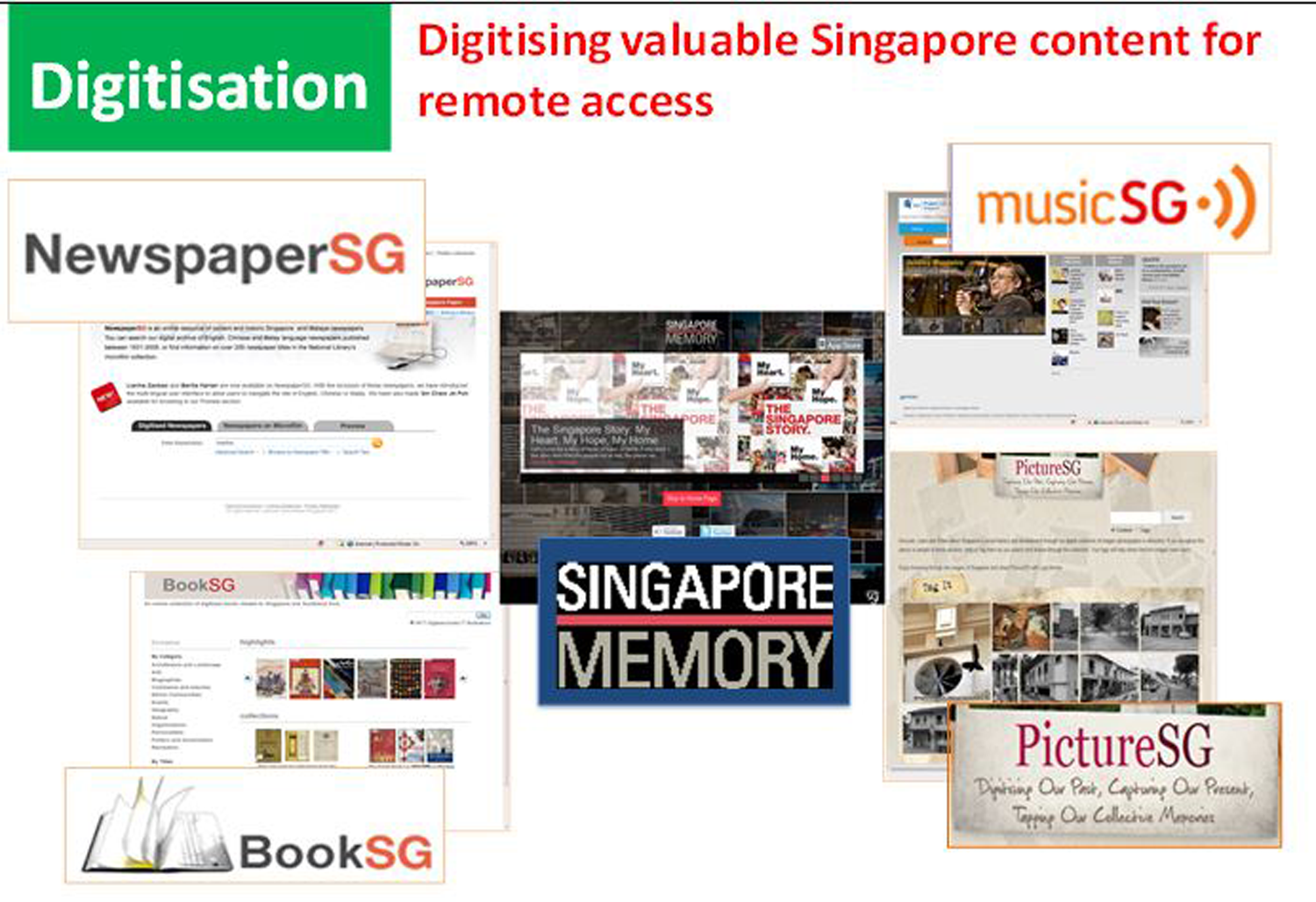
The NLB has also digitized its rare books, manuscripts and photographs, and has made them accessible to users. It has also started digitizing materials from the National Archives, including audio-visual content and oral history. These will be added to the digital collection of the NLB for remote public access. Please see: http://sgebooks.nl; http://pictures.nl.sg and http://archivesonline.nas.sg (see Figure 3).
The pervasiveness of the web and mobile devices
What else can the library do to make access even more convenient? In the transformation journey so far, the NLB had revamped its physical libraries to make them more inviting and user-friendly, it had updated and refreshed its collections, and it had also digitized its content and made them available to the Internet search engines for ease of access. New challenges appeared on the horizon. During this period, many new web technologies and mobile gadgets came into the market and users were adopting these technologies and devices very quickly. With the convenience that they enjoyed in their devices, users demanded the same level of convenience and user-friendliness in their library transactions.
The NLB was not ready. It was busy putting out digitized content on the web and did not realize that almost overnight everyone was turning to their mobile devices to access and seek content on the web. Users expected to find the information that they needed from NLB on their mobile phones.
The NLB team quickly turned its attention to this change in usage habits and worked with service providers to ensure that all its content could be accessible on mobile devices. Today, most of the NLB’s content can be accessed through mobile devices and all new content and new services use the same platforms to create a common user experience (see Figure 4).

Opportunities that social media offer
A discussion on library innovation is not complete without the mention of how social media impacts services, service delivery, and user engagement. Since 2011, the NLB has been mindful that the use of social media was important in the services it offered to its users as many of the library’s users were also users of social media. More important, social media offers NLB a chance to connect to its users in the places where they choose to interact with their network and content. Instead of viewing social media separately as a platform, the NLB embraces social media as part of its digital infrastructure. Social media are seen as an extension of the NLB’s digital infrastructure, though the NLB has no control over how they work, or how they will evolve in the future. The NLB has chosen to ride on them for as many of its services as possible and views them as a friend, much like the way it regards Internet search engines. By riding on the social media platforms and networks to reach its audience, the NLB is able to draw from social media what it would not be able to do by itself.
As an illustration, the National Library runs a national project called the Singapore Memory Project (SMP). This is a national effort to collect personal memories from anyone who has an experience with Singapore and is willing to share their experience. The memories collected complement the documentary resources that the National Library has and helps users in their understanding of the social history of Singapore. One of the strategies adopted by the SMP team is to encourage contributions through social media since many people share their comments and experiences in these spaces. The team also works with bloggers to collect stories about experiences of people who live or work in Singapore. Individuals may self-submit their memories for the project via the web portal, www.singaporememory.sg. Submissions are not reviewed nor edited by NLB staff, however, there is a feature for the public to flag out undesirable content to staff. Staff also run software to check for inappropriate content on a regular basis. NLB commissions vendors to curate stories and videos based on the NLB collections and memories collected. These are parked on the website for public access. The NLB also has Singapore Memory Project funding that supports anyone who wishes to curate stories for SMP using NLB and SMP content. Metatagging is done by NLB staff and the organization of the content into clusters on the SMP portal is also managed by NLB (see Figure 5).

Other efforts to enable search and find
In its work, the NLB realizes that there are some materials that are not easy for users to search and find as either the metadata is not rich enough or the nature of the content limits itself from search opportunities. These include materials such as audio-visual and oral history content. To enable searching of this unique content we are working on the following:
Voice-to-text conversion
The National Archives has a very large collection of oral histories and audio-video material that contain valuable content, which many Singaporeans would love to use. However, the work on the metadata that needs to be created for searching is labour intensive. To overcome this challenge, the NLB has started working on other ways to enable searching. It has done a proof of concept to convert voice to text for the oral history content and the audio-visual content. This has achieved a level of accuracy that is closer to what the NLB would like to have. To improve search results, the team also included a time stamping feature on the oral history or audio-video recording so that users could quickly find the desired segment of the content once they identified the item containing the required information.
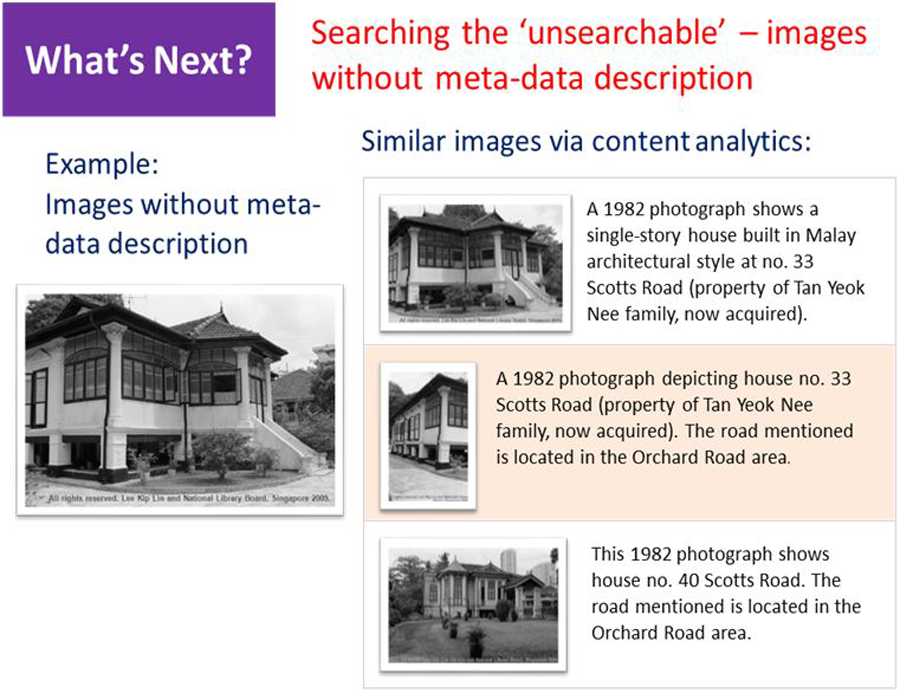
Image matching
The team also experimented with image matching to match images that look alike. This allowed for the description of one image to be used for another if the images belonged to the same person or item.
Optical Character Recognition (OCR) of text on video
For audio-visual recordings that have sub-titles, the team enabled keyword searching of the text by applying the OCR technology on the text. This made it easier for the user to find the item through a simple keyword search. See Figure 6.
What’s next?
By way of all these efforts, NLB hopes that users will be able to easily find items that they require for their study, research or self-discovery, or to enrich their lives. The NLB is not stopping here as there are other search tools that are becoming more feasible to further improve search results. These include linked open data, text analytics, and auto-extraction of time-based or location-based information (see Figure 7).
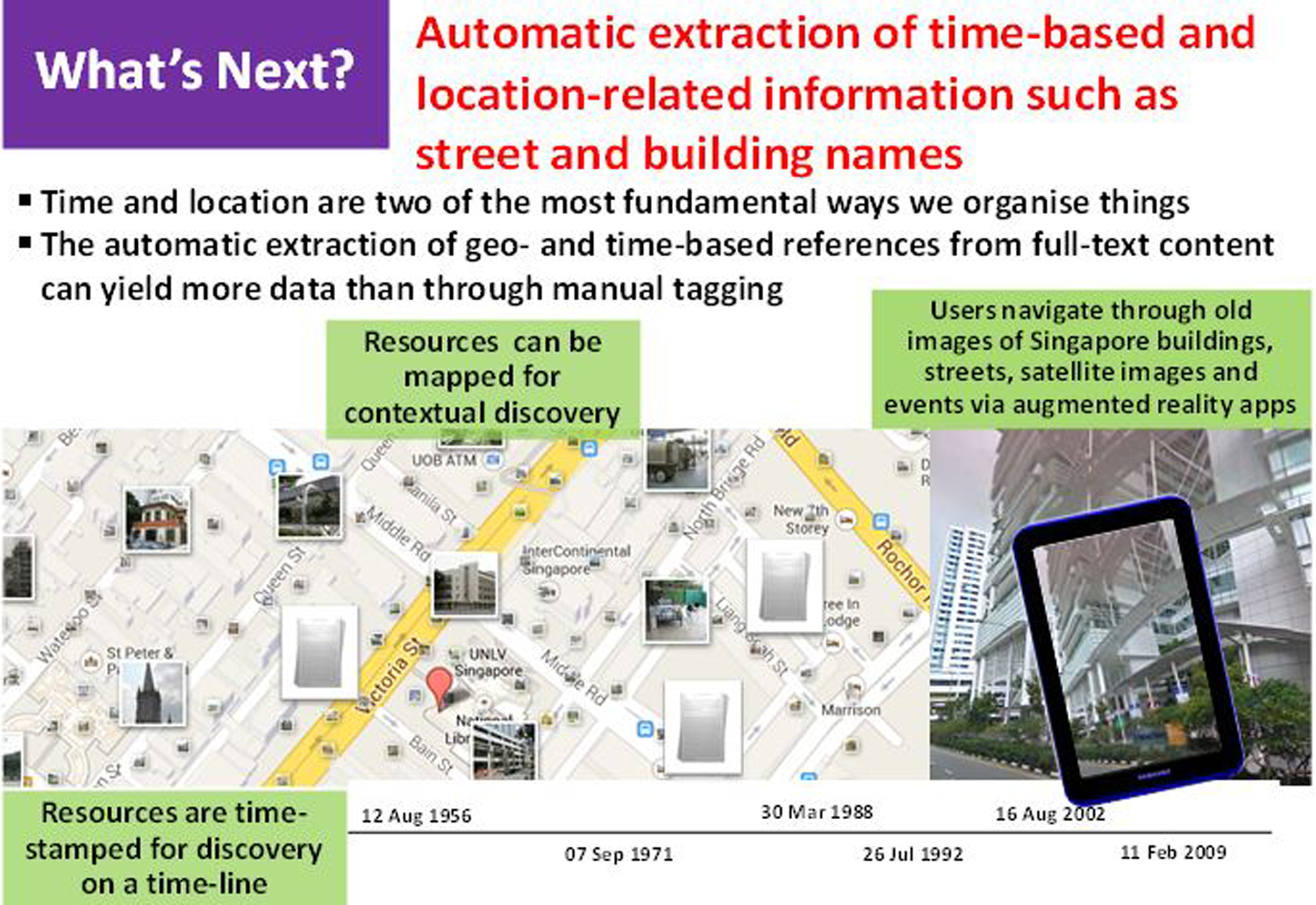
By using these tools to review the search results from one library collection, the system can pull out from other NLB collections relevant content that will make the learning of a topic more meaningful and productive. This is achieved without the user having to do a separate search for the additional related content, such as newspaper articles, or time/location- based articles. Currently, the NLB is experimenting with these tools and is getting encouraging results.
Partnership for win-win-win outcomes
For many years, the NLB had recognized the importance of working with others for desired outcomes by collaborating with partners. This has been a strategy that worked well for many of the services and programmes that NLB initiated over the years. In the early days, a partnership with a local company resulted in NLB deploying radio frequency tags in all its materials and these supported the self-service borrowing and returning functions in its libraries. Some 30 million loans a year are transacted using this technology.
The Singapore Memory Project team works with over 150 partners. Partners help in getting personal memories and provide the much needed support to rally volunteers who help to collect memories face-to-face with their personal touch. The newspapers digitization project could not have taken off so successfully without the support of our partner in the publishing sector.
These and many other examples of successful partnerships encourage the NLB to continue to adopt this partnering strategy. One of the most recent partnership efforts that the NLB established enables partners to make use of the online content that NLB has through an open innovation platform that NLB created. This allows partners to freely use the NLB content for their services and programmes thereby helping NLB to reach its users through the diverse services provided by the partners.
Funding for success
One other strategy that the NLB actively pursues is to look for funding opportunities outside of the NLB. The staff regularly seek opportunities for joint development of ideas. An example of this is the funding of the digitization of content from the British Library on and about Singapore.
The effort is made possible through the generous sponsorship of a donor who was keen to see more use of content previously not accessible. The NLB has also been successful in securing funding from private donors in setting up a library to provide services and collections focusing on Chinese culture. It hopes to find other donors to do the same for the other ethnic cultures.
Conclusion
The NLB is very aware that the transformation journey to better serve its users is far from over. As a national library its role is to collect, organize, preserve valuable heritage materials, and make them accessible to its users. The old model of asking users to come to the library to enjoy these resources will not be the acceptable norm for most users today or for those of the future.
Today users want to access these materials online and the library has to continuously look at new ways to meet this need. Challenges facing the National Library include: securing more funds to digitize materials securing rights for the use of digitized content outside of libraries keeping up with the new social media platforms and mobile devices and delivering content through these channels using the new channels effectively to engage users to productively use the content to create new content keeping staff motivated and skilled to continue to innovate and develop new services ensuring that stakeholders support the library in the above.
Despite the challenges, based on the journey taken so far, the NLB is confident that it can and will find ways to use technologies and its expertise to continue to innovate and develop new services to meet the needs of users and to bring content into the hands of its users.