



Abstract
The National Library of the Netherlands, (Koninklijke Bibliotheek, hereafter KB), has been innovating its services and organization for the past 20 years and expects to continue to do so in the future. The central question in this article is: what makes innovation work in the organization of the KB? We will focus on two use cases: the development of the recently opened Delpher portal, giving access to 30 million pages of digitized Dutch heritage, and the current development of the KB ResearchLab that gives internal and external researchers a platform for experiments. A review of innovation theory and practice (Balk 2013) provides us with a checklist of factors that determine the innovation capacity of a library, grouped in four themes: Leadership and culture, Knowledge and organizational learning, Collaboration capacity and Organizational design. By applying this innovation checklist to the use cases discussed, we hope to contribute to the body of best practice in innovation in national libraries. Finally, we will look ahead at the development of the National Digital Library of the Netherlands, integrating services for the public library community into the KB in the near future and share some potential scenarios for the future of the library landscape in the Netherlands with the audience.
Keywords
Introduction, problem statement and approach
In 2012 the National Library of the Netherlands, the Koninklijke Bibliotheek (KB) sent five staff members with very different perspectives (Research / IT, Marketing, Database Management, Front-End Development and Collections) to a three-day crash course on effectively using mobile technology in a heritage context. In this powerhouse environment, they came up with a totally new idea: creating a mobile application that would deliver historical information from the digitized newspaper collection on the spot, for every location in the Netherlands. The KB team won the pitch and funding to develop this idea. Within a few months they produced the app ‘Here was the news’ that made national television and got 60,000 downloads on its first day: http://www.hierwashetnieuws.nl/; http://www.kb.nl/nieuws/nieuwsarchief-2012/kb-lanceert-app-hier-was-het-nieuws. It is now at the end of its product-lifecycle, but has given us valuable experience on how to work with geographical linked data.
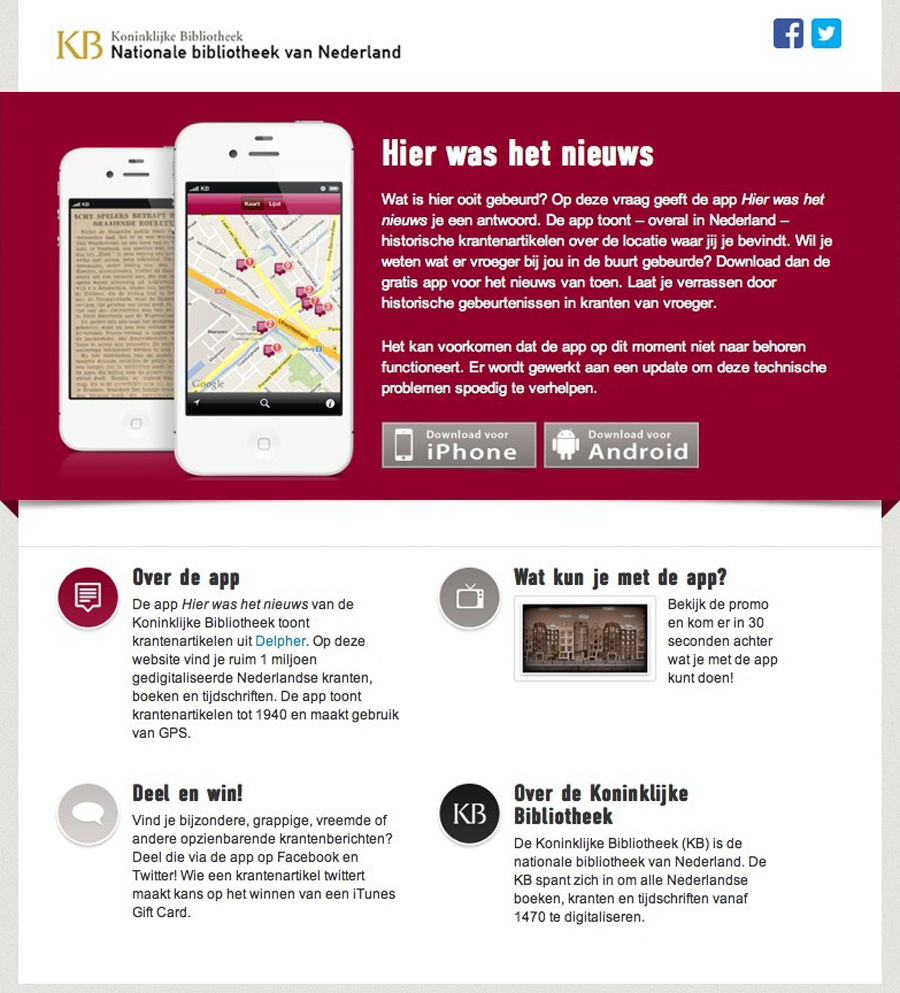
Screenshot of the app ‘Here was the news.’
This is an example of an innovation in the KB that was successful in many ways: it was conceived and implemented in a very brief period of time; the public loved it; it added value to our collections; the process was easy and fun; and we learned from the experience.
Not all innovation is so easy in the KB. Sometimes it is a difficult and painful process. Often new ideas fail before they even come to fruition. This is something that colleagues in the library world will recognize. The reasons for failure often seem obvious: the product was not mature or the public had no use for it; the organization was not ready for a new way of working; people did not want to change; or the library got stuck in its own bureaucracy. But there is a much more interesting question to be asked – what actually makes innovation successful? Rather than focusing on obstacles to innovation, we would benefit from knowing the factors that lead to successful innovation, so that we can foster those qualities in our libraries.
The quest for innovation enablers led to ‘mining’ the currently most widely accepted innovation theories that have a basis in empirical research. 1 This produced a long list of factors that determine capacity for innovation of an organization. The list was then explored in the community of national and research libraries for its relevance to our particular situation. The outcome was the ‘innovation checklist’ of 14 determinant factors that were considered as a ‘must have’ by the community, clustered in four themes: Leadership and Culture, Knowledge and Organizational Learning, Collaboration Capacity and Organizational Design.
In this article the theoretical framework that underlies the innovation checklist will be outlined. This will be followed by a description of two use cases of successful innovation in the National Library of the Netherlands–the development of the recently opened Delpher portal, giving access to 30 million pages of digitized Dutch heritage, and the current development of the KB ResearchLab, that gives internal and external researchers a platform for experiments. These use cases will be analysed with the checklist to learn how these factors have played a role.
With this, we hope to contribute to building a body of practice in innovation that may benefit all (national) libraries wrestling with the continuous process of adapting to a dynamic environment.
Key factors that determine the innovation capacity of a library 2
Approach to innovation in the context of this article
We define innovation here as a more or less radical, possibly disruptive change in products and processes, staying close to the original definition of Joseph Schumpeter (Schumpeter, 1947). Innovation is only successful when it adds value to the delivery of an organization (e.g. better products, more profit, larger market share). In a public institution such as a national library, innovation can be considered successful if it adds public value. It should be valued by the public and benefit society as a whole. In the context of this article we are specifically interested in the organizational aspects of innovation. This leads to the following definition of innovation:
Successful innovation in a national library is the creation or adoption of an idea or behaviour radically new to the organization, with added public value as an outcome.
Innovation concepts in the perspective of public value
The innovation checklist is based on a selection of the currently most widely accepted innovation theories. These theories were selected on the basis of two criteria – they have a firm basis in empirical research and they are relevant for innovation in a public value perspective.
Although the term ‘public value’ is widely used nowadays, it may be useful to elaborate briefly on the concepts associated with it, and the relation with the chosen innovation theories. In the public value perspective, public value outcomes are achieved in engagement with the users of the products and services, and in close alignment with the authorizing environment, that is, the complex field of influences around the institution, such as government, peer institutions, user organizations, public opinion (Moore 1995, Benington and Moore, 2011).
To stay aligned to user needs and changes in the environment, public institutions have no choice but to innovate (Hartley, 2011). But there is generally little patience in the environment with any disruption in service caused by the innovation process. A continued high quality, including improvement of running services, is expected at all times. In order to deliver public value, a public institution needs, therefore, to be able to handle continuity as well as radical innovation in parts (Hartley, 2011).
Innovation concepts that deal with balancing two opposing approaches of evolution and disruptive transformation are particularly relevant in the public value perspective. The Ambidextrous Organization concept offers mechanisms for managing the opposing forces of continuity and change (Tushman and O’Reilly 1996, 1999).
A public institution can only successfully adapt to the environment if the conditions for learning and knowledge sharing are good. Nonaka and Takeuchi’s classic study of the Knowledge Creating Company offers a number of enabling conditions that should be met (Nonaka and Takeuchi, 1995). The Dynamic Capabilities theory adds to this factors that create a culture to combine the fostering of core competencies and the implementation of radically new ideas (Teece 2007, 2012).
As the public is central in the achievement of public value outcomes, it is imperative to engage users in the innovation of the services offered to them (Benington and Moore, 2011). In the private sector Von Hippel was one of the first theorists to note that the sources of successful innovation often lie outside of the organization, and demonstrated that successful innovation is dependent on working with users and user communities (Von Hippel 1988, 2005).
More and more, public institutions are urged by the environment to develop new products and services in partnerships and networks with other public or private organizations (Benington and Moore, 2011). We know this to be particularly true for national libraries, which often play a central role in the scientific and cultural infrastructure of their country. The co-production of innovation in partnerships in the public sector aligns well with the Open Innovation paradigm that currently prevails in the private sector (Chesbrough, 2003). Over the past three decades, the belief has grown that successful innovation cannot be undertaken in isolation – ‘not all the smart people work for us’ – and that the process benefits greatly by using the external knowledge of partner organizations, suppliers and university research centers. The concepts of user innovation and open innovation have been widely researched for factors that determine success (Enkel, Bell and Hogenkamp, 2011; West and Bogers, 2013).
The checklist
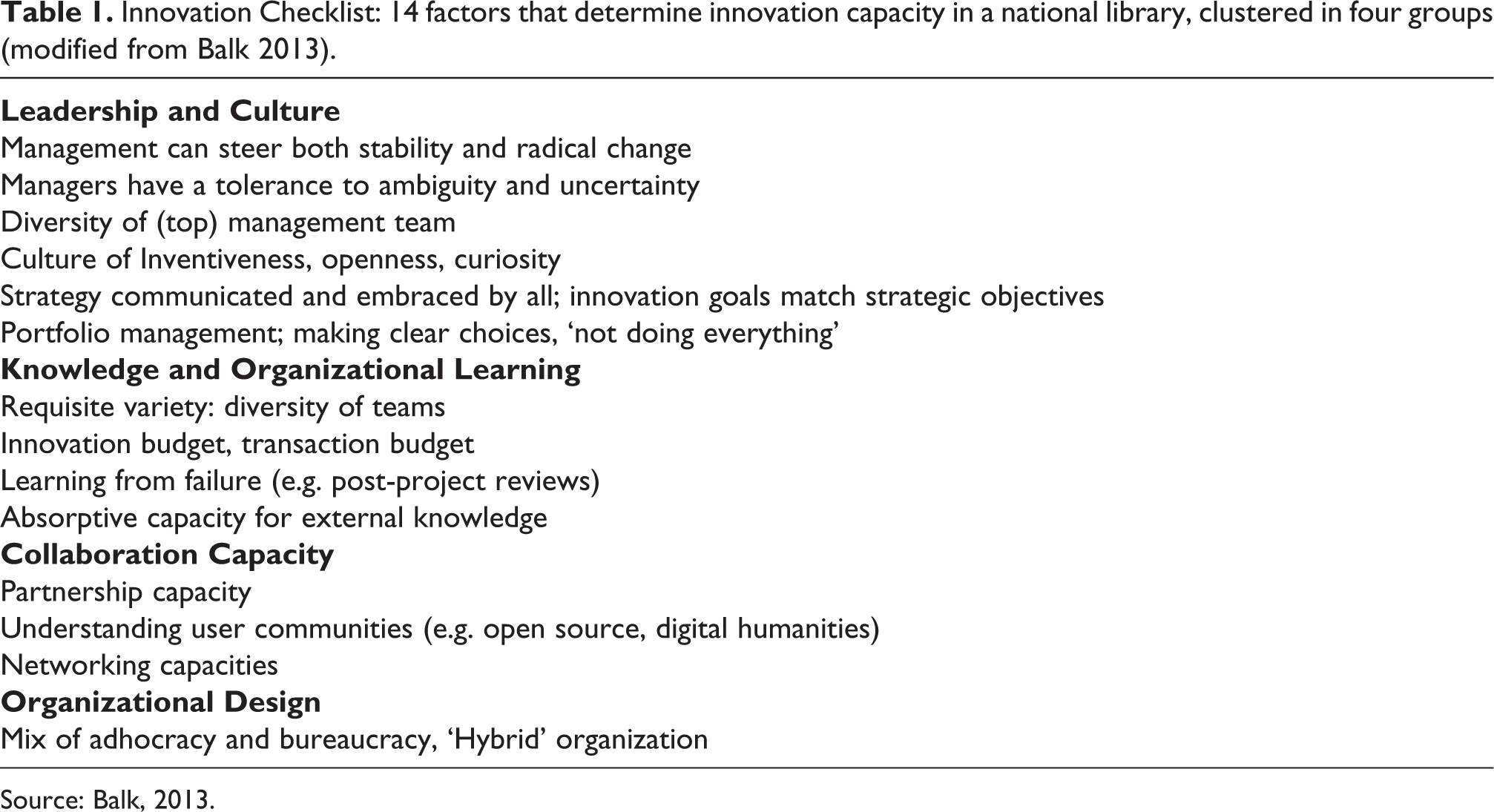
From the concepts discussed above, a long list of 42 factors that play a role in determining innovation capacity in a public organization emerged. This list was explored in the library community in a meeting with a focus group of library professionals and structured interviews with managers from four different national libraries across Europe (Balk 2013). The outcome was a selection of 14 key factors that determine innovation capacity, dubbed the innovation checklist (Table 1). The factors are grouped in four themes: Leadership and Culture, Knowledge and Organizational Learning, Collaboration Capacity and Organizational Design.
Innovation Checklist: 14 factors that determine innovation capacity in a national library, clustered in four groups (modified from Balk 2013).
Source: Balk, 2013.
Leadership and culture
All theories of innovation stress the significant influence of executives on the process and culture of innovation. This was confirmed in the library field where good leadership, both at CEO and other management levels was considered the first condition that should be met.
Singled out among the competencies for leadership were those that answered the demands of handling opposing forces: the ability to steer both stability and radical change (Tushman and O Reilly, 1996). They should be able to carry out their objectives in the face of the inevitable ambiguity and uncertainty that goes along with innovation and inspire confidence in their staff (Teece, 2007, 2012).
A premium was also placed on hiring executives with a non-library or even private sector background. As innovation benefits from the unexpected combination of ideas and knowledge, diversity in the top management team has been demonstrated to be more effective in innovation than uniform leadership (Tushman and O’Reilly, 1996).
Innovation needs a climate of inventiveness, openness and curiosity (Enkel, Bell and Hogenkamp, 2011). Ideally this climate is fostered by management throughout the entire organization, but it may even be effective if this climate is restricted to smaller innovative units within the organization (Tushman and O’Reilly, 1999). This can only work if the company strategy is communicated clearly and shared by all (Nonaka and Takeuchi 1995) and when innovation goals match strategic objectives (Enkel, Bell and Hogenkamp, 2011)
For innovation to be successful it is inevitable to deploy portfolio management – cut off some activities and support others (Tushman and O Reilly, 1996; Enkel, Bell and Hogenkamp, 2011). Those libraries that had deployed some form of ‘making clear choices and not doing everything’ had found this very effective.
Knowledge and organizational learning
Developing and sharing knowledge is already part of the ‘DNA’ of the library community. The means for exploiting knowledge effectively for innovation are often not so clear. Four factors from the vast innovation literature dealing with knowledge and organizational learning were recognized as crucial to library innovation (Balk 2013).
Parallel to the diversity at the top, the best new ideas and means of exploiting them are born in teams of which the members have a variety in background and training (Nonaka and Takeuchi, 1995, Teece 2012; West and Bogers, 2013, Enkel, Bell and Hogenkamp, 2011). For effective implementation of innovation it is imperative that the team contains members from all parts of the organization(s) that will be deploying the new product or service. This ensures both acceptance and understanding.
It may seem obvious, but must be mentioned, that the presence of a budget earmarked for innovation and the acquisition of external knowledge is considered crucial by most managers involved in the development of new ideas (Enkel, Bell and Hogenkamp, 2011).
Innovation is by nature unpredictable and projects implementing new products or ways of working may fail in many ways. Innovative organizations tolerate failure as part of their business (Tushman and O’Reilly, 1996). Failure can be an effective learning instrument for the organization, for instance by conducting post-project reviews (Teece, 2007, Teece, 2012).
One of the very few really quantifiable factors that determine innovation capacity is the absorptive capacity for external knowledge. This consists of two elements: the total R&D expenditure and the proportion of employees with (scientific-technical) graduate education (Enkel, Bell and Hogenkamp, 2011; West and Bogers, 2013). In particular the education level and the presence of skills in new technology were recognized as very relevant for library innovation.
Collaboration capacity
To effectively leverage outside knowledge, an organization must be able to open up its innovation process and innovate with users and suppliers in partnerships and networks (Von Hippel, 2005; Chesbrough, 2003). Research indicates that this requires a number of special competencies at the level of the organization as well as the individual (Enkel, Bell and Hogenkamp, 2011; West and Bogers, 2013). Based on the vast experience with different types of collaboration, library managers considered three areas of competence most important (Balk 2013).
Partnership capacity is a competence at the level of the organization and includes: commitment and trust between partners; having a reputation as a trustworthy partner, selecting the right partner(s); making clear agreements and defining clear targets; training employees to work with partners; and the ability to manage alliances (Enkel, Bell and Hogenkamp, 2011).
Both at the organizational and individual level an understanding of user communities is indispensable (Von Hippel, 2005). Von Hippel used the open source software community as an example of an innovative user community that disrupted the established market. For the library world, the digital scholarship communities (e-science, digital humanities) forces libraries to rethink the way they offer their resources and services. The recent special issue of the Journal of Library Administration excellently describes organizational implications of digital scholarship for libraries (Nowviskie, 2013; Posner, 2013; Rockenbach, 2013; Sula, 2013; Vandegrift and Varner, 2013; Vershbow, 2013; Vinopal and McCormick, 2013).
At the individual level the presence of networking capacities among the staff is a determinant factor. In order to collaborate successfully with people with diverse backgrounds and locations they need abilities such as social intelligence, cross-cultural competency and curiosity (Enkel, Bell and Hogenkamp, 2011).
Organizational design
In theories of organizational design, the hierarchically ordered bureaucracy is the best form for well established companies and public institutions in stable environments, but this form renders them unable to quickly adapt to new circumstances. In a fast changing environment, the best form is a loosely coupled organization of teams that assemble in an ad hoc way dependent on the (market) needs of the moment, the so called adhocracy (Mintzberg 1979). Pure adhocracies are mainly found in high tech environments with many start-up firms, where expertise is highly valued and where there is a premium on entrepreneurship, such as in Silicon Valley. A drawback in the pure adhocracy is the lack of continuity and cohesion. Research in innovation currently favors hybrid structural forms that combine both the fluid, flexible nature of the entrepreneurial start up with the more stable, cohesive aspects of the bureaucracy. In this form, adhocracy is the best form to either produce or to adapt to innovation, but it should be limited to sub-units engaged in creative work, that have the capacity and authority to engage with the organization at large (Tushman and O’Reilly, 1999). This type of adhocracy, often dubbed ‘skunkworks’ (Tushman and O’Reilly, 1999), has recently been advocated in the library community as one of the solutions to deal with the current wave of innovation (Nowviskie, 2013). The library managers that evaluated the long list of factors also selected the hybrid organization form as crucial to innovation (Balk 2013).
Innovation in the National Library of the Netherlands
Background
The KB is a medium sized national library with a permanent staff of 250 FTE in 2013. Its holdings encompass 6 million items (books, newspapers, magazines) and store over 200 million pages born digital and 60 million pages of digitized material. Yearly the collection grows by some 100,000 books and issues of periodicals, in addition to almost 2 million digital items. From 2007 onwards it has also archived a selection of Dutch websites. In 2013 the KB had around 16,000 members and 5 million online visitors. Although relatively small, the KB has long played a leading role in cooperation in the national library field, for instance, co-founding The European Library (2005) and Europeana (2008) and hosting these organizations up to the present day. 3
For the past 20 years, the KB has been continuously innovating its services and organization. In this period the focus has shifted completely from the traditional physical service of acquiring, storing, cataloguing and lending paper publications and offering reading rooms, to the perspective of a predominantly digital future.
The KB has always been at the forefront in the take-up and use of new developments. We were one of the first organizations in the Netherlands, and among the first national libraries, to offer online access to its catalogue. Our first website (see Figure 2) dates from 1993, only 2 years after the launch of the World Wide Web.
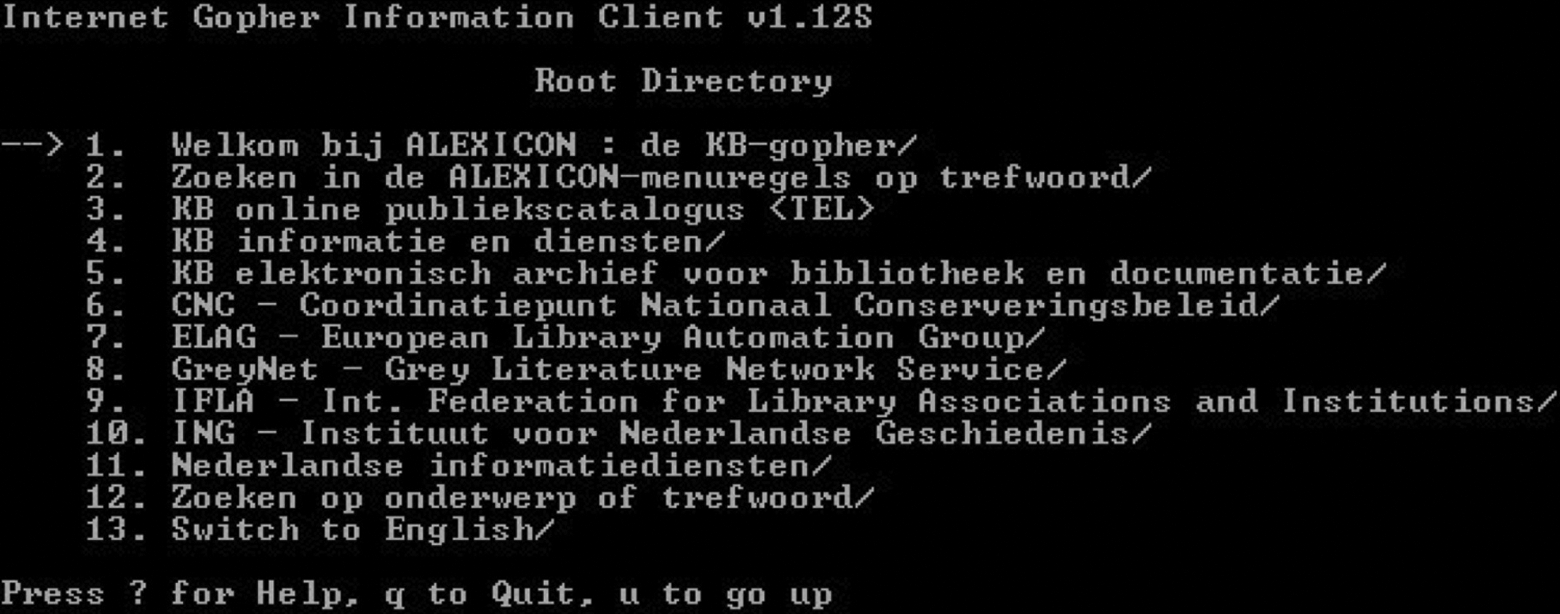
Gopher website, KB 1993.
In 1997, the KB opened its e-depot for electronic publications and started research in the preservation of digital content. In collaboration with a private partner (IBM), an innovative preservation system for the long term storage of digital content was developed that has been in use since 2003 and is currently being replaced by a new system developed within the KB.
In the 1990s, digitization of paper collections began – the first 100 highlights of our collection were available online in 1995. Around the turn of the century the first real digitization programmes were launched, always in cooperation with other collection holders in the Netherlands: The Memory of the Netherlands (1999); Dutch parliamentary papers (2003); and Dutch Newspapers online (2006). With the start of this latter project, that digitized 8 million Dutch newspaper pages, the KB made the step to large scale digitization.
In the course of the first decade of the 21st century, the expectations of the users of our services changed. As the Internet became the first resource for the public at large as well as for most researchers, our users came to expect that the KB digital services would be as complete as the traditional services and as ubiquitous as the web. The developments in technology and the web, in combination with the vast volumes of digital data now available, also led to new forms of research in the academic community and new demands on the services of the KB.
In 2010 the KB started the transition to becoming a true digital library, with the motto ‘the future of the KB is digital.’ A Digital Library programme was launched with ambitious goals for infrastructure, digital content and digital services. This is the background against which we set the two use cases.
Use case 1: The Delpher platform for digitized material
Delpher, (http://www.delpher.nl/) is a publication platform for digitized material and a full-text search engine for Dutch publications. First conceived in 2011, Delpher builds on the digitization efforts from the preceding decade. The ambition of the KB is to digitize and make available for use ‘ everywhere and by everyone,’ not only the collections of the KB, but all books, newspapers and periodicals printed in the Netherlands since 1470. To achieve this goal we work with public and private partners, such as university libraries, Google and ProQuest. In this context, we thought out both aspects of the service: a publication platform with persistent identifiers and a focus on the possibility to re-use the data in other contexts; and the full-text search environment, that focuses on end-user satisfaction.
It was immediately obvious that the KB did not want to deliver this service in a vacuum. We needed partnerships, not only because we did not own all of the content, but also to ensure that the end-result met the expectations of partners and users. In the period 2011–2013, building on existing networks between the university libraries of Leiden, Amsterdam, Utrecht, Groningen, the Royal Academy of Sciences and the KB, we built up a national infrastructure for full-text access to digitized material. The development process was sometimes very difficult. We had to balance the interests of the KB, the university libraries and the users. The digitized material was owned by some 50 different institutions in the Netherlands and abroad. Within the organization we drew on resources that also had to bear the burden of ongoing digitization and delivering services to the public as usual.
This was only possible by strong commitment at the leadership level, keeping up excellent communication with all stakeholders and a focus on the desired goal. It also helped that we managed to acquire some external funding for the building of the platform. In November 2013, we launched Delpher, which provides access to more than 1 million historical books, newspapers and journals – an amount we are looking to double by 2015. The service is now fully operational and attracts a large user base of academics and individual researchers.
Delpher is still in the beta stage. In the course of 2014 it will be developed into a fully stable service. In the next 4 years we will enrich the service in several ways. One of our aims is to offer all relevant named entities (names and places) in KB digital content as linked open data by 2018.
Use case 2: KB ResearchLab
The ResearchLab (http://lab.kbresearch.nl/), is a platform for engaging with the academic community in exploring new ways of interacting with KB content. Key elements of the lab are: a virtual environment for experimenting with new technologies and prototypes; access to KB data; a small staff within the research department to support development; and a programme of activities. Underlying principles of the lab are: reuse what you can of demos and prototypes work with the grain of the web: simple HTML +Flask (Python) + Web services document and enable others to reproduce let the users build their own interfaces and tools; and combine virtual and physical: have people meet to showcase new demos, discuss ideas, engage in hackathons.
The lab builds on existing infrastructure within the Department of Research. The KB has had facilities for research and development in place since the 1990s. In its current form, the Research Department consists of a group of eight FTE permanent staff and around four FTE funded by national and international research projects. Next to delivering expertise in relevant areas to the organization, the research group has always had the freedom and resources to explore new paths outside the production environment. It takes part in collaborative research projects in digital preservation, refinement and enrichment of digital content and semantic web technologies. To test, demo, and play around with innovative tools, the developers in the team created a sandbox environment several years ago. Although meant for internal use, this facility was often shared with visiting researchers.
From 2011 we explored the field of digital scholarship with a small group of researchers and staff from different parts of the KB. In 2013, inspired by what we had learned and by examples from other libraries, most notably the Harvard library lab (https://osc.hul.harvard.edu/liblab), New York Public Library Labs (http://www.nypl.org/collections/labs), and the British Library Labs (http://labs.bl.uk/), we decided to convert these sandbox activities into a proper lab environment.
The sandbox space was extended by a few terabytes, the technical coordinator of the group developed a nice structure and interface, and many weekends and evenings were spent on setting up the demos and services that were already available. We could also draw upon an already existing network within the Dutch academic community who were keen to showcase their tools. Support within the organization was sought and found in an informal manner and the lab team started working closely together with a few key people in IT, and KB Marketing & Services (Figure 3).

Lab design session. Clemens Neudecker, technical coordinator research and founder of the lab, Hildelies Balk, Head of Research, Theo van Veen, data infrastructure specialist and senior research advisor, Elco van Staveren, Head of Online Services, and Shan Swart, concept designer, Online Services.
By September 2013, the lab had reached the ‘pre- beta stage.’ The environment was successfully used in a hackathon, working with an international group of developers on interoperability of tools and workflows for text digitization http://researchkb.wordpress.com/2013/09/24/1st-succeed-hackathon-kb/. Its first really public activity was to support the KB Fellow (a three months fellowship offered yearly to a distinguished scholar) with a research question that needed a computational solution. This resulted in an application (http://lab.kbresearch.nl/analyze/Scansion) that generated much publicity in the Netherlands (Figure 4).

Animation of the Scansion machine in the KB ResearchLab, figuring KB Fellow Marc van Oostendorp (left) and KB data services coordinator Steven Claeyssens. https://www.youtube.com/watch?v=FcTufco9P3A.
In the first half of 2014 the lab was developed further. In June 2014 the prototype version of the lab was launched at the DH Benelux conference in The Hague (http://dhbenelux.org/). To align our work even closer with digital scholars, we launched a programme for ‘embedding’ young researchers (PhDs or post-docs) to work on a research question in the lab. In this programme we work closely with universities, starting out with the University of Amsterdam who were keen to collaborate. Two post-docs were selected – a computer scientist who intends to develop a tool for topic mapping and a humanities scholar with a research question relating to our digitized newspaper collection for which he needs support from developers. The first embedded researcher started on 1 July 2014. Other universities are also eager to collaborate and we are already preparing the next pilots with the universities of Utrecht and Groningen.
Plans for the near future are: developing the virtual environment from prototype to a more stable ‘permanent beta’; creating a physical lab space for events and training in the KB; setting up a digital scholarship training programme for KB employees; and improving the connection to the Delpher platform (Figure 5).

Screenshot of the KB ResearchLab prototype in July 2014.
Analysis of the use cases
Both use cases can be considered to be successful innovations. They are new products, implying a new way of working, taken up by the organization and carried out within a relatively brief period of time. They add value for the academic community and, by enriching digital cultural heritage, to society at large.
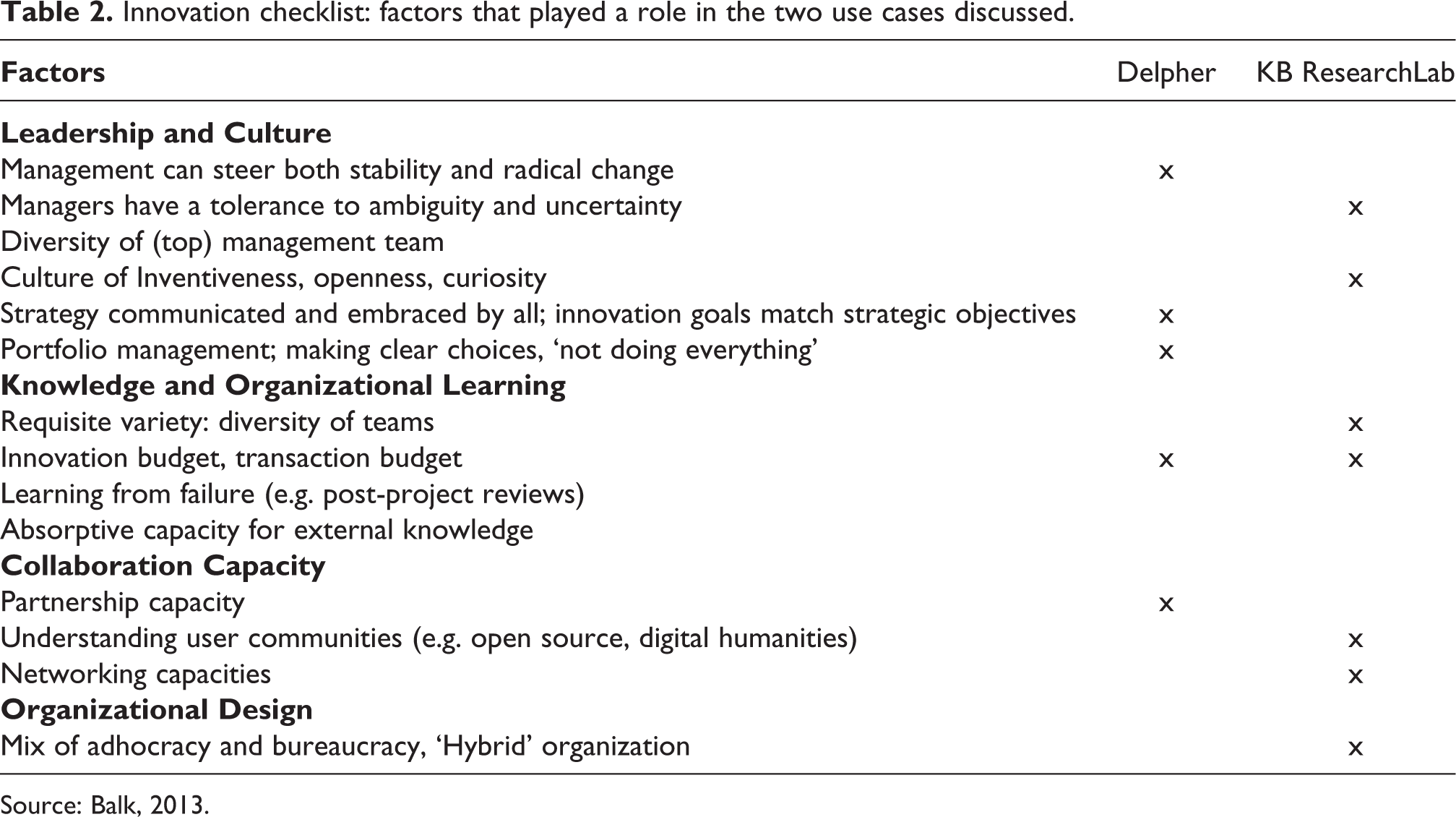
So, what did we do right? Let’s have a look at what factors in the checklist played a role in these innovations (summarized in Table 2).
Innovation checklist: factors that played a role in the two use cases discussed.
Source: Balk, 2013.
Delpher
The main factors in Delpher were balanced leadership and partnership capacity. The KB executive team was involved and committed to this project and managed to navigate the KB through the difficult process of maintaining a stable organization in a period of change. The quality most strongly present in the KB is probably partnership capacity. The KB is a trusted and sought after partner by libraries and universities and has successfully established and managed many (inter)national alliances, of which Delpher is a good example. In the case of Delpher, the selection of partners also worked out very well. Within the project, clear agreements were made and the strategic targets were defined and subscribed by all. A factor that smoothed the process and lessened the burden on the organization was the presence of extra funding, acquired with direct involvement of the general director for building the platform.
The KB ResearchLab
In the creation of the KB ResearchLab, the hybrid design of the KB really paid off. The Research Department operates as a ‘skunkworks’ with informal trails all through the organization. Also, the fact that the research group has a budget dedicated to innovation that can be deployed without bureaucratic delays played a major role. This made it possible to extend the capacity quickly, both in hardware and staff, and to set up activities such as the embedded researcher within a few months. The principles of the lab, such as ‘working with the grain of the web’ were drawn from the user communities targeted (open source software, computer science, digital humanities). The collaboration with people from different departments and backgrounds was highly beneficial to the development and showed good networking capacities all through the KB, as was the culture of inventiveness and openness in the departments involved. Finally, by accepting and supporting this adhocracy within a bureaucratic organization the top management of the KB demonstrates a fair amount of tolerance to ambiguity and uncertainty.
Conclusions
By ticking 11 out of 14 boxes in the checklist, the two KB use cases demonstrate the relevance of the checklist. We may cautiously conclude that it can make sense for a national library to foster and develop the qualities related to the factors in the checklist. As outlined above, the list was based on a review of innovation literature and an explorative survey of the national library community, with the aim of starting a discussion of good innovation practice among libraries. This may ultimately lead to the establishment of ‘best practice innovation’ in libraries.
Looking ahead
The KB will need all its innovation capacity to cope with the big changes that it faces in the near future. In 2015, its mandate will be expanded with the coordination of the public library sector. This will mean the integration of around 40 FTE staff with tasks formerly foreign to the KB, such as furthering literacy, providing special services for the reading disabled, and delivering the digital infrastructure for products and services of local public libraries. The most challenging innovation will be the development of the ‘National Digital Library of the Netherlands,’ integrating the collections and lending facilities of the public libraries with the collections and services of the KB. In addition to the technical complexities involved, this will be a tremendous effort of engaging and aligning all stakeholders in this field.
Looking further ahead to 2025, we see four potential scenarios for the Dutch library landscape (KB 2014). These have been conceived in a series of workshops, brainstorm sessions, and a conference in the KB in the period 2012–2013, with executives and professionals from the Dutch scientific and public library community and cultural heritage sector. The purpose of defining these scenarios was to reflect on the future in a systematic way and, if possible, to anticipate this future in the current strategy. In the conference that kicked off the discussion, 12 trends in technology, society and the library sector were identified, many in line with the IFLA trend report (IFLA 2013). On the basis of opposing the extremes of two major trends (role of government and public funding and competition of other market parties), four possible scenarios were defined: Transformation: In this scenario, many competing alternatives for traditional library functions become available, making many current library services redundant. As the government will still support the library sector, libraries will transform in order to deliver completely new services. Evolution: This happens when the number of competing alternatives is insignificant and government continues to invest in the library field. No radical changes will happen but the field will slowly evolve to adapt to new demands from the environment. Integration: When public funding diminishes but competing alternatives form no threat, a scenario where different organizations (e.g. libraries and cultural institutions) join forces and integrate becomes probable. The result is fewer but stronger organizations and a continued monopoly on information for libraries. Funeral: If competing alternatives become more attractive to users and public funding ceases entirely, very few libraries and services will remain relevant. In this scenario libraries will have to focus on strong value propositions, such as long term preservation of digital data, to survive.
Each scenario offers options for preparing for the future. The KB would be interested in continuing this discussion within the IFLA library community.