



Abstract
While Web 2.0 tools are increasingly being adopted by academic libraries to connect with patrons, they are not actively used to facilitate knowledge management (KM). This study investigates the awareness and comfort of librarians, their perceived usefulness of KM using Web 2.0, organizational readiness, and the ways in which these affect the library adoption of KM using Web 2.0. The survey questionnaire was completed by 101 librarians from 35 countries in 6 continents. Most respondents had heard of KM, were comfortable with Web 2.0, perceived KM using Web 2.0 to be highly useful, but were not entirely sure if their libraries were ready to adopt KM. Comfort with Web 2.0 was found to impact perceived usefulness, which in turn, strongly affected the likelihood of adoption of KM using Web 2.0. This is the first study that combines KM using Web 2.0 from the perspective of academic librarians globally, and has important implications for theory and practice.
Background and introduction
Academic libraries are undergoing a period of profound change, with changes in the format of information accessed and provided, and changes in the needs of users and organizational structures, as well as in the role of librarians. This necessitates libraries to become, not just providers of information and periodicals, but knowledge seekers as well – seeking knowledge both from their patrons as well as in-house knowledge of their own employees. Knowledge Management (KM) is “the capability of an organization to create new knowledge, disseminate it throughout the organization, and embody it in products, services and systems” (Nonaka and Takeuchi 1995). In non-profit organizations such as libraries, KM can improve communication among staff and between top management and can promote a culture of sharing (Teng and Hwamdeh, 2002). The basic goal of KM within libraries is to leverage the available knowledge that may help academic librarians to carry out their tasks more efficiently and effectively (Maponya, 2004). It can help transform the library into a more efficient knowledge sharing organization (Jantz, 2001). The only studies on library and KM have focused on KM in academic libraries (Townley, 2001; Maponya, 2004), the need for KM in libraries (Wen, 2005), the relationship between KM and library (Roknuzzaman and Umemoto, 2009; Sarrafzadeh, Martin and Hazeri, 2010), librarians’ awareness or perceptions of KM (Siddike and Islam, 2011), knowledge sharing behavior (Islam, Ikeda and Islam, 2013), KM in state-of-the-art digital libraries (Islam and Ikeda, 2014) and mapping KM tools to KM cycle for libraries (Agarwal and Islam, 2014). A few academic libraries have been practicing KM to some extent. Branin (2003) describes an enterprise-wide KM system at the Ohio State University Library in the United States. The library aimed to take a broad and evolutionary approach to KM by responding to new types of digital information assets created on campuses and among individual faculty and students. They created a knowledge bank and sought to extend the expertise of librarians beyond collection management – as knowledge managers for managing all types of information. Maponya (2004) carried out a case study of the KM practices in the University of Natal, Pietermaritzburg Library, South Africa. The library focused on partnerships and collaboration with other libraries to acquire knowledge. There was knowledge sharing to some extent, but little systematic sharing of know-how, expertise and experiences among the library staff. White (2004) conducted a case study of the KM culture at the Oxford University Library Services. The study found that the library had an effective knowledge acquisition culture, they focused on mentoring/coaching for transferring knowledge from long-serving members to new staff members, monitoring of intangible assets, and other KM tools. Despite limited implementations and varying perceptions of the Library and Information Science (LIS) community towards KM, most researchers view it positively and call for full involvement of LIS practitioners in KM (Abell and Oxbrow, 2001; Southon and Todd, 2001).
The advent of Web 2.0 has also brought new opportunities for the library, and the increasing role of the patron in its decisions (Kim and Abbas, 2010). In a digital environment, knowledge can be transferred in the form of knowledge-based services and products including e-mail, Web 2.0, websites, online discussion forums, video-conferencing and other collaboration tools (Agarwal and Islam, 2014). Using these tools, librarians can share their knowledge with colleagues and respond more effectively to user needs (Michael and Maria, 2007). Web 2.0 can be leveraged to support knowledge sharing, creation and other knowledge processes. Web 2.0 applications and tools are important for libraries, especially when they are going through budgetary constraints. This is because many of these Web 2.0 tools can be adopted free, or purchased at relatively low prices. Levy (2009) points out that the features of most Web 2.0 tools have their roots in KM tools. For example, Wiki as a Web 2.0 tool is part of the KM toolbox. Wikis can be read and edited simultaneously, helping to improve collaboration amongst library staff, between staff and patrons and even across libraries. ‘Library Success: A Best Practices Wiki’ (www.libsuccess.org) is used by librarians across the world to share their knowledge and successful projects, facilitating collaboration across libraries. Agarwal and Islam (2014) propose a set of technology and non-technology tools that libraries can use to implement KM, and map these to different phases of the KM cycle.
Even with these opportunities provided by KM and Web 2.0, most libraries are yet to fully embrace KM, or to leverage the use of Web 2.0 for KM goals. So far, there is little research in the area of KM using Web 2.0 as applied to libraries. It is unclear how librarians internationally perceive Web 2.0 and KM, and if they are ready to adopt KM in their libraries.
Objective of the study
The objective of the study was to investigate if librarians were aware of KM, if they were comfortable with Web 2.0, and whether their libraries were ready to adopt KM and Web 2.0. The proposition is that the more aware the librarians are of KM, and the more comfortable they are with Web 2.0 tools, the more open they would be to the idea of adopting KM using Web 2.0 in their libraries. However, this would also depend on the right conditions and organizational readiness to adopt KM being prevalent in the library.
The following research questions guide the study: RQ1. How aware are academic library professionals about KM and knowledge sharing practices? RQ2. How comfortable are they in using Web 2.0 tools? RQ3: How do these impact their perception of KM using Web 2.0 for libraries? RQ4: Based on their perception, how likely is their library to adopt KM using Web 2.0? RQ5: To what extent is this influenced by the library’s organizational readiness to adopt KM?
Knowing the perceptions of librarians about KM is the first step in determining whether academic libraries are ready to adopt KM or not. The process of participating in the study itself might prompt libraries to start thinking about KM seriously. This is the first time an effort has been made to measure the perception of academic librarians globally to ascertain library readiness to adopt KM using Web 2.0. Insights gained from the study may trigger more such research in library areas and beyond.
The rest of the paper is organized as follows: In the next section, we present our research model and variables. We then review the literature and arrive at hypotheses. The Technology Acceptance Model (TAM) (Davis, 1989) served as a theoretical lens for the study. This is followed by sections on methodology, findings and discussion, and conclusions and implications.
Research model
A research model is helpful in demonstrating the relationships between the variables of interest in a study. We propose a research model to study the factors affecting the likelihood of library adoption of KM using Web 2.0. It has two independent variables – ‘lack of awareness about KM’ and ‘degree of comfort with Web 2.0’, and one variable ‘perceived usefulness of KM using Web 2.0 for libraries’ that mediates the relationship between the independent variables and the dependent variable ‘likelihood of library adoption of KM using Web 2.0’. The ‘degree of organizational readiness’ is the moderating or interacting variable that moderates the relationship between ‘perceived usefulness’ and ‘likelihood of adoption’. The mediator and the dependent variable are based on the Technology Acceptance Model (TAM) by Davis (1989).
Literature review and hypotheses
‘Web 2.0’ refers to the social revolution (Birdsall, 2007) ushered in by the second generation of the web that facilitates communication, information sharing, interoperability and user centered design (King and Brown, 2009). Web 2.0 tools can be used to enhance library services by being more proactive and personalizing outreach (Miller, 2005; Huffman, 2006; Stephens, 2006; Bradley, 2007; King and Porter, 2007; LASSIE, 2007; Tedd, 2008; Kumar and Tripathi, 2010). Hanson and Cervone (2007) identified Wiki, blog, Really Simple Syndication (RSS), Instant Messaging (IM) and podcast as the prominent Web 2.0 tools for academic libraries. Kim and Abbas (2010) found RSS and blogs to be widely adopted by academic libraries.
Parirokh, Daneshgar and Fattahi (2007) surveyed 30 American academic librarians to identify the knowledge sharing requirements in their libraries. They found that the majority were friendly towards knowledge sharing and valued its importance. Kim and Abbas (2010) identified specific Web 2.0 technologies used by academic libraries by analyzing 230 library websites. They surveyed 184 users from two universities to find that RSS and blogs were widely adopted by academic libraries, while users utilized the bookmark function. However, their study did not seek the perceptions of librarians. Also, the study was limited to two universities in the US mid-west, and did not take into account global perspectives.
There is an acute gap in the literature and initiatives on KM using Web 2.0 by library practitioners. With the recent emphasis on the creation and dissemination of knowledge with the help of Web 2.0, this study presents the perceptions of librarians on using Web 2.0 for KM in libraries. This is the first time an effort has been made globally to measure this. We hope that this study will trigger more research on this area.
Specific variables identified in the research model (Figure 1) are reviewed below, and the hypotheses arrived at.
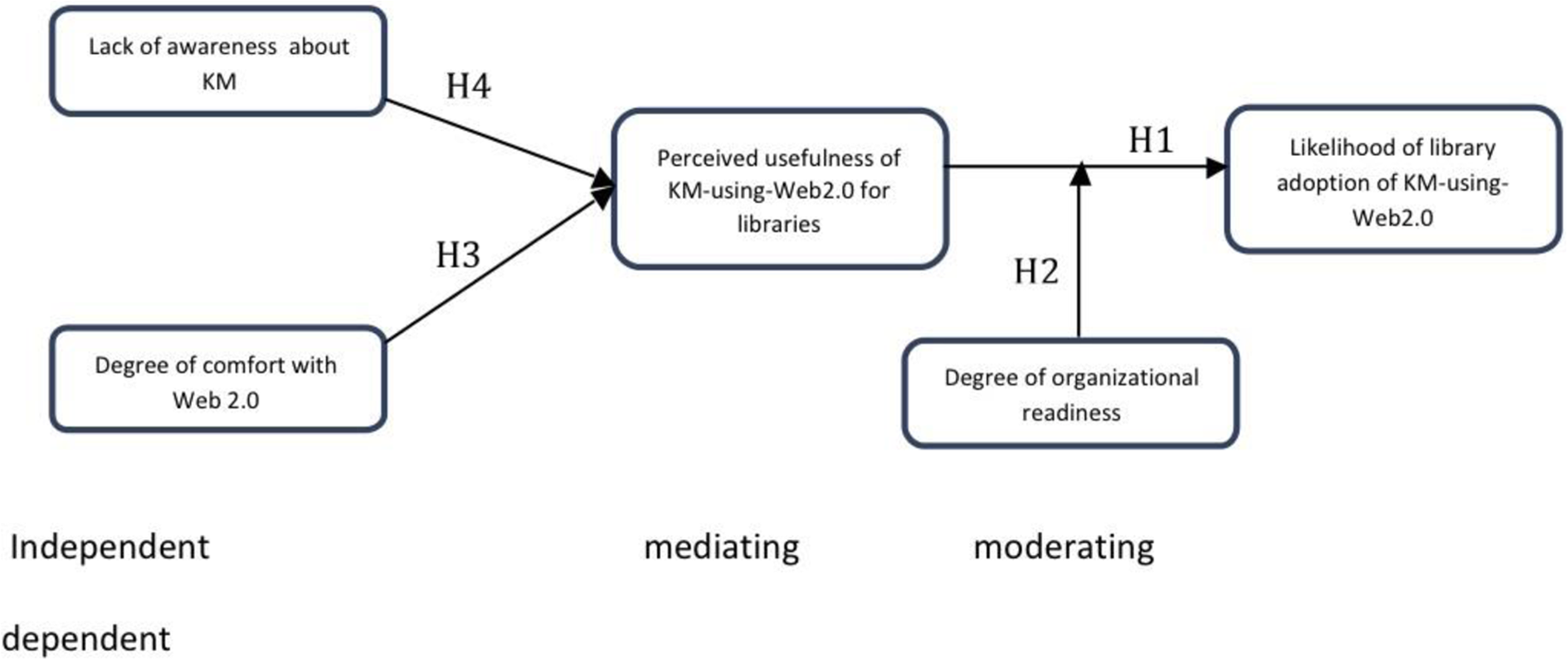
Research Model.
Likelihood of library adoption of KM using Web 2.0 (dependent variable)
Intentions are the active, conscious, future aims we perceive another person to have (Rummel, 1976). The theory of planned behavior (Ajzen, 1991) suggests that perceived or behavioral intention is the most important determinant factor in predicting the decision to take a specific action or not. Past studies have used behavioral intention to forecast specific behavior, given the close relationship between intention and behavior (Ajzen, 1991). We define likelihood of library adoption of KM using Web 2.0 as the perceived intention of the library to adopt KM using Web 2.0 from the point of view of individual librarians.
Perceived usefulness of KM using Web 2.0 for libraries (mediator)
Perceived usefulness is the degree to which the subject believes that the use of a technology will enhance performance (Davis, 1989). We define perceived usefulness of KM using Web 2.0 technologies as the extent to which librarians believe that KM using Web 2.0 will be useful for their libraries. We operationalize this as making library services more effective, making staff feel more valued, leading to increased productivity, helping to create new knowledge in libraries, improving users' satisfaction in libraries and making employee life at work easier. As per the TAM model, which has been validated in numerous studies, perceived usefulness has been found to influence behavioral intention through attitude (Davis, 1989). Therefore, we hypothesize:
Degree of organizational readiness (moderating variable)
We define organizational readiness as the set of factors that need to be in place, and in the right balance at the right point in time, before KM can be adopted in libraries. Many studies have found these to be the most common factors: knowledge sharing culture (Rahman, 2011), top management support (Kamath, Rodrigues and Desai, 2011), funding to set up a KM team and infrastructure (Basu and Sengupta, 2007), and timing – the right time to adopt (Holsapple and Joshi, 2000). To operationalize readiness, we include knowledge sharing culture, top management openness to ideas, funding for new initiatives, time taken to approve new initiatives, technology support and librarians’ willingness to invest time and effort. We hypothesize:
Degree of comfort with Web 2.0 (independent variable)
Degree of comfort is the degree of fit between the new technology and the individual's existing experiences and job responsibility (Rogers, 2003). We define degree of comfort with Web 2.0 as the individual ease and experience that librarians feel when using Web 2.0 technologies. Agarwal, Xu and Poo (2011) posit that one’s comfort level in using the system, system-knowledge, or computer-efficacy would affect use of the system/tool. The TAM model (Davis, 1989) posits that external factors affect perceived usefulness. Therefore, we hypothesize:
Lack of awareness about KM (independent variable)
Awareness is focused on an internal state. We define awareness as whether the librarian has heard about KM and the degree to which s/he understands the concept. Social awareness or influence has been found to influence perceived usefulness and usage (Venkatesh and Davis, 2000). Therefore, we hypothesize:
Methodology
We relied upon the survey questionnaire method for collecting data for this study, as the questions related to the perceptions of librarians, for which the survey method is the best suited.
Study population and sample
The target population of the study is academic librarians across the world. The scope of the study is limited to academic libraries because they have played a significant role in supporting information dissemination activities, and faculty and students stimulate the creation and transmission of knowledge. However, as it would be difficult to obtain a sampling frame consisting of academic librarians across the world, we utilized convenience sampling to reach out to librarians. The study population was academic libraries worldwide that were accessible using the International Federation of Library Associations and Institutions (IFLA) mailing list (IFLA Mailing Lists, 2014) and the IFLA KM section mailing list. Apart from these, we also reached out to academic librarians in the UK (listing maintained by University of Wolverhampton, n.d.), the USA (listing maintained by University of Texas, n.d.), Canada (Universities in Canada, n.d.), Australia (Universities in Australia, n.d.) and other countries such as Malaysia, India, Bangladesh, Norway, Denmark, where universities were found using Web search. The purpose was to reach out to a wide pool of academic libraries from different countries whose contact details were accessible online. This ensured coverage of diverse socio-economic and educational environments. The librarians reached out to were those who had registered themselves to be part of these mailing lists, as well as those whose email addresses could be obtained from the resources referenced above. Data was gathered using a web-based questionnaire. The collected data was statistically analyzed using psychometric procedure to determine support for our hypotheses.
Instrument development
The items developed for the five variables of our research model, as well as other control variables on Web 2.0 experience, knowledge retention and training, and demographic variables, are listed in Table 1 below. The control variables were not of theoretical interest but were included to see if they had any effect on the dependent variable.
Variables and items included in the questionnaire.
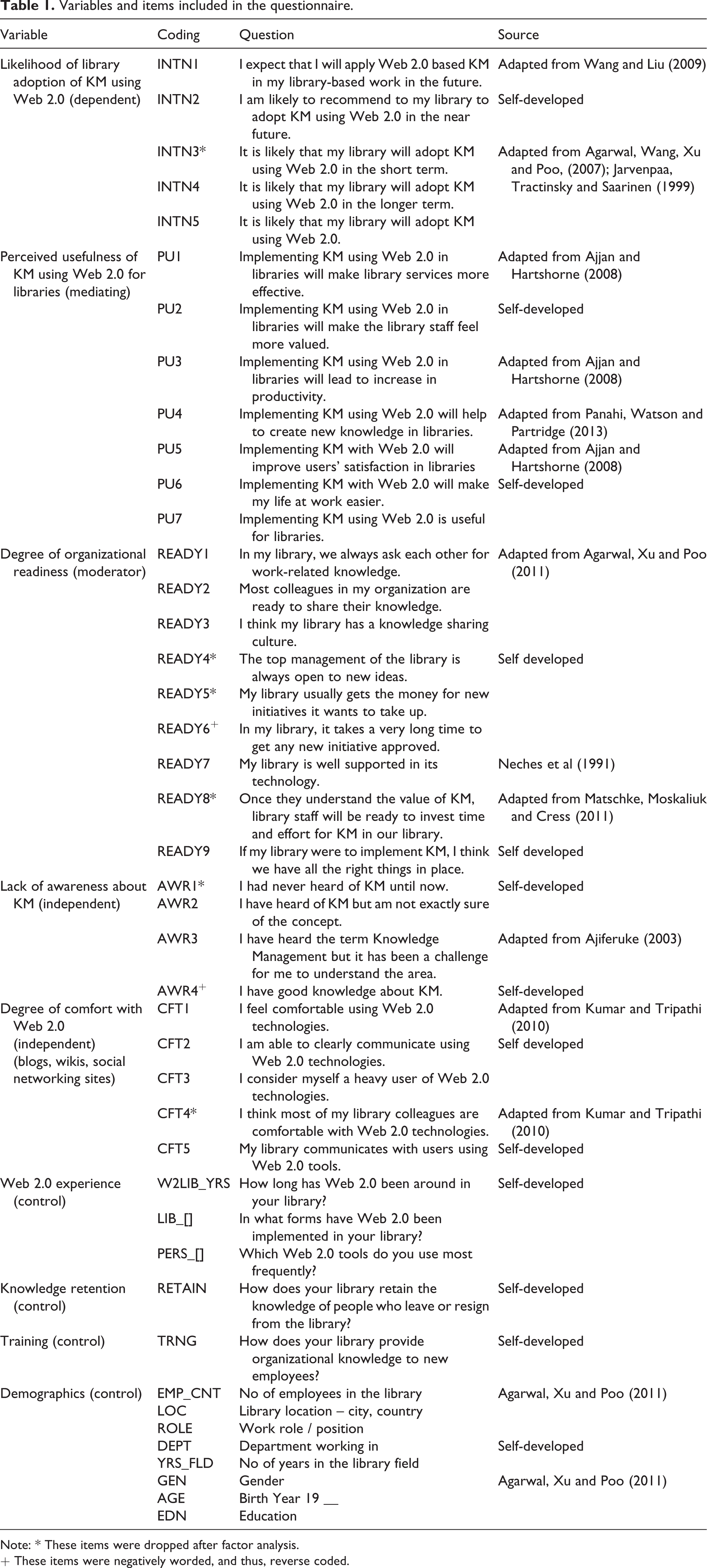
Note: * These items were dropped after factor analysis.
+ These items were negatively worded, and thus, reverse coded.
Where possible, survey items were taken from prior studies or adapted to suit the needs of this study. For other cases, the items were self-developed. The questionnaire used the 7-point Likert scale (1 = strongly disagree, 7 = strongly agree). An introductory paragraph defining knowledge management in libraries was included in the survey. The face validity of the survey items was ascertained through discussion.
Data collection and analysis
The survey instrument was pre-tested to check for any question wording issues. The questionnaire and the design of the study were approved by the Institutional Review Board of Simmons College. Participation was voluntary. Filling out the questionnaire implied consent. A web-based version of the instrument was created using Google form. None of the questions was made compulsory. Thus, a participant could choose not to answer a question s/he was uncomfortable with. In order to protect the identity of the librarians, no names, email addresses or library names were gathered.
Based on the names of universities gathered, the respective library websites were searched. From the listing of library staff, email addresses of librarians were gathered and collated. While some library websites listed emails of individual staff members, others had a common contact email for all external mails. We obtained the names and email addresses of 563 librarians in the UK, USA, Australia and Canada. Individual personalized emails were sent to all these. Apart from these, individual librarians were also contacted in other countries such as Malaysia, India, Bangladesh, Norway and Denmark. Mails were also sent to the IFLA and IFLA KM mailing lists. About 600 librarians were individually contacted, with the rest in mailing lists.
In total, 101 librarians from 35 countries in 6 continents filled out the questionnaire after multiple follow-up emails and efforts at reaching respondents and mailing lists. As the survey was anonymous, it was not easily to distinguish how many of the responses were from individual emails and how many from mailing lists. Thus, it would be difficult to arrive a precise number for the response rate. The response rate would be 101/(600 + those registered in the mailing lists). For the sake of calculation, if we were to disregard the number of people in the mailing lists, the response rate would be 101/600 or 16.83 percent. However, since there are likely to be hundreds of librarians registered in the mailing lists (some of whom might have been individually contacted), and assuming that one or more responses were from those registered in the mailing lists, the actual response rate would be even less than the 16.83 percent figure based on our calculation. As the responses were difficult to get, and the response rate not too high, no separate pilot data was gathered. Rather, exploratory factor analysis was done on the main data itself once the responses stopped coming in. Data was gathered between August 2013 and February 2014.
PSPP 0.8.2, the open source alternative to SPSS, was used for statistical data analysis. The authors also had access to IBM SPSS 22. The results generated by PSPP were found to be equivalent, and sufficient for the analysis.
Demographics
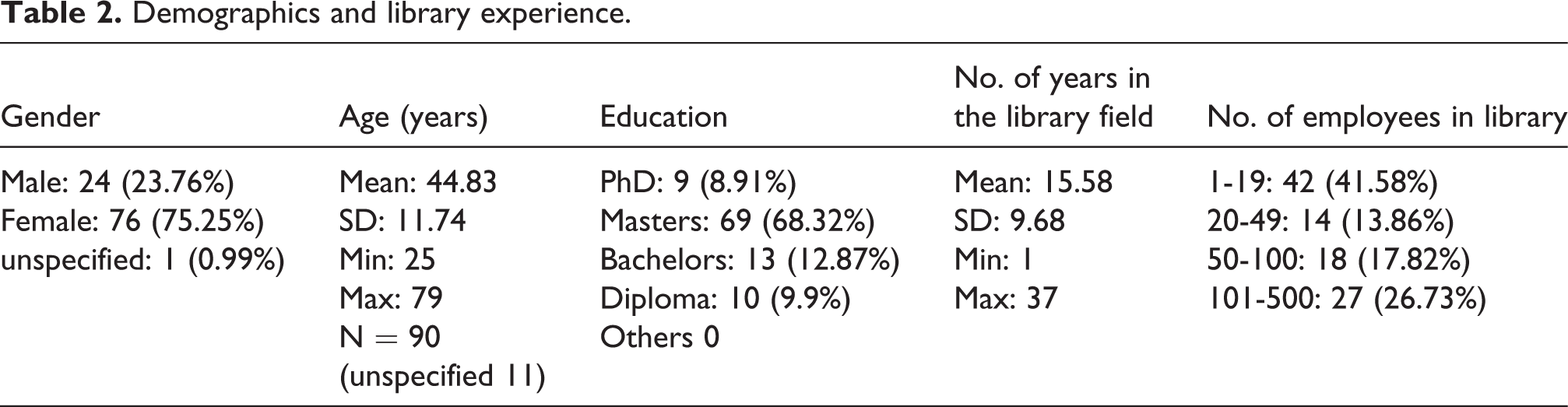
Table 2 shows the demographic distribution of the survey respondents.
Demographics and library experience.
The survey was truly international, with respondents coming from 35 countries in all continents excluding Antarctica. The participants were distributed almost equally between Asia and Europe (22 and 20 percent respectively), with the rest coming from the other four continents (see Table 3). Along with individual librarians reached out from university libraries in specific countries, this distribution also reflects the international nature of the mailing lists targeted.
Library location.

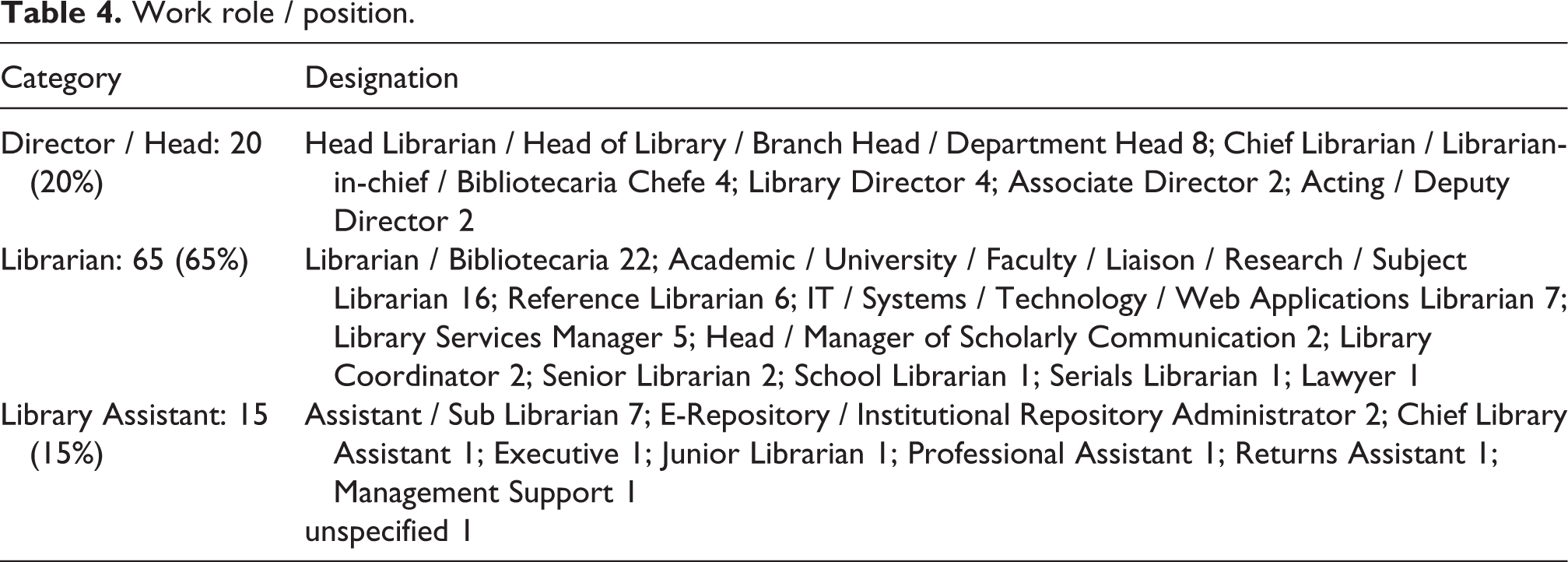
The work roles or positions specified by the respondents were classified into three categories based on hierarchy (see Table 4).
Work role / position.
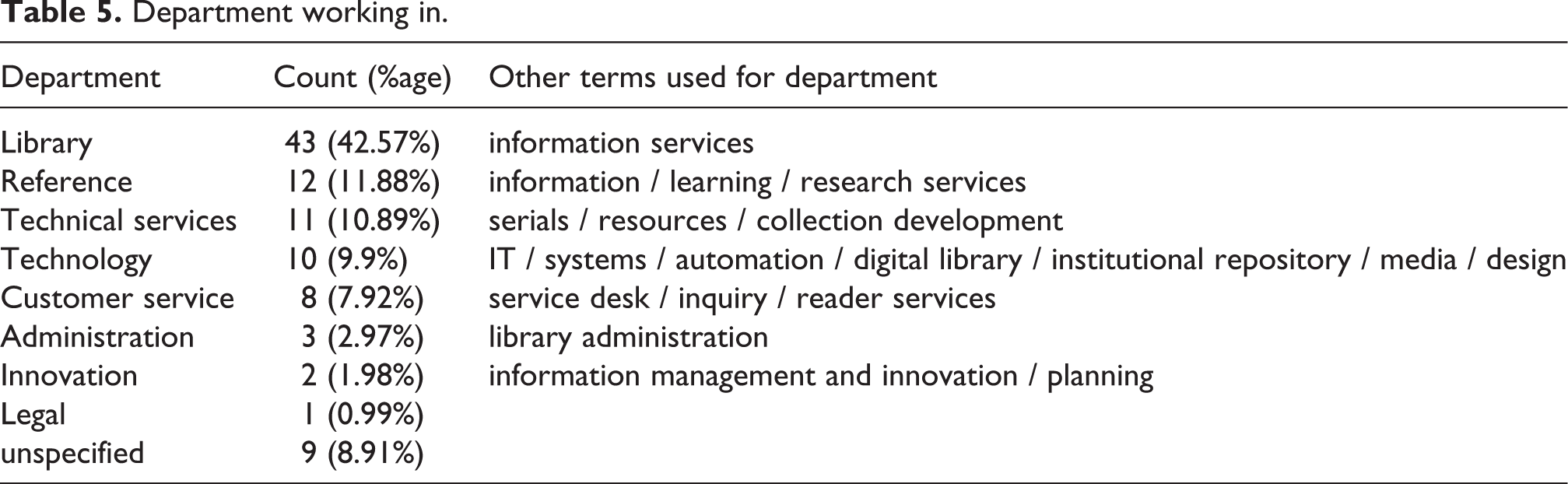
Forty-three percent of the respondents did not specify a specific department but said they worked in the overall library in general (see Table 5).
Department working in.
Exploratory factor analysis
Psychometric analysis was performed as per the procedure recommended by Anderson and Gerbing (1988). Exploratory factor analysis (EFA) is a technique within factor analysis used to uncover the underlying structure and relationships between measured variables (Norris and Lecavalier, 2009). EFA with principal component analysis (Hair et al., 1995) was used to extract the factors, followed by Varimax rotation. Six survey items – CFT4, AWR1, READY4, READY5, READY8 and INTN3 (see Table 1) were found to be problematic (both statistically and conceptually), and removed. All items loaded correctly on their respective variables. This indicates a high degree of convergent and discriminant validity, and thus construct validity for the five variables.
A reliability analysis was carried out using Cronbach’s alpha. Table 6 below shows the descriptive statistics and Cronbach’s α for the five variables in the research model. The internal consistency was above 0.8 for comfort, awareness and perceived usefulness, and close to 0.8 for likelihood of adoption. This was lower for organizational readiness as it is a multi-dimensional variable.
Descriptive Statistics and Cronbach’s alpha.

The participants exhibited a high degree of comfort with Web 2.0 (5.49 on a scale of 1-7) and disagreed that they were unaware of KM. Thus, they had some exposure to KM. Most participants thought that KM using Web 2.0 would be useful for libraries. While they tended to agree that their organizations were ready for KM, it was a relatively low level of agreement (4.85 on a scale of 1-7). Finally, the participants thought that their libraries were likely to adopt KM using Web 2.0.
Hypothesis testing
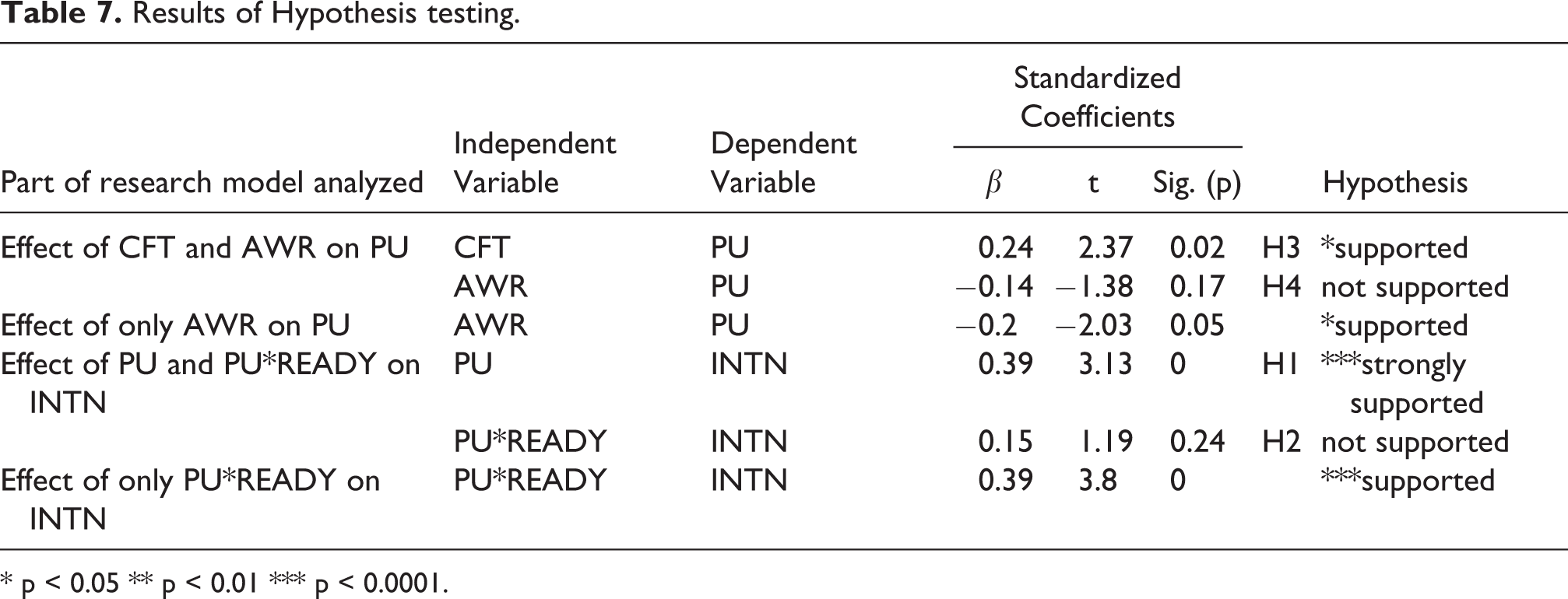
After completing the validity and reliability analysis, hypothesis testing was done using multiple linear regression. It is a procedure used to attempt the relationship between two or more independent variables and a dependent variable by fitting a linear equation to observed data. Table 7 lists the results of the hypothesis testing. The leftmost column shows the part of the research model (Figure 1) analyzed in the four iterations of the regression analysis. The next two columns show the cause-effect relationship between the variables in question. The number in the significance (p) column tells what the probability of error is. The hypothesis is supported if the probability of error is less than 5 percent i.e. p < 0.05.
Results of Hypothesis testing.
* p < 0.05 ** p < 0.01 *** p < 0.0001.
First, the left side of the research model was analyzed, looking at the effect of the two independent variables – lack of awareness about KM (AWR) and degree of comfort with Web 2.0 (CFT) – on the mediating variable perceived usefulness of KM using Web 2.0 for libraries (PU). Hypothesis 4 (effect of AWR on PU) was not supported, while H3 (effect of CFT on PU) was supported (p < 0.05).
To test for Hypothesis 4 again, we analyzed the effect of only AWR on PU. Now, the effect of AWR was found to be significant (p = 0.05).
Next, we analyzed the right side of the model. It has two relationships. H1 shows the relationship between the mediating variable perceived usefulness of KM using Web 2.0 (PU) on the dependent variable likelihood of library adoption of KM using Web 2.0 (INTN). H2 is a moderating effect. It shows the relationship of the interaction between PU and the degree of organizational readiness (READY) on the dependent variable INTN. The moderated relationship or the interaction was modeled by including a product term (PU*READY) as an additional independent variable (Irwin and McClelland, 2001), along with PU, to see their effect on the dependent variable INTN. H1 was found to be strongly supported (p < 0.0001), while H2 was not supported.
We analyzed the effect of only the moderator (PU*READY) on the dependent variable (INTN). When analyzed separately, H2 was found to be strongly supported (p<0.0001).
After the hypothesis tests, additional tests were carried out to see: a) any potential effect of the control variables age, gender, education, no. of employees in the library and no. of years in the library field on the dependent variable INTN; b) the direct effect of READY on both INTN or PU; c) the individual items for specific variables that had been deleted; and d) the nine individual items of READY on INTN. None of these were found to be significant. The only (strongly) significant effect was of READY4 (the top management of the library is always open to new ideas) on INTN (β = 0.43, t = 4.53, p < 0.0001).
Findings and discussion
In this study, we set out to answer a few research questions on the perceptions of academic library professionals about Web 2.0 and the degree to which the library is ready to adopt KM. The findings addressing the research questions and the results of hypotheses testing were summarized in Tables 7 and 8.
RQ1. How aware are academic library professionals about KM and knowledge sharing practices?
More than 71 percent of the participants strongly disagreed that they had never heard of KM, while another 10 percent disagreed. Thus, most librarians had heard of KM in some form. More than 31 percent of the participants indicated that they had good knowledge of KM. Only about 12 percent of the respondents indicated that they had heard of KM but were not exactly sure of the concept, or found it a challenge to understand. Overall, the mean response for lack of awareness was 2.95 (on a scale of 1-7; standard deviation 1.48). If we reverse lack of awareness to awareness, the mean response would be 5.05. The participations agreed that they were aware of KM and knowledge sharing practices, but did not consider it to be a strong agreement. Thus, most participants exhibited a relatively high degree of awareness about KM and KM practices. This is in line with past studies, e.g. by Siddike and Islam (2011), who found that 93 percent of their respondents had heard about KM in the literature. It is significant that about one-third of librarians internationally claim a good degree of knowledge in KM, which demonstrates that KM is slowly but surely finding its way in libraries.
RQ2. How comfortable are they in using Web 2.0 tools?
More than 43 percent of the respondents indicated a very high degree of comfort with Web 2.0 (those who chose 6 or 7 on a scale of 1-7). The mean response for degree of comfort was 5.49 with a standard deviation of 1.16. Thus, the participants were largely comfortable with Web 2.0. Of the 1.3 billion active Facebook users as of early 2014, many of these would be librarians as well. This individual comfort explains why libraries are embracing Web 2.0 (as found by Kumar and Tripathi, 2010).
RQ3. How do these impact their perception of KM using Web 2.0 for libraries?
More than 46 percent of the respondents perceived KM using Web 2.0 to be highly useful for libraries (responses of 6 and 7, on a scale of 1-7). The mean response for perceived usefulness was 5.75 with a standard deviation of .98. The relatively low standard deviation indicates that the respondents all agreed that KM would be useful for their libraries.
H3 was supported, while H4 found conditional support. The individual degree of comfort with Web 2.0 (H3) was found to affect the perceived usefulness of KM using Web 2.0 for libraries. This finding is consistent with Agarwal, Xu and Poo (2011), who found an individual's inherent lack of comfort with an information source to negatively affect the amount and order of use of that source. Thus, if a librarian likes using Web 2.0 technologies, s/he is likely to think it would be useful for libraries overall.
Finally, on its own, lack of awareness about KM (H4) was found to negatively affect the perceived usefulness of KM using Web 2.0 for libraries. If a librarian does not know enough about KM, s/he is unlikely to find KM using Web 2.0 useful for libraries. However, when analyzed along with degree of comfort with Web 2.0, the effect of AWR on PU was found to be insignificant. This might be because comfort with Web 2.0 is based on individual experience (which one can more strongly vouch for), while awareness is more subjective. Thus, between Web 2.0 comfort and KM awareness, the former is a more important factor for the librarians to perceive KM using Web 2.0 to be useful for libraries.
RQ4. Based on their perception, how likely is their library to adopt KM using Web 2.0?
About 37 percent of the participants strongly agreed that their library was likely to adopt KM using Web 2.0 (mean 5.35, SD 1.15). About 28 percent strongly agreed that the library was likely to adopt KM using Web 2.0 in the short term, while most of them only showed a slight agreement (mean 4.46, SD 1.68). Kim and Abbas (2010) had earlier compared academic library and user utilization of Library 2.0 features in the KM perspective and found that the adoption rate greatly differs for each Library 2.0 application. Some of the library-initiated knowledge transfer functions (e.g., RSS feeds, podcast) are widely adopted among academic libraries, while some of the user-initiated functions (e.g., Tagging, Wiki, etc.) are at a burgeoning stage.
H1 was strongly supported. The strong support for H1 is intuitive as libraries are likely to adopt KM using Web 2.0 only if they perceive it to be useful. This finding is consistent with the Technology Acceptance Model (Davis, 1989), where perceived usefulness has been shown to have a significant effect on intention.
RQ5. To what extent is this influenced by the library’s organizational readiness to adopt KM?
The mean value for the degree of organizational readiness was 4.85 (with a standard deviation of 0.91). Thus, the participants did not have a strong opinion on whether they thought their library was ready or not to adopt KM using Web 2.0, though they tended to think that it was.
However, the reliability of this variable was low (0.7) because it consists of multiple dimensions. We operationalized organizational readiness in terms of knowledge sharing culture (READY1-3; Cronbach’s α = 0.82), top management openness to ideas (READY4), funding (READY5), time to approve new initiatives (READY6), technology support (READY7), willingness to invest time and effort (READY8) and overall readiness (READY9). Analyzing these dimensions separately, 33 percent strongly agreed that they had a knowledge sharing culture (values of 6 and 7 on a scale of 1-7; mean 5.26, SD 1.21), more than 51 percent strongly agreed that their top management was open to new ideas (mean 5.4, SD 1.49), only 13 percent strongly agreed that they usually got funding for new initiatives, with most people disagreeing (mean 3.75, SD 1.62). About 22 percent strongly agreed that it did not take very long to get new initiatives approved, though a big percentage thought otherwise (mean 3.91, SD 1.70). These findings reflect that while top management were open to ideas, they did not always provide the money or approve new initiatives quickly. About 33 percent strongly agreed that they had technology support (mean 4.85, SD 1.4). More than 33 percent strongly agreed that library staff would be ready to invest time and effort on KM (mean 5.05, SD 1.19). Finally, in the question for overall readiness, 22.77 percent strongly agreed that their organization was ready to adopt KM (mean 4.69, SD 1.33).
Comparing the means of the seven dimensions (on a scale of 1-7, where 1 = not ready at all and 7 = completely ready), the pecking order of readiness is management openness 5.4, knowledge sharing culture 5.26, willingness to invest time and effort 5.05, technology support 4.85, overall readiness 4.69, time taken to approve new initiatives 3.91 and funding for new initiatives 3.75. Many of these readiness factors have been identified in prior studies – knowledge sharing culture, (Rahman, 2011), top management support (Kamath, Rodrigues and Desai, 2011) and funding to set up a KM team and infrastructure (Basu and Sengupta, 2007).
H2 found conditional support. The moderating effect of READY and PU on INTN (H2) also found strong support. However, this interacting effect (when analyzed along with the effect of PU on INTN) was found to be insignificant. This could be because usefulness was perceived to be a more important factor than readiness. Also, readiness, as a factor, had lower internal consistency as it had multiple dimensions. This finding held even when we considered only one dimension – knowledge sharing culture (READY1-3; Cronbach’s α = 0.82), where the overall effect was insignificant. Thus, perceived usefulness (H1) has a more important role on adoption than readiness (H2). This finding is in accordance with the TAM Model (Davis, 1989) where numerous studies have found perceived usefulness to affect adoption.
Conclusions and implications
The study found that librarians, in general, are comfortable using Web 2.0. Thus, libraries can expand their reach in this area, making use of this expertise in their staff. Librarians disagreed that they were unaware of KM. Thus, the study shows that the awareness about KM is increasing in libraries. It is time for KM researchers to help more libraries to adopt KM using Web 2.0, as most librarians agree that it would be useful and that, given favorable conditions, the library is likely to adopt KM using Web 2.0. The part where most work is needed is for libraries to further develop their organizational readiness. While the knowledge sharing culture was found to be strong and top management open to ideas, they did not always provide the funding or approve new initiatives easily. This is a bottleneck which needs to be addressed. For KM adoption, teams will need to be formed and both people and technology infrastructure developed. Thus, along with the openness of top management, libraries need to secure funds for KM. Other research organizations or universities could also help in this area by seeing it as a priority. Finally, libraries need to further improve their processes. They need to become more agile by responding to change quickly and by providing timely support to new initiatives. Overall, the study points to a favorable direction for KM using Web 2.0 in libraries. Adopting KM using Web 2.0 would lead to more agile libraries, service innovation, and libraries moving seamlessly towards the libraries of the future, while surviving budget cuts, competition from online sources such as Google and other difficulties.
The indirect benefits to participants are developing awareness about knowledge management, even as they fill out the questionnaire. Knowing the perceptions of librarians about KM is the first step in determining whether academic libraries are ready to adopt KM or not. The process of filling out the questionnaire itself might prompt libraries to start thinking about KM seriously.
The study also has implications for researchers in the KM, Web 2.0 and library areas. Bringing these together opens up further areas of research, and is a primary contribution of this study. We propose the term KML 2.0 to study the area of ‘KM using Web 2.0 in libraries’. Researchers should note the findings and limitations of this study and continue work in this area.
The study had a few limitations. First, a bigger sample than 101 would yield more data. Two of the hypotheses were conditionally supported. A larger sample could help determine if these hypotheses are more fully supported. Second, the use of convenience sampling would limit the generalizability of our findings. Third, the construct validity of the survey items could be further improved by adopting a two-step sorting procedure described by Agarwal (2011), even before the data collection is started.
Future work could be done in a number of areas: Further analysis could be done on the qualitative data obtained on how the library retains the knowledge of people who leave or resign from the library, and how the library provides organizational knowledge to new employees. The data could be further analyzed by individual continents to see how the findings differ across librarians in the six continents. We have looked at Web 2.0 technologies as a monolithic entity. Future studies could build on the work of Kim and Abbas (2010) and investigate individual technologies separately. Finally, the findings of the study could be supplemented with interviews of librarians to get a more in-depth picture of their perceptions about KM using Web 2.0 for libraries.