




Abstract
This article presents a case study of Victoria University Library as a relatively young university library contributing to the development of an institution’s nascent research culture. It showcases various scholarly communication projects and initiatives with an emphasis on digital repositories, digital literacies and new roles for libraries. The concerns, challenges, and successes of the Library may help inform the planning and implementation of initiatives and projects in similar academic libraries.
Keywords
Introduction
Within Victoria University and its external research environment, the demands on and expectations on researchers and those who facilitate research, namely, librarians, are becoming complex and sophisticated. As an entity tightly connected to its university community, Victoria University (VU) Library has proved itself to be agile and flexible in responding to this environment. This article showcases the various scholarly communication projects and initiatives of VU Library. VU Library endeavors to contribute to the development of a contemporary research culture with a four-pronged approach, including strategic planning direction; one-off funding of initiatives; partnership with research services, and a realignment of staff endeavors to support the direction.
Victoria University was one of the ‘new universities’ formed out of Colleges of Advanced Education as part of higher education reforms in Australia in the early 1990s. Like other Australian universities, VU aspires to be a research university. However, as a ‘new university’ it has lacked a significant research history and culture. Moreover, when compared to other Australian university libraries, VU Library has the lowest materials budget per capita. It is ranked 46th out of 46 on the list of the Council of Australian Universities (2012). Such comparisons are made difficult because of the university’s high number of vocational education students who are included in the ranking process. If only comparing serials expenditure per postgraduate student, VU Library is ranked 39th. It also has one of the lowest numbers of library staff per student – it is ranked 43rd out of 46. In recent times, it has had irregular funding for staffing and information resources. This has seen a reduction of almost 30 percent in staff numbers (from 101 EFT in 2010, to 70 in 2014) and a piecemeal implementation of strategic initiatives such as data management services. However, the challenge for VU Library is to develop a coherent and inclusive suite of research supports that crosses organizational boundaries, and bring them together in an integrated research data service to support the research and data lifecycles.
Background
VU achieved university status in 1991. As a university, it is in the unusual position of offering both higher education and vocational education programs, and is one of only four dual sector universities in Australia to offer both programs. By Australian standards it has a small number of research students, with 814 Higher Degree by Research students in 2013. However, it has a large total cohort of students (55,000 students in 2013) – 33 percent are students at bachelor degree and 54 percent at pre-bachelor degree levels. It also has 661 academic staff, who comprised 32 percent of the total staff of 2,119 in 2013. Not all of these academic staff are active researchers, although there is no publicly available data to indicate the exact figure of research active staff (Victoria University, 2014). As with other Australian universities, it has a large cohort of international students (29 percent) both overseas and onshore, mostly from Asian countries. VU also has educationally, culturally, linguistically and economically diverse students spread across nine onshore campuses and eight offshore partner sites. According to the university’s 2013 annual report, some 25 percent of the student cohort is from low socio-economic backgrounds and about 35 percent are mature-aged students (Victoria University, 2013).
As a younger university, VU is ranked at the lower end of the list of Australian research universities in terms of research income and research quality. However in the updated strategic plan Excellent, Engaged and Accessible: The University of Opportunity (Victoria University, 2013a), the Vice Chancellor and President, Professor Peter Dawkins, announced an ambitious target for VU to be in the top 20 Australian universities for research by 2020, with an emphasis on applied and translational research. The strategic plan also outlines the university’s goal to become deeply engaged with industry and community, including in its approach to research. The university has also identified areas in which it wants to specialize and become internationally renowned. As a first step it has been decided to position the university as Australia’s Sport University because of its existing breadth and depth of teaching, research and engagement in sport.
To achieve its ambitious strategic goals, the university went through a complete organizational change process in 2012 and 2013 to rebuild the university and establish a reputation as a university-of-choice. The university’s focus on achieving its strategic goals, including its research strategies, has been sharpened by increasing competition in the Australian higher education and vocational education market in the last few years. This is mostly due to changes in policies of both the federal government and Victoria state government, from regulated funding for students, to competition for students in the open market place.
New roles for libraries
While the focus of this paper is a case study of the concerns, challenges, and successes of the role of the library in the scholarly communication process, the paper also acknowledges the growing literature in the area of new and emerging areas of practice for librarians. For VU Library, the literature confirms its ongoing re-alignment of research services as it continues to provide value to its community. Since 2009, VU Library has extended its role to, and is a key partner in: (i) promoting the university’s research publications; (ii) collaborating in the analysis and reporting of the university’s research outputs to Government; (iii) promoting the university’s research repository; (iv) providing expert support to researchers in seeking, accessing and organizing information resources; and (v) developing a suite of services to support research data management.
In their manifesto of support for the research process, Bourg, Coleman and Erway (2009) outlined a set of practices to enable libraries to address matters in the evolving research landscape – in essence an evidenced-based, value-driven, client-focussed and flexible partnership approach. The manifesto points to the need for agile anticipation and response to changing research practices in infrastructure, training and engagement. This requires genuine collaboration: an understanding of the people involved, the value of the work and, at times, a willingness to step out of the way. At VU Library a cycle of annual and strategic planning and regular VU Library client surveys has informed the agile implementation of its practices.
The provision of data services, including management and curation, is another new role for the library, according to Tenopir, Birch and Allard (2012). They surveyed academic library members of the Association of College and Research Libraries (ACRL) to identify the state of research data service provision in the United States and Canada (2012: 3). Approximately 63 percent of the invited libraries responded. A minority (less than 20 percent) offered research data services other than reference-type services, although as many had future plans to offer such services (2012:17). Tenopir, Birch and Allard concluded that it would enhance and expand the library’s role in the academy if more libraries were involved (2012: 42).
In the Australian context Borchert and Callan (2011) recognized the need to provide professional development to Queensland University of Technology (QUT) librarians in 2009 because of institutional changes to research support services and systems. They surveyed QUT researchers and librarians to understand current research practices and needs, and subsequently professional development programs on e-research concepts and technologies were provided to support librarians in the university’s research agenda. Research data management, data interviews, changes in scholarly communication and collaboration tools were some of the topics around which training for librarians was designed. This is very similar to the in-house and external librarian development sessions provided to its staff by VU Library.
Mamtora (2013) from Charles Darwin University (CDU) provided an interesting comparison for VU library, CDU being an even smaller and recently established, dual sector Australian academic library. Mamtora pointed to the impact and impetus that the introduction of the Research Quality Framework in 2006, now replaced by Excellence for Research in Australia (ERA), had on the development of research services in Australian academic libraries.
VU Library’s approach
VU Library has a demonstrated track record of engaging with all endeavors of the university and has shifted its services accordingly to ensure its relevance and fitness. It is a trusted and responsible entity within the university, with a reputation of innovation, strong relationships and good governance processes, as evidenced most recently at the end of 2013 by its top ranking in an internal staff satisfaction survey. Client feedback, obtained from regular VU Library client surveys, has been used as a guide to prioritize practice. VU Library contributes to the university’s research goal mostly through collaborations with university research services, for example, in the implementation of projects such as Symplectic Elements, and the development of policy for the Victoria University Research Repository, an open access repository which aims to showcase prominent VU research outputs. While technical support for systems and deposit processes are handled by the VU Library’s five Digital Services staff, the training, advocacy and encouragement is provided by the Scholarly Information Services staff: that is, the Research Librarian in conjunction with the six College Librarians.
To develop the capabilities to support research repository, publication, training and data projects at Victoria University Library, the overall approach has been to build on the capabilities of existing staff rather than create new units within the library. The exceptions are two positions dedicated to support research processes or research training: the Digital Repositories Coordinator and the Research Librarian. The Digital Repositories Coordinator is part of the Digital Services unit within the library and focuses on the development of the research repository, data management projects and the relationship between library workflows and research publication systems. The Research Librarian is part of the Scholarly Information Services unit and is responsible for a range of research information services, including the design and delivery of research-skills development and training, collaborative technologies, supervision of students-as-staff (research ambassadors), and scholarly publishing and communication strategies. The activities of these staff are supported by other staff in the Digital Repositories and Scholarly Information Services units, who also contribute to training and repositories workflows and data management projects. Metadata services are provided by upskilling existing cataloguing and metadata staff to work in the Dublin Core environment required for the Research Repository. In terms of providing strategic direction for the library’s contribution to university research services and processes, the University Librarian is supported by the Library Management Team in integrating key research objectives into the library’s three year strategic plan (Victoria University, 2013b).
Analysis and reporting of the University’s research outputs
Since the inception of the Excellence in Research for Australia (ERA) initiative in 2010, Research Services and VU Library have worked closely to collect and report on research publications to the Australian Government as part of the ERA “which aims to identify and promote excellence across the full spectrum of research activity in Australia’s higher education institutions” (Australian Government, 2014). More recently this activity has been extended to include the Higher Education Research Data Collection (HERDC) audit “which comprises of research income and research publications data submitted by universities each year” (Australian Government, 2014a).
The support for the research publication collection processes is one objective of the university Research Repository. The Repository was developed in a context of central government funding for the foundation of research repositories in every Australian university. Although VU Library had an open access Research (or Institutional) Repository since 2001, one-off federal funding from the Australian Scheme for Higher Education Repositories (ASHER) led to a rapid expansion of the repository with the objective of providing a comprehensive record of the university’s peer reviewed research recorded from 2008. The main aim behind the provision of central ASHER funding was to establish a nationwide repository infrastructure that would provide access to research outputs for the government-defined research collection processes (HERDC and ERA) which, in Australia, help to determine centrally allocated research funding.
In addition to the consistent strategic objectives implemented through annual operational plans, there has also been an explicit strategy to support data management since 2010. In Partnering for the Future: Library Strategic Plan 2010–2012 (Victoria University 2010: 5), data management first appeared as “Partner with researchers in e-research programs and data management initiatives and strategies”. In 2013, university funds were allocated to implement Symplectic Elements in collaboration with Research Services to better manage and automate the harvesting and reporting of research outputs. Because of irregular allocation of funds and the ability to only allocate limited resources from within VU Library, the library has had to continually prioritize approaches to introducing data management services.
This approach has ensured that VU Library provides the best service possible, given available funding, to support researchers who are increasingly accountable to funders of research. Funders of research have driven the improvement of data management practices of researchers and institutions, in which libraries have a clear and important role. Researchers believe the areas in which research will change in the future are: data collection, analysis and management; collaboration with other researchers; and keeping up to date with new information technologies (Centre for Information Behaviour and the Evaluation of Research Information 2008: 27). Librarians have unique expertise and skills to assist researchers with these challenges by sharing storage and access, and by providing preservation and curation expertise and training and awareness opportunities.
Promoting research publications through the Research Repository
Since 2006 the Research Repository has been accessible through the VU Library website. The repository uses the University of Southampton’s e-prints software, which was selected due to its graphic reporting capabilities and submission protocols. One of two facets to the research repository is to enable reporting and compliance, for example for ERA. The other facet is to enable open access to the full-text of university research outputs, with high quality metadata, to promote the university’s research profile and share publicly funded research with the broader community.
Since 2005, over 3,000 full text items have been added to the repository. Apart from content sourced through the ERA and HERDC collection processes, a significant portion of the repository includes university theses, with 1,150 added so far. These have been acquired in part through the university’s compulsory submission processes, but also through retrospective digitization of older university theses throughout 2010 and 2011. VU Library has also been able to digitize research outputs from its special collections, including significant papers from the McLaren and Crow collections containing papers from local academics connected to the university and who made a significant contribution to the intellectual life of the west of Melbourne in the post-war period.
The statistics in Table 1 on public downloads from the repository demonstrate the strong growth in usage achieved in parallel to the growth in the size of the repository and general awareness or discoverability of its contents.
Victoria University Research Repository size and use 2009–2013.
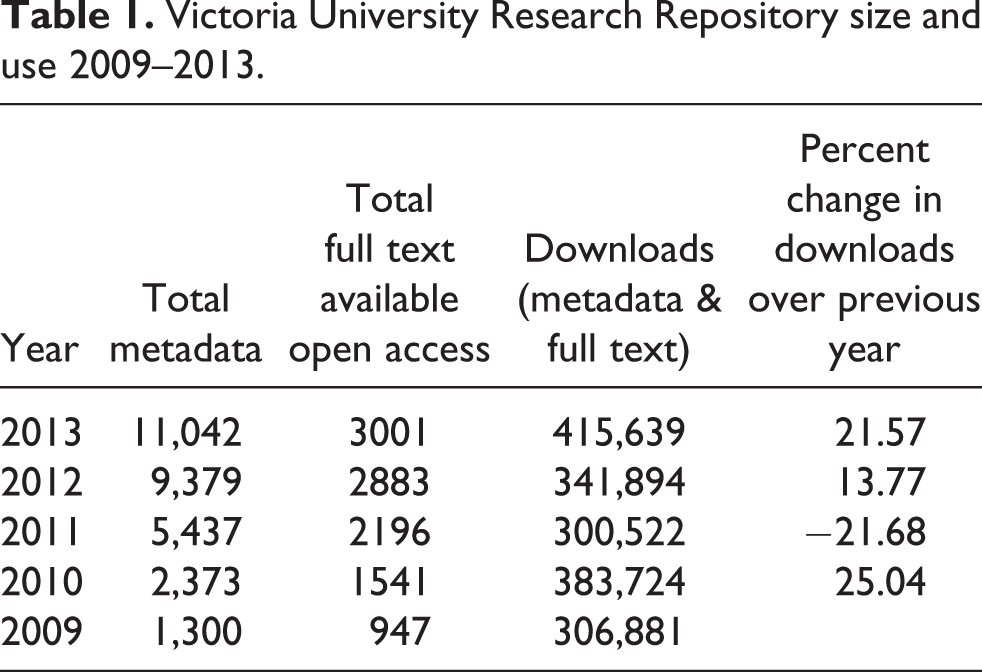
In late 2008, the university became one of the five Australian universities to have a mandate for the depositing of research outputs from university researchers through ‘Submission of Research Outputs of VU Staff and Students to the VU Institutional Repository’ policy. This policy specifies the mandatory submission of research outputs including theses, monographs and refereed scholarly and research articles and seeks contributions at either the pre-print or post-print (last accepted version prior to publication) stage. Although the mandate attempts to cover the full range of published research outputs, it includes the qualification that deposits are “subject to any necessary agreement with the publisher” to acknowledge the range of restrictive publisher policies that delay or even prohibit the availability of an open access version of the paper. In this context, there has been only limited success with the acquisition of full text open access outputs for the repository. The proportion of full text in relation to total metadata housed on the repository has hovered between 25 percent and 35 percent over the last 4 years. Much of the strategic effort around the further development of the university repository has been to address this issue and increase the proportion of full text available on open access.
There are a number of factors reducing the success of the repository mandate, ranging from a lack of awareness among researchers, researchers’ failure to retain an acceptable version of the paper for deposit, to the complexity of the copyright environment and repository deposit procedures. VU Library has promoted the repository by initiatives such as highlighting popular papers with high downloads and utilizing repository data to populate research biographies. It has also worked to reduce the burden of submission by taking on copyright checks and determining publisher open access policies. With the university Copyright Officer working within VU Library, the necessary expertise is at hand to advise on publisher agreements and related copyright conditions. VU Library also offers advice and training on where to publish. Since 2010, it has offered up to 10 sessions each year on Measuring Research Impact (bibliometrics) and Where to Publish. It also offers advice on negotiations with publishers at the point of having papers accepted.
Despite these initiatives, there are still barriers to improving the proportion of open access full text in the repository – the barriers result from the support requirements for the HERDC/ERA collections. This means that VU Library has had to focus its efforts on loading metadata and publication evidence instead of sourcing open access full text outputs. The requirements of loading evidence for the research collections result in a workflow that leaves the sourcing of copyright compliant full text versions to the end, after the metadata has been created and the HERDC/ERA lists have been produced. As there is a long time lapse between when the research output is submitted to the publisher and when the library contacts the researcher for the author’s version of the work, it is frequently the case that the author has lost the post-print version or left the university. This tension between supporting the ERA and HERDC workflows and sourcing open access research outputs is not unique to this university; as Danny Kingsley’s study of the Australian open access environment suggests, this is a widespread issue: “The requirement to collect information about research output in Australia for ERA and HERDC reporting is a double-edged sword. The research community in Australia has adapted to providing this information, albeit not without frustration at the high level of administration involved in compliance. And while some universities consider ERA to have helped the awareness of their repository and open access, overall, the evidence seems to indicate ERA has been detrimental to the promotion of open access in Australia.” (Kingsley, 2013: 10)
Extending the open access role of the repository
Over the past 2 years, the library has endeavored to address the issue and scope process improvements that would better combine workflows for research collections and extending open access. The successfully integrated workflow at QUT Library (Borchert and Callan, 2013), which combines publication submission for open access with the publication collection process, has been examined by VU Library as a potential model. This approach remains out of reach due to differences in university Intellectual Property policy, limitations of resources and lack of administrative staff. The alternative approach has been to proceed with the implementation of Symplectic Elements as a research publication system which can interface with the existing Research Repository. The harvesting capabilities of Symplectic Elements associated with alerting capabilities will reduce the burden of metadata development, establish a continuous workflow for research collections and enable earlier access to research outputs closer to the point of publication. VU Library anticipates that the system will offer improved pathways for researchers to upload open access versions of their publications. Although more training and cultural change will be required to ensure successful researcher engagement, there is the expectation that the current implementation will make it easier for researchers to load open access versions and consequently populate the repository.
Another factor that can help increase the focus on the open access role of the repository is the recently introduced mandates from Australian funding bodies which require all authors publishing publicly funded research to make their research available through open access repositories. The two primary government funding bodies in Australia, the National Health and Medical Research Council (NHMRC) and the Australian Research Council (ARC), introduced mandates for grant recipients in 2012 and 2013 respectively. Although VU Library coordinates the management of article processing fees paid to ‘Gold’ open access sources, Biomed Central and Wiley Open Access, the Research Repository remains the easiest and most cost effective option for researchers to comply with the new mandates and make their research open access. However, in the context of open access, there is ongoing work to raise awareness amongst researchers about copyright and retaining control of their work.
There are currently no mandates for open access data. At the university the management of research data has been guided by the Australian Code for the Responsible Conduct of Research (2007) that covers the management of data and corresponding responsibilities of institutions to provide support and infrastructure. To assist universities with research data management, the Australian government has invested substantial funds for developing the frameworks to allow Australian researchers to share their data. The Australian National Data Service (ANDS) has developed the Research Data Australia (RDA) platform as the key means for sharing information about research data collections with links to the home institution, often accompanied by links to the original data. VU Library has uploaded descriptions and metadata of significant university collections, including digitized collections of unpublished papers from its special collections, to the RDA site. Even though VU Library does not maintain a data repository separate from the Research Repository, it has offered advice about cloud options such as Figshare for uploading publicly accessible data. Such options help researchers meet journal editorial and submission requirements to provide open access data at the point of publication.
Scholarly communication and e-Research: how librarians help
“Scholarly communication is the system through which research and other scholarly writings are created, evaluated for quality, disseminated to the scholarly community and preserved for future use.” (Association of Research Libraries, 2013).
For VU Library the broad view is that scholarly communication includes all communication among scholarly peers, including informal means of communication such as social media as well as the formal or traditional scholarly communication through journal articles and books.
E-research normally refers to the use of innovative Information and Communication Technologies (ICT) such as Web 2.0 to support research and open new opportunities, particularly through collaborative approaches, as well as curation and management solutions for data generated over the entire research lifecycle to enable data sharing and repurposing, and open access. The Association of Research Libraries (ARL) “[uses] the term e-research to encompass computationally intensive, large-scale, networked and collaborative forms of research and scholarship across all disciplines, including all of the natural and physical sciences, related applied and technological disciplines, biomedicine, social science and the digital humanities” (Association of Research Libraries n.d.). E-research has the potential to increase the dissemination of research data, and to offer collaboration and engagement opportunities, nationally and globally.
Librarians have unique expertise and skills in core areas in e-research and scholarly communication to assist VU researchers with their data management. Librarians manage the environment in which knowledge can be created, discovered, captured, shared, distilled, validated, transferred, adopted, adapted and applied. As the literature review suggests, university libraries are planning services to support data management. Already VU Library manages the open access repository of university research outputs, contributes to the ANDS ‘Seeding the Commons’ project and the Research Librarian and Research Ambassadors (a peer-to-peer research support program) support researchers in their data management.
In 2009 VU Library initiated a Data Management survey which had been adapted from a survey used by three Australian universities in 2008, presented in the report by Henty et al. (2008). The university’s researchers’ survey responses indicated some key concerns around the lack of an institutional information technology framework, lack of policy support, inadequate institutional/network storage space and the need for training in data management and data planning, as well as in ICT literacy.
The survey revealed a high level of lack of awareness amongst the university’s researchers around e-research, and isolated, individual approaches to the storage and management of data. The availability of benchmark data proved useful to situate and contextualize the results of the survey. The responses from the university’s researchers reflected the main trends in the benchmark data and there were a number of common issues, for example, the lack of plans, a range of data types, that storage sits with the researcher, and the majority of files being small.
The study, which was repeated in 2011, gathered additional data on the university’s researchers’ use of information and communication technology tools. While a majority (70 percent) indicated collaborations around Australia and 55 percent mentioned international collaborations, fewer than 20 percent reported using video conferencing, web collaboration tools or file sharing tools. Instead the majority of researchers indicated a reliance on email (80 percent), face-to-face (66 percent) and phone-based (34 percent) interactions. A third (31 percent) indicated the need for more support with technology tools to work with statistics, qualitative, transcription, video and geospatial utilities and a third indicated the need for more support with collaboration technologies, including video conferencing and sharing files. For e-research to develop there is a need to improve researchers’ digital literacy skills.
Developing digital literacies
Librarians’ interest in, and indeed fervor toward, advancing ‘information literacy’ and the application of technologies to their work as information managers who collect and organize information sources, provide access, and support the management and use of information, is long-standing. The concept of digital literacy – the use of digital technologies to manage and use information – has emerged with the growth of networked communication technologies. Bawden (2001: 2) suggested that the term ‘digital literacy’ started to appear in the library and information science literature in the very late 1990s.
The need for digital competencies and skills is increasingly acknowledged, particularly in an educational and research context, as these capabilities are required for living, learning and working in a digital age. The digital age requires consideration of not only the information sources, but also the technologies that underpin professional practice, for example, communication and collaboration tools and social media, which is a whole way of thinking about information and its use. To researchers, interaction with information is fundamental, as is ensuring its quality. Researchers have data and materials, for example, comprehensive notes, books, and records related to research activities, including details of observations, processes and other significant actions or findings, that need to be stored long-term to enable research outcomes to be validated and justified. As well, research funders are increasingly requiring better documentation of, and (open) access to, research data.
For this purpose, the university has initiated and operationalized significant research storage space that is secure and automatically backed up. Previously researchers’ data and materials had been stored on a range of local stores. In conjunction with Research Services, the Library developed a project plan to guide the work of the College Librarians, who encouraged and assisted researchers to add their old or pre-existing research project data and materials to the university research storage space. The initiative offered an opportunity to raise awareness amongst researchers, in conversations (see Table 2), of the shift towards improving data management and of future requirements and obligations around secure data retention. As a result of the initiative, more than 20 datasets were added to the store in its first 3 months.
Winton (2012) Research data management conversation ‘icebreaker’.

Weaver (2007) has been a leader in the area of library research services, unpacking data management and identifying professional development roadmaps. Adopting Weaver’s (2011) engagement continuum of Gauge, Refer, Advise, Support and Partner, VU Library identified opportunities to support researchers’ responsibilities for improved management of research data. VU Library has built on the storage initiative by developing and implementing ongoing data management educational sessions and resources for researchers. It designs and delivers a comprehensive annual program of workshops to assist researchers and Higher Degree Research (HDR) students at every stage of their academic career or postgraduate studies.
These educational workshops, developed in consultation with Research Services, are geared to raising awareness within the researcher community about the discipline-specific scholarly communication environment, especially the benefits of open access to researcher visibility. With its aspirations to raise the quantity and quality of research-engaged staff, Victoria University encourages the open access publication of research outcomes towards increased dissemination, citation and greater impact. The workshops educate researchers on: (i) how to identify and target their publication of research outputs strategically; (ii) how to disambiguate personal names, for example by using open researcher and contributor ID (ORCID) to create unique identifiers; and (iii) how to build an online presence using a range of social media such as Twitter.
Working collaboratively with Research Services and the research community, the Library provides discipline-specific information that helps researchers to easily identify the top ranked scholarly journals in their field – including peer-reviewed Open Access publishing for their research outputs. In a central approach, funds to cover Author Processing Charges (APCs) in high ranking outlets and eligibility guidelines are provided by Research Services and managed by the Library. The Library has been recognized to have the expertise in scholarly communication to document and disseminate this information. At the same time, Victoria University continues its commitment to promoting green open access, in particular by providing guidance and support for researchers to maintain control over their works to enable the deposit of their works in the Research Repository. In engaging with researchers around the Open Access debate, sustainability of pay-to-publish models (APCs) and other developments in scholarly communication, the Library is taking an active and leadership role within the University.
What VU Library does at the grassroots
Through a program funded by the Graduate Research Centre (GRC) with VU Library providing in-kind contribution, the Research Ambassador (RA) program provides peer-to-peer research support to research students and staff. The Research Ambassadors, based in VU Library’s Research Lounge and other rooms, run peer-to-peer online and face-to-face consultations and regular workshops throughout the year. These interactions provide an excellent opportunity for research students to ask questions and find out more about a range of research-related topics. The RAs provide advice in a range of areas including quantitative and qualitative research design and data analysis, document formatting, EndNote, NVivo, data and file management, and library research information sources with induction, guidance and supervision from the Research Librarian. The program is based on Edith Cowan University’s SOAR (Support, Opportunities, Advice and Resources) Centre ambassadorship program. The RA program began in August 2011 with the aim of contributing to building research capability at Victoria University. Every 6 months new Research Ambassadors are recruited from a range of Colleges and with different expertise. Each Research Ambassador is offered a one-semester contract with the opportunity of renewal for another semester.
Despite being vulnerable to cuts in the current economic climate, the program has been run each year since its introduction in 2011 and has built a reputation and delivered benefits beyond its cost. The popularity of the program increased by 58 percent in its first year and by 28 percent last year, with a high level (60 percent) of awareness amongst research students. The RAs operate a Facebook Page which at the end of 2013 experienced a spike in the number of ‘page likes’. There has been an observation that there is a correlation between the level of engagement particular posts create and the number of page likes the RA Facebook page receives. Examples of posts on the RA Facebook page include: “Just wanted to say how much I appreciated the help I received from the library last year especially the sessions I spent with xxx the ambassador who was very understanding of my problems and provided a style of help that was appropriate to my inabilities to retain information various areas of computer use. This is an invaluable service.” “Thank you very much again for your excellent support. Previously, I have sought support from several people, who have all made the task seem insurmountable. You have made light work of this task, and now I know how to do it myself. Your clear and concise explanations have helped me to understand how to work with this software program in the future,” “Being a RA enables me to expose myself to the other disciplines colleagues are working on, which broadens my vision and enable me to approach my own research assignment from multiple angles. I wish I could spare more time learning from other RAs, as a process toward my professional development.”
Applying the Research Skills Development Framework
In another initiative aimed at developing research skills at grassroots level, VU Library has situated its practice and contribution to the development of independent and flexible lifelong learners by using the Research Skills Development Framework (RSDF) to integrate into the curriculum the skills to use information effectively and appropriately. Through this strategic, curriculum-based approach, the Library which has lean and static staff numbers, aims to maximize its ability to enhance students’ research and enquiry skills for higher level research studies and/or professional practice. Based on the Australian and New Zealand Information Literacy (ANZIL) Framework and Bloom’s taxonomy, the RSDF was developed at the University of Adelaide (2006) and outlines explicit and incremental development of research skills consisting of six facets of research and five levels of student autonomy. The Framework was devised to embed research skills development in the curriculum. According to Willison (2012), there is evidence that, as a result of its application, students acquired a range of discipline-explicit skills which would be beneficial for their later studies as well as for employment. The approach encourages a whole-of-course view, a multi-professional team-based approach to curriculum alignment. It is applicable to a range of discipline areas, and has the potential to strengthen pathways to research, which is important for this university. The RSD approach also offers a pathway to fully integrating digital/information literacy skills into curriculum and to supporting institutional strategies. VU Library’s introduction of the RSD approach is in the early stage of implementation; the Library is working with the Pro-Vice Chancellor Research and Research Training and the Pro-Vice Chancellor Learning and Teaching to gain university-wide endorsement for the approach.
The expanding role of VU Library
The need to shape the use of, and respond to, digital technologies for the management and use of information has increased with the growth of networked communication technologies. ICT skills are deemed essential for contemporary practitioners in the field of library and information science. As the CIBER report (2008: 21) indicates: “We are all [the] Google generation now”. The effective and critical use of our contemporary, information-rich environment is of strategic importance, not only to library staff, but to the students whose online research and enquiry skills they must help develop, as well as the academic staff and researchers they are tasked with supporting. While on-the-job learning continues to be integral to the development of new skills for librarians, VU Library is constantly enhancing the information and data management skills of its librarians, and ensured that it has the adequate team structure to help increase research quality and output.
Scholarly Information Services team
In the past 2 years, VU Library has fundamentally changed the level of service it provides to support research across VU through the formation of the Scholarly Information Services (SIS) team. This change of focus was driven by the Library’s decision to explicitly support the university’s strategic goals of increasing research quality and output. The SIS team members, consisting of College and SIS Librarians and a Research Librarian, are proactively involved with the staff from all the Colleges, research centers and institutes in order to help build the university’s research as articulated in its strategic plan. These librarians work directly and primarily with colleges and researchers, providing a range of instructional, collection, data management and scholarly publishing advice and assistance. As new areas emerge, the librarians engage in a range of interactions to identify new approaches and support resources or services. It is a way of working. To support this way of working, and in the context of the research support skills training shortage as identified in Auckland’s (2012) report, VU Library has introduced new development opportunities for its librarians around data management and open access as per the discussion in earlier sections of this article. In addition, VU Library has undertaken a program of project management training for its librarians. As certified Prince2 (Foundation) course graduates, the librarians apply the framework and its methods to a range of projects small and large, finding it a sensible approach to temporary work involving a group of people brought together around deliverables.
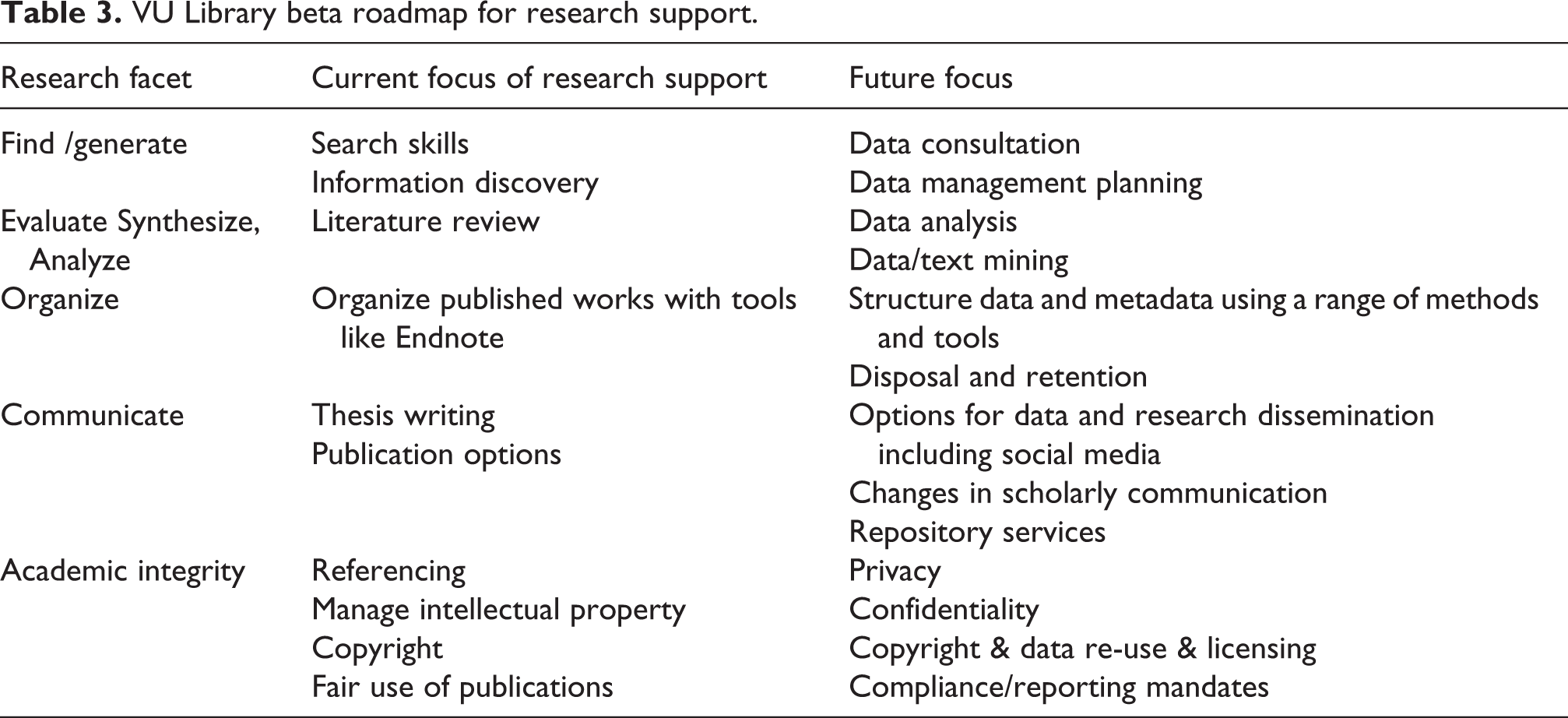
To develop a high level of knowledge and understanding of the needs and expectations of researchers in a fast-changing environment, VU Library has invested in further training and development opportunities for its librarians to stay current with new technologies, innovations, and ways of thinking. Colleagues from Monash University Library, namely Groenewegen (2013) and Searle (2011), have articulated the current expertise of librarians, and suggested how these might be extended in the support of researcher needs in the research data management (RDM) environment. Essentially the concept is a visualization that identifies new practices and maps the way in which new skills can be built on existing skills. VU Library has adapted this idea to develop its own roadmap (Table 3) for research support practices.
VU Library beta roadmap for research support.
Librarian training to foster research culture
At VU Library, training and development opportunities have included in-house and external staff development initiatives. The in-house train-the-trainer sessions, which are held annually, have addressed topical issues. For example, in 2013, the session “New (e)research skills” addressed how to analyze researcher scholarly information needs, including research-impact or bibliometrics; the emerging research data management (RDM) roles for librarians; and the planning of educational programs for researchers.
In another initiative, three university libraries in Victoria came together to organize the running of a one-off, 5-day intensive staff development held in early 2014. The intensive training, Research Support Services for Academic Librarians, was based on a unit offered within the QUT Master of Information Technology (Library and Information Studies). It aimed to develop the knowledge and skills required to provide specialized services and assistance to researchers throughout the research lifecycle in the context of academic and special libraries. The course content ranged from data mining to assessing impact; from open access to grant preparation support to the national research agenda.
VU Library as advocate
Since 2010, the Library has initiated and hosted forums during Open Access week to raise awareness within the research and university community to the era of openness and the options available to make research visible. The forums have also aimed to tackle misconceptions around quality, lack of peer review, pay-to-publish models and the challenges of the copyright context, and to reassure researchers that they can publish in their preferred journal and yet make their work accessible via open access by placing a copy in the university repository. In 2013, VU Library organized its most ambitious OA week event, a day-and-a half-long forum with speakers from VU Library, Research Services, the Colleges and two external speakers. It was also the most successful to date with more than 50 people in attendance during the day-long event.
The Library is also a member of the Australian Open Access Support Group (AOASG). At the end of 2012, the University Librarian was invited to represent the university as an inaugural member of AOASG. Other members of AOASG include: Australian National University, Charles Sturt University, Macquarie University, University of Newcastle, and Queensland University of Technology. The group aims to provide advocacy and publicity for open access to research in Australia. It meets regularly and has developed a website which includes resources and advocacy materials (Australian Open Access Support Group, 2013). As the AOASG website states: “The group will lobby government, have a media presence, and provide advice and support to both research funding agencies and research institutions on how to best implement open access policy, practices and supporting infrastructure.”
In support of this direction, the Library has articulated the desirability of an open access publishing option for the university. An Open Access electronic press for the university would contribute to a culture of research excellence and disseminate high quality university scholarship where there is no ready commercial market. In a transformative collaboration between the College of Law and Justice and the Library, the VU Law and Justice journal (VULJ) has been published in 2014 as an online open access scholarly law journal. The College established the editorial committee, arranged the peer review process, managed acceptance of articles and uploaded the final articles to the platform. The Library’s role was to negotiate the licence and access to the Open Journal Software (OJS) platform and assist with technical issues and uploading of articles. The journal is available on the new platform and it is expected that it will receive considerable traffic and have an impact nationally and internationally.
Conclusion and continuation
We have outlined some of the initiatives undertaken by VU library in providing research services to an emerging research university. The initiatives represent a synthesis of our professional skills and expertise which are combined with deep collaboration with the university research community, not only across the university but at all different levels: the institutional level, the researchers’ level, the students’ level in terms of student experience, and the curricular level. This has been supported by new research support systems and infrastructure and ongoing librarian training and development in a planning and review framework. All these efforts contribute to VU Library’s aim of fostering the university’s research culture.