




Abstract
The rapid growth of mobile device ownership among college students has greatly challenged academic libraries to reconsider their service profiles. In a recent research project conducted at the University of Illinois, mobile device ownership among college students was surprisingly high. While such a rapid adoption of mobile devices is a worldwide phenomenon, the authors sought to investigate similarities and differences of mobile information-seeking behavior of college students in diverse regions. The authors conducted a series of surveys at the University of Illinois in the United States and Kyungsung University in South Korea. Understanding mobile information-seeking behavior of college students at different locations will offer valuable insights as many academic libraries are creating new initiatives and service profiles for mobile library users.
Keywords
Introduction
The rapid growth of mobile device ownership among college students has greatly challenged academic libraries to reconsider their service profiles. In a recent research project conducted at the University of Illinois, mobile device ownership among international students was surprisingly higher than that among domestic students (Song and Lee, 2012). The result suggests that perhaps the digital divide between international and domestic students on US university campuses may no longer exist, as mobile devices are being widely adopted around the world. Furthermore, an increasing number of students use their smartphones as their primary tool to access information in addition to making voice calls. This trend is paving a way to the development of the truly ubiquitous library. While such a rapid adoption of mobile devices is a worldwide phenomenon, the authors sought to investigate similarities and differences of mobile information-seeking behavior of college students in diverse regions. As Huwe (2013) strongly asserted in his article, understanding new information-seeking behavior with mobile devices is critically essential for academic libraries to stay relevant to their users.
In this article, the authors conducted a series of surveys at the University of Illinois at Urbana-Champaign (UIUC) in the United States and Kyungsung University (KU) in South Korea. Understanding mobile information-seeking behavior of college students at two different locations will offer valuable insights as many academic libraries are creating new initiatives and service profiles for mobile library users.
Students are still restricted by location and Internet access methods when using desktops and laptops to search and retrieve information; however, mobile devices remove such barriers as they are easy to carry and also access both Wi-Fi and telecommunications service providers’ wireless networks. At the same time, mobile devices also have some limitations in their use as information-searching tools. Most notably, their small screen sizes and compatibility issues in using different software packages have often been identified as major weaknesses of mobile devices.
The goal of this article is to explore both similar and different mobile information-seeking patterns of college students in two countries. It must be clearly noted to the reader, however, that this article is not intended to provide any country-level generalization of mobile information-seeking behaviors in the United States and Korea. This comparative study is designed to capture a snapshot of mobile information-seeking behaviors in different environments. The purpose of this study is to provide insights and ideas for developing further research agendas and actual service profiles.
Literature review
A growing number of articles in the literature have recently examined college students’ adoption of smartphones and its implications for academic libraries. In a recent study (Kim et al., 2014), college students are found to be greatly impacted by social influence and value perceptions when making purchasing decisions. In other words, smartphone ownership strengthens their social ties with the larger student population on campus and also helps them appear to be technology-savvy and stay current with the latest technological developments. This study also confirms the findings of a case study which reported surprisingly high mobile device ownership among students at UIUC (Song and Lee, 2012).
In order for librarians to meet the challenges and opportunities brought by the rapid adoption of mobile technology, Murphy (2010) at Yale University strongly advocated mobile literacy. Mobile literacy would help librarians to stay current with the latest mobile technology advancement and to create appropriate services profiles using mobile devices and technologies. Walsh (2012) carefully elaborated mobile literacy further in his article. He compared mobile literacy with traditional information literacy, and he especially emphasized the ubiquity of mobile devices, which would greatly influence mobile information-seeking behavior. He correctly argued that traditional information-searching methods by students were no longer applicable to mobile information-seeking behavior. According to his assessment, mobile information searching would demand quick information with a relatively short time spent on searching.
The literature review also reveals that a rapidly growing number of library practitioners are reporting on their initiatives on creating mobile applications, commonly referred to as “apps,” for their libraries. Especially active is the healthcare community, and there are excellent case studies where mobile apps offer quick health and drug information to users (Ardito, 2011; Chiarella, 2013; Hasman, 2011). The healthcare community has introduced mobile apps to provide information on specific diseases, drugs, and locations of physicians. The contents that are offered by those mobile apps are targeted at those who do not wish to be engaged in lengthy research but demand quick reference information.
In addition, librarians are now evaluating and recommending a variety of mobile apps that help practitioners as well as users in specific disciplines. Ryan (2011) carefully illustrated the steps for developing library sites optimized for mobile devices and asserted that mobile technology would enable libraries to assist users where and when they needed information, which is the underlying theme of the ubiquitous library. Power (2013) suggested several mobile apps that would help librarians in managing their everyday tasks, including cloud storage, online bibliography management, and multimedia file management. Besara (2012) recommended mobile apps especially useful for library assessment, and she discussed various mobile apps that could help conduct both qualitative and quantitative research. It is amazing to learn how specific and also diverse mobile apps have become in such a short time, and, as Huwe (2013) wrote, libraries can certainly establish themselves as trusted collaborators for researchers by helping them manage the overload of mobile apps with relevant and timely updates of those appropriate for researchers in specific fields.
Hahn (2011) reported an interesting case study where mobile devices were used as navigation tools to locate materials in the library book stacks. He discussed how location-based services could be used at libraries especially with a large book collection, and he successfully incorporated a ubiquity feature of mobile devices into a particular library service. Specifically, the ubiquitous nature of smartphones enables users to carry their devices easily, and smartphones can function as a positioning system tool to locate desired materials, which often present challenges to users especially at libraries with complex floor plans and building layouts. Once students find call numbers, then they can use smartphones to locate the materials for which they are searching. Students can follow the navigation to the correct location of the materials that they wish to retrieve, which is very similar to how a global positioning system (GPS) in automobiles works. At Nanyang Polytechnic Library in Singapore, a 3D interactive map was recently introduced as a way-finding tool (Chia, 2014). This innovative tool is an advance on the traditional picture-based location service app. Users can easily find not only library books but also study spaces, librarian offices, and other facilities in the library building.
The growing body of the literature on mobile technology and its implications for libraries demonstrate the critical needs for library administrators and practitioners to understand the information-seeking behavior and needs of mobile users. This comparative study will contribute to the academic library community’s efforts to identify the needs and expectations of students who are increasingly using their mobile devices as research tools.
Methodology
The authors designed a survey questionnaire to compare mobile information-seeking behavior of students at two universities: the University of Illinois at Urbana-Champaign (UIUC) in the United States and Kyungsung University (KU) in Korea. This study focused on undergraduate students with business as their major field of study. Only the responses from those who identified themselves as undergraduate students enrolled in business programs were counted as valid. In previous research (Song and Lee, 2012), business students showed a high rate of smartphone ownership, which exceeded 90%, and the authors sought to compare business students in two different countries in their information-seeking behavior using smartphones.
Survey design
The survey consisted of three parts: mobile device ownership, activities using mobile devices, and library mobile services. The questions in the first part asked the types and models of mobile devices owned by the respondents. In the second part, the respondents were asked what types of information they would typically search for using their mobile devices. The purpose of this section was to learn if the respondents at UIUC and KU would show similar or different information-seeking patterns in terms of categories of information. The respondents were then asked to answer questions that would describe their experiences and perceptions of library services using mobile devices.
Data collection and analysis
At UIUC, an email was sent out to invite undergraduate business students to participate in the online survey, followed by two additional email invitations. A total of 115 valid responses were collected. At KU, the same method was used, and a total of 125 valid responses were collected.
The authors determined that descriptive statistics would be appropriate to compare the results of this study. The purpose of the study was not to discover any cause-and-effect issues in mobile information-seeking behavior, and such inferential statistical analysis tools as t-tests and regression were not necessary or applicable. Descriptive statistical analysis helps the reader compare the responses from the two universities to the same questions, and the results are presented in percentages and actual numbers as shown in the next section.
Results
All of the respondents at both UIUC and KU were enrolled at one of the undergraduate business programs at the time of the survey. The respondents from UIUC identified themselves as business majors in one of the following: accounting, finance, management information systems, marketing, operations research, organizational behavior, and technology management. At KU, all respondents were enrolled at the School of Business Administration and International Commerce.
Demographics
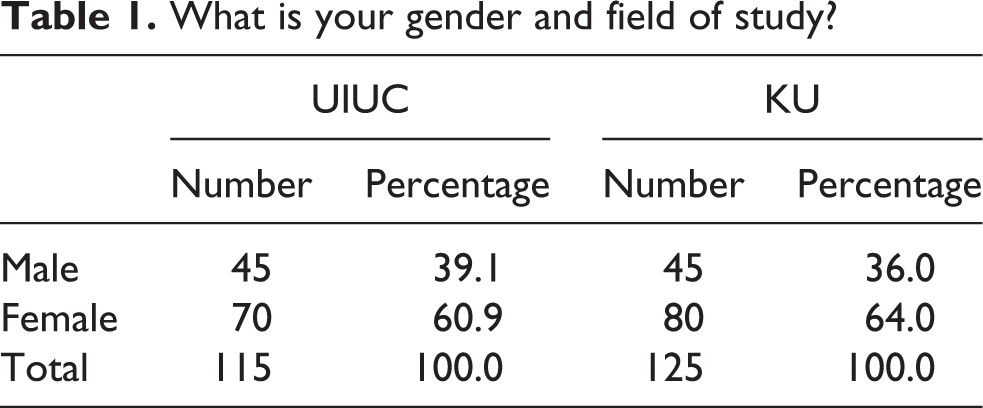
Table 1 shows the summary of the respondents’ demographic information. The respondents at both UIUC and KU were fairly distributed in gender, and those that were not enrolled as full-time students at business programs were not included.
What is your gender and field of study?
Mobile device ownership
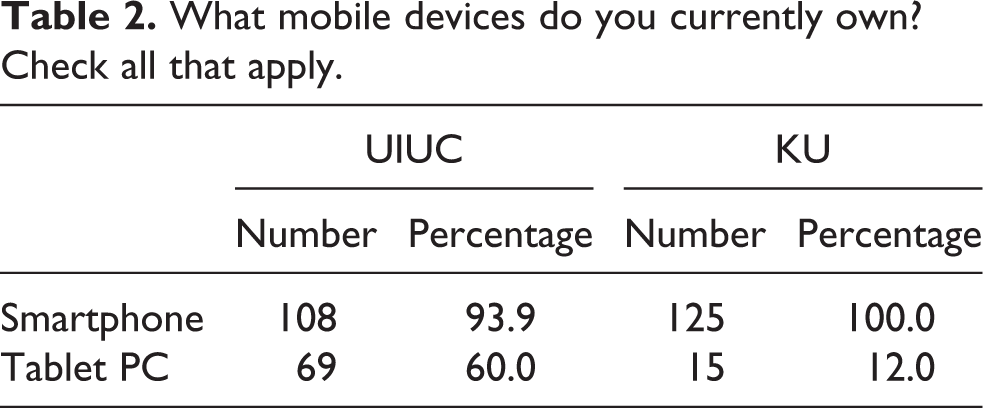
The respondents on both campuses showed a very high rate of smartphone ownership (Table 2). This is not too surprising, as South Korea has reportedly been one of the leading countries in terms of mobile device ownership. A previous research study (Song and Lee, 2012) had already discovered rapidly increasing mobile device ownership among business students at UIUC as well. All respondents at KU reported that they owned smartphones, and over 90% of UIUC students owned smartphones at the time of this survey. In terms of tablet PC ownership, however, a sharp difference emerged. Of the respondents at UIUC 69% owned tablet PCs, compared to only 12% at KU. The percentage of students who owned both smartphones and tablet PCs was 66% at UIUC and 12% at KU.
What mobile devices do you currently own? Check all that apply.
Smartphone types
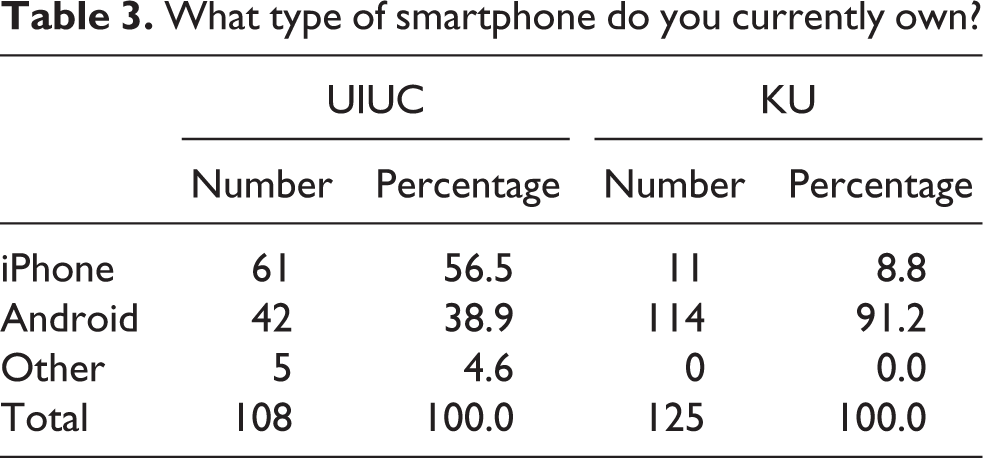
As Table 3 shows, UIUC and KU students showed some significant differences in the type of smartphones that they owned. Almost 90% of KU students owned Android-based smartphones, while the majority of UIUC students had iPhones from Apple. It is understandable since Samsung, the leading manufacturer of Android-based smartphones worldwide, is based in South Korea and offers a variety of models that work well with local mobile service providers. Interestingly, UIUC students’ ownership is no longer dominated by iPhones, contrary to the result of a previous research conducted two years ago (Song and Lee, 2012).
What type of smartphone do you currently own?
Favorite activities
Table 4 illustrates favorite activities using smartphones. The respondents were asked to state favorite activities using their smartphones, and making voice calls was not counted. The respondents were allowed to select multiple items, as smartphone devices offered a variety of features to the users. The authors were primarily interested in understanding similarities and differences in the use of mobile apps.
What is your favorite activity using smartphones? Check all that apply.

*Includes: e-books, magazines, journals, and other digital publications.
**SNS: social networking sites.
***Includes: online banking, sports updates, traffic updates, calculator.
The most striking difference between UIUC and KU students was the use of email and messaging services using their smartphones. Almost all UIUC students responded that email was the most frequently used mobile app, compared to only 37% of KU students. In contrast, online messaging was selected by all KU students as the favorite mobile activity, while a high number of UIUC students also used online messaging frequently. Online messaging clearly seemed to be the preferred method of communication for KU students, and this would have significant implications for libraries seeking to support research needs of these students. For instance, developing reference services via online messaging might be considered as a new service offering, which students with smartphones would find convenient and effective. Online messaging makes real-time interactive communications possible between students and reference librarians. When used with real-time video, innovative reference services may be created.
Social networking sites (SNS) also seemed to be heavily used by both UIUC and KU students. A higher number of KU students than UIUC students indicated that using SNS was one of their favorite activities with smartphones. About half of UIUC and KU students indicated that the favorite information they sought via their smartphones was weather and current news. The percentage of students who read e-books or other digital contents using smartphones was similarly low at both campuses – 29% at UIUC and 25% at KU.
Smartphones were being used for other purposes as well. The results of this survey showed that there were interesting differences in the use of smartphones as devices for various activities. Smartphones were widely used as digital cameras by KU students, although the percentage of UIUC students using smartphones in this way was relatively low. On the other hand, more UIUC students used smartphones as their digital schedule organizers than did KU students. Using smartphones as navigation systems was also more popular among UIUC students than among KU students. Online shopping using smartphones was more popular among KU students than among UIUC students; in addition, a considerably higher percentage of KU students enjoyed online gaming with their smartphones than did UIUC students.
Smartphones and library services
The last part of the survey was designed to discover the respondents’ experiences of using library services with their smartphones. The authors were especially interested in finding out limitations of smartphones for using library services. As Table 5 shows, the number of UIUC and KU students who had used online library services with their smartphones differed greatly. A surprisingly high number of UIUC students had never accessed library services in this way, whereas the majority of KU students had used library services via their smartphones in the last 12 months.
What is your experience with your library services using a smartphone?

*Includes: checking library hours, librarian contact information, and library location.
Primary reasons for accessing online library services at both UIUC and KU were similar – to browse library collections and to check individual library accounts. Smartphones did not seem to be actively used yet as a means of communicating with librarians for reference services. If online messaging were the dominant use of smartphones for Korean students, then the option of offering reference services via online messaging would need to be seriously explored.
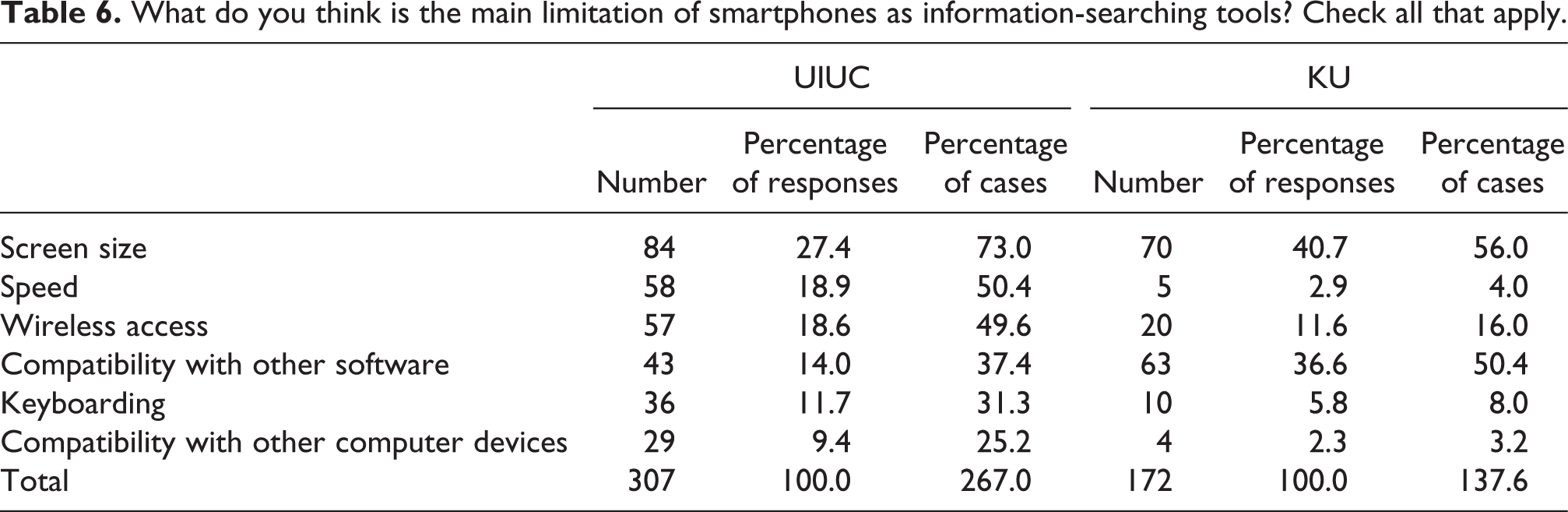
The respondents provided interesting responses for what they perceived as limitations of smartphones as their information-searching devices (Table 6). For both UIUC and KU students, the screen size was the most prominent factor that limited their use of smartphones in this way. In addition, the compatibility issues with other productivity software programs (such as word processing, spreadsheets, and presentations) were considered to be another significant factor that would limit the use of smartphones as their information-searching tools, especially for KU students. On the other hand, accessibility issues (Internet speed and Wi-Fi availability) did not seem to be a significant problem for KU students, while the majority of UIUC students found network accessibility to be an obstacle.
What do you think is the main limitation of smartphones as information-searching tools? Check all that apply.
Smartphones and research
Both UIUC and KU students indicated that desktop and laptop computers were still their primary tools for their research activities (Table 7). An interesting difference emerged in the use of tablet PCs between UIUC and KU students. No KU respondent indicated that they considered tablet PCs as their primary device for research, but 15% of UIUC students selected them as their primary research equipment. Although mobile device ownership among college students has dramatically increased in only a very short time, the result suggests that college students at both UIUC and KU still do not consider smartphones as their primary device when conducting research.
What is your primary device when conducting research?

Discussion
As noted earlier, the purpose of this study was to explore and compare mobile information-seeking behavior of college students in the United States and South Korea. In so doing, the authors sought to provide researchers with insightful suggestions for further research, while library practitioners could gain some understanding of how current college students were using their smartphones as information-searching devices. The United States has consistently attracted a large number of international students over the past few decades; therefore, comparing the behavior of US students with students in foreign countries would help create new service models for libraries serving large international student populations as well.
The respondents at UIUC and KU revealed some profound differences in their use of smartphones. Such differences may be attributed to multiple factors, including culture, language, and economy. Also, the mobile telecommunications infrastructure differs widely between the two countries, which undoubtedly has great influence in mobile device users’ information-seeking patterns. For example, KU students did not find the speed and accessibility of Wi-Fi as a hindrance to using smartphones, whereas half of the UIUC students found the network to be a major issue. South Korea is one of the leading countries in terms of national mobile infrastructure, which makes it relatively easy for Korean mobile users to connect to either the mobile network of telecommunications service providers or Wi-Fi access points, regardless of their current locations.
In addition, the results of the survey clearly show that Korean students strongly prefer using online messaging to email with their smartphones. There are currently many mobile apps available for online messaging, and those messaging services can become valuable channels for libraries to communicate with students. Online messaging services are different from traditional texting services offered by telecommunications service providers. Online messaging services help users create individual or group chat sessions, organize user profiles, and communicate with multimedia content. At UIUC, virtual reference service via the library’s home page is rapidly gaining popularity among students and faculty, and making this service available via mobile devices will greatly strengthen its library services, especially since UIUC has a large number of Asian students enrolled. As mobile device ownership is reaching close to the entire student population, the ubiquity of library services must be central to any library’s service profile.
The results of this study also show that students still heavily rely on their desktop and laptop computers for their research. Due to some obvious limitations such as screen size and software compatibility issues, students at both UIUC and KU prefer desktop and laptop computers to smartphones when conducting research for their course assignments and projects. Reading journal articles and e-books with smartphones is challenging due to screen size; moreover, many library databases are not available in mobile-friendly formats. Unless database interfaces are re-directed to mobile-friendly formats, students will find it very difficult to navigate those databases based on web interfaces. Also, smartphones are not optimal devices for multi-tasking. Students are typically engaged in multiple activities when conducting research, such as browsing online resources, reading, and writing. Desktop and laptop computers provide adequate computing power and screen size to help students engage in multi-tasking activities.
Smartphones have some clear advantages over the other computer types, including portability, convenience, and Internet accessibility (i.e. ability to access the Web via both telecommunication services and Wi-Fi networks). Smartphones can be effective tools when students need immediate and fast assistance for their research; for example, library practitioners have already begun offering location-based services to help students find books in stacks with complex floor plans and layouts (Hahn, 2011). Also, smartphones enable students to access their favorite social networking sites more frequently than desktops or laptops. Libraries will need to consider increasing their services via social networking sites, as they are essential marketing and outreach tools to update students on the latest developments and news on libraries.
Library instruction is likely to be another important area that can take advantage of high mobile device ownership. In anticipation of a rapid increase in mobile device ownership among college students, Murphy (2010) emphasized the need for librarians to incorporate their expertise into mobile learning. The availability of electronic resources has greatly changed the landscape of library instruction, and now, the amazingly fast advancement of mobile technology is presenting both challenges and opportunities to library instruction. Creating mobile apps which are specific to courses and topics will greatly enhance library instruction, as mobile users typically look for quick and specific information.
Library practitioners around the world have been reporting best practices for libraries using mobile devices. For example, Walsh (2010) experimented incorporating the Quick Response (QR) code functionality into library instruction at the University of Huddersfield. He reported that it was too early to make meaningful conclusion on the applicability of the QR to library instruction, mainly due to the low mobile device ownership at the time of the experiment. However, with a high mobile device ownership now, libraries may revisit such initiatives and attempt to develop mobile apps that can potentially benefit instruction and mobile learning.
A high number of both UIUC and KU students indicated that compatibility with other software programs was a serious issue. Hence, library instructors may need to address how to create bibliographic databases with their smartphones and also how to create and manage files in different formats and devices when conducting research. Moreover, a high ownership in smartphones among college students may help library instruction to be more interactive than before. Instructors can quickly conduct a survey or assessment, and they can also develop mobile apps that may help them teach and also test students simultaneously. Case studies and best practices on the use of mobile devices for library instruction and learning will make a great contribution to the library community.
Conclusion and suggestions for further research
While it is always difficult to generalize the behaviors of different cultural groups with a small sample population, case studies such as this offer some valuable insights into understanding similarities and differences. The number of international students at universities in the United States has consistently been high, and libraries need to understand how their information-seeking behavior has been shaped and influenced in their home countries. This comparative study explored some fundamental aspects of mobile information-seeking behavior among US and Korean students, and the results will help researchers and practitioners to develop hypotheses for conducting further research and creating new service profiles for mobile users.
The authors have some suggestions for further research after this explorative study. The result of this study shows that reading daily news was the primary information-searching activity of students with their smartphones. Do students still use the same resources from home countries for their research even after they begin their studies in other foreign countries? Studying what mobile apps they have downloaded recently will reveal interesting insights into understanding their information-seeking behavior. For example, Korean international students in the United States may still use Korean news sources and also access Korean portal sites to obtain information for their research.
The results also show that a surprisingly high number of KU students are using online messaging while the use of email has significantly dropped. Is this phenomenon similar among college students in other countries? If so, what service models can libraries create to accommodate this changing behavior? Case studies on this topic will confirm the result of this study and help libraries adopt appropriate service strategies. Furthermore, additional studies on college students’ use of online messaging in relation to their studies will offer great insights for libraries developing strategies using messaging services.
Finally, assessment of university-created mobile apps or mobile-friendly information sites will provide important insights into understanding students’ information-seeking behavior. What categories of information do students most frequently access using their smartphones? For example, do universities offer mobile apps which help students with the job search process? What information do students search for most often using their smartphones? The results of this assessment study will help libraries develop their marketing strategies as well as creating potential collaborative partnership with other student services on campus.
Footnotes
Funding
This research was supported by Kyungsung University Research Grant in 2015.