




Abstract
The 19th- and 20th-century Bengal Province in India was a nerve-centre with hosts of socio-cultural and religious reform movements due to its early association with secular liberal western education. Modern institutions of higher learning, established by colonial rulers, European missionaries and contemporary social reformers, led to the awakening of Bengali educated communities. This Bengal Renaissance had contributed towards strengthening production of Bengali literature and the development of the Bengali language. Socially active reformers established community libraries as community learning space in their respective localities. Many century-old libraries are still in existence. These community libraries extended their access to the youth, students, industrial workers and lifelong learners. With this background, this paper aims at in-depth analysis of the legacy of the Bengal Renaissance in the development of public libraries in India during colonial British rule. This paper also looks into the role of the individual reformist genres in the design and delivery of effective public library services and library outreach services in the province.
Keywords
Introduction
As indicated by many scholars, the ‘Bengal Renaissance’ refers to the socio-religious-cultural reform movement during the 19th and early 20th century in the undivided Bengal Province in India. 1 The Bengal Renaissance was influenced by the western secular education imparted initially by western missionaries and later by secular and nationalist agencies. While the European Renaissance impacted European societies for centuries on various fronts such as science, arts, culture, education and democratic values, the influence of the Bengal Renaissance related mainly to changing socio-religious-cultural values brought on by the early adoption of western education in Bengali society. Later these values were diffused to Eastern India and other parts of India.
The University of Calcutta was the first modern university in the Indian subcontinent established by the British colonial government in 1857, the year better known for India’s first war of independence or the Indian Mutiny. The university was established on 24 January 1857 as a multidisciplinary and secular western style university (Das, 2015). In the same year, the University of Bombay and University of Madras were established. The University of Calcutta was preceded by other institutions such as Fort William College (1800), Serampore College (1817), Hindu College (1817), Sanskrit College (1824), Calcutta Medical College (1835), Presidency College (1855) and St Xavier’s College Kolkata (1860), providing the foundations for secular western education and leading to the awakening of Bengali intellectuals towards socio-cultural and religious reform through newly found spiritual institutions. The Bengal Renaissance also contributed towards strengthening production of Bengali literature and the development of the Bengali language. Many contemporary writers of that time, such as Sivanath Sastri (1907), Raja Ram Mohun Roy (Collet, 1914) and Debendranath Tagore (1909), expressed their views favouring socio-religious reform movements. 2
The modern public library system in India began during British colonial rule with the establishment of community libraries across Bengal Province. Many of the community libraries were established with the generous support from the local zamindars (royal families), individual philanthropists, social reformers, and other influential or eminent personalities. Many of the public libraries were meant for the educated youth and neo-literates to enrich knowledge and provide continuous education. The Calcutta Public Library, established in 1836, became the first modern public library in South Asia to be established to supplement the secular western education system in India. The Uttarpara Jaykrishna Public Library, established in 1859 by Jayakrishan Mukherjee, an eminent personality in the locality, was the first free public library in colonial India. Gradually, many public libraries were established and became centres for adult learning and non-formal education.
During the early period of the 20th century the Swadeshi movement, a nationalist movement against British colonial rule, emerged. This movement intensified resistance against the partition of Bengal Province. The participants in the Swadeshi movement became engaged in boycotting western consumer products and started producing some of those items indigenously in the country. Historically, many public libraries in Bengal were established with the help of the activists of the Swadeshi movement and other contemporary political, social and religious reform movements of that time.
While activists and supporters of the Bengal Renaissance were engaged in the creation of literature supporting socio-cultural and religious reform movements, there was urgent need for the creation of public space for reaching out to the general public and engaging them with the neoliberal reform movements. Public libraries were considered an appropriate public space for engaging local communities and supporting public discourse.
Genesis of the public library system in colonial Bengal
Bengal Province was the national headquarters for colonial British rulers from the 17th to the early 20th century, until 1911. During the British colonial period many public libraries were established through community efforts that did not involve the patronage of local colonial rulers. In addition, other libraries were established through support from the local rulers. Obviously, the public libraries which received the support of local communities flourished with diversified services. Public libraries became a community space for social functions, intercultural interactions, debating on contemporary issues, and sometimes with political motives of raising awareness against the governing practices and abuses of the British colonial rulers.
The West Bengal Public Library Network (WBPLN) (2014) has documented a list of century-old libraries in the state of West Bengal in India as a part of an undivided Bengal Province before India’s independence. This list is shown in Table 1 found in the Appendix. Figure 1 indicates the distribution of these century-old public libraries in different districts of West Bengal. The Bengal Renaissance was centred on Calcutta (now Kolkata) and its surrounding districts, which are namely Howrah, Hooghly and 24 Parganas. Some parts of Calcutta were included in the undivided 24 Parganas district. This Figure also indicates that Calcutta district has the highest number of century-old libraries with a 28.7% overall share. Hooghly district stands second with a 18.8% share, whereas Howrah district stands third with a 14.9% share. 24 Parganas (South) and 24 Parganas (North) cumulatively have a 21.8% share. Century-old libraries do exist in other districts of West Bengal as well, namely Murshidabad, Bankura, Birbhum, Burdwan, Coochbehar, Malda, Midnapur (West), Midnapur (East) and Nadia, as recorded in Table 1.

Distribution of century-old libraries in West Bengal.
As shown in Figure 2, the geographical concentration of century-old libraries in West Bengal state is mainly across the districts surrounding Calcutta metropolitan city. Several districts were part of the undivided Bengal Province in the early 20th century, which is shown in Figure 3. The districts in the eastern side became part of Bangladesh after Bengal’s partition and India’s independence in 1947, whereas districts in the western side became part of India (Bose, 1993: 85). The map in Figure 2 indicates that the geographical proximity to the centres of the Bengal Renaissance triggered the high occurrence of public libraries in the surrounding districts during the 19th and early 20th centuries. This tradition continued until the enactment of the West Bengal Public Libraries Act in 1979, which ensures equitable development of a public library system across West Bengal state covering all districts (WBPLN, 2013).
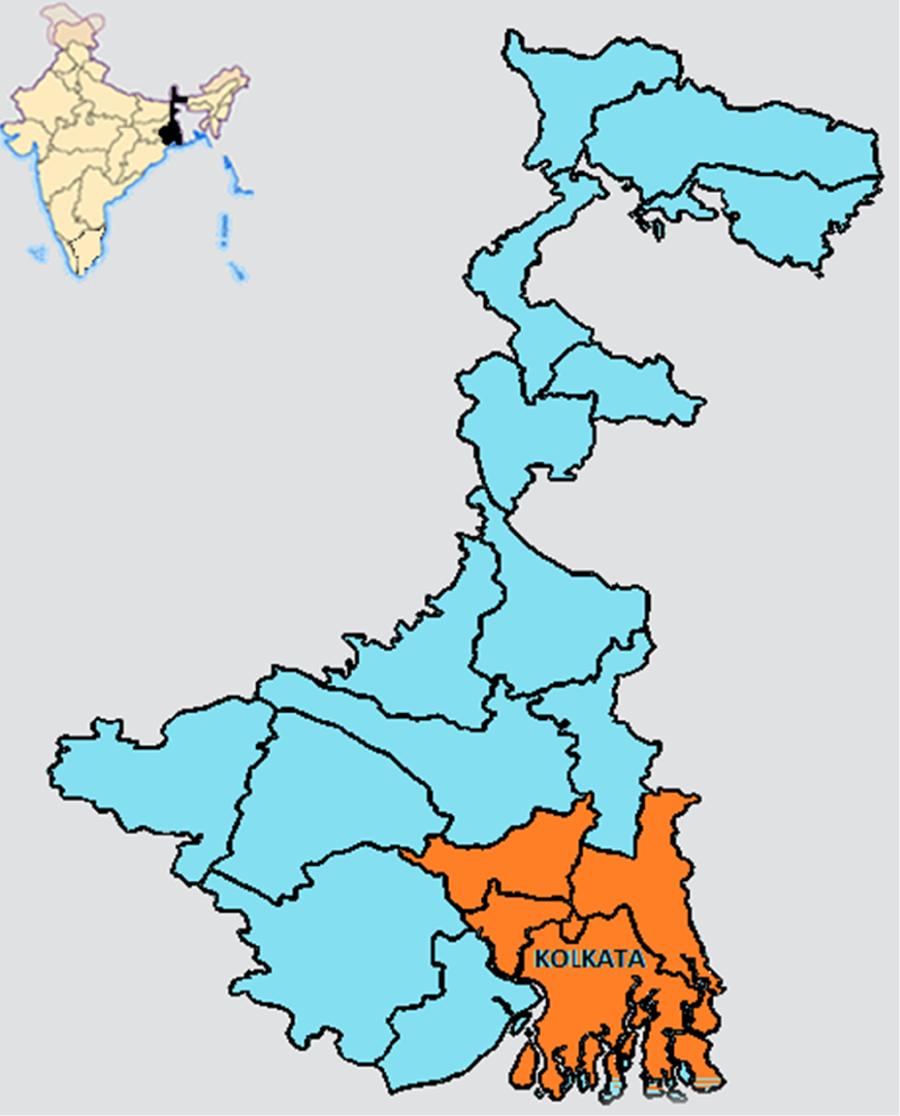
Concentration of century-old libraries in West Bengal surrounding the city of Calcutta.
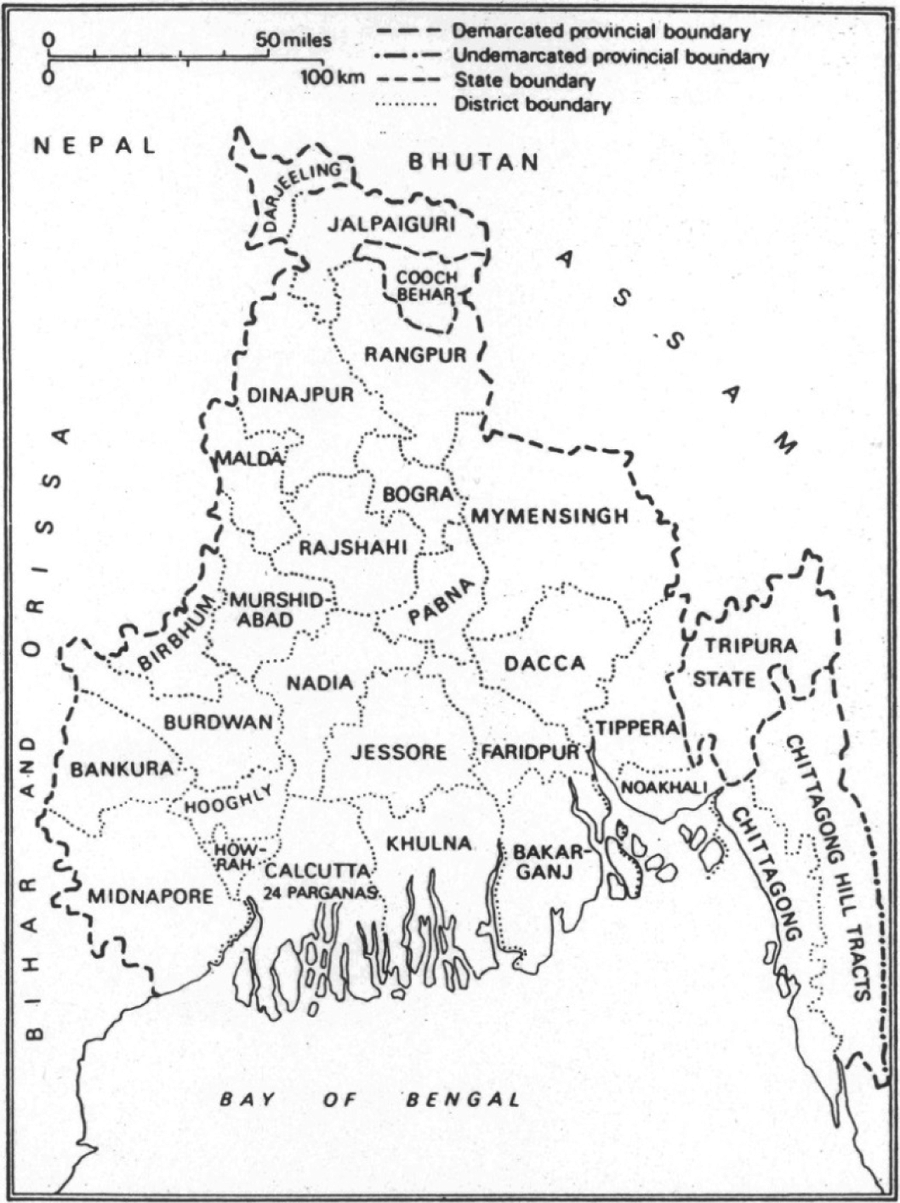
Bengal districts in the early 20th century.
To help in understanding the present status of the century-old libraries in West Bengal state, the management structure of WBPLN is briefly mentioned here. The State Central Library is positioned at the pinnacle as an advisory and policymaking body in WBPLN, followed by district libraries, sub-divisional libraries, town libraries and rural libraries. The state government also introduced a three-tier library system in every district, namely (1) district library, (2) town or sub-divisional libraries, and (3) rural or area or primary unit libraries to serve the local citizens. Through the transition, many of these century-old libraries were transformed into town libraries or rural libraries.
The Bengal Renaissance had a great influence in the development of community libraries in the 19th century. These libraries helped to increase adult literacy in rural and semi-urban areas through inculcating reading habits in young people, neo-literates and school-going children. As indicated in Table 1, century-old libraries can be categorized based on their year of establishment, primarily during the 19th century and then early 20th century till 1913. Figure 4 shows the distribution of these libraries in the last two centuries. Their impact is still a physical presence with 19th-century libraries representing 56.4% of public libraries in the region.

Distribution of century-old libraries based on year of establishment.
Many of these century-old libraries are now operational through voluntary efforts, while some others receive government support to continue their public services. Thus, another round of categorization is done based on the present management status and the distribution can be seen in Figure 5. This shows that government-sponsored libraries stand highest in number with a 64.4% share, and privately managed libraries stand second with a 29.7% share. This figure also indicates that the state government took over the responsibility of running these century-old libraries through sponsorship and ensuring inclusion of library personnel in the governmental payroll. The state government also offers sustainable career options to library personnel in government-sponsored libraries, while retaining autonomy in the management of the respective libraries. On the other hand privately managed libraries are run by the volunteers and core members from the local communities, without involving state government funding or absorption of library personnel in the governmental payroll. Government-aided libraries sometimes seek governmental support for infrastructure development, but usually they do not ask for recurring expenses. On the other hand 4% of the century-old libraries belong to the government library category. These include the National Library of India, Asiatic Society Library, Uttarpara Jaykrishna Public Library and North Bengal State Library. The former two libraries belong to the Government of India, and latter two belong to the Government of West Bengal.
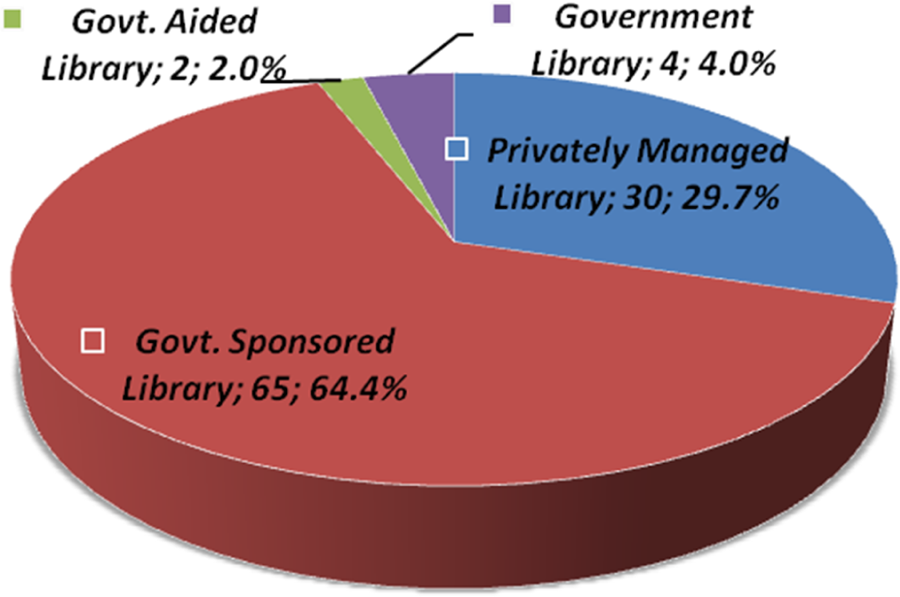
Distribution of century-old libraries based on management type.
Influence of the Brahmo Samaj movement
The Brahmo Samaj movement was part of the first wave of religious reform movements that marked the beginning of the Bengal Renaissance in the Indian subcontinent. The Brahmo Samaj was started at Calcutta on 20 August 1828 by Raja Ram Mohan Roy and Debendranath Tagore. Both Roy and Tagore were products of western secular and liberal education, and the Brahmo Samaj engaged in establishing educational institutions for spreading liberal education. They founded many schools and colleges for girls and boys. The educational institutions for girls became a turning point towards the emancipation of women in society through liberal education. Some of the significant schools and colleges founded by the Brahmo Samaj during the British colonial rule were: City College (1881), City School (1879), Brahmo Balika Shikshalay/ Brahmo Girls’ School (1890), besides many which were established in the 20th century through its educational wing, the Brahmo Samaj Education Society.
The Sadharan Brahmo Samaj Library which was founded in Calcutta in 1895 was initially restricted to the followers and members of the Brahmo Samaj. This library later expanded its access to the general public and became a prominent public library in the city. It is still running through self-sustainable resources and member contributions, without any governmental support. Other public libraries established in Bengal during the 19th century also have direct or indirect influence from eminent members of the Brahmo Samaj.
Many of the public libraries and academic libraries adjoining educational institutions were established by the core members of Brahmo Samaj in the areas surrounding Calcutta. Many eminent writers and educationists were born in Brahmo families, who took part in the advancement of knowledge and social reforms. Nobel Prize winner Rabindra Nath Tagore was one of them. He won the Nobel Prize in Literature in 1913 for his poetical work Gitanjali – Song Offerings, becoming its first non-European winner. Tagore utilized his Nobel Prize money to establish Visva Bharati University in 1921, which is an experimental university for embracing nature and creativity in pursuit of the advancement of knowledge and universal understanding. Tagore also became the founding President of the All Bengal Library Association, which was established in 1925 to co-ordinate the activities of existing public libraries and to organize the library movements in the province. Tagore himself was closely associated with the development of many rural and institutional libraries surrounding the Santiniketan Sriniketan areas – the birthplace of Visva Bharati. The Brahmo Samaj continues to influence eastern India, helping to construct a library-based society, educating and preparing citizens with liberal minds (Brahmo Samaj, 2014; Kopf, 1979).
Influence of the Ramakrishna Mission movement
The Ramakrishna movement was part of the second wave of religious reform movements during the late 19th and early 20th centuries. Swami Vivekananda, born at Calcutta in 1863 as Narendranath Dutta, was the founder of the twin organizations, Ramakrishna Mission (RKM) and Ramakrishna Math. Sri Ramakrisha was the great 19th-century saint of Bengal who rediscovered the new pathways in Hindu spirituality, called the Vedanta movement. The Mission aims at: the harmony of religions, harmony of the East and the West, harmony of the ancient and the modern, spiritual fulfilment, all-round development of human faculties, social equality, and peace for all humanity, without any distinctions of creed, caste, race or nationality. (Horiuchi, 2013: 119)
Here, Swami Vivekananda ignited the concepts of spiritual accomplishment and universal brotherhoods through his Ramakrishna movement, which was later carried on successfully by dedicated monks and followers.
Similarly to the Brahmo Samaj movement, followers of the Ramakrishna movement engaged in the establishment of new educational institutions as a means to all-round development of human faculties. They also developed public libraries to spread the teachings of Ramakrishna-Vivekananda and other reformers of the Bengal Renaissance. Swami Vivekananda’s sudden death in 1902 did not deter the organizations from establishing new centres and new educational institutions across the country. Many of the public libraries run by the RKM were equipped with state-of-the-art services, which also became exemplary for other community-driven public libraries. The state-of-the-art facilities included study carrels for serious readers and prospective authors, desktop computers for accessing the library catalogue database and other online information, etc. Table 1 also indicates some names of different century-old public libraries affiliated to RKM which continues to maintain public libraries for youth, the general public and followers in the state of West Bengal and in other Indian states. Most of these libraries also have a reading room, a supplementary facility which allows students to pursue their studies using their personal books and textbooks. Presently RKM maintains 269 libraries across the country – 140 public libraries and 129 school/college libraries – located in different branch centres of the Ramakrishna Mission (2013). Some important public libraries maintained by the RKM are namely, Ramakrishna Mission Institute of Culture Library, Calcutta; Swami Vivekananda’s Ancestral House and Cultural Centre Library, Calcutta; Ramakrishna Sarada Mission Ashram Library, Calcutta; Ramakrishna Mission Library, Narendrapur; Ramakrishna Mission Janashiksha Library, Belur Math; and Ramakrishna Mission Student Home Library, Belghoria. These are also government-aided public libraries and listed on the website of the West Bengal Public Library Network.
Influence of the Swadeshi movement
While the Brahmo Samaj and Ramakrishna movements were religious reform movements during the Bengal Renaissance period, the Swadeshi movement became a nationalist movement against British colonial rule in India. Through this movement many young people became socio-politically motivated towards greater participation in nation-building by following the principles of swadeshi (i.e. self-sufficiency). The Swadeshi movement is the precursor to the Indian independence movement, and helped to make Swadeshi enterprises flourish in Bengal Province as pointed out by Sumit Sarkar (1973). This movement involved boycotting British products and the revival of domestic products and production processes. The movement intensified with the announcement of the partition of Bengal by the Viceroy of India, Lord Curzon in 1905. This bifurcation plan was taken to weaken the nationalist movement in Bengal, which intensified during the beginning of the 20th century. The British planned to divide the province into eastern and western parts to reduce the cumulative effects of the nationalist movement. Many eminent personalities including Nobel-laureate Rabindra Nath Tagore, Sri Aurobindo, Deshbandhu Chittaranjan Das, Bipin Chandra Pal among others were involved in this movement. 3
The early revolutionary secret societies were founded in Bengal Province around the time of the Swadeshi movement. These extremist groups maintained their own libraries for motivating educated youth towards participation in freedom struggles. Many of these groups went underground, while maintaining collections of revolutionary literature gathered from different parts of the world. Their politically motivating literatures helped inspire the young people to achieve freedom from British rule. The Anushilan Samiti’s Calcutta branch, for example, had a library collection of 4000 books. Another revolutionary society, the Suhrid Samiti had a library collection of 230 books. The Suhrid Library and Indian Association Library, both listed in Table 1, belong to century-old libraries of this genre (WBPLN, 2014). Historian Sumit Sarkar (1973) gives a detailed account of how library resources were built up during the Swadeshi period and for what purposes.
Sarkar delved into the detailed functioning of some influential youth patriotic Samitis (or societies or associations) in Bengal. From the very beginning some of these societies combined physical culture with moral and intellectual training. Many of them also had a system of regular classes on socio-political issues. Their members were encouraged to read biographies of patriotic leaders, world literature on radical movements, radical ideologies and other socialist literature. Jogendranath Vidyabhusan wrote numerous biographies of Mazzini, Garibaldi, Kropotkin and other patriotic leaders – both Indian and foreign. Chattopadhyay’s (1882) book Anandamath which became essential reading for radical leaders and freedom fighters, was set against a background of the Sannyasi rebellion in the late 18th century. The book became synonymous with the struggle for Indian independence from British colonial rule. Thus, this book was banned by the Government. These patriotic societies maintained libraries with good collections of books in order to increase members’ interest in radical movements and ‘revolutions’ (Sarkar, 1973: 484). Some of the books in their collections were already banned by the Government. The Calcutta Anushilan Samiti had a library of 4000 books. Mymensingh Suhrid Samiti had a good library collection, out of which a list of 230 titles was preserved in the home political files of the colonial government (Sarkar, 1973: 483). Sister Nivedita arranged to supply Irish nationalist literature for motivating some early recruits to these societies. Their intellectual influences were extremely diverse. The Imperial Library of Calcutta was a good source of literature on socialism, and despite the librarian’s discouragement, Bhupendranath Dutta was able to get from there a book by Hyndman (Sarkar, 1973: 483–484). Sarkar further writes: ‘The library of the (Mymensingh Suhrid) Samiti had 230 books when the police raided it in November 1908; these included lives of Cromwell, Washington and Napoleon, Condemned as a Nihilist, Nabya Japan and several books on Ramakrishna and Vivekananda’ (Sarkar, 1973: 397).
The late 19th-century Bengal Renaissance also witnessed the establishment of many factories and mills in the vicinity of Calcutta. This increased migration of factory labourers from neighbouring states and their settlement at different districts around Calcutta. Swadeshi leaders took this opportunity to spread awareness amongst factory workers of exploitation by the British factory owners. The historian Sarkar observes the attempts made by Swadeshi leaders and social reformers to improve the material and moral conditions of Indian workers. The Brahmo social reformer Sibnath Sastri started night schools for labourers, a Workingmen’s Club in 1870, a monthly journal Bharat Sramajeebi in 1874 (for which he wrote a poem, beginning with the lines ‘Awake, Arise, O Workingman’), and an institute for workers in Baranagore in 1876. In addition to that Sastri established a library for factory workers in 1906 (Sarkar, 1973: 190; Sastri, 1907). This was the beginning of inculcating reading culture and the initiation of adult education for industrial workers in Bengal.
Many of these Swadeshi efforts influenced educated communities in Bengal to participate in neo-liberal movements as well as to sympathize with freedom struggles against the colonial rulers in India. Community libraries obviously helped in spreading literacy and encouraging socio-political awareness amongst the youth and working class.
Launching of free reading rooms
With the expansion of western education in colonial Bengal during the late 19th and 20th centuries, there was a proliferation of first-generation learners across Bengal province, particularly at Calcutta and surrounding districts. Many of these first-generation learners did not have suitable learning space or access to modern amenities such as electricity at home. Community libraries offered these learners a conducive learning space, called ‘free reading rooms’, for effective learning as well as for group study or collaborative learning. These libraries also organized study circles for discussing queries and clearing doubts related to their study. Table 1 consists of some of the century-old libraries offering a free reading room service to walk-in users. Still relevant today, many of the existing free reading rooms across the state of West Bengal also help students preparing their competitive examinations and school or college-level final examinations. Later many public and academic libraries across India constructed free reading rooms for walk-in users. Now, many of them even offer free Wi-Fi access for attracting young people to public libraries.
Calcutta Public Library and its successors
The Calcutta Public Library (CPL), established in 1836, is the oldest public library in modern India. This was a non-governmental effort, established collectively by colonial officers, Englishmen working in Calcutta in different capacities, and western-educated liberal Indians as its first proprietors. Membership was offered on a proprietary basis. In the Preface to the Catalogue of the Calcutta Public Library of 1846, a listing of 95 proprietors is found that includes both Englishmen and influential Bengali gentlemen (CPL, 1846: xvii–xviii). 4 Many of their successors contributed to the Bengal Renaissance and other social movements.
While advocating the establishment of Calcutta Public Library, the Editor of the Englishmen newspaper JH Stocqueler circulated an address in August 1835 among the principal inhabitants of city of Calcutta. He observed (CPL, 1846: iii): As considerable inconvenience is sustained by almost all classes of the community of Calcutta, owing to the absence of any thing like a General Library, combining the advantages of a library of reference and resort with those of a circulating library, it is proposed to take measures for immediately establishing such an institution, upon a scale commensurate with the interest and wants of the reading population.
He further emphasized that this library should be based upon broad and liberal principles in order to receive very general support throughout the metropolis. To Stocqueler, an Indian Public Library should be a mighty reservoir for all who burn with the thirst for knowledge. He then wanted to dedicate CPL ‘To All Ranks and Professions’, to every citizen of the metropolis of Calcutta.
Honourable Sir John Peter Grant seconded the public appeal made by Stocqueler. In a public meeting in Calcutta on 31 August 1835, Grant observed (CPL, 1846: iv): I believe this the only society of the same extent which has not a library of some description; at the Cape, at Bombay, they are better provided, and Madras has its Literary Society, but here in Calcutta, we are without the means of reading, except by purchasing books, from Humphrey Clinker up to Hume’s History of England.
Grant thought this was a very great inconvenience, and even Europeans living in Calcutta had no means except the expensive one of procuring books of light literature which formed the main reading of the greater part of the community; or those books which no man would purchase or refer to, except for the purpose of seeking out some particular information or referring to some point. He then proposed to have a public library in Calcutta for ‘the convenience of all classes of the community, by no means excepting those young men, natives of this country, who are most meritoriously pursuing their studies’ (CPL, 1846: iv).
All these efforts led to the establishment of Calcutta Public Library (CPL) in 1836. At the time of its inception, CPL received donations of books from private individuals, the library of the erstwhile Fort William College, and Governor General Sir Charles Metcalfe. Many native Indians, Englishmen living in the city as well as functionaries of colonial government became regular users. Its services were later extended to many poor students and others free of charge for a specified period of time (NLI, 2014).
The British colonial government later founded a government library called the Imperial Library in 1891 at Calcutta by combining a number of secretariat libraries and with collections from different libraries such as the Home Department, East India College, Fort William College and the East India Board in London. Imperial Library later acquired CPL in 1903 for expanding its services to the general public and also became a repository of printed books published in the Indian subcontinent. Imperial Library declared its purposes in a notification in the Gazette of India, which states: It is intended that it should be a library of reference, a working place for students and a repository of material for the future historians of India, in which, so far as possible, every work written about India, at any time, can be seen and read. (NLI, 2014)
The Imperial Library was widely used by contemporary progressive writers (Renaissance writers), social reformers, and also by the leaders of socio-political movements including the Swadeshi movement (Sarkar, 1973: 484). After independence, the Imperial Library became the National Library of India (NLI) in 1948 through the Imperial Library (Change of Name) Act, 1948. NLI also became an institution of national importance, dedicated to serving the whole nation with the largest collections of publications in all official Indian languages.
Conclusion
The Bengal Renaissance strengthened the production of Bengali literature and the development of the Bengali language. Newly emerged educated liberal and empowered Bengali intellectuals started to establish scholarly societies, youth associations and public libraries across the undivided Bengal Province. Many renowned public libraries were founded during this period. In every district of the province, public libraries were established with support from the local communities. Many of these century-old libraries are still in existence as shown in the Appendix (Table 1). Scholarly societies which are still in existence such as Bangiya Sahitya Parishad (Bengal Literary Association), Bangiya Bigyan Parishad (Bengal Science Association), Indian Association for the Cultivation of Science, and All Bengal Library Association also established their libraries and extended their access to the general public. The creation of social institutions also strengthened the nationalist science movement, first in Bengal province and later all over India.
Public libraries not only gave the necessary space for public engagement in socio-political issues, but also helped in the development of literacy in local communities, inculcating reading habits to first-generation learners, inculcating a scientific temper and overall transformation of the character of Bengali-speaking communities. Social reformers at that time visualized a society with open-mindedness, liberal, free from superstitions and belief in black magic, free from social exclusions and negative doctrines. All these social reforms were also made possible with the development of a middle class, having access to affordable public education and public library services. Later, many public libraries also indirectly supported Swadeshi and other nationalist movements. Thus, the legacy of the Bengal Renaissance had an overarching impact on the lives of billion peoples rippling beyond the 19th- and 20th-century timeframes.
Currently, non-government organizations (NGOs) and civil society organizations are developing rural libraries and reading rooms across South Asia to improve access to elementary, secondary and adult education, and to facilitate universal access to information as required for the development of livelihoods. Some of these NGOs are engaged in achieving United Nations Millennium Development Goals (UN-MDGs) through improving access to information and mass education. For example, an NGO named READ Global has subsidiaries in India (READ India), Nepal (READ Nepal) and Bhutan (READ Bhutan) for establishing rural public libraries and information access points in the respective countries. Similarly, another NGO, Room to Read, is also active in South Asia in the development of rural libraries and community libraries.
However, there is a need to have in-depth research and analysis of the long-standing influence of these public libraries in South Asian society in general and their influence in the socio-economic empowerment of common citizens in particular. First- or second-generation learners derive significant impetus while visiting a public library and continuing their formal or non-formal learning. Changing reading habits due to improved access to smart phones, networked computers and satellite televisions can pose serious challenges to certain segments of the population, as discussed by several scholars and sociologists. Some research could also be carried out in that direction to improve services of public libraries in South Asia aligned with the livelihood requirements of public library users.
Footnotes
Appendix
Century-old libraries in West Bengal State.
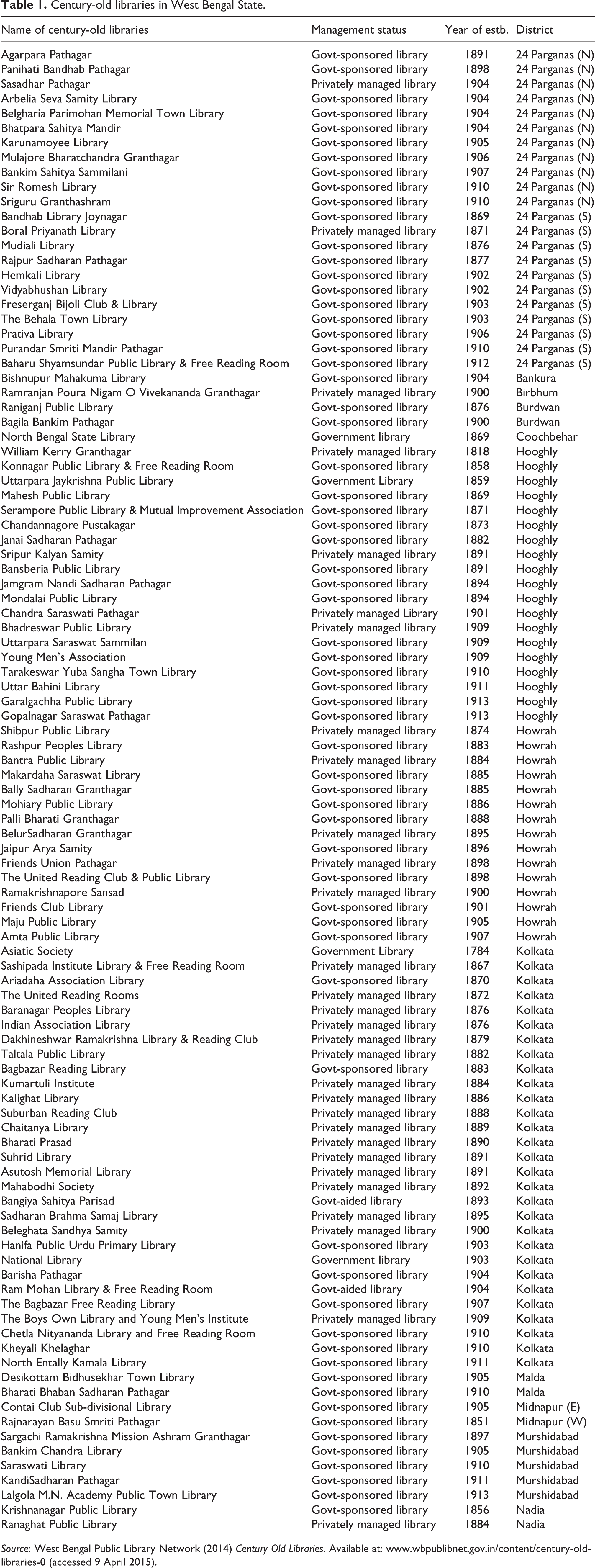
| Name of century-old libraries | Management status | Year of estb. | District |
|---|---|---|---|
| Agarpara Pathagar | Govt-sponsored library | 1891 | 24 Parganas (N) |
| Panihati Bandhab Pathagar | Govt-sponsored library | 1898 | 24 Parganas (N) |
| Sasadhar Pathagar | Privately managed library | 1904 | 24 Parganas (N) |
| Arbelia Seva Samity Library | Govt-sponsored library | 1904 | 24 Parganas (N) |
| Belgharia Parimohan Memorial Town Library | Govt-sponsored library | 1904 | 24 Parganas (N) |
| Bhatpara Sahitya Mandir | Govt-sponsored library | 1904 | 24 Parganas (N) |
| Karunamoyee Library | Govt-sponsored library | 1905 | 24 Parganas (N) |
| Mulajore Bharatchandra Granthagar | Govt-sponsored library | 1906 | 24 Parganas (N) |
| Bankim Sahitya Sammilani | Govt-sponsored library | 1907 | 24 Parganas (N) |
| Sir Romesh Library | Govt-sponsored library | 1910 | 24 Parganas (N) |
| Sriguru Granthashram | Govt-sponsored library | 1910 | 24 Parganas (N) |
| Bandhab Library Joynagar | Govt-sponsored library | 1869 | 24 Parganas (S) |
| Boral Priyanath Library | Privately managed library | 1871 | 24 Parganas (S) |
| Mudiali Library | Govt-sponsored library | 1876 | 24 Parganas (S) |
| Rajpur Sadharan Pathagar | Govt-sponsored library | 1877 | 24 Parganas (S) |
| Hemkali Library | Govt-sponsored library | 1902 | 24 Parganas (S) |
| Vidyabhushan Library | Govt-sponsored library | 1902 | 24 Parganas (S) |
| Freserganj Bijoli Club & Library | Govt-sponsored library | 1903 | 24 Parganas (S) |
| The Behala Town Library | Govt-sponsored library | 1903 | 24 Parganas (S) |
| Prativa Library | Govt-sponsored library | 1906 | 24 Parganas (S) |
| Purandar Smriti Mandir Pathagar | Govt-sponsored library | 1910 | 24 Parganas (S) |
| Baharu Shyamsundar Public Library & Free Reading Room | Govt-sponsored library | 1912 | 24 Parganas (S) |
| Bishnupur Mahakuma Library | Govt-sponsored library | 1904 | Bankura |
| Ramranjan Poura Nigam O Vivekananda Granthagar | Privately managed library | 1900 | Birbhum |
| Raniganj Public Library | Govt-sponsored library | 1876 | Burdwan |
| Bagila Bankim Pathagar | Govt-sponsored library | 1900 | Burdwan |
| North Bengal State Library | Government library | 1869 | Coochbehar |
| William Kerry Granthagar | Privately managed library | 1818 | Hooghly |
| Konnagar Public Library & Free Reading Room | Govt-sponsored library | 1858 | Hooghly |
| Uttarpara Jaykrishna Public Library | Government Library | 1859 | Hooghly |
| Mahesh Public Library | Govt-sponsored library | 1869 | Hooghly |
| Serampore Public Library & Mutual Improvement Association | Govt-sponsored library | 1871 | Hooghly |
| Chandannagore Pustakagar | Govt-sponsored library | 1873 | Hooghly |
| Janai Sadharan Pathagar | Govt-sponsored library | 1882 | Hooghly |
| Sripur Kalyan Samity | Privately managed library | 1891 | Hooghly |
| Bansberia Public Library | Govt-sponsored library | 1891 | Hooghly |
| Jamgram Nandi Sadharan Pathagar | Govt-sponsored library | 1894 | Hooghly |
| Mondalai Public Library | Govt-sponsored library | 1894 | Hooghly |
| Chandra Saraswati Pathagar | Privately managed Library | 1901 | Hooghly |
| Bhadreswar Public Library | Privately managed library | 1909 | Hooghly |
| Uttarpara Saraswat Sammilan | Govt-sponsored library | 1909 | Hooghly |
| Young Men’s Association | Govt-sponsored library | 1909 | Hooghly |
| Tarakeswar Yuba Sangha Town Library | Govt-sponsored library | 1910 | Hooghly |
| Uttar Bahini Library | Govt-sponsored library | 1911 | Hooghly |
| Garalgachha Public Library | Govt-sponsored library | 1913 | Hooghly |
| Gopalnagar Saraswat Pathagar | Govt-sponsored library | 1913 | Hooghly |
| Shibpur Public Library | Privately managed library | 1874 | Howrah |
| Rashpur Peoples Library | Govt-sponsored library | 1883 | Howrah |
| Bantra Public Library | Privately managed library | 1884 | Howrah |
| Makardaha Saraswat Library | Govt-sponsored library | 1885 | Howrah |
| Bally Sadharan Granthagar | Govt-sponsored library | 1885 | Howrah |
| Mohiary Public Library | Govt-sponsored library | 1886 | Howrah |
| Palli Bharati Granthagar | Govt-sponsored library | 1888 | Howrah |
| BelurSadharan Granthagar | Privately managed library | 1895 | Howrah |
| Jaipur Arya Samity | Govt-sponsored library | 1896 | Howrah |
| Friends Union Pathagar | Privately managed library | 1898 | Howrah |
| The United Reading Club & Public Library | Govt-sponsored library | 1898 | Howrah |
| Ramakrishnapore Sansad | Privately managed library | 1900 | Howrah |
| Friends Club Library | Govt-sponsored library | 1901 | Howrah |
| Maju Public Library | Govt-sponsored library | 1905 | Howrah |
| Amta Public Library | Govt-sponsored library | 1907 | Howrah |
| Asiatic Society | Government Library | 1784 | Kolkata |
| Sashipada Institute Library & Free Reading Room | Privately managed library | 1867 | Kolkata |
| Ariadaha Association Library | Govt-sponsored library | 1870 | Kolkata |
| The United Reading Rooms | Privately managed library | 1872 | Kolkata |
| Baranagar Peoples Library | Privately managed library | 1876 | Kolkata |
| Indian Association Library | Privately managed library | 1876 | Kolkata |
| Dakhineshwar Ramakrishna Library & Reading Club | Privately managed library | 1879 | Kolkata |
| Taltala Public Library | Privately managed library | 1882 | Kolkata |
| Bagbazar Reading Library | Govt-sponsored library | 1883 | Kolkata |
| Kumartuli Institute | Privately managed library | 1884 | Kolkata |
| Kalighat Library | Privately managed library | 1886 | Kolkata |
| Suburban Reading Club | Privately managed library | 1888 | Kolkata |
| Chaitanya Library | Privately managed library | 1889 | Kolkata |
| Bharati Prasad | Privately managed library | 1890 | Kolkata |
| Suhrid Library | Privately managed library | 1891 | Kolkata |
| Asutosh Memorial Library | Privately managed library | 1891 | Kolkata |
| Mahabodhi Society | Privately managed library | 1892 | Kolkata |
| Bangiya Sahitya Parisad | Govt-aided library | 1893 | Kolkata |
| Sadharan Brahma Samaj Library | Privately managed library | 1895 | Kolkata |
| Beleghata Sandhya Samity | Privately managed library | 1900 | Kolkata |
| Hanifa Public Urdu Primary Library | Govt-sponsored library | 1903 | Kolkata |
| National Library | Government library | 1903 | Kolkata |
| Barisha Pathagar | Govt-sponsored library | 1904 | Kolkata |
| Ram Mohan Library & Free Reading Room | Govt-aided library | 1904 | Kolkata |
| The Bagbazar Free Reading Library | Govt-sponsored library | 1907 | Kolkata |
| The Boys Own Library and Young Men’s Institute | Privately managed library | 1909 | Kolkata |
| Chetla Nityananda Library and Free Reading Room | Govt-sponsored library | 1910 | Kolkata |
| Kheyali Khelaghar | Govt-sponsored library | 1910 | Kolkata |
| North Entally Kamala Library | Govt-sponsored library | 1911 | Kolkata |
| Desikottam Bidhusekhar Town Library | Govt-sponsored library | 1905 | Malda |
| Bharati Bhaban Sadharan Pathagar | Govt-sponsored library | 1910 | Malda |
| Contai Club Sub-divisional Library | Govt-sponsored library | 1905 | Midnapur (E) |
| Rajnarayan Basu Smriti Pathagar | Govt-sponsored library | 1851 | Midnapur (W) |
| Sargachi Ramakrishna Mission Ashram Granthagar | Govt-sponsored library | 1897 | Murshidabad |
| Bankim Chandra Library | Govt-sponsored library | 1905 | Murshidabad |
| Saraswati Library | Govt-sponsored library | 1910 | Murshidabad |
| KandiSadharan Pathagar | Govt-sponsored library | 1911 | Murshidabad |
| Lalgola M.N. Academy Public Town Library | Govt-sponsored library | 1913 | Murshidabad |
| Krishnanagar Public Library | Govt-sponsored library | 1856 | Nadia |
| Ranaghat Public Library | Privately managed library | 1884 | Nadia |
Source: West Bengal Public Library Network (2014) Century Old Libraries. Available at: www.wbpublibnet.gov.in/content/century-old-libraries-0 (accessed 9 April 2015).
Acknowledgement
An earlier unpublished version of this paper was presented in the International Conference on History of Librarianship, at Enssib, Lyon during 25–26 August 2014. The author is grateful for a generous travel grant provided by the Enssib, France for participating in that conference.
Declaration of Conflicting Interests
The author(s) declared no potential conflicts of interest with respect to the research, authorship, and/or publication of this article.
Funding
The author(s) received no financial support for the research, authorship, and/or publication of this article.