



Abstract
The purpose of this paper is to analyze public librarians’ perspectives on the future of public libraries in Turkey. The research is arranged under six headings as follows: the state of overall change in public libraries; services; lifelong learning and information literacy; technology; administration and collection; building, librarian, user and other elements including finance. Every aspect of the study which entails literature review, findings, discussion and conclusion were examined within the scope of these six subjects. A descriptive method of research was used; the data was collected through an online survey technique that consisted of 62 questions in the form of a three-point Likert scale. Survey questions were also constructed within the frame of the six research headings, and the questions in each group were presented in a mixed order. The questionnaire was sent to 481 librarians working in public libraries in Turkey in 2014. Of these 201 librarians responded, and 185 survey answers out of these responses were found to be valid. The response rate was 38.5%. The results show that public librarians in Turkey are optimistic about the survival and development of public libraries in the future. According to them, public libraries will undergo significant changes in the sense of structural makeup, services, technology and administration by preserving their fundamental composition and functions.
Keywords
Introduction
Public libraries have to evaluate their social roles, missions, responsibilities and priorities about their future in order to continue their existence and set new positions. While Smith (2014) mentions that libraries are “absolutely essential”, Norman (2014: 232) states that the loss of social value for libraries will mean “silencing the voices of the past and damaging the future”. Cassidy (2014), assuming that there is a negative course of cases in terms of public libraries, states “let’s wake up and start valuing learning, imagination, culture and community, before all of those things are lost forever”. The most important problem that librarianship faces currently is how this profession will adapt to the changing information environment in the trend report prepared by IFLA (2014). The move toward digital resources is significant. Newly formed digital content in 2011 was several million more than the content of all books that have been written up to this time (Bartlett and Miller, 2011). Plus, OECD numbers show that Internet traffic increased 13,000% in the last 10 years and digital content created between 2008 and 2011 is more than all the written history recorded up to present (World Economic Forum, 2012: 59). To be able to comprehend this fast and qualitative change within the global information environment will help to make predictions as well as to form a perspective about trends or the social stance that will determine the future of libraries in general and public libraries in specific. The change in the global information environment will influence future roles and services of public libraries. It is especially the responsibility of public librarians to realize social and cultural changes in the matter of public libraries. Opinions of public librarians as well as related scientists on the future of public libraries will contribute to the development of national policies
Background
There have been attempts to discuss and estimate the rate and direction of social, economic, cultural and technological changes that directly concern libraries. In the IFLA Trend Report (2014) some key trends that will change the global information environment of public libraries were presented. Two of these trends are worth mentioning. They entail possibilities as “new technologies will both extend and limit opportunities to access information” and “online education can both democratize and disrupt global learning”. Discussion abounds on whether or not public libraries will be able to survive in the future. Wooden (2006) states that the public believes public libraries are necessary and precious not only now but also in the future. Public libraries have to and will adapt to the changing and complicated nature of the information world, just like lots of other live organisms (Dysart, 2011a). The issue of whether “the future” will constitute a threat or create new opportunities is a controversial subject. The fact that the level of use of public libraries has decreased in general all around the world is accepted as a concrete indication of this threat. Research conducted both in the USA and the UK shows that public libraries have negatively changed statistically and there is a decrease in use of these libraries (Chartered Institute of Public Finance and Accountancy, 2014; Sullivan, 2003). The same situation can be valid for Turkey (KYGM, 2014). The reasons for this threat are believed to be the Internet, new information and communication technologies, electronic book sellers, financial problems, new, quick and easy ways of access to information and replacing books with electronic sources in libraries (Sullivan, 2003).
On the other hand, it is estimated that both the digital divide, which will deepen in the future, and lifelong learning, which will be one of the mandatory conditions, will create opportunities for public libraries based on their principle of “equality in access to information”. It can be said that these opportunities will empower democracy in countries. In particular, it can be predicted that public libraries will play a role in filling the increasing gaps of democracy in neo-liberal societies and that this will occur through the effort to create an educated society. Therefore, the functions of public libraries in enhancing democracy will increase. Also, Watson (2011) argues that as books and libraries are not the same things, it would be wrong to assess them without differentiating. Gibbons (2014) believes that the basic problem of the future of public libraries is lack of obligatory strategic leadership rather than meeting the societal and technological requirements. Most Americans think that public libraries will continue to play a vital part in the future due to their function of “offering free information” and public libraries will participate in society to increase equality, opportunity and the development of society rather than being nostalgic institutions in this information age (Wooden, 2006). It can be said that public libraries will be secure in their existence as long as inequality in society and its outcome “ostracization” continue. Public libraries can play a role in resolving conflict in society, and as long as social problems continue, public libraries will survive through this function (Wooden, 2006). Watson (2011) believes that public libraries will be “ideas hubs” where librarians take part in helping people develop ideas rather than being a place which provides information and content. Public libraries will make a significant contribution to the local economy through this very function. In this context, Rydell (2011) thinks that public libraries will act like “knowledge brokers” in the next two decades.
It can generally be said that there are two hypotheses regarding the future of public libraries, i.e whether they endure or vanish in the future. However, Sullivan’s (2003) approach seems to expand our vision on this subject and is more realistic. According to him, it will not be a simple question of either gain or loss; public libraries will both win and lose. So public libraries which have strong societal relations, produce projects with other cultural institutions, publishers and politics, and use information and communication technology will win; public libraries that have a narrow point of view and are not inclined to cooperate with other organizations will lose. In this regard, it can be said that all public libraries in the world or in a country will not develop on the same level. Hence it is not an issue of existence and disappearance. Rather, it will be a societal selection process resulting in the survival of those that are attuned to change.
Hernon and Matthews (2013: 157) mentions four scenarios related to the future of public libraries. Public libraries will either keep their status quo and remain as traditional libraries or they will become “community living rooms”. They will either turn into electronic libraries or exist as happening places. In the same study it is stated that these scenarios will come true depending upon changes in society, economy, culture and technology (pp. 6–8).
Norman (2012) states that fundamental points about the future of the public libraries will be providing opportunities with proactive society and partner institutions; communication with society; lifelong learning and culture-oriented programs; strategic planning for library services; and collection and developing for society. In addition, technology, digital divide, center for social communication and unpaid service-information concepts can be counted among the fundamental points about the future of the public libraries. Oldenburg (1991) mentions the idea of the “third place” referring to public libraries. He uses this as a notion that provides a natural platform for community members of a library to gather, interact, create or realize themselves. The “first place” is home, “second place” is the workplace/school, and “third place” is libraries where people share the same interests. The possible change in the future of public libraries will reflect on some points; services, technology, administration, collection, building, user and budget can be considered among them.
Services
It is believed that public libraries should absolutely renew their services to survive, as they cannot continue their current services in the future. Some core services (i.e. circulation, reference, etc.) will survive but will undergo thorough change. However, the principle of free service – indiscriminately for everyone – will remain unchanged. In this context, developing better programs for young people, becoming a popular place for illiterate adults or adults with poor literacy, offering ready, quick and acquirable information, documents and forms for government service, providing easy access to formal procedures and offering better access opportunities via computers for everyone will be primary services (Wooden, 2006). Reliable services are mandatory for the existence of public libraries. Moreover, public libraries may have new roles like making increasingly complex information easier for users. Public libraries will need to support distance education which will spread gradually, especially with electronic sources. Public libraries will increasingly become a part of information literacy programs. They will tend towards disadvantaged groups especially the adult, the old, the poor, the poorly educated, women, the housebound, prisoners and digital immigrants. Roles of reference librarians will be vital because of the complexity of access to information (Sullivan, 2003). Nonetheless, Scheppke (2011) states that reference desks have died and the information desk in public libraries will not exist in the future. He argues that there will be a mobile reference service instead and this service will be offered through social media. Public library services for children will become more prominent in the future. Public libraries will need to cooperate more with educational and cultural institutions like museums and archives. Also, they will have to use new methods of public relations in order to announce their services.
Technology
Reeder (2011) explained public libraries’ relationship with technology in the future with this statement “they’re a place that you can go to get computer access, or access to technology that you can’t get anywhere else, and access to people”. It is a generally accepted fact that the main trend in determining the future of public libraries will be technological changes. Torrone (2011) asks if “it is time to rebuild and retool public libraries and make TechShops” in preparation for the future. Because he thinks public librarians will have a role in meeting the requirements of users in the creation of a techno-creative society, Schenker (2011) confirms that public libraries will be free centers for individuals, families and even small companies to access expensive technology.
It is generally accepted that public libraries will be necessary for an effective and equal access to the digital world by guaranteeing computer access for everyone (Norman, 2012; Wooden, 2006). New technology-based roles of public libraries will be providing content, access management and information literacy instruction. Also it can be assumed these new technology-based roles will interest lower socio-economic groups in society (Wooden, 2006). The public is expected to make use of the technological facilities of the public library in order to access public sector data. However, technology and the Internet can be perceived as a threat for today’s and tomorrow’s public libraries. The main source of this threat is the fact that people reach information faster and easier via the Internet. On the other hand, this threat also means an opportunity. The need for society to obtain the skills for accessing information and making use of technology will direct them to use public libraries. Furthermore, the question of whether information on the Internet is really reliable or not and the fact that the Internet is not an authority but overwhelmingly commercial are some other sources of concern for public libraries In other words, it will not be easy to find information for well-conducted research in the future, which will create opportunities for public libraries in the end (Sullivan, 2003). Nevertheless, as information culture (the level and quality of information use) between countries that produce and consume technology is different, the position of public libraries will also be different in different countries. They will be more important and necessary for countries producing technology.
It is obvious that local cultures are under threat of disappearing due to rapidly growing globalization. Examples of this can easily be observed today. The function of public libraries of protecting local cultures, especially by digitizing, will attain great importance against the unifying effect of globalization.
Lastly, public libraries just like other kind of libraries will have a security problem in automation systems.
Administration
Public library administrations will also be affected by the change. McEntyre (2011) discusses the McDonaldization model which means standardization and centralization of service for all public libraries in a country when he mentions that public libraries will need to develop new operating models in the future. It is still a possibility for this model to introduce a central public library administration system at a national level even though it may destroy the local character of public libraries. It could be said that this operating model is not appropriate for public libraries despite its advantages. The fact that users can operate public libraries for themselves is another foreseeable option for the future. Boaden and Clement (2009) propose flexible integration of cultural spaces such as library-theatre, library-museum, library-gallery and library-archive based on the concept of “together”.
Collection, building, librarian, user and finance
Future trends of collection can be as follows: electronic sources will replace printed books and other materials in public library collections, opinions and demands of users will be further taken into consideration in the selection of materials for the library, use of materials will be more “outside” of the library (at home, at work, etc.) and the importance of currency of materials will continue. However, these changes or the fact that other materials will replace books is not a determinant of the future of public libraries, because public libraries have never been about “the book”. They have existed and will exist to share information. There are currently several different materials apart from books and the number will increase in the future. In short, public library collections will be a combination of digital and other kinds of materials. Furthermore, as public libraries’ function of being a local memory becomes more prominent, they will have to preserve printed sources about local history and culture by digitizing. Digitizing will be a significant mission for librarians to preserve sources and make people use them (Dysart, 2011b).
Public library buildings are likely to be formed as places that take disabled people into consideration; function as a culture center; create a desire to work, think and learn; help technology and space integrate with a green library approach; are fun, comfortable and “proper for laziness” based on the principle of flexible architectural design. Such “user-oriented” places will create a “different” atmosphere with an “attractive” aesthetic rather than being functional management-oriented centers in the form of social communication and meeting centers for face-to-face communication in future (Yılmaz, 2013). Rydell (2011) argues that public libraries that function as physical meeting places will be less important because the fact that their mission is to provide electronic information will be more prominent. In spite of that, Aabø et al. (2010) mention in a study conducted in Norway that the function of public libraries as gathering places for individuals will continue to expand. It can be said that libraries’ function of providing spaces for social communication, cultural activities and leisure time will increase. Public librarians will need to be further highly educated due to the complexity of the information retrieval process (Sullivan, 2014). New future roles of public librarians will cause them to improve their qualifications. The fact that it will be hard to find librarians to employ in some countries due to low salaries is among the predictions about the future of public libraries (Sullivan, 2014). Public librarians will also need to have capacity and sufficiency to form and run lifelong learning and information literacy programs. In this context, their instructional roles will increase.
It is also expected that the use and user profile of public libraries will change. McMenemy (2009) states that public library users will be perceived by librarians not as clients but as citizens. While it is foreseen that the use of public libraries will get easier (Dysart, 2011b), users will also need to be better educated in the complicated information world. Virtual/electronic use will replace physical use of public libraries. On the other hand, public library buildings will function as social communication institutions where face-to-face and interpersonal relationships will occur in an increasingly virtualized world. In other words, the cultural purposes of public library use will become prominent. Their new roles and functions with regard to users will affect space design in the future.
Sullivan (2003) discusses public library branches that were closed down due to budget insufficiency in the USA. As public libraries are not revenue-generating institutions and are counted as income households, they will be among the first institutions to find their budget in financial difficulties. In fact, 71% of US citizens think that public library expenses do not go to waste, are to the point and may result in additional tax if necessary. But such thinking does not change the fact that financial problems will be among the major factors to determine the future of public libraries (Dysart, 2011b). Norman (2014) states that public libraries will not be given big budgets and so they will have to change the way they work. In this sense, the UK Local Government Group (2011) suggests public libraries consociate with private sector and other councils, integrate with shopping malls and village halls, and help health and police services.
Public libraries in Turkey
It can be said that the foundation of modern public libraries in Turkey was laid during the Republic period/era (after 1923). The libraries functioned especially as a part of literacy programs and as mediators of the cultural policies of the newly founded republic. Public libraries were involved with the ministries of education and culture. There is a predominantly central public administration system in Turkey. Accordingly, the public library system is the central structure. Public libraries serve as a part of the Ministry of Culture and Tourism, General Directorate of Libraries and Publications (KYGM, 2014). They work under governorships via directorates of culture in cities and district governorships in districts. Some municipalities also have libraries. There were 1118 public libraries including children’s libraries by the end of 2013 in Turkey, a country whose population is about 82 million and which has 81 provinces. The total number of materials is 16 million, the number of annual visitors is almost 20 million and the number of enrollees is 1 million in these libraries. Almost 7.5 million materials were borrowed and 3000 cultural activities were organized in 2013. There are 32 mobile libraries in total (KYGM, 2014). Public libraries consist of the central library, branch libraries, children’s libraries, mobile libraries and temporary collections. The budget of public libraries is provided completely by the central government and all policies, services and practices are planned, conducted and inspected by the central organization (KYGM, 2014). Public libraries put into practice the central government’s decisions; their local power is rather limited. They can only choose a very small amount of library materials (8.6%) (KYGM, 2014). Public libraries in Turkey have been facing a great personnel issue and this situation is getting worse. Staff in senior managements (general manager, vice general manager, etc.) are generally appointed politically and most of them are not librarians. As the school library system is very poor in Turkey, public libraries function more as school libraries. The majority of public library users consist of students, children, and adolescents. The subject of transferring public libraries to municipalities has been seriously considered and discussed lately. Indeed, a draft law on this issue has come up to the national parliament but has yet to be enacted.
Research questions
This study aims to analyze perspectives of public librarians currently working in Turkey regarding the future of public libraries. The study is based on six research questions.
According to public librarians in Turkey: What will the general trends of change of public libraries be in the future? What kind of change will public library services undergo in the future? What will public library functions be in terms of lifelong learning and information literacy? What will public library-technology relations be like in the future? What will public library administration systems be like in the future? What kind of changes will public library collection, building, personnel, user and budget undergo in the future?
These research questions were structured, and systemized on the basis of a literature review, interviews with Turkish public librarians and all the observations and studies that we have conducted to date.
Methodology
Research methods
The descriptive method of research was used in the study. The data was collected through survey. The online survey was constructed and applied in Google Docs. There are 62 multiple-choice questions in the survey. A 3-point Likert scale multiple-choice was used for 59 of the questions. It was important whether participants of the survey agreed or not, instead of how much they agreed with the ideas/statements that were provided. That is why such expressions as “I agree”, “I do not agree”, “I have no idea” were used in the Likert scale options. The use of the expression “I have no idea” instead of “I am not sure” or “I am doubtful” was a conscious decision. While “I have no idea” reflects a certain “not knowing” situation, the other two options show that the participant has some information in mind to a certain extent. As we intended to get clear opinions in this study, we preferred using “I have no idea”. The statements in the survey tried to be neutral to positive and negative judgments. The three questions in which 3-point Likert multiple-choices were not used consisted of different numbers of options. The survey questions were created under six groups. These are; General trends of change related to the future of public libraries and participants’ opinions about other elements such as: Services Lifelong learning and information literacy Technology Administration Collection-building-personnel-user-budget.
Questions under these six headings were asked non-consecutively to ensure consistency.
Participants
The number of professional librarians (graduates of departments of Information Management) working in a total of 1118 public libraries in 2014 in Turkey is 481. 1 The survey was sent to all these librarians in the study. Of these 201 answered the survey but only 185 responses were found to be valid. The sampling rate was 38.5%.
Data analysis
The data obtained in the research was evaluated by frequency analysis. SPSS 21 and Microsoft Excel programs were utilized for evaluations.
Findings
Opinions of public librarians in Turkey about the trend of change in public libraries in the future will be discussed within the scope of the six research questions in this section. It is important to stress that their opinions reflect the perspective about the future of public libraries in Turkey alone.
Public libraries’ general trends of change
Of the public librarians participating in the survey 92.4% stated that they occasionally considered the future of public libraries. Librarians predicted that radical changes of public libraries in Turkey will happen between 1 to 20 years with a percentage of 58.4; between 21 to 30 years with a percentage of 18.4; and in 31 years and more with a percentage of 18.9. The percentage of librarians who had no foresight about this subject was 4.3%. The data about opinions of public librarians in Turkey about public libraries’ general trend of change in the future is presented in Figure 1.

Public librarians’ opinions about libraries’ general trend of change in the future.
According to the findings in Figure 1, a majority of public librarians (91.9%) think that the public library institution will continue its existence and even 69.2% of them believe public libraries will become more necessary in the future. However, the fact that more than one-fifth of the librarians (21.1%) assume that public libraries will not be necessary cannot also be underestimated. A large number of research participants (85.4%) state that society will be affected in the case of future destruction of public libraries. A similar proportion of public librarians (84.3%) do not believe that public libraries will be perceived as “outdated” places. More than half of the librarians (57.3%) believe that the basic roles of public libraries will not change. However, more than one-third of the respondents (38.9%) foresaw that aforementioned roles would change.
Librarians were also asked about the possible trends of change of public libraries in the context of the information society. The majority of them (81.1%) believe that public libraries will be an indispensable part of the information society and their roles in the decreasing digital divide will strengthen (81.6%). The rate of those who think that public libraries’ role in developing democracy will increase (70.8%) and who think that their function as socialization centers will become prominent (75.7%) is very high. But one-fifth of librarians have the opposite opinion about both subjects.
Trends of change in public library services
It is predicted that one of the areas where the trends of change will be observed is public library services which will reflect changes in other public library aspects. Opinions of research participants about changes in public library services are shown in Figure 2.

Public librarians’ opinions about library services in the future.
According to findings in Figure 2, while a significant proportion of librarians (62.2%) think that a major change will occur in public library services, more than one-third (36.2%) do not believe that such a change will occur. However, they generally (71.9%) agree that public library services will be user oriented in the future. Librarians (76.8%) assume that there will not be change in regard to the importance of professional standards and these standards will continue to be significant. While the proportion of librarians who think that future public library services will not be free of charge is 25.4%, more than half of them (62.7%) state that they will remain free. A minority (11.9%) does not have an idea about this subject.
It is thought that cultural activities will be more necessary in public libraries (81.6%) and in this context services towards cultural minorities will increase (75.1%). A vast majority of participants (75.1%) predict that reference services will still be needed and similarly the importance of outreach will grow (80.5%). It is remarkable that although half of participants (49.7%) believe that mobile libraries will continue to be important, a significant number of librarians (41.1%) think that this kind of service will lose its importance.
Trends of change in public library functions in lifelong learning and information literacy
As emphasized in the literature review of the research, lifelong learning and information literacy are presumed to be the most prominent functions of public libraries in the future. According to the findings, librarians (79.5%) believe that public libraries will become a more important part of lifelong learning processes. In this context, 78.4% of the participants think that supporting and developing information literacy will be a significant mission of public libraries.
Trends of change in public library-technology relations
As explained in the literature review, technology is evaluated as the main section that will determine the trends of change towards the future. It has the potential to change not only all processes and services but also all other components of public libraries. In other words, technology is the primary element that will change public libraries. Approaches of public librarians to this subject constitute a major part of this study.
According to the findings in Figure 3, three out of four librarians (74.6%) consider public libraries will be centers of access to technology in the future. According to answers to another statement that more strongly reflects public library and technology relations, while more than half of librarians (58.9%) believe that public libraries will turn into TechShops, about one-third of them (30.3%) estimate that such a change will not happen and 10.8% of them do not have an opinion. Similarly, a vast majority of librarians (89.7%) regard public libraries as institutions that will meet only technology-based requirements of society in the future. Nevertheless, librarians do not associate the primary future role of public libraries with technology. Therefore, the proportion of librarians who agree with “the primary role of public libraries will be to teach how to use information technologies” is 56.8%. On the other hand, almost half of them (43.3%) do not foresee such a change of role or do not have an opinion.
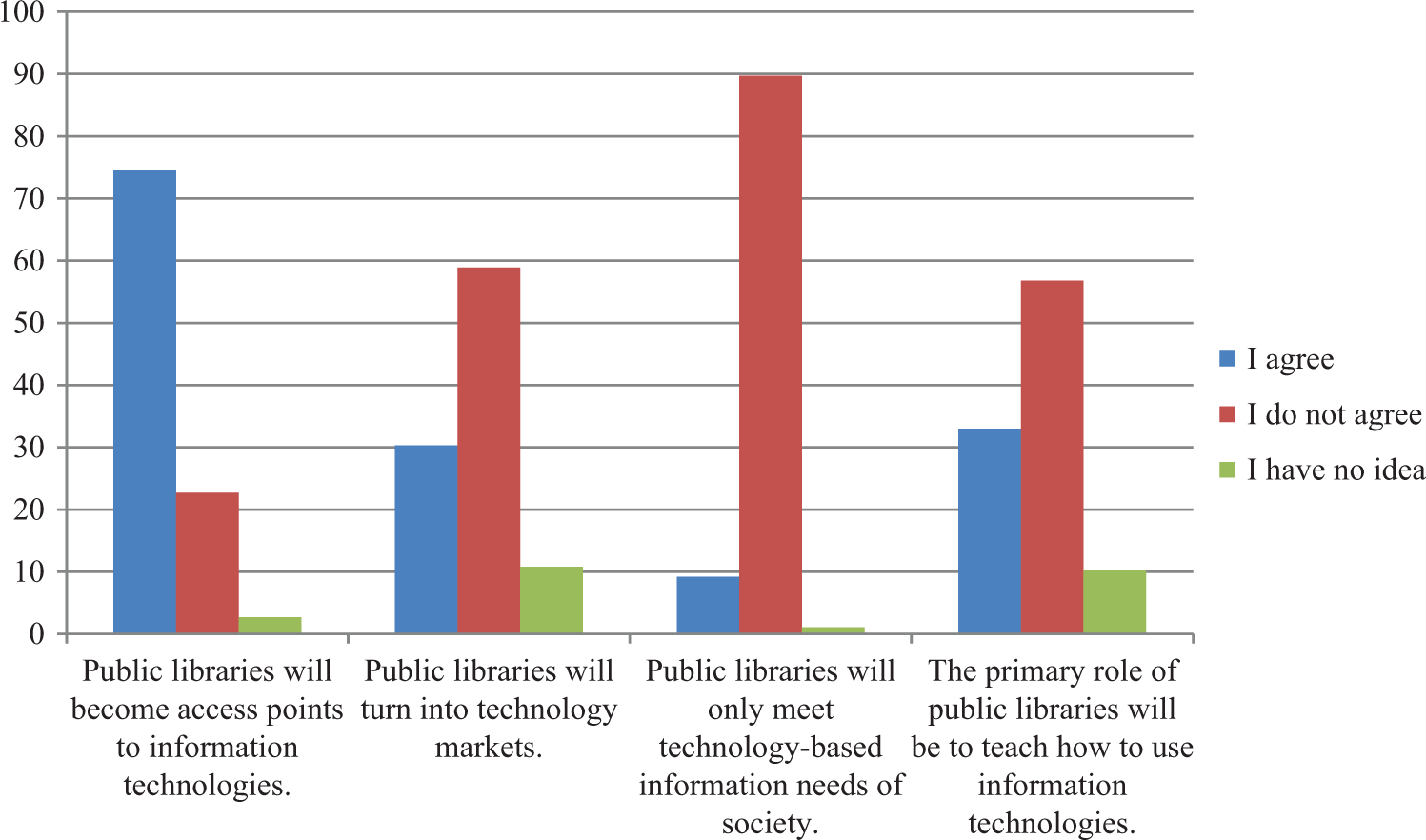
Public librarians’ opinions about technology in the future.
Trends of change related to administration structures of public libraries
Administration structures of public libraries are foreseen as another important area where change will occur. Perspectives of participants regarding this subject are provided in Figure 4.

Public librarians’ opinions about library management in the future.
As seen in Figure 4, a significant number of public librarians (61.6%) state that public library administration structures will be completely based on planning and strategy and a majority of them (83.2%) say that public libraries will have to develop new operating models in the future. The proportion of librarians who think that the hierarchical structure in public library administration will change or not change is almost the same. And the proportion of the rest who do not have an opinion (20.5%) is also high. It was remarked by 68.1% of the librarians that nationally qualified central administration systems will become more important and necessary for public libraries. More than one-third of them (31.9%) do not believe in such a change. Another element considered in administration structure is public libraries’ relationship with other cultural institutions. A vast majority of public librarians (81.6%) believe that public libraries will have to cooperate more and undertake projects with other cultural institutions. But 50.8% of them do not think that public libraries will become closer to museums and archives. However, 36.8% of librarians foresee such a relationship. Most of the librarians (84.9%) advocate that public relations as a part of administration will keep its importance for public libraries in the future.
Public libraries’ trends of change about collection, building, personnel, user and budget
Other elements that will go through change are collection, building, personnel, user and budget. Librarians’ predictions regarding collection are provided in Figure 5.

Public librarians’ opinions about library collection in the future.
Two-thirds of librarians (65.4%) think that the future of public libraries does not depend on the future of the “book”. However, 33% of librarians state that the future of the book is determinative in terms of public libraries. Research participants widely (89.7%) suppose that public library collections will just be composed of electronic sources but it is generally (68.6%) believed/assumed that this situation will not change the purposes of public libraries. According to 69.7% of public librarians, security of sources in future collections will become more important. Participants made predictions about trends of change in user services based on public library materials. Thus, while 69.2% feel that there will be no decrease in borrowing materials in public libraries, the proportion who think that the rate of lending will decrease is almost half (43.8%). Moreover, for a high percentage (78.4%) of respondents, it is understood that public libraries will need to play safer in terms of both forming and availing of the collection in the future.
Within the scope/context of the study, thoughts of librarians about the physical structure of libraries are shown in Figure 6.

Public librarians’ opinions about library buildings in the future.
Almost all of the librarians (93.5%) foresee that public libraries will continue their physical existence (as a building) and public library buildings will not get smaller (72.4%) in the future. The proportion of librarians (42.7%) who think that public libraries will be the “third place” to spend time after home and workplace is almost equal to the proportion (43.2%) with the opposite opinion. It is not thought that public library buildings will function as art galleries in future (52.4%). However, it is interesting that more than one-third of librarians (34.6%) put forward an opposite opinion. Furthermore, 73.5% of librarians state that safety systems in public libraries will become more significant in the future.
Insights of participants about the personnel element are provided in Figure 7.

Public librarians’ opinions about library staff in the future.
According to findings in Figure 7, a vast majority of public librarians (81.6%) do not believe that librarians’ role will diminish. The proportion of librarians who think that public librarians will need to improve their specialized knowledge is also very high (90.8%). Similarly, librarians 68.6% state that their instructive roles will not decline. More than half of them (56.2%) envision that they will serve users with social media tools. One-third of librarians disagree with this idea. It is predicted by 60.5% that the significance of other personnel apart from professional librarians will increase as well. A high proportion (71.9%) of public librarians suppose that vocational education will be completely practiced through distance education methods.
The change can also be observed in another public library element, which is the “user”. Public librarians’ points of views about the future of the user are shown in Figure 8.

Public librarians’ opinions about library users in the future.
According to findings in Figure 8, a substantial number of public librarians (64.9%) envisage that user requirements will radically change in the future. In this context, 77.8% think that users will be more educated and informed, and 83.8% that children and young people will not use libraries less. The proportion of participants who estimate that users will require a smaller number of librarians in the future is 67.6%.
A very considerable proportion of participants (85.9%) believe that the costs of public libraries will increase and accordingly 58.9% believe that there will be problems with budgets. Most of the public librarians (80%) assert that more money will be spent on electronic/digital sources.
Discussion
The results will be discussed in this section in relation to the six research topics.
RQ1. General trends of change
Public librarians in Turkey are concerned and (generally) worry about the future of public libraries. This data proves that answers of participants to the research questions/questionnaire are deliberate and reliable. They anticipate change in public libraries or believe that public libraries will definitely go through a change and this radical change will come about in the short or medium term. There is certainty but not at the same level of consistency between the facts that librarians think public libraries will exist in the future and they predict that public libraries will become more necessary. The facts that participants believe society will not be affected in the case of the destruction of public libraries and that public libraries will not be perceived as “outdated” places in future are consistent with answers to the two previous questions. Predictions of librarians that public libraries will be indispensable parts of the information society have a basis in their thought that public libraries will continue their existence and will even become more necessary in future and will help decrease the digital divide. Another justification of librarians for the existence and development of public libraries is their belief that the primary roles of public libraries will not change.
RQ2. Services
On the one hand librarians think that public libraries will go through radical changes, on the other hand a considerable number do not believe that there will be great changes in services. Although this seems to be a conflicting situation, another similar approach presents consistency. As stated in the previous section, participants argue that public libraries’ primary roles will not change in the future. They most probably consider the concept of services in this section as an output of these primary roles, draw a correspondence between these two elements and present very similar opinions. Participants’ ideas that cultural activities will be more required in public libraries and that services towards cultural minorities will not diminish overlap. Nonetheless, their predictions that the importance of outreach in public libraries will increase and that the significance of mobile libraries will diminish are contradictory. It can be said that this approach towards mobile libraries is based on the relation between public libraries and technology as it will be interpreted in the section about technology.
RQ3. Lifelong learning and information literacy
Participants establish a conceptual relationship between lifelong learning and information literacy. Their thought that both phenomena will be almost evenly important for public libraries in future is interesting. This situation seems consistent with public librarians’ predictions regarding the relationship between the information society and public libraries.
RQ4. Technology
There are three similar questions in this section which emphasize different aspects of technology. While librarians lean towards the idea that public libraries will be access points to information technology in the future, they regard the idea that public libraries will become TechShops as impossible. In this context, they almost disagree with the prediction that the only function of public libraries will be to meet the technology-based requirements of society. The idea that the primary role of public libraries is to teach how to use information technology seems unacceptable to them. According to the librarians’ answers to questions about technology, they have a clear approach towards the relationship between the public library and technology.
RQ5. Changes involving the administrative structure
According to participants’ answers to the survey questions formed in the framework of administration, it is understood that public libraries will have to improve their operating models but this will not change the hierarchical structure. Librarians’ prediction that the importance of a central administration system for public libraries will increase in future shows a parallel with their prediction about new operating models. Other data that attracts attention here is the difference between the librarians’ predictions that public libraries will have to be more cooperative and undertake projects with other cultural institutions, and the assertion that public libraries will not become closer with museums and archives. Participants’ approach about the need for public relations is that the public library administration should maintain sensitivity on this issue.
RQ6. Collection, building, personnel, user and budget
It is interesting that even though a substantial proportion of librarians do not associate the future of the public library with the future of the book, one-third of them link libraries with books. It is a conflict that almost all participants think that public library collections will only be composed of electronic sources. The proportion of participants linking the future of the public library with the future of the book is close to the proportion of participants thinking that electronic books will change the purpose of public libraries. However, the proportion of librarians who believe that electronic books will change the purpose of public libraries is low. The approach of participants that public libraries will maintain their primary functions in future in the first section of the discussion can be associated with their thought about the future of circulation services in this section. That only one-fourth of participants think borrowing will decrease in public libraries is consistent with their idea that public libraries’ primary functions will not change, because book circulation is accepted as one of the core services in public libraries.
Participants’ prediction that public libraries will exist physically (as a building) in future seems consistent with their disbelief that public library buildings will get smaller. In other words, they think that public libraries buildings will preserve their existence without getting smaller. The disbelief among almost all librarians that public libraries will become a “third place” shows that they have not internalized this concept yet. Librarians’ opinion that there will not be radical changes in basic aspects of public libraries also reflects on the future role of librarians. A vast majority of librarians think that the future role of a librarian which they perceive as a main element will not decrease. Their thoughts that librarians’ “instructive role” will not diminish but that they will need to improve their professional knowledge seem consistent with one another. Other data that supports this consistency is their approach that the importance of other personnel will also increase. Librarians’ belief that users will have service through social media tools in future seems similar to their idea about a public library-technology relationship as mentioned before. More clearly, one-third of librarians (33.5%) think that social media tools will be used in library services and almost one-third of them (30.3%) believe that public libraries will turn into technology markets.
Participants’ insights that public library users will become better educated and informed have caused them to predict that user requirements will radically change. Their approach that users will be more educated and aware is consistent with their thoughts that librarians will have to improve their professional knowledge stated in the previous section. Librarians’ non-acceptance of the statement that children and young people will use the public library less in future is similar to their general approach that public libraries’ primary roles will not change.
Librarians’ thought that public library costs will increase, which will make them have problems about the budget makes sense. They state that electronic sources will cause this increase in expenses.
The findings obtained show that Turkish public librarians have opinions especially consistent with these subjects in the literature: Public libraries will keep their existence. Their roles in actualizing the principle of equality in information access will increase. Their function in improving democracy will be more powerful. They will have the purpose of decreasing the digital divide. Their future will not depend on the future of books. They will depend on phenomena such as lifelong learning, information literacy and being social communication centers. Their services to disadvantaged groups will increase. Their national centralization approach will strengthen. The level of expertise of librarians will increase. The users will be more educated and aware. They will have problems about budget.
Turkish public librarians’ opinions about the following are not similar to/consistent with the literature: Public libraries will completely turn into technology centers. They will come close to archives and museums. They will become the “third place”. The training of librarians will be totally online.
Conclusion and recommendation
General results obtained based on the data provided under the result section and comments made in the discussion section are as follows.
Public librarians in Turkey have deliberated on the future of public libraries and they predict that radical changes will happen in 1–20 years which is a medium term. The librarians are optimistic that public libraries will protect their existence in the future and they will become more necessary. The librarians who think that destruction of public libraries will affect society in a negative way establish a relationship between public library and information society.
According to public librarians in Turkey, public libraries will continue their existence without changing their basic roles and will assume new roles like decreasing the digital divide, developing democracy and contributing to socialization. Librarians anticipate that public library services will undergo important changes in the future, turn into a user-oriented structure and continue to be free of charge. It is considered that while standards will maintain their importance, reference services, services towards cultural minorities and outreach will grow stronger in public libraries, while mobile libraries will become less important.
The relationship between public libraries and technology will become stronger to some extent; however, they will not become TechShops. Users’ technology-based requirements will become prominent and the main role of public libraries (but not the only one) will to a considerable extent be to teach how to use these technologies. The importance of planning and strategy in public libraries’ administration will increase, they will look for new operating models, and a central administration system will be regarded as an option in the future. Moreover, public libraries will cooperate more with other cultural institutions and reinforce their relationship with the public.
Relating to the future of public libraries it can be said that books will continue to influence, the collection will not just involve electronic sources and the change of sources in the collection will not change the purposes of public libraries. Concerns about the security of information sources and copyright issues will become more prominent in the future. Public libraries will continue their physical existence (building); however, they will require further security systems and their function of being the “third place” will not be achieved. Public libraries’ function of contributing to art will not increase. Public librarians will have to improve their professional knowledge and develop their instructive roles due to their increasing roles in the future. It is understood that the importance of staff other than librarians will increase and training of librarians will be significantly actualized through distance learning applications. User requirements will radically change and users will be more educated and informed but they will still need a librarian.
All in all, public librarians are optimistic about the survival and development of public libraries in the future. According to them, public libraries will change in terms of structural components, services, technology, administration, functions and roles by preserving their basic construction and features. It is certain that opinions of public librarians in Turkey about public libraries are influenced by the reality of the country where they live and work. Moderate development of public library services in Turkey limits the horizon of its public librarians. It seems that their approach is a little different from opinions of those librarians living in countries where public library services are well developed. Their prediction about technology-public library relations is a typical example of this. They are unable to adequately evaluate the decisive influence of technology on the future of public libraries. Nonetheless, their potential for being more realistic in thinking about the future increases compared to librarians from other countries. They experience the advantage of staying away from futuristic approaches.
This study could be converted to a new study comparing the approaches of librarians working in other types of libraries in Turkey. Furthermore, a comparative study with other countries’ librarians could be carried out.
Footnotes
Appendix

| Dear Colleague(s), This questionnaire was developed in order to write an article. It will be based on your opinion about the future of public libraries. You are required to mark each question. Thank you for your contribution. | |||
|---|---|---|---|
| Prof. Dr Bülent Yılmaz | |||
| To what extent do you agree with the following statements? | I agree | I don’t agree | I have no idea |
| In the following 20–30 years in Turkey; | |||
| Public libraries’ function of being socialization/social centers will become prominent. | |||
| Significant changes will not happen in public library services. | |||
| Administration in public libraries will completely be based on planning and strategy. | |||
| Public libraries will become access points to information technologies. | |||
| Improving/promoting information literacy will be the most important objective of public libraries. | |||
| Future of public libraries will depend on the future of books. | |||
| Public library buildings will diminish. | |||
| Librarians’ role in public library services will decrease. | |||
| Librarians will be less needed by public library users. | |||
| Public libraries will have budgeting difficulties. | |||
| Public relations will not be as necessary for libraries. | |||
| Public libraries will have to cooperate and do more projects with other cultural and educational institutions. | |||
| The significance of security systems in public libraries will increase. | |||
| Children’s libraries will be more important. | |||
| Public libraries will become more necessary. | |||
| There will be a charge for services in public libraries. | |||
| The hierarchy in public library administration will change. | |||
| Public libraries will turn into technology markets. | |||
| Public libraries will be more significant parts of the lifelong learning process. | |||
| The collection in public libraries will be composed of only electronic resources. | |||
| Public library buildings will function as art galleries. | |||
| Public librarians will serve users through social media tools. | |||
| User requirements in public libraries will ineradicably change. | |||
| Public libraries will spend more money on electronic/digital resources. | |||
| Maintaining security of sources in public libraries will be more important. | |||
| Society will not be affected if public libraries disappear. | |||
| Reference services will not be required in public libraries. | |||
| Public libraries will have to develop new operating models. | |||
| Public libraries will only meet technology-based information needs of society. | |||
| Electronic books will change the objectives of public libraries. | |||
| Public libraries will not exist physically (as buildings); they will continue their existence only in an electronic environment. | |||
| Training of public librarians will entirely be performed through distance electronic education systems. | |||
| Public library users will be more educated and aware. | |||
| Costs and expenses will increase in public libraries. | |||
| The importance of international librarianship standards in public libraries will be reduced. | |||
| Public libraries will be an indispensable part of the information society. | |||
| The primary role of public libraries will be to teach how to use information technologies. | |||
| Borrowing materials in public libraries will decrease. | |||
| Public libraries will be the “third place” where individuals spend their time after their homes and workplaces. | |||
| The importance of employees other than librarians in public libraries will increase. | |||
| Traditional roles of public libraries will not change. | |||
| The importance of mobile library services will diminish in public libraries. | |||
| Circulation between public libraries will decline. | |||
| Children and youth will use public libraries less. | |||
| Public libraries will become more like museums and archives. | |||
| The importance of “outreach” (taking service to where the old, the sick, the disabled, etc. are) will increase in public libraries. | |||
| The instructive role of public libraries will decline. | |||
| The importance of a national central system for public libraries will increase. | |||
| Public library services towards cultural minorities will decrease. | |||
| Public librarians will have to increase their specialized knowledge. | |||
| Public libraries will increase their role in the development of democracy in the country. | |||
| Public libraries will offer totally user-oriented services. | |||
| Public libraries’ role of reducing inequality of access to information (digital divide) will strengthen. | |||
| There will not be an institution called “public library”. | |||
| Cultural activities will be more required in public libraries. | |||
| Public libraries will be perceived as “outdated” places. | |||
| Automation systems in public libraries will further suffer and fail. | |||
| Public libraries will have to pay much more attention to copyright. | |||
| Public libraries will organize services separately for various groups according to features like age, gender, education level, occupation, etc. | |||
Declaration of Conflicting Interests
The author(s) declared no potential conflicts of interest with respect to the research, authorship, and/or publication of this article.
Funding
The author(s) received no financial support for the research, authorship, and/or publication of this article.