



Abstract
Even though it may seem that information floats on its own throughout the Internet, in reality someone must make policies and financial decisions to gather and organize data and prepare it for retrieval at the appropriate time. It must be stored in various formats in information hubs. These information hubs are essential components of the Internet, itself an essential component of socioeconomic development. But are these information hubs acknowledged in international development planning in the Information Age? This paper discusses information centers – libraries, archives and museums – in the context of coordinated global planning for socioeconomic development and offers a metric by which information centers may be correlated to a country’s social and economic advancement. It concludes with reflections about information components of the United Nations 2030 Sustainable Development Goals and the needs to gather data and expand information centers in order to achieve sustainable development.
Keywords
Introduction
When we talk about the Information Age, we readily recognize the need for robust broadband information and telecommunications networks. We know that vast amounts of multi-media, content-laden packages of information must be transmitted across those networks at very high speeds. And we know that the quantity of information increases every year.
Underlying this information-rich environment are questions related to the sources of information, e.g. after information and data are generated, who gathers, organizes and stores them? Libraries and archives, along with museums, digital archives, datacenters and even archaeological and World Heritage Sites are information centers. Information centers in the broadest sense are those places where information is collected, organized, stored and made accessible.
In the context of the flow of information and the development of a country, several questions come to mind. Is it possible, for example, to link information centers per se in some measurable way to the socioeconomic status of a developing country? If the ultimate goal of development planning is to advance the socioeconomic status of a society in the Information Age, should information centers be included in the plan?
This paper discusses aspects of these issues in the context of coordinated global planning for development. 1 In a sample of 22 countries in the Middle East and North Africa (MENA), the study offers a metric by which information centers may be correlated to the social and economic advancement of a developing nation. It concludes with reflections about information-related components of the United Nations (UN) 2030 Sustainable Development Goals and the needs to gather specific data and to establish and enhance information centers in order to achieve socioeconomic development.
Coordinated global planning for development
2015 Millennium Development Goals
The first coordinated effort to plan world-wide social and economic development did not occur until the end of the 20th century. The United Nations Development Programme hammered out the Millennium Development Goals (MDGs) and adopted them in 2001, at the turn of the 21st century. The UN gave the world 15 years in which to accomplish eight goals: Eradicate extreme poverty and hunger; Achieve universal primary education; Promote gender equality and empower women; Reduce child mortality; Improve maternal health; Combat HIV/AIDS, malaria and other diseases; Ensure environmental sustainability; Develop a global partnership for development.
Everyone recognized the essential and appropriate nature of the goals. At the same time they realized that many aspects of development were not included. None of the goals, for example, related directly to information and data at a time when information as a commodity in the Information Age was already being widely discussed.
As the 15-year timeframe for the Millennium Development Goals was winding down, the United Nations and various organizations began to conceptualize what the next strategic goals for development would look like. MDGs were set to expire in 2015 and progress was being made in all eight goal areas but everyone agreed the new goals must reflect the vast global changes made and evolving in the second decade of the 21st century.
IFLA, the International Federation of Library Associations and Institutions, joined with other organizations in discussing the post-2015 development agenda. There was agreement that the next generation of goals must recognize and address more aspects of social and economic development, including: access to information value of culture worldwide information and telecommunication infrastructure (Internet).
Global campaign to include culture
As planning for the new UN goals progressed, a coalition of organizations declared culture to be the fourth dimension of sustainable development along with economic, social and environmental dimensions. The coalition undertook a global campaign, ‘The Future We Want Includes Culture’, to advocate for the inclusion of culture in the post-2015 development agenda. Holistic and integrated development will only be achieved when the values of creativity, heritage, knowledge and diversity are factored into all approaches to sustainable development. This means guaranteeing the availability and accessibility of cultural infrastructure (such as, but not limited to, libraries, museums, theatres, community centres, arts education centres) and the implementation of long-term cultural programmes and projects. (Global Campaign for Culture, 2015)
Lyon Declaration on Access to Information and Development
During the 2014 IFLA World Library and Information Congress in Lyon, France, members of IFLA finalized and adopted The Lyon Declaration on Access to Information and Development. That document called upon the Member States of the United Nations to make an international commitment to ensure that everyone has access to, and is able to understand, use and share the information that is necessary to promote sustainable development and democratic societies. (IFLA, 2014)
Global Connect Initiative
During the UN General Assembly in September 2015, the US State Department launched the Global Connect Initiative: A crucial and common goal unites us here today in New York: the goal that the Internet – a core enabler for social and economic development – should be open and accessible to everyone. This goal is based on the core understanding that the Internet should be secured as a global resource and that it be managed in the public interest as a democratic, essential, secure, free, progressive, inclusive and pluralistic communication platform. (BestBits, 2015) States must promote and facilitate universal, equitable, secure, affordable and high-quality Internet access on the basis of human rights, the rule of law, and net-neutrality, including during times of unrest. All of the Internet, for All the people, All the time! (BestBits, 2015)
2030 Sustainable Development Goals
An open working group of the UN General Assembly hammered out a set of 17 Sustainable Development Goals accompanied by 169 targets. IFLA played a persistent and key role throughout the two-year process and has singled out four goals – Goals 4, 9, 11, 16 – and specific targets within each for initial emphasis during 2016. 3
The Goals were formally adopted by the United Nations General Assembly (2015) on 25 September 2015: Goal 1. End poverty in all its forms everywhere. Goal 2. End hunger, achieve food security and improved nutrition, and promote sustainable agriculture. Goal 3. Ensure healthy lives and promote wellbeing for all at all ages. Goal 4. Ensure inclusive and equitable quality education and promote lifelong learning opportunities for all.
4.4 By 2030, substantially increase the number of youth and adults who have relevant skills, including technical and vocational skills, for employment, decent jobs and entrepreneurship. Goal 5. Achieve gender equality and empower all women and girls. Goal 6. Ensure availability and sustainable management of water and sanitation for all. Goal 7. Ensure access to affordable, reliable, sustainable and modern energy for all. Goal 8. Promote sustained, inclusive and sustainable economic growth, full and productive employment, and decent work for all. Goal 9. Build resilient infrastructure, promote inclusive and sustainable industrialization and foster innovation.
9c Significantly increase access to information and communications technology and strive to provide universal and affordable access to the Internet in least developed countries by 2020. Goal 10. Reduce inequality within and among countries. Goal 11. Make cities and human settlements inclusive, safe, resilient and sustainable. 11.4 Strengthen efforts to protect and safeguard the world’s cultural and natural heritage. Goal 12. Ensure sustainable consumption and production patterns. Goal 13. Take urgent action to combat climate change and its impacts –‘Acknowledging that the United Nations Framework Convention on Climate Change is the primary international, intergovernmental forum for negotiating the global response to climate change’ (United Nations General Assembly, 2015: 14). Goal 14. Conserve and sustainably use the oceans, seas and marine resources for sustainable development. Goal 15. Protect, restore and promote sustainable use of terrestrial ecosystems, sustainably manage forests, combat desertification and halt and reverse land degradation, and halt biodiversity loss. Goal 16. Promote peaceful and inclusive societies for sustainable development, provide access to justice for all and build effective, accountable and inclusive institutions at all levels. 16.10 Ensure public access to information and protect fundamental freedoms, in accordance with national legislation and international agreements. Goal 17. Strengthen the means of implementation and revitalize the global partnership for sustainable development.
Linking information centers to socioeconomic development
The new, more comprehensive 2030 Sustainable Development Goals include factors directly and indirectly related to the human need for information. They represent a remarkable and essential first step toward acknowledging the vital role of information in social and economic development. They represent a rationale for pursuing answers to the question posed earlier in this paper: Is it possible to link information centers per se in some measurable way to the socioeconomic status of a developing country?
Data elements used in study
I undertook to explore ways of answering this question and began by using the populations and numbers of information centers in each of the countries making up the region called Middle East and North Africa (MENA). These data elements provide a manageable sample to test my hypothesis that information centers make a positive difference in development.
Middle East and North Africa countries
The 22 countries that make up the Middle East and North Africa were chosen as a sample sufficiently large and diverse to test a methodology. The countries represent a wide spectrum of economic productivity, share certain culture traits and for the most part aspire to maintain stable governments with some level of democratic participation.
Population of each MENA country
The populations of each country offer an indication of the number of people in the jurisdiction needing sustenance (water, food, housing), health care, education, jobs and access to information (United States Central Intelligence Agency, 2015).
Number of information centers in each country
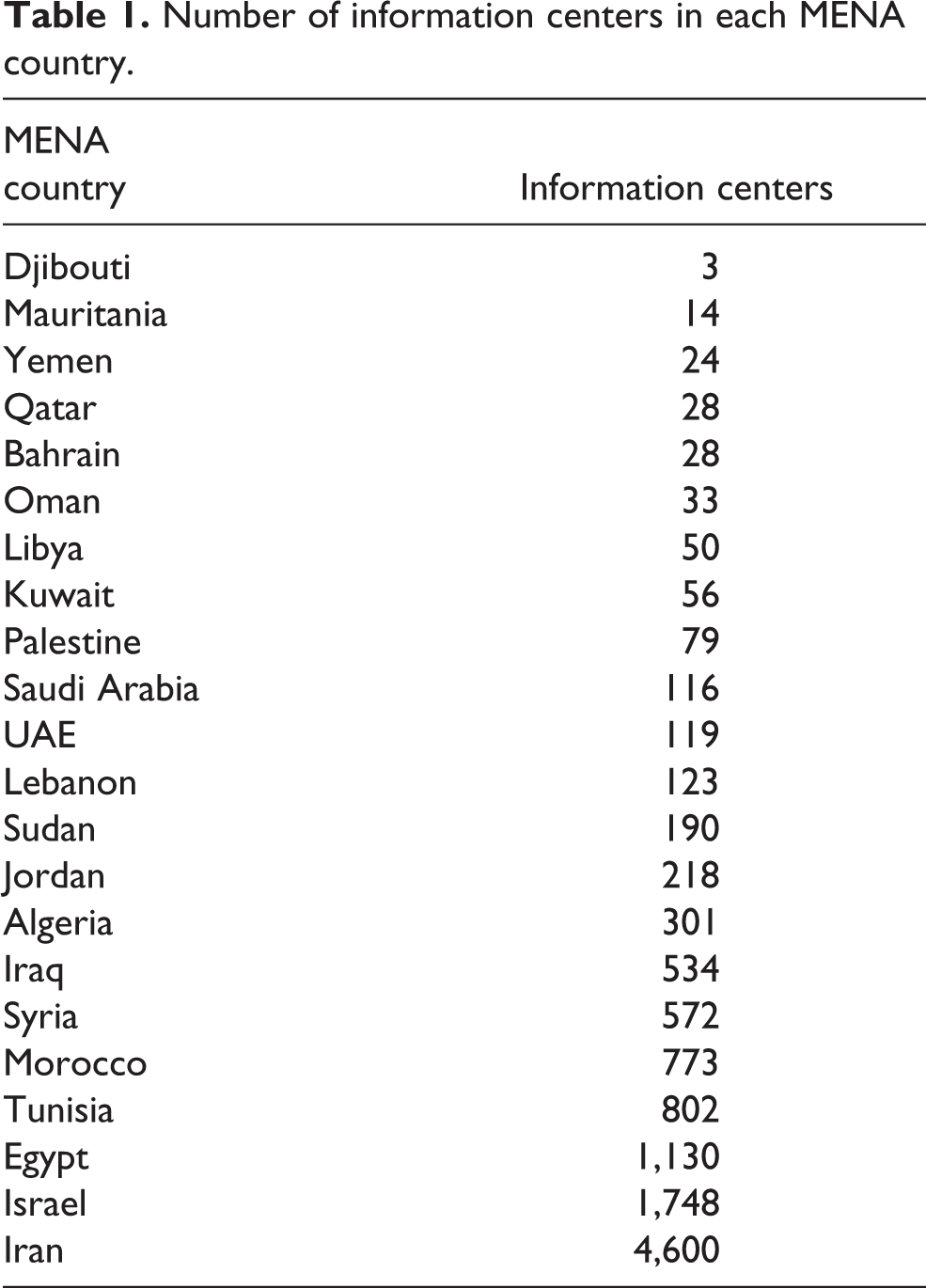
In the most comprehensive sense, information centers include documentation centers, digital and traditional libraries, archives and museums, archaeological and cultural heritage sites. Information centers collect the intellectual content, in other words, the data, information and cultural record of a region for the purposes of governing, commerce, education, research, innovation, entertainment and life-long learning. Information centers can indicate the commitment of a society to record, organize and preserve information about itself and to provide access to information from outside its region to local residents. Information centers promote personal fulfillment, educate a skilled labor force, foster an informed electorate, teach information literacy skills and encourage innovation and entrepreneurship. 4 (See Table 1.)
Number of information centers in each MENA country.
Population by country
Populations of each MENA country are listed beginning with the less populated to the more populated. (See Table 2 for specific numbers.)
Djibouti has 810,000 residents;
Bahrain has 1.3 million;
Ten countries in the region – Israel, Jordan, Kuwait, Lebanon, Libya, Mauritania, Oman, Palestine, Qatar, United Arab Emirates – have populations between 2 and 10 million;
Syria and Tunisia have 18 and 11 million respectively;
Saudi Arabia and Yemen have populations of about 26 million;
Four countries – Algeria, Iraq, Morocco and Sudan – support populations ranging from 30–40 million;
Egypt and Iran each have sizeable landmass and the largest populations with over 80 million.
MENA countries: Ranked by persons per information center including population and number of information centers.
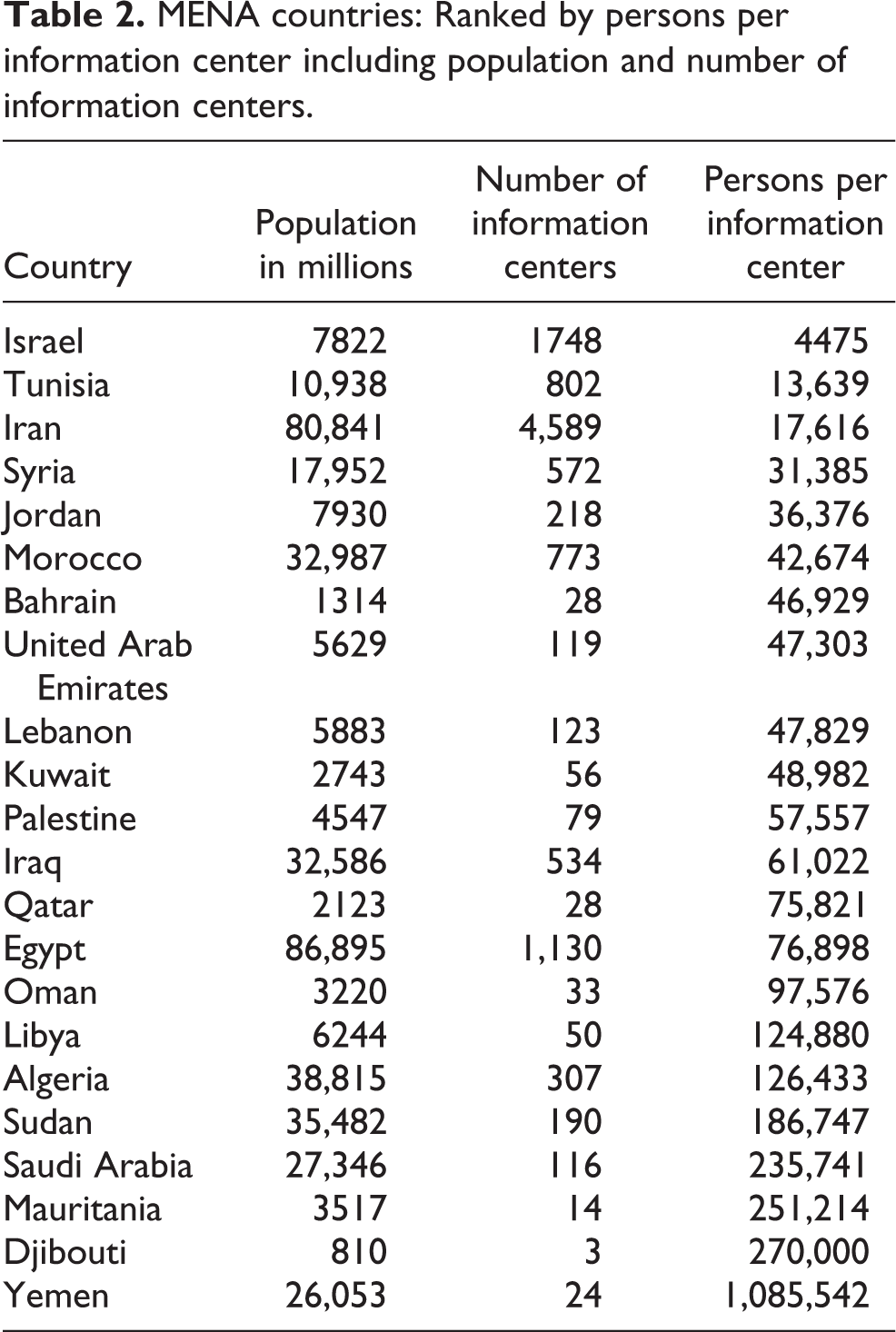
These 22 countries represent a broad range of population sizes and densities, and coincidently include diverse cultures, religions and languages.
Number of information centers by country
For this study, information centers include national, public, academic and special libraries, museums and some archives. School libraries, archaeological and World Heritage Sites, for example, are not included, nor is the availability of information and communications technology (ICT or Internet) in a country addressed in the study.
The number of information centers per country ranges from less than a handful to thousands. The reliability of statistics regarding the number of libraries, museums and archives in a country is dependent upon a government’s interpretation of what qualifies as an information center and the numbers they consequently report as well as the response to surveys circulated by organizations and publishers.
New calculated metric: Number of Persons per Information Center
In order to devise a metric to determine the saturation of information centers in a country, I divided the number of people in the country by the number of information centers. This provides a way to think about how many people share one information center. The metric helps to indicate the extent to which residents have access to information centers for education, research, innovation, life-long learning, entertainment and personal edification.
Population divided by number of information centers
This comparison of data elements, that is information centers vs. population, helps us understand how accessible information may be to people. We can interpret the lower number of persons per information center to mean that fewer people compete for one information center, thus the people in those countries have easier access to information. (See Table 2 and Figure 1.)
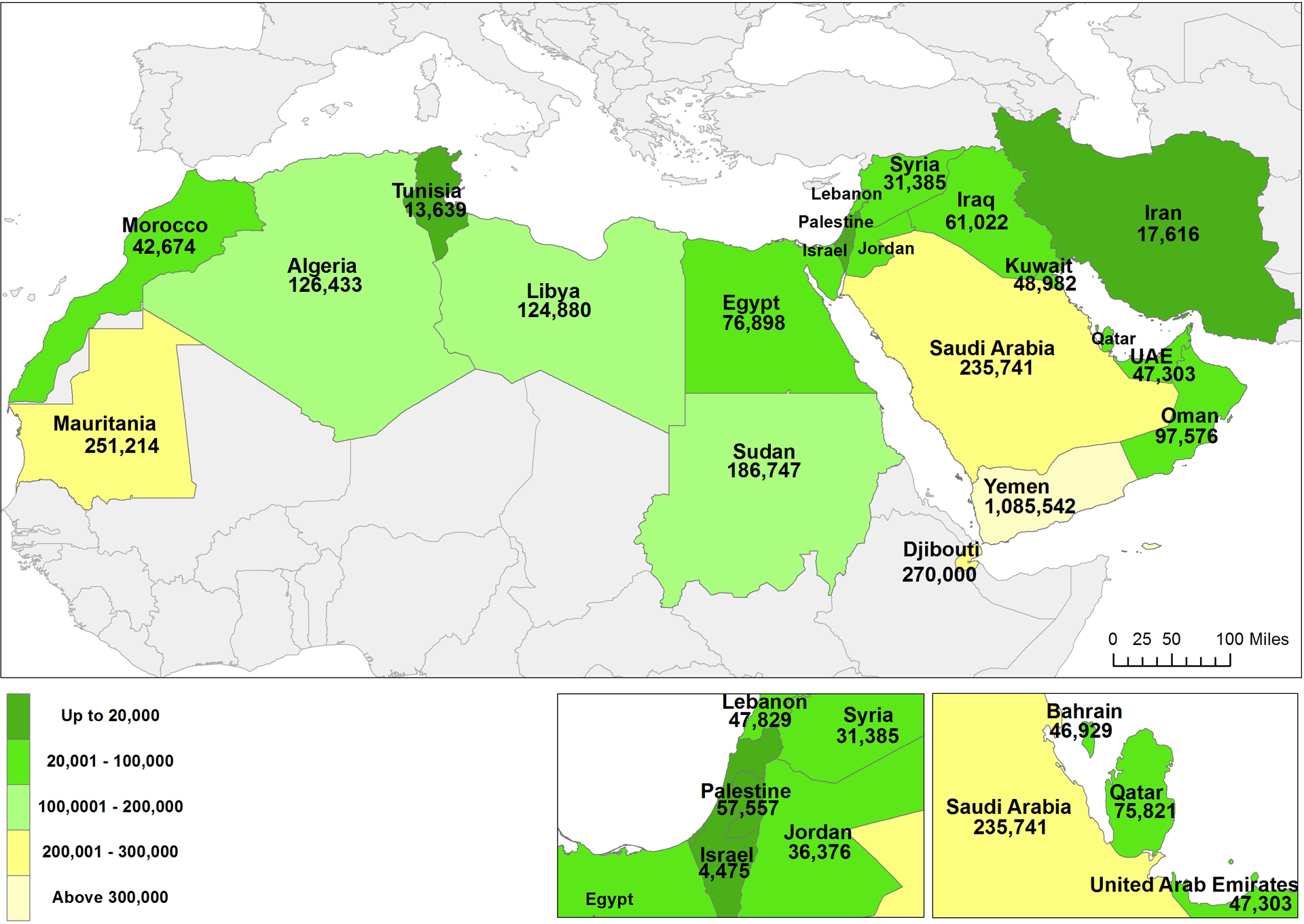
Number of persons per information center.
MENA countries fall into five ranges of numbers: Up to 20,000 people sharing one information center Israel – 4500; Tunisia – 13,600; Iran – 17,600 20,001 – 100,000 people sharing one center Syria – 31,000; Jordan – 36,000; Morocco – 43,000; Bahrain – 47,000; UAE – 47,000; Lebanon – 48,000; Kuwait – 49,000; Palestine – 58,000; Iraq – 61,000; Qatar – 76,000; Egypt- 77,000; Oman – 98,000 100,001 – 200,000 people sharing one center Libya – 125,000; Algeria – 126,000; Sudan – 187,000 200,001 – 300,000 sharing one center Saudi Arabia – 236,000; Mauritania – 251,000; Djbouti – 270,000 Over 300,001 people sharing one center Yemen – 1.1 million people
Yemen, with a population of 26 million and 24 information centers reported, has over a million people sharing one information center. Contrast that with the three countries providing the most information centers for their large populations: Israel, Tunisia and Iran. Iran, for example, has 80 million people sharing nearly 4600 information centers.
Human Development Index
The calculated metric called Persons per Information Center articulates the saturation of information centers in a country. The next step is to explore a possible correlation between the saturation of information centers and the social and economic development of a country. For this purpose the Human Development Index (HDI) was selected as a comprehensive indicator of socioeconomic development of a country.
HDI is issued each year and grew out of the first Human Development Report in 1990 published by the United Nations Development Programme. UN economist Mahbub ul Haq in partnership with Amartya Sen compiled the HDI to demonstrate that development includes not only a country’s economic advancement but also social improvement and capacity building for its residents. Development progress and assessment must consider people and their capabilities as well as economic growth.
The HDI is based on three dimensions revised as of the 2010 Human Development Report:
Life Expectancy Index – Measured by life expectancy at birth, also referred to as the standard of living factor. Education Index – Measured by 2 factors: Mean years of schooling for those age 25 Expected years of education for those age 5 Income Index – Gross National Income (GNI) with per capita Purchasing Power Parity (PPP) measured in US$ as an indicator of standard of living.
Human Development Index by countries and categories
The UN ranks HDI scores according to these four categories.
Very High HDI 0.944–0.808 (49 countries world wide) Israel, Qatar, Saudi Arabia, UAE, Bahrain, Kuwait
High HDI 0.790–0.700 (52 countries world wide) Libya, Oman, Lebanon, Iran, Jordan, Tunisia, Algeria
Medium HDI 0.698–0.556 (42 countries world wide) Palestine, Egypt, Syria, Iraq, Morocco
Low HDI 0.540–0.337 (42 countries world wide) Yemen, Mauritania, Sudan, Djibouti
Correlating Persons per Information Center to Human Development Index
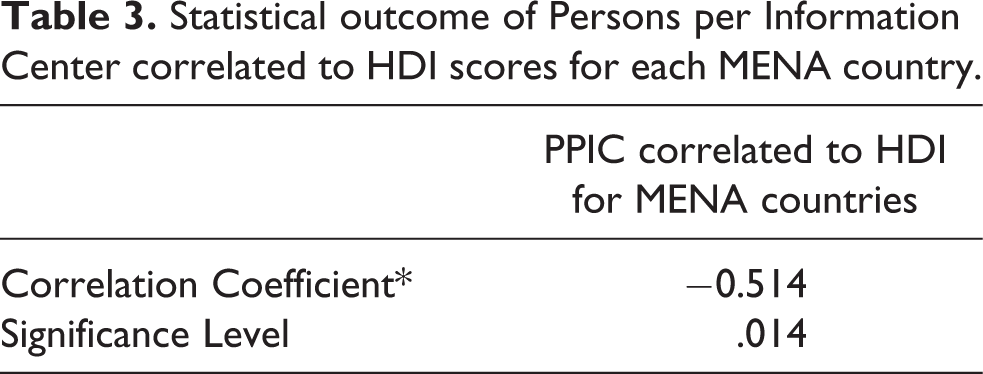
When the calculated metric Persons per Information Center was compared to the Human Development Index score using Pearson’s technique and Stata software, it resulted in a statistically valid ratio, indicating a -0.5142 coefficient with a significance level of .014. Loosely translated, this means that in 1000 cases, 14 of them will deviate from the correlation.
This comparison shows a significantly negative and moderately strong correlation between these two variables. Therefore, we can say that MENA countries with fewer people per information center will in most cases experience higher HDI scores. That is, if a MENA country has a higher saturation of information centers, the people have more access to information centers and, in addition, the country’s score on the HDI will in most cases be significantly improved (Table 3).
Statistical outcome of Persons per Information Center correlated to HDI scores for each MENA country.
The correlation between Persons per Information Center and the Human Development Index is illustrated visually in a scatterplot (Figure 2).

Persons per Information Center vs. Human Development Index.
On the bottom line are the HDI scores, going from left to right, from lowest to highest. Higher HDI scores demonstrate a better rating.
Along the vertical line are the number of persons per information center. In this case, the lower number, at the bottom, is more desirable than the higher number. Note that Yemen, with 24 information centers shared among 26 million people, is literally off the chart and does not appear on this scatterplot.
We see the line moving from high on the left to low on the right, indicating that most countries with high to very high HDI scores have fewer people per information center. Those countries fall into the lower right part of the graph.
This can be explained in several ways: MENA countries with higher HDI scores have a higher saturation of information centers; or, alternatively, most MENA countries with fewer people per information center have higher HDI scores.
The statistically significant correlation between the saturation of information centers and scores on the HDI in MENA countries provides a rationale for establishing and expanding information centers. As such, it could be used now to advocate for more and better information centers in the MENA region.
In addition, if the sample size is expanded and the correlation holds consistent in regions besides MENA, the metric and correlation can be used in measuring progress over time and toward the 2030 Sustainable Development Goals.
Factoring information centers into the Sustainable Development Goals
Focusing again on the SDG, Goal 16 is directly related to establishing ‘effective, accountable and inclusive institutions’ such as information centers and, in Target 16.10, it specifically addresses providing access to information: UN Sustainable Development Goal 16 Promote peaceful and inclusive societies for sustainable development, provide access to justice for all and build effective, accountable and inclusive institutions at all levels. Target 16.10 Ensure public access to information and protect fundamental freedoms, in accordance with national legislation and international agreement.
Information centers offer two-way exchanges
Information centers often function as two-way distribution points. For example, they: organize, preserve and digitize local records to support education and life-long learning and to provide primary sources for researchers, scholars and practitioners inside and outside the region; provide local residents, scholars, researchers and practitioners access to information outside the region, often including proprietary databases of scholarly journals and the latest globally generated knowledge in arts, humanities, social sciences, sciences and technology.
Every society has information content that is unique and is of value to the world. By establishing and/or expanding information centers within a country, the country makes its unique features visible to the world and encourages the two-way exchange of information.
Types of data needed
There are many types of data that are valuable, even essential, to collect and preserve but are not uniformly collected by countries across the globe. Some examples: census data – all aspects laws passed by federal and local governments policies that guide government operations local material artifacts and records significant and everyday events that become local history publications produced within the country fiction and non-fiction books, poetry and essays by local authors oral histories of local leaders and residents financial reports of corporations doing business in the country market and labor reports of the local economy.
As well as: cultural artifacts which represent ways of preserving national identity art objects.
The UN itself is advocating for more data. More data is needed in order to form the baseline for several of the Sustainable Development Goal targets. The need was specified in Item 57 within the Resolution adopted by the UN General Assembly on 25 September 2015: We recognize that baseline data for several of the targets remains unavailable, and we call for increased support for strengthening data collection and capacity-building in Member States, to develop national and global baselines where they do not yet exist. We commit to addressing this gap in data collection so as to better inform the measurement of progress, in particular for those targets below which [sic] do not have clear numerical targets. (United Nations Department of Economic and Social Affairs, 2015)
Data about information centers themselves
Shifting the focus to address data about information centers themselves, more accurate and thorough statistical reporting about the existence and types of information centers and cultural institutions in developing countries would greatly improve research efforts regarding their value. For example, no single international agency gathers and uniformly reports statistics regarding the numbers and types of information centers. Organizations collecting subsets of that data include many national government agencies, various publishers of reference sources, IFLA, UNESCO Institute for Statistics and Online Computer Library Center (OCLC). The available data regarding the number of libraries, museums, publishers and library schools is aggregated from over 80 sources and published by OCLC (2015) on its website Global Library Statistics.
Conclusion
Intuitively it makes sense that more information centers in a country lead to better informed residents living with higher educational and health standards. And intuitively we might assume that countries strive to achieve higher scores on the Human Development Index, a metric that tracks their standard of living, educational achievement and economic progress. But now we have a calculated, international metric demonstrating that within a Middle East and North Africa sample of countries, there is a statistically significant correlation between access to information centers and socioeconomic development.
Even in countries where information centers, particularly libraries and archives, are plentiful, they are nearly invisible to many people. In vast regions of the world, information and data have not traditionally been recorded. But today the global economy is increasingly looking to knowledge and service sectors for productivity and contributions to the marketplace. Information centers figure heavily into this scene, whether they are traditional, digital, visible or not.
Footnotes
Declaration of Conflicting Interests
The author(s) declared no potential conflicts of interest with respect to the research, authorship, and/or publication of this article.
Funding
The author(s) received no financial support for the research, authorship, and/or publication of this article.