



Abstract
This article presents an overview of the American library landscape and explains the trends and challenges American libraries are facing. US libraries provide people of all ages and backgrounds with access to information and technology. They are community and campus hubs, relied upon to provide the services and support that people need for study, research and lifelong learning. They continue to reinvent themselves to meet the emerging demands in the digital age while retaining their core values of cooperation, sharing and service.
Introduction
The United States has a vibrant and diverse library community that provide access to information and technology, which impacts how the American society thrives. Our libraries provide people of all ages and backgrounds with unlimited possibilities to educate themselves and to participate in a media-enriched society. They serve the research and learning needs of their campuses and communities. They are highly trusted and inclusive, safe places. They are community and campus hubs, relied upon to provide the information and support that people need for study and lifelong learning.
Boston was the last US city to host the IFLA Library and Information World Congress—and that was in 2001. So much has changed since then. US libraries are more connected than they have ever been in the history of library and information science. They are working together in more ways to serve their users and be more efficient. Moreover, they are engaging their communities in new ways with new services, changing people’s lives and improving their well-being in the process.
Although they are changing and making an impact in the digital age, many US libraries continue to struggle with the after-effects of the 2008 financial crisis. There have been fewer budget reductions and some small increases in funding over the past eight years, but the slowdown in cuts and the increases in funding are only partially rebuilding library budgets to pre-recession levels. Many states continue to close library branches and reduce the number of school librarians, media specialists and library technology coordinators due to lack of funding (Rosa, 2014). In addition, some states are tying library funding to student success. Performance-based funding and the culture of increasing accountability for outcomes will require libraries to find new ways to document their key role in academic achievement (CRL Research Planning and Review Committee, 2014).
Nonetheless, in today’s world, libraries continue to be key to helping people understand change and lead communities into the future. People require digital fluency and access to resources—anywhere, at any time, on any device—to keep their knowledge and skills up to date. As IFLA and the international library community get ready to meet in the United States, this article will provide a quick overview of the American library landscape and explain the trends and challenges American libraries are facing.
Overview
With a population of more than 320 million (US Census Bureau, 2016), the United States has about 120,000 libraries in total. They range in size from the Library of Congress—the largest library in the world, with 4200 employees—to academic, public, school, medical, law and special libraries run by one person. They range in budgets from several thousand dollars to multi-millions of dollars. And they range in population-served from communities of several hundred to communities of several million. This industry overview will provide a range of statistics on staff, usage, visits, e-resources and other measurements to offer an idea of the size and activity across the US libraries landscape.
Types of libraries in the United States
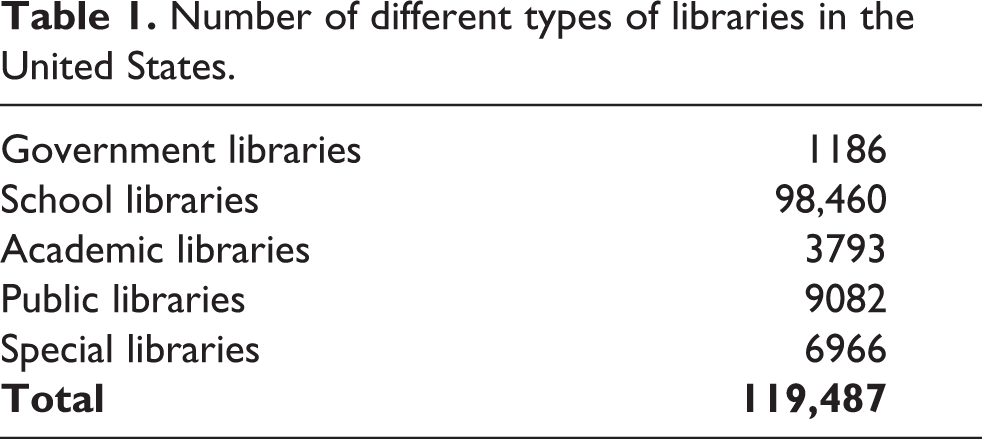
America’s 120,000 libraries fall into five basic types: government, school, academic, public and special (see Table 1).
Number of different types of libraries in the United States.
Government libraries and related agencies
Government libraries in the United States provide information to policymakers, elected representatives, government staff and employees, and, sometimes, to the general public. They are organized and managed to collect and provide the resources most needed by government decision-makers and government workers. They differ widely in size and scope.
The Library of Congress
The Library of Congress was established in 1800 to officially serve the United States Congress (Library of Congress, 2016a). The original building was burned and pillaged during battle in 1814. Thomas Jefferson sold his 6487 books to the government to help restock the library. Jefferson’s belief that all subjects were necessary for an informed legislature helped define the comprehensive collection policies of the Library.
The Library has evolved to serve not only Congress, but also the American people, with a variety of collections and services. It is located on Capitol Hill in Washington, DC and is regarded by many as the country’s national library. It has more than 162 million items on approximately 838 miles of bookshelves. The collections include more than 38 million books and other print materials, 3.6 million recordings, 14 million photographs, 5.5 million maps, 7.1 million pieces of sheet music and 70 million manuscripts.
In fiscal year 2015, the Library of Congress (2016b): Responded to more than 596,000 congressional reference requests and delivered to Congress approximately 20,540 volumes from the Library’s collections; Registered 443,812 claims to copyright; Provided reference services to 457,442 individuals in person, by telephone and through written and electronic correspondence; Circulated nearly 22 million copies of Braille and recorded books and magazines to the user accounts of more than 862,000 blind and physically handicapped readers; Circulated nearly 900,000 items for use within the Library; Preserved more than 9 million collection items; Cataloged a total of 162,477,060 physical items in the collections; Welcomed nearly 1.6 million onsite visitors and recorded 86.1 million visits and more than 482.5 million page-views on the Library’s web properties. At year’s end, the Library’s online primary-source files totaled 60.9 million. (See Figure 1).

The Library of Congress welcomed more than 1.6 million visitors to its Main Reading Room in the Thomas Jefferson Building, Washington DC. The Library is the chief steward of America’s record of knowledge.
Other federal libraries
The federal government operates more than 2000 libraries across all branches of the federal government and in many countries. Federal libraries are keepers of the nation’s collection of books, manuscripts, maps, pictorial records, scientific data, historical documents and rare materials. Federal libraries are served by a central organization, FEDLINK (Federal Libraries and Information Centers). Established by the Librarian of Congress in 1963, FEDLINK is an organization of federal agencies that addresses the technologies, procedures, policies of interest to federal libraries and the information services they provide to their agencies (Library of Congress, 2016c).
Institute of Museum and Library Services
The Institute of Museum and Library Services (IMLS), an independent federal agency, supports public, academic, research, special and tribal libraries with grant funding, policy development and research. IMLS conducts the annual Public Libraries in the United States Survey (PLS). The results inform librarians and policymakers about the changing needs of the public (IMLS, 2016a).
Examples of some of the grants IMLS provides include:
The Digital Media and Learning (DML) Research Hub at the University of California, Irvine, will use grant funds to develop widely available, easy to implement STEM (Science, Technology, Engineering, and Mathematics) programming, especially coding. The programming will use the online coding tool Scratch. This project grows out of the research from Connected Learning: An Agenda for Research and Design, and a current ongoing research project called Coding for All: Interest Driven Trajectories to Computational Fluency, which focuses on exploring youth, connected learning, and STEM to create more equitable learning opportunities and to support youth as they bridge their interests to academic and future pathways.
Guam Public Library System, which serves this US territory’s entire island community, will use grant funds to replace 30 library workstations that have obsolete hardware and software. The system maintains 65 heavily used public access computers throughout the main library and five branch libraries, and more than 50% require upgrades. A diverse group of users from across the island depend on computer and Internet access at the library, and for some it is their only link to the outside world. As part of broader efforts to update library technology, this project will ensure that library staff and patrons have reliable and secured network access, and it will allow the library to develop new programming that promotes literacy and lifelong learning. Grant funds will also support staff that attend the biannual Pacific workshop organized by IMLS.
Using a National Leadership Grant, the American Library Association and the University of Maryland, in partnership with the International City/County Management Association, conducted a three-year study of public libraries as providers of digitally inclusive services and resources. Digital literacy and digital inclusion are becoming increasingly important aspects of individual and community success. This study has generated new understanding of the roles public libraries are playing, and gaps or needs that must be addressed to help libraries fulfill their vision of equitable access for all. Building on the methods of the long-running Public Library Funding & Technology Access Study, this new investigation provides useful new data for public policy decision makers and funders.
Using a grant from the Laura Bush 21st Century Librarian Program, University Corporation for Advanced Internet Development, commonly called “Internet2,” and its member Research & Education networks, in partnership with the Association of Tribal Archives, Libraries, and Museums; the American Library Association; the Association of Rural and Small Libraries; and the Chief Officers of State Library Agencies, will run a pilot project to develop a library broadband network assessment toolkit and training program for rural and tribal libraries. Over the course of this 24-month project, Internet2 will pilot the use of the toolkit with at least 30–50 library practitioners in at least 30 rural public and tribal libraries across five states.
State libraries
State library agencies collect and archive state-related documents and provide information services to state government. They foster collaboration among public libraries and many provide subscription database access to libraries. State libraries participate in the Talking Book and Braille Library service that lends braille and recorded books, magazines and devices to play recorded books to people who are blind or have a physical disability.
The lead administrators of state libraries communicate and network through membership and participation in Chief Officers of State Library Agencies (COSLA, 2016). COSLA provides leadership on common issues and promotes state library relationships with federal government and national organizations. A common goal is the improvement of library services to the people of the United States.
School libraries
Historically regarded as the cornerstone of the school community, school libraries, which serve Grades 1–12, are no longer limited to books and reference materials. Instead, they have become sophisticated 21st-century learning environments offering a full range of print and electronic resources that provide equal learning opportunities for all students, regardless of the socio-economic or education levels of the community. They play an essential role in ensuring that 21st-century information literacy skills, dispositions, responsibilities and assessments are integrated throughout all curriculum areas. In addition to serving the school’s students, the library also serves parents, teachers, staff and other members of the learning community.
A revised education law
The Every Student Succeeds Act (ESSA, PL 114-95) (US Department of Education, 2016) was signed by President Obama on 10 December 2015 (see Figure 2). It is the first law in over 50 years to include language specific to school librarians and school libraries (Vercelletto, 2015). This measure reauthorizes the Elementary and Secondary Education Act (ESEA), the nation’s education law and commitment to equal opportunity for all students. The definition of “specialized instructional support personnel” in ESEA is now updated to include “school librarians.”

President Barack Obama signs the Every Student Succeeds Act (ESSA) during a bill signing ceremony in the Eisenhower Executive Office Building South Court Auditorium, 10 December 2015. (Official White House Photo by Amanda Lucidon).
School librarians and school libraries are crucial to successful student outcomes under ESSA. The outcomes include:
Holding all students to high academic standards that prepare them for success in college and careers;
Ensuring accountability by guaranteeing that when students fall behind, states redirect resources into what works to help them and their schools improve, with a particular focus on the very lowest-performing schools, high schools with high dropout rates and schools with achievement gaps;
Empowering state and local decision-makers to develop their own strong systems for school improvement based upon evidence, rather than imposing federal solutions;
Reducing the often onerous burden of testing on students and teachers, making sure that tests do not crowd out teaching and learning, without sacrificing clear, annual information parents and educators need to make sure our children are learning;
Providing more children access to high-quality preschool;
Establishing new resources for proven strategies that will spur reform and drive opportunity and better outcomes for America’s students.
Academic libraries
Academic libraries serve college, community college and universities and provide resources and services to support the learning, teaching and research needs of students, faculty and staff. They provide access not only to print materials, but also to a wide range of media, electronic resources and a variety of learning spaces. Surveys show that students and faculty value academic libraries, their high-quality digital and print collections, and the instructional support that helps them use these resources (Rosa, 2015). Academic library funding has not yet recovered from the 2008 recession. Spending on collections decreased 1.2 % in 2014 from 2013. There is good news though, with a 3.6% increase in salaries and wages (ACRL, 2013).
Academic librarians are finding creative ways to repurpose library spaces and make optimal budgeting choices.
The evolving role of the library, competition for space and funding, and the changing nature of scholarly publishing are just a few of the challenges facing academic librarians. One role of the Research Planning and Review Committee of the Association of College and Research Libraries (ACRL) is to consider these challenges and identify trends. In 2014, the Committee identified “deeper collaboration” as the underlying theme of the 2014 top trends (CRL Research Planning and Review Committee, 2014). The trends focus on the following categories: data, device neutral digital services, evolving openness in higher education, student success initiatives, competency-based learning, altmetrics and digital humanities.
Some highlights of academic library usage from the latest report (published in January 2014 based on data from fiscal year 2012) from the National Center for Education Statistics (Phan et al., 2014) are listed below:
22.4 million people entered an academic library over the course of a typical week and were supported with 28.8 million information services—services that involve the knowledge, use, recommendation, interpretation or instruction in the use of one or more information sources by a member of the library staff;
Academic libraries reported 85,752 full-time equivalent (FTE) staff working in academic libraries and 30,819 other paid staff;
Academic libraries loaned some 10.5 million documents to other libraries. Academic libraries also borrowed approximately 9.8 million documents from other libraries and commercial services;
The majority of academic libraries, 64%, were open between 60 and 99 hours during a typical week. Another 16% were open 100 or more hours per typical week and about 2% were open less than 40 hours per typical week;
Academic libraries added 52.7 million e-books to their collections, resulting in total e-books holdings of 252.6 million units;
Academic libraries spent approximately $2.8bn on information resources. Of that, expenditures for electronic serial subscriptions totaled about $1.4bn. Academic libraries also spent approximately $123.6m for bibliographic utilities, networks and consortia;
Three-quarters (75%) of academic libraries reported that they supported virtual reference services. Almost one quarter (24%) reported that they used short message service or text messaging;
About 55% of academic libraries reported that they incorporated information literacy into student learning or student success outcomes.
Public libraries
Public libraries serve communities of all sizes and types. As trusted institutions in virtually every US community, they are inclusive spaces to learn, explore and grow (see Figure 3). Through the library, people engage in lifelong learning, achieve economic success and strengthen health and wellness. As the name implies, public libraries serve the general public “from cradle to grave,” referring to the library’s focus on three population segments—children, teens and adults.

As trusted institutions in virtually every US community, American public libraries are inclusive spaces where people learn, explore and grow. The new Whitehall Branch of the Columbus Metropolitan Library, Columbus, Ohio, opened in 2015. The new library is equipped with the latest technology, including touchscreen TVs and iPads, a recording studio, and more than 70 public computers.
At the core of public library service is the belief in free access to information—that no one should be denied information because he or she cannot afford the cost of a book, a periodical, a website or access to information in any of its various formats. US public libraries are great democratic institutions that serve people of every age, income level, location, ethnicity or physical ability. Because libraries bring free access to all, they also bring opportunity to all.
Highlights of the public library survey, fiscal year 2013
The public invested over $11.5bn in revenue to public libraries. After adjusting for inflation, this reflects no change from the previous year and a 10-year increase of 7.5%;
There were 96.5 million attendees at almost 4.3 million public programs at public libraries in the fiscal year (FY) 2013 (IMLS, 2016e), an increase in attendance of 28.6% for all programs since 2006. The role of public libraries as community gathering places is bolstered by these increases.
Attendance at children’s programs has increased by 29.7% over 10 years, with 67.4 million attendees at children’s programs and 6.1 million attendees at programs for young adults;
In FY 2013, 6569 public libraries reported having e-books, an increase of 14.6% from FY 2012.
In addition to e-books, public libraries provide access to digital, audio and video materials. Like e-books, these materials can be downloaded and used either on devices loaned by the library or on patrons’ personal devices. Additionally, 67.3% of public libraries offered downloadable audio materials in FY 2013;
Public libraries circulated 2.4 billion materials of all types and formats in FY 2013, a 10-year increase of 25.4%. Libraries lent 835.6 million children’s books and materials in FY 2013. This is a 10-year increase of 22.7%;
There were 333.9 million user sessions on public access computers. This is a decrease of 9.2% from FY 2010.
Special libraries
Special libraries offer services within a specialized environment, such as corporations, hospitals, law firms, museums and private businesses. They can serve particular populations, such as the blind and physically handicapped, while others are dedicated to special collections, such as a presidential library. Staff in a special library are aware of materials, developments, issues and research in that library’s area of focus. The library service is tailored to a very specific area and supports that special interest.
The libraries and information centers profiled in the Directory of Special Libraries and Information Centers (DSL) contain topics spanning a wide range of interests, including: African Americans, Biotechnology, Climate Change, Environmental Design, Gun Control, International Law, Islam, Military Intelligence, Nuclear Medicine, Psychology, Terrorism, United Nations, Wildlife Conservation, Zoology and many more.
According to the DSL (Gale, 2013) there are five major categories of special libraries: Subject branches, departmental collections, and professional libraries maintained by colleges and universities. Branches, divisions, departments, and special collections in large public libraries that focus on one particular subject or group of subjects (such as a local history collection). Company libraries that operate within a framework of a business or industry producing goods, services or information for profit. Governmental libraries, including: those serving city departments and state or provincial government libraries within federal departments and military establishments divisions of national libraries. Libraries supported by nonprofit organizations, including those of: scientific societies civic, social, and religious organizations trade associations historical societies, museums, and hospitals private collections available for research.
Library associations
There are many professional associations in the United States for librarians. They all provide leadership for the development, promotion and improvement of library and information services and the profession of librarianship in order to enhance learning and ensure access to information for all. The associations can be of a general nature or a specialized group can be based on subject area, geography or both.
The
The
The
The
In June 2015, the ALA Council adopted a new Strategic Plan. Building on its long-standing commitment to its mission and core values, the new plan outlines three strategic directions that will provide a sharper focus and increase impact as an Association over the next three to five years.
ALA is organized into chapters and divisions and has affiliate relationships with many other organizations. Chapters promote general library service and librarianship within its geographic area, provide geographic representation to the Council of the ALA, and cooperate in the promotion of general and joint enterprises with the ALA and other library groups. Chapters include:
all 50 state library associations
Mountain Plains Library Association (MPLA)
New England Library Association (NELA)
Pacific Northwest Library Association (PNLA)
Southeastern Library Association (SELA)
Guam Library Association
Virgin Islands Library Association.
The 11 divisions are organized by type-of-library or type-of-library-function specialization and include:
American Association of School Librarians (AASL)
Association for Library Collections and Technical Services (ALCTS)
Association for Library Service to Children (ALSC)
Association of College & Research Libraries (ACRL)
Association of Specialized & Cooperative Library Agencies (ASCLA)
Library & Information Technology Association (LITA)
Library Leadership & Management Association (LLAMA)
Public Library Association (PLA)
Reference & User Services Association (RUSA)
United for Libraries (Trustees, Friends, Foundations)
Young Adult Library Services Association (YALSA)
Affiliate organizations of the American Library Association are groups having purpose or interests similar to those of the Association. Under Article X, Section 1, of the ALA Constitution and upon application formally made by the proper officers, the Council has affiliated with the American Library Association the following national organizations of kindred purposes. Some of the societies meet annually at the time and place of ALA meetings.
ALA has about 30 affiliations with other organizations. A few are listed below:
The
The
The
The
Library consortia
A library consortium is a group of libraries who partner to coordinate activities, share resources and combine expertise. The United States has a long tradition of library cooperation through library consortia. Today there are more than 100 library consortia in the United States, which offer significant advantages to libraries. The sharing of resources and collaboration on shared goals often enable libraries to deliver higher quality services than they would be able to deliver on their own.
More than half of US library consortia have more than 40 member libraries, serve multiple types of libraries, and have operated for more than 30 years. The large majority employ full-time staff. Consortia receive funding from a variety of sources. Public taxes, state funding and membership fees comprise a majority of their budgets. Resource sharing, shared online catalog and cooperative purchasing are among the most-used services offered by US library consortia. And their reach extends beyond their members with services used by nonmember libraries and end users. Licensing of e-content is the top initiative among US library consortia both now and in the near future. Funding is by far the most pressing challenge US library consortia are facing. Conferences, workshops, listservs, e-mail lists and websites are the communication channels most-used by US library consortia while webinars, e-newsletters, social media and video conferencing are gaining ground. Two-thirds of US library consortia host in-person meetings and workshops to connect with members several times a year (OCLC, 2016).
Key trends and issues
The digital age is presenting a number of strategic challenges and opportunities to libraries in the United States. US public libraries are at a crossroads, according to research by the Pew Research Center (Horrigan, 2015), as they attempt to balance the need to invest in new services and react to signs that the share of Americans visiting libraries is edging downward. Academic libraries are embracing the need for radical change in many areas, including library space and the changing nature of scholarly publishing, according to the American Library Association (Rosa, 2015). According to Outsell (outsellinc.com), an information, media, and technology research and development firm, the entire US information industry is at a tipping point as a result of 10 developments that are driving change and fundamentally changing the nature of knowledge work (Healy, 2015).
Among the key trends that are impacting US libraries are the demographic shifts in the population, new learning models and teaching techniques, the demands of digital literacy and inclusion, the changing nature of content and library collections, the speed of cloud computing adoption, the continuing decline in public funding of libraries, and the increasing globalization and socialization of information creation and distribution.
Major societal trends
Demographic shifts in the United States
Over the next 15 years, America’s demographic make-up will change significantly. Parts of the country—the “Rust Belt” and stretches of the Great Plains—will lose population, as many southern cities (Atlanta, Georgia; Las Vegas, Nevada; Charlotte, North Carolina) swell in size. The retiring Baby Boom population, those who were born from 1946 to1964, will dramatically alter the age demographics of many communities, leaving some with larger burdens on social services and fewer workers to help fund them. The Millennial generation, those 75 million individuals born between 1981 and 1997 who have never been without technology, will move into parenthood and leadership positions in companies and communities. And nearly every corner of the country will grow more diverse in population—from rural Wisconsin, where small minority populations could double in size, to metropolitan Houston, Texas, which could have more than one million new Hispanic residents by 2030 (Badger, 2015).
Every day, more than 9000 Americans turn 65. In 2015, 48 million Americans were age 65 and older, 18% more than just five years earlier. The number of older Americans will increase to 74 million by 2030, and 98 million by 2060.
The population older than 65—which is mostly retired—is growing much more rapidly than the population younger than 65—most of whom are still working.
These demographic changes—increasing racial and ethnic diversity along with a soaring older population—will be simultaneous and swift, and they will affect everything from how we use resources, to where we build new communities, to how we educate children. The Urban Institute projects in one modest growth scenario that the US may be home to 49 million more people by 2030.
This shift in demographics is a huge opportunity to think about the ways in which that growth can reshape the country—and libraries. Libraries will need to adapt their programming and outreach strategies, developing senior-friendly spaces and new services for a more diverse population, as well as implementing adaptive technologies.
New learning models and teaching techniques
A new future is coming to education. Online shopping, searching and social networks came first—education is next. Empowered consumers, fueled by economic incentives, are using online learning platforms and Massive Open Online Courses (MOOCs) to set new expectations for education—and for libraries. The behaviors, perceptions and motivations of online learners—how they evaluate the cost/value trade-offs of education, how they use and succeed with online education, and how they use and perceive the library—is being defined.
Interest in using Internet technology to reduce the price of education in the US is being driven in part by hope for new methods of teaching, but also by frustration with the existing system—soaring costs, lackluster student achievement and rigid government regulation. The biggest threat for those working in schools, colleges and universities face is not video lectures or online tests. It is the fact that the educational institutions are adapted to an environment that no longer exists (Shirky, 2014).
The Internet is becoming the new learning place. The most compelling reason that technology is seen as a positive force in education is its promise of establishing new learning models and innovative teaching techniques that could lead to improved student performance. Educational technology is poised to potentially redefine learning, reshape the student experience and extend quality education opportunities to almost anyone anywhere with an Internet connection.
US libraries are involved in this transition as well. They are playing a defining role in the digital management strategy for education. They are re-imagining curriculum support and information delivery, and they are becoming involved in supporting teachers in the production of presentations and online courses.
Library trends
Digital literacy and inclusion
The digital age brings the challenge of digital literacies, access to digital devices and Internet connectivity. Public, school and academic libraries are increasing digital resources and services in order to meet 21st-century needs. Librarians know that any decrease in physical visits is offset somewhat by virtual visits; however, it is difficult to count virtual visits.
According to IMLS (2012), Digital Inclusion is the ability of individuals and groups to access and use information and communication technologies. A digitally inclusive society means that:
all members understand the benefits of advanced information and communication technologies;
all members have equitable and affordable access to high-speed Internet-connected devices and online content;
all members can take advantage of the educational, economic, and social opportunities available through these technologies.
The Digital Inclusion Survey (Bertot et al., 2014), conducted by the American Library Association and the University of Maryland Information Policy Access Center (IPAC) and funded by IMLS, studied the role public libraries play in supporting digital inclusion. The study results show that public libraries are rising to the challenge of providing resources, services and educational opportunities to meet digital needs. Findings include:
Nearly all (94%) public libraries outlets offer some form of technology training to patrons;
Nearly all public libraries (95%) reported offering summer reading, with 40% indicating that they offer basic literacy programs and 34% reporting that they offer STEAM (Science, Technology, Engineering, Arts, Math) programs;
Nearly 75% of public libraries offer programs that assist individuals apply for jobs (e.g. interviewing skills, resume development, completing online job applications);
A majority of public libraries (68%) help individuals to access and to use employment databases, as well as to access and use online business information resources (58%);
Three-fourths of public libraries (76%) offer individuals assistance in accessing, using and completing e-government programs, services and forms;
An overall majority (59%) of public libraries offer programs designed to help individuals identify health insurance resources, and 48% of public libraries offer programs designed to help individuals understand health or wellness topics (e.g. healthy lifestyles, managing health conditions);
Public libraries are supporting small businesses and entrepreneurs, with 36% of public libraries provide work spaces for mobile workers and 48% offering programs on how to access and use online business information resources designed to support small business development (e.g. SBA.gov, Business Source Complete).
Content
The context for what a library obtains on behalf of its user community is shifting. It is being redefined around shared collections, e-resources and digital data curation and access. The future of library collections is being characterized by broad coordination and collaboration; very large-scale, shared infrastructure; shared services; and expectations set by consumer technologies and experiences.
Shared collections
For several years, US libraries have been exploring the trend from locally owned to jointly managed print library collections. And it is anticipated that a large part of existing US print collections, distributed across many libraries, will move into coordinated or shared management within a few years. Interest in shared print management reflects a growing awareness that long-term preservation of the published record can be organized as a collective effort. As print collections move into a shared environment for management and preservation, stacks are being removed and library spaces are being transformed into coffee shops, collaborative student spaces and art workshops (see Figure 4). These historic transformations are requiring new methods for managing collections.

Library spaces across the United States are being transformed to engage users in new ways, including the visible stacks alongside user spaces in the East Atrium at the William Oxley Thompson Memorial Library, the Ohio State University, Columbus, Ohio.
E-resources
The number one challenge for libraries is managing the integration of electronic journals and e-books into their collections and making that content available effectively to their communities. Licensed e-content is now the majority collection expenditure for most academic libraries, and e-books are the fastest growing part of public libraries’ budgets. Publishing models for e-journals and e-books are in a fractured experimental state and facing open content challenges. This, alongside flat or reduced collection budgets, is creating a shift to a user-driven acquisitions model.
The percentage of students who read e-books at school has nearly doubled since 2012; however, most children who have read an e-book (77%) say most of the books they read are in printed format (Scholastic and YouGov, 2014). Libraries are making efforts to understand user preferences about e-books. For example, a survey of about 1200 students in 100 American colleges in October 2014 found that for almost every type of schoolwork, students prefer to use a book rather than a computer (Kohli, 2014).
Locally produced e-content is getting more attention in libraries. Local digital assets and archives are being coordinated with large-scale digital archives, such as HathiTrust, the Digital Public Library of America, Google Books and Google Scholar. Stewardship of unique assets associated with a library—special collections, research data and institutional repositories—are being given increased priority and resourcing (see Figure 5). This shift to curation of digital scholarship and local digital materials is mandating linked digital content to enable discovery and future use.
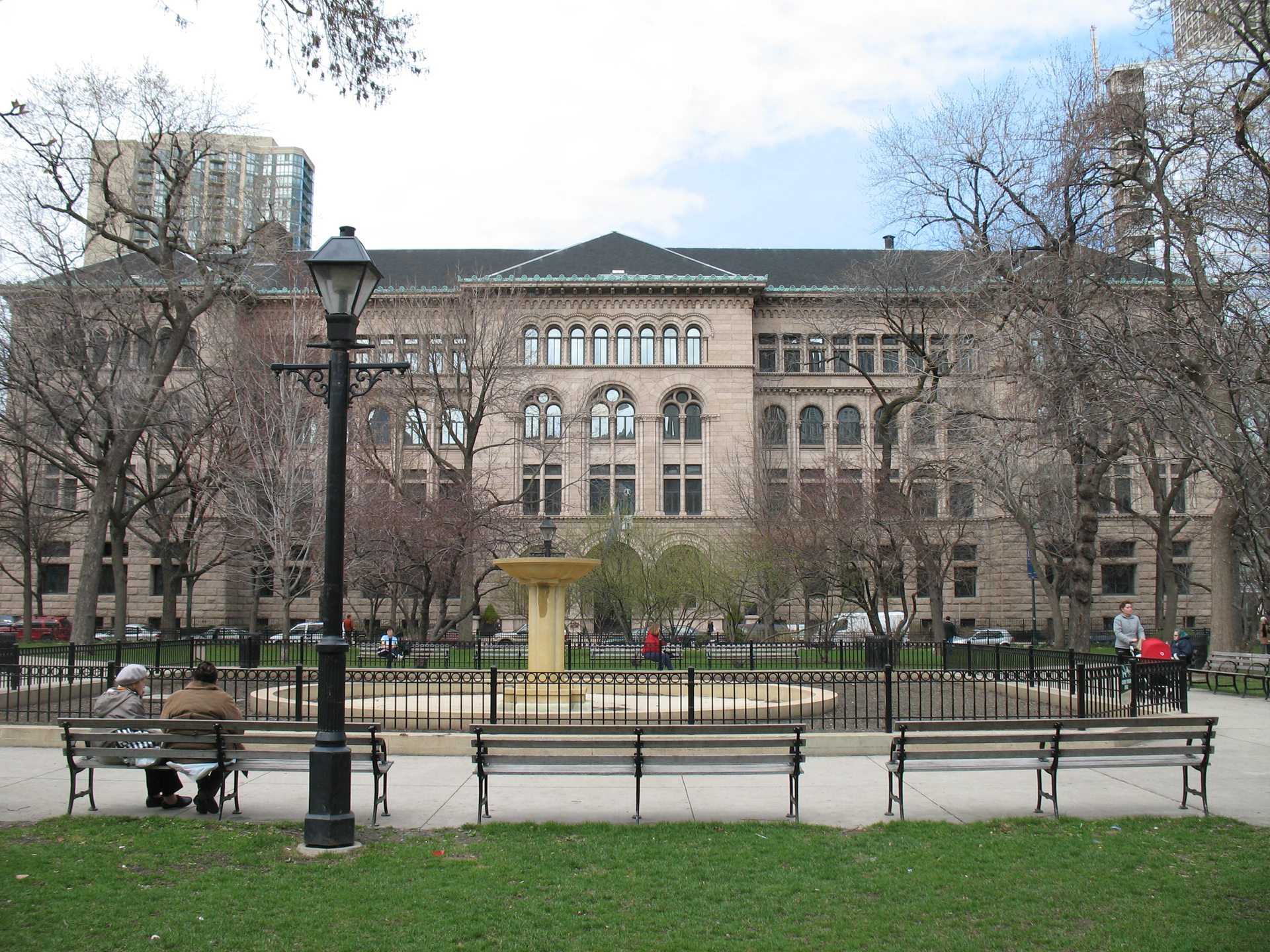
Stewardship of unique assets associated with a library—such as the rich research collections at the Newberry Library, Washington Square Park, Chicago, Illinois—are being given increased priority and resourcing in the digital age to enable discovery and future use of these important resources. (By TonyTheTiger at en.wikipedia, CC BY-SA 3.0, https://commons.wikimedia.org/w/index.php?curid=3516356)
Digital data curation
Universities are increasingly managing and preserving massive digital assets—images, text and data—that are requiring integrated data management and preservation programs. These are very likely to be collaboratively sourced and made available from shared infrastructure hubs. The role of the academic library in aggregating and servicing these assets is increasing in this regard as is the role of the public library in providing equitable access to local and national government data stores.
In addition, the local library is increasingly expected to serve as the maintenance agency for personal digital collections—those aggregations of information, research outputs and creative products produced by researchers, students and citizens.
Technology affecting libraries
From the very first computer-based library system, significant advancements have been driven by technology triggers such as server hardware, networks, personal computers and mobile devices. US libraries were constrained by the expense of scaling these physical systems dramatically. Today, with inexpensive, cloud computing availability, hardware and networks are no longer real constraints. Penetration of mobile smartphones and tablets has likewise removed constraints to physical location. The big data movement has made processing large collections of data inexpensive and fast. The removal of constraints is liberating US libraries with new service offerings.
Linked data
Linked data is a way of describing things using a vocabulary native to the Web. It allows machines to interpret text, put it in context and connect it to related resources. Linked data is getting increasing attention from the commercial information sector, which in turn shapes the library and academic approaches to the representation of their assets. The discovery of these assets is dependent upon their appearance and use within the large commercial hubs, which may be facilitated by linked data technologies.
Linked data reveals the relationships among things, and the range of those relationships goes well beyond individual library data capacities. There is both a need and an opportunity for library assets to be represented in the aggregate via a shared mechanism. The value of data delivery and discovery, with effective syndication services, is bringing new value, rather than just the value of the data itself.
Digital humanities
Digital humanities (DH) is a developing area of research and teaching that impacts academic library resources, collections and staff. 1 Librarians acquire and provide access to both digitized and born digital data sets and other materials related to humanities scholarship using or studying technology. A recent study found that all respondents to a survey believed that DH materials and outcomes should be included in the library collection. Results indicated that 70% of librarians identified acquiring, transcribing, and encoding as skills that could be shared by librarians and DH faculty. Of the responding librarians, 60% believed that a digital humanities librarian should collaborate and participate in DH projects.
Cloud computing
Cloud computing is a model of delivering applications and computing capacity as a service on the Internet. This model has become the focus of the entire IT industry and is having a major impact on libraries in the United States. By providing management systems for libraries at a network level, individual libraries no longer need to license and maintain their own instance of a traditional integrated library system (ILS)—nor do they need to have a separate electronic resource management (ERM) tool, URL link resolver or Discovery tool because the new platform offers all of these services in one integrated system.
Big data and predictive analytics
In an academic environment, researchers are storing massive collections of data outside of the library environment. These include project proposals, grant proposals, researcher notes, researcher profiles, datasets, experiment results, article drafts and copies of published articles. The published works traditionally managed by a library are just a single point in the full research information lifecycle. The short-term cost to keep data has dropped well below the cost of deciding what to delete, moving primary storage toward the researcher. Libraries’ role in the curation of these institutional assets is increasing.
Predictive analytics is an application of big data. It is the ability to provide forward-looking decision making based on historical data from multiple, disparate data sources. Library service delivery in the United States will increasingly be informed and directed by predictive analytics. In the public library community, an example of emerging predictive analysis is using reading literacy data intersected with census data to determine branch locations, content balancing and hours. In academic libraries, analysis may include using patent applications intersected with current research profiles to advise researchers on future work. Libraries increasingly will partner with institutional staff and external organizations to excel at this activity.
Mobile
Mobile has become ubiquitous and it is no longer optional to have a mobile-optimized experience across varied screen sizes. This will be true for both patron-facing services and staff-facing systems. Library services in the United States are beginning to provide continuity across devices. The consumer-driven expectation will be the ability to pick up the session on a different device in exactly the same place where the user left off, whether on a phone, tablet, laptop or desktop.
Trends within the profession
More than 400,000 US librarians and library staff members deliver library services every day to the communities they serve. They work in all types of places and with all types of people. What follows are the major trends in job prospects, salary outlook and retirement forecasts from the Bureau of Labor Statistics, Occupational Outlook Handbook (US Department of Labor. Bureau of Labor Statistics, 2016).
Job outlook and retirement trends
Employment of librarians is projected to grow 2% from 2014 to 2024, slower than the average 7% for all occupations. Budget limitations, especially in local government and educational services, and delayed retirement plans may slow demand for librarians. Some libraries may close, reduce the size of their staff, or focus on hiring library technicians and assistants, who can fulfill some librarian duties at a lower cost.
Jobseekers will face strong competition over the next 10 years, as many people with Master’s degrees in Library Science compete for a limited number of available positions.
About 40% of practicing libraries are 55 years old or older today. Yet there are indications that this older segment is delaying retirement due to several factors. Librarians are largely public employees. Government pension systems are one of the few remaining sources where employees may qualify for full retirement benefits at ages as young as the mid-50s. Yet even if these pension systems weather increased pressure to scale back, librarians face other pressures to continue working. For example, the two-thirds of librarians who are married have spouses who are approaching retirement in the face of nationwide decline in defined-benefit pensions from non-public employers, as well as the demands of ever-increasing health care costs. In addition librarians and their spouses who have built 401Ks are quite likely to have suffered significant losses with the economic downturn of 2008 (Davis, 2009). In 2025, prospects may improve, as older library workers retire and generate openings.
Wage outlook
The median annual wage for librarians was $56,170 in May 2014, the latest data available. The median wage is the wage at which half the workers in an occupation earned more than that amount and half earned less. The lowest 10% earned less than $33,680, and the highest 10% earned more than $87,060.
In May 2014, the median annual wages for librarians in the top industries in which they worked were as follows:
colleges, universities, and professional schools; state, local, and private: $59,700;
elementary and secondary schools; state, local, and private: $57,820;
local government, excluding education and hospitals: $50,990.
Conclusion
America’s libraries are well positioned to play a large role in helping communities and campuses adapt to a changing world. They continue to transform themselves, keeping pace with the changing economic, social and technological aspects of American society. They are deepening engagement with their communities, from technology to education to social services, and serving many segments of the population. They exist to provide everyone the opportunity to have access to resources to better themselves and to discover new things.
US librarians are clearly aware that their users’ needs and views are evolving. They understand that the rapid shifts in technology and collections require change—sometimes radical, system-wide change in addition to incremental, operational adjustments. They also recognize that librarians bring unique perspectives and skills to the information ecosystem, which now is crowded with online alternatives. They seek to develop high-value services and expect that this will be a moving target. They are open to continually reinventing themselves to emerging demands in the digital age while retaining their core values of cooperation, sharing and service.
Footnotes
Acknowledgements
This article has been a collaborative effort by many people and organizations. First, we would like to thank all the librarians and library representatives who provide information to the organizations that publish reports. We drew many statistics and data from those reports, which would not have been possible without the willingness of librarians to submit data. We would also like to thank members of the US National Committee who supplied valuable feedback and guidance as the article was planned, written and refined. In addition, we would like to thank the IFLA Journal editor and editorial committee for their excellent review and editing and suggestions. And finally, we would like to thank the many organizations that study and monitor the library landscape: the American Library Association, the Association of College and Research Libraries, the Public Library Association, the Association of Research Libraries, the Pew Research Center, the Aspen Institute, the National Center for Education Statistics, the US Department of Labor and many others. Their reports are invaluable in helping one understand the current and future library and information technology landscape.
Declaration of Conflicting Interests
The author(s) declared no potential conflicts of interest with respect to the research, authorship, and/or publication of this article.
Funding
The author(s) received no financial support for the research, authorship, and/or publication of this article.