



Abstract
Not only is ETH Zurich one of the world’s leading technical universities, with its major collections and archives it also makes key contributions towards the preservation and mediation of national and international cultural assets. The Thomas Mann Archive at ETH-Library is one of these archives. It houses the majority of the written personal papers of the famous German author and winner of the Nobel Prize in Literature Thomas Mann. Under the ambitious project TMA_Online, the roughly 35,000 manuscripts and letters and more than 80,000 newspaper articles from the Thomas Mann Archive were described and digitised fully in less than two years. The new web service Thomas Mann Archive Online is now available for searches. This project report outlines the concrete procedure in the various sub-projects, the challenges involved and the results achieved.
Keywords
Introduction
How come the literary personal papers of the German author Thomas Mann (1875–1955), a reconstruction of his last study and his personal mementoes are located at ETH Zurich in Switzerland? During his lifetime, Thomas Mann enjoyed close ties with the country. In 1933, the winner of the Nobel Prize in Literature initially fled to Switzerland from Nazi Germany. Following his exile in the USA, to where he had moved in 1941, he returned to Switzerland with his wife in 1952 and settled near Zurich. To mark his 80th birthday, ETH Zurich awarded him an honorary doctorate. The donation to the institute by Mann’s community of heirs after his death was due in no small part to this tribute. The renowned author, who received the title shortly before his death, was visibly very impressed by this unexpected honour (Sprecher, 2006: 91ff).
Established in 1956, the Thomas Mann Archive was initially part of ETH-Library for a few years. Shortly after they moved into their own premises at the heart of Zurich’s university district, however, they became an autonomous organisational unit within ETH Zurich for a number of decades before eventually being reincorporated into the library in 2012. Since its foundation, the Thomas Mann Archive has focused on three principle tasks: the preservation and expansion of the archival holdings, the operation of a research office with, for example, the contribution of several volumes to the published Frankfurt edition of Mann’s works, and the running of a museum with a small permanent exhibition within the archives (Habel and Wiederkehr, 2015: 40–41).
The archival holdings available in addition to the primary and secondary literature can be divided roughly into the following categories: Thomas Mann’s literary work (around 2500 documents) with manuscripts of novels such as Joseph and His Brothers or Confessions of Felix Krull, materials that Mann drew upon in his writing, and his diaries and notebooks. The extensive correspondence holdings (around 15,000 originals and approximately 18,000 carbons and copies) featuring letters to and from Thomas Mann, but also other family members. Several series of newspaper clipping files (around 82,000 articles) on the life and work of Thomas Mann, dating back to 1895. The most extensive of these is still ongoing to this day with the aid of media monitoring services.
The Thomas Mann Archive Online project
The Thomas Mann Archive Online (TMA_Online) project sprang from the hybrid reference situation that these holdings faced before the project began in mid-2013. Large sections of the archival holdings were exclusively catalogued via physical card indexes. Only individual sub-fonds were recorded electronically in various FileMaker files, albeit without the possibility for users to conduct online searches. In order to consign the era of index cards, a lack of modern search options and insufficient holding security to the historical materials and create a modern mode of access to the archive, the following three project objectives were defined for TMA_Online: The introduction of an archive information system with modules for the description of existing archival material according to the General International Standard Archival Description (ISAD(G)) to ensure data integrity, online searches in the metadata recorded and secure access to the digital copies within the Thomas Mann Archive reading room. As there are various legal barriers – the archive does not hold the usage rights to the available manuscripts by Thomas Mann, for instance – the online publication of the digital copies produced was out of the question. The complete indexing of Thomas Mann Archive holdings at single-item level to enable optimum references for research and the interested public. The complete digitisation of the documents indexed to preserve and protect the originals and simplify their usage in-house via access to the digital PDF user copies.
After previous attempts to realise the project had proven unsuccessful, a fitting opportunity presented itself in early 2013: thanks to its incorporation into ETH-Library, the project found its way into the ETH-Zurich Executive Board’s 2013–2014 Impulse Programme, which meant it could be financed sufficiently via this funding line.
Rapid realisation
As the Impulse Programme was initially scheduled to close at the end of 2014, the tight timeframe became a decisive factor in the ambitious indexing and digitisation project. In order to meet the deadline, it was vital for the project planning and realisation to be optimised consistently from the outset via various measures. For instance, it was clear that ETH-Library’s existing technical infrastructure had to be used to keep lead times to a minimum. Individual questions in the project execution and the various work packages were to be answered with an eye toward the effects on the schedule. And sub-tasks needed to be performed as parallel as possible and – under the expert guidance of the permanent staff – by student assistants deployed specifically for the project.
The project was managed in a lean organizational structure. Two members of staff of the Thomas Mann Archive, a representative of the library’s IT services and the head of the in-house DigiCenter formed the project team, which was led by the head of the archives unit. The heads of the Thomas Mann Archive, the Collections and Archives division, and the Media and IT Services division formed the project steering committee.
The rapid realisation of the project was greatly facilitated by the fact that the existing systems and infrastructure at ETH-Library could be used in central areas. For instance, these included the archival information system CMI STAR by Swiss manufacturer CMI AG, which has already been used in ETH Zurich’s University Archives and the Max Frisch Archive to accession, describe, manage and mediate archival holdings. In the space of a few weeks from the project launch at the end of July 2013 and with only a few minor adjustments, CMI STAR could be put into effect at the Thomas Mann Archive. Some project-specific additions, such as the automatic import process for the digital copies produced, were performed at a later date. This quickly paved the way for the development of the organisational archival tectonics and the description of the holdings in accordance with the ISAD(G) standard.
To process the project as efficiently as possible, a decision was made at the outset to separate the description of the unique archival core holdings of manuscripts and letters of correspondence from the processing of the newspaper clipping files. There were several reasons for this:
Different challenges: in the case of the relatively homogenous press documents, the challenge chiefly consisted in handling the considerable quantity of more than 80,000 articles. For the manuscripts and letters, the content-related and formal heterogeneity of the archival materials posed the greatest difficulties. Bulk recording geared towards a high throughput was separated from the disparately more complex archival description work.
Regulations: both press articles and archival materials were described at single-item level. In the case of the former, however, only the most rudimentary metadata, such as the name of the newspaper, the title of the article and the publication date, was recorded. If individual information was missing on the specimens or it was not documented in full, a conscious decision was made not to conduct any further searches. It was a completely different story for the archival materials, however. In order to provide researchers with metadata that was as complete as possible, searches were conducted to furnish any missing information on the manuscripts and letters of correspondence. Moreover, important references to editions or registry volumes that had already been published were recorded.
Spatially separate processing: in order to gain space for the team working on the archival materials within the Thomas Mann Archive, the press documents were moved to ETH-Library’s premises in the ETH Zurich main building some 500 metres away for processing. The two description and indexing teams each comprised up to six student assistants (equivalent to a maximum of 2.4 full-time posts or 2.7 respectively). Although the problem of space was solved by this spatial separation, the logistical and communicative effort involved in the project obviously increased.
Processing speed: thanks to its simple structure and limited set of metadata recorded, the paper clipping files enabled a high recording speed from the outset. As the metadata was recorded in Excel tables and only imported into CMI STAR afterwards via the freely configurable import wizard, the process could be accelerated even further (see Figure 1). In the case of the archival material, however, the description team was established and expanded gradually over several months (see Figure 2). As a result, any questions of detail that especially cropped up in the initial phase could be clarified in-house by the Thomas Mann Archive’s permanent expert staff and registered in the description guidelines.
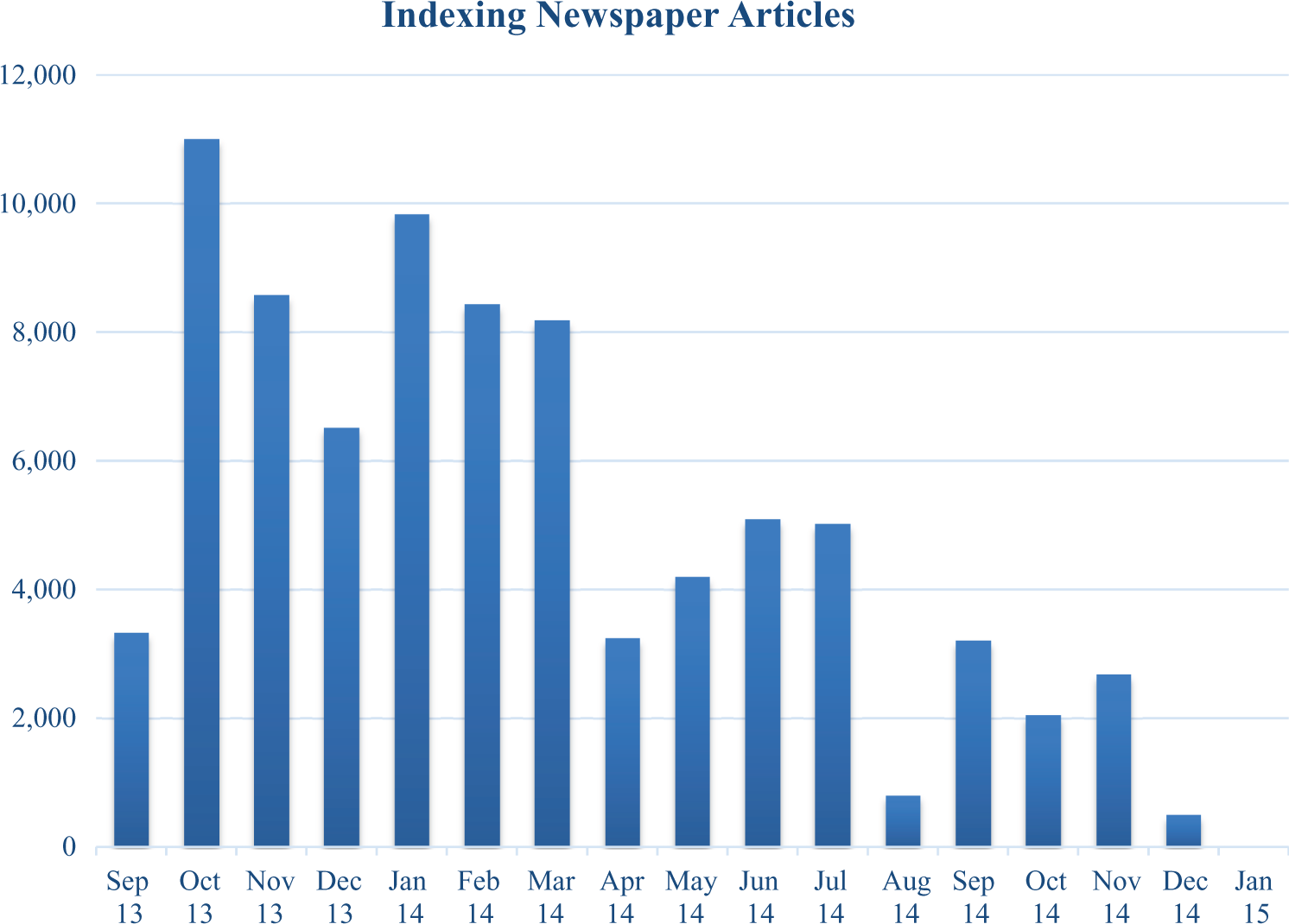
When recording the newspaper articles, great store was set by a high throughput at the beginning of the indexing work.

The initial phase of the first few months is clearly reflected in the progress of the description work on the archival materials.
Two main challenges arose during the description phase of the project: firstly, the permanent staff’s guidance of the assistants given the task of processing the archival materials was very intensive and, despite the gradual increase in the latter’s output, not always easy to manage alongside regular operations. Secondly, the effort involved in preparing the digitisation, downstream quality control and physical archiving of the documents had been seriously underestimated. In particular, the complete repackaging of the documents in archive-quality envelopes, folders and boxes, not to mention the labelling, took much longer than initially anticipated.
As for the digitisation work – which got underway at the end of 2013, once a sufficient stock of described documents had been accumulated – the project benefited from the experience and professionalism of ETH-Library’s internal digitisation centre, which is geared towards a high level of quality and throughput. The student assistants deployed at the centre for TMA_Online (the equivalent of up to 1.2 full-time posts) created the TIFF files of the individual pages according to certain specifications (resolution, colour profile, etc.). These were only condensed into multi-page PDFs in downstream, automated processes – a PDF of every document was produced – before being linked to the corresponding metadata sets in the archival information system. This was possible thanks to the technical system numbers of the metadata sets, which were assigned to the archival material in the form of barcodes and subsequently served as the basis for naming the digital copies during scanning.
Nor were the press documents and archival material treated the same during the digitisation process. The archival material was processed fully at ETH-Library’s DigiCenter and every single document was checked in a painstaking quality control process, e.g. for missing or cropped scans. In order to detect systematic errors, especially very early on in the processing phase, an even more detailed catalogue of criteria, for example on the positioning of the colour control patches, would have been helpful at the interface between digitisation and quality control. Around half of the press articles that were not unique documents were scanned by an external Swiss service-provider, which enabled the progress of the project to be accelerated significantly in this area. Moreover, the quality control for press articles was limited to spot checks.
Thanks to the extensive experience of the DigiCenter in handling and processing archival material, the main challenge of this sub-project was not the scanning itself. Instead, the difficulty lay in balancing out the entire system – from the description of the documents and the preparation of the digitisation to the digitisation itself and the management of the downstream quality control and processing phases in such a way that, on the one hand, sufficiently large stocks were available, all the while ensuring that no surpluses or bottlenecks developed anywhere. As reliable a volume structure as possible and the continual reporting of the project’s actual progress in the individual processing steps are key aspects that enable irregularities or looming difficulties to be detected at an early stage. Due to the time pressure that the project was under, a decision was made to forgo a detailed, projection-based examination of the original volume structure in the launch phase. This had a negative impact in that the figures subsequently had to be revised upwards in the advanced project stage and the resource planning adjusted accordingly.
Project completion with Thomas Mann Archive Online as a new search possibility
When it was announced that the 2013–2014 Impulse Programme would be extended to mid-2015, the TMA_Online project also stood to benefit. The description of both the archival materials and the articles in the paper clipping files was completed with over 118,000 individual items in January 2015. The new, archive-quality packaging of all indexed documents was carried out by the end of June with a reduced team of assistants. And the digitisation work was also completed simultaneously. Overall, more than 280,000 scans were produced for the TMA_Online project in the space of 19 months. Including the PDFs generated, the digital copies amount to a volume of around seven terabytes.
Above all, however, the extension of the project timeframe also provided an opportunity to participate in the conception and iterative development of the new CMI STAR Web client as the first customer in the first quarter of 2015, which was activated at the end of March 2015 under the designation Thomas Mann Archive Online (http://www.online.tma.ethz.ch). The aim of this developmental collaboration between the TMA_Online project and the manufacturer was to provide users with a modern Web client from a functional and technical perspective that aids German-language optimal searches for archival materials.
The central element of the new web frontend is the familiar, Google-style search for keywords. Based on retrieval systems from the library world, however, users also have the option of narrowing down extensive hit lists further according to criteria that can be combined freely, such as timeframe or level of description. Thanks to this multi-faceted information retrieval, the correspondence between Thomas Mann and Franklin and Dorothy Roosevelt can be found in a few clicks or the manuscripts of the novel Confessions of Felix Krull filtered out from the hundreds of press article hits on this work. Conversely, for issues related to reception history, for example, the facets enable the filtering of hits with items from the paper clipping files. As a personal tool or in order to register with the Thomas Mann Archive as a user, selected hits can be placed on an order list. On a technical level, TMA_Online fulfils the requirements for a responsive web application. Irrespective of whether it is accessed via a desktop computer, tablet or a smartphone, it adapts optimally to the different display sizes.
Users in-house in the archives’ reading room in Zurich can access the PDFs of the digitised documents directly via an instance of the Web client that has been configured accordingly. This waives the ordering processes and waiting times that are otherwise typical of most archive visits. The initial feedback from users of the Thomas Mann Archive on working with the fully digitised source material has been suitably positive.
Conclusion
With the TMA_Online project, ETH-Library’s Thomas Mann Archive was modernised in terms of archival description, digitisation and search options in a short period of time. The complete description of the holdings at single-document level and large-scale digitisation are by no means to be taken for granted, even for a relatively small literature archive with a low increase in holdings. The ETH-Zurich Executive Board’s 2013–2014 Impulse Programme paved the way in this respect – and not exclusively in financial terms, either. The ambitious timeframe was an additional incentive to push ahead with the project quickly, in a target- and solution-oriented way, and with the palpable dedication of all those involved. Any difficulties and discrepancies that cropped up during the project were solved promptly and pragmatically with one eye on the overall progress of the project. The main limiting factor in this progress lay in the number of student assistants, who – alongside normal operations – had to be instructed and supervised by the permanent staff, especially when it came to describing the archival materials. A ramp-up phase to clarify any open questions and specify the guidelines was paramount in this sub-area.
Research – primarily German literary studies – benefits very directly from the project work carried out, especially the new online search option. For the first time, for instance, the various correspondence holdings in the archive can be interconnected and searched for based on different aspects. Now a search via the extensive collection of press articles swiftly yields answers to questions related to reception history. Within the archive users can view the entire digitised archival material directly and without any pre-ordering.
Thanks to the solid foundation that has been laid, it will be possible to optimise the services of the Thomas Mann Archive in different directions in future. Naturally, the gradual online publication of the digital copies produced would be preferable. It is therefore one of the Thomas Mann Archive’s current goals to obtain permissions from the respective copyright holders to grant unrestricted direct online access to the digitised source material. To add a virtual reading room module to the CMI STAR Web client allowing researchers to request individual online access to files is an idea currently under discussion between the vendor and the user group in general.
With a view toward a networked usage of the metadata, the creation of an index of people, including links to the Common Authority File (CAF) for the correspondence holdings, for instance, would be a key requirement for the near future. Nonetheless, the roadmap for expansion also includes feeding the available indexing information into higher-level search portals – initially ETH-Library’s Knowledge Portal, but then also specialised portals such as the German Kalliope Union Catalogue for personal paper and manuscript collections. The library’s Knowledge Portal as the growing shared portal to all library resources already contains, for example, the inventory of the University Archives. Those of both the Thomas Mann Archive and the Max Frisch Archive will be added soon. The optical character recognition (OCR) of the scanned press articles is also envisaged with a view to offering a full-text search. The realisation of this and other optimisations echoes the very impulse idea that gave the funding line used to finance the TMA_Online project its name.
Footnotes
Declaration of Conflicting Interests
The author(s) declared no potential conflicts of interest with respect to the research, authorship, and/or publication of this article.
Funding
The author(s) received no financial support for the research, authorship, and/or publication of this article.