




Abstract
Around the world, a woman dies of cervical cancer every two minutes. In Nigeria, it is the second leading cause of cancer deaths, which could be avoided with proper access to health information. This mixed methods study, which employs a questionnaire, interviews, observations and discussion, examined women’s awareness on cervical cancer, screening status, sources, attitude and willingness, factors deterring them from being screened, and lessons learnt. Screening was done using visual inspection with acetic acid (VIA). The study involved two librarians, two medical doctors, a pharmacist and a laboratory scientist: 90 women participated in the cervical screening exercise in non-standard settings – an e-library and a cathedral. It was discovered that 90% of the women had never been screened. Thus, if the women are not sensitized on cervical cancer they may never go for screening and more casualties will be recorded. The paper concludes with recommendations and a call to action for all, especially librarians.
Keywords
Introduction
Cervical cancer is a leading cause of mortality in women, especially in sub-Saharan Africa. Human papilloma virus (HPV) infection is a well-established cause of cervical cancer (Bruni et al., 2018), with likely exacerbating factors being a lack of health insurance in most African countries, and poor access to information about the disease.
The World Health Organization (WHO) has reported that the number of Nigerian women suffering from cervical cancer annually totalled 14,089 (Agbo, 2018). In Northern Nigeria, cervical cancer accounts for 65.7%, making it the leading cause of all gynecological cancers (Oguntayo et al., 2011). Studies have also been carried out in Onitsha and Abakaliki (Nigeria) on the issues of health information on cervical cancer (Chinaka and Nwazue, 2013; Nwozor and Oragudosi, 2013). In the same vein, Ntekim (2012) reports that none of the 500 women attending maternal and child health clinic in a poor area of Lagos (Nigeria) in 1999 had ever had a Pap smear. Only 9% of healthcare workers in the two health institutions studied have had a Pap smear. There are similarly shocking stories of low participation of women in cervical cancer screening, even among professionals, in medical fields across other African countries like Tanzania and Uganda (Mutyaba et al., 2006). A recent study by Bruni et al. (2018) reveals that: About 14,943 new cervical cancer cases are diagnosed annually in Nigeria (estimates for 2018). Cervical cancer ranks as the 2nd leading cause of female cancer in Nigeria. Cervical cancer is the 2nd most common female cancer in women aged 15 to 44 years in Nigeria.
Access to health information gives people opportunities to live healthy lives, and seek help when they notice abnormal signs in their bodies. It is therefore critical to engage women with health information services and create awareness of cervical cancer screening. These aims, naturally flow from the UN’s Sustainable Development Goal 3 (SDG 3), which emphasizes the importance of ensuring healthy living and promoting well-being for all, as well as combatting gender discrimination, which systematically undermines women’s access to health care (UN Women, 2018). In view of this, librarians have a key role to play in promoting knowledge of cervical cancer, and thus improving lives by facilitating information awareness in their communities (Lankes, 2016). The right to equitable access to health information, which libraries and librarians promote, is therefore crucial.
Clearly, Nigerians and Africans need access to health information to reduce the burden of terminal diseases. This is, no doubt, why Anasi (2012) stressed the importance of the synergy between health and information professionals and the adoption of best strategies for the dissemination of health information. The need to control cervical cancer is critical and should not be left for the government alone. It is a matter of general concern because only a healthy woman can carry pregnancy, give birth, nurture babies, nurse, cook and take care of all members of her family. Additionally, society needs women to participate and contribute in nation building and in achieving the aims of the SDGs.
Promoting and disseminating community access to health-related information is a vital activity (Anasi, 2012; Chipungahelo et al., 2015). The library holds the key to facilitating access to information irrespective of class, gender, location and tribe. When the information is disseminated, right steps will be taken and there will be safe communities with sustainable health. This study therefore examined women’s awareness on cervical cancer, sources of information, screening status, attitude and willingness and factors deterring them from being screened. For these reasons, we conducted this study in Anambra State (in SE Nigeria) and Delta State (in SS Nigeria).
Research questions
The following research questions guided the study: Are women aware of cervical cancer in Anambra and Delta States in Nigeria? What is the screening status of the women in Anambra and Delta States? What are their sources of information awareness? What are their attitudes and willingness to be screened for cervical cancer? What factors deter the women from being screened?
Literature review
Health is critical to human development. Improved access to information plays a strong role in linking people to reliable and informed health decisions. The ability of libraries to partner with organizations and community health workers to give access to vital health information has been harnessed. Chipungahelo et al. (2015), Anasi (2012) and Obidike (2011) have stressed the importance of dissemination of health information in the prevention and treatment of diseases. In the same vein, health information services have provided cancer patients and their families with additional information and resources, empowering them with health literacy services. Full access to health information increases health awareness and knowledge, and saves lives, and libraries are providing cancer patients and their families with such information (Health Library News, 2019; Summa Health, 2019; Yoo-Lee et al., 2016).
There is need to engage women on health issues because many women do not know their statuses nor are they aware of HPV and the dangers of cervical cancer. In Onitsha for example, 35.56% of a sample (160 women) were aware while only 1.78% (8 women) had been screened (Nwozor and Oragudosi, 2013). Similarly, 85.0% of the women assessed in Lagos were not aware of cervical cancer while only a few (13.3%) of the respondents had ever been screened and none in the previous three years (Oluwole et al., 2017). At the University College of Ibadan, only about 3000 women were screened in the three-year period from 2005–2007 (Nigeria Health Watch, 2015). This is why librarians are taking action to engage women through access to health information on appropriate cervical cancer screening and vaccination.
Relevant health information sources are important in preventing sicknesses. Memorial Healthcare (2018) emphasized that with health information, most deaths from cervical cancer can be prevented as regular screening and follow-up can help detect abnormal (changed) cells early, before they turn into cancer. Therefore, women need education, information engagement and services to be able to make good decisions about their health. Inadequate access to health information diminishes awareness of preventive health measures. In other words, little knowledge of health issues and incorrect information on medical conditions and treatments have negative results for individuals, communities and the society (Ukachi, 2011). The observed gap in awareness and access to cancer-related information is one of the ideas behind the commemoration of World Cancer Day, to create opportunities to advocate and raise awareness on the growing need for women to protect themselves from cervical cancer and HPV.
Considerable efforts have been made by librarians to address these needs by empowering patients and giving direction, through information provision, contributing to improved patient care indicators, potential usefulness of the information in the future, clinical value, better informed clinical decisions and higher quality care (Anyaoku, 2014; Marshall et al., 2013; Nwafor-Orizu, 2014). Furthermore, in a study by Oluwole et al. (2017) a majority (86.7%) of respondents expressed willingness to undergo cervical cancer screening. Librarians offer insights that save women from cervical cancer and get them willing to participate in cancer screening and other preventive measures, and a calming influence at a naturally stressful time. When a women is well informed on health issues, she will likely talk about it in her groups and enjoin others to access the treatment. It is likely that the same reasoning holds for the findings of McCarthy et al. (2017), in which almost all the women (97%) were willing to undergo cervical cancer screening.
That notwithstanding, certain factors deter women from being screened for cervical cancer. Cultural beliefs, the health care system, the physician’s attitudes towards women, fear, pain, the gender of health workers, embarrassment about undergoing a gynecological examination, lower socio-economic background, lack of health insurance and low literacy (Abdullahi et al., 2009; Ackerson, 2010; Mutyaba et al., 2006; Ntekim, 2012; Tavafian, 2012) pose challenges. In the same vein, Ndikom and Ofi (2012) in their research identified ignorance, illiteracy, belief in not being at risk, a nonchalant attitude to health, financial constraint, and fear of having a positive result. Information remains the key to open and relevant insight to all heath issues.
Methodology
This is a mixed methods research that used a questionnaire, interviews, observations and discussion. The study started following the 2018 International World Cancer Day, when women who attended the event at the Onitsha Divisional Library, Anambra State revealed during the interactive session that they had never been screened for cervical cancer. The authors met with the doctor who delivered a cancer talk show and began discussion on partnering to reducing the screening cost to enable many women to know their statuses. The doctor agreed to reduce the cost if the authors could get 30 women. The authors started sensitization in schools and existing women’s meetings in churches, social groups and work places to create awareness on cervical screening and vaccination. Names and phone numbers were collected after which the authors started to share cancer information through the WhatsApp platforms which allowed for free interaction and maximum participation. This online engagement began in February 2018.
Target groups were adult women of any occupation. The authors opened a bank account specifically for payment for screening. Every payment was acknowledged in the Whatsapp group which increased trust and confidence between the authors and the women. The cervical screening was performed using visual inspection with acetic acid (VIA), a simple and inexpensive test used extensively in low resource settings: 90 women participated in the screening which took place in non-standard but convenient settings. Information about the exercise spread beyond Anambra State when some participants requested to include their friends from Asaba, in Delta State. Arrangements were therefore made for a convenient place in Asaba. The cervical screening exercises took place at Prof. Ken Dike State Central e-Library in Awka (the Anambra State Capital) and St Peter’s Cathedral in Asaba (Delta State Capital). These places were used to demystify the fear of VIA screening and for ease of participation for the women. Ninety women participated in the cervical screening exercise. 11 women were not screened but all of them listened to the cervical cancer lecture, completed the questionnaire, and participated in the discussion and interview. The reasons for not participating in the screening were that three participants were virgins, two were on their menstrual cycle, two were pregnant while four asked for permission to leave, saying they had emergencies, and did not return. The study took place between March and May 2018. In Awka Anambra State, cervical screening sessions took place on 23 March and 24 May 2018 while in Asaba Delta State, they took place on 2 and 29 May 2018. Each cervical screening exercise took an average of four hours including lecture, screening and documentation of events.
The study involved two librarians, two medical doctors, a pharmacist and a laboratory scientist. Dates were fixed as soon as payments for at least 15 women were received. Names were published on WhatsApp and convenient times fixed. At least one of the authors was always present to coordinate every activity and offer refreshment to the participants. A doctor gave lectures on cervical cancer, prevention, treatment, management and vaccine before every screening. Payment for the screening was N1500 each but during sensitization in different groups, some women donated money to cover expenses for those who wished to be screened but could not pay. Hence, 52 women benefited from the donations while 27 women paid for their own screenings. The screening instruments were mobile and were easily taken to the scheduled venues. Follow-up procedures were issued immediately for progression, counseling and referral. Simple frequencies and percentages were used to present the findings. Results were presented in tables and figures.
Findings
Table 1 shows the characteristics of women that participated in the cervical screening activities in the two cities. Women from various occupations participated. The greatest number came from civil servants with 50%, followed by self-employed women 16.7%, professionals 13.3%, traders 11.1%, students 6.7% and unemployed 2.2%.
Characteristics of the women that participated in the cervical cancer activity.
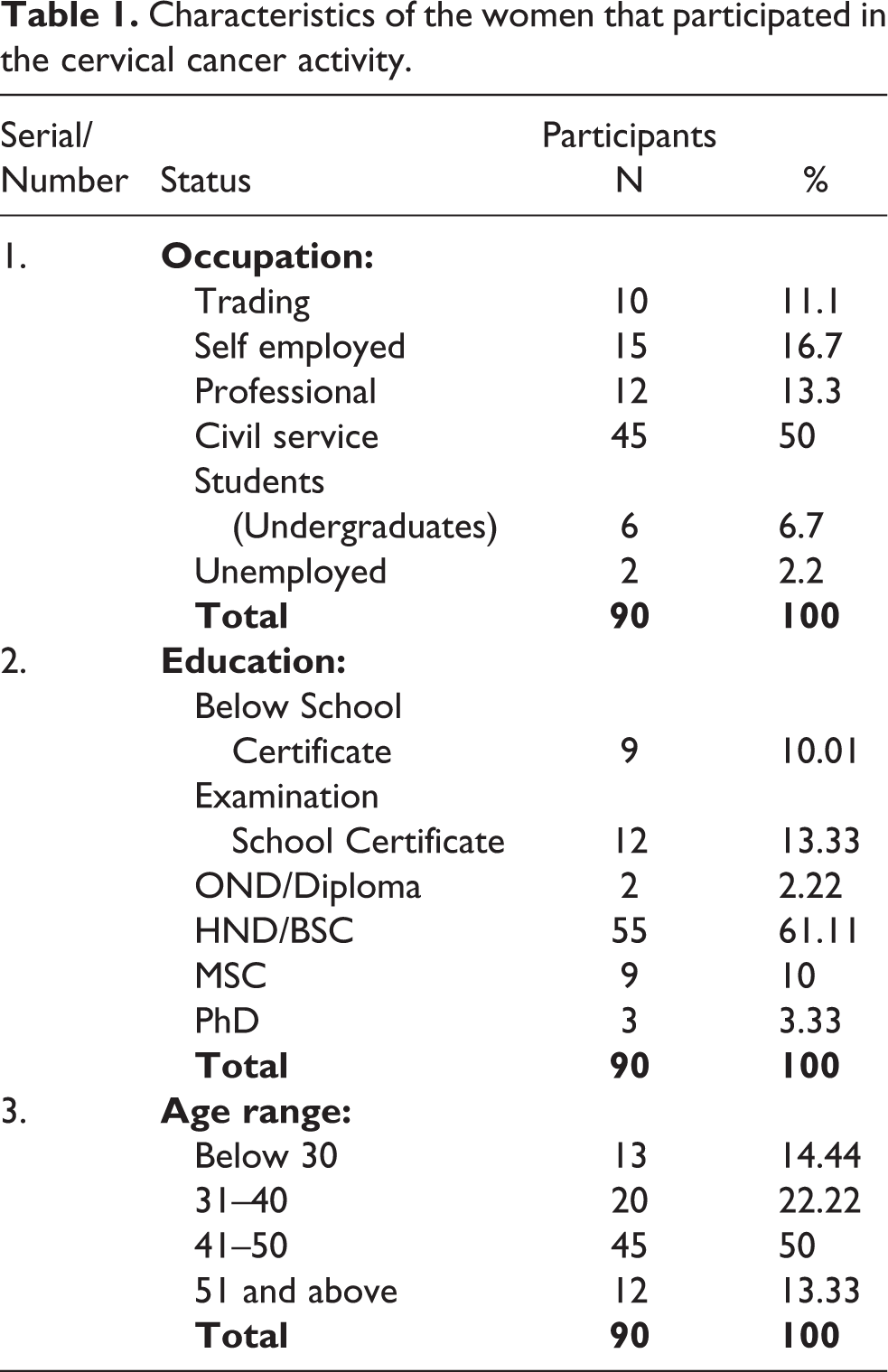
On their level of education, 61.11% women had an HND/BSC, 13.33% had a School Certificate, 10% had neither, 10% had MSC, 3.3% had a PhD and 2.2% had an OND/Diploma.
The age range shows that 50% of the women were between 41–50 years, followed by 22.22% of women within 31–40, 14.44% represented women below 30 years and 13.33% represented women above 50 years. The data for characteristics of women studied show that women in all statuses, educational background and age ranges need health information.
The chart in Figure 1 shows the rate of response on awareness of cervical cancer: 70% of the women noted that they were aware of cervical cancer while 30% stated that they had no knowledge of cervical cancer.
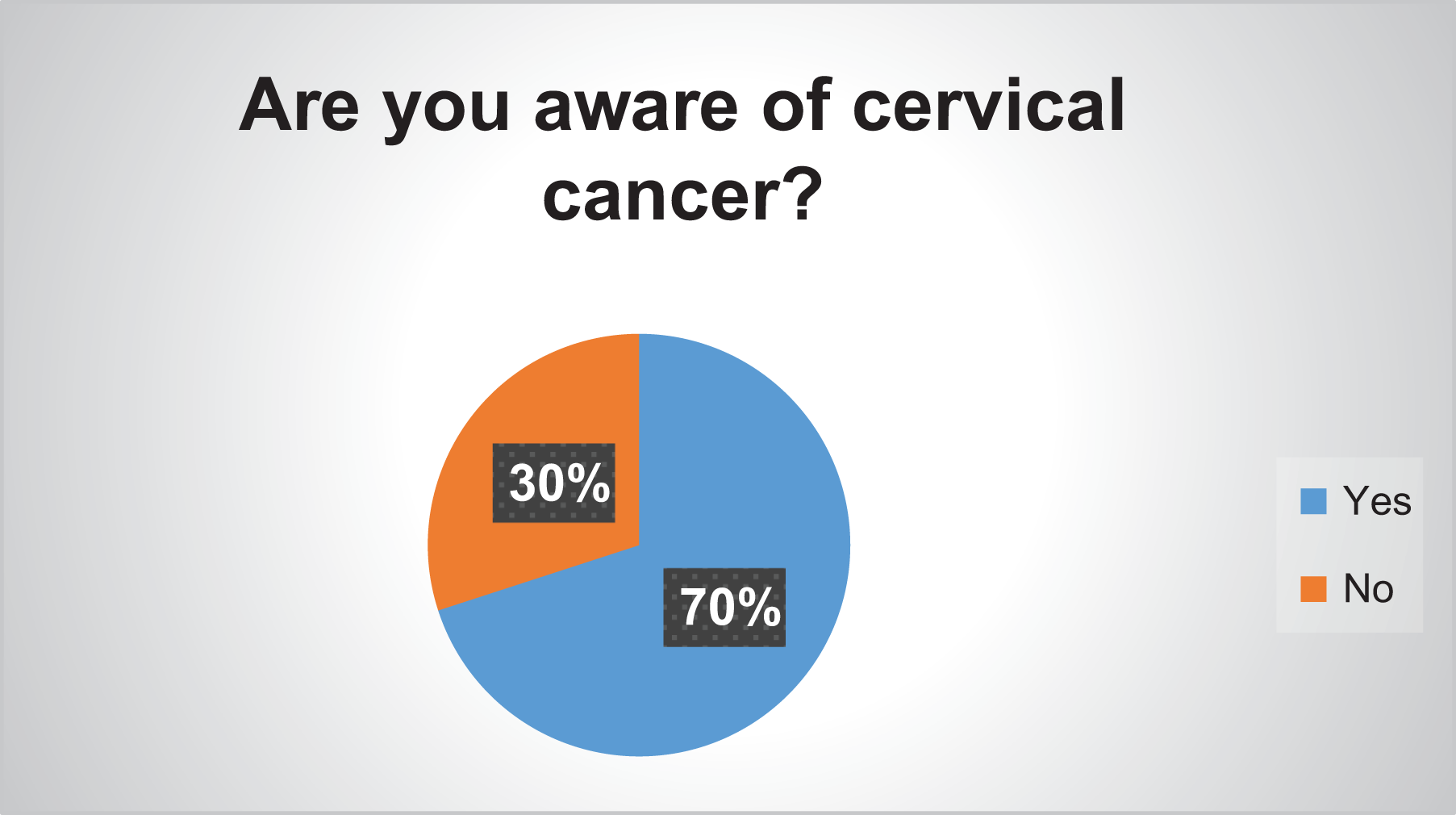
Awareness of cervical cancer.
The interview and discussion revealed that some of the participants had heard of other types of cancer, especially breast cancer, but were unaware of cervical cancer. It was also revealed during discussion that none of the women knew about HPV or about factors that could cause cervical cancer.
Enquiry on source of awareness as reflected in Figure 2 reveals that 50% of the women gained awareness of cervical cancer through their family members, 42.2% learnt about it through social media platforms, 26.7 through their churches, 18.9% through NGOs while the library served as the least awareness source at 2.2%.

Sources of awareness.
To ascertain whether the participants had been screened for cervical cancer previously, the question was asked. It was revealed that only 10% of the women had been screened prior to our interaction with them while 90% had never been screened.
Further verbal enquiry revealed that almost all women who had been previously screened did so because of the recommendation of their doctor during a medical review. Some reported that their doctor had noticed something during an ante-natal visit and told them to go for screening. They admitted that they would not have gone if the doctors had not told them about cervical cancer. Two of the women stated that cervical cancer screening was part of their routine medical checkup whenever they traveled abroad. They affirmed that they had never had it done in Nigeria until they heard of this opportunity.
Table 2 shows that 21.1% of the women were willing and ready to undergo screening even before the interactive discussion with them on cervical cancer, while the remaining 78.9% were unwilling. However, the rate of acceptance and willingness to undergo screening drastically changed after the interaction with them, which exposed them to enhanced knowledge of what cervical cancer is, including the benefits associated with its early detection. This is shown in the acceptance rate which increased to 80% while 14.4% remained undecided on whether to accept it or not. It was only 5.6% of the entire population that refused screening after the interaction as against the initial rejection rate of 78.9% prior to the interaction.
Attitude/willingness to undergo screening.
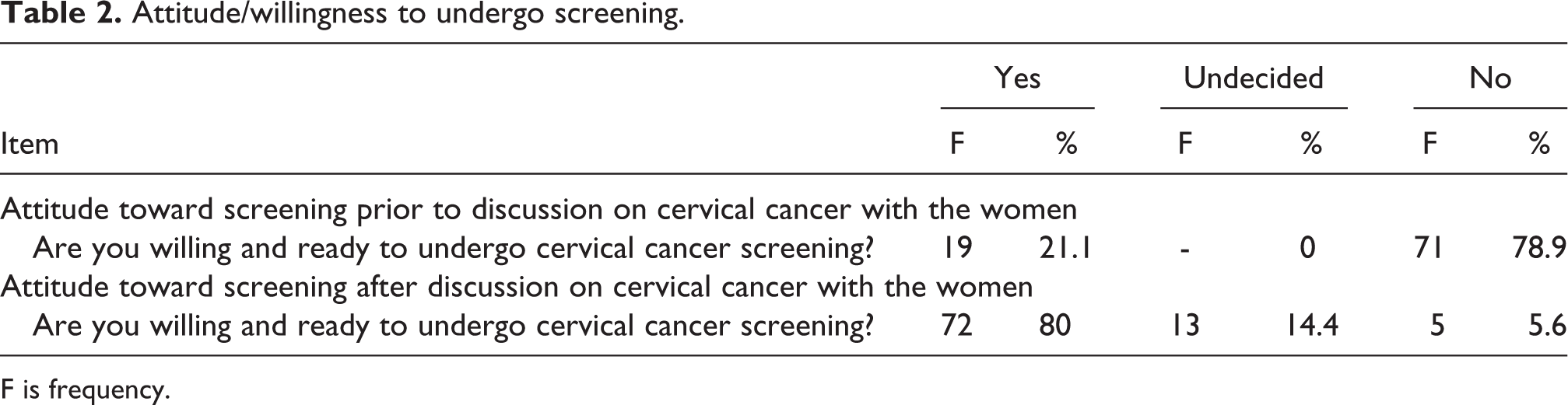
F is frequency.
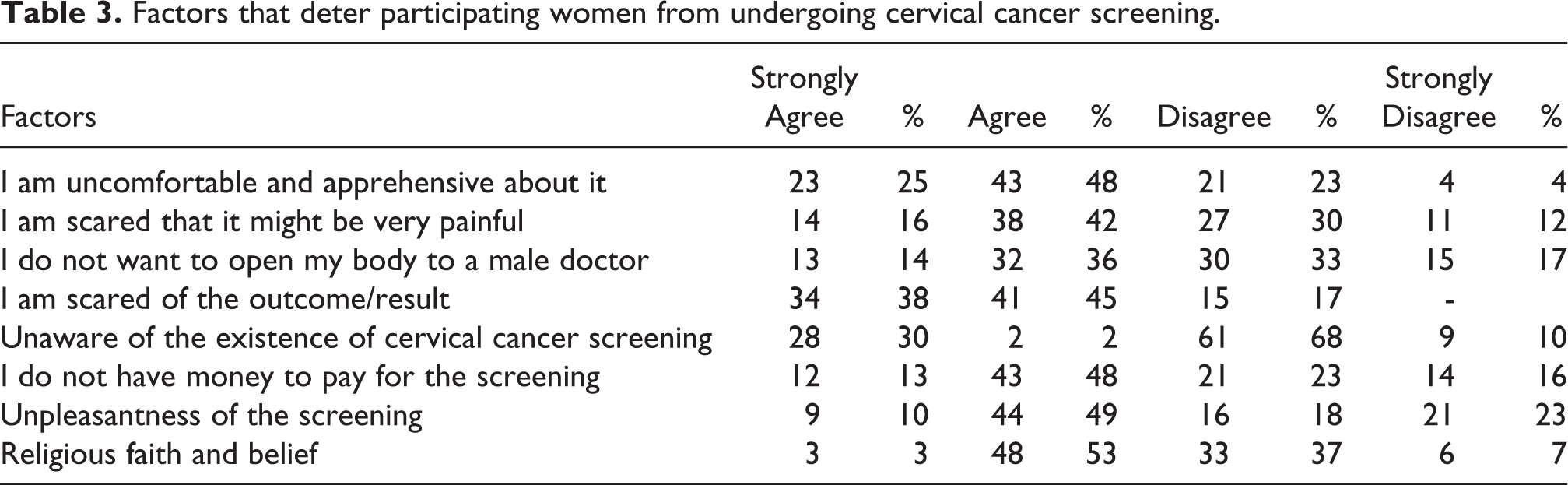
From Table 3 it can be seen that the factor that had the highest acceptance rate is “being scared of the outcome/result” which had agreement percentage rate of 83%. This is followed by “being uncomfortable and apprehensive about the screening” with the agreement percentage rate of 73%. The others in the order of rate of acceptance are: not having money to pay for the screening (61%), unpleasantness of the screening (59%), scared that it might be very painful (58%), and religious faith and belief (56%).
Factors that deter participating women from undergoing cervical cancer screening.
Lessons learnt from the cervical screening
Many women are eager to be screened after getting information on cervical cancer.
Women are also very interested in cervical cancer vaccines and want their young children to be vaccinated.
Some women wanted to be screened last. They were asking others who were screened before them how it felt and what really happened.
Many of them visibly relaxed when they were told before screening that the male doctors would not be part of the screening. They very much preferred women to screen them.
The excitement on being declared negative was infectious. They were flaunting their negative results and smiling happily.
Although those with negative results were understandably quiet, their mood changed following counseling.
Discussion of findings
The demonstration of interest in the program by different categories of women from different occupations, level of education and age range shows that health information is relevant and should be inclusive. This buttresses the statement of Solanke and Osuchukwu (2018) on the importance of facilitation and access to information regardless of age, income, race, ethnicity, religion, physical limitations, language, education or social status. The indication is that women need health information to improve their health knowledge base and also be able to make informed decisions on things that affect their lives. Ukachi and Anasi (2018) also emphasized that health information is needed to reduce levels of uncertainty and enable people to take the right health decisions.
The disclosure on the awareness of cervical cancer as shown in Figures 1 and 2 reveal that many of the women knew about it even though a small percentage admitted that they did not know about cervical cancer. Although the women admitted hearing of cervical cancer from family members, media, churches and non-government organization. The lowest source of awareness is the library and the indication questions the relevance of library to facilitation of access to health information (Popoola, 2019). It is not surprising that some women are unaware of cervical cancer in this age and time. The total lack of knowledge of HPV and how cervical cancer could be transmitted during discussion buttresses the concern of Anasi (2012) on the urgent need for strategic massive information awareness on cervical cancer.
The study also revealed that there was a low participation rate in cervical cancer screening among the women studied, which is confirmed by the results shown in Figure 3. This outcome is disheartening when weighed against its obvious consequences with the negative implications. This result corroborates with reports of studies previously carried out which revealed that more women in sub-Saharan Africa are dying of cervical cancer (Ferlay et al., 2012; Ibekwe et al., 2010; Ntekim, 2012). It is also noted in this study that the women who had been screened according to the interview and discussion did not even go of their own volition but went because their doctors discovered something and sent them for the screening. The other two went because their annual medical checkup included it.
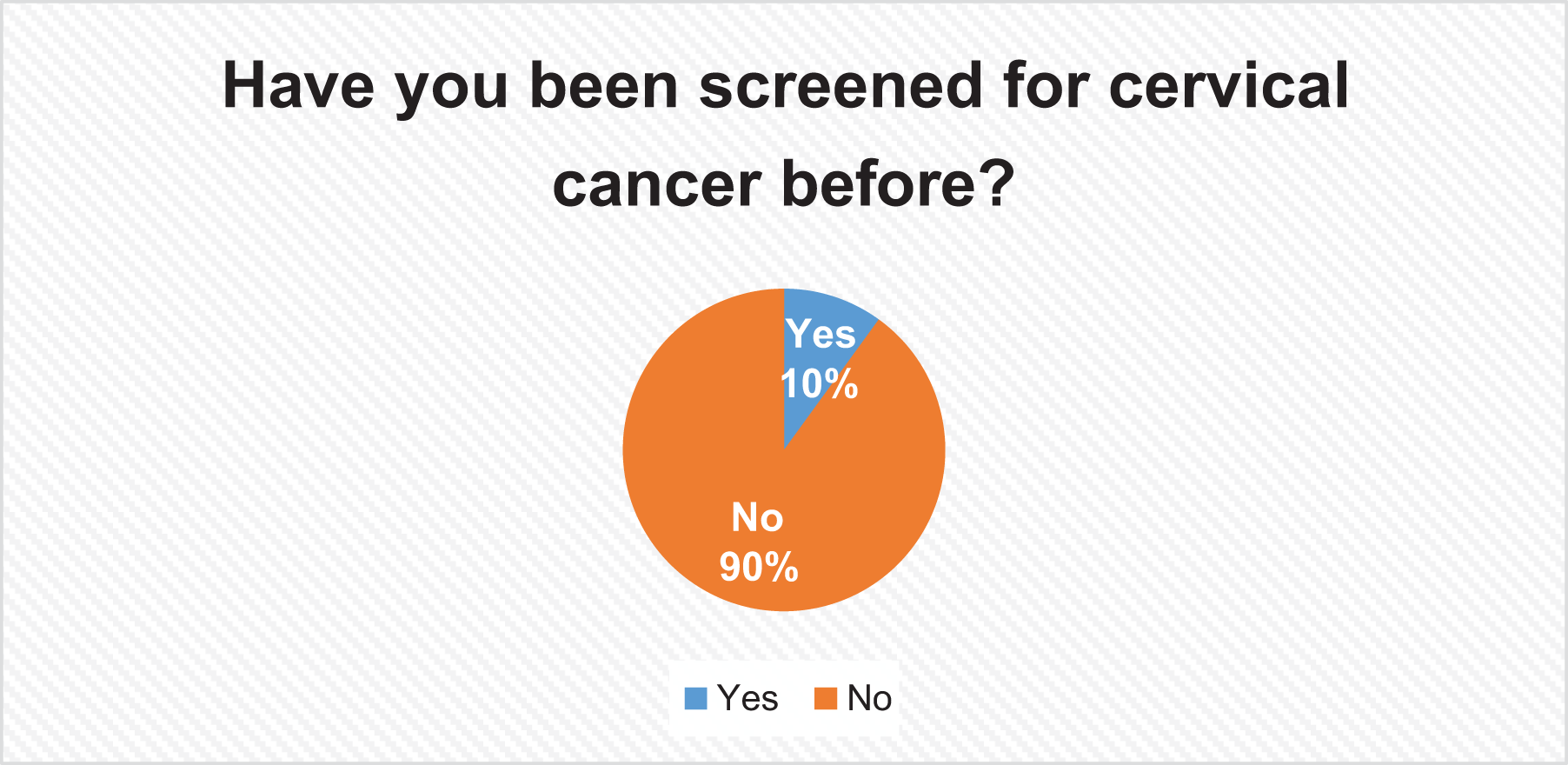
Screening status.
Conversely, the study also documented a shift in their attitude to and willingness to undergo cervical cancer screening after they were exposed to the knowledge of what causes cervical cancer, including the benefits inherent in early detection which can only be achieved through screening. This outcome relates to the findings of Jayasinghe (2017) and Ntekim (2012) whose studies established that providing positive provider-client relationships, confidentiality, privacy, compassion, respect and dignity for the women will make them participate willingly in the screening.
In the area of factors that deter the women from undergoing cervical cancer screening, the most notable ones are: being scared of the outcome/result, being uncomfortable and apprehensive about the screening, and not having money to pay for the screening. Besides the formal expression of these deterrents by the participants, personal observations by the researchers during the screening exercise showed apprehensiveness and uneasiness among the women. These deterrents were alleviated by counseling and demystifying the screening process for them. This approach was acknowledged by the Majorie Bash Foundation et al. (2018) in their cancer control program which emphasized the sharing of experiences about cancer and engaging different media in promoting cancer control in Nigeria. The problem of not having enough money to pay for the screening is not surprising considering the high cost of undergoing the process as well as the fact that most African countries do not have effective and efficient health insurance schemes for their citizenry like other developed countries, coupled with rate of poverty.
Implication of the findings
The findings indicate that if women are not offered health information on cervical cancer, they may never go for screening nor have knowledge of prevention and vaccination. It is clear that lack of information on cervical cancer is a contributing factor to women in Nigeria and sub-Saharan Africa having very high rates of cervical cancer. This should be a matter of grave concern to all stakeholders: librarians, government, society at large, communities, families and individuals. Libraries, especially, should reach out to women in all communities and sectors, building partnerships for effective sensitization programs. If women are not properly sensitized on cervical cancer, they may never visit the hospitals for screening and will continue to die unnecessarily. Women need help in the area of awareness, information availability and accessibility, and screening support assistance to meet this devastating health challenge just like their counterparts from the developed parts of the world. The findings in this study indicated that libraries and health information providers, health policies makers and primary health care providers could do more towards curbing this escalating menace in Nigeria. The study has also shown that women are keen to know more and participate in cervical cancer programs.
Conclusion and recommendation
Cervical cancer is a serious health issue that should not be viewed as a women’s problem only because everyone has a mother, sister, wife, daughter and female colleagues. Additionally, the roles that women play in families and society make them key players in the achievement of Sustainable Development Goals.
The importance of libraries and librarians in making health information available and accessible should be viewed critically. Figure 2 showed libraries scoring lowest as a source of information. The time for taking ownership of information and ensuring people are aware of library services on health information delivery is now.
Therefore, the study makes the following recommendations: Health libraries are important players in the process to achieve SDG-3, but must promote their role and make this more visible. Libraries in Nigeria should counteract the effect of the low resource status of their health care system on knowledge of cervical cancer by proactively facilitating access to reliable information, Health libraries must make themselves relevant to Nigeria’s health care system and SDG3 plans by working to share successful initiatives implemented towards tackling the urgent health issue of cervical cancer. Librarians should collaborate with other health care professionals to be more effective noting that cervical cancer screening can be arranged in informal venues and with flexible time other than the hospital, which will help to attract women for counseling and lectures. Libraries should assist in cervical cancer awareness creation by repackaging information in formats other than books and also translate them into local languages spoken in the communities. Libraries should help to share cervical cancer success stories, which have the potential to reduce fear and unnecessary tension. Libraries should collaborate with other health care professionals and help in providing materials for: lobbying government to organize massive health information education and awareness on cervical cancer across the States in the country including using radio and various electronic and social media to broadcast information acting in collaboration with different professional bodies and organizations concerned with cervical cancer; setting up a program to open National Cancer Center centers and make screening free and accessible to all.
This is an appeal for urgent action to start now and build on the modest initiative described in this study.
Footnotes
Declaration of Conflicting Interests
The author(s) declared no potential conflicts of interest with respect to the research, authorship, and/or publication of this article.
Funding
The author(s) received no financial support for the research, authorship, and/or publication of this article.
