



Abstract
This study investigated the intervention of TETFund in the provision of library resources in academic libraries in Imo State, Nigeria. It was guided by four research questions and three null hypotheses. The study adopted a survey research design with a questionnaire as the research instrument. The population of the study was 105 professional and para-professional library staff at two universities in Imo State. The findings show that TETFund intervenes to a high extent in the provision of information resources at the two universities studied. The study recommends that concerned government ministries should monitor the activities of TETFund to ensure that universities benefit equally, and that TETFund should be mandated to make the processes simpler. The researchers also recommend that TETFund organize conferences to educate institutions on the need and processes to access funding and benefit from TETFund.
Introduction
TETFund is an intervention agency which was set up to provide supplementary support to all levels of public tertiary institutions with the main objective of using funding alongside project management for the rehabilitation, restoration and reconsolidation of tertiary education in Nigeria, (Bamigboye and Okonedo-Adegbeye, 2015). Academic libraries lack the significant financial outlay required to provide scholars and researchers with the wide range of communication technologies that are necessary for the quick retrieval of information from immediate and remote databases. Since they find it difficult to design modern information services, maintain buildings, service equipment, train staff and pay their bills, the federal government established the Tertiary Education Trust Fund (TETFund) in a National Assembly Act in June 2011.
The main source of income available to TETFund is the 2% education tax that is paid from the assessable profits of companies registered in Nigeria. The levies are collected by the Federal Inland Revenue Service. If the funds from TETFund could be utilized effectively in Nigerian educational institutions, including for the development of academic libraries, there would be a high level of improvement in the collections of information resources in libraries. Information resources are the books and non-book materials, and also e-resources, in a library (Nnadozie, 2013). Book materials include textbooks, journals, periodicals, encyclopaedias and dictionaries. Non-print information sources include other resources which library patrons make use of when they visit the library, such as audiovisual materials, e-books, e-journals and the Internets. Information resources are very important in a library. According to Nwosu and Udo-Anyanwu (2015), the core of a library is its collection. Its pivotal place is enshrined in the basic mandate of libraries to stock information materials to meet the needs of their users.
In the case of human resources, TETFund intervention is one of the basic ways of enhancing staff development. In Nigeria, many staff in tertiary institutions have been trained locally and internationally through TETFund financing. This means that staff development is one of the basic benefits of TETFund. Based on the foregoing, TETFund is being used in infrastructural development, such as the modernization and improvement of information and communications technologies (ICTs), the acquisition of modern technology and library equipment, and the acquisition of recent books and non-books materials. For this reason, Ubah (2016) states that the TETFund intervention was introduced to improve infrastructural and human capital development in educational institutions. If this is to be achieved, libraries should not be neglected.
There are many challenges confronting TETFund’s financing of academic libraries. After receiving funds from TETFund, some school management teams find it difficult to allocate the required proportion to their academic library to ensure its development. Sometimes, when funds are allocated, their effective utilization becomes a problem because some library staff are not professionally trained. The development of libraries in developing countries like Nigeria has been observed to be a Herculean task, brought about by inadequate official support coupled with dwindling financial allocations. The acquisition of resources for libraries is the basic foundation for library development, but federal funding, which provides critical assistance to libraries through their parent institutions, is inadequate. According to Okonofua (2011), a lack of funding is the principal challenge faced by most Nigeria tertiary institutions, which limits their ability to be rated highly in global rankings of educational institutions. Okonofua remarked that, as long as the government remains the major source of funding, there will continue to be funding gaps from government sources due to the increasing number of government-funded organizations. Likewise, libraries, just like other arms of institutions, are striving to source funds.
Chisenga (2000: 27) states that ‘many libraries in Sub-Sahara Africa, including tertiary institutions’ libraries, just depend entirely on government funding for their operations which is no longer adequate’. This has prevented academic libraries from working out any reasonable acquisition programmes, and TETFund has thus become very important in library resources development. The need to utilize TETFund financing effectively in the acquisition of library resources and overall development of an academic library is important – especially in the two libraries under study here. It is against this backdrop that this study on the influence of TETFund intervention on the provision of library resources and services in academic libraries is being carried out.
Statement of the problem
Libraries are essential in institutions of higher learning. They are seen as social institutions that do not generate funds. However, the fact that libraries require adequate funding to provide the necessary information resources, facilities, effective service and training of staff cannot be disputed.
TETFund was established to assist in the funding of higher education institutions in Nigeria. With this, one would have thought that the problem of funding public higher education institutions in Nigeria, and their libraries in particular, would have been a thing of the past. But the situation on the ground suggests that academic libraries are still not fully enjoying the benefits of this funding. The researchers therefore wonder if the funding given to higher education institutions by TETFund is not adequate to assist in the provision of information resources, library equipment and facilities, staff training and library services. Could it be a result of the inadequate disbursement of the financial interventions from TETFund? Could it be the attitude of university management? Could there be a diversion of the library funds to other programmes in universities? Or could it be a matter of the unprofessional attitudes of librarians with regard to financial management? The need to clarify these issues prompted this study.
Research questions
Based on the research purposes, the following research questions were posed for the study: What is the extent of TETFund intervention in the provision of information resources at the Federal University of Technology, Owerri (FUTO) and Imo State University, Owerri (IMSU) libraries? What is the extent of TETFund intervention in the sponsorship of staff training at the FUTO and IMSU libraries? What is the extent of TETFund intervention in the provision of library facilities at the FUTO and IMSU libraries? What are the challenges encountered in accessing TETFund interventions by the FUTO and IMSU libraries?
Hypotheses
The following hypotheses were formulated for the study at a 0.05 level of significance:
Hypothesis 1: The mean rating of the extent of TETFund intervention in the provision of information resources is not significant at the FUTO and IMSU libraries.
Hypothesis 2: The mean rating of the extent of TETFund intervention in and sponsorship of staff development is not significant at the FUTO and IMSU libraries.
Hypothesis 3: The mean rating of the extent of TETFund intervention in the provision of library facilities is not significant at the FUTO and IMSU libraries.
Literature review
TETFund was established as an intervention agency under the Education Tax Act No. 7, 1993. The Tertiary Education Trust Fund (Establishment, etc.) Act, 2011 (TETFund Act) repealed the Education Tax Act Cap. E4, Laws of the Federation of Nigeria, 2004 and the Education Tax Fund Act No. 17, 2003 and established TETFund, which is charged with the responsibility for managing, disbursing and monitoring the education tax to public tertiary institutions in Nigeria. The Education Tax Act No. 7, 1993 mandated that TETFund operate as an intervention fund for all levels of public education (federal, state and local). This mandate was discharged faithfully between 1999 and May 2011, when the Education Tax Fund Act No. 17, 2003, was repealed and replaced by the Tertiary Education Trust Fund Act , due to lapses and challenges in operating the Education Tax Fund.
TETFund (2011) outlined the lapses and challenges thus: the Education Trust Fund was overburdened and overstretched, and could only render palliative support to all levels of public educational institutions in Nigeria; the duplication of the functions and mandates of other agencies set up after the Education Trust Fund, such as Universal Basic Education and the Millennium Development Goals; and the decay and dilapidation of facilities in tertiary education continued to be an issue, as funding was spread thinly spread. To enable TETFund to achieve the above objectives, the TETFund Act, 2011 imposes a 2% education tax on the assessable profits of all registered companies in Nigeria. The Federal Inland Revenue Service is empowered by the Act to assess and collect the education tax. TETFund administers the tax imposed by the Act and disburses it to tertiary education institutions at the federal and state levels. It also monitors the projects executed with the funds allocated to beneficiaries.
The mandate of TETFund, as outlined in section 7(1) (a) to (e) of the TETFund Act, 2011, is to administer and disburse funding to federal and state tertiary education institutions, especially for the provision and maintenance of the following: essential physical infrastructures for teaching and learning; instructional material and equipment; research and publication; academic staff training and development; and any other needs which, in the opinion of the Board of Trustees, are critical and essential for the improvement of quality and maintenance of standards in higher education institutions.
From the above, it is clear that TETFund’s primary objective was to generate additional income to support tertiary education and provide scholarships and grants for needy but promising students, attempting not only to strengthen and diversify the economic base of higher education institutions in Nigeria, but also to redirect their resources towards improving the productivity and quality of higher education.
Many authors have examined the concept of academic libraries. Reitz (2004) sees academic libraries as an integral part of colleges or other institutions of post-secondary education, which are administered to meet the information needs of their students, faculty and staff. Academic libraries are the lifeblood of institutions of higher learning because they help the members of the academic community to achieve the objectives of teaching and learning (Anyanwu, 2016). Nwosu and Udo-Anyanwu (2015) state that academic libraries are purpose-driven organizations. They are the major support infrastructure for the tripartite function of higher education: teaching, research and extension.
The core of a library is its collection. Academic libraries are libraries attached to tertiary institutions such as universities, polytechnics, colleges of education, colleges of agriculture, colleges of technology and research institutes (Akporhonor, 2005).
In Abubakar’s (2011) view, academic libraries are at the forefront of providing information services to their respective communities – students, lecturers and researchers – in order to support their teaching, learning and research needs. Scholars have emphasized the crucial role of academic libraries in research and scholarship in institutions of higher learning. Academic libraries are often referred to as the heart or nerve centre of institutions of higher learning, around which all academic activities revolve.
Academic libraries in Nigeria suffer from poor funding. This is because they are operating in an era of economic recession where resources (financial and material) are not forthcoming. Nigerian academic libraries derive the greater part of their funds from the government (both federal and state). Okiy (2005) notes that of all the different types of libraries in Nigeria, only university libraries have a clearly defined policy of funding because they are allocated 10% of the recurrent annual budget of their parent institution. However, it is regrettable that such monies are not forthcoming as most university administrators tend to flout that rule (Okiy, 2005; Yetunde, 2008). This persistent situation probably informed the government’s decision to review the previous Education Tax Act No. 7, 1993, as amended by Act No. 40 of 1998, and replace it with the present TETFund Act of 2011 to cater for tertiary institutions specifically.
The situation in private universities also tends to portray a gloomy picture as the story is the same. Yetunde (2008) observes that, in most private universities in Nigeria, the founder and board of trustees usually determine the share of the university library’s budget, which in most instances is inadequate. This affects the efficiency and effectiveness of the library’s functions.
There are difficulties with importing books and journals from abroad due to increases in foreign exchange rates. This has deterred many academic libraries from acquiring current and relevant titles that will support the academic programmes of their parent institutions. Thus, the efforts of most academic libraries in providing modern information services are thwarted by this problem whose genesis is in inadequate funding.
TETFund intervention in academic libraries
The present financial straits into which Nigerian academic libraries have fallen are in sharp contrast with the situation during the decade of the oil boom. Adequate funds were made available to academic and other libraries in the country from the revenue that was flowing into the country’s treasury through crude-oil sales. This was reflected in the construction of imposing library buildings and the increased frequency of acquisitions, as well as the quality of the new books, journals and other scholarly publications. However, the decline of Nigeria’s economy, which became evident from the early 1980s, naturally took an enormous toll on the funding of these libraries. As the government’s financial receipts declined, the once booming economy nosedived and, as a consequence, it became increasingly difficult to access sufficient funds for libraries, education and other social services.
As a result of the struggling economy, caused by the world oil glut and poor internal management of resources since the 1980s, the funding of Nigeria’s academic institutions and their libraries became a problem (Agboola, 2002). The importance of funding for providing quality library services cannot be overemphasized. It is the glue that holds the library building, collection and staff together, and allows the library to attain its goals. As such, money can be considered the soul of a library; inadequate funds impede the effectiveness of any library (Anafulu, 1997).
It can be argued that the government has been unable to offer the expected financial support to education and libraries as a whole. Recognizing this fact, foundations and bilateral and multilateral funding agencies have shown great interest in providing support to libraries through their various organizations. Libraries have been able to benefit from funding opportunities ranging from the capacity-building of library personnel to the provision of ICT facilities and databases (Whyte, 2004).
TETFund has intervened in so many areas in the development of academic libraries in Nigeria. It is a fact that TETFund funds have been used to provide numerous current local and foreign textbooks, journal materials and other publications at IMSU library, FUTO library and beyond, especially during accreditation (Ubah, 2016).
Nnadozie (2013) observes that TETFund is always used for the selection and acquisition of information resources in academic libraries, and that many higher education institutions utilize TETFund for purchasing books and non-book materials, especially during the accreditation period. For example, in 2011 and 2013, TETFund was used to purchase many local and foreign books especially during the accreditation period. Agunbiade (2006) highlights various library projects that have been funded by TETFund under the library development programme, including the computerization of libraries; provision of books, journals and reading materials; provision of equipment – for example, binding materials and equipment; and, in some cases, the provision of library buildings. This means that academic libraries have benefited significantly from the use of TETFund financing. In most universities, polytechnics and colleges of education, TETFund has added value in promoting the effectiveness of collection development (Ohadinma, 2015). Ohadinma notes that the procurement of information resources was neglected before the effective utilization of TETFund, hence TETFund has added significant value in the procurement of books and non-book materials.
Methodology
The study used a survey research design. The population comprised 105 professional and para-professional staff at IMSU library (27) and FUTO library (78). A census enumeration technique was used to adopt the entire population as the sample for the study. The instrument used for data collection was a questionnaire with interview questions.
The questionnaire was administered personally by the researchers by hand and in face-to-face contact. The completed copies of the questionnaire were collected by the researchers in person in order to be sure that the respondents had completed the instrument. The exercise lasted for a period of two weeks. The data collected was analysed using descriptive statistics – mean and standard deviation. Any variable with a mean of 2.50 and above is considered positive, while variables with a mean below 2.50 are considered negative. The significance of the hypotheses was tested at the 0.05 alpha level using t-test statistical tools. The decision rule is if the p-value ≤ 0.05, the null hypothesis is rejected and the alternative hypothesis is accepted.
Results
Results of analysis of the first research question: What is the extent of TETFund intervention in the provision of information resources at the FUTO and IMSU libraries?
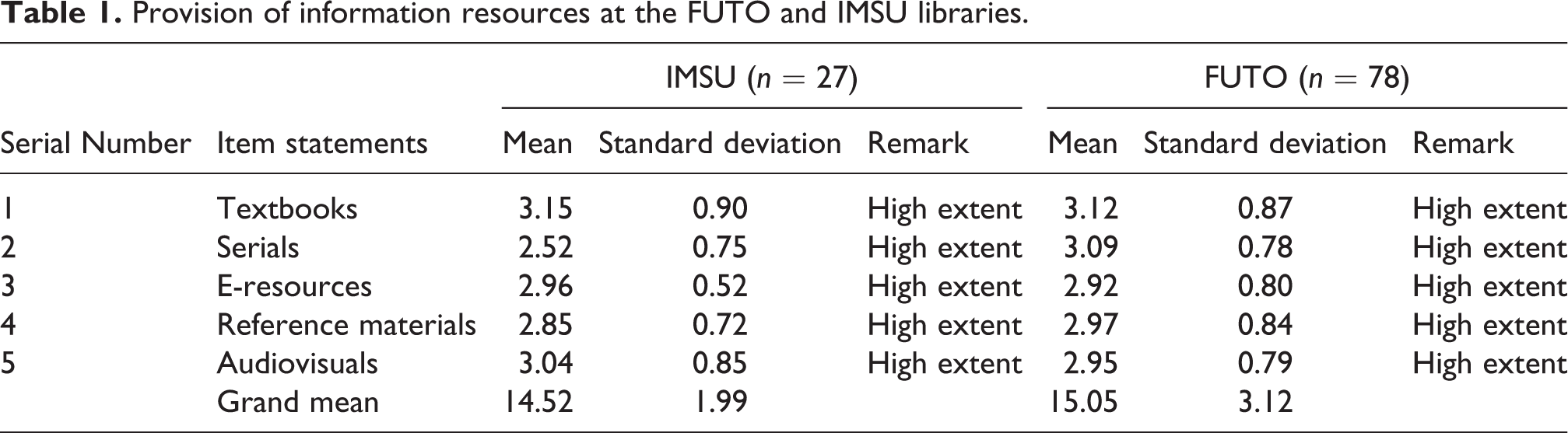
Table 1 presents the item-by-item means and standard deviations for the extent of TETFund intervention in the provision of information resources at the FUTO and IMSU libraries. All of the items in Table 1 have means above the criterion mean of 2.50. Also, approximating the means gives 3.00, indicating the high extent of the intervention at both the FUTO and IMSU libraries. This shows that TETFund intervenes to a high extent in the provision of information resources at the two universities. The overall or grand mean is 14.52 for IMSU, with a standard deviation of 1.99, while at FUTO it is 15.05, with a standard deviation of 3.12. The researchers observed that TETFund intervenes in the provision of textbooks, serials, e-resources and reference materials, but not in the provision of audiovisuals.
Provision of information resources at the FUTO and IMSU libraries.
Results of analysis of the first hypothesis: The mean rating of the extent of TETFund intervention in the provision of information resources is not significant at the FUTO and IMSU libraries
Presented in Table 2 is the t-test of significance regarding TETFund intervention in the provision of information resources at IMSU and FUTO libraries. From Table 2, the mean rating scores for IMSU and FUTO are 14.52 and 15.05, respectively, while their respective standard deviations are 1.99 and 3.12. The calculated t-value is 0.825, while the critical t-value is 2.000 at a 49.75 degree of freedom and 0.05 level of significance. Since the calculated t-value is less than the critical t-value, the null hypothesis is upheld. Therefore, the mean rating of the extent of TETFund intervention for the provision of information resources at FUTO and IMSU is not significant.
Calculated t-value and critical t-value of the extent of TETFund intervention in the provision of information resources.

Results of analysis of the second research question: What is the extent of TETFund intervention in the sponsorship of staff training at the FUTO and IMSU libraries?
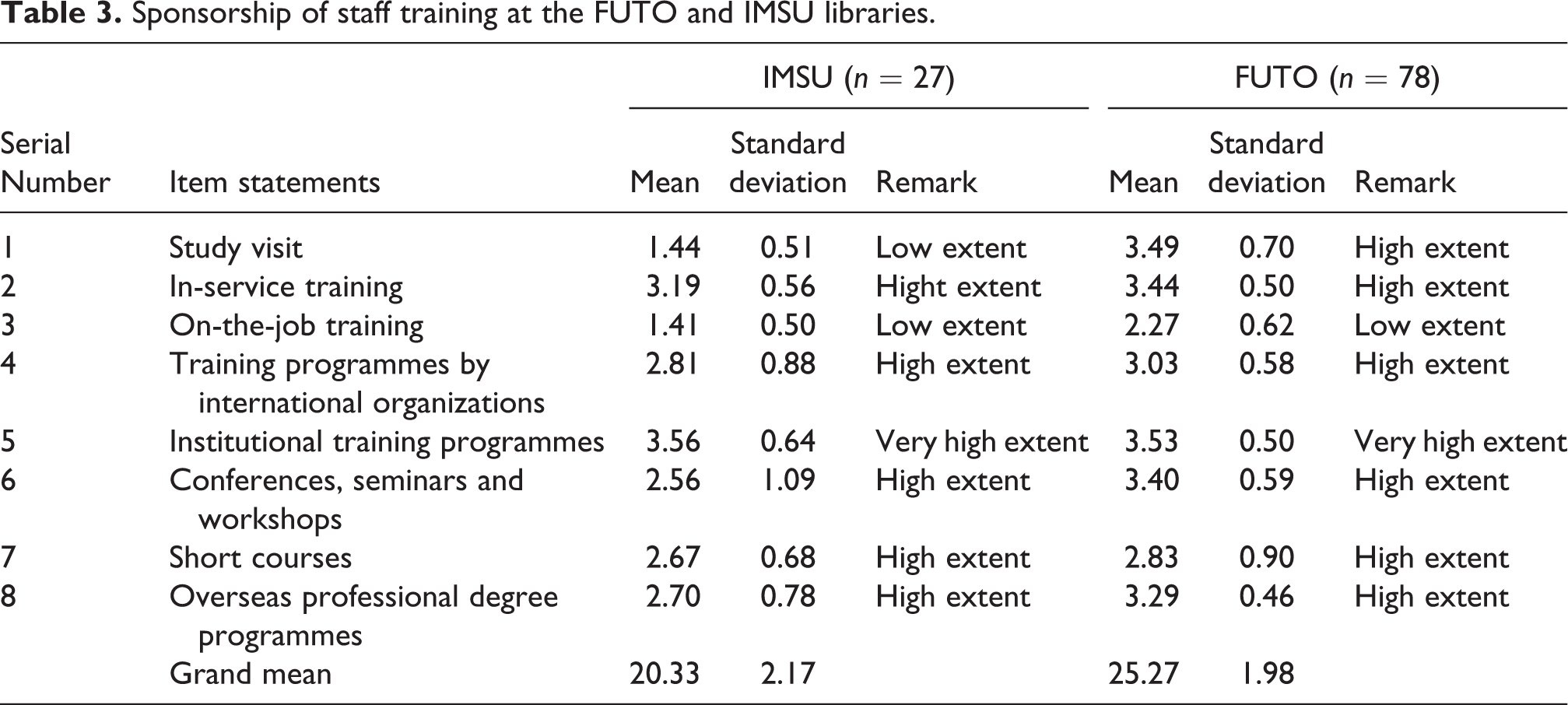
Table 3 presents the item-by-item means and standard deviations for the extent of TETFund intervention in the sponsorship of staff training at the FUTO and IMSU libraries. All of the items in Table 3 have a mean above the criterion mean of 2.50, except for Items 1 and 3. The librarians at IMSU and FUTO agreed with all of the items but disagreed on Item 1. The reason for the difference here could be attributed to the level of the management’s commitment to staff development matters at the two universities. While the librarians at IMSU rated Item 1 as ‘low extent’, with a mean rating of 1.41, the librarians at FUTO rated it as ‘high extent’, with a mean rating of 3.49. Item 5 has the highest rating by both IMSU and FUTO librarians because it is rated as ‘very high extent’. The Item 5 statement relates to sponsorship of ‘institutional training programmes’. In the interview carried out by the researchers, the university librarians accepted that TETFund intervenes in staff training in the areas of PhD and Master’s degree programmes and IFLA conferences, but to a low extent.
Sponsorship of staff training at the FUTO and IMSU libraries.
Results of analysis of the second hypothesis: The mean rating of the extent of TETFund intervention in and sponsorship of staff development is not significant at the FUTO and IMSU libraries
Table 4 presents the t-test of significance for the extent of TETFund intervention in sponsorship of staff training at the FUTO and IMSU libraries. The data in Table 4 shows that the calculated t-value is 10.900, while the critical value of t is 1.671 at a 37.62 degree of freedom and 0.05 level of significance. Therefore, the null hypothesis, which states that ‘the mean rating of TETFund intervention in and sponsorship of staff training is not significant at the FUTO and IMSU libraries’ is rejected. The researchers conclude that there is a significant gap between the extent of TETFund intervention and sponsorship of staff training at the FUTO and IMSU libraries.
Calculated t-value and critical t-value of the extent of TETFund intervention in the sponsorship of staff training.

Results of analysis of the third research question: What is the extent of TETFund intervention in the provision of library facilities at the FUTO and IMSU libraries?
Presented in Table 5 are the item-by-item mean and standard deviation ratings for the extent of TETFund intervention in the provision of library facilities at the FUTO and IMSU libraries. From Table 5, there is a low extent of intervention by TETFund for Items 1, 6, 8, 9, 11, 12, 13, 14 and 15. On the other hand, there is a high extent of intervention for Items 2, 4, 5, 7 and 10, while item 3 (reading chairs and tables) is rated as a very high extent of intervention by TETFund.
Provision of library facilities at the FUTO and IMSU libraries.
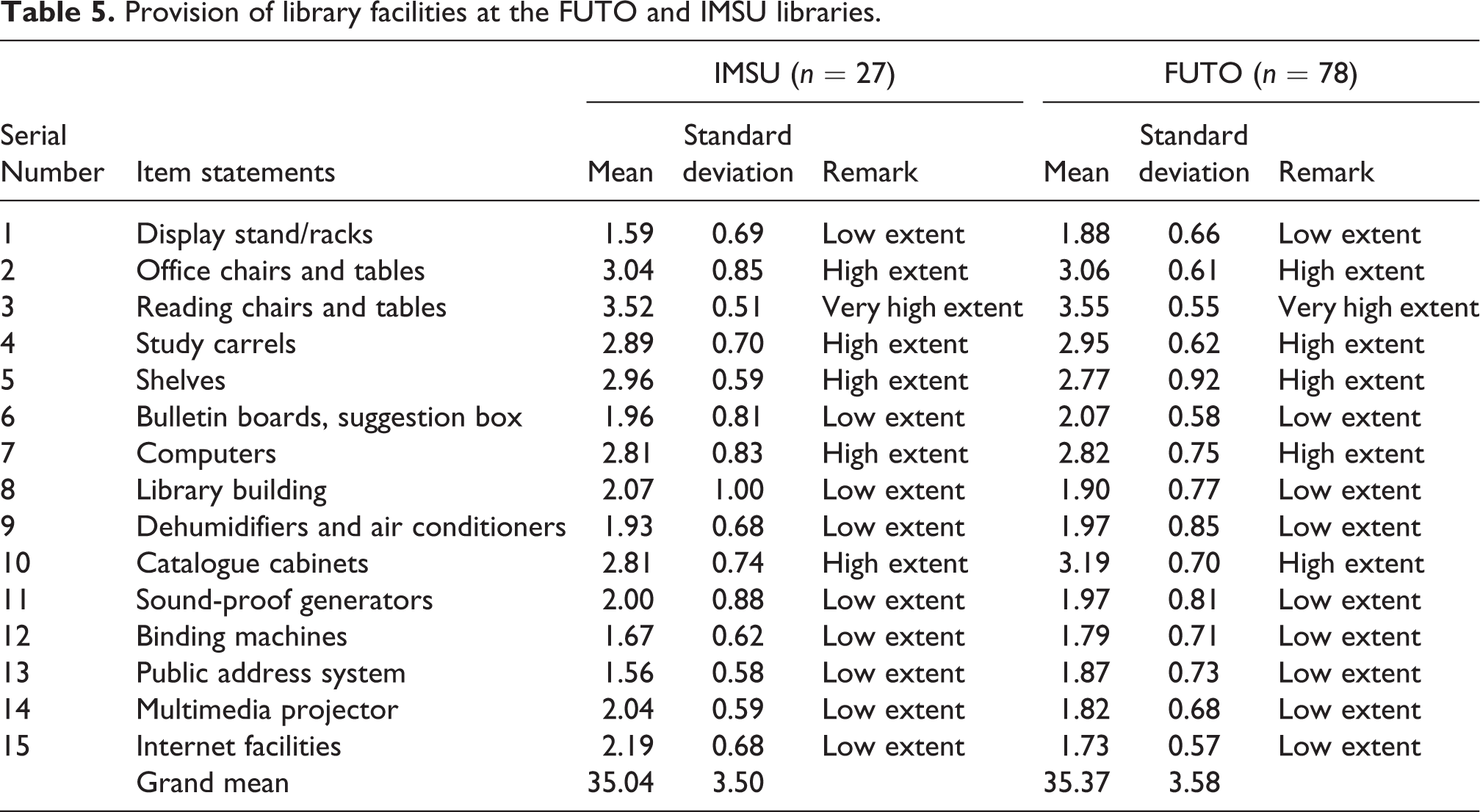
The researchers observed that TETFund intervenes in the provision of library facilities such as office chairs and tables, reading chairs and tables, study carrels, shelves, computers, the library building, dehumidifiers and air conditioners, and binding machines. However, it does not intervene in display stands/racks, bulletin boards, suggestion boxes, catalogue cabinets, sound-proof generators, public address systems, multimedia projectors and Internet facilities at the two libraries. The reason for non-intervention in these facilities stems from the fact that institutions indicate their preferences for the facilities they need when submitting their application for TETFund intervention.
Results of analysis of the third hypothesis: The mean rating of the extent of TETFund intervention in the provision of library facilities is not significant at the FUTO and IMSU libraries
Table 6 presents the t-test of significance for the extent of TETFund intervention in the provision of library facilities at the FUTO and IMSU libraries. The calculated t-value of 0.415 is less than the critical t-value of 2.021 at a 40.56 degree of freedom and 0.05 level of significance. The null hypothesis is therefore accepted. Hence, the mean ratings for the extent of TETFund intervention in the provision of library facilities at FUTO and IMSU do not differ significantly.
Calculated t-value and critical t-value of the extent of TETFund intervention in the provision of library facilities.

Results of analysis of the fourth research question: What are the challenges encountered in accessing TETFund interventions by the FUTO and IMSU libraries?
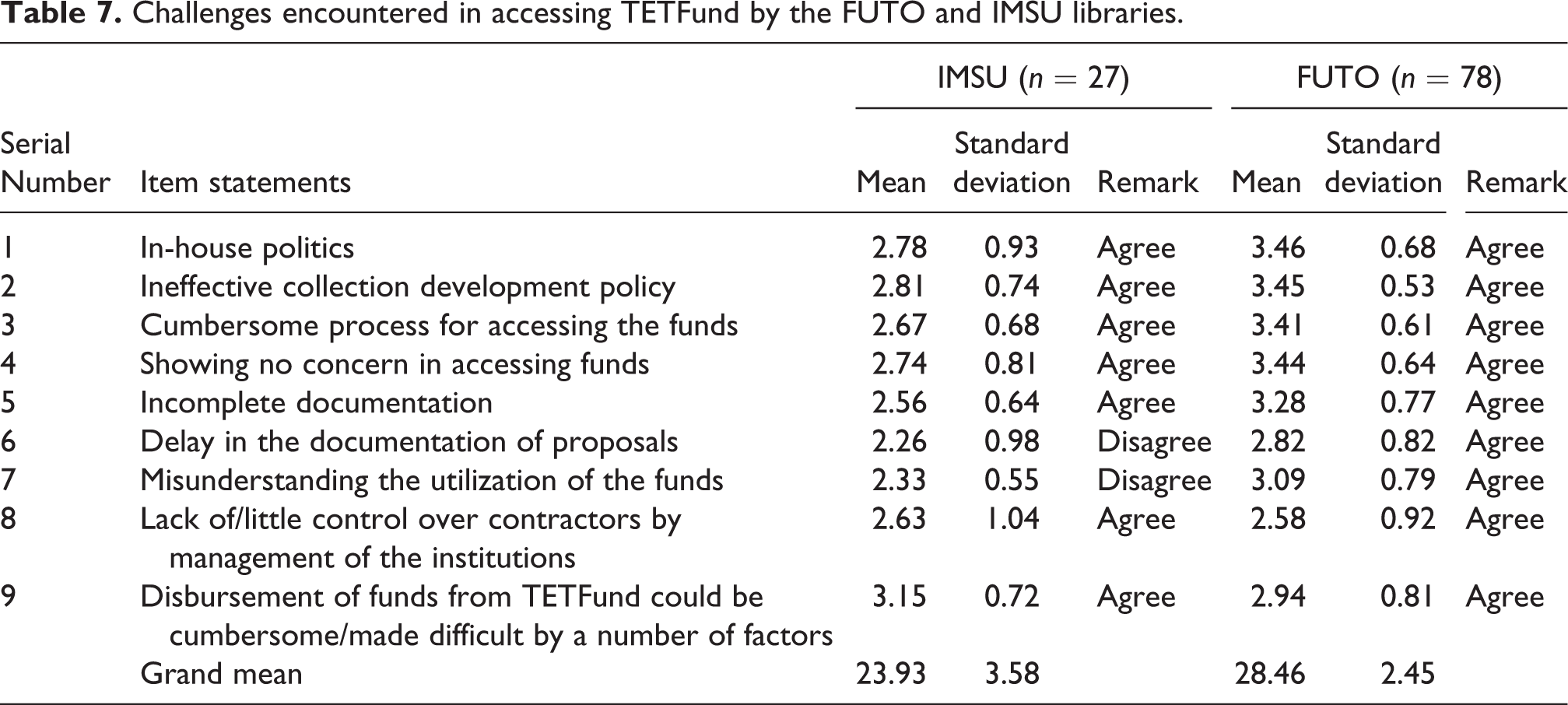
Table 7 presents the item-by-item means and standard deviations for the challenges encountered in accessing TETFund by the libraries under study. From Table 7, all of the item statements represent challenges encountered in accessing TETFund financing by the university libraries, except for Items 6 and 7 for the librarians at IMSU. These items have means above the criterion mean of 2.50, indicating agreement with the item statements. The librarians at both IMSU and FUTO agreed with all of the items except for Items 6 and 7, where the librarians at FUTO agreed but the librarians at IMSU disagreed. The two item statements that the librarians disagreed with are: ‘Delay in the documentation of proposals’ (with a mean of 2.26) and ‘Misunderstanding the utilization of the funds’ (with a mean of 2.33). The findings reveal that the librarians at the universities under study experience some challenges in accessing TETFund funds. They also show that the challenges encountered by the librarians include ‘in-house politics’; ‘ineffective collection development policy’; ‘cumbersome process for accessing the funds’; ‘showing no concern in accessing funds’; ‘incomplete documentation’; ‘delay in the documentation of proposals’; ‘misunderstanding the utilization of the funds’; ‘lack of/little control over contractors by management of the institutions’; and ‘disbursement of funds from TETFund could be cumbersome/made difficult by a number of factors’. However, ‘delay in the documentation of proposals’ and ‘misunderstanding the utilization of the funds’ were not rated as challenges in accessing TETFund by librarians at IMSU.
Challenges encountered in accessing TETFund by the FUTO and IMSU libraries.
Discussion
The discussion proceeds according to the major findings of the study listed above, and the findings are compared with the findings from other related studies.
The extent of TETFund intervention in the provision of information resources at the FUTO and IMSU libraries
The findings reveal that TETFund intervenes to a high extent in the provision of information resources at the two universities. This is revealed by the mean rating scores of the items, which indicate a high extent of intervention by TETFund in the provision of information resources for the libraries. The t-test of the first hypothesis reveals that the mean ratings of the extent of TETFund intervention in the provision of information resources at FUTO and IMSU do not differ significantly. This shows that the librarians at both the IMSU and FUTO libraries rated the extent of TETFund intervention in the provision of information resources as high. The information resources where TETFund intervenes to a high extent in their provision are textbooks, serials, e-resources, reference materials and audiovisuals. These findings are in line with the findings of Nnadozie (2013), who observes that TETFund is always used in the selection and acquisition of information resources in academic libraries. Nnadozie notes that many higher education institutions utilized TETFund for purchasing books and non-book materials, especially during the accreditation period. Osinulu and Daramola (2013) found that TETFund came at the right time to alleviate the inadequate funding experienced in the education sector, and university libraries in particular. The acquisition of learning resources such as journals and ICT facilities by particular libraries in south-west Nigeria has been reformed and greatly enriched. Ezeali (2019) reveals that TETFund has contributed to the procurement of learning materials. Anaelobi and Agim (2019) discovered that TETFund intervention has resulted in quality books and other information resources.
The extent of TETFund intervention in the sponsorship of staff training at the FUTO and IMSU libraries
The findings of the study reveal that there is a significant difference between the extent of TETFund intervention in the sponsorship of staff training at the FUTO and IMSU libraries. This finding shows that the librarians at IMSU and FUTO did not rate the extent of TETFund intervention in the sponsorship of staff training the same. This shows that there are slight discrepancies in the rating of TETFund intervention in the training of staff at the two universities. The reason for these discrepancies is observed to stem from TETFund’s training-preference policy, where staff at institutions that have library schools are given more chances for training sponsorship. FUTO does not have a library school, whereas IMSU does. The librarians at the two universities rated sponsorship of in-service training, training programmes by international organizations, conferences, seminars and workshops, short courses and overseas professional degree programmes as ‘high extent’ but sponsorship of institutional training programmes as ‘very high extent. For sponsorship for study visits, the IMSU librarians rated TETFund intervention as ‘low extent’, while FUTO rated it as ‘high extent’. The finding that TETFund sponsors university library staff to a high extent for in-service training, training programmes by international organizations, conferences, seminars and workshops, short courses and overseas professional degree programmes is in line with the findings of Udu and Nkwede (2014) that many staff at tertiary institutions have been trained, developed and empowered through TETFund. Ugoji (2016) believes that academic library staff, teaching staff in library and information science, and other university staff have benefited through TETFund-sponsored training and development programmes.
The extent of TETFund intervention in the provision of library facilities at the FUTO and IMSU libraries
The findings reveal that the mean ratings for the extent of TETFund intervention in the provision of library facilities at the FUTO and IMSU libraries do not differ significantly. The librarians at both IMSU and FUTO agreed in their rating of the extent of TETFund intervention in the provision of library facilities. They indicated that there is a low extent of intervention by TETFund in the provision of some facilities. On the other hand, there is a high extent of intervention by TETFund in the provision of other resources, while there is a very high extent of intervention in the provision of reading chairs and tables. These findings are partially in line with the findings of Agunbiade (2006), who highlighted various library projects that have been funded by TETFund under library development programmes. The reasons for the very high extent and high extent of support for some resources and facilities as opposed to others could be the result of needs assessments conducted at the universities and the ‘areas of intervention’ requests submitted by the two institutions. The implication of this for the institutions is that each receives interventions based on their areas of need.
The challenges encountered in accessing TETFund interventions by the FUTO and IMSU libraries
The challenges faced by the two institutions in accessing TETFund interventions are similar. The same challenges cut across the two institutions and have generally affected seamless access to TETFund interventions by the institutions. This state of affairs is supported by Adesulu (2014), who reports that incomplete documentation on the part of institutions applying for funds is one of the reasons why they cannot access these funds. Moreover, Onwuchekwa (2016) states that delay in the documentation of a proposal may hinder access.
Conclusion and recommendations
Education is essential for the development of any nation. It plays an important role in the formation of human capital. TETFund’s contribution to transforming the quality of tertiary education institutions in Imo State, Nigeria, in the areas of the provision of library resources and staff development is inadequate. TETFund is proving to be insufficient to sustain Nigeria’s tertiary education institutions, in particular with regard to the provision of library resources and human capital development. However, over the years, TETFund has persistently supported higher education institutions in Nigeria through the provision of funds, resulting in the marginal improvements in infrastructural facilities and other resources that we see in many public higher education institutions in Nigeria today.
Based on the findings of this study, the researchers make the following recommendations: The extent of the intervention of TETFund in the provision of information resources is commendable and therefore should be sustained. Since the sponsorship of staff training through TETFund interventions does not cut across all university libraries, the concerned government ministries should monitor the activities of TETFund to ensure that universities, to a reasonable extent, benefit equally. There should be more TETFund intervention in the area of library facilities at the two university libraries studied. Since the cumbersome process of accessing funds is one of the challenges affecting access to TETFund financing by universities, TETFund should be mandated to make the process simpler, although not too easy. TETFund should organize conferences to educate institutions on the need and processes required to access funds and benefit from TETFund.
Footnotes
Declaration of conflicting interests
The authors declared no potential conflicts of interest with respect to the research, authorship and/or publication of this article.
Funding
The authors received no financial support for the research, authorship, and/or publication of this article.
