



Abstract
This article uses survey data to describe, discuss, and examine the ways in which small and rural public libraries adjusted their programming during the COVID-19 pandemic. The restrictions associated with the pandemic forced libraries to close their doors and reimagine how they would deliver programming to their community.
Introduction
In recent years, libraries have increasingly developed and offered movement-based programming on-site. Many have used community rooms and other flexible space in their buildings for this type of programming. The abrupt closure of public libraries in the early spring of 2020 in the USA due to COVID-19 challenged librarians to rethink not only access to information, but also programming. This came just as many small and rural public libraries were preparing for one of their busiest times of the year in terms of programming at public libraries—summer.
This article presents evidence and discussion of innovative efforts by small and rural public libraries and librarians to continue to offer programming even with their doors closed to the public. Our discussion draws on information from websites and social media, as well as a survey conducted in September 2020.
As small and rural libraries in states across the USA began to be ordered to close due to COVID-19 in the spring of 2020, librarians were quick to reimagine and develop programs that exploited other public spaces in their communities in order to provide some continuity of service and engage their patrons. They developed programming in the community—outdoors—that users could safely access in their own time and on their own terms.
This article examines how small and rural public libraries responded to the COVID-19 crisis by transforming outdoor public space, including spaces owned by libraries as well as other civic and public spaces. This inquiry builds on our previous examination of public libraries that have installed food gardens on their properties (D’Arpa et al., 2020). The more general theoretical lens of this study is placemaking, which is defined by the Project for Public Space (n.d.) as efforts that “inspire people to collectively reimagine and reinvent public spaces.” We understand the concept of placemaking and public libraries with specific reference to and in conversation with the idea of the public library as a third place—that is, a place distinct from home and work that is rooted in community. Lankes (2016) writes: “Almost all types of libraries serve as third spaces. Public libraries, in particular, are one of the few remaining community-wide spaces for all residents.” Dalmer et al. (2020: p. 23), in their study of how public libraries help community members age in place, note that “public library practitioners and researchers have both used [Ray] Oldenburg’s notion of the third place as a means to highlight the value of and the many roles public libraries play in their communities.” For the purposes of this study, placemaking adds a degree of nuance that allows us to examine some of the ways in which public libraries expand their services, and particularly their programming, outside the buildings themselves.
The idea of placemaking in outdoor spaces around public libraries is not new, although it is understudied. In 2018, the nonprofit OCLC/WebJunction (n.d.) engaged in an action research project with the Wilton Public & Gregg Free Library in rural New Hampshire, which focused on transforming their “outdoor physical space for active learning and community engagement” using the principles of placemaking. The theory and practice of placemaking has been much more widely applied in the realm of museums, but has great potential for public libraries as well (Institute of Museum and Library Services, 2015).
Placemaking during the COVID-19 pandemic
As indoor public spaces closed and in some cases reopened with many limitations on access, public libraries sought to continue to engage communities through outdoor programs and installations, such as StoryWalk, outdoor scavenger hunts, and sidewalk chalk-and-paint trails—all of which patrons could engage in without being present together at the same time (Grochowski, 2020; Lenstra, 2020c, 2020d). Others focused on distributing and growing food outside or doing other outreach library programs at meal-distribution points (Lenstra, 2020a, 2020b). As numerous news stories have reported, many small and rural libraries boosted their Wi-Fi networks so that community members could, if they had a laptop or smartphone, access the Internet, including the library’s digital resources. They also made their resources available 24 hours a day. These outdoor services enabled patrons to practice social distancing while still engaging with public libraries. This outdoor work also frequently entailed external collaborations and partnerships, such as with parks, downtown development associations, schools, and local groups and organizations.
To better understand how public libraries engaged in outdoor spaces during the COVID-19 pandemic, particularly in small and rural communities, in September 2020 a survey was distributed to the membership listserv of the Association for Rural and Small Libraries, a professional association based in the USA representing small and rural libraries. The survey—“Public Libraries as Support Agencies for Play Streets Programs”—focused on understanding how public libraries could work with allied organizations to support Play Streets programs. The concept of a play street is not new and has been used by municipalities to expand public space when city parks are under construction or otherwise not sufficient to meet public demand. The Center for Active Design in New York City offers the following description of the Play Streets program: a low-cost way for neighborhoods and schools to create more space for active recreation. The program helps neighborhood organizations and schools identify streets that can be closed to traffic for certain periods of time, in order to create new outdoor play spaces. (Center for Active Design, n.d.)
Outdoor programming that promotes physical activity: survey results
Between 31 August and 25 September 2020, 130 small and rural libraries completed the survey. Of these, 114 responded to the question on activities during the COVID-19 pandemic and, of these 114 responses, 74 (57% of the total respondents) indicated that they organized outdoor programs during the pandemic (see Figure 1), representing small and rural libraries from 28 states. All but 2 of these 74 libraries specified the population of the town in which the library was located. The populations of the library service areas ranged from 153 to 20,000, with the median being 3000 and the average being 5797.
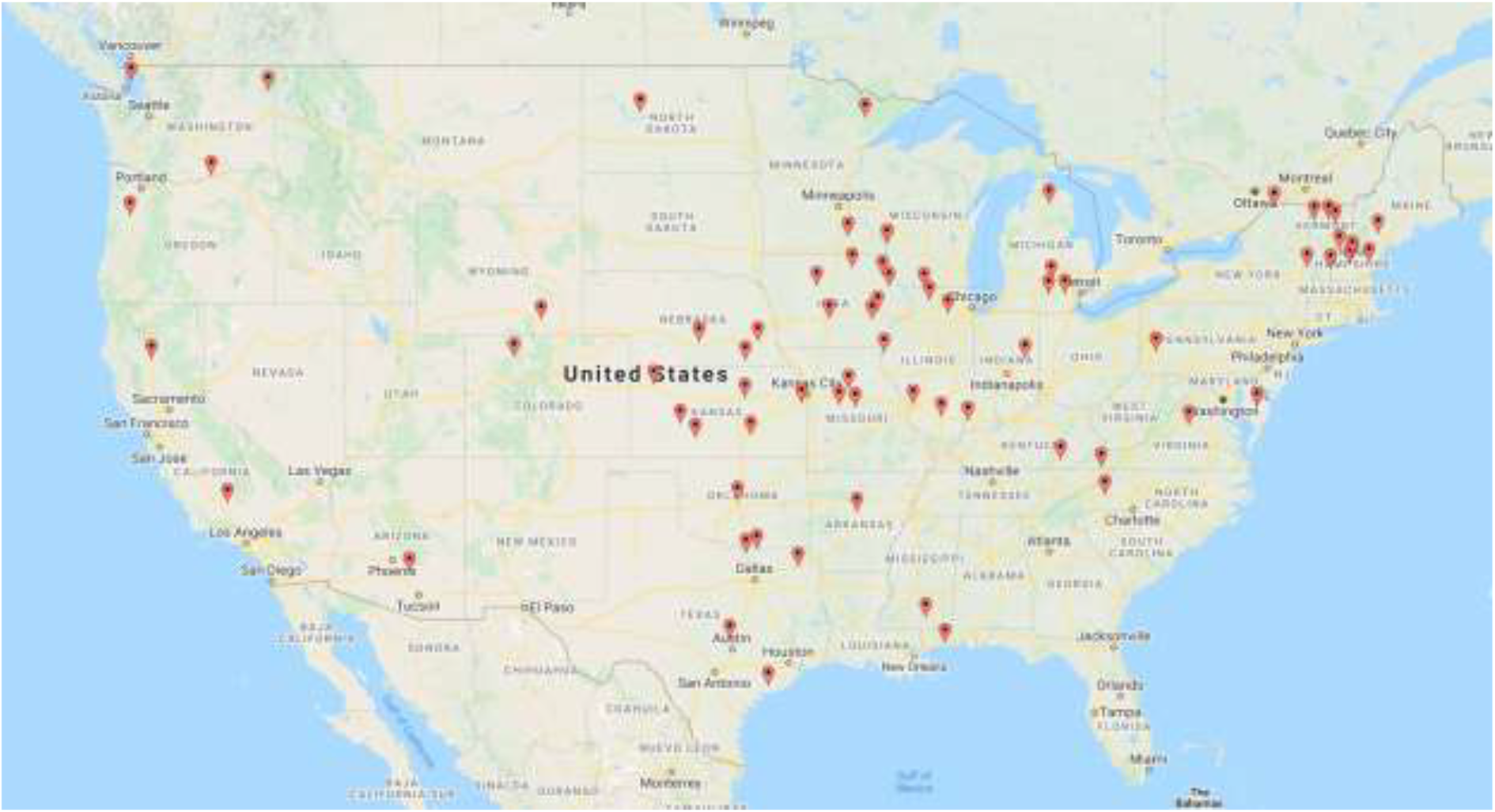
Small and rural libraries that offered outdoor play programming offered during the coronavirus pandemic, n = 74.
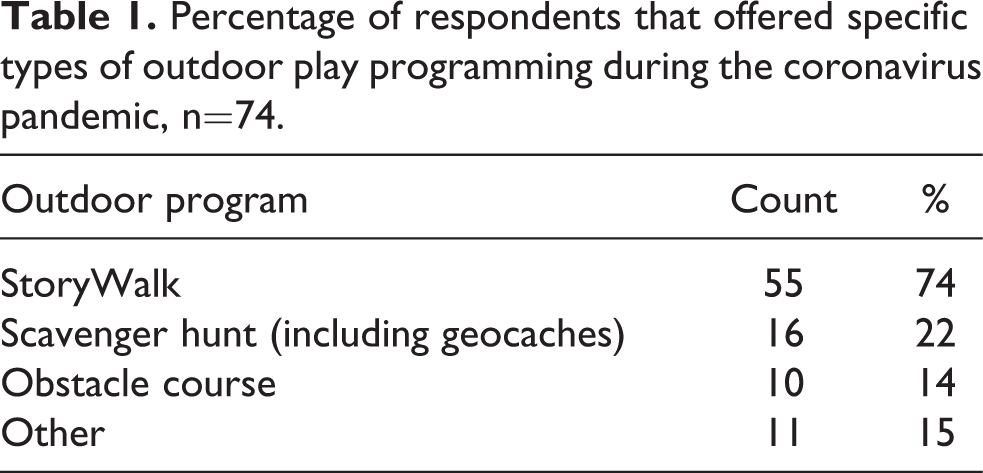
The most commonly offered outdoor program was, by far, the StoryWalk, with 55 libraries (or 74% of those that reported offering outdoor programs during the pandemic) stating that they developed and offered this program (see Table 1). After StoryWalk, no program was reported by more than 25% of the survey respondents. The other outdoor programs reported in the survey responses were diverse in their focus. This long list of other programs included both traditional and myriad variations on scavenger hunts; geocaching programs; outdoor obstacle courses; grab-and-go kits; science, technology, engineering, and mathematics or making activities and kits; nature-based programs; outdoor fitness; sports and sporting equipment collections; chalk-the-walk events; and walking clubs.
Percentage of respondents that offered specific types of outdoor play programming during the coronavirus pandemic, n=74.
Taking library programs outdoors: a closer look at the survey responses
StoryWalks
Since the StoryWalk program was reported by the survey respondents with such frequency, it is worth introducing this program and how these small and rural libraries have developed and refined it during the COVID-19 pandemic. StoryWalk was the idea of Anne Ferguson, who worked as a chronic disease specialist at the Vermont Department of Health. In 2007, Ferguson partnered with a local public library in Montpelier to refine and implement her idea of an outdoor walking trail with reading stations or stops (Thurston, 2020). For Ferguson and the library, this was a collaboration that would engage readers and encourage reading among individuals and families with children while enjoying the outdoors. The local library created a web page to share their experience and help others start similar programs. The StoryWalk stations each have a laminated page from a children’s storybook and are positioned along walking trails outdoors. The StoryWalk concept is very similar to United Way’s Born Learning Trails, except, unlike Born Learning Trails, the StoryWalk concept is not nationally coordinated (United Way, n.d.). After Ferguson created the idea of the StoryWalk—which she trademarked to ensure that it was used only for noncommercial purposes—it spread across the USA and other countries, typically, but not always, with public libraries as key partners (Kellogg-Hubbard Library, n.d.).
Many public libraries turned to the StoryWalk as the ideal way to transform public spaces and engage their communities during the COVID-19 pandemic. As one library, which serves a US town of 837, responded in the survey: “StoryWalks are the main tool we are using to mitigate exposure and maintain distance.” These programs are also opportunities for community collaboration. A library serving a town of 900 wrote: “We set up 2 StoryWalks at the library and at trails owned by the rec [recreation] department. The rec department helped with supplies and set-up.” Another library, which serves a town of 2200, wrote that they were “partnering with a Chamber of Commerce to do StoryWalks.” Although typically focused on children and families, some libraries also use StoryWalk programs to share local history stories and facts. One wrote that they were offering both a StoryWalk and a historic trail walk. Another library, which serves a town of 7000, wrote that instead of featuring children’s storybooks in their StoryWalk programs, they were featuring poems written at a higher reading level in a program they called “Poetry Walks.”
As the popularity of StoryWalk programming grew during the ongoing pandemic, some respondents reported trying to make permanent and more durable installations in outdoor public spaces where they could change stories out on a regular basis. A library serving a town of 4000 wrote that they were currently “working on a StoryWalk for Halloween and have applied for funding to create a permanent one as part of the city walking trails.” Similarly, another library reported that their StoryWalk programming during COVID-19 aligned with broader local efforts to promote walking and walkable communities. A library serving a town of 6220 wrote that they “provide picture books for our community StoryWalk on our new walking trail on the north side of town.”
Scavenger hunts: themes and variations
The second most commonly reported program was some sort of scavenger hunt, in which patrons were charged with exploring and finding specific things scattered around the community in windows, in parks, and in other spaces. In addition to more traditional versions of scavenger hunts, libraries reported on variations, which included the following examples from the open-ended survey responses: A bear hunt around town for kids to look for bears in windows. Scavenger hunts in our town to encourage outdoor exercise. Window seek and find. Local landmarks bingo. We are working with the Chamber, where members of the community are trying to find pictures at certain businesses. The library has placed five geocaches around the community and maintains them. We occasionally hide painted rocks and offer prizes if you bring them to the library. We are going to promote an Explore program in October for families to earn a medal by exploring our community (including historical sites, parks, hiking trails). We had a bookworm that escaped the library, patrons were to photograph it when they found it. We are active with Pokemon Go.
Obstacle courses: having fun while exercising outdoors
A smaller number of libraries reported organizing obstacle-course programs, in which the sidewalks in front of libraries are transformed to include things like hopscotch. A few libraries wrote that they had done a sidewalk obstacle course and may do another, and many simply wrote that they had offered these courses. Others reported combining sidewalk obstacle courses with other socially distanced library programming, and/or offering that program in collaboration with other local or community groups. One library wrote: The Recreation Department had a sidewalk chalk challenge, in which families could create their own obstacle courses on sidewalks using chalk & anyone who happened upon them could enjoy them later. We shared this activity, and we have shared some of the Recreation Department’s weekly activity guides on Facebook.
After these three types of program—StoryWalks, scavenger hunts, and obstacle courses—a wide variety of other program types was reported. This speaks to a spirit of experimentation that emerged during the COVID-19 pandemic, in which small and rural libraries recognized the value of outdoor programming and innovated to serve their patrons and maintain a strong presence as a resource in their communities. These experiments included: Yoga on the lawn. Cataloging & processing sports/outdoor play equipment for circulation. We made our summer family fun remote—families could get a bag of supplies and were encouraged to be active at home or [in] a park. We are planning seasonal/special occasion come-and-go activity bags…and a new landscaping project that will include a Fairy Door and other surprises around a large tree. We have devoted a large portion of our Summer Library Program prize budget for sporting and physical activity equipment for families to use at home. Encouraging making art and celebrating the outdoors. We offer State Park passes that we check out. Victory Gardens, passive programming in the garden. We started a Walking Club twice a week. People can choose a longer walk or shorter walk. We are having a fall festival with yard games, horse shoes, art show, pumpkin painting, and live music. We are hoping to social distance so we can get everyone out in the community. Our Summer Library Fun program included a bingo-style sheet which included things like take a walk with your family, go on a bike ride.
Discussion and conclusion
This study of how public libraries innovated to reimage their programs as outdoor activities in the face of having to close their doors to the public during the COVID-19 pandemic reveals some of the strategies that librarians, particularly in small and rural communities, developed to continue to serve their patrons. In so doing, they extended the footprint of the library itself into outdoor public spaces in their communities in unique ways that allowed patrons to continue to interact with and benefit from library services and programming. These early examples of innovation to sustain library services and programming during a global pandemic may serve to inform and inspire further placemaking practice that asserts the place of the library in its community as more than a building and transforms how we think of and use pubic space in the process.
Although this study is small, it demonstrates the additional work that is needed to more fully understand how public libraries are transforming during the pandemic. A recent initiative by the Knight Foundation’s Public Spaces Fellows is demonstrating the essential and critical nature of public spaces for public health and the need for them to be more equitable. Knight Public Spaces Fellow Eric Klinenberg, who has studied public libraries, points to efforts by libraries to move their services outside the library building during COVID-19: “A number of libraries have effectively unfolded, moving services outdoors, and moving librarians to other spaces, finding new ways for people to access the library even though the building itself was closed” (Gendall, 2020). He suggests that these efforts need to be both responsive to immediate needs and consider the long-term impact on our communities. The present study has explored one facet of that transformation. Much more additional research is needed to examine other ways in which libraries are moving services outdoors, and the discussions and planning libraries are engaged in to assess and imagine the place of the library for the term of the pandemic and beyond. If libraries are truly third places that are essential to personal and social development and community health, as suggested by Oldenburg, then how they use public spaces other than their buildings for services and programming must ensure the spaces are accessible, welcoming, inclusive, and accommodating—the same values that make the library itself a trusted institution.
This is not unique to the USA or, frankly, specific to the constraints and challenges that come with a pandemic. Libraries and librarians innovate and are resourceful. They are committed to serving their communities in ways that directly speak to unique needs and interests. Additional research is also needed to more fully understand the challenges and opportunities associated with community-based programming in outdoor public spaces by public libraries in urban communities, and by libraries in communities in other countries. Anecdotally, we do know that this is happening outside of the USA. The Kellogg-Hubbard Library (n.d.) in Vermont notes on their StoryWalk web page that “StoryWalks® have been installed in 50 states and 13 countries including, Germany, Canada, England, Bermuda, Russia, Malaysia, Pakistan and South Korea!” On 8 September 2020, Jenny Mustey from Campaspe Libraries in Melbourne, Australia, offered the story of her library’s StoryWalk program development and implementation in a video recorded and shared on YouTube. She describes it as a success and “a great way for libraries to promote physical health and literacy in their communities” (Public Libraries, 2020). We need to understand how Mustey’s library and other public libraries are transforming, adapting, and developing their own experimental placemaking projects.
As is typical of emerging trends in library practice, much additional work is needed. Specifically, additional work is needed regarding the impacts of these placemaking endeavors. One possible impact may be closer partnerships with other organizations, as libraries work with chambers of commerce, local businesses, parks, and other civic and community organizations to transform public space. This study has demonstrated the value and importance of closely attending to how public libraries have innovated and worked with their communities to transform public space during the COVID-19 pandemic.
Footnotes
Declaration of conflicting interests
The authors declared no potential conflicts of interest with respect to the research, authorship, and/or publication of this article.
Funding
The authors received no financial support for the research, authorship, and/or publication of this article.
