



Abstract
In July 2020, during the COVID-19 pandemic, the Monash University Library in Melbourne, Australia, and the Penn State University Libraries in Pennsylvania, USA, leveraged their previously established international sister-library partnership to host a virtual engagement event focused on promoting the partnership and selected special collections at both institutions. The Monash–Penn State Great Rare Books Bake Off, a friendly competition collaboratively developed by the two academic libraries, engaged both institutions’ communities with their collections and resources by inviting participants to bake featured recipes from their collections and post evidence of their experiences on social media platforms. In addition to promoting awareness of the institutions’ international partnership and their respective collections, a primary goal of the collaborative project was to offer their local communities an enjoyable and creative outlet during a difficult time. This illustrative case study describes how the two institutions planned, executed, and assessed the project.
Keywords
Introduction
As COVID-19 moved across the globe, many citizens found themselves without access to in-person educational, occupational, recreational, and cultural activities, and abruptly confined to their homes. Seeking to keep themselves busy, cope with stress, or just stave off boredom, many people found themselves suddenly dabbling in homesteading hobbies, picking up a dusty instrument, trying at-home exercises, or pulling out their sewing machines to make masks (Cotnam, 2020; Enrich et al., 2020; Gan, 2020; Hope and Lange, 2020). In particular, baking rose in popularity across continents as people turned to comfort foods and experimented with recipes new and old (Abdul, 2020; Collins, 2020; VanDerWerff, 2020), getting more creative as the pandemic wore on (Lorenz, 2020; Orlow, 2020). Many shared the fruits (sometimes unsuccessful) of these labors on social media using various hashtags like #stressbaking, #quarantinebaking, #covidchallenge, and #covidcooking (Clifford, 2020; Levin, 2020; Ray, 2020).
With their favorite physical locations now closed, people were also seeking to maintain relationships with favorite and familiar places from the safety of their homes. Finding themselves likewise isolated from their user communities, educational and cultural institutions were also experimenting with novel engagement ideas. Some university communities, like Boston University, tapped into the surge in baking as a means to maintain connections among students, faculty, and staff (Sassoon, 2020). Archives, public libraries, and museums quickly pivoted to promote their collections with virtual gallery tours, live concert series, and online story times (Institute of Museum and Library Services, 2020; State Library Victoria, 2020). A number of museums increased their use of social media to both engage their communities and expand their reach to a much broader public with their digital collections (Agostino et al., 2020; Samaroudi et al, 2020). And some piggybacked on the popularity of social media challenges by tasking users with posting pieces recreated from their collections with only household items (Barahas, 2020). In many of these challenges, participants did more than just engage with “likes.” They hunted through digital collections to find paintings to recreate. They shared recipes from their personal collections. They pulled out their favorite books as suggestions for story times. The popularity of virtual engagement opportunities during COVID-19 demonstrates that when institutions invite users to share their experiences, lives, and perspectives, people will often respond with enthusiasm.
In March 2020, Christina Riehman-Murphy, a co-author of this article, was scheduled to travel to Monash University with one of two inaugural Penn State Libraries International Partnerships Travel Grants to explore potential collaboration in the areas of the internationalization of library pedagogy and curriculum, information literacy, and diversity and inclusion. When months of planning were abruptly put on hold, she sought ways to continue engagement with Monash University Library under the serious constraints of the pandemic; local restrictions for both institutions included stay-at-home orders, and thus interaction for both parties had to happen entirely virtually. But necessity breeds creativity, and when she discovered that Monash was hosting a student bake off, which serendipitously aligned with baking projects that Penn State University Libraries was involved in, it seemed like an opportunity to collaborate virtually within the international partnership framework. Inspired by models like The Great British Bake Off (The Great British Baking Show in the USA) and the Folger Shakespeare Library and University of California Los Angeles’ social media Pi(e) Day cooking competition (Happe, 2020), she saw potential for a timely and engaging social media event.
After an enthusiastic response from the faculty and librarians at Penn State, Riehman-Murphy reached out to the organizers of the bake off at Monash to see if they would be interested in coordinating an inter-institutional bake off with recipes from both libraries’ special collections. Monash was also interested in the initiative, and the Monash–Penn State Great Rare Books Bake Off was born. The following sections will explore the larger context of community engagement through a review of relevant literature, describe the project’s background, detail the project’s planning process, and consider the project’s results and lessons learned.
Literature review
Engagement
While the pandemic has emphasized the need for virtual engagement efforts, this topic and practice have been a consistent area of interest in library and information science research situated in the field of library engagement and outreach, in particular in the world of special collections. Engagement is critical if collections and resources are to be seen and used by patrons; further, patron engagement is seen as central to library development efforts. Traditionally, the axis of engagement in galleries, libraries, archives, museums, and records (GLAMR) communities has revolved around donations, programs, exhibitions, and displays. Government, grant, or donor funding for these institutions is often predicated on providing opportunities for research. But funding may also be accompanied by contributions to collections and increased access to them via a diverse set of engagement opportunities. Library use of social and digital media has redrawn the footprint of institutions, thereby creating increased opportunities for wider engagement and expanded outreach.
When examined within the broader scope of GLAMR, special collections and archives in academic institutions may face difficulties in articulating their engagement to their larger library organization, as it often differs from traditional university library engagement, which focuses on providing library access to researchers and students that fits within existing frameworks of research and pedagogy. Leong (2013) explains that academic libraries are expected to help the university meet its goals of impact, engagement, knowledge transfer, and innovation. Special collections and archives, however, also contribute to engagement through partnering with researchers and providing a conduit for external public communication of research. Moreover, they are an integral part of visitors’ experiences, providing unique access to rare artifacts for students and researchers alike. In order to facilitate the effectiveness of these programs, special collections units must also maintain engagement with the general public and civic communities that make up the traditional heart of the GLAMR industry (Fulgham, 2019; Greenwood, 2019; Harris and Weller, 2012; Jensen, 2013).
With extensive shutdowns and quarantines, the impacts of COVID-19 on the in-person functions of libraries across the world have highlighted the importance of virtual programs and services, amplifying the focus on such models within library communities. In fact, many library-focused bodies, such as the International Federation of Library Associations and Institutions (IFLA), American Library Association, Australian Library and Information Association, Conference of Directors of National Libraries, National Authorities on Public Libraries in Europe, and Association of College and Research Libraries, have sponsored virtual programming efforts, and numerous library and information science publications have published special issues on the status of existing and emerging virtual library programs and services (IFLA, 2020). However, the question for both Monash University and Penn State University was how best to do this in a completely digital environment, especially as the chosen approach of a Great Rare Books Bake Off was originally based on competitions that were in-person events.
Virtual engagement as a form of community has been around since the invention of Web 2.0, but interest intensified when Facebook became public and with the growth of other social media platforms such as Twitter, Tumblr, and Instagram. The 2013 publication of Drotner and Schroder’s Museum Communication and Social Media: The Connected Museum forms the foundation for research done on the topic in the GLAMR areas, setting the parameters for the academic discussion of precisely how to engage communities in digital spaces. Archival studies explore these opportunities as part of the means to construct the archive and collection in digital spaces (Cram, 2016; Prieto Blanco, 2015). One component of the digitization of archives is promotion of them on social media—for example, Ashuri (2011) explores archival consumption of Israeli soldier testimonies through sites such as YouTube and Facebook, and how this interactivity with an audience means that the archives do not calcify and become static, but rather are sites of living memory and change. These discussions around the digitization of collections, social media engagement, and how they shape collecting are shared with special collections and archives within academic libraries.
Distinguished from outreach and programming, at its core, engagement demands a relationship between the institution and the user that is reciprocal (Diaz, 2019; Drotner and Schroder, 2013; Eshbach, 2020; Schlak, 2018). The engagement should impact curation, collection development, and education, and change the nature of interaction and collaboration. The very act of focusing on engagement is an act of openness to being changed, and this is no different in a virtual environment where users can interact with other engaged users through social media and less direct library touchpoints (Peacemaker and Heinze, 2015). Librarians who want to achieve engagement “should not expect to influence users’ work without being prepared to allow users a voice in the delivery of library services” (Peacemaker and Heinze, 2015:270). As such, good practice in virtual engagement is not simply about “being something” but instead “becoming for someone” (Garner et al., 2016; Weil, 2012; Xu and Saxton, 2019). At its heart, engagement should be user-centric interaction, which goes out into communities in order to promote participation and create an extended commitment that will work towards building relationships among institutions and their users. Social media, no matter what the format, provides its own communities and shared language, whether that be text-based (Twitter), visual (Instagram), or some combination of both (TikTok). The successful case studies involving virtual engagement demonstrate an understanding of existing special interest pools, whether it is through Instagram tags, Facebook groups, or the flow of memes across all of the networks (Baggesen, 2014; Budge and Burness, 2017; Chu and Du, 2012; Hunter, 2018; Salahu-Din, 2019; Villaespesa and Wowkowych, 2020). These case studies suggest that virtual engagement across the different platforms should not only be tailored to each experience, but also be about creating new relationships, capturing a feeling, and sharing dialogue. For example, Villaespesa and Wowkowych (2020), in discussing ephemera and Instagram, talk about the use of hashtags in order to create a shared feeling and an aesthetically pleasing moment that can be fed into an existing community of social photography. For libraries, archives, and special collections, virtual communication and engagement must be complementary to the physical spaces as well in order to be truly effective (Mihelj et al., 2019).
Project background
Monash University Library and Penn State University Libraries began to explore an international sister-library partnership in the spring of 2018 as part of a larger strategic collaboration between the two institutions (Penn State, 2018). After a successful summit, the two libraries entered into a formal relationship with the goals of sharing resources and practices, collaborating in areas of mutual interest, and, together, supporting the research and learning objectives of the larger institutional partnership. To date, the partnership has begun a no-fee interlibrary loan plan, shared professional development opportunities, and explored shared interests in collection strategy, assessment, data management services, library publishing, and library instruction. The collaboration has been largely facilitated by virtual meetings and email connections between the two partners, but the relationship has been significantly bolstered by several reciprocal visits. As described in the introduction of this article, it was the COVID-19 disruption of one of these planned visits of a Penn State librarian, Christina Riehman-Murphy, to Monash that precipitated the collaborative international library engagement baking event discussed in this article.
Early in 2020, Monash University Special Collections was exploring ways to promote awareness of and engagement with its extensive recipe book collection. Inspired by watching Instagram Live television videos of people baking in lockdown, the Special Collections librarians thought that perhaps library patrons, stakeholders, and community members could “cook from the collection.” The announcement that a novel coronavirus was expanding through Wuhan coincided with the start of the semester, and as many of the students who attend Monash University were unable to arrive in Australia due to border restrictions, the university moved all classes online. The university then began to move all student activities into a digital mode and launched Monash Social. Concurrent with these developments, Monash Special Collections proposed the “cook from the collection” idea to the library Communications Manager, Heidi Binghay, with the evolved title of the “Rare Books Bake Off.” The three goals of the project were to promote the library’s digitized collections, provide an incentive (vouchers for a local supermarket chain) that would help support students during the pandemic, and build student engagement with the library while providing a break or distraction from COVID-19 difficulties. The entries were to be judged by a library panel according to how well the cooking was captured on video, how a taste-tester reacted, and the final product’s presentation. The recipes were hosted on a web page along with a series of brief videos that were then posted on social media showing how to cook the recipes. The resulting entries were of high quality: the students had not only baked the recipes, but also edited together high-quality videos, each of which had its own unique twist on the end product.
Penn State Libraries had also had previous experience with baking-related engagement and outreach prior to the collaborative online bake-off event with Monash University Library. At the University Park campus, one of Penn State’s 23 campuses, the libraries had previously run a local Edible Book Festival event as part of the larger International Edible Book Festival, which commemorates the French gastronome Jean Anthelme Brillat-Savarin (Penn State, 2017). First launched in 2017, the local event encouraged students, staff, and faculty to participate in the competitive event by baking a literary-themed cake, which would then be eligible to win a prize in one of five categories: people’s choice, most creative, best depiction of a classic, funniest/punniest, and most appetizing. The goal of this event was to provide the participants with an entertaining way of engaging with the libraries and literacy.
Further, at the Penn State Abington campus, Riehman-Murphy was embedded in an undergraduate research project called “What’s in a Recipe?” In this multi-year project, students transcribed digitized family recipe manuscripts from the Folger Shakespeare Library’s collection. The lead faculty member, Dr Marissa Nicosia, also independently runs “Cooking in the Archives,” a public historical recipe project where she researches, updates, and recreates early modern recipes for the public via her blog (rarecooking.com). Despite the sudden restrictions due to COVID-19 right in the middle of the final weeks of the project, the students in the current cohort were able to complete their individual research projects virtually, for which one student recreated a 17th-century recipe and blogged about the experience. Thus, Riehman-Murphy knew that engaging students with historical recipes could be successful even in a virtual environment, and that Marissa Nicosia’s experience researching and recreating them for the general public had potential for many other engagement opportunities, such as a virtual bake off.
Project planning for a new initiative: the Great Rare Books Bake Off
Organizing an online engagement event across two institutions of the size of Monash University and Penn State University requires careful logistical planning. Ensuring a successful project required not only the coordination of, and buy-in from, multiple internal stakeholders from both institutions, but also the cross-institution coordination of those stakeholders. The project required support from marketing and design, special collections, digitization, bakers, development officers, library administration, and business offices on both sides of the partnership.
To facilitate the project work, each library assembled a project team. The two teams then communicated regularly via email and videoconferencing for full-group planning. The spirit of flexibility and comradery, which is needed when working in an international context, was clearly demonstrated in these meetings, as Penn State colleagues cheerfully agreed to meet outside of normal business hours to make the meetings work through significant time differences. As tasks were distributed and timelines established, smaller working groups were formed between the two partners around expertise or function in order to coordinate efforts. For example, marketing specialists from the two libraries worked together to develop an outreach strategy that would be conducive to both universities’ environments; special collections managers and librarians from both institutions worked together to develop a robust and diverse offering of possible baking options; and the lead bakers, Marissa Nicosia and Isabel Melles-Taberner, met virtually to swap baking tips, clarify confusing or culturally specific recipe nuances, and develop an aligned look for the social media baking content.
The rules that the group established for participation in the collaborative bake-off event were simple and designed to promote users posting any and all results, whether they were successful or not. In order for a social media submission to be counted, users had to:
Choose a recipe from a list of either Monash or Penn State special collections materials;
Bake the recipe and take a photograph or video of the finished product (baking fails were welcomed);
Submit the entry to Instagram, Twitter, or Facebook, and include the hashtag #TheGreatRareBooksBakeOff and either #BakeMonash or #BakePennState to indicate which team they were baking for;
Make sure that the account it was being posted to was public, so that each entry counted.
Although engagement and cross-cultural learning were the primary objectives for the online event, the group felt that the inclusion of friendly competition between the institutions would likely increase participation and social media engagement as well. The participation rules outlined above allowed for easy calculation of the event results and, ultimately, identifying the winner would be as simple as tallying up the tags to see which university had the most tagged entries.
During the planning, the teams decided that a week towards the end of July would be a good time to pilot this inaugural bake off. Despite this being out of term for both institutions, a July time frame would give the teams the time to select and bake recipes, source ingredients which were occasionally out of stock due to the pandemic, create content, and market the event. While the time difference between Melbourne, Australia, and Pennsylvania, USA, did not allow for a completely synchronous event, the group decided that the bake off would be launched on each institution’s respective Monday, 20 July and run through the week, ending on the following Friday, 24 July. The planning teams felt that tying the competition period to a single week rather than an extended period of time would potentially add a sense of urgency to the event and increase participation.
Community and recipes
The careful selection of recipes was essential to the success of the bake off. The goal was to choose recipes from Penn State and Monash University’s special collections and to reflect the local character of the food and history of each region as much as possible, thereby creating repositories of nostalgia and memory, and providing an opportunity to explore the familiar and the foreign (Weil, 2012). Therefore, in order to create a user-centric interaction for the communities we were hoping to engage with, the recipes needed to be particular to both of the local regions, represent a diversity of cultures, and reflect a classical national flavor. We also wanted the recipes to be accessible to bakers of all skill levels. Ultimately, four recipes from each university’s special collections were chosen by each team, with the plan that we add recipes for subsequent bake offs. Three were simple-to-cook recipes and one was of medium difficulty for adventurous cooks. By thinking broadly, we could also showcase different types of baked goods—cookies/biscuits, cakes, tarts, and so on. Although on the surface many recipes in Australia and the USA seem quite different, there are commonalities because of eastern and central European migrants. By choosing locally relevant recipes, the libraries hoped to promote curiosity about each other’s culture and evoke nostalgia for the familiar, which food history so often brings with it. The shared exploration of the different recipes, techniques, and backgrounds behind them also served to draw both the Penn State and Monash staff together in the planning stages.
Monash recipes
For Monash, the collection of cookbooks is extensive, so the main challenge was narrowing down the options to something that would reflect differences in class, place of origin, and the Australian divide between the city and rural areas, and, if possible, include Aboriginal and Torres Strait Islanders cuisine. After making a list of some of the more popular baked goods—lamingtons, scones, neenish tarts, ANZAC biscuits, pavlova, puddings, Greek bread twists, Italian biscotti, damper—the team went looking for matching recipes, preferably in their original editions. The final choice came down to choosing four recipes that best reflected the different elements of the Australian and Melbourne food world.
The first recipe was taken from a selection of cakes put together by the artist and restaurateur Mirka Mora. Mirka and Georges Mora immigrated to Australia from France at the end of World War II, opening one of the first street cafés in Melbourne. Although the Moras immigrated in the early 1950s, there had been many earlier Jewish immigrants to Melbourne. Not only did Mora’s work beautifully represent the café culture of Melbourne and its connection to French cuisine and the modernist art scene, but also the walnut cake was a classic Jewish recipe from Hungary. The second recipe was a fruit damper recipe from a beautiful artist’s book put together in collaboration with Kimberley Elders; it represented a part of working-class Australian food as well as the much longer history of the baking and cuisine of First Nations people. The third recipe came from an extensively annotated recipe book from rural Victoria in 1912. The smudged, dirty recipe was for “beautiful pudding,” which is better known as lemon delicious pudding, a British-style pudding that provided an interesting comparison to the US understanding of “pudding” as a custard or mousse. Eileen McMahon’s pudding gave us not only insight into the social and cultural life around the food, but also an opportunity to talk about American pudding versus British pudding. The last recipe was for the lamington (a chocolate and coconut covered sponge cake), which was the classic of Australian baking from 2020.
Penn State recipes
Like Australian baking and cooking, the US national cuisine is an amalgam of flavors, dishes, and traditions that represent the centuries-old colonization and subsequent decades of immigration from nearly every continent, as well as the lessons taken from the cultivation practices of the Indigenous Peoples of the Americas. Stereotypical traditional American cuisine often includes apple pie, hamburgers, or barbecue, but depending on your region and ethnicity, those particular dishes may be unfamiliar foods. In addition, cookery is not a particular collecting or digitizing focus for the Eberly Family Special Collections Library at Penn State’s University Park campus, so options were a bit more limited for this team. To its advantage though, Penn State has 23 campuses spread across the commonwealth of Pennsylvania, many of which have their own unique special collections. So, the team reached out to its special collections and archives community of practice in order to locate already digitized recipes that may have had a connection to Pennsylvania’s culinary history.
This search resulted in eight recipes, from which the final four were chosen. The first was a recipe for chocolate drop cookies, which came from the Elaine Hunchuck DeFrank family records in the Coal and Coke Heritage Center at Penn State Fayette Library. Elaine’s Slovakian heritage, which she brought to the Italian family that she married into, makes it impossible to trace the cultural origin of the recipe; however, this recipe uniquely reflects the large immigrant mining community near Pittsburgh. The second recipe was for cinnamon buns and came from the Abington campus near Philadelphia. Prior to becoming Penn State Abington, it was the Ogontz School for Girls, and its archives create an intimate picture of the life of the girls who lived there in the late 19th and early 20th centuries. Although traditionally a northern European pastry, the cinnamon bun recipe at Ogontz was served for over 34 years—its belovedness documented with poems and odes to its deliciousness. The third recipe for a lemon tart came from the 18th-century Browne manuscript at Eberly Family Special Collections Library. Although a classic French dish, the lemon tart in the USA is best represented by its close cousins, lemon meringue and key lime pies. And finally, the fourth recipe came from the Penn State Harrisburg Library and Special Collections, which is home to the Three Mile Island collection and a cookbook of local recipes which were gathered to document the food that helped Middletown residents survive the worst nuclear accident in US history. It is a recipe for the uniquely Pennsylvania pie, the wet shoo-fly pie, which originated with the Pennsylvania Dutch (who were actually German immigrants) in the 1870s.
Promotion
After meeting together, the group decided that both Monash and Penn State would have their own websites to promote the event. However, in the interest of efficiency and resource-sharing, both Penn State and Monash used Monash’s May 2020 “Rare Books Bake Off” website as the template for the separate but parallel sites (Monash University, 2020; Penn State, 2020). The websites included links to the recipes, video and images of the cooking process, citations, and the rules for entering, as well as hashtags and other social media necessities.
The social media strategies included posting two to three official posts per day across both libraries’ Instagram, Twitter, and Facebook accounts. Eliza Liddy, Multimedia Coordinator for Monash University Library, designed graphics for social media use, taking the theme colors of Penn State (blue and white) to design a series of entertaining images (see Figure 1). A multimedia specialist in Penn State Libraries Public Relations and Marketing Department created a logo that would give consistent branding across the platforms. The posts’ content also included formal “banter” between the libraries designed by the communication teams, as well as other information about the collections, recipes, and cooking processes interspersed during the week. The posts were staggered so that they mitigated time-zone differences between Melbourne and Pennsylvania. Both Monash and Penn State planned posts in advance of the event, with Monash opening the competition one day ahead and Penn State ending one day later.
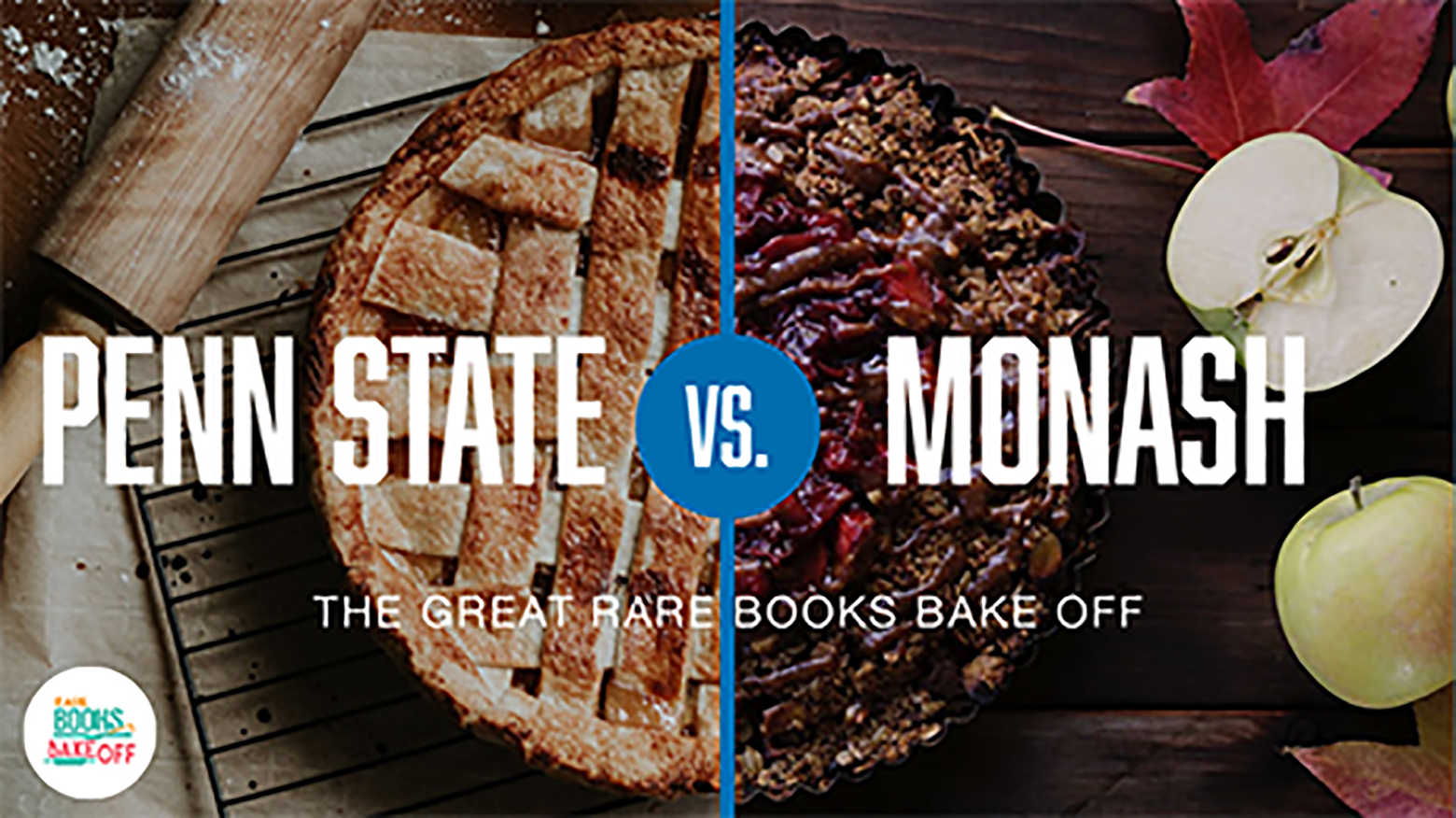
Penn State versus Monash social media post with two-pies image. Image credit to Eliza Liddy.
In addition to the libraries’ formal social media posts to their accounts, members of each planning team dedicated time during the week-long competition to elevating the community posts and interacting with any questions or comments that might come in. Hoping that the competitive team nature of the bake off would itself generate interest and incentivize participation, the group also decided to forgo monetary prizes (which had been a part of prior baking events at both institutions) and, instead, Mark Mattson, Head of Global Engagement Initiatives and International Partnerships Librarian, was put in charge of coming up with a “trophy” that would go to the winning institution to proudly display after the event. An antique pie plate from a local Pennsylvania baking company was acquired from an antiques shop near Penn State’s University Park campus and, once engraved, was designated as the prize that the winning library could display (see Figure 2). Having a physical representation of the bake-off event would also allow for the possibility of establishing an amusing tradition of trading the trophy between the partners in following iterations of the event.
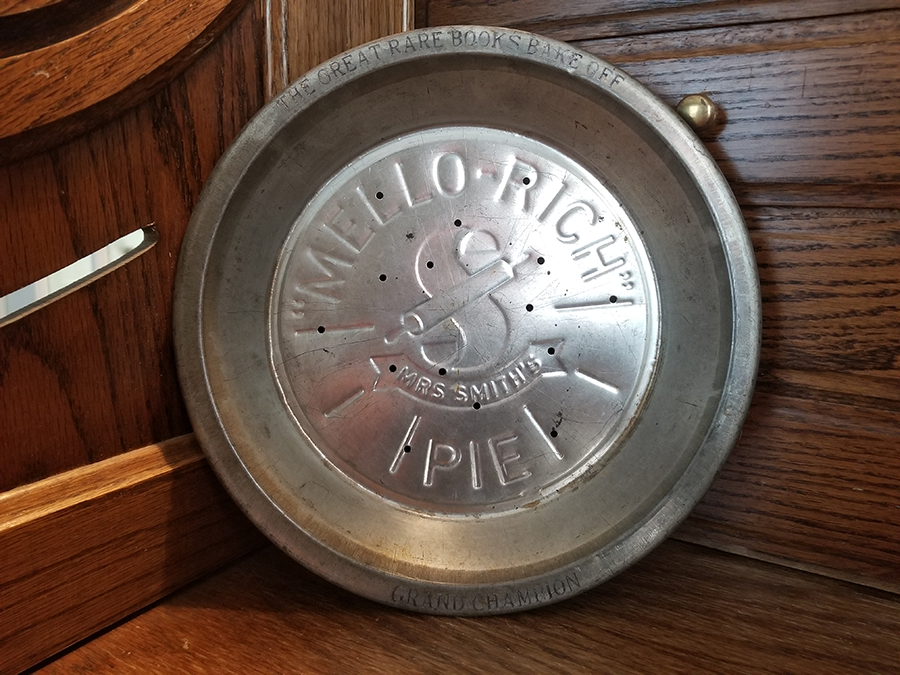
Pie tin etched with “The Great Rare Books Bake Off Grand Champion” and impressed with “Mrs Smith’s Mello-Rich Pie.” Image credit to Mark Mattson.
Results
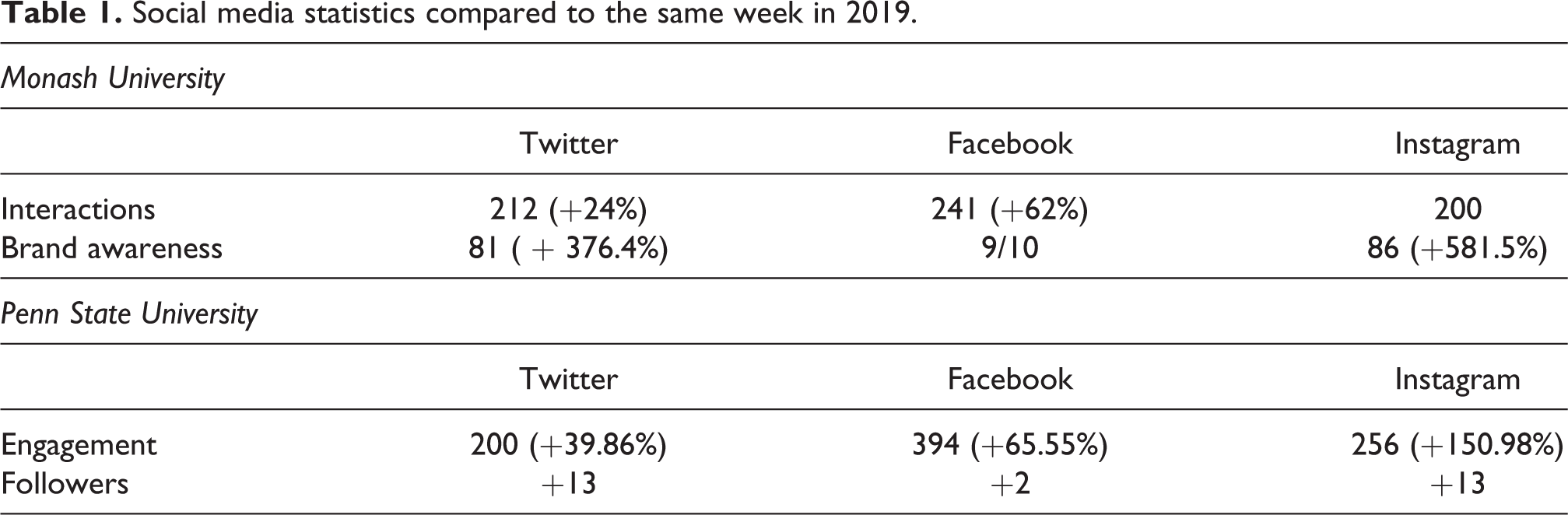
Because the Great Rare Books Bake Off was an event that required participants to both plan ahead (purchase ingredients) and perform, by social media standards, a relatively involved activity in order to participate, the team was unsure if the event would be appealing to a large audience. However, the resulting engagement surpassed the team’s expectations with not only the number of participants, but also the depth of enthusiasm that the participants displayed in their posts. Participants invested time not only in decorating their final baked goods in innovative ways, but as in Figures 3 -5, creating Instagrammable table settings and designs. In terms of level of participation in the inaugural event, the Great Rare Books Bake Off exceeded participation numbers from comparable past events at both institutions, and Marissa Nicosia commented after the event that the level of participation exceeded any efforts that she had previously been involved in through her “Cooking in the Archives” historical recipe project. Between both Penn State and Monash University, there were 169 items baked. Nicosia’s experience is supported by the social media metrics that were shared by the communications teams, as across both Penn State and Monash these showed an increase in engagement and reach. The Penn State web page had 1371 users, 6774 page views from 7 different countries, and a 52% bounce rate. Monash, by comparison, had 869 page views for the period of 14–26 July, which, although fewer than Penn State, still put it as the second most visited page for Monash University Library—second only to the library’s home page. Social media showed a similar increase of interactions and engagement, as well as a consistent increase in brand awareness and follower. The data on this is complex, as most of the analytics are comparative to previous years and not specific to the special collections but the wider university libraries; still, the scope of interactivity for the two university accounts increased (see Table 1).

Penn State alumni bake cinnamon buns and display their Penn State pride. Image credit to Instagram users @veravulture and @zellercat.
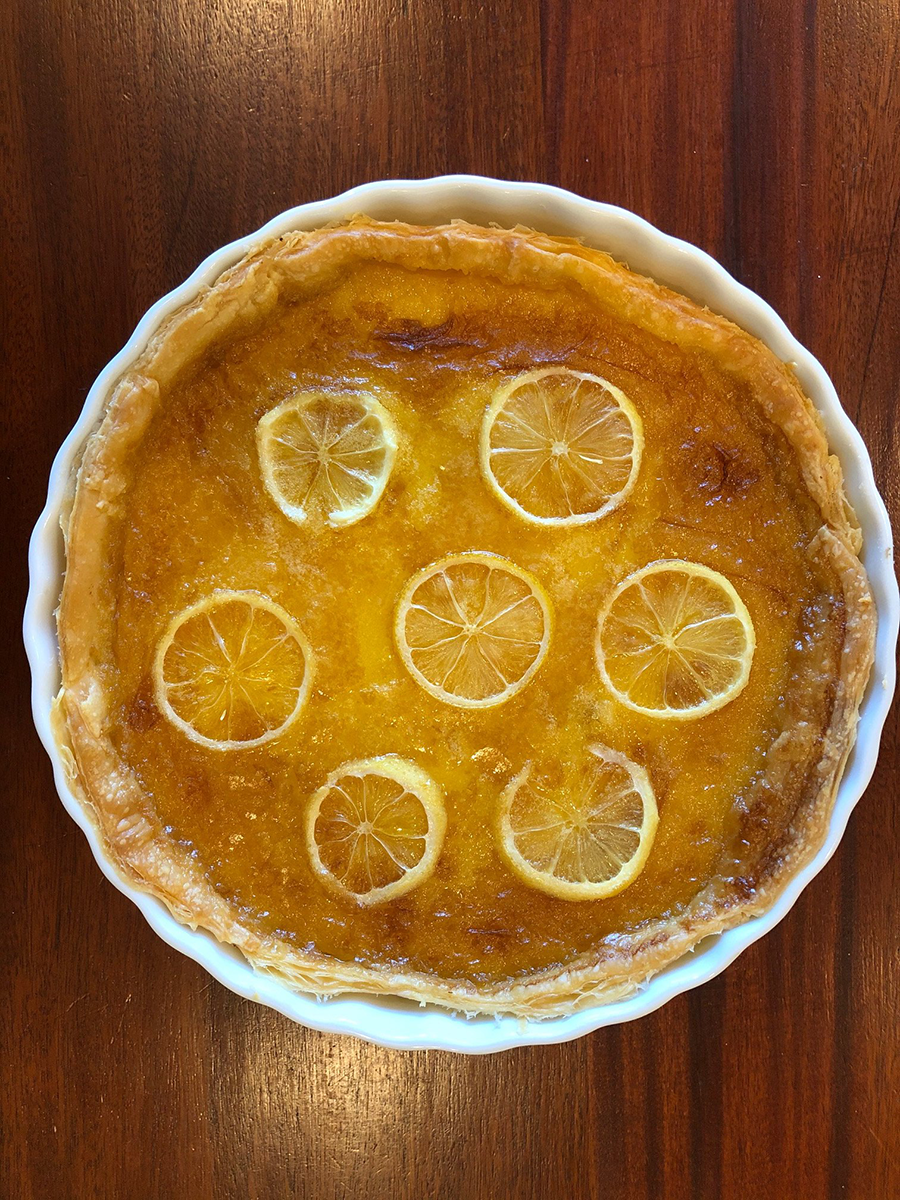
Monash University staff bake a lemon tart, adding lemon slices that then go viral. Image credit to Graham Harrison.

Monash University staff bake “beautiful pudding,” creating Instagram-worthy designs with table settings. Image credit to Instagram user @anney_24.
Social media statistics compared to the same week in 2019.
Further evidence of the popularity of the bake off through the university accounts came in the form of the State Library of New South Wales chiming in by baking from one of its own rare-books manuscripts to join in the hashtag, even though it was not part of the competition. The State Library of Victoria took a slightly different approach, adding a “bake the recipe” component to its membership activities email. Additionally, in the fall of 2020, Florida State University Special Collections and Archives contacted us to get permission to use the #thegreatrarebooksbakeoff hashtag for their own competition, which was inspired by ours (Hagaman, 2020). They are considering making it a yearly event, which reflects the feedback that Monash University and Penn State received, with the participants relaying that they were eager to participate in a “rematch” event the following year, that they would like to expand the event to possibly include some in-person aspects, and that they enjoyed not only the results of their baking, but also the creative and cross-cultural aspects of the event.
One element that these results and the audience engagement have emphasized is the importance of each team having a dedicated space to special collections in social media challenges. For both teams, there was some difficulty, with each communication team balancing its continued social media responsibilities to promote other areas of teaching and learning as well as the bake off. At some points, the intensity of posting meant that we were oversaturating communications. In the end, however, the high engagement was worth the disruption, but it emphasized that, to go ahead, some of the institutional social media structures will need adjusting. This is reflected in the successful branding done by Florida State University, which emphasized that it was coming out of Florida State University Special Collections and Archives, allowing for a more immediate connection to their collection promotion. By making the branding specific to each collection, Monash University and Penn State would be able to really highlight the research they did on their collection's recipes which in turn reinforces both communities they are part of. This is reflected in the type of branding done by Florida State University, which emphasized that it was coming out of Florida State University Special Collections and Archives, allowing for a more immediate connection to collection promotion, which is important given the amount of work that both Monash University and Penn State put into their recipe choice as the underpinning of community promotion. This is one immediate way in which the engagement from users influenced the institution; in January 2021, Penn State Special Collections launched its own Instagram page to better connect with users interested in archival content.
In addition to fitting in with the popular social media trends of 2020, the recipes had been specifically chosen to give the bake off a sense of community that drew from the international character of the competition. Despite some awkwardness in posting information about the different recipes, the choices worked remarkably well. Almost every entry reflected the importance of connecting the recipes to the history and culture of their place of origin, validating the extensive research done on the recipes’ background. Within Monash, staff who were born in the USA found some familiarity in the cinnamon buns while at the same time learning about “shoo-fly pie” from a state that they had previously had less familiarity with. Other contributors shared personal connections to the recipes, expressed family traditions while using their grandparents’ baking tools, or dedicated the submission to a loved one. In one case, a participant posted a photograph of her cookies and explained that she chose the particular recipe because “I identify w/ the uncertain ethnic amalgamation of their origins in western PA [Pennsylvania]” (Beshero-Bondar, 2020). In another example, a Monash staff member who was unable to bake posted photographs of her grandmother’s and great-grandmother’s recipe books, which she had been transcribing, pointing out how in the middle of a shopping list her grandmother had joyously written: “May the Hen laid—what a wonderful bird!” (O’Neil, 2020). The place of the recipes within both Victorian and Pennsylvanian culture anecdotally brought more depth to those participants who made the activity a family event and got their children involved in the preparation, giving them an opportunity to learn about things such as Indigenous Australian culture or direct contact with the devotion that is involved in college football. In the comments, there was comradery displayed in both the baking successes and baking failures across “team lines,” with tips being shared and encouragement given to everyone, even on the posts that included props to show “team spirit” with elements like the school mascot or colors.
As referenced in our literature review, one of the main difficulties with the promotion of special collections within a university is to connect the material not only to academic researchers but also to the wider public. An important subgoal of the Great Rare Books Bake Off, alongside fortifying the international partnership, was to help promote each university’s special collection. Despite the number of people participating, the bake off was still only reaching a few very localized networks that depended largely on the organizers. In part, this can be seen to be a result of social media not being a freely open space, and instead being regulated by multiple complex algorithms and regulations which determine who sees what content and when. The result is that becoming part of the ongoing exchange in environments that are incredibly dynamic and responsive can be a hurdle that is difficult to overcome (Baggesen, 2014; Griffin and Taylor, 2013). This is true of the bake off, where posts that were information-heavy and without images found less traction, making conveying important collection information to users difficult outside of “we have recipes.” One solution for any repeat bake off would be to carry out more research into other social media cooking influencers on each platform and make sure to engage with them. For example, to help promote the damper, it would be ideal to reach out to other online groups such as the Murrigellas, a group of Murri home cooks, and see if they would be willing to bake with us, as well as to provide cooking tips.
Other issues, such as equality and representation, are more difficult to address in a digital sphere. Despite a massive increase in social media usage for adults in both the USA and Australia during the last 15 years (Pew Research Center, 2019; Social Media Perth, 2020), approximately 30% of adult citizens in these countries do not use social media due to disadvantage, many of whom are important members of the community that both universities wish to engage. However, one area where this can be handled is in improving collecting practice. The Great Rare Books Bake Off influenced Monash Special Collections to rethink its cookery book collection, in particular how user response illustrated the importance of an individual’s relationship to cooking, cultural practices, and identity. During the competition, it became clear that the collection’s cookery books did not represent perceptions of Victorian cuisine beyond a narrow sample. For example, despite the influence of Italian migrant communities in shaping Melbourne’s food history and requests from Monash staff members for tiramisu, there was only one Italian cook book in the collection and it unfortunately did not have the dessert. For Penn State University, the bake off affirmed that despite cookery not being a priority in the collection development plan, the distributed special collections model across geographically distributed campuses can hold a diversity of materials. In preparation for future bake offs, however, the curator is on the lookout for recipe manuscripts which may fit the competition’s parameters and the scope of the collections. For Monash, future collecting will focus on updating to include new immigrant communities as part of the discourse, as well as seeking (and encouraging) local Indigenous recipes. There is also much more room for engagement with the society that Monash Special Collections is actively trying to preserve, especially the importance of consultation in finding “community” recipes in a multicultural society. The Great Rare Book Bake Off also demonstrated the importance of manuscript recipes and the immediacy they bring to people. The data proves that there are significant gains to be made from special collections engaging in this type of social media project and future iterations of the Great Rare Books Bake Off will provide more information for a targeted research study where we can explore the best methods of assessing engagement for both the users and the institutions.
Lessons learned
The assessment process included real-time evaluation and adjustments (modifying the number of social media posts to respond to engagement, clarifying areas of confusion with the rules or recipes, or adapting messaging tone), but the majority of the project assessment occurred post-event. In appraising the project post-event, the partners reviewed the participation results and outcomes in order to identify event successes, challenges, and the possibility of replicating the event in the future. The assessment process included reviewing total participant numbers, examining submissions for variations in forms of engagement, identifying points for improvement, and soliciting feedback from project team members. While the group unanimously agreed that the event was a success and that it should be further developed into an annual event, the group also identified multiple lessons that had been learned.
One of the most important lessons learned through hosting the inaugural event was the need to further clarify participation instructions. During the event, the team received various questions about how to participate using various social media platforms. Individuals sometimes posted to accounts that were set to private and were inaccessible for inclusion in the event. Inquiries about how to participate if someone did not use social media were also an indication that further clarification of the participation procedures was needed. This prompted the team to consider a non-social-media option in future events. One clear illustration of this issue was in Monash’s use of Workplace (the university’s internal social media space) to find support from library staff, as well as putting out a request to enter the competition. Three days into the competition, the tallied numbers indicated that despite the fact that the Monash team seemed to be doing well, Monash entries lagged behind the entries of Penn State early in the event. This forced the group to go back to basics in order to seek more entries, and to address the fact that people were posting their entries to Workplace rather than on public social media platforms such as Twitter, Instagram, or Facebook. Many of the posts were also set to private, so the hashtags could not be counted. To remedy this, members of the planning group created Instagram accounts so that they could repost the entries of people who did not want to make their own accounts public. With a renewed push for content, as mentioned above, the final participation tally was comparable.
Related to the need to clarify participation instructions, the team also recognized the importance of using separate engagement posts and accounts across various social media platforms to promote participation to different groups. The different platforms seemed to reach different communities and audiences, and making the content and promotional materials accessible to the multiple platforms was important in reaching a large section of the universities’ communities.
Further, as the event progressed, ideas for collaboration with other institutional entities and groups were identified; however, it was decided that such collaborations would need to be established in advance of the event. In addition, engaging the social media accounts of groups such as the universities’ alumni associations and student groups would help to extend the community of engagement and potential participation for the event, so the team plans to work on establishing these opportunities for the next iteration of the event. In the future, this would mean that there is more of an opportunity to reach out to students as well and begin to develop a pedagogical component in the competition.
The cross-border and cross-cultural aspects of the event did seem to draw in participation and enthusiasm, but the team also needed to navigate some of the cultural differences between the audiences. While the culture of the two institutions and their home countries are in some ways similar to each other, the team did recognize that the university environment in Australia is quite different to that of the USA. For example, Penn State University has a very strong team spirit/sporting culture, whereas Monash University does not have an official mascot or a single major sporting team, which required the group to choose the generic “green and gold” motif that Australia uses when competing internationally. Similarly, the social media posts designed to create “friendly competition” were carefully crafted through collaboration to ensure that the messaging would be culturally relevant on both sides of the partnership in terms of the use of humor and informal language. These cultural differences did, however, provide a fun opportunity within the promotional materials to play up differences, such as the use of the terms “cookies” and “biscuits.”
Another aspect of the event that the group felt could be improved in next year’s iteration was the integration of promotion for related content. For example, the team felt that there could be more special collections content and sister-library content featured on the websites and social media posts. With the attention of a large number of participants that the event drew, the team felt that it may have been possible to further engage the community in the collections by using interesting facts or perhaps additional challenges. The event might have also given a bit more background on the two libraries’ partnership and how the partnership is benefiting the two universities. These items were present in the event’s content, but they could have been featured more prominently.
A final lesson learned was in the timing of the event. The inaugural event was planned to run from Monday through Friday of the selected week. However, the team received feedback that participating in a somewhat extensive baking event on weeknights was challenging for participants with busy work–study–family schedules. In response to some of this feedback, the team is planning to include the weekend in future iterations of the event so that the event would run from Monday through the following Sunday. This expansion into weekend days will hopefully provide more opportunity for busy individuals to participate in the event and further expand the pool of potential participants.
Conclusion
Born out of the disruptions associated with the COVID-19 pandemic, the Monash–Penn State Great Rare Books Bake Off was a successful virtual engagement project that not only brought libraries and users together, but also generated excitement around selected digitized collections and the fascinating rare books within them. As previously stated, engagement demands a relationship between the institution and the user that is reciprocal. In this project, the virtual event space was a platform for multimodal engagement where users engaged digitally with library collections and brought the library into their homes through the physical process of replicating a recipe. In sharing the recipes on social media, both teams learned about the recipes, techniques, and objects that were important to the users, which will inform future iterations of this event. This collaborative project crossed institutional boundaries as well as national borders and clearly exhibited a robust level of engagement, as demonstrated by both the number of volunteer participants and the examples of enthusiasm, creativity, and comradery exhibited by the librarians and community members from both institutions. The cross-border aspects of the collaborative project between the two academic libraries, while raising some minor complications, significantly enriched the project by fostering real-life intercultural engagement for the participants. The Great Rare Books Bake Off successfully accomplished its stated goals of engaging the institutions’ communities with their rare book collections and resources, promoting awareness of the institutions’ international partnership, and supporting their communities with a fun and creative outlet during a difficult period of time. Both Penn State Libraries and Monash University Library look forward to continued investment in their growing partnership and hosting future Great Rare Books Bake Off events in the coming years.
Footnotes
Declaration of conflicting interests
The authors declared no potential conflicts of interest with respect to the research, authorship, and/or publication of this article.
Funding
The authors received no financial support for the research, authorship, and/or publication of this article.
