



Abstract
This study investigates how communication channels to exchange agricultural information were chosen. Specifically, it identifies the communication channels used by farmers in Tanzania and determines the factors influencing the choice of communication channels for exchanging agricultural information. The study employs a meta-analysis review methodology in identifying, evaluating and interpreting studies relevant to the topic of interest. The results indicate that radio, mobile phones, television, fellow farmers, agricultural extension agents and newspapers were the commonly used communication channels for transferring agricultural information. Moreover, the channels’ influence, availability, affordability, communication network coverage, and the resources and facilities needed to use a particular communication channel were found to influence the choice of channels. It is concluded that understanding the audience, the characteristics surrounding messages and choosing appropriate communication channels are important for enhancing access to agricultural information. It is recommended that agricultural information providers should understand the factors surrounding communication channels before disseminating agricultural information.
Introduction
Information is important for social and economic transformation. Its importance in social and economic transformation outweighs that of other transformational factors (Logan, 2012). Information is a carrier of explicit knowledge; it can be repackaged in different forms and shared through different channels (Mahroeian and Forozia, 2012). As a carrier of explicit knowledge, information can be repackaged into a comprehensive or in-depth understanding rather than a general idea of how things work (Gilson et al., 2013).
Agricultural production involves several risks and uncertainties (Ullah et al., 2016). Farmers may have inadequate knowledge on what and how to produce (quality), when to produce potential markets available, the quantities of produce needed and how to store produce (Singh, 2018). To limit the impacts of these risks and uncertainties, farmers need to make informed decisions. This is only made possible when farmers have adequate access to relevant agricultural information.
Agricultural information is generated by several stakeholders. Among farmers, agricultural information is acquired through long-term experience (Wood et al., 2014). Moreover, agricultural information may be generated through agricultural research (Munyua and Stilwell, 2013). Once generated, agricultural information must be presented in a form that is easy to use by those who need it. Depending on the users, agricultural information may be organized, translated and repackaged before being exchanged. It can be repackaged in audio, text, graphic, image and video forms (Indrati et al., 2018). Repackaged agricultural information is managed by personal and impersonal sources (Isaya et al., 2018). Farmers must choose relevant sources of agricultural information to access the required information. When a source of agricultural information is known, the information must be communicated and used by the farmer.
A communication process involves the sender, the receiver, feedback, noise and the communication channel (Iksan et al., 2012). A communication channel is a medium through which a message is transferred (Ifukor, 2013). It is a pathway through which information is transmitted (Turk, 2013). A communication channel links the sender and the receiver of the message in the communication process. These channels can be formal or informal (First and Tomić, 2011). Formal communication channels are recognized as official channels by an organization (Sheykh and Eslami, 2010). They include radio, television, newspapers, pamphlets, letters and meetings. In organizations, formal communication channels are designed and managed to allow the exchange of information between decision levels and between departments (Hociung, 2011). Formal communication channels form part of the formal structure of an organization and are used to support organizational management (Raza, 2013). Therefore, formal communication channels are used to transfer information in an official and planned communication process. Informal communication is a communication process that is spontaneous, interactive, rich, implicit, multidimensional and diverse (Kumar, 2015). Common informal communication channels include the grapevine, rumours, informal social groupings and phatic communication (Zulch, 2014). With current developments in information and communications technologies (ICTs), social networks may be useful channels to support both formal and informal communication.
The choice of an appropriate communication channel is important for an effective communication process. When choosing a communication channel to transfer a message, one may consider the costs of using the channel, and the availability of other resources to use the channel (Gensler et al., 2012). The communication channel should have limited noise (Stephens et al., 2013). In the communication process, noise is anything that interferes with the transfer of messages and can include physical disruptions, status effects, cultural differences, poor reception, semantic problems, perceptual distortions and lack of feedback. Moreover, one has to choose a communication channel with more authority and influence. Zulch (2014) points out that written communication is more authoritative and has more influence than other channels of communication. Likewise, it is important to consider the time of day and the distance between the communicators. When it is daytime on one side of the world, it is night on the other. Other factors to consider when choosing a communication channel include the urgency of the message (Stephens et al., 2013), confidentiality (Saxena and Chaudhari, 2012), safety and the security of the message being transferred (Cattaneo et al., 2013).
Statement of the problem
Agricultural production is an information-intensive activity. Stakeholders in the agricultural sector use various communication channels to exchange agricultural information. Commonly used communication channels include face-to-face oral communication (Lwoga et al., 2011), radio and television stations (Mtega, 2018), magazines, leaflets (Benard et al., 2014) and mobile phones (Barakabitze et al., 2015). Despite employing different communication channels to exchange agricultural information, studies (Mkenda et al., 2020; Msoffe and Ngulube, 2016; Mubofu and Elia, 2017) indicate that access to agricultural information among farmers has remained a challenge for years. This has limited the level of usage of new knowledge (Ndimbwa et al., 2019), technologies and best agriculture practices (Isaya et al., 2018), leading to stunted growth of the sector and the prevalence of poverty among farmers. This study therefore sets out to investigate the factors that are considered when choosing communication channels to exchange agricultural information in Tanzania.
Research questions
This meta-analysis is intended to respond to the following research questions: Which communication channels are used to exchange agricultural information in Tanzania? Which factors influence the choice of communication channels to exchange agricultural information in Tanzania?
Research methodology
This study investigates how Tanzanian farmers selected communication channels to exchange agricultural information. The study uses individual studies as units of analysis. It employs a meta-analysis review methodology in identifying, evaluating and interpreting studies relevant to the topic of interest and provides information about the effects of some phenomena across a wide range of settings (Kitchenham, 2004). This methodology was chosen because many studies on communication channels for exchanging agricultural information among farmers have been conducted across a wide range of settings in Tanzania. Moreover, meta-analysis can make inferences to a larger population than individual studies.
The scholarly publications included in the study are journal articles published between 2000 and 2020. Google Scholar was selected to search for scholarly journal articles because it is the most powerful and largest scholarly programme indexing peer-reviewed papers, theses, books, preprints, abstracts and technical reports from broad areas of research (Husain, 2020). Google Scholar has the highest ability to identify the most relevant documents for a given query (Martín-Martín et al., 2019). It is a search engine that can identify a collection of publications for a particular research topic through digital snowballing (Zientek et al., 2018).
Article selection
Inclusion and exclusion criteria are important for review studies. Card (2012) defines inclusion criteria and exclusion criteria as a set of explicit statements about the features of studies that will or will not be included in the meta-analysis. This study involves peer-reviewed scholarly articles written in English. Unlike other research reports, peer-reviewed journal articles undergo a quality check, which is of great importance in improving the credibility of scholarly publications (Ali and Watson, 2016). The peer-review process checks against malfeasance, helps to maintain standards, and ensures that the reporting of research work is as truthful and accurate as possible (Voight and Hoogenboom, 2012). Thus, peer-reviewed journal articles from studies conducted in Tanzania on ‘communication channels used for exchanging agricultural information’ using either qualitative, quantitative or mixed approaches are included in this study. Moreover, the study includes journal articles from studies that involve adequate sample sizes of farmers (50 or more respondents). Usually, a sample size of 30 or more respondents can be used to generalize the results of a study (Kothari, 2004). Furthermore, peer-reviewed journal articles published between 2010 and 2020 are included in the study. Within this time frame, adequate advancements in communication technologies have been made that may affect how people exchange information. These inclusion criteria were used to form a checklist for the screening of journal articles to be included in the study.
Data extraction
The Google Scholar search on communication channels for exchanging agricultural information among farmers in Tanzania retrieved 506 results. The consideration of all the inclusion criteria resulted in the exclusion of 477 results, leaving a selection of 29 studies. Therefore, a data extraction form was used to collect data from 29 selected peer-reviewed journal articles (see Figure 1). Further, 19 peer-reviewed journal articles were excluded because they were found to be duplicates (only one of several journal articles resulting from a single study conducted by the same researcher in the same study area and at the same time was chosen). Thus, only 10 peer-reviewed articles were found to meet all of the inclusion criteria. The effectiveness of a systematic review does not depend greatly on the number of studies reviewed but on studies that meet the set criteria.

Data extraction form.
The data extraction form had five parts: author and year of publication; overall objective of the study; study approach; communication channel used; and reasons for selection of the communication channel.
Results
This section presents the results of the study by research question. It is divided into two subsections: choice of communication channels and factors influencing the choice of communication channels.
Choice of communication channels used by farmers
Table 1 shows the meta-analysis results of the 10 peer-reviewed journal articles on the communication channels used by farmers in exchanging agricultural information. The communication channels were included in the current study if they were used by at least 10% of the total population or mentioned to be used by the majority in the case of qualitative studies. The sample size from the individual studies ranged from 50 to 600 respondents. Moreover, all of the relevant studies were published between 2012 and 2020.
Communication channels commonly used by farmers.
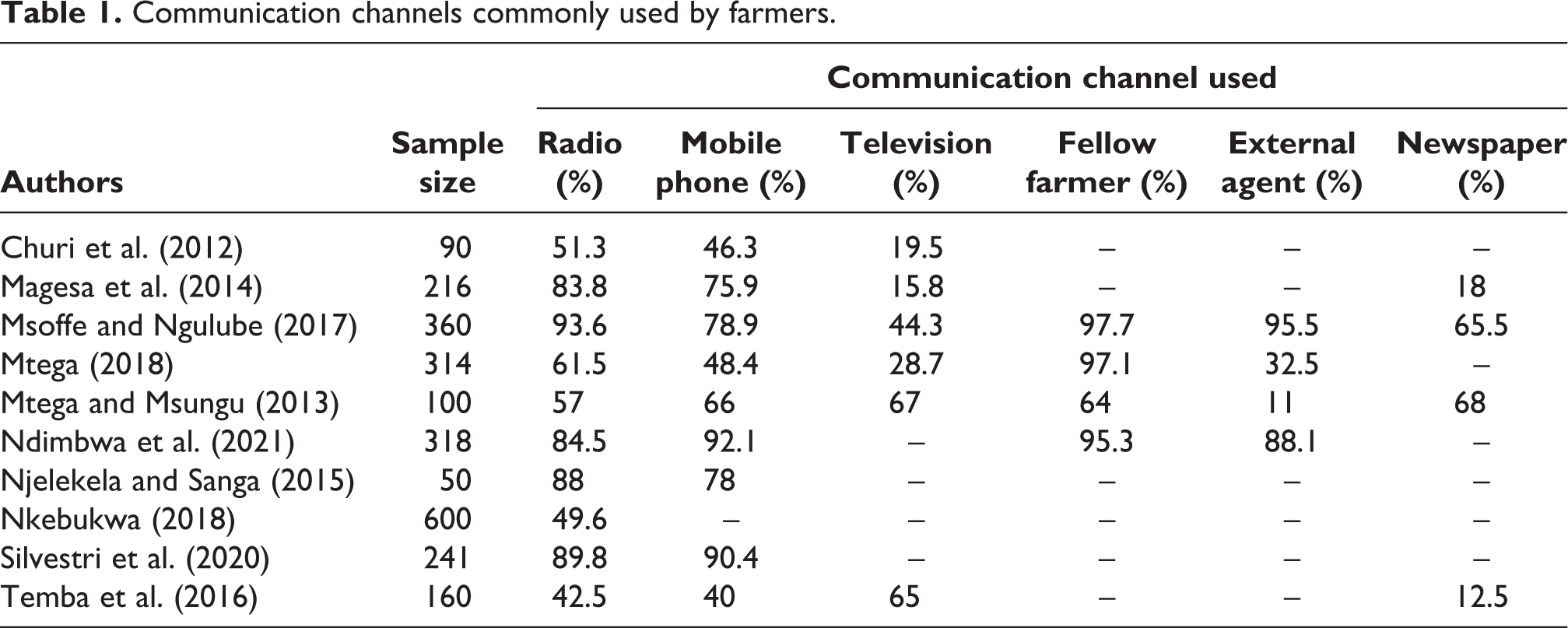
The results indicate that radio was mentioned by all of the studies as the communication channel of choice. This implies that all of the 10 studies found radio to be the communication channel used most by farmers to access agricultural information. The results indicate that about 42.5% to 93.6% of the farmers in the individual studies used radio as a communication channel. The mobile phone as a channel of communication was reported by nine studies. The number of farmers reported by the 10 studies to use mobile phones ranged from 40% to 92.1%.
The results in Table 1 indicate that television was ranked as the third channel in terms of being mentioned by the studies. The results show that some respondents from six quantitative studies used television as their communication channel of choice. The number of farmers using television from the six quantitative studies ranged from 15.8% to 67%.
The fourth-ranked communication channel reported by the studies was fellow farmers; 4 of the 10 studies reported that farmers accessed information from their fellow farmers. The number of farmers using fellow farmers as a communication channel ranged from 64% to 97.7%. Likewise, extension agents were reported by 4 of the 10 studies as a communication channel used by farmers. These studies reported a frequency of usage of extension agents as a communication channel ranging from 11% to 95.5%.
Lastly, farmers used newspapers as a channel for agricultural information. Four of the 10 studies reported the usage of newspapers among farmers. The number of farmers using newspapers to access agricultural information ranged from 12.5% to 68%.
Factors influencing the choice of communication channels among farmers
The results from the 10 studies indicate that several factors influenced the choice of communication channels among farmers. This study considers only the three factors mentioned by the majority of the farmers in each study.
Factors influencing the choice of ICT-based communication channels among farmers
The results in Table 2 indicate that the choice of ICT-based communication channels depended on some general factors and ICT-tool-related factors. The results indicate that two studies pointed out that the usage of radio and television among farmers was influenced by the timing of programmes. Farmers follow daily activity schedules and only use the radio and television programmes when they are aligned with their schedules (Magesa et al., 2014; Ndimbwa et al., 2021).
Major factors influencing the choice of ICT-based communication channels.
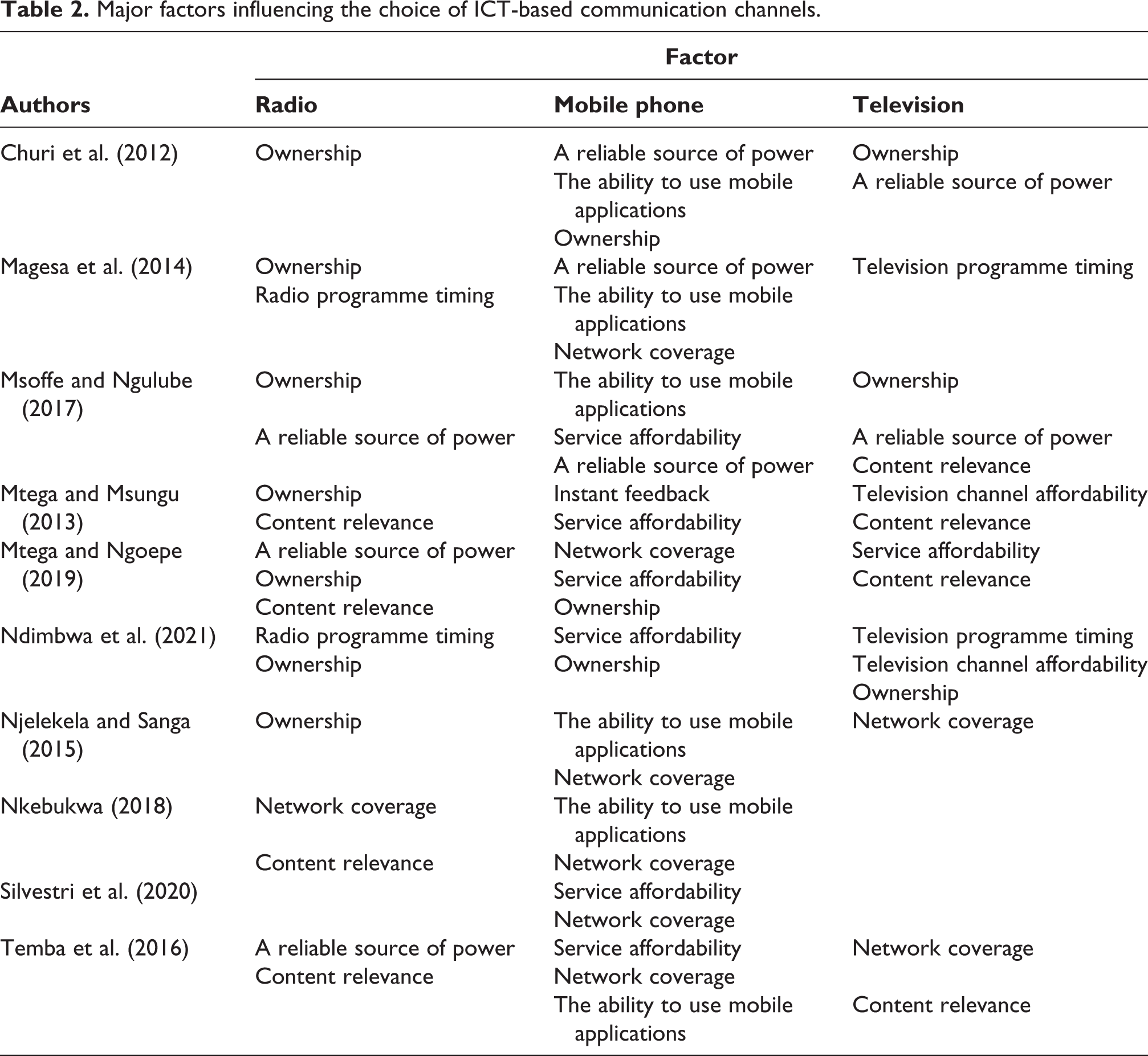
The results in Table 2 indicate that six studies found that the affordability of ICT services influenced the usage of ICT pathways (Msoffe and Ngulube, 2017; Mtega and Msungu, 2013; Mtega and Ngoepe, 2019; Ndimbwa et al., 2021; Silvestri et al., 2020; Temba et al., 2016). These results imply that when the cost of using ICTs is cheap, farmers may use an ICT-based communication channel more. Moreover, the results from four studies (Magesa et al., 2014; Msoffe and Ngulube, 2017; Mtega and Msungu, 2013; Njelekela and Sanga, 2015) indicate that access to relevant ICT applications influenced the usage of ICT-based channels. In some cases, specific ICT applications had the best results for communicating agricultural information. When such applications are available, farmers use them to enhance their access to information.
The results in Table 2 indicate that one study reported the ability of ICTs to enhance instant feedback, influencing their choice as a communication channel (Mtega and Msungu, 2013). Communication channels may be synchronous if they can enhance instant feedback and asynchronous if they cannot. Moreover, three studies (Churi et al., 2012; Mtega and Ngoepe, 2019; Njelekela and Sanga, 2015) indicated that farmers’ ownership of ICT tools influenced the usage of the tools in accessing and/or sharing agricultural information. Those who own ICT tools have more opportunities to use these tools than those who do not.
The results in Table 2 also indicate that four studies (Mtega and Ngoepe, 2019; Njelekela and Sanga, 2015; Nkebukwa, 2018; Temba et al., 2016) reported that ICT network coverage influenced the use of ICT-based communication channels. The level of usage of ICTs for accessing and/or sharing agricultural information is always higher in areas with an adequate ICT infrastructure and good network coverage than in areas with a poor ICT infrastructure (Mtega and Ngoepe, 2019). Five studies (Churi et al., 2012; Magesa et al., 2014; Msoffe and Ngulube, 2017; Mtega and Ngoepe, 2019; Temba et al., 2016) pointed out that the reliability of power sources among farmers influenced the usage of ICTs to access and/or share agricultural information. ICTs are power-dependent; those with access to power can use ICTs, but when the power supply is unreliable, usage of ICTs is equally variable.
Lastly, the results in Table 2 indicate that five studies (Churi et al., 2012; Magesa et al., 2014; Msoffe and Ngulube, 2017; Nkebukwa, 2018; Temba et al., 2016) pointed out that farmers’ ICT skills influenced the usage of ICT-based communication channels. Some level of skill is necessary to use ICT tools and applications, and those that require more limited skills may be used more by farmers than those requiring advanced skills.
Factors influencing the choice of non-ICT-based communication channels among farmers
Among the 10 studies reviewed, only seven of them involved non-ICT based communication channels. The results in Table 3 show the major factors influencing the choice of the main non-ICT communication channels. The results indicate that the choice of fellow farmers was influenced by the easy availability and accessibility of fellow farmers, and the fact that no resources are needed to access agricultural information from fellow farmers (Churi et al., 2012; Misaki et al., 2016; Msoffe and Ngulube, 2017; Mtega and Ngoepe, 2019; Ndimbwa et al., 2021). Others chose fellow farmers as communication channels because of their influence in enhancing access to relevant agricultural information and being considered as more convenient (Churi et al., 2012; Misaki et al., 2016; Msoffe and Ngulube, 2017; Mtega and Ngoepe, 2019).
Major factors influencing the choice of non-ICT-based communication channels.
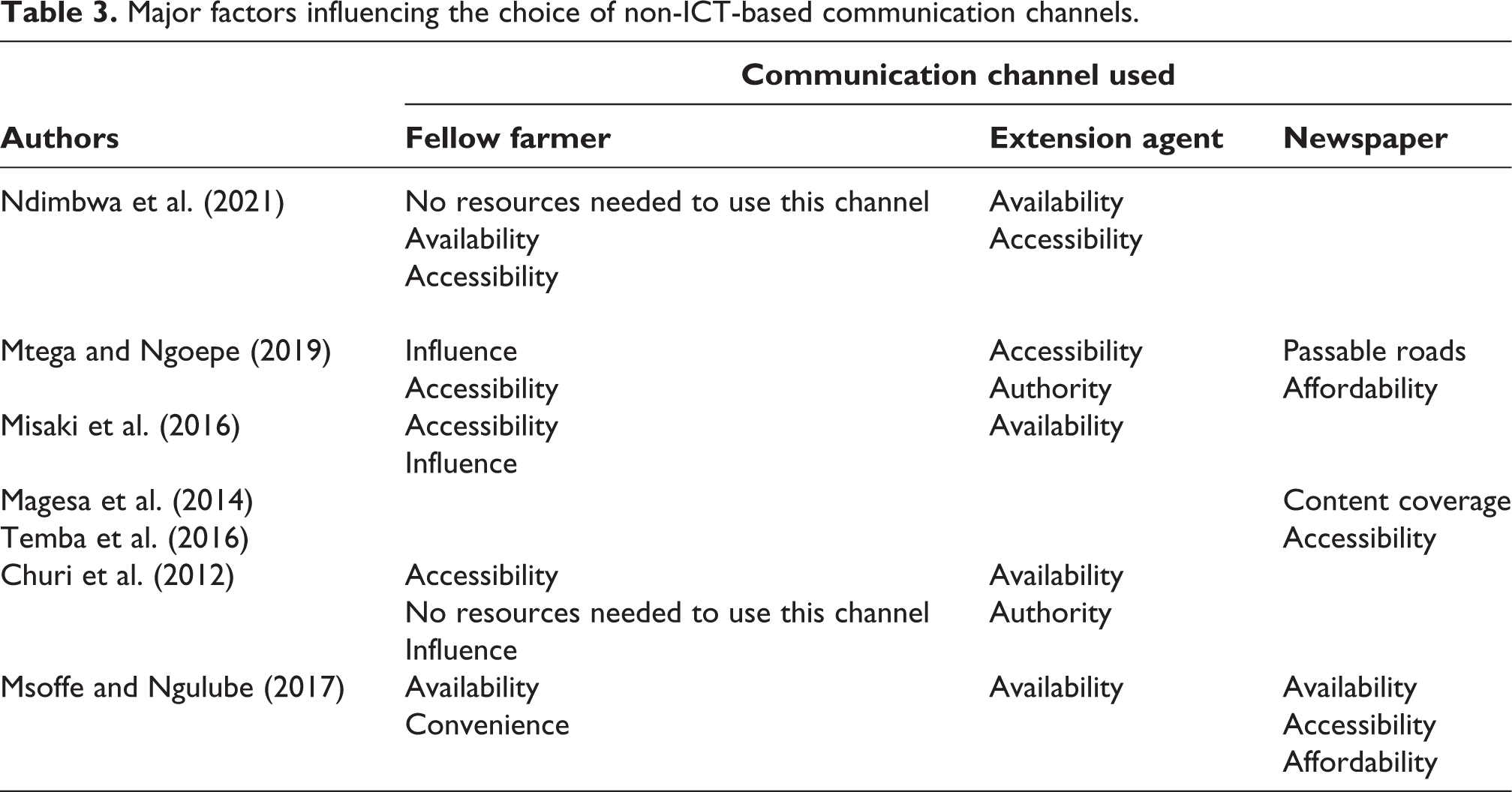
The choice of agricultural extension agents was influenced by several factors. The results in Table 3 indicate that the availability of agricultural extension agents influenced the dependency on them in the delivery of agricultural information (Churi et al., 2012; Misaki et al., 2016; Msoffe and Ngulube, 2017; Ndimbwa et al., 2021). The availability of agricultural extension agents among farmers is mostly influenced by their numbers. Moreover, the accessibility of agricultural extension agents influenced their usage in enhancing access to agricultural information among farmers (Churi et al., 2012; Misaki et al., 2016; Msoffe and Ngulube, 2017; Ndimbwa et al., 2021). The accessibility of agricultural agents may be determined by their availability in terms of how many there are to serve a given population of farmers. This implies that when the farmer-to-agent ratio is low, farmers will have easy access to agricultural information (Msoffe and Ngulube, 2017), whereas, when the ratio is high, the accessibility becomes difficult. The results in Table 3 indicate further that the choice of agricultural extension agents to communicate agricultural information was influenced by the agents’ authority in the field of agriculture (Churi et al., 2012; Msoffe and Ngulube, 2017). Agricultural extension agents are believed to have more authority in providing agricultural extension services; they are more knowledgeable and have more skills in how to meet farmers’ agricultural information needs (Msoffe and Ngulube, 2017).
The results in Table 3 indicate that the choice of newspapers as a channel for communicating agricultural information depended greatly on the passability of rural roads to enable the delivery of newspapers (Mtega and Ngoepe, 2019) and the affordability of newspapers (Msoffe and Ngulube, 2017; Mtega and Ngoepe, 2019). The use of newspapers as a communication channel also depended on their content coverage (Magesa et al., 2014) and availability (Msoffe and Ngulube, 2017; Temba et al., 2016).
Discussion
Among the six most commonly used communication channels, fellow farmers and agricultural extension agents are interpersonal communication channels; they require a face-to-face setting to enhance access to and/or the sharing of agricultural information. The results from the present study indicate that only 4 of the 10 studies reported the use of interpersonal communication channels by the majority of the farmers. These results imply that farmers only use face-to-face communication channels for accessing and/or sharing agricultural information when they are in the same physical place. However, farmers come from different geographical locations, most of them have limited access to agricultural extension services (Msoffe and Ngulube, 2017), and only few among them are reliable sources of agricultural information (Mtega et al, 2016).
The decision to use interpersonal communication channels is influenced by their accessibility and availability. The availability of trusted interpersonal communication channels is influenced by the number of people who can enhance the accessibility of the needed agricultural information. The choice of fellow farmers as a communication channel depends greatly on the trust farmers have in other farmers. Those who are trusted to be the carriers of the required agricultural information must be available and accessible when needed. Farmers decide to access agricultural information from their fellow farmers because there is no charge for the acquired information. In most cases, agricultural information is not accessed from any farmer but rather from those who are believed to be lead farmers – pioneers in terms of the adoption of new technologies and practices, and experienced (Misaki et al., 2016). Lead farmers influence others in terms of using new farming technologies and practices.
Similarly, the choice of agricultural extension agents is influenced by their availability and accessibility. The availability and accessibility of agricultural extension agents among farmers depends on how many of them there are in a given village. In Tanzania, one agricultural agent usually serves several villages, and the agent-to-farmer ratio is poor (Benard et al., 2018). This limits their accessibility and dependency on them for enhancing access to and use of agricultural information among farmers. However, despite being limited in terms of numbers, agricultural extension agents are believed to have authority. Farmers trust a lot of what they hear from agricultural extension agents.
Newspapers were mentioned by four of the studies as one of the communication channels used for enhancing access to agricultural information. However, relatively few respondents from the four studies used this communication channel. Regardless of the number of farmers using newspapers for agricultural information, the use of newspapers in providing agricultural information is influenced by the passability of roads to enable the delivery of newspapers. Most countries in Africa, including Tanzania, do not have good rural roads (Benard and Dulle, 2014), which limits the delivery of newspapers in rural areas. Moreover, the usefulness of newspapers in the provision of agricultural information depends greatly on their content. Unfortunately, newspapers in Tanzania have very limited agricultural content (Ndimbwa et al., 2019) and, in most cases, cannot be afforded by farmers.
Farmers used radio, television and mobile phones as communication channels for accessing and/or sharing agricultural information. The ownership of communication tools influences the usage of communication tools (Sanga et al., 2014). Therefore, farmers who own ICT tools are potentially more frequent users of such tools than non-owners. However, the level of usage of radio and television also depends on the timings and availability of agricultural programmes. Moreover, access to ICT services is influenced by the quality of the network coverage. When there is no or poor ICT network coverage, the ownership of ICT tools has no meaning because it does not result in ICT usage. Therefore, before disseminating agricultural information via ICT tools, one has to assess the coverage and quality of the ICT network.
The use of radio, television and mobile phones may also be affected by service affordability. Radio and television channels are either free-to-air or paid channels. When channels can be accessed for free, anyone may have access. However, not all farmers may be able to afford to pay the subscription fees for radio and/or television agricultural programmes (Familusi and Owoeye, 2014). This also applies to mobile phones, which involve fees for use. The cost to use mobile phone services also influences mobile phone use for accessing and/or sharing agricultural information. Thus, before using ICTs to disseminate agricultural information, one has to consider the costs of ICT services and whether farmers can afford them. Likewise, access to a reliable power source is a factor to take into consideration before deciding to use ICTs for disseminating agricultural information. ICTs are power-dependent and can only provide reliable services when there are reliable sources of power.
The use of mobile phones is influenced by other specific factors. Some farmers prefer to use them because they have the power to provide instant feedback (Kaske et al., 2018). They can enhance both synchronous and asynchronous communication (Madell and Muncer, 2007). Communicators can get instant feedback (Valk et al., 2010), record the message communicated and store it (Martin and Abbott, 2011). Moreover, mobile phones have several applications that are used for specific purposes. Farmers may use applications to exchange agricultural information.
Generally, before enhancing access to agricultural information, it is important to, first, determine the availability of the channels and, second, assess the usefulness of each channel among farmers. The usefulness of a communication channel is determined by its ease of use, influence on the message receivers, authority and affordability. The usefulness of communication channels also depends on the coverage of communication networks and the availability of the other resources and facilities needed to use the channel.
Conclusion
The results of this study clearly show that not all communication channels are used by farmers for exchanging agricultural information. Radio, television, mobile phones, fellow farmers, agricultural extension agents and newspapers are some of the most commonly used communication channels in rural settings. Their availability, accessibility and usage influence access to agricultural information. It is also clear that farmers have their reasons for choosing certain communication channels for exchanging agricultural information. The decision to use a communication channel depends on its influence on the user, authority, cost-effectiveness and communication network coverage, and the availability of the resources and facilities needed to use that channel. When communication channels are available, affordable and easy to use, farmers may have adequate agricultural information. Thus, an effective agricultural information communication process relies on the choice of communication channels. Communicators need to know that some of the communication channels are meant for mass communication and can affect agricultural information dissemination to a larger audience. Others are suitable for one-to-one communication. It is recommended that agricultural information providers should first understand the factors surrounding the usage of communication channels before disseminating agricultural information to farmers. It is also important to design interactive communication channels for instant feedback. The findings from these studies are limited to how farmers in Tanzania chose communication channels for exchanging agricultural information. It is not known how other agricultural stakeholders choose communication channels. Moreover, it is time to study how the private and public sectors may work together to lower the cost of communication among farmers, and design some specific communication strategies to meet the agricultural information needs of different stakeholders in Tanzania.
Footnotes
Declaration of conflicting interests
The author declared no potential conflicts of interest with respect to the research, authorship and/or publication of this article.
Funding
The author received no financial support for the research, authorship and/or publication of this article.
