



Abstract
The manipulation of information to suit one’s vested interests is a growing hazard. It has elements of disinformation, misinformation and fake news, and lacks authenticity. Such manipulation and distortion of facts can have serious consequences for a community, especially in a diverse nation like India. It calls for strict measures and awareness to check this spread. Technology further catalyses such dissemination. Institutions, libraries, governments and the media are all deliberating effective means to distinguish fake news from authentic news. This article details some such initiatives. It discusses the Government of India’s Information Technology (Intermediary Guidelines and Digital Media Ethics Code) Rules, 2021, to curb such deceitful dissemination, elements of which can be replicable in other geographies. It spotlights the issue and underscores the need for media and information literacy for all to be more discerning during the reception, consumption and assimilation of information before responding to it. Further, the fact-checking initiatives and Information Technology Rules as taken and framed in India may be replicated in other countries.
Keywords
Introduction
The United Nations’ Sustainable Development Goals aim for a better, fairer society by 2030 by eliminating poverty and inequality. To achieve these aims, society needs relevant and authentic information. The Internet and social media have enabled easy accessibility and affordability in terms of information creation, circulation and consumption at lightning speed. With the click of a button, contents, videos and pictures can be broadcast globally. This very power, speed and reach of technology becomes corrosive and hazardous when used maliciously with bias and prejudice.
The media is replete with instances of vested interests curbing the flow of right information. Of many, one such instance was when, during the COVID-19 lockdown, rumours were circulating on the Web attributing the spread of the virus to exposure to radio emissions from new 5G antennas (Martin, 2020). Even the recent farmers’ protests in India have seen several rumours about the state and its use of force to quell the situation, which fortunately were proved baseless (Menon, 2020). Circulating information without checking its veracity can snowball into public unrest and endanger law and order. The viral spread of information, also referred to as ‘digital wildfires’, may cause irreversible damage to life and property, and erode the social fabric of society.
The media has a lot of power, which can be revolutionary if used responsibly. Unfortunately, such responsibility is open to manipulation, and instances of the same seem to be on the rise of late. A few social media have been found to be using their power for divisive purposes and have been penalized for circulating wrong information. Social media has been used to spread inflammatory speeches and videos, prompting the naive to violence or unwanted behaviour. In the context of health, misleading information can set back government efforts. With the ever-growing speed and reach of social/digital media, it is very difficult to control the damage caused once misinformation or disinformation has been circulated among the masses. In light of this, it becomes imperative for policymakers to step in and ensure proper checks and balances are in place to curb any such misuse.
With the omnipresent Internet, the misleading information circulates more rapidly. This is particularly pertinent for a country like India, where there are 696.77 million Internet users; estimates say that this number will increase to 974.86 million users by 2025. Rural India has 227 million active users, 10% more than urban India’s 205 million. Further, 71 million children aged between 5 and 11 also go online using adults’ devices. There are 18.9 million, 340 million and 346.2 million Indians on Twitter, WhatsApp and Facebook, respectively (Statista, n.d.). Netizens are a growing sector across the globe.
In the light of the above, this article considers the relevance of media and information literacy for all to understand and practice. The people should exercise their media and information literacy skills while using content available on social media or generating their own content and sharing with others. It underscores that the downsides of social media in the form of misinformation, disinformation and fake news can be stemmed through media and information literacy competencies. Media and information literacy entails having the skills and competencies to identify, evaluate and scrutinize different types of media, and understand the contents that are published. These competencies enable individuals to create content and be prudent purveyors of information. The study also surveyed a number of library and information science (LIS) educators in India to find out what they do to sensitize their students and spread awareness to stem the rising tide of fake news, misinformation and disinformation. LIS educators have conducted webinars to spread awareness among students and laypersons. They teach how to differentiate between fake and genuine news, and how to evaluate information for accuracy before using it for decision-making or sharing with others.
This article conveys the message that everyone (tweens, teenagers and adults) needs to be media and information literate. It advocates that the syllabi at all levels of education, from school to doctoral, should incorporate the components of media and information literacy. Academic and public libraries should hold awareness sessions to sensitize their users to the importance of being media and information literate.
Literature review
With the easy availability of social media, any information can be communicated to millions of people in no time. If the information is positive or accurate, it may help millions. For instance, if someone has a problem, they may seek help, or information about an imminent earthquake, cyclone or natural disaster may be shared. But misinformation generated with malfeasance may spread like wildfire, harming people, sabotaging social peace and harmony, and endangering law and order in a country. The current flow of fake news and propaganda fools too many people, as social media tries to control the flow of misleading information.
Tandoc et al. (2020) surveyed 2501 respondents and interviewed 20 participants from Singapore’s technologically advanced city state. They ignored fake news posts which they found on social media, and tried to correct fake items directly relating to them and their close acquaintances. Misinformation has caused widespread alarm. It has been reported that people were exposed to false stories prior to the 2016 presidential election in the USA, which they believed to be true. Following this, Facebook and Twitter realigned their algorithms and policies to check the spread of false content (Meserole, 2018).
Examining and commenting on the veracity of statements made by 22 social media forums concerning drugs, dietary supplements and toxic bisphenol, Al Khaja et al. (2018) categorized them as ‘objectively true’, ‘false’ or ‘potentially misleading’. Surprisingly, 59.1% of the messages circulated about drugs were found to be ‘potentially misleading’. Just 13.6% of the messages passed regulatory scrutiny. Al Khaja et al. conclude that the majority of the drug-related content was deceptive or totally false, and did not have evidence to substantiate it. Wang et al. (2019) have also observed that social media has heavily propagated misinformation related to health.
Colliander (2019) observes a similarity in how individuals respond to fake news. When they find that others have commented critically on a piece of fake news, they are less inclined to make positive comments and share it further among their contacts. Additionally, disclaimers from social media platforms do not help as much as comments from other users. In Allcott et al.’s (2019) study of trends in the dissemination of content from 569 fake news websites and 9540 fake news stories on Facebook and Twitter, users’ interaction with false content increased continuously until the end of 2016, but fell thereafter.
The media plays a crucial role in shaping adolescents– the physical, cognitive, moral, psychological and socio-emotional dimensions of their personalities. They get their role models, sense of right and wrong, or of desirable or otherwise, from what is presented to them via various media forums. The media very often shapes concepts of heroism, beauty, status and success. Students must be well equipped with the competencies to live in, contribute to and thrive in the Digital milieu where they are logged in globally every minute of the day. So, to promote critical engagement with media content, it is essential to advocate and encourage media and information literacy. If we want children to navigate and make use of social media platforms judiciously, they should be well skilled in deciphering what is served to them or, at times, floats freely to them on these forums. Moreover, they should have the discretion and maturity to see through content and evaluate it. This requires a discerning eye. Media and information literacy is the ability to access, analyse, evaluate and create content.
Media and information literacy encompasses the skills and competencies required to read, write and comprehend print, non-print, audio and video content; navigate the Internet and social media platforms; and generate one’s own content responsibly and judiciously for further dissemination and sharing. In modern information ecosystems, citizens should be well trained in processing the news that reaches them, including how they read, process and respond to it. According to UNESCO’s definition of media and information literacy, it is the ability to reach the right judgements with proper deciphering of advertisements (UNESCO, 2013). Further, people should know how to process information/media messages constructively for further use. This can be for creating more pieces based on the same content. While creating, consuming or producing messages or content for the media, media and information literacy acts as a gatekeeper against disinformation, stereotypes and intolerance. In December 2008, the European Parliament passed a resolution mandating the incorporation of media literacy in teacher training at all school levels (European Parliament, 2008). The media has strengthened and buttressed the participation of consumers of media content in the shape of comments, debates and more.
There was a lot of misinformation being circulated as the COVID-19 pandemic broke out and at the time of the 2016 US election. Twitter has introduced labels and warning messages to alert netizens about the veracity of contents or posts. Studies indicate that misinformation spreads much faster on social media. The important areas of public health and social peace and harmony have seen fakery wreak havoc. Netizens need to be careful when retweeting manipulated media on Twitter and refrain from mindlessly forwarding suspicious WhatsApp messages and Facebook posts. The importance of one’s accountability for online posts is yet to sink in.
Facebook has devised advertising policies to prevent misuse of platform for dissemination of information pertaining to illegal products, unsafe substances and discriminatory practices (Facebook, nd). Instagram, which is owned by Facebook, has identified the hashtags that are frequently used in posts sharing false or misleading information. Another move redirected those looking for information on COVID-19 to a particular message, providing links to verified and authoritative information sources.
Recently, Wikipedia has published pages describing the menace of fake news in India, titled ‘Fake news in India’ (Wikipedia, 2021a) and ‘Indian WhatsApp lynchings’ (Wikipedia, 2022a). There are also other Wikipedia pages that describe the menace and consequences of fake news on the subcontinent, titled ‘Misinformation related to the COVID-19 pandemic’ (Wikipedia, 2022b) and ‘COVID-19 pandemic in India’ (Wikipedia, 2021b).
Fake news, misinformation and disinformation
The terms ‘fake news’, ‘misinformation’ and ‘disinformation’ are used interchangeably, overlapping in meaning and content. The issue of fake news has existed for a long time. In 1835, the Sun newspaper published that there was life on the moon, which became known as the Great Moon Hoax (Vida, 2012). The pernicious effects of fake news are again under the spotlight as fake news has increased during the coronavirus pandemic and the 2020 US presidential election (Pennycook and Rand, 2021).
Fake news is fabricated, falsified or false news with the trappings of real news media content. However, such news does not pass through rigorous editorial vetting for the veracity, authenticity, accuracy, currency and credibility of the content that it claims to convey. It is projected to be genuine to spread falsehoods and dupe or mislead people, arouse passions and attract viewership. It has gained attention in the contexts of politics, health, vaccinations and climate change. The spread of fake news is pernicious for everyone. Further, it thrives in standard news outlets and threatens their credibility (Lazer et al., 2018).
The difference between misinformation and disinformation hinges on whether the false or illegitimate information is purposefully disseminated to delude people or not. Disinformation may be textual, visual or gestural. This also means that disinformation is purposefully or wilfully misleading. The feature of misleading recipients is deliberate, not accidental or by chance. Lazer et al. (2018) state that information is alethically neutral and should not be evaluative of truth.
Fetzer (2004) has emphasized that information is meaningful data that is independent of truth; the receiver adds context and sense, and misrepresentation or misinformation occurs in the process. Thus, information is the genuine part of the semantic content, whereas misinformation is its false part. Disinformation is the part of misinformation that has been orchestrated to deceive the information receiver. The easy and fast dissemination of information, distortion and manipulation happen because of the rapid development of information and communications technologies and their easy availability. Social media has enabled the public consumption of information. People quickly forward and share information without challenging it. Research has highlighted that a large number of people retweet false information. Further, social bots share information and thus catalyse the spread of fake news, misinformation and disinformation (Ndlela, 2020). Misinformation alludes to wrong and misleading information, while disinformation is orchestrated to deceive the information receiver.
Prakash Javdekar, former Indian Minister of Information and Broadcasting, said on 27 August 2020 on Twitter that Fake news has a potent power of disturbing peace. Manipulation of public opinion over social media platforms has emerged as a critical threat to public life. Fake news campaigns across the world are because of lack of targeted legislation, lack of media literacy and awareness. Disinformation aims to weaken the basic structure of a functioning democracy. Universe of fake news is much larger than simply fake news stories. Fake news is more potent and dangerous. (PIB India, 2020).
A study by the Stanford Education Group highlights the struggles that middle school, high school and college students have as they try to understand and evaluate the information available on the Internet. Inauthentic pieces in the guise of real news are highly likely to mislead them (Donald, 2016). Fake news, with its elements of misrepresentation, manipulation and the tweaking of facts, eats into the democratic values of modern-day society. Not only that, it curtails the free and timely availability of authentic information, which can be used to make further decisions. These fake news pieces border on a visceral appeal to raw emotions rather than being an objective representation of news, facts and developments, and often goad people into wrong actions through processes of hatred, bigotry and negativity, thus serving the subversive purpose of their creators. Along similar lines, the German concept of postfaktisch refers to manipulating political and social narratives to rouse emotions rather than an objective and logical thought process (Bluemle, 2018). Sadly, this is a universal phenomenon, and even the most discerning minds can be deceived.
Media literacy can be described as the clutch of literacy skills that are relevant to the present ecosystem of overflowing information in diverse forms and models. It enables media consumers to use news objectively, without getting distracted by deliberate yet subtle appeals to the emotions, and to respond appropriately.
Media literacy for the 21st century
Tracing the beginnings of media, it goes back to the first half of the 20th century. Frank and Thompson (1933) suggested that students be taught to develop a discerning eye to appreciate the differences between high and popular culture in the UK. The 1950s witnessed the introduction of media literacy in the USA, recognizing the growing influence of mass media on people’s behaviour. The Internet opened a new chapter, serving as a milestone in the development of media literacy because it radically changed the texture of the media space. With rapid and drastic changes, and the quantum leaps made by technology, traditional literature appeared to become obsolete, and hence meaningless and irrelevant to the changing times.
Considering the emerging situation with reference to media and information technology (IT), and the inextricability of media in human lives, it becomes all the more crucial that people have a certain level of media literacy to help them navigate the world of words, messages, information, videos and audio materials better and more objectively, rather than being deceived by half-truths and twisted facts.
Information flows across borders and is accessed by a vast consumer base. Many of these consumers have impressionable minds - that is, young people. It is thus imperative that they learn to look at any information objectively and critically, and media literacy needs to be part of the modern-day curriculum. Further, it has already been in Library and Information Science, and Journalism courses in higher education institutions.
Educated people are less likely to believe in conspiracy theories because of multiple psychological factors related to education. Conspiracy theories have consequences as they affect people’s health and safety, are universal and spread across societies and cultural settings, and are associated with the negative emotions and psychological motivations underlying intergroup conflict (Van Prooijen and Douglas, 2018). Other terms for conspiracy theories include ‘conspiracy predispositions’, ‘conspiracy ideation’, ‘conspiracy ideology’, ‘conspiracy mentality’ and ‘conspiracy world view’.
News and information are often seen through the lenses of emotions and feelings, with an appeal to sentiments rather than objectivity. And this is where educators need to step in and rectify the situation. Rationality, authenticity, facts and transparency should be the basic parameters rather than biases, prejudices, superstitions and similar elements that appear to be low in logic. Objectivity is lost if facts become coloured by irrationality, prejudices, biases, bigotry, and individual whims and fancies. With regard to media manipulation for unethical interests, the vested interests of a handful of people, the exponential reach and the comfort of anonymity that comes with social media seem to be the key factors. A low level of media literacy, coupled with the naivety of the masses, makes people more vulnerable to such designs and manipulations. People need to be more discerning, rather than taking everything at face value.
The Pew Research Center has reported that almost 23% of American adults admitted to spreading misinformation via social media. Sometimes it was unintentional, but often it was not (Barthel et al., 2016). Under the seemingly safe cover of anonymity and invisibility, online disinhibition can easily lead one to post comments; with no humane consideration or mindfulness of the ripple effects of the dissemination of misinformation. Such anonymity may give way to Asperger’s syndrome.
User-generated comments are a growing feature of social media. The comments sections beneath news articles or embedded in social media provide users with unique opportunities to share their views. Research has shown that exposure to uncivil comments may have various detrimental effects on readers. It may result in a biased perception of the news content, but explicit references of the moderation done can mitigate such an adverse effect (Yeo et al., 2019). As for forums, it has been often noted that they ‘play possum’ when convenient. Popular platforms such as Facebook, YouTube and Twitter have disappointed on several occasions, and the ill-intentioned have used them to further their motives, as social media has become the preferred platform for several subversive agendas– and there are no signs of this subsiding anytime soon.
Trollers seem to be self-appointed monitors of society, using technology and social media to advance their designs. It can range from simple comments without considering others’ sentiments to outrageous material that can trigger a lot more, and worse. Another emerging nuisance is online fraud– fraudsters using online forums to financially cheat their targets. Financial institutions have made it a routine procedure to tell their clients not to share personal information over the phone or e-media. Sadly, this is just the tip of the iceberg.
An example of the damage caused by fake news in India can be seen during the difficult times of COVID-19 in 2020 when fake news triggered a mass exodus of migrants from the cities to their native places. The Supreme Court of India directed the media to publish government figures on the COVID-19 pandemic crisis. The Supreme Court promptly stepped in, asking the government authorities to set up a portal to disseminate real-time information pertaining to the pandemic and counter the panic that was being spread through fake news. The central government asked all states and union territories to deploy mechanisms to prevent the dissemination of unverified and fake news ( Hindustan Times, 2020).
The Supreme Court directed electronic, print and social media platforms to ensure that the unverified and misleading news that may cause any disturbance or unfounded fear in the public is not disseminated (Rautray, 2020). The free flow of ideas and information is a precondition for any democracy to flourish. This requires a free media that can function without fear or favour, with the government providing only a regulatory framework. Fake news poses a serious challenge as it misleads the public, which consumes the information; creates a problem for the government and dents media credibility. It also compels the government to interfere with the functioning of the press. Further, it dilutes the support and goodwill that are, at times, needed for development and progress.
The media, once said to be the watchdog of democracy, cannot be allowed to fall into the hands of evil minds, holding at ransom the safety of millions for no fault of their own. In such a scenario, it becomes rational and imperative to watch out for miscreants, misuse and manipulation with proper control and supervision by the state. We need policies, checks and balances to keep this misuse at bay. People fall prey to fake news, misinformation and disinformation because they lack digital media literacy skills and contextual knowledge to differentiate between high-quality and low-quality content. Education and training in digital literacy may improve discernment with regard to mainstream content and fake news (Guess et al., 2020).
Indian initiatives in countering fake news and disinformation
Fake news and disinformation have become common challenges for the educated citizen who is keen to distinguish fake news from authentic news. The Union Government and media houses in India are also making attempts to decipher real facts from fake ones. Table 1 shows some of the initiatives that are being undertaken by Indian agencies and media houses to combat the menace of fake news– for example, the India Today Group runs the India Today Anti Fake News War Room, with the hashtag #AFWAFactCheck, and fact-checking initiatives are being undertaken by the leading media houses, such as the Times of India’s @TimesFactCheck and The Quint’s #WebQoof. Most of the non-governmental fact-checking initiatives, as described in Table 1, are certified by the International Fact-Checking Network (IFCN) and Facebook partners in fact-checking in the country.
As shown in Table 1, the most popular fact-checking initiative is @AltNews, a non-governmental initiative; 358,300 Twitter users follow this handle. It also maintains an Indian-language handle to fact-check misinformation in Hindi (@AltNewsHindi) and a specialized handle to fact-check science and health-related misinformation (@AltNewsScience).
With the enormous impact and consequences of fake news in India in recent times, the Government of India has implemented several countermeasures and media strategies to tackle the spread of fake news at its roots. As shown in Table 1, the second most popular fact-checking initiative is Cyber Dost (@Cyberdost), which was launched in January 2019 to spread awareness of cybercrimes. Cyber Dost is also an attempt to impart information and media literacy related to cyber-safety and cybersecurity; 329,900 Twitter users follow this handle.
A further initiative was the establishment of the PIB Fact Check unit under the aegis of the Press Information Bureau of the Ministry of Information and Broadcasting in November 2019. The unit works along the four principles of find, assess, create and target (FACT) to fight fake news effectively. By order of the Supreme Court of India in April 2020, Indian states were directed by the Union Government to take adequate measures to fight fake news and prevent COVID-19 pandemic-related panic among citizens.
As illustrated in Table 1, information and media educators in India are now equipped with effective tools and platforms for unbiased fact-checking and strongly opposing unverified, malicious social media comments containing rumours that are designed to cause social disharmony. Further, we need committed and vigilant information and media professionals to educate ordinary citizens about the dangers of misinformation and disinformation. They should also support an influential community leader in each locality to debunk false news affecting local communities. Fact-checked information, available from these fact-checking initiatives, should be shared with other social media and instant messaging platforms, such as WhatsApp, Facebook Messenger and Telegram, by information and media educators, and social influencers.
Indian initiatives for fact-checking and countering fake news online.
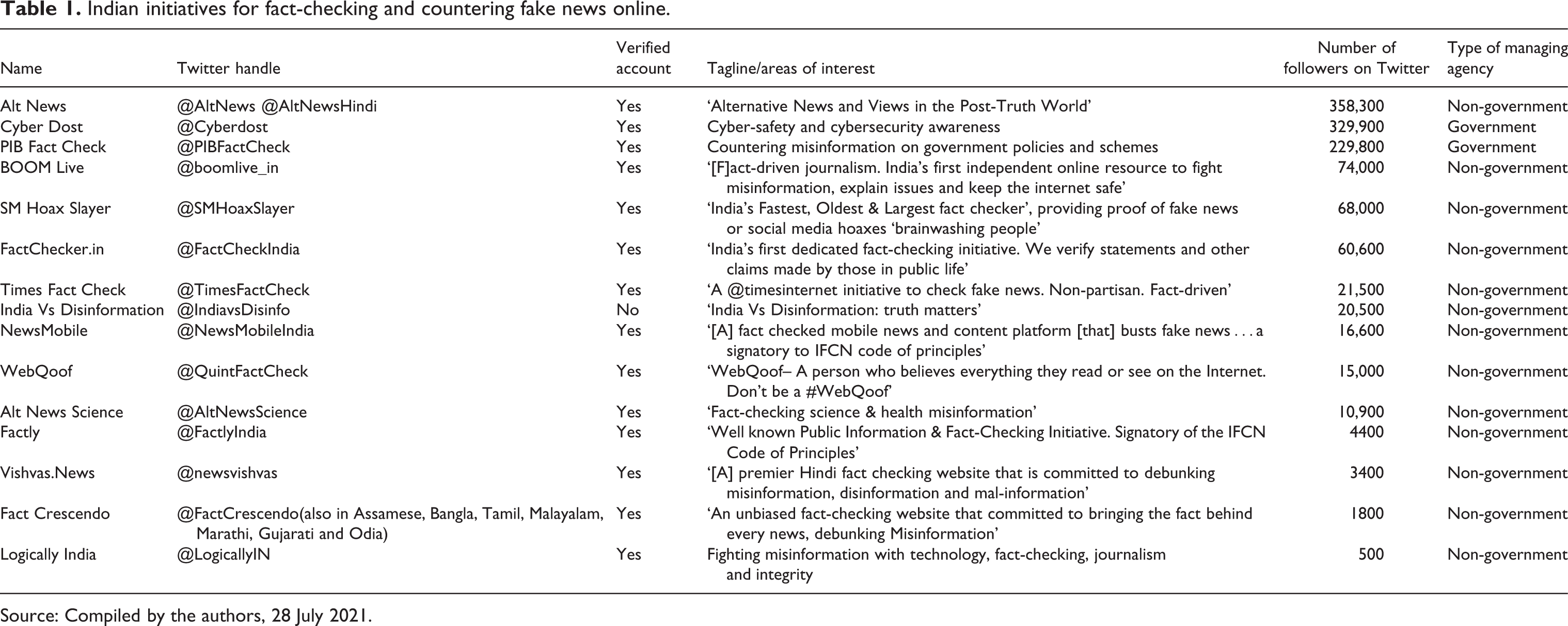
Source: Compiled by the authors, 28 July 2021.
As shown in Figure 1, information and media literacy plays a critical role in debunking fake news, disinformation and misinformation at the community level. Thus, the Press Information Bureau and other agencies have been arguing for the creation of a larger platform to encourage media literacy and how to spot fake news. Covishaala is a programme that was started by the fact-checking agencies Logically and NewsMobile to educate and inform the public across India about the facts of COVID-19 and vaccination in order to overcome unfounded fears of vaccination and control the spread of the virus (Economic Times, 2021). 1 There have also been instances of WhatsApp and the National Association of Software and Service Companies collaborating to offer education and training on digital literacy to make people aware of fake news on social media (India Today, 2019).
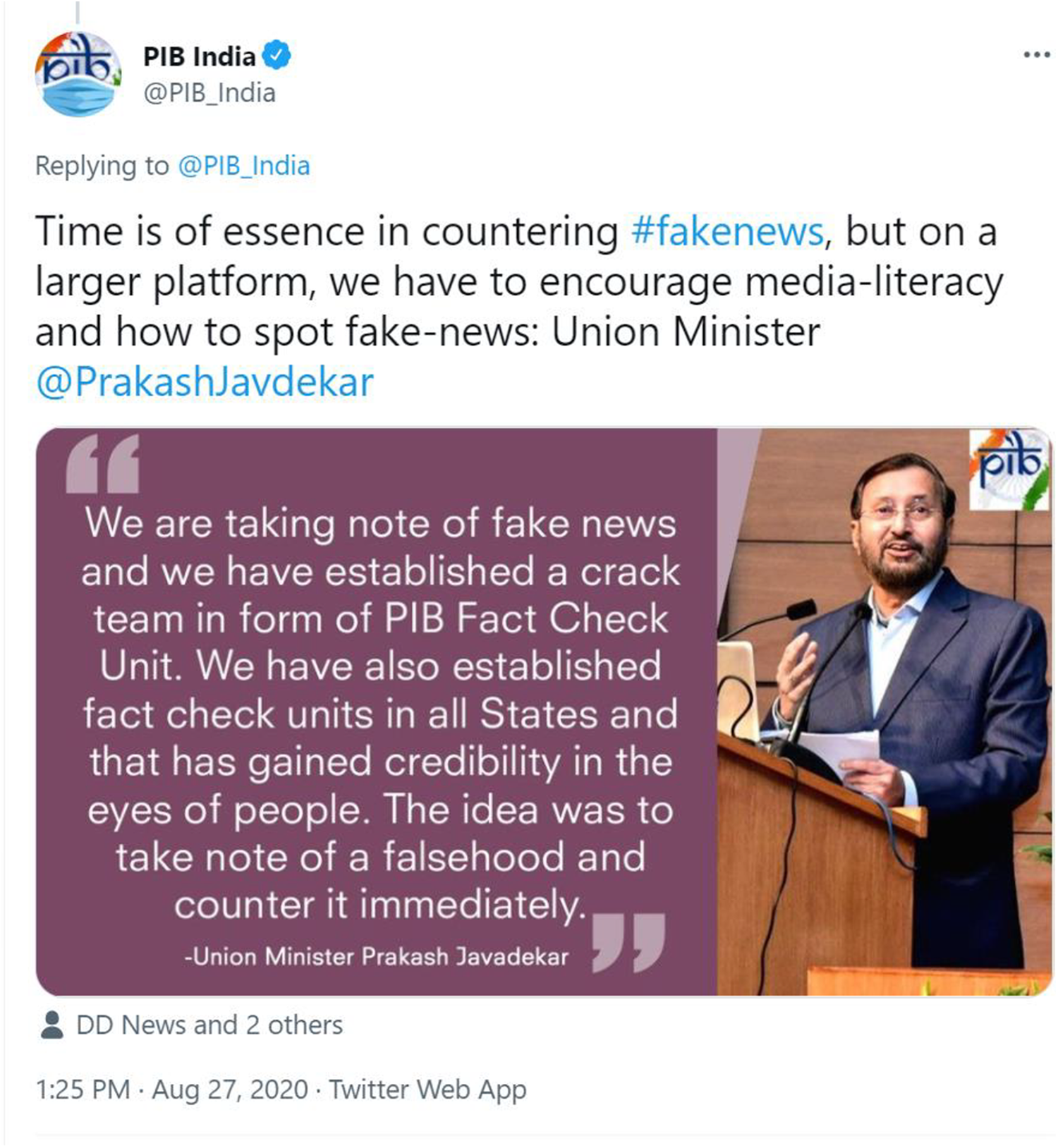
The importance of media literacy for tackling misinformation in India.
Government policies to combat fake news, misinformation and disinformation
With the huge advances made by technology, social media is inextricably integrated in the lives of a vast segment of the population in India. The country has some 530 million WhatsApp users, followed by YouTube with 44.8 million, Facebook with around 411 million and Instagram with 210 million (Chakravarti, 2021). In contrast, Twitter has a more modest 17.5 million users, indicating the natural inclination towards verbosity. However, even short statements can lead to full-blown conflict, as evidenced by a recent incident where the forum was the media used and violence was triggered.
Given such a massive user base, the speed at which news travels and its potential to cause harm if misused, it is imperative to police the social media well. The recently announced Information Technology (Intermediary Guidelines and Digital Media Ethics Code) Rules, 2021, are a step in this direction (PRS Legislative Research, 2021).
The Information Technology (Intermediary Guidelines and Digital Media Ethics Code) Rules, 2021– highlights
The Information Technology Rules were notified in February 2021 under the Information Technology Act 2000. The Rules, which came into force on 26 May 2021, are fairly comprehensive and take into account most of the issues that have created challenges stemming from social media and digital platforms. They address issues pertaining to the origin of a source and the objective redressal of grievances, leaving no room for irresponsible or unaccountable attitudes among social media forums, digital platforms, news producers and television companies (PRS Legislative Research, 2021).
The Rules empowers consumers of social media platforms and over-the-top platforms by making it mandatory for them to have an India-residing grievance redressal officer to look into their grievances. Moreover, the Rules sets specific time frames for the acknowledgement and resolution of grievances. Indecency, vulgarity, nudity or any other objectionable content is dealt with strictly with special protection for women and children against exploitation through fake news and any other misuse of social media. In fact, the Rules establish a three-level grievance redress mechanism, which includes self-regulatory bodies registered with the Ministry of Information and Broadcasting to look after the code of ethics, and a charter for the self-regulating bodies formulated by the Ministry of Information and Broadcasting.
Part 1 of the Guidelines defines essential terms like ‘access control mechanism’ and ‘digital media’. Part 2 is about due diligence, which intermediaries must follow while performing their duties, and the grievance redress mechanism. The intermediary must publish rules and regulations, a privacy policy and a user agreement for access, terms and conditions for publishing and sharing contents. There should be a grievance redress mechanism for significant social media intermediaries. If social media companies do not comply with the country’s IT rules, they are liable to face punishment.
Some tech giants, such as Twitter, were not able to appoint a chief compliance officer, resident grievance officer and nodal contact person within the stipulated time frame. A three-month period for compliance was granted to all significant social media intermediaries under the Information Technology Rules. Under the law, the immunity conferred on the intermediaries was conditional, subject to them satisfying the conditions of the Information Technology Rules. Intermediaries that provide messaging services must provide the identification credentials of the person with whom the information originated.
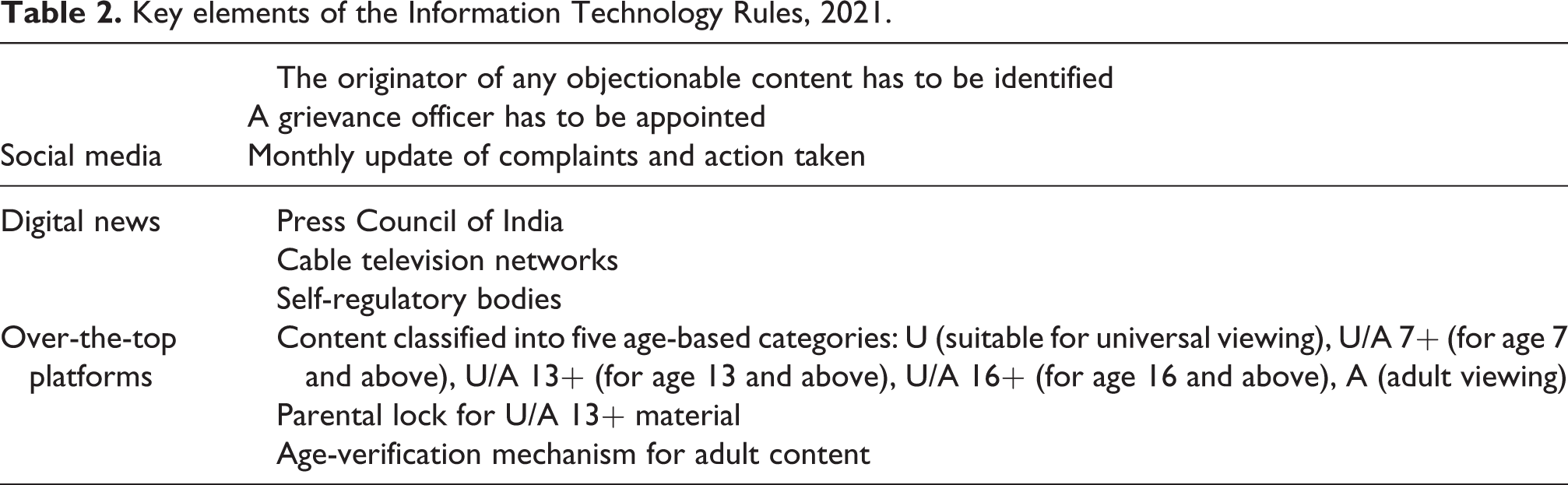
Part 3 focuses on the code of ethics, and procedures and safeguards concerning digital media rules for publishers of news and current affairs content and online curated content. A publisher must not transmit, publish or exhibit any content that is prohibited under any law. Online content must be classified under different ratings: U, U/A7+, U/A13+, U/A16+ and A (see Table 2). There should be restrictions on access to adult content by children and publishers should make curated content accessible to persons with disabilities.
Key elements of the Information Technology Rules, 2021.
The Constitution of India extends freedom of speech and expression via any media without interference, censorship or reprisal through Article 19(1a) and Article 21. However, this right has to be exercised with some responsibility, in accordance with Article 19(2) of the constitution. Freedom of expression should not endanger or jeopardize the sovereignty and integrity of India, national security, relations with other countries, or law and order.
Data protection in India is currently governed by the Information Technology (Reasonable Security Practices and Procedures and Sensitive Personal Data or Information) Rules, 2011. The 2011 rules have been framed under the section 43A of the Information Technology Act, 2000. These Rules impose certain obligations and compliance requirements on organizations that collect, process, store and transfer sensitive personal data of individuals. The Bureau of Indian Standards has also introduced new measures for data privacy assurances. Organizations are supposed to establish, implement, maintain and improve their data privacy management systems. By adhering to these standards, organizations will assure their employees and customers of their privacy practices.
Section 505(1) of the Indian Penal Code prescribes imprisonment for up to three years, a fine or both for those who try to publish, circulate or spread fake information that may disrupt the country’s peace or law and order. Section 66D of the Information Technology Act 2000 prescribes imprisonment of three years and a fine of 100,000 Indian rupees. Section 54 of the Disaster Management Act (DMA) defines the penalty for people who try to spread false information regarding an imminent disaster, which may cause panic, confusion and turmoil amongst the public. The perpetrators may face imprisonment of twelve months or a fine under Section 54 of the DMA, 2005.
The key provision is that a platform shall not allow itself to be used as a tool to violate any law that is in force or undermine the country’s sovereignty and communicate something that is false. This is part of a global trend. In the initial stages of the Internet, platforms were given immunity from liability in the USA for content posted by users. Section 230 of the Communications Decency Act provided a global template and opened up space for contemporary tech giants. But now, the relevance of Section 230 is being questioned even in the USA, which has a Personal Freedom Index of 8.72 and a Human Freedom Index of 8.46.
Social media platforms are hugely influential but seem to be inclined towards functioning within a legislative framework of rights without responsibilities. This is not tenable. The new Information Technology Rules, among other things, mandate that platforms divulge the original source of unlawful or inflammatory viral messages within 72 hours. The platforms say that the new laws will impact citizens’ privacy, as WhatsApp would have to do away with the end-to-end encryption of user chats. But the right to privacy is not absolute, and it is subject to reasonable restrictions. There have been cases of mob lynching and riots in the past, and instances where WhatsApp messages were circulated and recirculated, so it is essential to know the origins of such content. Other countries, such as the UK, the USA, Australia, New Zealand and Canada have issued communiqués that tech companies should include a mechanism in the design of their encrypted products and services so that the governments may access the data (Sarkar, 2021).
Awareness sessions should be held about the resources available, and a curriculum created by leading journalism educators, which could be published by UNESCO for developing countries. UNESCO has published new resources concerning freedom of the press, gender equality and climate communication (Unesco, 2021). These resources can be integrated into school and higher education curriculums.
Online news is also regulated under the Information Technology Act. Online news portals are expected to abide by traditional media regulations, such as those followed by newspapers and news channels. The government ordered Twitter, Facebook and YouTube to take down posts spreading misinformation around COVID-19.
Roles of libraries in controlling fake news, misinformation and disinformation
The IFLA has declared that people have a fundamental right to access expressions of knowledge, creative thought and intellectual activity, and publicly express their views. It asserts that the right to know and freedom of expression are closely interrelated. The right to know is a requirement for freedom of thought and conscience; freedom of thought and freedom of expression are necessary conditions for freedom of access to information. The IFLA avers that a commitment to intellectual freedom is a core responsibility of library and information professionals. It therefore calls on libraries and library staff to adhere to the principles of intellectual freedom, uninhibited access to information and freedom of expression, and to recognize the privacy of library users (IFLA, 2006). Users should be taught to differentiate between advertisements, opinions and reported news. They should develop a sceptical stance towards information in order to be able to reject fake news (Bonnet and Rosenbaum, 2020).
Library professionals should be aware of various tools and websites. For instance, the First Draft functions for charitable and educational purposes. It aims to protect the communities from the detrimental effects of misinformation. It provides practical and ethical guidance in finding, verifying and publishing content sourced from the social web. Library professionals should tell users about CRAAP (currency, relevance, authority, accuracy, purpose) checkpoints and the RADAR (rationale, authority, date, accuracy, relevance) framework for evaluating content.
Commisso (2017) advocated that the archivists should develop repositories of fake news items with sufficient context to enable researchers interpret the information and understand how these items originated and disseminated. Library professionals need to know about image and video verification tools and websites. ‘Trust and Verification in an Age of Misinformation’, for example, is a Knight Center for Journalism in the Americas massive open online course and comprises four modules.
Library professionals should adhere strictly to the Resolution on Access to Accurate Information of the American Library Association. They could adopt and incorporate the Association of College and Research Libraries’ Framework for Information Literacy for Higher Education in their training and awareness sessions for students. Library professionals and associations should work to promote and ensure critical information literacy among current professionals for posterity (Jaeger and Taylor, 2021).
A lack of education and media literacy leads people to fall prey to fake news, as they cannot determine the credibility of information (Cheby, 2018). The sharing of fake news online may cause tremendous harm (Anderson, 2018). It also interferes with democratic processes and civic participation since an informed electorate is a prerequisite for a well-functioning democracy (Saunders et al., 2018).
AL-Zaman (2021) analysed 9657 items of misinformation originating in 138 countries and fact-checked them against 94 organizations to understand the prevalence and sources of misinformation. The study highlights that social media is the biggest producer of misinformation– particularly Facebook. Countries like India, the USA, Brazil and Spain have a high prevalence of misinformation. Interestingly, online information related to Indian systems of traditional medicine might sometimes be wrongly attributed as misinformation by fact-checkers on social media, as pointed out by the Ministry of Ayush. The study also highlights that misinformation pertaining to COVID-19 peaked in March 2020 globally and declined gradually thereafter. The prevalence of misinformation could directly affect the number of casualties in a country. A weak information and communications infrastructure, less digital information literacy, and a lack of awareness among people lead to the high circulation and prevalence of misinformation.
UNESCO (2020) has published Journalism, ‘Fake News’ and Disinformation: A Handbook for Journalism Education and Training, which includes seven modules that could be incorporated in media literacy sessions organized by libraries.
The IFLA has emphasized that critical thinking is an essential skill in media and information literacy, and may help users identify fake news. It has published an infographic with eight simple steps to spot fake news. 2 Libraries could share this infographic with their users.
Libraries have a significant role to play in educating their users to distinguish between real and fake news. They could introduce a two-credit mandatory course for all students to cover the different aspects of media and information literacy, as the University Grants Commission (UGC) has done with its course on ‘Research and Publishing Ethics’ to promote academic integrity and prevent misconduct in education and research.
The unprecedented powers of computing, big data, artificial intelligence, machine learning, automation and the Internet of things have enabled big tech companies to shape and mould the public conversation, and this has an unpleasant underbelly– the fostering of hatred and division through incendiary content, and the disruption of peace through objectionable images and revenge porn. Fake news spreads in two steps: first, as an ordinary news item and then, when the falsehood has been identified, again as a news item (Murayama et al., 2021). Misinformation about politics, the pandemic and the COVID-19 vaccines spread with little resistance, increasing vaccine hesitancy and reducing compliance with public health measures like social distancing and the wearing of masks.
Several capacity-building webinars were planned and organized in India during the COVID-19 pandemic in 2020–2021. For example, the Knowledge Resource Centre of the Energy and Resources Institute, in association with UNESCO New Delhi, organized a webinar series on ‘Fake News and Misinformation’, where expert speakers were drawn from the LIS community and other fields. The rationale behind this interactive webinar series was to address the challenges and control public narratives during the pandemic concerning the proliferation of misinformation and fake news. The first webinar was titled ‘Seeing through Misinformation: Combating the Fake News Online’ and was held on 7 August 2020; the second was titled ‘Media and Digital Literacy in Classroom to Combat Misinformation’ and was held on 14 October 2020; and the third was titled ‘Fighting Fake News: Misinformation and Cybersecurity Issues’ and was held on 5 March 2021. Similarly in India, several college and university libraries organized informative webinars on misinformation and fake news for their stakeholders during the COVID-19 pandemic. For example, the central library of Derozio Memorial College in Kolkata hosted the one-day ‘National Webinar on Misinformation, Fake News and Society: A Roadmap Approach’ on 10 July 2020, and the library of Kiang Nangbah Government College in Meghalaya organized a webinar on ‘The Fight against Misinformation, Empowering Citizens in India through News and Information Literacy’ on 7 January 2021.
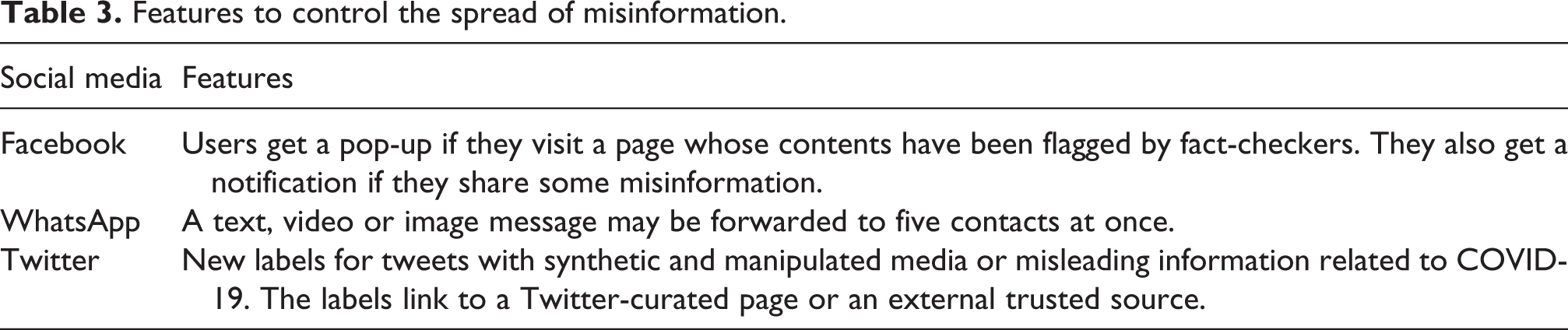
Various national and state-level library associations and library schools also organized different online and virtual sessions on fake news and misinformation during the same period. For example, Kerala Library Professionals’ Organisation organized a webinar on ‘Misinformation, Disinformation and Mal-information’ on 14 April 2021. Videos of some of these events were uploaded on YouTube channels, while some of the events were reported in the newsletters, blogs and social media channels of the respective associations and institutions. Some of the features and tools discussed in the webinars to control the spread of misinformation are presented in Table 3 and Table 4. These tools are being used by university and college libraries across India to control the spread of misinformation. Library professionals have frequently used library websites, blogs and social media channels to reach out to their academic stakeholders and apprise them of the dangers of fake news and misinformation.
Features to control the spread of misinformation.
Tools to check the authenticity of news, images and videos.

We created a questionnaire in Google Forms to learn about LIS educators’ perspectives on misinformation and ways to contain it. Four Assistant Professors and seven Associate Professors responded. The LIS educators felt that there was a problem of misinformation and fake news in society. Out of the 11 respondents, 10 thought that the circulation of misinformation and fake news led to wrong decision-making and perceptions. All of the LIS educators felt that the circulation of misinformation and fake news endangered law and order in the country. Ten of the educators mentioned that there were modules in their respective LIS curriculums to teach students to differentiate between fake and authentic news, and information and misinformation. Conversely, two of the LIS educators said that they did not have any such modules. Out of the 11 educators, only two mentioned that they had plans to start modules for their students. One educator had secured a grant of US$1000 from the US Federal Grants for her department to conduct a webinar series on media and information literacy. The LIS educators offered many suggestions for containing the circulation of misinformation in society: people should refrain from forwarding messages without verifying them; students at school, college and university levels need to be sensitized to the authenticity and validity of sources of information and news, and should be made aware of how to differentiate between legitimate and fake information sources; students should be made aware of the IFLA guidelines for spotting fake news; and fact-checking websites should be consulted for checking and ascertaining the validity of a source and its contents. It was also mentioned by one of the LIS educators that the prevalence of fake news could not be completely eliminated, but it could be controlled by making people aware of the various tools for verifying content.
Conclusion
The importance of the media cannot be overestimated, particularly in times of disaster, whether natural or man-made. In India and beyond, the media has acted as a beacon during the COVID-19 pandemic, with countless instances of delivering a free flow of critical information. The media has definitely enhanced the democratic and participative quotient of the world’s largest democracy. It has exponentially increased accessibility to otherwise inaccessible ivory towers of authority and power. The cascading effect includes enhanced accountability and accessibility. Apart from being a source of entertainment, the media has been informative, developmental and participatory. It has been a great enabler, empowering the layperson– many defaulting Goliaths have been put in their place by humble Davids.
With so much revolutionizing power, the constituents of society should know how to wield this power judiciously and constructively to their advantage, for progress, peace and development, rather than being misled by a handful of misrepresented facts, figures, audio clips or videos. This is why media and information literacy should be incorporated in curriculums at various levels in academia.
The Indian initiatives, driven by volunteers and concerned citizens, to fact-check and counter fake news, misinformation and disinformation are exemplary for developing countries. Such countries have minimal resources for these types of schemes. With the support of LIS institutions, citizens in these countries could have more capabilities and capacities to identify the sources of fake news and minimize its spread in real time on social media and instant messaging platforms. During the pandemic, library and information professionals and LIS educators, associations and institutions in India extended their support to society by strategically controlling the spread of misinformation and fake news through several interventions, such as organizing informative webinars and online sessions, and analysing and updating the misinformation status of various viral posts on library websites, blogs or social media channels. This study is important for library and information professionals in other countries. It highlights the efforts made by different stakeholders in India to stem the rising tide of misinformation, disinformation and fake news. LIS educators are making concerted efforts to sensitize students to differentiating between information, misinformation, disinformation and fake news, and not indiscriminately forwarding, sharing and liking posts and videos on social media.
Footnotes
Declaration of conflicting interests
The authors declared no potential conflicts of interest with respect to the research, authorship and/or publication of this article.
Funding
The authors received no financial support for the research, authorship and/or publication of this article.
