




Abstract
The accessibility of special collections during the COVID-19 pandemic was a matter of concern for libraries and their users due to the specific nature of special collections compared to other information sources in libraries. This study therefore investigated the accessibility of special collections in university libraries in the South South zone of Nigeria during the COVID-19 pandemic. The population of the study included 233 librarians in federal, state and private universities in the zone. The study adopted an online questionnaire and there was a total of 197 respondents. The findings show that special collections were accessible to library users through library websites, institutional repositories, CD-ROMs and flash drives during the COVID-19 pandemic in Nigeria. The study reveals some of the challenges affecting the accessibility of special collections during the COVID-19 pandemic in university libraries in Nigeria and recommends ways of enhancing the accessibility of special collections during a crisis such as the COVID-19 pandemic.
Introduction
The development of special collections in Nigerian libraries dates back to the establishment of the first university in Nigeria – namely, the University of Ibadan in 1948. As, at the time of the establishment of the University of Ibadan, there was no national library in existence and since the University of Ibadan was the highest institution of learning, the University Library was designated as the national repository for Nigerian publications (Apeji, 1986). As a result, it became compulsory for all publishers in Nigeria to deposit two copies of their books, journals, pamphlets, gazettes, sheet music, maps, plans and videos, for example, in the University Library (Apeji, 1986). Later, other universities and libraries were established. The development of libraries in different universities in Nigeria, however, increased the need to develop special collections in the various university libraries to meet the information needs of the library patrons at these universities.
The COVID-19 pandemic, which came as a shock to all sectors of the economy, and particularly university libraries in Nigeria, meant that libraries had to shut down physical access to their information sources, special collections and services. Libraries, as custodians of processed knowledge, are vital hubs with regard to accessing and disseminating information for users, irrespective of their location. With the spread of COVID-19 affecting service providers, including libraries, it was impossible for library patrons to access critical information sources such as special collections for learning, teaching, research activities and community services.
According to Apeji (1986), special collections are rare archival materials, manuscripts, government publications and historical records. Similarly, Purdue University (2022) notes that special collections include groups of items, such as rare books or documents, that are either irreplaceable or unusually rare and valuable. Omeje et al. (2016) confirm that special collections contain highly valuable materials that could aid teaching, learning and research. Special collections may be defined as primary information sources that are acquired or produced in a university and stored in the library – including, for example, theses and dissertations, documents, rare books, manuscripts, archival materials, reports, technical papers, presentations, research findings, inaugural lectures, workshop and conference presentations, lecture notes and videos – and can aid the research activities of the university community. Special collections are rare information materials that are only available and accessible within a library and may not be available elsewhere. Special collections have been extremely important for library users for learning, teaching, research activities and community services during the COVID-19 pandemic. Most of them contain records that are of enduring value and information sources that can stimulate further research in a university setting.
Library policies that excluded special collections from loanable materials hindered access to these resources during the COVID-19 pandemic in Nigeria. Special collections are useful for the development of further research since they contain critical information, case studies, scientific findings, reports, archival records and government documents, for example, that could aid research and be helpful in the fight against COVID-19. During the COVID-19 pandemic in Nigeria, all universities and libraries were shut down following an order by the government in order to reduce the spread of the virus. The closure of libraries had a negative effect on the accessibility and dissemination of special collections for library patrons (Omeluzor et al., 2022). Some literature has discussed the efforts that were made by libraries and information service providers towards increasing access to information resources during the COVID-19 pandemic (IFLA, 2020; Hinchliffe and Wolff-Eisenberg, 2020; Omeluzor et al., 2022). How these efforts translated into the accessibility of special collections during the COVID-19 pandemic in university libraries in Nigeria was the main reason for this investigation. The study was guided by the following four research questions: What are the information materials that constitute special collections in university libraries in Nigeria? Which of the special collections were accessible to library patrons during the COVID-19 pandemic in Nigeria? Which mediums did libraries adopt to provide access to special collections during the COVID-19 pandemic in Nigeria? What were the challenges of accessing special collections during the COVID-19 pandemic in university libraries in Nigeria?
Literature review
In Nigeria, the COVID-19 pandemic was first reported on 27 February 2020, which later led to the shutting down of libraries (Omeluzor et al., 2022). The closure of libraries during the COVID-19 pandemic was a pretest to ascertain the ability and readiness of libraries to provide access to critical information sources such as special collections to their library users. Pearson (2020) reports that the spread of COVID-19 led to the shutting down of some libraries, which affected physical access to information and services, with some resorting to online services. For instance, the libraries at the University of the Pacific (2020) and the University of Adelaide (2020) transitioned to remote operations, making online resources and services available through their library websites. These online resources included access to e-books, e-journals, publisher databases and streaming videos, but not special collections. Similarly, Onifade (2020) confirms that the Nimbe Adedipe Library at the Federal University of Agriculture, Abeokuta, provided access to reference services, information literacy and electronic resources through social media (WhatsApp) and Zoom during the COVID-19 lockdown. A study by Emasealu and Umeozor (2021), which surveyed 43 academic libraries in Nigeria on the availability and remote accessibility of academic library services during the COVID-19 lockdown, reveals that 33 (76.7%) of the libraries had websites and subscribed to various e-resources with some restrictions using the library Internet protocols, while 10 (23.3%) did not have functional websites. The findings also show that 17 (39.5%) of the libraries had websites without online information services for remote access to information for users in remote locations. It was evident in the study that 3 (7.0%) of the libraries had very few digital resources and were remotely inaccessible, whereas 13 (30.2%) provided meaningful information sources that were available online and could be accessed remotely during the COVID-19 lockdown. Among these recent studies, there is no evidence of accessibility to special collections during the COVID-19 pandemic in university libraries in Nigeria.
Access to special collections during the COVID-19 pandemic
Accessibility to information resources is a major concern for libraries. It is why libraries adopt several mediums in order to ensure uninterrupted access to information sources and services for their patrons. Information access is the right of everyone. However, because of the importance of special collections, access is usually monitored. It is evident that during the COVID-19 pandemic some libraries allowed access to special collections. For instance, the State Library of New South Wales (2022) was committed in supporting the research work of scholars, students and other members of the public through providing access to its special collection materials. Similarly, Smith College Libraries (2022) provided access to the Special Collections Reading Room during regular hours, which was open on a walk-in basis for Smith students, faculty and staff who were in the campus COVID-19 screening programme and all other visiting researchers by appointment. Furthermore, the Claremont College Library (2022) website provided assistance to library patrons who requested access to special collections. The website has a search tool that enables users to search for information by author, keyword, title or subject in special collections, archives and the online archive of the Claremont Colleges Digital Library. The literature shows that some universities around the world were able to provide access to information sources, including special collections, during the COVID-19 pandemic.
According to Purdue University (2022), some of the special collections in its archives and special collections unit – such as the Bruce Rogers Collection, William Freeman Myrick Goss Library of the History of Engineering, and Indiana collection – including rare books, were accessible to library patrons. Purdue University reports that the special collections were accessible via a repository with structured subject-based access to enable easier access to these resources by users on the library website. In addition, the University of Washington Libraries made rare books, manuscripts, papers, records, photographs, moving images and architectural drawings accessible for library patrons during the COVID-19 pandemic. The special collections unit was open by appointment, and users were expected to make a research appointment with the library to access the resources (University of Washington Libraries, 2022).
In their study of 20 postgraduate students at the Nnamdi Azikiwe Library, Omeje et al. (2016) report that the University of Nigeria, Nsukka, Special Collections Division is one of the four principal divisions of the library and is housed in a closed-access room on the first floor of the main library building. The study reveals that postgraduate students use special collections such as theses and dissertations, materials on Africa, United Nations publications, government documents and archives. According to Omeje et al. (2016), the purposes for using special collections include research, extracting statistical data, gathering information on international perspectives on particular issues, and policy matters. A study by Chukwu et al. (2018) reveals that the Federal University of Technology, Owerri, started a digitization programme to convert all of its special collections into electronically accessible resources through its institutional repository. Similarly, Anunobi and Onyebinama’s (2011) report shows that awareness of the creation of electronic theses and dissertations was developed during the introduction of the Database of African Theses and Dissertations by the Association of African Universities. This effort, as reported by Anunobi and Onyebinama (2011), aimed to provide access to special collections. Some recent studies have also shown that critical information, including special collections and digital materials, was disseminated through university libraries to library patrons during the COVID-19 pandemic (Duke University Libraries, 2020; Ishtiaq et al., 2020; Omeluzor et al., 2022).
A recent survey of academic libraries’ responses to COVID-19 in the USA reveals that access to both technologies and print materials remained largely unaffected by the COVID-19 pandemic (Hinchliffe and Wolff-Eisenberg, 2020). The findings further show that 80% of the libraries did not report any changes to their existing technology lending programmes, while 85% reported providing access to print materials. Emasealu (2019) affirms that as traditional libraries are moving towards providing services in a digital environment, improved access to remote library collections is making the use of electronic information resources more realistic and attractive.
Challenges of accessing special collections during the COVID-19 pandemic
The difficulty of providing access to special collections is revealed in Emasealu and Umeozor’s (2021) study, which shows that 10 of the federal universities in their study did not have online visibility because there were no traceable websites dedicated to the libraries for their services. Their findings further reveal that digitized materials, including special collections, were not accessible to library patrons during the COVID-19 pandemic. Panezi (2014) argues that there should be freedom in accessing and using information resources (orphan and out-of-print works). Panezi insists that such materials should be included in the corpus of works in the public domain. According to Ali and Gatiti (2020), the role of librarians and information specialists in a pandemic is to promote health awareness by creating and disseminating information relating to preventive measures, not restricting access to special collections and thereby supporting research teams, researchers and faculty by providing information regarding the latest developments, research and literature, and meeting the core needs of regular library users.
Kwanya et al. (2015) explain that, with information and communications technologies (ICTs), the world has been transformed into a ‘global college’. Hence, ICTs can be used by university libraries in providing services that extend special collections to users outside the library building, especially during situations such as the COVID-19 pandemic. Emasealu and Umeozor (2021) state that ‘ICT has such magnitude of impact in information delivery system such that libraries are now deeply engaged in digitization of almost all library resources in order to provide fast, interactive and dynamic information services to users’. However, their findings show that ICTs were not used adequately for the delivery of information services, including special collections, in university libraries during the COVID-19 pandemic in Nigeria. In an era when ICTs are being applied in all areas of human endeavour, especially with the spread of the COVID-19 virus, university libraries need to take advantage of ICTs for the creation, accessibility and dissemination of special collections for the benefit of library patrons. Panezi (2014) states that the digitization of information brings new life to works, enhancing access and bringing information closer to users.
The university libraries in Nigeria were not immune to the challenges affecting the accessibility of special collections during the COVID-19 pandemic. According to Emasealu and Umeozor (2021), Nigeria is severely challenged by the lack of basic infrastructure, which has prevented the development of special collections in academic libraries. Similarly, Chukwu et al. (2018) identify the erratic power supply, lack of modern infrastructure, lack of skilled staff and nonchalant attitude of departments as major factors affecting the management of special collections in a Nigerian university of technology. Equally, Yaya and Adeeko (2016) state that the ICT departments in most libraries in Nigeria lack modern computer systems. In addition, Jagboro et al. (2012) identified inadequate training in the use of basic computer programmes among librarians as a challenge in the development of special collections in libraries. Omeluzor and Oyovwe-Tinuoye’s (2016) study reveals that the erratic power supply, insufficient training and inadequate funding are among the challenges facing the use of integrated library system (ILS) for the provision of services and resources, including special collections, in academic libraries in the Edo and Delta States of Nigeria. Omeje et al.’s (2016) study found that the problems encountered by postgraduate students in the use of special collections are the absence of networks, materials not being up to date, absence of photocopying services and difficulty in using catalogues. These (and more) were some of the challenges that made special collections inaccessible during the COVID-19 pandemic in Nigeria.
Methods
Research approach
The study adopted a descriptive survey design. The descriptive survey design was a reliable means of providing the researchers with the opportunity to use the data collected for a study and has shown some level of reliability in social science research that uses data (Omeluzor, 2020).
Population
The population of the study comprises all the librarians in the libraries at federal, state and private universities in the South South zone of Nigeria. Librarians were selected as the respondents in this study because they have records on the usage of special collections during the COVID-19 pandemic period in the various libraries under study. According to a study by Oyovwe-Tinuoye et al. (2021:5), there is a total of 233 academic librarians in the federal, state and private universities in the South South zone of Nigeria: ‘Among these universities, 95 respondents are from the federal universities, 93 of the respondents are from the state universities while 45 of the respondents are from the private universities given a total of 233’. This study therefore adopted the population of 233 as its sample.
Research instrument
The instrument for data collection was a structured online questionnaire that was designed by the researchers. The researchers adopted an online questionnaire because it was easier to reach out to all the respondents quickly without the risks of travelling by road and spending money on transport. The research instrument was developed using a Google Form to provide answers to the four research questions. 1 The instrument had five sections (see Appendix 1). Section A focused on the demographic information of the respondents. Section B had 12 options, which required the respondents to indicate the options that constituted special collections in the various libraries under study. The questions in Section C required the respondents to indicate whether special collections were accessible to library patrons during the COVID-19 pandemic. It had a 5-point Likert scale where 5 was the highest score and 1 the lowest (5 = strongly agree, 4 = agree, 3 = undecided, 2 = disagree, 1 = strongly disagree). Section D focused on the medium that the library adopted to provide access to special collections for patrons during the COVID-19 pandemic, while Section E required the respondents to identify the challenges affecting the accessibility of special collections in their library during the pandemic. Section E had a 5-point Likert scale where 5 was the highest score and 1 the lowest (5 = strongly agree, 4 = agree, 3 = undecided, 2 = disagree, 1 = strongly disagree).
Testing and retesting of the questionnaire
In order to ascertain the validity of the instrument, the researchers used pre-reliability tests such as face, content and construct checks. The researchers used the services of information professionals, who went through the instrument and, after making some minor corrections, certified that it was suitable for collecting data for the study. To verify the content validity, the researchers sent the instrument to 15 librarians at the Imo State University, located in the south-east geopolitical zone of Nigeria, who were not part of the study. The 15 questionnaires were all returned and analysed using the Cronbach’s alpha correlation coefficient at the .5 level of acceptance, which gave a result of r = .84. This result indicated that the instrument was reliable and good for data collection for the study, since the test result was above the acceptance point of .5.
Distribution and data collection
The questionnaire was distributed to the respondents via their respective verified WhatsApp/email addresses. The respondents’ emails addresses were retrieved from an earlier attendance sheet of the Nigerian Library Association’s annual conference and general meeting. The use of WhatsApp/email addresses to send out the questionnaire directly to the respondents eliminated responses from unintended respondents. Out of the total population of 233 librarians who received the questionnaire, there were 197 responses, giving an 85% response rate, and these were used for the analysis in this study. The data collected was analysed using a Google Forms analysis tool and SPSS (Statistical Package for the Social Sciences), version 16.0. The results are presented in tables showing frequency, percentages, means and standard deviations for clarity and understanding. In the four tables, the mean scores are rated as follows: a mean of 0.1 to 1.9 is very low, 2.0 to 2.4 is low, 2.5 to 2.9 is high, and 3.0 and above is very high.
Results
Demographic information of the respondents
The results with regard to the respondents’ qualifications reveal that 98 (49.9%) had a Master’s degree and 99 (50.1%) had a PhD in Library and Information Science, while none had a Bachelor’s degree. This shows that the respondents had the necessary qualifications in the profession in their respective university libraries in Nigeria. On the designation of the respondents, the results show that 33.3% were Assistant Librarians and 8.3% were Librarian II and Librarian I, respectively. The results also reveal that the majority (41.7%) of the respondents were Senior Librarians, while a lower percentage (8.3%) were University Librarians. The results show that none of the respondents were Deputy University Librarians. The results indicate that different categories of librarians participated in the study.
The results reveal that the majority (56%) of the respondents who participated in the study were currently working in the special collections unit at their various universities. Twenty-five percent of the respondents served in electronic library units and 10% served in reader services, while 5% and 4% worked in cataloguing and administrative units, respectively. The results on the length of service reveal that the majority (33.3%) of the respondents had worked as librarians for between 6 and 10 years, and 25% had worked for 21 years or more. The results also show that 8.3% of the respondents had worked for 1–5 years, while 16.7% had worked for 11–15 years and 16–20 years, respectively. These results may imply that the majority of the respondents who participated in this study had some long-time experience of special collections and library services.
Findings
The first objective was to identify the information materials that constitute special collections in the university libraries in the South South zone of Nigeria. The results in Table 1 show that all (100%) of the respondents attested that theses and dissertations, technical papers, government publications and archival materials constituted special collections in their libraries. The results also reveal that the majority of the respondents indicated that rare books (97.4%), Africana (79.1%), video collections (77.1%) and United Nations publications (72.5%) constituted their special collections. The results in Table 1 further show that the respondents identified reports (52%), workshop and conference proceedings (41.6%), and lecture notes and presentations (31.9%) as special collections. These results imply that all the information resources listed in Table 1 constitute special collections of libraries. These materials were relevant for the provision of information to library patrons during the COVID-19 pandemic.
Special collections (N = 197).

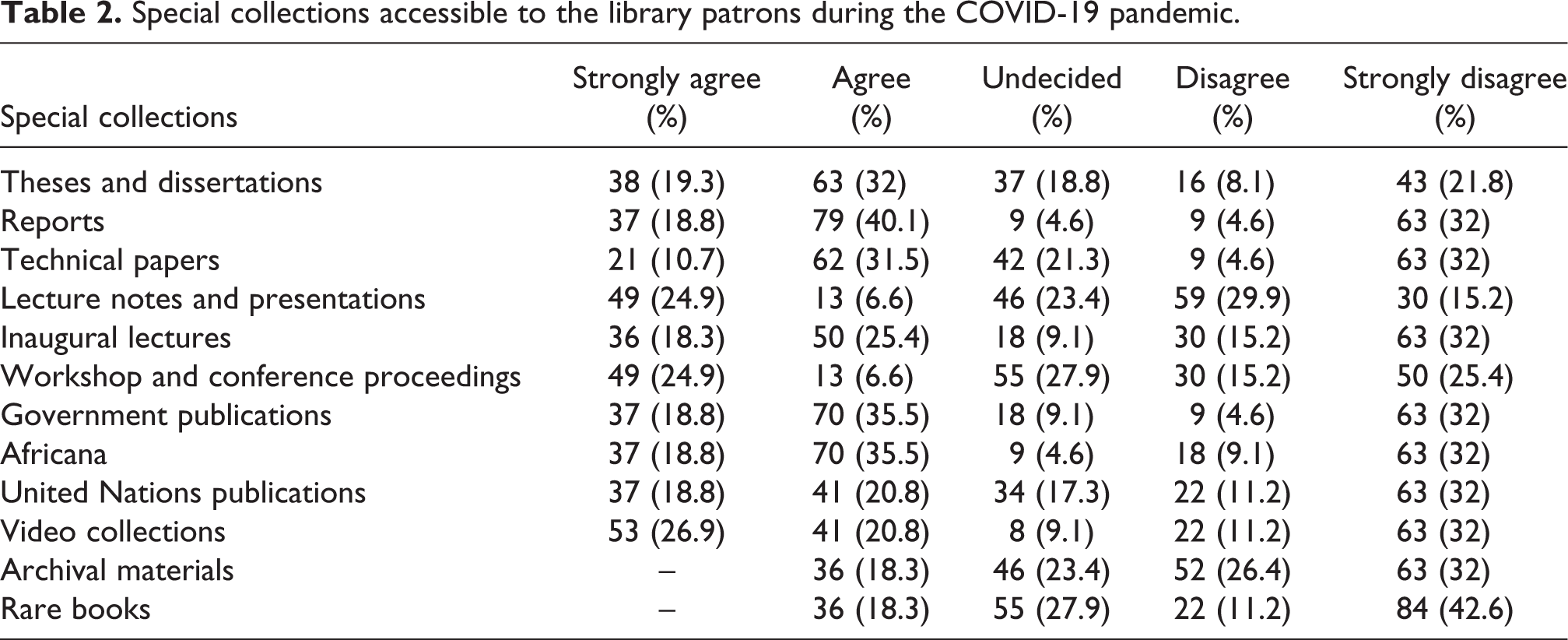
The second objective, as shown in Table 2, was to establish which special collections were accessible to library patrons during the COVID-19 pandemic. The result in Table 2 shows that 19.3% and 32% of the respondents strongly agree and agree that thesis and dissertation were accessible to users during the COVID-19 pandemic; 21.8% and 8.1% of the respondents strongly disagreed and disagreed respectively, while 18.8% were undecided. The result indicates that 18.8% and 40.1% of the respondents strongly agree and agree that reports were accessible to users during COVID-19 pandemic. 32% and 4.6% strongly disagreed and disagreed while 4.6% were undecided. A total of 10.7% and 31.5% of the respondents also agreed and strongly agreed that technical papers were accessible to users, 4.6% and 32% of the respondents strongly disagreed and disagreed with that, while 21.3% were undecided on its accessibility to the library patrons during COVID-19 pandemic. The result in Table 2 also reveals that 24.9% and 6.6% of the respondents strongly agreed and agreed that lecture notes and presentation were accessible to users while 29.9% and 15.2% disagreed and strongly disagreed that it was accessible, and 23.4% were undecided. The result further reveals that 18.3% and 25.4% of the respondents strongly agreed and agreed that inaugural lectures were accessible, 15.2% and 32% disagreed and strongly disagreed that it was accessible while 9.1% of the respondents were undecided. The result in Table 2 indicates that 24.9% and 6.6% of the respondents strongly agreed and agreed that workshop and conference proceedings were accessible to users, 15.2% and 25.4% of the respondents disagreed and strongly disagreed while 27.9% were indifferent. The result in Table 2 also shows that 18.8% and 35.5% of the respondents strongly agreed and agreed respectively that government publications and Africana were accessible to the users, whereas 32% and 4.6% strongly disagreed and disagreed that government publication were accessible. It is also reveals that 32% and 9.1% strongly disagreed and disagreed that Africana was accessible to the users. The result in Table 2 also reveals that 18.8% and 20.8% of the respondents strongly agreed and agreed that United Nations publications were accessible to the users; 11.2% and 32% of the respondents disagreed and strongly disagreed, while 17.3% of the respondents were undecided. The result in Table 2 further shows that 26.9% and 20.8% of the respondents strongly agreed and agreed that video collections were accessible to the users while 11.2% and 32% of the respondents disagreed and strongly disagreed that video collections were accessible. On the accessibility of archival materials, 18.3% agreed that it was accessible, 26.4% and 32% disagreed and strongly disagreed that it was accessible to the users, while 23.4% were indifferent. A total of 18.3% of the respondents also indicates that rare books were accessible to library patrons during the COVID-19 pandemic, 11.2% and 42.6% disagreed and strongly disagreed while 27.9% were undecided.
Special collections accessible to the library patrons during the COVID-19 pandemic.
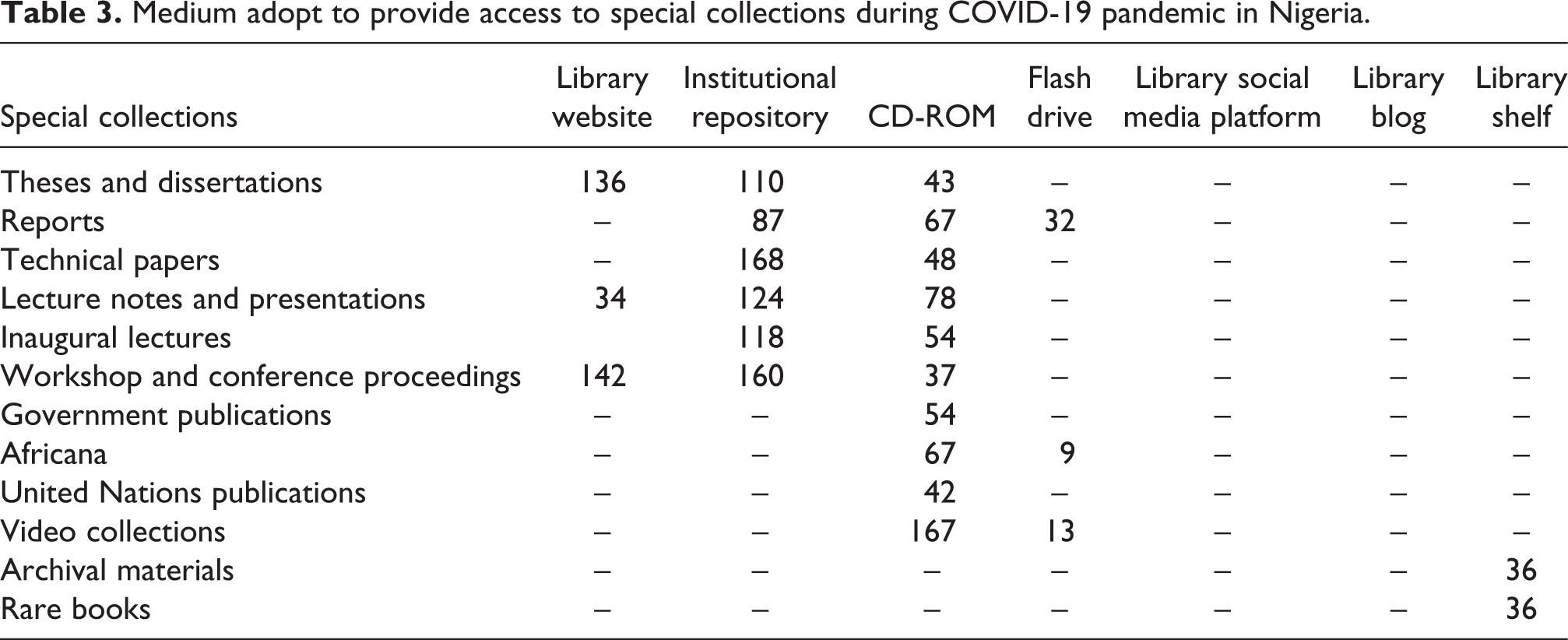
The third objective was to ascertain the mediums that the libraries adopted to provide access to special collections for library patrons during the COVID-19 pandemic. The results in Table 3 show that 136, 34 and 142 of the respondents, respectively, specified that theses and dissertations, lecture notes and presentations, and workshop and conference proceedings were accessible via the library website for patrons during the COVID-19 pandemic. The results also reveal that 110, 87, 168, 125, 118 and 160 of the respondents, respectively, indicated that theses and dissertations, reports, technical papers, lecture notes and presentations, inaugural lectures, and workshop and conference proceedings were accessible via their institutional repository during the COVID-19 pandemic. The results further show that the majority (167) of the respondents confirmed that video collections were accessible with the aid of CD-ROMs. The results also indicate that 32, 9 and 13 of the respondents, respectively, specified that reports, Africana and video collections were accessible via flash drives, while 36 indicated that archival materials and rare books were accessible on the library shelves. The results in Table 3 show that the university libraries’ social media platforms and blogs were not used to access special collections during the COVID-19 pandemic in the South South zone of Nigeria.
Medium adopt to provide access to special collections during COVID-19 pandemic in Nigeria.
The fourth objective was to find out the challenges in accessing special collections during the COVID-19 pandemic in university libraries in Nigeria. The results in Table 4 reveal that all of the items were basically factors that affected the accessibility of special collections during the COVID-19 pandemic in Nigeria. The results, however, show that the unavailability of current materials (X = 4.2) was a major challenge. This is followed by inadequate ICT infrastructure (X = 3.6) and an inadequate Internet network. The results in Table 4 also indicate that erratic power supply (X = 3.4), inadequate funding (X = 3.3), outdated catalogues (X = 3.2) and inadequate ICT skills and inadequate training (X = 3.1) were challenges. An earlier study by Omeje et al.’s (2016) had shown that erratic power supply (X = 3.4), inadequate funding (X = 3.3) and outdated catalogues (X = 3.2) were challenges in accessing special collections in Nigeria. The results show that inadequate ICT skills and inadequate training (X = 3.1) were challenges.
Challenges of accessing special collections during COVID-19 pandemic in university libraries in Nigeria.

Note. Acceptable mean score = 2.5.
Discussion
The findings of this study capture the holistic response of the participants from various units in university libraries on the accessibility of special collections during the COVID-19 pandemic in the South South zone of Nigeria. The findings in Table 1 identify the information sources that constitute special collections in university libraries in Nigeria, including theses and dissertations, reports, technical papers, lecture notes and presentations, Africana, government publications, United Nations publications and video collections. Omeje et al.’s (2016) study also identifies the sources shown in Table 1 as special collections that contain relevant information for research, teaching and learning in the university. Similarly, Anunobi and Onyebinama (2011) confirm that theses and dissertations constituted the special collections that were converted into digital collections by the Association of African Universities.
The findings in Table 2 show that special collections were accessible to library patrons during the COVID-19 pandemic. For instance, a majority of the respondents confirmed that theses and dissertations (51.3%) and reports (58.9%) were available to them. This means that the libraries were able to provide access to special collections during the COVID-19 pandemic. Other special collections that were accessible during the COVID-19 pandemic included technical papers, lecture notes and presentations, workshop and conference proceedings, government publications and Africana. This finding substantiates the findings of Hinchliffe and Wolff-Eisenberg’s (2020) study, which found that access to special collections was not affected by COVID-19 across libraries in the USA. There is evidence that the State Library of New South Wales, Smith College Libraries, Purdue University Library, University of Washington Libraries and the Nnamdi Azikiwe Library at the University of Nigeria were among the libraries that made their special collections accessible for library patrons during the COVID-19 pandemic. The findings in Table 2 reveal that some of the respondents disagreed and were undecided in their response, which means that some libraries in Nigeria were unable to provide access to special collections for their patrons during the COVID-19 pandemic. This may be as a result of the closure of libraries around the world (Pearson, 2020) and in Nigeria (Omeluzor et al., 2022), except for those that provided access through electronic mediums.
The findings in Table 3 indicate that library websites, institutional repositories, CD-ROMs and flash drives were the mediums used to provide access to special collections for library patrons during the COVID-19 pandemic in Nigeria. This finding substantiates the assertion by Claremont College Library (2022) that assistance was given to library patrons who requested access to special collections through its website. This finding is also supported by the findings of Emasealu and Umeozor’s (2021) study, which proved that 76.7% of libraries in Nigeria had websites and various e-resources that were used to provide access to meaningful information sources and services during the COVID-19 pandemic. The findings in Table 3 further reveal that special collections such as theses and dissertations, reports, technical papers, lecture notes and presentations, inaugural lectures, workshop and conference proceedings, government publications, Africana, United Nations publications and video collections were accessible to library patrons through those mediums during the COVID-19 pandemic. The use of websites, institutional repositories and CD-ROMs enhanced access to critical and relevant information sources for patrons who could not access the physical library due to restrictions during the COVID-19 pandemic. The University of the Pacific (2020) and University of Adelaide (2020) were among those libraries that used online resources and their websites to provide services for their patrons. The findings in Table 3, however, reveal that special collections were not accessible via social media platforms, library blogs and the library shelves. However, it is important to state that library blog may serve as online noticeboard for sharing unrestricted information with the general public. The inability to access special collections via the library shelves may not be unconnected with the shutting down of libraries in Nigeria in line with government directives as a measure to curb the spread of the COVID-19 virus (Omeluzor et al., 2022).
The findings in Table 4 reveal that inadequate ICT infrastructure, inadequate ICT skills, inadequate training, an erratic power supply, inadequate funding, a poor Internet network, the unavailability of institutional repositories, the unavailability of current materials and outdated catalogues were among the factors affecting access to special collections during the COVID-19 pandemic in Nigeria. These findings corroborate the studies by Emasealu and Umeozor (2021) and Omeje et al. (2016) showing that Nigeria is severely challenged by its lack of basic infrastructure and poor Internet connections, which have prevented the development and use of special collections in academic libraries. Omeje et al. (2016) also confirm that 10 of the federal universities in their study did not have online visibility.
Inadequate training in the handling of ICT tools could have also hindered the provision of access to special collections and other information sources in libraries during the pandemic. This finding agrees with Omeluzor and Oyovwe-Tinuoye’s (2016) and Jagboro et al.’s (2012) studies, which identified inadequate training in the use of basic computer programmes among librarians as a challenge for the development and provision of access to special collections in libraries. The erratic power supply and inadequate funding were also identified as challenges facing the accessibility of special collections in university libraries in Nigeria. This finding is confirmed by Omeluzor and Oyovwe-Tinuoye (2016), who show that these factors are impediments in providing access to special collections in libraries in Nigeria. They remain hindrances in the delivery of information and services to library patrons in the 21st century, and are interrelated for the purpose of enhancing access to information services in libraries. The inadequacy of these factors may have led to poor service delivery during the pandemic.
Conclusion and recommendations
The relevance of libraries as storehouses of knowledge came to the fore during the COVID-19 pandemic. This is because access to information sources, including special collections, was restricted, which affecting teaching, learning, research activities and decision-making in different sectors – especially the education sector. Special collections constitute an important part of library information sources and contain information that can help in the development of vital documents by various organs of government. The findings reveal that library patrons had access to and interacted with special collections during the COVID-19 pandemic. It is important to state that library websites, institutional repositories and CD-ROMs were the mediums that libraries used to provide access to special collections for their patrons during the pandemic. The use of online platforms shows an improvement in providing quality access to information resources that helped to break down the barriers to accessing information during the COVID-19 crisis. The support offered by the university libraries in Nigeria in allowing access to their special collections for their patrons during the COVID-19 pandemic is highly commendable. Such efforts need to be improved on to enable regular access to special collections and other information sources and services, and meet the information needs of library patrons during a crisis. The study shows the tenacity of the libraries in Nigeria in being able to provide access to special collections when faced with a number of challenges and daunting issues that had consistently resulted in setbacks in the delivery of information and services in Nigeria. On the basis of the foregoing, the following recommendations are made: Library management teams should prioritize the use of their website and institutional repository to make special collections and other information sources accessible for library patrons during a pandemic such as COVID-19 and other major crises in the future. University and library management teams should source funding for the development of the library infrastructure, including the power supply, Internet connection and ICT facilities, to enhance access to special collections and other information sources. University libraries should prioritize training programmes for librarians to enable them to perform well in the delivery of quality services to library patrons during a crisis. There is a need for university libraries to provide skeleton services during a crisis to enable the provision of on-the-shelf print sources from special collections for patrons. Library management teams should create awareness and enlightenment campaigns in respect of the available special collections to increase their usage by library patrons. A specialized library blog should be used to enhance information sharing with registered library patrons for the purpose of providing continual access to special collections and other relevant information.
Supplemental material
Supplemental Material, sj-pdf-1-ifl-10.1177_03400352221149755 - Accessing special collections during the COVID-19 pandemic in university libraries in Nigeria
Supplemental Material, sj-pdf-1-ifl-10.1177_03400352221149755 for Accessing special collections during the COVID-19 pandemic in university libraries in Nigeria by Saturday U Omeluzor, Philomena F Gbemi-Ogunleye, Asimi Akibu Alarape and Lateef Alhaji Bello in IFLA Journal
Footnotes
Declaration of conflicting interests
The authors declared no potential conflicts of interest with respect to the research, authorship and/or publication of this article.
Funding
The authors received no financial support for the research, authorship and/or publication of this article.

Supplemental material
Supplemental material for this article is available online.
Note
References
Supplementary Material
Please find the following supplemental material available below.
For Open Access articles published under a Creative Commons License, all supplemental material carries the same license as the article it is associated with.
For non-Open Access articles published, all supplemental material carries a non-exclusive license, and permission requests for re-use of supplemental material or any part of supplemental material shall be sent directly to the copyright owner as specified in the copyright notice associated with the article.
