



Abstract
Library and information science schools and their accreditations play a crucial role in preparing individuals to become effective and competent library and information professionals. A number of efforts have been undertaken to analyze the accreditation standards and procedures for library and information science professionals in a specific context (e.g. country). However, there is limited research from a global perspective. This article provides an overview of the qualifications of library and information science professionals and accreditation and certification in library and information science schools around the world. A non-probability sampling strategy was employed to collect all this information. A total of 586 programs (e.g. undergraduate) from 198 library and information science schools in 69 countries was represented. The results show that an accredited national degree was the most required credential to work as a professional librarian in the field. Master’s degree programs appeared to be the most commonly offered degree programs at these schools, and English was the most popular language of instruction in all degree programs.
Keywords
Introduction
The world of library and information science (LIS) is a diverse and ever-changing field. Where once it was easy simply to find a job as a librarian, in today’s society, that has become a significantly more complex process. In today’s information society, the LIS field has adapted to the current needs of the field by offering a greater diversity of specializations and skill sets (e.g. see Bird, 2021; Raju, 2020). One of the repercussions of this adaptation is a greater diversity of specializations and skill sets being offered academically. While this certainly enriches the field and strengthens the career prospects for LIS students, it also poses an additional challenge to employers to find employees with the specific skill sets needed to be successful at the job. It also creates an additional challenge for incoming students as they often have chosen a specific career path and need a specific skill set to be successful within that career. Unfortunately, few broad-ranging tools are currently available for use by prospective employers or future students. This study is reflective of the mapping project designed by the Building Strong Library and Information Science Education (BSLISE) Working Group (n.d.), an initiative of the IFLA Education and Training Section, LIS Education in Developing Countries Special Interest Group, and Library Theory and Research Section. This project was designed to provide employers and students with an accessible tool to find LIS schools that will teach the skill sets each group needs to succeed in the global information economy. In addition, the job market is becoming even more diverse, as more programs develop undergraduate degrees in a field that in North America has been strictly a graduate-degree field (American Library Association, 2023; Hamlin, 1981). This does allow for greater reciprocity with countries that have focused primarily on undergraduate education within the LIS field, such as China in the early 1990s (Xue et al., 2019). However, it presents a greater challenge for employers to find what level of degree is needed for a successful job candidate, and for a prospective student looking for career options in the global marketplace.
In addition, while English is regarded as the global business language (Neeley, 2012), no such global language is recognized within academic institutions. Many countries have a large diversity of languages spoken within their boundaries, as well as an even larger diversity of languages spoken around them. This linguistic diversity can present a challenge to international students who may not have access to particular skill sets within their home country but may also be unable to gain fluency in an additional language to the level needed to succeed at the academy within a given time frame.
The LIS world is becoming ever more interconnected and globalized. The demand for data analysis experts and information professionals continues to grow, with the Bureau of Labor Statistics (n.d.) forecasting a growth rate of almost 10% through 2026 in the USA alone. The knowledge, skills, and abilities of LIS professionals have also diversified with the digital age (Yadav, 2021). However, no common certification is recognized globally, making professional movement globally a challenge. In addition, research on the credentialing of information professionals internationally is somewhat sparse. Most studies focus primarily on the requirements within their specific country rather than an overarching review internationally. The primary reason for this is the disparity in requirements globally. LIS is a general term, encompassing skill sets that range from traditional library work to business skills, such as marketing and management, to technology skills. LIS schools and their accreditations play a crucial role in preparing individuals to become effective and competent library and information professionals. A number of efforts have been undertaken to analyze the accreditation standards and procedures for LIS professionals in a specific context (e.g. country). However, there is limited research from a global perspective. This study aims to focus on procedures that address issues of the qualifications of LIS professionals and accreditation and certification in LIS schools around the world.
Literature review
The range of skills within the LIS field has become diverse between countries. However, no specific research on how to obtain those various skills has been explored. While similar processes in professional certification are available, there are even more differences, which presents a challenge for international recognition (Chu and Raju, 2018: 4).
In the USA, the Bureau of Labor Statistics defines a librarian as a person who can help people find information and conduct research for personal and professional use. Their job duties may change based on the type of library they work in, such as public, academic, and medical libraries. Librarians typically need a master’s degree in library science. Some positions have additional requirements, such as a teaching certificate or a degree in another field. (Bureau of Labor Statistics, n.d.)
In Australia, one can become a librarian by obtaining a Master’s or an undergraduate degree. In 2018, there were 10 Higher Education institutions offering 23 ALIA [Australian Library and Information Association] accredited courses, including Master’s, Bachelor and Graduate Diploma. There were two universities, 14 TAFEs [technical and further education institutes] and one private RTO [registered training organization] offering the 17 ALIA accredited Diploma of Library and Information Services courses, making a total of 27 accredited institutions and 40 accredited courses. (Australian Library and Information Association, 2018)
Europe is also somewhat of a blend in terms of accreditation. Librarianship may be pursued at the Bachelor’s or Master’s level in the UK, for example (Marcella and Oppenheim, 2020). However, in recent years, there has been a proliferation of unaccredited undergraduate information management courses in the UK, which poses a serious risk to the continuation of LIS education. An IFLA working group documented that developing an international framework for accreditation and certification is a challenging task even though “similarities in professionalization and certification in LIS can be found across countries and regions” (Chu and Raju, 2018: 4).
Similarly, in Eastern Europe (EE) and some former Soviet Union (FSU) countries, there were several paths whereby a person could become a librarian: As early as 1994, EE/FSU countries made a concerted effort “to follow international trends” in LIS education, encouraging schools of library and information science to “develop to an appropriate level” in such areas as information technologies, information management, marketing, and user education. (Dali and Dilevko, 2007: 85)
International trends in LIS education.
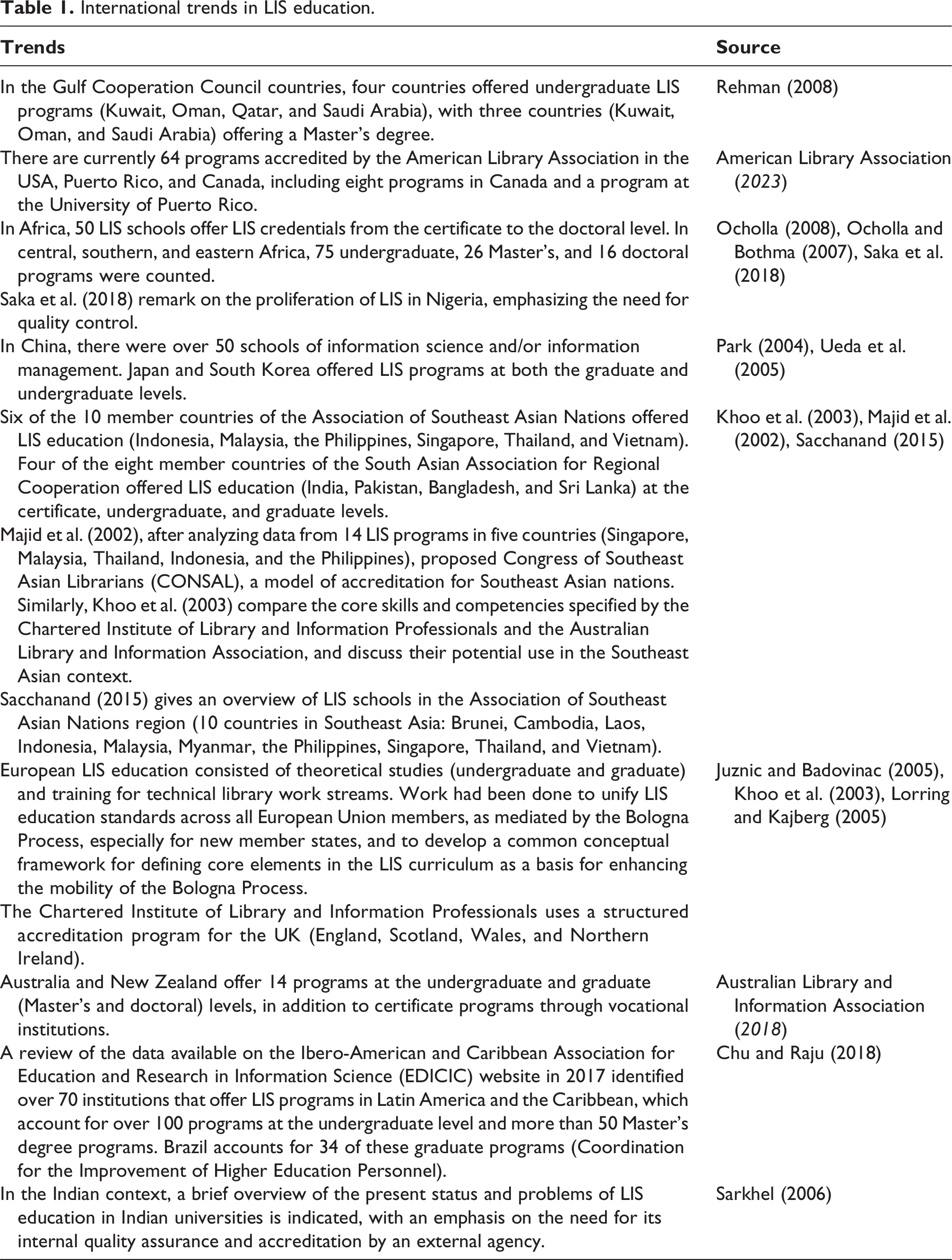
The work by the IFLA BSLISE Working Group (Chu and Raju, 2018) is currently one of the more comprehensive works underway. However, there are still additional questions remaining concerning LIS education and its manifestations internationally. As Dalton and Levinson (2000) stated: “most importantly it was discovered that professional accreditation of LIS courses by professional bodies was extremely rare, occurring in only a small proportion of countries.” Unfortunately, not much further research has been carried out following Dalton and Levinson’s (2000) initial findings.
A lack of exposure to international experiences can be a limiting factor for students in furthering their educational and professional goals (Bird et al., 2015; Hendershot and Sperandio, 2009). Without a background in travel and international experience, the default for most students will be a local choice, whereas a national or international option might better fit the needs of students. In addition, employers often do not have the resources necessary to make an informed decision on reciprocity when it comes to LIS degrees and certifications, except for university rankings, which do not entirely represent LIS programs (Lund et al., 2019). As Hotho (2008) discusses how the LIS world has looked for methods to ensure its professional boundaries and Wiggins and Cannon (2013), as well as Jordan (2019), discuss some of the challenges presented to new professionals trying to enter the workforce, this boxing-in of the profession often makes it challenging to look outside of local or regional expectations. Internships can often provide greater exposure to international opportunities, but there is still a dearth of availability of virtual internships (Bird et al., 2015). These virtual internships can provide both employers and students with a global perspective and offer greater job opportunities for both parties.
Methods
This study focused on the procedures that address professional qualifications, accreditation, and certification for the professional practices of LIS professionals worldwide. In the context of this study, LIS is defined as the study of information in all its formats and processes, the technologies used to interact with information, and the nature of human interaction with information and technology in all society. It is also a professional field that engages all aspects of the information life cycle, utilizes appropriate technologies to connect people to information anywhere, and is practiced in public or private cultural heritage institutions (e.g. libraries, archives, museums), information centers, and workplaces, among others. LIS education and research is conducted in universities or other academic institutions offering degree (undergraduate and graduate) and non-degree programs, in units that are at the level of a school, college, or faculty, a subunit such as a department, or an organized degree program within a department or school. The professional qualification to work as a LIS professional is framed in terms of the academic preparation or training needed to practice or work as a professional librarian. Certification is defined as authoritative validation of the competencies necessary to practice or work as a professional librarian. Accreditation refers to assessment of the academic unit (e.g. school, department, or program) offering LIS degree programs by an external organization.
An online questionnaire was developed by an international team of scholars and professionals and reviewed rigorously to minimize potential misinterpretation issues. The questionnaire was pilot-tested at the 2019 IFLA World Library and Information Congress and additional feedback was solicited prior to its finalization. The formal dissemination of the questionnaire commenced on 28 October–31 December 2019. A non-probability sampling strategy was employed due to the lack of a suitable list of schools and contacts as a sampling frame. The questionnaire was actively promoted by members of the IFLA BSLISE Working Group in their respective geographical areas of interest and connections, including regional, national, and international mailing lists. The invitation email briefly described the type of information collected via the questionnaire to help respondents self-identify to participate in the study. Multilingual contacts in five of the seven IFLA official languages (Arabic, Chinese, French, Russian, and Spanish) and an additional two languages (Portuguese and Turkish) were included in the invitation to assist the participants as questions arose. Since the research group did not have access to a German-speaking contact, a German-language contact was not included in the invitation. Additionally, platforms such as the 2021 and 2022 IFLA World Library and Information Congress and BSLISE webinars and newsletters were used to solicit participation in the questionnaire. Since this study is part of a larger project that is aimed at developing a regularly updated international database and asset map about LIS schools and programs around the world, the data collection process has continued. The results presented in this article are based on data collected from 28 October 2019 to 9 September 2021. A total of 198 unique LIS schools from 69 countries on six continents were represented in the data set (see Figure 1).
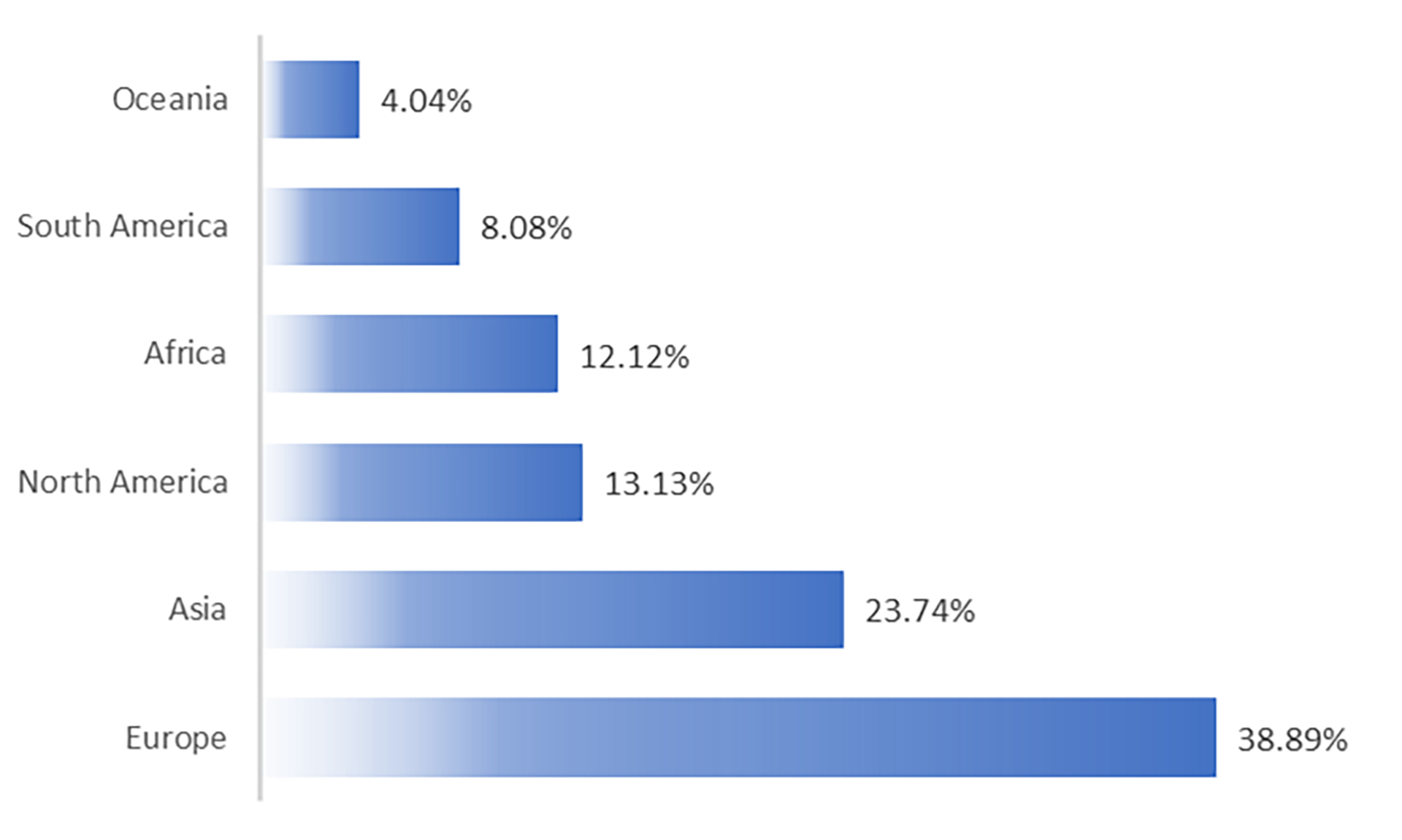
Distribution of LIS schools by continent (n = 198).
Limitations
The invitation method of the survey and the language of the questionnaire (English) might have resulted in a bias toward western countries. The number of responses obtained was limited and, thus, the results and conclusions may not be representative for all LIS schools. In addition, the survey remained open for a two-year period and, although many efforts were undertaken to disseminate the survey worldwide, the limitations remarked affected the number of responses, leaving some schools out of the sample. In addition, the questionnaire did not define “professional librarian,” as many countries typically define the term differently (Chu and Raju, 2018). This may have skewed the results as respondents may have submitted answers based on criteria that applied to their own context.
Results
A large majority of the participants (82.3%, n = 163) from 69 countries indicated that a type of credentialing (e.g. certificate, undergraduate degree) is required to work as a professional librarian and an accredited national degree is the most required credential (70.2%, n = 139). Although a definition of the field of LIS was included in the survey to provide a framework for the study, no definition for “professional librarian” as a title was provided in the questionnaire. Therefore, the respondents interpreted it based on their own context (see Figure 2).
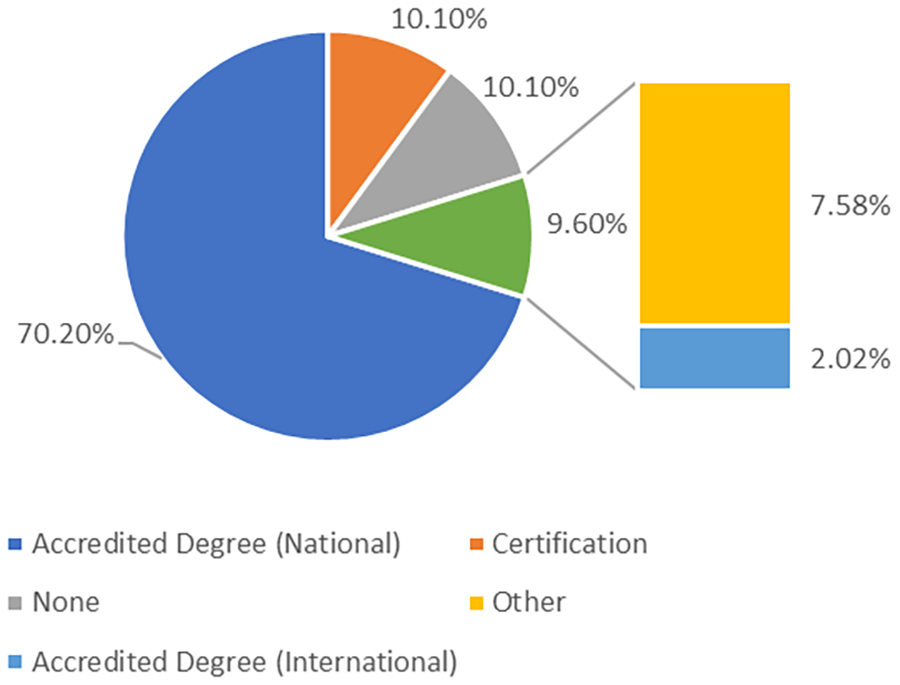
Qualification requirements to work as a “professional librarian” (n = 198).
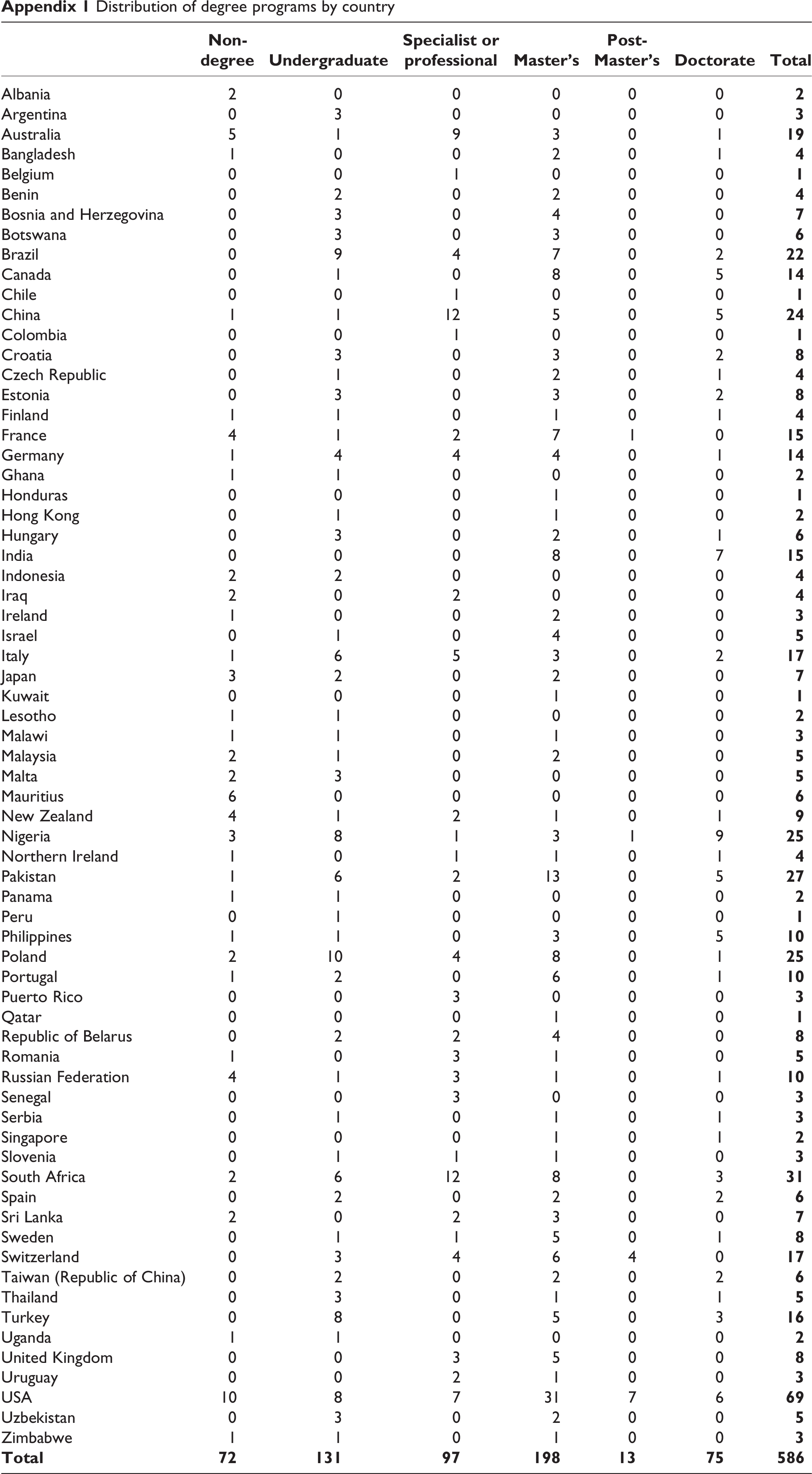
A total of 586 non-degree (e.g. certificate, diploma, associate), undergraduate, specialist or professional, Master’s, post-Master’s, and doctoral degree programs were reported. The most frequently offered degree by the schools participating in the study was a Master’s degree. About 34% (n = 198) of the programs offered by 190 LIS schools were at the Master’s level (see Figure 3). A list of the degree programs broken down by country is available in Appendix 1.
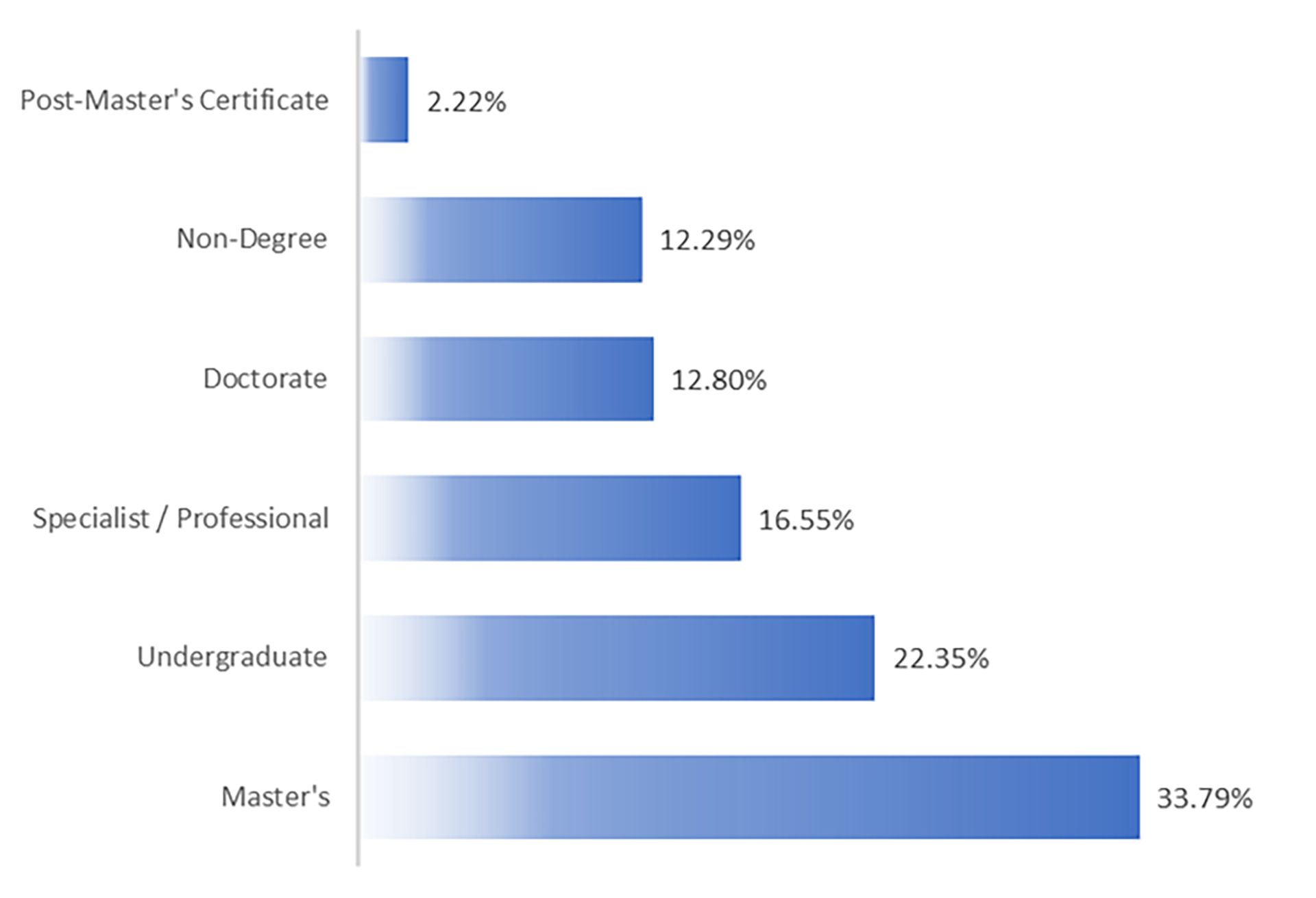
Programs offered by degree type (n = 586).
The schools that listed their degree programs were asked a series of questions about each of their degree programs from the admission requirements, program foci, and modalities to language(s) of instruction and accreditation status. The respondents could identify up to three languages of instruction for their programs. The results below are categorized by the types of degree program as shown in Figure 3.
Non-degree programs
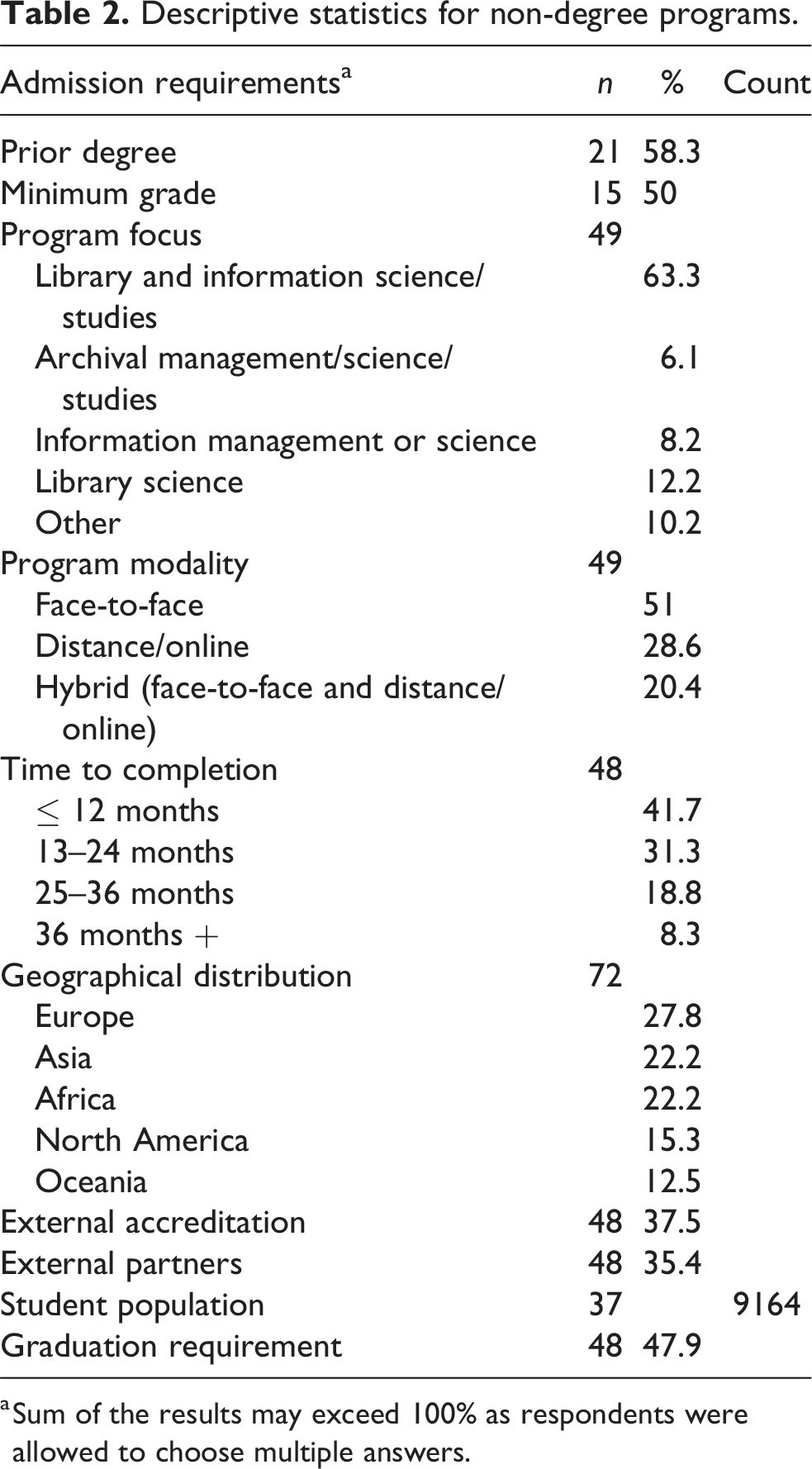
Seventy-two non-degree programs were reported by 49 LIS schools in 33 countries. A program that grants a certificate, diploma, or associate degree is considered as a non-degree program in the context of this study. Descriptive statistics for these non-degree programs are presented in Table 2. These programs often stipulated a prior degree (58.3%, n = 21) and a minimum grade point (50%, n = 15) of average from a prior degree as admission requirements. A large majority of these non-degree programs (63.3%, n = 31) had library and information science/studies as their primary focus. Face-to-face (51%, n = 25), distance/online (28.6%, n = 14), and hybrid (20.4%, n = 10) modalities were used to deliver instruction in these programs.
Descriptive statistics for non-degree programs.
a Sum of the results may exceed 100% as respondents were allowed to choose multiple answers.
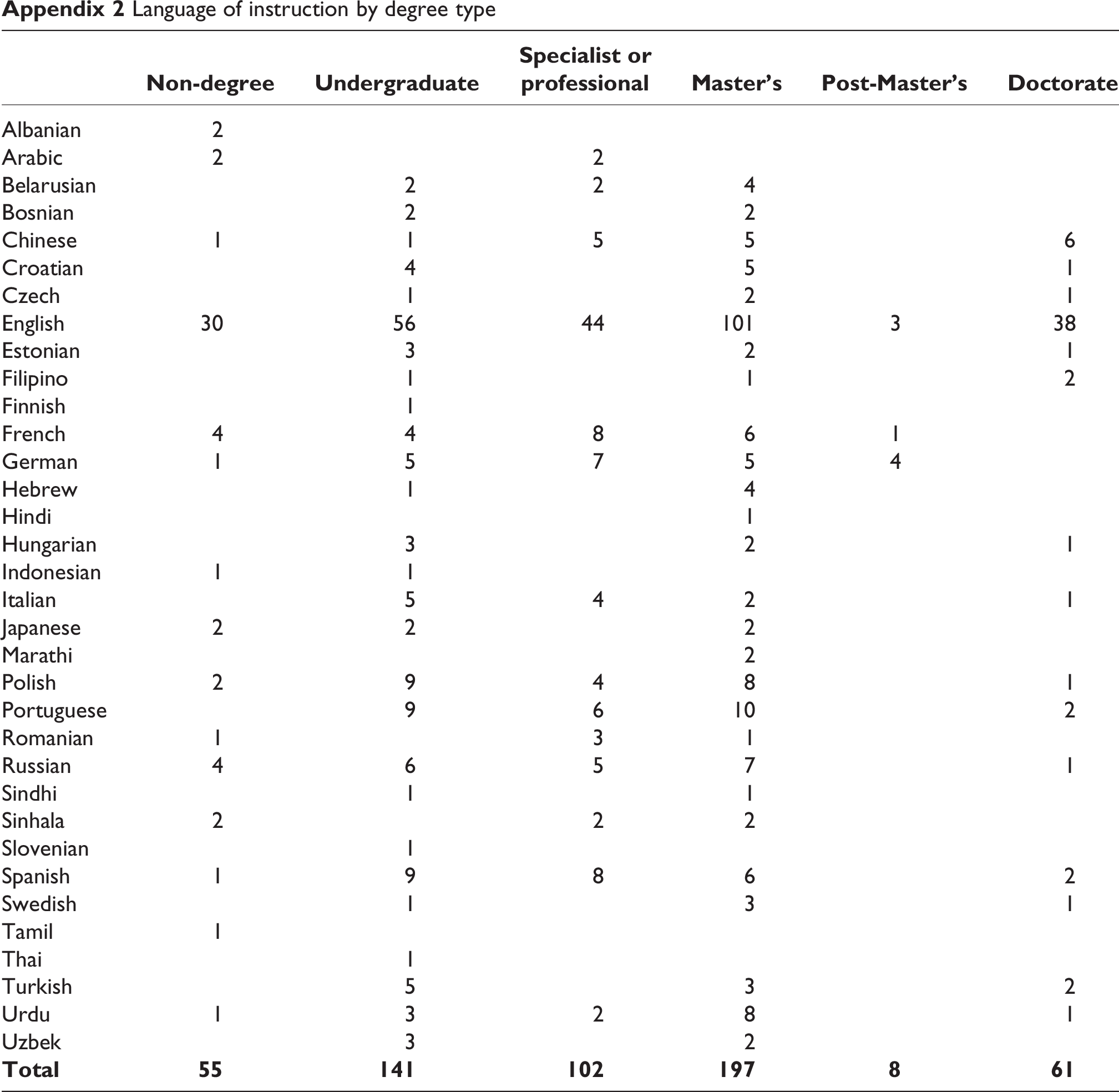
At the time of data collection, 9164 students, both part-time and full-time, were enrolled in these programs. English as a language of instruction (54.5%, n = 30) was quite common in these programs, followed by French (7.3%, n = 4) and Russian (7.3%, n = 4). The remaining languages are listed in Appendix 2. About one-third of the programs (n = 24) responded to a question about a curriculum update, and almost 70% (n = 17) of these programs indicated that their curriculum was updated in 2018 or later. About 48% (n = 23) of the programs had a graduation requirement (e.g. final paper or similar, thesis, dissertation, examination, portfolio, practicum), and a large majority of the students in these programs (73%, n = 35) completed the required coursework within two years.
Only 37.5% (n = 18) of these non-degree programs had external accreditation and 76.5% (n = 13) of these accredited programs were accredited only by a national organization. The rest were accredited by an international accrediting organization that operated outside of the program’s home country. About 35% (n = 17) of the non-degree programs had an external partner, including academic programs and professional organizations outside of their institutions. Although about half of these programs (53%, n = 9) had external partner(s) only at the national level, about one-third (29.4%, n = 5) had national and international partners, and 17.6% (n = 3) had only international partner(s).
Undergraduate degree programs
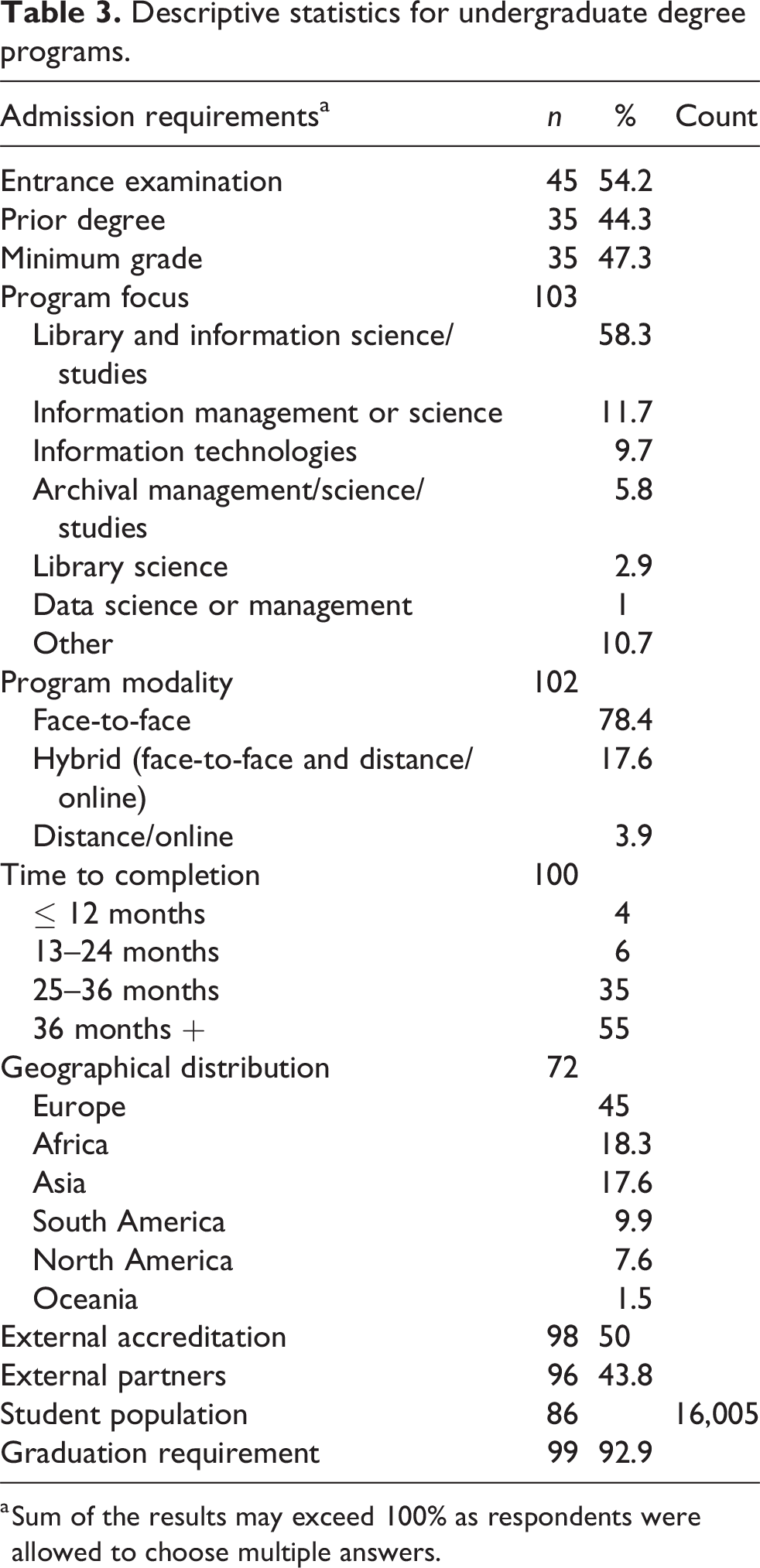
A total of 131 undergraduate degree programs were reported by 100 LIS schools in 49 countries. The admission requirements for these undergraduate degree programs included an entrance examination (54.2%, n = 45), a prior degree (44.3%, n = 35), and a minimum grade from a prior degree (47.3%, n = 35). Descriptive statistics for these undergraduate degree programs are presented in Table 3.
Descriptive statistics for undergraduate degree programs.
a Sum of the results may exceed 100% as respondents were allowed to choose multiple answers.
Most of these programs (58.3%, n = 60) had a library and information science/studies focus. Other focal areas included information management or science (11.7%, n = 12), information technologies (9.7%, n = 10), and archival management/science/studies (5.8%, n = 6). The face-to-face modality was the most used method of delivery (78.4%, n = 80), followed by hybrid instruction (17.6%, n = 18) and distance/online instruction (3.9%, n = 4).
At the time of data collection, a total of 16,005 students were enrolled in undergraduate degree programs. English was the most commonly used language of instruction (39.72%, n = 56), followed by Polish (6.38%, n = 9), Portuguese (6.38%, n = 9), and Spanish (6.38%, n = 9). The remaining languages are listed in Appendix 2. About 39% (n = 47) of the programs responded to a question about curriculum updates and a little over half of these programs (n = 26) indicated that their curriculum was updated in 2018 or later. Almost all the undergraduate programs had a graduation requirement (92.9%, n = 92) and 55% (n = 55) of the programs graduated their students within three years or more.
Half of these undergraduate programs (50%, n = 49) had an external accreditation and about 60% (n = 32) were accredited only by national organizations. The rest of the programs were accredited either only by international organizations or by national and international organizations.
Almost half of the undergraduate programs (43.8%, n = 42) had external partners outside their institutions. A little over half of the programs that had external partners (54.8%, n = 23) partnered with national and international partners, whereas 40.5% (n = 17) of the programs partnered only with national organizations.
Specialist/professional degree programs
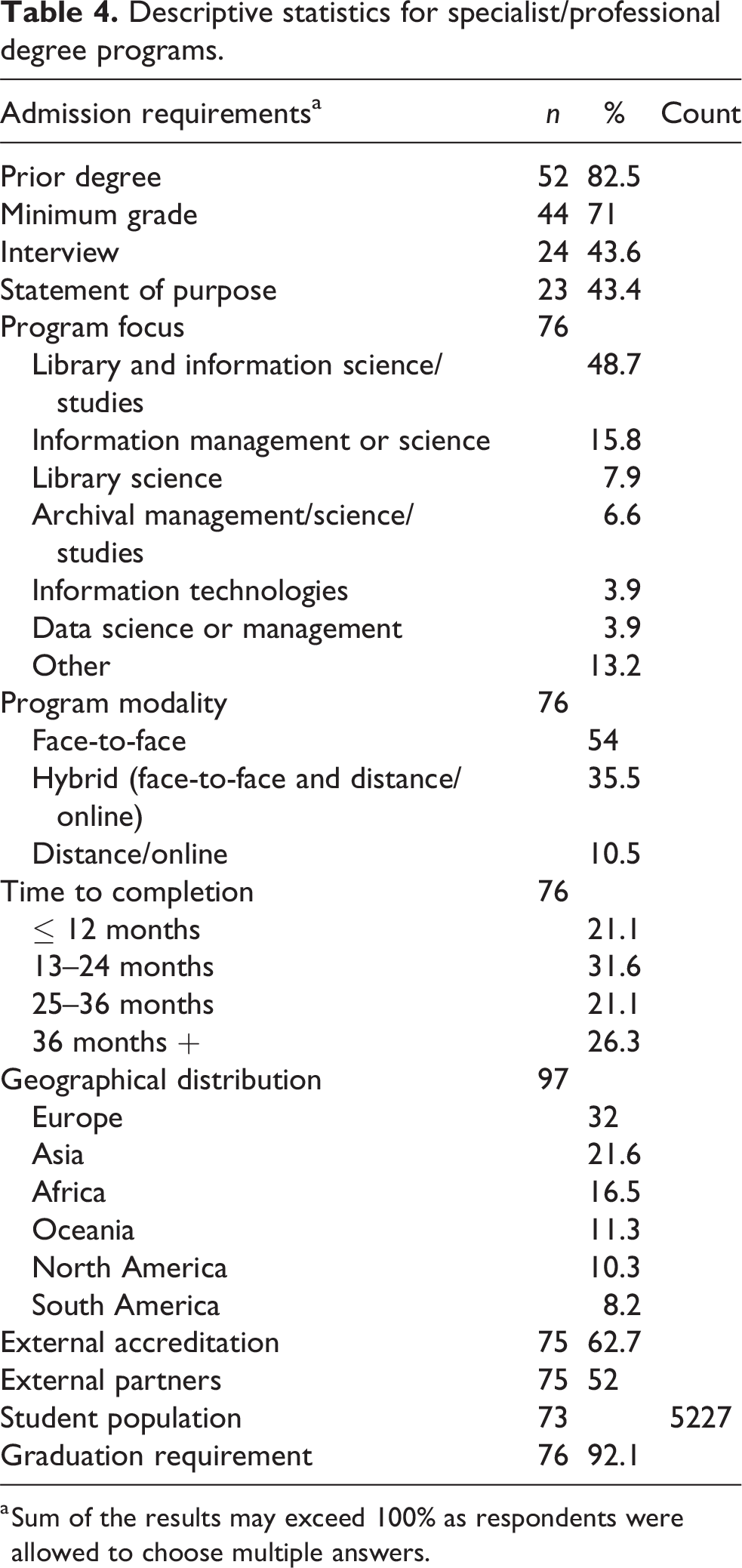
A total of 97 specialist or professional degree programs were reported by 57 LIS schools in 28 countries. Often, the admission requirements included a prior degree (82.5%, n = 52), a minimum grade from a prior degree (71%, n = 44), an interview (43.6%, n = 24), and a statement of purpose (43.4%, n = 23). Descriptive statistics for these programs are presented in Table 4. Almost half of the respondents (48.7%, n = 37) indicated that the primary focus of their programs was library and information science, followed by information management or science (15.8%, n = 12). More than half of the programs (54%, n = 41) used the face-to-face method to deliver instruction.
Descriptive statistics for specialist/professional degree programs.
a Sum of the results may exceed 100% as respondents were allowed to choose multiple answers.
At the time of data collection, a total of 5227 part-time and full-time students were enrolled in these programs. English (43.14%, n = 44) was the most commonly used language for instruction, followed by French (7.84%, n = 8) and Spanish (7.84%, n = 8). The remaining languages are listed in Appendix 2. A little less than half of the programs (n = 31) responded to a question about the last time their curriculum was updated. The majority of these programs (58.1%, n = 18) indicated that their curriculum was updated in 2018 or later.
A little over 60% (n = 45) of the programs had external accreditation and 83.7% (n = 36) of the accredited programs were accredited by a national organization. The rest were accredited by an international organization (7%, n = 3) or by national and international organizations (9.3%, n = 4). More than half of the programs (52%, n = 39) had external partner(s) outside of their organizations. Although about half of these programs (53.8%, n = 21) had partners only at the national level, 41% (n = 16) had national and international partners.
Master’s degree programs
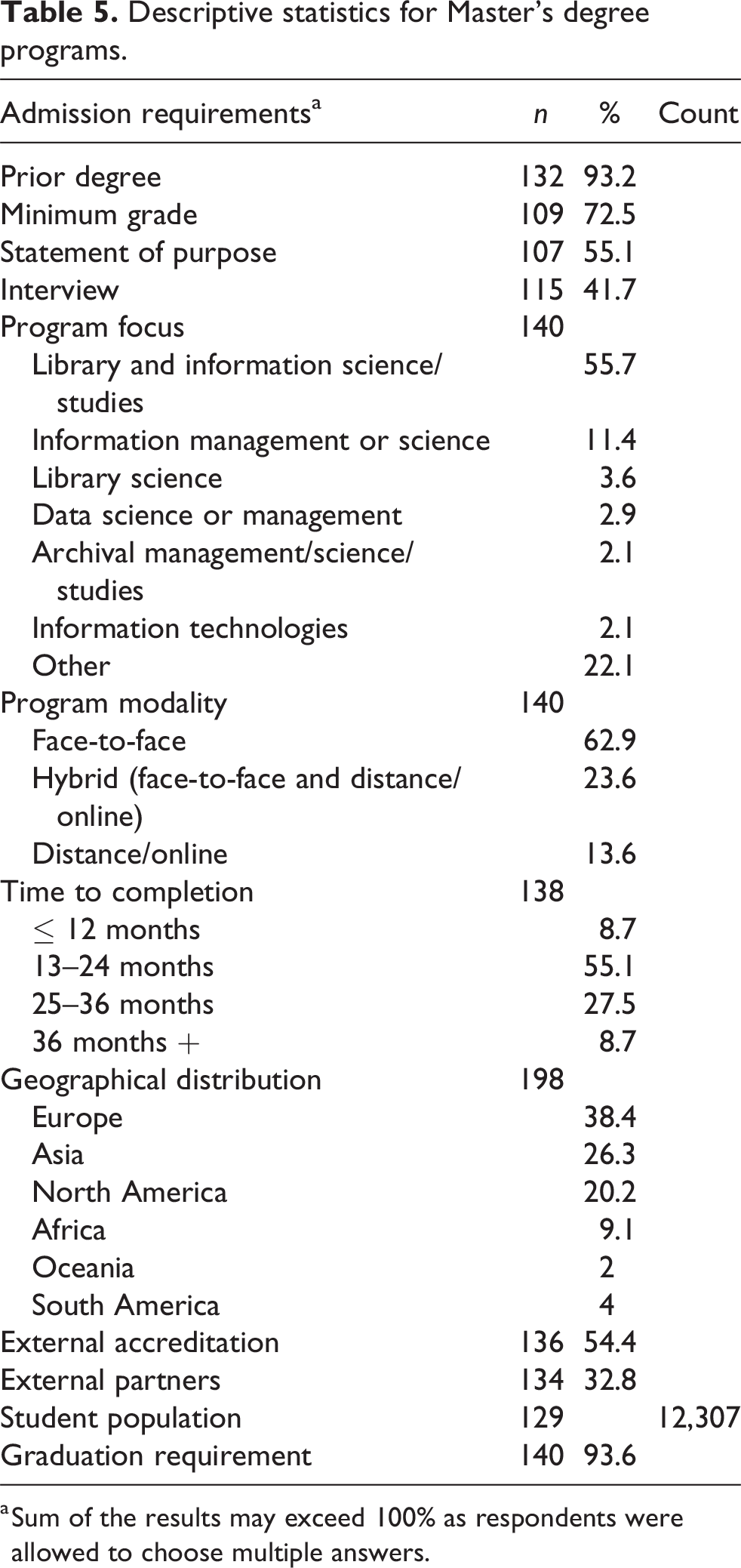
A total of 198 Master’s degree programs were reported by 127 LIS schools in 53 countries. A prior degree (93.2%, n = 123) and a minimum grade from a prior degree (72.5%, n = 79) were among the most frequently required criteria to be admitted to the programs. Descriptive statistics for the Master’s degree programs are presented in Table 5. A little over half of the programs (55.7%, n = 78) primarily focused on library and information science/studies and 11.4% (n = 16) of the programs had a primary focus on information management and science.
Descriptive statistics for Master’s degree programs.
a Sum of the results may exceed 100% as respondents were allowed to choose multiple answers.
Most of the Master’s degree programs used the face-to-face format (62.9%, n = 88) for course delivery. At the time of data collection, 12,307 students were enrolled in these programs. About half of the programs (51.27%, n = 101) used English as the language of instruction, followed by Portuguese (5.08%, n = 10), Polish (4.06%, n = 8), and Urdu (4.06%, n = 8). The remaining languages are listed in Appendix 2. Almost all of the programs (93.6%, n = 131) had a graduation requirement (e.g. final paper, thesis, dissertation, examination, portfolio, practicum) and the majority of the programs (63.8%, n = 79) graduated their students within two years. About one-third of the programs (n = 65) responded to a question about the last time their curriculum was updated. The majority (69.2%, n = 45) indicated that their curriculum was updated in 2018 or later.
About half of the programs (54.4%, n = 74) had external accreditation. A large majority (76.1%, n = 51) of these accredited programs were accredited by a national organization and only 9% (n = 6) of them were accredited by an international organization. The rest (14.9%, n = 10) were accredited by national and international organizations. About one-third of the programs (32.8%, n = 44) had external partner(s) outside of their organizations and 56.8% (n = 25) of these programs had partnered with national and international organizations. Whereas 31.8% (n = 14) of the programs had partnered only with national organizations, 11.4% (n = 5) had partnered with international organizations only.
Post-Master’s certificate programs
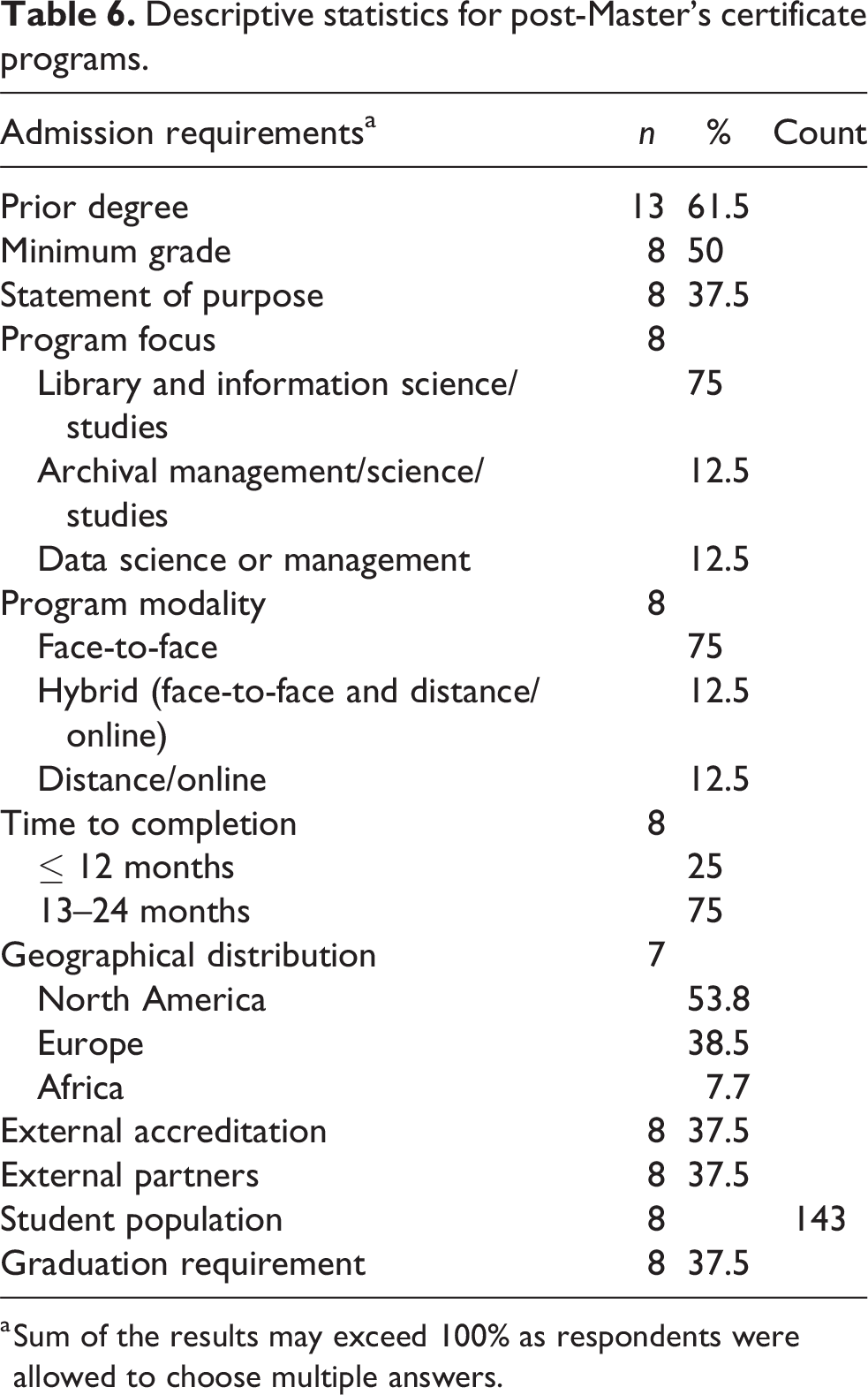
A total of 13 post-Master’s certificate programs were reported by 13 LIS schools in four countries. Descriptive statistics for the post-Master’s certificate programs are presented in Table 6. These programs generally required a prior degree and minimum grade from a prior degree as admission requirements. The primary focus of a large majority of these programs (75%, n = 6) was library and information science/studies. The face-to-face modality (75%, n = 6) was the most commonly used method to deliver instruction.
Descriptive statistics for post-Master’s certificate programs.
a Sum of the results may exceed 100% as respondents were allowed to choose multiple answers.
At the time of data collection, 143 students were enrolled in these programs. Four programs used German as the language of instruction, followed by English (n = 3) and French (n = 1). About one-third of the programs (37.5%, n = 3) had a graduation requirement (e.g., final paper, thesis, dissertation, examination, portfolio, practicum) and all of the programs (n = 8) graduated their students within two years. Only two programs responded to a question about the last time their curriculum was updated. One program updated their curriculum in 2016 and the other in 2019.
About one-third of the programs (37.5%, n = 3) had an external accreditation and all of these accredited programs were accredited by national organizations. About one-third of the programs (37.5%, n = 3) had external partner(s) outside of their organizations and all of these programs had partnered with national organizations.
Doctoral degree programs
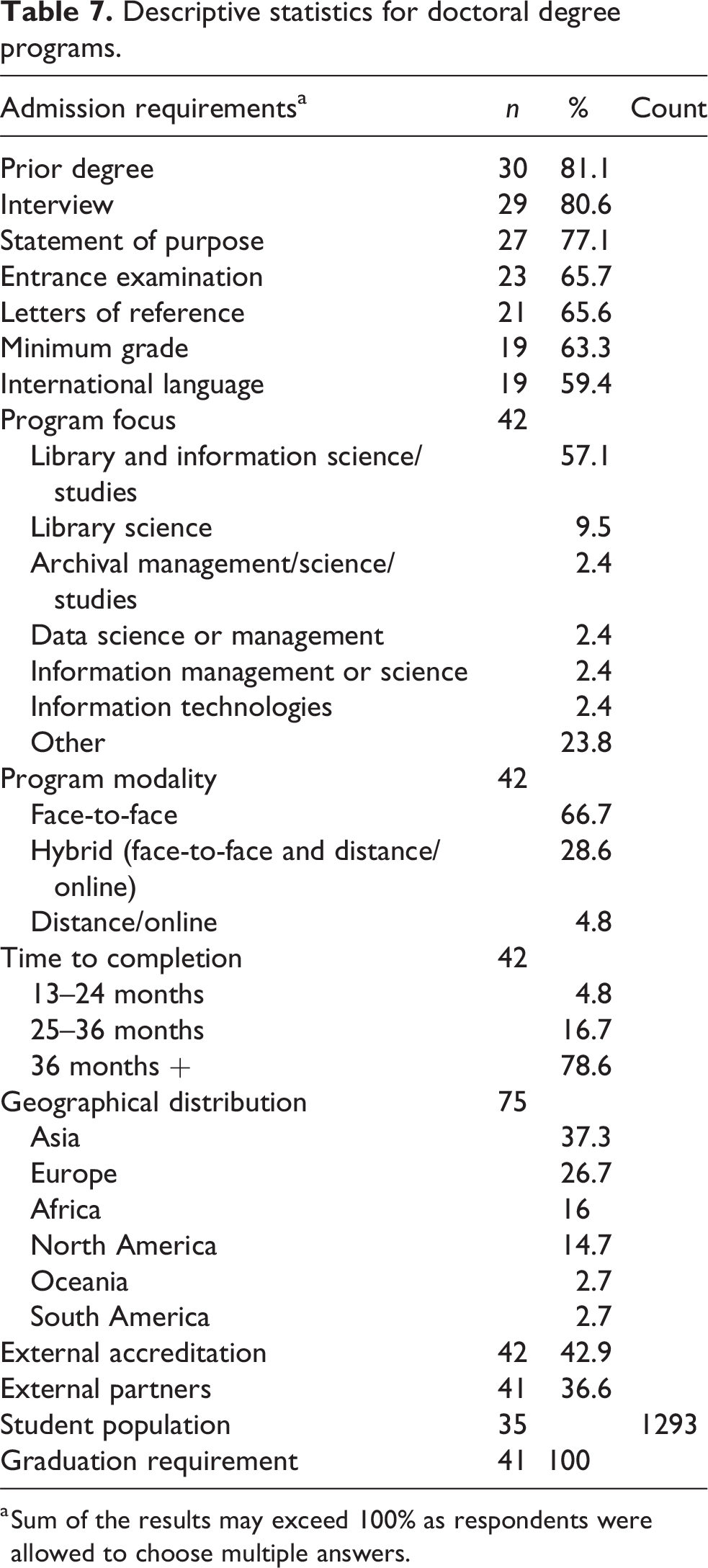
A total of 75 doctoral degree programs were reported by 59 LIS schools in 30 countries. Descriptive statistics for the doctoral degree programs are presented in Table 7. The admission requirements to the doctoral degree programs included a range of criteria, from a prior degree and interview to proficiency in an international language. The primary foci in these doctoral programs included library and information science/studies (57.1%, n = 24) and library science (9.5%, n = 4).
Descriptive statistics for doctoral degree programs.
a Sum of the results may exceed 100% as respondents were allowed to choose multiple answers.
At the time of data collection, 1293 students were enrolled in these programs. English (62.3%, n = 38) was the most commonly used language of instruction, followed by Chinese (9.8%, n = 6). The remaining languages are listed in Appendix 2. All of the respondents indicated that they had a graduation requirement (n = 41) and most of the programs (78.6%, n = 33) graduated their students in three years or more. A little less than one-third of the programs (n = 17) responded to a question about the last time their curriculum was updated. A large majority of the programs (76.5%, n = 13) updated their curriculum in 2018 or later, and others chose to update their curriculum on an ongoing basis.
A little less than half of the programs (42.9%, n = 18) had an external accreditation. Thirteen (76.5%) of the accredited programs were accredited only by national organizations and the rest (n = 4) were accredited by national and international organizations. About one-third of the programs (36.6%, n = 15) had external partner(s) outside of their organizations. A large majority of these programs (80%, n = 12) partnered with national and international organizations, whereas two programs had only international partners and one program had only national partners.
Discussion
LIS schools and their accreditations are crucial in preparing competent library and information professionals. The results of this study give an overview of professional qualification accreditations and certification from LIS schools by using a survey procedure. A total of 198 LIS schools from 69 countries were represented in the sample, complementing previous studies that focus on specific regions, such as Europe (e.g., Juznic and Badovinac, 2005), Asia (e.g., Park, 2004), or Africa (Saka et al., 2018). Although the results were more limited in some countries than in previous studies (e.g., 50 LIS schools in China versus the 24 programs obtained in this study; Bird et al., 2015; Schniederjürgen, 2007), this study represents the first effort worldwide to map the different initiatives.
Eighty-two percent of the LIS schools indicated that a type of credential (e.g., certificate, undergraduate degree) is required to work as a professional librarian. Although a definition of the LIS field was included in the survey, the diversity of the results obtained (e.g., the different names of the programs collected) suggests there is no common definition shared worldwide. Similarly, 70.2% of the schools indicated that an accredited national degree is the most required credential. This is in line with previous studies, which show that requirements are diverse (e.g., Australian Library and Information Association, 2018; Chartered Institute, n.d.; Chu and Raju, 2018) or there is a need to embrace requirements, as pointed out by Saka et al. (2018) in Nigeria. The most frequently offered degrees by the schools in the sample are Master’s (34%) and undergraduate (22.35%) degrees. This is in line with previous studies (Park, 2004; Ueda et al., 2005). Also, it is worth mentioning that specialist/professional degree programs (16.55%) stand out in some countries—for example, South Africa with 12 (19% of its output), China with 12 (4%), and Australia with 9 (5%)—and non-degree programs (12.29%) stand out in the USA (10 programs or 11.6%), Mauritius (5, 100%), and Australia (4, 26%). Based on the responses, certain types of programs are more common in some places (e.g. Albania and Mauritius with non-degree; Belgium, Chile, and Colombia with specialist; Honduras and Kuwait with Master’s). Similarly, at the continent level, some profiles emerged (e.g., post-Master’s certificate in the USA, undergraduate in Europe). The results also show that higher levels of education are scarce (e.g. doctorate or post-Master’s certificate). In terms of program features, a prior degree or minimum grade is needed in all the categories, even for non-degree programs (58% need a prior degree and 50% a minimum grade). Moreover, the results show that the program focus is predominantly on LIS studies, with other areas (archival management, information management or science) having limited focus. Considering that LIS is a diverse area, this indicates that the programs participating in the study adopted a compartmentalized approach.
External accreditation is needed in all types of programs (62.7% of specialist/professional degrees, 54.4% of Master’s, 37.5% of post-Master’s, 50% of undergraduate, 42.9% of doctorate, 37.5% of non-degrees). This emphasizes the role of accreditation institutions in the LIS field, which is in line with previous studies (Majid et al., 2002). Not surprisingly, undergraduate and Master’s degrees have the highest student populations (16,005 and 12,307, respectively), and there are much lower numbers at the highest levels (e.g. 1293 in doctorate and 143 in post-Master’s degree programs). This study also emphasizes the need for having open data on this topic, not only for students (e.g. choosing to study abroad) but also for boosting research and professional mobility.
Conclusion
The global LIS community is responsive to the many diverse communities that it serves. This is reflected by the vast range of differences found in LIS programs. Undergraduate, graduate, and professional programs all serve to meet the need for trained information professionals throughout our communities. However, there are a number of overarching themes that resonate among information seekers. By providing tools that help facilitate greater levels of standardization, LIS programs can better collaborate with other programs to meet the expectations of a global marketplace. In addition, this flow of information is designed to be multidirectional, where both developing and developed countries can collaborate and share their unique experiences and expertise to build stronger education systems for both.
Footnotes
Declaration of conflicting interests
The authors declared no potential conflicts of interest with respect to the research, authorship, and/or publication of this article.
Funding
The authors received no financial support for the research, authorship, and/or publication of this article.

Distribution of degree programs by country
|
|
|
|
|
|
|
|
|
|---|---|---|---|---|---|---|---|
| Albania | 2 | 0 | 0 | 0 | 0 | 0 |
|
| Argentina | 0 | 3 | 0 | 0 | 0 | 0 |
|
| Australia | 5 | 1 | 9 | 3 | 0 | 1 |
|
| Bangladesh | 1 | 0 | 0 | 2 | 0 | 1 |
|
| Belgium | 0 | 0 | 1 | 0 | 0 | 0 |
|
| Benin | 0 | 2 | 0 | 2 | 0 | 0 |
|
| Bosnia and Herzegovina | 0 | 3 | 0 | 4 | 0 | 0 |
|
| Botswana | 0 | 3 | 0 | 3 | 0 | 0 |
|
| Brazil | 0 | 9 | 4 | 7 | 0 | 2 |
|
| Canada | 0 | 1 | 0 | 8 | 0 | 5 |
|
| Chile | 0 | 0 | 1 | 0 | 0 | 0 |
|
| China | 1 | 1 | 12 | 5 | 0 | 5 |
|
| Colombia | 0 | 0 | 1 | 0 | 0 | 0 |
|
| Croatia | 0 | 3 | 0 | 3 | 0 | 2 |
|
| Czech Republic | 0 | 1 | 0 | 2 | 0 | 1 |
|
| Estonia | 0 | 3 | 0 | 3 | 0 | 2 |
|
| Finland | 1 | 1 | 0 | 1 | 0 | 1 |
|
| France | 4 | 1 | 2 | 7 | 1 | 0 |
|
| Germany | 1 | 4 | 4 | 4 | 0 | 1 |
|
| Ghana | 1 | 1 | 0 | 0 | 0 | 0 |
|
| Honduras | 0 | 0 | 0 | 1 | 0 | 0 |
|
| Hong Kong | 0 | 1 | 0 | 1 | 0 | 0 |
|
| Hungary | 0 | 3 | 0 | 2 | 0 | 1 |
|
| India | 0 | 0 | 0 | 8 | 0 | 7 |
|
| Indonesia | 2 | 2 | 0 | 0 | 0 | 0 |
|
| Iraq | 2 | 0 | 2 | 0 | 0 | 0 |
|
| Ireland | 1 | 0 | 0 | 2 | 0 | 0 |
|
| Israel | 0 | 1 | 0 | 4 | 0 | 0 |
|
| Italy | 1 | 6 | 5 | 3 | 0 | 2 |
|
| Japan | 3 | 2 | 0 | 2 | 0 | 0 |
|
| Kuwait | 0 | 0 | 0 | 1 | 0 | 0 |
|
| Lesotho | 1 | 1 | 0 | 0 | 0 | 0 |
|
| Malawi | 1 | 1 | 0 | 1 | 0 | 0 |
|
| Malaysia | 2 | 1 | 0 | 2 | 0 | 0 |
|
| Malta | 2 | 3 | 0 | 0 | 0 | 0 |
|
| Mauritius | 6 | 0 | 0 | 0 | 0 | 0 |
|
| New Zealand | 4 | 1 | 2 | 1 | 0 | 1 |
|
| Nigeria | 3 | 8 | 1 | 3 | 1 | 9 |
|
| Northern Ireland | 1 | 0 | 1 | 1 | 0 | 1 |
|
| Pakistan | 1 | 6 | 2 | 13 | 0 | 5 |
|
| Panama | 1 | 1 | 0 | 0 | 0 | 0 |
|
| Peru | 0 | 1 | 0 | 0 | 0 | 0 |
|
| Philippines | 1 | 1 | 0 | 3 | 0 | 5 |
|
| Poland | 2 | 10 | 4 | 8 | 0 | 1 |
|
| Portugal | 1 | 2 | 0 | 6 | 0 | 1 |
|
| Puerto Rico | 0 | 0 | 3 | 0 | 0 | 0 |
|
| Qatar | 0 | 0 | 0 | 1 | 0 | 0 |
|
| Republic of Belarus | 0 | 2 | 2 | 4 | 0 | 0 |
|
| Romania | 1 | 0 | 3 | 1 | 0 | 0 |
|
| Russian Federation | 4 | 1 | 3 | 1 | 0 | 1 |
|
| Senegal | 0 | 0 | 3 | 0 | 0 | 0 |
|
| Serbia | 0 | 1 | 0 | 1 | 0 | 1 |
|
| Singapore | 0 | 0 | 0 | 1 | 0 | 1 |
|
| Slovenia | 0 | 1 | 1 | 1 | 0 | 0 |
|
| South Africa | 2 | 6 | 12 | 8 | 0 | 3 |
|
| Spain | 0 | 2 | 0 | 2 | 0 | 2 |
|
| Sri Lanka | 2 | 0 | 2 | 3 | 0 | 0 |
|
| Sweden | 0 | 1 | 1 | 5 | 0 | 1 |
|
| Switzerland | 0 | 3 | 4 | 6 | 4 | 0 |
|
| Taiwan (Republic of China) | 0 | 2 | 0 | 2 | 0 | 2 |
|
| Thailand | 0 | 3 | 0 | 1 | 0 | 1 |
|
| Turkey | 0 | 8 | 0 | 5 | 0 | 3 |
|
| Uganda | 1 | 1 | 0 | 0 | 0 | 0 |
|
| United Kingdom | 0 | 0 | 3 | 5 | 0 | 0 |
|
| Uruguay | 0 | 0 | 2 | 1 | 0 | 0 |
|
| USA | 10 | 8 | 7 | 31 | 7 | 6 |
|
| Uzbekistan | 0 | 3 | 0 | 2 | 0 | 0 |
|
| Zimbabwe | 1 | 1 | 0 | 1 | 0 | 0 |
|
|
|
|
|
|
|
|
|
|
Language of instruction by degree type
|
|
|
|
|
|
|
|
|---|---|---|---|---|---|---|
| Albanian | 2 | |||||
| Arabic | 2 | 2 | ||||
| Belarusian | 2 | 2 | 4 | |||
| Bosnian | 2 | 2 | ||||
| Chinese | 1 | 1 | 5 | 5 | 6 | |
| Croatian | 4 | 5 | 1 | |||
| Czech | 1 | 2 | 1 | |||
| English | 30 | 56 | 44 | 101 | 3 | 38 |
| Estonian | 3 | 2 | 1 | |||
| Filipino | 1 | 1 | 2 | |||
| Finnish | 1 | |||||
| French | 4 | 4 | 8 | 6 | 1 | |
| German | 1 | 5 | 7 | 5 | 4 | |
| Hebrew | 1 | 4 | ||||
| Hindi | 1 | |||||
| Hungarian | 3 | 2 | 1 | |||
| Indonesian | 1 | 1 | ||||
| Italian | 5 | 4 | 2 | 1 | ||
| Japanese | 2 | 2 | 2 | |||
| Marathi | 2 | |||||
| Polish | 2 | 9 | 4 | 8 | 1 | |
| Portuguese | 9 | 6 | 10 | 2 | ||
| Romanian | 1 | 3 | 1 | |||
| Russian | 4 | 6 | 5 | 7 | 1 | |
| Sindhi | 1 | 1 | ||||
| Sinhala | 2 | 2 | 2 | |||
| Slovenian | 1 | |||||
| Spanish | 1 | 9 | 8 | 6 | 2 | |
| Swedish | 1 | 3 | 1 | |||
| Tamil | 1 | |||||
| Thai | 1 | |||||
| Turkish | 5 | 3 | 2 | |||
| Urdu | 1 | 3 | 2 | 8 | 1 | |
| Uzbek | 3 | 2 | ||||
|
|
|
|
|
|
|
|